

Released: 12 December 2018
Originally Released: 9 December 1988
Developer: Tecmo
Also Available For: Mobile, Nintendo 3DS (Virtual Console), Nintendo Entertainment System (NES), Nintendo Wii (Virtual Console), Nintendo Wii U (Virtual Console), PC Engine, Super Nintendo Entertainment System (SNES; remake), Xbox (Unlocked in Ninja Gaiden (Team Ninja, 2004))
The Background:
Whether they were silent assassins working for the US government, mutated turtles, or rainbow-coloured warriors fighting for and against our world, ninjas were a staple of the 1980s, especially in videogames. While often depicted as agile foes, ninjas also made up some of gaming’s most memorable characters and, in 1988, a very particular ninja effectively defined the difficulty of 8-bit games for a generation of players. Developed alongside a beat-‘em-up arcade title of the same name, Ninja Giaden was specifically created to capitalise on the ninja craze of the eighties and marked developer Masato Kato’s first full-time project as a video game designer. Inspired by some of Nintendo’s most popular titles, director Hideo Yoshizawa sought to create both an iconic protagonist and truly challenge players to give them their money’s worth. The game stood out by emphasising story as much as action through impressive, anime-style cutscenes and was re-titled for its North American release. Ninja Gaiden’s difficulty was a major talking point upon release and this reputation grew into legend over the years, with many reviews and online personalities ranking it as one of the most challenging retrogames of all time. Regardless (or, perhaps, because of this), Ninja Gaiden is also noted as one of the best of its era, despite some drawbacks in its design, and it even inspired some well-regarded sequels back in the day, to say nothing of challenging a new generation of gamers through 3D reboots decades later.
The Plot:
When ninja Ryu Hayabusa’s father is seemingly killed in a duel by an unknown assailant, he sets out on a quest for revenge that soon pits him against a demonic entity known as Jaquio.
Gameplay and Power-Ups:
Ninja Gaiden, one of the most notorious and quintessential titles for the classic NES, is a 2D, sidescrolling action adventure in which players assume the role of Ryu Hayabusa, a black clad, katana-wielding ninja who battles his way through six levels (referred to as “Acts”), each with as many as four different screens (or “Areas”), to avenge the supposed death of his father. There are no difficulty options here; instead, you must endure one of the games that defined the term “NES Hard” with only unlimited continues and your own perseverance. Well, that’s not quite true. Ryu Hayabusa is extremely fast, agile, and capable, quickly slashing and defeating most enemies with one hit with a press of B or X and nimbly hopping across gaps, to platforms, and to ladders with A. Each enemy you defeat awards points (though there’s no high score table and these don’t seem to grant you extra lives) or a special jar to restore some health. These are must-have items as you’ll be bombarded by respawning enemies (seriously, they often spawn the second you kill one!) and destructible projectiles. You must also be mindful of the timer, which pushes you to keep moving and risk plummeting your death across the game’s many chasms. Oh, and be wary of the extreme knockback Ryu suffers when hit, which often sends him careening to his death. If you lose all your lives and have to continue, you must start from the first Area of the last Act you played, though the game throws you a bone in Act IV by not forcing you to battle past the penultimate boss more than once.
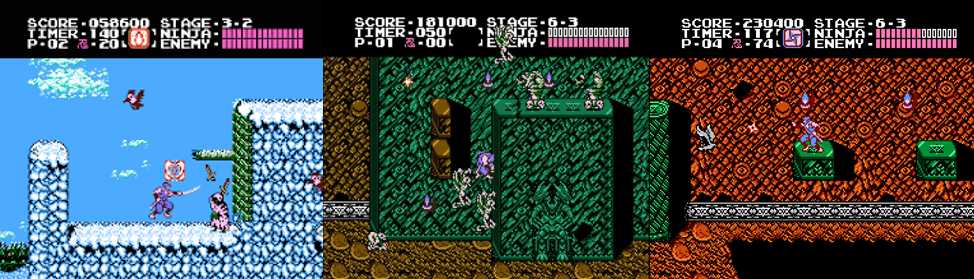
While Ryu is quick and agile, he can be cumbersome in mid-air and is prone to falling through platforms that are otherwise solid, so you must time your jumps properly, which is easier said than done with the sheer amount of chaos on screen! Ninja Gaiden’s big gimmick is Ryu’s wall-spring jump ability, which allows players to hop between walls and vertical sections by tapping A. This is super fun and utilised perfectly, with Ryu clinging to the wall until you press A and easily hopping to higher ground. However, Ryu’s strangely unable to climb over edges, forcing you to jump to a nearby platform and then jump back to progress, and also cannot drop down a pit even if he climbed up it. These sections never outlive their welcome, however, and, if anything, I would’ve liked to see more of them as opposed to the tricky jumps across bottomless pits! Ryu can also utilise special items, usually by pressing up and B, though these are tied to a “Spiritual Strength” ammo count and are usually best saved for bosses or more hectic sections. Ryu can toss shuriken for a ranged attack and utilise boomerang shuriken, blast a fire wheel in a spread attack, and turn his jump into a bladed somersault with the “jump and slash technique”, which instantly kills all bosses! Each of these costs a different amount of Spiritual Strength, so you must smash lanterns and defeat birds to increase your ammo. I’d also recommend holding down and B when you have the jump-slash since it must be saved for the final boss and costs the most Spiritual Power to use. Players may also find the odd extra life, protect themselves with a rare flaming shield, and even freeze all onscreen enemies with a sand timer, though it’s best to time this just right as you don’t want to take damage from the frozen enemies! Any power-ups are lost between Acts, forcing you to get yourself up to strength for each boss, though every projectile can be destroyed if you time your attack just right and many enemies can be tricked into falling to their deaths or despawning if you can manipulate the screen correctly.
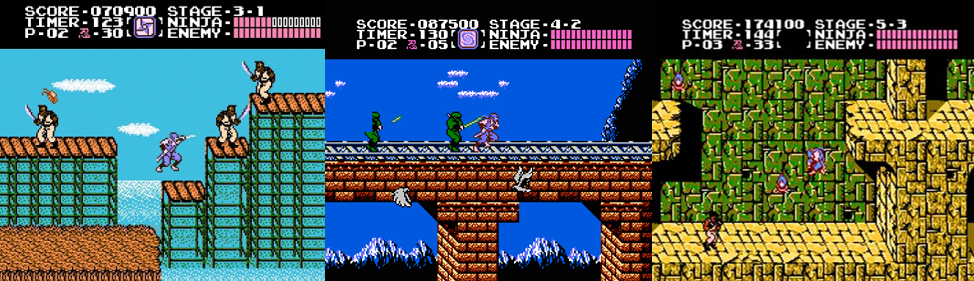
Ninja Gaiden fully deserves its reputation. I played on the Nintendo Switch, so I had the advantage of save states and rewinds, and even then I could see how challenging this game would be back in the day. Things start off quite tame, to be fair, and you’re introduced to Ryu’s wall-spring jump and the platforming challenges in a way that eases you into the gameplay loop. However, it’s not long before birds are swooping in, ninjas are leaping from offscreen, and enemies and projectiles are filling the screen, screwing up your jumps, knocking you down pits, or whittling down your health bar as you hop and climb about. There isn’t much to the game, technically speaking, with no environmental hazards to worry about save for some dragon-themed turrets and the many pits that fill the stages. there is no lava, for example, no toxic funk, and Act III doesn’t include slippery platforms or icicles. Platforms don’t even move or crumble beneath your feet; they’re just spaced further apart, get gradually smaller or have enemies perched on them, and the game tasks you to clamber up ladders or hop up vertical shafts to progress. Some Areas do have you moving from the right side of the screen to the left, to be fair; each Act has different destructible gimmicks to drop items and power-ups; and you occasionally climb long-ass ladders, avoiding birds as you go. There are no bonus stages to break up the action, however, though the game places a surprising emphasis on story, more so than most games of its era. Ninja Gaiden’s difficulty is in its platforming challenges and the sheer influx of enemies, who constantly fly at you and spawn in no matter how many times you defeat them. They linger right where you need to drop, guard small platforms over pits, and rain down in large numbers, mocking your attacks as you struggle to be quick enough to clear some breathing space. There’s always something else up ahead and you’re constantly being tested, with the game requiring split second decisions and punishing you severely if you hesitate or don’t take risks. The special items certainly help in these situations, but it’s a calculated risk as you don’t want to be left on empty when the boss appears!
Presentation:
I was honestly blown away by Ninja Gaiden. While the game’s a little too zoomed out at times, making the sprites a bit too small and reducing their detail, this greatly benefits the gameplay as you can always see the entire screen and get a better idea of what’s coming at you. Every sprite and projectile stands out against the different, colourful backgrounds and I never lost track of Ryu, even when the game noticeably struggled to keep up with the action. Sprite flickering and screen tearing is common in the later stages of Ninja Gaiden, where the enemy numbers increase, you’re more likely to be tossing projectiles, and the bosses get bigger and more ambitious. Still, I can forgive this as it’s a product of its era and adds to the charm and my progress was never impeded by these issues, just the damn knockback, Ryu’s stiff mid-air movement, and the cacophony of hazards onscreen! While enemies are somewhat basic and Ryu doesn’t have an idle animation, he exudes a lot of personality in his swift movements and fun wall jump and is fleshed out beyond most other 8-bit protagonists thanks to the many anime-style cutscenes that relate the game’s story. These were incredibly impressive, boasting large, partially animated sprite art and a lot of dialogue, even if there were some translation errors. Ryu’s battle sees him accosted by the Central Intelligence Agency (CIA), fall for the beautiful and mysterious Irene Law, learn of an ancient curse on some statues, and get mixed up with demonic forces! Cutscenes occasionally interrupt the gameplay, providing a dramatic view of the ominous Temple of Darkness and seeing Ryu challenged by Bloody Malth, to say nothing of detailing Ryu’s quest for revenge and some unexpected revelations regarding his father! This is all set up from the opening cutscene, which includes some parallax scrolling and sets the standard of the anime aesthetic for the game, though I admit that I wasn’t blown away by the game’s soundtrack, which was fitting for the action but not exactly memorable.
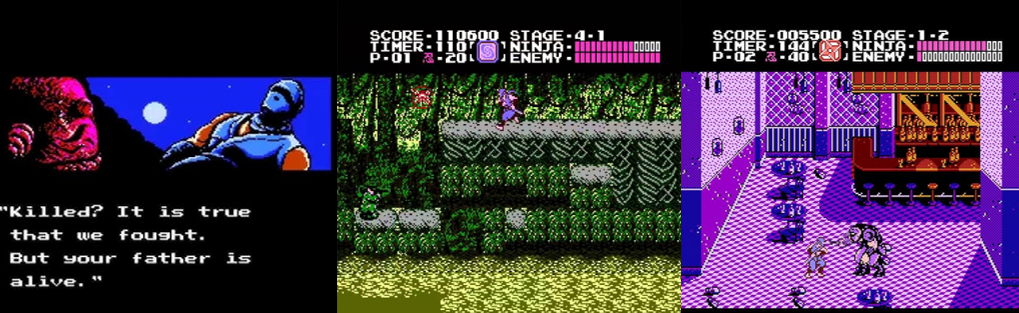
Players battle across some varied, if uninspired, environments throughout Ninja Gaiden, including the city streets (with alleyways, buildings in the foreground, basic skyscrapers in the background, and neon signs to jump to), battle the first boss in a seedy bar, and hop to girders against the rocky walls of a spawling factory. This leads to an outside location where you must hop to stone platforms and pillars against a mountain range, a flowing river with wooden platforms dotted across its surface, and the aforementioned snowy mountaintop where Ryu must climb vines as makeshift ladders. Act IV sees Ryu parachut into an Amazon rainforest, where the background is a mess of tangled greenery and the swamp-like water spells instant death if you slip from the log platforms. This ends with you scaling another mountain and magically infiltrating the Temple of Darkness, a suitably gothic castle full of tracks, mine carts, and featuring a long stone bridge, with dark brick work contrasting the orange foreground. When you venture into the Temple of Darkness, you’re faced with an excruciating grey backdrop, one dotted with demonic statues and imagery, that’s rivalled by Act V’s purple brick background and stone-grey platforms. Thankfully, this eventually gives way to a looming mountainside, and you’re tasked with hopping across some of the game’s trickiest jumps and heading up the mountain, which stretches high into the sky and ends with a castle rooftop set against a cloudy night sky. What really impressed me about this final Area was that it returns as the first Area of Act VI, with you now going to the left for Ryu’s toughest challenge yet! As you venture deeper into the gothic structure, you’re faced with columns, tall walls, and demonic imagery. With more surfaces to cling to, you may find your jumps or progress impeded as Ryu accidentally clings to walls you weren’t aiming for, which is just another headache to contend with as enemies fill the screen and tax the 8-bit hardware to its limit.
Enemies and Bosses:
There are a handful of enemies that stand between Ryu Hayabusa and his vengeance, with most of them being recycled again and again and only becoming more troublesome due to their sheer number and annoying placement. At first, you’re slaughtering street punks who rush you with baseball bats, toss knives, or fist-fight you while wearing boxing gloves. Dogs scramble across the floor at high speed, bats and various birds fill the airspace and screw up your jumps, and even tigers take a shot at you once you land in the rainforest! You’ll come across soldiers who charge at you, fire bursts from machine guns, and wield bazookas, sword-wielding baddies, martial artists who fly at you with a propeller kick, and even brutes swinging maces! Green-clad ninjas rain from the sky and slice at you with katana, Halloween-themed killers toss machetes and axes in sporadic arcs that seem to always hit you thanks to the game’s janky hit boxes, and dragon-themed cannons spit fireballs. Ninjas fly overhead on jetpacks, tossing a spread of shuriken that are all-but-impossible to avoid, gaunt corpses slink about, and Grim Reaper-like banshees chuck wooden swords (or possibly crosses). By far the worst of the regular enemies, in my opinion, are the scythe-tossing minions whose blades fly like boomerangs and are incredibly difficult to avoid or destroy, especially when other enemies leap from offscreen or they respawn half a second after being destroyed! As you play, you’ll inevitably spot the “Enemy” health bar in the heads-up display. This is reserved for encounters with the game’s bosses, the “Malice Four”, and shows you’re doing damage to your tougher foes even if your health is dropping dangerously low.
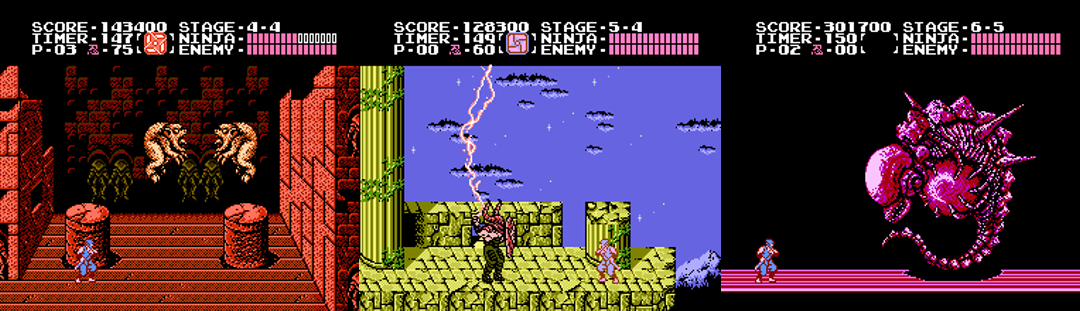
The first of the four is the hulking Barbarian, who slowly stalks you in a dive bar and swings a cutlass-like sword up close. You must use your speed and wall-spring jump to outmanoeuvre him, which is easier said than done due to his hit box. The masked Bomberhead awaits in Act II and carries a chain blade that he twirls around and flings your way. This can be tricky to avoid as its direction is seemingly random, but your projectiles serve you well here and you can toss everything since you lose it all anyway. Act III’s Basaquer is much more daunting since he’s far more mobile and harder to hit. He somersaults overhead and kicks up a slew of destructible stones upon impact, but the flame wheel makes short work of him. Act IV forces you to battle two foes at once, each with their own health bar, in an enclosed space, with sprites flickering and the hardware limping along. The large, dog-like Kelbeross hop around and ruin your health bar, but you can position yourself under the pillars to stay safe and whittle them away at your leisure. Bloody Malth certainly cuts an intimidating figure with his ceremonial armour and lightning, but his shield is purely for show so just toss your projectiles until he’s done and don’t fall off the roof! The difficulty really spikes at the end of Act VI, where you face three bosses back-to-back, starting with Ryu’s brainwashed father, attacking an orb rather than his sprite to undo his brainwashing. Then, the demonic wraith Guardia de Mieux/Jaquio attacks, floating above and spitting two fireballs that are virtually impossible to avoid! Honestly, without the insta-kill jump-slash, I have no idea how you’re supposed to beat this guy so be sure to have that item when you reach him or you’ll have to play through Act VI again! Finally, a Xenomorph-like demon represents your final challenge. This is a far easier battle, however, as all you must do is avoid or destroy the fireballs he rains down and attack his dome-like head and spiked tail to reveal his glowing heart, which must be destroyed to gain victory.
Additional Features:
There’s nothing else on offer in Ninja Gaiden, unfortunately. Not even a high score table or additional difficulty modes, which is very rare for a game of this era. There are no cheat codes for the NES version, either, so the only additional features of note are the save state and rewind features offered by the Nintendo Switch. These are a godsend for this game and dramatically reduce the difficulty, replacing it with frustration as you constantly rewind back to undo mistakes, though it’ll be no help at all if you reach Jaquio with anything but the jump-slash!

The Summary:
I’d heard all about Ninja Gaiden and was well aware of its reputation as one of the hardest games of the 8-bit era of gaming. It was a daunting prospect, one I doubt I would’ve tackled without the Nintendo Switch’s modern-day features, but I’m glad that I did. The game is very visually impressive, making the most of the NES hardware and being particularly ambitious with its anime-style cutscenes and story-based narrative. While his sprite is very basic, Ryu Hayabusa exudes a lot of personality and has a remarkable range of movement. There are a lot of special attacks on offer to help keep the game interesting and fun, though it’s incredibly satisfying to slash enemies into an explosion of fireworks with your katana. The wall-spring mechanic was inspired, adding an extra layer of verticality and fun to the otherwise simplistic platforming, with my only note being that I would’ve liked to see more of it! The enemies wore out their welcome very quickly, unfortunately, both visually and with the slew of enemies and projectiles reaching obnoxious levels simply to frustrate players and encourage further rentals. I much preferred the big, more fearsome bosses, though even they are handicapped by a lack of attacks and animation frames. While environments aren’t anything too innovative, I liked how the game emphasised high walls and pillars at times, even if many were purely there to mess up your jumps. The challenge offered by the platforming is truly taxing and I’m sure it tested many NES kids back in the day. The rewind and save states help with this, but you still need a lot of skill, luck, and trial and error to deal with everything happening on the screen. I had a lot of fun with Ninja Gaiden, even in its more frustrating moments, and I was impressed by a lot of it, even when the hardware struggles at times. However, I would’ve liked to see a bit more from the game, be it a bonus round, difficulty options, or more emphasis on the jumping and climbing.
My Rating:
Pretty Good
Was Ninja Gaiden a beloved addition to your NES library? How did you fare with the game’s challenge and did you ever beat it on original hardware? What did you think to Ryu’s wall-spring jump and special attacks? Did you struggle in the penultimate battle against Jaquio? Which game in the franchise is your favourite and would you like to see the original series re-released on modern consoles? Let me know your memories and thoughts on Ninja Gaiden in the comments, support me on Ko-Fi, and check out my other retrogame reviews on the site.

 Dr. K's Waiting Room
You must be logged in to post a comment.