Movie Night [Sci-Fanuary]: Ant-Man


January sees the celebration of two notable dates in science-fiction history, with January 2 christened “National Science Fiction Day” to coincide with the birth date of the world renowned sci-fi writer Isaac Asimov, and HAL 9000, the sophisticated artificial intelligence of Arthur C. Clarke’s seminal 2001: A Space Odyssey (1968), being created on 12 January. Accordingly, I’m spending every Sunday of January celebrating sci-fi in all its forms.

Released: 17 July 2015
Director: Peyton Reed
Distributor:
Walt Disney Studios Motion Pictures
Budget: $130 to 169.3 million
Stars:
Paul Rudd, Evangeline Lilly, Corey Stoll, Abby Ryder Fortson, and Michael Douglas

The Plot:
Petty thief Scott Lang (Rudd) struggles to adapt after being released from prison. Determined to prove himself to his young daughter, Cassie (Fortson), he turns to stealing once more and unwittingly nabs Doctor Hank Pym’s (Douglas) Ant-Man suit. Gifted with an opportunity to turn his life around, Scott trains with Pym and his stern daughter, Hope van Dyne (Lilly), to master the suit’s ability to shrink and control ants in order to keep the conniving Doctor Darren Cross (Stoll) from perverting Pym’s life’s work into a weapon.

The Background:
When comic book readers were first introduced to Hank Pym/Ant-Man, he wasn’t quite the garishly-costumed Avenger would later help form the Avengers; instead, he was merely a scientist featured in the pages of Tales to Astonish #27. The creation of the legendary duo Stan Lee and Jack Kirby, the character was re-envisioned as a superhero eight issues later and would go on to be a consistent, if unstable, character in the pages of Marvel Comics. Crucially, however, Pym wasn’t the only character to take up the mantle of Ant-Man; one of Pym’s most notable successors was Scott Lang, a reformed criminal created by David Michelinie, Bob Layton, and John Byrne, who took over the role in 1979. Both Hank Pym and Scott Lang had featured in Marvel cartoons and videogames since their debut, but development of a live-action film can be traced back to the 1980s, when development was scuppered by a similar concept, Honey, I Shrunk the Kids (Johnston, 1989). The project finally started gaining traction in the early-2000s when Edgar Wright and Joe Cornish wrote a film treatment focusing on the Scott Lang version of the character for Artisan Entertainment, who held the film rights at the time. Over the next ten years, the film was continually showcased and teased; the character was bumped from the first phase of the Marvel Cinematic Universe (MCU) and eventually slotted in to debut in Phase Three. Sadly, Wright eventually left the project in 2014, right after both casting and the script had been finalised, due to “creative differences” between himself and Marvel Studios. Peyton Reed soon succeeded Wright as the director and worked closely with star Paul Rudd (who underwent a physical transformation for the role) and writer Adam McKay to rework and expand upon Wright’s script. Double Negative and Industrial Light & Magic handled the film’s shrinking effects, with star Corey Stoll sporting a motion capture suit to bring the villainous Yellowjacket to life. Finally, after being in development for over ten years, Ant-Man released to a massive $519.3 million worldwide gross; the reviews were equally impressive, with critics praising the film’s family dynamic, performances, and the unique blend of humour and action that set it apart from other MCU films. The film performed so well that a sequel was produced in 2018, and a third instalment is due for release later this year, and only served to further bolster Rudd’s undeniable charm and charisma.

The Review:
Ant-Man is one of those Marvel superheroes that I’ve never really had strong feelings about one way or another. Like many, I mostly know the character as being an emotionally and psychologically unstable individual who occasionally abuses his wife and has inferiority complexes, though I primarily associate the character with one of the Avengers’ greatest villains, Ultron. Consequently, while Ant-Man and the Wasp were instrumental in the formation of the Avengers in the comics, I can’t say that I was too disappointed to see the character miss out on the big screen debut of Marvel’s premier superhero team. However, by the time Ant-Man was produced, the MCU was really ramping up its scope; the Avengers had formed, we’d seen Gods and bleeding-edge technology and even space adventures and, while Ant-Man probably would have fit in nicely during the MCU’s first phase (although it probably would have been deemed too derivative), it was actually a surprising breath of fresh air to come back down to “ground level”, so to speak, before really getting balls deep into the Infinity Saga.
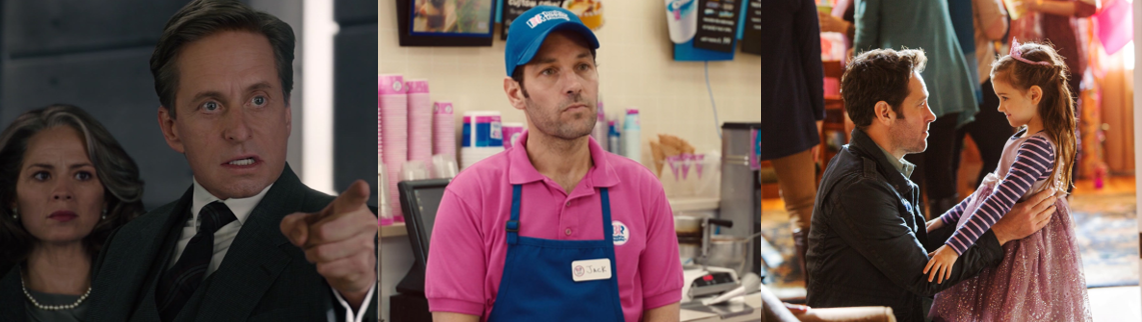
Years after Hank quit S.H.I.E.L.D., ex-con Scott tries his best to set a good example and rebuild his life.

Ant-Man opens up in 1989 and by showcasing just how far de-aging technology has come as Hank Pym (digitally restored to match the time period) angrily confronts Howard Stark (John Slattery), Peggy Carter (Hayley Atwell made up to look noticeably older), and Mitchell Carson (Martin Donovan) after discovering the Strategic Homeland Intervention, Enforcement and Logistics Division’s (S.H.I.E.L.D.) attempts to replicate his Hank Particle technology. While Peggy is shocked at the revelation, Howard tries to impress upon Hank that his research could be put to far better, greater use than simply fuelling his efforts as Ant-Man. Already annoyed at being reduced to a glorified errand boy, Hank is pushed to the edge when Carson mocks his anger and brings up his late-wife, Janet, leading to Hank lashing out, breaking Carson’s nose, and quitting S.H.I.E.L.D. Although Howard pleads with Hank to reconsider, Hank storms out, making an enemy of Carson in the process and establishing a few key plot points for the movie: Hank doesn’t trust S.H.I.E.L.D., seems a little unstable, and is highly protective of his research. The film then jumps ahead to then-present day to introduce us to Scott Lang right as he’s being released from prison; a former VistaCorp systems engineer, Scott is a veritable genius, holding a Master’s degree in Electrical Engineering but is reduced to working a menial job at Baskins-Robbins in his desperate attempt to stay on the straight and narrow and set a good example for his young daughter, Cassie (Fortson). It’s crucial to note that that Scott wasn’t arrested for anything violent or threatening (indeed, he states that he hates violence); instead, he hacked into VistaCorp’s security system and redistributed misbegotten funds to their victims before exposing their misdeeds online, painting him as a sympathetic, almost Robin Hood-like figure right from the outset as he strives to do good deeds and has a clear moral compass but isn’t exactly the best at making responsible decisions. Although Scott has a strained relationship with his ex-wife, Maggie (Judy Greer), and her new fiancé, cop Jim Paxton (Bobby Cannavale), he is extremely close to Hope, who is always excited to see him. He’s desperate to make up for lost time but faces nothing but an uphill battle to show that he’s changed and can be a responsible adult.
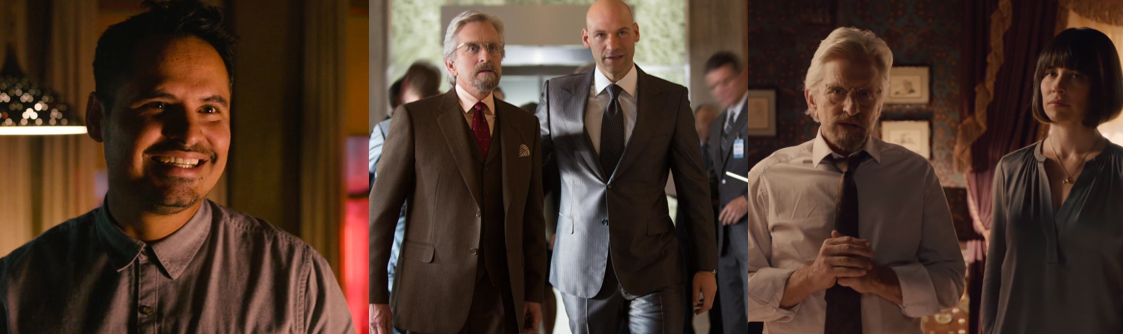
Luis’s enthusiasm is offset by Hanks’ cantankerous nature and Darren’s lust for power.

After his release, Scott is taken in by his former cellmate and best friend, Luis (Michael Peña), an enthusiastic, supportive, and incredibly friendly and optimistic former con who initially tries to coax Scott back into his former life. Luis is one of many highlights in Ant-Man; in many ways a predecessor to the colourful characters and banter we’d see in Thor: Ragnarok (Waititi, 2017), Luis just exudes likeability and friendliness. Peña’s delivery and fast-talking cadence also provide one of the film’s most hilarious moments where Luis rapidly breaks down the particulars of a big-time score, which is fantastically realised with Peña’s voice playing over a number of other ancillary characters as he enthusiastically tells Scott how he came by this information. Luis sets Scott up at an apartment and introduces him to Dave (Tip “T.I.” Harris) and Kurt (David Dastmalchian), both of whom are only too eager to assist with Scott’s heist into a rich old man’s house and make that big score. Scott doesn’t return to his cat burglar ways lightly, but believes he has no choice if he ever hopes to set himself up with an apartment, pay his child maintenance fees, and see his daughter again. In the interim years after the opening, Hank Pym has done pretty well for himself; he set up his own company, Hank Technologies, and is clearly quite wealthy from the research and technology developed there. However, he has slowly become more and more of a recluse and been pushed further away from his company; his protégé, Darren Cross, is in the final stages of assuming full control of Hank Technologies, renaming it Cross Technologies, and fully replicating the Hank Particle technology. Fascinated by Hank’s past as the shrunken secret agent superhero Ant-Man, Darren has developed a suit, the “Yellowjacket”, to reproduce the technology and sell it as a peacekeeping weapon for geo-political and military applications. Hank is frustrated by all of this, especially Darren’s insistence on reproducing the Ant-Man technology, but handicapped by his ability to do anything about it; prolonged exposure to the Hank Particles has left Hank physically unable to suit up again because of the risk of further (and permanent) damage to his mind and body but he is equally adamant that his estranged daughter, Hope, not take up the mantle because of the risk not only to her but also his lingering guilt and fear after losing his wife to that same technology.   
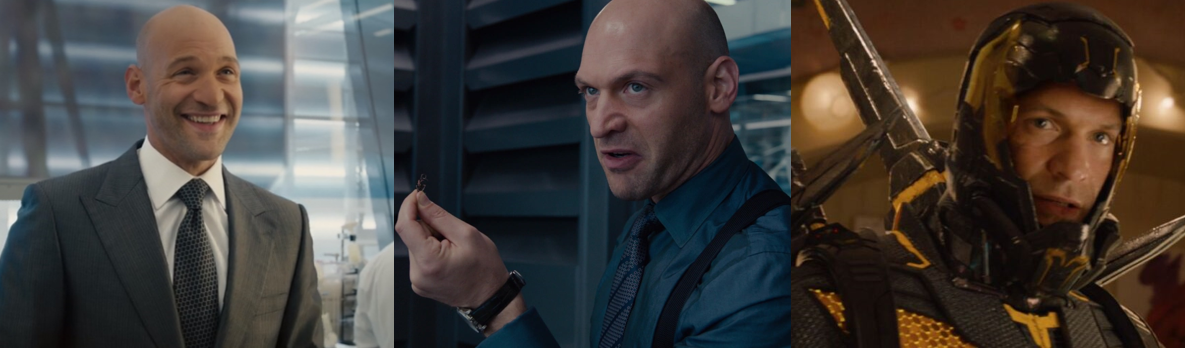
Darren is not just on the cusp of having everything he lusts for, but also completely going off the rails.

Although Darren is frustrated at his inability to shrink organic material, both Hank and Hope know that it’s only a matter of time before he cracks the secret and begins manufacturing weaponised Ant-Man technology. Although Hank is reluctant to risk losing Hope, he’s more than happy to recruit Scott to his cause, having identified him as the perfect expendable candidate for their operation thanks to his intellect and skills as a cat burglar. I always found Hank’s reasoning here very interesting, and somewhat hypocritical; he won’t risk losing Hope so he brings in Scott, positioning him to a point where the former thief has little choice but to agree to become Ant-Man, but Scott has quite a lot to lose as well so it just goes to show that Hank, for all his morals and ethics, doesn’t necessarily have the most clean-cut of motivations. Anyway, Scott is initially disheartened to learn that all his efforts have resulted in only an old motorcycle suit and a funky helmet but, upon slipping into the outfit out of sheer curiosity, he is both excited and horrified to discover that it enables him to shrink down to near-microscopic proportions at the push of a button! Scott is naturally freaked out and attempts to return the suit, only to be arrested in the process and perfectly placed for Hank to exposit a truncated version of his life story and his troubles with Darren Cross. For a stereotypical, suit-wearing antagonist, Darren actually has a few things going for him that help him to break free of the corporate bad-guy trope I loathe so much. Of course he’s a smooth-talking, slick weasel and a sharp businessman, but he’s also a manipulative and sadistic asshole; he took full advantage of Hank’s trust and faith to gain a majority interest in Hank Technologies, leeched every bit of information and brilliance from his mentor he possibly could to advance his own career and self-interests, and has no qualms about killing those who get in his way using perverted Hank Particles to reduce them to a gooey residue. He’s a highly intelligent, and highly unstable, antagonist who oozes charm but also menace; you’re never really sure what he’s thinking and you can almost see the urge to lash out and go full crazy bubbling beneath the surface. In many ways, he’s a dark opposite for both Scott and Hank since he’s kind of like what Scott could have become if he’d gone down that path while also being on the verge of a full-on meltdown like Hank seems to be half the time. Both Darren and Scott also have eyes on Hope, but Darren’s lack of mortality and lust for power are what separate him from his rival.
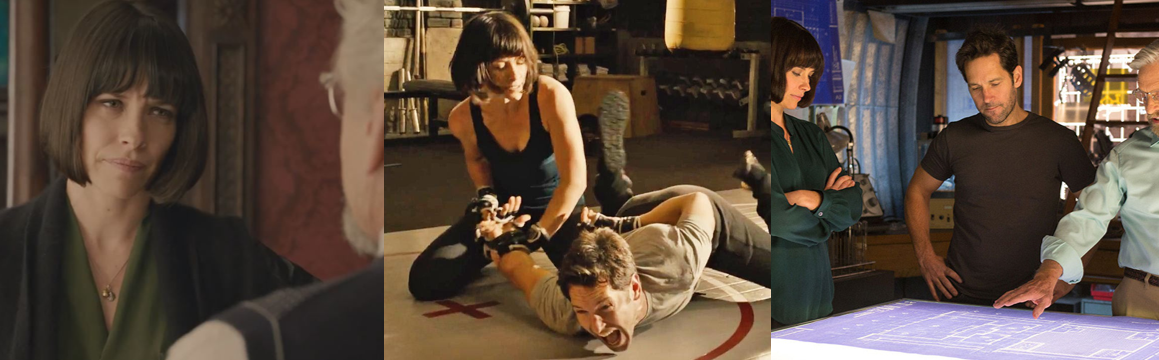
Hope resents her father keeping things from her and stopping her from suiting up.

Hope and Hank have a strained relationship, to say the least; she resents her father for keeping the truth about what happened to her mother from her, and for picking Scott over her, however they come together when they realise how dangerously close Darren is to perfecting and weaponising the Ant-Man technology. Still, Hope is very abrasive to both Scott and her father, referring to him as “Hank” or “Dr. Pym” for much of the film and constantly annoyed at Scott’s ignorance. Familiar with both Darren’s research and personality, as well as the particulars of Hank’s technology, to say nothing of the company’s security measures and systems, Hope is also Scott’s physical superior in every way; she sees Scott as a bungling, naïve fool who’s in over his head and is greatly frustrated at her father’s apparent lack of trust in her. To be fair, Hank distrusts almost everyone; he resents both S.H.I.E.L.D. and the flamboyant nature of the Avengers, and sees this job as being more about subterfuge then barging in all guns blazing. Hank is also tortured at the loss of his wife, who joined him for his pint-sized adventures as the Wasp and was lost to him after she was forced to reduce herself down beyond the limits of the suit and got lost in the “Quantum Realm” as a result. Scott’s influence on the two is palpable; by sharing with Hope that Hank clearly loves her and doesn’t want to risk losing her, he not only learns the trick to communicating with Hank’s ants but also helps mend the rift between father and daughter, finally revealing the truth about her mother’s death and her father’s inability to cope with the grief of his greatest failure. Consequently, all three are forced to set aside their differences, and self-doubts, in order to redeem each other and keep Darren from potentially threatening the world for the next generation.

The Nitty-Gritty:
One thing that sets Ant-Man apart from other films in the MCU, particularly at the time it was made, was its strong emphasis towards humour; humour has always been a big part of the MCU, but Ant-Man is basically part-comedy and shines all the brighter for it. Paul Rudd impresses in the title role with his incredible screen charisma, likeability, and comedic timing and the film features not just the traditional snark and biting wit of the MCU but also some truly amusing gags relating to Baskin-Robbins (they always find out) and Titanic (Cameron, 1997), but also excellent use of sight gags and editing (the film consistently cuts away from the drama of Scott’s shrunken adventures to see him barely having an impact on the real world). Ant-Man also separates itself from other MCU movies by being as much a heist movie as it is a superhero affair; Scott and his crew undergo a great deal of preparation and planning before breaking into Hank’s house, which involves acquiring uniforms, cutting power lines, and communicating from a nondescript van. Once Scott is inside the house, we get to see just how capable and adaptable he is; he’s slick and agile, easily able to slip inside with barely a whisper, and cobbles together unique solutions to break into Hank’s antique vault using only household items. Whilst being trained in combat by Hope and the particulars to the suit by Hank, Scott lends his skills to planning the assault on Pym Technologies, which involves studying the layouts and the security systems and the defences surrounding the Yellowjacket suit. This requires a highly co-ordinated attack on all fronts, using every resource at their disposal, including not just Scott’s crew (much to Hank’s chagrin) and also an infiltrating into the Avengers compound. This leads to a brief scuffle between Ant-Man and Sam Wilson/The Falcon (Anthony Mackie) that is the first true test of Scott’s newfound abilities, and additional opportunities for Luis and Scott’s amusing cohorts to shine with their hilarious shenanigans.
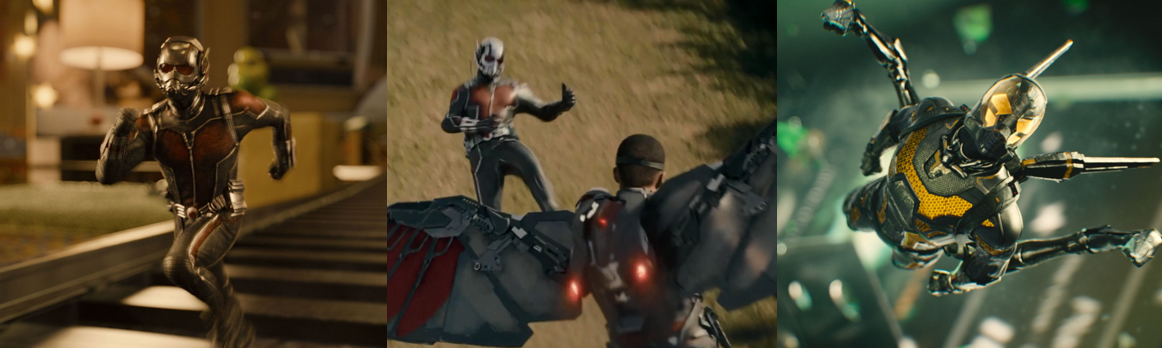
The suits look fantastic thanks to both excellent practical and digital effects.

Ant-Man absolutely excels in its visuals and presentation. The Ant-Man suit itself is a thing a beauty; fittingly drawing its influences from Scott Lang’s comic book adventures and more modern interpretations of the character, it’s not a mechanised suit of armour or made up of fancy nanotech and wis, instead, a very tangible and almost rudimentary costume that resembles a motorcycle outfit. It looks advanced, but not so advanced that it’s impossible to believe a genius like Hank Pym could have made it at home and with limited resources, and I love how it seems so functional and practical. The helmet is especially impressive, especially in this first outing for the character; rather then peeling back like nanotech, it flips up and is a largely practical prop, all of which works wonders for bringing this frankly ridiculous character to life. Darren’s Yellowjacket outfit is functionally similar, but noticeably different; for starters, it was brought to life using digital effects but I sure as hell couldn’t really tell that when watching the film. Yellowjacket has always been a bit of an absurd character, costume, and concept for me but the film presents the character as very menacing and technologically superior to Ant-Man in everyway. While it’s admittedly very “safe” for the film to wheel out the dark doppelgänger trope again, Yellowjacket can not only shrink and grow himself and other objects but he can also fly and sports stinger-like blasters on his back; this, coupled with the characters’ distinctive red and yellow colour schemes, really makes it much easier to distinguish the two in their climatic fight scene.
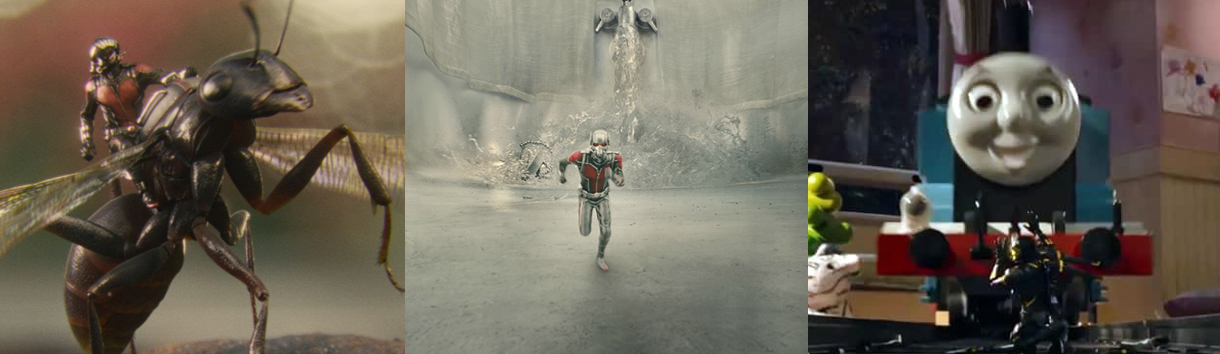
Ant-Man’s unique ability to shrink makes for some fun and innovative action sequences and visuals.

Naturally, Ant-Man’s most unique selling point is the character’s ability to shrink down to a near-microscopic level; this effect is rendered using digital technology and directly attributed to the suit and the Pym Particles, meaning that Scott must stay in the suit and the helmet at all times to stay alive when shrunken. Although minuscule in size, Scott retains his full-size strength and weight, effectively making him superhuman when he’s shrunk. However, the dangers surrounding him are many and varied; normal, everyday things such as a person entering a room, rats, and water are life-threatening hazards and the effect is, quite naturally, very disorientating for Scott for much of the first half of the film. Thanks to a lengthy (and amusing) montage sequence, Scott slowly learns to master the suit, which enables him to shrunk and grow in a fraction of a second to pass through the smallest openings, strike with near-superhuman speed, strength, and swiftness, and enlarge or reduce everyday objects to be used as weapons in combat. As versatile as the suit is, perhaps the greatest benefit of the suit is the ability to control ants using electromagnetic waves. Hank is obviously the absolute master of this; he controls flying ants to spirit Scott across the city, commands “Bullet Ants” to keep him subdued, and even directs drones to communicate and pass sugar cubes. While Hank is very clinical about this ability, preferring to number the ants rather than name them and grow attached to them, Scott is much more appreciative of their help and bonds with them like one would a pet. He names his flying ant “Anthony” and is devastated when it is killed near the finale, but also learns through his training of the particular differences and practical applications of each of the different types of ants at his disposal: “Crazy Ants” can conduct electricity to fry electronics, Bullet Ants deliver an excruciating sting, “Carpenter Ants” allow him to fly about at high speeds, and “Fire Ants” not only bite but also form bridges and pathways. By the finale, Scott has fully mastered the suit and the ants, and is able to shrink and grow in the blink of an eye to dodge bullets and take down entire groups of highly trained, armed men, leading to some of the MCU’s most unique action sequences as everyday locations are rendered exciting and action-packed thanks to Scott’s diminutive stature.
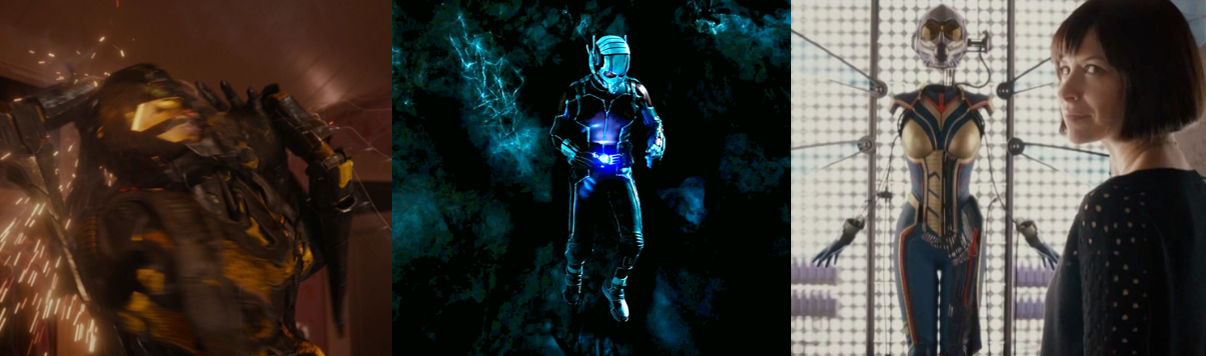
Yellowjacket is defeated, Ant-Man returns from the Quantum Realm, and Hope finally earns her wings.

A particularly frosty confrontation between Hank and Darren sets Cross off and sees him beefing up security, leading to an escalation in Hank’s plans. Although he despairs of Scott’s friends, Hank begrudgingly accepts their help in causing distractions and infiltrating Pym Technology. While Ant-Man and his ants fry the servers and cause chaos to the security systems, Hank puts himself in considerable danger as Darren negotiates the selling of the Yellowjacket technology to Carson and his Hydra associates, and the two finally reveal their true faces as hated enemies. Although Hank is wounded in the fracas, the timely intervention of Hope allows Scott to escape when he’s captured; Hope’s pleas to Darren fall on deaf ears and, pushed to the edge by the destruction of his company, he dons the Yellowjacket suit for himself and fully embraces his hatred and lust for power. This leads to some fun and incredibly unique fight scenes as Ant-Man and Yellowjacket battle not just on a damaged helicopter but also in a suitcase, bouncing about between packets of sweets, keys, and a mobile phone, and Ant-Man bats Yellowjacket into a fly zapper with a table tennis pad. Darren’s knowledge of Scott’s identity leads to him targeting Cassie, escalating their conflict significantly and leading to my favourite fight sequence of the film where Ant-Man and Yellowjacket duke it out on a toy train set and across Cassie’s bedroom, leading not just to an enlarged ant being set loose upon the city but a gigantic Thomas the Tank Engine crashing out into the street! Yellowjacket’s titanium armour proves too tough for Ant-Man and, with his daughter at risk, Scott has no choice but to risk going sub-atomic in order to disrupt Darren’s suit and reduce him down into a twisted nothingness. Adrift in the Quantum Realm, Scott is disorientated and bombarded with bizarre visuals but holds on to his memories and love for Cassie and uses those emotions to force himself back to consciousness, repairing his regulator and returning to the real world. His heroic actions and self-sacrifice earn him not just his daughter’s adulation but Paxton’s respect, finally allowing him to be a part of Cassie’s life once more or for them to build a family unit. His return also gives Hank the hope that he might be able to retrieve his wife one day, and finally sees Scott and Hope act on their mutual attraction for each other. The film concludes with Luis (eventually) relating that the Falcon is actively seeking out Ant-Man for help with a much bigger problem that affects not just the superhero community, but the entire world, and Hank finally gifting Hope with her own Wasp suit for the next go-around.

The Summary:
I wasn’t expecting much when I went into Ant-Man; the MCU was growing and starting to veer away towards the cosmic and outlandish and it seemed like their days of doing more grounded, more human heroes were all but done but Ant-Man definitely set a precedent for diverse storytelling that the MCU continues to stick to. It’s amazing to me that even after expanding their scope towards Gods and the depths of space and hinting towards larger cosmic threats the MCU is still masterfully able to snap back to ground level with a character like Ant-Man, and Scott Lang was such a breath of fresh air for the franchise. Paul Rudd is so immediately likeable, and he brought a real comical, heartfelt performance to Scott Lang, and it’s largely thanks to him that I found myself actually caring about Ant-Man for the first time in…I think forever. The comedy and gags on offer were absolutely top notch, with Luis being an obvious highlight, but I also really enjoyed Michael Douglas’s performance; he played a world weary, cranky, slightly unstable former superhero-come-mentor perfectly and brought so much presence to every scene he was in. He, like all of the actors in this, also seemed to be having a great time with the film, which doesn’t take itself too seriously and perfectly incorporates elements of a heist movie to give it a unique flavour. While we see incredible cosmic visuals and escalating threats quite often in the MCU, Ant-Man’s shrinking sequences are still really impressive; I love how our senses are changed alongside Scott’s when he’s smaller and how everyday things we take for granted suddenly become a life-threatening obstacle for Ant-Man. It’s fun seeing Scott learn about the suit and what he can do, and seeing him bond with the different ants and work alongside his crew, and while I think Ant-Man probably would have been better placed in the MCU’s first phase, it was a much-needed palette-cleanser at the time and remains one of the most entertaining and unique entries in the MCU.

My Rating:

Rating: 4 out of 5.

Great Stuff

Did you enjoy Ant-Man? How did you think it compared to other films in the MCU? What did you think to the emphasis on comedy and heist elements and on Scott’s status as a struggling ex-con and father? Did you enjoy the film’s unique action sequences and shrinking effects? Were you disappointed that Yellowjacket ended up just being a dark mirror of Ant-Man or did you think Darren’s character stood out enough to justify it? Were you a fan of Ant-Man prior to this film and, if so, which iteration of the character was your favourite? Whatever you think about Ant-Man, sign up to drop a comment below or leave a comment on my social media, check back in next week as Sci-Fi Sunday continues.

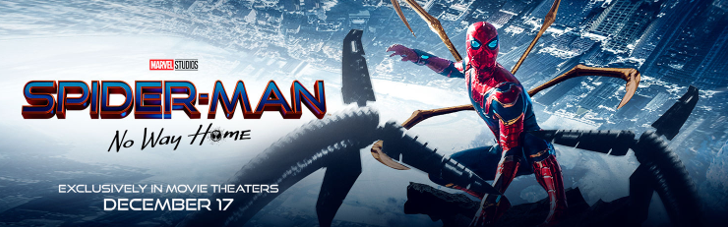
Movie Night: Spider-Man: No Way Home

Released: 17 December 2021
Director: Jon Watts
Distributor: Sony Pictures Releasing
Budget: $200 million
Stars: Tom Holland, Zendaya, Jacob Batalon, Willem Dafoe, Alfred Molina, Jamie Foxx, and Benedict Cumberbatch

The Plot:
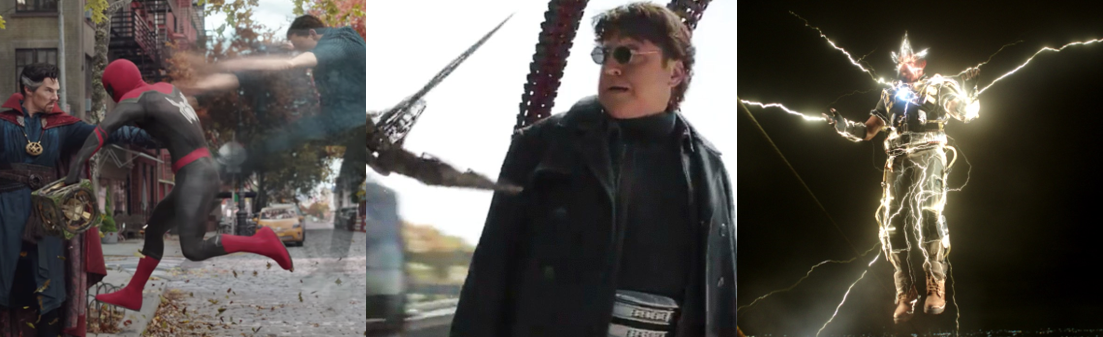
After having his secret identity publicly outed, Peter Parker/Spider-Man (Holland) finds himself branded a murderer and requests Doctor Stephen Strange (Cumberbatch) cast a spell to make everyone forget his identity. However, when the spell is corrupted, reality is fractured and Peter is beset by foes from across the multiverse seeking to avenge themselves against Spider-Man, no matter what world he’s from!

The Background:
Following the massive success of the original Spider-Man trilogy (Raimi, 2000 to 2007) and the largely mediocre reception of the poorly-timed reboot films, Marvel Studios were finally able to achieve the impossible when they reached an agreement to include a new version of the iconic web-slinger in their interconnected Marvel Cinematic Universe (MCU). Tom Holland took on the role of a young, fresh-faced take on the character and debuted in spectacular fashion in Captain America: Civil War (Russo and Russo, 2016) before spinning off (no pun intended) into the incredibly successful Spider-Man: Homecoming (Watts, 2017). Spider-Man: Far From Home’s (ibid, 2019) impressive $1.132 million box office proved that the MCU could sustain the success it had amassed even after the cataclysmic events of Avengers: Endgame (Russo and Russo, 2019) but development of a third outing for the character was initially stalled when financial disputes threatened to see the character once again pulled from Marvel’s control. After these issues were resolved, and following a delay due to the Covid-19 pandemic, production finally got underway in late-2020 and, almost immediately, rumours began circulating regarding the possible return of actors from the previous Spider-Man franchises. These were only exacerbated when Benedict Cumberbatch was confirmed to reprise his role as Dr. Strange, a character who was already scheduled to have his own multiversal adventure, and when the long-awaited trailer was finally released following a leak, confirming that Alfred Molina would be returning as Doctor Otto Octavius/Doctor Octopus thanks to digital de-aging. Finally, after months of speculation and wild fan rumours, the film’s final trailers confirmed that this story would tackle Spider-Man’s varied cinematic multiverse and the film received an official release date. Thanks to bringing together elements from across Spider-Man’s cinematic legacy, Spider-Man: No Way Home was met by unanimous praise; critics lauded the performances and heart of the film, in addition to atmosphere and chemistry between the actors, and the film made a mammoth $1.916 billion at the box office.

The Review:
I feel it’s only fair to emphasise here that I simply cannot find the language to talk about this film without using spoilers. If the title and various warnings aren’t enough for you, then this text should be: here be spoilers, and I’m not planning on holding back as I feel the movie deserves to be discussed in detail and the only way to do that is to talk about spoilers. Also, I was initially torn when it came to this film; the build up to it saw some really toxic opinions and members of the fandom rear their ugly heads, and the marketing has been a bit all over the place. Sony showed a surprising amount of restraint with their trailers, and maybe held them off a little too long, but it definitely built up a great deal of hype and intrigue surrounding it and it felt good to be excited and curious about a movie for a change. Having said that, though…be better, people, come on. If you have a favourite Spider-Man, that’s great, but don’t rag on people for having a different opinion. Spider-Man is really lucky as he has had so many adaptations and so much representation, so many live-action portrayals, and all of them have been extremely accurate to the source material and exciting outings in their own right, so maybe just be thankful that the web-head gets so much love and is so popular rather than being ungrateful or attacking others for their opinions?

Jameson’s smear campaign spells personal trouble for Spider-Man and his friends.

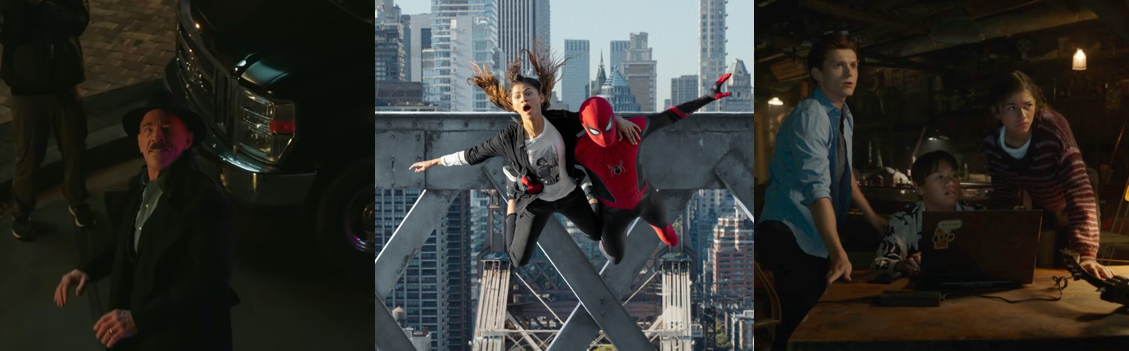
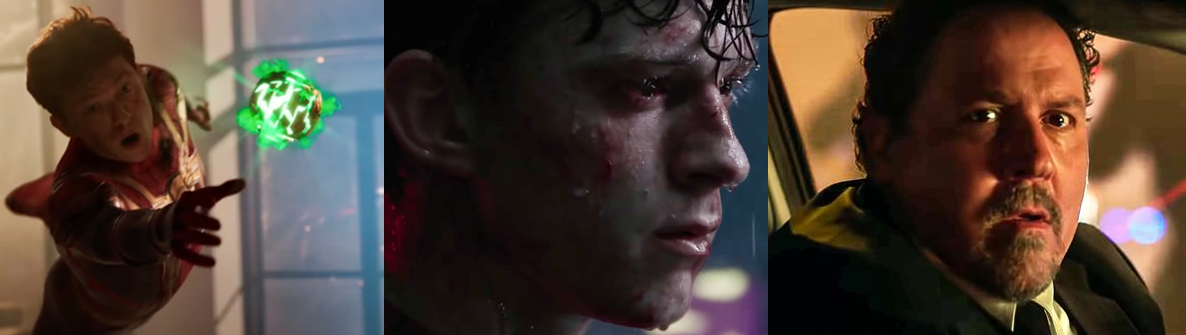
Spider-Man: No Way Home picks up immediately where Spider-Man: Far From Home left off, with blustering, loud-mouthing online personality J. Jonah Jameson (J. K. Simmons) gleefully broadcasting edited footage sent to him by Quentin Beck/Mysterio (Jake Gyllenhaal) that not only implicates Peter as a murderer but also outs his secret identity to the entire world. Naturally, this sends New York City into a bit of an uproar and, pretty much immediately, both Spider-Man and his new girlfriend Michelle Jones-Watson/M. J. (Zendaya) are swamped by a mob that is split between worshipping and condemning Spider-Man, paparazzi looking to get a sound bite, and cops seeking to question Peter’s involvement in Beck’s death. Despite his best efforts to escape the chaos, and to break the news to his beloved Aunt May (Marisa Tomei) and his begrudging friend and handler, Harold “Happy” Hogan (Jon Favreau), Peter and his friends and family are soon apprehended by the Department of Damage Control (DODC), which has now extended its scope into being a federal agency responsible for such matters. Although M. J. and May remain tight-lipped on the matter, Peter’s bungling but loyal friend Ned Leeds (Batalon) and Peter himself don’t exactly help his case, and Peter is left overwhelmed by the barrage of accusations and the public’s awareness of his true identity. Any legal ramifications concerning these matters are quickly swept under the table, however; although Happy and May recently ended their fling (much to Happy’s dismay), the Parkers are given sanctuary at Happy’s secure apartment and an especially good blind lawyer is able to ensure that the charges against Peter are dropped. However, public opinion remains divided; since the world considers Mysterio a hero, many people condemn Spider-Man (which isn’t helped by Jameson’s continuing smear campaign against Peter) and Peter is treated with both awe, fear, and adulation by his fellow pupils. Thankfully, he has M. J. and Ned there to support him through it; despite the revelation uprooting their lives and thrusting them into the spotlight as well, they remain his loyal and understanding companions, which is always sweet to see. While Peter appreciates this, and could probably have adjusted to the major changes in his life with their support, his guilt and shame are magnified when neither her, Ned, or M. J. are able to successfully get into college.

Peter turns to Dr. Strange for help, but muddles the spell and causes reality to fracture as a result.

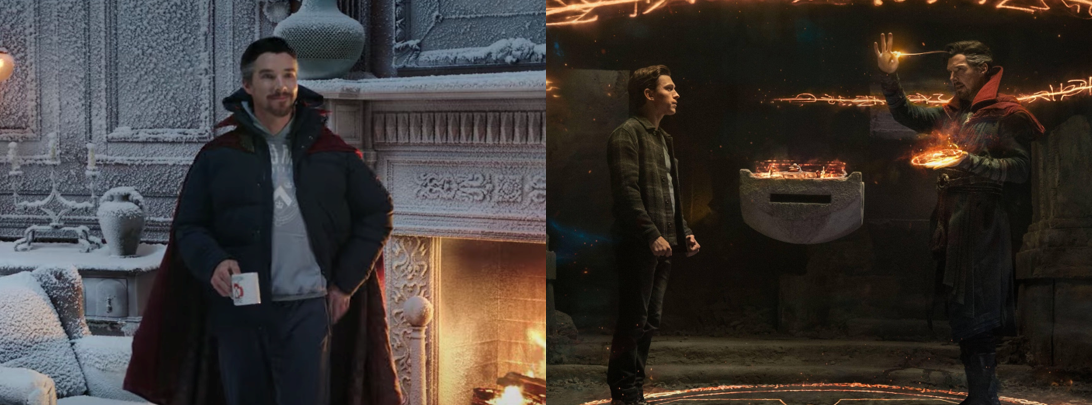
Because of the media storm and controversy surrounding Peter, no college wants to risk being associated with any of them, and Peter is guilt-ridden at having cost his loved ones the chance of realising their dreams. Yet, even though this has happened, M. J. and Ned still take it on the chin and remain optimistic (or, at least, put on a brave face, in M. J.’s case) and neither of them blame Peter for this, but it does little to alleviate his guilt. Desperate for a solution, Peter seeks out the council of Dr. Strange (who, it is amusingly revealed, is no longer the Sorcerer Supreme thanks to being snapped away for five years; Wong (Benedict Wong) has assumed the position instead, which could potentially be explored to greater humourous effect in Strange’s upcoming movie). Although Wong cautions against it, Dr. Strange offers to cast a complicated and dangerous spell that will erase the knowledge of Peter’s secret identity from everyone in the world; however, Peter starts to panic mid-way through the spell and requests that May, M. J., Ned, and Happy be exempt from the erasure, which causes Strange to lose control of the spell and contain it within a jewel least it wreak havoc upon the world…and the multiverse. The relationship between Dr. Strange and Peter is notably different to what we saw between Peter and Tony Stark/Iron Man (Robert Downey, Jr); Strange isn’t a mentor to Peter, he’s more like a work associate, and he’s willing to help the kid out because of his efforts at restoring half the population, but he’s easily frustrated by Peter’s naivety and ignorance, especially when it comes to the world of magic, and angered that Peter risked tampering with the fabric of reality before properly exploring all of the real-world options available to him or learning to adapt to the changes in his life.

Molina makes a triumphant return as the crazed Doc Ock, who’s intrigued by the MCU.

Determined to make up for this, Peter tracks down a college professor to plead M. J. and Ned’s case, only to suddenly be attacked by a face very familiar to us but completely alien to him as Dr. Octopus attacks the Queensboro Bridge in a confused rage, ranting at Peter and demanding to know what happened to his “machine”. Though confused by the villain’s sudden appearance, Spider-Man holds his own in impressive fashion thanks to the advanced technology and gadgets built into his Iron Spider costume, saving lives while fending off Doc Ock’s mechanical arms; his genius mind addled by the corrupting influence of his mechanical tentacles, Doc Ock is intrigued by the Iron Spider’s nanotechnology but startled to find a very different face behind the mask. His confusion soon turns to manic frustration when Peter is able to use the suit’s nanotech to take control of Doc Ock’s arms and render him helpless, and Octavius’s rage is only incensed further when he suddenly finds himself a prisoner in a dark catacomb beneath Dr. Strange’s Sanctum Sanctorum. Although dismissive of the idea of magic and vehemently rejecting the idea that he needs help or to be fixed, Doc Ock is intrigued to see the evidence of a multiverse surrounding him; not only has he met the MCU version of Peter and M. J., but he shares his prison with Doctor Curt Connors/The Lizard (Rhys Ifans), a monstrous creature Dr. Strange was able to subdue offscreen and who is very clearly from another reality. Ock’s curiosity is only piqued further when he and Peter catch a fleeting glimpse of another Spider-foe Octavius knows all-too-well, Doctor Norman Osbourn/The Green Goblin (Dafoe), before being imprisoned.

Peter finds a number of monstrous, and maniacal, villains have crossed over into the MCU.

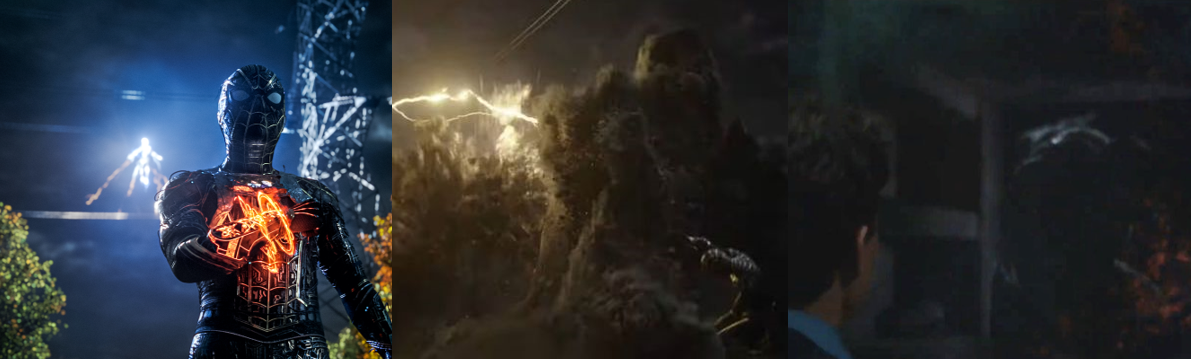
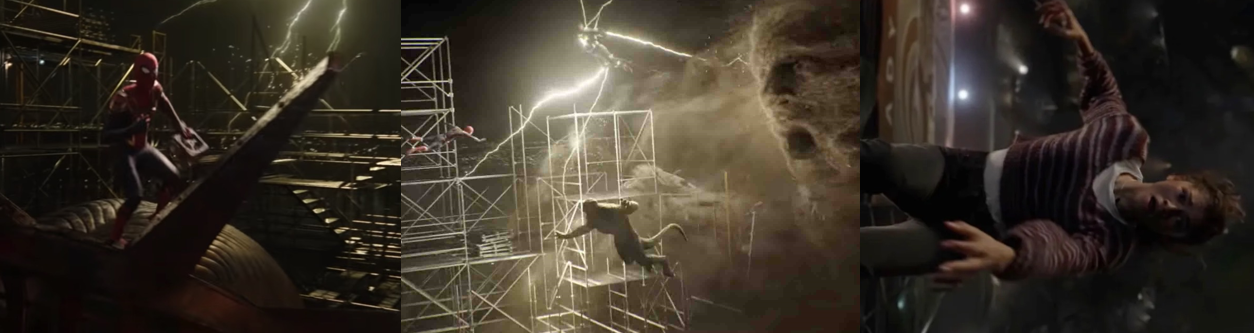
Angered at the incursions that have slipped into their world because of Peter’s ignorance, Dr. Strange demands that he and his friends “Scooby-Doo this shit!” and round up the visitors so they can be sent home; he grants Peter a magically-charged gadget that allows him to shoot a web that instantly teleports the villains to the prison, and Peter is forced to turn his suit inside-out after it gets ruined by paint thrown by a mob. Although he initially heads out to track down the Green Goblin, Peter instead finds Max Dillon/Electro (Foxx), who draws power from electricity lines to regain his physical form and alter the nature of his powers. Disorientated at having being violently ripped from his reality, Electro lashes out in anger, and Peter is only saved by the timely intervention of Flint Marko/The Sandman (Thomas Hayden Church), who helps Peter subdue and capture Electro. However, upon realising that he’s trapped on another world, the Sandman also grows antagonistic and winds up confined as a result, and Peter learns from each of them the nature of their personalities, their worlds, and their fates: Green Goblin, Doc Ock, and Electro are all fated to die in battle with Spider-Man, and returning them home would seal that fate, and that’s something Peter cannot, in good conscience, allow.

The Green Goblin quickly re-establishes himself as Peter’s greatest threat.

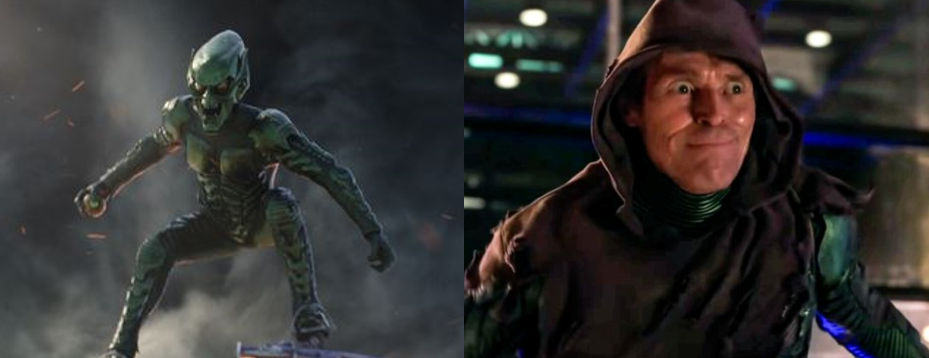
This brings him into conflict with Dr. Strange, who is determined to activate the jewel and send the visitors back home regardless since he’s weighing the fate and stability of the entire multiverse rather than the lives of a few villains. When Peter tries to take the jewel from him, a bit of a scuffle ensues in which we see Peter is able to control his body even while forced into his astral force thanks to this spider-sense, and his knowledge of geometry also allows him to figure out the mirror dimensions, web up Strange, and leave him stranded there while he works to cure the villains. While he has good intentions, and his friends and family support his efforts, and he is even able to convince the villains to trust him to help keep them alive, Peter underestimates the depths of Norman’s psychosis. Rendered a meek, bewildered scientist who is lost and in pain, Norman willingly works alongside Peter to help fix Doc Ock, returning the tentacled menace to his more good-natured self, but Norman’s dark half, the Green Goblin, soon resurfaces to throw Peter’s entire plan out the window. I got a real kick out of seeing Norman and Otto being familiar with each other, and the Lizard and Electro also having a familiarity with each other, it really helped to flesh out their respective worlds and deliver exposition regarding the characters to those who might not be familiar with them. While it’s disappointing that the Sandman was rendered entirely in his sand form for 90% of the movie, and the Lizard was basically a non-factor (there’s even a moment where he is simply confined to a van and forgotten about until the film’s big climax needs to happen), both Doc Ock and the Green Goblin play significant roles in the story. The Goblin wraps the remains of his God-awful suit in a tatter cloak and Dafoe’s demented facial expressions get to shine trough as he operates entirely unmasked throughout the film; he’s also far more vicious and deadly than ever before, cackling in Peter’s face and taunting him at every turn. While all of these returning actors slipped back into their roles perfectly (and even got a chance at redemption, in Electro’s case), Dafoe steals the show ones again as a maniacal and vicious villain who simply wants to cause Peter pain, no matter which Peter it is!

The Nitty-Gritty :
When I first heard that Tom Holland’s third solo movie was going to delve into the multiverse, I have to admit that I was disappointed and annoyed; I enjoyed Spider-Man: Into the Spider-Verse (Persichetti, Ramsey, and Rothman, 2018) but even with that film I questioned the logic of confusing matters with multidimensional shenanigans. The MCU definitely seems to be gearing towards exploring the multiverse, but I expected this to be confined to Dr. Strange’s solo films and worried that bringing in faces from the Sam Raimi and Marc Webb films would just be pandering and confusing. Not only that, but I’m of the firm belief that every role can be recast: Dafoe, Simmons, and Molina were all fantastic in their previous iterations but who’s to say that another actor wouldn’t be just as good, if not better? I expected this third Spider-Man movie would be the perfect excuse to finally bring the Sinister Six to life using the villains already established in the MCU: Adrian Toomes/The Vulture (Michael Keaton), Herman Schultz/The Shocker (Bokeem Woodbine), Mac Gargan/The Scorpion (Michael Mando), and even Mysterio (he was the master of illusions, after all) could all have returned and joined forces with two new villains (ideally an all-new Doc Ock) to collect a bounty on Spider-Man. Hell, I was more excited at the prospect of Charlie Cox returning as Matt Murdock/Daredevil or Spider-Man being forced to go on the run and teaming up with the Netflix Defenders than complicating things with multiverse hijinks, and I still maintain that it makes zero sense to have Eddie Brock/Venom (Tom Hardy) exist in a separate universe when it would have been far simpler to have him be based in San Francisco but still exist in the MCU (like how other MCU heroes and movies take place in different cities but those characters don’t have to be transported through time and space to interact).

Spider-Man butts heads with Dr. Strange regarding how to deal with the villains.

And yet….man, was it a thrill to see Alfred Molina return in the role! Bringing back these iconic actors in their most famous villain roles might be unapologetic fan service but it was fan service executed almost to perfection. I say “almost” as we were one villain short from an iteration of the Sinister Six; Eddie doesn’t show up into the mid-credits scene and he is teleported back where he came from without having any impact on the movie (though he does leave a part of himself behind…) and there was no secret sixth villain added to the roster. However, that’s not to say that the five villains we did get were disappointing…far from it! Since the MCU is different to where he came from, Electro is able to not only reconstitute his body, but also alters his powers; the addition of an Arc Reactor only pushes his powers even further, allowing him to resemble his traditional comic book appearance far closer than in his original iteration. The Sandman may be in sand form for the majority of the film, but he remains an emotionally conflicted character; at first, he helps Peter, and even tries to talk sense into some of the villains, but the idea of being kept from his home world and his daughter pushes him against the web-slinger out of pure self-preservation. This motivation is the driving force behind many of the villains, as they have either accepted their monstrous new powers or have no wish to be sent away to die. In the case of Doc Ock and the Lizard, this is due to technology or mutation clouding their judgement; when Peter repairs the inhibitor chip on Ock’s neck, he becomes much more agreeable and even helps Peter to hold off the villains in the finale, and when the Lizard ingests the cure and returns to his human form, he returns to his more docile personality.

Peter is devastated by loss and pushed to the edge by the Green Goblin.

The same is also true of the Green Goblin, however Norman’s psychosis is far more manipulative, calculating, and violent. He has no desire to return home to meet his end and absolutely brutalises Peter to keep him from trying to cure him; the Goblin quickly re-establishes himself as Peter’s most dangerous and notorious foe not only by swaying the other villains into turning on Peter, but delivering a massive beatdown on him that leaves him helpless to keep his Aunt May from harm. Although Peter manages to shield May from the Goblin’s pumpkin bomb, the glider blindsides her and leaves her with a fatal wound, and she tragically dies in his arms, leaving him heartbroken and with her final words of encouragement ringing in his ears: “With great power, there must also come great responsibility.” May’s death devastates Peter, and drives him into a quest for revenge against the Goblin; no longer merely satisfied to cure or help the villains, he wishes nothing less than the Goblin’s death at his hands, and it’s a true moment of despair for the young Avenger. No Way Home really puts Peter through the wringer, pushing his morals and optimistic outlook to breaking point, and really burdens him with the guilt of having indirectly caused his mother-figure’s death by trying to help the villains rather than allowing them to return home and potentially die as fated.

Spider-Man gets some unexpected help to fend off the combined threat of these multiversal villains.

Desperate to find Peter and give their support, M. J. and Ned mess about with one of Dr. Strange’s sling-rings and discover the presence of two more familiar faces who slipped through the dimensional barriers and are determined to help and let me tell you…I have never seen a cinema explode into rapturous applause before but my screening blew the roof off when Andrew Garfield and Tobey Maguire made their long-awaited, and long-rumoured, return to their famous roles. Both arrived due to Strange’s spell and have been trying to track down MCU-Peter, and both have arrived from later in their careers, finally giving us a coda to their stories: Webb-Peter reveals that he struggled to cope after failing to save Gwen Stacy (Emma Stone), and almost lost himself to his rage at one point, and that he has thrown himself into his duties as Spider-Man to cope. Raimi-Peter is noticeably older, but still in good shape, and, though haunted by his failures and losses, maintains that he and M. J. (Kirsten Dunst) found a way to carry on). The scenes with the three Peters are an obvious highlight and they share some fantastic line sand banter together; Webb-Peter is elated to have found “brothers” and they work together to synthesise cures for the villains based on their previous experiences and scientific acumen. They also share stories of their adventures and powers, with Webb-Peter and MCU-Peter both being astounded (and a little disturbed) by Raimi-Peter’s organic webbing, Raimi-Peter extending a much-needed pep talk to Webb-Peter, and both Webb- and Raimi-Peter being impressed by MCU-Peter’s space adventures. Seeing them work together, offering MCU-Peter support and understanding, is fantastic as Webb-Peter delivers an emotional soliloquy about his failures (and gets to make amends for it by catching M. J. in a truly emotional moment) and Raimi-Peter relates the messages passed on to him by his beloved Uncle Ben (Cliff Robertson), and MCU-Peter is even able to help them get past being solo heroes and work together using his experiences of teamwork as an Avenger.

The multiversal breach rages out of control, leading to Peter making a selfless sacrifice…

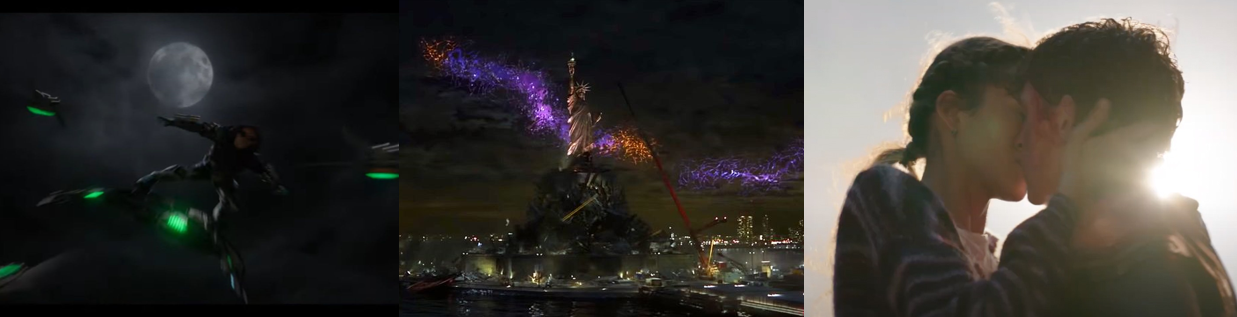
With three Spider-Man working together, the Lizard, the Sandman, and Electro are all subdued and returned to their human forms, presumably alleviating them of their madness and violent tendencies, in a mind-blowing final confrontation around the Statue of Liberty (which is being refurbished to hold Captain America’s shield aloft). Despite the best efforts of his alternative counterparts, though, MCU-Peter is driven into a rage and attacks the Green Goblin mercilessly and even prepares to deliver a fatal blow with his own glider, only for Raimi-Peter to intervene (and get stabbed in the back for his efforts). Ultimately, MCU-Peter delivers a cure, rather than a kill, to his newest foe and Norman is left an emotional and remorseful wreck, though this pales in comparison to the threat unleashed by one of his pumpkin bombs as Strange’s spell is blown free and miscellaneous, vaguely-defined villains and intruders from all across the multiverse threaten to converge on the MCU. Dr. Strange struggles to contain the spell and, determined to make amends for his previous mistake, MCU-Peter decides to make the ultimate sacrifice and has Strange cast a new spell that will make everyone, everywhere, forget all about Peter Parker. He thanks his counterparts for their help and bids an emotional farewell to M. J. and Ned, promising to find them and rekindle their friendship/relationship after the spell is cast, but hesitates upon seeing how happy and better off M. J. and Ned are without him in their lives. Ultimately, Peter chooses to leave them be and fashions a new, 100% comic accurate costume for himself using his counterparts’ suits as inspiration and finally gets his big, triumphant final swing as he begins a new life safe in the knowledge that no one knows his true identity any more…and that he’s not alone in the vast, dangerous multiverse.

The Summary:
After viewing that first trailer and seeing Doc Ock show up once again, my mind was pretty much blown when it came to this movie. It raised so many questions, many of them being concerns that Tom’s third solo outing would get overwhelmed or bogged down by multiverse shenanigans and blatant fan service. Subsequent trailers helped shed a bit more light on the film, and I began to calm down a bit and predict that these returning characters wouldn’t be as integral to the narrative as many were making out. This turned out to be true, to a degree; the villains are definitely a big part of the film, but Spider-Man: No Way Home still does a fantastic job of focusing on Peter, his relationships, his growth, and his identity crisis. Could we have seen a grittier, more grounded film that dealt with him being on the run and learning to adapt to his tumultuous new public life? For sure, yes, and I would also argue that many of these villains could have been recast and reimagined as MCU characters and it would have worked just as well, but again there is such a thrill to be had at seeing these actors return to their iconic roles and, in many cases, reinvigorate their characters with the benefit of hindsight. I loved that Peter’s focus was on others the entire time; his selflessness is a driving force of his character, and every decision he makes is to try and benefit either his friends or family or to save lives. This is motivated by his guilt, of course, as they would only be in danger because of him, and he remains a flawed character trying to make amends for his mistakes, which is the quintessential essence of Spider-Man for me. More than any other Spider-Man, MCU-Peter tries to help even the most villainous characters rather than condemn them to death, it was truly heart-breaking to see him o devastated by Aunt May’s death that he was willing to cross that line. Of course, the undisputable highlight is seeing Tom Holland share the screen with Tobey Maguire and Andrew Garfield; while it’s painfully obvious that all three actors weren’t on set or in the studio at the same time for every shot (whether due to Covid or scheduling), it’s still a blast to see them interacting, hearing those iconic themes, and seeing them in action. Once I accepted that No Way Home was going to be a multiverse adventure, my hope was that the film would go all-out to deliver on its potential…and I’m happy to say that it went above and beyond! Action-packed, emotional, and amusing throughout, Spider-Man: No Way Home may very well be in the top-tier of Spider-Man adventures and I am very excited to see where Peter’s journey takes him now that his status quo has been so dramatically changed.

My Rating:

Rating: 5 out of 5.

Fantastic

Have you seen Spider-Man: No Way Home? Were you excited at the idea of iconic Spider-Man villains making their return or do you think that the multiverse stuff should stay in the Dr. Strange movies? What did you think to the way the film handled the public’s knowledge of Spider-Man’s identity and would you have preferred to see this explored a little more in-depth? Which of the returning villains was your favourite, and how excited were you to see Tobey Maguire and Andrew Garfield return (and Charlie Cox finally be incorporated into the movies)? Were you disappointed that we came so close to the Sinister Six and that Venom didn’t have a role in the film? Where do you see the MCU-Spider-Man’s story going from here? Whatever your thoughts on Spider-Man: No Way Home, leave a comment below.

Movie Night: Logan

Released: 3 March 2017
Director: James Mangold
Distributor: 20th Century Fox
Budget: $97 to 127 million
Stars: Hugh Jackman, Patrick Stewart, Boyd Holbrook, Stephen Merchant, Dafne Keen, and Richard E. Grant

The Plot:
It’s 2029 and Mutants are all but extinct. Jaded, world-weary, and suffering from Adamantium poisoning due to his weakened healing factor, James Howlett/Logan (Jackman) has been trying to keep the increasingly-dementia-ridden Professor Charles Xavier (Stewart) out of harm’s way but his already tumultuous life is thrown one last curveball when they are forced into protecting Laura/X-23 (Keen) from a group of mercenaries seeking to retrieve her and genetically engineer Mutants as potential soldiers.

The Background:
By 2017, 20th Century Fox had more than profited from their various X-Men movies and spin-offs, which had raked in over $1,800,000,000 at the box office. Although The Wolverine (ibid, 2013) received mixed reviews upon release, a sequel was still put into development thanks, in no small part, to the film’s worldwide gross of over $300 million and Hugh Jackman’s popularity and commitment to the role. Rather than produce a direct continuation of the last film, and on keeping with the loose continuity of Fox’s X-Men franchise, this new film drew inspiration from movies like The Wrestler (Aronofsky, 2008) and Unforgiven (Eastwood, 1992) as well as storylines such as “Old Man Logan” (Millar, et al, 2008 to 2009). Purposely developed to be the conclusion to Jackman’s time in the role, the film took the surprisingly simple title of Logan and was produced as an R-rated film in order to make Jackman’s last outing the most violent yet. Afforded a much smaller budget than its predecessors, Logan went on to be an unprecedented critical and commercial success, earning over $600 million at the box office and drawing rave reviews across the board for its bleak tone, violence, and emotionally affecting end to the character’s extraordinary popularity. Though potential follow-ups were thrown into uncertainty when Disney purchased the 20th Century Fox, regaining the rights to the X-Men franchise, among others, in the process, Jackman has, so far, remained adamant that Logan would be his last go-around in the role.

The Review:
Set in the far future of 2029, Logan (who has, somehow, regained all of, if not most of, his memories and now openly refers to himself as “James Howlett” and is even (mysteriously) carrying an Adamantium bullet from X-Men Origins: Wolverine (Hood, 2009) that he plans to use to kill himself with at some point) is now a dishevelled, world-weary, broken down limo driver who is succumbing to Adamantium poisoning and his weakened healing factor, which allows him to drink himself into a stupor but also results in a prominent limp and a visible amount of pain and discomfort. Completely done with the X-Men, Mutants, and pretty much everything in life, he has no time for anything or anyone, much less the assholes trying to steal the tyres off his limo. He doesn’t want to fight anymore and just wants to be left alone but is incredibly irritable and quick to anger because of everything he’s been through and brutally skewers, slices, and dices the thieves when they push him too far; though he is hurt in the process, he’s more annoyed that they damaged his limo.

Logan and Xavier have a rocky, dysfunctional father-son relationship.

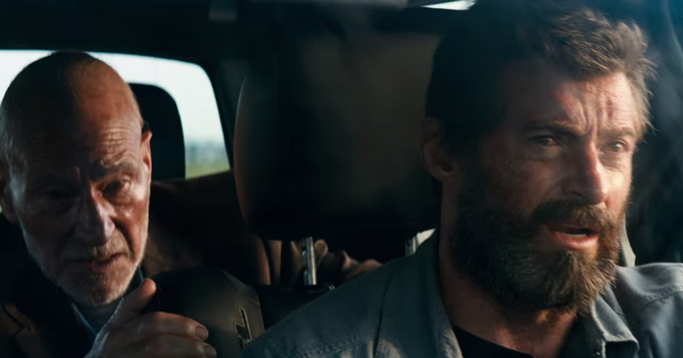
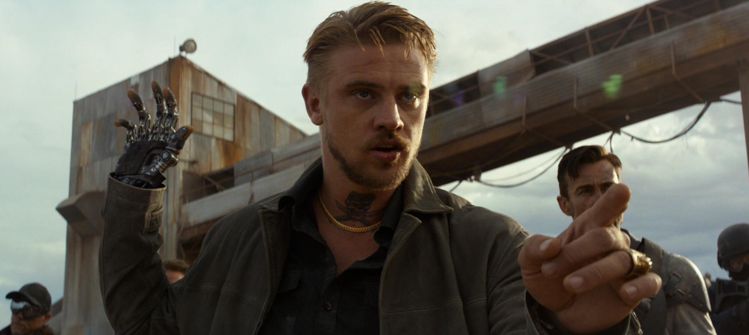
Logan has no time or patience at the best of times but least of all of those who call him “Wolverine”, proposition him, or oppose him; he dismisses Gabriela Lopez’s (Elizabeth Rodriguez) pleas for help until she promises him a big bundle of cash and is angrily dismissive of the semi-cybernetic Donald Pierce (Holbrook). He just wants to be left alone and has no interest in helping or fighting anyone so, when Laura ends up in his care, he is extremely annoyed at being dragged out of his hole and Xavier’s insistence that they help and protect her. Logan is working as a limo driver to save up the money to buy a yacht and disappear from civilisation forever with the decrepit and increasingly irascible Xavier; Xavier now suffers from bouts of dementia, which results in mood swings, a fractured perception of time and reality, an overall grouchy demeanour and spite-filled outbursts, and, worse of all, awful seizures which cause incredible pain to those in his vicinity. He has a tumultuous relationship with Logan, resembling a petulant child at times, but also trying to stress the importance of Laura’s existence and safety and is still trying to teach him to be a better man.

Xavier’s seizures make him a very real danger to those around him.

Logan, of course, is the only one able to endure Xavier’s abuse and is doing everything he can to keep Xavier safe, and others safe from him, and to administer his medication to him. He sticks by the Professor out of a begrudging love and loyalty, seeing him as a father-figure, but isn’t happy about what he’s become, the world they live in, or the life he leads. It’s very heavily hinted that the Professor killed all of the X-Men during one of his seizures, which is haunting Logan and causing him incredible grief and pain since he, presumably, witnessed it and he has to live with the knowledge of it. We see a sample of Xavier’s seizures early on and Caliban (Merchant) complains about how they’re getting worse but we don’t really see their true, devastating effects until later in the film when Xavier lapses into a violent episode as Peirce’s men are coming for him and Laura. The effect is an intense, crippling version of Xavier’s “freeze ability” first seen in X-Men 2 (Singer, 2003), rendering all within his vicinity helpless and wracked with pain. This results in one of the film’s standout moments as Logan, struggling against the effects of Xavier’s mind the way a man struggles against the tide, rams his claws into Peirce’s men with a violent ruthlessness. Even after Logan delivers Xavier’s medicine and stops the seizure, though, it has lasting effects as those who suffered from it lie in agony or struggle to regain their composure.

Pierce is full of the kind of egotism that only youth can bring.

Caliban isn’t really given a lot of  backstory or focus but Merchant does a decent job with the limited time he has; it’s nice to see new Mutants/characters involved in the franchise but, beyond acting as Logan’s conscience and trying make him realise the hopelessness and gravity of their situation, he doesn’t really have much else to do except get used and abused by Pierce, add to Logan’s grief, be ignored, and sacrifice himself in an unsuccessful attempt to kill Pierce (though he does take some of the other Reavers out with him). Pierce, though, is a charismatic, arrogant antagonist; he’s full of the kind of egotism that only youth can bring and attempts to coerce Logan into co-operating before leading a raid on his Mexican hideout. Though persistent, he’s clearly in over his head but determined to see his mission through; still, at least he’s not another guy-in-a-suit villain. In the end, he meets his need not at Logan’s hands but at the hands of a new batch of young Mutants, his commitment to the mission turning out to be his downfall, though he does last a little longer than his employer, Doctor Zander Rice (Grant).

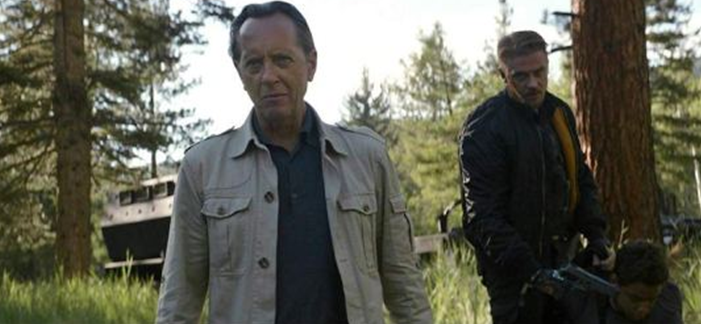
Rice is, honestly, a waste of Grant’s talents and simply there to be the film’s “mastermind”.

Personally, I feel the inclusion of Rice is a little unnecessary; it’s a bit of a waste of Grant’s talents and stature as an actor and I almost feel like it would have worked better if he had showed up for the finale in a quick cameo rather than being peppered throughout the film simply to deliver exposition. Rice is basically a substitute for Colonel William Stryker (Brian Cox); a scientist who is experimenting on, and fascinated by, Mutants. The difference, though, is that Price unwittingly caused the extinction/suppression of Mutants through his research and is now working to genetically engineer a new generation of Mutants by splicing the genes of the older generation, such as the X-Men and, of course, Logan. Price is a slimy, manipulative individual; pragmatic and logical but also entirely convinced that his way is just and yet, at the same time, marvels at X-24’s (Jackman) efficiency and savagery. His villain is the kind of hypocritical kind who believes he was only trying to help humanity and, having accidentally effectively wiped Mutants out, is now trying to rebuild Mutants according to his design.

Laura is the breakout character, being both an innocent child and a whirling ball of savage fury.

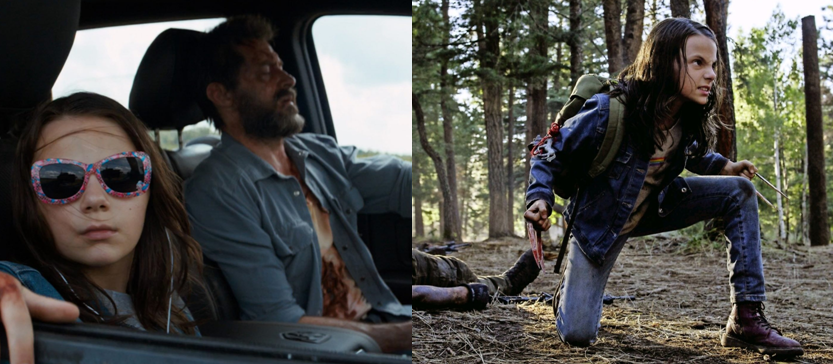
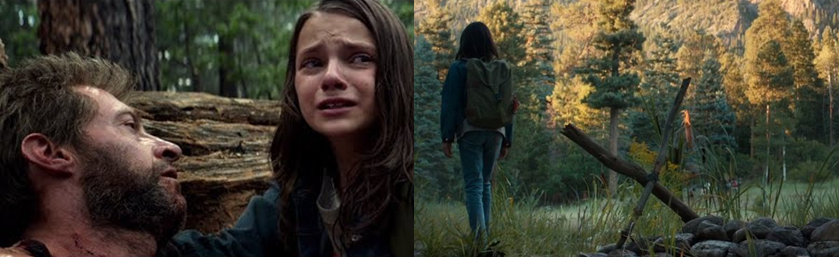
Of course, Laura is the standout character; initially little more than a scared, unassuming little girl, she is a whirlwind of feral fury and naïve innocence. The two combined are a dangerous combination, making her unpredictable and violent at the best of times, though easily appeased by childish wants and desires (cereal with too much milk, X-Men comics, kiddy rides, snacks, funky sunglasses, fiddling with everything she sees and the like). When her life is in danger, or those around her are threatened, she reacts with a primal, savage fury, attacking and killing on instinct, and is every bit the animal that Logan has fought against all these years. As the film progresses, Laura opens up more, speaking first in angry Spanish and then in angry English; her and Logan begrudgingly bond, forming a dysfunctional family dynamic alongside Xavier, and her safety becomes his final mission and reason for living over the course of the film. Having buried his oldest friend and mentor, Logan is vulnerable and grieving and, in that moment, comes to see Laura as a true person, his daughter, rather than simply a liability or mission.

The Nitty-Gritty:
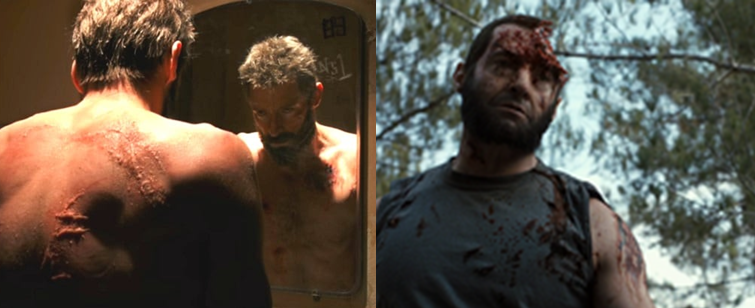
Of course, what separates Logan from its predecessors is its excessive violence, gore, and profanity (which Jackman secured by selflessly taking a pay cut); Logan is covered in scars and bruises, his claws sever limbs and skewer his prey without mercy and in extremely brutal fashion. Irritable and grouchy, Logan is quick to a fiery temper and has no time for decorum or mercy this time around and this is reflected in the way he mercilessly dismembers those who get in his way, as though losing the X-Men finally removed the last vestiges of his humanity and he’s been left with its tattered remnants.

Despite his rage, Logan is crippled by chronic pain and a lifetime of injuries and fatigue.

This is clearly the most vulnerable and distraught we’ve ever seen Logan; perhaps the closest parallel was when he was living like a hermit at the beginning of The Wolverine. Here, though, he’s lost absolutely everything and is suffering inside and out; we saw him struggling with a dodgy healing factor in The Wolverine but it’s far worse here as not only does he struggle to heal, or heal properly, but all his old wounds are resurfacing and he is slowly dying from, and being crippled by, Adamantium poisoning. He suffers from a persistent cough, is clearly in constant pain, and is now forced to wear glasses to read, watch phone screens, and to see properly. Despite this, Logan continues to fight with a savage fury when pushed; he fights through the pain, uses it even, which results in a number of visceral, brutal action scenes but also allows the film to explore Logan’s humanity in a way we haven’t seen before. Ultimately he succeeds in this but in a thematic way since Laura uses the bullet to blow X-24’s head off.

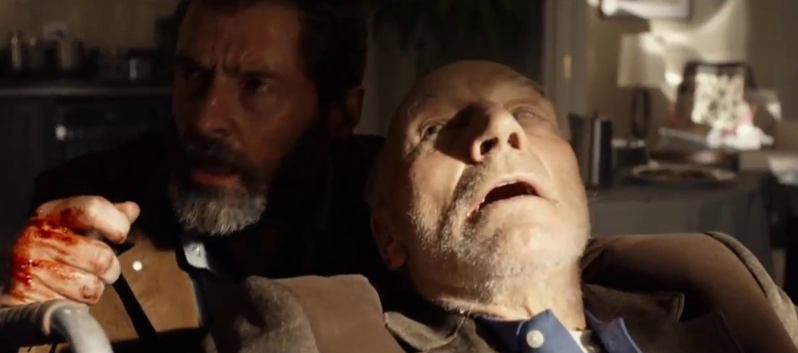
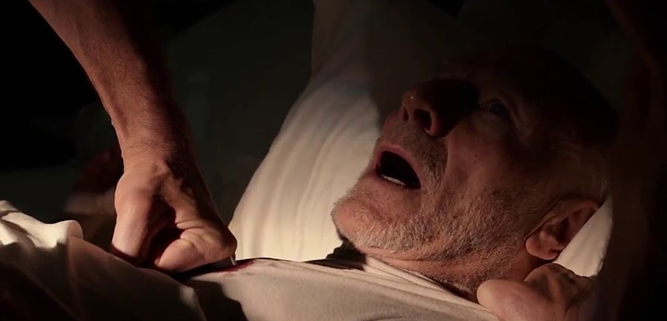
Xavier meets a gruesome end after a rare, and tragic, moment of clarity.

Xavier is a broken-down shell of his former self; frail and weak and far from his usual eloquent sense. Prone to bouts of profanity and cruel spite, Xavier is a shadow of the man he used to be and is entirely dependant upon, and resentful of, Logan and Caliban. Of course, Xavier’s condition makes it difficult to separate fact from fiction; his outbursts and vindictiveness could be due to his dementia since he perks up once Laura comes into their lives. Xavier is transformed by the conformation of a new breed of Mutants, determined to protect Laura and get her to the rest of her kind, and becomes more of a kindly old grandfather. This make sit all the more tragic when, in a moment of clarity and sanity, he is brutally murdered by X-24 and dies believing that Logan, his last remaining student and friend, killed him.

In death, Logan finally finds the peace he has long desired and ensures that his legacy will live on.

Logan is deeply affected by Xavier’s death; he is horrified at the thought that his mentor and father-figure died thinking he had turned on him and uses that anger as motivation in his fight against Pierce, Rice, and X-24 but he is hopelessly outmatched by his younger, stronger clone. All the determination, rage, and will in the world don’t really help Logan in a one-on-one fight and he is forced to use whatever means he can, including both taking Rice’s serum and sacrificing his own life, to end X-24’s threat. In the end, Logan is able to deliver Laura to her fellow new Mutants and dies to protect her; in the process, he finds the peace he has long desired in that his legacy gets to live on and he finally gave his life for something worthwhile, a chance for a new generation of Mutants to live free in the world. It’s a poignant scene, one that is a fitting farewell for Jackman and his iconic role, though a part of me would have preferred to see Liev Schreiber return as Victor Creed rather than a clone of Logan.

X-24 emobides Logan’s darker, animalistic side of Logan and exists as his dark mirror.

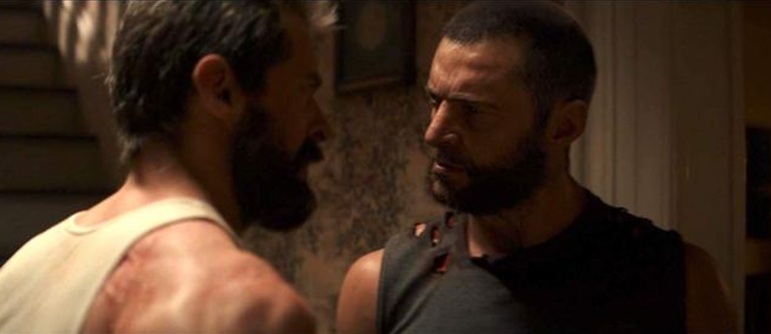
However, X-24 has obvious thematic reasons to exist; superficially, he represents everything Logan has fought to not be over the years, being little more than a savage animal forced to blindly and unquestioningly follow orders. Additionally, he is the younger, stronger version of Logan (with none of the age, scars, blemishes, or pain that Logan carries) meaning that, in fighting X-24, Logan is literally and figuratively fighting against himself, his past, and the most savage parts of his nature. Again, though, I do feel like Creed could have fulfilled this in exactly the same way (X-24 even resembles Creed in many ways) but I guess it’s more explicit this way and keeps the filmmakers from referencing one of the more unfavourably-received X-Men films. Still, I’m glad, and actually kind of surprised, that the filmmakers decided to not keep X-24 around in an attempt to leave the door open for Jackman’s return and the film definitely seems to be setting Laura up to be the next Wolverine.

As great as the film is, there are some questionable moments to nitpick.

There are some things that bother me about the film, however; first and foremost is, obviously, its sketchy continuity. Apparently, this film takes place in the “Good Future” seen at the end of X-Men: Days of Future Past (Singer, 2014), which is fine but a little depressing that, no matter which timeline you follow, the X-Men are doomed to suffer and die. Second, there’s the massive lull the film takes with Logan, Xavier, and Laura stop to help a family on the highway and end up getting close to them; it works, again in a thematic sense, to remind Logan of what it means to be happy and have a family but it does kind of slow the film down and it’s a pretty cheap way to up the body count, add to Logan’s grief and rage, and to sell X-24 as a relentless killer. Add to that Gabriella’s incredibly well edited phone video, which stretches plausibility not only through its professional construction but also through her ability to record all of that footage without being spotted. Finally, there’s the vague explanation of what happened to the X-Men and the other Mutants; I can appreciate the subtle ways the film hints at its story and what has happened but, considering how wildly different the world is since we last saw the X-Men and Wolverine, a little more consistency and exposition would have gone a long way, instead, we’re left with a lot of questions and unresolved plot points; it definitely feels like they were setting up for a spin-off involving and, arguably, I feel like The New Mutants (Boone, 2020) should have explored her and the other new breed of Mutants to help expand upon this premise and the success of the film but it is what it is and for an emotional last chapter for Jackman and Logan it excels in every regard.

The Summary:
While the X-Men films have always been big, action-packed features full of special effects and increasingly elaborate action scenes, Wolverine’s solo efforts have always strived to have a slightly different flavour; even X-Men Origins: Wolverine dabbled in being a war movie and trying to tell a more intimate, focused story amidst its bombastic action. However, this becomes undeniably explicit in Logan, which is, essential, as much road trip film and a Western as it is in an intense character study; heavily influenced by Sergio Leone’s “Spaghetti Westerns” (1964 to 1966) and classic Westerns like Shane (Stevens, 1953), Logan is the exploration of a tortured, jaded loner just trying to exist in a world that has long past him by but who is forced back into prominence by the hands of fate. Logan is a very different kind of comic book/superhero movie; it’s not full of bombastic action or overly-choreographed set pieces and is, instead, a much more subdued exploration of the longevity, suffering, and mortality of the man we know as Wolverine. However, when the action and fights do happen, they’re fast, brutal, and viciously intense and, perhaps, the best way to describe Logan: intense. It’s a far cry from the loud, frenetic action of other X-Men films, especially X-Men Origins: Wolverine, and is all the better for it, finally unleashing the animalistic nature of Wolverine and showing just how dangerous and violent he can be while also being, essentially, a character study, or deconstruction, of Logan and allowing him both the chance to be the ferocious character he has battled against all this time and give him the send-off he deserves.

My Rating:

Rating: 5 out of 5.

Fantastic

What did you think of Logan? How do you feel it compares to the other X-Men and Wolverine movies? What are your thoughts on the presentation of a broken down, dying Logan and the introduction of X-23? Were there any parts of the film that disappointed you? Would you have liked to see Liev Schreiber return? Do you think Hugh Jackman will ever be tempted to return to the character in some way, shape, or form or do you feel it’s best to pass the role on to someone else; if so, who, and do you want Laura to assume Wolverine’s mantle? Whatever your thoughts, please leave a comment below.

Movie Night: The Wolverine

Released: July 2013
Director: James Mangold
Distributor: 20th Century Fox
Budget: $100 to 132 million
Stars: Hugh Jackman, Tao Okamoto, Rila Fukushima, Hiroyuki Sanada, Haruhiko Yamanouchi, Svetlana Khodchenkova, Will Yun Lee, and Famke Janssen

The Plot:
Haunted by memories of Jean Grey (Jansssen), Logan/Wolverine (Jackman) is called back to Japan by the dying wish of an old friend, Ichirō Yashida (Yamanouchi), who offers to end Logan’s immortality. However, when Yashida dies, his granddaughter, Mariko (Okamoto) is targeted by assassins, and Logan’s healing factor is compromised, Logan is begrudgingly forced to protect her and uncover a conspiracy with Yashida’s vast corporation.

The Background:
20th Century Fox had vastly profited from their X-Men movies, the first three of which earned them over $600 million. Though X-Men Origins: Wolverine (Hood, 2009) was met with mixed reviews, the film grossed over $300 million against a $150 million budget and Hugh Jackman’s popularity as the character all-but ensured that some kind of sequel would be put into production. After deciding to draw upon elements from Chris Claremont and Frank Miller’s work on the character’s time in Japan, famed director Darren Aronofsky was brought on to direct; Aronofsky was responsible not only for the film’s blunt and unimaginative title but also restructuring the film as a standalone spin-off rather than a straight-up sequel to X-Men Origins. By 2011, however, Aronofsky had exited the project due to vast amount of overseas shooting the film would require and James Mangold was brought in as a replacement. Produced on a smaller budget than X-Men Origins, The Wolverine had a somewhat shaky box office; it’s currently the seventh-highest grossing film in the franchise, earning less in worldwide revenue than the much-maligned X-Men: The Last Stand (Ratner, 2006) but still more than the much-lauded X-Men 2 (Singer, 2003). Critically, however, the film fared far better than its predecessor, with the general consensus being that it was a far more accurate portrayal of the character. Personally, I have to admit that I missed the more recognisable X-characters of the previous film and the chance to shed more light on Wolverine’s complex and storied history but I did appreciate the film’s more brutal nature and grittier, more focused direction.

The Review:
In keeping with the theme of the previous X-Men movies, The Wolverine opens with a particularly gruelling and thrilling scene that sets the tone for the film to follow. In this case, we find Logan being held in an armour-plated well as a prison of war in Nagaski mere moments before the fateful atomic bomb is about to drop. Understandably panicked by the incoming wall of fiery death, young Japanese soldier Ichirō Yashida (Ken Wamamura) is too afraid to commit ritual seppuku but, having seen how Yashida risked his life to free prisons and give them a chance to escape, and fully aware of what’s to come, Logan manages to escape from his prison and shield Yashida from harm at the bottom of the well.

Memories of Jean haunt Logan’s dreams.

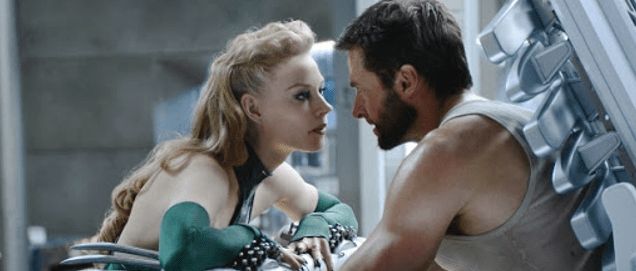
Surprisingly, rather than continue this narrative and fill in a large missing chunk from Wolverine’s early life, the film then jumps ahead to a few years after the events of X-Men: The Last Stand. Although Wolverine has not only recovered his missing memories, this is both a blessing and a curse as not only is he now (conveniently for this film’s plot) haunted by memories of Nagasaki, he’s also haunted by dreams of Jean Grey (Janssen). In them, he and Jean are happy and content in the afterlife; however, this perfect illusion is continually shattered by the brutal remind of how he skewered the love of his life and his desire to be with her in death. It seems that, despite appearing content and well-adjusted at the end of The Last Stand, Logan was unable to cope with what he did to another man’s wife that he decided, after minimal interactions with, that he loved and walked away not only from the X-Men but also the name of the Wolverine, vowing never to kill or endanger others again.

Thanks to Viper, Logan spends most of the movie with his healing factor on the fritz.

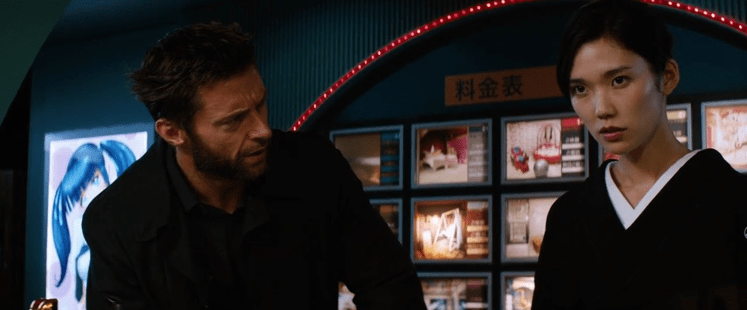
However, Logan is soon approached by Yukio (Fukushima), a Mutant with limited pre-cognitive powers who tracks him down to not only offer him Yashida’s blade but also accompany Logan to Tokyo so that Yashida can pass along his thanks before he succumbs to the caner that is eating away at his body. Initially resistant, Logan is eventually convinced to tag along for one day and is horrified to find that Yashida is offering to somehow remove his superhuman healing factor so that others can benefit from it and he can finally live out a normal, mortal life. While in Japan, Logan has a tense introduction to Yashida’s son, Shingen (Sanada) and granddaughter, Mariko (Okamoto), but is nevertheless adamant about heading back home as soon as possible. However, while tormented by his nightmares, Logan is attacked by Yashida’s doctor, Viper (Khodchenkova), and wakes to find Yashida has died in the night. Receiving a frosty reception at the funeral, Logan is immediately alerted to things not being quite right and is thrust into action once more when Yakuza thugs open fire and attempt to kidnap Mariko. In the fracas, Logan receives a few gunshots (included a blast from a shotgun and point-blank range) and is confused, and shocked, to find that his healing factor is mysteriously dulled. This does little to keep him down, though, and he is able to largely shrug off gunfire long enough to get Mariko to relative safety. As a result, a large portion of The Wolverine focuses on Logan’s damaged healing factor causing him both here and there and questions regarding his perceived immortality as he both tries to reconcile his past actions and get to the bottom of a conspiracy within Yashida’s vast organisation.

Logan’s complex, volatile character is finally explored in some depth.

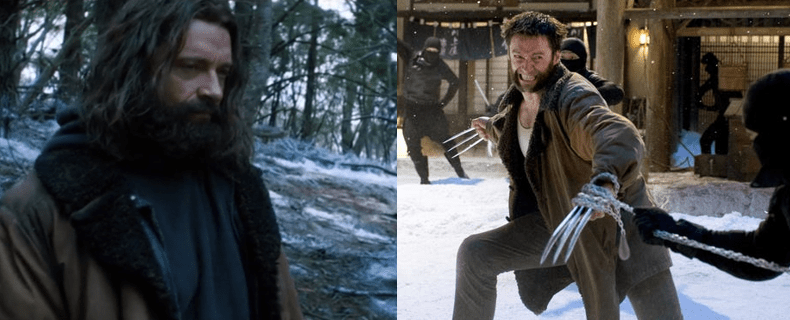
As you might expect, Hugh Jackman is the unmistakable star of the show once more; now a far more tortured, broken man than we’ve seen before, this is a Logan who is visibly tired of the death and heartbreak that seems to follow him at every turn. Initially content to hide away from the world, he is forced back to Japan out of little more than the last vestiges of honour within him but is quick to do the right thing and defend Mariko when it appears her fiancé and father want her dead. Rather than being the cool, charismatic loner we’ve seen before, however, this Logan is a cynical, grouchy ex-soldier who just wants to be left alone and is desperately trying to suppress his violent urges. Honestly, it’s the version of Logan we should have gotten in X-Men Origins: Wolverine; world-weary and wanting death but not quite ready for it, he slowly comes to realise this his animalistic nature can be used for good and eventually comes to reclaim his title of the Wolverine.

Japan, and Japanese culture and traditions, plays a big role in the film’s plot and visual identity.

Compared to every other X-Men movie that came before it, The Wolverine is a much grittier, more focused affair; the story centres entirely on Logan and his inner emotional turmoil and his reluctance to get involved in the convoluted drama and conspiracy that has infected Yashida’s company. The Japanese setting works wonderfully to visually separate it from the other films as well and much of the film is focused on Japanese traditions and mysticism; Logan is like a vagrant stranger in his world, constantly referred to as a rōnin (a “samurai without a master”) or a gaijin (a derogatory Japanese word for an outsider or foreigner), who doesn’t fit and is not welcome. The simple, open countryside’s and urban landscapes of Tokyo give the film a visual identity that is truly unique; this isn’t another bombastic X-Men movie taking place in a large, familiar urban space or a grey-coloured military lab and it really adds to the film’s appeal at aesthetic.

Mariko and Yukio both help to bring Logan back into the fight in different ways.

It also helps that a large portion of the film includes subtitles; Japanese characters routinely speak to each other, and Logan, in their native tongue, adding a coat of legitimacy to its setting. All too often, foreign characters simply speak in English all the time and having them speak in Japanese helps to add to the other-worldliness of the setting and empathise with Logan, who doesn’t understand a word of Japanese. Logan’s newfound vulnerability is also clearly meant to help us empathise with him as it means he struggles to recover from injuries and is in near-constant pain, a step slower than usual, and actually has to struggle to succeed rather than simply charging head-first into battle. Of course, he’s not alone in his fight but rather than sharing screen time with other colourful, fan favourite Mutants, Logan spends most of his time associating with Yukio and growing closer to Mariko. The moment she is introduced, Yukio is portrayed as a bad-ass character in here own right; her pre-cognitive abilities work in conjunction with her athleticism and skill with a blade to make her a formidable opponent and ally. Mariko, on the other hand, is much more of a damsel in distress; initially, Logan sees her as little more than a pampered, self-entitled princess but she’s soon revealed to be oppressed by the desires of her father, fiancé, and her devotion to maintaining the honour of her family. She’s a damaged, conflicted character but is also able to put up a bit of a fight when needed so she isn’t just some screaming, helpless trophy to be fought over.

The Nitty-Gritty:
Up until now, we’ve seen glimpses of Logan’s vicious nature but The Wolverine goes above and beyond in portraying just how brutal and savage Wolverine can be. Initially reluctant to fight, much less kill, when Logan unsheathes his claws to fight, it’s with a fast, ruthless ferocity; every blow is designed to either kill or maim and you truly get the sense of an animal being unleashed in full force. For the majority of the film, Logan is chopping apart nameless, faceless Yakuza goons; he faces a new test in the form of Viper, a seductive, snake-like Mutant who is able to use her toxins to dull his senses and her medical expertise to suppress his healing factor. While the two don’t really come to blows (the honour of dispatching her is left to Yukio), Logan is able to match swords with Shingen, who has garbed himself in the ceremonial armour of the Silver Samurai. It’s in this fight that Logan regains his sense of identity and honour but it’s merely the beginning of the end for the film.

Logan is forced to operate on himself to restore his full abilities.

The decision to dull Logan’s healing factor didn’t sit right with me at the time as I was more interested in seeing a nigh-invincible Wolverine cutting down foes and being emotionally vulnerable rather than physically but it actually does work quite well in the film. That is until the revelation that it’s not some toxic or Mutant suppressant keeping his powers dulled but a weird little spider robot thing attached to his heart. Quite how that works is beyond me but it makes for a tense scene where Logan, having already been told by Yukio that he would die holding his heart in his hand, is forced to cut himself open and remove the device. It’s been suggested that Yukio’s vision actually foreshadowed Logan’s eventual, dramatic death in Logan (Mangold, 2017) but I don’t actually agree with that; Yukio specifically says that he saw Logan lying on the operating table with his lifeless heart in his hand but Logan is clearly impaled on a tree in a forest holding the very-much-alive hand of his “daughter” in Logan so I think this is a bit of a stretch, to say the least.

The actual Silver Samurai seems to conflict with the film’s more grounded, gritty tone.

After spending most of its runtime being almost the exact opposite of X-Men Origins (gritty and introspective, brutal and reflective rather than loud and bombastic), The Wolverine ends with a massive, knock-down brawl between Logan and a huge mech suit of armour. This true Silver Samurai is not only made from the same indestructible Adamantium that coast Logan’s bones but also wields two gigantic blades that are able to cut off Logan’s claws! Revealed to be Yashida, who faked his death and orchestrated everything just to forcibly extract Logan’s healing ability from the marrow of his bone claws, this finale is notably at odds with the tone of the rest of the film but is, nevertheless, quite the exciting end to the film. You really get the sense at Logan is in actual danger thanks to the Silver Samurai’s ability to actually hurt him, which is good for raising the stakes for the finale, but I wasn’t a fan of how Wolverine leaves the film with his entire Adamantium skeleton intact exact for his claws. The bone claws are a fun addition to his character and backstory but are pretty lame by themselves and I would have liked to see him just dip them into some Adamantium to recoat them or something.

Xavier and Magneto turn up alive and fully powered, hinted at a greater threat to come…

Simultaneously, though, I wasn’t a fan of how the next film simply gave him back the Adamantium claws without any explanation. Speaking of which, The Wolverine’s mid-credits sequence sees the inexplicable return of the fully repowered Erik Lehnsherr/Magneto (Ian McKellen) and Professor Charles Xavier (Patrick Stewart), who seek to recruit Wolverine to face an impending threat. A tantalising scene that raises a lot of interesting questions, this scene, and all the character development and story potential of The Wolverine’s finale, would be either swept away or forgotten completely in subsequent films. What happened to Yukio, for example, who ends the film as Logan’s self-appointed bodyguard? What happened in the two years between the final scene and the mid-credits scene? Why did Fox cut a scene in which Logan receives his traditional costume? Well…okay, I can kind of understand that last one but, thanks to the mess Fox made of the X-Men timeline and their complete disregarding of continuity, The Wolverine ends up being this really good, really engaging partially standalone story that exists in a weird bubble where it’s not really canon, but kind of is, but nothing that happens in it factors into Logan’s next appearances in any way.

The Summary:
Ever since Wolverine’s introduction in the first X-Men movie, I was waiting for a movie, and a depiction of the character, like The Wolverine. Far darker, grittier, and more brutal than his previous depictions, this is the first X-Men film to truly delve into the meat of the character’s complexities. As much as I enjoy, and apologise for, X-Men Origins: Wolverine, there’s no denying that The Wolverine, despite its bland title and tonally contradictory finale, surpasses its predecessor in every way. The oriental setting really adds to the film, as does Jackman’s bulkier (and yet more streamlined) look. Showing Logan as being constantly torn by his actions, haunted by his memories, and struggling with the dichotomy of being a weary immortal soldier who is tired of life but not quite ready die is a fascinating dive into the character’s nuances and psyche. Punctuated by fight scenes that cast a wider light on just how vicious the character can be and let down only by the fact that subsequent sequels failed to really expand upon where The Wolverine leaves the character, The Wolverine is easily one of the best X-Men movies, perhaps surpassed only by the even bleaker and grittier Logan.

My Rating:

Rating: 4 out of 5.

Great Stuff

What did you think about The Wolverine? Do you find that it’s a far better portrayal of the character compared to X-Men Origins: Wolverine or do you, perhaps, feel that it’s a bit over-rated? How did you feel about Wolverine’s healing factor being suppressed and the inclusion of the Silver Samurai? Which Wolverine story arc from the comics was your favourite? How would you like to see Wolverine re-introduced to the Marvel Cinematic Universe? Whatever your thoughts about Wolverine and the X-Men, feel free to leave a comment below.

Movie Night: X-Men Origins: Wolverine

Released: April 2009
Director: Gavin Hood
Distributor: 20th Century Fox
Budget: $150 million
Stars: Hugh Jackman, Liev Schreiber, Danny Huston, Lynn Collins, Taylor Kitsch, Daniel Henney, Will.i.am, and Ryan Reynolds

The Plot:
Mutant brothers James Howlett (Jackman) and Victor Creed (Schreiber) are drafted to Major William Stryker’s (Huston) Team X. However, when his murderous sibling goes wild, Logan volunteers for a radical procedure to make him indestructible.

The Background:
20th Century Fox had vastly profited from their acquisition of the X-Men movie rights from Marvel Comics. Under their banner, the first three X-Men movies (Various, 2000 to 2006) had made over $600 million and, soon after X-Men: The Last Stand (Ratner, 2006) brought the trilogy to an end, development began on a series of spin-offs focusing on solo X-Men. Chief among these was, of course, the character of Wolverine; the role had catapulted the relatively-unknown Australian actor Hugh Jackman to superstardom and was the natural choice for a spin-off given how popular the character and his rich recently-uncovered backstory was. Collaborating on the script in order to craft a more interpersonal story, Jackman and director Gavin Hood aimed to explore the duelling nature of Wolverine’s animalistic character. Popular X-Men characters like Wade Wilson/Deadpool (Reynolds) and Demy LeBeau/Gambit (Kitsch) were incorporated into the script, which sought to explore the complex relationship between Logan, Victor, and Stryker based on both their characterisations in the comics and the world Bryan Singer had establish in his first two X-Men movies. Sadly, much like X-Men: The Last Stand, X-Men: Origins Wolverine received mixed to average reviews upon release; despite earning more than double its budget at the box office, X-Men Origins is largely regarded unfavourably by the majority of fans and critics alike. Personally, I always enjoyed the film, which was far more in the vein of X-Men 2 (Singer, 2003) than the third film; I liked that it introduced new and interesting Mutants and feel that it gets a bad reputation despite being an unashamedly enjoyable popcorn action film.

The Review:
When X-Men Origins: Wolverine was released, the details of Wolverine’s early years had already been published in Marvel Comics some eight years prior; still, the revelation that James Howlett (Troye Sivan) had began life as a sickly boy in the 1800s was still relatively fresh for many readers who were more used to seeing Logan hooked into machinery and brainwashed into being a merciless killer as Weapon X. Unfortunately, as interesting as it would be to delve into Howlett’s early years and the details of his friendship with the young Victor Creed (Michael-James Olsen), X-Men Origins has no time for that as, within the first five minutes or so, young James has seen his father murdered, unsheathed his bone claws for the first time, killed his father’s murderer only to discover that his victim was actually his real father, and gone on the run with his similarly-powered half-brother. Sadly, this manic pacing is a theme for X-Men Origins; it’s all quick cuts and revelation after revelation in 1845 and then, as the film’s opening credits roll, we see James and Victor (now Jackman and Schreiber, respectively) taking part in every major war over the next hundred years or so. The montage, easily one of the more impressive parts of the film and which arguably should have made up the bulk of the movie’s runtime, does a great job of showing how James grows increasingly jaded with their mercenary lifestyle and how Victor grows equally bloodthirsty over time.

Logan eventually becomes disillusioned with Team X’s increasingly violent methods.

Eventually, the two are put before a firing squad after Victor kills his commanding officer. Obviously, this doesn’t actually kill the two so they are immediately recruited by Stryker, who drafts them into Team X, a group of highly skilled Mutants under his command. James and Victor go on what is implied to be many missions but, thanks to the film’s breakneck pace actually seems more like one mission, alongside such notable Mutants as Wade Wilson, Fred Dux (Kevin Durand), John Wraith (will.i.am), Agent Zero (Henney), and Chris Bradley (Dominic Monaghan). Unfortunately, Victor’s bloodlust can no longer be controlled and, when Stryker orders the team to slaughter innocent sin order to get his hands on a mysterious mineral, James walks away from the team.

Jackman is unquestionably the star of this film, shining at every turn.

Taking the name Logan (why this name is never explained), James spends the next six years making a modest living as a lumberjack in Canada alongside his lover, Kayla Silverfox (Collins). However, after Stryker shows up to warn Logan that their old team mates are being slaughtered, Kayla is killed by Victor and, overcome with grief and rage, Logan willingly volunteers to have Adamantium surgically grated to his skeleton to give him the tools to enact his revenge against his half-brother. Once again, the star of the show here is Hugh Jackman; now at his most toned and muscular and fully at ease with the role of Wolverine, Jackman’s charisma and animal magnetism help X-Men Origins to stay engaging even in its most head-scratching moments. Jackman does a fantastic job of conveying the myriad of emotions Logan goes through, from his more tender, vulnerable moments to his raw, animalistic brutality. Unfortunately, much is made throughout the film (and in the first three X-Men movies) of Wolverine’s animal side; Stryker (Brian Cox) hinted that, in his past, Wolverine wasn’t a very nice person and X-Men Origins also hints that he did some terrible things during the many wars he fought in…but we never see this. Sure, he’s a tortured character because of his traumatic memories of war and is a formidable beast when enraged but, for the most part, he’s the same honourable, good-natured person we’ve seen in the original trilogy. It would have been far more engaging and interesting to really delve into Wolverine’s time as a cold-blooded killer who slowly grows to become disillusioned with that life compared to Victor, who relishes in killing and giving in to his animal nature.

Schreiber is clearly relishing this role and is more than a match for Jackman.

Speaking of Victor, Schreiber was an inspired choice to bring the character to life. Like many comics, X-Men Origins hints very strongly that Victor and Sabretooth (Tyler Mane) are the same character but never fully lands on one side of the fence or the other; certainly, Schreiber’s loquacious nature and cold, calculated charisma separate him from mane’s more bestial portrayal but, in any case, Victor is a fantastic parallel to Logan. Sadistic and heartless, he kills for the fun of it and simply wishes to prove that he’s better than his half-brother, which he does at every turn. It’s surprising, then, when it is revealed that Victor wouldn’t be able to survive the Adamantium bonding process; perhaps this was a lie on Stryker’s part, though, as Victor is consistently shown to be Logan’s better at every turn save for that line and one brief scuffle between them before the finale.

As good as an actor as Huston is, Stryker’s motives and logic are all over the place in X-Men Origins.

After making an impact in X-Men 2 and considering the importance his character has on Wolverine’s early years, it’s only nature that Stryker plays a big role in this film as the puppet master. Yet, while Huston is a great actor and brings a certain scenery-chewing relish to the role, he’s physically nothing like Brian Cox so it’s a bit weird to me that they chose to cast him. Add to that the fact that Stryker’s plan is needlessly convoluted and bone-headed (he tricks Logan into joining Team X, allows him to leave, has one of his agents (spoiler: it’s Kayla) shack up with him, then fakes her death, pretends like Victor isn’t under his control when we know he clearly is, is somehow able to convince Logan to become indestructible and then, when Logan escapes the Weapon X facility, Stryker’s first order (to a guy whose only power is “expert marksmanship”) is to kill their now invincible creation!) and you have a villain who is charismatic enough to fulfil his role as the master manipulator but flawed in his onscreen execution.

Gambit’s role is brief but surprisingly enjoyable and important to the plot.

Such flaws are evident throughout X-Men Origins, I’m afraid to say; the film’s wonky pacing and questionable plot see characters either being tricked or used with ridiculous ease (you’d think Wolverine, of all people, would be able to tell that Kayla’s death was faked, surely) or simply stumble upon the information they need or into the location where the information they need is. The scene where Logan interrogates Dux (now transformed in the Blob) is a great example; it’s a fun scene, one of my favourites, but Dux isn’t able to tell Logan everything he knows so, of course, he sends him to New Orleans to track down another Mutant, Gambit, who knows Stryker’s exact location. Honestly, Gambit has a far bigger and more prominent role in the film than I originally believed; slightly bigger than a cameo but not quite a co-star, he exists to guide Wolverine to what ends up being a pretty obvious location for his final showdown but, while Kitsch is pretty enjoyable in the role, it’s hard to look past his elaborate superhuman acrobatics. I guess you can make the argument that his Mutant ability to super-charge kinetic energy allows him to perform superhuman leaps and bounds but that doesn’t really help explain how Zero goes flying all over the place all the time. Yet…I find myself enjoying these action and fight sequences. They’re loud and over the top but what’s wrong with that? The scene where Wolverine tries to out-race Zero’s helicopter on a motorcycle is pretty awesome, as is his dramatic takedown of said helicopter (which sees him clinging onto it as it crash lands) and the obvious trailer shot of Logan dramatically walking away from the explosion, as cliché as it is, hits all the right spots for me as an action movie fan. Wolverine’s fight scenes are equally enjoyable; similar to Logan’s fight scenes from X-Men 2, Logan fights with a vicious, brutal intensity where the animal side of him everyone likes to talk about so much really comes to the forefront.

The Nitty-Gritty:
As much as I enjoy X-Men Origins, however, it’s tough to look past the film’s narrative flaws. As a prequel to X-Men (Singer, 2000), though, the film does line up fairly well (far better than the quadrilogy of “prequels” that were to follow), it’s just a shame that the filmmakers were in such a rush to cram everything into this one movie. This could easily have been restructured to show Logan’s early childhood and time during the war and then his time with Team X, leading to a falling out and with Victor over their methods. The second film could have then shown Wolverine transformed into Weapon X as we saw in the otherwise-disappointing X-Men: Apocalypse (Singer, 2016), with that film and that procedure being responsible for his memory loss, than then the third and final movie could have just been The Wolverine (Mangold, 2013) or even Logan (ibid, 2017). Instead, we rush through all of Wolverine’s greatest hits at a breakneck pace all to get to a point that somewhat awkwardly leads into the start of the first X-Men.

Logan’s ultimate fate is a bit rushed and messy but still somewhat affecting in its bleak execution.

Despite that, however, I still find the scene where Stryker blasts Wolverine in the head with a few Adamantium bullets quite heartbreaking. It’s a messy way to go about his memory loss considering having his healing factor be responsible is a far more cerebral and interesting explanation but it’s still tragic to see him awaken surrounded by death and destruction with no idea who he is or where he is. The implication of this ending, and the final act of the film, is that Logan spent the next fifteen-or-so years relying solely on his instincts, which is kind of ironic considering there was probably some evidence left behind on Three Mile Island to explain his origins. Sadly, however, the X-Men films never filled in the gap between this one and X-Men (at least, not fully, as the films go out of their way to ignore or retcon this entire film) so we never really know what he got up to or what happened to Victor (unless he really did devolve into a mindless, semi-mute brute).

Reynolds was perfectly cast but dealt a bad hand here. Luckily, it wouldn’t be his last time in the role.

Of course, you can’t talk about X-Men Origins without addressing the elephant in the room: Deadpool. Reynolds was perfectly cast as Wade Wilson back in the day and it’s clear from the post-credit sequence that Fox were planning a spin-off for the character all along but, yes, it is disappointing to see the character chopped up and butchered into a weird amalgamation of recognisable Mutant powers as Weapon XI (Scott Adkins) rather than the fast-talking, unkillable “Merc With a Mouth” we all know and love. It’s weird watching this film back now as they could just as easily have had a more traditional Deadpool be Logan and Victor’s final opponent; lose the Adamantium blades and the optic blasts and just have him be a super-healing, super-skilled soldier who is loyal to Stryker. Or, better yet, simply imply that wade was killed and have Victor, now a feral animal, be the film’s final “boss” and then do a post-credits scene that shows Wade alive and well and working as a mercenary. Luckily for Reynolds, and for us all, Deadpool would eventually get his spin-off and it was absolutely brilliant but, thanks to the convoluted mess that the X-Men franchise has become, those films sit in a weird bubble of continuity where everything and nothing is canon at the same time.

X-Men Origins uses its cameos to fill some gaps in the franchise’s once-stable timeline.

Speaking of canon, this film obviously concludes with what was, to me (at the time, anyway), a pretty shocking cameo by Professor Charles Xavier (Patrick Stewart), who arrives on Three Mile Island to rescue Stryker’s Mutant prisoners. Sure, the de-aging affects aren’t as good as in X-Men: The Last Stand but this was a very welcome cameo for me and helped to fill a gap in what was, at the time, a straight forward timeline. While I also applaud the way the film attempts to place a little bit more spotlight on Scott Summers/Cyclops (Tim Pocock) and even goes out of its way to show that he never sees or hears Wolverine so as not to create a continuity error, once again the character is somewhat shafted by his ham-fisted inclusion; I liked that Stryker sent Victor specifically to hunt Cyclops down, as though his powers were fundamental to Weapon XI, but the fact that Cyclops is already wearing ruby-tinted sunglasses to keep his powers in check is a little odd as I always assumed this was a solution provided by Xavier. Still, it’s fun to him and a few other recognisable Mutants in little cameos and that the film allows for other popular or B-list X-characters to be included without Wolverine sucking all of the spotlight away from the traditional X-Men thanks to Jackman’s screen presence, charisma, and popularity.

The Summary:
I don’t know what it is about X-Men Origins: Wolverine but…I still really like it. yes, the plot is nonsensical and all over the place, rushing through some story beats that could be a movie all by themselves and lingering on others that are far less interesting and yes it does do a disservice to Deadpool and raise a lot of questions that subsequent X-Men movies and spin-offs largely ignore. But it’s just so much fun! Maybe it’s because I grew up with loud, bombastic action movies but I find this film immensely enjoyable in a lot of ways. It’s fun when it needs to be, bad-ass when necessary, and even touching at times. It’s over the top and mindless action, yes, but what’s wrong with that? Honestly, it irks me that the franchise went out of its way to ignore or retcon this film as it cost us Schreiber returning to the series and caused continuity to be thrown out of the window. Maybe Wolverine deserved better than a big, dumb action movie but sometimes big, dumb fun is just big, dumb, and fun and that’s okay.

My Rating:

Rating: 3 out of 5.

Pretty Good

What did you think about X-Men Origins: Wolverine? Do you think it deserves the reputation it gets or do you, like me, find it to be an enjoyable entry in the franchise? How did you feel about the way the film treated Deadpool and the relationship between Logan and Victor? How would you like to see Wolverine re-introduced to the Marvel Cinematic Universe? How are you celebrating the month of Wolverine’s debut? Whatever your thoughts about Wolverine and the X-Men, feel free to leave a comment below.

Movie Night: Eternals

Released: 5 November 2021
Director: Chloé Zhao
Distributor:
Walt Disney Studios Motion Pictures
Budget: $200 million
Stars:
Gemma Chan, Richard Madden, Kumail Nanjiani, Lia McHugh, Brian Tyree Henry, Lauren Ridloff, Barry Keoghan, Don Lee, Angelina Jolie, Salma Hayek, Bill Skarsgård, and Kit Harington.

The Plot:
Over 7,000 years ago, the God-like Celestials charged their superpowered, immortal creations, the Eternals, with defending the fledgling planet Earth from their evil counterparts, the Deviants. After destroying the Deviants, the Eternals lived among humanity and went their separate ways; however, when the Deviants re-emerge following the return of half the world’s population, reunite to protect humanity from this monstrous threat.

The Background:
Jeez, okay…this is a tough one for me. So, after the legendary Jack Kirby left Marvel Comics in 1970, he created a race of cosmic, God-like beings called the New Gods and intended to tell a finite story with his creations before the comic book was cancelled. When he then returned to Marvel, he developed a startling similar concept initially titled “The Celestials” before being legally advised to change the title. Although The Eternals was cancelled, Kirby’s plotlines were later resolved in other Marvel publications and the characters and their mythology played a pivotal role in the wider Marvel universe. Although I am mildly aware of the Celestials and Thanos’ status as a Deviant, however, I can’t say that I have ever encountered the Eternals in all my years of reading comics so I was intrigued when the team was announced as being part of the fourth phase of the Marvel Cinematic Universe (MCU), which director Chloé Zhao aimed to further expand the scope of the MCU. Featuring a diverse cast of characters and story spanning several centuries, MCU maestro Kevin Feige was eager to delve further into the MCU’s cosmic history and introduce a new ensemble of characters to their ever-growing series of interconnected films. Although Eternals was delayed due to the COVID-19 pandemic, the visual effects team continued to work remotely and the film was finally released to largely mixed reviews. After being review-bombed by bigots, critics praised the visuals of the film while also questioning the pace and characterisation; others questioned Marvel’s attempts to branch out from their usual formula while praising the deconstruction of the superhero genre, though Eternals’ worldwide gross of over $171 million would point to it being a relative financial success.

The Review:
So, as I mentioned, I had no expectations for Eternals; I know absolutely nothing about the characters and have never encountered this group in all my years of reading comics, but I often find that this actually helps with my perception of a movie (I wasn’t really familiar with the Guardians of the Galaxy and I loved those films). Still, it seems like we’re only really getting this movie because Inhumans (Various, 2017) failed to impress as there was a time when Marvel where really pushing the Inhumans to the forefront of their comics. In fact, I believe the Inhumans are tangentially related to the Eternals in the comics, but it definitely seems like Marvel Studios are abandoning tackling the Inhumans and have turned to the Eternals in their stead. Introducing the Eternals means expanding the cosmic scale of the MCU beyond even the scope of the Thor movies (Various, 2011 to present) as these characters, and their creators, came into existence before even the Infinity Stones were created, meaning that they’re not just akin to Gods but also responsible for inspiring humanity’s evolution, innovation, and mythology.

The film doesn’t spend much time dwelling on the romantic drama between these characters.

Even more than the Guardians of the Galaxy films (Gunn, 2014 to present), Eternals is an ensemble film and, more so than any other MCU movie so far, the film’s characters are a tight-knit group of superhuman character. Before Eternals, the MCU’s teams have been a mishmash of egos and personalities who struggled to get along, but the Eternals are more like a family of God-like beings who are initially heartbroken when they go their separate ways. Sersi (Chan) is the closest thing we have to a main character; an empathetic Eternal who’s able to transmutate matter upon physical contact and who has a strong connection with humanity. For centuries, Sersei was engaged in a romantic relationship with Ikarus (Madden), the most powerful of the Eternals; while all of the Eternals exhibit superhuman strength and durability, Ikarus can fly and fire lasers from his eyes and yet, despite his great power, he isn’t chosen to lead the team: the honour falls to the conflicted Sersei. Left heartbroken after their relationship ended with little explanation, Sersei has been living as museum curator and dating Dane Whitman (Harrington), who actually barely appears in the film; I expected Dane to be the audience surrogate but he only really bookends the film and we simply learn what’s happening alongside the Eternals as they reunite. This means that their isn’t really a love triangle between Sersei, Dane, and Ikarus, though a mild one does exist thanks to the presence of Sprite (McHugh), an Eternal cursed to remain a child and who can conjure illusions at will, who carries a torch for Ikarus.

The Eternals have gone their separate ways and lived amongst us in secret for centuries.

When the Deviants suddenly appear, Sersei, Dane, and Sprite are saved by Ikarus and, since the Eternals were charged with destroying these monstrous beings, they quickly realise that they need to reunite with their comrades. Naturally, they seek out their spiritual leader Ajak (Hayek), who not only has the ability to heal their injuries but can also commune with their creator, the titanic Celestial Arishem (David Kaye), and communicates His will to the team. However, they discover Ajak dead, slaughtered by the Deviants, and this responsibility passes to Sersei and, in the process, she learns a terrible truth about the Eternals’ origins and the true nature of their mission on Earth. This only spurs her to reunite with her follow Eternals, which leads them to India, where they find Kingo (Nanjiani) revelling in fame as a popular Bollywood star. Easily one of the most entertaining characters in the film, Kingo can fire bolts of cosmic energy from his fingers and brings along his valet, Karun (Harish Patel), to document the trip and, in the process, provide not only an audience surrogate but another highlight of the film. As powerful as Ikarus is, he is matched perhaps only by Gilgamesh (Lee) and Thena (Jolie), who retired to Australia hundreds of years ago after the battle-hungry Thena began to suffer from the “Mahd Wy’ry”, a condition that causes her to remember her past conflicts and drives her into a mindless aggression against her fellow Eternals. While Thena is able to conjure weapons from thin air and lives for battle, Gilgamesh turns his cosmic powers into his hands to boost his physical strength ever further. This comes in handy when the group braves Druig’s (Keoghan) sanctuary and defend it from Deviants; able to manipulate the minds of others at will, Druig was the first of the group to question their mission and Arishem’s decree that they not interfere in human conflicts unless Deviants are involved, and chose to separate himself not just from his fellow Eternals, but the wider world itself in order to protect generations of people. While Druig is initially sceptical, he’s soon convinced to rejoin his comrades by the scale of the threat they face and after being reunited with Makkari (Ridloff), an Eternal with superhuman speed and who can only communicate through sign language.

Easily Marvel’s most diverse movie yet, though the main antagonists were largely forgettable.

At this point, you’ve probably noticed that Eternals is packed full of diversity and representation; each character looks and sounds different and Marvel are definitely widening the scope of their fictional world with this team. Nowhere is this more prevalent than in the depiction of Phastos (Henry) as not only being openly gay, but in a same-sex relationship and raising a young boy, giving us the MCU’s first male-on-male kiss. Like Druig, Phastos is initially reluctant to reunite with his fellow Eternals; a master builder, he lost faith in humanity after his technological innovations eventually led to the creation of nuclear weapons and further conflict. However, his love for his family and desire to protect them spur him forward and the group is finally reunited…only to find that the Deviants have changed significantly over the years. Amongst their number stands an alpha, Kro (Skarsgård), who starts off as the largest and most intimidating of his monstrous brethren and eventually evolves into a sentient, humanoid form after absorbing the powers and lifeforce of a few of the Eternals. This gives him the ability to speak, heal his wounds, wield similar cosmic energy as the Eternals, and alter his fellow Deviants into far more grotesque and versatile forms. This means the Deviants can fly, attack with razor-sharp claws, and chomp down on their prey; they’re also incredibly durable and aggressive, but actually don’t appear all that much in the film. Kro, especially, doesn’t reach his humanoid form for some time and then vanishes for a huge hunk of the movie, only reappearing very briefly in the finale, as the Deviant threat is soon usurped by another, far more personal and dangerous menace.

The Nitty-Gritty:
It actually kind of sickens me to see so many bigots and haters dump on this film just because it features a lot of diversity; sure, there’s quite a lot packed in here all at once but we live in a world where diversity is the norm. just look around your office, or school, or local supermarket; everyone looks and sounds different, so why shouldn’t that be the case in superhero movies? Eternals was, in many ways, a great way to highlight diversity in the MCU for the first time and, since I’m unfamiliar with these characters, I really don’t care if this means their gender, skin colour, or sexual orientation has changed. Take Kingo, a recognisably Indian and very spiritual Eternal; he’s easily a stand-out character in the film thanks to his egotistical attitude and him revelling in his celebrity status, and Karun helps to add a real heart to the film since he is in awe of the Eternals. Then there’s Makkari, the MCU’s first deaf character, who exhibits a fantastic sense of enthusiasm and personality through her sign language, and the fact that all of the characters have distinct and interesting accents to help them standout from the rest of the MCU. Eternals is also a visually impressive movie; it’s clear that the MCU is definitely going for more visually distinct and experimental films in Phase Four and Eternals is probably the most beautiful MCU movie to date. The film constantly jumps to different eras and moments in human history, and different locations across the globe, as well as bombarding the viewer with some surreal cosmic imagery and some incredible costume design for the titular group.

While the film is incredibly visually appealing, its hampered by a bloated cast and some redundancies.

The Eternals’ powers and technology are equally intriguing; there’s a real Stargate (Emmerich, 1994) vibe to the presentation of their ship and influence upon humanity, and their cosmic powers are augmented by distinct, gold-laced CGI that’s comprised of suitably Kirby-esque swirls and patterns. Their costumes, though sadly absent for a great deal of the film, are equally impressive; unlike any other costumes in the MCU, the Eternals are garbed in a form-fitting, regal attire that is sleek, sexy, and colourful while still appearing comfortable and practical. Everything looks great until Kro takes on his human form; then the CGI takes a noticeable hit and he appears extremely out of place and cheap-looking, which is a shame as the Deviants didn’t look too bad for the most part (even though they were just big, generic monster-things). Thankfully, the film excels in the depiction of the Celestials and when fleshing out the cosmic history of the MCU; we’ve seen hints to this before, and even some brief scenes of Celestials here and there, but Eternals goes all-in with depicting these God-like beings in full and basically positioning them as being responsible for life on Earth and countless other worlds and integral elements of the wider cosmic balance. It has to be said, though, that the film does suffer from being a bit bloated; there are ten main characters, each of whom only exhibit the one power, and while the cast is very charismatic and does a pretty good job of standing out and making the most of their screen time, it definitely feels like six or maybe eight characters would have been more manageable. Like, Makkari was fine but probably could have been removed completely, and Gilgamesh could probably have been cut as well, and Ajak’s personality traits probably could have been merged into Thena to give her a bit more to do beyond just going crazy here and there.

Kro’s effects are a bit of a letdown and there’s a lot of exposition to sit through here.

Similarly, there are some other areas where Eternals also fails to hit its mark; although there is a great deal of action and the trademark MCU snark in the film, there’s noticeably far les than in other MCU movies. That’s not necessarily a bad thing; not every movie, even if it’s a superhero movie, needs to be full-on mindless action all the time, but there isn’t really anything on show here to separate this from other MCU movies where we’ve seen similar powers and abilities done far better. Eternals is, however, a much more deliberate and meditative entry in the MCU; the debates between the Eternals regarding whether to weigh the lives of one world against countless others in the vast cosmos is intriguing, and the Eternals are quite a complex group of characters; created to do Arishem’s bidding, they follow Arishem’s word without question and regard Him with the reverence we reserve for our Gods. Over time, some of them question Arishem’s design for them and the world, while others remain steadfastly loyal to the will of Arishem to a fault, which infuses the film’s narrative with a fascinating religious undercurrent. However, Eternals falls into a trap that plagues many movies that need to explain a lot of lore; it’s the first MCU film to feature opening text explaining the background of the Eternals, but then Sersei relates some of it to Dane, and the others bring Kaurn up to speed, and then there’s a long piece of exposition between Arishem and Sersei that she then tells the others about. For me, that’s a lot of redundant exposition; I feel it might have been better to veer more towards a more visual and implied narrative and then spread the exposition out a bit, but I also suspect that the opening text was added in just to make sure audiences understand what’s going on.

The Eternals are rocked to learn the truth behind their origins and mission.

I suppose it’s not too surprising that the Deviants and Kro fail to make much of an impression as antagonists in the film as their threat is completely overshadowed by Ikarus. Initially a devout follower of Arishem, Ajak grows to truly care for the Earth and sees the vast potential of humanity after they reversed the effects of the Snap, which leads her to planning to oppose Arishem’s true design for the Eternals. It turns out that they’re not there to protect the world, but are actually there to help foster the planet’s population to feed a young Celestial, Tiamut, who’s growing in the centre of the Earth and will destroy the world upon awakening. Ikarus is so devoted to Arishem that he allows Ajak to be killed by deviants and then actively fights against his friends and family, and even his beloved Sersei, to bring their mission to an end so that their memories can be erased and they can be sent to another world, as has happened over and over throughout the ages. It has to be said, though, that there are some flaws in this twist; it turns out that the Eternals are basically akin to robots, creations of the Celestials that are programmed “not to evolve” (even though they clearly do, emotionally at least), so why wouldn’t the Celestials just recall them after the Deviants are wiped out and only dispatch them when the creatures return? It also seems extremely unlikely that the Eternals wouldn’t have rebelled against their master’s grand plans in the past, so a bit strange that Arishem wouldn’t do a more thorough job of wiping their memories. The emergence of the Deviants is also more of a coincidence than anything else, and Tiamut’s awakening has only been hastened by the Snap, and Kro’s potential as a character and an antagonist is completely stunted by Ikarus’ mid-way heel turn and I almost feel like it might’ve been better to have him and Sprite teaming up from the start and have the Deviants the Eternals face be mere illusions. Regardless, Sersei and the others are determined to save the world and spare Tiamut’s life so that thousands of lives can be created by His powers; initially, they plan to do this by creating the “Uni-Mind” and vastly augmenting Druig’s power to put Tiamut to sleep. However, Ikarus’ fanatical devotion to awakening the Celestial leads Sersei with no choice but to turn the emerging Celestial to marble, freezing it in place, and Ikarus is so remorseful for his actions that he willingly commits suicide by flying into the centre of the sun. In the aftermath, Druig, Thena, and Makkari head out into the galaxy to find the other Eternals and inform them of the truth, while Arishem dramatically arrives to abduct Sersi, Phastos, and Kingo and judge whether humanity is worthy of saving and Dane is so rattled by the experience that he prepares to take up the cursed sword of his ancestors…

The Summary:
As I said, I went into Eternals with little no expectations; I saw the trailers and imagined that it would be a visually stunning and atmospheric entry in the MCU, and it definitely is that. Marvel are clearly taking some chances in Phase Four and experimenting with more diversity, variety, and unexpected directions going forward; it’s fascinating to see them go all-in with some of Marvel and Jack Kirby’s more surreal cosmic aspects and really opens the franchise up to an endless number of possibilities. This is juxtaposed by the same grounded, realistic approach to the subject matter that we saw in the likes of Thor (Branagh, 2011) that helps to introduce these wild concepts by framing them against real-world events, technology, and mythology to show how this fictional world has been influenced by these demigods. When the action does kick in, it’s pretty impressive and I like how each of the Eternals looks, sounds, and feels distinct and exhibits unique powers that make them formidable in their own right but almost unstoppable when their united against their monstrous enemies. However, Eternals is far more interested in world-building, moral discussions, and character analysis in a bid to present something of a deconstruction of the typical superhero movie. This may or may not land for you; for me, it did for the most part, but I felt the exposition could have been paced out better and the film would have benefitted from a little less hand-holding and veering more towards abstract visuals, but there’s no denying that it did an exceptional job of bringing a fresh group of sexy and powerful characters into the MCU which I imagine will have a significant impact on the franchise going forward.

My Rating:

Rating: 3 out of 5.

Pretty Good

Have you seen Eternals? If so, what did you think to it and where would you rank it against the other films in the MCU? Which of the characters was your favourite? What did you think to the diversity and variety on offer in the film? Do you like seeing the cosmic scope of the MCU or do you prefer their more grounded and relatable stories? Are you familiar with the Eternals and, if so, how do you think the film worked as an adaptation? Whatever you thought about Eternals, sign up to leave a reply down below or drop a comment on my social media.

Movie Night: Shang-Chi and the Legend of the Ten Rings

Released: 3 September 2021
Director: Destin Daniel Cretton
Distributor:
Walt Disney Studios Motion Pictures
Budget: $150 million
Stars:
Simu Liu, Awkwafina, Meng’er Zhang, Florian Munteanu, and Tony Leung

The Plot:
Desiring a normal life away from his father, Xu Wenwu (Leung), who has led the terrorist organisation known as the “Ten Rings” for a thousand years thanks to his mysterious alien rings, Shang-Chi (Liu), a master kung fu, flees to San Francisco. However, his normal, everyday life is shattered when he is forced to confront his father, who has become obsessed with locating a lost mythical land.

The Background:
Shang-Chi was created by Steve Englehart Jim Starlin and debuted in December 1973 to capitalise on the popularity of kung fu (and, specifically, the late Bruce Lee) during that time. Despite being a staple of Marvel Comics ever since, and me being a die-hard comic book reader and collector, I can’t really say that I have any experience of Shang-Chi at all beyond a few passing mentions and I am much more familiar with Danny Rand/Iron Fist, so I was surprised not only when a movie was announced but also to learn that the concept was kicked around in the 1980s and that an adaptation very nearly saw the light of day in 2004. Seeking to introduce new characters for the fourth phase of the Marvel Cinematic Universe (MCU), MCU producer Kevin Feige saw Shang-Chi as a way to not only do the Mandarin justice but to also expand the scope of the MCU into Asian territories and a whole new genre. Following delays due to the COVID-19 pandemic, Shang-Chi and the Legend of the Ten Rings finally released to overwhelmingly positive reviews; critics praised the film’s martial arts and characters and regarded the film as a breath of fresh air for the MCU and the film managed to defy the pandemic by grossing almost $169 million at the box office.

The Review:
The movie opens with a quick recap of the titular legend of the Ten Rings, which actually doubles as two legends in one; basically, Xu Wenwu found the mysterious and powerful, potentially alien, rings about a thousand years ago and they granted him immortality, everlasting youth, and the power to conquer and reign. Like all men with power, though, he craved even more and, upon learning of the lost land of Ta Lo, ventured there to learn the powers of the Gods. While Trevor Slattery (Ben Kingsley) was a complete mockery of everything the Mandarin stands for, Wenwu isn’t exactly a one-to-one interpretation of the fictional warlord either; rather than controlling different elemental powers and such, the ten rings function more as a kind of magnetic inexhaustible energy field that Wenwu manipulates like whips or uses to fire concussive bolts, propel himself through the air, or form shield. I can understand why (the actual ten rings are probably a little too close to the powers of the Infinity Stones, maybe), though, and it definitely makes for some unique action and fight scenes involving the character.

This new version of the Mandarin end sup as one of the MCU’s most complex and sympathetic villains.

Crucially, however, Wenwu is a surprisingly complex and sympathetic character; in the comics, the Mandarin is generally always this power-hungry dictator who slaughters and destroys simply to feed his lust for power but Wenwu actually gave up his evil ways after meeting, being bested by, and subsequently falling in love with Ying Li (Fala Chen). Together, they sired two children and it was only after Ying Li died that Wenwu returned to the rings, rebuilt his criminal empire, and returned to amassing a formidable armed of well-trained assassins and terrorists. Having studied Ta Lo for years, Wenwu has become somewhat consumed by grief and guilt; he supplants the blame for Ying Li’s death into the people of Ta Lo and, later, even Shang-Chi himself and his entire motivation is based on the belief that storming Ta Lo and opening the “Dark Gate” they protect will return his love to him. Indeed, for the majority of the film, Wenwu is a well-spoken, intelligent, and even kind-hearted character; he’s stern and tough, and seen to be ruthless and uncompromising, and definitely has a dark past soaked in blood but it’s undeniable that he cares for his children, and his lost love, even if the allure of the ten rings is often more provocative for him.

When his father comes looking for him, Shang-Chi is forced to confront his past.

As for Shang-Chi, after his mother died he was trained to be an assassin, like all of the men under Wenwu’s command; a highly adept and dangerous fighter, he was given his first assignment at fourteen and used it as an opportunity to escape from his father’s organisation. Fleeing to America and changing his name to “Sean”, Shang-Chi was content to hide from his true self and his true power and eke out a meagre living as a valet attendant alongside his oldest and closest friend, Katy (Awkwafina). However, when Wenwu’s goons come for him (specifically the jade pendant the wears around his neck, a gift from his late mother), Shang leaps into action to defend himself and Katy using his incredible (and largely unmatched) martial arts skill. Realising this his sister is in equal danger, he travels to Macau (with Katy in tow) and is forced to face his past in the process; ashamed of his upbringing, the heinous acts he has committed in his father’s name, and his inability to save his mother, Shang is reluctant to face his inner demons but nonetheless adamantly opposes his father’s plot to burn Ta Lo to the ground and is convinced that Wenwu has gone mad with grief and needs to be stopped.

Katy provides the comic relief while Shang-Chi tries to repair his relationship with Xialing.

Katy largely fills two very crucial roles in the film: she’s both the audience surrogate and the comic relief, two roles she fulfils beautifully. Her rapport and banter with Shang is genuinely affectionate and entertaining and she is often getting into amusing situations that he has to rescue her from since she’s not really a fighter. Her enthusiasm and kind nature more than make up for this, though; even after learning about Shang’s true name and past, she sticks by him and her faith in him is never shaken. In fact, it’s only bolstered when she sees how good a fighter he is and when they reach Ta Lo, she is eager to help out in the ensuing battle in her own way and ends up not only being a vital part of the finale but also a highlight of the film. Shang’s sister, Xu Xialing (Zhang), more than makes up for Katy’s lack of fighting prowess; a grim and independent young woman, she and Shang were close as children but she grew to resent him after he left and never returned for her, and after spending a lifetime being shunned by her father and denied the same fighting training her brother received. Nonetheless, she has self-taught herself to be as formidable a fighter as he, especially with a roped kunai, and the reforging of their relationship as brother and sister is a key subplot of the film. Though they join forces fairly quickly after reuniting and agree that their father has gone mad, it’s only through truly working together to oppose Wenwu that their tension and lingering issues come to be resolved.

Some formidable, if underdeveloped, goons oppose our heroes alongside some fun cameos.

Of course, the odds are fairly stacked against are three heroes; Wenwu sends his two top enforcers, Razor Fist (Munteanu) and Death Dealer (Andy Le), to acquire Shang and Xialing’s pendants, alongside dozens of nameless, faceless, disposable members of the Ten Rings. While Death Dealer is little more than an unnamed mute with a cool look and some swift moves, there’s discord between him and Shang since Death Dealer was so instrumental in Shang’s harsh and brutal training as a child. We get a touch more personality for Razor Fist, a hulking brute of a man with a blade for an arm who follows his orders relentlessly but is still smart enough to know when to withdraw or refocus his goals for his own survival. Rather than being depicted as strictly a terrorist organisation, the Ten Rings is painted as a global, adaptable organisation that can topple governments and change the course of history through many and varied means. The film even has Wenwu comment on the unfortunate situation with Slattery and philosophise on the power and meaning being names and reputations, though I honestly could have done without revisiting this lingering plot point as I wasn’t impressed with the way Iron Man 3 (Black, 2013) handled the character. Of course, there are a few familiar faces from the MCU to be found here as well; both Wong (Benedict Wong) and Emil Blonsky/The Abomination (Tim Roth) appear in the film for what basically amounts to a brief cameo in Xialing’s underground fight club where Wong tricks Abomination into knocking himself out as part of a scam to fun his magical teachings.

The Nitty-Gritty:
Shang-Chi and the Legend of the Ten Rings is an extremely visual film that is heavily seeped in Chinese lore and mythology; aesthetically, it stands out beautifully from other films in the MCU, especially in the fight choreography and the largely oriental setting of the film once the characters move away from san Francisco. Even then, fights and shots are framed in a way that is visually engaging and entertaining, with the camera being fluid and flowing as smoothly as Shang-Chi’s fast and elegant movements. Macau provides an alluring neon background for Xialing’s fight club while Wenwu’s compound embodies his centuries of age and experience. Of course, it is Ta Lo that really makes the film stand out; an alternate dimension of mythological wonders come to life, Ta Lo is a land untouched by the ravages and wars of man and heavily reliant upon the old ways of combat and the benefits of magical armaments. The closest MCU parallels I can draw are to Black Panther (Coogler, 2018) and Doctor Strange (Derrickson, 2016) for the way it mixes traditional oriental folklore and magic with advanced technology, at times, and the use of both to create a whole new corner of the MCU, one rich in notions such as chi and lost lands of wonders that potential hold more dangers for this interconnected world.

Fittingly, the varied and impressive fights steal the show.

And then there are the fight scenes. Honestly, we haven’t seen fight scenes like this in the MCU at all, and they’re very rarely in cinema these days as well. Fights are fast-paced, kinetic, and full of energy, motion, emotion, and variety. Shang-Chi is every bit a living weapon, easily able to defend himself against numerous armed and unarmed foes even in close quarters like on a double-length bus or on a narrow scaffold while also being so away of his surroundings that has able to keep Katy safe from harm at the same time. At first, he is completely unmatched; even the hulking Razor Fist can’t hold to tough him so expert are his martial arts skills, but Xialing is able to defeat him in their cage fight thanks to Shang-Chi holding back against her and her having trained to be his equal. In Ta Lo, Shang-Chi learns additional martial arts skills, ones more focused on chi and serenity than anger and brute force, in order to stand toe-to-toe with his father, who is an accomplished fighter even without his magical ten rings. Thanks to a fluid camera and some truly incredible shots, Shang-Chi’s fights are a masterpiece of visual cinema that all seem to flow as one continuous shot and really highlight how talented the character (and the actors) are in their craft.

The film culminates in a massive battle against demonic creatures and between father and son.

Similar to Black Panther, the film concludes with a dual sequence depicting Xialing and Katy battling alongside the residents of Ta Lo to defend it from the Ten Rings and Shang-Chi confronting his father in a series of escalating fist fights. The stakes become incredibly high as Wenwu fanatically pound son the Dark Gate, convinced that it will return Ying Li to him, only to unleash a swarm of demonic creatures that suck the souls from their victims! While Ta Lo and the Ten Rings are forced to fight together to fend off these winded demons, Shang-Chi desperately tries to talk sense into his father and to stop him from destroying the gate entirely. Thanks to Wenwu’s ten rings and his mad obsession, to say nothing of his centuries of experience and knowledge, to say that the would-be Mandarin is a formidable foe is more than an understatement. Shang-Chi, however, finds the strength to persevere and continue to battle against his father, even turning the power of the rings against him at one point and summoning one hell of a game-changing ally to aid in the fight, as he finally accepts his destiny and true self. While a lot of MCU films can have somewhat disappointing conclusions as the heroes battle a dark mirror of themselves Shang-Chi chooses an intense and emotionally charged finale that pits father against son. While the influx of gigantic CGI creatures can detract from this narrative, it doesn’t change how spectacular a debut and finale this is for the titular character, who makes an impactful first appearance in the MCU that appears as though it’ll have lasting ramifications for this shared universe of films.

The Summary:
Considering I absolutely nothing about Shang-Chi and was only really aware of three characters in this film (one of which being another vastly different interpretation of the Mandarin), I really enjoyed Shang-Chi and the Legend of the Ten Rings. The final battle was maybe a little overblown and dragged a bit and there were a few instances where we told things rather than being showed them but, overall, it was a very entertaining film. It feels like forever since I’ve seen a big budget kung fu film at the cinema and Shang-Chi definitely delivered on that front, showcasing easily the most fluid, complex, and impressive fight scene sin the MCU and shining a long-overdue spotlight on a hitherto unseen corner of Marvel’s interconnected world. Simu Liu is instantly likeable as the well-meaning, but flawed, main character, Awkwafina stole the show with her loveable and amusing escapades, and Tony Leung brought a depth and emotional complexity that I wasn’t expecting from one of Marvel’s most fearsome villains. With top-notch special effects, jaw-dropping fight scenes, and a focus on Chinese mythology and folklore, Shang-Chi has opened a door into even more spectacular territory for the MCU and I’m excited to see where the character and his world go next as Phase Four continues on.

My Rating:

Rating: 4 out of 5.

Great Stuff

Have you seen Shang-Chi and the Legend of the Ten Rings? If so, what did you think to it? Are you a fan of the title character? What are some of your favourite Shang-Chi stories and moments from the comics? Which of the film’s fantastical creatures and cameos was your favourite? What did you think to this new interpretation of the Mandarin and the way the character’s been handled in the MCU? What’s your favourite kung fu movie? Whatever your thoughts, sign up and leave a comment or let me know on my social media.

Movie Night: Black Widow

Released: 9 July 2021
Director: Cate Shortland
Distributor:
Walt Disney Studios Motion Pictures
Budget:
$200 million
Stars:
Scarlett Johansson, Florence Pugh, David Harbour, Olga Kurylenko, Ray Winstone, and Rachel Weisz

The Plot:
On the run after the events of Captain America: Civil War (The Russo Brothers, 2016), Natasha Romanoff/Black Widow (Johansson) reunites with her estranged sister, Yelena Belova (Pugh), and discovers a conspiracy tied to her chequered past as a Russian spy.

The Background:
Created by the legendary Stan Lee, Don Rico, and Don Heck, the Soviet super spy Natalia “Natasha” Romanova/Black Widow first appeared as a recurring villainous in Marvel Comics’ Tales of Suspense series, where she frequently clashed with Tony Stark/Iron Man. After running across Clint Barton/Hawkeye, however, she eventually shook off the brainwashing she had been subjected to and defected to the United States, becoming a hero and an Avenger in the process. Over the years, the character has become a popular staple of Marvel’s publications and a strong feminist icon who has made numerous appearances in other Marvel media and made her first live-action appearance in the Marvel Cinematic Universe (MCU) in Iron Man 2 (Favreau, 2010). Development of a standalone Black Widow movie, however, was fraught with issues; the film was initially in development back in 2004 and MCU producer Kevin Feige considered exploring the character further in 2014 as the MCU was in full swing. Despite the character being killed off in Avengers: Endgame (The Russo Brothers, 2019), and the sexist machinations of Marvel Entertainment CEO Ike Perlmutter, and repeated delays due to the COVID-19 pandemic, Black Widow finally got a solo film that sought to explore her complex past in 2021. Black Widow was released to a modest (if not disappointing) box office compared to other MCU movies, potentially because of the aforementioned pandemic; the reviews were generally positive, with many praising the film’s action and presentation, though some criticised the film’s derivative nature and how long it took for Black Widow to receive her time in the spotlight.

The Review:
Black Widow aims to address a lingering issue with the character since her introduction into he MCU, and that is her lack of a detailed backstory. Unlike other MCU heavy-weights, Black Widow’s past has only been vaguely hinted at and is shrouded in mystery. However, as much as I feel the character deserves her time in the spotlight (and honestly should have had her past with other side characters explored in some one-shots years ago), I always found this to be part of the character’s mystique. Not knowing the specifics of her time in Budapest and only vaguely hearing hints of her past (“Drakov’s daughter”, “I got red in my ledger”, “Daughter of Ivan”) made her seem like a very mysterious character who had done some terrible, almost unspeakable things and was trying to atone for them. Thankfully, Black Widow retains much of the character’s mysterious aura while still shedding some much-needed light on her past. As a girl (Ever Anderson) was raised in Ohio alongside her sister, Yelena (Violet McGraw), by her parents, Alexei Shostakov (Harbour) and Melina Vostokoff (Weisz). However, her childhood was nothing more than an elaborate deep cover infiltration by the Soviets and, after Alexei acquires the crucial data her was sent to retrieve, the girls are suddenly ripped from their happy, suburban life and forced into serving the State in the “Red Room”. There, they are sterilised and trained relentlessly to become the perfect weapons, each of them moving and operating identical to the other and, with them at his beck and call, General Dreykov (Winstone) is able to topple governments and societies alike with the merest order.

Black Widow places Nat in a vulnerable position where she’s left alone and forced to confront her past.

The film then jumps ahead to shortly after the end of Civil war; after eluding Secretary of State Thaddeus “Thunderbolt” Ross (William Hurt) and being branded a fugitive, Natasha contacts one of her few remaining allows, Rick Mason (O-T Fagbenle), to help her escape from Strategic Homeland Intervention, Enforcement, and Logistics Division (S.H.I.E.L.D.), her former allies who are now relentlessly hunting her down. having lost her surrogate family (the Avengers), Natasha defaults to her cold, KGB training and is fully prepared to live off the grid and with few ties as possible; she is in a very vulnerable and fight-or-flight position at the start of the film and there’s a very real sense that she feels angry at herself for having grown so accustomed to working with, and trusting, others. She is rattled when she discovers that Dreykov is still alive and that the Red Room is still active, especially after the horrific acts she had to do to bring them down to join S.H.I.E.L.D. and is even more uncomfortable at having to travel back to Budapest and dig up the long-dead ghosts of her past since all she’s tried to do is forget about and atone for her time in the KGB.

Natasha reunites with Yelena, who wishes to free the other Widows from Dreykov’s control.

In the years since Natasha’s defection to the United States, Yelena was subjected to something more than just the psychological conditioning that turned Natasha into a ruthless assassin. Yelena, like her fellow Black Widows, was instead also subjected to a mind-control agent of Dreykov’s design that renders them little more than mindless puppets to carry out his every whim. However, after she is accidentally exposed to a chemical antidote, Yelena regains her senses and begins a campaign to free her fellow sisters from Dreykov’s control. As they were trained in exactly the same manner, Yelena is, in many ways, an exact mirror of Natasha; they move the same, fight the same, and have the same penchant for killing but the difference is that Yelena is noticeably more blunt and bitter since, unlike her “big sister”, she has been trapped in the role of an assassin without any hope of reprieve. Free for the first time in her life, Yelena is still a somewhat excitable and naïve child to many of life’s normality’s but is a formidable foe in battle; indeed, one of the objectives of Black Widow is to sell us on the idea that Yelena is every bit as good as Natasha while also being a distinct and likeable character in her own right. It succeeds in this regard by having her be evenly matched (and even best) Natasha when they fight and through Pugh’s natural charisma and adorable line delivery, which manages to be both blunt and endearing at the same time.

Alexei is a goofy blowhard who is desperate to relive his glory days as the Red Guardian.

Angered to learn that Dreykov is still alive after she risked everything, including sacrificing his young daughter Antonia (Ryan Kiera Armstrong), to kill him and defect to the U.S., Natasha reluctantly teams up with her “little sister” to find the Red Room (which is notorious for being impossible to trace) and bring it, and Dreykov, down once and for all. To do this, they decide to free Alexei from the prison he has been rotting in for over twenty years; having been exposed to a variation of the same super-soldier serum that birthed Captain America (Chris Evans), Alexi had a colourful career as the Red Guardian at some point but is now an out of shape blowhard who loves to drone on about his glory days (even if they don’t necessarily fit in with reality). Honestly, Alexei is one of he many highlights of the film; I have a real affinity for David Harbour and he embodies the role of his big, bear of a man perfectly, able to convey both genuine emotion and also a great deal of laughs with his bombastic nature and exaggerated (or inappropriate) stories of his time as a superhero.

Dreykov sends his best agent, the silent mimic known as Taskmaster, to hunt Nat and Yelena.

The three of them reluctantly reunite with Melina and learn the horrifying truth behind Drewkov’s operation; through an intricate system of mind control, he is able to command his Black Widows and has kidnapped, indoctrinated, and disposed of countless young girls over the years in order to maintain his position of power. Since Yelena has the only sample of the antidote, Dreykov sends his top operative, the silent and intimidating Taskmaster, to track her and the others down and acquire it by any means necessary. Taskmaster is quite the menacing foe, despite being uncharacteristically silent; a natural mimic, he is able to copy and replicate the physical abilities of anyone he watches and also predict and counter incoming attacks thanks to his intimidating skull helmet feeding him constant data. Wielding a sword, shield, bow and arrows, and even talons reminiscent of T’Challa/Black Panther (Chadwick Boseman), Taskmaster is incredibly adaptable and able to mimic Natasha’s most famous moves on the spot as well as possessing all of the fighting aptitudes of the Avengers, making for a relentless and threatening enemy that is made all the more intimidating through the fact that he doesn’t say a word the entire time.

The Nitty-Gritty:
Going into Black Widow, I’d heard comments that the same was playing it “too safe”; that is was basically a rehash of Captain America: The Winter Soldier (Russo and Russo, 2014) and I can totally understand those observations. Personally, though, I found this to be a good thing; it’s not the first time the MCU has returned to a more grounded story after a big, cosmic event and hearkening back to one of the MCU’s most entertaining and successful films isn’t a bad thing, in my opinion. Indeed, I imagine when watching the MCU films in order, Black Widow will fit in pretty perfectly as an epilogue to Civil War. Nowhere are the similarities to The Winter Soldier more apparent than in the presence of those annoyingly large location subtitles, the film’s gritty and hard-hitting action, and the character of Taskmaster. Taskmaster’s presentation, demeanour, and even his theme are all highly reminiscent of the titular Winter Soldier (Sebastian Stan) from that film. Like the Winter Soldier, he has a tendency to ram and shoot at cars, performs a number of nifty knife tricks, and is an inexorable force who appears sparingly throughout the film but makes an impact every time he does.

Black Widow is bolstered by some gritty, hard-hitting, and over-the-top action and fight sequences.

Taskmaster’s story is noticeably different from his comic book counterpart, however, in that “he” isn’t a “he” at all; when I first saw the trailers, I (like many, I’m sure) was fully expecting Melina to be under the skull mask and, while the revelation of Taskmaster’s true identity has a great impact on Natasha, I can’t help but feel like that would have been just as meaningful a reveal and a far better use of Rachel Weisz. The remainder of the film’s action scenes are also instantly familiar to anyone who’s seen The Winter Soldier. Well framed and full of ever-escalating action, fight scenes are as brutal as they are beautiful and entertaining to see (even if Natasha, especially, walks away from multiple situations that should have killed her outright). Natasha and Yelena’s reunion is marked by a fierce bit of melee combat that instantly sells Yelena as Natasha’s equal; their daring helicopter rescue of Alexi was a thrilling sequence as Alexi causes a chaotic prison break and the three are forced to escape from an incoming avalanche; and their final assault against the Red Room is made visually interesting and distinct by the fact that the facility is floating up in the clouds. This results in an explosive and over-the-top finale very similar to when the Helicarriers rained from the sky in The Winter Soldier but, again, I’m convinced that these parallels were a conscious decision and the film certainly doesn’t suffer from them and, I feel, is distinct enough to hold its own.

Essentially, the story is about Nat reconnecting with her family and herself.

 A central theme of the film is family. Natasha hides her heartbreak and sorrow at losing her surrogate family behind a cold bravado and resists letting Yelena, Alexi, and Melina into her heart and life as much as she can. We know that this isn’t the entire truth, though, since we’ve heard her talk fondly of her affection for the Avengers are her job as  S.H.I.E.L.D. agent and we see at the start of the film how much she cares for Yelena. Natasha insists that her childhood and this hitherto-unknown family unit was all a fake and meant nothing to her and her attitude seemingly reflected by Alexi, who was frustrated at being stuck in a “boring” undercover assignment and desperately wanted to get back into his costume to fight Captain America again. However, just as Alexi felt true feelings of love and fondness for his “daughters”, so too is Natasha unable to deny that she feels a kinship and responsibility towards not just Yelena but all of Dreykov’s Black Widows. Her urge to finish the job and kill the man who ruined her life is motivated not just by her personal need for revenge but also a deep-rooted desire to free the girls under his control and ensure that no others are ever violated in the same way. Along the way, she reconnects with her first family and comes to realise that she isn’t as alone as she once though, setting her on the path towards reuniting with her disparate Avengers comrades.

The Summary:
I’ll admit that I wasn’t exactly that thrilled at the prospect of a solo Black Widow film, especially one that came out after she had died in the MCU timeline. I definitely feel like she, and other key S.H.I.E.L.D. personnel should have featured in a one-shot or television movie or even, yeah, a feature-length film a few years ago or had her story folded in with the likes of Clint Barton/Hawkeye (Jeremy Renner) to appease the more sexist executives at Disney. Still, as the saying goes: Better late than never. Black Widow was an enjoyable romp with some impressive action and fight scenes, some fun humour and heartwarmingly poignant moments. It was great seeing Natasha in a more vulnerable position and to explore her backstory and character in more detail and the film introduces some entertaining and colourful new characters to the MCU, with Yelena and Alexei stealing the show at every opportunity. It seems as though Marvel Studios are pushing forward with a big shake-up in their films and line-up and I fully expect to see these two, at least, play a major role in the coming years.

My Rating:

Rating: 4 out of 5.

Great Stuff

Have you seen Black Widow? If so, what did you think to it? Did you like the new character sit introduced and the exploration into Natasha’s past? What did you think to Taskmaster and how the film adapted the character? Do you agree that Black Widow should have had her own solo film a lot sooner or do you think the film was in a good position as a cool down after Avengers: Endgame? Would you like to see more films focusing on this character? Whatever you thought about Black Widow, drop a comment down below.

Movie Night: X-Men: The Last Stand

Released: May 2006
Director: Brett Ratner
Distributor: 20th Century Fox
Budget: $210 million
Stars: Hugh Jackman, Halle Berry, Famke Janssen, Ian McKellen, Kelsey Grammer, Shawn Ashmore, Ellen Page, Aaron Stanford, Patrick Stewart, Rebecca Romijn, Vinnie Jones, Anna Paquin, and James Marsden

The Plot:
The Mutant community is divided when a major pharmaceutical company announces the development of a “cure” that will permanently suppress the Mutant X-Gene. As Erik Lehnsherr/Magneto (McKellen) uses the controversy to step up his war against mankind, Jean Grey (Janssen) inexplicably returns from the dead, her powers having grown exponentially and threatening the lives of humans and Mutants alike.

The Background:
Since Stan Lee and long-time collaborator Jack Kirby created the X-Men in 1963, Mutants have featured prominently in Marvel Comics; unlike most of Marvel’s superheroes, the X-Men (and Mutants in general) are met with near-constant hostility as they stand in for oppressed minorities everywhere. The X-Men grew to greater mainstream prominence thanks to the influential animated series from the nineties, the success of which led to 20th Century Fox purchasing the film rights and producing two well-regarded X-Men films in the early 2000s. The production of X-Men: The Last Stand, however, was far more complex than its predecessors; former director Bryan Singer unexpectedly walked away from the franchise, taking X-Men 2 (Singer, 2003) screenwriters Dan Harris and Michael Dougherty with him in order to make the divisive Superman Returns (ibid, 2006). Many replacements were considered, including Joss Whedon, and the main cast’s contracts were hastily extended before Fox settled on director Matthew Vaughn, who assembled most of the remaining cast. However, family issues and the pressure of Fox’s tight film schedule led to Vaughn exiting the project and Brett Ratner replacing him at the last minute. With limited knowledge of the source material, Ratner trusted the film’s writers, who drew inspiration from the iconic “Dark Phoenix Saga” (Claremont, et al, 1980) and Whedon’s 2004 “Gifted” arc. The sudden mix-up of directors, writers, and creative minds led to X-Men: The Last Stand being far less universally praised compared to its predecessors; despite being regarded as a financial success, the film received mixed to average reviews and is often regarded as a low point for the franchise.

The Review:
Unlike the last two X-Men movies, X-Men: The Last Stand opens with two slightly less exciting scenes; the first is an early example of de-aging effects that we are seeing being incorporated, and perfected, more and more these days. To be fair, the effects actually hold up really well here; both Professor Charles Xavier (Stewart) and the future Magneto look a good twenty-or-so years younger and it’s a great little scene that shows a snapshot of their friendship and relationship that has only been hinted at before and finally fleshes out Jean Grey’s character more than we’ve had in the films so far.

Angel looks impressive but has little impact on the film’s many plots.

The other opening scene introduces us to Warren Worthington III (Cayden Boyd), the Mutant son of corporate mogul Warren Worthington II (Michael Murphy), who is desperately trying to file down the angel’s wings that are sprouting from his back. This scene does a lot to show the shame and fear and desperation many Mutant children feel when they discover that they are Mutants and these emotions play a vital role in one of the film’s central narratives. You would think that the grown-up Warren (Ben Foster) would thus play just as big a role given his prominence in the film’s opening but…no. Unlike Kurt Wagner/Nightcrawler (who is inexplicably absent and not mentioned in this film due to actor Alan Cumming disliking the make-up process), Warren (also known as “Angel” in the comics, where he was a founding member of the X-Men) barely factors into the film at all, disappearing for most of it and serving only to inspire the X-Men to continue Xavier’s dream later in the film (and save his Dad, I guess).

The exhilerating reintroduction of the X-Men is little more than a holographic simulation.

After the opening credits (which thrust Hugh Jackman and Halle Berry’s names to the forefront), though, the film kicks things up a notch by introducing us to the new X-Men team in the midst of what is clearly a Sentinel attack heavily inspired by the seminal “Days of Future Past” (Claremont, et al, 1981) storyline. Ororo Munroe/Storm (Berry) is now the team’s field leader, Logan/Wolverine (Jackman) is the reluctant tag-along, and the core X-Men are comprised of the X-Kids from the previous film: Marie D’Ancanto/Rogue (Paquin), Bobby Drake/Iceman (Ashmore), and Peter Rasputin/Colossus (Daniel Cudmore) finally receive their X-suits and are joined by Kitty Pryde/Shadowcat (Page). Sadly, however, as fantastic this scene is, it is quickly revealed to be nothing more than an elaborate Danger Room simulation. The post-apocalyptic, Sentinel-ruled future of this storyline would be realised far better nearly ten years later but this snapshot is sadly about as exciting as X-Men: The Last Stand gets for some time. Very quickly, we realise that despite the presence of a President (Josef Sommer) who is sympathetic to their cause, and a Mutant, Henry “Hank” McCoy/Beast (Grammer), installed as the Secretary of Mutant Affairs, all is not well at Xavier’s School for the Gifted. Scott Summers/Cyclops (Marsden) is a broken man after the death of his wife, Jean Grey, and no longer fit to lead the X-Men; haunted by memories of Jean and his pain, he abandons the school and returns to Alkali Lake only to discover Jean mysteriously resurrected.

Jean’s Phoenix powers are impressive and destructive…when they’re actually on show.

Despite a heartfelt reunion, their time together is violently cut short and, thanks to a bloated cast and Marsden choosing to join Singer in Superman Returns, Cyclops is disrespectfully killed off…off screen. Yep, in a movie where one of the central storylines is the famed “Dark Phoenix Saga”, the crux of which heavily involved the relationship and love between Cyclops and Jean, the writers chose to kill Cyclops off. Sadly, it would take numerous X-Men sequels and spin-offs to try and patch together Cyclops’ characterisation and prominence and, even then, his character still feels hollow and shafted compared to other X-characters. On the plus side, Jean’s character is suddenly massively fleshed out; Xavier reveals that Jean is a “Class Five” Mutant (…yeah, this film randomly introduces power classes for Mutants but doesn’t really explain them very well) and that her powers are so strong that he had to suppress them so that she wouldn’t be consumed by them. This lead to Jean developing a sadistic, purely instinctual, predatory personality known as the “Phoenix”, which is the personality we largely see throughout this film. The Phoenix drives Jean to indulge her lust for Wolverine, abandon Xavier’s school and his teachings, and even fall under the manipulative sway of Magneto but, honestly, she largely spends a good chunk of the film’s third half just standing around moodily until she is cajoled into unleashing her full power.

Wolverine has now evolved into a full-time member and leader of the X-Men.

Jean’s extensive characterisation also changes our perspective of Xavier; up until now, he’s has been seen as this benevolent, kind-hearted teacher but both Phoenix and Magneto reveal that Xavier has a dark side to his methods as well. Wolverine is visibly disgusted that Xavier would seek to control Jean but, ultimately, Xavier sacrifices his life to try and calm Jean’s emotions and keep her from letting her powers overwhelm her. The death of Xavier hits hard and, if Cyclops’ death didn’t raise the stakes, Xavier’s really does; even Wolverine is heartbroken at the loss of his mentor and it shakes the team so much that they consider closing the school for good. Speaking of Wolverine, this film sees his story arc from the last two movies reach its natural conclusion; originally a loner, he came to reject his past and hedge his bets with the X-Men and, by the end of X-Men: The Last Stand, has become a full-time member of the team, the school, and basically the co-field leader of the team alongside Storm. To get to that point, though, he has to struggle with the knowledge that he will be forced to kill Jean, whom he is in love with, in order to save her and keep her from going nuts. Storm is uncharacteristically quick to jump to this conclusion but Wolverine spends the majority of the film believing that Jean can be redeemed; it is only when the Phoenix starts disintegrating friend and foe alike that he resolves to save her by ending her threat once and for all.

Magneto holds nothing back in waging his war against humanity and their cure.

Magneto’s arc in this film is super interesting to me; in the previous films, you could empathise with his motives due to his backstory but, by X-Men: The Last Stand, Magneto has transformed into everything he hates. Gathering an army of angry young Mutants and rallying them against the so-called “cure”, Magneto becomes little more than a xenophobic, hypocritical dictator, delivering speeches clothed in black and red and with disturbingly Nazi-like mannerisms. It’s fascinating to watch him become so consumed by his prejudices that he loses sight of how far into the dark he has fallen; yet, even when he is disagreeing with Xavier’s motives to the point of escalating conflict, he still has immense respect for his former friend and is visibly shaken by his death. Ultimately, Magneto finds himself reduced to a mere human and horrified by the Phoenix’s true powers and left despondent and alone…though thankfully, conveniently, stupidly luckily the cure is, apparently, not as permanent as Worthington claims despite being harvested from a Mutant whose power is to suppress other Mutants’ powers. The side plot of the cure feels like it would have been enough of a plot for the entire film as the film seems to struggle a bit with focusing on the cure plot and the Phoenix plot, with both dipping in and out of importance as the scene requires. Rogue, frustrated at not being able to touch others without hurting them, is ultimately driven to take the cure despite the fact that she seemed far more comfortable with her powers in the second film. Other than Rogue, though, no other characters seem even remotely interested in the cure; McCoy is overwhelmed and in awe of Jimmy/Leech’s (Cameron Bright) abilities and Storm is vehemently against the idea of “curing” mutation but the real conflict about the cure is personified through the rabid, faceless masses. Even Magneto explicitly uses the existence of a cure more as a reason to declare war on humanity and it honestly feels like any kind of excuse would have been enough to set him off.

The Nitty-Gritty
X-Men (Singer, 2000) struggled a bit with balancing its screen time between its large cast and, while X-Men 2 did a decent job of fleshing out Wolverine and the X-Kids, it too struggled a bit with having so many main characters and X-Men: The Last Stand has even more characters to wedge into its limited runtime. As a result, returning characters like John Allerdyce/Pyro (Stanford) and Raven Darkhölme/Mystique (Stamos), are largely the same as in the last movie but reduced to angry henchman and angry captive-turned-turncoat, respectively.

Once again, the film is bloated with far too many characters for its runtime.

Though upgraded to a member of the X-Men, Colossus is painfully underused; he has exactly one line and exists solely to be this big, handsome, muscular guy with the cool ability to turn into metal and throw Wolverine when he demands it. Even though Kitty is given more characterisation, her sub-plot with Iceman really could have been expanded to include Colossus; like, have Kitty and Colossus be in a relationship and have Rogue be jealous of their closeness just as she is of the relationship between Iceman and Kitty in the film. But, no; instead, Colossus is just…there, some guy on the team we know nothing about who looks cool but is basically a blank canvas. Beast fares slightly better thanks, largely, to Kelsey Grammer’s charisma and dulcet tones; he’s also used far more prominently and, through him, we get a sense of Xavier’s history teaching X-Men we’ve never seen before to help flesh out this world even more. Unfortunately, the film just doesn’t know when to stop as Magneto recruits a whole bunch of new acolytes, most of whom boil down to a one-note character and a cool look or power. Cain Marko/Juggernaut (Jones) stands out the most thanks to Jones’ attempts at characterisation and his meme-inspired delivery but he’s not even a shadow of the character from the comics. James Madrox/Multiple Man (Eric Dane) exists for one fake-out scene, Callisto (Dania Ramirez) is little more than a smarmy bitch for Storm to fight, and Psylocke (Meiling Melançon), Arclight (Omahyra Mota), and Kid Omega (Ken Leung) are just there because they look cool, are recognisable characters, and Magneto needs “pawns” to sacrifice but they’re barely given names much less any kind of backstory. The film does excel at times, though; the score is exceptional, far more memorable than those from the previous films, and the majority of the film’s effects hold up pretty well.

Though a terrifying force, the Phoenix is nothing compared to what she was in the comics.

Chief amongst these scenes are those involving Magneto’s vast powers; first, he flips cars and armoured trunks around with simple flicks of his hands and a quiet confidence and then, later, he wrenches the Golden Gate Bridge from its moorings and brings it crashing down on Alcatraz Island, the site of the cure’s production. It’s an impressive scene that is topped only by the explosive and destructive unleashing of the Phoenix’s true powers; enraged, Jean begins destroying and disintegrating everything around her, causing debris, water, and fire to fly into the air and threatening the safety of everyone on the island. Of course, only Wolverine, with his superhuman healing factor, can withstand Jean’s powers long enough to end her threat and, while I disagree that Jean’s peerless power wouldn’t be able to vaporise Wolverine as easily as she does everything and everyone else, it does lead to a few cool shots where we see Wolverine’s Adamantium-coated skeleton beneath his seared flesh.

The Summary:
X-Men: The Last Stand is a loud, confusing mess of a film in many ways. It’s tonally all over the place, being bleak and serious one minute and then comedic at others. The two central plots are both big enough to have films of their own and distilling the entire Dark Phoenix story into one movie, especially one that isn’t even devoted to it, obviously means that this storyline suffers as a result. Yet, to be fair, it does kind of work in the context and world that Singer created in his previous two movies. Unfortunately, though, there’s just way too much going on at once and far too many characters crammed into the film’s runtime. Behind the scenes issues clearly affected the film’s production, necessitating the killing off of many characters and the hasty introduction of new ones who are given little to do and even less characterisation. It’s not as bad as I remember it being, to be fair, and it does annoy me that subsequent X-Men films went out of their way to erase or undo many/all of its events rather than find ways to build upon or write around them but it is, undeniably, a poor way to end what was, at the time, shaping up to be an otherwise strong trilogy of movies.

My Rating:

Rating: 2 out of 5.

Could Be Better

What are your thoughts on X-Men: The Last Stand? Where do you rank it against the other X-Men films? Which of the many, many new characters do you like the most? Were you annoyed at how the film treated Cyclops and the “Dark Phoenix Saga”? How would you have done the film differently? Whatever you think about X-Men: The Last Stand, and X-Men in general, feel free to leave a comment below.

Movie Night: X-Men 2

Released: April 2003
Director: Bryan Singer
Distributor: 20th Century Fox
Budget: $110 to 125 million
Stars: Patrick Stewart, Ian McKellen, Hugh Jackman, Brian Cox, Famke Janssen, Rebecca Romijn-Stamos, Alan Cumming, James Marsden, Halle Berry, Anna Paquin, Shawn Ashmore, Aaron Stanford, Kelly Hu, and Bruce Davison

The Plot:
The war between humans and Mutants escalates after an attack on the President of the United States (Cotter Smith). Having interrogated Erik Lehnsherr/Magneto (McKellen), Colonel William Stryker (Cox) leads an assault on Professor Charles Xavier’s (Stewart) sanctuary for Mutants, scattering his X-Men and setting in motion a plot to rid the world of Mutantkind.

The Background:
After Stan Lee and long-time collaborator Jack Kirby created the original X-Men in 1963, Mutants have long been a staple of Marvel Comics; unlike many of Marvel’s superheroes, the X-Men (and Mutants in general) are hated and feared, standing in for oppressed creeds and minorities everywhere and giving Lee an easy way to produce numerous new superheroes with minimal effort. The X-Men later influenced a whole new generation through the much-lauded animated series from the nineties, the success of which led to 20th Century Fox purchasing the film rights and releasing the first live-action X-Men movie in 2000 with director Bryan Singer at the helm. Against the odds, X-Men proved a success, bringing in over $290 million against a $75 million budget. Production and development of a sequel began almost immediately, with Singer and producer Tom DeSanto both researching the more nuanced storylines of the X-Men comics, specifically God Loves, Man Kills (Claremont, et al, 1982), which introduced William Stryker into the X-Men lore. Singer also clearly drew inspiration from films like Star Wars: Episode V: The Empire Strikes Back (Kershner, 1980) and Star Trek II: The Wrath of Khan (Meyer, 1982) for X-Men 2’s bleaker, more sombre tone and sought to cast a bigger spotlight on the younger pupils of Xavier’s School for the Gifted. Allowances had to be made, however, when developing X-Men 2 (also known asX2” and even “X-Men: United”); after the release of X-Men, Halle Berry had won the Academy Award for Best Actress for her role in Monster’s Ball (Forster, 2001), necessitating that her character, Ororo Munroe/Storm, have more screen time. Other scenes, including the return of Sabretooth (Tyler Mane), the inclusion of the Danger Room, and an expanded role for Scott Summers/Cyclops (Marsden) were all cut due to the expanded cast and to keep the film at a reasonable length. After being released, X-Men 2 was a massive financial success, bringing in over $400 million in worldwide revenue and becoming the ninth-highest-grossing film of 2003. The critical reception was glowing as well and X-Men 2 still stands as one of the more well-regarded entries in Fox’s long-running X-Men franchise.

The Review:
As deep and impactful as the opening of X-Men was, X-Men 2 goes out of its way to top it with one of the most layered, complex, and engaging action sequences put to cinema; the film opens with Kurt Wagner/Nightcrawler (Cumming) infiltrating the White House and attacking Presidential guards. He is stopped short of potentially stabbing President McKenna but leaves behind a blade proclaiming “Mutant Freedom Now”. Immediately, the stage is set for an escalating conflict and that is the key word to describe X-Men 2: escalation. Everything that was great about the first movie is expanded upon and dialled up a notch, increasing both the stakes and the scope of Singer’s X-Men world.

X-Men 2 benefits from not having to waste its runtime on copious amounts of exposition.

As X-Men devoted so much of its time (arguably too much) to establishing the rules and lore of this grounded, quasi-science-fiction take on the X-Men, X-Men 2 doesn’t have to worry about wasting time establishing characters or expositing information. When we’re reintroduced to Doctor Jean Grey (Janssen), Cyclops, and Storm, we already have an idea of their characters as we were exposed to them, albeit briefly, in the first movie. As an added bonus, actions from the first film have consequences in the sequel: Jean’s powers are a bit out of whack after exerting herself in the conclusion of the first movie and Logan/Wolverine (Jackman) is first reintroduced having found the abandoned facility Xavier directed him to in the last film.

Logan’s paternal side is shown as he is left protecting the X-Kids.

The core X-Men are given far more to do this time around but, again, much of their screen time is taken away by other characters; however, whereas the Brotherhood were largely silent, one-dimensional antagonists in the first film, the “X-Kids” (Marie D’Ancanto/Rogue (Paquin), Bobby Drake/Iceman (Ashmore), and John Allerdyce/Pyro (Stanford)) are actually surprisingly well developed. We already know Rogue from the first film but, here, she’s far more comfortable in her own skin and with her powers; she and Drake struggle to reconcile their throbbing biological urges due to the nature of her powers but her story arc is indicative of the story of all of these X-Kids: maturity and growing into the role of an official X-Men. Both Iceman and Pyro get their own separate story arcs as well, both of which are far deeper and more developed than anything either Cyclops or Storm go through in the entire series! When Iceman, Pyro, and Rogue are forced from the X Mansion by Stryker’s team, Wolverine takes them to Iceman’s family in Boston. There, the film explicitly wallops us over the head with its themes by having Iceman “come out” as a Mutant to his family, who react in the same clichéd way as a lot of fictional (and real, I’m sure) parents do when their kids reveal themselves to be gay. Heartbroken at his family’s reaction, he leaves them behind to stick with his real family, the X-Men.

Storm may not get much but she’s got way more to do than Colossus or Cyclops!

Pyro, however, is vastly developed from a brief cameo in the first movie to an obnoxious, fire-obsessed, angry young kid; clearly resentful of Iceman’s comfortable upbringing, he is as hot-headed and temperamental as his powers dictate, aggressively lashing out at cops and growing increasingly tired of Xavier’s more passive teachings. When he meets Magneto, he is clearly in awe and, when Magneto panders to Pyro’s ego, willingly joins the Mutant extremist at the film’s conclusion rather than try to grow beyond his anger. Other Mutants are not so lucky; Peter Rasputin/Colossus (Daniel Cudmore) appears in a tantalisingly frustrating cameo and, as mentioned, Cyclops’ screen time is significantly reduced. Halle Berry may have moaned a lot about her character being side-lined but at least she often has some kind of significant role; here, she doesn’t just fly the X-Jet but she also uses her weather powers to create some bad-ass tornados (twisters? Whatever) and gets a lot of development through her interactions with Nightcrawler. Cyclops, though, bickers with Logan (again), is worried about Jean, has one fight scene, and then disappears for almost the entire movie before Marsden puts in a fantastically heartbreaking performance for the film’s conclusion. I’m not fan of Cyclops but his character deserved so much better than he gets in this, and all of these movies. When he’s missing, Logan implies that Jean doesn’t even love him…when she’s been married to him for years! Speaking of Logan, he has a far bigger, meatier role in this film and the narrative does an excellent job of tying his mysterious past into the plot of the film and the events unfolding. Add to that the fact that we get some absolutely brutal onscreen action thanks to his berserker rage and Adamantium claws and you have a film that really ramps up whenever Wolverine is onscreen.

Wolverine utlimately rejects his past and the chance to learn who he really was.

Wolverine’s past is given a bit more clarification through his interactions with Stryker, who teases Wolverine with hints and promises of revealing his entire past and origin. Ultimately, though, Wolverine rejects his past, whatever it may be, and chooses to side with the X-Men full-time. This character arc would eventually be deconstructed in subsequent sequels and spin-offs but it really works here to show that Logan has decided to put whatever his past was behind him and focus on the present. Stryker is also a fantastic addition to Singer’s world. A cold, calculating, manipulative villain who is motivated by a personal grudge against Xavier and a maniacal, xenophobic desire to control or wipe out all Mutants, his charisma and screen presence is more than up to the task of matching that of Magneto. Sadly, though, Stryker and Alkali Lake would go on to be continually used and beaten into the ground in later X-Men movies but Cox’s captivatingly snake-like performance still makes this first use of the character the best, in my opinion. Speaking of Magneto, X-Men 2 largely defines the grey area the character would come to occupy in subsequent films. Arrogant and pretentious, Magneto takes one step further into the dark in this film; though he and Mystique (Romijn-Stamos) are forced to team up with the X-Men out of mutual survival, they are both happy to mock, manipulate, and betray the team (and humankind) at a moment’s notice. In X-Men 2, Magneto develops into the ultimate opportunist and manipulator; he is the best kind of bad guy as he believes that he is right and you can sympathise and empathise with his beliefs, though his methods grow more and more questionable throughout the film, leaving him firmly in the role of villain by the film’s end.

The Nitty-Gritty:
I said that everything that worked about the first film has been expanded, improved upon, and dialled up a notch and it’s true: the effects are way better, for one thing, and the narrative is paced and constructed a lot better thanks to there not being a need for loads of exposition and world-building. It’s true, though, that Cyclops suffers greatly from the inclusion of so many new characters; even Mystique gets more to do and a bigger role, which is a real shame for the X-Men’s long-standing field commander.

Deathstrike makes for a formidable opponent for Wolverine.

X-Men 2 also has the benefit of included far more interesting and engaging action sequences; the opening, obviously, and Magneto’s escape from his ludicrous plastic prison (seriously, how was that build so fast?) spring to mind but the inclusion of Yuriko Oyama/Deathstrike (Hu) also delivers perhaps the best Wolverine-centric one-on-one fight scene so far. While Deathstrike is little more than another mute henchwoman, this fight more than makes up for her lack of personality; sporting Freddy Krueger-like Adamantium claws, Deathstrike is like a mixture of Sabretooth’s raw animal power and Mystique’s athletic grace and is more than a match for Wolverine. When they get into it, it’s an especially brutal fight that, alongside Wolverine’s enraged skewering of Stryker’s soldiers, would set the scene for further Wolverine spin-offs.

Stryker hates all Mutants and personally blames Xavier for the death of his wife.

Two of the film’s core themes are faith and family; faith is exemplified through Nightcrawler but family is portrayed in numerous different ways. Iceman’s family rejects his true nature, so he turns to his surrogate family; Wolverine also finds himself committing to this same surrogate family by the film’s end and the larger role played by the X-Kids and the pupils helps to emphasise that Xavier is a father figure as much as a mentor and teacher. The other side of this theme is portrayed through Stryker and his Mutant son, Jason (Michael Reid MacKay); convinced that mutation is a disease, Stryker was unable to accept that his son couldn’t be cured and driven half-mad when Jason used his vision-inducing powers to drive his wife to suicide. Stryker then developed a serum to control and brainwash Mutants using Jason’s cerebral fluid and had his son half-lobotomised in order to overpower Xavier; he even declares “My son is dead!”, indicating the lengths to which his madness and obsession with destroying Mutants has gone.

Nightcrawler was a great addition and a continual influence on the franchise.

One of the most influential additions to the film apart from Stryker, though, was Nightcrawler; as a new addition to the world, and the team, a surprising amount of nuance and detail is given to Nightcrawler’s characterisation and backstory. He has far more layers to his character than any of the three X-Men had in the first film and I learn more about Nightcrawler and what makes him tick in this film than I do about Cyclops in the entire series! Nightcrawler was in the circus, he’s a Mutant of devout faith, and he pities those who hate and fear him rather than hating them; despite his demonic appearance, he’s a Mutant of peace and inclusion. Compare this to what we know about Cyclops: he likes cars and motorcycles, is committed to Xavier (though we don’t know the specifics of what drives that devotion), loves Jean, dislikes Logan, and is a bit afraid of his full potential. Who is he? What’s his story? In one scene, we learn more about Nightcrawler than we do Cyclops in two movies and there’s something very wrong about that.

Jean struggles with her powers and ultimately sacrifices herself to save her friends and family.

And then there’s Jean. In X-Men, she was just kind of…there. It was explicitly stated that she was nowhere near as powerful as Xavier, yet she was also a medical doctor so she wasn’t entirely useless (though her characterisation wasn’t up to much). Here, she spends the whole film struggling with her powers, which are wildly in flux and unpredictable. Her doubts cause a few moments of danger for the team but, when her friends and family are about to be wiped out by a wall of water, she ultimately choose to sacrifice herself to save them. Why? Well…because that happened in Wrath of Kahn, obviously, and Singer wanted to lay the groundwork for the much-coveted “Phoenix” arc of the comics. Jean regularly takes on an ethereal, fiery glow as she strains her powers to their limits and the silhouette of a phoenix can be seen after she has apparently died. While this storyline was largely botched in the sequel (and then again a few years later), it’s clear what Singer was going for here but, to me, the execution falls a bit flat. Why didn’t she just stay on the jet?

The Summary:
It’s obvious why X-Men 2 is still so renowned; it’s a far superior film compared to its predecessor and is worlds above its successor. It expands upon the world and the characters of the first film so much and actually feels like a real X-Men movie from start to finish, balancing the use of Wolverine and the involvement of its other characters really well (as long as you ignore Cyclops…) For me, it’s clearly still one of the best, if not the best, X-Men movies and is definitely in the top three but a lot of my enjoyment of it is soured by how poorly its plot threads were handled in the sequel and how Fox continually went back to the well and kept bringing back Stryker, Alkali Lake, and Nightcrawler (or Nightcrawler-like characters). It isn’t enough to make me say I dislike the film, though, as it still holds up really well and is a vast improvement on the original.

My Rating:

Rating: 4 out of 5.

Great Stuff

What are your thoughts on X-Men 2? What title did it have where you are from? How do you feel it holds up these days? Does it still rank high in your list of X-Men movies or do you, perhaps, place it lower? Whatever your thoughts on X-Men 2, or X-Men in general, leave your thoughts below and be sure to check out my review of the thirdX-Men film.