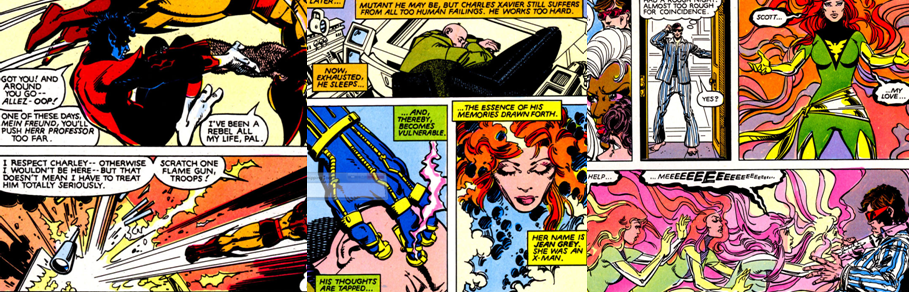
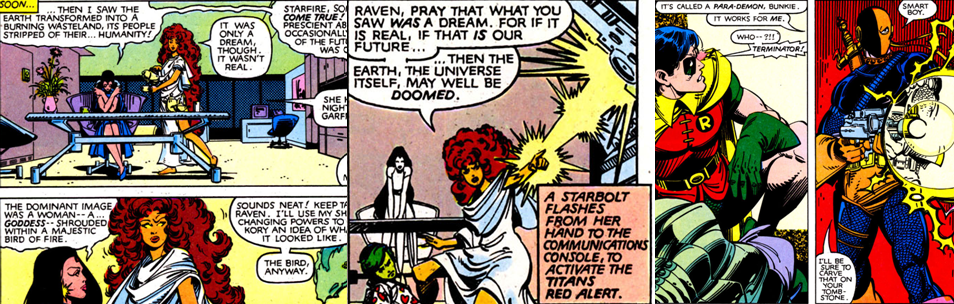
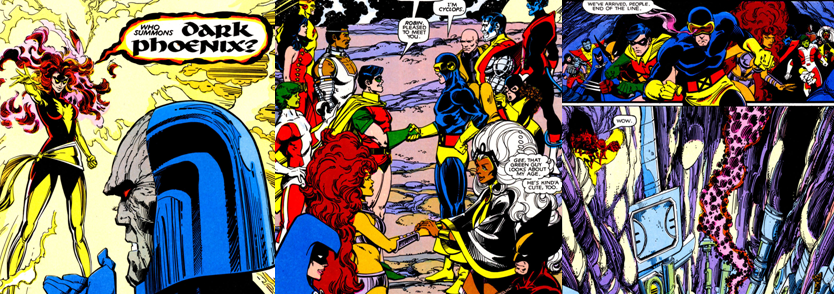
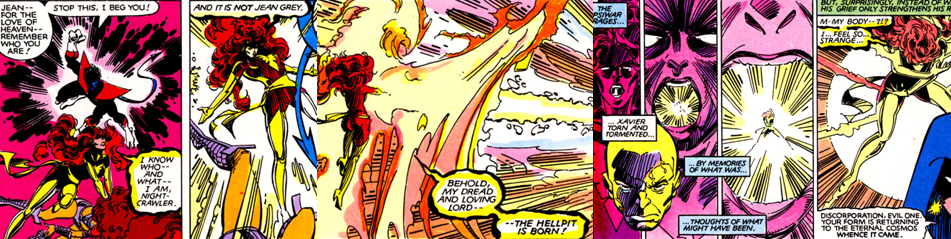
Movie Night [X-Men Month]: X-Men: Days of Future Past: The Rogue Cut


To commemorate, the culmination of their long-running and successful X-Men movies, 20th Century Fox declared May 13th as “X-Men Day”, a day to celebrate all things Mutant and X-Men and celebrate Marvel’s iconic collection of superpowered beings who fight to protect a world that hates and fears them. After exhausting all of their storylines with their original cast, save for Hugh Jackman, 20th Century Fox began producing a series of loose prequels centred on younger X-characters and, to commemorate X-Men Day this year, I’m spending the next few weeks looking back at the first three entries in this “Beginnings Trilogy” to see if they still hold up today.


Released: July 2015
Originally Released: May 2014
Director: Bryan Singer
Distributor: 20th Century Fox
Budget: $200 to 220 million
Stars: Hugh Jackman, James McAvoy, Michael Fassbender, Jennifer Lawrence, Peter Dinklage, Nicholas Hoult, Patrick Stewart, Ian McKellen, and Anna Paquin

The Plot:
By 2023, Mutants and their allies have been hunted to near extinction by the mechanical Sentinels. Desperate to avert this dystopian future, Professor Charles Xavier (Stewart) has joined forces with his long-time adversary, Erik Lehnsherr/Magneto (McKellen) and opt to use Kitty Pryde/Shadowcat’s (Ellen Page) time-bending abilities to send the consciousness of Logan/Wolverine (Jackman) back to 1973 to team up with their younger selves (McAvoy and Fassbender, respectively) and keep Raven Darkhölme/Mystique (Lawrence) from causing the eradication of Mutantkind.

The Background:
Having been an integral part of Marvel Comics since their 1963 debut, the X-Men went on to have success in numerous videogames, cartoons, and a financially successful franchise under the banner of 20th Century Fox. After three blockbuster movies and two successful spin-offs focusing on breakout star Hugh Jackman, Fox opted to bring in a younger cast and shine a spotlight on the early days of the X-Men. With X-Men: First Class (Vaughn, 2011) planned as the start of a new trilogy, development began on a sequel that same year; however, rather than develop Vaughn’s ideas for a more grounded and fitting sequel, series producer Lauren Donner and returning director Bryan Singer set writer Simon Kinberg to work penning an adaptation of the classic “Days of Future Past” (Claremont, et al, 1981) storyline that would see the older original X-Men actors sharing the spotlight with their younger selves thanks to its time travel plot. X-Men: Days of Future Past is, for me, one of the better X-Men sequels and I actually rank it quite high despite my dislike for the dodgy timeline these prequels created, a belief shared by many as the film was met with a generally positive critical response that was matched by its box office gross as the film made over $740 million worldwide, the highest of out any X-Men movie to date (apart from the Deadpool (Various, 2016 to present) spin-offs). A year or so after the film’s release, Fox released The Rogue Cut, an extended version of the film that includes an entire excised subplot concerning Marie D’Ancanto/Rogue (Paquin); as I consider this the definitive version of the film, this will be the cut I am reviewing here.

The Review:
In best Terminator (Cameron, 1984) fashion, Days of Future Past opens to show a dystopian future, a war-torn wasteland where Mutants, Mutant sympathiser, and those who may one day produce Mutants, are relentlessly hunted and killed by massive, fearsome Sentinels. Those that survive are either constantly hounded, unable to defeat this terrifying foe, or experimented on by the very worst of humanity. It’s a bleak and depressing future, one that is decidedly at odds with both Xavier’s dream for human/Mutant cohabitation and Magneto’s dream of Mutant superiority. It is into this hellscape that we are reintroduced to a whole new team of X-Men, many of whom are comprised of old and new faces alike. The purpose of many of these characters is simply to die in horrific ways as the Sentinels carve through stone and metal, incinerating them, ripping them to pieces, skewing them, and constantly adapting to their abilities.

Kitty uses her newfound abilities to help allies and former foes escape the unstoppable Mutant hunters.

Luckily, though, Kitty has…somehow, it’s never actually explained exactly how in the film…developed her powers of intangibility to the point where she can project a person’s consciousness into their younger self. This power, alongside the heightened senses of James Proudstar/Warpath (Booboo Stewart) and the portal-hopping powers of Blink (Fan Bingbing), has allowed the X-Men to stay just barely one step ahead of the Sentinels. However, when they finally reunite with Xavier, Magneto, Logan, and Ororo Munroe/Storm (Halle Berry), they learn of the true origins of the Sentinels; they were created back in the seventies by a scientist named Boliver Trask (Dinklage) and put into mass production after Mystique executed him on public television. Believing that keeping Mystique from killing Trask would erase their future from history, Logan volunteers to make the trip back into his younger body (as only he can survive such an extended trip) and bring the younger Xavier and Magneto together to steer Mystique away from her dark fate. The concept of Days of Future Past is past meets future; however, fans of the newer, First Class cast should be happy to find that the returning cast members from the original X-Men films don’t overshadow their younger counterparts. The older actors bookend the film, and are peppered throughout, but the majority of the film’s runtime is devoted to the new, younger cast and Logan’s interactions with them to prevent a nightmarish future. As a result, most of the older cast exist solely to deliver exposition or to shock us with their gruesome death scenes; once again, Peter Rasputin/Colossus (Daniel Cudmore) is dealt a shitty hand compared to returning characters like Storm and Bobby Drake/Iceman (Shawn Ashmore), who at least have a few lines and play a semi-important role in defending the X-Men from the Sentinels. The new characters follow the same blueprint we’ve seen from nearly every X-Men movie in that they look cool and have cool powers but we no nothing about them and they exist simply to be slaughtered by the Sentinels.
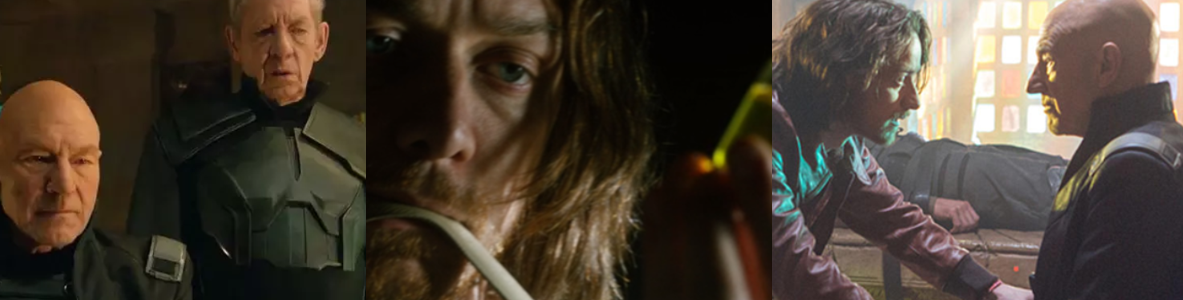
Though Xavier and Magneto are finally united in the future, the young Xavier is a disillusioned addict.

The focus is thus placed on Xavier, who drives the desperate dive into the past, Magneto, who has completely set aside his grudge against Xavier and is now despondent at all the years they wasted pointlessly fighting each other, and Kitty, whose powers anchor Logan in the past. They really sell the desperation and futility of their situation and seeing them all right at the end of their tether is an affecting moment that really helps to motivate Logan in ways we haven’t seen before. Awakening in the past with his bone claws, Logan inexplicably finds himself in America rather than causing waves over in Vietnam; travelling to Xavier’s mansion, he finds the young professor walking but at his wits end. Having fallen into a deep depression after the events of First Class and the outbreak of the aforementioned war, Xavier has become addicted to Henry “Hank” McCoy/Beast’s (Hoult) magic serum, which suppresses his powers and allows him to walk and sleep but has transformed him into a broken shell of his former, and future, self. This positions Wolverine in what is, for him, an uncomfortable position; with the clock ticking against him and frantic to prevent the future he has seen, Logan is forced to guide Xavier back towards his true self. Generally, this take the form of Logan’s trademark tough love but, when he begins to see just how far Xavier has fallen, he allows the younger professor to connect to his mind and converse with his future self in a fantastically poignant scene. Jackman gels really well with the First Class cast, portraying Logan as a blunt, war-weary soldier who has also matured and grown into a role of responsibility and duty. The knowledge that he is the only one who will remember the bad future is haunting as he is fully aware that he will remember seeing all the death and destruction even if their mission succeeds, basically sacrificing his own inner peace for the sake of the world.

While Xavier’s forced to confront his demons, Magneto seems ready to accept his destiny…

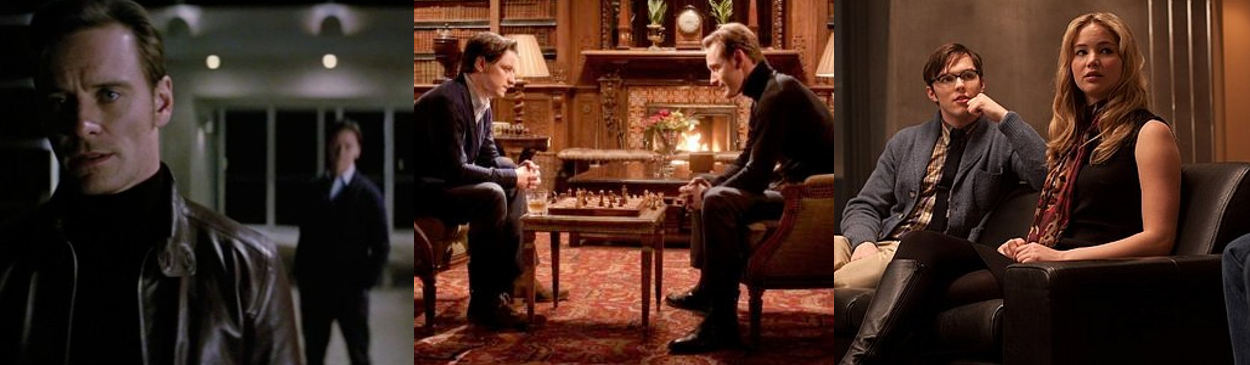
McAvoy continues to show new sides to Xavier; he ended First Class taking his first steps towards becoming the mentor and father-figure he is destined to be but begins this film as little ore than a disillusioned junkie. Logan’s mission forces him to overcome those demons and also to do something even more difficult: reach out to his childhood friend and true to pursued her to veer from her path and join forces with his former friend, Erik Lehnsherr. At this point, Xavier feels nothing but hatred and resentment for Erik for not only inadvertently crippling him and turning him into the man he has become but also for taking Raven away from him. This is, of course, completely irrational as Xavier told Mystique to go with Erik at the end of First Class but this is actually the point; Xavier’s emotions, anger, and despair have clouded his mind and motivations, blinding him to his own failings. Erik, however, is more than happy to remind Xavier of these failings; once again, Fassbender is a magnetic (no pun intended) presence, dominating every scene he’s in thanks to his cold, calculating countenance and his ominous charisma. In an emotional outburst, Erik chastises Xavier for hiding and cowering in his mansion when their brothers, sisters, and teammates were captured, tortured, and slaughtered by Trask’s experiments, which really sells the idea that Erik is all about protecting and defending all Mutantkind, even those who would oppose him. As I mentioned before, however, Magneto’s story arc is almost exactly as it was in First Class; he begins the film as an ally, turns on his friends, and ends the film as a fully-garbed Magneto ready to enact his will on the world…only for the very next film to find him a doting family man who has retired from his war. It’s a shame, really, and I feel like the script could have been tweaked so that Erik is the one who is destined to kill Trask that solidifies his position as an all-out villain; it’s not that I don’t like Erik’s moral ambiguity and the conflict Fassbender brings to the role, it’s just frustrating to see him end up looking so much like Magneto with such promise for the next movie only to have to go through it all over again.
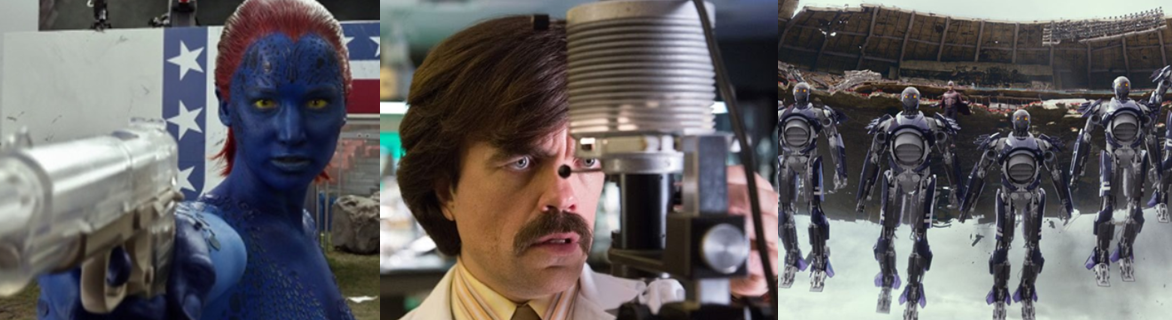
The battle for Mystique’s soul is as much a part of the plot as Trask and his Sentinels.

After First Class, Jennifer Lawrence shot to superstardom and thus plays a pivotal role in this film; having been working alone to free Mutant prisoners and campaign for Mutant superiority, Mystique uncovers Trask’s experiments and plans for the Sentinels and believes the only logical course of action is to execute the man responsible for so many Mutant deaths (including those of her friends from First Class). Now much closer to her bad-ass, emotionally closed off future self, Mystique rejects both Xavier an Erik when they attempt to stop her and the crux of the movie really becomes a battle for her soul as much as the future as all parties try to keep her from taking her first life and dooming them all. I’m still not a fan of Lawrence, and quite how her power to assume the form of others leads to Sentinels that can adapt to any form of attack is beyond me (Armando Muñoz/Darwin’s (Edi Gathegi) powers would have been more fitting), but her story arc here is quite engaging and she sells the character’s conflicted nature really well. Fulfilling the resident, Mutant-hating human antagonist role is Bolivar Trask, a scientist who views Mutants as a threat to all humanity that can unite the warring nations in a way never seen before. Dinklage is great in this role, portraying Trask as a man of conviction who both admires and fears the potential of Mutants and their threat to humanity. Like every good villain, he is completely convinced that he is in the right and is motivated by a sense of duty and patriotism but there is a sadistic side to him as he has been relentlessly experimenting on and killing Mutants. He is juxtaposed by, who else, but Major William Stryker (Josh Helman); rather than being a military scientist who wants to round up and experiment on Mutants (or being played by Danny Huston as he should have been considering where the character was at this point), Stryker is more like Trask’s muscle. In many ways, it feels like Trask has usurped Stryker’s usual role, which makes Stryker’s inclusion pretty pointless save for causing Wolverine to freak out. Of course, the film’s big selling point is the inclusion of the Sentinels; these massive Mutant hunting machines were hinted at (as was this entire storyline) in X-Men: The Last Stand (Ratner, 2006) but it still blows my mind that we got to a point where an X-Men movie would not only use time travel and the “Days of Future Past” storyline but the Sentinels as well. They appear in two forms here, the sleek, super-adaptive, semi-mimetic poly-alloy, relentless killers of the future and the large, bulky, more comic-accurate machines of the past. Personally, I prefer the latter and feel like an army of those would have been just as pressing a threat and would have negated to need to focus so hard on Mystique’s unique X-Gene, but the threat of the Sentinels is a very palpable one as we see how unstoppable they become in the future. Of course, it doesn’t make a whole lot of sense that the government would either not put them into mass production for some fifty years or that they would not reactivate the program when Magneto emerged as a real threat but the comic book nerd in me finds their presence very exciting nonetheless.

The Nitty-Gritty:
Well, while McAvoy, Fassbender, Lawrence, and Hoult all get a good innings and time to shine, other characters from First Class aren’t so lucky; with the exception of Alex Summers/Havok (Lucas Till), who returns in a brief cameo, all of the Mutants from the previous film have died between movies, victims of Trask’s experiments. This is quite a kick in the teeth as we could have seen these characters actually develop and progress but, instead, they are unceremoniously killed off to fuel Mystique’s lust for vengeance and Magneto’s desire for Mutant supremacy. On the other hand, though, it does mean that the film does a far better job of juggling its cast of characters, putting the focus on Xavier, Erik, and Mystique with Logan along for the ride to remind us of the stakes.
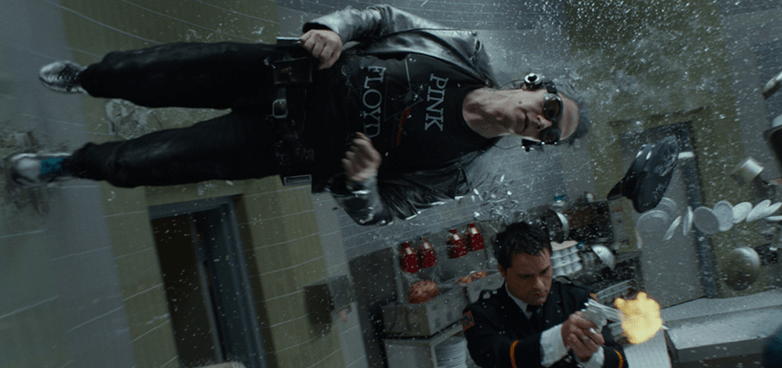
Quicksilver is a breath of fresh air for the franchise who needed a far bigger role.

Of course, it wouldn’t be an X-Men movie without the gratuitous introduction of a brand new Mutant and, in this case, we get one of the best and yet more disappointing inclusions yet: Peter Maximoff/Quicksilver (Evan Peters). A superfast kleptomaniac, Quicksilver is an energetic ball of fun in a film that is generally quite serious due to its stakes. His powers also allow for a fantastic scene in which he travels so fast that the rest of the room appears to be stationary, a sequence that, perhaps, rivals the opening of X-Men 2 (Singer, 2003). Unfortunately, though, so great are Quicksilver’s powers in this film that the movie would be over too quickly if he were to play a larger role so, after helping break Erik out of his special prison, the film promptly ditches Quicksilver with the weakest of explanations. Like, I get it but he’s such a cool, fun, and interesting character that I would have much preferred the writers find a way to incorporate him rather than just taking the easy, lazy route out.
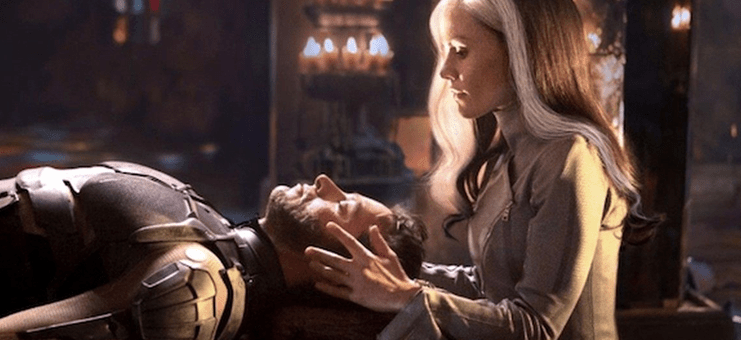
Rogue takes over after Kitty is injured, reuniting with Logan in the process.

Still, at least Quicksilver made it into the film; Rogue was reduced to a mere cameo in the theatrical cut but, here in The Rogue Cut, plays a pivotal role when Logan’s violent thrashing critically wounds Kitty, forcing Iceman and Magneto to go off on a side mission to rescue Rogue and have her take Kitty’s place. It’s nice to see the footage cut back into the film and helps to remind us of the stakes in the bad future but I can kind of see why it was cut as it is kind of unnecessary. They could have simply replaced one of the new future X-Men, like Sunspot (Adan Canto) with Rogue and had the best of both worlds but at least it leads to a tender reunion between Rogue and Logan.
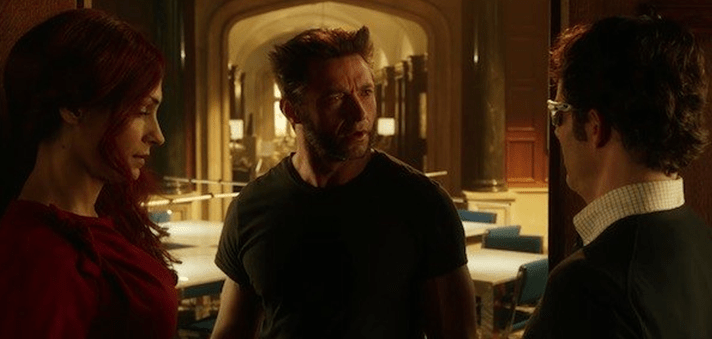
Logan awakens in a good future that is, sadly, destined to also end in ruin…

Probably the biggest missed opportunity of Days of Future Past, however, is that the filmmakers don’t use the time travel plot more to their advantage to explain the discrepancies in the time line. They try to but only in relation to the future events rather than those of established canon, and Logan’s journey to the past clearly creates at least two new timelines (one for the younger cast and one for the older cast that, despite appearing idyllic, eventually turns just as bleak and dour as the Sentinel-ruled future), but they could easily have used this as an excuse to correct the existing continuity as well. Instead, we find Logan not in the middle of fighting alongside Team X or Xavier and Erik not working together at the school; in fact, the film’s ending goes out of its way to basically erase X-Men: The Last Stand and The Wolverine (Mangold, 2013) from continuity, which is actually quite lazy as The Wolverine proved there was still a lot of mileage to be made in dealing with The Last Stand’s ending, and although it refers to X-Men Origins: Wolverine (Hood, 2009), it pretty much pretends like that film didn’t happen and right when it ends with the ominous implication that seventies-Logan ends up in Stryker’s custody it’s revealed it’s actually Mystique posing as Stryker…despite the fact that Wolverine does end up Stryker’s prisoner in the next film.

The Summary:
X-Men: Days of Future Past successfully brings the two X-Men casts together in one era-spanning action/adventure; the stakes have never been higher and the calibre of acting never more affecting as two generations of X-Men seek to prevent a nightmarish future. It doesn’t do much to correct the existing canon; in fact, it actually screws up way more than it fixes with the new timeline it creates and repeats quite a few of the things I disliked about X-Men: First Class as well as making a few new ones (such as killing characters off-screen and dramatically expanding on Mystique’s importance). Yet, like X-Men Origins: Wolverine, there’s just something about this film that I really enjoy. It’s bombastic and action-packed at times but there’s more a sense of ominous foreboding, that the future is an inevitable tide the characters cannot fight against, that lends a lot of weight and urgency to the plot. Jackman’s interactions with the younger X-cast are fantastic, placing his character in an uncomfortable position where he finds himself having to inspire his future mentor and fighting against an enemy that he can’t just slice to ribbons with his claws. Is it a perfect movie? No, of course not; it’s an X-Men film and those rarely manage to be perfect because of one reason or another. Do I think it was too early to do this storyline and mash these casts together? Absolutely. And yet, this is easily in my top five (maybe even top three) X-Men movies purely for the thrill of seeing the past and the future collide, the presence of the Sentinels, and the fact that it ties up one storyline while setting up an entirely new timeline of events.

My Rating:

Rating: 5 out of 5.

Fantastic

What did you think of the Rogue Cut of Days of Future Past? Do you think it is superior to the theatrical cut or do you, perhaps, not care for its additional plot points? What did you think of integrating the old and new X-Men casts together? Were you also a bit confused about Kitty’s sudden ability to time travel? What are your thoughts on the “Days of Future Past” storyline from the comics? Which X-Men storyline would you like to see adapted to film one day? Whatever your thoughts, feel free to leave a comment below, and pop back next week for one last X-Men review.

Screen Time [Multiverse Madness]: WandaVision


In September 1961, DC Comics published “Flash of Two Worlds” (Fox, et al), a landmark story that brought together two generations of the Flash: the Golden Age Jay Garrick and the Silver Age Barry Allen thanks to the concept of the multiverse, an infinite number of parallel universes that allowed any and all stories and characters to co-exist and interact. Marvel Comics would also adopt this concept and, to celebrate the release of Doctor Strange in the Multiverse of Madness (Raimi, 2022) this month, I’ve been both celebrating the Master of the Mystic Arts and exploring the Marvel Cinematic Universe’s (MCU) equivalent of the multiverse every Sunday of May.


Air Date: 15 January 2021 to 5 March 2021
Network: Disney+
Stars: Elizabeth Olsen, Paul Bettany, Kathryn Hahn, Teyonah Parris, Kat Dennings, and Evan Peters

The Background:
Without a doubt, the MCU has become a nigh-unstoppable multimedia juggernaut that has brought some of Marvel Comics’ most beloved, and obscure, characters to life on the silver screen. Although Marvel Studios had dabbled in television ventures as well with Agents of S.H.I.E.L.D. (2013 to 2020) and their Netflix shows, they really upped their focus on TV productions for the MCU’s fourth phase and to coincide with the release of their parent company’s streaming service, Disney+. Spearheaded by MCU head honcho Kevin Feige, the Disney+ shows focused heavily on maintaining and expanding the continuity of the MCU going forward, and the first of these announced was a spin-off that would focus on the previously underutilised characters of Wanda Maximoff (Olsen) and the Vision (Bettany). WandaVision was a curious venture that aimed to explore new areas of the MCU, and the multiverse, by placing the characters in different decades and parodying popular sitcoms throughout the years. Feige aimed for the show to shed new light on Wanda’s potentially dangerous powers and to lay the foundation for the MCU’s fourth phase by dabbling in the multiverse. Inspired by both classic sitcoms and notable comic book storylines involving both characters, the show was framed as a surreal and bizarre mystery that would weave in aspects from outside the MCU and build to a dramatic finale that fundamentally altered Wanda’s character. Released in weekly episodes that sent fan speculation into a frenzy, WandaVision received widespread critical acclaim; critics praised the show from breaking away from the usual MCU formula and its emotional and dramatic themes, though some criticised the finale and the show’s overall pacing. Still, WandaVision was highly successful and its story arcs continued in a later spin-off.

The Plot:
Three weeks after the events of Avengers: Endgame (Russo and Russo, 2019), Wanda Maximoff and the Vision are living an idyllic suburban life in the town of Westview, New Jersey, where they conceal their true natures. However, things are not as they seem as their surroundings begin to move through different decades and they discover that they’re being manipulated by a malevolent supernatural force.

The Review:
Thanks to the inclusion of super cringe, super appropriate jaunty theme songs and opening titles at the start of each episode, WandaVision quickly catches us up with the two Avengers and the general theme of the show; somehow, Wanda and the Vision have gotten married and settled down in Westview, a quiet little town where they hope for a fresh start amongst normal, everyday people. To achieve this, the two keep their extraordinary abilities hidden; however, when in the privacy of their own home, Wanda freely uses her magic to perform household chores, such as tidying and cleaning, and the Vison walks around in his default synthezoid form without a second thought. Outside of the house, the Vision alters his physical appearance to pass as human and works at Computational Services Inc.; while he is naturally incredibly efficient and hardworking, neither he nor his co-worker, Norm (Asif Ali), has any idea what the company actually does. Although Wanda and the Vision seem perfectly happy in their new life, with all its quirks and eccentricities, WandaVision shows hints towards a darker side of their lives right from the first episode; while entertaining his boss and his wife, Mr. and Mrs. Hart (Fred Melamed and Debra Jo Rupp), neither of the main characters can recall where they came from, when they got married, or how they even got there. Wanda is so confused by her inability to answer such simple questions that she simply sits, perplexed, while Mr. Hart chokes to death on a piece of food and Mrs. Hart is locked in an agonising loop where she can only say “Stop it!” with good humour. Eventually, Wanda sees how serious the situation is and asks the Vision to step in and the whole incident is laughed off as a gag, but it’s a disturbing moment made all the more intriguing when the episode ends with its events being watched by another within the show, providing our first hint that WandaVision is a show within a show.

Wanda’s concerns over her family are superseded by strange events and imposters in her quaint life.

Still, despite this incident, the two are determined to fit in with their quaint little suburban community; the Vision joins the neighbourhood watch, Wanda joins the planning committee for the local talent show, and Wanda is keen to take the family trick-or-treating later in the show. Essential to helping her to fit in is Agnes (Hahn), Wanda’s “neighbour to the right”, who constantly drops in on her at the most convenient of times to offer friendly advice about how to deal with the local social committee or to help her out of awkward situations. Agnes takes a special interest in Wanda and the Vision’s sex life (apparently because she is under-sexed and under-valued by her unseen husband, Ralph), and continuously probes Wanda for intimate details about her life and offers Wanda advice about how to spice up her sex life. Right from the off, Agnes is dropping hints about the two starting a family, and this is only exacerbated when Wanda feels detached from the community because she doesn’t have children like Dottie Jones (Emma Caulfield Ford), the head of the committee and a prominent figure in Westview’s social elite. After their magic show is a smash hit (despite the Vision being inebriated due to gum clogging his systems and Wanda frantically using her Chaos Magic to explain away her husband’s superhuman feats, and the fact that there are no children in attendance for show), Wanda is overjoyed when she spontaneously becomes pregnant and so angered by the strange appearance of a beekeeper’s outfit emerging from a manhole that she literally rewinds time to return to her happy moment.

Pregnancy throws Wanda’s powers out of whack but Geraldine incites her wrath by mentioning Ultron.

Wanda’s pregnancy is explored through the third episode, “Now in Color” (Shakman, 2021); while she is delighted to find that she is already four months pregnant and happy to busy herself using her magic to decorate and prepare a nursery, the Vision begins to find himself disturbed by the strange goings on in their lives and around Westview. Every time he stops to consider why his neighbours are acting so strangely or how Wanda’s pregnancy is progressing so fast, Wanda gets closer and closer to popping, replacing his concerns with the dual emotions of happiness and anxiety at the thought of becoming a father. Wanda’s pregnancy sends her powers all out of whack and causes a neighbourhood blackout; when she worries that Westview will suspect she’s the cause of it, this strikes a chord with the Vision but, again, Wanda causes an abrupt jump cut to keep him from following his thoughts through any further and he’s soon rushing off to retrieve Doctor Stan Nielsen (Randy Oglesby) to help deliver the baby. Although she tries her best to hide her condition using bowls of fruit and to wish away a stork she randomly brings to life, Wanda eventually succumbs to her pregnancy but, luckily, her new friend Geraldine (Parris) is on hand to help out. Thanks to Geraldine, Wanda successfully gives birth to Baby Tommy and then she and the Vision are shocked at the arrival of his twin, Baby Billy. While thanking Geraldine and cooing over her babies, Wanda is reminded of her own twin brother, Pietro (Aaron Taylor-Johnson); this seems to snap Geraldine out of her trance and, when she accidentally reminds Wanda of her brother’s death at Ultron’s (James Spader) hands, Wanda becomes enraged and forcible ejects Geraldine from Westview, which is revealed to be encased within a translucent energy field not unlike television static and monitored by government agents.

While Monica, Woo, and Darcy try to help Wanda, Hayward is convinced that she’s a threat.

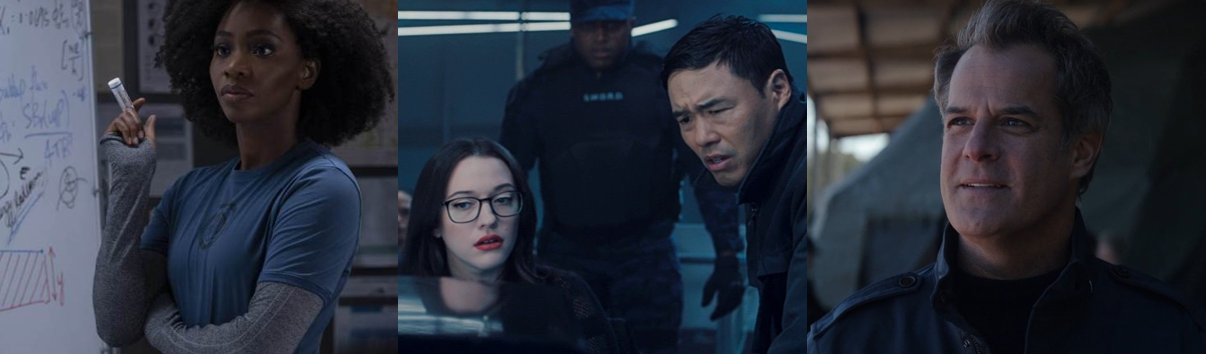
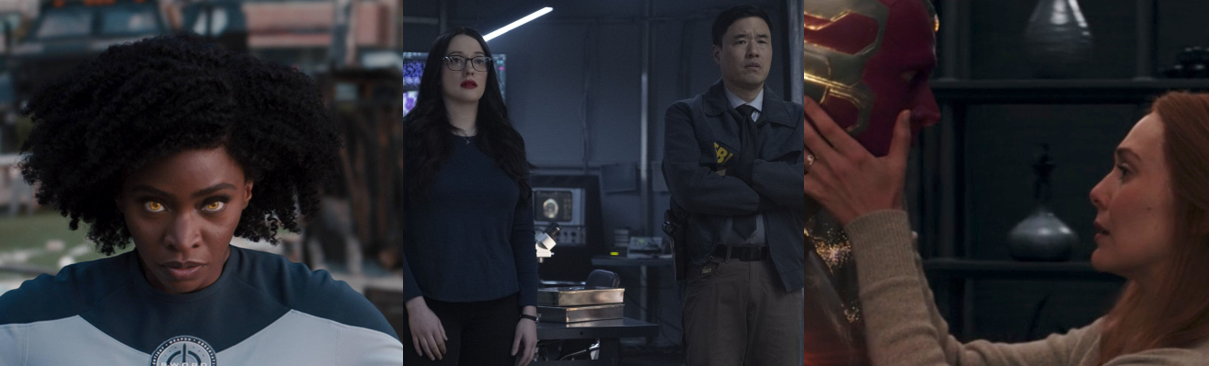
This is the perfect way to transition to some actual context for the show as, after three episodes of intrigue and mystery, “We Interrupt This Program” (Shakman, 2021) goes a long way to explaining just what the hell is happening by following Geraldine after she is restored to life by the second snap of the Infinity Gauntlet. It turns out that she’s not a native of Westview at all and is, in fact, a grown-up Monica Rambeau, which is relayed in a harrowing sequence where Monica stumbles through a hospital thrown into disarray by people suddenly returning from being disintegrated and culminates in her receiving the heart-breaking news that her mother, Maria (Lashana Lynch), succumbed to cancer while Monica was lost to the snap. Monica is a former fighter pilot captain in the Sentient Weapon Observation and Response Division (S.W.O.R.D.), an intelligence agency founded by Maria and now run by Director Tyler Hayward (Josh Stamberg) that monitors and responds to threats posed by robotics and artificial intelligence. Monica is assigned to assist the Federal Bureau of Investigation (F.B. I.) with a missing persons case in Westview and liaises with Jimmy Woo (Randall Park), whose investigation has stalled because no one seems remember Westview or its inhabitants and the entire town is sealed within an odd temporal anomaly referred to as the “Hex”. After Monica’s drone disappears inside the Hex and Monica is sucked within shortly after, Hayward brings in Doctor Darcy Lewis (Dennings) and a number of other scientists to help. Darcy then recognises the patterns of cosmic background radiation and discovers that they are akin to old analogue broadcast signals, successfully tunes into WandaVision, and becomes invested in the show. Woo and Darcy ascertain that WandaVision’s “cast” is comprised of Westview’s missing residents, and that Monica and everything that breaches the Hex is assimilated into the show to become part of the cast a harmless toy, or a beekeeper. Their attempts to contact Wanda using radio signals only unnerve Wanda and injure Dottie, and Wanda is enraged at Monica trespassing in Westview; their confrontation is so traumatic for her that her sitcom demeanour falls away, and she’s briefly horrified by an apparition of the Vision’s mangled corpse.

While the twins adore their uncle, Wanda is confused by Pietro’s altered appearance and personality.

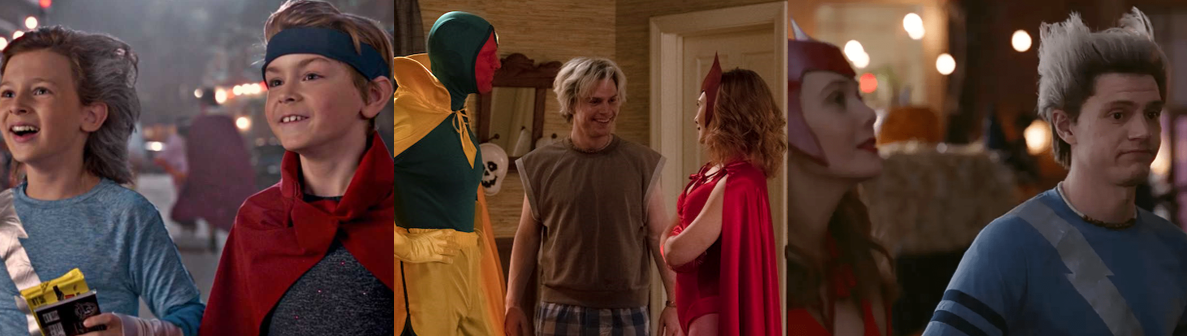
From then on, WandaVision routinely switches between the ongoing drama within the show and the efforts of those outside the Hex to try and figure out what’s happening. Wanda and the Vision’s struggles to calm their crying children are skipped over when the twins spontaneously age-up to five years old; Billy (Baylen Bielitz) and Tommy (Gavin Borders) adopt a stray dog, “Sparky”, and then age-up another five years to be “old enough” to keep him. Sadly though, Sparky goes missing and is found dead by Agnes; Wanda struggles to comfort her boys, hypocritically asking Billy (Julian Hilliard) and Tommy (Jett Klyne) not age-up any further so they can face the natural reality of Sparky’s death. However, having seen what their mother is capable of (she soon decides she’s “tired of hiding” and openly uses her magic in front of Agnes), they implore her to use her powers to “fix the dead”, a feat that she believes is beyond even her and yet she’s stunned when “Pietro” (Peters) shows up on her doorstep, alive and well but sporting a new face and personality. The twins quickly become close to their fun-loving, free-spirited uncle; Pietro still has his superspeed, here depicted very similarly to his MCU counterpart, and is very much the freeloading man child archetype. Pietro causes havoc on Halloween night and is generally a bad influence on the twins, which he claims is what Wanda wants from him. Wanda doesn’t fully trust or understand his appearance, however, and is confused by their differing memories of their childhood; he relates a fuzzy memory of being shot to death and then hearing her calling for him and expresses an awareness of Wanda’s influence on Westview. Rather than judging her, Pietro is impressed at how far her powers have progressed but, just as she begins to feel comfortable enough to open up about how alone she has felt, Wanda has a brief vision of Pietro’s bullet-riddled corpse dead and strikes him with her powers when he makes a glib remark about the Vision’s death, which is enough to cause her to distrust him from then on.

The Vision is angered to discover that Wanda enslaved Westview, but equally determined to help her.

Despite Wanda’s best efforts, the Vision’s concerns about Wanda and Westview continue to niggle at him; he’s aghast when Wanda brazenly uses her magic in front of Agnes and horrified when he learns the townsfolk are being manipulated by Wanda’s powers. When he confronts her, Wanda tries to walk away from the heated argument, and even rolls the credits, but the Vision persists, desperately trying to talk sense into her and infuriated that he’s being controlled, though Wanda insists that she’s not in control of what’s happening and is simply trying to make the best of it. Still, Wanda is troubled by the Vision’s behaviour towards her and his increasing tendency to go “off-script”; the Vision finds residents locked in (and pained by) endless, repeating loops or frozen in place at the edge of town and is stunned when Agnes reveals that he’s not only an Avenger…but also dead, two things he has no memory of. When he attempts to breach the Hex, he begins to disintegrate before Darcy and Hayward’s eyes, distressing Billy so much that Wanda expands the Hex to cover an even greater area and causes Darcy and several other S.W.O.R.D. agents to become assimilated into WandaVision. This only encourages Hayward’s belief that Wanda is a significant threat to Westview; already antagonistic towards superpowered individuals thanks to the struggles he lived through during the Blip, Hayward believes that Wanda is an aggressive terrorist and routinely clashes with Darcy, Woo, and Monica when they champion Wanda’s heroic actions and frame her as a victim of oppression and experimentation rather than aggressor, despite her recent actions. However, Hayward is unconvinced and even manipulates security footage to suit his agenda when, in reality, he’s reconstructed the Vision’s physical remains into a weapon under his direct control.

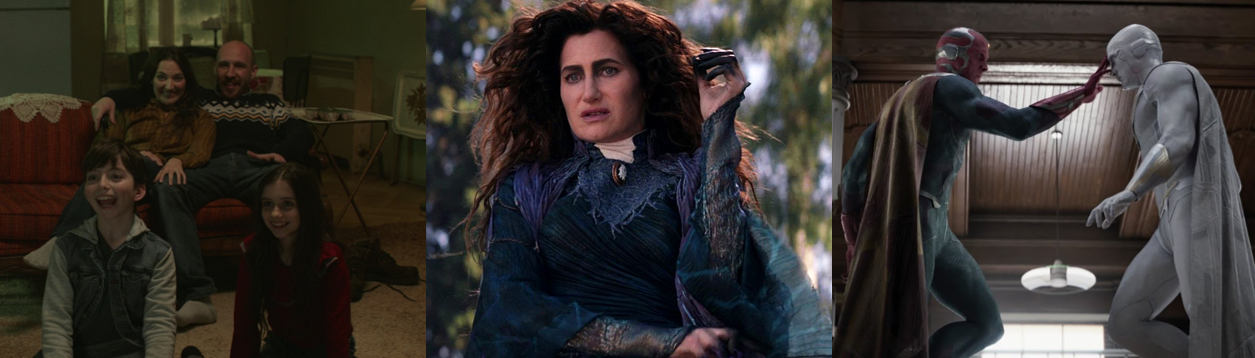
It turns out that Agatha Harkness was behind (almost) everything in a bid to steal Wanda’s powers.

When Monica successfully breaches the Hex using a 1980s drone, Hayward attempts to assassinate Wanda, so she leaves her idyllic fantasy land to deliver a warning against him trying to interfere in her life. This, and expanding the Hex’s influence, causes Wanda’s mental state and control over Westview to begin to deteriorate as the show jumps ahead to the late-2000s; the house and town glitch and switch between eras and Wanda jumps at the chance to take a personal day while Agnes watches the twins. However, her confusion over her unpredictable powers soon turns to dread when she discovers an ominous, gothic lair in Agnes’s basement and her magic is rendered useless by a series of runes. This is when Agnes reveals (through a jaunty musical number) that she’s actually a malevolent witch named Agatha Harkness and has been behind everything happening in Westview (including Sparky’s death!) all along. While this is a fun reveal and definitely changes the context of the show, it does fall a little flat as many watching (including myself) would have no real idea of the significance of the name “Agatha Harkness”. Still, WandaVision tries to make up for this with a flashback to 1693 Salem, Massachusetts that shows Agatha being condemned by her fellow witches for practising dark magic from the forbidden tome known as the Darkhold and revealing that she’s capable of draining the magic and lifeforce of other witches to increase her powers. Drawn to, and envious of, Wanda’s power, Agatha desires to learn the secret of Wanda’s natural affinity for magic and forces her to relive some of her most traumatic memories to understand how the Avenger could possibly be the fabled “Scarlet Witch”.

Agatha forces Wanda to relive her worst memories, while the Vision reconciles with his counterpart.

Wanda witnesses a childhood memory of how she and her family would regularly watch old US sitcoms to bond and practice their English. It was during young Wanda’s (Michaela Russell) favourite episode of The Dick Van Dyke Show (1961 to 1966) that their home was bombed, killing her parents and trapping her and young Pietro (Gabriel Gurevich) and actually the first instance of her using her Chaos Magic to affect the probability of the missile exploding. A subsequent memory of her volunteering to be a part of Hydra’s experiments with the Mind Stone shows that the Infinity Stone simply amplified Wanda’s natural magical abilities rather than causing them, as the MCU first suggested. Wanda also remembers a time when the Vision offered her comfort after Pietro’s death by suggesting “grief [is] love persevering”, and the truth behind her visit to S.W.O.R.D. headquarters after his death; contrary to Hayward’s earlier footage, Wanda was denied custody of the Vision’s expensive and potentially dangerous remains but was allowed to see for herself that he was truly gone. Grief-stricken, she visited Westview, where the Vision had intended for them to start a life together, and exploded in a burst of Chaos Magic; empowered by her pain and loss, her powers not only swept through Westview, transforming it into its original 1960s sitcom setting and enslaving its citizens, but also reconstituted an exact replica of the Vision for Wanda to settle down with and alleviate her anguish and she willingly lost herself to this fantasy world. Essentially a magic vampire, Agatha takes power from those she deems unworthy, and is far more adept at wielding dark magic than the more emotional and naïve Wanda; Agatha mocks Wanda for wasting the powers of the Scarlet Witch in such a way and goads her into a battle by threatening her children so that she can take that power for herself. Wanda is saved by the intervention of Hayward’s reconstructed Vision; cold and ruthless, White Vision attempts to kill Wanda as per Hayward’s orders, but she’s saved by the Vision. As both Visions prove to be equally matched in terms of powers and abilities, the Vision is able to subdue his counterpart by hypothesising that neither are the “true” Vision by using the philosophy of the Ship of Theseus to show that they are simultaneously both the Vision and not the Vision. The Vision then restores White Vision’s memories and personality, releasing him from Hayward’s control and ending his threat as he darts off the an uncertain future.

Wanda outsmarts Agatha, frees Westview, and isolates herself to better understand her powers.

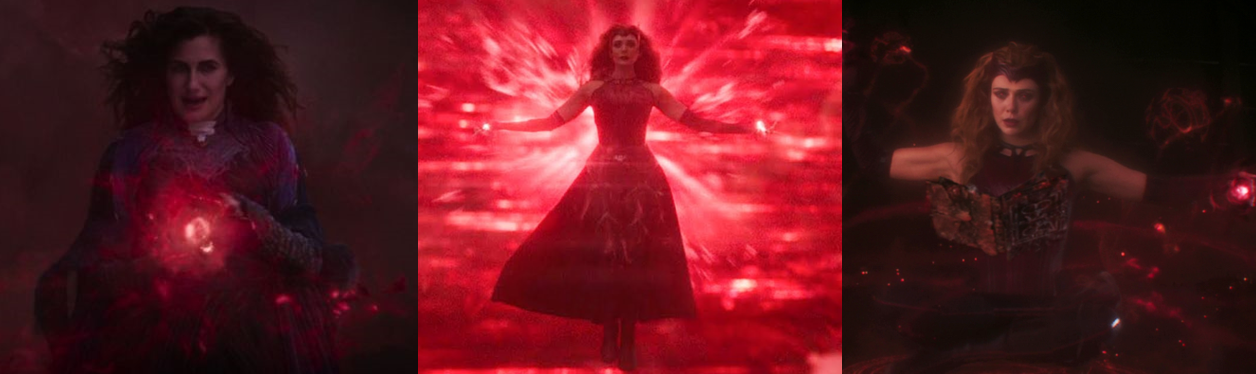
Hayward’s efforts to bring Wanda down lead Agatha to condemn him and his S.W.O.R.D. troops as being little more than the modern-day equivalent of witch hunters, but Wanda protects them regardless and Monica reveals that repeated exposure to the Hex has granted her superhuman abilities that allow her to shield the twins from Hayward’s attempt to gun them down. Darcy then rams his jeep to keep him from getting away and, thanks to Woo’s subterfuge, Hayward’s plot to emerge a hero from the whole affair is exposed. Agatha reveals that the Darkhold foretold that Wanda’s power is destined to not only rival the Sorcerer Supreme’s, but also to destroy the world, and forces her to face the consequences of her actions by releasing Westview’s citizens from her spell. Wanda is distraught to learn that those she thought she was protecting were in such physical and emotional pain, to the point where they beg her to let them go…or die to be free from their torment. Wanda creates a gap in the Hex so that the citizens can finally leave in order to both atone for her actions and to reject Agatha’s claims, but quickly reseals the Hex to keep Billy, Tommy, and the Vision from being erased. Forced to choose between saving her family or saving the town, Wanda ultimately accepts that she is the legendary Scarlet Witch and manages to outsmart Agatha by first overloading her with her Chaos Magic and then turning Agatha’s trick against her by casting protective runes that render Agatha’s powers inert. Wanda punishes the defeated and despondent Agatha by forcing to reassume her “role” as Agnes as recompense for her actions, and finally dispels the Hex, restoring Westview and the surrounding area to normal. Wanda and the Vision head home with the twins and reassure them that they’ll always be a family, before the two share an emotional last moment together where she admits that he was a product of her love and hope as much as her sadness and promises that they’ll see each other again. While Monica knows how much Wanda sacrificed to restore Westview and understands her pain, Wanda’s faced with the judgemental eyes of those she inadvertently hurt, so she heads out to understand her power in isolation at a remote cabin, where she studies the Darkhold in her astral form.

The Summary:   
At its core, WandaVision is a story about grief, loss, and the extremes one goes to after having suffered through some of the worst traumas both imaginable and unimaginable. Hayward’s concerns over Wanda’s threat, while radical, are well founded as, in a moment of anguish, she effectively manipulated the minds and wills of an entire town and forced them to bend to her desires just to make herself feel better. However, it’s clear that Wanda hasn’t done this out of any animosity or aggression; she’s simply suffering and in a great deal of pain, but has caught many innocent souls in her web as a result. Even the Vision is disturbed to see what Wanda’s influence is doing to Westview’s citizens; by touching his fingers to their temples, the Vision is able to free them from Wanda’s control and is met with only hysteria and pleas for help and to get Wanda to stop. When he confronts Wanda, the Vision is enraged at her actions and yet hoping that she didn’t tear families apart and hijack people’s lives out of any malicious intent…however, even Wanda begins to question her intentions and motivations, and her tendency to lash out and the uncertainty about the true nature of the Scarlet Witch certainly raises questions about her character.

The show’s visual style and presentation change as the characters jump through different sitcom eras.

WandaVision wonderfully separated itself from other MCU productions with its production style, format , and overall presentation, which becomes very metatextual and is full of homages to both the source material (the family dress up in comic-accurate costumes for Halloween) and a wide variety of American sitcoms. The first few episodes are presented in black and white, using an older aspect ratio, and clearly drawing inspiration from the sitcoms of the 1950s and 1960s, particularly the likes of Bewitched (1964 to 1972) in not only its premise and setting but also the filming techniques used (the special effects are achieved using practical, in-camera effects and of-the-time methods to give it that authentic fifties feel). The Bewitched influences are even more explicit in opening titles of the second episode, “Don’t Touch That Dial” (Shakman, 2021), which are directly influenced from that show, and we see this again as the series progresses, particularly in “Breaking the Fourth Wall” (ibid), which emulates the opening titles of Modern Family (2009 to 2020). The series is injected with a wash of colour at the conclusion of “Don’t Touch That Dial” and jumps into the vibrant brightness of the 1970s from “Now in Color” (ibid) to evoke groovy, jaunty, sitcoms like The Brady Bunch (1969 to 1974). With each new era, the character’s wardrobes, hair styles, and the show’s furnishings are all updated accordingly, and the focus quickly becomes about depicting the growth of Wanda’s family unit. Initially, episodes feature a canned laughter track to accompany the many sight gags and double entendres; this laughter track remains even when odd or disturbing events are happening onscreen, such as when characters are in danger of going “off-script”, and is ultimately replaced in favour of characters directly breaking the fourth wall or being filmed in a mockumentary, as was the style of late-2000s sitcoms.

A bunch of weird events, moments, and character quirks sent internet speculation running wild!

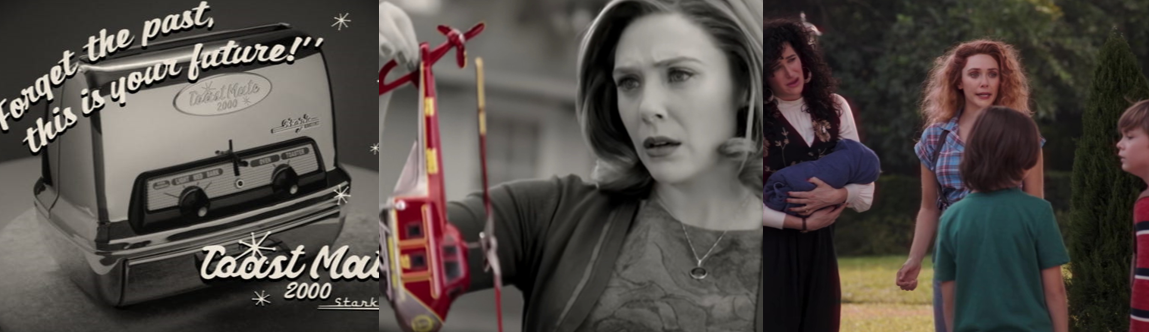
WandaVision certainly got people talking when it first came out, and it’s easy to see why; every episode is peppered with gags, double meanings, and vague hints about what’s really happening in Westview (Agnes refers to Wanda as “The star of the show!”, which is another double meaning as she’s the star of the talent show and her own actual show). Many of the episodes end with false commercials for products and services that act as metaphors for Wanda’s suffering and anguish: The Stark Industries ToastMate 2000 is a metaphor for her sex life (and emits the same ominous beeping as the Stark missile that threatened Wanda’s life as a child, alongside the slogan “Forget the past, this is your future!”), Strücker watches directly reference the man who experimented on Wanda, Hydra Soak bath powder promises an experience so relaxing that it’ll make bathers forget their troubles and unlock the “Goddess within”, Lagos paper towels are tough and absorbent enough to clean up any accidental mess, the claymation Yo-Magic yoghurt is delivered to a boy stranded on a desert island who struggles to open the lid and wastes away to a skeleton over the course of several days and nights, and Nexus antidepressant pills offer a reprieve for those struggling with the weight of loneliness, guilt, and the feeling of life moving on without them and desperate for some relief. As if these odd commercials weren’t enough, the early black and white episodes are often punctuated by bursts of colour that disturb Wanda and allude to things being not quite right; Wanda is confused to find a toy helicopter that matches Tony Stark’s (Robert Downey, Jr) colour scheme and a tense discussion between Wanda and Dottie quickly turns bizarre when Woo speaks directly to Wanda through the radio, briefly causing Dottie to snap out of character and cutting herself to reveal red blood against the monochrome surroundings. Furthermore, there are numerous allusions to a greater threat looming in the background, one many assumed to be Mephisto; Dottie states that “The Devil’s in the details” and Agnes lends Wanda her rabbit, Señor Scratchy, but ultimately the threat proved to be much closer to home and hiding in plain sight.

A poignant tale of grief that gives some of the MCU’s supporting characters a chance to shine.

Overall, I can see why so many people were impressed by WandaVision; the show is practically the definition of variety, featuring a lot of humour, heart, and drama to keep you invested throughout its run time. No two episodes are the same, even those set within the same time period, and the show evolves as we learn more about what’s going on, splicing in more of those familiar MCU elements while giving returning side characters like Darcy and Woo more time in the spotlight to shine as interesting personalities in their own right. WandaVision also introduces a new superhero to the MCU in the form of the grown-up Monica Rambeau, who ends the series altered at a cellular level and with the prospect of her own space adventure ahead of her with the Skrulls. Of course, there are some things that don’t work; it’s a bit of a tease to bring in Evan Peters only to have him revealed to be an actor with a ridiculously suggestive name who was manipulated by Agatha rather than actually being the Quicksilver from the X-Men movies (Various, 2014 to 2016). Agatha’s reveal didn’t really work for me either, as mentioned, but I did enjoy her as a villain and puppet master; however, it can’t be denied that reducing WandaVision to a big light show battle did kind of go against the deeper themes explored throughout the previous episodes. I think it might have been more effective to leave the Visions to handle the heavy combat in the finale and have Agatha and Wanda engage in a battle of wills rather than tossing fireballs at each other, but it was a colourful and intense end to the series. I enjoyed the chance to explore these characters in more detail, the new introductions to the MCU, exploring the effects of the snap from a different perspective, and the introduction of Wanda’s children and the expansion of her powers. WandaVision definitely tries something new and, for the most part, manages to stand out through its unique presentation; when it’s exploring Wanda’s complex trauma or paying homage to classic sitcoms, it’s really at its strongest, but there are a few missed opportunities spliced in there that may put some viewers off.

My Rating:

Rating: 3 out of 5.

Pretty Good

Did you enjoy WandaVision? What did you think to the themes of grief and loss explored in the series? Did you enjoy the exploration of Wanda and the Vision and the additional spotlight given to some of the MCU’s side characters? What did you think to the use of different colours and filming techniques? Were you also caught up in the speculation, and were you suspicious of Agnes at the time? Did you find Evan Peters’ inclusion disappointing or were you excited to see him included? What do you see happening next for these characters and are you excited to see more from Monica and White Vision? Whatever you think about WandaVision, let me know below.

Movie Night [X-Men Month]: X-Men: First Class


To commemorate, the culmination of their long-running and successful X-Men movies, 20th Century Fox declared May 13th as “X-Men Day”, a day to celebrate all things Mutant and X-Men and celebrate Marvel’s iconic collection of superpowered beings who fight to protect a world that hates and fears them. After exhausting all of their storylines with their original cast, save for Hugh Jackman, 20th Century Fox began producing a series of loose prequels centred on younger X-characters and, while X-Men Day coincided with Friday the 13th this year, I’m going to spend the next few weeks looking back at the first three entries in this “Beginnings Trilogy” and see if they still hold up today.


XMenFirstClassLogo

Released: May 2011
Director: Matthew Vaughn
Distributor: 20th Century Fox
Budget: $140 to 160 million
Stars: James McAvoy, Michael Fassbender, Jennifer Lawrence, Rose Byrne, Nicholas Hoult, Lucas Till, Caleb Landry Jones, Zoë Kravitz, and Kevin Bacon

The Plot:
In 1962, right in the middle of the Cuban missile crisis, newly-graduated Professor Charles Xavier (McAvoy) meets Erik Lehnsherr (Fassbender) for the first time. United in their search for the Mutant terrorist Sebastian Shaw (Bacon), the two join forces with the United States government in forming the first team of Mutants and working to avert World War Three.

The Background:
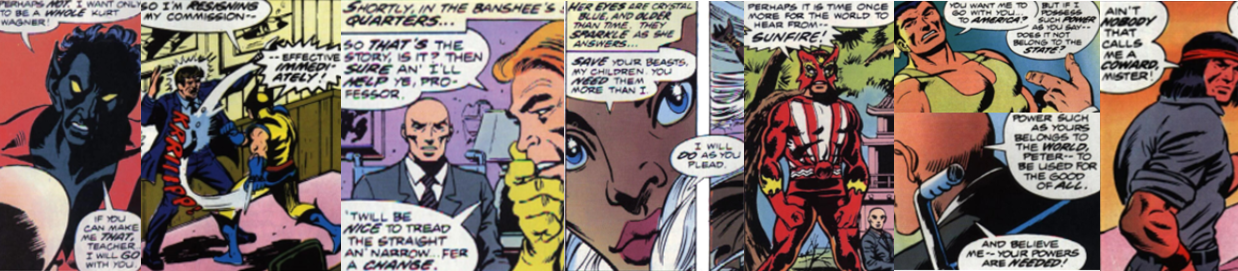
The X-Men have been an integral part of Marvel Comics ever since they debuted back in 1963. Created by Stan Lee and Jack Kirby, the X-Men offered, through their Mutant heritage, an easy excuse to introduce multiple new superheroes with minimal effort. Since then, the X-Men, and all of Mutantkind, have existed as a metaphor for a variety of social issues and seen much success outside of the pages of Marvel Comics thanks to a number of action figures, cartoons, and videogames. After purchasing the film rights, 20th Century Fox profited greatly from the franchise; the first three X-Men movies (Various, 2000 to 2006) alone brought in over $600 million and they had seen similar financial success with a spin-off movie centred around the franchise’s breakout star, Logan/Wolverine (Hugh Jackman). It was during the production of X-Men 2 (Singer, 2003) that the idea of a prequel revolving around younger versions of the X-Men was first proposed; after X-Men: The Last Stand (Ratner, 2006) effectively ended the series, with most of the main cast either dead, depowered, or having exhausted their story arcs, Fox returned to the idea of producing prequels with plans for a spin-off focusing on a young Erik Lehnsherr/Magneto (Ian McKellen). Perhaps shaken by the mediocre critical reception of X-Men Origins: Wolverine (Hood, 2009), Fox abandoned any further ideas of individual spin-offs and ordered a rewrite of the script to focus on Erik and Charles’s early years and the formation of the original X-Men. Although Bryan Singer, who had helmed the first two X-Men movies and very much set the tone and standard for Fox’s franchise, was unable to direct, he returned as a producer and Fox hired Matthew Vaughn (who had previously dropped out of directing the third film) to direct and the idea for the prequel began to take real shape. X-Men: First Class released to strong reviews, a warm critical reception, and eventually made over $350 million in worldwide gross; for many who were disappointed with X-Men Origins: Wolverine, X-Men: First Class represented a step in the right direction for the franchise but, for me, it represented the first sign that Fox were playing it fast and loose with continuity.

The Review:
X-Men: First Class begins with a shot-for-shot recreation of the opening from the first X-Men movie: that is, a young Erik Lehnsherr (Bill Milner/Brett Morris) first discovering his ability to control metal in a Nazi death camp. The purpose of this scene is blatantly obvious and two-fold; the film wants you to remember Erik’s tragic and complex beginnings while also wanting to course-correct back on track to align with Singer’s original vision for the franchise. Oddly, as I’ll get into later, this desire to shift the franchise back towards that quasi-science-fiction, grounded approach is at odds with the direction First Class’s script wants to take its characters so, for me, opening with this scene was more of an insult than a welcome homage.

Lacking Erik’s troublesome childhood, Xavier works to raise awareness of Mutants.

The film could easily have just began with Erik in the office of Nazi scientist Doctor Klaus Schmidt (Bacon); this scene extends that of Singer’s original, impactful opening to show how Erik’s powers were a source of fascination for the Nazis and does just as much to setup his motivations for the remainder of the film. Schmidt, a Mutant himself, forces Erik to use his powers by first threatening and then executing his mother, which would be the driving force for Erik’s lust for revenge and hatred of humanity. At the same time, a young Charles Xavier (Laurence Belcher) meets and befriends Raven Darkhölme (Morgan Lily) and, honestly, this should have been the first clue that these new X-Men movies were not going to concern themselves with things like logic or continuity. While X-Men: First Class gives some much-needed backstory to Raven (who, when she goes up to be Jennifer Lawrence, eventually takes the name “Mystique”), it does so at the cost of  the continuity of the original trilogy as Xavier never once mentions that he had this brother/sister relationship with Mystique (Rebecca Romijn) nor does the older Mystique ever use this relationship to her advantage in those films.

Michael Fassbender steals the show from the proto-X-Men with his complex, seething menace.

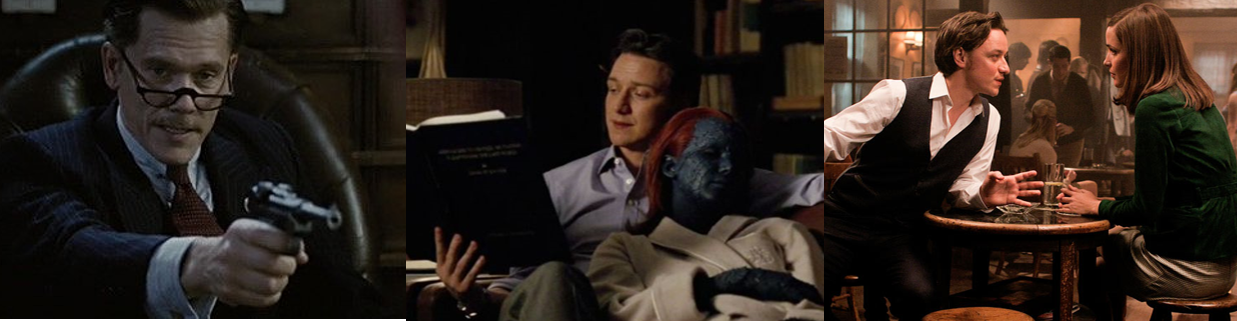
Still, we continue, giving the film the benefit of the doubt, when these characters grow into James McAvoy and Michael Fassbender, respectively. Rather than the wise, all-knowing father-figure of the original X-Men films, Xavier here is a young, post-grad student who downs alcohol and uses both his knowledge of Mutations and his mental powers to pick up chicks in bars. With his long, thick hair and sixties sensibilities, Xavier is a far more “hip and groovy” character but the moment he meets Moira McTaggert (Byrne) and learns of Schmidt’s (now calling himself Sebastian Shaw) plot to incite a third world war, he’s all about assembling his own team of Mutants and working alongside Moira and the CIA to build better relationships between humans and Mutants. It’s an interesting look at the character’s early years but it’s nothing compared to the far more interesting story involving the future Magneto; desperate to hunt down Shaw and make him pay, Erik has spent his entire life tracking down those responsible for his incarceration, torture, and the deaths of his family and people. Fassbender excels in the role, bringing a tortured, focused edge to the character and shines in every scene he’s in; his quiet, seething vengeance is tempered somewhat when he meets and befriends Xavier (another contradiction to the original films as Xavier is clearly not seventeen in this movie…) but their relationship is destined to fail based solely on Erik’s desire to kill Shaw, to say nothing of his own conflicting desire for Mutant prosperity. Still, once the two begin working together, they are introduced to Henry “Hank” McCoy/Beast (Hoult) and, thanks to his prototype Cerebro technology, begin recruiting a team of young Mutants to help oppose Shaw’s own club of misfits. In true X-Men fashion, this means a whole bunch of characters are suddenly thrown into the mix with little to make them stand out beyond them all being young and sexy and having cool-looking powers. Of them all, it is, thankfully, Hank who gets the most screen time and development thanks to his immediate attraction to Raven, his awkward, quirky characterisation, and his desire to develop a serum to suppress his more unattractive physical qualities. Though it seems he and Raven are united in the desire to appear “normal”, she ultimately comes to embrace her unique appearance and, when Hank’s serum actually accelerates his Mutation, he is forced to do the same.

Despite it literally being his Mutant power, Darwin is unable to adapt to survive Shaw’s attack.

The other members of this proto-X-team aren’t so lucky; Sean Cassidy/Banshee (Jones) does alright, being the amusing comic relief of the team, but Alex Summers/Havok (Till) is little more than the “moody bad boy” of the group who, with very little motivation, comes to accept the team as his friends and surrogate family. Angel Salvadore (Kravitz) randomly decides to defect to Shaw’s side when he offers them the chance, with no real explanation or reason beyond the deal apparently sounding better than being mocked by the CIA, but the real slap in the face is the ultimate fate of Armando Muñoz/Darwin (Edi Gathegi) who, despite literally being able to “adapt to survive”, is unable to keep himself from being blown to pieces by Shaw. I mean, we’ve seen that he is able to spontaneously grow gills and armour-plating but it’s apparently too much to find a way to resist Alex’s concussive blasts. Yet at least these proto-X-Men get a neat little training montage to show off snippets of their personalities and powers, however this loses quite a bit of its impact when it’s revealed that they trained and mastered their powers in one week, which honestly isn’t quite as bad as the fact that Xavier found it perfectly acceptable to use this time in this way even though the threat of war is literally hanging over their heads. It’s almost as if the film has too many characters and should have just focused on Xavier, Magneto, Beast, and Mystique as the primary protagonists but this is, of course, only exacerbated by the fact that Shaw has his own evil team of Mutants.

Shaw’s little club all look cool but are painfully under-developed as characters.

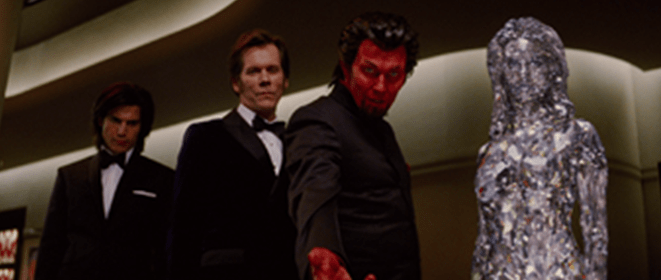
Similar to Magneto’s original Brotherhood, the sheer number of characters and the pace of the film demands that these antagonists simply look cool and not much else, with the exception of Emma Frost (January Jones), who also looks sexy and has a slightly bigger role as she is Shaw’s right-hand woman and a telepath. Azazel (Jason Flemyng) has a great look and is clearly meant to be evoking Kurt Wagner/Nightcrawler (Alan Cumming) but we learn absolutely nothing about him; no seeds are planted for a relationship between him and Mystique that might lead to Nightcrawler’s birth and he gets only one line. Still, it’s one line more than Janos Quested/Riptide (Álex González), who says nothing the entire movie and simply whips up a few mini tornados (or twisters, whatever) and causes some minor inconveniences for the team. Again, it’s almost as if Shaw’s team should have been scaled down to four characters rather than five. Luckily, though, Shaw gets plenty of screen time and Bacon is clearly relishing the role, chewing the scenery and portraying Shaw as an unhinged sociopath who lays much of the groundwork for the villain Erik is destined to become. Able to absorb and redirect energy to maintain his youth, Shaw is a near-unstoppable antagonist, even more so when he acquires a special helmet from the Russians to protect himself from psychic attacks. His motivations are simple to grasp; like Erik, he’s seen the lengths of man’s inhumanity to man and wishes to use a full-scale nuclear war to cleanse the Earth and bring about an age of prosperity for Mutantkind and, as such, he’s a despicable character through and through with an undeniable amount of charisma, making for a fitting challenge for these proto-X-Men.

The Nitty-Gritty:
X-Men: First Class has an interesting premise and does a decent job, for the most part, of fleshing out the early years of Xavier and Magneto. However, despite its pacing being far better than that of X-Men (Singer, 2000) and X-Men Origins: Wolverine, it suffers from trying to cram everything into its runtime despite the fact that a sequel was clearly set up and going to be produced that would have allowed some of these storylines to play out at a much more comfortable pace.

Desperate to cram everything into its runtime, the film inexplicably ends with Xavier paralysed!

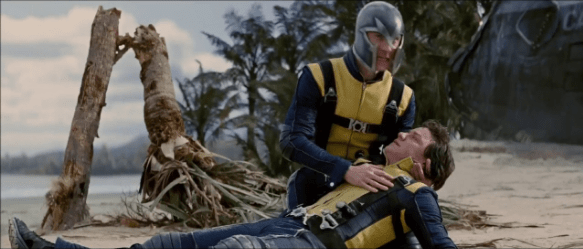
As a result, we get numerous timeline discrepancies in the film: Xavier grew up with Mystique and meets Erik when they’re much older than first stated; Hank builds Cerebro rather than Charles and Erik, Xavier’s first students are wildly different than those hinted at in the previous films and, most egregious of all, the film concludes with Xavier being paralysed by an errant bullet and Erik assuming the role and name of Magneto. No matter how you slice it, none of this aligns with the continuity of the time as we saw a young, bald, walking Xavier, still friends with Magneto, in the opening sequence of The Last Stand and a young, bald, walking Xavier at the conclusion of X-Men Origins, both of which were still canon at this point. The film seems to be in a rush to catch up to the beginning of the first X-Men movie and, honestly, should have ended with Xavier fully-functional and planning to open his house to more Mutants alongside Erik, who would be affected and changed by his final confrontation with Shaw.

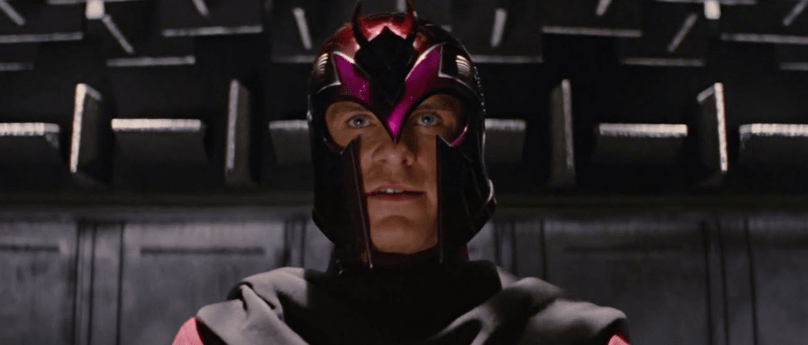
Erik eventually becomes Magneto and look ready to strike back at the world…until the next film…

There is quite a big inconsistency in this film as well, though, wider canon notwithstanding. Obviously, I touched upon Darwin being offed so easily but, for me, the main issue is how vehemently Xavier opposes Erik’s desire to kill Shaw. Xavier believes that killing Shaw in cold blood will set Erik down a dark path he won’t be able to recover from and he’s right, of course, but the inconsistency is that we’ve seen (and, thanks to reading Erik’s mind, Xavier has seen) that Erik has plenty of blood on his hands already. He describes himself as a “weapon” and this appears to be true; he’s tortured and killed numerous people in his bid to track down and end Shaw so why should one more death darken his fate? It doesn’t help that Erik’s descent into villain as told in this film is repeated over and over again in the next three sequels, all of which repeat the same arc (Erik starts off good, becomes morally grey, and ends the film fully-garbed as Magneto and ready to strike back at humanity…only to start the next film good and the cycle repeats). It’s one of those things that seems to work on the surface but falls apart when you think about it and is, again, something that could have been improved upon had the script focused on just Xavier and Erik and a slightly altered greater conflict rather than throwing in a bunch of under-developed or superfluous characters.

This brief cameo did more for Logan’s character than his own spin-off movie!

Speaking of which, the also contains a bevy of cameos; Rebecca Romijn briefly appears in a fun cameo when Mystique is randomly seducing Erik (seriously, their sudden sexual relationship kind of comes out of nowhere and is purely motivated by Raven wanting to hurt Charles and feeling alienated from Hank) and veteran actors like James Remar, Ray Wise, and Michael Ironside all randomly show up in the film’s third act but the true icing on the cake was the brief cameo by Hugh Jackman as Logan. X-Men: First Class was the first real test to see if an X-Men movie could survive and be just as successful without Jackman in a leading role and, judging by its box office and reception, it clearly succeeded in this regard but it’s still fun to see Jackman randomly pop up and tell his future mentor and adversary to “Go fuck [themselves]”.

The Summary:
X-Men: First Class is a fun and engaging X-Men movie; it’s got a fantastic revenge subplot involving the future Magneto and is clearly inspired not only by Singer’s original X-Men movies but also 1960s spy thrillers, all of which give it a familiar, and yet unique, flavour within the franchise. McAvoy and Fassbender steal the show from start to finish but Bacon is a deliciously devilish villain and the acting and action sequences are pretty good, overall, with the film showing new and interesting takes on established characters and shedding more light on events only previously hinted at. And, yet, for me, Fox made a massive mistake by marketing and constructing this film as a prequel. It honestly should have just been a straight-up reboot, restarting the franchise with young actors and a whole new timeline of events rather than trying to awkwardly align with the established canon. For me, continuity is everything and you simply cannot watch X-Men: First Class as part of the wider X-Men canon because it just doesn’t fit; they should have done what the James Bond franchise did and kept Jackman but recast everyone else and started completely fresh because, when you need a convoluted timeline to explain what’s going and where things fit and it still doesn’t completely line up, you’ve kind of lost me as a viewer. The irony is that the very next movie had the perfect excuse to explain these inconsistencies and chose not to, meaning that my opinion of X-Men: First Class is decidedly frosty and conflicted, at best.

My Rating:

Rating: 3 out of 5.

Pretty Good

What are your thoughts on X-Men: First Class? Were you as annoyed by its disregard for the existing canon as I was or do you think the film is able to hold up despite this? What did you think of the cast and characters and the bigger role given to Mystique? Which heroes and villains, or storylines, do you think would have worked better for a proto-X-Men team? How did you celebrate X-Men Day this year? Whatever you think, feel free to leave your thoughts and opinions on X-Men below and be sure to come back next week for another X-Men review.
Movie Night [Multiverse Madness]: Doctor Strange


In September 1961, DC Comics published “Flash of Two Worlds” (Fox, et al), a landmark story that brought together two generations of the Flash: the Golden Age Jay Garrick and the Silver Age Barry Allen thanks to the concept of the multiverse, an infinite number of parallel universes that allowed any and all stories and characters to co-exist and interact. Marvel Comics would also adopt this concept and, to celebrate the release of Doctor Strange in the Multiverse of Madness (Raimi, 2022) this month, I’m both celebrating the Master of the Mystic Arts and exploring the Marvel Cinematic Universe’s (MCU) equivalent of the multiverse every Sunday of May.


Released: 4 November 2016
Director: Scott Derrickson
Distributor:
Walt Disney Studios Motion Pictures
Budget: $165 to 236.6 million
Stars:
Benedict Cumberbatch, Chiwetel Ejiofor, Rachel McAdams, Mads Mikkelsen, Benedict Wong, and Tilda Swinton

The Plot:
Doctor Stephen Strange’s (Cumberbatch) life is a celebrated neurosurgeon is shattered when a car accident robs him of the use of his hands. When traditional medicine fails him, he turns to the enigmatic Ancient One (Swinton). Quickly, and arrogantly, mastering spells and magics, Dr. Strange is forced to choose between his life of fortune and status and defending the world from rogue sorcerer Kaecilius (Mikkelsen).

The Background:
The creation of legendary artist Steve Ditko, Dr. Strange started out as a five-page pitch prior to his debut in the pages of Strange Tales and was known for his elaborate spells and quirks and bizarre adventures. Dr. Strange is renowned as one of Marvel’s most pivotal figureheads, and actually has quite the storied history with adaptation. Like a number of Marvel superheroes, the Master of the Mystic Arts first flirted with the silver screen in the seventies thanks to an extremely obscure live-action adaptation that I’m sure the vast majority of people have never heard of. Dr. Strange also cropped up in Marvel cartoons over the years, and even had a feature-length animated adventure back in 2007, but another live-action adaptation very nearly happened in the late-eighties and mid-nineties as well. After many failed attempts to bring the character to cinema screens throughout the 2000s, the legalities surrounding Dr. Strange were tidied up when, in 2014, Dr. Strange was officially announced to be part of the MCU’s third phase of films. Scott Derrickson was chosen to helm the film after producing not only a twelve-page scene for the film but also a ninety-minute pitch, concept art, and even an animatic all at his own expense. Derrickson’s background was in horror, and he aimed to ensure that he had actors of the highest calibre to experience the film’s fantastical elements. Although many actors were considered for the title role, Derrickson (and many fans) always envisioned Benedict Cumberbatch as the Sorcerer Supreme, and the actor took great care to properly reproduce the character’s hand gestures from Ditko’s art work. Derrickson also returned to Ditko’s original art for the film’s special effects, which aimed to bombard the viewer with surreal imagery and fantastical visuals to set the film apart from others in the MCU. Despite being one of Marvel’s more obscure superheroes, Doctor Strange was a massive success; its worldwide gross of almost $680 million ensured that the film would receive a sequel, and the film was universally praised for its visuals and originality in a genre quickly becoming bloated with superhero adventures.

The Review:
I remember being quite excited and intrigued when Doctor Strange was announced and the first trailers dropped; Dr. Strange is another Marvel superhero who I am not really all that familiar with, as my reading of him is limited to a few sporadic appearances in other stories and the comics collected in his Marvel Platinum compilation. Thus, the bulk of my knowledge about him comes from what I’ve read online, his appearances in the 1994 Spider-Man cartoon, and the aforementioned animated feature; however, it turned out that this was more than enough to make me familiar with the character, some of his abilities, and a couple of his major enemies ahead of seeing his live-action debut for the first time.

Arrogant neurosurgeon Dr. Strange is ironically left unable to operate after a devastating car crash.

When we’re first introduced to Dr. Strange, he’s already a wealthy, acclaimed, and arrogant neurosurgeon; so talented are Dr. Strange’s abilities that he can easily perform life-saving brain surgery while identifying music tracks, and not only instantly identify a premature case of brain death and operate on a man already declared clinically dead but also perform complex invasive procedures into the brain without the aid of scans or camera imagery. Dr. Strange is so full of himself that he talks down to others at every opportunity, offering little in the way of professional courtesy or respect, and routinely turns down surgical prospects that he deems unworthy of this time and attention in order to be given a real challenge. He believes that a normal, everyday Emergency Room is a “butcher’s shop” that is capable of only saving one life at a time compared to the scope of his more specialised field of expertise, which has brought him fame and acclaim. This has bought him a luxurious apartment full of expensive clothes and accessories, and a supercar that he drives with reckless abandon that is only compounded by his insistence on talking on speaker phone while rocketing around tight, winding roads outside of the city; distracted by his phone, Dr. Strange is blindsided and sent careening down a cliff side in a horrific car crash that leaves him a bloodied, broken mess. Although he survives, his hands are completed shattered from the accident and, following many painful and desperate surgeries, he is left frustrated and angered by a constant trembling in his hands that spells the end of his surgical career.

Former lover Christine is the closet thing Dr. Strange has to a friend.

Dr. Strange’s condescending attitude and tendency to show off means he clashes with fellow surgeon Nicodemus “Nick” West (Michael Stuhlbarg), a fully qualified and experienced doctor whom Dr. Strange sees as an incompetent fool at the start of the film. Dr. Strange partially blames Nick for the state of his wrecked hands mid-way through the film, but he is forced to turn to him later on when his trembling hands still prove incapable of performing surgery. However, while also frustrated by Dr. Strange’s attitude, his medical skill and sheer genius in the operating room are a source of awe to Doctor Christine Palmer (McAdams), a former lover of Strange’s and the closest thing he has to a friend. While he helps her with a misdiagnosed patient, he does so mainly to stick it to Nick and more to show off his incredible talents rather than out of any kind of professional courtesy, and, though the two share some banter given their previous relationship, she knows all-too-well how vain and self-centred Dr. Strange is. However, even she couldn’t predict the sudden shift in his attitude following the accident; where he was once arrogant and condescending, Dr. Strange becomes a broken, infuriated, embittered man who lashes out at her attempts to help, drains his fortune on experimental procedures, and is so driven to desperation that he seeks out Jonathan Pangborn (Benjamin Bratt), a former paraplegic who made a miraculous recovery and points him towards Kamar-Taj.

Mordo is a devout follower of the Ancient One, an all-powerful sorcerer with a dark secret.

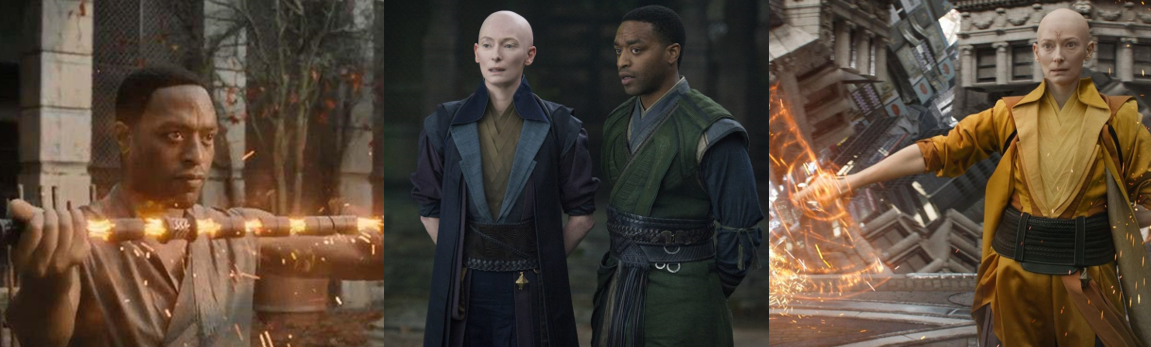
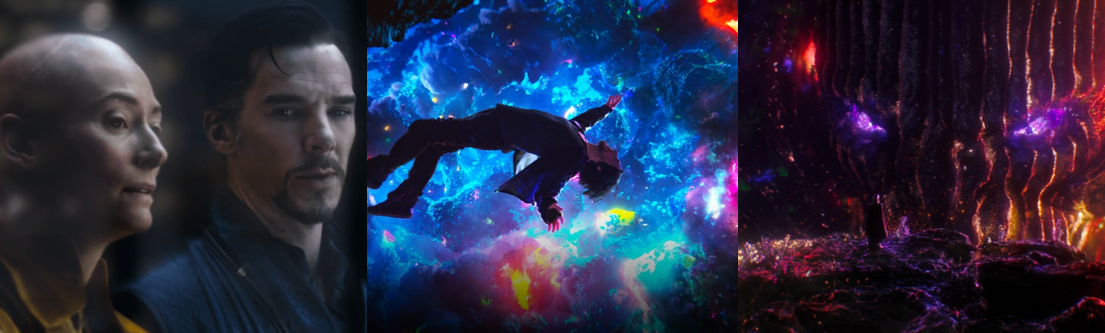
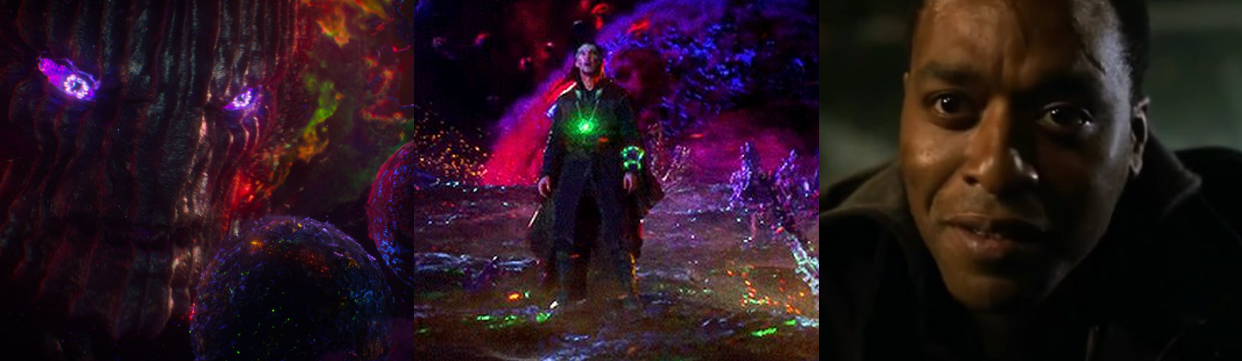
Using the last of his resources, Dr. Strange travels to Kathmandu to seek out the mysterious Kamar-Taj and attracts the attention of Karl Mordo (Ejiofor), who saves Strange from a brutal beating at the hands of muggers and brings him to the doorstep of a dilapidated building, where he is introduced to “The Ancient One”. Even in his pain and suffering, Dr. Strange remains sceptical and somewhat insolent; this is understandable, to be fair, given he’s a man of science and logic and the idea of magic is as bizarre to him as it would be to us, but his insolence is only exacerbated thanks to his relentless ego and temper. Mordo empathises with Strange’s scepticism, and even relates to it, but is a far more respectful and informed individual after learning from the Ancient One. The Ancient One literally forces Dr. Strange to open his eyes to a wider world, one beyond the limits of the physical body and his rational perspective on life, by pushing him into the Astral Dimension by separating his Astral Form from his body. There, beyond time and space and the limits of reality, he is given the briefest glimpse of the vast, dangerous wonder of the multiverse. Though cast away from Kamar-Taj, Dr. Strange’s stubbornness impresses Mordo, who is able to convince the Ancient One to give the damaged neurosurgeon a chance to redeem himself under their tutelage, despite the similarities she sees between Strange and Kaecilius.

Though a quick study, Dr. Strange struggles to overcome his scepticism and his physical ailments.

What follows is an extended training montage in which the Ancient One introduces to Dr. Strange (an the audience) the logistics of magic and how it works in the MCU; through training and hard work, sorcerers are able to draw upon energies from across the multiverse to conjure weapons, cast spells, and work wonders. Because of the damage to his hands, Strange initially struggles with the physical aspects of his training, but is humbled when he sees an amputee performing spells and learns that he must set aside his ego, and his disbelief, in order to succeed; the Ancient One pushes him to this revelation by stranding him on Mount Everest and forcing him to transport himself back or risk death. Thankfully (or conveniently, depending on your perspective), Dr. Strange possesses a photographic memory; just as this allowed him to acquire Medical Doctorate and PhD at the same time, this means that he can digest multiple volumes from the Kamar-Taj library both while awake and asleep thanks to utilising his Astral Form. Dr. Strange’s thirst for knowledge and incredible learning ability impresses the Kamar-Taj librarian, Wong (Wong), who puts Strange onto more advanced tomes and warns him against stealing from the Ancient One’s private collection. Stoic and gruff, Wong provides much of the film’s comic relief, but it’s also through him (and while learning combat alongside Mordo) that Dr. Strange learns more about Kaecilius and how he fell from grace.

Kaecilius is determined to expose the Ancient One and “save” the world from death and suffering.

Kaecilius was introduced at the very start of the film, when he and his zealots attacked Kamar-Taj, and stole pages from one of the library’s many mystical tomes before managing to escape from the Ancient One after one hell of a visually impressive confrontation in what we later learn is the “Mirror Dimension”, a pocket reality where the environment is constantly shifting and changed around the inhabitants as the caster dictates. Proud and headstrong, Kaecilius questioned the Ancient One’s teachings and turned against his teacher after learning that the Ancient One was drawing forbidden powers from the Dark Dimension to extend her lifespan and grant her her awesome powers. A cold, driven man, Kaecilius believes her to be a hypocrite who deceived all of her pupils and, alongside those he has convinced to his cause, works to decipher the pages he stole from Kamar-Taj to both draw from that same dark energy and expose the Ancient One’s true nature. This sees him, and his fellow zealots, become imbued with the malevolent influence of the Dread Dormammu (Cumberbatch), a primordial cosmic entity that is seemingly the embodiment of hatred and seeks to infest and conquer all realities using sorcerers like Kaecilius as puppets. Kaecilius, sadly, falls into the same trap as many MCU villains in that he’s largely a waste of a talented actor and disappointingly absent for much of the film; spoken about as a kind of bogeyman and as a dark mirror of Dr. Strange, Kaecilius ends up being a lot like Malekith (Christopher Eccleston) in that he makes an impression when he is on screen thanks to Mikkelsen’s scowling countenance and silky-smooth line delivery but ends up being a regrettably forgettable villain who is simply there to give Dr. Strange someone to fight against and strive to be the opposite of.

The Nitty-Gritty:
Magic such as this is a tricky concept to bring to life, and was wholly new to the MCU at the time; we had seen a version of magic before, of course, one that is just as much attributed to near-God-like alien physiology and technology, but had never seen literal, unequivocal magical spells and abilities before. Thus, it was smart of the film to introduce this franchise-changing concept slowly, and in a way that kept things tantalisingly grounded (for the most part) while hinting at magic’s incredible (and near-limitless potential). Sorcerers tend to limit their magic to glowing, sparking whips, shields, or melee weapons and to instantaneously shift from one location to another, and often focus their abilities through weapons or objects such as the Staff of the Living Tribunal or the Sling Ring. The film slowly develops the wealth and potential of magic as it progresses, localising it in the mysterious foreign land of Kamar-Taj and then expanding it to encompass more familiar and urban locations, such as New York City. This allows us to see that this kind of magic has always existed in the MCU, we just haven’t experienced it yet, and it was smart to frame magic, and the secret of Kamar-Taj, as a mystery that Dr. Strange must solve.

Dr. Strange mostly focuses on defensive magic, but recklessly experiments with the Time Stone.

Wong reveals to Dr. Strange that the true purpose of Kamar-Taj, and the sorcerers, is to man three Sanctum Sanctorums across the world and continuously fend off threats from beyond their world, such as Dormammu, in an on-going battle of light against darkness. Despite everything he’s seen and learned, this is where Dr. Strange initially chooses to bow out since he has no intention of fighting a magical war, but he is forced to fight alongside Mordo and Wong when Kaecilius suddenly attacks the Sanctum Sanctorums. Though a talented and peerless surgeon, Dr. Strange struggles to learn the ways of magic; even after absorbing knowledge from Wong’s library, he is severely outmatched against Kaecilius and his followers, and succeeds only through luck, the use of rudimentary spells, and the intervention of the Cloak of Levitation, a semi-sentient cape that allows him to fly and adds more comic relief to the film. Dr. Strange’s scepticism soon turns to an insatiable thirst for knowledge and to challenge himself by experimenting with more and more advanced magic; this not only leads him to steal volumes from the library and question the nature of Kamar-Taj, but also to experiment with the Eye of Agamotto. This ancient relic houses the Time Stone and allows the user to control the flow of time itself, localising it to reverse or speed up time as they dictate, and Wong and Mordo are angered by Strange’s recklessness with the Infinity Stone. Mordo, in particular, is outraged at Strange’s careless tampering with the laws of reality, something he believes should be protected at all costs, just as he whole-heartedly believes in the teachings and standards set by the Ancient One.  

The Ancient One teaches Dr. Strange about the vast dangers of the multiverse which dwarf his ego.

The multiverse is presented as a veritable acid trip, a bizarre bombardment of colours, energy, and surreal environments that overwhelm Dr. Strange’s perception of reality and throw all logic out of the window. This, and the fantastical nature of Dr. Strange, allows the film to stand out from others in the MCU with some truly trippy visuals, such as New York collapsing in on itself, Dr. Strange’s Astral Form directing Christine’s attempts to save his physical body (and even killing one of Kaecilius’s followers, something he is aghast at thanks to his Hippocratic Oath), and worlds full of fantastic visuals, warped gravity, and cosmic impossibilities that exist side-by-side with a Dark Dimension full of malice and hatred, where only malevolence lives. Seduced by Dormammu’s influence, Kaecilius longs to destroy all concepts of time and allow the Dark Dimension to envelop the world in a perverted attempt to “save” it. So driven by his conviction and power is Kaecilius that he fatally wounds the Ancient One, but not before revealing that the Ancient One has been drawing power from the Dark Dimension. Before dying, the Ancient One explains to Dr. Strange, in the Astral Dimension, that her methods were necessary in order to defend the world and that such bending of the rules will be necessary to balance out Mordo’s steadfast nature and defeat Kaecilius.

Dr. Strange successfully bargains with Dormammu, but Mordo is left disillusioned by deception.

Indeed, Dr. Strange is faced with an apocalyptic scenario when Kaecilius and his zealots conjure Dormammu in Hong Kong, leading to widespread chaos and destruction and the deaths of Wong and many other sorcerers. Taking the Ancient One’s words to heart, Dr. Strange sees no other option but to first reverse time to restore those who have fallen and journey to the Dark Dimension himself and confront Dormammu head-on. There, in a world of swirling, nightmarish, eldritch horror, we see how truly gigantic the scope of the MCU is as the titanic cosmic being that is the Dread Dormammu dwarfs the fledging sorcerer and threatens to overcome the entire world and spread his reach to every man, woman, and child. However, Dr. Strange has the last laugh when he unleashes the power of the Time Stone to trap Dormammu in an ever-repeating loop of time; there, Dormammu’s continual attempts to kill Dr. Strange, though successful, ultimately fail as the loop resets over and over, angered the malevolent creature since he is unfamiliar with the concept of time and forced to bargain with Dr. Strange. In return for taking Kaecilius and his followers and abandoning his desires to consume the Earth, Dr. Strange agrees to release Dormammu from the loop, thus saving the entire world and ending the threat from the Dark Dimension. Although we see Dr. Strange die again and again, we have no way of knowing exactly how long this loop lasted for, or how much pain and suffering Dr. Strange endured as he made perhaps the greatest sacrifice of anyone in the MCU as he was fully committed to ending his days in that cycle of death and this moment not only completed Dr. Strange’s character arc in the film of learning to set aside his ego but also cemented him as a big-time player in the larger MCU. Unfortunately, while Dr. Strange finally sees that his true destiny is to serve a greater good, Mordo is disillusioned by the revelations and the lengths that Strange goes to to repel Dormammu and pledges to rid the world of sorcerers.

The Summary:
Doctor Strange remains one of the most unique and intriguing entries in the MCU; even when Thor Odinson (Chris Hemsworth) first burst into the franchise and shook it up by introducing Gods and a version of magic, and we started seeing the first hints of the Infinity Stones, I never would have guessed that we would see the Sorcerer Supreme reversing the flow of time, fending off cosmic entities like Dormammu, or blowing the fabric of his fictional world apart with concepts like the multiverse. And yet, at its core, Doctor Strange is the humbling story of redemption for a vain, arrogant asshole of a man who endures a horrific accident, has his entire world destroyed, and is forced to accept a greater destiny. It’s pretty clear now that the intention was to set up Doctor Strange as a counterpart to Tony Stark/Iron Man (Robert Downey, Jr); both are snarky, self-absorbed men who put their unique talents to use in service of both personal glory and the wellbeing of the world around them. However, while Iron Man helped to ground the MCU and make its fantastical elements relatable, Dr. Strange’s very existence meant that the scope of the MCU was basically limitless and we’ve since seen that it stretches beyond even our reality. Full of mind-bending visuals that make for some entertaining action sequences, Doctor Strange might have played things a little too safe but that’s not exactly a bad thing when it comes to a concept like magic, which can basically do anything and make characters like Dr. Strange severely overpowered. Thankfully, the film frames Strange as very much a rookie and struggling to master and even fully understand this bizarre world he has entered into, meaning that subsequent appearances by the character can simply build upon the foundations laid by this fantastical first film.

My Rating:

Rating: 4 out of 5.

Great Stuff

Were you a fan of Doctor Strange? What did you think to the introduction of magic to the MCU and the way the film explained the concept? Did you enjoy Dr. Strange’s character arc and portrayal in the film? What did you think to the Ancient One and the depiction of Mordo? Were you also a little disappointed by Kaecilius, and what did you think to the final showdown between Dr. Strange and Dormammu? What are some of your favourite stories involving these characters and do you think Dr. Strange is too overpowered as a character? Whatever your thoughts on Doctor Strange, sign up to leave your thoughts below or leave a comment on my social media, and check back in next Sunday for more Multiverse Madness!

Back Issues [X-Men Month]: Giant-Size X-Men #1


To commemorate, the culmination of their long-running and successful X-Men movies, 20th Century Fox declared May 13th as “X-Men Day”, a day to celebrate all things Mutant and X-Men and celebrate Marvel’s iconic collection of superpowered beings who fight to protect a world that hates and fears them.


Story Titles: “Second Genesis!”, “…And When There Was One!”, “Assault Force!”, and “Krakoa…The Island That Walks Like a Man!”
Published: May 1975
Writer: Len Wein
Artist: Dave Cockrum

The Background:
In 1963, after achieving success with characters like the Fantastic Four, Tony Stark/Iron Man, and, of course, Peter Parker/Spider-Man, Marvel Comics’ Stan Lee and Jack Kirby dreamed up the concept of “Mutants”, ordinary people who developed extraordinary powers once they hit puberty. In contrast to lauded superhero teams like the Avengers and the Fantastic Four, the X-Men were hated and feared by the general public and thus used to tackle variety of social issues, most notably racism. Unfortunately, the X-Men initially struggled to find an audience and the comic was cancelled by issue sixty-six in 1970. Five years later, under the direction of Chris Claremont, Len Wein and Dave Cockrum collaborated on a revival of the title, which saw an international team of Mutants join the team, breathed new life into the title, and the X-Men have been an enduring and popular team in comics ever since, influencing an entire generation with a much-lauded animated series in the nineties and, of course, a series of massively successful live-action movies.

The Review:
The story opens in Winzeldorf, Germany where a torch-carrying horde of bigots are chasing after Kurt Wagner/Nightcrawler; despite his demonic appearance, Nightcrawler pities the braying crowd for their “mindless prejudices” and laments that they are so blinded by their hatred of him that they’re risking their own safety. Rather than teleport to safety, Nightcrawler opts to leap into the crowd and fight them off with the only language the bigots understand: violence. The numbers game is too much for the young Mutant, however, but he is saved from a fiery death by the timely intervention of Professor Charles Xavier/Professor X, who freezes the horde with his incredible mental powers and offers Kurt a place at his school in order to both shield him from such hatred and help him “find [his] true potential”, an offer that Nightcrawler gratefully accepts. The story then jumps over to Quebec, Canada where Xavier meets with another Mutant, Logan/Wolverine (also codenamed Weapon X by the Canadian government). Having been impressed with Wolverine’s recent fight against Doctor Bruce Banner/The Hulk, Xavier offers the abrasive Mutant a place on his team to help other Mutants in need. Wolverine jumps at the chance to be freed from the shackles Canadian government, resigning in typical Wolverine fashion and happily leaving alongside the wheelchair-bound professor.

Xavier is able to recruit his new team, despite some reservations from the would-be X-Men.

After Xavier quickly recruits former ally Sean Cassidy/Banshee over the course of three panels, the story jumps over to Kenya where a group of African tribesmen beg Ororo Monroe/Storm to use her powers of weather to end the drought that has ravaged their lands. Revered as a Goddess, Storm conjures winds and rain to help out the struggling natives and, after informing Storm of her Mutant status, Xavier appeals to her curiosity enough to recruit her to his cause as well. Siro Yoshida/Sunfire of Osaka, Japan is recruited even faster and easier than Banshee and then Xavier heads over to Siberia to draft Piotr “Peter” Rasputin/Colossus (despite his reservations about leaving his family), a muscle-bound patriot who is able to cover his skin in an organic metal that renders him strong and impenetrable enough to shield his sister from a runaway tractor. Finally, Xavier travels to Camp Verde, Arizona to recruit the last member of his new team of X-Men, John Proudstar/Thunderbird, a Mutant swift and strong enough to catch up to and bring down a charging bison. If Wolverine was a bit rough around the edges, Thunderbird is down-right rude as he offers Xavier little more than ridicule and boastful pride; Xavier is able to convince him to his cause, however, by questioning his courage.

The X-Men are attacked and captured, leaving Cyclops the sole survivor.

The team assembles at Xavier’s school in Westchester, New York, now garbed in uniforms made of “unstable molecules” that Xavier obtained from Doctor Reed Richards/Mister Fantastic. Sunfire demands answers and Xavier provides them by introducing them to Scott Summers/Cyclops, who informs them all that the X-Men have disappeared. Cyclops relates how the team were alerted to a new Mutant (who was “so powerful as to defy classification”) on the island of Krakoa by Xavier’s Mutant-detecting machine, Cerebro; Cyclops lead Jean Grey/Marvel Girl, Warren Worthington III/Angel, Bobby Drake/Iceman, Alexander Summers/Havoc, and Lorna Dane/Polaris to Krakoa but, shortly after landing, they were attacked by an unseen foe. Cyclops awoke disorientated, his costume in tatters, and without his visor and briefly unable to project his trademark optic blasts; he took the Strato-Jet back to Xavier’s mansion to alert the professor (finding his powers to have increased in the process) and assemble a new team to rescue the X-Men.

The new X-Men struggle to work as a cohesive unit thanks to their egos.

Although Sunfire initially refuses to go along with the mission, claiming to hate his fellow Mutants as much as humans, he intercepts the jet on the way to Krakoa to join the mission anyway. This, as noted by both Storm and Thunderbird, calls attention to the fragility of this new, untested team and they’re right to point this out as Xavier has effectively slapped together a team of egos, misfits, and strangers who have even less field training as a unit that the original X-Men. Regardless, the team soon arrives at Krakoa and Cyclops splits them into teams of two: Storm and Colossus head to the North, Banshee and Wolverine the East, Sunfire and Nightcrawler the South (much to Sunfire’s chagrin), and Thunderbird and Cyclops take the West. Upon landing, Cyclops and Thunderbird note that strange temples have suddenly erupted from the ground and, as they move to investigate, they are attacked by living vines. Over on the East side of the island, Banshee and Wolverine are similarly attacked by a giant crab but, thanks to Wolverine’s viciousness and Banshee’s scream, they make short work of the crustacean. Meanwhile, on the North side, Storm and Colossus manage to fight their way out of a seemingly sentiment landslide and, finally, Sunfire and Nightcrawler battle through a flock of raging birds on the South side all while Sunfire continually berates Nightcrawler with sarcasm and criticism.

By pooling their energies into Polaris, the X-Men defeat Krakoa and blast it into space!

Regardless, the team all rendezvous at the temple, break their way in, and find the X-Men being held captive and, apparently, fed upon by vines. After the X-Men are rescued, their prison crumbles to pieces and Angel scolds Cyclops for coming back for them as the island comes to life around them. It turns out that Krakoa itself is the Mutant Xavier detected, having been brought to ravenous life by an atomic blast, and referring to itself as “we” as it details its plan to feed upon “Mutant energies”. Krakoa attacks the two teams of Mutants, who struggle to co-ordinate their strategies and to make a dent on the Mutant’s considerable hide. Thankfully, Xavier telepathically contacts Cyclops and informs him of Krakoa’s one weak point; while Xavier mentally battles the creature, Cyclops directs the team from the ground, channelling Storm’s ability to conjure lightning into Polaris and then adding his and Havoc’s energy blasts to the building magnetic force. The result is a surge of magnetic energy that disrupts Krakoa’s ability to retain its humanoid form and, as the island breaks apart around them, the team blast their way to safety on an ice float. As they watch, Krakoa is hurled off the planet’s surface and away from the planet and the Mutants survive the tumultuous seas thanks to Iceman’s ice-bubble and are left united and victorious.

The Summary:
Those who read my review of The X-Men #1 (Lee, et al, 1963) will remember that I wasn’t exactly impressed with the X-Men’s debut appearance. Setting aside the sexist attitudes and outdated dialogue at work in that comic, the story was a plodding, laborious read that ended right as it was about to get interesting. Additionally, you may recall that I’m not exactly the most well-read of X-Men fans; I find the lore to be somewhat impenetrable because there are so many characters and so many stories that even trying to read the most famous arcs can leave you scratching your head in bemusement at the density of the mythology. Giant-Size X-Men #1 is therefore far more accessible, in some ways, as it acts as a soft reboot for the comic that features some of the most iconic X-Men ever created.

Most of the new X-Men get a chance to shine with their colourful powers and abrasive personalities.

What makes Giant-Size X-Men #1 a better read than The X-Men #1, though, is that the characters are much more visually interesting and distinct in their personalities. Wolverine, Thunderbird, and Sunfire are all different levels of abrasive, with Sunfire openly clashing with Nightcrawler, Wolverine resorting to violence at the drop of a hat, and Thunderbird offering criticisms on the stability of the new team. Conversely, Storm, having lived a sheltered life where she was worshipped as a Goddess, is somewhat naïve and Nightcrawler just wants everyone, human and Mutant alike, to be accepted. Banshee, Cyclops, and Professor X are, of course, some familiar faces to long-time X-Men readers. Thankfully, both Professor X and Xavier are far less annoying than in their debut comic; Xavier is less of a stern, uncompromising teacher and more a worried father-figure desperate to rescue his students from their mysterious fate and Cyclops, rather than trying to force his authority over the new Mutants, is similarly concerned only with holding the fledging team together long enough to rescue his friends and loved ones.

Krakoa exists mainly to bring the X-Men together and it doesn’t take much to defeat it.

Similar to The X-Men #1, Giant-Size X-Men #1 is more concerned with introducing and assembling its team of Mutants rather than all-out action but, as I say, it does a far better job of doing this than its predecessor as the new team is introduced in interesting ways rather than just expositing their abilities in the Danger Room. Although little is made of Nightcrawler’s teleportation abilities or Wolverine’s heightened senses, each of the new characters get a bit of time to shine, although the final battle against Krakoa boils down more to Polaris channelling various energies into herself rather than a concentrated group effort besting the island-sized Mutant. Still, I much preferred the dialogue, characterisations, and presentation here than in the X-Men’s debut story, though I’ll admit that a lot of that has to do with me favouring these characters and the move away from redundant exposition and storytelling from the sixties.

My Rating:

Rating: 4 out of 5.

Great Stuff

What are your thoughts of Giant-Size X-Men #1? What did you think to the new X-Men and their introduction? Which of the new characters was your favourite? What did you think to Krakoa as the main threat and the way it was defeated? Which era of the X-Men is your favourite and who is your favourite ever team/character? How are you planning on celebrating X-Men Day this month? Whatever your thoughts, leave a comment below, and be sure to come back every Saturday for the rest of May for more X-Men content.

Back Issues [Multiverse Madness]: Strange Tales #110


In September 1961, DC Comics published “Flash of Two Worlds” (Fox, et al), a landmark story that brought together two generations of the Flash: the Golden Age Jay Garrick and the Silver Age Barry Allen thanks to the concept of the multiverse, an infinite number of parallel universes that allowed any and all stories and characters to co-exist and interact. Marvel Comics would also adopt this concept and, to celebrate the release of Doctor Strange in the Multiverse of Madness (Raimi, 2022) this month, I’ll be both celebrating the Master of the Mystic Arts and exploring the Marvel Cinematic Universe’s (MCU) equivalent of the multiverse every Sunday of May.


Story Title: “Doctor Strange, Master of Black Magic!”
Published: 9 April 1963 (cover-dated July 1963)
Writer: Stan Lee
Artists: Steve Ditko

The Background:
Dr. Strange began life as the brainchild of legendary artist Steve Ditko, when he submitted a five-page pitch for a new type of character, one who dabbled in black magic, to the immortal Stan Lee. The character was so named as he was to debut in the pages of Strange Tales, a Marvel Comics anthology title that initially published horror tales, and it was Lee who infused the character with many of his more elaborate spells and quirks. Known for his surreal visuals and bizarre adventures, Dr. Strange has since become one of Marvel’s most pivotal figureheads. The Master of the Mystic Arts has been at the centre of many of Marvel’s most important stories and remains one of their most powerful characters, and has even successfully crossed over into the mainstream thanks to featuring in various videogames, cartoons, and the MCU.

The Review:
The story begins with a man being tormented by horrific nightmares as he sleeps; presumably having tried every solution to no avail (though there’s no actual in-comic evidence of that), he seeks out the help of the mysterious Dr. Strange, a man rumoured to practise the dark arts, in order to ease his torment. The next morning, he arrives “on a quiet street in New York’s colourful Greenwich Village” at the fantastic home of the aforementioned doctor, and begs for his help. The man tells of a haunted figure, bound in chains, who incessantly glares at him in his dreams, and Strange immediately pledges to visit him that evening and discover the answer by entering the man’s slumbering mind!

Dr. Strange agrees to help a man being tormented by horrific nightmares.

Before this, though, Dr. Strange indulges in a bit of meditation where he separates his soul (or “metaphysical spirit”) from his physical form and effortlessly travels through walls and across vast distances to “a hidden temple somewhere in the remote vastness of Asia” where his wizened master dwells. The old man warns Strange of a darkness that threatens him and urges him to be cautious as Strange is set to succeed the elderly wizard as the defender against the forces of evil. Dr. Strange heeds the warning, and promises to depend upon his magical amulet when under threat, and makes good on his promise to visit the man and enter his nightmare using his metaphysical spirit form.

In the dream dimension, Dr. Strange comes under threat from the mysterious Nightmare.

In the desolate void of the dream world, Strange encounters the figure tormenting the man and demands answers. The cloaked spirit claims to the symbol of the evil this man has done to a “Mr. Crang”, but their conversation is quickly interrupted by the arrival of a caped, shadowy figure on horseback, one far more menacing and known all-too-well to Dr. Strange. The entity is Nightmare, a being of darkness and chaos, who vows to make Strange pay for entering the hostile dream dimension once more. As Dr. Strange’s physical body is left helpless and in a trance, the sleeping man awakens and, keen to keep Strange from revealing what he knows about Mr. Chang, pulls out a gun and prepares to murder the sorcerer on Nightmare’s bidding!

Thanks to the intervention of his master, Strange is saved and the criminal is exposed.

However, Dr. Strange isn’t left entirely helpless; he calls out to his master for aid and, from half a world away, the elderly wizard manipulates the mysterious golden amulet around Strange’s neck. The trinket glows brighter and brighter, revealing “a fantastic metal eye […] such as no mortal has ever beheld” and, upon seeing this strange eye, the would-be gunman freezes on the spot and is left immobile. This is all the distraction Strange needs to easily dart past Nightmare and return to his body, though his shadowy foe vows to have his revenge one day. Upon returning to the physical world, Strange compels the man to speak the truth and he finally reveals that his nightmares were caused by all the robberies he committed against other businessmen. The story ends with Dr. Strange urging the man to confess to his crimes as it’s the only way he’ll be able to sleep and thus ends the…less than thrilling first appearance of the Master of the Mystic Arts.

The Summary:
“Doctor Strange, Master of Black Magic!” is very clearly a back-up tale in a comic book featuring a bunch of different short stories and, as a result, is a brisk little episode simply designed to introduce this quirky new character to Marvel’s readers. We really don’t learn a whole hell of a lot about anything going on here; we don’t even learn the name of the man being haunted by Nightmare let along any background on Dr. Strange, his origin, or his motivations. Even Dr. Strange’s powers are vague, at best, with the focus of this first story being solely on his ability to astral project and enter dreams to help others. His magical amulet isn’t named or explained beyond being this mystical artefact and a lot of the familiar trappings either aren’t really here or are ill-defined compared to what you might expect from the character.

While the story’s not that great, Dr. Strange stands out as an enigmatic highlight.

The story itself is incredibly simplistic, which is most likely due to how few panels and pages were allotted to tell the tale, and there’s definitely a lot of questions left hanging in the air for subsequent stories to fill us in on, which is a refreshing change from other superhero debuts that bombard the reader with nothing but exposition. “Doctor Strange, Master of Black Magic!” is arguably too vague, though, but it’s definitely very intriguing; Dr. Strange isn’t really positioned as a superhero in the traditional sense and is, instead, more of an enigmatic consultant for ailments and supernatural occurrences. The real standout here is the art, particularly regarding Dr. Strange’s character design; while the backgrounds and locations aren’t that interesting (the dream dimension is basically an empty void), Dr. Strange is colourful and eye-catching and I enjoy how he gives off a wise, almost condescending authority that would become so synonymous with the character going forward. The hooded figure and Nightmare are intriguing malicious forces representing guilt, sin, and chaos but they’re very vaguely defined, so it’s pretty easy for Dr. Strange to steal the show. It’s just a shame that he basically spends the entire story either standing around or sitting down in a trance rather than doing something more interesting, like casting spells or spewing out nonsense incantations.

My Rating:

Rating: 2 out of 5.

Could Be Better

Have you read “Doctor Strange, Master of Black Magic!”? Do you own a copy of Strange Tales #110? What did you think to the story and the mystery surrounding Dr. Strange? Do you think that the tale needed a few more pages to tell a bit more of his story or did you enjoy the intrigue surrounding Dr. Strange and Nightmare? What are some of your favourite Dr. Strange stories and who is your favourite villain of his? Do you enjoy multiverse shenanigans in comics or do you find them to be overly complicated? Whatever your thoughts on Dr. Strange, sign up to drop a comment down below or let me know on my social media and check back next Sunday for more Multiverse Madness from the Sorcerer Supreme.

Movie Night [Dare-DAY-vil]: The Trial of the Incredible Hulk


Blind lawyer Matt Murdock first made his debut in Daredevil #1 in April of 1964 and was co-created by writer/editor Stan Lee and artist Bill Everett, with input from the legendary Jack Kirby. While perhaps not as mainstream as characters like Peter Parker/Spider-Man, Daredevil has become one of Marvel Comics’ greatest creations and has featured in a number of ancillary media and merchandise, included a questionably-received big-screen adaptation in 2003 and a critically-successful Netflix series. Still, he’s one of my favourite Marvel superheroes so what better excuse to pay homage to the “Devil of Hell’s Kitchen” than by spending the day celebrating the character?


Released: 7 May 1989
Director: Bill Bixby
Distributor: New World International
Budget: Unknown
Stars: Bill Bixby, Lou Ferrigno, Rex Smith, Marta DuBois, Nicholas Hormann, and John Rhys-Davies

The Plot:
Back on the run and having lost all hope for a cure for his green-skinned alter-ego, Doctor David Banner (Bixby) wanders into a city under the control of crime boss Wilson Fisk (Rhys-Davis). After witnessing Fisk’s men accost Ellie Mendez (DuBois) on the subway, Banner transforms into the Hulk (Ferrigno), framed for the crime, and subsequently arrested. Refusing to stand trial lest the Hulk be unleashed, he offers no co-operation to his blind lawyer, Matt Murdock (Smith), but the two find themselves teaming up against Fisk when Murdock is revealed to be the masked crimefighter known as Daredevil.

The Background:
I’ve mentioned it at length before but, long before the Marvel Cinematic Universe (MCU) dominated cinema screens, Marvel Comics had a decent amount of success with live-action adaptations thanks to the iconic Incredible Hulk television series (1977 to 1982). The show, which coined the unforgettable line “Don’t make me angry. You wouldn’t like me when I’m angry”, ran for eighty episodes before finally coming to an end on 12 May 1982 and firmly entrenched the Green Goliath in the cultural consciousness thanks to standout performances by stars Bill Bixby and Lou Ferrigno, who would go on to voice the character for years to come. About six years after the end of the series, the first of three made-for-television movies was produced; although intended as a backdoor pilot for a Thor (Eric Kramer) spin-off, The Incredible Hulk Returns (Corea, 1988) was, apparently, a ratings success and a second feature-length film was produced to capitalise on the renewed interest. The Trial of the Incredible Hulk was one of my first exposures to the Incredible Hulk show; like The Incredible Hulk Returns, the feature debuted another Marvel superhero, Daredevil, in the hopes of producing a spin-off that never came to pass and also featured Stan Lee’s first ever onscreen cameo in a Marvel production. Overall, though, the film seems to have garnered mixed reviews, with the general consensus being that it didn’t quite deliver on its title or premise.

The Review:
Rather than open with a version of the traditional, iconic opening from the television show, The Trial of the Incredible Hulk begins with a morose narration from David Banner (now using the pseudonym “David Belson”), who catches any newcomers up to speed with his current predicament (literally just a case of, “Gamma Rays turned me into a monster” with a few shots from the pilot episode). We then join Banner, now sporting a thick head of hair and full beard, working a demeaning job digging a trench or a ditch or some such. When a co-worker attempts to rile him up and Banner is barely able to keep his anger in check, he once again regretfully hits the road and heads towards the city, despite warnings that he could “get lost there”.

Though Banner resigns himself to a life in prison, Murdock is determined to bring Fisk down.

Haunted by his many years on the road and inability to cure his unique condition, Banner remains a lost, tortured soul who drifts from place to place and job to job, refusing to put down any roots and to keep himself to himself and on the move. Despite this, however, he is unable to stand idly by when Ellie Mendez is hounded by a couple of goons on the subway; for his troubles, not only does he transform into the Hulk once more but he also winds up in jail and accused of attacking the woman. Although he knows he is innocent, he adamantly refuses to stand trial out of fear of the damage he might do lest the stress trigger another transformation, and feels that prison is a fitting place for him. The city (which, despite never being named, appears to be New York City) is a bustling metropolis and home to blind lawyer Matt Murdock, a seemingly unassuming man who regularly makes light of his condition with his co-workers. He also has a friendly banter with his staff, Christa Klein (Nancy Everhard) and Al Pettiman (Richard Cummings Jr.), whom he wows with his enhanced senses (which they put down to him making wild, if uncannily accurate, guesses). At the heart of the city is Fisk Tower, a large and ominous structure that dominates the city skyline, and Matt has made it his solemn vow to tear the building down, and Fisk with it, once they have concrete proof that he is involved in the city’s underworld.

Fisk plot to control of the criminal underworld is opposed by Daredevil and his newfound ally.

Matt’s suspicions about Fisk are entirely well-founded as the criminal mastermind directs, via radio and video, two of his henchmen in the systematic robbery of a jewellery store. An enigmatic and authoritative figure, Fisk conducts all of his business with precision and immaculate detail, directing every movement and having the entire operation planned to the smallest detail. Untouchable and in full control of the criminal underworld. Fisk’s operation is put at risk when his goons accost Ellie on the subway; when Banner gets involved in the matter, Fisk begins targeting them both in order to avoid linking him to the crime. When Matt is appointed as Banner’s lawyer, he sees this as the perfect opportunity to get a lead on Fisk and is confused and angered at Banner’s unwillingness to co-operate and refusal to divulge his true name and origins. When the stress of an impending trial, Ellie lying about the subway attack (due to Fisk threatening her with reprisals), and his position in general trigger a transformation, Banner is convinced to trust Murdock when the lawyer reveals his duel identity as the masked vigilante Daredevil. Although Banner has reached the end of his rope and lost all faith in the science that was once his life, he finds himself reinvigorated by Murdock’s plight since he was transformed by the better by radioactive substances and he leaves the film far more optimistic and content to have a “brother in the world”.

The Nitty-Gritty:
The Trial of the Incredible Hulk is a relatively inoffensive little extension of the television show but nothing massively spectacular, though I never really watched the show as a kid as it wasn’t really on TV over here in the United Kingdom, as far as I am aware. As a result, I remember being somewhat impressed with the film back then since it wasn’t as if live-action superhero productions were as accessible as they are today. Even now, it’s still pretty entertaining; sure, it doesn’t deliver on its premise at all (the “trial” only happens in a nightmare of Banner’s and seems to refer more to the emotional trial that Banner is going through) but it’s an interesting time capsule of a bygone era when live-action superhero adaptations were certainly ambitious, if nothing else.

The Hulk’s screen time is sadly limited but he sure makes an impression when he does appear.

As is the case with much of the Incredible Hulk TV show, the Hulk himself is unquestionably the star of the film. Sadly, he gets very little screen time; Banner doesn’t even transform into the Hulk for the finale but, when he does turn green, it’s treated as a pretty big deal. This is, however, par for the course for The Incredible Hulk; the episodes I have seen generally focus much more on the drama surrounding Banner, the people he meets, and his weekly attempts to find a cure for himself or help those in need and the Hulk appears very sporadically as a result. While the Hulk’s rampage in Banner’s nightmare is a standout moment in the film, and is a great showcase of the Hulk raging against a room full of people for a change, it’s still just a dream sequence. Luckily, there’s a particularly decent follow-up scene later on when, having witnessed Daredevil be pummelled by Fisk’s men, Banner transforms to save him and, in the process, forms a kinship with the blind crimefighter.

The film was intended as a backdoor pilot for Daredevil, who’s decent enough, if a little boring.

This, coincidentally, brings me on to the subject of Daredevil; Daredevil’s presence is hinted at early in the film as graffiti carrying his name adorns the walls of the city and the film spends a great deal of time setting up Murdock’s day-to-day life, introducing his enhanced senses (although the depiction of his radar sense is a bit questionable), and making him a prominent figure all before he first appears in an all-black ninja outfit to save Ellie’s life. Despite the fact that his outfit is disappointingly barebones, I appreciate that Daredevil is sporting a look straight out of “The Man Without Fear” (Miller, et al, 1993), one of the first Daredevil stories I ever read. Daredevil is something of an urban legend in the film but he is also unofficially sanctioned by police chief Albert G. Tendelli (Joseph Mascolo), who even has a direct line to contact Daredevil when he needs help outside of the normal confines of the law, and allies like Turk (Mark Acheson) to feed him leads. Rex Smith may not always be performing Daredevil’s few limited fight scenes or acrobatic feats (which are incredibly limited) but he does a decent enough job in the role; while the film alters his origin somewhat to have him begin his training as Daredevil as an adult and after being inspired by Tendelli, he undergoes a trial of his own when Fisk’s men put a severe beating on him and leave him feeling humiliated.

While it drops the ball on the title, the film entertains with some decent sequences and performances.

Undeniably, though, The Trial of the Incredible Hulk is elevated by the presence of the bombastic and alluring John Rhys-Davies; despite never using the name “Kingpin”, Rhys-Davies is perfectly cast as Fisk and brings just the right level of authority and scene-stealing charisma to the role to make him larger than life but also threatening. Even better, he’s not just some one-dimensional gangster, either; he’s incredibly lenient with his right-hand man, Edgar (Hormann), even when he has a change of heart and helps Ellie escape from Fisk’s captivity. At the same time, though, Fisk is absolutely ruthless; having grown weary of Daredevil’s interference and wishing to consolidate his power over the city’s underworld, he presents his rivals not just with a number of jewels but also video evidence of Daredevil’s beating. While he fully believes that this has resulted in Daredevil’s demise, his plans are ultimately ruined when Banner and Daredevil crash the party and force Fisk to flee to fight another day.

The Summary:
In many ways, it’s a bit of a shame that The Trial of the Incredible Hulk didn’t lead to a spin-off for Daredevil; even back then, a TV show about a black-suited vigilante had to have cost less to make than one about a scientist who turns into a musclebound strongman. However, I can kind of see why a Daredevil spin-off wasn’t produced; as much as I enjoy the character, his portrayal in the film, and the magnetic presence of John Rhys-Davies, Murdock and Daredevil are nowhere near as compelling or visually interesting as the Hulk. It’s equally a shame, then, that the Hulk has such limited screen time in the film but I can forgive a lot of that as, again, the main focus of the show was always the drama surrounding Banner and the film does a serviceable job of trying to introduce Daredevil and make us care about him. Ultimately, while it’s probably the most boring interpretation of Daredevil you’ll see, I can’t help but have a soft spot for The Trial of the Incredible Hulk; it was my introduction to the TV show and a vital part of my childhood so I have a lot of nostalgic affection for it and it’s worth watching for John Rhys-Davies’ performance alone, to say nothing of the dramatic allegorical and physical trial that Banner and Murdock, respectively, endure in the film.

My Rating:

Rating: 2 out of 5.

Could Be Better

Have you ever seen The Trial of the Incredible Hulk? If so, what did you think to it and its portrayal of Daredevil? Were you a fan of the Incredible Hulk TV show back in the day and what did you think to the feature-length films? Do you think including other Marvel Comics characters benefitted these films or do you think they took the focus away from the Banner/Hulk conflict that made the show so memorable? What do you think of Daredevil as a character and which storyline of his do you think is the best, or the worst? How are you celebrating Daredevil’s debut this year? Whatever you think about Daredevil, drop a comment below.

Back Issues [Crossover Crisis]: The Uncanny X-Men and The New Teen Titans


In April 1985, the first issue of the ground-breaking Crisis on Infinite Earths (Wolfman, et al, 1986) released and saw the temporary destruction of the “Multiverse”. To celebrate this momentous event, I’m discussing multiversal crossovers all throughout April in an event I dubbed “Crossover Crisis”.


Story Title: “Apokolips… Now!”
Published: January 1982
Writer: Chris Claremont
Artist: Walt Simonson

The Background:
As I’ve mentioned on a couple of occasions, DC Comics and Marvel Comics have had a surprisingly collaborative and amicable relationship over the years that has led to some inter-company friendships, homages, and co-publications between the two comic book giants. By 1982, both Marvel’s Uncanny X-Men and DC’s Teen Titans were seeing a resurgence in popularity thanks to both teams featuring an exciting new creative and character line-up. Over in Marvel Comics, writer Chris Claremont had revitalised Marvel’s Mutant team by introducing a group of diverse and multi-cultural new characters while the New Teen Titans, under the pen of Marv Wolfman, had been aged up and also included some of the title’s most synonymous characters. With so many similarities between the two teams, and considering the success of the two titles were selling at the time, a crossover between the two was a smart business move for both parties.

The Review:
“Apokolips… Now!” begins at the Source Wall, an impossibly large stone wall that represents the edge of the known universe and which is comprised of the legendary Promethean Giants, who were turned to stone for trying to breach the boundaries of the cosmos. There, we find Metron, the generally impartial intellectual of the New Gods, conversing with all-mighty Darkseid, who gifts him with the “Omega-Phase Helmet”, a highly advanced crown that allows Metron’s Mobius Chair to achieve the impossible and penetrate the great stone wall in order for them both to achieve their heart’s desire (Metron for knowledge and Darkseid for power).

A normal day at the X-Mansion is interrupted by a vision of Jean.

The story then jumps to Westchester, New York where Professor Xavier’s X-Men are engaging in a training session within the Danger Room, an exercise that grates on Logan/Wolverine’s patience despite his respect for the professor. After impressing Xavier with their teamwork, the Mutants retire for dinner and the story takes the opportunity to catch us up not only with the current X-Men roster and their powers (the aforementioned Wolverine, Scott Summers/Cyclops, Ororo Munroe/Storm, Piotr “Peter” Rasputin/Colossus, Kurt Wagner/Nightcrawler, and Kitty Pryde/Shadowcat) but also the tragic rise and downfall of Jean Grey, who attained incredible cosmic powers as the Phoenix that eventually corrupted and consumed her. The X-Men’s memories of Jean are extracted by Darkseid and the Phoenix briefly assumes a corporeal form where she begs for help from Cyclops much like Barry Allen/The Flash did in Crisis on Infinite Earths.

Raven and Starfire are spooked by Phoenix while Robin is jumped by Deathstroke!

Meanwhile, over at Titans Tower (yes, in this story, the Marvel and DC universes again exist in a shared world rather than being separate, parallel worlds), Rachel Roth/Raven of the New Teen Titans finds her dreams interrupted by a prophetic nightmare of a woman, taking the shape of a flaming bird, destroying their world. When Garfield Logan/Changeling assumes the form of a similar bird, Koriand’r/Starfire randomly loses control of herself and attacks him; well aware of the threat that the Phoenix poses, Starfire summons the remaining members of the team (Wally West/Kid Flash, Donna Troy/Wonder Girl, and Victor Stone/Cyborg) away from their procrastinations, personal lives, and crimefighting antics to bring them up to speed on the Phoenix’s destructive power. Dick Grayson/Robin, however, is kept from joining his team mates when he butts heads with one of Darkseid’s Parademons only to be attacked by Slade Wilson/Deathstroke the Terminator, who not only reveals that he’s in cahoots with Darkseid but is easily able to knock Robin unconscious thanks to his superior physical and mental abilities. The X-Men discover that Jean’s parents and other areas across the world have also witnessed visions of Jean and mysterious incidents all linked to Jean’s past. After locating Robin, Starfire relates Phoenix’s legend as the “chaos-bringer” and a cataclysmic force; although Robin points out that cosmic threats are a little out of their league, and the more pressing issue of Deathstroke’s current plot, he promises Starfire that they’ll do everything they can to track down and stop Phoenix. The story then introduces us to Ravok the Ravager, another of Darkseid’s henchmen who he recruits as part of his plot to siphon the Phoenix’s vast cosmic powers.

Both the X-Men and Teen Titans are captured with a ridiculous amount of ease.

Weary from pushing himself too far, Xavier enters a deep sleep and barely has enough time to defend himself when Starfire bursts into the X-Mansion and attacks him in a rage. Xavier’s unparalleled psychic powers are subdued by a combination of Cyborg’s ultrasonic blasts and Raven’s dark “Soul-Self”, however Robin is disturbed and irritated at his team’s recklessness in breaking into the mansion and attacking Xavier without provocation. His reprimanding is interrupted by the arrival of Ravok and his Shock Commandos, who storm the mansion looking for the X-Men but quickly adapt to defeat and kidnap all of the Teen Titans but Changeling, who follows along undetected. While investigating New Mexico, the X-Men comes across Deathstroke and one of Darkseid’s “Psi-phons”; although they easily destroy the Psi-phon and are able to fend off the Parademons, Deathstroke quickly recovers from Wolverine’s initial attack to take each of the Mutants out with a “fear ray” that grounds Storm, a “toxi-grenade” that renders Shadowcat, Nightcrawler, and even Wolverine unconscious while a Parademon blasts Cyclops, and overpowers even Colossus’ hulking metallic form. Deathstroke and Ravok bring their captives to all-mighty Darkseid, who waits at the Source Wall and immediately sees through Changeling’s deception to subdue him, and then kills Ravok for his ineptitude with his destructive “Omega Beams”.

Darkseid summons Dark Phoenix but the heroes quickly join forces to confront the New God.

Darkseid secures his captives to a gigantic machine, the “Psychon-Wave”, which painfully and forcefully draws upon their superhuman powers and the Mutants’ memories of Jean, concentrating them on the breach in the Source Wall to bring Dark Phoenix back to life. He then regales the inquisitive Changeling with the reason for this plot (basically, he wants to use the Phoenix to transform the Earth into a new Apokolips that will allow him to conquer first New Genesis and then the length and breadth of reality itself). Hungry for destruction, Phoenix willingly accompanies Darkseid through a Boom Tube to begin this plot but, quite ludicrously, the heroes’ restraints disappear when Darkseid departs! Freed from captivity, the Teen Titans and the X-Men immediately agree to work together to stop Darkseid and Phoenix despite Wolverine not being happy about working with kids. While Shadowcat tries to flirt with Changeling and Kid Flash comments on the diversity of the X-Men, Cyborg, Xavier, Starfire, and Cyclops locate and acquire the Mobius Chair, which Shadowcat and Changeling accidentally activate to provide them with a means of escape. Tensions are stirred when Colossus sees Shadowcat flirting with Changeling and when Starfire kisses Colossus in order to learn Russian, but the team are soon carried back to New York in order to fulfil Cyclops’ solemn vow to make Darkseid pay for violating Jean’s memory and peace. They follow Phoenix’s unique psychic trail to a series of underground tunnels beneath the city where they are attacked by Deathstroke’s Parademons once more. Rather than waste time in a pointless battle, Robin and Cyclops give the order to collapse the tunnel and blast an escape route for their two teams, which conveniently brings them out right at Darkseid’s main base.

Dark Phoenix threatens the Earth’s safety so is subjected to a psychic attack.

Impressed at the tenacity of his foes, Darkseid dispatches Deathstroke and Dark Phoenix to hold the two groups off while he complete his work; although Starfire attacks Dark Phoenix in a fury, her starbolts succeed only in further empowering the corrupted Jean, who vehemently resists Nightcrawler’s attempts to reason with her and equally overwhelms even Raven’s Soul-Self. Dark Phoenix then powers up Darkseid’s “Hellpit” and Darkseid boasts about how this will transform Earth into Apokolips within mere minutes. Interestingly, he actually offers the X-Men and the Teen Titans the opportunity to yield and join his cause, which isn’t something I’ve ever seen Darkseid do before, but Shadowcat and Changeling opt instead to use their powers to try and disrupt and destroy the technology powering the Hellpit. For their insubordination, Darkseid commands Dark Phoenix to destroy them but they are saved at the last second by the combined power of Raven, Xavier, and the Mobius Chair. After Cyclops subdues Deathstroke and Robin spirits Shadowcat and Changeling out of danger, Dark Phoenix is bombarded by a psychic assault that simultaneously drains her rage and hatred and overwhelms her with love and affection.

Darkseid is defeated when the Phoenix Force is unleashed against him.

Drained, and close to unravelling, Dark Phoenix is easily goaded into reabsorbing the blast she fired at the Earth to sustain herself. When Darkseid moves to intervene, he is assaulted first by Kid Flash and then the combined forces of Cyborg, Wonder Girl, Colossus, and Starfire, who force his Omega Beams back into his eyes and therefore keep him from stopping Dark Phoenix from empowering herself and thus sparing the Earth. However, still at risk from being consumed by her raging power, Phoenix heeds Darkseid’s advice to focus her energies through a physical form and bonds herself to Cyclops. This, however, proves to be her undoing as Cyclops channels her powers with his undying devotion to his lost love and then turns the full Phoenix Force against Darkseid. The chaotic, flaming energy blasts itself, and Darkseid, across the vast cosmos of the universe to return to the Source Wall and thus imprison the New God within the Wall alongside the doomed giants of yore. Victorious, the two teams revel in how close they came to being destroyed and how fantastic their triumph was, while Scott finds some solace in Storm’s suggestion that Jean’s good soul ultimately saved them in the end. Finally, Metron returns to his chair and bids farewell to the imprisoned Darkseid, commenting that everything has returned as it once was as is to be expected.

The Summary:
“Apokolips…Now!” is quite the chaotic story; considering how many characters it has to juggle, it’s honestly surprising how coherent the story ends up being. If there’s one thing that always puts me off about team-based comics, especially X-Men and the Teen Titans, it’s the sheer abundance of characters and lore a single issue has to deal with so to mash the two together is no mean feat. The result is that no one single character from either team really gets any focus; indeed, many of the characters have next to nothing to do and the focus is, instead, on the meeting of the two teams rather than a bunch of separate interactions between them.

There are a lot of characters who don’t always get time to shine and whose interactions are limited.

This is best seen in the fact that neither Robin or Cyclops get much of a chance to act as a field leader; Nightcrawler is basically a non-factor, and Wonder Girl may as well not be there. Sure, most of the characters are assumed to be busy in fisticuffs with the Parademons and the Shock Commandos but we don’t really get to see much of this. Indeed, we’re even denied a proper fight involving Deathstroke; he takes out Robin with a ridiculous amount of ease, subdues all of the X-Men largely single-handedly, and his fight with Wolverine all takes place off-panel! These days, I like to believe that you’d never see that happen given how prominent Deathstroke and Wolverine are but, in this, Deathstroke is little more than one of Darkseid’s minions who gets taken out pretty quickly to continue the focus on Dark Phoenix. Indeed, Jean’s presence gets more play here than a lot of the other characters; her death was still relatively new at the time and hadn’t been driven into the ground yet so her reappearance is a particularly emotional moment for the X-Men, particularly Cyclops. However, while it’s pretty cool to see Dark Phoenix enamoured with Darkseid and willing to commit global destruction on his behalf, it’s not really enough to elevate this story for me.

While the art is great, the story is just okay and wastes a lot of potential.

I’m not entirely sure where Metron went or what happened to him when he breached the Source Wall and Darkseid’s plot basically boils down to every other plan he has (he’s either seeking out the Anti-Life Equation or trying to conquer the universe, it seems) and, again, he really doesn’t do all that much. This isn’t entirely out of character for Darkseid, who typically allows his underlings to do his work for him, but it’s kind of weird to see him team up with Deathstroke. Like…did Darkseid pay Slade off? I can’t help but feel Trigon might have been a more suitable villain for the New God to ally with. Overall, it’s a pretty decent tale; we don’t get to see the X-Men and the Teen Titans facing off against each other (the closest we get to that is when the Teen Titans attack a weakened Xavier), which is a shame, but it’s fun seeing the teams co-operate. There’s a little tension in the brief Colossus/Shadowcat/Changeling “love triangle” but that’s about all the dissention we get; I would have liked to see how Robin and Cyclop’s leadership styles differ and more interactions from Kid Flash, Wolverine, Wonder Girl, and Storm. Instead, the comic is all about the spectacle of seeing these different comic publisher’s heroes and villains interact in as unspectacular a way as possible. A fun adventure, to be sure, but maybe a little too “safe” and it could very easily be any one of a hundred other X-Men or Teen Titan stories with a few tweaks…but at least the artwork is good.

My Rating:

Rating: 2 out of 5.

Could Be Better

Have you ever read The Uncanny X-Men and the New Teen Titans? If so, what did you think to it? Do you own a copy of the original comic or do you remember reading it when it was first published? Were you disappointed that the two teams didn’t come to blows or were you happy to see them just working together with no issues? Would you have preferred to see different characters in each team’s line-ups? What did you think to Darkseid’s plan and the return of Dark Phoenix? Would you like to see the X-Men interact with Marvel heroes again in the future and, if so, what stories would you like to see? Whatever your thoughts on The Uncanny X-Men and the New Teen Titans, and comic book crossovers of this kind, drop a comment down below and check back next Wednesday for the final instalment of Crossover Crisis.

Back Issues [Crossover Crisis]: Batman vs. The Incredible Hulk


In April 1985, the first issue of the ground-breaking Crisis on Infinite Earths (Wolfman, et al, 1986) released and saw the temporary destruction of the “Multiverse”. To celebrate this momentous event, I’m discussing multiversal crossovers all throughout April in an event I dubbed “Crossover Crisis”.


Story Title: “The Monster and the Madman”
Published: September 1981
Writer: Len Wein
Artist: José Luis García-López

The Background:
Although the two companies both publish stories of colourful, superpowered heroes in a cut-throat industry, the relationship between DC Comics and Marvel Comics has been surprisingly collaborative and amicable over the years (especially compared to many of the toxic fans” who argue on social media every day…) Sure, there’s been lawsuits and underhanded tactics from both companies, but not only were the legendary Stan Lee and the disreputable sham Bob Kane actually good friends but both companies borrowed from and inspired each other and they’ve even collaborated on many joint publications in the past. Having already pitted Clark Kent/Superman against Peter Parker/Spider-Man in Superman vs. The Amazing Spider-Man: The Battle of the Century (Conway, et al, 1976), DC and Marvel brought these two characters together again in 1981. That same year, the two companies also produced a sixty-four-page “Treasury Edition” comic book that pitted Bruce Wayne/Batman against Doctor Bruce Banner/The Hulk. At the time, graphic novels were nowhere near as commonplace as they are today and both characters were experienced a way of renewed mainstream interest off the back of a popular television series and moving away from the camp aesthetic of the 1960s, respectively. Like many of these early DC/Marvel crossovers, Batman vs. The Incredible Hulk can fetch a pretty high price these days, and it also wouldn’t be the last time that their paths crossed in one form or another.

The Review:
One of the most reliable constants of many comic books, especially back in the 1960s through to the mid-1990s, was that many stories derail or pad out their narrative with a recap of their character’s origins and background. This seems to mostly happen to Spider-Man, who often interrupts whatever problem he’s having in the issue to recap his iconic origin and, don’t get me wrong, I get why this happens (you can’t expect every reader to be familiar with your characters, after all) but I much prefer it when comics simply have a bit of text before the story to catch readers up. Batman vs. The Incredible Hulk opts for this latter option and is all the better for it; before the story starts, we get a one page, two-column spread the recaps how Bruce Wayne saw his parents shot and trained his body and mind to become Batman and how Dr. Banner was bombarded with Gamma radiation and subsequently transforms into the rampaging Hulk whenever stressed or angry. Like Superman vs. Spider-Man, Batman vs. The Incredible Hulk begins with a prologue that establishes the villains of the story; the first is more of an abstract introduction as people all over Gotham City suffer from horrific and disturbing nightmares while the second is far more tangible as is shows that the Joker is back in town and has joined forces with a disembodied voice for nefarious reasons. The story then shifts to find Banner, under the pseudonym of “David Banks”, working a menial job for Wayne Research in order to get close to their “experimental Gamma-Gun”, and who is the only person to act fast enough to slip into a radiation suit and avoid the Joker’s debilitating laughing gas when the Harlequin of Hate and his goons show up to steal that same device!

Outmatched against the Hulk’s sheer power, Batman out-thinks the brute to take him down.

When Banner moves to raise the alarm, he is tackled and beaten by Joker’s thugs which, of course, causes him to transform into the Hulk! Quickly realising that their firepower is absolutely useless against the creature, the Joker orders his men to grab the Gamma-Gun and flee but their escape is impeded by the sudden arrival of the Batman! Unfortunately for Batman, the Joker immediately takes advantage of the Hulk’s child-like demeanour to convince the Green Goliath that Batman is his enemy and thus the two engage in fist fight! Batman initially holds back from confusing and potentially further antagonising the Hulk but finds his attempts to paralyse his foe by striking his nerve centres fruitless. Unable to harm the Hulk, Batman tries to keep his distance and out-think the creature and almost gets his spine snapped as a result! Batman is finally able to subdue the Hulk, however, by forcing him to breathe in a big lungful of his special Bat-gas but, though the Hulk is finally toppled, the Joker escapes with the Gamma-Gun. Batman returns to the facility as Bruce Wayne and immediately enlists the services of the grief-stricken Banner in the construction of a replacement Gamma-Gun.

The Joker and the Shaper conspire to capture the help using fake soldiers.

Back at the docks, the Joker activates the Gamma-Gun and allows his newfound friend, the Shaper of Worlds, to partially manifest in the real world and give us all a run-down on his origin as a parasite who feeds upon the dreams of others and bring them to life. He’s struck a bargain with the Joker (whose insane mind makes him “unique in all the universe”) to help restore the Shaper’s failing abilities, though exactly what the Joker is getting out of this deal is left unclear (and it is heavily implied that the Shaper scares even the Joker!) While Batman hits up Gotham’s underworld in search of the Joker, Banner finds the stress of his assignment putting him on edge. Although he’s briefly calmed down by a cup of Alfred Pennyworth’s tea, he continues to push himself without food or proper rest. Thus, when the Joker’s men arrive disguised as military officials charged with arresting Banner, it isn’t long before he turns green once again. When a specially-designed taser-rifle fails to have the desired effect on the Hulk, a massive blob-like creature enters the fray. Despite the Hulk’s increasing rage and best attempts, the creature is effectively able to absorb and contain the Hulk and spirit him away and Batman arrives in time only to hear Commissioner Jim Gordon receiving confirmation from General Thaddeus “Thunderbolt” Ross that the soldiers were fakes. Back at the Joker’s warehouse, the Hulk goes on a rampage when he hears the Clown Prince of Crime’s plan to revert him to Banner in order to make adjustments to the Gamma-Gun; despite the Shaper’s best efforts to quell the beast’s rage, both he and the Hulk are tormented by disturbing nightmares that leave the two physically and emotionally drained. Bored by the conflict, the Hulk flees but the Shaper comes to the conclusion that the crippling pain and madness his condition brings him can be cured not by the Gamma-Gun…but by the Hulk himself thanks to his unique Gamma properties and orders the Joker to recapture the beast. To facilitate this, the Joker explains the bind he’s in to Batman and enlists his aid, which soon leads to a second confrontation between the two characters. Bored of Batman and being constantly hounded by “puny humans”, the Hulk chooses to flee but a fight soon inevitably breaks out.

Despite his vast cosmic powers, Batman is able to trick the Joker into leaving himself vulnerable.

Once again, Batman chooses to fight smarter rather than harder, rolling with and doing everything he can to avoid or survive the Hulk’s attacks while trying to talk sense into the increasingly-enraged Hulk. Batman’s tricks result in the Hulk demolishing the building the two were fighting in and once again fleeing in order to be left in peace. Batman is finally able to get through to the Hulk by posing as a harmless old blind man and offering the creature his friendship, which calms the Hulk enough to the point where he willingly goes along with the Joker to confront the Shaper. However, angered that the Joker is willing to let the Hulk face this foe alone, Batman slaps his archenemy down and finally joins forces with the Jade Giant to battle a legion of their enemies brought to life by the Shaper’s powers. Finally on the same page, the two are easily able to overcome the living nightmares and fight their way to the Shaper, who holds them at bay with an impenetrable barrier. Angered at the idea of anything being stronger than he is, the Hulk charges ahead at full speed and exhausts his Gamma energy, reverting to Banner and curing the Shaper. Despite Batman’s pleas, the Shaper honours the bargain he made with the Joker and, having been cured, bestows the Joker with “limitless, infinite power”. Effectively acting as a genie for the Joker, the Shaper makes all of the Joker’s wishes come true, transforming him into a God-like jester who unleashes chaos and madness throughout Gotham City and uses his reality-warping powers to shape the city, its people, and even Batman however he sees fit. When the Shaper refuses to renege on his word, Banner transforms back into the Hulk and finds himself transported to the Joker’s increasingly mental world. Batman goads the Joker into pushing his powers to the limit by criticising his creativity and lack of imagination; although this results in things becoming even more warped and abstract, it also has the intended side effect of overwhelming the Joker, leaving him wide open for a knockout punch. In the aftermath, the Shaper takes his leave, the Joker is confined to Arkham Asylum once again, and Batman allows Banner to slip away in order to find the peace he so desperately desires.

The Summary:
Given that I grew up mainly reading DC and Marvel Comics and annuals published in the seventies and eighties, Batman vs. The Incredible Hulk’s presentation is immediately recognisable to me and these are the quintessential representations of these characters at that time, in my opinion. Batman is much more of a stoic tactician and a fair-minded vigilante than a grim, overly paranoid avenger of the night and the Hulk speaks with a child-like demeanour and, while he just wants to be left alone, is more than ready to throw hands when provoked. Thanks to the Hulk’s unpredictable and explosive demeanour, Batman vs. The Incredible Hulk features a couple of fights between the two characters that are instantly believable. It’s not the first time that someone/a villain has manipulated the Hulk into trusting them or going nuts on a specific target and Batman is smart enough to not try and match the Hulk blow for blow. Instead, their fights are more about Batman trying to outmanoeuvre his foe, trying to reason with him, and using his physical skills and gadgets to stay out of the Hulk’s reach and to subdue him. It’s definitely a battle of brains versus brawn, which isn’t unusual when characters fight the Hulk but it’s definitely a spectacle seeing Batman trying to take on such an overwhelming foe. Superman versus the Hulk obviously makes more sense on paper but I don’t think it would have resulted in as interesting a story and probably would have descended into a slugfest instead.

Batman and Hulk tangle more than once in a brain vs. brawn bouts.

I’m not familiar with the Shaper of Worlds but the story does a pretty good job of establishing his powers and what he wants; desperate to cure the crippling pain and madness caused by his fading abilities, he enters into a partnership with the Joker to use Gamma radiation to stabilise him. It’s unusual to see the Joker acting out of fear or subordinate to another but his characterisation remains completely on point and he never seems to be a diminished threat. Instead, he remains in control and a tangible menace throughout; he’s smart enough to manipulate the Hulk and even convince Batman to help him, and then obtains God-like power and goes berserk bending and twisting reality, forcing Batman to think of ways to outsmart him, which is always fun to see. Overall, it was quite a decent crossover between the two. The Hulk typically doesn’t have one set location so setting the entire story in Gotham City was a good idea; seeing Banner and Wayne (and Alfred) interact was a nice little inclusion and something missing from Superman vs. The Amazing Spider-Man. While neither character’s supporting cast have very much to do, it was nice to see Gordon show up (and to have him communicate with Ross) and having the Shaper conjure up nightmarish visions of both character’s foes was pretty awesome, especially when the Hulk reacted to Batman’s enemies with disinterested rage. There could have been more interactions between Batman and the Hulk; entire pages and chapters go past without the two interacting at all, either in or out of costume/form, which is in contrast to Superman vs. The Amazing Spider-Man but I think this was done to keep the story from descending into a series of one-sided fights. After all, there’s only so many ways you can show Batman avoiding being pummelled by the Hulk before it gets repetitive, and we do get to see interesting character combinations and interactions (and a pretty decent Batman story featuring the Hulk) as a result.

My Rating:

Rating: 3 out of 5.

Pretty Good

Have you ever read Batman vs. The Incredible Hulk? If so, what did you think to it? Do you own a copy of the original comic or do you remember reading it when it was first published? Were you surprised that Batman was pitted against the Hulk? Do you think he should have met a different Marvel character instead? What did you think to the team-up between the Joker and the Shaper and the Joker’s acquisition of phenomenal cosmic powers? Would you like to see DC and Marvel collaborate again in the future and, if so, what stories would you like to see? Whatever your thoughts on Batman vs. The Incredible Hulk, and comic book crossovers of this kind, drop a comment down below and check out my other Crossover Crisis reviews!

Movie Night: Morbius

Released: 28 January 2022
Director: Daniel Espinosa
Distributor: Sony Pictures Releasing
Budget: $75 million
Stars: Jared Leto, Matt Smith, Adria Arjona, Tyrese Gibson, Al Madrigal, and Jared Harris

The Plot:
Doctor Michael Morbius (Leto) is a Nobel Prize-nominated scientist desperate to find a cure for his crippling blood disease. After experimenting with vampire bats, he becomes imbued with the strengths and abilities of a vampire, but also cursed with a thirst for blood! However, his life becomes even more complicated when his friend and colleague, Milo (Smith), seeks to learn the secrets of Morbius’ newfound abilities…by any means necessary!

The Background:
Following the massive success of Sam Raimi’s Spider-Man trilogy (2000 to 2007) and the sadly unspectacular reception of Marc Webb’s reboot films, Marvel Studios were finally able to achieve the impossible and fold the iconic web-slinger into the Marvel Cinematic Universe (MCU). The incredible success of Spider-Man: Homecoming (Watts, 2017) was enough to excite Sony into producing a number of spin-offs that would focus on some of Spidey’s supporting characters and anti-heroes; the success of Venom (Fleischer, 2018) meant that Roy Thomas and Gil Kane’sLiving Vampire” would finally get his time in the sun. Eccentric method actor Jared Leto was attached to the project from the early going, and helped bring in director Daniel Espinosa to officially begin the production in June 2018. Producers were reportedly excited about the project for its unique take on having a doctor undergo a gruesome metamorphosis, but audiences were left confused as to Morbius’s continuity after the trailers seemed to reference multiple competing timelines. After repeated delays due to the COVID-19 pandemic, Morbius went on the gross just over $163 million at the box office and was met with overwhelmingly negative reviews. Reviews criticised the film’s poor characterisations and humourless narrative, the bloodless action scenes, and generally regarded it as a confused mess that barely qualifies as a coherent film. Although star Leto claimed that there have been talks for future films and appearances from the title character, this negative reaction puts the question of any potential crossovers in doubt, though Sony continue to push ahead with solo projects for other Spider-Man villains.

The Review:
I’ll never understand Sony; they were making big bank with the Spider-Man license after the success of the first two live-action films, but then they let Avi Arad stick his oar in and complicate Spider-Man 3 (Rami, 2007) with a multitude of villains and plot points. Then they rebooted the franchise, which is fair enough, but chose to retell the origin story in its entirety all over again and, rather than building up their audience with a measured approach, they threw all of Kevin Feige’s notes out of the window and crammed at least three movie’s worth of content into The Amazing Spider-Man 2 (Webb, 2014) in a long-running, misguided attempt to get a Sinister Six movie off the ground. Then they had the audacity to make a Venom solo film without Spider-Man in it…Spider-Man, y’know, the who caused Venom in the first place ,was omitted from the film and there was this weird, awkward question of whether Sony’s films were linked to the MCU or not. And yet, annoyingly, Sony persisted because their films continue to make money regardless of things like this and, in a desperate bid to make tangentially related Spider-Man properties without actually including Tom Holland (why they don’t just make live-action Miles Morales films is beyond me!), they’ve given Morbius, of all people, his own solo film I just…I just can’t. To me Morbius is a nobody; he doesn’t deserve his own solo film at all. Hell, I’d be hard pressed to be excited if he showed up as supporting character in Moon Knight (Various, 2022) or the upcoming Blade reboot, but to give him, of all people his own film? And to cast Jared Leto, a guy who I really don’t get the hype for considering how bat-shit crazy he is, really had me doubted that this would be any good at all and I literally went to see it out of sheer, morbid curiosity.

Sickly Dr. Morbius is transformed into a monstrous vampire with a thirst for human blood.

Naturally, given he’s the title character, Morbius is the story of Dr. Michael Morbius, who begins the film as a frail, sickly, but brilliant scientist. Despite being crippled by an undisclosed and unspecified blood disease, has become the world’s foremost authority on blood-related illnesses. Morbius is so accomplished that his artificial blood has, somehow, “saved more lives then penicillin” (which a quick Google search will tell you is pretty much an impossible claim) but, for all his genius, Morbius is crippled not just physically but also by arrogance. He not only refuses to accept his Nobel Prize, but apparently insults his peers, the nation of Sweden, and the entire scientific community at the ceremony (though we don’t actually hear what he says and there are pretty much no repercussions from this accept some rolled eyes and, presumably, the loss of the substantial cash prize that comes with the award). Morbius has lived his whole life in agonising pain, requiring multiple blood transfusions a day just to stay alive, and also being the smartest person in the room; even as a child (Charlie Shotwell), his brilliance impressed, and he has dedicated his entire life to finding a cure not just for himself, but also for the only friend he has in the entire world, Lucien, whom he treats as a brother despite lumbering him with the nickname “Milo” since he was used to his dormitory buddies having a short life expectancy. Morbius’s search for a cure naturally leads him to studying the unique blood-eating properties of vampire bats, which allows him to develop a serum that promises to reverse his condition. Thanks to Milo’s wealth and resources (which the film makes no effort to explain the source of), Morbius and his absolutely stunning fellow doctor and co-worker, Martine Bancroft (Arjona), sail out into international waters to test the serum out on his rapidly deteriorating body and, to the surprise of them both, he undergoes a startling transformation. The serum fundamentally alters his DNA structure, transforming him into a bat-man hybrid (a “Living Vampire”, if you will) who craves human blood and is (…somehow…) bestowed a range of superhuman abilities: he’s transformed to the peak of human physical condition…and beyond, capable of manhandling armed foes, ripping through human flesh with his talon-like claws, leaping vast distances and scaling walls with ease, and apparently gaining high levels of durability. Furthermore, he acquires a form of echolocation, which leads to some of the films more visually interesting moments as his ears ripple, his eyes turn all goopy, and the world gains this distorted, smoky, rippley x-ray-like sheen whenever he focuses his hearing. Morbius also develops a kinship with vampire bats, which “welcome him like a bother” and obey his commands, learns how to travel along air currents to glide and fly (it’s not state din the film but I assume he has hollow bones as a result of his transformation…maybe..?), but all of these fantastic abilities come at the cost of his humanity.

Unlike Morbius, Milo has no qualms about indulging his bloodlust and revelling in his newfound powers.

The taste of human blood turns Morbius into a monstrous, fanged creature who attacks those around him in a rabid bloodlust; though he’s able to stave off his cravings using his artificial blood, it very quickly (and I mean within a matter of days) loses its effectiveness and, terrified of becoming a bloodsucking monster, Morbius tries to do everything he possibly can to reverse his transformation. He can’t simply go without blood either, as this causes his debilitating condition to return in full force and threatens to kill him from blood starvation, so he spends the remainder of the film trying to repress his inner monster while also searching for a solution to his problem. Morbius’s plight becomes all the more complicated when Milo discovers his condition and is slighted that his life-long friend denies him access to the life-saving condition. Wishing to spare his friend from the curse of vampirism, Morbius instead drives Milo to steal the serum and take it for himself by pushing his friend away and appearing to be a selfish prick who has no interest in sharing. Unlike Morbius, Milo has no compunction about embracing the physical benefits of the serum, and delights in indulging his bloodlust at every opportunity. This means, you guessed it, that not only does he become a dark mirror of the titular anti-hero (Morbius has his fair share of bloodshed in this film, and it’s barely touched upon how betraying his Hippocratic Oath affects him beyond inconveniencing his life) but he also dons a suit and a tie to stalk the streets as a bloodthirsty vampire. Although Milo shares many of the same powers as Morbius some are inexplicably denied him; he can’t fly like Morbius, and never demonstrates the ability to control bats, though both are able to leap and seemingly teleport vast distances accompanied by an unexplained ethereal smoke. It should also be noted that neither of these artificial vampires are vulnerable to sunlight, and other traditional tropes like Holy Water and a stake through the heart are openly mocked in the film, meaning that Morbius’s only hope of putting an end to Milo’s rampage is to synthesise a fatal anti-serum in his makeshift lab (which, of course, he’s able to do without any difficulty at all). The film wants you to see Morbius and Milo’s relationship as a tragedy of two brothers coming to blows because of a fundamental difference in ideology; Milo wants to embrace his new lease of life and is only too happy to suck the blood from anyone he can to stay healthy and strong, while Morbius sees himself as a monster who has brought an unspeakable atrocity into the world, and his efforts to create a cure and confront Milo are only compounded when Milo’s actions lead to him (as in Morbius) being arrested for murder.

Sadly, the supporting cast really doesn’t get much to do or time to shine and are pretty one-note.

Indeed, Morbius’s actions don’t go unnoticed, or unpunished, throughout the film. He slaughters the ship full of trigger-happy mercenaries in a pretty creepy scene and the bodies catch the attention of Federal Bureau of Investigation (FBI) agents Simon Stroud (Gibson) and Alberto “Al” Rodriguez (Madrigal), who quickly piece together that the ship was being used by Morbius for some bizarre experiment. These two, while a highlight, are severely underused and underdeveloped in the film; they have a bit of back and forth banter, which is amusing, and are readily accepting of the possibility that Morbius is an actual vampire, but they really don’t actually get to do all that much accept discover the crime scenes, interrogate Morbius, and arrive too late to really help with anything, and we learn next to nothing about them beyond the fact that they’re dedicated FBI agents who’ve worked together for a while. Sadly, the same can be said about all of the film’s supporting characters, particularly Martine and Morbius and Milo’s lifelong doctor and father figure, Doctor Emil Nicholas (Harris).Martine isn’t just some assistant to Morbius or the object of his affections; she’s a smart and capable doctor and, while he’s clearly attracted to her (how could he not be, after all?), his focus has always been on the research since he believes he has nothing to offer because of his crippling condition. After witnessing his starling transformation, Martine works to protect and help cure him, covering for him even when seeing the monster Milo has become, and the two (as in her and Morbius) develop a romantic attraction that has all the chemistry of a wet paper bag simply to emphasise that Morbius has more of a heart and a conscience than his bloodthirsty counterpart. Still, she has a bit more to do than Emil, who’s mainly there to support Morbius’s brilliance and take care of Milo, and to give one a kindly target to rip open and the other a mentor to avenge.

The Nitty-Gritty:
Morbius primarily focuses on many of the same cliché tropes as any other “man-made-monster” film you’ve seen before, or any movie that deals with the potential horrors of reckless scientific experimentation. Morbius is an arrogant and brilliant scientist, but one driven to desperation by his rapidly deteriorating condition and the promise he made to Milo to cure them both. When he turns, he’s horrified by his actions and struggles to keep his monstrous side at bay, while also relishing the power and freedom offered by his abilities. though he goes out of his way to target disreputable types, he can’t help but deliver some smarmy backtalk to Stroud and Rodriguez when they start asking questions, and even tells a horrified money forger “I am Venom!” when intimidating him and his friends into vacating their makeshift lab. As I expected upon seeing the many different trailers to this film, many of the more explicit references to Spider-Man and the MCU have been excised from Morbius; this “Venom” line and a throwaway comment by Rodriguez seem to suggest that it takes place in the same universe as the Venom films, but the “Murderer!” graffiti over a Spider-Man poster is missing and, while Adrian Toomes/The Vulture (Michael Keaton) does make a cameo, it’s in completely different scenes and contexts first suggested and only serve to muddy the waters when it comes to these standalone Sony films. Indeed, this cameo along makes absolutely no sense as Toomes somehow transports over to this world thanks to the events of Spider-Man: No Way Home (Watts, 2021), somehow cobbles together a new flight suit, and then suggests the two team up…which Morbius randomly agrees to for no reason. Why they couldn’t have just had Eddie Brock/Venom (Tom Hardy) make a cameo, or even Andrew Garfield’s Spider-Man, is beyond me; instead, Sony continue to just desperately try to get in with the MCU in the most ham-fisted way possible and I dread to think what sort of ridiculous Sinister Six they’ll eventually put together will look like.

Despite some cool visuals and horror elements, Morbius is a confusing mess of a film.

I went into Morbius with low expectations; I make no apologies over not being a fan of the character, the lead actor, to the concept of wasting millions of dollars on a standalone film for the character, but there were times when Morbius impressed me…just a little. While the film plays it as safe as the Venom movies when it comes to violence and gore, and it doesn’t even contain the one f-bomb its rating would allow, some of the scenes of Morbius’s feral attacks are framed quite well, with a good use of shadows, tension, and quick, brutal cuts to imply some ferocious action without necessarily dwelling on the gore. Morbius rips open people’s throats, mauls them, and drains their blood all, mostly, offscreen, making for a decidedly toothless vampire film but I was actually okay with this as at least something interesting was actually happening. Morbius looks pretty decent when he’s all vamped up as well; while his monstrous visage comes and goes and is realised pretty much entirely through CGI, it’s present a lot more than I expected (I was almost certain he wouldn’t go full on vampire until the very end) and a pretty decent adaptation of the source material. While it makes no sense that he’s able to teleport in a puff of smoke or slide like he does, Morbius generally looks pretty cool when he’s bouncing all over the place, swinging from poles, and going all feral, so it’s a shame that his scuffles with Milo descend into a confusing and blurry CGI slugfest full of gratuitous slow motion and frantic, poorly lit shots. I can understand when the Venom films generally become a CHI mess since those characters are brought to life exclusively through CGI, but Morbius offered the opportunity to craft a ore traditional, cheaper horror/action film that relied more on practical effects than bonkers CGI someone at Sony, however, clearly didn’t get that memo and what we’re left with is a confusing mess of a finale that pits the two Living Vampires against each other in a wild brawl of questionable CGI and nonsense editing.  

The Summary:
As I said, I had low expectations for Morbius; I don’t even like the character so I couldn’t even begin to hope that it’d be this sleeper hit or a surprisingly enjoyable action/horror romp as I would forever be questioning just why the hell anyone would ever invest millions of dollars in a standalone film about Michael friggin’ Morbius of all people! If you’re gonna do Morbius, you stick him in a Blade film or in an episode of one of Marvel’s many TV shows, you don’t give him his own movie, let alone one that doesn’t even have Spider-Man in it. Yet, Sony continues to be absolutely clueless regarding their license rights, and it boggles my mind how they were ever able to be successful with the Spider-Man property in the first place with decisions like this! Setting aside my bias, Morbius wasn’t as bad as I was expecting it to be; there are some decent moments, Jared Leto actually does a decent job in the title role, and I quite liked seeing Morbius go full-on vampire and bamf! all over the place, slashing at people and baring his fangs. Sadly, though, those moments are fleeting and tarnished by an abundance of cartoony, dodgy CGI; both Morbius and Milo’s vampiric forms look like something out of a videogame, and the film itself is a massive step back fort he superhero genre, almost back to the mid-2000s era of throwing messy CGI fights at the screen amidst a few quips, attractive actors, and middling action scenes and hoping it’ll stick. I can just about understand banking on Venom, even without Spider-Man, since Venom have always been popular but…Morbius is a nobody. Even if Spider-Man had been in this, or if it had been part of the MCU, this film would have been dead on arrival for me and the only way it could’ve even been remotely salvaged is if it had been part of the Venom franchise but Sony couldn’t even do that right! In the end, it was a poorly paced, messy piece of nonsense with a few decent visuals and action scenes but which squanders whatever potential it could’ve had with a middling narrative and crippling case of identity crisis.

My Rating:

Rating: 2 out of 5.

Could Be Better

Did you enjoy Morbius? If so…what’s the matter with you? What did you think to Jared Leto’s performance and Morbius’s relationship with Milo? Did you enjoy how the film portrayed Morbius and his powers? Which villain or context do you think would’ve worked better for the Living Vampire? Were you confused by the film’s identity and the odd post-credits scenes? Are you a fan of the character in general (and, if so, again…why?) and would you like to see Morbius return in some capacity? What Spider-Man villain would you like to see get a standalone movie? I’d love to know your opinion of Morbius, so leave them below and be sure to check in for more Spider-Man and Marvel content in the near future.