

Released: 14 February 2024
Director: S. J. Clarkson
Distributor: Sony Pictures Releasing
Budget: $80 million
Stars: Dakota Johnson, Tahar Rahim, Sydney Sweeney, Celeste O’Connor, Isabela Merced, and Adam Scott
The Plot:
After a near-death experience,.paramedic Cassandra “Cassie” Webb (Johnson) begins seeing glimpses of the future revolving around Ezekiel Sims (Rahim), a superpowered businessman determined to kill three teenagers before they can kill him in the future as Spider-Women, compelling Cassie to begrudgingly discover the truth of her past and protect the girls.
The Background:
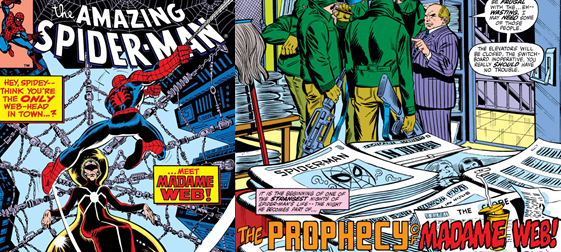
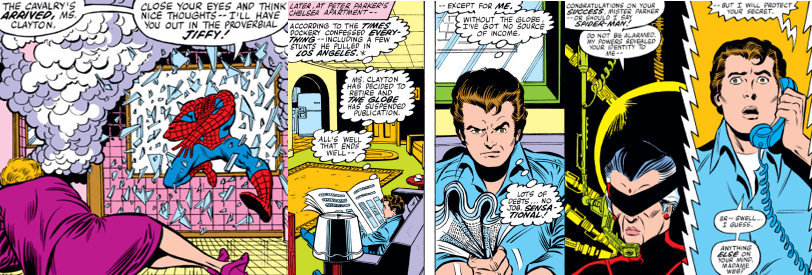
After Sam Raimi’s Spider-Man trilogy (2000 to 2007) proved a phenomenal success, Marc Webb’s reboot films proved sadly mediocre and led to an unprecedented agreement between Sony Pictures and Marvel Studios that allowed the iconic wall-crawler to appear in the Marvel Cinematic Universe (MCU) and Sony to release tangentially-connected spin-offs featuring Spidey’s villains and side characters. Encouraged by the financial (if not critical) reception of their Venom (Various, 2018 to present) movies (and seemingly undeterred after the car-crash reception of Morbius (Espinosa, 2022)), Sony not only signed off on a solo project for Sergei Kravinoff/Kraven the Hunter, but also the enigmatic clairvoyant Cassandra Webb/Madame Web. Created by Dennis O’Neil and John Romita Jr., Madame Web first appeared in The Amazing Spider-Man #210 and significantly influenced Spider-Man’s battles against multiversal forces, but is perhaps best known for her inclusion in the Spider-Man animated series (1994 to 1998), where she was voiced by Joan Lee (wife of the legendary Stan Lee). Writing began on a Madame Web feature while Morbius was still in production and saw numerous rewrites, even after director S. J. Clarkson signed on and retooled it into Sony’s first female-centric Marvel film. Producer Lorenzo di Bonaventura expressed difficulties in adapting Madame Web’s clairvoyance to the screen and emphasising secrecy surrounding the project given her relative obscurity, a fact explicitly addressed by the inclusion of other, more recognisable Spider-Women. The cast appear to have been mislead as to the status of the film in the wider MCU; this may explain the bizarre marketing campaign that saw star Dakota Johnson seemingly openly criticise the film, though she wasn’t the only one. After numerous delays, Madame Web released to scathing reviews; the film made just shy of $100 million at the box office and critics attacked the poor dialogue and script, lacklustre special effects and pacing, and the blatant false advertising regarding three of the lead characters.
The Review:
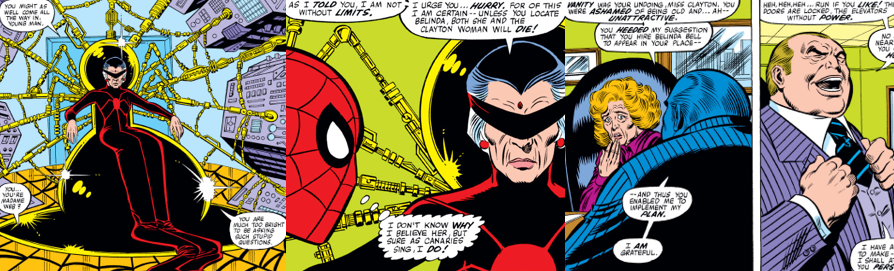
So, if I had a whole bunch of negativity towards making standalone, Spider-Man-less films about the likes of Eddie Brock/Venom and Doctor Michael Morbius, you can be damn sure that I was baffled to the point of insanity by the decision to make a solo Madame Web movie. Not only is she an extremely obscure Spider-Man character, but her depiction is generally as a wizened, blind mentor who manipulates Spider-Man like a chess piece as part of Marvel’s on-again/off-again insistence on convoluting Spidey’s origins and mythos with semi-paranormal cosmic ideas of Spider Totems and “Webs of Fate”. It’s ironic, really, as the concept could have worked a little better if Madame Web had been depicted as a Professor Charles Xavier/Professor X-type figure, mentoring and recruiting Spider-Women to oppose the Inheritors, despite my dislike for them, because at least then the focus would be on the spider-powered women and not this thoroughly unlikeable paramedic who, despite choosing a carer where she’s sworn to protect lives and being depicted as a workaholic who rushes to do that very thing, is reluctant to help the three girls targeted by Ezekiel Sims. Much of Cassie’s reluctance stems from her lingering feelings of abandonment, confusion about her true self and past, and what’s framed as an unconventional upbringing since her mother, Constance (Kerry Bishé), died during childbirth and Cassie was raised in the foster system, left with only mementos of her mother, Constance’s research into the near-mythical spiders of the Peruvian jungles, and the mistaken, childish belief that Constance cared more about her arachnids than raising her daughter. Consequently, Cassie has a bit of an abrasive edge to her; while she tirelessly works to save lives alongside her friend and partner, Ben Parker (Scott), she’s uncomfortable with receiving gratitude for this, has no idea how to act around children, and would much rather spend time in her apartment with a local stray cat than socialise with her colleagues or even Ben’s pregnant sister-in-law, Mary Parker (Emma Roberts). Her anxiety and social awkwardness is only exacerbated after she nearly drowns and is sporadically bombarded by visions of the past and near future, all framed by a mysterious web-like pattern, though she initially dismisses these visions and it takes her a ridiculously long amount of time to realise that they’re not only true, but that the fates she is witnessing can be changed.
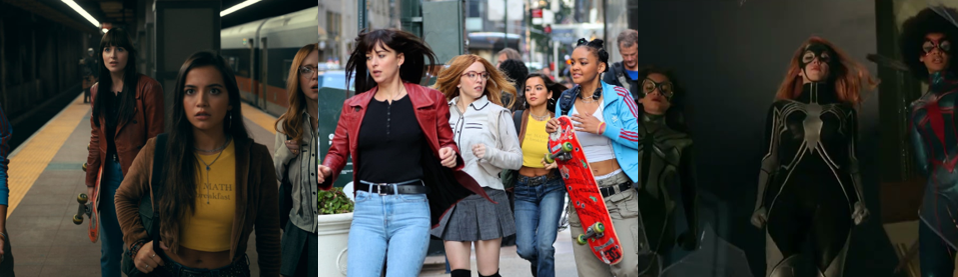
Central to her visions are four individuals – a violent killer clad in a somewhat-familiar spider-themed costume and possessing superhuman strength and spider-like abilities, and three twenty-somethings teenagers that Cassie sees horribly murdered by this assassin time and again. As fate would have it, their destinies are all intertwined and lead Cassie to encounter the three girls individually to establish some surface-level characteristics for the three that are partially developed as the film chugs along. Julia Cornwall (Sweeney) is the quiet, shy girl who’s struggling with her parents’ divorce, Anya Corazon (Merced) is both book smart (she literally wears a t-shirt proclaiming her love of “math”) and dealing with fending for herself after her father’s deportation, and skater Mattie Franklin (O’Connor) is the streetwise rude girl with a chip on her shoulder since she comes from money. The three couldn’t be more different but quickly form a genuinely enjoyable sisterhood after they’re saved by Cassie; while initially distrusting of her, they eventually come to believe in her janky clairvoyance after she saves them from Ezekiel multiple times. However, Cassie is seemingly impulsively compelled to do this, and it takes her a while to realise the responsibility she has towards the girls; she routinely abandons them, chastises them, and even jets off to Peru to investigate her origins and undergo a spiritual journey that finally teaches her that she has an obligation to protect the three with her abilities. The three girls do their best with the materials, appearing fun and likeable and adding some pathos to their characters through their shared feelings of abandonment, but the script is rarely in their favour. The same is true for Cassie, who constantly narrates her life like an idiot and acts very irrationally for a paramedic, though eventually she settles into the role of a reluctant surrogate mother and protector to the girls.

The girls are targeted by Ezekiel since he’s been plagued by visions of his death at their hands at some point in his future. Previously working alongside Constance, Ezekiel betrayed and killed her to get his hands on a mysterious spider that granted him his amazing powers, but also cursed him with the knowledge of his impending death. In the interim, he built a vast, indistinct corporate empire and has become obsessed with finding and killing the three Spider-Women who’ve haunted his nightmares, aided by his “girl in the chair”, Amaria (Zosia Mamet), who hacks into the police database and CCTV cameras all over the city to track the girls down. It’s not made clear why the Spider-Women would hunt down and kill Ezekiel in the future, or what he’s done that makes him such a diabolic villain except one confirmed kill, but boy does he like to mumble and grumble about how badly he wants them dead and his desire to ensure he lives on! As if having all the wealth and technology he needs at his disposal isn’t enough, Ezekiel also possesses spider-like powers; he can walk and climb on walls, leap vast distances, possesses superhuman strength and reflexes, and can poison his victims with a touch, eventually causing cardiac arrest. He also seems to display some degree of clairvoyance and psychic power to rival that of Cassie, communicating to her on the astral plane at one point, and dresses in an admittedly cool looking outfit when out on the prowl. How he changes in and out of this isn’t made clear either, however, as he’s often seen wearing the form-fitting suit in one scene and then fully in his business attire in the next with no explanation, and he’s routinely humiliated by Cassie since she can anticipate his actions ahead of time. While Cassie doesn’t demonstrate the same superhuman powers, the three girls do in the frantically-edited visions of the future, though it’s unclear how, when, or why they gained superhuman powers. Ezekiel does, however, share his powers with the mysterious Las Arañas, a secret Peruvian tribe who dress in makeshift jungle attire that’s very similar to Spider-Man’s and try to save Constance when she’s wounded, delivering Cassie and then later making her realise that her mother ventured into the jungle to save her, not because she didn’t care about her. Frankly, I find this whole aspect to be borderline insulting; I hate the idea of a tribe of Spider-People and of a spider species that can grant these powers as it diminishes Spider-Man’s uniqueness, though the depiction of the spider-powered people clambering and leaping about the place is pretty good and surprisingly horrific, especially when Ezekiel is tossing bodies around in Cassie’s visions.
The Nitty-Gritty:
There’s a shared feeling of abandonment between the four female leads; all of them feel like outsiders to some degree, isolated from others and even their families since they either don’t have a parental figure, or their parents don’t seem to care about them. While their individual personalities initially clash because of their different backgrounds and current social standing, they quickly bond once they realise how much they have in common, with the three girls, especially, forming a makeshift sisterhood due to their current circumstances. Although Julia is Cassie’s most vocal supporter, they initially believe she’s either crazy or just another adult they can’t rely on and decide to go against Cassie’s warnings and fend for themselves, an action that very nearly sees them all killed by Ezekiel before Cassie intervenes. She chastises them, angry at their irresponsible and reckless actions, but struggles to give them the answers they want and to properly care for them since he’s apparently so maladjusted that she can barely stand to be around her handful of friends, much less look after three scared teenagers. Thus, she turns to Ben to shelter the girls while she tries to find answers in Peru; this turns out to be a good decision since Ben is a much more emotionally stable individual. He deeply cares for his sister and is extremely excited about being an uncle, but is also devoted to his friend and partner, to the point where he resuscitates Cassie after she drowns, begs her to socialise with his family and their colleagues, and agrees to look after the girls even though he has no idea what kind of danger they’re in. As good as Adam Scott was in the role (I particularly liked the banter he shared with Cassie, which hinted at a former attraction, and his struggles to keep up with the girls), the only reason he’s here is for fan service: yes, he’s playing the future Uncle Ben and, through him, we even see the birth of his nephew (who ridiculously goes without a name) and get hints towards his future, despite Madame Web taking place in its own separate continuity from previous Spider-Man movies. There’s also something really weird about Julia, Anya, and Mattie all being older than Peter and the frustration of the three running around in normal street clothes instead of the awesome Spider-Women suits we barely get a glimpse of in their future.

Yes, Madame Web is another great example of Sony lying to us; the trailers and posters showcased Julia, Anya, and Mattie as fully-empowered Spider-Women but this isn’t the case at all. I guessed that we wouldn’t see them suit up until the very end, but the truth is far worse; they only wear their costumes in fleeting visions, with no explanation of how they get their powers, and the film has the gall to setup a potential sequel that actually addresses these issues, but to me it’s a dropped ball that completely derails the movie. The bulk of Madame Web is focused on Cassie’s struggles to reconcile her past and understand her newfound powers; there are numerous scenes of her witnessing snapshots of the future, meaning we get a lot of time loops and confused looks from Cassie that border on the maniacal as she tries to understand what’s happening. Primarily, though, these visions are used as fake outs; almost every time, the scene will show Ezekiel coming in, wrecking fools, and killing his targets in an almost effortless manner, only to suddenly snap back to Cassie and show her taking action to avoid this fate. It’s all very reminiscent of the Final Destination films (Various, 2000 to present), which is fitting but kind of lowers a lot of the stakes since you can just assume every violent scene or action sequence is just a vision. When Ezekiel does get a chance to fight, he’s effectively peerless; none of the protagonists have the strength or ability to go toe-to-toe with him, meaning Cassie drives a lot of cars into him and catches him off-guard with her clairvoyant powers, leaving him perplexed and looking stupid. When the Las Arañas appear, it’s all shot with an unsettling, nightmarish shaky-cam filter that makes their appearances and abilities not only difficult to pin down, but also appear needlessly cartoonish. There are some decent effects at times, such as when Cassie takes her spiritual journey and interacts with the Web of Fate and the lingering memory of her mother, and things are surprisingly grounded for a Sony Spider-Man-adjacent movie, with Ezekiel being unable to swing from webs and more reliant on his physical abilities. This, in conjunction with his intimidating costume, does paint him as a formidable figure; he’s almost like a slasher villain at times, draining the life from his victims, breaking their limbs, and pouncing like an animal, but this persona is awkwardly juxtaposed with his pandering civilian identity, where he may as well twirl an old-timey moustache as he spouts generic villain dialogue with little charisma or conviction.

So, all these recent revelations help Cassie make sense of her mother’s notebooks; while she previously resented Constance’s apparent fixation on her spider research, she realises that her destiny has been intertwined with Ezekiel’s since before her birth and takes herself to Peru to find answers. There, a Las Arañas, Santiago (José María Yazpik), helps her to realise that her mother was trying to cure her of some disease and that she has a greater destiny, one that will bestow her with “great power” once she accepts the “responsibility” that comes from her abilities. Before, she saved and sheltered the girls simply because it was the right thing to do; she had little interest in watching over them or bonding with them, or of their greater destinies as Spider-Women, but her spiritual journey motivates her to actively shield them from Ezekiel’s wrath, and gives her greater control over her future sight. After rescuing them and allowing Ben and Mary to get to safety, Cassie takes the girls to a fireworks warehouse and they finally set aside their differences to set a trap for Ezekiel, planting flares all over the place to cause a series of explosions. This actually causes quite a few issues for the protagonists, however, as the explosions destroy the helicopter Cassie called in to rescue them and eventually sees Julia, Anya, and Mattie separated and facing fatal falls. Luckily, Cassie masters her powers enough to…somehow…spiritually duplicate herself long enough to help the three to safety, incurring Ezekiel’s anger. Despite him being haunted by very specific visions of his death at the hands of the three Spider-Women, Cassie changes his fate and claims that she was always the one who was destined to end him (which doesn’t seem true, but okay) and lures him onto unstable ground, eventually causing him to plummet to his death and be crushed by debris. Cassie also takes a plunge but, luckily, she taught the girls CPR earlier and they’re able to revive her, though she’s not only inexplicably left paralysed with no explanation but also winds up blinded by a stray firework. Still, she’s not bothered by this; in fact, the film ends with her happier than ever since she can now, presumably, use the full extent of her psychic powers and clairvoyance to see and understand the future and is prepared not just to take on the three as their foster mother, but to mentor them into the Spider-Women they are destined to become…effectively ending the film where it really should’ve started! Like, why not have Cassie already be infirm but fully empowered and training, say, Julia, showing their origins through flashbacks and exposition, and have Julia be the point woman in recruiting Mattie and Anya when Ezekiel, an Inheritor assassin, targets them? It could’ve been Sony’s answer to the X-Men, in a way, and even take place in the same universe as their other pointless spin-offs, and might’ve been more enjoyable because then we would’ve gotten to see the gorgeous Sydney Sweeney in their slick, form-fitting Spider-Woman costume for a lot more of the runtime!

The Summary:
I went into Madame Web expecting it to be bad based on the trailer, the disaster that was Morbius, and my dislike for the concept in general. I tried to have an open mind, however; the cast, for example, intrigued me, as did the costume design, and to be fair there is the ghost of a semi-decent idea here, it just would’ve worked better as a side plot in a Spider-Man film or reworked to have Julia Carpenter/Spider-Woman at the forefront, with Cassie as a mentor figure. Any goodwill the film might’ve gotten from its Spider-Woman costumes is flushed down the toilet since we barely get a good look at these and the girls don’t even become Spider-Women in the movie; Ezekiel’s costume and action scenes somewhat make up for this, but he’s such an ineffectual and confusing villain that it’s hard to care when he’s onscreen. The relationship between the protagonists was somewhat enjoyable; I liked how the girls bonded, their shared feelings of abandonment, and them coming together as a surrogate family, but it’s executed so poorly and, although the girls do try, they’re all hampered by a really awful script. Dakota Johnson suffers from this the most, I think; she was some weird, awkward silences and quirks and is forced to spit out some really awful dialogue and nonsensical exposition. Add to that the fact that Cassie is a weird and pretty unlikeable character, abandoning and yelling at the girls even though she’s supposed to be a paramedic and you have a main character who’s hard to relate to, a villain as flat as a piece of paper, and three boisterous young girls who are completely wasted in this travesty of a film. It’s more than a step back for the genre; Madame Web harkens back to a time when superhero movies were not only afraid to use codenames and costumes, but outright ashamed of them, delivering cookie cutter dramas that falter at the first hurdle. It’s a sad state of affairs and I have lost all hope for Sony’s future Spidey-adjacent movies, and my expectations were already at the bottom of the barrel to begin with!
My Rating:
Terrible
Did you enjoy Madame Web? If so…what’s the matter with you? What did you think to the performances and the dynamic between the four protagonists? Were you disappointed that the girls didn’t actually become Spider-Women in the film? What did you think to Ezekiel, his characterisation, and the nonsense about the Las Arañas? Do you think a Madame Web movie could ever work, or would you rather see a Spider-Woman take the forefront? Which Spider-Woman is your favourite? I’d love to know your opinion of Madame Web, so leave a comment below and be sure to check out my other Spider-Man and Marvel content.




 Dr. K's Waiting Room
You must be logged in to post a comment.