
In September 1961, DC Comics published a little story called “Flash of Two Worlds” (Fox, et al), a landmark story that featured in The Flash #123 and brought together two generations of the Flash: the Golden Age Jay Garrick and the Silver Age Barry Allen. In the process, DC Comics created the concept of the multiverse, the idea that DC Comics continuity was comprised of an infinite number of parallel universes that allowed any and all stories and characters to exist and, more importantly, interact and I’ve been celebrating this ground-breaking concept every Sunday of September!
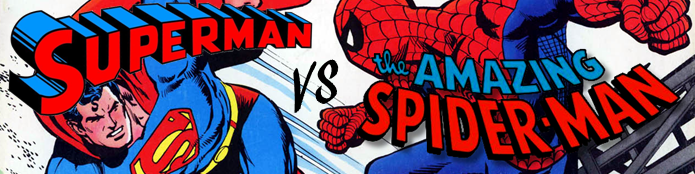
Story Title: “The Battle of the Century!” (Includes four chapters: “A Dual of Titans”, “When Heroes Clash!”, “The Call of Battle!”, and “The Doomsday Decision”)
Published: March 1976
Writer: Gerry Conway
Artists: Ross Andru and Dick Giordano
The Background:
Despite the fact that the two companies were both producing colourful, superpowered costumed heroes in a cut-throat industry, relations between DC Comics and Marvel Comics have been surprisingly collaborative and amicable over the years (they’ve certainly been more civil with each other than many of the toxic “fans” I see arguing on social media every day…) Sure, there’s been lawsuits and underhanded tactics from both companies, but not only were the legendary Stan Lee and the disreputable sham Bob Kane actually good friends but the two companies both borrowed from and inspired each other and they’ve even collaborated on numerous joint publications in the past. The idea of pitting Clark Kent/Superman against Peter Parker/Spider-Man was first suggested by author and literary agent David Obst, who pitched the idea to Marvel Comics publisher Stan Lee and DC Comics editorial director Carmine Infantino as a live-action feature film. Writer Gerry Conway and artist Ross Andru, two of the few who had worked on both characters in the past, were brought in to bring the concept to life, which was treated as more of a fantasy tale (despite the fact that DC had introduced the concept of the “Multiverse” over a decade previously). The comic, which generally sells for quite a high price these days, wouldn’t be the last time Superman and Spider-Man (or DC and Marvel, for that matter) crossed paths as the two would collaborate on a number of inter-company crossovers during the eighties and nineties.
The Review:
Our story begins with just another normal, boring day in Metropolis as a gigantic mechanical construct is tearing its way through the city. Even Superman laments the frequency of such events but is unable to see who is controlling the robot thanks to it being lined with lead and is equally unable to stop it thanks to its incredible strength, an “inertia ray”, and gravity beams being emitted from its mechanical feet that crush Superman with “ten times the gravity of Krypton”. All of this means that Superman is smashed through the nearby buildings (which are, we later learn, conveniently empty despite the fact that the robot is rampaging through downtown Metropolis with reckless abandon and Superman even has to save innocent civilians from falling debris) and is unable to keep the robot from stealing a computer console from Scientific and Technological Advanced Research Laboratories (S.T.A.R. Labs). Indeed, Superman is so distracted with trying to retrieve this from the robot’s head that he completely misses that the mastermind directing the machine’s attack was none other than Lex Luthor himself!
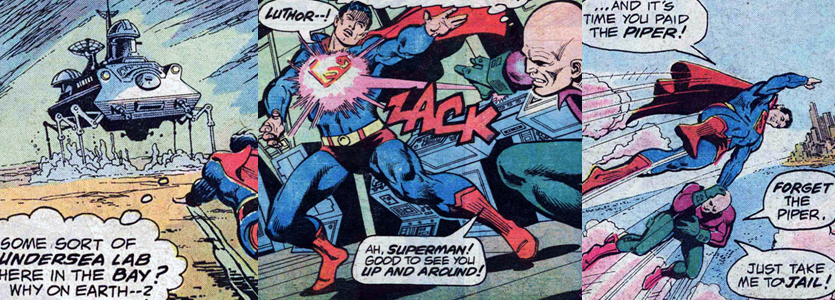
Superman returns to his civilian life as Clark Kent, reporter for the Daily Planet (owned by Galaxy Communications at the time), who avoids one of Steve Lombard’s mean and unprofessional pranks thanks to his super powers, gets chewed out by his boss, Morgan Edge, for not covering the attack (quite why Edge chooses to target Clark over Lois Lane or Lombard is beyond me), and realises from watching the footage back that he can track the robot’s obvious trail of destruction and gigantic footprints to Metropolis Bay There, beneath the water, he immediately discovers (and is attacked by) a walking undersea laboratory. Inside the lab, Superman confronts Luthor and after trying, and failing, to convince him to renounce his evil ways and rekindle heir former friendship, is attacked by a series of high-intensity laser beams. Though he’s able to dart through them, one blasts him into his eyes and, thanks to essentially being red sun radiation (which weakens Superman), dazes him and causes him to wreck Luthor’s lab. Luthor manages to spirit away the programming circuit he stole from S.T.A.R. Labs but ends up being apprehended by Superman after almost drowning to death.
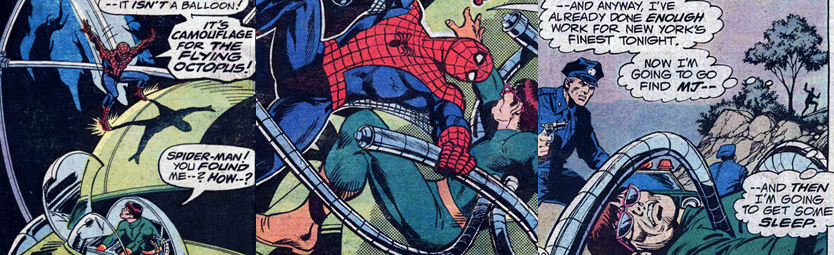
The story then switches to New York City right as Spider-Man is swinging in to take care of a handful of crooks who are in the middle of robbing the Metropolitan Museum. Of course Spidey easily trounces the crooks with his spider-powers but things quickly escalate when the mastermind behind the plan, Doctor Otto Octavius/Doctor Octopus, suddenly attacks with his mechanical limbs and, thanks to the element of surprise (and a good old whack to the back of the head), is able to temporarily knock Spider-Man unconscious and escape in his ridiculous looking “Flying Octopus” craft with boxes and boxes of loot. After fleeing from the police (who naturally assume Spider-Man to have been involved in the robbery), Spidey (as Peter Parker, obviously) presents the photographs of the entire event to his boss, J. Jonah Jameson, but earns the cantankerous editor’s wrath when Jameson prints the shots unseen and is left with nothing but a blurry, instinct picture on page one of his newspaper, the Daily Bugle. When his spider-sense suddenly alerts him to a passing blimp overhead, Peter ditches Mary Jane Watson and heads off to investigate as Spider-Man only to discover (after having to think on the fly thanks to his web fluid having run dry) that the blimp was disguising Doc Ock and his flying machine. The ensuing fight wrecks the blimp, causing it (and them) to crash into the Central Park reservoir and, with one swift punch to the jaw, Spidey successfully apprehends Doc Ock and heads off to try and smooth things over with Mary Jane.
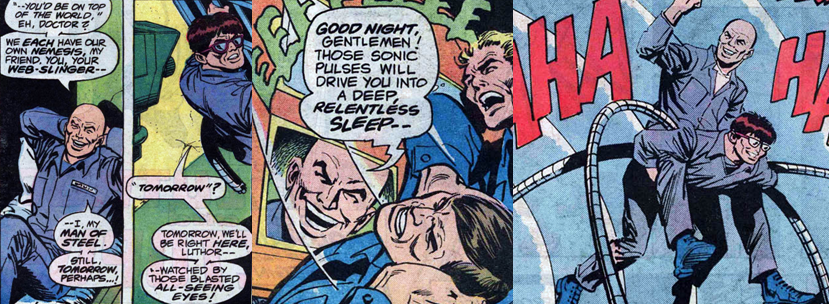
As luck (or fate, or simple plot convenience) would have it, both Lex Luthor and Doc Ock end up being shipped off to “Federal Maximum-X Security Penitentiary Number One, the most “escape proof” prison in the world” out in New Mexico and the two immediately bond over their respective losses and enemies and agree to join forces upon escape. Though Doc Ock is sceptical of their chances, Luthor quickly uses a number of small, high-tech devices hidden under a layer of fake skin to disrupt the prison’s security cameras and guards and allow Doc Ock to regain control of his mechanical limbs and literally carry them both to safety within just a few hours of Luthor’s arrival, The story proper begins with Clark, Lois, and other members of the Daily Planet staff attending the world news conference in New York; as you might expect, Peter is also there and, after being berated by Jameson, snaps at his boss and quits his job, shocking (but also impressing) Mary Jane with his sudden outburst. Meanwhile, Clark is stunned to hear that Edge doesn’t want him covering the news conference and, again, alludes to his temptation to replace Clark with a more well-known newscaster. Frustrated that Clark is happy to roll over and allow himself to be forced out of the “biggest story of his career”, Lois storms off in anger at his cowardice and her inability to truly hate him since he’s so charming and likeable. In true Lois Lane fashion, she risks her life climbing up a scaffold to get some better pictures (because Jimmy Olsen couldn’t make the trip, apparently) and nearly falls to her death when she’s saved by Peter. They bond over their respective professional accomplishments, much to Mary Jane’s displeasure, but Peter is left flabbergasted when Superman suddenly swoops in and seemingly vaporises them both right before his eyes!
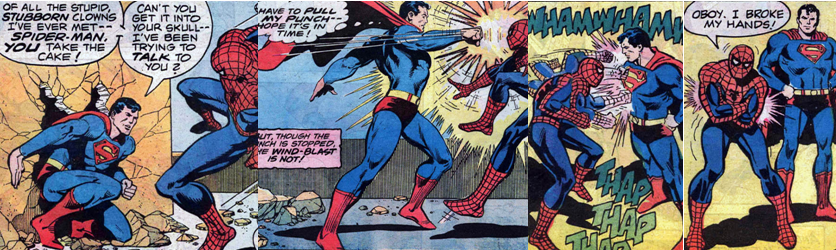
Clark also witnesses this event and is equally stunned and changes to Superman to investigate while Peter frantically switches to Spider-Man using the staircase (because, in a cute moment, the convention doesn’t have traditional phone booths). The two superheroes instantly run into each other in the skies above the building and come to blows (Superman having assumed, as many often do, that Spidey is connected to his doppelgänger). Although Superman immediately begins to be the voice of reason, Luthor and Doc Ock (who were behind the fake Superman; Luthor’s even still wearing the costume and has the lifelike mask nearby!) decide to escalate their conflict by surreptitiously blasting Spider-Man with red sun radiation to power him up for the fight. Thanks to the red sun radiation, his anger at being pushed around, and believing the Superman has captured or killed the woman he loves, Spider-Man attacks relentlessly; his strength knocks Superman off balance and his fury causes him to stubbornly refuse to listen to reason, all of which makes Superman mad enough to throw a killing blow at Spidey’s head. At the very last second, Superman is able to pull his punch but the resulting “wind-blast” sends Spider-Man flying through buildings and across the city. Disgusted at having nearly killed a man, Superman tries one more time to get Spidey to listen to reason and, when the red sun radiation wears off and amusingly leads to Spidey simply hurting his fists on Superman’s steel-hard body, Spider-Man finally relents. After comparing notes, they quickly bury their issues and agree to work together to uncover the truth about what happened but the proof of the pudding is clear: Spider-Man dominated the fight between the two and had Superman reeling throughout.
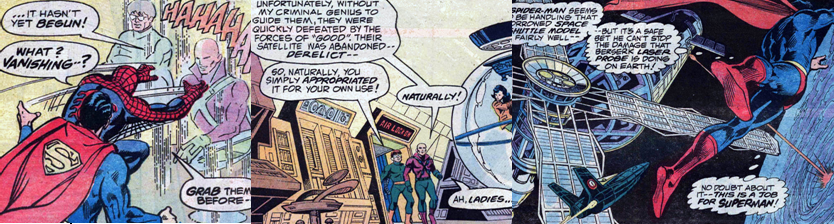
Following the “energy residue” of the imposter to the Penn Central railroad yard, Superman shows that he hasn’t quite shaken off the dickish ways of his sixties incarnation by allowing Spider-Man to go in first and run a gauntlet of traps and hazards before he (as in Superman) just ploughs right in there and they both confront the combined might and intelligence of Luthor and Doc Ock. Revealing that Lois and Mary Jane have simply been taken captive to lure the two heroes into a trap, the villains quickly vanish, having been mere projections all along (which you’d think Superman and Spider-Man would be able to register with their enhanced sense but apparently not…), and nearly manage to kill Spidey with a booby trapped computer console before Superman intervenes. Superman then rebuilds the wrecked computer at super speed and down to the smallest detail, apparently somehow managing to repair and restore the destroyed files that would have been on it in the process, which leads the two to Mount Kilimanjaro. There, a local nomadic Masai tribe lead them to another of Luthor’s secret bases. After battling and defeating a superpowered tribesman (who also wields a sword charged with red sun radiation), the two discover that Luthor and Doc Ock have headed to the upper atmosphere and the abandoned satellite headquarters of the Injustice Gang. There, Lois and Mary Jane are held hostage and are privy to the supervillains’ mad scheme: using the programming circuit he stole from S.T.A.R. Labs, Luthor is able to disrupt and hijack Comlab (a massive, missile-like communications tower in orbit) and cause it to fire a “high-intensity laser probe” into the Earth’s atmosphere and hold the world to ransom or face untold death and destruction from the violent storms the laser causes.
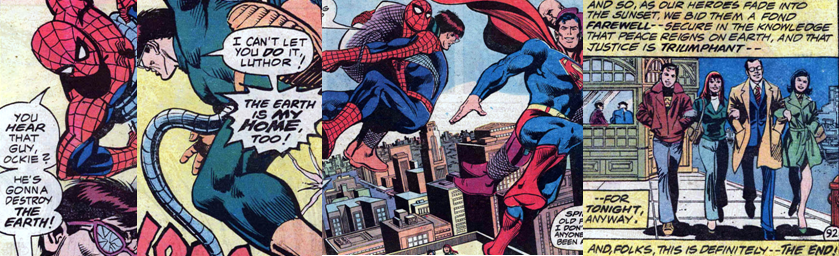
Superman and Spider-Man (piloting a shuttle of his own with surprising efficiency) head up to stop them but are immediately overwhelmed by Luthor’s lasers and captured. Although they catch their foes off-guard by feigning helplessness, Superman and Spider-Man are thrown off balance when Luthor suddenly shuts off the satellite’s artificial gravity (quite how this would affect Superman is beyond me…), which allows the villains to topple the costumed heroes with a humiliating ease. Quickly recovering, the two turn the tide when Superman is able to get close enough to Doc Ock to…remove his glasses! Distracted by recovering his comrade’s glasses, Luthor is unable to defend himself against Spider-Man, and Spidey is able to turn Doc Ock against Luthor by appealing to his greed because, after all, what use is money if Luthor plans to decimate the world? Although this is enough to disable to destructive laser and cause the two villains to come to blows, Superman must still take care of a gigantic tidal wave that threatens to engulf the entire United States! Of course, Superman is able to dispel the wave by flying at it at super speed and, with the villains subdued and the threat ended, Superman and Spider-Man part as allies and return to their respective lives, with both men able to win over (and back) their employers with their exclusive insight into this one of a kind team up.
The Summary:
I grew up reading Superman, Batman, and Spider-Man stories from the 1970s so, for me, Superman vs. The Amazing Spider-Man feels like a very familiar and nostalgic little tale. The artwork and characterisations are representative of this era; both the main characters and their villains pop out nicely, with Luthor being more of the scheming supervillain rather than a manipulative businessman. While Spider-Man is just as troubled by his angst and anxieties and spouts the usual quips and puns that were “hip” at the time, Superman is far from an unstoppable demigod while still having one foot in the ridiculously overpowered nature of his Golden Age counterpart. If you’re a fan of Lois and Mary Jane then this isn’t the comic for you; the two barely factor into the plot at all and, arguably, could have been excised completely and the villains’ scheme would have carried on largely unchanged. Similarly, characters like Jameson, Morgan, and Lombard are mainly just there for comic relief or to flesh out and contrast the normal, everyday lives of our two heroes. This is a bit of a missed opportunity, in many ways, as we’re denied a meeting between Jameson and Clark’s usual boss, Perry White, or even a sub-plot where Lois and Mary Jane have to work together to either escape or help stop the villains. Maybe if the story hadn’t suddenly veered off to waste time on the Marais tribe or wasted pages recapping the origins and powers of the heroes and villains we could have seen more of these interactions or had Spider-Man visit Metropolis.
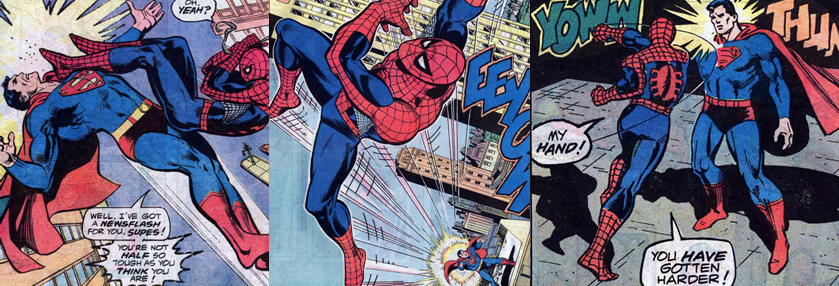
Still, the comic is called Superman vs. The Amazing Spider-Man and we definitely do get that; the two fight for about twelve pages and it’s a fairly evenly matched affair thanks to Spidey being supped-up by Luthor’s special red sun ray. Superman, ever the Boy Scout, spends most of the fight reeling from Spidey’s surprising strength and trying to calm the web-slinger down and, every time he tries to fight back, Spider-Man is right there to shut him down and press the attack. In fact, Superman only throws one punch in the entire fight but it’s enough to send Spidey flying with “the force of a compact hurricane”. Interestingly, there’s a lot of subtext that can be gleaned from this bout; Spidey, representing Marvel Comics, is the young, hot-tempered upstart who hits first and asks questions later and Superman, representing DC Comics, is the older, more level-headed veteran who seeks to resolve conflict peacefully but will strike back if pushed too far. Naturally, the two pool their respective talents far more than they clash and, after resolving their issues, never come to blows or conflict again. I suppose it’s nice that there wasn’t a lame excuse for them to fight again, like hypnotism or whatever, but the actual inciting incident is pretty paper thin (even though he saw “Superman” vaporise Mary Jane and Lois, Peter knows Superman by reputation so you’d think he’d hesitate to suddenly think he’d gone rogue) and I would have liked to see a bit more of how their different approaches to situations clash. We only really got to see this once when they reached the rail yard and it seemed petty and mean on Superman’s part to send Spidey in alone when he (again, as in Superman) could just burst in there without issue. It’s a good job that the clash and interactions between the two heroes pays off as the supervillain team up is a bit lacklustre; Doc Ock is reduced to a mere common criminal and a henchman here, having no real agency and playing very little role in the story other than giving Luthor someone to talk and boast to and acting as Luthor’s muscle. It’s a shame as Doc Ock is one of Spidey’s most devious, intelligent, and imposing villains but he may as well not be in the story at all since everything (from the prison escape, to framing Superman, to the red sun ray, and the orbiting satellite/laser plot) is Luthor’s plan and Lex may as well have teamed up with Flint Marko/The Sandman for all the use Octavius’s arms and demented genius were.
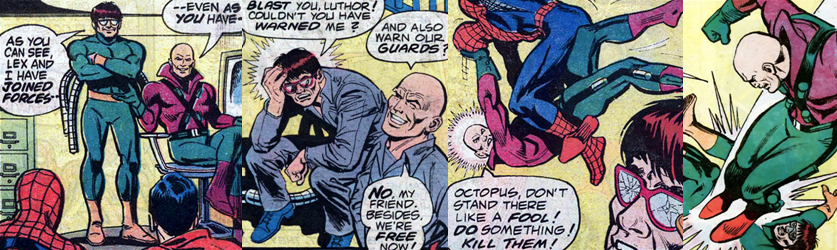
As a result, Luthor comes out of this looking like a scheming, diabolical madman who is happy to threaten and kill millions for a measly ten billion dollars; his genius allows him to create all kinds of fantastic technology and even duplicate red sun radiation to weaken Superman but, in the end, he’s undone because Spidey was able to manipulate Octavius to turn against him. Overall, it’s a decent enough story; well drawn and full of big, action-packed panels when the two heroes clash and take on their foes but the main appeal of Superman vs. The Amazing Spider-Man is, unsurprisingly, in seeing two of Marvel’s premier superheroes butting heads and joining forces. In that regard, the story works but just barely; it reads like a typical, run of the mill Superman story from the time just with a guest appearance by Spider-Man and some of his supporting characters. When the Marvel characters do appear, they’re written exactly as you’d expect from that era as well and no one side really looks better or dominates the other…unless you look at the subtext at work. Superman and Spider-Man appear to be evenly matched in their fight but Spider-Man is clearly the aggressor; Luthor outshines Doc Ock at every turn, relegating him to being a mere henchman, so I guess everything just about evens out on both sides but I can’t help but feel like the story was lacking a little. It would have been nice to see Spidey in Metropolis, more interactions between the two in and out of costume, and the two having to deal with their counterpart’s villains in a more interesting way than flailing around on a space station but there’s an appeal to Superman vs. The Amazing Spider-Man, if only because of the comic’s rarity and the chance to see these two heroes, and worlds, collide for a change so it’s probably worth seeking out for the sheer spectacle of it if nothing else.
My Rating:
Pretty Good
Have you ever read Superman vs. The Amazing Spider-Man? If so, what did you think to it? Do you own a copy of the original comic or do you remember reading it when it was first published? Were you also disappointed that the comic didn’t make better use of its concept, supporting characters, and villains or were you happy with the story we got? Which of the two heroes, and publishers, was/is your preference? Do you enjoy all comic books and superheroes equally or are you one of those toxic fans who actively hates other characters and companies? Would you like to see DC and Marvel collaborate again in the future and, if so, what stories would you like to see? Whatever your thoughts on Superman vs. The Amazing Spider-Man, and comic book crossovers of this kind, drop a comment down below and check out my other multiverse reviews.










You must be logged in to post a comment.