
January celebrates two notable dates in science-fiction history: “National Science Fiction Day” on January 2 to coincide with the birth of world renowned sci-fi writer Isaac Asimov, and 12 January being when Arthur C. Clarke’s HAL 9000 was created. Accordingly, I dedicate January to celebrating sci-fi in all its forms.


Released: 15 August 1986
Director: David Cronenberg
Distributor: 20th Century Fox
Budget: $9 to 15 million
Box Office: $60.6 million
Rotten Tomatoes Scores: 93% / 83%
Quick Facts:
A reinterpretation of George Langelaan’s 1957 short story and a remake of Kurt Neumann’s 1958 sci-fi classic, The Fly was surreptitiously produced by comedy legend Mel Brooks, featured creature effects by Chris Walas, Inc., and almost starred Pierce Brosnan or John Malkovich. Though a sequel and stage play followed, Cronenberg’s proposals for another follow-up never materialised, despite Jeff Goldblum’s enthusiasm.
The Review:
I think it’s fair to say that, for shy, insecure recluse Seth Brundle (Jeff Goldblum), meeting Veronica “Ronnie” Quaife (Geena Davis) at a Bartok party was love at first sight. Cradling a glass of Scotch and claiming to be working on something that’ll “change the world and human life as we know it”, Brundle is excited to discuss his work with the beautiful Ronnie, misreading her interest as anything other than a story for Particle Magazine since, by his own admission, he “doesn’t get out much”. Equally, I think it’s fair to say that Ronnie’s intrigued by Brundle’s doe-eyed naivety; she later admits that he’s “very cute”, indicating that she was attracted to him despite his somewhat bumbling nature and acute travel sickness. This, and the perception that Brundle is a harmless cook, drives her to visit his isolated laboratory/apartment, housed within a rundown building in what looks like a pretty rough area of town (red flags if I ever saw them). Once there, Ronnie immediately regrets her decision upon seeing Brundle’s sparse apartment, which is the furthest thing from a clinical, scientific setup you can imagine. Brundle, however, is a closet showman as he tries to impress with his piano skills and introduces her to his revolutionary Telepods. While Ronnie’s unimpressed by the “designer phonebooths”, Brundle’s extremely protective of them, even the “clunky” prototype, since he literally cobbled them together from bits and pieces of other Bartok technology. Yet, Brundle isn’t some hack or fraud; Stathis Borans (John Getz) later reveals that Brundle has a distinguished scientific career and almost won the Noble prize for Physics at just twenty-two! It seems, then, that Brundle is being unnecessarily humble regarding the Telepods, which he controls via a simple computer interface and voice recognition software and which are apparently so efficiently designed that they cause no power drain to his apartment or the immediate area.
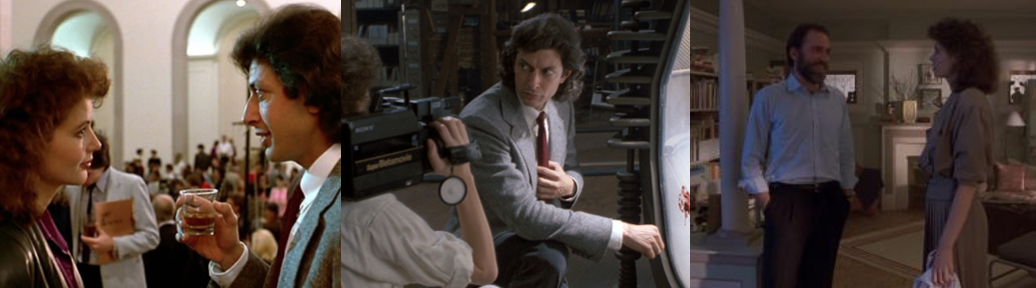
Ronnie, however, is incredibly sceptical of Brundle’s claims to be able to teleport inorganic matter between Telepods. However, when she witnesses it after seductively handing over her stocking, Ronnie immediately recognises that they’re an exciting scientific breakthrough and begins grilling Brundle, causing him to panic when he realises that he’s misread the signs and prematurely revealed his project. Thus, Brundle’s relieved when the creepy, condescending Stathis dismisses Ronnie’s account, initially believing Brundle’s a “con man” before spitefully running with the article after the two become lovers. Brundle offers Ronnie the chance to follow his work more closely, eager to publish a complete record of his world-changing invention and, intrigued, she agrees. However, ever the curious journalist, Ronnie questions the teleportation process, so Brundle naturally demonstrates the system’s fatal flaw by teleporting a baboon (because I guess lab rats or rabbits are too hard to come by!) While Ronnie is horrified when the process turns the baboon inside out, Brundle is both grief-stricken and enraged by the continued failure, blaming himself for the flaw since the computer is only following his commands. Luckily, he gets an intense and passionate sermon on the “flesh” when Ronnie, smitten by his intellect and drive, seduces him. This sexual escapade inspires Brundle to realise that the computer is being too analytical about organic matter, so he excitedly rewrites his program and is elated when the second baboon is successfully teleported. While Brundle and Ronnie celebrate and begin a whirlwind romance, the jealous Stathis descends into a malicious tantrum, angrily confronting Ronnie and threatening to expose Brundle’s work just to get back at them. Ronnie’s forced to pay her editor and former lover a late-night visit to try and reason with him, leaving poor Brundle to drink himself into a stupor. Drunk, believing Ronnie is cheating on him, Brundle spontaneously decides to teleport himself, completely unaware that a seemingly harmless housefly has snuck into the machine with him.
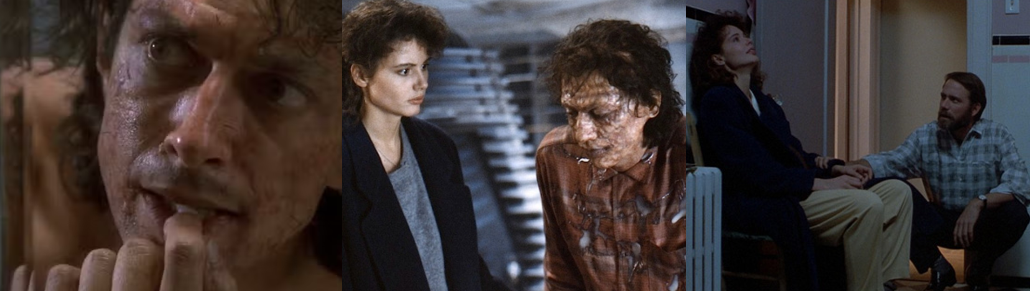
Though Ronnie allays his fears regarding Stathis, she’s alarmed to learn about this and relieved to find he’s unharmed. Her relief turns to amazement when Brundle immediately undergoes physical changes, suddenly becoming far stronger, having more stamina, and being more excitable than ever, After being physically exhausted by his sexual appetite and discovering coarse hairs on his back, Ronnie reacts with horror when Brundle suddenly urges her to undergo the process, believing the Telepods purified his genes and made him superhuman, only to lash out with anger and take to the streets to find someone more willing, leaving her devastated. Brundle impresses barfly Tawny (Joy Boushel) with his gruesome physical strength and Telepods, though he’s further frustrated when she also refuses to use the machines and when Ronnie reveals that he’s sprouting insect hairs. Drunk on his newfound physical strength and ignoring Ronnie’s concerns about his health and erratic behaviour, Brundle throws her out in a rage, only to beg her to visit him some time later, his condition having noticeably deteriorated. After realising Ronnie was right when his fingernails fall off, Brundle is horrified to discover that his Telepods spliced him and the fly on a molecular level and surmises that the foreign DNA is manifesting as a “bizarre form of cancer” that’s causing gruesome tumours and decay. Terrified, Ronnie begs Stathis for help, those he’s disgusted upon viewing footage of the rapidly worsening Brundle, whose despair is replaced by a manic glee as he finds he can scale walls and vomit a corrosive enzyme to eat, now excited to be transforming into a unique lifeform he dubs “Brundlefly”. Though Brundle’s mental health degenerates alongside his body and he laments his declining humanity, he works tirelessly on a solution using his Telepods, only to be wracked by agonising spasms and to realise his only viable option is to sacrifice a healthy life. Ronnie’s nightmare only worsens when she finds she’s pregnant and, fearful that the baby could be contaminated by Brundle’s mutated genes, struggles with telling the increasingly monstrous and animalistic Brundle of her plans for an abortion.
The Fly is very different from the original film, and the source material, replacing concerns about nuclear annihilation with a very blatant AIDS analogy and marrying the fear of scientific curiosity with the tragedy of watching a loved one succumb to a cancerous disease. For me, The Fly is one of the quintessential examples of how to do a remake as it takes the basic premise of the book and adds a new spin to it, modernising it and recontextualising its themes into an unforgettable, tragic sci-fi body horror piece. The Fly takes itself very seriously, showcasing Brundle’s mental and physical decline in gruesome and uncomfortable detail, so much so that Cronenberg famously cut a scene where Brundle beat a cat/baboon hybrid to death as audiences lost sympathy for him. While it’s admittedly odd that Brundle cobbled together his Telepods largely by himself, operates in a less than sterile environment, and uses baboons as test subjects, his eccentric and secretive nature speaks to these decisions. These are also early warning signs that Brundle isn’t quite prepared for how dangerous his Telepods can be. Not only were they not calibrated to handle living tissue, they also can’t comprehend the presence of two lifeforms, essentially killing Brundle during his first jaunt since what emerges is an “insect… who dreamt he was a man… and loved it!” Brundle’s pained soliloquy about “insect politics” is easily one of the film’s most emotional and horrifying moments, largely because The Fly does such a great job building the romance between Brundle and Ronnie. It helps that Goldblum and Davis were dating at the time, but their characters have great chemistry together, with Brundle finally having someone to talk to and be open with and Ronnie excited to be at the forefront of a scientific breakthrough and involved with such a passionate and selfless man.

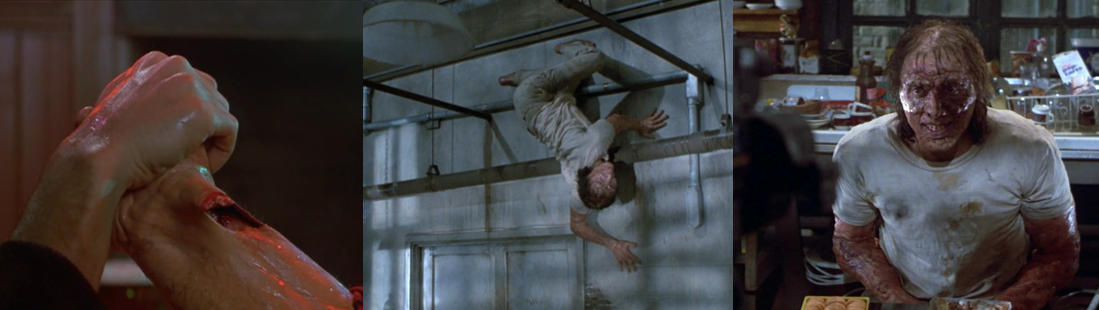
It’s thus even more tragic and horrifying to see Brundle go from an eccentric, loveable goof to a conceited, temperamental jerk and a broken, literal shell of his former self. At first, Brundle’s excitement at reaching his physical potential is infectious but, when he subscribes his condition to the purifying nature of the Telepods, be becomes uncharacteristically violent. Brundle’s mood swings only increase as he deteriorates; he constantly goes from despair, to anger, to sarcastic acceptance even when collecting his decaying body parts. Brundle initially tries to put a positive spin on his condition by urging Ronnie to document his fly-like abilities, before becoming resentful of Ronnie’s frequent absences and trashing his apartment during one of his many outbursts. Brundle noticeably struggles to maintain his logic, reason, and humanity as his body hideously warps, barely holding onto himself long enough to warn Ronnie to stay away for her own safety. However, when he learns that she’s pregnant, Brundle sees the unborn child as potentially the last link to his humanity. Rather than stumbling around with a big fly head, Goldblum endures a horrific physical transformation that is brought to life through top-notch make-up and prosthetics and showcases his deterioration in multiple stages. At first, things aren’t so bad with a few extra hairs, skin blotches, and bad hygiene but, within about a week, Brundle struggles to stand and his skin is covered in disgusting boils. The foreign DNA essentially turns him into a living, slowly decaying cocoon, at first bestowing him with the proportional strength of a fly and then crippling him with pain as the mutation grows more severe. Brundle loses his fingernails, his teeth, his ear, and his penis (judging from his ghastly medicine cabinet); his fingers and toes fuse together; and his speech is so badly distorted that his computer doesn’t recognise him. All throughout Brundle’s transformation, he’s pained by a growth on his side, which another deleted scene reveals birthed a gruesome, fly-like appendage! Brundle loses the ability to properly digest food, using “vomit drop” to liquify sugary treats, and is eventually reduced to a rotten, limping, tumour who’s barely recognisable as a man in a startling gruesome analogy for the AIDs epidemic, the aging process, and cancer.
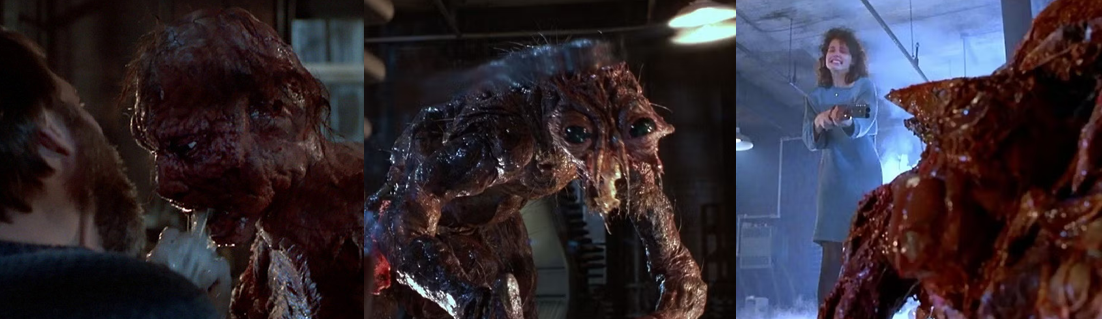
After a horrifying nightmare about her baby, Ronnie pleads with Stathis to help her and he takes her for an abortion since she refuses to risk giving birth. Desperate for a part of himself to live on, Brundle pleads with her to keep the baby but, when she refuses, he’s forced to bring the distraught and terrified Ronnie to his lab. Barely able to speak, Brundle explains his insane plan to teleport himself, Ronnie, and their unborn child and fuse them together into one body, his warped mind seeing this as the only way for them to be together as the “ultimate family”. Though Stathis bravely tries to stop Brundle, he ends up getting his hand and foot melted by vomit drop, though his harrowing moment is merely the appetiser for The Fly’s most impressive and unsettling scene. While fighting off Brundle, Ronnie dislodges his jaw, kickstarting Brundle’s final, gruesome metamorphosis as his sickly shell splits, his flesh tears to ribbons, and his eyes explode as the sickly, gangly Brundefly emerges! Driven only by his insane plan to undo his condition, the “Spacebug” launches Ronnie into a Teleport, activates the sequence, and settles his into another Telepod. However, the horribly injured Stathis fires a shot that shorts out Ronnie’s Telepod. Enraged, Brundefly smashes his way out, only for the countdown to complete and the Telepod to activate! As Howard Shore’s haunting score rises to a crescendo, the Telepod deposits Brundlefly, now little more than a howling, mangled mess of meat, piping, and machinery. Barely breathing, clearly wracked with agony, the twisted Brundlefly/Telepod-thing crawls along on pure instinct. Traumatised and wary, Ronnie grabs Stathis’s gun to defend herself but is crippled by heartache at the sight of what’s left of her lover. With the last vestiges of his strength and humanity, Brundlefly weakly presses the gun to his bulbous forehead. Though Ronnie hesitates, struggling to kill the man she loves, Brundlefly emits a heart wrenching groan and silently pleads to have his torment ended and, more on instinct than anything, Ronnie fires, atomising Brundlefly’s head and causing what’s left of him, and his tormented lover, to collapse to the floor.
Final Thoughts:
I was way too young to watch The Fly when I first saw it, and yet it didn’t traumatise me like other horror films back then. There are many reasons why The Fly is so well regarded, even when it first released, and I largely credit The Fly for being one of a handful of movies that made me appreciate the beauty of practical effects, prosthetics, and animatronics. Brundle’s physical and mental decline is disturbing to witness, with him becoming this monstrous, pain-wracked hunchback who grows increasing volatile as his humanity is stripped away. This final transformation into Brundlefly remains as captivatingly horrific as ever, with the sickly, almost alien creature being unpleasant to look at and yet deeply sympathetic, especially when he’s mewling on the ground after being spliced with the Telepod. Add to that the horrifying maggot birth sequence and you have a movie that largely cemented David Cronenberg as the king of body horror. Cronenberg’s visuals are even more potent when you watch The Fly as an allegory for sexually transmitted diseases, a plot point just as prominent in this first-class remake as the dangers of meddling with science and which works so well because of the chemistry between the leads. Brundle and Ronnie make an adorable pair, a couple you really root for due to their undeniable chemistry, and Stathis makes for a despicably loathsome third wheel. The fact Stathis becomes someone to root for by the finale is almost as unsettling as seeing him get dissolved by fly vomit since he’s such a vile creep, but it speaks to how well-written The Fly is that every character is so well rounded. The Fly may very well be the quintessential Jeff Goldblum performance as he throws his all into the role, enduring unimaginable discomfort to showcase Brundle’s declining state and being the perfect mixture of lovable goof, erratic jerk, and enraged monster. I don’t think it’s hyperbole to say that The Fly has aged beautifully and is just as impactful and emotional now as it ever was, especially for me, and it remains one of my all-time favourite movies of any genre…and the standard bearer for how good remakes can be!
My Rating:
Fantastic
Are you a fan of this gruesome remake of The Fly? Did you enjoy the ways it reinterpreted the book, or do you think it strayed too far from the original text? Were you invested in the romance between Brundle and Ronnie? What did you think to the horrific make-up effects and Brundle’s mental and physical deterioration? Is The Fly your favourite remake? Would you like to see a new adaptation of Langelaan’s book? How are you celebrating all things sci-fi this January? Leave a like and a comment with your thoughts, go check out my other sci-fi reviews, and donate to my Ko-Fi to suggest other sci-fi movies for me to cover.

 Dr. K's Waiting Room
You must be logged in to post a comment.