Back Issues [Crossover Crisis]: Freddy vs. Jason vs. Ash: The Nightmare Warriors


In April 1985, the first issue of the ground-breaking Crisis on Infinite Earths (Wolfman, et al, 1986) released and saw the temporary destruction of the “Multiverse”. To celebrate this momentous event, I’m discussing multiversal crossovers in an event I dubbed “Crossover Crisis”.


Published: August 2009 to December 2009
Writers: Jeff Katz and James Kuhoric
Artist: Jason Craig

The Background:
Although it is regarded as one of the best slasher properties around, Paramount Pictures became embarrassed with their Friday the 13th franchise (1980 to present) and sold (some of) the rights to rival studio New Line Cinema back in the early-2000s. This led to the long-awaited clash between Friday’s iconic killer, Jason Voorhees (Various) and New Line’s Freddy Krueger (Robert Englund) after years in Development Hell. Despite mixed reviews, Freddy vs. Jason’s (Yu, 2003) box office gross of nearly $117 million made it he most profitable entry in either franchise and naturally led to talks of a sequel. Unfortunately, these fell apart due to rights issues surrounding fellow horror icon Ashley “Ash” Williams (Bruce Campbell), but the three horror heavyweights did meet up in Freddy vs. Jason vs Ash (Kuhoric, et al, 2007 to 2008) courtesy of WildStorm and Dynamite Entertainment. Based on Jeff Katz’s film treatment, Freddy vs. Jason vs. Ash proved successful enough to warrant a follow-up the following year that was originally envisioned as a twelve-issue story before being scaled back. Katz returned to co-write the story, which he envisioned as a massive conclusion to the Freddy vs. Jason trilogy and a love letter to all three franchises. Fellow writer James Kuhoric was adamant about ensuring all the returning characters felt familiar to series fans, with special emphasis put on the clash of personalities between Ash and Tommy Jarvis. The two also sought to redesign Jason, giving him a Grim Reaper-like visage, and make the most of the unrestricted nature of the new format to show more over-the-top kills on a much larger scale. Although some saw The Nightmare Warriors as an improvement on the first crossover due to its larger scale, it was also criticised for being somewhat mindless and predictable and for struggling to juggle not just the titular horror icons but its extended cast of characters.

The Review:
The Nightmare Warriors opens twenty-four hours after the end of Freddy vs. Jason vs. Ash, with undead killer Jason Voorhees still trapped under the bumper of Ash Williams’ beloved Oldsmobile, still with a machete blade where his left hand once was, and still missing his trademark hockey mask, beneath the frigid depths of Crystal Lake. Cursed with eternal unlife by the Necronomicon Ex Mortis, Jason is compelled to return to the world of the living at the urging of his mother, Pamela, though it’s once again dream demon Freddy Kruger assuming Pamela’s form to reactivate Jason and set him against Ash for besting them in the previous crossover. At that same moment, a group of government agents, led by Director Gordon Russell, arrive to secure the area, intent on securing the Necronomicon for themselves, deeming its power to open rifts and raise demons more enticing than the unkillable Jason. Within mere panels, his team find and thaw out the book and spirit it back to base, while a separate team dives into the lake to retrieve Jason and nullify him. Unfortunately for the frogmen, Jason bursts to life and slaughters them all, shrugging off their bullets and high-powered shock lancers and dicing them to bloody pieces, then retrieves the remains of his mask and heads out to find Ash at this “mother’s” bidding. Spreading of Ash, the story jumps over the Franklin, Michigan and ahead six months; Ash’s narration once again brings us up to speed on his life: after defeating Freddy and Jason, he and surviving girl Caroline (or “Carrie”) settled down into suburbia, despite the dramatic age gap between them. Their domestic bliss is interrupted by the first of many returning faces when Doctor Maggie Burroughs (also known as Katherine Kruger, Freddy’s daughter and noted child counsellor) drops by. Since the events of Freddy’s Dead: The Final Nightmare (Talalay, 1991), Maggie has been working with another prominent Elm Street character, child psychiatrist Doctor Neil Gordon, to identify special “focal magnets” for the supernatural who can combat dark forces.

Ash initially refuses Maggie’s offer to join the other survivors, as the Pentagon resurrects Freddy.

Although she’s come to the right place, given Ash is the “Chosen One”, Ash has given up his Deadite-slaying ways and has no interest in joining their crusade to pre-emptively target the dark evils of the world and Maggie leaves empty handed. Ash heads out on a beer run, blissfully ignorant to the fact that Jason is tearing into his house and attacking Carrie. Although she desperately fights back, she’s no match for Jason and her head ends up cooking on the barbecue. On the drive back, Ash catches wind of this when he gets a vision of Freddy – not unlike the visions suddenly striking Stephanie Kimble, “Dream Master” Alice Johnson, and her teenage son, Jacob – between the panels, but he arrives too late to help and is pegged as a murderer by Carrie’s family. As a mysterious individual watches on, Ash fights off Carrie’s dad and makes a run for it as the cops arrive, hopping on the first train out of there to go find Maggie. Although Maggie seems to sense her father’s return, she allays the fears of her lover, Neil, since they’re protected by the dream-blocking powers of Hypnocil. She also assures their two psychic recruits, Rennie Wickham and Tina Shepherd, that they have nothing to fear and excites them with the prospect of new recruits joining their cause. Neil, however, isn’t completely sold on Maggie’s plan, especially after seeing a similar group of survivors butchered by Freddy in the past, but Maggie convinces him with her words (and her allure) that the survivors of Freddy and Jason’s rampages are special, crucial, to stopping such monsters. Their new recruits turn out to be Alice, Jacob, Stephanie and her father, Steven Freeman (referred to as “Stephen”). Just as they arrive, Stephanie suffers a massive seizure, bombarded by visions of Jason, who adds a bunch more bodies to his kill list when he follows Ash. Meanwhile, at the Pentagon, Director Russell and his team’s hard work translating the Necronomicon with some pretty futuristic technology sees them return Freddy to the real world, now fully mortal and free of his burns. Although Freddy gives Director Russell the run-around and plays coy, he gives them enough to confirm the book’s power and Russell orders a strike team to intercept Jason, who’ve they’ve tracked to Maggie’s house.

As the group struggles to co-exist, Freddy is joined by a revitalised Jason and a sadistic Maggie!

Jason makes a dramatic entrance shortly after Ash arrives looking to avenge Carrie’s death; Stephen’s incredulity about the entire thing turns to abject terror at the sight of Jason, who unceremoniously caves his head in, but the others are saved when the mysterious onlooker, Tommy Jarvis, bursts in to spirit them away in his jeep. The strike team arrives soon after and subdues Jason with sleeping gas, bringing him into custody at last. Chastising their efforts and clashing egos with Ash, Tommy warns about Jason’s brutality and power and begs them to leave it to him given his past experience, but Maggie won’t hear of it. She touts Rennie’s empathic power and each of the group reveals some of their past experiences with both killers and their special abilities, such as Alice sporting dream-based powers and Tina being somewhat telekinetic, and Ash naturally boasting off his Deadite-slaying past. Maggie desperately calls for he and Tommy to set aside their egos and focus on using the Necronomicon to put both monsters down for good, stating that her father oversees the project to research it, but the group remains divided. At the Pentagon, Jason is wheeled into a Deadite holding cell and once again falls prey to Freddy’s influence. Somehow possessing the Necronomicon’s power along with his dream powers, Freddy brags of his plot to use Russell to finish what he started in Freddy vs. Jason vs. Ash. Although Jason still wants to kill Freddy, he’s convinced to join forces with Freddy mentions Tommy’s name and Freddy uses the magic words – “Klattu! Verata! Nikto!” – to restore, repair, and upgrade Jason’s body and mind, turning him into Freddy’s long-haired, dual-machete-wielding General. Later that evening, Ash and the others (sans Tommy, Stephanie, and Jacob) enter the Pentagon using Maggie’s credentials and are immediately locked up on Director Russell’s orders despite their warnings about Freddy. As Ash questions Maggie’s relationship with Russell, she’s brought to Freddy, who can freely shift between a normal human and his burned form and has physically merged with the Necronomicon, effectively making him a God. In a dramatic moment, Maggie murders Russell with Freddy’s glove and reveals that she’s been working with Freddy the whole time, the two apparently in a very sexual incestuous relationship.
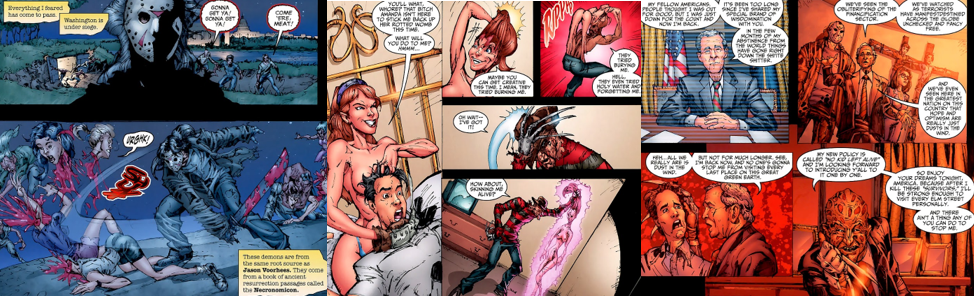
As Jason leads the Deadite army, Freddy kidnaps Jacob and spreads fear and death through the nation!

Although Neil believes it to be some kind of brainwashing, Maggie goes the whole hog and kills him and Rennie, rechristening herself Kathryn Kruger and being transformed by Freddy into a claw-handed murderess. Thanks to Tina’s psychic powers, Ash and the others are alerted to the betrayal just as the Pentagon goes on high alert after Jason leads the Deadite army in a jail break. Although desperate for some payback, Ash is convinced to flee by Tina and Alice; when he tries to retrieve the Necronomicon, he’s attacked by a claw-wielding machine controlled by Freddy but a combination of Tina’s psychic powers and Ash’s bravado brings it down. Tommy is aghast to see Jason leading the medieval dead on a killing spree throughout the nation’s capital, though his attempts to stop the masked killer are for naught as he’s quickly captured by a couple of bat-like Deadites and brought to Freddy, leaving Jason and the Deadites free to carve up congress. Back at the Stabe Hotel, Jacob is seduced by Stephanie in a nightmarish ruse by Freddy, who binds and tortures him until he cries for his mother. Sensing his plight, Alice uses her powers to transport herself, Ash, and Tina into Jacob’s nightmare, but they’re unable to keep Freddy from kidnapping Jacob and challenging them to confront him at the White House. Thankfully, they’re able to put Stephanie back together in the dreamworld and save her life, though the experience of being skinned alive in the nightmare leaves her traumatised. At the White House, the Deadites hold off the military and the cops and allow Freddy to address the nation, first using the guise of President George W. Bush and then reverting to a less despicable visage, his own burnt form, to dictate his “No Kid Left Alive” policy and declare war on the children of America.

When Freddy sets Stephanie and Kathryn against his enemies, Alice passes her powers to Jacob.

Ash galvanises Alice, Tina, and Stephanie and they gear up to go rescue Jacob; they find Washington swarming with Deadites and blood raining from the skies and their resolve falters when Alice chastises Ash’s plan of simply fighting their way to victory. Luckily, the military arrive and cause a big enough distraction; their wholesale attack upon the Deadites and Freddy’s focus on repelling their forces allows Ash and the others to slip past the undead defences, but the distressed Stephanie is lost when she wanders off and has her untapped Voorhees blood awakened by Freddy’s influence, turning her into a mindless killer like her…I wanna say uncle?…that sees her don her own hockey mask and set out to fulfil her birthright and kill Jason. In the Oval Office, Freddy brags of his superiority to the captive Tommy but, annoyed by the kid’s defiance, prepares to kill him when Jason intervenes, wanting the kill for himself. This is again enough to turn the two against each other; Freddy orders Kathryn to kill Jason and the two get into it, with Kathryn cutting chunks out of Jason and even impaling him on a flagpole, but the fight is interrupted when Ash comes crashing in in a tank, crushing Kathryn and blowing Freddy clear out of the Oval Office with a cannon shot. As Ash and the others rescue Tommy and Jacob, Freddy literally pulls himself together out on the lawn where he’s confronted by Alice; when Freddy mocks her chances and boasts of his immortality, she allows herself to be killed since she has a terminal disease, but her death passes her Dream Master powers to Jacob and releases the spirits of the original Dream Warriors and Freddy’s mother, Amanda. Suitably empowered, Jacob and the Dream Warriors dispatch of Freddy’s Deadite forces, bringing Freddy to his knees in defeat once more.

Tommy and Ash set aside their differences to defeat Freddy and Jason once more.

However, as Amanda prepares to bring Freddy’s soul to be judged by the Almighty, Freddy drops the ruse and guts Jacob; Ash and Tommy clash one last time as they try to get their priorities straight and ultimately agree to let Tommy have his wish to be the one to finish Jason off. Tommy attacks Jason with all his anger and strength but is, of course, physically outmatched by the revitalised killer; drawing strength from all the pain and death Jason has caused, Tommy pummels him with a rock but falters when he sees Jason’s unblemished face. The normally silent monster utters the words “Yew… daie!” and leaves Tommy with a shoulder injury and facing certain death. Luckily, Stephanie impales Jason with two machetes to the back, distracting him long enough for Tommy to behead him with a massive shard of glass and triumphantly hold up his severed head. As Tina desperately tries to stop Jacob from bleeding out, Freddy feasts upon both the souls of the Dream Warriors and of Jason himself; Ash thrusts the Necronomicon into Neil’s hands and demands he find a passage to end the nightmare and buys him time by battling Freddy once more but all hope seems lost as Neil can’t read the book’s language. However, the spirit of his former lover, Nancy Thompson, arrives to help and, together, they speak the cursed words, opening another vortex. Although Freddy’s power is such that he can resist the portal’s pull, the Dream Demons (revealed to be dwelling within the Necronomicon) express outrage at his failures and remove his powers, leaving him vulnerable to one last quip from Ash and a shotgun to the chest, which sends him flying into the vortex. Nancy and Neil share a tearful farewell and, as the nation recovers, a victorious Ash and Tina share a completely random kiss and he parts ways with Tommy with a mutual respect. However, Jason’s body disappears from the battlefield and the story ends in Springwood, 1964, where a random cop caught in the Necronomicon’s vortex blindly signs Freddy’s arrest warrant, apparently changing Freddy’s past despite him laughing from the clouds? It’s a bit confusing, if I’m honest.

The Summary:
Freddy vs. Jason vs. Ash: The Nightmare Warriors suffers from a lot of the issues that plagued the last crossover; the story is a bit of a mess, with twists and turns that pop up seemingly at random just to drag the story out to six issues, and with some underdeveloped themes and conflicts. Like, I must have missed when the Pentagon conjured enough Deadites to need a prison for them, and I’m not sure why Director Russell thought he could manipulate Freddy so easily, plus it’s really out of character for Maggie to suddenly be so on her father’s side that she not only kills in his name but is turned on by his affections. The art is also quite inconsistent again; it picks up from issue four but there are a lot of instances where the artist is again simply copying shots from Freddy vs. Jason and I had a hard time recognising a lot of the returning characters. Stephen looks more like a scowling Marshall Mathers III/Eminem than his film counterpart, I kept mixing Stephanie, Rennie, and Alice up and I just don’t think enough was done to visually make them stand out from each other. Alice, for example, should be far older than she’s portrayed here, which would’ve helped. I genuinely forgot Jacob was even in this until he was kidnapped, and I can’t say I cared much for Tommy’s characterisation; get him being gung-ho about wanting to end Jason, but I like to think he would see the benefits of joining forces with the so-called “Nightmare Warriors”. I did enjoy seeing him clash with Ash; I genuinely think the story might’ve been stronger with more focus on those two being an odd couple pairing and placing more emphasis on the Ash/Tina relationship since she randomly kisses him at the end despite there being no chemistry between them prior to that.

The interactions between Ash and the returning characters is the best part of this bloated crossover.

Ash is a little different here than in Freddy vs. Jason vs. Ash, at least initially. He’s settled down with Carrie and is happy to leave his past behind, but he’s brought back into the fight when she’s killed by Jason. Unlike the opening of the last crossover, I enjoyed this death since Carrie lasted a little longer and her death pushed Ash into joining up with Maggie and gave him a greater personal stake in the battle against Freddy and Jason. It’s not one that’s fully realised since Ash tangles more with Freddy, which I get as it’s fun seeing them trade insults as well as blows, but he doesn’t really fight with Jason all that much and, unlike the last crossover, there’s no three-way dance between them this time. Ash is also a little more contentious this time around; he clashes with Tommy, of course, but also aggravates Alice with his misogynistic attitude and inability to think of a plan beyond just ploughing through what’s in front of him. The Deadites get a little more play this time around, with Jason leading the medieval dead and them chattering away as they’re killing and being killed, but they primarily exist to be cannon fodder for the military, Ash, and the Nightmare Warriors. Speaking of whom, I did enjoy seeing these surviving characters return, even if they’re not as strong or visually interesting as the Dram Warriors. The only really useful one was Tina, and even she just blasted doors open and levitated stuff; Alice only became useful by dying and even then Jacob was attacked before he could finish offing the Deadites, meaning the returning characters were more like fan service than anything else.
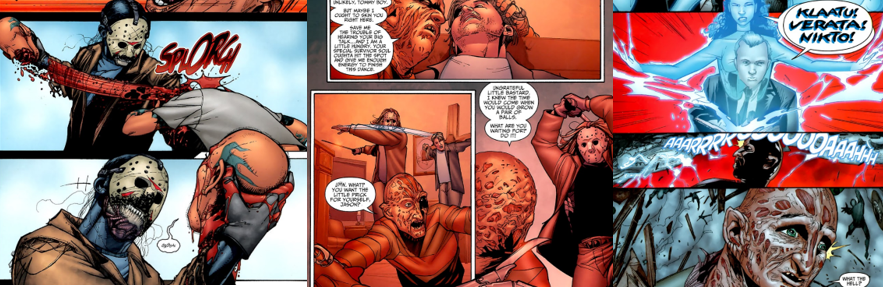
More gore, more fan service, and more action doesn’t necessarily amount to a better story.

I don’t mind this; a story titled Freddy vs Jason vs. Ash should be heavy on the fan service, after all, but it does mean this story is even more bogged down with exposition than the last one as we need a recap on what everyone’s been up to since their last appearances. As before, Jason trumps Freddy in terms of kills; he hacks, bludgeons, and slaughters too many people to count here and it’s just as gruesome and glorious as you could ask for, but he is also once again relegated to being Freddy’s minion. At least this time he gets a visual upgrade and even speaks, but he doesn’t seem any more intelligent and the plot point of Stephanie “becoming a Voorhees” amounts to a mere distraction. Although the story makes a dramatic show of Jason’s beheading, we know he isn’t really dead as “only a Voorhees” can truly kill him and, as Pamela states, he can “never die”. Freddy is basically the same as in the last story, being a master manipulator but sporting incredible (and ill-defied) dark powers thanks to the Necronomicon. Having absorbed the book into himself, he can freely manipulate the waking world as he does the dream world but does little with this except send Jason and the Deadites on a killing spree, bring his enemies to him to absorb their souls and power, and mock his foes rather than just kill them. Seeing him take on Bush’s guise and revel in his Godhood was fun, and the story is far more creative with his powers and his dialogue, and I really liked seeing him reduced to a snivelling wretch after being stripped of his power. However, I still don’t really get the ending and I think The Nightmare Warriors confused itself by trying to be bigger and more grandiose than any other film in the franchises. Ultimately, it’s more enjoyable than the last crossover due to the fan service, cameos, and increased gore and action, but still falls short of being anything other than a novelty read for fans of these three horror staples.

My Rating:

Rating: 3 out of 5.

Pretty Good

Did you enjoy Freddy vs. Jason vs. Ash: The Nightmare Warriors? How do you think it compares to the last crossover between these three? What did you think to the returning characters and the fates that befell them? Did you like seeing Jason get an upgrade and Freddy become all-powerful? What was your interpretation of the ending? Which film in the three franchises is your favourite? What other horror crossovers would you like to see? Drop a comment below or on my social media to share your thoughts and feel free to check out my other reviews of both franchises, and the rest of my Crossover Crisis content!

Back Issues [Crossover Crisis]: Freddy vs. Jason vs. Ash


In April 1985, the first issue of the ground-breaking Crisis on Infinite Earths (Wolfman, et al, 1986) released and saw the temporary destruction of the “Multiverse”. To celebrate this momentous event, I’m discussing multiversal crossovers all throughout April in an event I dubbed “Crossover Crisis”.


Published: November 2007 to March 2008
Writers: James Kuhoric and Jeff Katz
Artist: Jason Craig

The Background:
Despite being regarded as one of the best slasher franchises, Paramount Pictures became embarrassed with their association with the Friday the 13th films (Various, 1980 to present) and eventually sold (some of) the rights to rival studio New Line Cinema. This meant that the long-awaited showdown between Friday’s iconic killer, Jason Voorhees (Various), and New Line’s Freddy Krueger (Robert Englund) could finally emerge from years of Development Hell. Freddy vs. Jason (Yu, 2003) received mixed reviews but its nearly $117 million box office gross made it the most profitable entry in either franchise and talks of a sequel inevitably came up. Unfortunately, no follow-up emerged on the silver screen, primarily because the main idea involved including horror icon Ashley “Ash” Williams (Bruce Campbell) and no deal could be reached. We did, however, see these three horror heavyweights tangle in not one but two limited edition comic books published by WildStorm and Dynamite Entertainment, who had been regularly publishing Ash’s comic book adventures for some time. Based on Jeff Katz’s film treatment, Freddy vs. Jason vs. Ash was praised for its covers and artwork and for its incorporation and expansion of all three franchises, though it was criticised for being somewhat predictable. Nevertheless, as alluded to, it was followed up by another clash between the three some two years later, one that sought to weave in even more lore from the franchises but was also met with somewhat mixed reviews.

The Review:
Our story begins five years after the events of Freddy vs. Jason and is narrated by the loquacious wit of Deadite-slaying, S-Mart employee Ash Williams, who not only relates that Crystal Lake has once again reverted back to its “Forest Green” moniker but is also now home to “Super Mega Ultra S-Mart”. Ash recaps what happened in the movie (unstoppable, undead killer Jason Voorhees was resurrected by dream demon Freddy Kruger and the two battled to the death at Camp Crystal Lake when Jason’s murderous ways defied Freddy’s wishes), and then reintroduces us to the two survivors of that epic showdown, Will Rollins and Lori Campbell (referred to as “Laurie”, for some reason), who have inexplicably returned to Forest Green because Laurie can’t shake the feeling that Freddy and Jason are still alive. Of course, basic horror movie odds state that this is a bad idea; both Will and Ash point out that it’s a bad idea, but Laurie won’t be dissuaded and, with snow caking the landscape, they investigate the remains of Camp Crystal Lake. Naturally, Laurie finds blood at the site and, moments later, is horrified to see Will’s eviscerated corpse strung up from the rafters, his entrails spilling to the floor. Hysterical and panicked, Laurie desperately tries to channel her survivor’s instinct, the special qualities that Ash bitterly remarks make such individuals special, attacking Jason with a buzzsaw and chastising his mindless killing, only to end up with a machete to the face as Ash sadly comments that, for better or for worse, the only true “chosen one” is him. Jason takes his newest victims back to his shack, where his beloved mother’s severed head has been joined by Freddy’s, a memento of his victory in Freddy vs. Jason. As we saw at the end of the film, Freddy’s spirit survived and, once Jason enters the shack, he’s immediately forced into a lucid dream state where he relives his childhood torment. He’s enraged when he finds Freddy nailing his mother, but Pamela soothes him, as ever, and convinces Jason that his new “daddy” not only wants to protect him from bullies but can also make him a “normal little boy” like he’s always wanted; all Jason has to do is go back to his childhood home and dig up the Necronomicon Ex Mortis that’s buried there.

With our survivors unceremoniously offed, a similar plot begins that sees Ash thrown into the mix.

With our returning characters summarily killed off, the story jumps over to the Forest Green S-Mart to introduce a new batch of horny, cliché teens; four slackers more interested in making crude dick jokes, pulling pranks on their supervisor, and giving oddball customers the brushoff. The four – Jarvis, Raoul, Davey, and Caroline (or “Carrie”) – are unimpressed to learn that a “senior housewares domestic engineer” is coming in to whip them, and the entire store, into shape for the holiday season. Of course, this is the “Chosen One” himself, Ash Williams, still sporting his robotic hand and embittered by both the influence the Necronomicon has over his life and the losses he’s suffered because of it. Still, he finds solace in kicking Deadite ass whenever they show up and the hope that he’ll one day get to destroy the book once and for all. Ash immediately puts the moves on some teens hanging around outside the S-Mart; as he’s reprimanded for his tardiness and shown around by the manager, the teens wander into the path of the lurking Jason, his vision twisted by Freddy’s influence and driving him into a killing frenzy. The screams attract Ash, and the cops, who immediately target Ash for being an out-of-towner but are forced to release him when the manager vouches for his innocence. Despite the event, Ash gets to work, unimpressed by the store’s presentation and the kids’ lethargic attitude and naivety regarding the dark forces lurking in the shadows. Naturally, Raoul and Jarvis mock his doomsaying demeanour, but Carrie is intrigued by his stories of cursed books and demons; just as he shares more of his experiences, she also clues him in on the local legend of Jason Voorhees, unaware that Jarvis and Raoul are listening in. When Raoul jumps in wearing a hockey mask and brandishing a tomato sauce-splattered hockey stick, Ash nearly kills him before Jarvis intervenes, further increasing the animosity between them and the unimpressed Ash. His mood lifts, however, when he not only sees the S-Mart sells the impressive “Chain Lightning” chainsaw but also when sultry Bree strokes his ego, convincing him to buy supplies for her camping trip, only to ditch him once he’s finished loading up her fancy sports car.

Ash searches for the Necronomicon, unaware that Freddy and Jason are also hunting it.

Meanwhile, Freddy urges Jason to continue towards his goal but the hulking killer can’t help but slaughter a group of carollers he spots in the forest along the way. Wouldn’t you know it, though, Bree and her shit-kicking friends are spending the night in the old Voorhees mansion, unaware that Jason is prowling outside. Ash rolls up soon after on the trail of the Necronomicon and immediately heads to the fruit cellar, ignoring the commotion upstairs as he assumes it’s just the kids getting laid (though it’s actually Jason ripping them to bloody pieces), and finally locating the book just before realising there’s a madman on the loose inside. Ash races upstairs and finds Bree, half naked and in shock, and uncomfortably slaps a kiss on her before delaying Jason with a shotgun blast and making a run for his Oldsmobile. With Bree in hysterics and the car refusing the start, Ash deflects Jason’s machete with his robot hand and is forced to bail when the monster wrecks his beloved car. Thankfully, Carrie suddenly runs Jason down as he’s throttling our hero and all three of them get to safety, much to Freddy’s anger. In Jason’s subconscious, where the hulking killer is little more than a terrified child, Freddy reiterates his mission to retrieve the book and gives Jason license to kill anyone who gets in his way, learning Ash’s name from the depths of Jason’s admittedly empty mind. Ash, Bree, and Carrie head to S-Mart, where Raoul and Jarvis are getting high, and Ash again chews the kids out for being macho assclowns. As Ash desperately searches for a solution in the pages of the Necronomicon, Jason waltzes through the front door and goes on a delightfully gory killing spree, forcing Ash to reload and rearm himself with his trademark chainsaw.

With Freddy’s threat now apparent, Ash comes up with a plan to destroy both undead killers.

Round two between Jason and Ash goes slightly more in Jason’s favour, with Ash being comically battered around the shop, incapacitating him enough for Jason to tear out Bree’s throat and retrieve the book. While the survivors regroup, now convinced of Jason’s threat and Ash’s abilities, Jason brings the book back to his shack and Freddy reads those immortal words – “Klaatu! Verata! Nikto!” – and returns to the waking world once more. Ready to spread a new kind of nightmare with the book’s power, Freddy leaves, considering the two even, but surprisingly makes good on his promise to “fix” Jason. Ash and the others head to Carrie’s place where they take stock of the situation, with Ash even referring to Jason as a Deadite and the group agreeing that “someone” must be manipulating him; but, with little else to go on, they turn in for the night. Thus, Ash finds himself dreaming of being back in the cabin; he even has his old hand for all of five panels before Freddy’s claws burst from it. As before, he races to the work shed and severs the razor-fingered limb with a chainsaw and wry commentary, only to be stunned when his blood forms into tiny, mocking Freddys and then a full-size Freddy, who introduces himself to Ash and then, strangely, states his plan to have Ash and the kids bring him the Necronomicon despite the fact that he already has it. Regardless, Ash fights Freddy off and forces himself awake, discovering that whatever happens in a dream happens in the real world, which is bad news for Davey as he’s pummelled to death by dodgeballs in his nightmare. Relishing his returning strength, Freddy orders Jason (now little more than his obedient lackey) to go kill them so he (as in Freddy) can properly read the book, while Ash has the kids round up some supplies from the S-Mart before heading back to the Voorhees estate. Ash’s plan is for them to stay awake, lure out Jason, and bury him under his own house using explosives; he arms himself with Chain Lightning, steals “some sugar” from Carrie, and heads inside, leaving the others to carry out their part of the plan.

Although supposedly smarter, Jason chooses to defy Freddy, who’s obsessed with the Necronomicon.

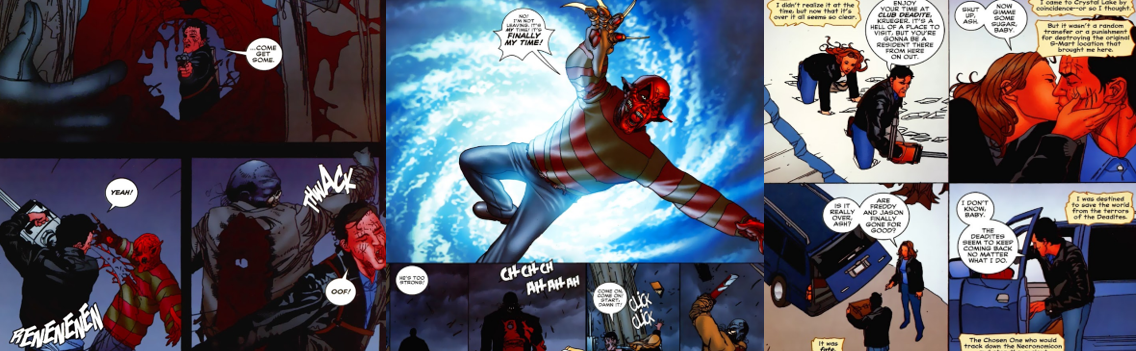
Unfortunately for the dumbstruck Raoul and Jarvis, Jason is a bit smarter now and doesn’t fall for their trap; he even taunts them with a finger wag before advancing on them. In the house, Ash is surprised to find Freddy manifested in the real world, suffering a shoulder wound for his arrogance, and even more stunned to find Freddy has already read from the book and enacted his plan to dominate both the waking and the dream worlds. Transforming to his demonic form and conjuring both ethereal Dream Demon spirits and miniature claws, Freddy prepares to cut Ash down but is surprisingly – and bafflingly – interrupted by Jason, now wielding two machetes, who randomly decides to turn against Freddy for no reason. Still, Freddy’s more than willing to oblige and conjures the demonic corpses of Jason’s many victims to swarm the hockey masked killer, with many familiar faces (even some who weren’t Jason’s prey) making a welcome return. Despite their numbers, and Freddy running him through with his own machete, Jason refuses to go down without a fight, but Freddy’s attention is soon turned to Ash when he finds the “Chosen One” has swiped the book during the commotion and made a run for it. In the forest, Ash is attacked by demonic trees and crows but quickly asserts himself with his chainsaw and shotgun, stumbling upon the bludgeoned remains of Raoul and Davey soon after. He’s relieved to find Carrie survived, however, but they’re forced to take shelter in the Voorhees house when the enraged Dream Demon looms over them from the clouds in an awesome visual. Ash frantically searches through the Necronomicon for the passage that will banish Freddy and Jason to the Deadite realm and discovers sketches of the two in the book’s pages, lending more credence to the “Jason is a Deadite” philosophy and only exacerbating Ash’s anger towards the book and all the suffering it’s caused. Ash entrusts the book, and the scared words, to Carrie and prepares to hold the two killers off, only to wind up tangling with Freddy’s nursery rhyme kids and watching, helplessly, as Carrie is taken away by Freddy in a recreation of the end of the original Nightmare on Elm Street (Craven, 1984).

After a long and bloody battle, Freddy and Jason are seemingly defeated once more…

Of course, Ash easily fights these apparitions off but, more surprisingly, Carrie is inadvertently saved from Freddy’s leering lusts by Jason. While he’s no match for Freddy’s God-like power, Jason is still switched on enough to snatch the book from Carrie before she can read the magic words, forcing Ash to blow his hockey mask (and half his rotten face) off to protect her. Ash then literally disarms Jason to retrieve the book, but Jason simply jams his machete blade into the stump and swats Ash out of the house, through a window and into unconsciousness, as the estate collapses on him and Freddy, leaving Carrie to run for her life when the demonic Freddy bursts forth demanding his book. After savouring the chase, Freddy gleefully mocks her by cutting himself in a perversion of the Holy Communion and reclaims the book, only for Jason to suddenly return and, despite Freddy’s taunts and impressive light show, splits his head in two with his machete. Naturally, Freddy quickly recovers, freezes Jason with a puff of bloody air, and prepares to use the Necronomicon to send him far away. Just then, Ash comes barrelling in in his bizarrely repaired Oldsmobile and runs Freddy down before beating the piss out of him and blowing his nuts off with his shotgun. Ash’s bravado is nullified when a recovered Jason enters the fray and causes Ash to slip into the icy waters of the frozen Crystal Lake. Freddy duplicates himself to momentarily overwhelm Jason and their fight is interrupted (…again…) by Ash, who breaks free from the ice and blows a hole in Jason’s chest and takes a swipe at Freddy with his chainsaw, only to be quickly overpowered and manhandled by their supernatural strength and powers. Luckily, Carrie finally gets her shit together and reads the passages, opening a vortex that sucks Freddy into the Deadite realm. Although Jason manages to resist the vacuum, he’s forced back to the depths of Crystal Lake by Ash’s Oldsmobile but, regardless, the threat is summarily ended. However, while he revels in this victory, Ash expresses scepticism that the two – and the Evil Dead – can ever truly by defeated and, indeed, the final panels not only show that Jason is alive in the frozen Crystal Lake but that the Necronomicon also foreshadows a future confrontation between the three!

The Summary:
Oh my, is this story quite the glorious mess! First of all, I have to say, while the covers are indeed striking, the interior artwork widely fluctuates between issues and is often almost incomprehensible. Although Will and Lori barely resemble their film counterparts, Ash, Freddy, and Jason are all rendered exactly as they appear in their films, almost to a fault as Jason Craig blatantly copies poses and images from Freddy vs. Jason in some panels. Sometimes, characters are depicted in a quirky, exaggerated manner almost on the verge of caricature; others, they’re a mass of angles and colours and blobs and things appear very rushed. You can guess which style works best for the story. Second, there’s the writing; Ash’s narration is a nice touch and is a unique way to fill in any blanks and to convey his overriding character arc of being this cursed “Chosen One”, but the narrative is kinda all over the place at times. Will and “Laurie” return only to be killed off right away, the new characters are dull and simply there to add to the body count, and a lot of the writing annoyingly pokes fun at the tropes of the Friday the 13th franchise rather than embracing them. I can’t help but feel the story might’ve been better served by having Will and Lori survive; maybe they also work at the S-Mart and they could’ve delivered some of the exposition, and died due to the power boost Freddy and Jason receive here. Instead, we’re left with a couple of jock dickheads and some slutty girls who mock Ash at first and then fall for his charms as soon as the bodies start piling up.

Ash’s bravado sees him underestimate his foes, and their connection to the Necronomicon.

Speaking of which, Ash is depicted quite fittingly here; he’s both bitter and tortured and snarky and proactive, openly telling his horror stories to anyone who’ll listen even when there’s no context or reason for him to and immediately jumping into action whenever a threat emerges. He’s never short of a quip or biting remark and bombards both his undead enemies and his smarmy teenage cohorts with snappy insults whenever he can; he also makes sure to spout all his familiar catchphrases, often when slicing and dicing, and comes up with a decent enough plan to get rid of the two monsters, even if he does underestimate their abilities. Yet, he’s also a complete moron; he easily falls for Bree’s deception, arrogantly assumes he can best Freddy and Jason since he’s killed Deadites before, and is easily distracted by whichever shapely piece of ass is in his view at that moment. The best parts of the story are when he’s matching wits with Freddy, with the two trading more barbs than blows, and going toe to toe with Jason, with Ash’s unique abilities giving him just enough edge to at least hold his own against Jason’s superior strength. Similar to Freddy vs. Jason, Freddy is more of a manipulative presence here; weakened, he must manipulate Jason once again, often using the form of his beloved mother, to restore his power and, consequently, claims only one victim in the entire story. Yet, his threat is constantly emphasised; the Necronomicon promises to increase his power a thousandfold and enables him to bring his dream powers to the real world, and nowhere is this more apparent than in him assuming his demonic visage about halfway through the story. Unfortunately, only the reader is truly aware of Freddy’s threat for the majority of the book; characters are naturally only aware of Jason since he’s a local legend, though this doesn’t diminish Freddy’s importance since he constantly pops up to chastise Jason or make lewd advances towards the characters before enacting his diabolical plan.

Despite some gruesome kills and seeing the three go at it, the story is lacking in key areas.

Of the three, Jason kinda gets a little shafted. Sure, he builds up an impressive kill count here and delivers the story’s most gruesome moments (his wholesale slaughter of the S-Mart customers and employees is a notable highlight), but I didn’t like that he was reduced to Freddy’s pawn once he delivered the Necronomicon. Freddy supposedly reenergised Jason’s brain cells with the book, but we see little evidence of this; sure, he’s a bit smarter and seems a little more aware of what’s happening, but it’s not enough for me to say he’s never shown that level of intelligence before. It’s also incredibly baffling to me that Jason just randomly turns on Freddy; there’s no explanation for this and it just comes across as a bit forced and a way to avoid coming up with a good reason to have them fight again. The fights between the two, and three, characters are pretty good; they’re surprisingly evenly matched despite Jason’s supernatural strength and Freddy’s increased powers and their battles are generally interrupted by characters waking up or interjecting themselves, but there was some meaty, bloody action whenever they got into it. Sadly, I’m not sure it’s enough to really elevate this story; it’s a fun glimpse at what could’ve been in a potential Freddy vs. Jason sequel, but I definitely think another pass was needed at the script and a few of the issues needed addressing. Primarily that the story really is just a retread of Freddy vs. Jason but with elements from the original Evil Dead films (Raimi, 1981 to 1992) thrown in, but also…Freddy has the Necronomicon so why does he need Ash the others to get it? Why does the story flip-flop between calling it Forest Green and Crystal Lake? How did Ash know the Necronomicon was at the Voorhees house? Still, I liked the visual of Crystal Lake covered in snow, the callbacks and references to each film and certain events from each franchise, and the visual of the three going at it, I just think it needed a little bit more to really elevate it to must-read territory.

My Rating:

Rating: 3 out of 5.

Pretty Good

Did you enjoy Freddy vs. Jason vs. Ash? What did you think to the artwork and the characterisations? Were you disappointed that Will and Lori were offed so quickly? Did you like the connection between the Necronomicon and Jason’s origin? Would you have liked to see these three horror icons tangle on the big screen? Which film in the three franchises is your favourite? What other horror crossovers would you like to see? Drop a comment below or on my social media to share your thoughts and feel free to check out my other reviews of both franchises, and the rest of my Crossover Crisis content!

Movie Night: Evil Dead Rise

Released: 21 April 2023
Director: Lee Cronin
Distributor: Warner Bros. Pictures
Budget: $19 million
Stars: Lily Sullivan, Alyssa Sutherland, Gabrielle Echols, Morgan Davies, and Nell Fisher

The Plot:
Road-weary Beth (Sullivan) pays an overdue visit to her older sister Ellie (Sutherland), who is raising three kids on her own in a cramped Los Angeles apartment. Their reunion is cut short by the discovery of a mysterious book deep in the bowels of Ellie’s building, giving rise to flesh-possessing demons, and thrusting Beth into a primal battle for survival as she is faced with the most nightmarish version of motherhood imaginable.

The Background:
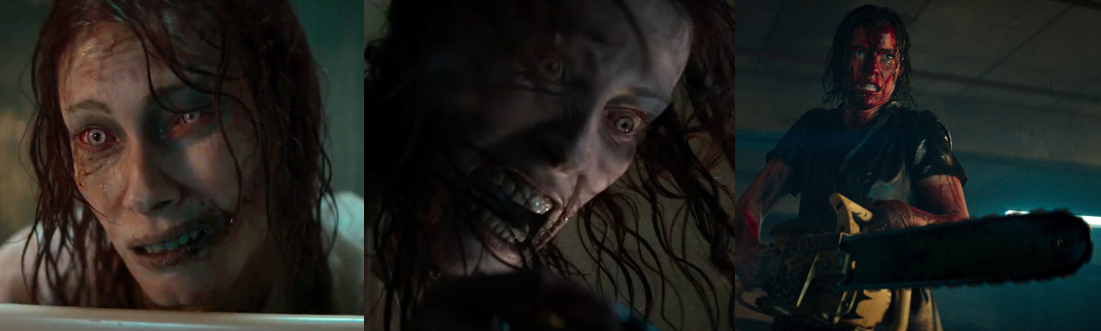
The Evil Dead (Raimi, 1981) was the brainchild of now-legendary horror director Sam Raimi and his long-time friend Bruce Campbell, who eventually became a horror icon for his portrayal of long-time franchise protagonist Ashley “Ash” Williams. Audiences were horrified by The Evil Dead, which became an unexpected critical and financial hit. After reluctantly returning to the franchise for the bigger and better Evil Dead II: Dead by Dawn (ibid, 1987), Raimi and Campbell divided audiences with the slapstick stylings of Army of Darkness (ibid, 1993), which left the franchise dead in the water (beyond videogames and comic books) for the better part of twenty years. However, Evil Dead rose from the grave with Evil Dead (Álvarez, 2013), a brutal re-imagining that proved a commercial and critical success; naturally, talk of a sequel soon followed, but Raimi also bizarrely spoke of plans to produce a sequel to Army of Darkness, which would then be followed by another film that linked the original films to the remake. Although both projects ultimately never came to fruition, Campbell reprised his role and the franchise continued on in the critically-acclaimed Starz series Ash vs. Evil Dead (2015 to 2018) before retiring as Ash, leaving the fate of another Evil Dead movie up in the air. However, Raimi, Campbell, and their long-time producer friend Robert G. Tapert officially revived the franchise in 2019; Raimi hand-picked Lee Cronin to direct and Cronin later proudly claimed that the film used over 6,500 litres of fake blood! Originally set to be released exclusively on HBO Max, test screenings proved so positive that Warner Bros. upgraded Evil Dead Rise to a theatrical release where it proved to be an unexpected financial success. Evil Dead Rise made nearly $150 million worldwide and been met with overwhelmingly positive reviews. Critics praised the lively gore, the surprisingly poignant performances, and the new direction, which focused on motherhood and family, leaving the franchise in a good place for potential follow-up movies that explore the lengthy, bloody history of the Deadites and their damnable book.

The Review:
I think I detailed my opinions on the Evil Dead movies pretty well in my individual reviews; I’ve always been a bit fan of the series and really enjoyed the gritty, gory, madcap nature of the original movies. While my ranking of all four is pretty clear-cut and I have my issues with the original film and Army of Darkness, I think the franchise has, overall, hit more than it missed. Granted, a lot of this was because of the grotesque content of the first two films and Bruce Campbell’s career-defining turn as the franchise’s quick-witted, chainsaw-armed protagonist, but Evil Dead showed that the series still had plenty of gas in it even as a remake. Evil Dead is easily one of my most favourite horror movies; I loved how the filmmakers took the concept seriously, put some real money behind it, and yet still didn’t hold back with the gore. If anything, Evil Dead pushed things further than even the ghastly original movie, and I remember being super happy to see that the remake performed well, critically and commercially, and yet disappointed to find that we never got a follow-up, much less closure regarding the film’s abrupt ending. When the ridiculously fun Ash vs. Evil Dead landed, I held out hope that maybe we’d see a team up between Ash and Mia Allen (Jane Levy) but, sadly, it wasn’t to be and the closest we got to this was seeing characters from across the franchise crop up in Evil Dead: The Game (Saber Interactive 2022). I was thus sceptical when the first trailers for Evil Dead Rise landed; not only did it seem to be doing something very different with the concept (which isn’t necessarily a bad thing as we’ve seen the “cabin in the woods” trope done to death at this point), but it was hard to tell where it fit into the canon; was it a continuation of Sam Raimi’s original films, the remake, the series, or its own thing entirely? Evil Dead Rise ends up subtly being all of these things at once, and it works a lot better than I thought it would.

Perpetual screw-up Beth is forced to defend her family after her sister is possessed by a demonic force.

The film begins in familiar territory; twenty-somethings Teresa (Mirabai Pease), Caleb (Richard Crouchley), and Jessica (Anna-Maree Thomas) are enjoying themselves at a secluded lakeside cabin with Jessica violently succumbs to demonic possession and attacks her friends, but this cold-open is really just there for a big of explicit fan service and homage to the original movie and to get things off to a gruesome start as the rest of the film takes place in the claustrophobic corridors and dank apartment of a Los Angeles tower block. There, struggling tattoo artist Ellie lives with her three kids – eco-warrior Bridget (Echols), wannabe disc jockey Danny (Davies), and imaginative Kassie (Fisher) – and is facing impending eviction as their building is scheduled for demolition. Their family dynamic is at the heart of the film and based on mutual respect; though they miss their father and want to see him and Ellie patch things up, they’re not lashing out or resenting her efforts to keep a roof under their heads and are all largely pragmatic about their less-than-ideal situation. This is similar to the relationship between Ellie and Beth; they used to be very close as kids but drifted apart somewhat as Beth took to the road as a “groupie” and has been so focused on getting her music career off the ground that she’s neglected to stay in contact with her sister, nieces, and nephew. Yet, despite arriving too late to help with Ellie’s messy break-up, the two power past any bitterness since Ellie can intuit that something’s bothering Beth; specifically, she’s struggling with the revelation that she’s pregnant, and much of the film’s focus is on her accepting this and being put through a gruesome trial by fire as she fights to protect her sister’s kids. I really enjoyed Beth and Ellie’s relationship; it’s clear that Beth feels bad about not staying in touch and that she wasn’t there for her sister like she’s always been for her, but she’s trying her best and Ellie doesn’t give her a hard time over it. Once Ellie gets possessed and starts violently lashing out, Beth steps into a matriarchal role with ease since she already had a good relationship with the kids as their bad-ass aunt.

The kids witness some truly horrific sights, and some even succumb to the malicious evil force!

I actually didn’t mind the kids, either; kids can often be hit or miss, especially in horror movies, but the kids in Evil Dead Rise thankfully avoided being stroppy, confrontational teenagers or whining, annoying brats. Although Danny and Bridget clash a little bit, especially when she interrupts him, and there’s a little resentment as he’s older and can drive, there’s no antagonism between them and they have some fun banter and a playful relationship with youngster Kassie, probably the standout of the three, especially considering the horrors she’s subject to throughout the film! While coming back from fetching pizza, Bridget, Danny, and Kassie are rocked by a sudden earthquake which opens up a hole in the parking garage of their tower block. Unable to resist his curiosity, Danny ventures down into a hidden vault from the building’s past as a bank and discovers a couple of vinyl records and a mysterious book sealed by fang-like thorns. Ever the budding DJ, he plays the tapes and learns of this third volume of Naturom Demonto, unwittingly unleashing the demonic force that possesses and corrupts his mother into a twisted, snarling Deadite. This is primarily where relationships briefly break down between Bridget and Danny; she begged him not to mess around in the vault, chastised him for stealing the book and records, and angrily lashes out at him after he reveals his part in the nightmarish events that have taken place. Danny’s smart enough not to object to this or even fight back; he carries a tremendous guilt knowing that he’s caused harm to his mother and is indirectly responsible for some truly shocking deaths, but Beth is on hand to cool their tempers and ensure that they all stick together as a family. Still, Danny is compelled to fight back against the demonic Ellie to try and make amends and when Bridget is also claimed by the evil force regardless, he tries to comfort Kassie, but ultimately even he ends up another victim to the spiteful evil after taking a face full of blood bile from his possessed sister and a few wince-inducing stabs to the arms.

Possessed by the evil force, Ellie may be the most formidable and wicked of all the Deadites!

I mentioned that this is the third volume of the Naturom Demonto and it’s true; the tape recording explicitly states this, which is enough of an explanation for me (it’s easy to believe that the original trilogy, the remake, and this film are all in the same canon, just with different books) and this is only bolstered when you remember that there were three books in Army of Darkness, something I somehow forgot about until after seeing this film. The evil force unleashed here is similar to what we’ve seen before, but also very different; what we see of the book is mainly ghastly prophetic drawings inked in human blood, and this particular book was discovered by a group of priests, one of whom foolishly read from it in a bid to understand the afterlife and heal the sick, and who was forced to lock it away after finding it quite indestructible. Still, the evil is still represented by a rushing, disembodied force that latches onto its victim through violent assault; poor Ellie never even sees it coming; she’s lashed up in elevator cables, has her earring ripped out, and is bent and broken by the invading spirit, which spitefully twists her love for her family against her. In previous Evil Dead films, the possessed would briefly revert back to normal but it was always a trick by the demons; here, Ellie does have brief moments of genuine lucidity, but the rest of the time it’s the demon maliciously tormenting her family and trying to trick them into letting her in, which the poor naïve Kassie almost falls for. Once possessed, Ellie demonstrates horrific superhuman strength, speed, and a contortionist’s agility; she easily manhandles the handful of other tenants, chewing out an eyeball, ripping limbs from bodies, and throwing off her attackers with ease. Unlike other Deadites, Ellie is practically unstoppable; the tape details how the possessed now shrug off all injury, even being set aflame, and that the only permanent solution is total bodily dismemberment and even then, Ellie just keeps coming back! Although her kids and Beth manage to barricade themselves in the apartment, the evil still seeps in thanks to Bridget suffering the smallest of nicks; that (and a disgusting kiss from her mother) is enough for the evil to claim her as well, turning her into a rabid, feral child who, like her mother, pounces upon her prey with snarling glee.

The Nitty-Gritty:
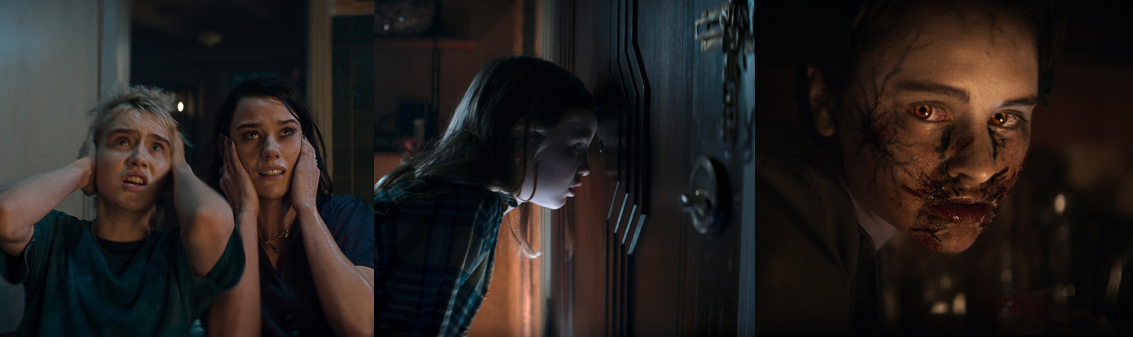
Evil Dead Rise definitely goes back to the smaller, grittier, isolated horror that was so prevalent in the original. While this is the first time an Evil Dead movie has taken place in a major city, an all-out Deadite infestation isn’t the focus here; instead, the isolation of a cabin in the woods is replaced by a similar, claustrophobic horror of a cramped apartment in a dilapidated apartment building where the power and elevator are less than reliable. The earthquake also takes out the stairwell and causes power fluctuations, further recreating the sense of despair that permeated the previous cabin-based movies. Where Evil Dead Rise really stands out, though, is that it focuses primarily on one Deadite, the possessed form of a mother and sister, rather than a group of the undead or the ritualistic sacrifice of souls to summon a greater evil. This scaling back of the threat works really well in the context of the movie; Beth and the kids can’t just leave as they’re cut off from escape and feel a sense of obligation to tend to Ellie’s rotting corpse, then they’re forced to endure psychological and horrific bodily harm at the revived Ellie’s hands with no real hope of salvation. Indeed, the handful of other residents prove to be little more than cannon fodder to the flesh-hungry Deadite; a wonderful sequence provides just enough of a hint of Ellie’s brutality as Beth watches in horror through the peep hole in the apartment door, but that comes after she ravenously rips a bloke’s eye out and spits it into someone else’s mouth! This isn’t the only reference to Evil Dead II in the film, though; in fact, there are lots of them peppered throughout, from similar tilting shots and situations (like the stairway having collapsed like the bridge was destroyed), to explicit lines (“Come get some!” and the gaggle of zombified corpses littering the corridor chanting “Dead by dawn!” over and over), to Beth’s eventually handiness with a chainsaw, but I also appreciated that evil infecting Bridget was depicted as a putrid, tar-like corruption of her veins, similar to in the first film.

Alongside its mounting, atmospheric dread, Evil Dead Rise doesn’t skimp on the brutal gore!

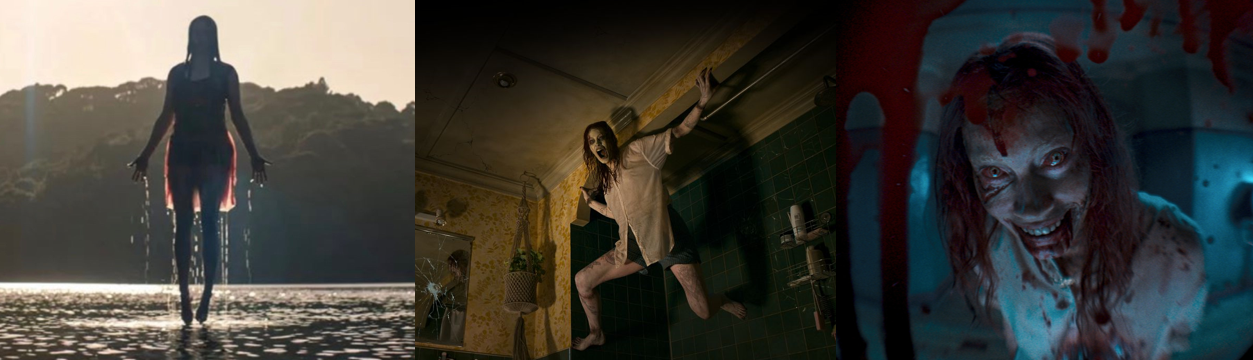
Of course, one explicit way that Evil Dead Rise evokes not just Evil Dead II but the majority of the franchise is through its gore. While a surprising amount of the film is actually devoted to building tension and focusing on the mounting horror inside the apartment as Beth and the kids struggle to come to grips with what’s happened, Evil Dead Rise is unrelenting when the blood starts spilling. Things are off to a gruesome start in the cold open when the possessed Jessica rips Teresa’s scalp off, shoves a drone’s blades into her face and tosses Caleb’s severed head from the lake but Ellie’s bone-crunching possession and the way her body is twisted and contorted by the invading spirit is extremely gruelling to watch, and even evokes the controversial “tree rape” scene from the original movie. Once claimed by the evil, Ellie becomes a sneering, cackling ghoul who stabs a shard of glass into Beth’s hands, tears through the other tenants, and even tries to stick a tattoo needle in Bridget’s eye! At one point, Ellie is briefly stunned when Beth shoves a pair of scissors up her nose and blows her arms and a leg off, but her unrelenting assault sees poor Bridget get possessed as well. Bridget announces this by chewing on a wine glass, the shards piercing her throat, and gleefully runs a cheese grater down Beth’s calf, turning her skin into ribbons of gore! Bridget’s attack upon her siblings is much briefer than her mother’s thanks to Kassie’s little mop friend; when Bridget leaps to devour her little sister, she gets the broken end of the mop’s handle shoved right through her skull, but she soon recovers from this to brutalise Danny, who also turns into a Deadite after being repeatedly stabbed by his possessed, knife-wielding sister. There’s a fair bit of disgusting vomit here, too; Ellie spews up a load of creamy-white gunk before collapsing and Bridget practically drowns Danny in bloody bile before being set alight. The film even has a bit of an ode to The Shining (Kubrick, 1980) for a scene where Beth and Kassie are forced to escape in the malfunctioning elevator and it fills up with thick, bubbling gore that is deposited, alongside them, into the ground floor car park!

After enduring a gruelling assault, Beth is forced to dismember her possessed sister to dispatch the evil force.

This volume of Naturom Demonto unleashes a slightly altered demonic force, one far more durably and malicious than those we’ve seen before; sure, Ellie could be compared to the cackling witch from Evil Dead II and the possessed Mia delighted in tormenting her friends in Evil Dead, but there’s something more visceral and horrifying about a mother spitting such venom at her cowering children and twisting Ellie’s emotions against her family. Although the recordings reveal to Beth that complete bodily dismemberment could put a stop to Ellie, she’s not exactly got the tools for that in the tiny apartment, but there is a convenient woodchipper in the parking garage. At first, this isn’t Beth’s goal; she’s simply trying to get Kassie to safety, which she manages to do after subduing her attackers with a shotgun and taking the bloody express elevator to the ground floor. However, the possessed Danny and Bridget rip their way into their mother’s body and the three of them come together as a multi-limbed, screeching monstrosity known as the “Marauder”. This almost spider-like amalgamation of limbs and teeth follows Beth and Kassie to the garage and stalks them in scenes reminiscent to Mia’s final stand against the Abomination (Randal Wilson/Rupert Degas). Disturbingly quick and inhumanly powerful, the Marauder corners Kassie and revels in her horror as it closes in on her with a chainsaw, but Beth manages to save her young niece with a well-timed shotgun blast and claim the chainsaw her herself. She’s then able to hold her own against the beast, retaining all of her limbs in the process, so Kassie can activate the woodchipper; the Marauder’s foot gets caught in the spinning blades and it’s reduced to chinks of gore with an agonised wailing. However, even with its body being chewed up and when left a blinking, twitching, severed head, it continues to taunt Beth, who simply chops into it with her chainsaw and boots the head into the machine, finally finishing it off and allowing her and Kassie (both drenched in blood) to escape the apartment building. The film ends with the reveal that Jessica was also a tenant in the building and, in a homage to the ending of The Evil Dead, she’s attacked by the disembodied force while investigating the garage. Personally, I would’ve liked to see the cold-open replaced with a slightly different scene (perhaps a flashback to the book’s reading from 1923 so that Bruce Campbell could’ve made more than a voice cameo) and replaced Jessica with one of the characters from Evil Dead, just to tie things together a little better, but I appreciated the homage and enjoyed the blood-soaked finale, which worked as a cathartic, heroic evolution for the previously unsure and hesitant Beth, who has now become a battle-hardened protector figure.

The Summary:
I don’t want to say I was anxious about Evil Dead Rise, but I was curious; to be honest, I was a bit annoyed that we never got a direct sequel to Evil Dead, as much as I enjoyed Ash vs. Evil Dead, and was worried that the film would either ignore the remake or just be another reboot. Thankfully, the one, throwaway line about there being three books satisfied my urge for some kind of explanation and the film provided enough entertainment to keep me engaged regardless. This is again another brilliant indication that the Evil Dead franchise doesn’t need Ash to be enjoyable, and I really liked that Evil Dead Rise mixed things up a bit by focusing on a family trapped in their apartment rather than the cliché cabin in the woods. The location was almost too perfect at evoking the same sense of isolation and dread as being trapped in a secluded cabin and the focus on the family dynamic and drama made the horror so much more impactful and meaningful. Ellie might be the most intimidating and malicious Deadite in the entire series; seeing her love for her children twisted against them and her voracious need to torment and consume them was just horrendous in ways beyond the simple terror of a rabi, zombie-like demon scratching at the door, and this was conveyed really well through the child actors. I liked how each of them stood out in their own ways; the whole family was a little alternative and had a great dynamic, and the central story of Beth needing to step up and defend her family, stand on her own two feet, and realise her role as a mother came through really well. Gorehounds should also be very satisfied with Evil Dead Rise; the film does a great job building tension and focusing on psychological terror rather than going a mile a minute with the splatter-horror but, when the blood does start flowing, it’s brutal and glorious to see! I especially enjoyed that Ellie was twisted into an all-new monstrosity at the end and the implication that each book unleashes a slightly different evil, and, overall, I was extremely impressed by the film, which again took the concept seriously (while still having a little fun) and delivered both chilling tension and shocking gore in equal amounts.

My Rating:

Rating: 4 out of 5.

Great Stuff

What did you think to Evil Dead Rise? Where would you rate it compared to other entries in the franchise? What did you think to the new direction and were you satisfied by its links to the other films? Which of the characters was your favourite and what did you think to the family-orientated focus of the horror? What did you think to the film’s gore and callbacks to previous Evil Dead films? Were you surprised by how durable Ellie was and what did you think to her multi-limbed Marauder form? Where would you like to see the franchise go next? Whatever your think about Evil Dead Rise and the franchise, feel free to leave a comment below or on my social media, and go check out my other Evil Dead reviews!

Movie Night: Evil Dead

Released: 5 April 2013
Director: Fede Álvarez
Distributor: Sony Pictures Releasing
Budget: $17 million
Stars: Jane Levy, Shiloh Fernandez, Lou Taylor Pucci, Jessica Lucas, Elizabeth Blackmore, and Randal Wilson/Rupert Degas

The Plot:
Mia Allen (Levy) is taken to a remote cabin by her friends and estranged brother, David (Fernandez), in hopes of forcing her to go cold turkey with her addiction to heroin. When they discover a macabre book filled with incantations in the morbid cellar, Mia is tormented by ghastly visions that turn out to be all-too-real as an ancient, demonic force seeks to brutalise and possess her and her friends.

The Background:
In 1981, critics and audiences were horrified when The Evil Dead hit cinemas. The result of a collaboration between now-legendary horror director Sam Raimi and his long-time friend Bruce Campbell (as well as friends and family alike), The Evil Dead might have been a low-brow, low-budget splatter-horror film, but it was a surprising critical and commercial hit. After failing to achieve mainstream success, Raimi reunited with Campbell for the bigger and better sequel; Evil Dead II: Dead by Dawn (Raimi, 1987) became a cult classic thanks to its over the top gore and iconic action hero, however it was only this latter element that was expanded upon for the third film, Army of Darkness (ibid, 1993), which divided audiences due to its heavier focus on slapstick comedy. While the story continued in videogames and comic books, rumours of a remake or fourth entry circled Hollywood for years; although Campbell declared the project dead in the water in 2007, he later announced that it had found new life with a script that was more a re-imagining of the original film than a straight-up remake. Director Fede Álvarez made his feature-film debut with the remake, which he saw as a continuation of the original film; Álvarez also made the creative decision to focus on practical effects and make-up wherever possible even though it took longer and cost more. Evil Dead proved a surprising success; it made just shy of $100 million at the box office and was met with largely positive reviews that praised the brutal gore and grittier tone, though there were inevitably some who took issue with the debauched content and the absence of Campbell’s memorable protagonist. While these latter criticisms were addressed when Campbell returned for an admittedly awesome three-season spin-off, Sam Raimi teased a continuation of Army of Darkness before finally opting to produce another standalone entry in the franchise rather than a sequel to Evil Dead.

The Review:
I went into great detail in my reviews of the original Evil Dead trilogy about my thoughts on the franchise; while I can respect the hustle and ambition of the first film, and there’s an appeal to Bruce Campbell’s unfiltered bravado in the third, it’s the second one that strikes the perfect tone between horror, action, and comedy that I think works best for the franchise. I’ll always recommend people go to Evil Dead II before the original and had long held the belief that The Evil Dead just hadn’t aged as well as its far superior sequel. There’s often a lot of hatred levelled at remakes, and deservedly so at times, but I would argue horror, of all genres, has fared pretty well whenever it gets a new coat of paint. After seeing the first trailers and getting over the fact that Campbell wouldn’t be returning (and, wisely, wasn’t recast), I remember being really excited for this darker, gritter re-imagining of the first film, an almost comical venture in hindsight that was in desperate need of an update no matter how highly I regard its sequel.

After quitting her addiction, Mia is possessed and tormented by a spiteful evil force!

So, no, Ash Williams is not in Evil Dead. It would’ve been a fool’s errand to ask any actor to try and fill those shoes so, instead, we get an all new, young and sexy cast with an entirely different motivation behind isolating themselves in a creepy cabin in the woods. Like the original movie, Evil Dead features five main characters, two of which are brother and sister. Mia and David were close as children but have since grown apart and there’s a fair amount of bad blood between them since David left Mia to care for their dying mother all alone. As if that wasn’t bad enough, Mia has become addicted to heroin and has tried, unsuccessfully, on many occasions to kick the habit. This is the first time that David has been present for her intervention, however, and much of the film’s focus is on him trying to care for her and make amends with her as she struggles with painful withdrawal symptoms, which manifest in the form of horrific visions of a demonic force seeking to devour her. Mia is, at her core, a fundamentally broken character; she has a loving and caring support network but, despite their best efforts, none of her friends truly understand what’s going through and she feels increasingly isolated when her claims to be haunted by a malicious evil are chalked up to her going cold turkey. When they refuse to give in to her desperate demands to leave, adamant to force her to kick her destructive habit once and for all, she tries to leave by herself, only to crash and be confronted by the evil in the forest, which here takes the form of a demonic doppelgänger of herself. Targeting her as the weakest member of the group, the demon possesses her through a far more logical (though no less traumatic) version of the infamous “tree rape” scene and she’s driven to abusing herself and others through increasing violent behaviour.

Mia’s friends and family fall victim to the evil’s malicious influence and suffer terribly as a result.

Mia is cared for by her best friend, Olivia (Lucas), a nurse who’s suffered through Mia’s attempts to kick her habit before and is at her wit’s end with it all, especially after Mia not only previously made the same promises to quit but after legally died after overdosing in the past. Her previous experiences with Mia’s wild hallucinations mean she fails to heed her friend’s scathing warnings about the stench coming from the cellar (which is full of dead cats hanging on meat hooks!) and their impending doom after they discover the Naturom Demonto. It’s all new to David, however, who is so desperate to keep his sister safe out of a sense of guilt that he doesn’t hesitate to take her to safety after discovering her scalding her body in the shower, only to be undone by the rising evil forces in the area. Although he might not seem it, David is closer to Ash than you might think; he’s a “charming liar” who’s been through his fair share of women and has the same terrible taste in neck-wear, and he’s also a sceptic and reluctant hero whose concerns begin and end with Mia and only extend further once the shit really hits the fan. His current girlfriend, Natalie (Blackmore), is a stranger to the group and naturally quite dependant on David as a result; she’s struggles to fit in and is adamant that they should leave once things start to escalate but David remains largely dumbfounded, only really taking things seriously once Mia starts puking up red bile and mutilating her tongue with a box cutter! Poor Natalie ends up the most unfortunate victim of the horrific events at the cabin; driven to near madness by the rotting infection in her arm, she severs it in a daze before attacking her friends in a possessed frenzy and being put out of her misery. Things don’t fare much better for Olivia, who is equally driven to maim her face as per depictions in the Naturom Demonto and ending up little more than a crazed, bloodthirsty demon who needs to be beaten to death.

The evil force now has a consistent physical form that yearns to wreck havoc.

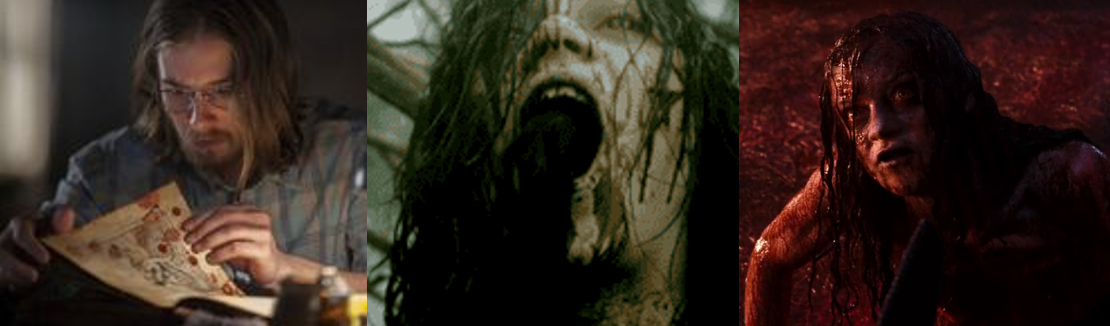
The demonic force that plagues these characters is significantly altered in Evil Dead; the film opens with a young girl (Phoenix Connolly) suffering from the book’s possession and the lore behind it only escalates from there. Though lacking the monstrous visage on the front cover, the Naturom Demonto is still bound in human flesh and inked in human blood but now contains helpful warnings, written in English, not to read its incantations out loud. It also contains many drawings of the fates the characters later suffer before schoolteacher Eric (Pucci), who makes no bones about chewing David out for his absenteeism and who you’d think would be one of the film’s smarter characters, decides to ignore all these warnings and read from the book, awakening the familiar evil force from the woods. While Eric suffers greatly (and comically) for his foolishness, he also acts as a source of exposition for the events occurring; this time, the book unleashes a disembodied, demonic spirit known as “The Abomination” (Wilson/Degas), which possesses a host and then sets about claiming five souls in order to take physical form in a dirge of rain. The possessed are driven into a violent daze, mutilating themselves and attacking others in a spiteful rage, while Mia cackles and looks on with glee from the cellar. While the only way to stop them is again by bodily dismemberment, the victim’s souls can only be saved from damnation using “purifying” fire, driving grieving fathers to watch their possessed daughters suffer, or a live burial. While David is able to succeed at the latter, the evil force manages to claim enough souls to burst from the ground in terrifying and gore-soaked fashion, though it appears throughout the film as a snarling, animalistic doppelgänger of Mia that delights in her torment and commits the cardinal sin of driving her to bash her and David’s beloved dog Grandpa (Inca) to death with a hammer!

The Nitty-Gritty:
Evil Dead is easily the heaviest of the entire franchise thanks to its focus on addiction; Mia has struggled so badly from the trauma of watching her mother waste away and then die that she turned to heroin for a release and this addiction has caused her nothing but further pain. Her friends, though doubtful, support her attempts to get clean but very much prescribe toe a “tough love” philosophy since she’s sworn off the drugs before and always relapsed. This, as much as anything, proves to be their downfall when they fail to take her claims seriously, resulting in her becoming more and more possessed and them suffering greatly. Another prominent aspect of the film involves David trying to make amends for abandoning Mia; the brother/sister dynamic was barely a thing in The Evil Dead but, here, it’s at the forefront of these characters. It’s because of his guilt and love for her that David tries to get Mia to safety, and that same sense of duty compels him to defend her even when she’s a cackling witch and even sacrifice himself in an attempt to safeguard her, foolish as that decision was. Thus evil Dead thematically and visually has very few links to the previous films; the tilting and rushing camera is back but the cabin and book are both very different. The cabin now has a close link to the two main characters and brings back many painful memories for both Mia and David, the former because of how hard it was to see her mother suffer and the latter because of his guilt and not being there to support them. The location isn’t quite the same and the nature of the possessed and the evil itself are also much different, though you can still spot Ash’s prized Oldsmobile on the grounds and Campbell makes a completely pointless post-credit cameo (I would’ve much preferred he had waved the kids off at the start or even if they’d stumbled upon his corpse).

The film is unrelenting with the brutality and viciousness of its gore and effects!

As ambitious and admittedly impressive as the traditional make-up and practical effects were in the original trilogy, Evil Dead definitely reaps the benefits of modern technology, and from emphasising practical effects throughout its production. The gore on display is truly unsettling; you really feel the brutality of each wound and it’s genuinely sickening seeing Natalie’s arm drop to the floor with a wet squelch. Indeed, the movie really excels is in taking the concept and really treating it seriously; there’s very little humour in Evil Dead and the evil force is far more malevolent than playful, though elements of this latter characterisation can still be found when the possessed Mia spitefully barks at her friends. Instead, the focus is on brutal and unashamed gore; that girl is absolutely roasted in the opening sequence, Mia’s skin bubbles from the searing-hot water, and she sicks up a spew of blood bile onto Olivia, who is ten compelled by the book (and the evil force) to carve open her face with a shard of glass. Poor Natalie gets assaulted by the possessed Mia in the cellar in a disturbingly sexual way before receiving an infectious bite to her hand and being compelled to saw the diseased limb off with an electric knife in a far more gruesome scene than any of Ash’s struggles with his own infected appendage. She’s then driven to attack her friends with a nail gun, only to end up losing her other limb to a shotgun blast and bleeding out on the cabin floor! And that’s before we even touch upon Mia scalding herself, a demonic root forcing itself way down her throat, and slicing into her tongue with a box cutter! Of all the characters, it’s Eric who suffers the most abuse, however. This bespectacled dumbass sure as hell can take a licking and keep on ticking; he slips on a piece of Olivia’s skin, landing on the toilet as he falls, before being brutalised by repeated stabs to the face by a needle, riddled with nails, and ending up with his arm being bludgeoned by the possessed Natalie and a bloodied and beaten mess courtesy of her crowbar attack, and yet he still keeps breathing!

The Abomination puts Mia through the wringer in the blood-drenched finale.

In comparison, Mia gets off quite lightly; she doesn’t end up having her head bashed in with a piece of ceramic and all of the injuries and ailments she suffers while possessed magically disappear after she spontaneously returns to life following David’s effort to purify her with a live burial, though she makes up for this in grisly fashion in the last act of the movie. With all of their friends dead or springing to unlife as violent and crazed demons, and with the book proving to be indestructible, David is forced to step up and protect Mia despite his best, most futile efforts to lie to himself about her condition. He ventures into the cellar to confront her and is manhandled in comical fashion by her crazed attack; it’s only thanks to one last gasp of life from Eric that David is able to bundle Mia up and bury her alive, purging her of the evil’s malicious influence and then immediately jump-starting her heart with a jerry-rigged defibrillator that he stabs haphazardly into her chest! Though this works, Eric’s possessed corpse attacks him and David is forced to sacrifice himself to keep Mia safe, setting the cabin (and himself) alight with a small explosion. This, however, proves to be the final sacrifice needed to bring the Abomination back to life; the skies literally pour blood and the creature, a twisted and demonic mirror of Mia, claws its way out of the ground in a recreation of the original film’s iconic poster. It attacks Mia with a ravenous malice scalding her skin with the lightest touch; Mia’s desperate attempts to hide and fight back also mirror Ash’s panicked escape from the unseen evil, but this finale proves easily the most unsettling sequence in the entire franchise thus far thanks to actually being able to see the blood-drenched demon as it scrambles after its prey. Although Mia severs the Abomination’s legs with a chainsaw, the gnarled demon overturns David’s truck and crushes Mia’s left wrist! Desperate and in agony, Mia has no choice but to tear her wrist free! Considering the film already showed a severed limb, I had no idea this was going to happen at the time and, even now, it’s absolutely brutal to watch! However, it’s a fantastic character moment for Mia as she finally takes charge and attacks her demons, given horrific physical form, to put an end to her misery by thrusting the stump into the chainsaw’s handle, and sawing through the Abomination’s head in a crazy fury! Defeated, the creature sinks into the ground and the blood rain promptly stops, leaving Mia a dishevelled and traumatised mess as she wanders off for help, the Naturom Demonto left forgotten and very much intact…
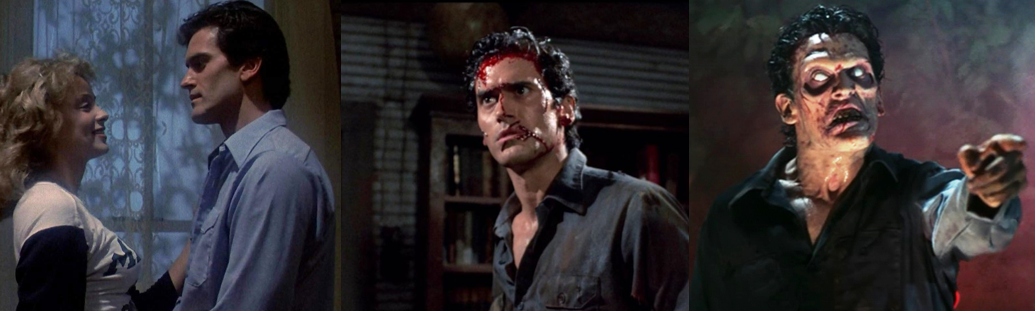
The Summary:
I remember being stunned by Evil Dead when I first watched it. Although a long-time fan of the franchise, even I would admit that the only one of the original trilogy I really enjoyed and highly rated was the second one, with the first having aged poorly and the third being too comical for my tastes. Thus, I was excited to see a gritty, no-nonsense modern take on the concept and Evil Dead certainly brought the horror back to this cult franchise! While it’s true that the film isn’t as immediately iconic without its smart-mouthed action hero, no actor could really fill Bruce Campbell’s boots and the cast we have is surprisingly strong for a horror film. Mia’s struggles with addiction and the impact it’s had on her friends is violent, tragic, and palpable, even more so for David, who is burdened by guilt at having been absent during his mother’s illness and Mia’s suffering. Of them all, Eric proved the most exasperating character; he’s constantly giving David a hard time (and rightfully so) and stupidly reads from the book despite clear warnings not to, but he make sup for it being enduring some truly horrific abuse once the shit hits the fan! And that’s what really makes Evil Dead a standout entry for me and one of the top horror remakes; it takes the source material seriously, pays homage to the originals by reconfiguring some of their most memorable moments into a gory new context, and expands on the lore in ways that are both familiar and unique to this incarnation. The film is worth the price of admission for its unrelenting, sickening gore but it proves to be a visually stunning and ominously engaging, spiteful horror that makes no apologies for its content and proudly showcases some truly disturbing moments as if in defiance of a slew of poorly-regarded PG-13 horror productions. As much as I enjoyed the spin-off TV show, it never fails to disappoint me that we never got a follow-up to the remake; it made money and proved popular but, sadly, we never got to see Ash and Mia team up as chainsaw buddies, but luckily we can also return to this gritty, unrelentingly brutal film whenever we want a good taste of visceral horror!

My Rating:

Rating: 5 out of 5.

Fantastic

What did you think to Evil Dead? Where would you rate it compared to other entries in the franchise? Were you disappointed by Ash and Bruce Campbell’s absence? What did you think to the new characters and the depiction of addiction? Were you impressed by the film’s unrelenting gore and effects or is it a little too much for you? What did you think to the changes made to the lore and the depiction of the Abomination? Were you disappointed that we never got a follow-up to this film? What are some of your favourite remakes? Whatever your think about Evil Dead and its franchise, feel free to leave a comment below or on my social media.

Movie Night: Army of Darkness

Released: 19 February 1993
Director: Sam Raimi
Distributor: Universal Pictures
Budget: $11 million
Stars: Bruce Campbell, Embeth Davidtz, Marcus Gilbert, Richard Grove, and Ian Abercrombie

The Plot:
Thrust back to medieval times by the Necronomicon Ex-Mortis, Ashley “Ash” Williams (Campbell) finds himself the only hope of fending off a veritable army of Deadites, led by his own demonic doppelgänger (also Campbell).

The Background:
In 1981, up-and-coming director Sam Raimi and long-time collaborator Bruce Campbell brought together friends and family alike to produce one of the most controversial splatter-horror films of all time, The Evil Dead. Despite regular on-set mishaps and tensions, the film was surprisingly well-received and, after his mainstream career failed to take off, Raimi returned to the concept six years later for a sequel. Evil Dead II: Dead by Dawn (Raimi, 1987) might have been part-remake due to rights issues but it was met with largely positive reviews; its over the top gore led to it becoming a cult horror classic, though it would take another six years before a third instalment would see the light of day. After Darkman (ibid, 1990) proved a modest critical and commercial success, Raimi began developing ideas he’d had for the third film while shooting Evil Dead II, primarily a large-scale medieval piece with a time-displaced Ash. Producer Dino De Laurentiis was still onboard to provide financing for the film, though Raimi and his cohorts still had to fight to get the funds they needed for this larger venture. As ever, production was troubled by difficult conditions; the sweltering heat and Raimi’s penchant for abusing his life-long friend Bruce Campbell, and the gruelling shoot caused issues during the production, to say nothing of the painstaking practical effects work needed to bring the much larger concept to life. Having struggled with the ratings board with his previous Evil Dead films, Raimi purposely set out to make Army of Darkness more a slapstick horror/comedy and toned the gore way down, only to be hit with an unfairly high rating as penance for releasing the previous films independently. Additionally, studio interference saw Raimi’s original vision for a bleak cliff-hanger ending changed to a more hopeful one, and it’s often not clear which version you’re going to be watching when you purchase a copy of the movie. Finally, while Army of Darkness$21.5 million box office gross made it a relative success, many have been divided in their opinions on the film; some praised the presentation and effects work, others criticised the slapstick approach. While the film went a long way to further cement Ash as a horror icon and is often seen as a cult classic, it remains a contentious entry in the franchise and its events are often overlooked or outright ignored in subsequent entries (though this is also due to licensing issues).

The Review:
In my reviews of The Evil Dead and Evil Dead II: Dead by Dawn, I made it pretty clear that my bias is firmly towards Evil Dead II on being the best of Sam Raimi’s original trilogy. For me, it’s the perfect balance of horror and comedy and really cemented Ash’s character as a reluctant hero who transforms into a horror icon after being put through the wringer by a malevolent force. Evil Dead II set Ash up nicely as a cursed victim forced to see those he loves and cares about either turned into zombie-like Deadites or brutally murdered before his eyes, and constantly haunted by the evil force no matter how hard he fights, and Army of Darkness immediately sets about reminding viewers of this with yet another recap of the previous movie in the opening. This time, it’s narrated by Ash, firmly placing him as the main character and focus of the franchise and this movie, and quickly skims through the events that saw Ash lose his hand and end up being sucked through a vortex to medieval times.

A frustrated Ash must set aside his ego and assume a heroic role to clean up his mess.

Understandably, given the horror and the trauma that he’s gone through, Ash is pretty tetchy in this film. While it’s nice to get a sense of his life before the horrors of the cabin, seeing him as a dedicated and knowledgeable S-Mart employee, any vestiges of his original bookish demeanour have been completely swept away and replaced with a bitter, antagonistic bravado that sees him openly mouth off to anyone, regardless of their authority or stature. He has, officially, had enough of this shit, basically, and his only concern is finding a way back home; he doesn’t want to be some prophesised hero, he doesn’t want to get involved in the issues between Lord Arthur (Gilbert) and Duke Henry the Red (Grove), and he certainly has no intention of battling the Deadites any more than he has to. Thus, he makes a deal with the Wise Man (Abercrombie) to retrieve the Necronomicon Ex-Mortis to help them turn the tide in their war against the Deadites but on the proviso that the Wise Man uses the book to send him back home, no questions asked. Unfortunately for Ash, life is never that simple; the evil force constantly conspires against him but is only part of the problem in Army of Darkness. Ash’s ego and sense of superiority means he not only expresses his frustration to the masses but also fails to heed the Wise Man’s words; despite being little more than a retail employee, Ash sees himself as their physical and intellectual superior, a façade he maintains even as he’s blundering his way through the movie. This same bravado, brought on after the trauma he’s experienced, causes him just as much grief as any reanimated skeletons as he refuses to listen to proper instructions and ends up raising the titular army of darkness in his haste and selfishness to get back home.

A spurned Sheila finds herself transformed into a spiteful witch by the evil’s power.

The opening recap once again shows Ash at the cabin with Linda (Bridget Fonda) but skims past her relevance pretty quickly this time around (and even completely omits Annie Knowby (Sarah Berry) from the narrative) to instead focus on Sheila (Davidtz). Since Arthur captured Ash alongside Henry and his men, who killed her brother in battle, Sheila is initially instrumental in condemning Ash to the Deadite pit since he’s assumed to be one of them. Like all of the “primates” in Arthur’s kingdom, Sheila is suitably impressed by Ash’s prowess in battle and his “boomstick” and quickly reverses her ill will towards him, which he initially callously dismisses since he’s busy living up the rewards of being hailed a hero. Although he’s as gruff and flippant towards her as he is to the other “primitives”, Ash finally gets the chance to get laid after being impressed by her spirited nature, but bashfully spurns her when given the choice between returning home or helping her and her people fight off the evil he’s unleashed, with even Sheila branding Ash a coward for this choice. Although it seems as though Sheila is doomed to become little more than a damsel in distress when she’s swept away by a Deadite gargoyle, she actually assumes the role of secondary antagonist after being brought to “Evil Ash” and transformed into a Bride of Frankenstein-esque (Elsa Lanchester) witch by his kiss. Her kidnapping proves to be just the kick up the ass Ash needs to get his shit together, but her demonic visage almost proves his undoing in the finale when she causes his supped-up Oldsmobile to crash and delights in tormenting his body and his heart.

Ash has no time for the Wise Man’s riddles or the rivalry between Arthur and Henry.

This is the first Evil Dead production to have a large cast of characters, and all of them react to Ash in different ways. Initially, Ash is met with suspicion by Arthur, though Ash is far from impressed by either Arthur or Henry and, once he escapes the pit, Ash immediately punches Arthur out and humiliates him. Although flippant towards Henry, especially as he was in chains when they met, Ash earns the duke’s respect after allowing him and his men to go free, which pays off dividends in the finale. It’s thanks to the Wise Man, who has knowledge of Ash’s greater destiny from his familiarity with the Necronomicon, that Ash is able to win the awe of the crowd and begrudgingly quest for the book. However, he loses the respect of the masses after dooming them all to death and destruction through his ineptitude and, while Arthur and the Wise Man are honour-bound to uphold their end of the bargain, they condemn him for his foolishness, but are soon relying on his surprising scientific acumen and military tactics to defend the castle. Ash’s eventual leadership skills and engineering abilities are so impressive that even Arthur is forced to offer his begrudging respect. Though a proud and seemingly cruel king, one who’s not only ore than happy to toss his prisoners into his Deadite pit to the amusement of the braying crowd but also freely executes any escapees with a crossbow, Arthur’s first priority is the safety of his people. He’s waged bitter war against Henry the Red for some time but is driven to find and protect the Necronomicon not to use it against his enemy, but to put an end to the Deadites that have infested his land. Still, the rivalry between Arthur and Henry runs so deep that, at first, it seems as though the duke has condemned his enemies to their fate; however, thanks to Ash’s rallying cry in a deleted scene, Henry and his men arrive just in the nick of time to help turn the tide against the invading Deadites and peace is finally fostered between the two as a result.

Ash sprouts an evil double who raises an undead and seeks to conquer the land!

Naturally, the evil force is back at work in Army of Darkness; somehow, it’s already been unleashed across the land, despite the Necronomicon being hidden in an ominous cemetery. The demonic forces it unleashes and possesses are now freely referred to as Deadites and attack people openly, causing much fear and panic in the lands, and the evil force continues to be both possessed individuals and an invisible, roaring spirit that relentlessly pursues Ash. However, Ash is wise to its tricks this time around; he knows when it’s playing possum, when to fight, and when to flee when it’s nearby, though he’s far more capable in a one-on-one situation than when chased by the invisible force. For the first time, the evil force is given stable and consistent physical form in this movie; previously, it was simply limited to cackling, monstrous possessed bodies but Army of Darkness sees Ash once again battle against himself when the force manifests through his reflection in scenes that recall his experiences at the cabin in the second film. The result of this is Ash literally (and bloodlessly) splitting into two after his evil twin sprouts from his body; despite being a morally grey character, the more recognisably “Good” Ash triumphs over his evil twin and leaves him for dead, only for “Evil Ash” to return to life as a rotting, skeletal corpse that acts as the embodiment of the evil force and seeks to conquer the living through the titular army of darkness. Evil Ash gives Campbell more chances to showcase his range, being a maniacal and raving, pirate-like figure that ramps all of Ash’s arrogance and hot-headed bluster up to eleven, taking a possessed Sheila as his bride and digging up an army of the dead to ravage the land. The Necronomicon also gains more personification this time around; there are three books, each capable of biting and attacking Ash when he screws up the magic words, and the Deadites take a number of forms, from gibbering zombies to screeching witches, but is primarily represented by an army of skeletons. The evil force is also far more playful this time around; it’s still spiteful and malicious, but its loquacious and quirky skeletal troops are just as likely to get into slapstick scrapes as they are the skewer their victims.

The Nitty-Gritty:
The Evil Dead films had always been fairly comedic up to this point; even the first, which is easily the grittiest and splatter-horror of the bunch, had its ridiculous moments, but Army of Darkness takes the comedy/horror atmosphere of Evil Dead II and runs with it! Some of this is a little lost on me; the Three Stooges were a bit before my time and I’m not really a fan of their slapstick comedy or repetitive routine, so seeing Ash fend off skeletal limbs as they bonk his nose and box his ears is a little too childish for me. A lot of the comedy is focused on Ash’s 20th century sensibilities, slang, and technology and the fear, awe, and confusion it inspires in the natives; to these people, Ash’s rudimentary science and bog-standard weaponry are like magic and his bravado is able to impress all the more since they are so enthralled at his ability to defeat the Deadites with his strange weapons. His grouchy demeanour is also a fun source of comedy; he’s far more selfish and outspoken this time around and only undertakes the Wise Man’s quest because he has no other choice to get home. The film also boosts his action hero status up to eleven, gifting him even more memorable one-liners and moments, as well as using his engineering abilities and 20th century science books to not only fortify the castle defences and turn his beloved Oldsmobile into a bad-ass fighting machine, but also somehow construct a working artificial hand using an armoured gauntlet and the gift of a montage!

Ash is now an arrogant fool who’s only separated from his evil double by a fine, grey morality.

Indeed, for me, much of the film is again carried by Bruce Campbell; I may not agree with every decision made to blow Ash’s characterisation so ridiculously out of proportion but there’s no question that, again, this is his show (as evident in the opening titles, which actually call the film Bruce Campbell vs. Army of Darkness). If you enjoyed Ash’s fight against his severed hand in Evil Dead II, Army of Darkness takes that horse and well and truly flogs it to death by having Ash be set upon by cackling, miniature versions of himself using some ambitious, if dodgy, composite effects. These diminutive little gremlins torment Ash, stabbing and tripping and mocking him at every turn and forcing him into more and more comical extremes as he tries to stamp and drown them out. Ash’s character is also expanded upon in ways that would continue to be featured in subsequent adaptations and continuations of the franchise; now a much more self-serving anti-hero, Ash primarily fights for himself and makes no bones about it. He basks in the adulation of the people only to feed his ego and is more than happy to leave them to their fate after unleashing the book’s evil since he’s fed up with all the fighting and everything it’s cost him and just wants to go home. He has a change of heart, of course, but Ash’s hesitant nature literally manifests itself into a separate being in this film and it’s a grey morality that separates “Good” Ash from “Evil” Ash. Evil Ash is more obviously the personification of the evil force that’s been hunting Ash all this time and is bent on the wholesale slaughter and possession of the living, painting him as more obviously “bad”, but it takes a great deal of motivation for Ash to get his shit together and start fighting for something other than his own self-preservation, turning him from a reluctant but bad-ass hero to a flawed braggart who needs to be pushed into defending others.

Some impressive effects feature in the finale, which sees Ash either stranded or returned to his normal life.

Thanks to focusing more on bombastic action and wacky, slapstick comedy, blood and gore is all-but-absent from Army of Darkness. While there is an impressive geyser of blood when one of Henry’s men is tossed into Arthur’s Deadite pit, there’s none at all when the recap shows Ash chopping off his hand and even the Deadites are less intimidating, save for the decaying visage of Evil Ash, and more likely to rattle off quips and play fight than tear flesh from bone. However, Army of Darkness raises the titular army from the grave with some remarkable practical effects, puppets, and old school camera techniques in the explosive and overly ambitious finale, which sees Ash forging gunpowder and becoming a symbol for the people to rally behind in the battle against the stop-motion effects, corpse-like costumes, and gibbering puppets used to bring the army of the dead to life. Ash uses his steam-powered Oldsmobile to mow them down using a bladed attachment and, despite being physically outmatched, proves an adaptable, if desperate, brawler, when he clashes swords with Evil Ash. Ash manages to hold both Evil Ash and a Deadite soldier at bay with a surprising deftness before setting him on fire, reducing Evil Ash to another babbling skeleton, and blowing him up using a bag of gunpowder. This restores Sheila to normal and results in victory, but Ash finds himself conflicted; he briefly considers staying in the past, where he can continue to be hailed a hero and even live like a king, but ultimately he decides that he belongs in his own time. The Wise Man finally repays his bravery with a solution to his time displacement; depending on which version of the film you watch, Ash either has to drink five droplets of a special potion or repeat another magic phrase to enter a deep sleep. Either way, he screws up this process once again and either ends up sleeping too long and waking up in a post-apocalyptic future or returns to his mediocre life as an S-Mart employee where he wows his co-workers with his tall tales and continues to fend off the vengeful Deadites (which, incidentally, has always been my preferred ending).

The Summary:
To this day, I struggle with Army of Darkness. It’s certainly the biggest and most ambitious of the original Evil Dead trilogy, with a much larger scope and cast of characters and it really expands upon the lore of the franchise in its own way, but it’s such a jarring genre shift from the last two movies that it just doesn’t always land for me. Ash’s bravado has been ramped up to such an extreme that he’s gone from a quirky and unlikely action/horror hero to a selfish wise-ass who’s both too arrogant and blockheaded to remember some simple words and yet adaptable and knowledgeable enough to craft an artificial hand and a steam-powered quasi-tank using medieval technology. Ash is at his most unlikable here at times, which works in the sense of him setting aside his ego and fighting for something other than himself, and I totally get that he’d be frustrated after everything he’s been through, but it makes him more of a cliché than someone to root for. The film is super toned down compared to the last two, relying on slapstick comedy and over the top action rather than gore and horror, and sadly rehashing a lot of the entertaining aspects of Evil Dead II through a watered-down presentation. There are some good aspects, such as the impressive (if overly ambitious) special effects and Bruce Campbell’s charisma, but I’d argue they’re not enough to give this much consideration. While I prefer the “good ending”, it really doesn’t matter which version you watch as the film is barely ever referenced and I can’t say I’m sorry about that. You’re much better off sticking with the cliff-hanger of the last movie and assuming that Ash found his way back using the book rather than sitting through this, unless you have little kids who want to get into horror but aren’t quite ready to see the gory content of the first two movies.

My Rating:

Rating: 2 out of 5.

Could Be Better

Are you a fan of Army of Darkness? Which ending do you prefer? What did you think to Ash’s characterisation as an arrogant blowhard? Did you enjoy the shift towards slapstick comedy or do you prefer the gory content of the other films? What did you think to Evil Ash and the Deadite army? Did you enjoy the special effects used in the film or do you find it too dated and cringe-worthy? Would you like to see Army of Darkness get more recognition or do you think it’s better off ignored? Whatever your thoughts on Army of Darkness and the Evil Dead franchise, drop a comment below and be sure to check out my other Evil Dead content.

Movie Night: Evil Dead II: Dead by Dawn

Released: 13 March 1987
Director: Sam Raimi
Distributor: Rosebud Releasing Corporation
Budget: $3.5 million
Stars: Bruce Campbell, Sarah Berry, Dan Hicks, Kassie Wesley, Lou Hancock/Ted Raimi, and Denise Bixler

The Plot:
After discovering a recorded incantation that unleashes a demonic spirit from the nearby woods and possesses his girlfriend, Ashley “Ash” Williams (Campbell) is tormented and partially possessed by the evil force. Things escalate when locals and scientist Annie Knowby (Berry) arrive at the cabin, only to be set upon by a monstrous, zombie-like demon dwelling in the basement…

The Background:
Back in 1981, long-time friends and collaborators Sam Raimi, Bruce Campbell, and Robert Tapert begged and borrowed to turn a simple horror concept into the ambitious, if hazardous, The Evil Dead , a low-budget horror that established Raimi’s directorial style but failed to propel him into the mainstream despite surprisingly positive reviews and being a sleeper hit. After his follow-up projects bombed, Raimi returned to his horror roots for an Evil Dead sequel, but production was immediately upended by rights issues; since Raimi didn’t own the rights to his original film, the opening sequence of the sequel served as a partial recap/remake of The Evil Dead, though now streamlined to focus on only Ash and his girlfriend. While shooting the first film, Raimi had conceived of a sequel in which Ash would be transported back to medieval times, an idea that the studios passed on; however, despite The Evil Dead’s financial success, producer Dino De Laurentiis wouldn’t approve of Raimi’s more outlandish ideas, necessitating a return trip to the cabin. Although the script had been conceptualised for some time, Raimi brought in another long-time friend, Scott Spiegel, to make adjustments and it was Spiegel who took the franchise in a more horror/comedy direction, with him and Raimi both drawing inspiration from their love of the Three Stooges. This was especially evident in Campbell’s slapstick fights against both the evil force and his own possessed hand; Evil Dead II dramatically increased Campbell’s abuse and stunt work, and the set remained notably hazardous for the cast and crew. As before, the film’s special effects and horror were achieved in-camera using a series of dollies, animatronics, and traditional filmmaking techniques; footage was run in reverse, large and uncomfortable suits were worn, and shots often tracked the actors from the rafters and through the walls of the set. Over 880 gallons of fake blood were used during filming, a custom-built prop chainsaw was built to be attached Ash’s severed hand, and the KNB EFX Group had to use every trick in the book, from miniatures to matte paintings, to deliver the film’s far gorier and more ambitious make-up and special effects. This meant that the film again had trouble with the ratings board; when they proposed cuts that would severely cripple the film’s runtime, it went unrated upon release, a gamble which may account for its much lower box office gross of $5.9 million. However, Evil Dead II was met with largely positive reviews; critics praised the direction and performances, especially Campbell’s work, as much as the over the top gore and blend of horror, comedy, and action. Of all the Evil Dead films, Evil Dead II is the most influential; it’s regarded as a cult horror classic and its characterisation of Ash and shift towards horror/comedy was replicated in subsequent comic books, videogames, and the unfortunately short-lived television series.

The Review:
If you’ve seen The Evil Dead then you might initially be put off by Evil Dead II simply because it immediately retcons a great deal of that film; gone are Ash’s friends and sibling, reducing the cast of the initial cabin experience to a vastly different version of Ash and his doting girlfriend, Linda (Bixler). However, I do believe this is to the film’s benefit; the reshot opening sequence, which effectively retells and replaces the first movie, features all of the best parts of The Evil Dead but with higher production values across the board, meaning you can easily skip the original movie and be all the better for it since Evil Dead II establishes so much of the lore, atmosphere, and characterisations that would continue throughout the remainder of the series. The movie opens with Professor Knowby’s (John Peaks) ominous narration regarding the semi-intelligent book, now rechristened “Necronomicon Ex-Mortis” but still referred to as the “Book of the Dead” and containing the same rituals as before, but now with a far more animated face and a great deal more power and influence seeped into its gory pages. From there, the film very much mirrors the first movie; this time, it’s just Ash taking his girlfriend to a secluded, abandoned cabin for a romantic getaway and elements of Scott’s (Richard DeManincor) character are weaved into him.

Ash is far more well-rounded and made dangerously unpredictable by the evil’s influence.

Consequently, in contrast to the first movie, Ash is no longer bookish or some geek who struggles to be assertive; by borrowing Scott’s bravado, Ash is bolstered and given deeper characterisation by a snarky confidence that translates far better once he assumes the role of unlikely horror hero. He still thinks gifting an awful magnifying glass necklace to his girlfriend is a good idea and still exhibits the same likable charisma and tortured conflict seen in the first film, but he’s much more competent and less wishy-washy here, though all his sexual confidence can’t keep him from giving into curiosity and playing Professor Knowby’s tape and bringing forth the evil lying dormant in the forest. Although he doesn’t have to suffer the pain of watching his sister and friends get possessed and picked off by the evil force they unleash, he’s still tormented when Linda is overtaken by the titular evil dead and becomes a gibbering, maniacal zombie-like creature. Ash’s concern and love for a large group of friends is focused all on Linda, making her a much more prominent character in his life and she returns again and again to spitefully mock him or cause him further harm. He’s also the sole focus of the evil force itself; similar to the last film, the evil possesses Linda and even the house itself to taunt Ash, driving him to near madness in a far shorter and more brutal space of time, but it also infects him more than once. Most prominently, it enters his hand, compelling it to attack him and forcing him to sever it at the wrist with a chainsaw, but it also overtakes him completely on a couple of occasions, something that was strangely missing from the first film and works in tandem with Ash’s fractured mindset to make him a dangerous and unpredictable character this time around since you’re never sure when he’s going to suddenly become a flesh-hungry Deadite.

Ash’s love for Linda keeps him sane, while Annie is the key to banishing the evil.

Although Linda’s role is again quite small, the absence of Ash’s other friends means she takes on a more prominent role in a number of ways. First, as mentioned, all of his attention is focused on her, giving her more to do and more agency in the cabin and allowing Ash’s grief to be largely focused on her. Second, she becomes something of a secondary antagonist after being possessed; Linda proves to be Ash’s Achille’s heel time and again and the evil force doesn’t hesitate to exploit that. While he’s far faster at chopping off her possessed head to defend himself, he remains heartbroken at the loss and even when her headless corpse mocks him and attacks him with a chainsaw, he remains conflicted and reluctant to harm her until he’s pushed to breaking point. Finally, Ash is definitely a much more confident character when it comes to women in this film, but he’s absolutely portrayed as a one-woman man; Linda’s memory is one of the few things that keeps Ash sane and allows him to resist the influence of the evil force, and her necklace has very much the same impact on him as the rising sun, banishing the evil from his body and bringing him to his senses, which allows her to be far more important to the overall plot, and to Ash, than simply being another cackling demon in the corner. Ash also eventually bonds with Annie; while she initially believes that he’s murdered her father and mother, Henrietta Knowby (Hancock/Rami, respectively), her research into the Necronomicon Ex-Mortis means that she’s soon relying on Ash to help them survive until the dawn and recover the missing pages of the book to put a stop to the rampant evil. Like her father, Annie has been researching the book for some time and is excited to get to the cabin so she can bring the book’s missing pages to her father, only to find a deranged man covered in blood and wielding a shotgun. It’s only after hearing about what happened to her parents that Annie starts to realise that the real danger lurks in the cellar and the pages of the Necronomicon and that her ability to read from the book is their only hoping of stopping the evil force.

The supporting cast largely causes problems and get themselves offed in gory fashion.

While Ash’s friends might be gone, Evil Dead II still features an extended cast; Annie comes to the cabin with her research partner, Professor Ed Getley (Domeier), and they enlist the help of two locals, repairman Jake (Hicks) and his girlfriend, Bobby Joe (Wesley), easily the two most annoying characters in the entire film. Thanks to Ash having been tormented by the evil force and jumping at every shadow (not to mention being covered in blood and having a stump for a hand!), Annie and the others instantly distrust and attack him, locking him in the cellar without heeding his warnings. Much like Cheryl Williams (Ellen Sandweiss), sneering redneck Bobby Joe is driven out into the malevolent woods and attacked, though with far less disturbing methods, and Jake becomes so consumed with concern for her that he tosses the Necronomicon’s pages into the foreboding cellar and forces Ash and Annie to go into the woods at gunpoint and find her. Mean, stupid, and cynical, Jake doesn’t believe any of the supernatural mumbo-jumbo Ash and even Annie tries to convince him of, needlessly extending the film and endangering the group and ending up dead as a result. Since Ash is infused with some of Scott’s bluster this time around, it’s poor, unassuming Ed who mirrors Ash from the first film; he’s basically a blank slate there to make up the numbers and add to the body count and give Ash a heroic moment when he puts the possessed academic down with an axe. Professor Knowby takes on a far greater role here as well; not only is he responsible for bringing the Necronomicon  to the cabin and first unleashing its demons, he essentially dooms the characters by burying his possessed wife in the fruit cellar. In a desperate attempt to find redemption, his tormented spirit appears before them to provide the key to dispelling the evil and acting as something of a counter to the malevolent force.

The evil force delights in tormenting Ash and attacking through demonic possession.

Of course, the primary antagonistic force in the film is the disembodied “evil dead”. Unlike in the first movie, where it’s pretty clear that the evil force is lurking in the forest and waiting to strike at its prey, the evil is dormant and quiet until Ash plays the tape recording but no less ruthless than before. Indeed, this time around, the evil force is far more diverse; in addition to urging its victims to “Join us!” with a booming whisper (William Preston Robertson) and wrecking the main bridge back to civilisation, it creepily transforms the front of the cabin into a glaring face and delights in torturing Ash by possessing furniture, lights, and stuffed animals inside the cabin for one of the most amusing and disturbing scenes in the film. The evil force repeats many of the same tricks from the first film, sweeping around with erratic and unsettling movements, bashing through doors, wrecking the only bridge to safety, and infecting its victims through possession and bloodletting, but also has many more options for physical manifestation; it turns Linda into a cackling Deadite and even transforms Ash into a hideous demon, but derives much pleasure from possessing his hand and causing him direct physical harm. Even when it’s cut off, Ash’s hand continues to torment him, even stabbing Annie in the back by the finale, but the evil dead’s most prominent manifestation is the bloated, demonic Henrietta (Raimi) who dwells in the cellar. Both Linda and Henrietta are much more vocal than the Deadites from the last film, issuing threats and torturing their victims verbally as well as physically, with the swollen Henrietta swinging Annie around while levitating overhead. As before, there are ways to conquer the evil force; it’s banished by daylight and strong emotional ties, for example, but those possessed can only be stopped by total bodily dismemberment, something that again proves difficult for the likes of Ash given how much he loves Linda. A new wrinkle introduced here, though, is that the Necronomicon itself also holds the secret to stopping the evil force; since Annie is the only one who can read it and the pages she needs are lost in Henrietta’s cellar, this gives the characters more options and motivation for venturing deeper into the cabin, and the book, for a solution, and the book even contains some prophetic passages concerning Ash’s future adventures and greater destiny within the series.

The Nitty-Gritty:
There’s no doubt in my mind that Evil Dead II is the superior of the first two movies; the film looks so much better and benefits from a better quality of film grain and lighting, higher production values, and the seasoning of Raimi and Campbell as director and actor. It’s still full of the same sweeping, erratic camera work as the first movie but everything looks like it’s of a much higher quality; this extends to the puppets and practical effects, which shine all the brighter here thanks to the greater budget, and to Campbell’s performance. Before, he was a little quiet and understated but he’s really put through the wringer here, quickly forced to endure horrendous torture from the evil force in the first fifteen minutes of the film and spending a lot of it seemingly on the knife’s edge of insanity after flailing about with his girlfriend’s severed head chomping on his hand, being tormented by laughing furniture, being driven through the windscreen of his car, and having been forced to fight and then chop off his own hand! However, while Bruce Campbell’s performances are far better than in the first film, Evil Dead II is really let down by Jake and Bobby Joe. The former, in particular, is exceptionally grating; I get that that’s the point, he’s meant to be a sweaty, unlikeable, self-serving redneck, but damn is he a pig-headed pain in the ass and the most glaringly unwatchable aspect of the film, which is saying a lot considering all the gore involved!

Ash is put through the wringer but comes out of it as one of horror’s most iconic heroes.

Luckily, Ash is here to counterbalance this. Ash has to go from cocksure college student to horror hero in far less time than in the first film, but it’s pulled off well thanks to Campbell’s refined charisma and the early going being able to directly focus on Ash’s relationship with Linda while still piling on the madness and abuse towards the character. Ash really goes through a gauntlet in this film; not only is he forced to chop up, bury, and continuously fight against his Deadite girlfriend, he fights himself in some of the most memorable sequences in the entire franchise that really showcase Campbell’s comedic chops and physical performance. While I’m no fan of the Three Stooges, it’s hard to deny Campbell’s physical commitment to the movie, which saw him getting beaten up, repeatedly hit over the head, and almost drown in a puddle. Nowhere is this more memorable than during Ash’s battle against his severed hand, which also doubles as an external representation of the battle that rages within himself; thanks to being infected by the evil force, he’s also susceptible to it and must fight to overcome it by remembering his lost love. Ash is also far more forthright and proactive in this film; having been driven to the brink by the spiteful evil force, he openly stands up to Jake even when he’s armed and constantly tries to warn Annie and the others of the evil at the cabin, only to be met with disbelief and aggression. When Annie and Ash are forced to venture into the cellar to retrieve the pages, Ash completes his transformation into one of horror’s most memorable action icons by reconfiguring a chainsaw into an attachment for his bloody stump, arming himself with a sawn-off shotgun, and spouting his most memorable catchphrase: “Groovy!”

The film perfectly balances its cartoonish humour with copious gore and horrifying demons.

Naturally, given it’s of the same splatter-horror subgenre as its predecessor, Evil Dead II still features copious amounts of blood, violence, and gore, though things are definitely much more skewed towards comedy this time around. As unsettling as it is when Ash’s reflection comes to life, deer heads and lamps giggle at his misfortune, and when his hand is twisted into an infectious claw, it’s all much more over the top and campy, with the evil force’s spiteful demeanour now taking a more playful edge, demonstrated when his severed hand flips him the bird and Linda’s decaying corpse does a little dance for him before smashing his head into the boarded up window with skeletal hands that are clearly being moved by Bruce Campbell. Still, there’s a great deal of gore on show here; Ash spends the whole movie sporting a series of weeping cuts on his face, the cabin tries to drown him in all kinds of viscera, and Ash gets a face full of the red stuff when he first chainsaws Linda’s head in two and then lops his hand off at the wrist. Stop motion effects are still employed here, particularly when Henrietta emerges from the cellar floor and her corpse-like face transforms into a more demonic visage, as are traditional, cheap tricks like running the footage of Kassie Wesley in reverse to make it seem like Bobby Joe has swallowed the witch’s eyeball! Similar techniques are again used to bring the trees to life to attack Bobby Joe, though this time they settle for taking root in her flesh, dragging her through the woods, and smashing her against a tree trunk rather than sexually violating her. Like Cheryl, Ed is transformed into a demonic creature through which the evil speaks, becoming a monstrous ghoul that swallows a chunk of Bobby Joe’s hair and ends up chopped into bloody pieces, though his blood takes on a green hue. Easily the best Deadite effect is saved for Ash, who becomes a monstrous version of himself at a couple of points, while Henrietta fulfils the role of the principal physical manifestation of the evil, dragging Jake down into the cellar and leaving him little more than a torrent of blood.

Although Annie dispels the evil, Ash is sucked through a portal and trapped in medieval times!

After shaking off the evil’s influence, Ash tools himself up in his now iconic look and ventures into the cellar to retrieve the expanded pages of the Necronomicon, which hold the key to dispelling the evil: one passage forces it to take on a physical form and another opens a rift through which the spirit can be banished. After successfully retrieving the pages from the flooded, rat-infested cellar, Ash is attacked by Henrietta, who bursts from the cellar with a maniacal glee, transforming into a squealing, demonic mass that would make Ray Harryhausen proud! Thanks to a timely distraction from Annie, Ash is able to chop the witch up and finally finish her off with a shotgun blast to the face and a witty one-liner (“Swallow this!”) However, the evil force attacks the cabin in full force, emerging as a gigantic, terrifying tree-like demon with a face so horrifying that a plant instantly withers and it sends a white streak through Ash’s hair! Although Ash’s bastard limb delivers a mortal wound to Annie, she’s able to finish the incantation with her dying breath, banishing the evil to the void but, sadly, taking Ash and his Oldsmobile as well since she never gets to close the portal. Previously, while examining the pages of the Necronomicon, Ash was overwhelmed by a sudden energy when he saw a depiction of the “Hero from the Sky”, a prophesised saviour who defeated the evil back in ancient times. Keen-eyed viewers will note the figure’s similarity to Ash and this brief picture is no coincidence as, in the finale, Ash finds himself unceremoniously deposited back in medieval times. There, he’s initially greeted with hostility by the armour-clad natives but proves himself to be the prophesised hero when he instinctively shoots down an incoming winged Deadite. However, while he’s subsequently hailed as a hero, Ash is left distraught as he realises he’s trapped in ancient times and his long night is still far from over

The Summary:
I mentioned in my review of the first movie that my first Evil Dead experience was Evil Dead II and, even now, I would always point a newcomer to this movie over any of the original three since it really is the most complete version of the story with the perfect blend of horror, action, and comedy. Thanks to opening with a recreation of the first film, one that reduces the cast down to simply Ash and his girlfriend, you get all the best parts of The Evil Dead with higher production values, better performances, and better effects told in a nice concise twenty-odd minutes. From there, the film expands on the original concept and then ends with Ash being trapped in medieval times for a bleak cliff-hanger ending that’s still more enjoyable than most of the third film even though it’s just a short tease at the end. While it lacks a lot of the raw grittiness of the super low-budget original, Evil Dead II more than makes up for it with higher production values and a much more enjoyable presentation; the gore and ambitious effects are much higher quality and shine so much brighter because of it. There are times when it’s a little cartoonish in its execution but, for me, Evil Dead II has always been the perfect balance of the dirty splatter-horror of the first and the ludicrously comedic action of the third film. Ash is a far more well-rounded character, one who transforms from a meek survivor into an action icon with his chainsaw for a hand and one-liners. Crucially, he remains a flawed and vulnerable character; driven half-mad by the evil and overcome by it more than once, Ash becomes as dangerous as the evil he’s fighting and is given far greater characterisation thanks to the film focusing more on him than bland supporting characters. In the end, if you’ve never seen an Evil Dead movie and don’t know where to start, don’t be intimidated by the II in the title and make sure you start here, with what is, for me, still the quintessential classic Evil Dead experience.

My Rating:

Rating: 4 out of 5.

Great Stuff

What do you think to Evil Dead II? Do you prefer it to the original film and how would you rate it compared to the other films? What did you think to how Ash’s new characterisation and transformation into a more competent action hero? Were you a fan of his battle against his severed hand and chainsaw appendage? Did Jake and Bobby Joe also grate on your nerves? What did you think to the film’s presentation, gore, and the marriage of horror and comedy? Would you cut your hand off so readily if it got possessed? Whatever your thoughts on Evil Dead II and the franchise, feel free to leave a comment below or on my social media.

Movie Night: The Evil Dead

Released: 15 April 1981
Director: Sam Raimi
Distributor: New Line Cinema
Budget: $375,000
Stars: Bruce Campbell, Ellen Sandweiss, Richard DeManincor, Betsy Baker, and Theresa Tilly

The Plot:
Ashley “Ash” Williams (Campbell) and his friends, including his girlfriend Linda (Baker) and sister Cheryl (Sandweiss), drive to a remote cabin in the woods for a vacation. There, they find an audio tape that, when played, unleashes a legion of demonic spirits that possess and torment the group, leaving Ash to defend himself from his zombified friends.

The Background:
The Evil Dead was the brainchild of now-legendary horror director Sam Raimi, who had collaborated with his long-time friend Bruce Campbell on several low-budget Super 8mm film projects in the past. When they hit upon the idea of venturing into horror, Raimi produced a proof of concept on a measly $1,600 that served as the prototype for The Evil Dead and sought financing for a larger project by begging friends and family alike to amass the funds he required. With a cast and crew made up of locals, friends, and family, the film was shot entirely on Kodak 16mm film stock and fraught with mishaps: there were many minor injuries, including Betsy Baker accidentally getting her eyelashes ripped off, the contact lenses used to give the cast demonic eyes were extremely uncomfortable to wear, arguments frequently broke out because of the cramped conditions, and Raimi delighted in tormenting his cast, especially Campbell, to capture more realistic emotions on set. The Evil Dead popularised Raimi’s penchant for unsettling gore and sweeping camera movements; Dutch angles, camera dollies, and use of a cobbled together shaky cam all added to the unique visual presentation of the film. The film was also bolstered by some ambitious low-budget gore; Raimi relied entirely on make-up, prosthetics, and painstaking stop motion to create his gory effects, which included copious amounts of animal meat and live cockroaches. Perhaps the most controversial scene in the film saw Cheryl sexually assaulted by a demonic tree, a sequence with Raimi himself later admitted was unnecessarily gratuitous. Raimi went all in for the film’s theatrical premiere by hiring ambulances to wait outside Detroit’s Redford Theatre to build a sense of atmosphere around the film, which was beloved by legendary horror writer Stephen King and became one of the genre’s most infamous splatter-horror movies. Despite being slapped with a dreaded NC-17 rating or outright banned in some countries, The Evil Dead was surprisingly well-received for a horror film; the film was a sleeper hit, making between $2.7 and $29.4 million at the box office, and critics have praised The Evil Dead’s unnerving atmosphere and camera work and its unique twist on the genre, though its low-budget and obvious flaws were highlighted as failings. Despite its praise and financial success, The Evil Dead failed to launch Raimi’s directing career; he was forced to begin work on a follow-up that was part-remake, part-sequel due to rights issues, and this low-budget splatter-horror soon became a cult franchise that made a horror icon out of Bruce Campbell, allowed Sam Raimi to experiment with other genres before achieving mainstream success, and came to encompass comedy/horror sequels, videogames, and even a stage show!

The Review:
As a big horror fan, I became aware of the Evil Dead films largely through reputation; Ash was as much a recognisable horror icon as any of the top slashers when I was a kid, though my first real exposure to the series came with a completely out of context viewing of the second movie back in my youth that obviously impressed me enough to keep an eye on the franchise. When I finally switched from VHS to DVD, either the first or the second boxset I bought was the Evil Dead trilogy; back then, I would religiously watch all the special features and commentaries and it was amazing seeing this low-budget horror franchise being brought to life and becoming a cult phenomenon. I think it’s only fair to say, though, that it’s always been easy for me to rank the original trilogy; the second is clearly the best for me, with the first and third kind of tied at the bottom for different reasons. Still, it’s a horror staple and has been a part of my home movie collection for decades now and it’s always enjoyable to throw on one of these outrageous splatter-horrors and remember a time when the genre had some serious balls.

Ash and his friends are tormented by an evil force that first claims his sister, Cheryl.

The film centres on five college friends – Ash, his girlfriend Linda and sister Cheryl, Scott (DeManincor) and his girlfriend, Shelly (Lilly) – who decide to vacation at an old cabin in the woods that they rented on the cheap because it’s so secluded, rundown, and preceeded by a dilapidated bridge. It’s always weird rewatching the original Evil Dead and seeing Ash portrayed as a decidedly uncool and dorky college student; compared to Scott, who’s aggressively assertive and cynical at times, Ash is contemplative and bookish, far more likely to fumble his way through Latin than he is to spout one-liners. Indeed, it’s Scott who first investigates the basement and is more inclined towards being brash and outspoken, even pointing a loaded gun in Ash’s face just for a laugh and willing to take his chances out in the haunted woods than wait around in the cabin. In comparison, Ash is more empathetic; while he enjoys a gag, he knows when to stop, unlike Scott, and is more concerned with the welfare of others and figuring a way out of their predicament, though his curiosity concerning the Naturom Demonto directly leads to the evil force being unleashed when he plays Raymond Knowby’s (Bob Dorian) tape. Of all the characters, it’s Cheryl who senses the unsettling nature of the cabin and the surrounding woods right from the start; she’s clearly uncomfortable in the cabin, with its creepy decorations and atmosphere, compelled to draw a picture of the Naturom Demonto, and so creeped out by the haunting voice (Sam Raimi) whispering from the woods that she stupidly goes out to investigate and gets disturbingly abused for her curiosity.

While the romance between Ash and Linda is barebones, the tension and horror are palpable.

The attack leaves Cheryl understandably traumatised, so much so that she demands to leave the area right away, despite the disbelief of her friends and brother. Still, Ash agrees to take her to safety, only to discover that the bridge has been destroyed and they are now trapped in the cabin, much to Cheryl’s dismay as she fully gives in to despair following the shock and horror of her attack. Of course, Cheryl isn’t the only one who shares Ash’s affections; The Evil Dead makes an attempt to explore the romance between Ash and Linda when he gifts her probably the ugliest magnifying glass necklace-thing in a fun romantic gesture, but they don’t get many chances to interact with each other. Linda and Shelly are so bland and interchangeable that I often get the two mixed up or forget about whichever one isn’t wearing the necklace and they only really become interesting to the plot after being infected by the evil. The possessed Cheryl essentially becomes the primary antagonist, growling and watching from the basement, while Shelly violently attacks Scott after being claimed by the evil force and Linda becomes a spiteful, child-like demon who delights in mocking and tormenting her former friends. The entire experience rattles Ash and Scott in different ways; Ash refuses to leave behind his injured girlfriend, and later cannot bring himself to dismember her after she becomes possessed, whereas Scott its perfectly happy to save his own skin, only to end up cut to ribbons offscreen, thus leaving Ash as the sole survivor forced to step into a more proactive role to try and save his friends and destroy the evil force torturing them.

The spiteful, evil force lurking is the woods is unleashed with violent and bloody results.

Contrary to later films and entries in the franchise, the titular “evil dead” is somewhat vaguely defined here. Represented as a disembodied, malevolent force that lurks in the woods, the evil is already present even before Raymond Knowby’s tape is played but is fully unleashed upon the recitation of passages from the fabled Naturom Demonto. A Sumerian text containing ancient burial rituals and incantations, this book of the dead is inked in human blood and bound in human flesh and brings forth an intangible evil that possesses not only the main characters, but the surrounding area. It briefly jerks the wheel of Ash’s prized (if unreliable) Oldsmobile, almost causing a head-on collision, and an ominous voice calls for the characters to “Join us!” all before the book is even discovered, so strong is its influence. Of course, perhaps the most memorable incarnation of the evil force is when it possesses the surrounding trees to attack Cheryl. Cheryl then becomes the principal embodiment of the evil force, levitating and barking threats and being hideously transformed into a demonic, zombie-like being. From there, the horror only escalates; Cheryl attacks her friends, demonstrating incredible physical strength by manhandling them and the evil force is easily able to possess anyone injured while in the cabin following her transformation. Cheryl further degenerates into an ashen, cackling, crone-like monstrosity while trapped in the basement, leaving Shelly to attack Scott, her skin cracked and boiling, clawing at him even as her face splits and melts away.

The Nitty-Gritty:
While far from the first horror film to employ the “cabin in the woods” cliché, The Evil Dead may very well be the most mainstream and infamous example of it. Personally, I’ve always been a little ambivalent and ignorant towards it; I’m not very outdoorsy and spending a weekend in a secluded, creepy cabin isn’t really something we do here in the UK, so it can be a bit of a hit and miss premise since, much like the idea of summer camp, I can’t readily imagine ever being in such a position. Still, despite the questionable performances of the main actors (it’s clear that this is new territory for them, resulting in some clunky and awkward line deliveries), The Evil Dead does a really good job of making the cabin itself as much a character as the actors. Rusty tools, creaking floorboards, an aggravating ticking clock, and unsettling stuffed animals adorn the interior, creating an ominous atmosphere even before the evil force sweeps through the group. I’m a big fan of Sam Raimi’s unique camera work in this film; the evil force is represented through a series of sweeping first-person shots that fly through the woods, barge through the cabin, and is completely unbound by its surroundings, creating a menacing, unseen force that cannot be fought or escaped no matter how hard the characters try.

The film leaves an impression thanks to its gore and controversial content.

The Evil Dead deserves a lot of credit for doing as much as it can with a shoestring budget; yes, the effects haven’t aged too well and are questionable these days, easily being the worst of the franchise, but its commitment to violent gore is commendable. Still, the make-up effects are a bit hit and miss at times; those possessed resemble a combination of the possessed Regan MacNeil (Linda Blair/Mercedes McCambridge) and a zombie, featuring creamy-white eyes, slashes and gouges, a pale complexion, and an abundance of viscera and veins, and they jerk around like puppets with bone-crunching rigidity. The real meat of the horror is in the sickening depiction of gore; pencils are stabbed into ankles and the possessed Shelly is not only half melting but chews her own hand off at the wrist and ends up chopped into quivering, bloody limbs! Later, when Ash is attacked by his possessed friends in full force, he gouges out Scott’s eyes with nauseating brutality and the remains of his friends bubble and melt away as only the finest and most gruesome stop motion can depict. Of course, easily the most outrageous an unsettling part of the film comes within the first thirty minutes when, beckoned by the evil force, Cheryl wanders into the pitch-black woods where the force barrels through the trees and then possesses them, tangling her up in their branches and stripping her naked. The branches then thrash her, choke her, and force her down to be sexually assaulted by them through a combination of reverse footage and in-camera wire work which, while impressive, is maybe taking things a little too far just for the sake of shock value.

After enduring horrendous torture, Ash appears to win the day but the evil seemingly never dies…

If you’re more familiar with Ash as a chainsaw-wielding, shotgun-toting bad-ass then The Evil Dead will be a bit of a shock to you. Ash does use a shotgun in the film, though sporadically and with little effect, and he only fires up a chainsaw one time, though he’s unable to bring himself to chop up his beloved Linda’s body. Instead, he simply tries to bury her alive, resulting in her reanimating and attacking him out in the woods. Although Bruce Campbell would suffer far worse abuse in the later films, he certainly gets a hard time of it here; he’s tossed about by his possessed friends, crashing through furniture each time, beaten with a poker, and ends up caked in blood when Linda’s headless corpse tries to rape him and when he ventures into the basement for more ammo! Still, while he’s more an exhausted survivor than a wisecracking action hero, further study of Knowby’s recording reveals to Ash that the only way to stop the possessed is by bodily dismemberment; though they can fight off their possessed friends and even cause them pain, even causing violent, gory seizures with the Sumerian dagger, they will continue to reanimate unless they’re chopped up. Although Ash is initially hesitant compared to Scott, he’s soon decapitating and beating Linda’s possessed corpse with a shovel and fending off the cackling, mocking games of the evil force. Somehow, he’s even able to remain himself after his leg is gouged by Linda and later chewed on by Scott, potentially because the evil force delights in torturing him, and is forced to find new reserves of resolve to endure the torment. The cabin itself comes to life as the force stalks him, driving him to near madness through fear and exhaustion, and his demonic friends attack in a frenzy for the gore-drenched finale. In the chaos, Ash is able to use the ugly necklace to toss the Naturom Demonto into the fireplace, which causes the possessed to freeze, be torn to bloody ribbons by demonic claws, and then rapidly, sickeningly decompose before his eyes. However, as the blood-soaked and dishevelled Ash stumbles out into the light of dawn, the unseen force charges through the house and seemingly swallows him for one last jump scare!

The Summary:
As suggested earlier, The Evil Dead is far from my favourite entry in the splatter-horror franchise; as a horror movie, it’s pretty by the numbers in a lot of ways and more of a standard, low-budget gorefest that seeks to shock through its violent, bloody, and questionable content rather than provide something with real substance. The characters are all very bland and forgettable, even Ash, who exhibits none of his later bravado and impresses only because he’s the most good looking and he happens to be lucky enough to survive. I suppose you can argue that he balances the traits of the other characters – he’s not as brash as Scott or anxious as Cheryl or as forgettable as Linda or Shelly – and there is a tragedy and charisma to him, but I much prefer the tweaks made to his character from the second film onwards. That basically just leaves the gore, horror, and effects which, while ambitious and impressive, pale in comparison to other horror films and even the Evil Dead sequels. The Evil Dead feels like an extended proof of concept; the ideas are there, there’s some potential here, and it certainly shocks in its outrageous gore and content, but it’s definitely inferior compared to its sequel. I would still recommend it as a cult horror film and an example of how to stretch a limited budget and produce shocking content, and I commend the effort that went into it, but it’s hard to rate it much higher when there are better horror films from this era and the second movie so massively outpaces this one and set the standard for the rest of the franchise.

My Rating:

Rating: 2 out of 5.

Could Be Better

Are you a fan of The Evil Dead? Where would you rate it compared to other entries in the franchise? Which of the characters was your favourite and what did you think to how Ash was portrayed here? What did you think to the evil force and its spiteful, playful nature? Were you impressed by the film’s gore and effects or is it a little too low-budget for you? What did you think to the performances and Sam Raimi’s directorial style? Would you read from a book bound in human flesh and inked in human blood? Whatever your thoughts on The Evil Dead and its franchise, feel free to leave a comment below or on my social media.

10 FTW: Surprisingly Good Horror Remakes

We’ve heard it all a thousand times by now: “when will Hollywood stop with the remakes!?”, “Why can’t Hollywood come up with new ideas!?”, “Remakes suxxorz1!!” Honestly, while some films should never be re-made and some remakes do baffle the mind, remakes aren’t the plague of cinema that a lot of people like to think they are. In fact, some are pretty damn good.

If you’re one of those bleeding heart Twitter people, though, who just like to decry remakes in general, maybe you should take a moment to consider this small list of horror remakes that are not only surprisingly good but, in some cases, actually surpass their originals:

Halloween
10 Halloween (Zombie, 2007)

We’re kicking things off with quite the controversial choice here. I’ll argue until the end of time that John Carpenter’s Halloween (Carpenter, 1978) is the forefather of all modern horror, particularly the slasher genre. It’s a subtle, atmospheric piece with a fantastic, mysterious antagonist and the truly frightening prospect that random unspeakable acts of horror can happen in a suburban environment. Rob Zombie’s take, however, is a loud, frenetic, uncomfortably gruesome take on the property. Michael Myers (Daeg Faerch/Tyler Mane) is an incredibly disturbed young boy from a violent and abusive family who becomes a remorseless, emotionless, unstoppable tank of a killing machine. Zombie delves right into his own take on Michael’s backstory, presenting in grotesque detail the exact events that turn Michael into a nigh-supernatural killer.

In many ways, the initial focus of the film acts as a kind of prequel to the events of Carpenter’s original, as the remainder of the film’s runtime is devoted to recreating Michael’s killing spree in Haddonfield, with the primary difference being that nearly the entirety of the film is told from Michael’s perspective. Sure, Malcolm McDowell, great as he is, cannot hope to compete with the fantastic Donald Pleasence but the film is bolstered by the incredibly cute Scout Taylor-Compton (who is arguably more attractive and relatable to modern audiences than Jamie Lee Curtis) and even appearances by Brad Dourif and Danielle Harris (and what an appearance hers is!) While it’s unlikely to be as iconic or influential as Carpenter’s benchmark film, for those who find the original and its sequels dated and slow, Rob Zombie’s remake is a much-needed kick up the ass that, for better or worse, dragged Halloween kicking and screaming out of obscurity.

Poltergeist
9 Poltergeist (Kenan, 2015)

I know, right? How could Hollywood ever even entertain the idea of remaking Tobe Hooper/Steven Spielberg’s 1982 horror classic? Well, they did, and don’t be mistaken; it’s not actually that bad. While it lacks probably my favourite scene from the original, where corpses rise from the Freeman’s unfinished swimming pool, the remake is just as terrifying and engaging as the original, with the added bonus of having a modern-day make-over that is far more accessible than the now-dated original. Don’t get me wrong, the original is still a classic, but Sam Rockwell and Kennedi Clements put in some great performances, easily on par with those of Craig T. Nelson and the late JoBeth Williams. Did Poltergeist necessarily need a remake? Probably not, and the fact that numerous haunted house stories since the original have all pulled from or mirrored Hooper’s seminal horror classic probably didn’t help to differentiate Kenan’s new take on the property, but I feel it’s a largely misrepresented film that is nowhere near as bad as some people think.

It
8 It (Muschietti, 2017)

Although I spoke about this film quite recently, it is deserving enough to make this list. Watching Tommy Lee Wallace’s 1990 miniseries, great as it is and as amazing as Tim Curry’s performance in that is, you can’t help but think that Stephen King’s novel deserved to be told without the restraints of a television miniseries. Focusing exclusively on the child side of King’s story, and bringing the events forward to the 1980s rather than the 1950s, Muschietti adheres closely to King’s text while still putting his own spin on events. Bill Skarsgård’s take on Pennywise is suitably unsettingly and otherworldly; what he lacks in Curry’s charisma he more than makes up for by being genuinely creepy and a fearsome menace. Muschietti also focuses on the friendship and troubles of his child protagonists incredibly well, anchoring them to the film’s central narrative and allowing King’s themes of childhood and loss of innocence to play out beautifully. With a lengthy runtime and concluding on a fantastic tease for a second chapter, this new version of It, while not without its issues (primarily regarding screen time for the many characters), did not disappoint in realising the gruesome potential that the miniseries could only hint at.

7 Dawn of the Dead (Snyder, 2004)

Released at the peak of Hollywood’s new-found fondness for zombie films in the early-to-mid-2000s, largely spearheaded by 28 Days Later (Boyle, 2002) and the God-awful Resident Evil (Anderson, 2002) and its decent-enough sequel, Resident Evil: Apocalypse (ibid, 2004), Zack Snyder’s remake of George A. Romero’s massively-influential 1978 film of the same name takes the general themes and premise of its source material and ramps them up with some incredible action, grotesque gore effects, and a much-needed modern day gloss. While zombie purists may lament the inclusion of the fast-moving, animalistic undead introduced in 28 Days Later, Snyder’s rapid editing and penchant for style over substance make the creatures more vicious and scary than in Romero’s original film. With some great supporting performances by the likes of Ving Rhames and Michael Kelly (and even a brief cameo by Ken Foree, repeating his iconic line from the original film), Snyder’s Dawn of the Dead is a non-stop masterpiece of zombie cinema that never slows down to the snail’s pace that Romero’s introspective original prefers to adopt.

Texas Chainsaw Massacre
6 The Texas Chainsaw Massacre (Nispel, 2003)

One of the primary reasons I was inspired to make this list, The Texas Chain Saw Massacre (Hooper, 1974) was a film that desperately needed this remake! Seriously, the original might have been shocking and gruesome at the time but, since then, it has not aged well; it’s a slow, dull piece of cinema that drags on way too long, with questionable acting and a lifeless soundtrack. The only redeeming quality comes from the maniacal Sawyer family, and even they are a hooting, loud bunch of camp. Produced by Michael Bay’s Platinum Dunes, which would go on to be responsible for a variety of horror remakes, The Texas Chainsaw Massacre is much better than it had any right to be. With an uncomfortable gradient, shocking soundtrack, and even some decent performances by Jessica Biel and Eric Balfour, Nispel’s remake downplays the cannibalistic nature of the franchise in favour of grotesque torture-porn levels of horror.

While the film reintroduces Leatherface (Andrew Bryniarski), one of horror’s most iconic figures, and even suggests a tragic backstory for the character, Nispel’s Chainsaw brought us one of the most despicable and significant horror icons in years in the form of Sherriff Hoyt (masterfully embodied by the great R. Lee Ermey). Hoyt, a tobacco-chewing, foul-mouthed sadist, drives the plot of this remake, raises its quality to another level, and his popularity was arguably responsible for the equally-enjoyable prequel, The Texas Chain saw Massacre: The Beginning (Liebesman, 2006). On a side note, though, am I the only one shocked that, including remakes and reimaginings, the Chainsaw franchise is made up of eight separate movies? Crazy!

The Blob
5 The Blob (Russell, 1988)

Now we’re getting somewhere! Irvin Yeaworth’s original 1958 film, starring Steve McQueen, was a campy piece of B-movie mush that has come to resemble a comedy more than a science-fiction piece. Channelling the likes of David Cronenberg and John Carpenter, Chuck Russell’s reimagining, however, takes the story of the bulbous alien lifeform to far more grotesque levels. Incorporating some incredibly disgusting practical effects, the population of a small town is literally dissolved by the titular amoeba. Although some of the composite shots are obviously dated by today’s standards, an entirely CGI rendition of the Blob would probably have aged incredibly poorly by now. Instead, The Blob retains a level of camp in its premise but, with its gruesome effects and no-nonsense attitude, is a great example of how effective and impactful practical effects can be.

Friday the 13th
4 Friday the 13th (Nispel, 2009)

We’re back with Marcus Nispel and Platinum Dunes for this masterfully well-crafted remake of not only the original 1980 classic but, also, the first three sequels. Similar to Halloween, for those who find the original movies to be dated and cut-and-pasted, by-the-numbers slasher films with very little to differentiate them from each other until Friday the 13th Part V: A New Beginning (Steinmann, 1985) then this is the film for you! In fact, I often encourage newcomers to the franchise to watch this film and then jump straight to Jason Lives! Friday the 13th Part VI (McLoughlin, 1986); not because the continuity would tie together but, by doing that, you watch one kick-ass film with loads of gratuitous mid-2000s sex (which is far more graphic, enjoyable, and realistic than sex scenes from the 1980s) and horror imagery that sums up the first four entries of the franchise incredibly well and then you can delve into the enjoyable nonsense of zombie Jason Voorhees.

Beginning with the brutal decapitation of Mrs. Voorhees (Nana Visitor) and detailing how Jason (Caleb Guss/Derek Mears) witnessed her murder and grew up alone in the wooded forests of Camp Crystal Lake, as well as detailing Jason’s transformation from the lesser-known burlap sack look to the now-iconic hockey mask, Friday the 13th is filled with some incredibly gruesome kills as Jason uses bear traps, snares, and other tricks to entrap and kill hapless teenagers all over the shop. Add to that some strong performances by Danielle Panabaker, Aaron Yoo, and Jared Padalecki and you have an intense, non-stop horror film that, like Jason, comes at you a mile a minute. Honestly, the only bad thing I have to say about this film is that, despite making $92.7 million on a budget of $19 million, we never saw a sequel; even Rob Zombie’s Halloween got a shitty sequel!

The Thing
3 John Carpenter’s The Thing (Carpenter, 1982) and The Thing (Heijningen Jr, 2011)

Here’s some more controversy for you: I actually liked Matthijs van Heijningen Jr’s version of The Thing. It starred Mary Elizabeth Winstead, who I absolutely adore, and, while marketed as a remake, was actually, ingeniously, a prequel to John Carpenter’s 1982 horror/sci-fi classic. Based exclusively on a brief scene from Carpenter’s film, van Heijningen Jr’s The Thing details how a Norwegian research team unearth an extraterrestrial craft and unwittingly awaken a shape-changing, parasitic alien lifeform and concludes with the survivors attempting to hunt down and eliminate the creature’s final form, which leads directly into the beginning of Carpenter’s The Thing.

Drawing loosely from both Christian Nyby’s 1952 B-movie classic The Thing From Another World! and the story that inspired it, Who Goes There? (Campbell, 1938), John Carpenter’s The Thing is one of the quintessential examples of the effectiveness of practical special effects to the horror genre. Kurt Russell and Keith David lead the charge when their small Antarctic outpost is slowly assimilated by the titular alien creature, leaving the survivors to descend into distrust and anarchy as they struggle to fight off the ever-growing menace both outside and within their number. Carpenter’s film features some truly incredibly moments of practical effects wizardry, from a torso sprouting razor sharp teeth, to a severed head growing spider-like appendages and a dog literally splitting in two as tentacles blast out from its head; yet, while its similarly-impressive practical effects were tampered with in post-production, I never felt like Heijningen Jr’s The Thing was sub-par to Carpenter’s film. Instead, it works amazing well as a companion piece, allowing one to binge-watch both movies side-by-side and be suitably entertained.

2 Evil Dead (Alvarez, 2013)

Similar to The Texas Chain Saw Massacre, Sam Raimi’s landmark 1981 horror film The Evil Dead was in desperate need of a remake. Sure, the stop-motion, puppetry, and practical effects were great considering the limited time and budget Raimi had available to him but, over time, neither they nor the acting have aged incredibly well. In fact, for me, Evil Dead II: Dead by Dawn (Raimi, 1987), which retells the events of the original in its opening moments, already surpassed Raimi’s original film by leaps and bounds: Ash (epitomised by Bruce Campbell) is a far more capable, well-rounded character, the effects are much better, and the film adopts a quirky style of black comedy that was sorely missing in the original. Fast forward to 2013 and, rather than attempt to emulate Raimi’s black comedy style, Fede Alvarez approaches his remake with an intense seriousness.

The horror is brutal and horrendous to look at; there’s no laughing deer heads here. Instead, characters saw their arms off, are attacked by nail guns, get beaten by crowbars, and are forced to tear their arms off at the elbow in gruesome fashion. The plot is largely the same, with a group of largely likeable characters accidentally awakening an ancient evil, but the stakes are much higher; here, the evil seeks to take on a physical form and bring about the apocalypse whereas in Raimi’s original film it simply wanted to claim the souls of those trapped in the cabin. While it lacks a character as iconic as Ash, Evil Dead makes up for it with some truly difficult to watch moments that are both sickening and perversely entertaining; even Raimi’s controversial tree rape scene is included and utilised in a far more effective and plot-relevant way and that alone is reason enough to place this film over the original, in my view.

The Fly
1 The Fly (Cronenberg, 1986)

This is it, the quintessential argument that not all remakes are bad and that they can, in some cases, vastly surpass their originals. While Kurt Neumann’s 1958 film of the same name may be closer to the original story and is still a pretty decent piece of 1950s science-fiction, despite its now campy tone, Cronenberg took the idea of a man teleporting himself with a fly and took it to whole new levels. Before, the man bore the head and arm of the fly as a result of the accident and slowly deteriorated into madness; here, though, thanks largely to an absolutely stellar performance by the always-amazing Jeff Goldblum, Cronenberg details the physical and mental degradation of his main character, Seth Brundle, in painstakingly brutal detail. Brundle, a brilliant scientist, initially embraces his newfound physical attributes before realising that he has been stricken by an infection on a cellular level not unlike AIDS or cancer. Soon, his body deteriorates at an alarming rate, with top-notch special effects being employed to make Goldblum practically unrecognisable through heavy make-up and full-body prosthetics.

As he alienates those around him, Brundle’s mind also begins to depreciate; initially desperate to reverse the effects, he soon comes to believe that he was never a man to begin with and prepares a gruesome legacy for himself whereby he will merge his crippled body with that of his lover (a strong, heartwrenching performance by Geena Davis) and his unborn child. In the process, he not only dissolves his rival’s hand and foot with corrosive fly vomit but literally bursts out of the remains of his decrepit human skin to emerge as a grotesque fly-like creature, before finally, tragically, forcing his lover to end his torment. The Fly transcends boundaries; it is a horrific tale of science gone wrong, a body horror with terrifying consequences but, at its heart, it is also an extremely tragic love story. Cronenberg did what many fail to do with their remakes; he took the original concept and not only put his own spin on it but also transformed it into something entirely separate from the source material and yet vastly superior to it in many ways.

Arguably, remakes like A Nightmare on Elm Street (Bayer, 2010) (which attempted to put a unique spin on the franchise and ended up becoming a carbon-copy retelling of Wes Craven’s seminal 1984 original), Total Recall (Wiseman, 2012), RoboCop (Padilha, 2014) could really learn a thing or two from The Fly, and many of the remakes on this list. If you’re going to remake a movie, don’t just retread the same material as before; go back to the source, back to the text, and either produce a more faithful adaptation or extrapolate the core themes and general premise and produce a great movie, rather than a simple, insulting cash-grab.