Game Corner [Donald Duck Day]: QuackShot Starring Donald Duck (Mega Drive)


DonaldDuckDay

It’s June 9th, which means that it’s National Donald Duck Day! Disney’s foul-tempered fowl first debuted in The Wise Little Hen (Jackson, 1934) way, way back on 9 June 1934 and has since become one of the multimedia conglomerate’s most enduring and popular characters, featuring in a variety of cartoons, videogames, and other merchandise.


GameCorner
QuackShotLogo

Released: December 1991
Developer: SEGA
Also Available For: SEGA Saturn

The Background:
As I’ve said once or twice before, Disney had quite the reputation back in the nineties for licensing their popular characters and film franchises and producing some of the best 8- and 16-bit action/platformers on SEGA’s home consoles. Of all their enduring characters, Mickey Mouse, as the brand’s mascot, obviously featured in the majority of these titles but Donald Duck had his fair share of pixelated adventures over the years as well. Generally, Donald’s adventures were very similar to Mickey’s in that he would explore a fantasy world, generally trying to rescue his nephews Huey, Dewey, and Louie, and featured an abundance of jumping and platforming. QuackShot Starring Donald Duck was unique in that respect as, rather than bouncing on enemies and following a linear path from right to left, Donald becomes an Indiana Jones-type figure who travels the world in search of a lost treasure and the game featured a lot more backtracking and puzzle solving than most titles featuring Disney’s characters.

The Plot:
When flicking though a book in his Uncle Scrooge McDuck’s library, Donald stumbles across a map that leads to the lost treasure of King Garuzia, former ruler of the Great Duck Kingdom in ancient times. Alongside his three nephews, Donald hops in his biplane and heads out across the world to track down the lost treasure all while Big Bad Pete and his goons try to stop him at every turn and beat Donald to the treasure.

Gameplay:
QuackShot Starring Donald Duck is a 2D, sidescrolling action/platformer with a heavy emphasis on backtracking, exploration, and puzzle solving. Players take on the role of Donald Duck, decked out in an Indiana Jones-inspired getup, as he travels from Duckburg to Transylvania, to the South Pole and the ancient tomb of King Garuzia in pursuit of a lost treasure.

QuackShotControls
Run or slide to move a little faster and avoid a chargrilled butt.

Unlike other Disney titles, especially those starring either Donald or Mickey Mouse, QuackShot is a much slower, more methodical affair; Donald’s standard walking speed is painfully slow but, by holding down the A button, Donald will break out into what can best be described as a “spirited trot” for a few seconds, which really doesn’t speed things up all that much. When ducking, you can press the C button and Donald will slide forwards on his front, which is super handy for passing through small passageways and underneath spiked ceilings and can be a faster way of getting from start to finish.

QuackShotAttacks
Stun enemies with plungers or knock them out with popcorn.

Donald can also jump, as you might expect, but it’s more of a hop than anything else; Donald’s jumping height and distance is dependant on his momentum, angle, and the length at which you press the C button. Sadly, Donald cannot defeat enemies by jumping on them and is therefore entirely reliant on his special pop-gun to take out enemies. Donald’s gun can shoot out plungers to stun enemies so he can safely pass by or popcorn to permanently dispose of them; though he has unlimited plungers, Donald’s popcorn shots are limited and run out quite quickly as they fire in a spread. Plus, you know…enemies respawn after you leave the screen anyway so it’s better to just use the plungers.

QuackShotMap
Travel across the world using the map, checkpoints, and Donald’s handy-dandy biplane.

When you start QuackShot, you are presented with a map and can choose to travel to one of three destinations: Duckburg, Mexico, or Transylvania. Where you choose to go determines how far you can progress in the game; for example, if you visit Duckburg first, you’ll be soon stopped as you don’t have the ability to scale walls yet; if you visit Mexico, you’ll be told that you need a key to progress further; and, if you visit Transylvania first, you’ll need special ammo for your gun to progress further. In each case, a non-playable character (NPC) directs you to one of the other locations so you can get what you need to progress. Donald thus plants a flag (essentially a checkpoint) and you are able to call your nephews in your biplane to return to the map and travel elsewhere. Once you’ve cleared these first three areas, the map will expand and you’ll be able to travel to four new locations where the cycle repeats itself again; you can’t enter the temple in Egypt without retrieving the Sphinx Tear from the palace of the Maharajah and you can’t clear the Viking Ship of its ghost infestation without a special key from the South Pole, and so on. This partial progression and backtracking format makes the game much slower and requires a little more brain power than the average platformer; while NPCs always tell you where you need to go to progress in a particular level, if you miss that message and travel somewhere else instead, the only way to remind yourself of where you need to go is to hope that you remember where you just came from.

QuackShotTemper
Collect enough peppers and you’ll fly into a berserker rage.

Donald’s health is indicated by a small power meter in the game’s heads-up display (HUD); when attacked or otherwise hurt, Donald loses some of his power but can replenish his health by stunning or attacking enemies and picking up ice cream cones or a roast chicken (there’s something very disconcerting about a duck eating chicken to replenish its health…). Attacking enemies adds to your score, which is also displayed in the HUD, and you’ll be awarded with an extra life when you reach a high enough score; extra lives can also be found in levels as well and, if you die, you can grab these again to effectively have infinite lives but, should you exhaust all of your lives, the game has infinite continues so you can simply choose to restart from your last checkpoint. The HUD also shows Donald’s current temper; when he picks up enough red-hot chilli peppers, he flies into a berserker rage that renders him invincible for a few seconds and allows you to attack any particularly annoying enemies. These peppers are few and far between, however, so I didn’t find myself entering this state too often. Some levels feature bottomless pits and instant death traps (falling ceilings, water, or lava) as well so you’ll have to factor this in as you explore the game’s environments. As you explore each area and speak to NPCs, you can access an in-game menu with the Start button. This is how you can call your aircraft (which can only be done when near to a checkpoint flag), use certain items (though these will only work when you’re right next to where they need to be used), and read things such as your map or other items to help you solve puzzles. The game’s puzzles are generally simple enough, requiring you to hop over moving platforms, stun moving blocks so you can progress, or hitch a ride on passing enemies. Probably the game’s more troublesome puzzle comes when Donald is about to be crushed by a falling ceiling and you have to hop on certain blocks in the right order in order to halt it and keep you from being flattened.

Graphics and Sound:
As a Disney title on the SEGA Mega Drive, QuackShot looks just as gorgeous and appealing as the rest of their titles released around this time. Disney’s games are always bright, vibrant, and eye-catching and QuackShot is no different, with Donald, Pete, and the game’s various enemies and environments popping out and full of charm. When you leave Donald idle for some time, he’ll tap his foot impatiently like a certain blue hedgehog and he is full of life as he waddles and hops along. Levels aren’t quite as varied and unique as in some of Donald’s other outings, or those that feature Mickey; instead, you’ll visit more real-world locations than fantasy environments, which will see you walking through the streets and jumping across the rooftops of Duckburg, exploring the haunted lower depths of a Viking Ship, and traversing dangerous jungles.

QuackShotGraphics
QuackShot is colourful and lively, if a bit by the numbers.

They’re all pretty standard locations for your average action/platformer and they’re not especially teeming with life or background elements but they’re serviceable enough and generally quite short; you’ll play half a level and then have to jet off to another location before you can proceed any further, making playing both short and sweet but also quite long and complex. The game’s music is equally fun and lively and catchy enough but nothing especially ground-breaking or memorable. The game’s plot is told through a combination of stationary cutscenes and in-game dialogue boxes between Donald and recognisable characters like Goofy and Gyro Gearloose; they’re large and cartoony, though, and perfectly in keeping with the cartoon aesthetic of the videogame and certainly a lot more in-depth than those of other platformers from the same time period.

Enemies and Bosses:
While Mickey generally had to deal with some fantastical and outlandish enemies, Donald is faced with more lacklustre and generic enemies sucu as vampire bats (that travel along a straight line and are easily avoided), incorporeal ghosts that cannot be harmed, and birds that drop wasp nests or bombs on you. Donald will also butt heads with a number of Pete’s goons who shoot at you or toss bombs at your head, Vikings who hide in barrels and try to shoot you full of arrows, kangaroos (complete with boxing gloves), evil cactus plants that break apart for added annoyance, and even skeletons who try to throw their heads at you.

QuackShotBosses
Bosses are big and lively but pretty simple to put down.

While exploring Dracula’s Castle, you’ll also encounter a giant ghost who floats just out of reach and cannot be harmed; every so often, he breaks up into smaller ghosts before reforming and, rather than try to damage him, you actually have to find a certain platform that will take you to the castle’s upper levels and out of harm’s way. You’ll also come up against a few bosses on your travels, none of which really pose that much of a threat as long as you have enough health, ammo (if necessary), and can avoid their simple attack patterns. Donald has to fight against Count Dracula (easily dispatched by standing beneath him when he opens his cape and shooting plungers upwards), a ferocious fire-breathing tiger (dispatched by firing bubblegum shots when it’s jumping), and a possessed suit of Viking armour that constantly shields against your attacks and can only be harmed by hitting its head.
QuackShotPete
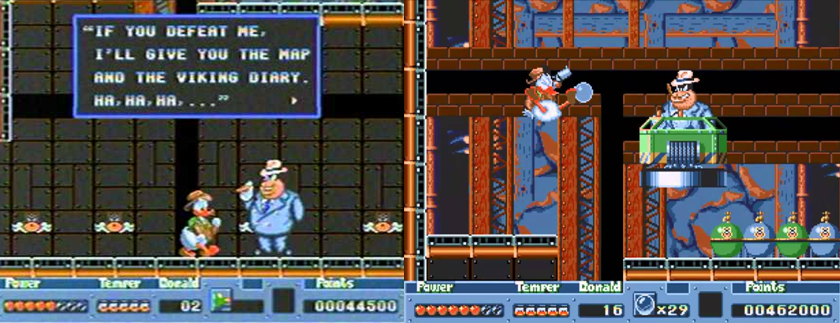
Pete finds his position as the game’s final boss usurped at the last second…

Eventually, you’ll face off against Pete himself in a bid to retrieve the map; this battle sees Pete circling the area in a massive press machine and attempting to squash Donald into a fine paste. Pete’s goons are also stationed around the arena to make hitting Pete in the face that much harder as you climb higher and higher up the arena but, like all the bosses, this is simply a test of patience rather than being an exercise in frustration.

QuackShotFinalBoss
The game’s true final boss isn’t much of a threat…

Once Pete is taken out, Donald heads over to the Great Duck Treasure Island, where the tomb of King Garuzia lies, to do battle with the knight guarding Garuzia’s treasure. As final battles go, this is a bit of a disappointment; the knight basically stays in the centre of the screen, twirling his sword and trying to fling it at you, and causing blocks to fall from the ceiling. He leaves himself wide open for your attacks, meaning it’s pretty simple to dodge the falling debris and blast him with your plungers or other weapons until he finally gives up King Garuzia’s treasure.

Power-Ups and Bonuses:
The only real power-up you can get through regular gameplay is the aforementioned red-hot chilli peppers; you can also collect bags of cash to increase your score, though, and find some cheeky shortcuts peppered through stages that lead either to stockpiles of items and ammo, extra lives and health, or hidden doors to progress further.
QuackShotWeapons
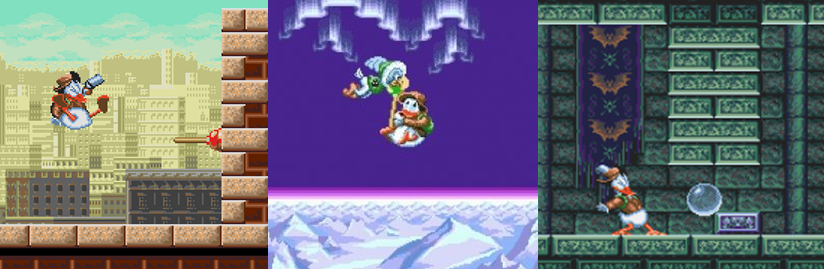
Donald’s plunger gets a few upgrades along the way.

As you explore, you’ll receive two upgrades for your pop-gun; the first changes your yellow plunger to a red one, which allows you to scale vertical walls with temporary platforms, and the second changes it to green and allows you to hitch a ride on flying enemies. Gyro also supplies you with bubblegum ammo, which allows you to break open walls and certain blocks so you can explore a bit more of the map and the game’s locations. These bubbles are quite slow and linger around the screen for some time, which can limit your firing speed (which is already quite slow to begin with).

Additional Features:
There’s not much replayability in QuackShot beyond playing through a perfectly acceptable action/platformer over and over. There’s no difficulty settings to choose from, no additional characters to unlock or play as, and there aren’t even any cheats or passwords to input. While this does mean you have to rely on old school gaming and memorisation to play through the game’s relatively short length, it also means that you can’t save your progress or jump to a later stage in the game if you have a power cut.

QuackShotBanner

The Summary:
Generally speaking, QuackShot Starring Donald Duck isn’t especially challenging but its pacing really ruins the many positive aspects of the game. Donald is so slow and clunky and the gameplay is so plodding and sluggish that there’s no real sense of urgency or agency to the game’s plot or action. QuackShot looks great and isn’t especially punishing or unfair but it’s nowhere near as action-packed or appealing as other Disney titles, even ones that also feature Donald Duck. Instead, you’re left with a perfectly average little title that looks and sounds great but doesn’t exactly leave you clamouring for more or especially excited.

My Rating:

Rating: 2 out of 5.

Could Be Better

What did you think of QuackShot Starring Donald Duck? Where do you rate the game compared to other Disney titles of that era? Do you agree that it’s not as appealing as other Disney videogames on the Mega Drive or did you find it to be just as enjoyable? Which was your favourite, or least favourite, and who is your favourite Disney character? How are you celebrating National Donald Duck Day? Whatever you think about QuackShot, Donald Duck, or Disney in general, drop a comment below and have a great Donald Duck Day!

Game Corner: Castle of Illusion Starring Mickey Mouse (Mega Drive)

GameCorner
CastleOfIllusionMDLogo

Released: November 1990
Developer: SEGA AM7
Also Available For: Game Gear and Master System

The Background:
As I’ve mentioned before, Disney had quite the reputation for licensing their characters for top quality videogames back in the nineties. These days, licensed videogames are often frowned upon but, back then, Disney’s movies and characters made for some of the most enjoyable action/adventure platformers on the SEGA Mega Drive and Super Nintendo. Mickey Mouse, Disney’s beloved mascot, received quite a few videogames for the Mega Drive, each one an enjoyable 2D romp capturing the whimsy and aesthetic charm of Mickey’s character and animated adventures. Castle of Illusion Starring Mickey Mouse paved the way for Mickey’s subsequent adventures, both solo and alongside Donald Duck, who also had his fair share of adventures on 8- and 16-bit hardware back in the day. So influential is Castle of Illusion’s reputation that a remake was released in 2013 for PlayStation 3, Xbox 360, PC, and various mobile platforms. Until now, this was the only version of Castle of Illusion I had played; while that was quite a while ago, I remember it being a fun little 2.5D romp so, when I started planning on expanding my Mega Drive library, I knew that Castle of Illusion would have to be on the list to see how the title holds up.

The Plot:
Mickey and Minnie Mouse live peacefully in Vera City but when Minnie is suddenly abducted by the evil witch Mizrabel, Mickey must journey into the witch’s Castle of Illusion to recover the seven Gems necessary to defeating Mizrabel and stopping her from switching bodies with Minnie.

Gameplay:
Castle of Illusion is a 2D, sidescrolling action/platformer in which players must guide Mickey through six Levels, each hidden behind doors within the titular Castle of Illusion. Rather than using a traditional map screen or a hub world, or simply transitioning from one level to the next, Mickey travels to each of the game’s Levels by passing through enchanted doorways in Mizrabel’s castle, which is a nice change of pace from simply navigating a basic map or automatically dropping into a Level.

CastleOfIllusionMDAttacks
Bounce off enemies with Mickey’s butt or toss items at them.

Mickey has two main forms of attack to defend himself against Mizrabel’s many and varied minions; he can either grab an apple or a marble and throw them at his enemies or bounce on their heads with his rump. Throw projectiles can be useful but, as a lot of enemies are shorter than the projectiles travel, you’ll most likely be making use of Mickey’s butt to defeat your enemies. However, if you don’t hold down the jump button, Mickey will take damage, which is annoying, so it’s worth holding it down every time you make a jump in case an enemy swoops beneath you. When you land on an enemy’s head, you can bounce from one to another to make short work of multiple enemies, clear larger gaps, or reach higher platforms. While Mickey’s arsenal of moves isn’t exactly the deepest, he makes up for it by controlling extremely well for the most part. There are times, however, when either he feels a little slippery or the surfaces he is standing on are oddly slippery and you’ll find yourself sliding off an edge and to your death or accidentally slipping into an enemy or down a bottomless pit. While instant death traps and obstacles aren’t too obtrusive, they are present in some of the worst areas, such as a section where Mickey must jump from small platforms while waterfalls threaten to drag him down a bottomless pit and to his death.

CastleOfIllusionMDSwing
Swinging from ropes can be a tricky mechanic.

As standard, Mickey has a fairly decent, semi-floaty jump that takes him quite far and far the longer you hold the jump button down and depending on how much momentum you have. His walk is quite sluggish, though, and he doesn’t really speed up beyond much of a gentle stride so the game’s emphasis is more on platforming and mild exploration and puzzles rather than fast-paced, high-speed action. Mickey can duck to avoid projectiles and enemies as they jump but, while he can swim without fear of drowning, he can’t actually attack any enemies whilst underwater, leaving him vulnerable. Certain Levels task Mickey with grabbing on to ropes, vines, and other hanging apparel; I found grabbing these to be troublesome, at best, as more often than not Mickey simply leap through the rope but, once you grab on, you can swing from rope to rope with the added bonus of automatically dispatching any airborne enemies as you swing along.

CastleOfIllusionMDExplore
Explore Levels to find items and bonus areas.

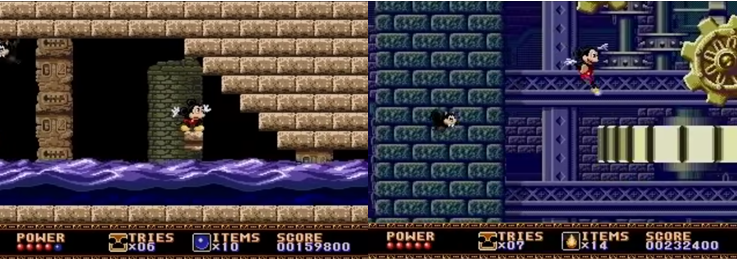
Mickey’s health is represented by a five-point power bar; Mickey loses a point every time he takes damage and loses a life every time his health is fully depleted by can replenish a health point by grabbing a Star item. He can earn an extra try by either grabbing some Mouse Ears or collecting first 40,000 points and then 50,000, awarded by defeating enemies, grabbing gems, and tallied up after you complete each Level. Some Levels require Mickey to do a bit of exploration; in Toyland, for example, you need to find a key in order to progress while in the Storm, you have to contend with a maze-like cycle of water jets and find the right path to the Level’s exit. While exploring the Library, you can jump into tea cups and swim through a few small bonus areas to grab extra projectiles or gems, and you’ll sometimes have to run away from a large rolling obstacle or try to not be swept away by rushing water.

Graphics and Sound:
Though later surpassed by its later 16-bit successors, Castle of Illusion is still a gorgeous little title; all the sprites and backgrounds pop with bright, colourful art and feature some interesting animations and elements. When left idle, Mickey has a charming little animation where he sways his hips to the game’s various whimsical tunes and he always looks full of life and vigour as he strolls, hops, and bounces along. His enemies aren’t quite as dynamically rendered but they’re interesting and wacky enough to fit the themes of the game’s various Levels.

CastleOfIllusionMDGraphics
Levels are varied and full of life and obstacles to overcome.

As you travel through the castle’s enchanted worlds, you’ll journey through a forest, a toy box, a giant library, and the castle itself. Each Level has various other layers to it, meaning you’ll hop across leaves and through spider’s webs, leap through a sweet and chocolate world, get stuck in sticky jelly, and even traverse a pyramid-like structure where damaging water threatens to wash you away. Once you reach Mizrabel’s castle proper, you’ll have to contend with far more obstacles and face your greatest challenge as giant boulders try to crush you, bridges crumble beneath you, and Mickey must leap from cogs and gears and swinging pendulum’s in the castle’s clock tower.

Enemies and Bosses:
Being that the game is, essentially, a jaunt through a magical, fairytale-like setting, Mickey comes up against a whole host of enemies in his journey that vary from the painfully generic to the bizarre. You’ll go from butt-bouncing on sentient mushrooms, spiders, toy soldiers, bats, and chubby little bookworms to contending with juggling clowns on unicycles (which race at you once they’re riders are defeated), skeletal fish, and extremely annoying, bouncing letters of the alphabet.

CastleOfIllusionMDBosses
The game’s bosses aren’t much of a threat.

At the end of each Level, Mickey has to face a large boss, known as a Master of Illusion. These range from an angry tree that tries to drop acorns on your head, a jack-in-the-box that tries to punch you with boxing glove, a totem pole that can only be knocked down by butt-bouncing on the enemies it spews out, and a giant sweet dragon.

CastleOfIllusionMDWitch
Stay away from Mizrabel’s attacks and you’ll soon have Minnie back safe and sound.

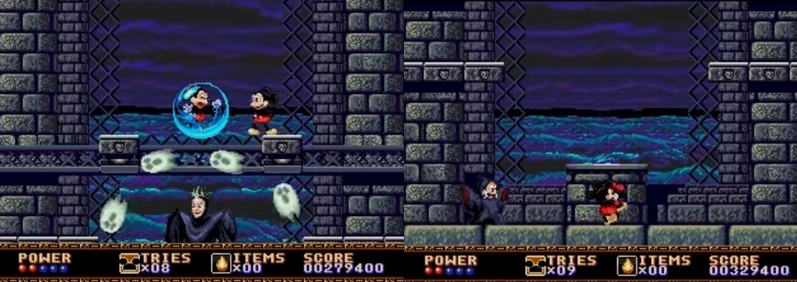
After defeating the Masters of Illusion and getting through Mizrabel’s castle, Mickey has to face off with the witch herself at the top of her castle, with Minnie held captive in a magical balloon. Fittingly, Mizrabel assumes the form of a youthful sorceress for the battle, which sees Mickey having to keep to the high ground to avoid the witch’s swirling spirits and butt-bounce on her head in the small window of vulnerability she has. While none of these boss battles are particularly difficult, as they all stick to a very predictable attack pattern, there’s not a lot of call for Mickey’s projectiles during these fights and even Mizrabel is bested with relative ease simply by staying on the upper platforms.

Power-Ups and Bonuses:
There’s not a lot on offer here apart from the standard trope of being awarded an extra life when you collect enough points. You can, however, pick up bags that will gift you with a whole bunch of projectiles to throw and use your butt-bounce to reach higher and out of reach areas to find additional health, gems, and ammo but, apart from that, there’s no much else available to expand your health or arsenal.

Additional Features:
The game has three difficulty modes: Practice, Normal, and Hard. In Practice mode, you start with full health and won’t have to face any bosses and only need to collect three Gems and can continue four times after you exhaust all your tries but you won’t get the game’s true ending; in Normal and Hard, you start with three or two health points, respectively, and have to find all seven Gems and can continue two times in Normal but have no opportunity to continue in Hard mode; you also lose all items you’re carrying after losing a try, adding a level of difficulty to the game and requiring you to exhibit more skill than in its 8-bit successor.

CastleOfIllusionMDConclusion2

The Summary:
It’s easy to see why Castle of Illusion is so beloved; it’s a fun, charming little adventure that looks and feels just like you’re playing a cartoon. Mickey has always been dropped into this bright, colourful fairytale adventures, even when he made the transition to 3D titles, and these worlds are surprisingly fitting for Disney’s cheeky little mascot. Offering just the right level of challenge to keep you coming back for more, Castle of Illusion set the standard for Mickey’s subsequent 8- and 16-bit adventures, most of which deviated very little from this game’s core gameplay and mechanics. It might not be the best action/adventure platformer on the Mega Drive, or the fastest or most action-packed title, but it’s still a charming, whimsical romp that looks, plays, and sounds fantastic and is well worth your time.

My Rating:

Rating: 4 out of 5.

Great Stuff

What did you think about Castle of Illusion? Where does it sit in your hierarchy of 16-bit Disney games? Did you ever play the remake from a few years ago? How do you think it compares to the original? Whatever your thoughts on Castle of Illusion, and Disney and Mickey games in general, drop a comment below and share your thoughts.

Mini Game Corner: Land of Illusion Starring Mickey Mouse (Master System)

LandOfIllusionLogo

Released: June 1993
Developer: SEGA
Also Available For: Game Gear

A Brief Background:
Back in the nineties, licensed videogames hadn’t quite earned the reputation that they have these days. Anyone who had played one of the many videogame adaptations of Disney movies and properties, particularly on SEGA’s Mega Drive or the Super Nintendo, would generally be in for a good time and treated to big, colourful, well-animated graphics and tight, fun gameplay. One of the most prolific of Disney’s characters to be licensed out to videogames was their enduring mascot, Mickey Mouse. A couple of years after Castle of Illusion Starring Mickey Mouse (SEGA AM7, 1990) and World of Illusion Starring Mickey Mouse and Donald Duck (ibid, 1992) released for Mega Drive, a similar (though, apparently, unrelated) title was released for SEGA’s 8-bit consoles, the Master System and the Game Gear handheld.

The Review:
Land of Illusion is a pretty standard 2D, sidescrolling action/platformer in very much the same vein as previous Disney titles released around that time. Players take control of the affable Mickey Mouse and journey through fourteen stages, dispatching enemies using Mickey’s rump, sliding down slopes, or by throwing objects at them. Mickey controls at a steady, grounded pace; he doesn’t slip and slide around, making precision platforming a much easier task than other platformers of the time. He begins the game with two stars in his Power Gauge, meaning he can take two hits before he must try again from either the beginning of the stage or from the last checkpoint he passed. Players can refill Mickey’s health by smashing blocks and other objects to uncover cake; if you search hard enough, you’ll also find a bonus star in each stage, which will add another star to Mickey’s Power Gauge and thus allow him to take more hits. Mickey can also collect coins, which will add to his score tally; defeating enemies and bosses also adds to this tally and he’ll earn an extra try for every 10,000 points. Mickey must sometimes take to water to navigate through a stage; in these areas, players will have to watch Mickey’s air meter, as he’ll lose a life if it runs out. There’s a few simple push-and-pull-based puzzles that Mickey must also solve by opening blocked areas or turning environments upside down and, occasionally, he’ll need to find a key in order to progress.

LandOfIllusionAttacks
Stomp on enemies with Mickey’s butt or chuck a rock at them.

Players must also complete each stage within a time limit (as was the style at the time) but, as Mickey progresses through the game’s story and stages, he frees some familiar-looking faces and is gifted various items that aid his quest; the Magic Flute allows players to replay any stage they’ve previously completed (which can be essential for tracking down other items and extra energy you’ve missed), a Shrinking Potion (which allows Mickey to fit through small tunnels, doors, and spaces), a Rope to climb certain walls, Cloud Shoes to walk on clouds, and a Magic Bean to grow a beanstalk and reach the Phantom’s castle. As mentioned, you can increase Mickey’s health with cake and collect stars to increase Mickey’s Power Gauge but that’s about it. There’s no invincibility, speed ups, or special abilities here. Instead, you can grab Mickey Ears or hit 10,000 points for an extra try and will use the game’s mandatory times to progress further. However, while you can shrink through gaps with the Shrinking Potion, your attacks are useless and being able to jump on clouds doesn’t really help at all except when climbing the magic beanstalk. Otherwise, there’s nothing extra here; the game has one ending, no unlockable or extra characters, and the only incentive to play it again is to beat your last high score.

LandOfIllusionStages
Though simple, stages are bright and colourful.

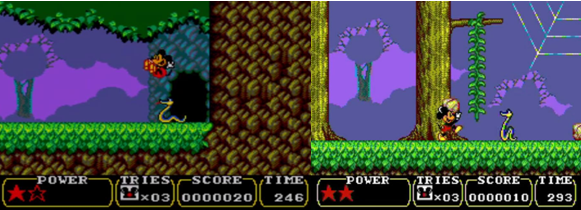
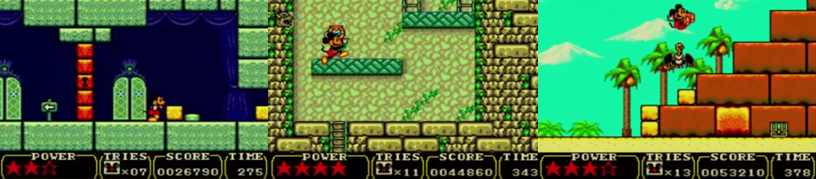
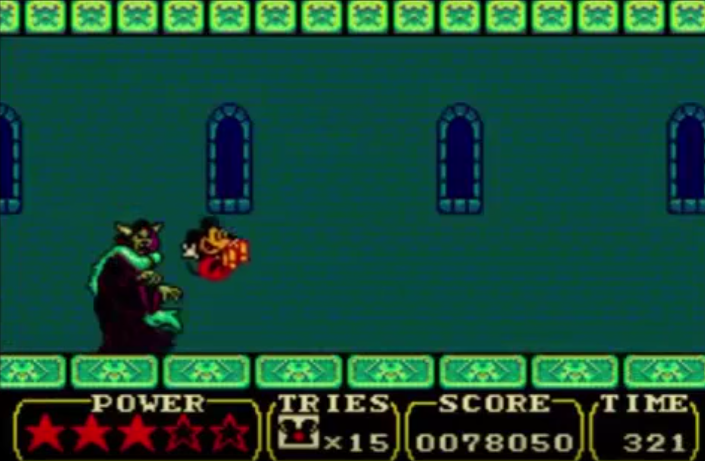
While nowhere near its 16-bit counterparts in terms of graphics or sound quality, Land of Illusion is still quite a charming little 8-bit title. The Master System was never known for having particularly exciting backgrounds or environments, so all of the artistic effort seems to have gone into making the sprites (particularly Mickey) as bright, colourful, and animated as possible. You’ll travel to some pretty standard areas in Land of Illusion (a forest, a desert, a couple of castles…) but each one is distinct in its design and features slightly different gameplay mechanics. You might have to let a tornado of leaves carry Mickey over spikes to safety, for example, or have to outrun a wall of spikes or cross poisonous water or lava. The Master System renders these environments simply enough but it’s surprising how vivid and engaging they are for such an under-powered console. Similarly, the game obviously doesn’t match the bright, poppy tunes or sound quality of its bigger brother but the soundtrack nevertheless does a serviceable job; there’s some catchy little tunes, all of which are perfectly in keeping with Mickey’s cute-and-cuddly aesthetic. Enemies here are as generic as they come; you’ll butt-bounce off the likes of spiders, wasps, snakes, and floating skulls. Some present more of a challenge than others, however, shielding themselves from harm, reforming after being hit, or being invulnerable to Mickey’s butt-bounce.

LandOfIllusionPhantom
Wait for an opening and then hit him with your butt!

You’ll battle some big bosses while playing Land of Illusion but none will really pose much of a challenge (…I really struggled with the giant crab, though, thanks to how slow Mickey moves underwater). You’ll dodge their attacks, maybe toss one of a limited number of blocks at their head, or wait for an opportunity to bounce off their heads with Mickey’s butt. The final boss, the Phantom, is slightly more complex as you must first traverse his booby-trapped castle and then dodge his energy balls (just crouch right in front of him) and jump over his whirlwind attack before he’ll pause long enough for you to smack him. He’ll mix it up by jumping to the ceiling, forcing you to throw blocks at him, but it’s over within seconds, especially if you’ve completely powered up Mickey’s Power Gauge.

LandOfIllusionConclusion

The Summary:
While a mere shadow if its 16-bit counterparts, Land of Illusion does a decent job at entertaining; there’s no bottomless pits or cheap deaths, plenty of opportunities to explore, and some charming graphics and tunes on offer. Gameplay is about as simple as it gets, which is to be expected given the Master System’s simple two button setup; as mentioned, you might have to backtrack to previous levels to get items to progress further if you missed them, and you will find a challenge in the game’s final level but, with infinite continues as standard and a leisurely pace to its gameplay, Land of Illusion is a fun enough little jaunt to keep you distracted for a couple of hours.

My Rating:

Rating: 3 out of 5.

Pretty Good

Did you ever play Land of Illusion? What were your favourite, or most frustrating, Disney videogames from back in the day? Would you like to see a HD compilation of Mickey’s 16- and 8-bit titles? Go ahead and take to the comments to share your thoughts and memories.