
In 1981, Shigeru Miyamoto and his team at Nintendo R&D1 created Donkey Kong, an arcade title that introduced gamers to two of Nintendo’s most recognisable characters: Mario and Donkey Kong. To celebrate everyone’s favourite King Kong knock-off, I’m dedicating a few days this week to gaming’s most famous ape!

Released: 23 September 2020
Originally Released: 21 November 1995
Developer: Nintendo
Original Developer: Rare
Also Available For: Game Boy Advance, Nintendo 3DS, Nintendo Wii, Nintendo Wii U, Super Nintendo Entertainment System (SNES)
The Background:
After making a name for themselves Stateside with the financial and critical arcade classic Donkey Kong (Nintendo R&D1, 1981), Nintendo captured the home console market with the Nintendo Entertainment System (NES). Largely supplanted by their moustachioed mascot, Super Mario, Donkey Kong gained a new lease of life thanks to legendary British developers Rare. Donkey Kong Country’s (Rare, 1994) revolutionary pre-rendered graphics pushed the SNES to its limits, saw a redesign of Donkey Kong Jr., and became the third-bestselling SNES game. Accompanied by universal praise, development of a sequel began shortly after Donkey Kong Country’s release and was purposely designed to be more challenging compared to its predecessor. Although it utilised the same pre-rendered graphics pioneered in the first game, Donkey Kong Country 2 was designed to be less linear and focus more on speed, leading to Diddy Kong taking the lead role. He was joined by a new character, Dixie Kong, who was designed to offer gameplay mechanics similar to those in the first game but different enough to be unique. Donkey Kong Country 2 was a massive hit upon release, one met by both critical acclaim and numerous awards. The game was seen as an overall improvement in every way and has been ported to both other platforms and Nintendo’s digital mediums, and inspired Retro Studios’ 2020 revival of the franchise.
The Plot:
When Donkey Kong is kidnapped by the vengeful King K. Rool, his nephew, Diddy Kong, teams up with his girlfriend to rescue him from the Kremling army.
Gameplay and Power-Ups:
Like its predecessor, Donkey Kong Country 2: Diddy’s Kong Quest (a clever pun that took me years to pick up on) is a 2D, sidescrolling adventure brought to life using pre-rendered graphics converted into 2D sprites. This time around, Donkey Kong has been kidnapped, forcing you (and a friend, if you have one) to play as his nephew, Diddy Kong, or Diddy’s girlfriend, Dixie Kong, and traverse the Gangplank Galleon worlds to rescue him. You’re given three saves and three player options: either going it alone, tagging between the Kongs with -, playing two-player co-op or playing a “contest” mode against a friend. The control scheme should be immediately familiar to anyone who’s played the first game: you jump with B, attack with Y, grab your partner with A, and throw them with Y. Your Y attack differs depending on which Kong you’re playing as: Diddy performs a cartwheel to hit enemies in his path and add some momentum to his jump while Dixie twirls her ponytail, which lets her glide for a few seconds and thus makes her the better choice for clearing the game’s many gaps and bottomless pits. Your partner acts as your life bar; as long as you have a partner Kong, you can take at least one hit. You’ll need to smash DK barrels to reunite with your partner and collect bananas, KONG letters, and 1-Up balloons to earn 1-Ups. These can also be earned by spending Banana Coins to play Swanky Kong’s Bonus Bonanza mini game, and you’ll need a fair few lives as the game’s platforming and hazard placement can get pretty tough as you progress. Occasionally, you’ll find the odd invincibility barrel but there are no new power-ups included here. You can save your game at Wrinkly Kong’s Kong Kollege, where you can also spend Banana Coins to learn about various game mechanics, or abuse the Nintendo Switch’s rewind and save state feature to mitigate some of the game’s difficulty.
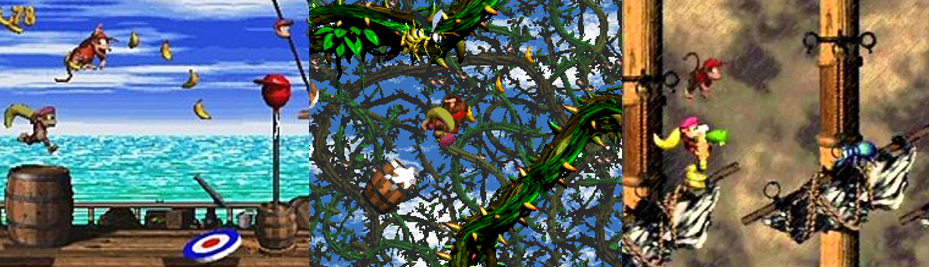
Whereas Donkey Kong and Diddy Kong controlled very differently in Donkey Kong Country, with one being slower, bigger, and more suited to attacking and the other being fast, nimble, and better suited for platforming, Diddy and Dixie are very similar here. Dixie’s better for crossing gaps, though, and since there’s a lot of platforming and tricky jumps you’re usually better off sticking with her. It’s a shame that Diddy Kong remains unchanged from the last game as there’s little incentive to play as him beyond giving yourself a greater challenge. The Kongs’ animal friends are back, once again freed from crates and opening additional exploration and attack options. Rambi charges through enemies and destructible walls, Enguard slices through water with a sleekness the Kongs can only dream of, and Squawks the parrot spits peanuts with Y. Not only can Rambi charge up a gore, Enguarde attacks with his needle-like nose, and Squawks flies with taps of B, they’re joined by two new animal buddies. Squitter the spider fires a web projectile with Y and creates temporary web platforms with B while Rattly the snake allows you to charge a big leap to reach higher areas. Many of the hidden mini game rooms are played with these companions, too, and multiple animals can be found in certain stages, allowing you to take different routes and acquire different collectibles. The Kongs can also hurl barrels, TNT barrels, cannonballs, and treasure chests, with the latter two activating cannons to bonus games and yielding collectibles, respectively. Your goal is the target at the end of each stage, with each set up to gift different rewards depending on when and how hard you hit the target, awarding you extra bananas, lives, coins, or a KONG letter. Giant DK Coins and Kremkoins are also hidden across the various worlds; the latter are spent at Klubba’s Kiosk to access a bonus world. You can also hire Funky Kong’s airplane to fast travel across the overworld, climb ropes, chains, and ride wind gusts and, of course, blast across the environment using various barrels.
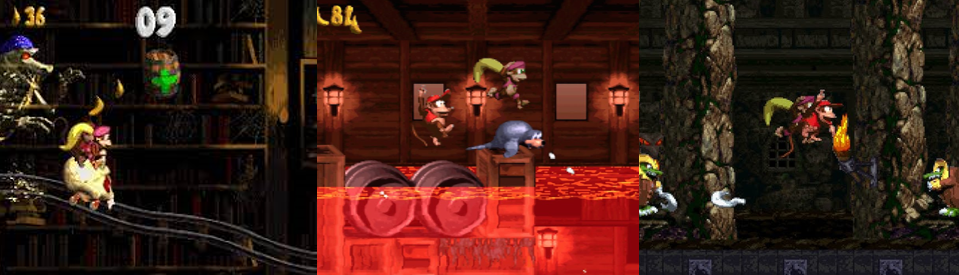
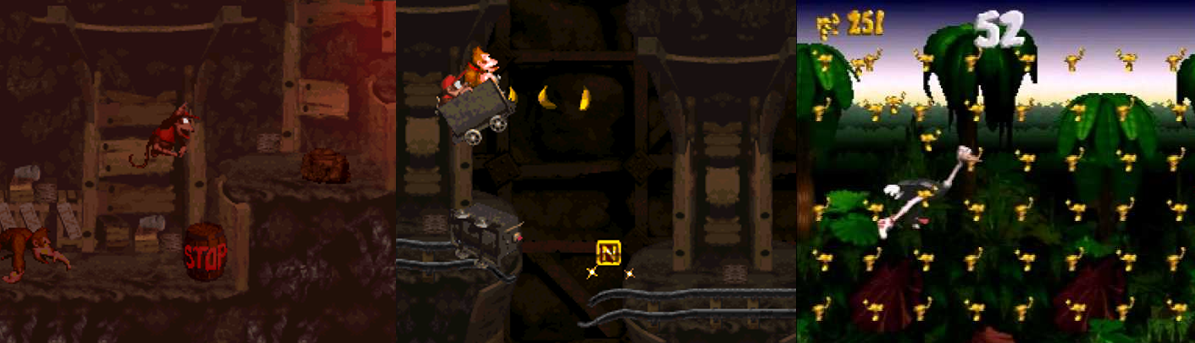
Barrels either automatically shoot you or you must time your shot to reach an adjacent barrel, often with the risk of plummeting to your death or hitting spiked thorns. Pits, water, toxic gunk, and lava all spell instant death and can be difficult to avoid thanks to some gaps being frustrating to clear. Dixie helps with this, as does bouncing on enemies, but you’ll also want to utilise any animal companions to help squeeze through narrow gaps or around thorns. Some stages have you traveling from the right side of the screen to the left; others force you into a race or a timed challenge. You’ll see many of these in the many bonus rooms, which challenge you to defeat multiple enemies, collect bananas or stars, or reach the end goal after a short obstacle course to earn rewards. Many hazards and gimmicks seen in the first game return here: you’ll ride mine carts and high-speed rollercoasters (hitting lights to open gates and jumping to new tracks), swim through mazes of crates, avoid plenty of pits, and slip on icy ground. Vertical traversal is as prominent as horizontal, requiring you to hop and barrel blast up ship masts as often as you explore the submerged interiors. Sometimes, water, lava, and toxic gunk rises after you, creating a sense of panic as you desperately hop to platforms and climb higher. Others, the floor rises, creating a crushing hazard, or you’re forced to make pixel perfect jumps or fly through thorny mazes. Sometimes, you’ll need to jump on seals to freeze water or cool lava, giving you a short window to slide under enemies or swim to safety. Other times, you’re floating between Zingers, dodging cannonballs, jumping to poles and hooks, and making desperate leaps across chasms to progress. Your animal friends are invaluable in many of these situations but you’ll definitely want both Kongs on hand, especially in the endgame when tight corridors filled with spikes and obstacles make even the simplest movements hazardous.
Presentation:
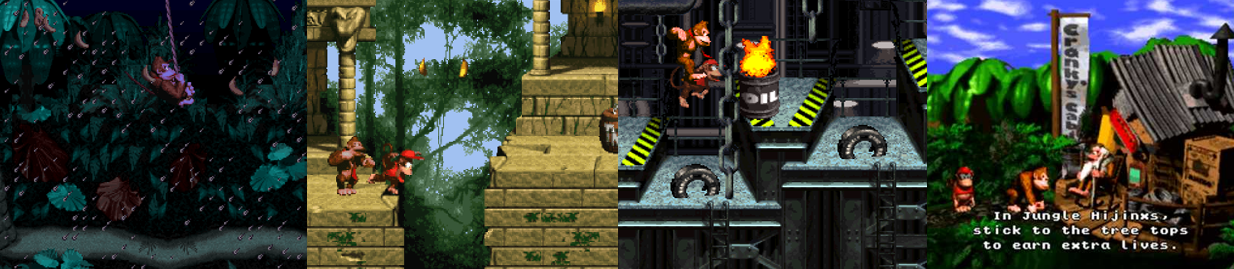
Donkey Kong Country 2 doesn’t really look or play any better than the first game, in my opinion. I’ve never been a fan of the aesthetic of this franchise and it continues to be ugly, blurry and pixelated here. The sprites, especially, have some mess on them that looks sloppy at times, though I did like how animated and cartoonish the Kongs were. Diddy and Dixie celebrate when you hit the end goal, cry when thrown, juggle and loaf about when left idle, and it’s funny how their eyes comically bug out whenever they see bosses. Each has little exclamations for when they’re hit or victorious and they control pretty well, but they have large hit boxes and can be clunky to move around, making them easy targets for the equally large hit boxes of enemies and hazards. There’s no introduction cutscene this time and the title screen is as basic as you can get, but you can talk to a few more Kongs (including the returning Cranky Kong) for some lore, tips, and to break up the gameplay. The music is mostly the same as before; I recognised some of the tunes from the first game and it’s all very whimsical and enjoyable, if not very memorable. Gangplank Galleon is a more foreboding overworld than Donkey Kong Country’s, featuring lava, dungeons, and a frigid mountaintop. I liked that Pirate Panic starts you on King K. Rool’s pirate ship, essentially starting the game where the first one left off, and the pirate theme continues throughout in the enemy sprites and level layouts.
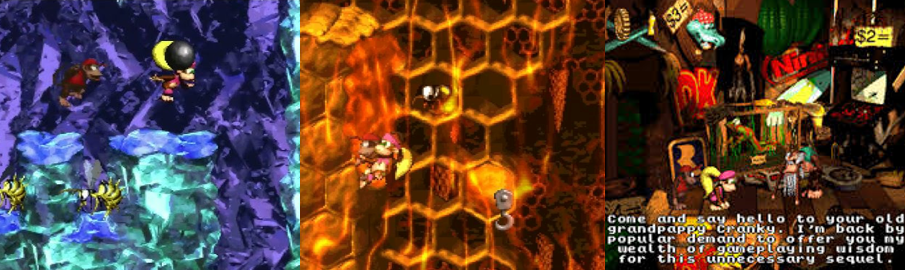
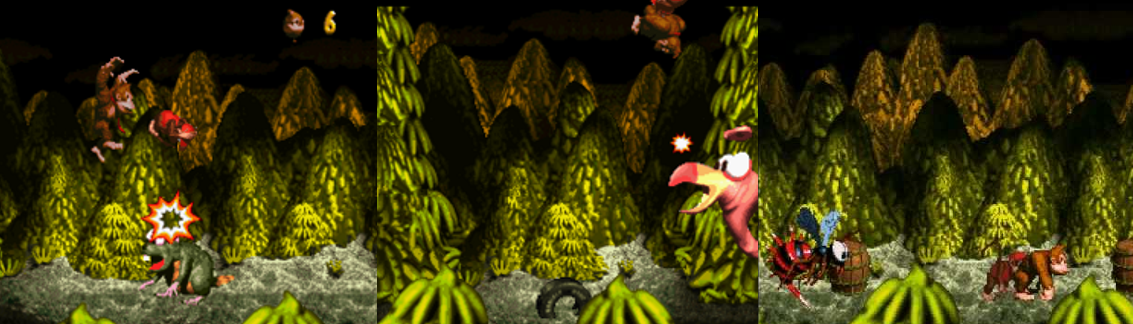
Typically, stages fall into a routine very quickly. You’ll either be hopping about on the deck of a ship, clambering about in the masts up top, or exploring the inside, with these areas being flooded, riddled with lava, or beset by wind and rain. Wind is a particularly dangerous element as, while you can ride updrafts to new areas and it boosts your jump, it also pushes against you and can screw up your platforming. Caves, mines, and frozen mountaintops also appear, with some being remixed into the pirate-themed stages. While the mine cart stages are disappointingly bland, the game makes up for it with Krazy Kremland’s fairground and rollercoaster, where you’ll see fireworks and rides in the background. Stages like Jungle Jinx and Mudhole Marsh can be difficult thanks to the dense forest and contrasting colours, which swallow up the sprites and make for some muddy, ugly visuals. I liked stages set in the beehives, with their sticky nectar offering new platforming challenges, and those like Gloomy Gulch that adopted the haunted forest trope and the scorching volcano aesthetic of Crocodile Cauldron. However, any stages that incorporate the thick, maze-like mess of thorns and brambles can go die in a ditch. By the time you reach Toxic Tower, you’re avoiding toxic gunk in a suitably medieval dungeon before boarding King K. Rool’s steampunk-like airship, The Flying Krock. Gangplank Galleon features many paths, shortcuts, new worlds, and required stages, though it can be clunky to navigate. Also, while Donkey Kong Country 2 performs well, I did notice some frustrating slowdown one I reached K. Rool’s Keep. The game struggled to render all the sprites and hazards, slowing the gameplay to a crawl, and the large hit boxes became aggravating thanks to the sadistic enemy and obstacle placements of the game’s latter stages.
Enemies and Bosses:
King K. Rool’s army is familiar but largely original here in Donkey Kong Country 2. His ships are infested with rats and little snapping crocodiles and seemingly every stage is populated by Zingers, spiked bees whose red variants can’t be killed and who act as much as hazards as they do enemies, flying back and forth, in circles, or in vertical formations that force you to squeeze by. His Kremlin army is still easily dispatched with a simply bop on the head or a barrel to the face, but they’re sporting some new designs. Some bounce in place or at you, larger Kremlins wield cannonball-firing blunderbusses or toss boomerang-like hooks, smaller ones patrol back and forth with cutlasses that have a shockingly large hit box, and others are large and muscular and become enraged (and harmful) when you hit them. The wacky (and somewhat familiar) Cat-O-9-Tails either hurt you or toss you across gaps (or into spikes) with their tentacle-like tails, vultures swoop from the skies, porcupines totter across the ground, and stingrays and voracious fish lurk in water. You’ll be chased by a skeletal pirate ghost while speeding across broken rollercoaster tracks, jump to temporary ropes that are actually snake-like ghosts, slide and jump out of the way of rope-climbing Kremlins, gain a mid-air boost from passing dragonflies, and get bashed about (usually down a pit) by barrel-wearing Kremlins. You’ll race against Screech, hop to Krocheads to clear bodies of water or swampland, hop to Kannon’s barrels to achieve the same goal, tip over Click-Clack beetles to attack their underbelly, and encounter rotund sorcerer-type enemies who toss barrels and suicidal Kremlins at you.
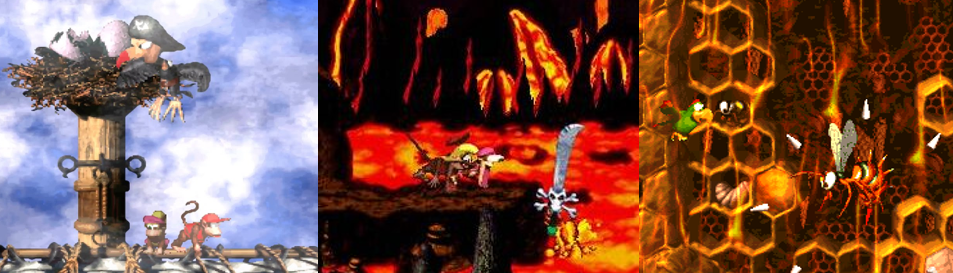
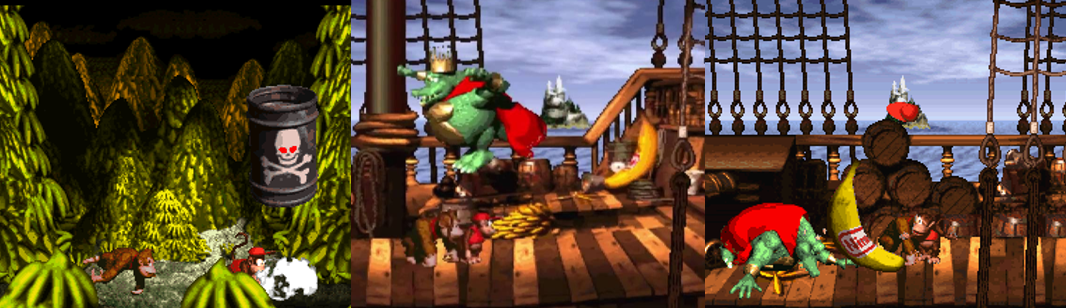
Each of Donkey Kong Country 2’s worlds end with a boss battle, though you’re awarded a Kremkoin rather than a giant banana this time around. Each boss has at least two phases, no life bar, and rarely a DK barrel to restore your partner if you’re hit, and they’re all essentially invulnerable until a barrel spawns for you to throw. Your first boss is Krow, a large, pirate-themed crow fought up in a crow’s nest (…get it?) Krow dives at you and launches giant egg from his nest. You must hop on this egg and toss it at Krow to deal damage, which eventually sends Krow into such a frenzy that he causes eggs to erratically rain down, making it trickier to score the final two hits. Kleever, a sentient sword, hides in lava for the first phase and tosses fireballs you must dodge. Eventually, a cannonball drops which you must throw at Kleever, then you must use the hooks to cross the lava pool and repeat. In the second phase, Kleever emerges from the lava and flies about, swiping and chasing you as you hop to the many hooks scattered around, tossing cannonballs to finish it whenever you get a chance. Kudgel, a roided-up Kremlin wielding a massive club, leaps offscreen and stuns you when he lands if you’re standing on the ground. He also swings his club like a baseball bat, after which a TNT barrel drops in. Toss this at him enough times and he’ll start pouncing at you, forcing you to run or cartwheel under him and making timing your throws a tad more difficult. King Zing is fought in a sticky beehive after previously chasing the player (on Rambi) in Rambi Rumble. King Zing is unique in that you fight him as Squawks, fluttering around and spitting peanuts at his stinger (a difficult target to hit considering how small it is). After enough hits, King Zing fires a spread of stingers and splits into smaller, regular Zingers, all of which can be tricky to avoid with Squawks’ awkward controls and hit box.
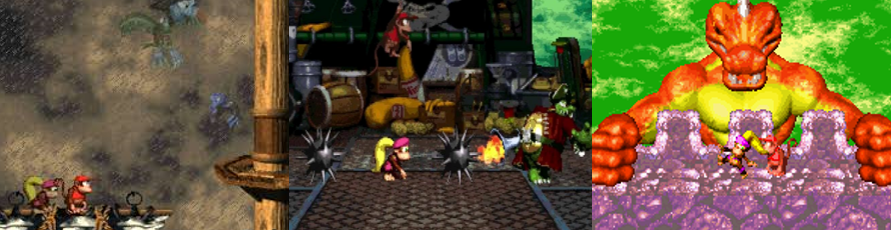
Another giant crow stands as the game’s penultimate boss. Fundamentally, battling the spirit of Kreepy Krow is the same as battling Krow except this time you’re up in the masts and sails of a pirate ship and he sends his minions after you. You must avoid the ghosts and hit the living enemies to spawn a barrel to toss at Kreepy Krow, trying not to plummet to your doom or be hit by the giant bird’s swoop. In the second phase, more baddies fly at you and you must climb hooks and chains, dodging Kreepy Krow’s falling eggs, to finish the deadbeat off. When you finally confront King K. Rool in his stronghold, where he’s gleefully torturing Donkey Kong, the Kremlin captain flees to his airship and you’re forced to beat Screech in a race through dangerous thorns and brambles. With Donkey Kong held hostage aboard The Flying Krock, you battle King K. Rool and his gigantic blunderbuss in a three-stage fight. In the first phase, you must dodge his rocket-powered charge and toss his cannonballs back when he sucks you in for a clobber. After enough hits, he collapses and the game tricks you into thinking you’ve won, only for King K. Rool to rise again and add new attacks to his arsenal. He fires spiked balls that reduce your dodging and jumping area, blue shots that freeze you, red shots that slow you, and purple shots that screw up your controls. He also turns invisible and speeds up his shots which, alongside his large hit box and the lack of DK barrels, makes this the toughest boss fight in the game as it just keeps going on and the margin for error is very small. If you’re playing the Game Boy Advance version, you’ll also battle a final final, version exclusive boss, Kerozene. A titanic Kremlin, Kerozene attacks by slamming his fists and summoning two Kleevers. You must dispatch these with cannonballs and then chuck another at Kerozene’s face when he starts glowing. After ducking his fists, you must jump to them to avoid the plumes of fire he spawns, waiting for them to die down so you can retrieve your cannonball and continue your attack.
Additional Features:
Your save file tracks the collectibles you’ve obtained in your playthrough and Cranky Kong will comment on or criticise your progress once you complete the game. While KONG letters and Banana Coins are easy to spot, they’re not always easy to acquire. DK Coins are even more elusive, requiring skilled platforming and tricks to reach. Many are rewarded by finding and completing bonus stages or discovering hidden paths. These are fun distractions and offer bite-sized challenges, but it can be tedious and frustrating revisiting the stages to hunt these down. If you collect all seventy-five Kremkoins, you’ll not only collect everything the game has to offer but also pay off Klubba and access the Lost World, six additional stages that remix enemies and gimmicks from the main game and offer an even tougher challenge for hardcore players. The final of these, Krocodile Kore, offers another boss battle with King K. Rool that’s a reskin of the regular final boss, but made even tougher. As if that wasn’t enough, the Game Boy Advance version adds Golden Feathers to upgrade Expresso II’s stats in the version exclusive Expresso Racing mini game and Photographs to fill Wrinkly Kong’s scrapbook. Collecting everything sees Cranky commend your performance and places you higher on the pedestal in the final cutscene, but offers no other tangible unlocks.
The Summary:
There’s no doubt that Donkey Kong Country is a Nintendo classic. While I’m not the biggest fan of its visual style or clunky gameplay mechanics, it was an impressive title that breathed new life into the cantankerous ape and showcased the power of the Super Nintendo. Donkey Kong Country 2: Diddy’s Kong Quest is more of the same, which you might think means it’s just as good if not better, but there’s something decidedly off about the execution. The absence of Donkey Kong hurts the game as there’s just not enough visual or gameplay difference between Diddy and Dixie Kong. If Diddy gained some new, tangible gameplay mechanic beyond just being a bit faster, maybe I’d appreciate the game more. Like, maybe Diddy could toss barrels but Dixie couldn’t; or if Diddy’s jumps were shorter to emphasise Dixie’s helicopter mechanic more. Instead, they’re so similar that you may as well stick to Dixie since you need her to clear gaps. The animal friends were fun, as ever, and the new additions added some unique aspects to the game, but I would’ve liked to see them incorporated more. The developers almost did this by giving Squawks race sections and a boss battle, but it would’ve been nice to see the other animal get this luxury, too. There is a load more collectibles this time around, which adds some nice replay value, but many are so difficult to reach and you don’t get anything substantial for finding them all so it’s barely worth your effort unless you want to punish yourself with the more difficult Lost World stages. I liked that the bosses were a bit more diverse this time, but I would’ve liked to see more variety in the environments. Everything feels like a carbon copy of the first game, just with the difficulty cheaply ramped up and very few new mechanics to make this an improvement on the original. It’s a shame as there was a fair but to like here, but the janky hit boxes, aggravating difficulty spike, and lack of originality mean Donkey Kong Country 2 feels like an inferior and less enjoyable retread of the first game to me.
My Rating:
Pretty Good
What did you think to Donkey Kong Country 2: Diddy’s Kong Quest? Was it part of your SNES library back in the day? What did you think to Dixie Kong and the new animal friends? Which of the boss battles was your favourite? Did you find all of the game’s secrets and bonus rooms? Did you struggle with the dramatic difficulty spike? Which of the Donkey Kong Country games is your favourite and why? How are you celebrating Donkey Kong’s anniversary this year? Whatever your thoughts on Donkey Kong Country 2, leave them below, support me on Ko-Fi, and go check out my other Donkey Kong content.


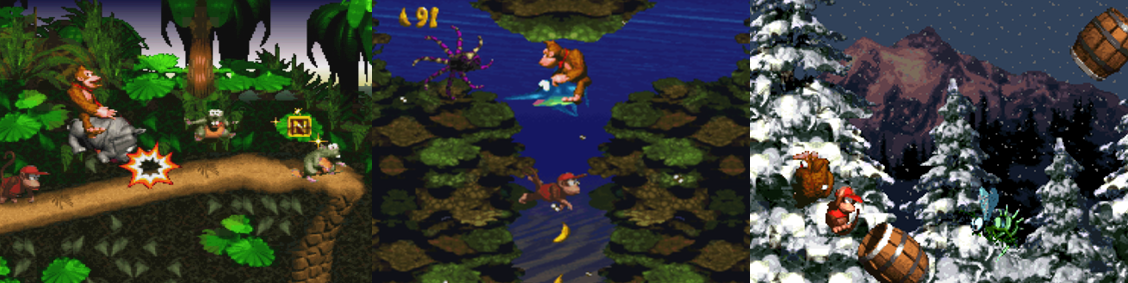

 Dr. K's Waiting Room
You must be logged in to post a comment.