Movie Night [National Anime Day]: Death Note Relight 1: Visions of a God


15 April has been designated National Anime Day to celebrate the stylistic genre, which achieved mainstream success thanks to animators like Osamu Tezuka.


Released: 31 August 2007
Director: Tetsurō Araki
Distributor: Madhouse
Budget: Unknown
Stars: Brad Swaile, Alessandro Juliani, Brian Drummond, Shannon Chan Kent, and Chris Britton

The Plot:
In the Shinigami realm, the mischievous Ryuk (Drummond) regales his fellow Death Gods with tales of his time in the human world, specifically the complex game of cat-and-mouse between Light Yagami (Swaile), who used Ryuk’s killer notebook to punish criminals, and the eccentric “L” (Juliani), a detective determined to bring Light’s alter ego, “Kira”, to justice.

The Background:
Death Note (stylised as “DEATH NOTE”) was a manga created by author Tsugumi Ohba and illustrated by Takeshi Obata that began as a very broad and basic concept regarding Shinigami and a series of strict rules. Ohba and Obata developed a system where they would draft storyboards alongside their editor; Ohba visualised the panels during his downtime and Obata was apparently afforded a great deal of creative freedom for his artwork. Published in Weekly Shōnen Jump between 1 December 2003 and 15 May 2006, Death Note was incredibly successful and widely praised for its art, compelling characters, and complex plots and was so popular that it received an equally well-regarded thirty-seven episode anime between 3 October 2006 and 26 June 2007 and two highly praised live-action, Japanese adaptations. To coincide with the end of the anime, two feature-length specials were produced that retold the story, with new footage linking the condensed format. Many have criticised the films for simply existing as a recap of the anime and a shameless cash-grab, ones that might do a good job of telling a more concise story but ultimately have little appeal for those that have already watched the entire anime series.

The Review:
If you’re familiar with the anime version of Death Note, then Death Note Relight may hold few surprises for you; the bulk of the special’s runtime is made up of re-edited scenes and sequences from the anime, recontextualised into a condensed version of the story that acts as both a celebration of the anime and a fantastic way to digest its first twenty-six episodes or so. Death Note Relight is framed as a flashback, of sorts, a tale told by Ryuk to another, unnamed Shinigami (Unknown) who is bored of their realm and wishes to hear stories of Ryuk’s time on Earth before heading there himself. Although unimpressed by the Shinigami’s gift of a rotten apple, Ryuk agrees to share his tale and the story quickly introduces us to budding criminologist Light Yagami who, angered by the various injustices sweeping the world, vowed to stamp out crime and change society for the better using the titular Death Note, a notebook from the Shinigami world that allows the writer to kill and alter the lives of any names written in its pages, in order to become a God of a new world order.

Using Ryuk’s Death Note, Light executes criminals in order to establish a new world order as “Kira”.

A genius prodigy, Light found himself easily bored in classes and by his academic success; although his curiosity was aroused when the Death Note randomly fell from the sky to the campus grounds, he believed the notebook to be a sick prank but couldn’t help himself from trying it out based on the helpful instructions written inside. Realising that the notebook was legitimate, Light soon found himself consumed by a murderous need to punish evildoers everywhere, and quickly overcame his horror at Ryuk’s appearance, apparently ready to face the consequences of his actions with a blasé arrogance. However, even Light was stunned to find that Ryuk approached him not to punish him, but to enjoy the show, with the only consequences of using the notebook being that Ryuk himself would take Light’s life when the time came and the would-be God would be trapped in purgatory afterwards. Despite these warnings, Light continues to use the Death Note to punish those he deems guilty and quickly becomes renowned as a bringer of justice, with his followers dubbing him “Kira” and praising his actions and swift brutality. Although he isn’t happy with the pseudonym, Light can’t help but be pleased by the following he builds and the influence he’s already having, but his joy is short-lived when he’s publicly challenged by the secretive and equally intelligent private detective “L”. Slighted by accusations of his methods, Light doesn’t hesitate to try and kill L, switching from a twisted sense of moral justice to a manic desire to prove his superiority over his newfound rival, even if it means murdering lawmen or those who dare to speak out against his divine actions.

The eccentric L’s suspicions about Light are accurate but he’s frustrated by a lack of evidence.

Naturally, Kira’s actions quickly attract the attention of the International Criminal Police Organisation (ICPO), who were so confused and frustrated by the random series of heart attacks and murders of criminals that they quickly embrace L’s input despite his controversial methods and odd behaviour. An enigmatic figure whose deductive skills are as legendary as his arrogance, L both shocks his colleagues, including Light’s father, detective superintendent Soichiro Yagami (Britton), and impresses Ryuk with his ability to outsmart Light using body doubles, aliases, and distorted voices. Soichiro and his staff are stunned to find that L (who allows them to address him as “Ryuzaki”) is an emaciated, pale, soft-spoken young man with a penchant for sweet treats provided by his handler, Watari (French Tickner). Regardless, L exhibits near-superhuman insight into the Kira murders; simply by observing Kira’s methods, L accurately deduces Kira’s personality and basically everything about him except for how he executes his victims and his true identity. Naturally, volunteers are few and far between since many quit the case to avoid being targeted by Kira, leaving L with Soichiro and a handful of his most loyal officers at his disposal and L somewhat alienates even these men when he proposes closely monitoring them and their families since he suspects that Kira is closely linked to the police department. This leads to surveillance cameras being placed around the Yagami house and public messages being broadcast to try and flush Kira out but, thanks to Ryuk, Light is fully aware of this and goes to great lengths to continue his studies and his vigilante actions while appearing to be just a fastidious student. Though impressed by this, L remains convinced that there’s more to Light but is frustrated by a lack of evidence, and ultimately agrees to officially bring Light into the investigation when the even more dangerous “Kira II” appears.

Guided by Rem, Kira fanatic Misa will do anything, even kill and shorten her life, to earn Light’s love.

At first, Light is fairly routine in his approach to the Death Note and is content to allow his victims to die of simple heart attacks; however, once he learns of the police investigation into Kira, he starts to become more elaborate and complex in his methods. He threatens Federal Bureau of Investigation (FBI) agent Raye Penbar (Michael Adamthwaite) and his family with death to learn the names of every FBI agent assigned to the case (and then kills him anyway), which sets his fiancée, Naomi Misora (Tabitha St Germain), on a path of vengeance against Kira. A coincidence of fate sees Light cross paths with Naomi, whose attempts to protect herself with a fake name fail spectacularly when Light emotionally manipulates her into trusting him with her true name, thereby allowing him to compel her to kill herself through the Death Note’s power. Thanks to the Death Note’s ability to alter the lives and destinies of those written in it, Light covers his tracks and picks off both criminals and police officers alike to continue operating as Kira, but even he lacks the “Shinigami Eyes” that Kira II, beloved celebrity Misa Amane/Misa-Misa (Kent), possesses. A Kira fanatic who believes so strongly in his work that she’s willing to indiscriminately murder police officers and anyone who dares to speak against Kira, Misa owes her life to the diminutive Shingami Gelus (Michael Dobson), who broke a cardinal rule of his kind and saved her life at the cost of his own; out of loyalty to Gelus, Rem (Colleen Wheeler) guides and protects Misa on her quest to join forces with Kira. Thanks to the Shinigami Eyes, she’s able to seek out Light and pledges to follow his every word if he agrees to be her boyfriend, even entrusting him with her Death Note and happy for him to use her however he sees fit out of appreciation for him, as Kira, unwittingly punishing the man who killed her parents.

The Nitty-Gritty:
The Death Note Relight films are, so far, my only exposure to the anime version of the manga and, from what I’ve seen, there’s certainly enough visual impetus to check out the anime; in fact, the only reason I haven’t yet is simply due to lack of time. The animation and level of detail in Death Note Relight is truly astounding, however; the Shinigami realm, in particular, is a notable highlight. A realm of desolate darkness, gothic architecture, and a veritable bone graveyard as far as the broiling grey clouds allow you to see, the realm is a bleak, nightmarish landscape where the Shinigami sit around, toiling with boredom and unable to find a decent meal. The human world is equally impressive; there’s a fantastic use of lighting and shadows, especially whenever Ryuk appears or Light’s obsessive demeanour is explored, which effectively showcases that Light is seeping further and further into the darkness of the Shinigami world he more he experiments with the Death Note’s capabilities and the more his morality deteriorates. This is also emphasised in the constant framing of eyes; L’s are always half-open and shrouded in shadow, either due to poor natural light or his mop of hair, while Light’s dramatically change colour to an ominous purple-red whenever he’s conspiring to kill to revelling in his sadistic form of justice.
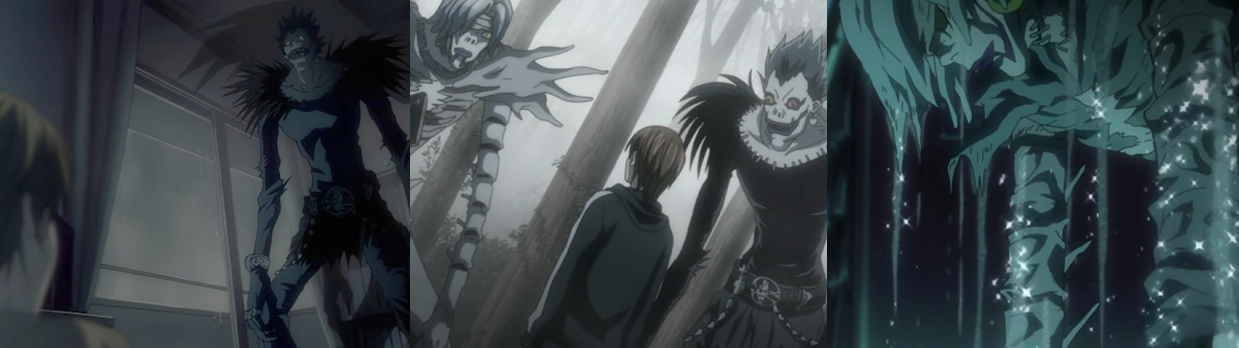
Even the impressive and aloof Shinigami end up subjected to Light’s malicious machinations…

As ever, the most visually impressive and thematically intriguing aspect of Death Note, for me anyway, are the Shinigami; Ryuk appears as a towering, gaunt, gothic figure, never blinking and with a permanent shark’s grin on his face. He observes and comments upon Light’s actions with an unbiased glee, delighting in Light’s murderous actions, and becomes deeply invested in the game of cat-and-mouse between him and L simply because it provides him with a source of amusement for the first time in ages. However, while Ryuk follows Light about, hovering over his shoulder unseen by anyone who hasn’t touched the Death Note, he certainly doesn’t play favourites; he can see the names and life span of others with his Shinigami Eyes but only offers to share this gift in exchange for half Light’s natural life, and rarely offers Light any assistance simply because he finds it amusing to see how Light deals with each obstacle in his path towards Godhood. However, Light coerces the omniscient Shinigami’s assistance in locating the surveillance devices placed throughout his house by threatening to deny Ryuk his beloved apples, which have the same addictive properties to Shinigami as alcohol and cigarettes, showcasing that even a God of Death isn’t beyond Light’s scheming. Ryuk is contrasted by Rem, the skeletal, androgynous (but clearly more recognisably female) Shinigami who has vowed to protect Misa in Gelus’s place. Unlike Ryuk, Rem is far more protective of her Death Note handler; she reluctantly wipes Misa’s memory when she’s held in captivity, threatens to kill Light if he doesn’t find a way to rescue her, actively intervenes to protect her when she infiltrates the Yotsuba Group, and reveals to L and the other officers that Light has been fooling them with fake rules. Rem is horrified both when Misa further shortens her lifespan by dealing with Ryuk and when she realises that Light has manipulated events to take her out of the equation, forcing Rem to kill to keep Misa alive, destroying herself as a result and galvanising Light’s sense of superiority over even the Shinigami.

The intriguing dynamic between Light and L remains despite the special rushing through certain events.

Due to Death Note Relight being comprised of snippets and key moments from the first twenty-six episodes of the anime, there are some issues with the special’s pacing; while I’m familiar with the general story thanks to the live-action films and anyone who’s watched the anime would be able to follow along without much issue, the uninitiated may be put off by how the special breezes through certain aspects of the story, jumping from beat to beat to recap the most narratively important aspects of the anime. Consequently, there’s a disconnect regarding Light’s character, for example; we don’t really get to see him before he acquires the Death Note, which means he appears far more malevolent and self-centered rather than tragic and morally corrupt. A lot of L’s initial mystery is quickly swept aside when Ryuzaki reveals himself so he can work more effectively with Soichiro’s task force, and even Misa’s introduction feels a little rushed considering how important she is to the second half of the story. Regardless, the essential intrigue of Light’s descent into egomaniacal obsession and his tense back and forth with L remain in Death Note Relight; both know so much about each other and yet so little, specifically their true identities, either of which would result in ultimate victory for the other. Light gains a significant advantage when he agrees to team with Misa, but his attempts to manipulate events so he can discover L’s real name are compounded by L’s suspicions about him, which means Light can’t just arrange L’s death without incriminating himself, and L’s incarceration of Misa since she’s far less adept at covering her tracks than Light.
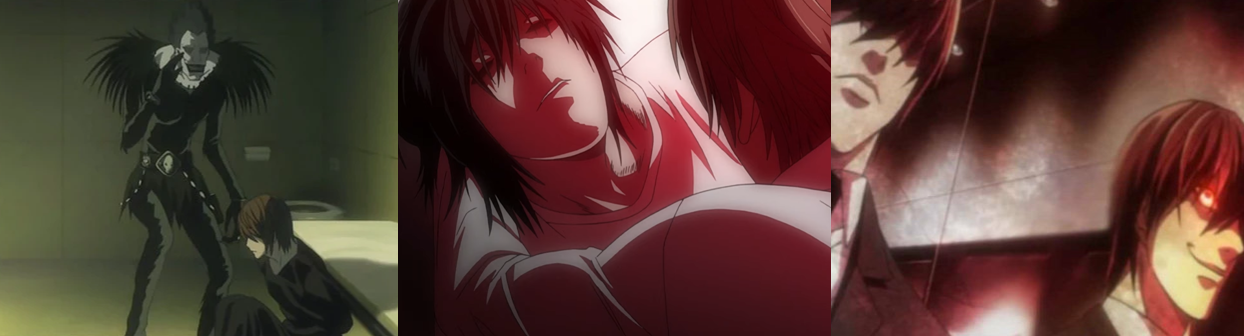
Light’s manipulations put him on track to becoming the God of the new world.

This would spell victory for L if Misa didn’t willingly forfeit her ownership and memories of the Death Note in order to protect Light; however, L is baffled when Light willingly allows himself to be incarcerated and briefly succumbs to despair after his deductions seem incorrect. When Light suddenly changes his demeanour after giving up his own memories as part of a complex plot to manipulate events in his favour, a brief scuffle breaks out between the two that ends with Light being chained to L and uncovering a link between Kira and the Yotsuba Group, which has profited from the killings perpetrated by Light’s patsy, Kyosuke Higuchi (Andrew Kavadas). Higuchi plots to use the Death Note to take over Yotsuba and coerce Misa into marrying him and, when he’s apprehended following an action-packed car chase, L and the others finally learn about the Death Note and the presence of the Shinigami. L is so stunned by this that he completely misses that Light has undergone another dramatic change after reacquiring the Death Note; regaining all of his memories, Light revels in his victory and intellectual superiority, though his plot to murder L stumbles when Misa’s unable to recall L’s true name, forcing her to reduce her lifespan even further to earn Light’s love and respect. Just as L attempts to test the rules of the Death Note, he’s aghast when Watari suddenly dies of a heart attack and all their data is deleted thanks to Rem, who sacrificed her existence to ensure Misa’s safety. Rem also writes L’s name in the Death Note, killing the eccentric and tragic detective and awarding Light ultimate victory. Light plays the part of an enraged, grieving victim well but, once the mourners disperse from L’s grave, Light descends into maniacal laughter; he boasts of his triumph and superiority over his rival and promises to entertain Ryuk further with the creation of his new world. The special comes to an end with Ryuk ruminating over Light’s perceived Godhood and wishing the unnamed Shinigami well in his search for excitement on Earth after all his experiences with Light.

The Summary:
As I mentioned at the beginning of this review, I just don’t have the time or motivation to sit down and watch every episode of the Death Note anime, especially if I was to put together an in-depth review. So, for me, Death Note Relight 1: Visions of a God is a fantastic way to experience the general sense of the anime’s story in a relatively painless two hour stint. I make this distinction only because it can’t be denied that the story suffers a bit from the re-edit; if I were to go into this completely blind, I might find some of the characters a bit one-dimensional, the lore of the world a little undercooked, and the pacing a bit suspect as the story jumps between a series of barely-connected events without much cohesion. However, I am initiated so this isn’t a massive issue for me and all the things I love about Death Note are here, from Light’s unbearable smugness, L’s quirky demeanour, and the always impressive Shinigami. The moral implications of the Death Note and Kira’s actions aren’t delved into too deeply (he’s simply seen as a murderer who needs to be stopped, regardless of who he’s targeting), robbing Visions of a God of some of Death Note’s normal nuance, but the character study and dynamic between Light and L is still fascinating to watch. The sequences are all gorgeously animated as well, with fantastic use of atmosphere and a hard rock soundtrack to give even tense dialogue a bit of a punch, and it ends on a cliff-hanger that’s just enticing enough to encourage a watch of the second part. Overall, I think there’s a lot to like here for die-hard and casual Death Note fans alike but Visions of a God is a must-have for anyone who’s a fan of the series but doesn’t want to waste an entire weekend binge-watching the anime.

My Rating:

Rating: 4 out of 5.

Great Stuff

What did you think to Death Note Relight 1: Visions of a God? Did you think it was a bit pointless considering the entire story was told in the anime series or did you enjoy the condensed story? What did you think to Light, his campaign against crime, and his tense rivalry with L? Which of the Shinigami is your favourite and how would you use a Death Note? What was your introduction to anime and how are you celebrating National Anime Day today? Whatever your thoughts on Death Note, or anime in general, feel free to share them in the comments or on my social media.

Movie Night: Death Note 2: The Last Name

Released: 3 November 2006
Director: Shūsuke Kaneko
Distributor:
Warner Bros. Pictures
Budget: $20 million (estimated)
Stars:
Tatsuya Fujiwara, Kenichi Matsuyama, Erika Toda, Takeshi Kaga, Nana Katase, Shidou Nakamura, and Shinnosuke Ikehata

The Plot:
The battle of wits and wills between Light Yagami (Fujiwara) and the eccentric “L” (Matsuyama) is taken to the next level with Light joins a task force dedicated to stopping the murderous “Kira” but his delicate plot to advance his career as judge, jury, and execution with his mysterious Death Note is threatened when another killer notebook and Shinigami enter the playing field.

The Background:
Between 1 December 2003 and 15 May 2006, author Tsugumi Ohba and artist Takeshi Obata’s Death Note (or “DEATH NOTE” as it is stylised) was published in the pages of Weekly Shōnen Jump. Originating as a broad concept that saw Ohba visualising the panels in his downtime and Obata incorporating pacing and action into them, Death Note was incredibly successful and widely praised for its art, complex characters, and elaborate twists and turns. This popularity soon translated into an equally well-regarded anime that originally aired between 3 October 2006 and 26 June 2007 and was accompanied by two feature-length specials retelling the story with new footage in late-2007 and 2008, respectively. Director Shūsuke Kaneko didn’t take this task of creating a live-action adaptation lightly; he gambled on filming not one, but two movies back-to-back just to do the source material justice, and insisted on using computer effects to bring the Shinigami to life, which this time included the less mischievous and more good-natured Rem (Ikehata). Like its predecessor, Death Note 2: The Last Name topped the Japanese box office and received a limited overseas release, but far exceeded the first film’s box office with its worldwide gross of over $54 million. Critically, the film also performed notably better; reviews praised it as being stronger, delving much deeper into the characters, and greatly expanding the tension and intrigue between the two main characters. A somewhat divisive L-centric spin-off followed the film’s success, which later received a more direct miniseries and follow-up film in 2016 that also garnered mixed reactions.

The Review:
So, as mentioned in my review of the first film, I haven’t actually watched the original anime or read the Death Note manga, despite being tempted on many occasions to get into both. It’s definitely on my ever-expanding to-do list but, for now, I’m more than happy to call myself a fan of the franchise based on these two live-action adaptations. Again, I’m watching the original Japanese audio version with English subtitles, which isn’t my preferred way of watching Japanese media but it’s ever stunted my enjoyment of the film, and I distinctly remember first watching this sequel back-to-back with the first film years ago when they were included in a late-night double feature. And it’s a good job, too, for as good as Death Note was, it ends of a massive, tantalising cliff-hanger that cries out for further resolution, and much of that film was focused on establishing the rules of the killer notebook, the role of the Shinigami, and the degradation of Light Yagami’s morals. Beginning the last film as an intelligent, if overconfident, law student, Light quickly becomes intoxicated with the power of the Death Note; that many in the general public claim his actions as the murderous “Kira” as being the just work of God doesn’t help, and Light’s ego has become so immense that he’s willing to sacrifice friend, lover, and lawmen alike in order to keep himself from being exposed as the “God of the New World”.

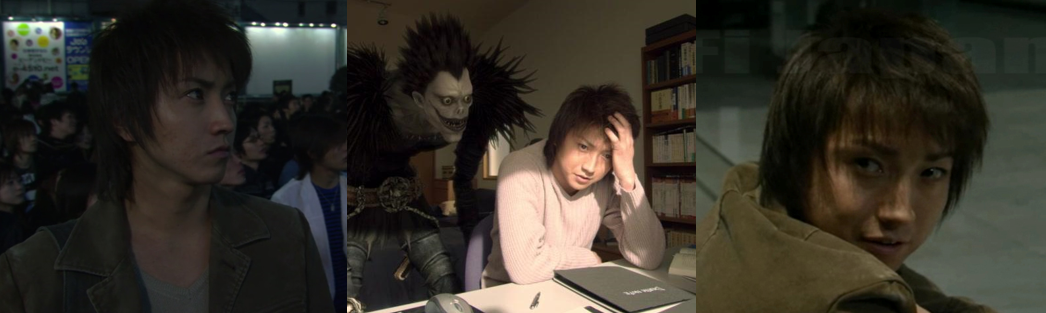
Light is fully prepared to manipulate, and sacrifice, anyone to one-up L.

Death Note 2: The Last Name opens with a quick recap of the previous film and with Light having successfully manipulated events so that his girlfriend, Shiori Akino (Yuu Kashii), was killed in order to gain sympathy from his father, Detective Superintendent Souichirou Yagami (Kaga), and the task force he’s assembled to track Kira down under the supervision of the eccentric, renowned detective, L/ Ryuzaki. Playing the part of a victim of Kira’s brutal wrath, Light joins the team with the express intention of tracking down the man responsible for the deaths of his girlfriend and countless criminals, with none suspecting that he is the true culprit behind the mysterious deaths except for L. L has correctly deduced every piece of the puzzle and has all the evidence he needs, in theory, to pin Kira’s actions onto Light except for concrete proof and an explanation as to how he’s able to kill with just a glance. Because of this, Light is able to give L the run-around and stay one step ahead of him while secretly manipulating events with his Death Note to both take suspicion away from him and to learn L’s true name. Light could learn this simply enough by trading half of his lifespan for the Shinigami eyes, which would let her see the true name and remaining years of anyone he looks at, but e’s determined to usher in his new age and to outwit L with his mind. When another Kira (quickly dubbed “Kira II”) starts issuing threats and killing not just criminals but anyone who even dares publicly speak out against Kira, Light sees an opportunity to realise his goals by manipulating the new Kira to his advantage. So complete is Light’s arrogance that he even goes as far as to manipulate the film’s new Shinigami, Rem (Ikehata), to write new rules into the Death Note to bamboozle the Kira task force, and to surrender both his Death Note (and his memories of his actions as Kira) and himself to a period of isolation all to win L’s trust in order to learn his name and cement himself as the God of the New World.

Both Misa and Kiyomi are determined to continue what they see as Kira’s righteous crusade.

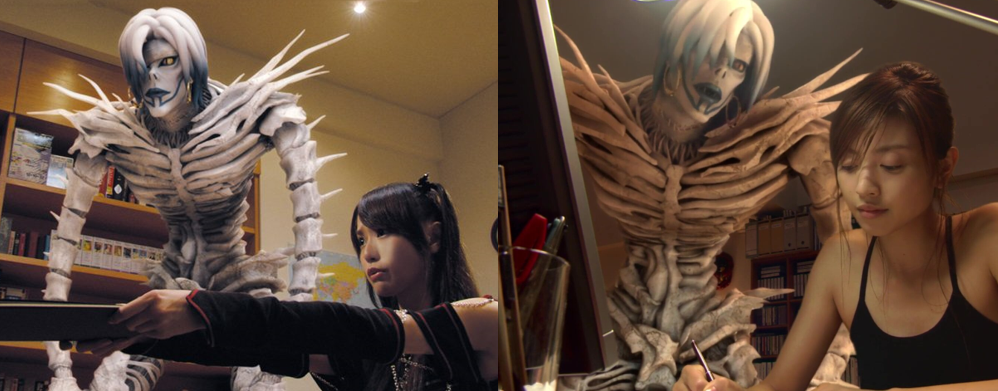
Young celebrity Misa Amane (Toda) is the new Kira in town thanks to acquiring her own Death Note. When she was just a schoolgirl, Misa came home to find her family slaughtered by a sadistic killer and became obsessed with Kira after her family’s killer fell victim to his judgement and she’s only too eager to continue his work, and publicly propose an alliance, as Kira II. While Light primarily targeted criminals, he was known for killing federal agents if they threatened to expose him, but Misa continues his work with a far more brutal flair, felling lawbreakers and lawgivers alike and even killing innocent people just because they speak out against Kira. Thanks to sacrificing half of her lifespan to acquire the Shinigami eyes, Misa is easily able to target and kill anyone and everyone who dares speak out against her hero; the eyes also allow her to deduce Kira’s true identity and seek Light out to forge an alliance, not just as co-Kira’s but also as lovers. Since Misa is absolutely besotted with him, Light is easily able to use her feelings and her naïvety with the Death Note to his advantage; Light agrees to the alliance simply to use Misa’s eyes to learn L’s true name but, sadly, Misa isn’t anywhere near as thorough as Light wen it comes to covering her tracks and ends up captured by L and his task force. With both of them having lost their memories as part of Light’s grand scheme, Misa’s Death Note falls to budding reporter and Kira supporter Kiyomi Takada (Katase); she’s also so pleased to have been chosen as Kira’s “partner” that she trades half her life for the eyes and kills indiscriminately to both continue his work and further her career, but is just as sloppy about covering her tracks and easily apprehended by the unmatched team of Light and L. This allows Light to regain his memories and, in a flash, sacrifice Kiyomi and pin all of Kira’s murders on her in a perfect loop; it also completes the puzzle for L and the task force as they touch the Death Note and become aware of the Shinigami, though this also raises the question of how they’re going to explain that literal Gods of Death and killer notebooks are behind the recent murder spree.

Even with two Shingami to contend with, Light’s main concern is learning L’s true name.

Speaking of which, Ryuk returns, still following Light around and offering commentary, taking amusement in his game of cat-and-mouse with L, and enjoying apples as and when. Thanks to Light having to constantly be on guard and hide his true intentions, Ryuk grows bored and frustrated, and basically disappears for a big chunk of the middle of the film after Light gives up the Death Note and his memories of it. There’s also a new Shinigami on the block, the androgynous Rem; this skeletal, far less mischievous Shinigami is Misa’s constant companion and is watching over her in place of her friend, the diminutive Shinigami Gelus, who had taken a shine to Misa and committed the cardinal sin of protecting her from an obsessive fan with his Death Note, thus dooming himself to oblivion. Unlike the cheeky and outspoken Ryuk, Rem is soft-spoken and fiercely loyal; she vows to punish anyone who threatens Misa and is even forced to turn herself to dust to save Misa’s life after Light manipulates events to put her in danger, which again adds credence to Light’s monstrous nature. The Shinigami are exposed to L and the task force, first through mentions dropped by Kira II, then by observing Kiyomi, and finally after touching the Death Note and conversing with Rem. Interestingly, while Light was stunned by Ryuk’s presence and Misa was awestruck by Rem’s, L initially reacts with a mixture of dear and incredulity. Once he accepts that the Shinigami are real, he’s satisfied that he’s finally wrapped up this strange case, which sees him reluctantly join forces with Light after his nagging suspicions cannot be proven and then subject both Light and Misa to near-torturous isolation in a bid to force a confession rom them. As ever, L’s deductive reasoning is almost supernatural; he’s able to correctly guess everything that’s happening, even without proof, as though he’s read ahead in the script, but even he can’t predict the lengths of Light’s depravity and it costs him dearly when his mentor and father-figure, Watari (Shunji Fujimura), falls victim to the Death Note after Misa is threatened.

The Nitty-Gritty:
Thanks to Light now being officially integrated onto the task force, there are far more face-to-face interactions between him and L this time around. The two play chess, literally and figuratively, against each other, with each throwing out accusations, explanations, and questions in a bid to outwit the other. Even if he couldn’t manipulate life and death with the Death Note, Light is extremely thorough at covering his tracks; he has not only won the support of his father and colleagues thanks to sacrificing Shiori but he has cold hard facts on his side since L cannot pin anything on him, nor explain how he could kill so many so easily as Kira. When Kira II surfaces, Light sees an opportunity to shunt suspicion from him completely and throws himself into the investigation after his sister and father almost fall victim to the new Kira’s wrath. Similarly, he orchestrates events to place Kiyomi into the firing line and, free from his memories of the Death Note, proves himself just as capable a detective as L by cobbling together graphs and data to pinpoint who these new Kiras are. When Light gives up his memories, we see him briefly return to his pre-Death Note character and get a sense of how deeply the book has corrupted his morals and intelligence; for a short time, we see how positive a force he could be, especially when he and L unite against the new Kiras, which only makes his devilish turn back to a callous puppet master all the more harrowing after he regains his memories and is revealed to have manipulate man and Death God alike to his own ends.

Light freely manipulates others, Death Gods, and even himself to outwit L.

The nature of the Death Note and the Shinigami realm is delved into a little more here; as before, the book is filled with rules regarding its use, though Misa and Kiyomi don’t utilise its true potential in the same way that Light did and are content to simply jot down names and cause their victims to die from heart attacks. We get to briefly see the Shinigami world, a desolate realm where the Gods of Death watch humans and live off the years of those they write in their notebooks. The Shinigami cannot use their Death Notes to prolong lives, however, and doing so causes them to turn to sand, as it does to Gelus and, eventually, Rem. As in the first film, the world is dividing in their opinion of Kira. Well, not quite divided, as Kiyomi’s research shows; not only does a sizable percentage of the country support Kira, prominent members of the government have also taken to praising the murderous vigilante. Even Kira’s strongest supporters are shocked, however, when they witness his brand of justice first-hand and when Kira II effectively holds a news station hostage to both deliver a warning to any who would dare oppose Kira in any way and to broadcast a series of live executions. Thankfully, Misa is so besotted with Light that she not only agrees to follow his every order and to kill anyone he asks but she also gives her Death Note to him in order to win his trust. Realising that he can use her to learn L’s new, Light reluctantly agrees to enter a relationship and partnership with her, though he cares little for her or the fact that she’s sacrificed half her life for him (she’s so devoted to Light that she does this again after regaining her memories since she’s forgotten L’s true name and lost the Shinigami eyes when she gave up her Death Note). When Misa resumes her killing spree, she immediately makes herself a target once more and, when the shrewd L is able to figure out that Kira has added fake rules to the Death Note, Light is forced to take even more extreme measures in order to protect himself, remembering his true callous nature and even writing his own father’s name in the Death Note.

In the end, Light is outsmarted but it’s a hollow victory for the doomed L.

Light’s obsession and delusions come full circle by the finale. He fully believes he’s a God now, and it’s hard to deny it given how he’s able to puppet people around with the Death Note, but he ultimately falls victim to his own arrogance and having vastly underestimated L’s deductive abilities. L tricks Light with a fake Death Note, and even fakes his own death at Light’s hands in order to learn the horrifying truth behind his duel identity, all to bring Light into the…well, the light… and expose him. With Light having hidden a piece of the Death Note in his watch and jotting down names with his own blood as and when people threaten to expose him, the game of one-upmanship between him and L escalates to the point where L is forced to his own name in the Death Note in order to circumnavigate his murder at a Kira’s hands and confront Light alongside a shame-filled Souichirou. Held at gunpoint and with nowhere left to run and no excuses left, Light refuses to bow acknowledge L’s intellectual superiority and spits criticism of his father’s broken system and the failure of the law to match the impact he had as Kira. After all his machinations and desperate attempts to cover his tracks, Light’s true nature as a reprehensible, egotistical, power-mad killer rise to the surface during this dramatic finale, which sees his sneaky watch destroyed and leaves him with a bullet in his leg. Raving about his destiny to be the saviour of a new, crime-free world, Light is so convinced of his superiority and Godhood that he outright demands that Ryuk kill everyone present and bend to his will and, in doing so, seals his fate. While the Shinigami will die if they protect humans, they are able to take lives using the Death Note and, similar to how Ryuk despaired of Light’s lack of humanity and compassion at the end of the last film, the Shinigami is somewhat disgusted to see the once intelligent and adaptable Light reduced to begging for supernatural help and writes his name instead. As Light enters his death throes and spits declarations of his he’ll be remembered as a hero, Ryuk solemnly informs him that Death Note users are doomed to limbo rather than going to Heaven or Hell. Sadly, there’s no way to save L; having arranged for his peaceful death, L quietly passes away a few days later after expressing his gratitude and appreciation to Souichirou. Though Souichirou condemns his son’s actions, the official word is that he died by Kira’s hands and that Kira’s reign of terror is finally over, leaving Light’s family mourning their loss, Misa with no memory of her love or the Death Note, and the cackling Ryuk free to cause further havoc as he sees fit.

The Summary:
It’s honestly a little tough for me to pick with is the better film between Death Note and Death Note 2: The Last Name. The first is maybe a little more cerebral in its focus on showing how the Death Note twists Light into this cruel and arrogant murderer, while the sequel is full of twists and turns and an escalating cat-and-mouse between L and Light. Ultimately, I’d highly advise watching both back-to-back as they’re clearly intended to be two parts of a larger whole. While the first film includes more variety in the use of the Death Note, the second really shows just how adapt Light is with the notebook since his would-be successors are sloppy and unimaginative. Both Misa and Kiyomi use the Death Note indiscriminately, lacking even Light’s skewed moral code, and think only in the short-term, giving up half their lives simply because it’s easier to use the Shinigami eyes than to figure out other ways of targeting and killing their victims. I enjoyed the addition of Rem and the brief glimpse into the Shinigami realm and life; she and Ryuk remain a captivating and visual highlight and its fun seeing the differences between the two, with Rem being more stoic and sombre and Ryuk being this cackling maniac at times. The true draw of the film is the intense back and forth between Light and L; it’s maddening seeing that L has figured everything out except for the means and I enjoyed seeing the strange friendship between the two, which is made all the more awkward as L is so peculiar and never truly gives up his suspicions about Light. The two are constantly one-upping each other, with Light seeming to be one step ahead of everyone, but seeing L sacrifice his own life in order to expose Light and watching Light descending into raving vitriol was a truly cathartic moment. While Light may have had a point about the unjust legal system, his superiority complex and sheer lack of empathy ultimately made him no better than his successors and worse than a literal Death God. This results in him become a tragic anti-hero of sorts who fully deserves to be brought down, but there’s little celebration surrounding Light’s death and, indeed, the film ends with the suggestion that Kira’s death has cause crime to increase once more, leaving the moral ambiguity of his actions up for debate.

My Rating:

Rating: 4 out of 5.

Great Stuff

What did you think to Death Note 2: The Last Name? If you’re a fan of the anime or manga, how did it work as an adaptation for you? What did you think to the changes made to the source material? What did you think to the new Kiras and how they differed from Light? Were you a fan of the cat-and-mouse game between Light and L? What did you think to Rem and Ryuk and the way they were manipulated by Light? How would you use a Death Note? Whatever your thoughts on Death Note, feel free to share them in the comments or on my social media.

Movie Night: Death Note (2006)

Released: 17 June 2006
Director: Shūsuke Kaneko
Distributor:
Warner Bros. Pictures
Budget: $20 million (estimated)
Stars:
Tatsuya Fujiwara, Kenichi Matsuyama, Yuu Kashii, Asaka Seto, Takeshi Kaga, and Shidou Nakamura

The Plot:
A battle between the world’s two greatest minds begins when Light Yagami (Fujiwara) finds the Death Note, a notebook with the power to kill, and decides to rid the world of criminals. Advised by the Shinigami, Ryuk (Nakamura), Light’s crusade to bring his own brand of justice to the world soon brings him into a game of cat and mouse with an eccentric detective known as “L” (Matsuyama).

The Background:
Death Note (or “DEATH NOTE” as it is stylised) began life as a manga created by author Tsugumi Ohba and illustrated by Takeshi Obata; starting out as a very broad and basic concept regarding Shinigami and strict rules, Ohba and Obata developed a system whereby both of them would draft and storyboards alongside their editor. Ohba would visualise the panels during his downtime and Obata would incorporate pacing and action into them, and was afforded a great deal of creative license when it came to his artwork. Originally published in Weekly Shōnen Jump between 1 December 2003 and 15 May 2006, Death Note was incredibly successful and widely praised for its art, compelling characters, and elaborate twists and turns. So popular was Death Note that was adapted into an equally well-regarded thirty-seven episode anime between 3 October 2006 and 26 June 2007, which received two feature-length specials retelling the anime’s story with new footage in late-2007 and 2008, respectively. Considering how popular both the manga and the anime are, it was perhaps inevitable that a live-action adaptation would follow; director Shūsuke Kaneko didn’t take this task lightly and even gambled on filming two movies back-to-back just to try and do the source material justice. To bring the Shinigami Ryuk to life, Kaneko chose to utilise computer effects so that audiences would be into him being a fantastical and artificial character, though insisted that the animators at Digital Frontier create him as though he were a man in a suit. After topping the Japanese box office, Death Note received a brief cinema release overseas alongside both subtitled and dubbed versions of the film, and eventually made over $31 million at the box office. The film was relatively well regarded by critics, with reviews praising it as a tense thriller and faithful adaptation and placing specific emphasis on the interplay between Light and L. The film was followed by a sequel, just as Kaneko intended, that proved to be even more successful and spawned not only a somewhat divisive L-centric spin-off but also a miniseries and follow-up film in 2016 that also garnered mixed reactions.

The Review:
So, I have to preface this review by saying that, as of this writing, I haven’t actually read the original Death Note manga or watched the anime series; I’ve been meaning to, but never seem to be able to find the time for either, which is a bit of a shame as I really dig the concept and the characters. Death Note (as in, this movie) was my introduction to the franchise; I remember it and its sequel randomly being on Film4, I believe it was, years and years ago when I was taking my undergraduate studies and I stayed up later then usual to watc  h them purely on the strength of the brief screen time Ryuk received in the promos. I was intrigued and have been a big fan of the franchise since…and I hope to one day get around to checking out the original source material. The second thing to note is that I’m watching the original Japanese audio with English subtitles; apparently, there is a dubbed version out there (and, honestly, I would prefer that) but that’s not included in my box set. The film is initially framed as a bit of a mystery, and out of sequence, showing the names of the Death Note’s victims onscreen before they collapse from a fatal heart attack before a gaggle of stunned onlookers, including the police, the press, and everyday civilians.

Disillusioned by the judicial system, Light judges those he deems guilty with the accursed Death Note.

The film follows university student Light Yagama, a young prodigy wo dreams of joining Japan’s National Police Agency and working alongside his father, Detective Superintendent Souichirou Yagami (Kaga). A highly intelligent young man, Light is something of a brash youth who believes he’s smart enough to justify skipping years of on-the-job experience and intuition. Strongly opposed to criminals and in favour of swift, uncompromising justice, Light hacks into the police database and is disheartened to see criminals slip through what he perceives as a broken system, one that he can strengthen and make more efficient. The Death Note gives him the power to do that; initially afraid of Ryuk and sceptical, he tests the books’ power and is stunned at first but soon gets into the habit of offing known criminals. Light’s crusade doesn’t simply stop at murders and rapists; he judges anyone and everyone for their crimes and targets corrupt politicians and, eventually, anyone who threatens to get in his way or expose him. Once the deaths become a regular thing, the press and public have a field day; dubbing the one responsible “Kira” (a Japanese approximation of the word “killer”), cults and online followings start to crop up praising Kira for doing God’s work and punishing the wicked, seeing him as a saviour and begging him to punish more evildoers. This goes both ways, though, as there are also those who see Kira as being just as bad, if not worse, than those he targets but his impact is widespread; bullies stop harassing students and wrongdoers are scared shitless, but even those who “praise” Kira are stunned when the vigilante force strikes down those who dare speak up against him in public. Without a doubt, the power of the Death Note and the fanatical nature of Kira’s followers inflates Light’s ego to breaking point; he sees himself as the saviour of the world, the divine hand of God, and as the only one capable of brining peace, order, and justice to an increasingly unfair world. For all his lofty talk, however, Light has a selfish, vindictive side to him that skews much of good his killings may do; he hopes to use the crisis as a means to fast track his appointment to the National Police Agency and goes to any means necessary to ensure he’s positioned as the only one capable of stopping the mysterious Kira.

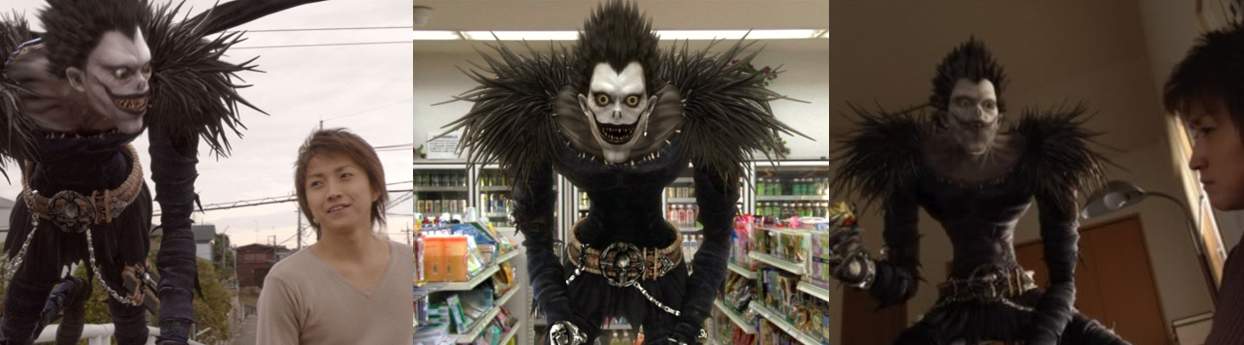
The demonic Ryuk observes Light’s killing spree with mild amusement and curiosity.

Light’s constant companion on his descent into madness is Ryuk, a demonic Shinigami with a taste of apples and a mischievous nature. Having grown bored in the Shinigami realm, he drops the Death Note into the human world in hopes of some entertainment; the book itself contains instructions, purposely written in English as that’s the most common language on Earth, and a series of rules that dictate how the book works. Any name written in it will suffer a fatal heart attack within forty seconds unless the writer states otherwise; the writer must picture their victim when writing their name so as not to target those that share the same name, and the book’s power is virtually unlimited. Light spends great deal of time testing the limits and rules of the book (and wasting entire pages on just a few names), witnessing its effects first-hand and eventually detailing more complicated instructions, essentially playing God and manipulating those who would root him out or opposing him into bending to his will. Ryuk is, for the most part, nonplussed by all of this. Invisible to anyone who hasn’t touched the book (unless Light wishes another to see them), Ryuk is similarly incorporeal and is driven only to find some amusement; he makes no effort to assist in any way Light, preferring to remain neutral and throwing temper tantrums when Light ignores him and stops giving him apples to avoid suspicion. ; he offers commentary and is curious about Light’s motives and intentions, but is content to simply let events play out as they do. However, Light is able to manipulate even Ryuk into assisting him by denying him attention and apples unless he helps him locate the surveillance devices placed in his room and spot when people are following him. Ryuk exists by taking the years the Death Note’s victims would have lived were it not for their untimely deaths. Furthermore, if requested, the holder of the Death Note can also dramatically cut their lifespan in order to receive the Shinigami eyes, which allow them to perceive the world as Ryuk does and thus see the real name and lifespan of those around them, and they can also choose to cast away the book, which will cause them to lose all memory of it, though the power and allure of the Death Note prove as enticing and irresistible to Light as apples are to Ryuk.

Stumped by Kira’s mystery, the cops turn to the eccentric L, while Naomi conducts her own investigation.

Souichirou and his team work tireless to solve the mystery of Kira; Souichirou is (somehow) convinced that a singular individual is behind all the killings and his team pledge their unfaltering support to his efforts to bring Kira to justice. However, after hitting a wall in their investigation, they have no alternative but to turn to the mysterious, world-renowned detective known only as “L”. Initially, L contacts them through his assistant and father-figure, Watari (Shunji Fujimura), and appears as little more than a distorted voice on a laptop but turns out to actually a highly intelligent, if socially inept and quirky, young man named Ryûzaki, L’s powers of deduction border on the supernatural; he correctly surmises that Kira’s killings are the result of some malicious intent rather than mere coincidences, though is unable to figure out the cause of the murders since even he has no reason to believe that the Shinigami are real. An eccentric figure always seen sitting in odd positions and snacking on desserts or drinking sugary drinks, never blinking, and his mind constantly pondering the mystery of Kira, L produces complex charts and data to prove his theories that Kira is a single individual rather than a virus, and narrow down that he’s likely to be a university student judging by the time of the unexplained deaths. L also brings in agents from the Federal Bureau of Investigation (FBI); Light is annoyed to find agent Raye Iwamatsu (Shigeki Hosokawa) following him but this is where he really starts to get creative with the Death Note. Ralising that Raye can’t be the only FBI agent assigned to the Kira case, Light uses the Death Note to have him doom his colleagues by writing their name on pages of the book, thereby showing that his quest to usher in a new world now includes murdering even those who would uphold the law if they threaten his work. After witnessing his death, Raye’s fiancée, Naomi Misora (Seto), a former associate of L’s, is left devastated. She undertakes her own investigation and easily singles out and accuses Light using a false name as part of her quest for revenge against the man responsible for her beloved’s death. Kira’s impact on the world is staggering; far more people support his brutal methods than they do oppose them, but those that are against the wholesale murder of any and all criminals make valid points regarding due process and false accusations. One of the principal anti-Kira crowd is also Light’s girlfriend, Shiori Akino (Yuu Kashii), who dreams of being distract attorney and cannot sanction Kira’s particular brand of justice or Light’s support of him. Despite this, Light believes that she would understand that he was acting for the greater good and a higher cause and taking the action no one else could, so confident is he in his appeal and her love for him.

The Nitty-Gritty:
A principal theme in Death Note is that of obsession; once he sees the cult following building around Kira, Light becomes convinced that he’s at the forefront of a fundamental change in the history not just of Japan, but the entire world. Seeing himself as the God of Justice and fully believing that he’s the saviour the world needs, Light dreams of a world without crime, where the guilty and the evil are punished instantly and without compromise, and is so blinkered by his vision for this new world that he never even stops of consider the moral ramifications of his actions. Instead, he simply punishes those he deems guilty without hesitation but he more than meets his match in L; since L doesn’t know about the Death Note of the Shinigami, he’s somewhat on the backfoot when it comes t his adversary, but they’re actually on equal ground as Light is unable to simply strike L down because he doesn’t know the eccentric detective’s real name and doesn’t want to sacrifice his lifespan to learn it. L is able to use this to his advantage, sacrificing a death row convict, “Lind L. Taylor” (Matt Lagan), to learn more about Kira’s capabilities, a cold-blooded tactic that Souichirou cannot condone but he and his team are so baffled by Kira’s killings that they have no choice but to put their faith in the unorthodox L. Light’s reaction to L outsmarting him is outright insult; he’s clearly not used to being outsmarted or made a fool of, so he makes it his mission to figure out L’s true identity and prove his intellectual superiority, which thus becomes his new obsession throughout the film.

Light and L embark on a game of cat-and-mouse to try and expose each other.

Thus, a cat-and-mouse game between the two ensues; since Souichirou refuses to allow Light to get in one the case, seeing it as both a personal challenge and too dangerous for his smart but headstrong son, and Light is forced to alter his methods after L figures out that his killings align with his class schedule. After the FBI agents are killed, Souichirou loses the vast majority of his investigation team as many leave to protect themselves and their families and he all-but demands that L reveal himself since, up until that point, he’s remained safely hidden. Watari takes the remaining group to L’s hotel room and the unusual stealth forbids them from openly revealing their names going forward and shares his deductions about Kira’s ability to manipulate life and death, which are so on the money that he may as well have read the script. Through sheer reasoning, L figures out that Kira is someone who doesn’t like to lose, is immature, and who can dictate the time, place, and way a person dies as well as needing to know that person’s name and face; indeed, he knows everything but the who and how, which continue to elude him throughout the film. In this regard, the two are very similar; L is also quite immature and persistent, and Light would very much like to put an end t his rival but cannot without getting close enough to him to learn his real name. after narrowing down his chief suspects to Souichirou’s team and family, L has them isolate in the hotel room and places bugs and camera sin their homes to monitor their families, but Light is shrewd enough to not only discover this but also continue to murder as Kira using a miniature television hidden in a big bag of crisps. Like Naomi, L is convinced that Light is Kira and insists on monitoring him to prove that theory, even after there’s no evidence to support it; it’s intriguing to see everyone so close to nailing their man and yet lacking the crucial proof to pin him to the wall, and Light delights in outsmarting them all, even his father, at every turn.

Ultimately, Light proves a reprehensible monster who sacrifices his girlfriend to clear his name.

While Ryuk can appear overly cartoony at times, he’s an otherworldly being designed to be out of proportion and extreme in his movements and appearance. With his wide, manic eyes, devilish smile, and gothic attire, he certainly cuts an iconic figure, especially when flying about on his bat wings, and a big part of Death Note’s appeal for me is his appearance and the allure behind him and his kind. The other appealing factor is the battle of wits between Light and L; both are morally skewed individuals, willing to put others at risk to prove a point and succeed in their game, but only Light is willing to manipulate and sacrifice those nearest to him to get what he wants. At first, it seems as though the grief-stricken Naomi has taken Shiori hostage in order to force a confession from Light; L watches, fixated on figuring out how Light has been killing people as Kira, but Light pleads with Naomi and is left distraught when Shiori is short and killed while trying to escape from Naomi! With the police closing in and seeing that she’s killed an innocent girl apparently for no reason, Naomi shoots herself in the head and the anguished Light, seen as a sympathetic and wrong young man, is gratefully accepted by L onto Souichirou’s investigation team. However, Light reveals to the audience (and Ryuk) that he found out Naomi’s true name ahead of time and manipulated everything, forcing her to take a hostage and commit suicide in order to clear him from all suspicion and get his police career on track. Even Ryuk expresses disgust at Light’s lack of empathy and inhumanity after learning that he purposely wrote a companion piece for Shiori, thereby sacrificing her for his own ends, and the film ends not only with Light having degenerated into a old-blooded monster and the hint that L still has his suspicions about him, but also with young celebrity Misa Amane (Erika Toda) being saved from an obsessive fan by the appearance of a second Death Note!

The Summary:
Death Note is quite the oddity; the premise itself is both alluring and ludicrous and the leaps in logic are almost laughable at times. The very idea that L could figure out some kind of connection to a single individual screams of convenience and it almost feels like the narrative would’ve been served slightly better by not revealing that Light was behind all the murders, or quite how he was going about it (maybe paint Ryuk as the killer) until halfway through. However, a great deal of the film’s appeal is seeing Light operate undetected, jotting down names without anyone noticing and amassing this huge following and controversial discussion regarding Kira’s morals and methods, often acting in plain sight. I love how he’s easily whittled down to the top suspect and then has to change his methods and go to extremes to avoid being exposed and give L the run-around, and it’s fun seeing these two infallible and super intelligence individuals clash as they try to one up each other. Ryuk, and the very idea of a killer notebook, is an extremely appealing and interesting anti-hero; more of mischievous sprite than a malicious demon, it’s interesting seeing him follow Light around and question him and watching Light become as monstrous on the inside as Ryuk is on the outside. Death Note’s main hook is the game of cat-and-mouse between Light and L, which here primarily revolves around L desperately trying to prove that Light is Kira and Light outsmarting his rival and manipulating events to get his career and his desire to be the God of the New World underway. In this way, the film really excels; it can be a bit daft and cartoony at times, but for the most part everyone plays it completely straight and it ends up being a pretty tense, fantasy-laced thriller.

My Rating:

Rating: 4 out of 5.

Great Stuff

What did you think to the live-action adaptation of Death Note? If you’re a fan of the anime or manga, how did it work as an adaptation for you? What did you think to the changes made to the source material? Were you a fan of Light’s and where do you fall on the debate about his actions as Kira? What did you think to Ryuk and the concept of a killer notebook? Would you take advantage of such power? What did you think to L and his massive leaps in deductive logic? Whatever your thoughts on Death Note, feel free to share them in the comments or on my social media.