

Released: 5 February 2013
Developer: Visceral Games
Also Available For: PC, PlayStation 3, Xbox One, Xbox Series S/X (Backwards Compatible)
The Plot:
Three years after narrowly surviving a Necromorph outbreak on Saturn’s moon, Titan, former engineer Isaac Clarke and his allies explore the frozen planet Tau Volantis to discover the origins of the Necromorphs and oppose the fanatical Unitologists, who wish to “cleanse” humanity through the Necromorphs.
The Background:
Taking its cue from seminal survivor/horror franchises like Silent Hill (Konami/Various, 1999 to 2012) and Resident Evil (Capcom/Various, 1996 to present), Glen Schofield and his small (but committed team) shook up the genre with Dead Space (EA Redwood Shores, 2008). Highly praised and selling over one million copies, a sequel was greenlit almost immediately. The team worked hard to improve and refine Isaac’s gameplay and character, which was reflected in Dead Space 2’s (Visceral Games, 2011) equally positive reviews. Unfortunately poor sales meant that development of Dead Space 3 was almost cancelled, so the team scrambled to up the focus on action to appeal to a more mainstream audience and increase sales. Halfway into production, the decision was made to incorporate a co-op mode, which required an adjustment of the mechanics and enemy AI to allow for simultaneously two player gameplay. Environments in Dead Space 3 were bigger than ever, resulting in larger locations, new ways to play, and the inclusion of a rappel system to take advantage of the bigger play area. In anticipation of Dead Space 3 being the final game, the developers sought to wrap up Isaac’s story, expanding on both his character and the lore behind the Markers, while also using the new, frozen setting to tweak and refine the Necromorph designs. Consistent with its predecessors, Dead Space 3 released to generally positive reviews; reviews praised the action-orientated gameplay, co-op mode, and use of horror. Although sales started strong and the game was bolstered by some downloadable content, Dead Space 3 failed to meet EA’s expectations and tentative ideas for a fourth game were scrapped. Largely considered the worst of the trilogy, Dead Space 3 was criticised for its length and repetitive gameplay, and it is generally regarded as a fall from grace for a once-promising franchise.
Gameplay:
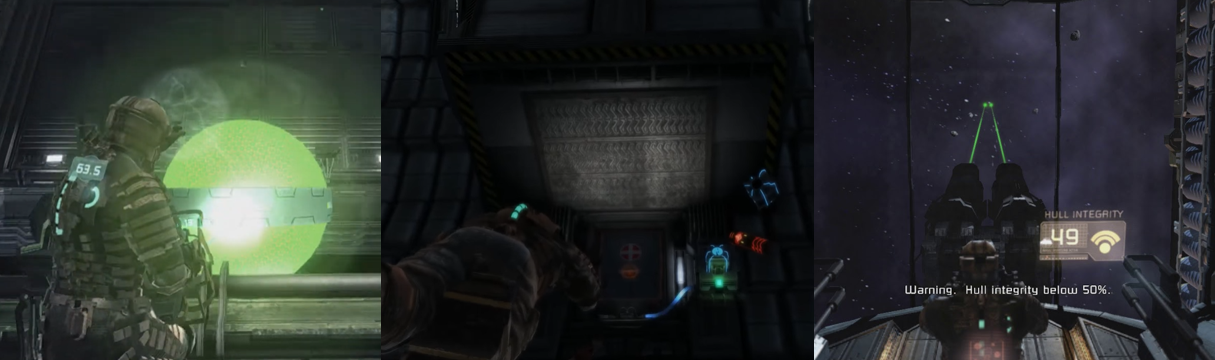
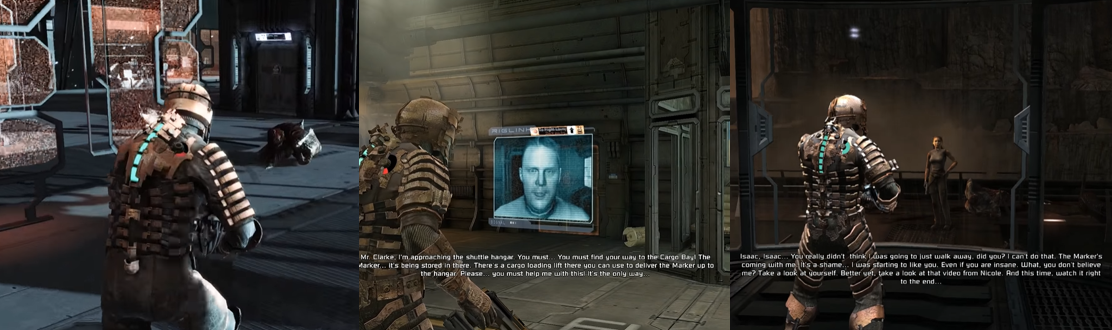
Like its predecessors, Dead Space 3 is a third-person survival/horror game set in the vastness of the cosmos many hundreds of years into the future. You’re once again placed into the role of Isaac Clarke, a former engineer now turned disgraced nobody thanks to the traumatic events of the last two games. This time around, you have a few control options available: you can pick from three control schemes or, if you’re feeling very fancy (or very stupid), you can use the Kinect to play! Obviously, I didn’t do this and went with the default control scheme, which sees you aiming with the Left Trigger, firing or bludgeoning enemies with a melee attack with the Right Trigger, and reloading with X. You can press and hold the Left Bumper to run or tap it for a handy (if occasionally clunky) dodge roll, tap the Right Bumper to stomp on enemies or crates or use your weapon’s secondary fire mode when aiming, and drop a temporary waypoint marker towards your next objective or destination by pressing in the left stick. Pressing in the right stick sees you crouch, which is somewhat handy when you engage in firefights with Unitologist leader Jacob Danik’s forces, and you can quickly replenish your health or stasis meter by pressing B and Y, respectively (as long as you have the associated items in your inventory). A is your action button, used to pick up items, open doors and interact with panels, switches, and such. You also press the left stick to take off and land when in zero gravity environments, where you’ll speed about using the bumpers but must collect air cannisters to avoid suffocating. Eventually, you’ll reacquire the use of your telekinetic abilities: while aiming with LT, you press B to interact with certain doors or objects and move them about, blast them with RB (skewering enemies with their own limbs in the process), or press Y to temporarily freeze enemies or hazards (such as large cogs or crushing weights) so you can pass them or easily decimate them.
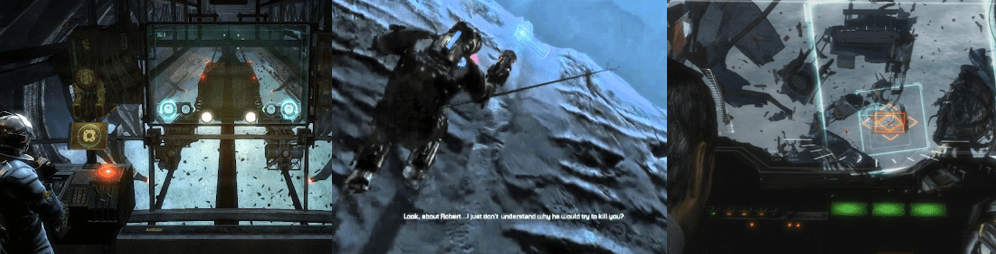
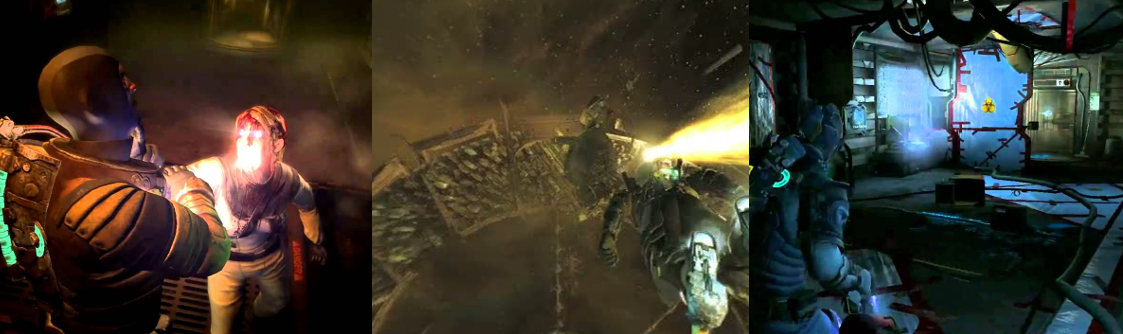
So, overall, the gameplay and controls are as you’d expect from Dead Space. Where Dead Space 3 primarily differs, though, is in the inclusion of a two-player co-op mode. Playing with a friend will require to you switch discs at a certain point, but you can play alone and avoid this option and also won’t have the benefit (or handicap) of an AI-controlled partner to worry about (John Carver appears in cutscenes but not alongside you like in other co-op games). While the option to play online is probably disabled now, you can still play in couch co-op, but I’m not sure how much this impacts the gameplay. There’s a certain hacking puzzle where each player guides a circuit to a certain point and presses A but that’s it, and it’s easily bypassed in single player by using both analogue sticks. There are no other areas where two players need to press switches or activate doors so I barely even noticed it as a function, though a late game objective would benefit from two players as you’d be able to split up and cover more ground. The co-op mode may also explain the abundance of Necromorphs (Feeders are especially abundant and annoying in single-player mode) and resources to be found. Another new aspect is a rappel mechanic where you and your partner zip down (or up) walls, shafts, and inclines, hopping across chasms, avoiding debris and hazards, and picking off Necromorphs. It was an okay mechanic but wore out its welcome pretty quickly and became more aggravating by the third of fourth time I endured it. Zero gravity sections are few and far between this time around, replaced by more open-ended sections set in the vast bleakness of space. You’ll float and fly about retrieving key items and activating doors in these sections, but they’re not as prominent in the previous games. One cool section sees you guiding a shuttle towards a planet as it crashes. You need to stay in the pre-set guidelines, blast at space debris, and even repair the ship’s engines to stay on course, which was quite fun.
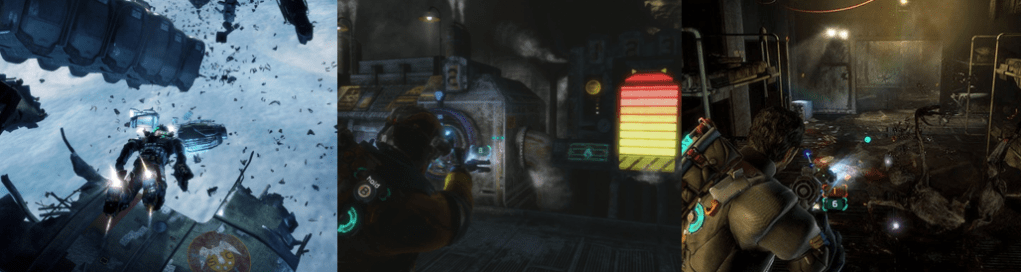
While some familiar Dead Space puzzles return here, they’re also far less prominent than in the previous games. You’ll still be hacking open doors by rotating a cone of light and pressing A on the blue sections, moving batteries to power up lifts and doors, and freezing hazards so you can slip past, but the focus is much more on seemingly never-ending, bloody combat this time around. You’ll make more use of your telekinetic abilities to power up generators and open certain doors, and there are a few puzzles where you use it to move plates into the correct order or awkwardly bend and twist alien architecture to match hieroglyphics or turn large structures to activate power nodes. However, the trickiest parts about these sections are the waves of enemies that’ll burst in the spoil your concentration. Later in the game, you must pay attention to film reels, onscreen prompts, and blood smeared around to activate alien translator devices, and take shuttles to new and previous destinations to explore other areas or take on optional side missions for new loot. You will also frantically tap A or make movements with the analogue sticks to succeed at quick-time events (either during dramatic cutscenes or when enemies grapple with you), and occasionally be forced to explore without your handy compass. Opportunities to use stasis and kinesis in interesting ways are few and far between here; you won’t be freezing bridges or moving about the environment to create new paths all that often. Instead, you search for key items to cobble together at workbenches and insert into something else, diverting power from one system to another to power up lifts or allow you to burn away the Necromorph infestation with a volatile gas, and blasting about through high-speed teleportation tunnels. You can pick from four difficulty modes, each of which increases the aggression of the enemies, and you can use the resources you find from crates, lying about the environments, or pick up from bodies to upgrade your suit and weapons, but you can only carry two weapons at a time and this time you need to craft new ones. I found this to be very aggravating; I wasn’t always able to create new weapons as the resource cost is so high, so I ended up playing most of the game with an upgraded version of the default Plasma Cutter. Furthermore, while it’s fun seeing flares scattered about and revisiting different areas to find new enemies and challenges there, I quickly became frustrated by how often the game simply throws a barrage of enemies at you in place of more intimate encounters and meaningful puzzles.
Graphics and Sound:
Graphically, Dead Space 3 may be the most ambitious of the entire trilogy. While human character models suffer from the same issues that dogged most games of this generation (namely, appearing to be little more than action figures or oddly-rendered puppets pretending to be flesh and blood), the environments, scope, and lighting effects are better than ever. You see this right from the beginning where, in a first for the series, you’re stuck on a frozen ice world and bombarded by snow and limited visibility before running through a gritty, futuristic city that’s ripped right out of Blade Runner (Scott, 1982). Although environments remain cramped and claustrophobic, there’s a grander sense of scale on offer, especially in the zero gravity sections. Far from being confined to scuttled spaceships, you can now blast through the openness of space using your suit’s thrusters and rocket along at blinding speeds thanks to alien technology. The writing and character interactions are also far more dramatic this time around; Isaac is at his lowest, estranged from his love, Ellie Langford, and constantly butting heads with her new lover, Robert Norton. Twists and turns are abundant as the Unitologists infiltrate and brainwash people to their cause, adding greater stakes to the gameplay as you race to rescue or protect Ellie and the other disposable side characters are killed off for dramatic emphasis. I still don’t really like that Isaac is so chatty now, but he’s given a little more weight and characterisation here. He’s not only still struggling with the traumatic influence of the Markers and the previous games, he also has intense rivalries with Norton and Danik and builds a rapport with new character John Carver that makes their poignant decision to stay behind and give their lives to save Elli (and the world) all the more impactful.
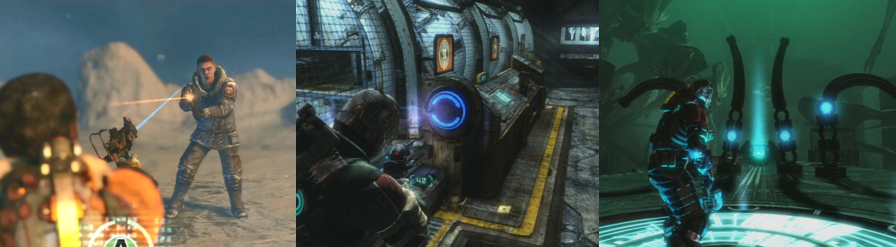
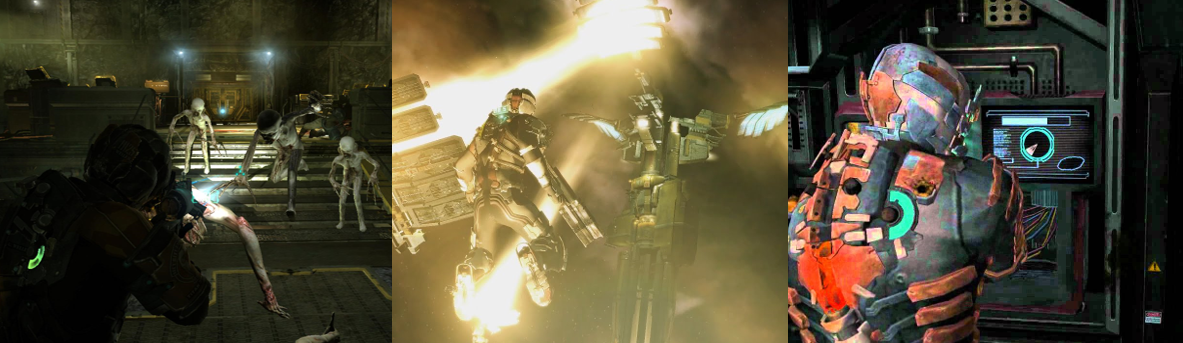
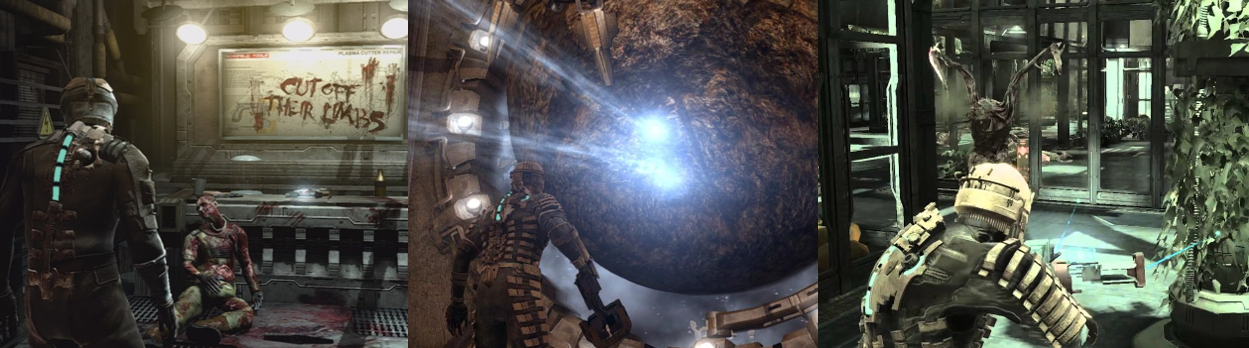
All of this is merely window dressing for what I consider to be the strength of this franchise, and that’s the unsettling, ominous environments you explore. Blood, bodies, and flickering lights all add to the tension, as do the randomly falling grates and corpses, crucified torsos, non-playable characters who commit suicide or are reanimated before your eyes, and the many ominous messages written in blood over the walls and floors. Enemies burst from vents, crawl up through snow, explode to shambling life when infested with parasites, and clamber around walls and over railings to get to you. If you can’t fight them off or get pummelled too much, you’ll be treated to a gory death scene, and body parts will be sent splattered around as you target the Necromorph’s limbs to dispatch them. As ever, Isaac’s meters and ammo are displayed on his suit and weapons rather than a traditional heads-up display, though you can still bring up a live inventory, map, and objective screen and Isaac receives regular incoming video and voice messages from enemies and allies to clog up the screen space. Environments are similar to before, but noticeably different in same areas. You’ve still got dark, confined corridors, barracks, and other areas on spaceships and space stations, but you’ll be in steampunk-like facilities, genetic labs, and Necromorph infested outposts, too. Much of the game is set on a frozen planet, where snow and ice are naturally abundant, and you’re buffeted by snowstorms and crossing crumbling ice caverns. Perhaps the most visually interesting location comes in the final stretch of the game where you’re exploring an alien city, caverns filled with Markers, and a degenerating moon home to a gigantic eldritch abomination that really ups the ante for the finale.
Enemies and Bosses:
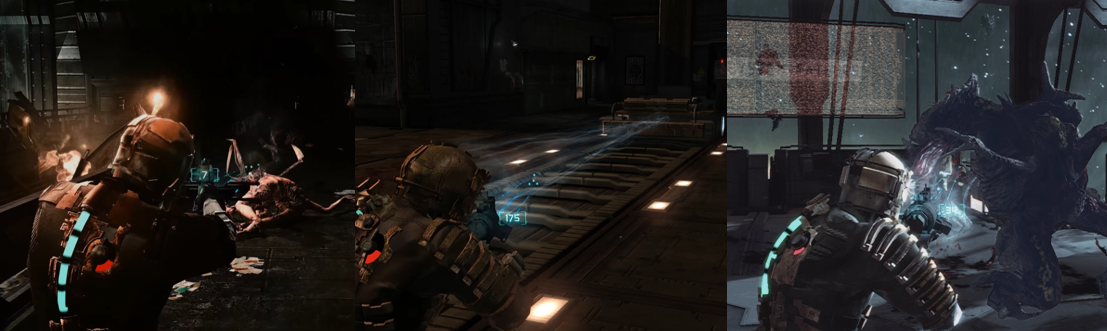
Many familiar Necromorphs return in Dead Space 3. As ever, no matter their appearance or attack pattern, your best bet is to target their limbs, severing their blade-like arms and their legs to slow them down and reduce their threat, though many are more than capable of attacking even without a head or reanimating if you don’t pick off the spider-like parasites infesting them so don’t forget to freeze them with Stasis when in a tight spot. “Slash” Necromorphs burst up from corpses, out of vents, and around corners without warning, leaping at you, slashing, and grabbing you to try and rip your face off, so be sure to keep your distance wherever possible. Only a handful of Necromorphs can fire projectiles, but these can be the trickiest to hit. Small variants scuttle about on walls and ceilings firing from their lashing tentacles, “Pukers” cough up acidic bile to slow you down, and the fatter variants spawn tiny parasites that’ll quickly consume you if you’re not careful. Spider-like parasites can infect corpses, making them zombies who shamble after you with wrenches and frantically blast you with assault rifles. The odd wall-mounted Necromorph also reappears, and you’ll again have the “joys” of encountering “Regenerator” variants who can only be slowed and fled from as there’s no dramatic way of putting them down this time. Mine-like cysts will blow you off your feet, large tentacles will block your path, and the aforementioned “Feeder” variants will swarm all around you from overhead vents. In addition, you’ll also get into firefights with Danik’s troops. These guys take cover, fire assault rifles and laser-guided rockets, and can even toss grenades at you that you can throw back using your Kinesis ability. Luckily, if Necromorphs are about, you can hang back and let the two groups battle it out, thinning their numbers to make your life a lot easier.
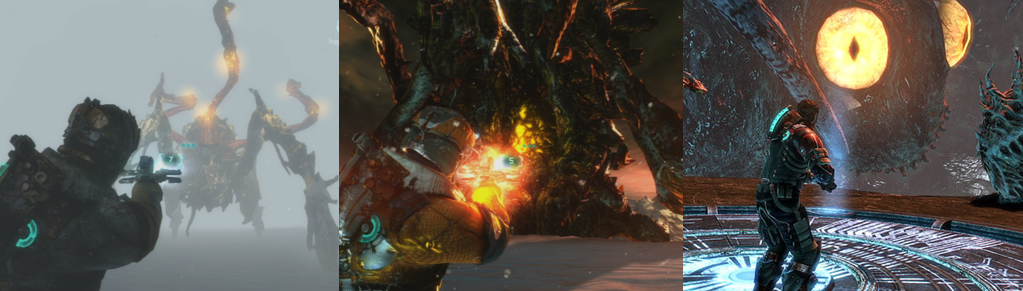
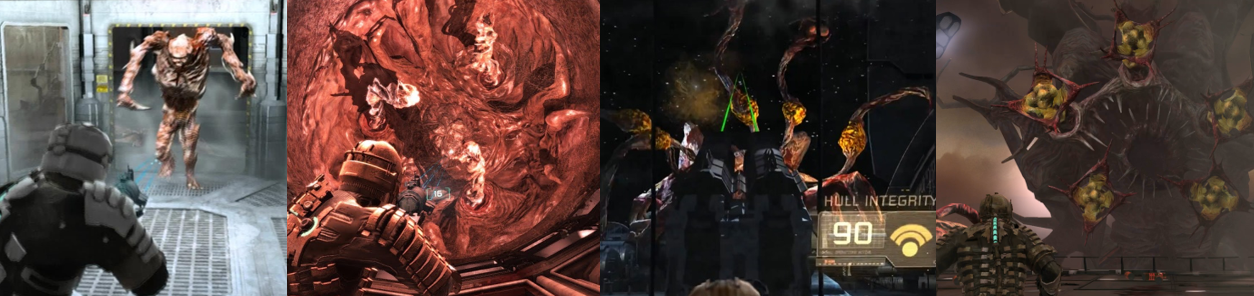
One aspect of Dead Space 3 I was quite disappointed by is the lack of bosses. Bosses have always been a bit of a weak spot in the franchise and Dead Space 3 noticeably suffers from a lack of tangible boss moments. Some Necromorph enemies can be analogous to bosses, such as the ever-annoying Velociraptor-like “Stalkers” who hide behind crates and rocks and charge at you from out of the blue and the large, skeletal Alien Necromorphs that gore you like a rhino. Easily the most persistent boss in the game is the crab-like “Snow Beast”, a gigantic crustacean you’ll battle in three separate locations, with the main strategy repeating each time but with less options for cover and resource replenishment. The Snow Beast lunges at you and tries to squish you with its spiked legs, only being vulnerable after you sever the whipping tentacles on its back and blast at its exposed mouth/underside. Stasis is useful for keeping it at bay but you’ll need to time your dodge roll well to avoid its lumbering attacks. Eventually, you drive it away but it pops back up again later, this time with crates in the way and no opportunities to recharge your meter, and a third time in the middle of a snowstorm where it’s joined by regular Necromorphs. This time, you use Kinesis to activate two generators and then lure it into the path of two harpoon guns that finally tear it apart. Far more visually interesting is the gigantic, Lovecraftian “Nexus” creature. This squid-like thing tries to crush you with its tentacles limbs, spits up Feeders, and tries to suck you into its maw. You must dodge and dispatch these annoyances and blast its tumour-like growths before targeting more globules inside its digestive tract! Finally, you battle the Tau Volantis Moon itself! The very surface crumbles and changes around you as an eldritch nightmare looms overhead, throwing rocks and depositing Necromorphs onto an unstable circular platform. Luckily, there’s a glowing circle here that will super charge your Kinesis and Stasis abilities, allowing you to slow and dismember enemies and launch large blue rocks into the thing’s eyes. Blast its tentacles when it tries to suck you in and repeat this three times, then succeed at a simple quick-time vent and you’ve won the day.
Power-Ups and Bonuses:
It’s hard from me to talk about Dead Space 3’s weapons as I struggled with the system. This time, you start with the standard Plasma Cutter and can add attachments and circuits to increase its stats (damage, reload time, clip size and such), which is fine, but you also use these same resources (alongside blueprints found scattered throughout the game) to craft new weapons. While many can be pre-made from these blueprints(providing you have the resources), others are cobbled together to give a sense of customisation. Unfortunately, the cost to create and upgrade weapons is so high that I often found myself relying on the standard Plasma Cutter. I created a rapid-fire submachine gun and a shotgun variant, but they were so weak that I rarely used them. A flamethrower proved much more reliable but you can also craft weapons that shoot lightning or acid rounds, darts, and explosives. I was pretty disappointed that I didn’t get to experience much of this, however. One of the appeals to games like this is naturally acquiring new weapons, but I found it difficult to craft new ones and their benefits lacklustre compared to upgrading the Plasma Cutter. A big reason for this is that the same resources are used to upgrade your suit. While Isaac gains new suits as the story progresses, you can spend resources upgrading your maximum health and armour, extending the range and recharge time of your kinesis meter, and improving your oxygen supply. It seems to be much more stripped down and barebones this time around, but these benefits are useful as you have limited inventory space for things like health and ammo. When you reach a workbench, you can store items in a safe for later use, which is useful, and this is also where you scavenger bot will deposit more resources after you deploy it. It’s worth taking the time to smash enemy bodies, crates, and explore your surroundings for pick-ups as they’ll frequently drop ammo, health, and resources to upgrade and craft your equipment. Recharge points for your abilities are also common and you can occasionally make use of environmental hazards (drops, explosive barrels, and laser traps) to dispatch enemies.
Additional Features:
There are fifty Achievements to aim for in Dead Space 3, many of which you’ll get from a simple playthrough. You get Achievements for beating the various difficulty levels, for example, dispatching the Snow Beast, crafting a weapon, and retrieving resources from a scavenger bot, all things you’d do without even trying. Some are a bit more obscure, such as shooting a deer head in an office, using the gas to destroy five Cysts, and not taking damage in certain sections. Others are a little more grindy: there are audio and text logs and alien artifacts to be found, blueprints and weapons to collect, and limbs that need to be severed if you want to tick off all the game’s Achievements. You’ll also need to play in co-op mode, use different weapons and melee attacks, and complete all optional missions to get the full 1000G associated with the game. Finishing Dead Space 3 on any difficulty unlocks “New Game”, which allows you to restart with all the upgrades and weapons and such from your last playthrough, access a new suit, and acquire better upgrade parts. If you have a save file from Dead Space 2, you get access to the “Planet Cracker” Plasma Cutter. Finally, if you managed to download the game’s additional content, you can play an epilogue story that comes with eight additional Achievements and sees Isaac and Carver escaping Tau Volantis, battling Dik’s cultists, and learning of an impending Necromorph invasion of Earth!

The Summary:
I’d heard that Dead Space 3 was the weakest of the original trilogy. Nothing specific comes to mind regarding that statement, just a general consensus that it’s not as strong as the first two games. I went into it with this in mind but expecting more of the same and, in many ways, that’s true. Dead Space 3 doesn’t stray too far from the previous formula of exploration, puzzle solving, and Necromorph slicing, but it adds a few wrinkles and changes things around just enough to drag it down a little bit. The crafting system, for one, was a major headache for me. I really didn’t like that I couldn’t swap to different weapons to break up the action as I lacked the resources to craft and/or properly refine the other weapons. It also took a lot of the fun out of the exploration when all you’re rewarded with are parts to cobble together weapons rather than an actual gun. The puzzles were extremely stripped down, and nowhere near as prominent. Sure, sometimes you have less time to hack a console or need to craft something to open a door, but ultimately the game failed to utilise the Stasis and Kinesis abilities in interesting ways compared to the last two games. It’s the same for the zero gravity sections. Yeah, it’s fun flying through space but these are merely distractions from the main gameplay rather than being standout sequences since the game would rather waste your time on frustrating rappel sequences. The lack (and recycling) of bosses hurts the game, too. I like fighting big, monstrous creatures but these encounters were few and far between. It’s also weird to me that you don’t get an AI partner in single-player and the game didn’t lean more into the co-op aspect. I honestly forget John Carver was even there as he only appears in cutscenes and scripted sequences, making you wonder why they bothered with the co-op function at all. Ultimately, there was a lot to like here – the game is as horrific and nerve-shredding as ever – but I can’t help but feel as though something was lacking. The soul, perhaps? I can’t quite put my finger on it but it was definitely a far less enjoyable and much more aggravating experience compared to the first two, which is a shame considering the core gameplay and mechanics are just as appealing.
My Rating:
Pretty Good
Did you enjoy Dead Space 3? How do you think it compares to the previous two games? What did you think to the co-op mechanics and the new rappel gimmick? Were you also disappointed by the lack of boss battles and frustrated by the increased enemy swarms? Were you able to craft some decent weapons or did you also struggle with this system? Did you ever find all those artifacts? Which game in the franchise is your favourite? What horror-theme videogames are you playing this October in anticipation of Halloween? Whatever your thoughts on Dead Space 3, drop a comment below.









 Dr. K's Waiting Room
You must be logged in to post a comment.