

Released: 18 October 2005
Originally Released: 29 October 2004
Director: James Wan
Distributor: Lions Gate Films
Budget: $1 to 1.2 million
Stars: Cary Elwes, Leigh Whannell, Danny Glover, Ken Leung, Michael Emerson, and Tobin Bell
The Plot:
Doctor Lawrence Gordon (Elwes) and voyeur Adam (Whannell) wake up in a dirty bathroom with their feet chain to pipes, the latest captives of the twisted and mysterious “Jigsaw” (Bell) who subjects his victims to deadly “games” to test their commitment to life. With his family at risk, Dr. Gordon has just hours to either kill Adam or use the rusty saw to cut through his foot and escape his fate!
The Background:
After finishing film school, Australian writer/director duo Leigh Whannell and James Wan were desperate to fund a film of their own. Inspired by the unprecedented success of the low-budget Blair Witch Project (Myrick and Sánchez, 1999), the two dreamed up the basic concept that would become Saw: two men chained up in a room with a dead body between them that played out like a mystery thriller. To raise the funds they required, Wan and Whannell shot a seven-minute short, with Whannell in the lead, depicting a man with a modified bear trap strapped to his head, which caught the eye of producer Gregg Hoffman. Hoffman loved the short and agreed to finance it, and give the two creative control and a percentage of the profits, through their production company, Twisted Pictures, and that same short was also enough to convince Cary Elwes to sign on, though a legal dispute saw this relationship deteriorate for the better part of five years. Once Danny Glover was signed on, Tobin Bell jumped at the chance to take part, especially considering the twist ending, and the crew set to work constructing the elaborate, dingy sets. The film was shot very quickly, with little time for rehearsals, which resulted in the Saw’s gritty presentation and rapid cuts, though Wan used this to his advantage to help bolster the editing process. The film’s gruesome death traps became not only a staple of the resulting franchise but helped popularise the “torture porn” sub-genre of horror cinema and caused a great deal of controversy amongst critics. Indeed, although Saw‘s eventual $103.9 million box office made it the most profitable horror film since Scream (Craven, 1996), reviews were mixed; many were put off by the frantic editing and gross-out content, while others praised Saw as a ground-breaking entry in the genre. Regardless, Saw‘s strong opening weekend saw a sequel approved and Saw quickly spiraled into a dense and popular (if divisive) horror franchise, with six sequels released annually between 2005 and 2010 alongside videogames, comic books, other merchandise, and later sequels.
The Review:
I vividly remember the hype for Saw; it was one of the few times I actually visited a film’s website and participated in the viral marketing campaign, which was especially surprising considering that I wasn’t a massive fan of the overly bleak and dreary Seven (Fincher, 1995), which mainly impressed me because of its gruesome kills and twist ending. However, Saw was both heavily advertised as being grittier and nastier than Seven and the trailers had hooked me on the premise alone, so I was all for it and I’m very happy to say that I saw all the Saw movies at the cinema when they first released and became a huge fan of the franchise, despite them getting more and more over the top. The first Saw, though, is decidedly low key; most of the film takes place in one location, a dingy bathroom with a dead body in the middle of it, and focuses on the plight of its two main characters, two men who couldn’t be more different and who find themselves stuck together, chained to pipes, with their only options being death or murder. Of the two, Adam is the first to awaken; after narrowly avoiding drowning, he’s flustered, confused, and aghast to find himself trapped in the dilapidated room alongside Dr. Gordon while the doctor is much calmer and more pragmatic about their situation, at least from the off.
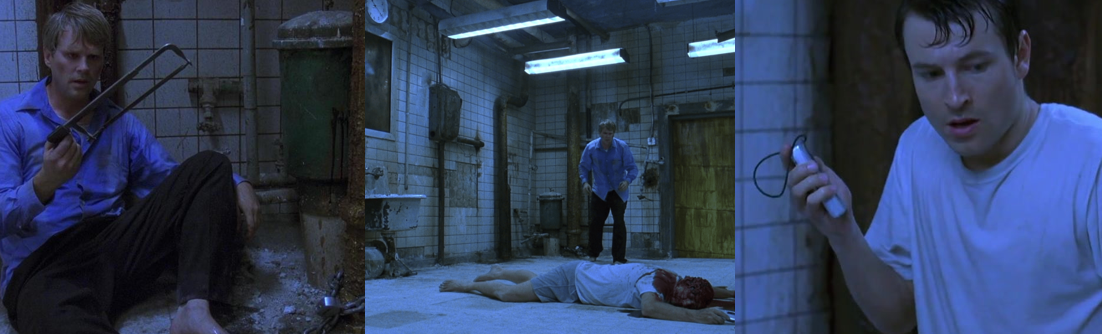
After their initial introductions and trying to get their heads around what’s happening, the two find they each have a microcassette on their person and, with a great deal of difficulty, Adam retrieves the tape player from the suicide victim whose brains are splattered across the bathroom floor. Playing the tapes reveals that the two are the latest victims of a sadistic killer labelled Jigsaw by the tabloids; he challenges Dr. Gordon to a simple game: kill Adam by six o’clock or else his wife and daughter, Alison and Diana (Monica Potter and Makenzie Vega, respectively) will die. Jigsaw also subtly gives the two the option of suicide or even using the hacksaws Adam later finds in the funky water of the toilet cistern to cut through their feet since the chains are too strong. While Adam continues to be horrified by the situation, Dr. Gordon is more than familiar with Jigsaw since he was once a prime suspect in the police investigation into the killer, but his knowledge of Jigsaw fails to alleviate Adam’s anxiety or the mistrust between the two, which only escalates as the film progresses since Adam is a terrible liar (something amazingly conveyed by Whannell’s atrocious acting!) Luckily, Dr. Gordon was cleared of any suspicion, but he witnessed first-hand the lengths Jigsaw goes to test his victims after hearing the testimony of the only known survivor of his games, former drug addict Amanda Young (Shawnee Smith). When Dr. Gordon receives a call from Alison, who’s being held at gunpoint by Jigsaw’s desperate accomplice, Zep Hindle (Emerson), warning him not to trust Adam, a series of flashbacks reveal that Adam was hired to follow Dr. Gordon and photograph his movements, and that Dr. Gordon has been less than faithful in his marriage, which was already strained by his long hours and neglectful tendancies. Once they stop playing coy with each other, Dr. Gordon and Adam actually work quite well to figure out that they’re being watched and come up with ways of trying to get around Jigsaw’s games; unfortunately, their attempts to fool Jigsaw are squandered not just by Adam’s unconvincing attempt to play dead but also because Jigsaw has seemingly prepared for every eventuality and shocks the two with an electrical current running through the pipes they’re chained to.

When the film isn’t following the two captives, either directly in the room or via video feed being observed by Zepp, it’s flashing back to show glimpses of their lives before they were captured; Adam’s are mainly focused on him stalking Dr. Gordon and being abducted by a pig-masked figure, but Dr. Gordon’s show his tumultuous homelife and busy day-to-day working as an oncologist to terminal cancer patients like John Kramer (Bell). This is where he meets Detective David Tapp (Glover) and his partner, Detective Steven Sing (Leung), the cops investigating Jigsaw. Having met with nothing but dead ends and the horrific leftovers of Jigsaw’s victims, save for Amanda’s harrowing story, Tapp believes they’ve finally found their man when one of Dr. Gordon’s penlights is found at Jigsaw’s latest twisted game. Although they’re unable to connect him to the killer in any meaningful way, careful analysis of the tape Jigsaw left for Amanda allows them to deduce his possible location and they’re so gung-ho about catching Jigsaw that they immediately investigate without back-up or a proper search warrant. There, they find a disused warehouse full of traps, Jigsaw’s now-iconic proxy (a puppet named Billy), little models of Jigsaw’s games, and Jeff (Ned Bellamy) strapped to a chair. Although they get the drop on the hooded Jigsaw, they’re left scrambling to keep Jeff from being killed by the drills closing in on his head, which is enough of a distraction for Jigsaw to violently slice Tapp across the throat! When Sing pursues, he accidentally triggers a shotgun trap and is brutally killed, leaving the scarred and traumatised Tapp to descend into near madness. Convinced that Dr. Gordon was their man, Tapp shuts himself away and devotes himself to tracking Lawrence’s every movement, employing Adam to keep tabs on him to try and catch him in the act, but doesn’t hesitate at a chance for revenge when he spots Zepp struggling with Alison in the Gordon home.

Throughout the film, the true identity of Jigsaw is kept a tantalising mystery. When he appears, it’s either via a pre-recorded message (either on a tape recorder or speaking through Billy), under a hood or disturbing pig mask, or simply as an eye since he likes to get up close and personal with each of his victims. The few times we do see Jigsaw in person, he’s characterised as a methodical and eerily intelligent man, one who speaks in riddles and half-truths and challenges everyone, whether they’re his victims or his potential prosecutors, to both think their way out of situations and consider their perspective on life. He openly criticises Adam for living the life of a voyeur, as well as Dr. Gordon’s lack of appreciation for his family, and is seen to be a patient and fastidious man who painstakingly plans out each game to account for every eventuality. However, for much of the film, we’re led to believe that Jigsaw is Zep, a lowly orderly from Dr. Gordon’s hospital; this twist comes fairly early on, when Dr. Gordon recognises him from the various disturbing Polaroids left in his wallet, and from there Zepp is seen unobscured as he toys with Alison and Diana. Yet, while Zepp is clearly seen to be unhinged and dangerous, since he shoots and kills Tapp during their struggle, there’s an ongoing sense that there’s something not quite right; for one thing, Zepp doesn’t sound anything like Jigsaw and he is also constantly showcasing an emotional paranoia about “rules” and the situation that doesn’t fit with Jigsaw’s more patient demeanour. Indeed, despite his tendency to slice a jigsaw piece out of each of his victims (hence the name), Jigsaw openly describes his abject disgust at those who waste their lives and the sickness eating inside of him, thus perfectly laying the seeds for the film’s dramatic finale where it’s proven that Zepp was just another victim of Jigsaw’s depraved games.
The Nitty-Gritty:
If there’s one theme in Saw, it’s of trust. Dr. Gordon and Adam almost instantly distrust each other not just because of their strange situation or Adam clearly trying to cover up his knowledge of Dr. Gordon’s identity and life, but also because of the class divide between them. Adam is a desperate mercenary, of sorts; he lives in squalor job to job, caring little for who pays him or why they want people followed or the lives of the person he’s photographing. In comparison, Dr. Gordon lives very comfortably; he has a nice house, a nice office, and takes his life for granted so much that he’s happy to rest on his laurels and even consider a fling with Carla (Alexandra Chun), one of his interns (though, ironically, he put a stop to the liaison before it could properly get underway right before he was abducted, showing that he was already planning to turn his life around and try harder with his family). There’s a discord between Dr. Gordon and Alison, to the point where she treats him very coldly since she believes he’s lying about his happiness, and Sing’s unwavering trust in Tapp is arguably what leads to his death since he doesn’t stop to question his partner in raiding Jigsaw’s warehouse. This leads me to the second most prominent theme in Saw: obsession. After his injury and Sing’s death, Tapp becomes obsessed with proving Dr. Gordon’s guilt, to the point where he’s fired, divorced, and turns to alcohol and isolation. Tapp’s so consumed by grief and obsession that he’s suffered a mental breakdown and has become obsessed with “closing [the] case”, and it’s this obsession that drives him not just to intervene when Zepp tries to kill Alison and Diana but also to pursue him to the bathroom, where he’s shot and killed in a brief struggle with the manic orderly.
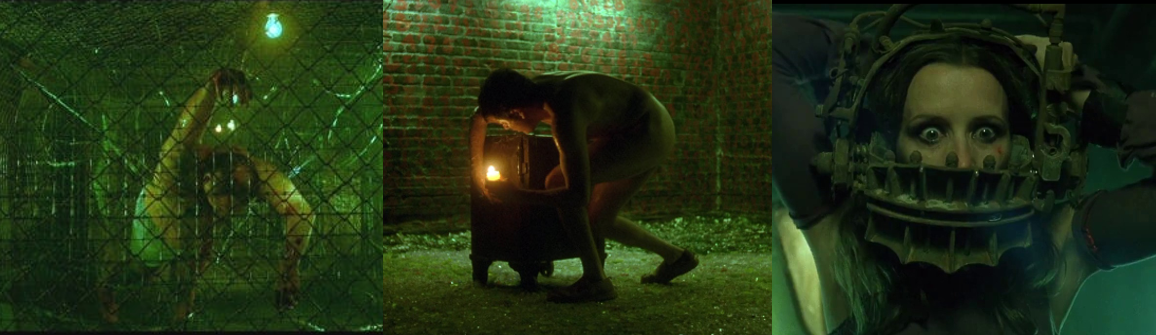
Of course, one of the main selling points of Saw are the gruesome traps Jigsaw sets for his victims and the violent ways in which they die. Shot using a frenetic camera and fast edits and bolstered by a dingy, almost low-rent lighting, the traps are presented in a way that invites the audience to experience the fear and panic felt by their victims, who are all subjected to torturous tests that reflect their sin, vices, or crimes. The first trap we see finds Paul (Mike Butters) wrapped up in razor wire after bleeding to death in an attempt to escape; Paul was chosen for the simple crime of cutting himself despite being perfectly healthy and sane, so Jigsaw wanted to test if he was truly suicidal or just wanted attention. Next, Tapp and Sing investigate the immolated corpse of Mark (Paul Gutrecht), a man who had claimed to be sick but was always out and about; to test his “illness”, Jigsaw injected him with a slow-acting poison, doused him in flammable jelly, and challenged him to navigate a field of broken glass to find the combination to the safe containing the antidote using only a candle to light his way. Easily the most iconic trap of the film (and, quite possibly, the entire franchise) is the reverse bear trap that Amanda found strapped around her head after she refused to stop wasting her life on drugs. Amanda’s only hope of survival lay in the stomach of Donnie Greco (Oren Koules) and, though reviled and hesitant, Amanda had no choice but to disembowel him to get a key out of his stomach. Considering how iconic the reverse bear trap became, it’s interesting that we don’t actually see what it’s capable of beyond a brief demonstration on a mannequin; a later Saw film would rectify this and the franchise returned to the trap again and again but in its original incarnation, the threat and sheer dread evoked by the bear trap was terrifying enough! While there’s a fair amount of blood in Saw, the first film is decidedly more reserved than its more over-the-top successors; it’s more about the atmosphere and sense of desperation here, making Saw more of a gore-thriller than a straight-up “torture porn” movie, though this Uncut Edition of the film does add a few extra frames of gore, blood, and panic to the mix despite actually running shorter than the theatrical version. Later films would up the ante on not just the traps but in exploring Jigsaw’s entire twisted philosophy, but it’s quite bitter and simplistic in Saw: he hates those who don’t appreciate life and wants to punish them for it so they can justify their existence through extreme measures and bloodshed. Crucially, there’s a distinction made that Jigsaw isn’t some psychotic murderer; technically, he hasn’t killed anyone, but his depraved methods make him a top priority for the likes of Tapp and Sing. The hints towards him being an enigmatic, almost cult-like figure are sown here, however; not only does his reputation proceed him, but Amanda asserts that Jigsaw “helped [her]” with his test, despite the fact that it’s clearly left her an emotional wreck.

Jigsaw’s traps may be a highlight but there’s a definite sense that these gruesome games were simply a test of his greater designs for those who don’t appreciate life. I say this because it definitely seems like he abducted the likes of Paul, Mark, and Jeff and simply placed them in a life-or-death situation, but he concocts an elaborate, multi-staged plan with all these different elements (Zepp, a kidnapping, planting evidence, even luminous paint and alternative ways to kill Adam) for Dr. Gordon’s test. Dr. Gordon’s calm demeanour degenerates as his situation becomes more and more desperate; hearing Alison’s voice and learning of Zepp’s involvement only exacerbates his emotional state and he’s pushed to the brink when his time runs out and he hears what appears to be the agonising death of his wife and child. His logic and reasoning evaporate and are consumed by an obsessive, desperate need to save their lives at any cost so, much to Adam’s abject horror, Dr. Gordon wraps a makeshift tourniquet around his ankle and gets sawing! Even this sequence, as harrowing and uncomfortable as it is, is nowhere near as gory as it could be or what we’d see in later films as Saw wisely keeps the focus on Dr. Gordon’s crazed expression and Adam’s horrified reaction. Finally free from his shackle, Dr. Gordon shoots Adam but is unable to kill or even oppose Zepp when he comes to finish them off for failing to complete the game in time. Luckily, Dr. Gordon only wounded Adam, who springs to life in a maniacal rage and beats Zepp to death using the toilet tank lid! Bleeding to death and barely clinging to life, Dr. Gordon drags himself off to get help though, sadly, this version of the film strangely omits Dr. Gordon’s final line to Adam (“I wouldn’t lie to you”) that I always felt was a lovely way to show how far their relationship had progressed. Injured and in shock, Adam is stunned when he roots around in Zepp’s pockets for the key only to find he possessed a tape of his own (it’s not clear what Zepp’s crime was but he was coerced into helping the true Jigsaw enact his plan on pain of death), which leads to easily one of the best twist endings in all of cinema, one perfectly bolstered by Charlie Clouser’s iconic “Hello Zepp” score. After playing the tape, Adam is astonished when the corpse in the middle of the room comes to life and rips some of the fake blood from his head to reveal himself as Dr. Gorodn’s patient! Kramer then tells Adam that the key was in the bathtub all along (if you re-watch the opening, you see it get sucked down the drain) but, when Adam tries to shoot him with Zepp’s gun, Kramer incapacitates him with an electric shock via remote control and dramatically slams the bathroom door shut with a simple stern declaration: “Game over!”

The Summary:
As much as I’ve enjoyed seeing the Saw franchise evolve and delve deeper into Jigsaw’s twisted sense of morality, methods, and justification for his horrendous actions, it’s hard, even now, to deny the appeal and almost timeless quality of the original film. Saw has a very gritty, urban feel to it; the entire film is awash in bleak, stark colours, moody lighting, and rusted, dirty tools and environments that give the whole thing an edge and an atmosphere that not only set the standard for the franchise, but which subsequent films have attempted to emulate and surpass, for better or worse. The central premise of Saw is really strong (just two guys trapped in a room with a horrifying choice to make), but I also enjoyed following the cops trying to bring Jigsaw in; Danny Glover gives the strongest performance of any of the protagonists, but Cary Elwes hold his own as well, despite this accent slipping a few times, to deliver a nuanced and tragically relatable portrayal of a successful, pragmatic man driven to the edge. The traps are, of course, a highlight of the film not just for their depravity but for how simple and effective they are; there’s a definite sense that Jigsaw cobbled all this together by hand and through meticulous planning that gets a little muddled in later films once the traps become outlandish and more nightmarish. Even more appealing is the twisted logic behind the traps, that they’re designed to punish those within with a fitting crime to test their commitment to and appreciation of life, and the suggestion that this all comes from a man whose life is coming to an end. Later films would obviously expand on this but it’s all here in the subtext and things like that, and all the little clues and background details, make Saw a classic horror/thriller even before you get to the shocker of an ending!
My Rating:
Fantastic
What did you think to Saw? Did you enjoy its frantic, gritty presentation or were you put off by the quick edits and gruesome content? Which of the traps was your favourite and do you think you’d be able to survive if placed in one? Were you shocked by the ending or did you suspect there was more to that corpse? Which of the Saw films is your favourite and what do you think to Jigsaw’s mentality? Whatever your thoughts on Saw, feel free to share them below and check out my other Saw content across the site!


 Dr. K's Waiting Room
You must be logged in to post a comment.