Click here to listen to my guest spot on the Anthological podcast discussing this film


Released: 10 November 1982
Director: George A. Romero
Distributor: Warner Bros. Pictures
Budget: $8 million
Stars: Carrie Nye, Jon Lormer, Stephen King, Leslie Nielsen, Ted Danson, Hal Holbrook, Fritz Weaver, E. G. Marshall, and Joe King
The Plot:
Abused Billy Hopkins (Joe King) takes solace in Creepshow, a horror anthology comic with tales of a cursed family’s Father’s Day, a simple-minded yokel’s encounter with a meteorite, a heartless millionaire’s spiteful vengeance, a mysterious crate, and a germaphobe’s battle against cockroaches.
The Background:
Horror has a long and successful association with anthologies for many decades. Books, comics, and television shows have benefitted from telling episodic or short-hand horror tales over the years, with celebrated horror author Stephen King using the medium to deliver some of his finest works. In 1982, King collaborated with the grandfather of the zombie genre, George A. Romero, on this cult classic horror anthology movie. While two of King’s existing short stories were adapted for the film, the remaining shorts were written specifically for the movie, with King and his young son appearing as actors. Star Ted Danson endured a gruelling experience shooting in a specially prepared pit to simulate being drowned while co-star Leslie Nielsen (then known as a dramatic actor) kept things light on set with a hidden fart machine. Additionally, although 20,000 live cockroaches were utilised for the “They’re Creeping Up on You” segment, horror legend Tom Savini bolstered their numbers with nuts and raisins. With a box office gross of over $21 million, Creepshow was a surprise success that proved popular with critics for its quirky blend of comedy and horror and became a horror classic. However, while Creepshow led to a comic book and two sequels of varying quality, distribution issues led to a planned television spin-off being reworked into the thematically similar Tales from the Darkside (1983 to 1988), though a well-regarded TV series revival did eventually emerge in 2019.
The Reviews:
As Creepshow is an anthology film comprised of five short stories and a framing narrative to tangentially link them together, it’s just logical that I go over each one individually and then discuss the overall film. The prologue and epilogue reveal that Creepshow is a horror anthology comic with pulp horror stories and advertisements for prank toys like x-ray glasses and voodoo dolls. Billy Hopkins (an avid horror fan judging by his bedroom) loves the comic but is berated by his cruel and strict father, Stan (Tom Atkins), for wasting his time on such trash. When Billy dares to speak back to his father, he gets a smack for his troubles, much to the chagrin of his loving but ultimately helpless mother (Iva Jean Saraceni). When Billy tries to appease his father and apologise, Tom sees through the trick and demands that he give up his comics and horror, forcing him to go to bed and tossing Creepshow in the trash. Unbeknownst to him, there is inexplicable supernatural power in those pages as the comic’s skeletal host, the Creep, lingers outside Billy’s window as he wishes death upon his father. The segments that follow are then presented as adaptations of the comic stories, complete with the occasional comic book panelling and colour effects to tie everything together. Once they’re all finished, two garbagemen (Marty Schiff and Tom Savini) retrieve the comic from the Hopkins’ trash and find the voucher for an “authentic” voodoo doll removed. Inside the Hopkins residence, the still grouchy and aggressive Tom complains of neck pain before experiencing stabbing pains all over. As Tom collapses in agony, Billy cackles gleefully in his bedroom as he repeatedly stabs at the voodoo doll, the image turning into the cover art for the next issue of Creepshow.
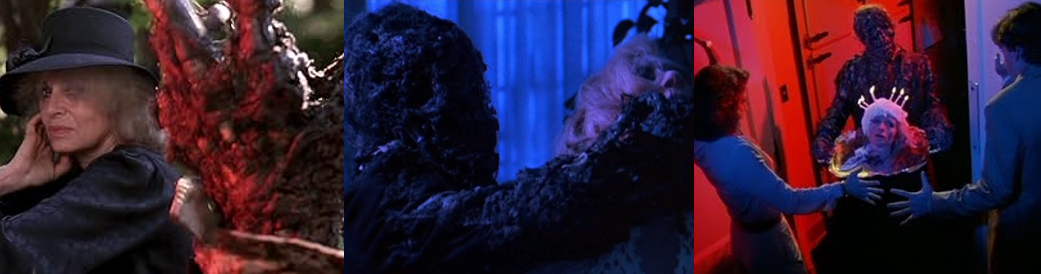
The first full-length story to spring to life is “Father’s Day”, which revolves around the filthy rich Grantham family. Every year, Sylvia (Carrie Nye), gathers the family for a special dinner. This year, her niece, Cass Blaine (Elizabeth Regan), brings her husband, Hank (Ed Harris), to meet her condescending aunt, her self-absorbed cousin, Richard (Warner Shook), and her great aunt, Bedelia (Viveca Lindfors). Between criticising Cass’s healthy appetite, Sylvia nonchalantly tells Hank that Bedelia, the family matriarch, once murdered the disgustingly wealthy and miserly Nathan Grantham (Lormer). Having accumulated vast wealth through unscrupulous and criminal means, the aged patriarch became aggressive, demanding, and paranoid, believing everyone was using him for his fortune and making constant, abusive demands of Bedelia, who was forced to care for him and endure his belittlement. Bedelia finally snapped after her father orchestrated the death of her fiancé, the only man who’d shown her any kindness, to keep her in check. Unable to take her father’s barrage of insults and childish demands for his Father’s Day cake, Bedelia cracked him in the head with an ash tray. Though free of Nathan’s abuse, Bedelia remained scarred and traumatised, placing a flower at his gravesite every Father’s Day. While drunkenly reminiscing about the murder, (which Sylvia helped cover up to profit from her inheritance), Bedelia is horrified when her father’s gaunt, gruesome corpse suddenly bursts from his grave and throttles her to death, still slurring demands for his cake. While having a smoke, Hank wanders into the family cemetery and ends up crushed when the zombified Nathan telekinetically drops a gravestone on him. When Cass expresses concern for her husband, Sylvia begrudgingly volunteers to look for him (hinting at her desire to seduce him), only to end up with her head twisted backwards by Nathan. Impatient and frustrated, Cass demands the lackadaisical and half-cut Richard help search for their missing party, only to be appalled when Nathan’s ghastly, maggot-ridden corpse bursts from the kitchen and proudly presents his cake: Sylvia’s severed head on a silver platter, covered with frosting and candles!
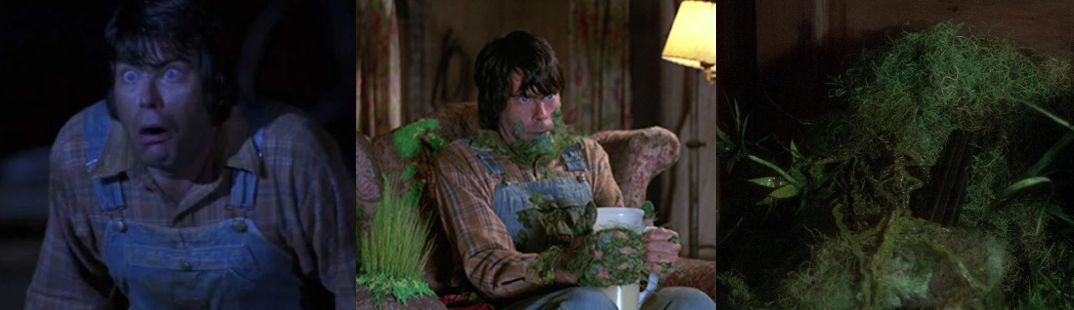
Stephen King takes centre stage in “The Lonesome Death of Jordy Verrill” as the titular, dim-witted, hillbilly farmer. After being amazed by a falling meteorite, Jordy investigates and, dreaming of collecting a cool $200 from the “Department of Meteors” at the local college, touches the red-hot rock without thinking. Jordy’s dismayed at his characteristic bad luck and thinks he’s cost himself a payday when he tries to cool the meteorite and it cracks and is so preoccupied by his overactive imagination that he misses the strange goo that spills from the rock and touches his skin. Retreating home, hoping to repair the meteorite in the morning, Jordy enjoys a beer and some wrestling, sucking his fingers out of habit, but is perplexed and horrified to find a strange, green vegetation growing there. Though he immediately thinks to call a doctor, he stops himself when he imagines it leading to a painful amputation and resolves to simply ignore the problem. As the night continues, the vegetation rapidly spreads across his land, his house, and his body, causing him dreadful itching and to drink himself into a stupor after seeing the vegetation consume his face. Unable to take the itching, Jordy tries to relieve his discomfort with a bath, only to be inexplicably warned against it by his deceased father (Bingo O’Malley), who warns that water will only feed his condition. Realising that he’s beyond help anyway, Jordy gratefully plunges into the bath for some momentary relief but, by the morning, his entire farm, house, and body are consumed by the alien vegetation. Despite the short opting for bizarre, dumbfounded comedy, the finale is unexpectedly grim and emotional as the transformed Jordy cocks his gun, prays for some good luck for once in his life, and blows off what used to be his head. While this ends his torment, the alien vegetation continues to spread beyond Jordy’s land, potentially spelling doom for humanity.
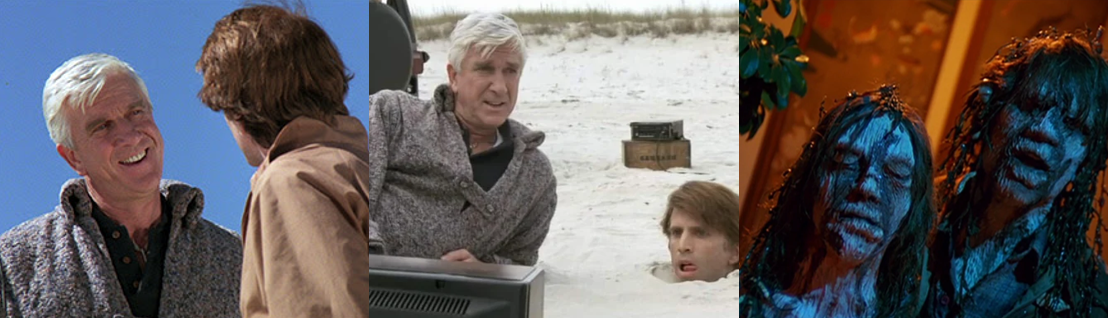
If you’re anything like me, you’ll be surprised to see the late, great comedy actor Leslie Nielsen delivering a seemingly uncharacteristic performance as maniacal, spurned millionaire Richard Vickers in “Something to Tide You Over”. In actuality, Nielsen started his career in more dramatic roles, though his comedic flair seeps through here as Richard is disturbingly jovial and avuncular in his vengeance. After learning that his wife, Becky (Gaylen Ross), is having an affair with square-jawed Harry Wentworth (Danson), Richard visits Harry, coldly dismissing his feelings and simply looking to assert his right over his property. Unimpressed by Harry’s threats, Richard lures his rival to Comfort Point, a private beach he owns, where he implies Becky is in danger. Since he has no choice, Harry makes the trip, only to find a shallow grave in the sand, which he’s forced into at gunpoint by the menacingly aloof millionaire. Harry’s forced to bury himself neck-deep in sand and to watch a live feed of Becky in the same position, slowly succumbing to the tide as it washes over her. Dismissing Harry’s pleas and bribes, Richard simply drives off, watching with glee from his high-tech home as the two struggle to hold their breath. While a glimmer of sanity seems to suggest Richard has some remorse for his actions, a stiff cocktail quickly alleviates such emotions and he dispassionately returns to tidy up the crime scene hours later, sure that his victims were washed out to sea. However, Richard is stunned when Becky and Harry return as drenched, shuffling revenants bent on revenge. Though initially nonplussed and confident his pistol can hold off the ghouls, Richard’s reduced to a cackling, terrified wretch as the two shrug off his assault and use their supernatural powers to grab him, subjecting him to the same fate they suffered and leaving the raving lunatic to see just how long he can hold his breath.
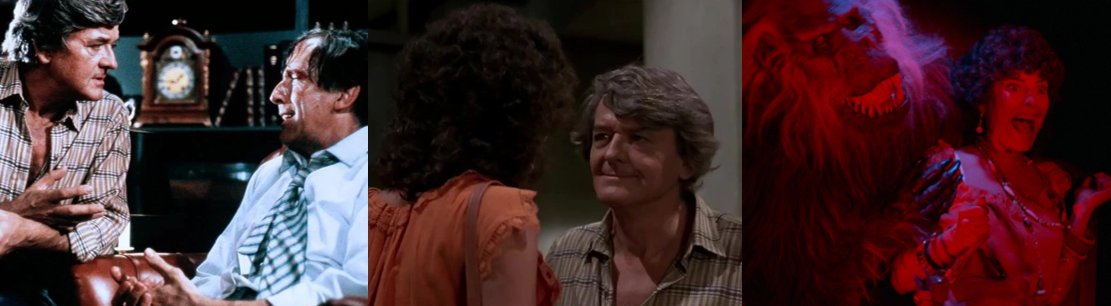
“The Crate” is easily the longest segment and centres on good friends Dexter Stanley (Weaver) and Henry Northrup (Holbrook), professors at Horlicks University. Meek and mild-mannered, Henry daydreams of murdering his emotionally abusive, borderline alcoholic wife, Wilma/Billy (Adrienne Barbeau), who frequently belittles and embarrasses him in front of his friends. Though Dexter feels for his timid friend’s predicament, he’s powerless to intervene, but this drama is superseded when university janitor Mike Latimer (Don Keefer) discovers a mysterious crate hidden under a basement staircase. Though apparently originating from an Arctic expedition, the crate is a mystery to Dexter, who forces it open and is horrified when the bizarre, voracious ape-like “Fluffy” (Darryl Ferrucci) bursts out and devours Mike’s hand (and then the rest of him!) Fleeing, the shellshocked Dexter babbles of the horror to a passing graduate student (Robert Harper) who, first sceptical and then curious of the creature, is promptly mauled and dragged off by Fluffy, which returns to its crate after each kill. The half-mad Dexter shares the gory story with Henry, begging him to help dispose of the creature in a nearby quarry. Though loyal to his clearly traumatised friend, Henry sees this as the ideal way to dispose of his abusive wife and promptly drugs Dexter, clears up the crime scene, and lures Billy to the university on the pretence of helping a young girl who’s been assaulted by Dexter. Eager to both mock the girl’s ordeal and further demean Henry, the tanked-up Billy races over and, suspecting nothing from her meek husband, willingly enters the creature’s hovel without fear. Seizing his opportunity, Henry finally enacts his fantasies and desperately calls for the monster to awaken and kill his wife, only to be met with silence and a barrage of insults from Billy. Just as she’s done criticising his manhood, Fluffy pops out to feed. Though disgusted, Henry finds the courage to reseal the crate and dump it (and the bodies) in the quarry as Dexter suggested. Despite some apprehension, both men agree to stay quiet, though henry’s insistence that the ravenous creature has drowned turns out to be false when we see Fluffy tearing through the submerged crate.
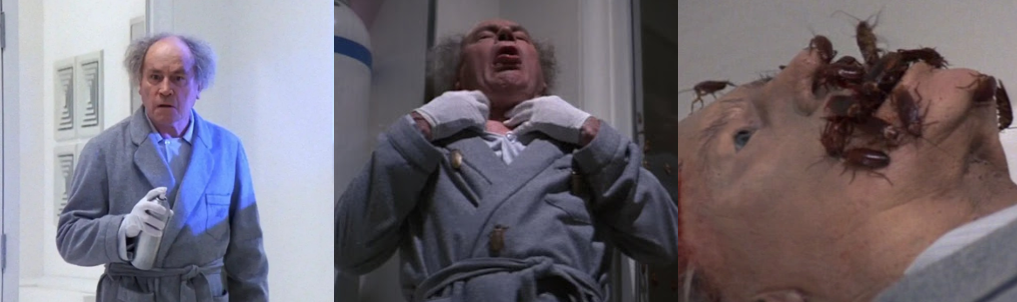
The final story, “They’re Creeping Up on You!”, forces us to share about twenty minutes with uncompromising, belligerent, and extremely wealthy businessman Upson Pratt (Marshall), a germaphobe who lives in a sparse, air-tight penthouse apartment and conducts all his business via telephone and computers. Pratt begins the story battling a cockroach infestation, spraying and stamping the bugs, demanding an exterminator, and threatening to rob people of their livelihoods if his demands are not met. Pratt is delighted to learn that his company’s recent successful corporate takeover resulted in the suicide of his business rival, Norman Castonmeyer, and dismissive towards Norman’s grieving widow, Lenora (Ann Muffly). When Lenora blames him for her husband’s death and wishes all kinds of pain upon the cruel entrepreneur, Pratt simply laughs, having fended off such insults all his life just as effectively as he’s stamped out bugs. Still, Pratt is increasingly disgusted and troubled by the cockroaches, which appear in his food, his equipment, and soon swarm throughout his apartment during a blackout. Having insulted an alienated anyone who could help him, Pratt never wavers in his desire to avenge himself on those who have subjected him to the infestation but is soon overrun by persistent bugs. In his panic, Pratt flees to a more secure panic room only to be mocked by another call from Lenora, who wishes death upon him, and promptly suffers a fatal heart attack upon seeing cockroaches scuttling around his bed. When the blackout lifts, the aggrieved, unsympathetic building handyman (David Early) stops by to check on the unresponsive Pratt. While the cockroaches seem to have disappeared, perhaps vanished now Norman’s death has been avenged or being manifestations of Pratt’s isolation and paranoia, they soon burst from his corpse, tearing through his skin and enveloping his shredded remains.
The Nitty-Gritty:
Although Creepshow offers a unique premise, with its segments being stories in a comic book, the comic book hook isn’t used much. Sure, some shots are framed by comic book panels, actors are rendered against colourful backdrops, and each story fades into an artist’s depiction of the ending, but it’s a tangential link, at best. While the Creep is a questionable animatronic creation, he has a fun, creepy design and it would’ve been nice to see him (and/or Billy) thumbing through the pages of Creepshow and reacting to the stories between segments. The film is an interesting, if occasionally awkward, blend of horror and comedy, with “The Lonesome Death of Jordy Verrill” being the worst offender. I’d like to say King is doing his best but Jordy is such a cartoonish buffoon that it’s hard to take his plight seriously, what with his bizarre fantasises about college professors and doctors. This seems to be a bait and switch, however, as the segment has an unexpected and emotional conclusion where Jordy blows what can loosely be described as his head off, but it doesn’t land quite as well since he’s such a bizarre moron prior. Creepshow really has an issue with pacing, to be honest, as the film is way too long at just over two hours and some stories drag on needlessly. I can’t help but think “The Crate” could’ve easily skipped right to Mike and Dexter examining the titular crate and cut out much of the dull build up. Sure, it effectively paints Billy as an abusive bitch and Henry as a timid, put upon husband, but we clearly see that in every interaction they have and dwelling upon how awful Billy is takes too much focus away from the monstrous Fluffy. While it’s likely it was intentional to paint Fluffy as an afterthought as the true horror was Billy’s belittling and vindictive ways, this segment outstayed its welcome by tacking on an odd final exchange between Henry and Dexter.
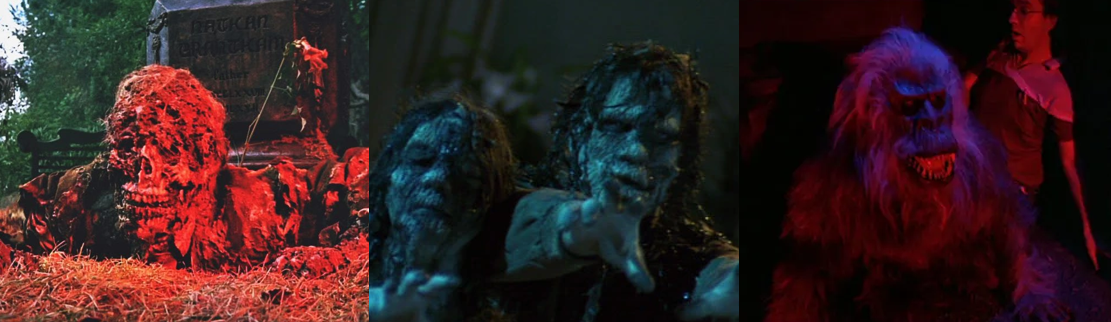
Even my favourite segment, “Something to Tide You Over”, suffers from uneven pacing. Richard’s threat and Harry’s awful predicament are well conveyed but things linger a little too long rather than focusing on Harry’s desperation and slow, painful death. It’s fun seeing Leslie Nielsen be such a despicable, crazed lunatic and there’s a fair bit of nuance to Richard as he shows glimmers of regret and madness throughout. The same can’t be said for Sylvia or any of the Grantham family, who were all obnoxious and thoroughly unlikable characters, or Pratt, who we delight in seeing tortured by the relentless cockroaches. While there’s not much gore in Creepshow and many of the scares are played for laughs, the practical effects are impressive. The squelching, zombified Nathan Grantham sets an early standard, rendering him as a grinning, rotting corpse who strangely exhibits telekinetic powers alongside superhuman strength, all while demanding his special cake. Harry and Becky’s waterlogged corpses are equally impressive, sporting sunken eyes, shrivelled features, and gushing bloody seawater when shot. Equally, the alien vegetation was really good in “The Lonesome Death of Jordy Verrill”, with grass, moss, and vines rapidly overtaking the simple-minded goon’s land, house and, most terrifyingly, his body. This is a slow process more akin to an infection than body horror, though the depiction of the fungus gradually consuming him and eventually transforming him into a vaguely humanoid grass man nicely tied into his desperation for relief from his suffering. Fluffy may be one of the most obvious hand puppets but it’s certainly a unique creature, being some kind of rabid monkey. It’s a little weird and incredibly convenient that it always returns to its crate and only attacks when it’s most dramatic, but Fluffy delivers the most gruesome gore of the movie as it claws, gouges, and bites at its victims.
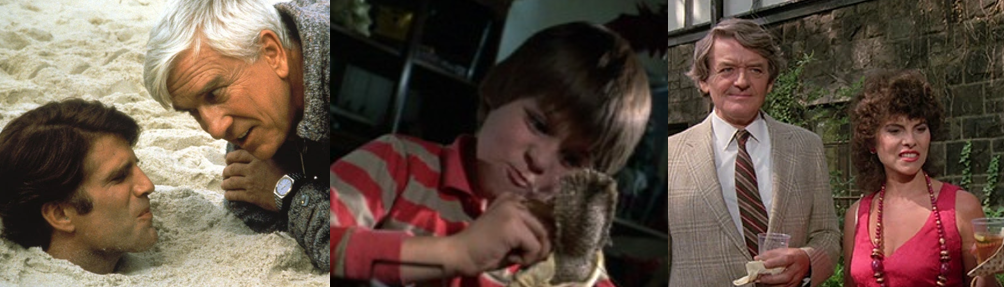
“They’re Creeping Up on You!” was probably my second favourite of the segments (“The Crate” is just too long for me to rate it at number two), but it still felt lacking at times. Pratt is a suitably deplorable excuse for a human being and I enjoyed seeing him squirm and get increasingly agitated as cockroaches swarm his germ-proof apartment. There definitely seems to be a suggestion of the supernatural here, even knowing how quickly cockroaches can infest buildings, as they increase the more he belittles others and delights in the death and grief he’s caused. Lenora’s calls, especially her ominous final message, suggest she is putting a death curse upon him, or that her husband is enacting a gruesome and fitting revenge for all the pain Pratt’s caused. Although Pratt’s corpse is also quite obviously a highly detailed dummy, it was quite unnerving to see the cockroaches burst through his skin and envelop him, with this final segment certainly bringing more of a creepy vibe to the proceedings as opposed to the black comedy and unsettling atmosphere of its predecessors. There’s something deeply disturbing about the usually jovial Leslie Nielsen coldly describing what he plans to do to Sam Malone, forcing Harry to bury himself in sand at gunpoint and watch his lover struggle against the tide. Richard has a madcap nature to him that makes him extremely unpredictable, with him coolly commanding every situation with a few curt words and threats rather than physical violence. It’s tough to pick whether Nathan Grantham was more cruel and vindictive than Billy as both are aggressive, patronising, and demanding individuals who push their victims to breaking point, meeting fitting ends as a result (though Nathan’s so stubborn and malicious that he literally returns from the dead to get his Father’s Day cake!)
The Summary:
Although I’m a big fan of horror, horror comedies, comedies, and comic books, Creepshow missed the mark for me in many ways. It’s always to be expected that some segments in an anthology film will be stronger than others. Creepshow certainly offers a variety of stories, but the film is just too long and some segments really outstay their welcome rather than telling fun, gory horror tales. I liked that each one had a different flavour, from bickering families faced with a spiteful zombie patriarch to a spurned husband enacting a chilling revenge and a bizarre monster living in a box and ready to eat an abusive wife. The practical effects were an obvious highlight, with the rare instances of gore being quite shocking, the undead appearing very tactile and disturbing, and even the unconvincing Fluffy making an impression since it’s so weird and wild. I enjoyed seeing some famous faces pop up here, especially Ted Danson and Leslie Nielsen, though it might’ve been a mistake to give Stephen King such a prominent role. Jordy is so dim-witted he makes Tom Cullen seem like a genius (M-O-O-N, that spells “genius”!) and I felt the comedic buffoonery of the character really lessened the emotional impact of his transformation and suicide. Similarly, while it helps to build sympathy to see just how put upon Henry is, “The Crate” is crippled by its overly long run time, which is doubly disappointing considering most of the other stories deliver on their premise in an acceptable length of time. I enjoyed seeing the likes of Pratt and Richard get their comeuppance, and how different each story was, but the wraparound segments felt lacking to me as they didn’t capitalise on the unique aspect of the Creepshow comic book. Ultimately, I can’t help but feel a little dissatisfied with Creepshow, which maybe crams too much into its runtime to be as effective as other horror anthologies and definitely has a format that’s more suited to an anthology television show than the big screen.
My Rating:
Pretty Good
How offended are you by my disappointment with Creepshow? Which of its short stories was your favourite? Do you agree that the pacing is off and it runs too long or were you satisfying by the length? What did you think to the special effects and sparing use of gore? Were you surprised to learn that Leslie Nielsen used to be a dramatic actor? Which of Creepshow’s sequels and counterparts is your favourite? Whatever you think about Creepshow, leave a comment, go check out my other horror anthology reviews and my guest spot on the Anthological podcast, and donate to my Ko-Fi to fund more reviews like this.

 Dr. K's Waiting Room
You must be logged in to post a comment.