
Game Corner: Zool: Ninja of the “Nth” Dimension (Mega Drive)

GameCorner
ZoolLogo

That’s right; we’re back in the nineties with another bright, colourful action/platformer. This time we’re looking at one of many attempts by the Amiga to copy SEGA’s success with Sonic the Hedgehog (Sonic Team, 1991), Zool: Ninja of the “Nth” Dimension (Gremlin Graphics, 1992), which was ported to the Mega Drive by Electronic Arts. Given that it released about a year after Sonic, and about a month before Sonic the Hedgehog 2 (Sonic Team, 1992), Zool was one of the first videogames to ape Sonic’s success and even beat the franchise to the punch in some ways. Hell, just look at his eyes; they’re almost exactly the same style as Sonic’s!
ZoolStory
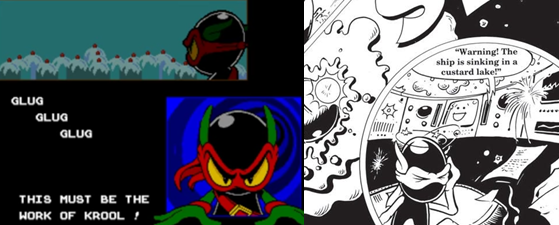
Zool used cutscenes and comics to tell its story.

One of the main things that sets Zool apart from Sonic is its use of text-and-picture cutscenes in the game’s opening and ending to tell its story; this story was also elaborated on through a charming little comic included in the game’s manual. It would be some years before Sonic videogames even used in-game sprite animations to convey their story, much less text-and-picture cutscenes.
ZoolChupa
I’d rather have a packet of Love Hearts…

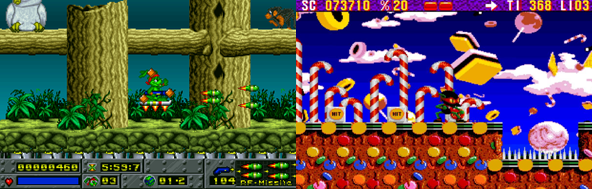
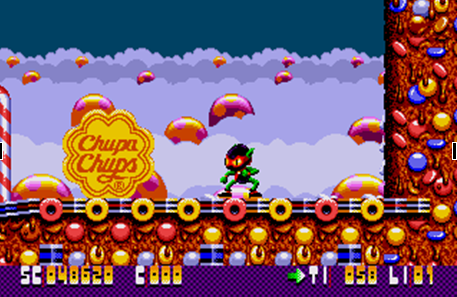
As we saw in Cool Spot (Virgin Games, 1993), Zool also includes some rather unsubtle product placement; the entire first World is littered with Chupa Chups, quite possibly the most generic lollipop sweet there is. Quite how Zool contributed to the sale and advertisement of Chupa Chups is beyond me but perhaps it was this advertising revenue that allowed the videogame to be ported not only to the Mega Drive but also to MS-DOS (where it would later be surpassed by the far superior Jazz Jackrabbit (Epic MegaGames, 1994)), Game Boy, Game Gear, Master System, SNES, and even the Atari ST.
ZoolWorlds
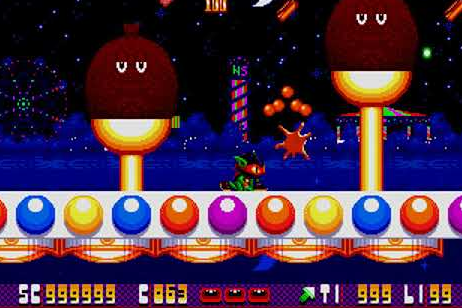
Zool‘s Levels are certainly vibrant.

But let’s start from the top; upon beginning the game, players are immediately tossed into an absolute blast of bright, vibrant colours and catchy, rock/electronic music. Zool, a little gremlin ninja thing from the “Nth dimension”, must jump, blast, and spin his way across seven equally animated and colourful Worlds (each with four Levels), defeating the minions of Krool in an effort to return to his home dimension.
ZoolAttacks
Blast, spin, and slide your way to victory.

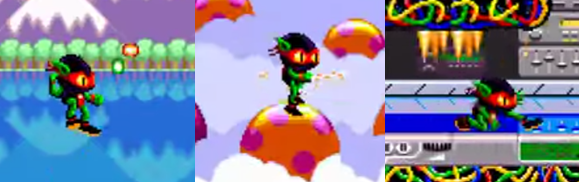
Despite wielding energy sticks on the game’s box art, Zool’s primary form of attack is to blast enemies with energy projectiles; however, unlike other sidescrolling shooters, Zool can only fire projectiles in the direction he is facing. Zool can also perform a spinning top attack when jumping to attack airborne enemies or break certain level obstacles or, thankfully, simply jump on enemies to defeat them. Zool can also scale walls by either climbing or jumping up them, slide under spikes and through narrow gaps, and fire projectiles whilst ducking.
ZoolMaze
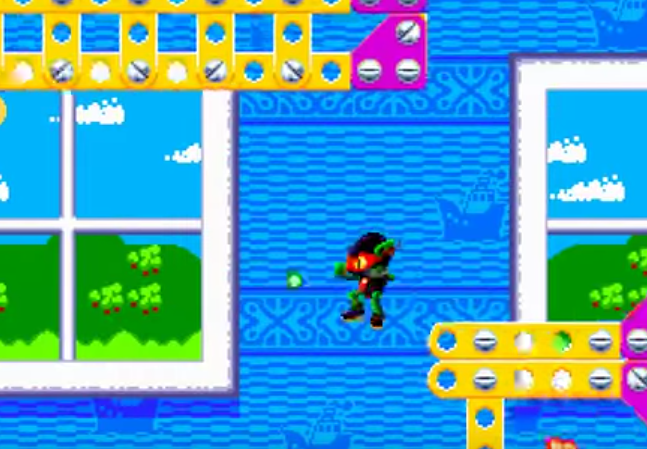
Zool darts around maze-like Levels at break-neck speed!

Arguably, Zool plays a lot faster that Sonic, however the game lacks some of the polish of SEGA’s iconic platformer; controlling Zool is like skating on ice on the Moon as Zool darts across Levels and soars through the air seemingly in defiance of gravity. While this doesn’t stop the game from being extremely fun to play or make navigating Levels that difficult, it can make some of the game’s attempts at precision platforming trickier.
ZoolGoal
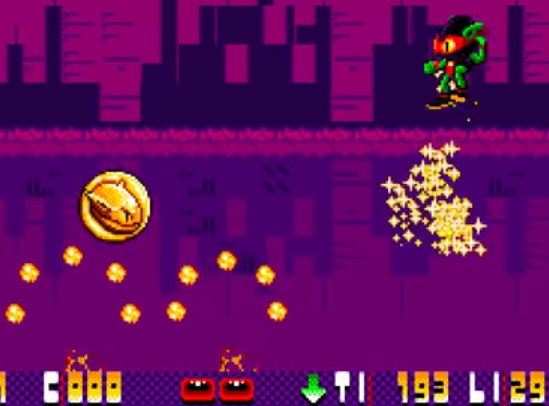
You have to collect items and find a coin to clear Levels.

What does get in the way of navigation is the game’s primary gameplay mechanic; in order to clear a Level, Zool must collect a certain number of items. These change as Zool visits new Worlds (being anything from various fruits to CDs and bath toys) and the number you must collect depends on the difficulty you set the game to. Once Zool has collected enough items, he must follow an extremely vague arrow in the game’s HUD to reach a coin and be spirited away to the next Level or World.
ZoolHidden
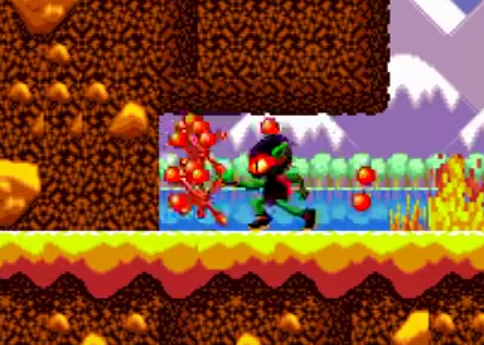
Blast walls to reach hidden routes.

Zool must do all of this while battling against not only respawning enemies and level obstacles such as spikes and disappearing platforms but also while traversing the game’s maze-like Levels. Some Levels are considerably more labyrinthine than others, to be fair, and sometimes the game cheekily hides your route behind a wall that must be blasted open…though, as there’s no visual distinction between walls, it’s easy to miss these routes entirely.
ZoolBosses
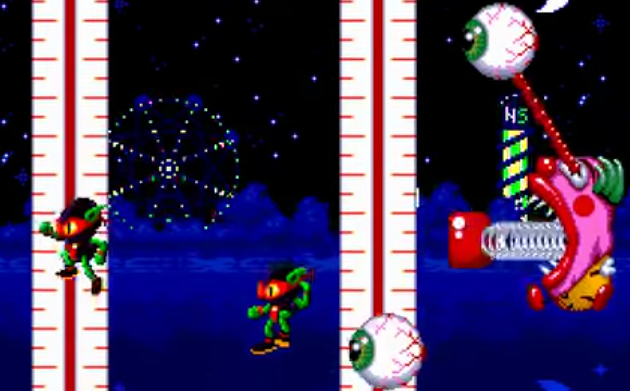
Truly the stuff of nightmares!

Zool’s enemies are as wacky and outrageous as the game’s Worlds; Zool must contend with the likes of anthropomorphic jelly, killer violins, floating screws, projectile-spitting liquorice treats, and evil fruit (the implication being that sweets are good and veggies are bad…which I can get behind). To clear each World, Zool must also battle equally weird and wild bosses, such as a giant cactus and a screaming pink head with a spring-loaded boxing glove for a tongue!
ZoolPowerUp
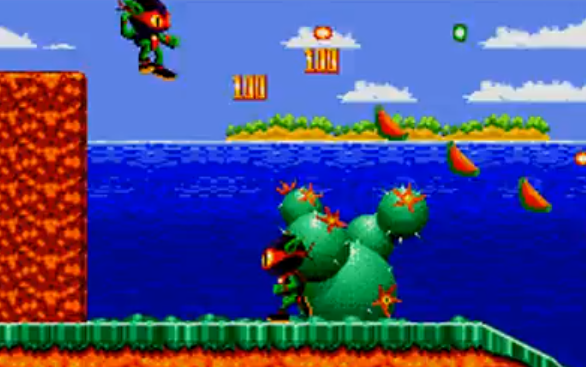
Double Zool’s shot with power-ups!

Luckily, Zool has plenty of things to assist him in his mission; Zool has an energy bar and can take three hits before losing a life, can blast various checkpoints to respawn at a number of different points throughout a Level, and can collect numerous power-ups that increase his jump height, give him a shadow to double his firepower, increase his time, destroy all onscreen enemies, or make him invincible.

ZoolSecret
Some hidden mini games add some spice.

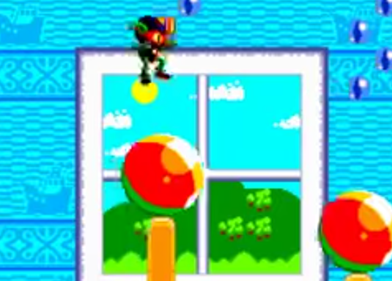
There are a few hidden secrets to be found in Zool as well; when I played the Master System version, I distinctly remember accidentally finding a warp point that simply took me straight to the game’s ending. There’s also some mini games and arcade games that can be played by doing certain actions in some Levels to add a little intrigue and variety to the proceedings.
ZoolControls
Platforming can get tricky.

Zool isn’t especially difficult, even on its hardest difficulty setting; 1 Ups are scattered across Levels (sometimes extremely liberally) to increase your chances, enemies often drop health, and the bosses have very simple attack patterns. However, there are some frustrating elements; the time limit, for one, and having to collect enough items to access the exit point, for another. While there are no bottomless pits, there are some frustrating platforming sections that require Zool to jump to very small, disappearing platforms and, if you fall, it can be a chore to get back up, especially as the enemies will respawn.
ZoolEnding
Turns out it was all for nothing and the REAL battle is still going on!

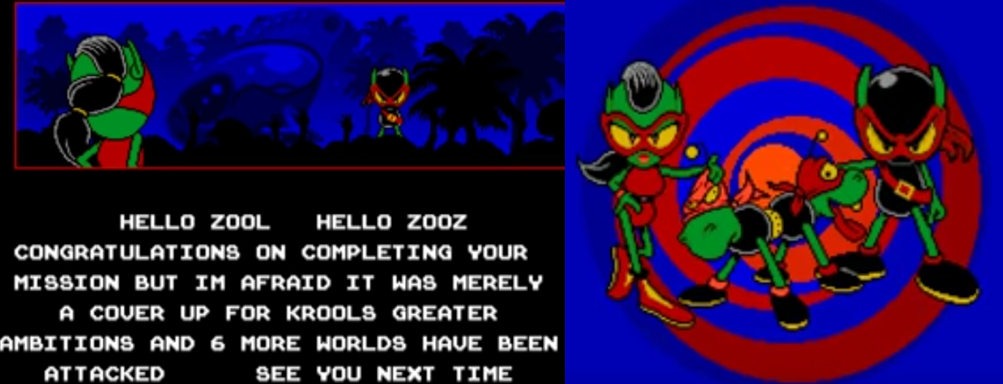
Perhaps the biggest letdown of Zool, though, is the ending; after defeating the final boss, Zool successful escapes back to the Nth dimension where he is greeted by Zooz, his female companion. Although she congratulates Zool, she reveals that Krool has invaded another handful of worlds, essentially making the ending a giant tease for its sequel, Zool 2 (The Warp Factory, 1993). This might be fine but, unfortunately, Zool 2 never received a port to the Mega Drive, all but forcing players to invest in an Amiga or other such console to play the sequel. I did own Zool 2 back when I had an Amiga and remember it being a pretty fine little game in its own right; this time, players can select between Zool and Zooz, with each character playing slightly differently (Zooz had a whip…) and being able to take alternative routes through Levels. It’s a shame that Zool 2 didn’t get the same cross-platform release but I guess that does go some way to making Zool the unofficial mascot of the Amiga. Unfortunately, despite these two titles, the myriad number of ports Zool received, and even a couple of young adult novels, Zool has pretty much faded into obscurity. Quickly surpassed by Sonic 2 and other similar action/platformers, Zool never quite managed to outshine Sonic like the Amiga probably hoped he would. Zool’s time in the sun was very brief and it’s a shame, really, as, despite the game’s slippery controls, the character has a unique design and his games were extremely bright, energetic fun with some nice levels of animation. When it comes to a re-release, port, or HD remaster, I’d like to say “never say never” as even the similarly-themed, arguable more obscure Superfrog (Team17, 1993) got a nifty HD version in 2016 but it does seem like Zool’s brief flirtation with fame has long since passed.

My Rating:

Rating: 4 out of 5.

Great Stuff

Do you remember Zool? If so, which version did you play? If you haven’t, I urge you to track down a copy and give it a whirl but, either way, let me know your thoughts in the comments below.

Game Corner: Cool Spot (Mega Drive)

GameCorner
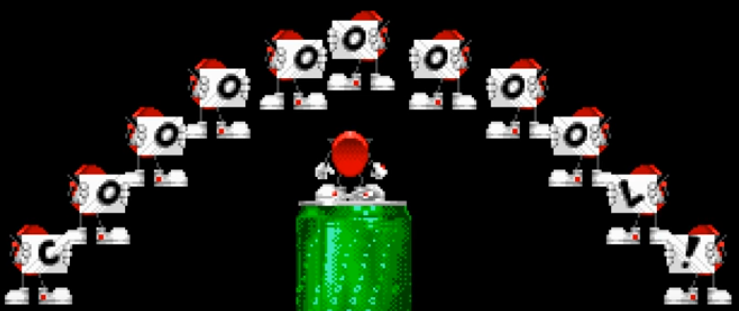
CoolSpotLogo

Aah, the nineties. A time when, thanks to the escalating battle between SEGA and Nintendo for console supremacy, everyone and their mother was desperate to have a cute, action/platformer mascot. These mascots had to be cool; they had to be fun; and, most of all, they had to have attitude. Because of this, we got such fantastic Sonic the Hedgehog knock-offs as Aero the Acro-Bat, Soccer Kid, and Awesome Possum and, in some of the most bizarre and obscure examples, food brands represented by guys like Chester the Cheetah and Cool Spot.

CoolSpotFido.PNG
7 Up was so cool they had TWO extreme mascots!

Cool Spot was the mascot for the fizzy drink 7 Up, but this reference largely went over the heads of Brits such as myself as, in the UK, 7 Up was represented by the equally radical Fido Dido so, when I played Cool Spot (Virgin Games, 1993) for the first time on the Amiga, I assumed it was the same kind of product placement as the Penguins in James Pond 2: Codename: Robocod (Vectordean/Millennium Interactive, 1991).

CoolSpot7Up.PNG
Personally, I prefer Sprite…

Regardless, the red spot featured in the logo of 7 Up’s trademark drink got his own videogame…because of course! You could tell that Cool Spot was both cool and had attitude because he wore shades and sneakers and was portrayed as a radical, laidback surfer dude. Spot actually featured in a couple of titles prior to this videogame; Spot: The Video Game (Virgin Mastertronic, 1990), which was little more than a puzzle game that resembled Connect 4, and Spot: The Cool Adventure (Visual Concepts, 1992), which was simply a reskinned version of McDonaldland (ibid).

CoolSpotPlot.PNG
Cool Spot has quite the in-depth plot…

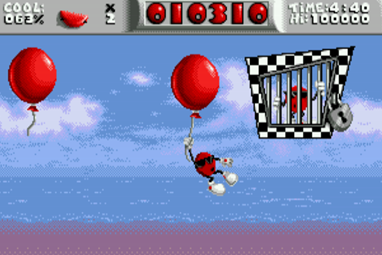
However, when Spot’s fellow Spots are randomly locked up in cages in Cool Spot, he doesn’t hesitate to leap into action and journey across eleven levels collecting “Cool Points” (small red spots). Once Spot collects enough Cool Points, he must find the cage containing his fellow Spot and blast them free, all within a time limit and while battling a variety of enemies (everything from giant grabs to toy robots).

CoolSpotAttack.PNG
Blast your foes with soda bubbles!

While Spot is hindered by a handicap that befalls far too many of his platforming brethren (in that he cannot damage or defeat enemies by jumping on them, which I always feel should be rule one of any action/platformer), he can blast his foes with soda bubbles flicked from his awesome gloves. Using the D-pad, you can even change the direction of these bubbles to blast enemies out of the air, though some will take multiple shots or defend themselves using shells.

CoolSpotHazards.PNG
Don’t be so cool that you forget to look where you’re going!

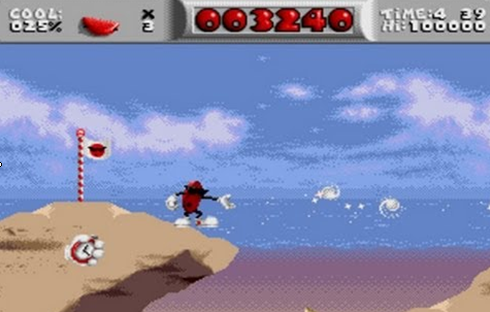
Spot seems far more concerned with looking cool than having much in the way of a versatile moveset; he can walk and leap about the place and that’s about it. If you hold the direction you’re going in, Spot will, eventually, speed up and be able to leap further, holding the jump button seems to help him reach higher places, and he is able to clamber up ledges but there’s no spindashes or power-ups available here beyond some ridiculously sparse health items, time increases, and one-ups.

CoolSpotBonus.PNG
Enter a bonus stage to try for an extra life!

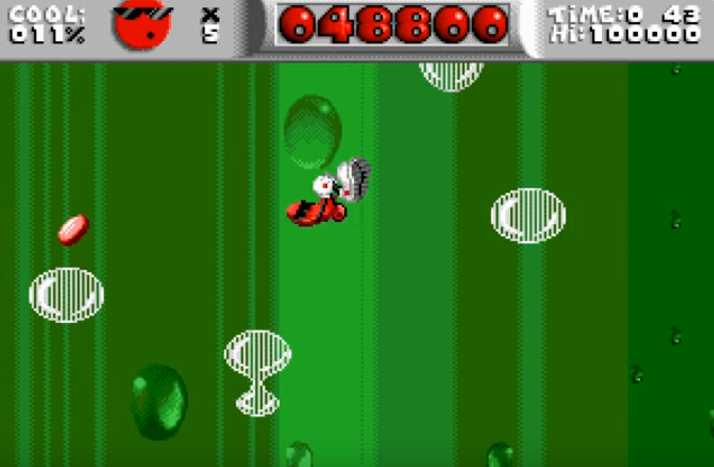
You can also try and collect letters in each level to earn a continue and, once you complete a level, your remaining time and total Cool Points are tallied up; if Spot has enough, he’ll be awarded with an extra life. If you collect enough Cool Points in any level, Spot will be able to enter a Bonus Stage where, under a strict time limit, he must bounce around on soda bubbles collecting even more Cool Points and try for another extra life.

CoolSpotCage.PNG
You’ll have to search everywhere for these cages.

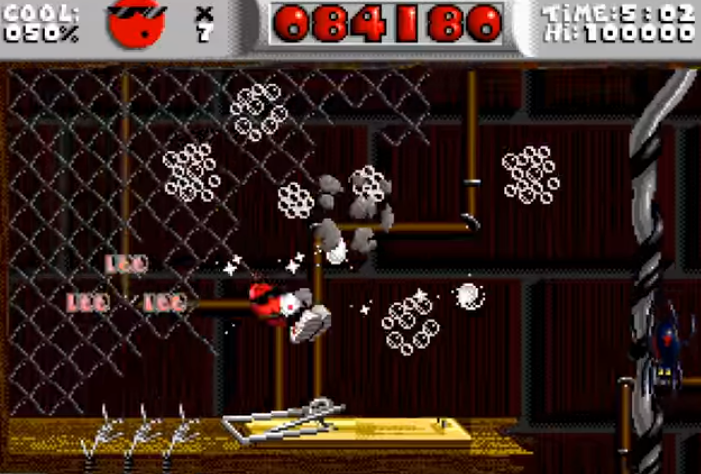
And you’re going to need those extra lives, my friend, because Cool Spot is quite a tough game. It starts out relatively easy, with Spot jumping around a sandy beach and blasting enemies without much issue, but levels quickly adopt a maze-like structure, forcing you to search high and low for both Cool Points and the cage that is your goal all while being bashed about by enemies or hit by obstacles like spikes and mousetraps. Spot’s health is indicated by a humerous face sticker at the top of the screen; as Spot takes damage the face reacts and comes more and more unpeeled. When the face falls off, Spot dramatically whirls around and collapses and you’ll have to start the level over, either from the beginning or from your last checkpoint.

CoolSpotEnd
Spoilers: The ending isn’t much to shout about.

On the plus side, Spot doesn’t have to contend with any boss battles but, on the downside….Spot doesn’t have to contend with any boss battles. He simply swaggers from one level to the next, with little variety (there’s a beach, a dock, what appears to be inside some dry wall, a bath tub, and a toy shop and that’s about it….oh, and there’s a train level…), freeing his fellow Spots and, once he clears the final level, he celebrates with all his mates and you get given a high score.

CoolSpotTricky.PNG
Tricky platforming will test your wits.

Cool Spot is one of those videogames that is fantastic to look at but tricky to play; the backgrounds, graphics, and sprite animations are all gorgeous, vivid, and full of life and character. The music and voice samples are charming and up-beat and Spot has some of the best walking, idle, and celebration animations this side of Sonic and Earthworm Jim. It’s unfortunate, then, that his game calls for some tricky and precise platforming that the controls make very difficult.

CoolSpotTricky2.PNG
You never really know what waits at the bottom of a jump…

More than once, Spot must make blind leaps, hop from one precarious (often temporary) platform to the next, and hope that he doesn’t plummet back down to a lower level and waste his time having to hop back up or fall into a bottomless pit and die. Honestly, I often found it easier to just die and respawn at a checkpoint higher up rather than having to fight with the game’s stiff-yet-floaty jumping mechanics.

CoolSpotCompetition.PNG
Honestly, anything Cool Spot did, its competitors did better.

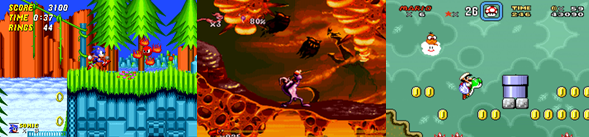
As a rival to Sonic the Hedgehog (Sonic Team, 1991), Cool Spot is lacking in a few areas; the game has the graphics and the look and Spot is a very animated and funky character, but without the fast-paced action and the challenge presented by Sonic’s boss battles and bonus stages, Cool Spot simply can’t compete. And you have to remember that this game came out in 1993 so, while it beat Sonic the Hedgehog 3 (SEGA Technical Institute, 1993) by a year or so, it came out after Sonic the Hedgehog 2 (ibid, 1992). Cool Spot also released across a variety of platforms, meaning it had to compete with Mario’s far superior offerings as well as those of its other third-party competitors, like Earthworm Jim (Shiny Entertainment, 1994).

CoolSpotCompetition2.PNG
Colourful and wacky action/platformers were ten a penny back then.

Even on the Amiga, Spot faced stiff competition from the likes of Zool: Ninja of the Nth Dimension (Gremlin Graphics, 1992) and its sequel, Zool 2 (The Warp Factory, 1993). He even had to compete with the two Jazz Jackrabbit (Epic MegaGames, 1994; 1998) games on the MS-DOS and these four titles all did everything Cool Spot did but better: the run-and-gun-like gameplay, floaty jumps, colourful graphics, funky music and sprite animations, and even the product placement were all better in any one of these four titles. Yet, Cool Spot wasn’t the end for 7 Up’s odd little mascot; Spot Goes to Hollywood (Eurocom/Burst Studios, 1995) saw the surfin’ spot switch to the isometric style that was popular amongst many 2D platformers that didn’t quite know how to adapt to 3D (I’m looking at you, Sonic 3D: Flickies’ Island (Traveller’s Tales/Sonic Team, 1996)). Like Cool Spot, Spot Goes to Hollywood came out on multiple consoles, including the PlayStation and SEGA Saturn, but once again had to settle for being nothing more than an average little platformer in a world full of competitors trying to stand out. In the end, while it’s nothing compared to most of its peers, Cool Spot is a fun little action/platformer. The music and graphics do just enough to make the tricky gameplay endurable and the game is tough, but fair in many ways (at least the enemies don’t respawn once you leave the screen…), meaning that it’s up to the player to make informed decisions about when to jump and how to navigate Spot’s vibrant world.

My Rating:

Rating: 4 out of 5.

Great Stuff

Do you remember Cool Spot? If so, what was your first experience? If not, why not go give a play? Either way, sound off below and let me know what you think.