

Released: 16 October 1992
Director: Bernard Rose
Distributor: TriStar Pictures
Budget: $8 to 9 million
Stars: Virginia Madsen, Tony Todd, Xander Berkeley, Kasi Lemmons, and Vanessa Estelle Williams
The Plot:
While researching urban legends for her university thesis, student Helen Lyle (Madsen) learns of Daniel Robitaille (Todd), the hook-handed “Candyman”, and is tormented by his restless spirit after trying to disprove his legend.
The Background:
Volume five of visionary British horror writer Clive Barker’s Books of Blood (1984 to 1985) featured the short story “The Forbidden”. Set in Barker’s native Liverpool, the story offered a horror take on segregation and the culture of poor urban areas. After Barker caught Hollywood’s attention with The Hellbound Heart in 1987 was heralded as “the future of horror” by iconic horror author Stephen King, more of his works made the jump to the silver screen. When director Bernard Rose signed on to bring “The Forbidden” to life, he opted to radically change both the setting and Candyman’s race to comment upon inner city violence, racial issues, and the tumultuous history of the Cabrini-Green housing estate. Eddie Murphy was the original choice for the title role but, when he proved too expensive, the late, great Tony Todd fought for the opportunity, negotiating a sweet $1000 bonus for every bee sting he suffering during filming. Virginia Madsen, a friend of Rose’s then-wife, joined the project and was placed into a hypnotic trance to add to Candyman’s otherworldly allure. Todd worked closely with make-up artist Bob Keen to refine Candyman’s appearance, while bee wrangler Norman Gary supervised the nearly 200,000 real honeybees, many being stingerless new-borns. Though its $25.8 million worldwide box office made Candyman a minor hit, the film attracted controversy for its depiction of race, though reviews were largely positive. Now regarded a horror classic, Candyman was praised for its terrifying atmosphere, social commentary, and haunting score courtesy of Philip Glass. While Candyman was followed by two sequels of varying quality and a lauded 2021 half-sequel, half-remake, Candyman cemented its place in horror history and turned star Tony Todd into an enduring icon for his captivating performance.
The Review:
Set in downtown Chicago, Candyman follows semiotics graduate student Helen Lyle and her mischievous best friend, Bernadette Walsh (Lemmons), as they research urban legends. Helen and Bernadette interview undergraduate students at the University of Illinois Chicago, with most repeating versions of the same modern-day campfire story of mysterious “Candyman”. While Helen and Bernadette are as sceptical (and even mocking) as Helen’s husband, Trevor (Berkeley), who teaches a course debunking such urban legends, their interviewees firmly believe the tall tales. Many of these accounts are from second- or even third-hand information, news reports, or rumours passed between friends and the generations and growing more elaborate over time. Helen and Bernadette are fascinated that so many are convinced that the hook-handed Candyman is real, that if you say his name five times in a mirror he’ll appear to split you from groin the gullet, and have aspirations of changing the understanding of such myths. While typing her notes, Helen learns of a very real and very feared Candyman holed up in Cabrini-Green Homes, a destitute tower block run by violent gangs. While researching Cabrini-Green, Helen learns her building was also built as a cheap housing project before being turned into luxury condos, but on the cheap, so residents could easily pass between apartments using a poorly covered up hole in the bathroom. Helen theorises that Cabrini-Green is very much the same and that a local thug uses this method to sneak into people’s homes and butcher them, building a reputation for himself as a nigh-supernatural killer.
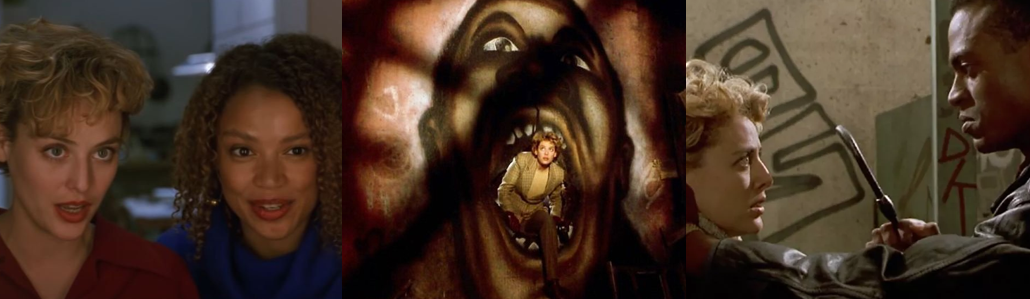
Against Bernadette’s protests, Helen insists on checking out Cabrini-Green and, fooling the catcalling residents that they’re cops, they investigate the squalid tower block. Inside, Helen not only proves her theory but finds graffiti of the mythical Candyman and the ominous warning “Sweets to the Sweet”. Wary local Anne-Marie McCoy (Williams) and streetwise kid Jake (DeJuan Guy) provide eyewitness statements and further hearsay regarding the Cabrini-Green bogeyman. Anne-Marie knew Candyman’s latest victim but was powerless to help since her first priority is keeping her baby, Anthony (Lanesha Martin), safe, while Jake tells how Candyman once castrated a local “retarded” kid. While their stories are incredibly gruesome and Bernadette’s unnerved by Cabrini-Green’s hostile residents and reputation, Helen excitedly documents this evidence as it proves her theory that Candyman is a ghost story. She correctly assumes that a local gang leader (Terrence Riggins) uses a hook and exploits this myth to spread terror throughout the area, which Helen believes will change the perception of urban legends. Ironically, despite her arrogance and gusto, Helen’s surprisingly ill-informed about the real Candyman, Daniel Robitaille, and must learn his true origins from pompous scholar Professor Philip Purcell (Michael Culkin). Though captivated by Robitaille’s tragic story, Helen continues on and runs afoul of the local gangster, being brutally assaulted but fingering her assailant to Detective Frank Valento (Gilbert Lewis), effectively ending “Candyman’s” reign of terror by exposing him as a normal (if violent) man. Despite concerns about her husband’s fidelity and support, Helen heals and is excited to debunk the Candyman myth, only to find Robitaille’s unquiet spirit insulted at having his legend tarnished and herself haunted by him after she speaks his name five times into a mirror.
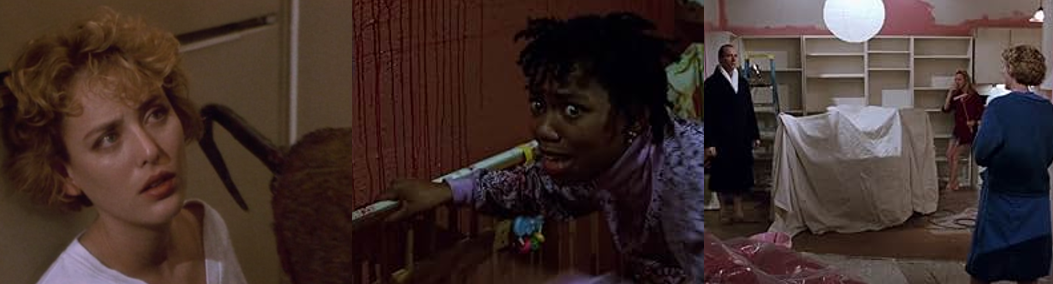
Candyman skews into a supernatural thriller once Helen first encounters Robitaille’s besmirched spirit and wakes up in Anna-Marie’s apartment covered in blood, baby Anthony missing, Anna-Marie’s rottweiler decapitated, and the mother in a distraught state. The cops find Helen defending herself with a meat cleaver and naturally arrest her and Detective Valento’s formally friendly demeanour is replaced with a disgusted, demanding tone as Helen is pegged for violent assault and abduction. After enduring a humiliating strip search, Helen’s finally bailed out by Trevor, who promises to stick by her despite being strangely absent when she called for help. Unfortunately, Helen’s haunted by Candyman, who mesmerises her and promises to make them immortal by establishing a new urban legend with her as his “victim”. This is bad news for Bernadette as she’s disembowelled by the resentful spirit and Helen’s once again pegged as the prime suspect. Due to her erratic behaviour and seemingly being murderously violent, Helen is committed, tormented by Candyman’s silver-tongued visage and forced to evoke Robitaille’s name when cross examined by sceptical Doctor Burke (Stanley DeSantis). Helen desperately flees the sanitorium by posing as a nurse and returns to Trevor, only to find he’s moved in his young lover, Stacey (Carolyn Lowery), and now deathly afraid of Helen. With her life in ruins, Helen pivots towards trying to at least save baby Anthony and decides to trade her life for the baby’s to satisfy Robitaille’s desire to be re-empowered as a terrifying ghost story.
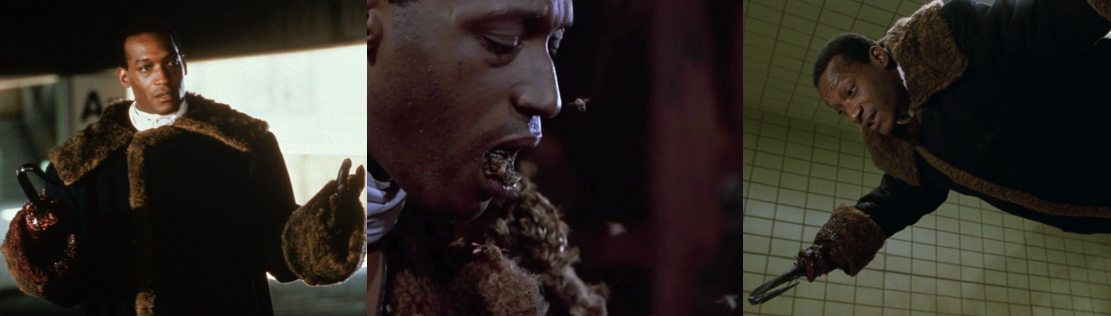
Candyman shows that young, horny, and stupid kids test the urban legend on a dare, never quite believing it was true, and pay the price. Helen’s efforts to debunk Candyman’s legend see Robitaille’s spirit manifest to correct this affront, with him haunting and partially hypnotising her to “be [his] victim” and kick-start a new urban legend. Robitaille was born wealthy and was well-educated, with a talent for art back in the late-1800s. After falling for and impregnating a young white woman, Robitaille was set upon be a lynch mob, had his right hand severed, and was stung to death by bees. Thus, the “Candyman” became a ghost story told in hushed tones and allowed Robitaille to live on in a form of immortality. Robitaille seems satisfied by this, only spilling innocent blood to further his legend, but is forced to step in when Helen causes his “congregation” doubt. Candyman appears only to those who summon him but personally haunts Helen, tormenting her and painting her as a mad woman who kills her best friend and abducts babies. Candyman brutally butchers anyone to further this assumption, turning everyone against Helen and driving her to perish along with him to spare Anthony. Graffiti of Candyman’s past shows that Helen resembles his lost love, partially explaining his obsession with her and, while the gangster who steals his name and gimmick is very human, Candyman is clearly a wraith of some kind. Appearing out of thin air, floating, mesmerising with a look and his gravelly voice, Candyman easily manhandles and slaughters his victims with his bloody hook hand, summoning bees and shrugging off Helen’s desperate attempts to fight back, even if he still bleeds and requires rest.
The Nitty-Gritty:
You can’t talk about Candyman without mentioning Philip Glass’s haunting overture. This almost religious and whimsical tune bolsters the foreboding atmosphere and adds as much gravitas to Candyman’s presence as his long, thick coat, bloody hook, and the immortal Tony Todd’s raspy, mesmerising voice. Equally, race is obviously front and centre in the titular wraith and Cabrini-Green. Obviously, I’m no expert on gentrification or segregation, but both Helen and Bernadette are aghast to learn that their fancy building was also once a glorified ghetto. Residents live in fear of Cabrini-Green, with the cops having little presence and the inhabitants are either violent gang members or terrified locals. There’s a sense that places like Cabrini-Green are both cursed (Candyman was tortured and killed there generations ago) and separated from “normal”, “polite”, white society as people actively avoid the violent area. Anna-Marie dislikes being painted as a “gangbanger” or lowlife just for living in a bad area, but the gangs certainly don’t help Cabrini-Green’s reputation as they accost any outsiders and go around killing and maiming people without punishment. Even Bernadette, an African American woman, feels uncomfortable there, more than Helen, who fearlessly and confidently (and naively) braves the danger for her thesis. Unlike the locals, who fear the gangster Candyman, Helen’s not afraid to go to the cops and finger her attacker, but even she’s disgusted by how quickly the cops (even African American detective Valento) react when a white woman is attacked there, especially as they turned a blind eye when a black woman was killed there. Obviously, Robitaille’s murder was also due to prejudice, though he doesn’t seek revenge for this or even seem that bothered by it, indiscriminately killing only to keep his legend alive.
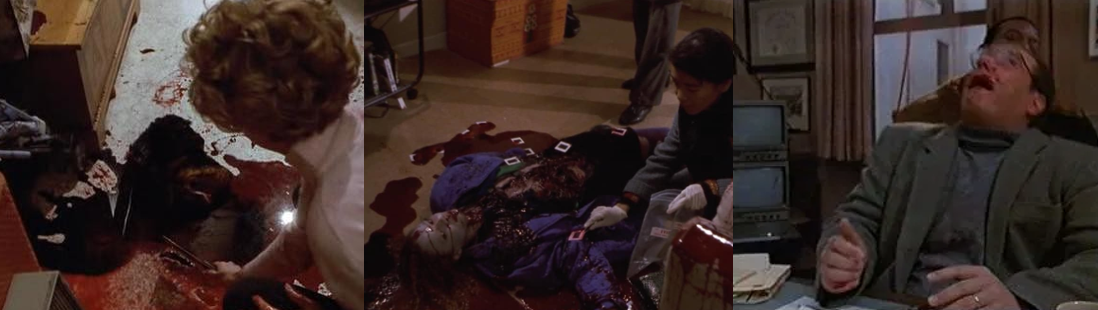
Although Candyman opts more for an ominous tone, things do get disturbingly bloody. At first, Candyman’s appearance and his victims are largely obscured, tying into his status as an ever-shifting ghost story. As Helen learns more, the brutality and clarity of the gore become more apparent, with Jake’s story of how “Candyman” castrated a young boy being particularly unnerving due to how malicious and random the attack is. Typically, we’re treated to the aftermath of Candyman’s attacks, with Helen waking up covered in blood, Anna-Maria’s apartment and Anthony’s crib being similarly bloodstained, and even Bernadette’s gruesome death depicted offscreen and through her butchered corpse. The only death we see clearly is Dr. Burke’s, whose back is split open when Helen calls Candyman. It’s a disturbing and savage end to a character who really didn’t deserve such horrifying treatment, just like Bernadette’s death, which has a distressing sexual undertone as all we hear are her screams of agony and Robitaille’s grunting. Dr. Burke’s death is similarly sexualised, almost an act of unwanted sexual aggression, and this ties into Robitaille’s designs for Helen. He mesmerises her and effectively date rapes her before rendering her docile for a kiss. Given that Helen resembles his lost love, this sexual subtext makes perfect sense and also goes hand in hand with his desire for them to burn alive like tragic lovers. Therefore, while Candyman uses gore sparingly, the blood is thick, viscous, and unnerving whenever it appears. Much of the movie is about building a tense atmosphere and Candyman’s magnetic presence, then suddenly the score drops or Robitaille appears for a jump scare that often leads to a savage murder. It’s extremely effective, largely because of Todd’s allure and Candyman’s horrifying hook hand, and more than makes up for some dodgy moments like when he’s floating above Helen or comically flies out of a window.
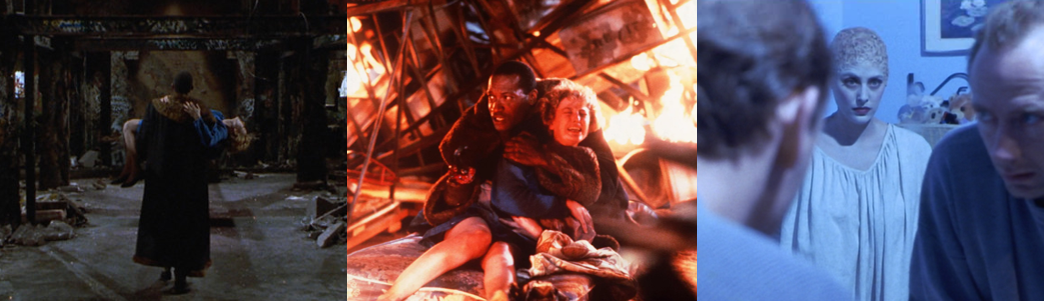
While Helen starts with good intentions, she quickly discovers that Daniel Robitaille is very real when he confronts her. Thanks to his influence, Helen is pegged as an abductor, murderer, and crazy woman, losing her husband to a younger, perkier student and being committed for her crimes. Eventually, realising she cannot escape him, Helen resolves to at least try and save baby Anthony from a squalid apartment in Cabrini-Green. When Helen confronts Candyman, he offers to spare the boy if she submits to him, which she willingly does. However, he immediately welches on the agreement by placing Anthony beneath a pile of debris the locals were assembling for a bonfire party, forcing Helen to scramble into the wooden construct to rescue him. Unfortunately, Jake spots the hook and assumes that “Candyman” has returned. Thus, he leads a mob of Cabrini-Green’s residents in burning the pyre to finally rid themselves of their tormentor. Though Candyman restrains her in the flames, relishing the legend their deaths will birth, Helen stabs him through his bee-encrusted ribs with a flaming piece of wood and causing Candyman to combust. While thrashing in agony and heartbreak, Candyman causes the structure to partially collapse, briefly pinning Helen under a beam and setting her back and hair on fire. Despite the pain, Helen safely returns Anthony to Anna-Marie, then succumbs to her horrific burns and dies. Surprisingly, Jake, Anna-Marie, and the other residents of Cabrini-Green join Trevor at Helen’s grave to both pay their respects and put Candyman to rest. Guilt-ridden, tormented by memories of a marriage he took for granted, the distraught Trevor locks himself in the bathroom, dismisses Stacey’s concerns, and mutters Helen’s name five times in anguish. She then appears before him, now also a wraith, and orgasmically dismembers him, leaving another brutalised corpse to further the legend of the hook-handed killer.
The Summary:
While I didn’t grow up with Candyman like I did other horror franchises, it remains one of the most haunting and striking of its genre even to this day. The score and atmosphere work in tandem with Tony Todd’s eye-catching look and voice to essentially create a modern-day gothic icon not unlike Count Dracula. These comparisons are especially apt when you consider Candyman as a tragic, romantic figure and that Helen even attempts to “stake” him with a hook while he’s slumbering. Candyman tackles relatable themes like segregation and racial prejudice and uses them as a backdrop for its supernatural elements, presenting a world where there’s a clear class and race divide that breeds resentment and violence. This is the perfect kindling for Candyman’s legend, which is so prevalent that street thugs are copying his look and gimmick to spread fear. Virginia Madsen delivers a nuanced performance as Helen, going from a fearless investigator to being captivated by Candyman’s allure and descending into near madness due to his actions. Tony Todd cemented his status as a screen and horror icon with this role, presenting Candyman as a loquacious, irresistible, and horrifying figure who, unlike his killers, doesn’t discriminate when choosing victims. Candyman wishes only to live as a feared memory, only taking lives when called forth and to bolster his legend, but actively torments Helen to start a new story and help him live on. While gore is used sparingly, it makes a hell of an impact when it appears and Candyman’s kills are disturbingly psycho-sexual in their brutality. It’s a very beautiful and atmospheric film, sneaking some chilling and startling moments amidst its painfully relevant story, and remains perhaps the greatest urban gothic horror of its time.
My Rating:
Great Stuff
Are you a fan of Candyman? If you’ve read the source material, how do you think the film works as an adaptation? What did you think to Tony Todd’s magnetic performance and the surprising tragedy behind Candyman? Did you enjoy the foreboding atmosphere and Helen’s investigation into the Candyman legend? Which of the Candyman films is your favourite? Whatever your thoughts on Candyman, feel free to share them below, check out my other horror content, and donate to my Ko-Fi if you’d like to see me cover the other Candyman movies.




 Dr. K's Waiting Room
You must be logged in to post a comment.