Back Issues [Crossover Crisis]: Crisis on Infinite Earths


Cover-dated April 1985, the first issue of this ground-breaking event precipitated the destruction of the “Multiverse” in favour of a unified DC canon. Though DC returned to this concept again and again, that doesn’t change how influential this massive crossover was and what better way to celebrate than with a “Crossover Crisis” of my own?


Published: 3 January 1985 (cover-dated: April 1985) to March 1986 (cover date)
Writer: Marv Wolfman
Artist: George Pérez

The Background:
In Showcase #4 (1956), writer Robert Kanigher and artist Carmine Infantino debuted Barry Allen/The Flash, the successor to Jay Garrick, who was established as an alternative version of the Fastest Man Alive. This concept was taken to the next level when Barry and Jay met face-to-face, revealing an infinite number of parallel worlds. Regular crossovers between the likes the Justice Society of America and the Justice League of America soon followed, allowing alternative heroes and various stories to exist simultaneously. Over time, writers like Mark Wolfman became frustrated with this concept, which made keeping track of continuity difficult and it was hard for both writers and readers to connect with the stories. Wolfman initially pitched a reader guide to simplify the DC universe, which then evolved into a sprawling tale of multiversal destruction seen as a risky proposition as it meant erasing all continuity and starting from scratch to attract new readers. Such an event was unprecedented and DC spent two years laying the foundation for this Crisis, hiring researchers to document every character and event in their library and bringing in George Pérez to illustrate, with the artist excited at the idea of illustrating every DC character. Crisis on Infinite Earths became a bestseller for DC Comics and was heralded as a turning point for both the publisher and the industry. The fallout saw every DC character rebooted, with Clark Kent/Superman notably being reimagined as a more grounded character and Wally West taking over as the Flash, though Carter Hall/Hawkman was irrevocably damaged for years as DC struggled to reconcile certain elements of his character. Praised as the greatest comic book crossover in history, the event popularised massive, cosmic crossovers and DC revisited this concept numerous times in subsequent years. The event was even adapted into an ambitious and well received television event and an impressive three-part animated feature.

The Review:
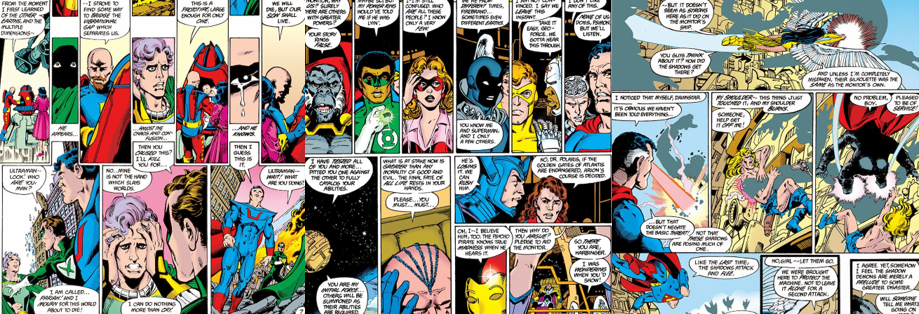
Confused by the concept of the multiverse? Well, Crisis on Infinite Earths has you covered, to a degree, as it opens with (and features throughout) narration and exposition from the tragic Kell Mossa/Pariah. In the beginning, before there was light and life, there was only darkness. Then, from nowhere, came a single light that grew and expanded and finally exploded in “pain [and] relief” as the multiverse was born. The idea is infinite parallel realities all co-exist at once, separated by vibrational planes, though this is noted to not have been the intention when the light burst into being. The story the shifts to one such Earth where the hooded, weeping Pariah witnesses the destruction of not only that world, but the entire reality, at the hands of an all-encompassing white light. As entropy erases everything it touches, Pariah begs to be taken with it, sparing him his grim fate, only to be teleported away as the universe meets its destructive end. We then jump to Earth-3, home of the Crime Syndicate, an evil alternative version of the Justice League. There, Harold Jordan/Power Ring and Clark Kent/Ultraman desperately try to stop the cataclysmic natural disasters springing up across their world as the anti-matter wave approaches. While Thomas Wayne Jr./Owlman and Jonathan Allen/Johnny Quick lament their helplessness against such awesome power, the world’s only superhero, Alexander Luthor, watches helplessly as lifelong enemies like Diana/Superwoman are devoured by the anti-matter wave. With no way to save his world, Alexander rushes to be with his wife, Lois, and baby son, Alexander Luthor, Jr. In a parallel to Superman’s iconic origin, the baby is loaded into a specially prepared rocket and spirited away to Earth-1 as his world dies.
With all universes at risk of annihilation, the Monitor assembles a team of heroes and villains.

The mysterious Mar Novu/The Monitor observes this from his orbiting, spherical space station alongside Lyla Michaels/Harbinger, whom he sends to recruit Earth’s greatest heroes and villains to stop the pending Crisis. Harbinger recruits King Solovar from Gorilla City, Dawnstar from the 30th century Legion of Super-Heroes, Danette Reilly/Firebrand from Earth-2 1942, Ted Kord/The Blue Beetle from Earth-4, and Roger Hayden/Psycho-Pirate from present-day Earth-2. She returns Psycho-Pirate’s emotion manipulating Medusa Mask and coerces him into quelling Louise Lincoln/Killer Frost’s bloodlust and bringing both her and Ronnie Raymond and Professor Martin Stein/Firestorm to the cause. Though Harbinger is possessed by a Shadow Demon when recruiting Ahri’ahn/Arion the Sorcerer, he joins the other recruits, including Kal-L/Superman, John Stewart/Green Lantern, Neal Emerson/Doctor Polaris, Victor Stone/Cyborg, Simon Jones/Psimon, and Todd Rice/Obsidian. With tensions running high, the group are attacked by Shadow Demons, which seem impervious to physical, mental, and energy-based attacks. While the likes of the Blue Beetle can only run and Firestorm struggles with Killer Frost’s newfound affections, Obsidian and the arrogant Dr. Polaris put their shadow- and magnetism-based powers to good use. The Monitor halts the attack and introduces both himself and the threat to their universes. Weakened by the spread of anti-matter and facing suspicion from his assembled forces, the Monitor reveals that he’s judged them as the best hope of protecting five devices spread across the different eras that he hopes will halt the anti-matter wave. Meanwhile, reality is warped across the multiverse: in prehistoric times, Anthro the Cave-Boy is as astonished to spot a futuristic city amongst the wilds as Querl Dox/Brainiac-5 is to see mammoths stampeding through the 30th century. Half a galaxy away on Oa, the Guardians of the Universe prepare to summon their entire Green Lantern Corps to meet the threat, only for a mysterious voice to corrupt the Central Battery and trap them in a stasis beam. On Earth-1, Bruce Wayne/Batman is busy confronting the Joker during his latest crime spree and is astonished when an emaciated, confused Flash suddenly appears babbling about the end of the world and begging for help before disintegrating before the Dark Knight’s eyes!
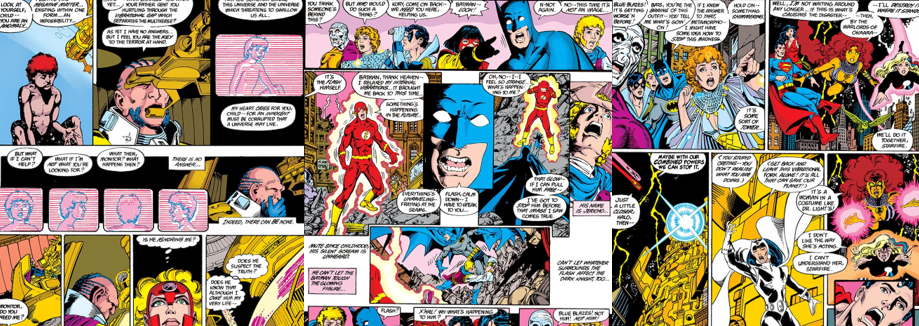
As the Crisis worsens, the Monitors prepares Alexander and a new Dr. Light to face the threat.

On the post-apocalyptic Earth-AD, Kal-L, King Solovar, and Dawnstar meet Kamandi, the last boy on Earth, and discover the Monitor’s device, a towering, golden Cosmic Tuning Fork that’s immediately (though only briefly) attacked by Shadow Demons. Arion, Obsidian and the Psycho-Pirate watch over another tower in Atlantis, only for the Psycho-Pirate to be transported to a dark realm and coerced into turning against the Monitor just as Harbinger secretly conspires with that same dark force. Oblivious, the Monitor experiments on the rapidly aging Alexander Luthor, Jr., an impossible merger of matter and anti-matter who potentially holds the key to defeating the anti-matter spread, whom Harbinger’s dark master wants destroyed before he can threaten his schemes. Meanwhile, in the far future of Earth-1, the Flash races to keep his world from being torn apart from natural disasters but is forced to vibrate at super-speed to escape death. This same anti-matter energy arrives on present-day Earth-1, much to the horror of the Teen Titans, who desperately try to both halt the destructive wave and save lives alongside Batman and Superman. As Linda Lee/Kara Zor-El/Supergirl does the same, Barbara Gordon/Batgirl gives in to self-doubt, and John Constantine arrogantly believes it’ll all work out, Vril Dox/Brainiac coldly observes the events concludes that, if he’s to survive, he must team up with Lex Luthor. While defending a Cosmic Tuning Fork from both Nazi forces and Shadow Demons in 1942 Markovia, the Blue Beetle discovers the mysterious Scarab fused to his suit is lethal to the shadowy entities but is wounded before he can put this to good use and returned to his world by the Monitor to spare him. Back on Earth-AD, the skies turn red and King Solovar succumbs to his wounds while Cyborg, Firebrand, John Stewart, and Psimon team up with some local heroes (including Jonah Hex) in 1879 to defend another tower, only to be as overwhelmed by anti-matter as the far-flung future of the Legion of Super-Heroes. Elsewhere, the terrified heroes of Earth-6 blame Pariah for the looming threat, to no avail (though Pariah does save Tashana/Lady Quark to ease his suffering). While the unseen villain forcibly recruits the Red Tornado, the Monitor activates an “ion-based energy ray” to empower Doctor Kimiyo Hoshi, transforming her into the new Doctor Light and sending her to defend his tower on Earth-1.
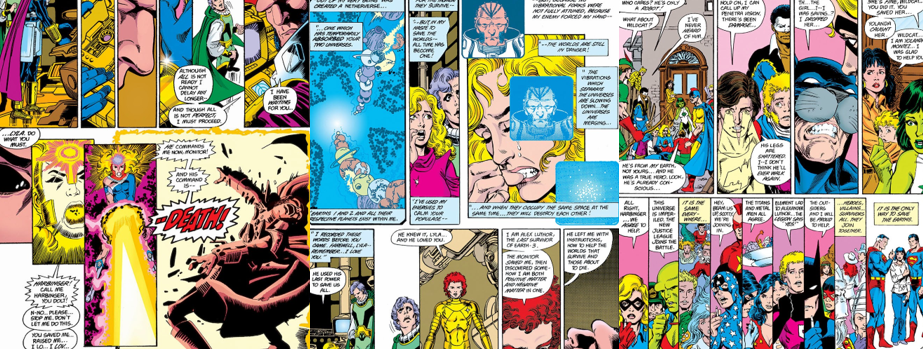
Following the Monitor’s death, his champions are convinced to unite and save the remaining Earths.

When the heroes attack her, believing she and the tower caused the entropy, Superman quells the fighting, though things take a turn when the Shadow Demons combine into one gigantic, terrifying entity in each era. Even Princess Diana Prince/Wonder Woman’s hopes of recruiting her Amazonian sisters fail. When Pariah berates the Monitor for not doing more to intervene, he reveals just how weak he’s become and then nobly faces his end at Harbinger’s hands. Distraught, Pariah weeps as Earth-1 and Earth-2 are finally consumed; confused to find his strength hasn’t increased as a result, the dark villain delights in having the Psycho-Pirate torture the Flash. Depowered, Lyla is distressed by her actions but a pre-recorded message from the Monitor reveals that his death allowed his essence to empower his Cosmic Tuning Forks and create a “netherverse”, a pocket dimension to keep Earth-1 and Earth-2 safe. After giving the Monitor an appropriate burial, Lyla, Pariah, and the now teenage Alexander Luthor, Jr. gather both world’s champions on the Monitor’s satellite to merge all existing realities into one lest all worlds and realities be lost. Since there are some doubters, Alexander has them witness the Red Tornado be forcibly transformed into a being of pure, primal force, one easily subdued by sorcerers like Kent Nelson/Doctor Fate and Zatanna Zatara (though Ted Grant/Wildcat’s legs are shattered during the fracas). Thus, even the most sceptical agree to defend their worlds, only for the satellite to disintegrate courtesy of the event’s big bad, the Anti-Monitor! Fleeing to the emptiness of limbo, Alexander moves to save Earth-4, -S, and -X, only for Harbinger to subdue him and take his place. While Yolanda Montez continues Wildcat’s legacy on Earth-2, the Freedom Fighters and the Monitor’s agents come to blows on Earth-X when the Psycho-Pirate, his powers augmented by the demonic Anti-Monitor, stirs fear and hatred amongst them. Similarly, on Earth-1, Billy Batson/Captain Marvel and his siblings mindlessly attack Supergirl and Wonder Woman, though the fighting ends when Harbinger forces Earth-4, -S, and -X into the netherverse alongside Earth-1 and Earth-2, exhausting her incredible powers but dooming them to be slowly merged together.
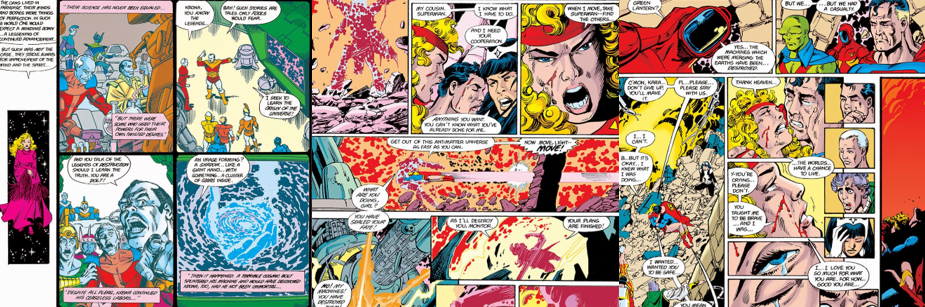
After Lyla relates the Anti-Monitor’s origin, Supergirl sacrifices herself to try and destroy him.

Thus, Lyla, Pariah, and Alexander assemble Earth-1’s Superman, Earth-2’s (Kal-L), Captain Marvel, the Blue Beetle, Lady Quark, and Uncle Sam and reveal that, ten billion years ago, the Oan scientist Krona dared to seek the beginning of the universe, witnessing a giant hand clutching a star cluster. This caused a cosmic fracture, creating not just the multiverse, but an anti-matter universe and a counterpart to Oa, Qward. After banishing Kronoa, the Oans created peacekeeping forces like the defective Manhunters and the Green Lantern Corps but were fractured by a civil war, birthing the Controllers. Amidst the fighting, the Monitor and his evil, anti-matter counterpart came into being. The Anti-Matter conquered Qward and created the Shadow Demons to spread his influence throughout the anti-matter universe before waging war against the Monitor upon sensing his presence. Evenly matched, they were rendered unconscious for nine billion years before being awoken by the misguided Pariah, once a celebrated healer and scientist who also investigated the origin of the universe. Pariah’s world paid the price, and he was damned to live forever and watch all worlds die, though the Monitor also saw him as instrumental in saving all reality. Alexander uses his unique matter/anti-matter powers to create a dimensional tear to the anti-matter universe, which Pariah leads the heroes to the Anti-Monitor’s vast stone fortress. Enraged that the Psycho-Pirate is too drained to corrupt them, the Anti-Monitor has his stronghold attack, injuring the usually invulnerable Kal-L. Dr. Light and Superman discover the Anti-Monitor’s solar collector but are attacked before they can destroy it and halt the merger of the Earths. Hearing her cousin’s agony, Supergirl flies to Superman’s aid, brutally beating the villain in a rage and chastising his disdain for life, tearing through his protective armour. Furious, the Anti-Monitor prepares to explode with all his energy and, in a last-ditch effort to destroy him, his machine, and save everyone, Supergirl tackles him, destroying his machine but being fatally blasted. As the Anti-Monitor’s deteriorating, incorporeal form slinks away, Superman mourns his cousin’s death and vows to kill the Anti-Monitor. Kal-L calms his counterpart and they escape, and a memorial service is held on Earth-2, where Superman pays homage to Supergirl, vowing to remember her and fight in her name. Despite the loss, the five worlds are saved; similarly, the Green Lantern Corps free their masters and almighty Darkseid wisely cloaks Apokalips from the Anti-Monitor’s gaze. However, the Anti-Monitor reconstitutes himself on his ship, where the Flash is imprisoned, and prepares a counterattack from Qward.
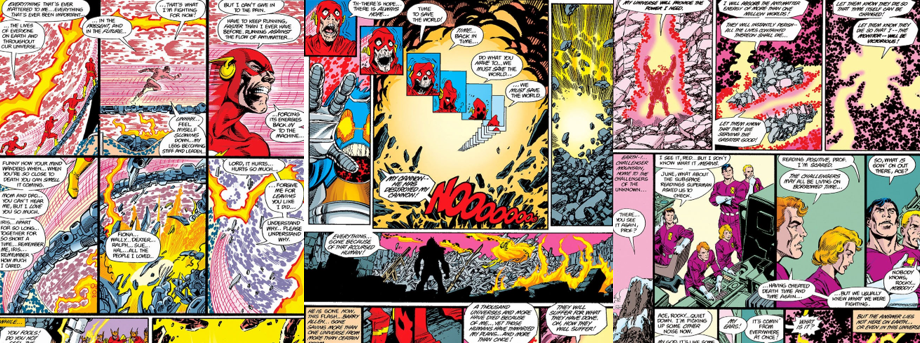
Despite the Flash’s noble sacrifice, the Anti-Monitor gains God-like power from his anti-matter universe.

Though saved, the five worlds are still overlapping, causing anomalies and damage to each while  the Anti-Monitor oversees the creation of the anti-matter cannon, which he plans to use to obliterate the worlds. Just as the Psycho-Pirate feels his powers return, the Flash escapes and angrily attacks the sadistic villain, forcing him to turn the Anti-Monitor’s slaves against their master as a distraction. Though stunned to find the anti-matter cannon is powered by concentrated anti-matter and realising that destroying it would kill him, the Flash bravely circles the weapon’s core to turn its destructive energy back on it. Staving off the agony with memories of his loved ones, the Flash runs fast enough to move back in time (explaining his earlier, sudden appearances). Though Barry successfully destroys the weapon, it costs him his life. Enraged, the Anti-Matter absorbs the anti-matter universe, literally sucking the life out of over a million worlds to feed his lust for power and vengeance, an act so awesome that it’s detected by both the Challengers of the Unknown and the embodiment of the Lord’s wrath, Jim Corrigan/The Spectre. In the face of multiversal destruction, the Guardians of the Universe offer Guy Gardner the chance to become a Green Lantern once again and, when all but one of them are all slaughtered by a sudden explosion, Guy vows to avenge them as their champion. The Brainiac/Luthor team then recruit dozens of villains to strike while the remaining Earths are weak and in disarray. As time runs amok on Earth-1 and Alexander, Lyla, and Pariah address the United Nations, the villains make their move, having conquered Earth-4, -S, and -X, encasing them within impenetrable barriers, and threatening to destroy the remaining worlds. Lyla and Jay recruit a reluctant Wally West/Kid Flash to breach the barrier with the cosmic treadmill, though neither Luthor or Brainiac care much about their losses since they still possess the power to destroy everything. However, the Spectre ends the hostilities by revealing that the Anti-Monitor still lives and plans to corrupt the flow of time and formation of life by travelling to the dawn of time.
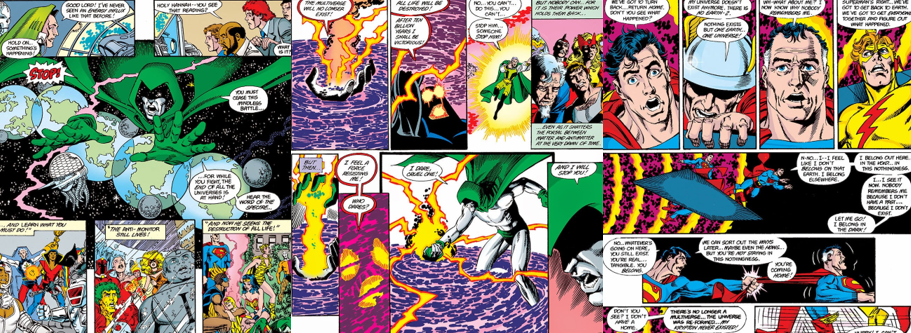
The Spectre demands co-operation, resulting in a singular world being created.

With the villains back on side, Kal-L bids an emotional farewell to his wife, Lois Lane, to join the counterattack, alongside a surprising newcomer: the Superboy from Earth-Prime (a fictional approximation of the real world where he’s the only superhero). After a rousing speech from Uncle Sam, heroes and villains alike pool their technology and powers to travel to the dawn of time and confront the anxious Anti-Monitor. The Anti-Monitor reveals that he, not Pariah, was responsible for the destruction of Pariah’s world after he took advantage of Pariah’s experiments to rebuild his power, absolving the tragic figure of his sins. Now grown to immense proportions, the Anti-Monitor withstands the assault of those assembled (with guys like Batman offering only support), absorbing their life energy to add to his power and allowing his hand to be the one that shapes all reality, as witnessed by Kronoa. His grasp is intercepted by the Spectre and the combined magic of the unified sorcerers, reducing the battle to a literal arm wrestle between the Anti-Monitor and the Spectre. Thanks to their bickering, Luthor’s underlings fail to kill Kronoa before he can cause the creation of the multiverse and the Anti-Monitor, and all seems lost. However, following a blinding light and the literal shattering of all time and space, Kal-L awakens on present-day Earth to find he’s on the same world as his Earth-1 counterpart. Sharing the same fragmented memories, Superman explains that time seems to be healing (albeit wonkily) and that elements of multiple Earths have been merged into one. For example, everyone knows Supergirl died but not how, the Flash is presumed vanished, and Earth-2’s Keystone City and Jay Garrick now live on this Earth. Jay, Wally, and the Supermen use the cosmic treadmill to discover Earth-2 is missing. Realising that the multiverse no longer exists, Superman has to force his older counterpart to return rather than throw himself into the endless void in despair. With the cosmic treadmill irreparably damaged, Wally assembles everyone at Titans Tower, discovering guys like Captain Marvel, Superbody-Prime, Uncle Sam, and the Earth-2 Dick Grayson/Robin also exist on this world, where they’re all shocked to see Harbinger alive and powered back up. The refugees are despondent and horrified to learn their worlds, pasts, and many loved ones are gone thanks to “cosmic irony” as Harbinger explains that there is now one Earth with one coherent timeline that folds their disparate lives into its flow, sending Kal-L into a crazed distress at having lost his wife and home.
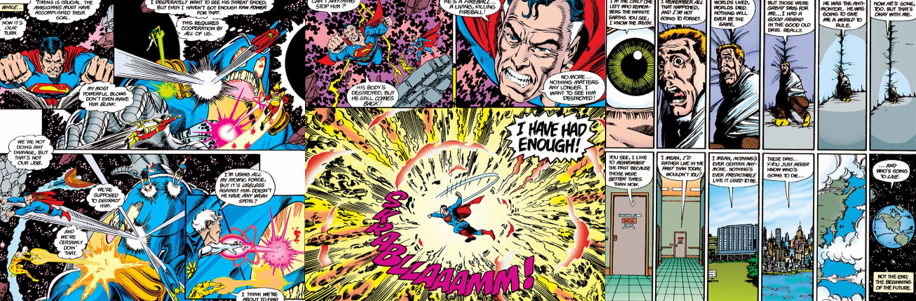
A final, all-out assault ends the Anti-Monitor and starts the universe anew, with some casualties.

After questioning the imprisoned Lex Luthor, Batman, Jason Todd/Robin, and Alexander confirm that, while some duplicates remain and some lives were restored, others weren’t and only those who present at the dawn of time remember the multiverse. Just as they’re processing this, the skies turn red and the world suddenly shifts to the anti-matter universe, where the titanic, disembodied Anti-Monitor still lives! Though incensed by their efforts, the Anti-Monitor congratulates them for handing him his first defeat in ten billion years and then decrees that they must all die. Wally’s shock at his mentor’s death is mirrored by the abject panic that sweeps the civilians following the Anti-Monitor’s threat, which doubles when the Shadow Demons kill Don Hall/Dove, Helena Wayne/Huntress, and Tula Marius/Aquagirl. While the sorcerers remove the Shadow Demons, Harbinger assembles one last effort to stop the Anti-Monitor on Qward. Though the Anti-Monitor is too large and powerful to be damaged, Harbinger has Dr. Light absorb the star feeding him power, weakening him enough for Alexander to breach the villain’s armour. With the threat seemingly ended by a combined energy blast, Alexander struggles to return Earth home and the Anti-Monitor absorbs his exiled Shadow Demons to rise again and vaporise Wonder Woman. Rather than see anyone else die, Kal-L tackles the Anti-Monitor, believing he’s got nothing to lose, and Alexander and Superboy-Prime are trapped with him. Though Darkseid, watching from Apokalips, strikes a fatal blow through Alexander’s eyes, the Anti-Monitor refuses to die, so Kal-L delivers a final strike that obliterates the tyrant. Faced with the pending destruction of the anti-matter universe, Kal-L and Superboy-Prime prepare to meet their end only for Alexander to teleport them, alongside Kal-L’s Lois, to a pocket dimension. In the aftermath, Wonder Woman returns to the clay that forms Themyscira, her Earth-2 counterpart is welcomed among the Gods, the dead heroes are memorialised, and Wally assumes the Flash mangle. Confined to Arkham Asylum, the Psycho-Pirate is dubbed a raving lunatic since he’s the only one who remembers the multiverse and the catastrophic events of the Crisis.

The Summary:
Whew, there’s a lot happening in Crisis on Infinite Earths. There’s a reason I’ve put off reviewing it for so long, and why I rarely revisit it. It’s a very dense and complex story, full of exposition and cameos and faces both obscure and iconic. As a celebration of DC’s rich history and characters, it’s hard to find much better than Crisis on Infinite Earths, which stuffs just about every costumed character, hero or villain, into its dense twelve issues! My hat’s off to George Pérez; it must’ve been painstaking to sketch all these group shots, action sequences, montages, and dramatic events. Equal praise to Marv Wolfman as I can’t imagine how difficult it was to make sense of all these different worlds and come up with a cohesive way to explain, link, and destroy them all. In the end, the solution was simple: pure, destructive, unstoppable entropy. It’s fitting that the anti-matter wave is depicted as a blinding white light that erases everything it touches, for it symbolically represents a blank page or an artist’s eraser, indicating that these colourful and convoluted worlds are being literally wiped clean for a new status quo. Our guide through most of this is Pariah, a tragic figure doomed to watch each world die as penance for kick-starting the events that follow. Immortal but seemingly powerless to intervene, all he can do is shout desperate warnings and is powerless to rescue anyone and constantly met with aggression, suspicion, and accusations. He’s merely a pawn in a much larger game, however, much like Harbinger, who acts as an all-powerful emissary of the Monitor and deliver exposition in his stead. A conflicted individual burdened with the knowledge that she will betray and murder the man to whom she owes her life, Harbinger, nevertheless works to uphold the Monitor’s legacy and bring together heroes and villains alike to stand against his dark counterpart.
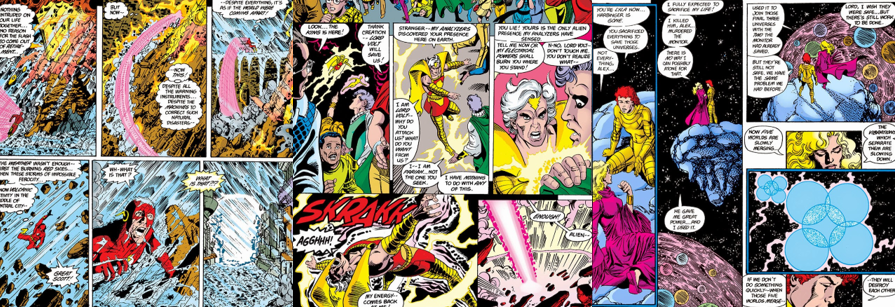
The Anti-Monitor’s power sends shockwaves through the multiverse and those who’ve witnessed it.

The dreaded inevitability of death is a focal point in Crisis on Infinite Earths. When the anti-matter wave hits, heroes and villains set aside their differences and use all their powers and resources to either stop it or save people from its destructive touch. Even the abhorrent Crime Syndicate find themselves fighting to save their world and Ultraman willingly enters the wave to die on his terms. Even before the wave arrives, the worlds are shaken to their core by natural disasters; volcanoes, tsunamis, and ominous, crackling red skies precipitate the disaster as much as Pariah. Perhaps no character is more synonymous with the coming destruction than the Flash; thanks to his super-speed, he ends up travelling through time, arriving before the likes of Batman and Wally as an omen of what’s to come and taking on an appearance that resembles Death itself. The Anti-Monitor echoes this in his design; though shrouded by his all-powerful armour, he sports a skull-like visage and dark, piercing eyes. Commanding demonic shadows, he’s very much the embodiment of Death and his lust for utter annihilation drives him to snuff out all life and light. Sadistic to the core, he employs the Psycho-Pirate to foster fear and hate, turning his would-be opponents against each other and causing countless more deaths. His ruthlessness seemingly knows no boundaries as he gleefully corrupts Harbinger, relishes the death of his counterpart, and nonchalantly obliterates his rebellious slaves without a second thought. His power and cruelty are so great that even the mighty Darkseid is driven to hide rather than confront him, striking when the villain is at his most vulnerable and largely avoiding the greater conflict. For all his God-like power, the Anti-Monitor still relies on technology; his merger and destruction of worlds can be halted or stopped by Cosmic Tuning Forks or destroying his solar collector. Indeed, it’s only after his massive, world-ending cannon is destroyed that the Anti-Monitor eschews all other methods and absorbs the entire lifeforce of the anti-matter universe into himself to literally take matters into his own hands.
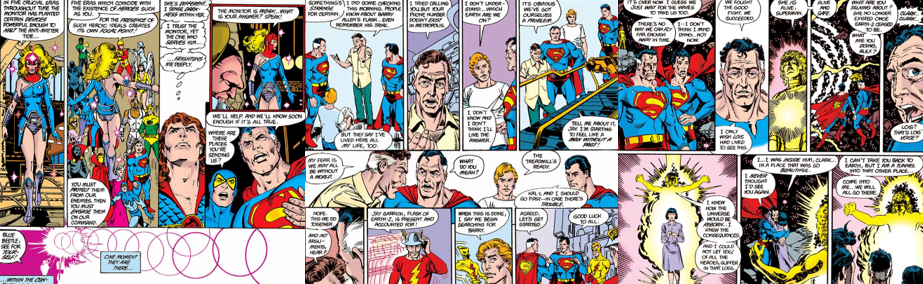
The Supermen anchor the story, leading the assembled champions in battle and saving all reality.

There is no one central character in Crisis on Infinite Earths. Instead, it’s a team-up story through and through, meaning some of your favourites may be sidelined. In some respects, I don’t mind this; Batman outright admits how useless he is against the Anti-Monitor and it’s clear only beings of incredible power can stand against him. Yet, the Blue Beetle is said to be pivotal in opposing the villain, the Red Tornado is briefly said to be incredibly important, and Lex Luthor comes close to co-ruling five entire worlds and even leads the charge to assassinate Kronoa. The Earth-2 Superman, Kal-L, is often at the heart of the conflict, leading the others and inspiring confidence, as is his Earth-1 counterpart. It’s therefore more tragic seeing Superman’s grief-stricken reaction to his cousin’s death; holding Supergirl in his arms, the Man of Steel briefly forgets his morals and vows to kill the Anti-Monitor as recompense. This is but one of the unforgettable deaths featured in Crisis on Infinite Earths as the Flash sacrifices himself to deal a critical blow to the Anti-Monitor, making a martyr of himself for decades before DC made the bone-headed decision to revive him. There’s an odd dichotomy in Crisis on Infinite Earths; these alternative worlds and characters co-exist and are even folded into one by the end. Rather than wiping everything away and starting afresh by the conclusion, the story clunkily has the survivors forget key events and weaves characters like Captain Marvel and the Justice Society into a unified timeline. This works for me as I prefer a coherent narrative, but it essentially means Crisis on Infinite Earth takes place mid-way through the early years of the post-Crisis reboot and reimaginings like John Byrne’s Superman stories happen before and during this event, rather than after it.
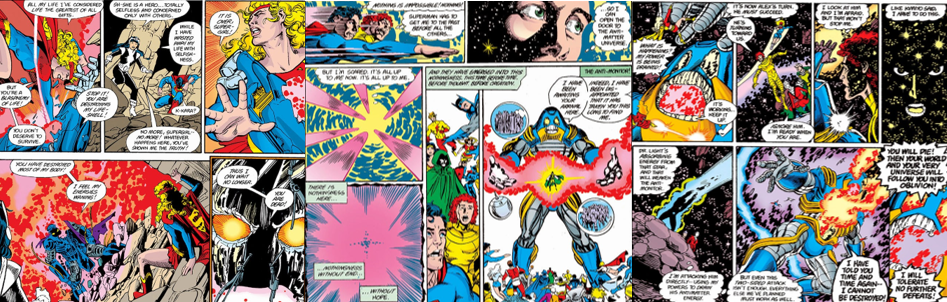
Worlds lived, worlds died, and the DC Universe was never the same…for about twenty years…

These days, Crisis on Infinite Earths may be a lot for modern readers to take in. Many of its characters and concepts are either forgotten, wildly different, or have been done to death thanks to the multiple reality-altering events that followed (many specifically to address loose ends from this story). At the time, though, I’d wager many long-term DC readers appreciated the cameos and call-backs weaved into the story. I’m glad DC devoted twelve issues to the story and didn’t rush it, but it does get repetitive and convoluted as it drags on. The secondary threat of Brainiac and Luthor directing a team of villains to conquer the five worlds, for example, could probably be skipped or relegated to a tie-in comic. Similarly, the defending of the Cosmic Tuning Forks isn’t very interesting and doesn’t really add to the story since we barely see any action around this, the Shadow Demons are too powerful to be interesting, and it’s all negated by the Monitor’s death. In this respect, I think the event could’ve been cut down to eight or ten issues and still been just as effective, especially as many Earths and characters feature as quick cameos to be obliterated. The remaining five Earths are said to be the most important, which is a little disrespectful to those that perished by the Anti-Monitor’s hand and a bit of an insult to any fans of those worlds. I liked seeing new heroes rise during the chaos, like a new Dr. Light (who was an aggressive bitch throughout), Wildcat, and Guy being Green Lantern again, though it falls a little flat when you know the canon is going to be altered after this to return the status quo. I liked the Anti-Monitor’s design and his characterisation as a reprehensible being who craved only power and destruction, but it was hard to get a sense of his power and limitations. One minute he’s weakened by giant towers, then his armour is containing his energy, and then he’s being powered by a black sun despite having absorbed the lifeforce of his anti-matter universe. Still, the unification of heroes and villains to oppose him was fun to see, the sacrifices and determination were poignant, and the weaving together of a singular continuity, while flawed, was ambitious and visually engaging to behold.

My Rating:

Rating: 4 out of 5.

Great Stuff

Have you ever read Crisis on Infinite Earths? What did you think of this unprecedented mash-up of DC’s various worlds and characters? Which parallel world was your favourite and were you upset to see destroyed? What did you think to the Anti-Monitor, his vast power and his stubborn refusal to die? Were you shocked to see Supergirl and the Flash die so dramatically? Do you agree that the story dragged on a bit by the end? Which of the subsequent Crisis events was your favourite and what are some of your favourite cosmic events? Drop a comment below to share your thoughts about Crisis on Infinite Earths and feel free to check out my reviews of other notable crossovers.

Movie Night: Blue Beetle

Released: 18 August 2023
Director: Angel Manuel Soto
Distributor: Warner Bros. Pictures
Budget: $104 million
Stars: Xolo Maridueña, Bruna Marquezine, Belissa Escobedo, George Lopez, Raoul Max Trujillo, and Susan Sarandon

The Plot:
College graduate Jaime Reyes (Maridueña) finds himself unwittingly bonded to an alien, beetle-like suit of armour (Becky G) and drawn into a destructive conflict with the vindictive Victoria Kord (Sarandon) and her ruthless enforcer, Ignacio Carapax (Trujillo)

The Background:
Initially presented as a beat cop created by Charles Nicholas Wojtkoski, the Blue Beetle is easily one of DC Comics’ more obscure characters, despite Steve Ditko’s reimagining attaining cult status due to his time with Justice League International. It’s the third iteration, Jaime Reyes, who is easily the most recognisable incarnation of the Blue Beetle thanks to being a Latino superhero and appearances in videogames and television. Development of a live-action film focused on the character began in 2018, initially scheduled as content for HBO Max before Warner Bros. were impressed by director Angel Manuel Soto’s vision and bumped it to a cinematic release. The filmmakers were keen to emphasise Jaime’s family roots and values alongside him coming to terms with his powers as a metaphor for maturing into a young adult, with star Xolo Maridueña excited at the prospect of being DC’s first Latino superhero. The Blue Beetle armour was designed by Mayes C. Rubeo, who took inspiration from anime as much as the character’s many iterations in and out of the comic books, while various special effects groups collaborated to bring the character’s unique alien weaponry to life. Although Blue Beetle was met with mainly positive reviews that praised the performances and heart of the movie, it was met with a disappointing initial box office; as of this writing, the film has grossed over $50 million at the box office, though DC Universe head honcho James Gunn and all involved were keen to return to the character in future projects.

The Review:
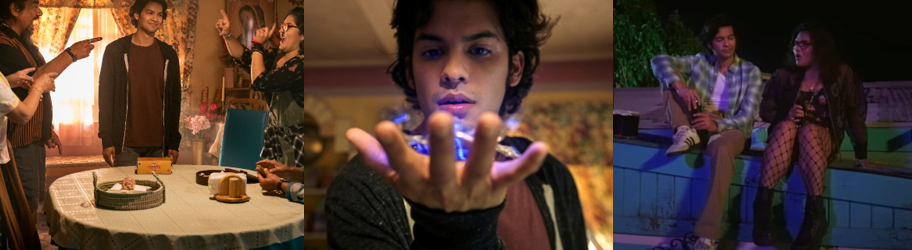
I’ll be honest and say that I was very surprised when I first caught wind of a live-action Blue Beetle solo movie. Considering the state of the DCEU, it seemed odd to me that they would prioritise such a film, though it’s pretty clear that it’s yet another attempt by the studio to change direction, as well as appeal to fans of troubled superheroes like Peter Parker/Spider-Man and target a new demographic in the genre, in this case the Hispanic audience. While I’m quite familiar with all iterations of the Blue Beetle, I’ve always felt a bit of a disconnect with Jaime, mainly because his iteration changed the concept so much. Still, he’s a popular figure and I can understand trying something new, and luckily Blue Beetle proved to be an enjoyable enough adventure simply by focusing on relatable themes such as family, a sense of identity and duty, and exploring xenophobic themes through Jaime and his destitute, hard-working family against the technologically advanced corporate greed of Victoria Kord and her malevolent Kord Industries. When we first meet Jaime, he’s just graduated from Gotham High (the first in his family to achieve this) and has aspirations of making his family prouder by landing a job worthy of his degree, only to find himself forced to scrub gum off Victoria’s decking alongside his snarky little sister, Milagro (Escobedo). I can immediately relate to the frustration he feels about this; there’s nothing worse than spending years at university (getting yourself into debt, in Jaime’s case) only to find having a degree doesn’t open the doors you’d expect, and Jaime suffers even more as Victoria basically treats all her staff, especially the lower classes like the Reyes’, as glorified servants.

The heart-warming and relatable relationship between Jaime and his family is the heart of the film.

Jaime is devastated to learn that his family will be forced to leave their home since Kord Industries tripled the rent; after his beloved father, Alberto (Damián Alcázar), suffered a mild heart attack and was forced to sell the family garage, they’ve barely been able to scrape by, though the Reyes’ remain resolute because they are such a tight-knit and loving family unit. Jaime’s mother, Rocio (Elpidia Carrillo), remains steadfast that they can whether any storm, his surprisingly capable and bad-ass Nana (Adriana Barraza) demonstrates a fighting spirit and chequered background that contrasts with her frail form, while his rebellious, anti-authoritarian uncle, Rudy (Lopez), riles his family up with his crackpot theories and wacky inventions. Still, they are a supportive and loving group; Jaime might be embarrassed by their outspoken love for him, but he’s absolutely devoted to them and desperate to help out with their financial situation. This sense of loyalty and responsibility sees him intervene when he spots Victoria and Carapax giving Jenny Kord (Marquezine) a hard time, which results in him and Milagro getting fired but also opens an opportunity for Jaime to secure a better job at Kord Industries courtesy of a grateful Jenny. Although his family wind him up over his obvious attraction to the young Kord, Jaime is primarily motivated to take a chance on this offer out of a deep-rooted desire to put himself to work for the good of his family, and ends up biting off more than he can chew when a desperate Jenny hands him a mysterious scarab, an alien device once studied by her father and long coveted by Victoria, who moves Heaven and Earth to acquire it to upgrade her company’s destructive One Man Army Corps (O.M.A.C.) technology.

The scarab bestows Jaime with potentially unlimited power and opens up an unexplored corner of the DCEU.

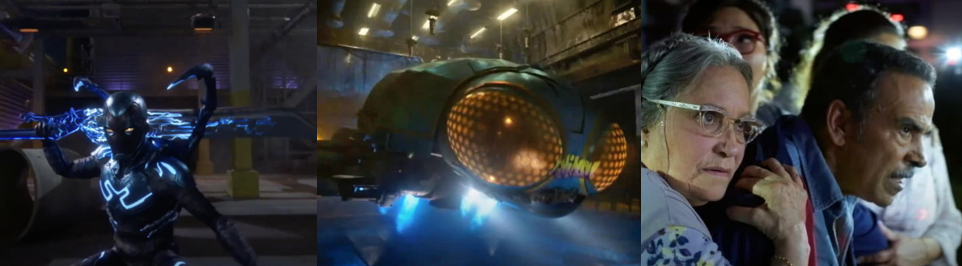
Upon inspecting this artifact, Jaime and his family are shocked and horrified when it suddenly springs to life and grafts itself to his spine, painfully growing a techno-organic armour right through his skin and encasing him in an honestly really well-realised rendition of the Blue Beetle suit in scene reminiscent of The Guyver (George and Wang, 1991). Unlike in his initial comic run, the armour (which identifies itself as Khaji-Da) communicates directly to him, though he remains mostly incapable of controlling the symbiotic suit and much of his character arc is learning not to fear or rid himself of the armour, but to embrace his newfound destiny. Described as a world-destroying weapon, the armour renders Jaime effectively bulletproof and resistant to serious injury, healing any wounds he receives and conjuring fantastical weapons based purely on his imagination and willpower. Initially, Jaime is terrified at the prospect of the symbiote imbuing itself into his nerves and brain and is entirely dependent on Khaji-Da to take over when in a combat situation, with his only influence being his desperate pleas not to use lethal force (a sentiment his family, curiously and hilariously, do not share). With his family fearing for his safety and Jaime out of his mind with panic, they’re forced to turn to Jenny for answers; she reveals that her father, Ted Kord, once studied the scarab alongside its former host, Dan Garrett, with both of them fighting crime in the past as the Blue Beetle. Although she’s unable to offer a reasonable solution to Jaime’s predicament, her assistance allows Jaime, Milagro, and Rudy to explore Ted’s long-abandoned lab and retro technology and put Jaime on the path to discovering his true calling as a superhero.

While Carapax showcases some surprising depth, both he and Victoria ham it up a bit too much.

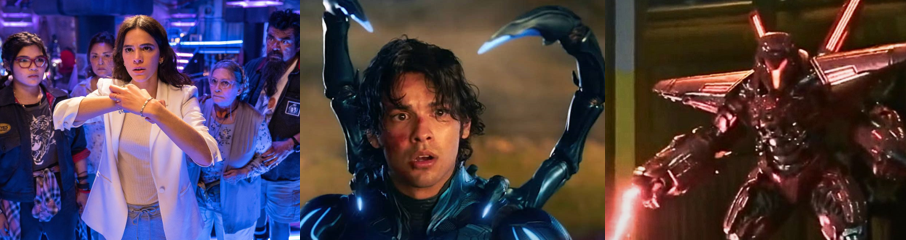
Malicious and ruthless after being spurred by her father in favour of her brother, Victoria has reshaped Kord Industries into a weapons manufacturer and become obsessed with acquiring the scarab to take her O.M.A.C.’s to the next level. Although I applaud the filmmakers in securing Susan Sarandon for this role, it can’t be denied that she’s absolutely hamming it up to the point of being a pantomime villain, overdelivering many of her lines and exuding a one-dimensional, xenophobic hatred towards anyone she sees as lesser than her. The only person she shows a modicum of respect and admiration for is her right-hand man, Carapax, the most capable and ruthless of her soldiers; a half-human cyborg empowered by the existing O.M.A.C technology, Carapax is absolutely loyal to Victoria’s bidding and takes a sadistic pleasure in hunting down Jaime to apprehend him for her experiments. Although a largely stoic and grim juggernaut of a henchman, Carapax is secretly hiding a pain of his own, one that he has largely forgotten due to the emotional and physical trauma of being transformed into a cyborg; his family were murdered before his eyes by Victoria’s weapons, and she herself oversaw his transformation simply out of a cruel desire to test her technology on a live (and suitable) subject. Bolstered by uncannily futuristic technology and her own private army, Victoria stops at nothing, even targeting her own niece, to get what she wants; her desire to get her hands on Jaime is so great that she leads an attack on the Reyes household and indirectly causes Alberto to suffer a fatal heart attack. This, however, has the knock-on effect of galvanising the Reyes’ into using Ted’s weaponry to storm Kord Industries and rescue Jaime, proving that Carapax was incorrect when he dismissed Jaime’s love for his family as a weakness. As interesting as Carapax is, these developments don’t come until the film’s finale and he loses much of his appeal whenever his bulky armour obscures his face and form, ultimately making him as over the top as Sarandon’s performance.

The Nitty-Gritty:
Although themes of family are prevalent in many superhero films, they’re at the forefront in Blue Beetle and represented in different ways by each character. Obviously, the most prominent representation of traditional family values are the Reyes’, a hard-working immigrant family who weathered terrible adversity to establish a home in the United States and value each other more than material possessions. These aspects are explored through Jaime’s interactions with Alberto, in which he expresses no regrets at having to work every job he could get and all the hours of the day to get his family to America, and later guides Jaime towards embracing Khaji-Da and ending the conflict within him as his final gift to his son. Jenny is absolutely aghast at how her aunt has perverted her father’s company into a greedy, ruthless powerhouse that lords itself over everyone and treats its employees as expendable pawns. Heartbroken at the disappearance and presumed death of her father, Jenny has actively been trying to do good in his name against her aunt’s wishes and sees liberating the scarab from Victora’s clutches as the ultimate insult. Victoria’s entire motivation for being such a cartoonishly cold-hearted villain is based on the bitterness she felt towards her father, who bequeathed Kord Industries to Ted over her despite her being instrumental in establishing the company. Finally, though Carapax sneers at Jaime’s emotional ties to his family, the scarred brute is fuelled by the trauma he endured at seeing his family violently killed; he carries their locket on his person and is later inspired to end himself and Victoria after remembering that his poisonous employer was responsible for his pain and suffering.

While the suit and effects are a lot of fun, it’s the familial aspects that hold this film together.

I praised the Blue Beetle suit earlier and it really does look great here; a mixture of practical and CGI effects, the armour is extremely versatile, conjuring bug-like wings, concussive blasts, and even a fully-functional Buster Sword to easily best swarms of heavily-armed goons. Indeed, the Blue Beetle is almost too powerful here, proving resistant to all harm and unstoppable once Jaime and Khaji-Da are united; the only one capable of consistently offering a challenge to the Blue Beetle is Carapax, whose weapons-grade O.M.A.C. armour is more than up to the task of matching the panic-stricken teen blow for blow. While the Blue Beetle armour is strikingly faithful to its comic book counterpart (almost to a fault with its strangely cartoonish face), the O.MA.C. armour is heavily altered to more resemble Carapax’s comic book counterpart, and appears more akin to something seen in the Iron Man movies (Various, 2008 to 2013). Still, the action and fight scenes involving both were exhilarating and fun, especially when Khaji-Da took control and turned Jaime into a cartwheeling, sword-wielding engine of destruction. The Blue Beetle’s flight scenes were also a lot of fun, as was exploring Ted’s underground lair, his retro-tech (including comic-accurate renditions of the Dan Garrett and Ted Kord Blue Beetle suits), and the Reyes’ commandeering Ted’s old school weapons and ridiculous bug ship to go rescue Jaime. While the bug ship looks a little cartoony at times, it was fun seeing Rudy stomp about, impaling Victoria’s guards and unleashing Ted’s unique weaponry on her forces, as was seeing Milagro and even Nana take up arms to help Jaime out in the name of love and family. Yet, easily the film’s most poignant scene is a metaphysical interaction between Jaime and his father’s spirit in a limbo between life and death; here, Alberto encourages his son to embrace his destiny, finally allowing true symbiosis between him and Khaji-Da, a revelation sadly somewhat muted when Jaime has to wait for the suit to reboot after escaping Victoria’s energy-sucking device (though this is a great excuse for the gun-toting Nana to shine).

Jaime’s family ultimately proves his greatest strength in overcoming Carapax.

Desperate to retrieve the scarab after learning Jenny swiped it, Victoria leads her troops and Carapax to the Reyes’, mercilessly threatening them and even causing Alberto’s death in a bid to draw out and capture Jaime. This proves a success and Jaime is hooked up to an elaborate machine that forcibly downloads the scarab’s code to empower the O.M.A.C. armour, but luckily Alberto’s spirit and Jaime’s family help to rescue him and scupper Victoria’s entire operation. Jenny even earns a modicum of catharsis when she tackles Victoria out of her helicopter and smashes the scarab data which, in conjunction with blowing up the O.M.A.C. lab, leaves Victoria desperate to avenge herself, only to find that Carapax has suffered a change of heart when Jaime inexplicably shows him mercy and they come to an understanding. This comes after a lengthy and brutal battle between the two armoured warriors in which the continually bust out bigger and better weapons to try and beat the other; Carapax uses every trick in the book, including taunting Jaime over his perceived weaknesses and seemingly killing Rudy, to gain the upper hand on his young foe, who is pushed to the brink by the onslaught. Despite having spent the whole film admonishing Khaji-Da for favouring lethal force, Jaime is fully preparing to execute the defenceless Carapax but spares his life after being shown his traumatic memories, finally reaching an understanding with Khaji-Da and leaving the grief-stricken brute to avenge his losses against Victoria. In the aftermath, Jenny assumes control over Kord Industries and immediately sets about discontinuing their weapons production; she vows to rebuild the Reyes’ house and give back to the community, rather than steamrolling over it, and shares a passionate kiss with Jaime (though, to be honest, I wasn’t convinced that she was as into him as he was her, so maybe they should’ve stayed plutonic friends, at least until the sequel). Speaking of which, the seeds of further intrigue are planted not just from the opening credits, where an errant Green Lantern beam causes the scarab to fall to Earth, but when Ted Kord (Unknown) desperately tries to contact someone for aid…

The Summary:
I was honestly sceptical going into Blue Beetle; it’s such an obscure character and an odd decision to go in, especially now with the DCEU in such a confusing flux, but the film actually held up really well, despite a few hiccups. The effects and suit action were really impressive, with a strong anime influence and drawing from some familiar superhero cliches but presenting them in a visually engaging new way, such as Jaime panicking and pleading with the suit and apologising to those around him since he’s not in control of himself when Khaji-Da takes over. Jaime himself and his family were very enjoyable characters; I liked their banter, their relatability and humanity, and the heart that held them together even in the toughest of times. While I wasn’t entirely convinced of the romance between Jaime and Jenny (mainly because I would’ve liked to see more of her showing an equal interest in him, rather than it being largely one-sided), the relationship between him and his sister, father, and uncle kept the family drama elements interesting for me. Unfortunately, Susan Sarandon is hamming it up a bit too much for me; she seems to be channelling the pantomime-like villainy that once dogged the genre and which I thought we’d moved on from. Carapax is far more compelling, but is largely just a surly brute of a man until some last-second revelations and is again simply a dark mirror of the hero, clichés that I can’t help but point out as flaws even if the film mostly kept its head above water. Overall, this was a fun introduction to a fresh, young superhero and I’d like to see more from these characters going forward, with perhaps some more visually and thematically interesting villains being introduced to place more emphasis on the positives at work here.

My Rating:

Rating: 4 out of 5.

Great Stuff

Did you enjoy Blue Beetle? Were you surprised to see the character brought to life on the big screen or did you enjoy seeing a fresh new ethnically diverse superhero take the spotlight? What did you think to the relationship between Jaime and his family? Did you enjoy the look and powers of the suit? What did you think to the more cartoonish presentation of the villains? Would you like to see more from these characters, and which obscure DC hero would you like to see get their own film? Whatever you thought about Blue Bettle, drop a comment below or on my social media and be sure to check out my other Blue Beetle content on the site.

Back Issues: Blue Beetle (2006) #1-3

Story Title: “Blue Monday”
Published: May 2006
Writers: Keith Giffen and John Rogers
Artist: Cully Hamner

Story Title: “Can’t Go Home Again”
Published: June 2006
Writers: Keith Giffen and John Rogers
Artist: Cully Hamner

Story Title: “The Past Is Another Country”
Published: July 2006
Writers: Keith Giffen and John Rogers
Artist: Cynthia Martin

The Background:
I wouldn’t begrudge modern readers of DC Comics if they didn’t know who Dan Garret was. The creation of Charles Nicholas Wojtkoski, the very first Blue Beetle featured prominently in Charlton Comics and is pretty much all but forgotten in the legacy of the character. Hell, I wouldn’t be too surprised it Garret’s successor, genius inventor Theodore “Ted” Kord, didn’t ring a bell; in 1966, Steve Ditko reimagined the Blue Beetle but, despite his tenure on Justice League International and making waves through his friendship with Michael Carter/Booster Gold, Ted never really rose beyond the ranks of a D-list hero and is generally remembered for being shockingly and graphically executed on-panel in the build-up to the universe-shaking Infinite Crisis (Johns, et al, 2005 to 2006). Indeed, even a big Ted Kord fan like myself has to acknowledge the mainstream impact of his successor, Jaime Reyes, easily the most recognisable incarnation of the Blue Beetle to date; Jamie has appeared in videogames, cartoons, and in live-action, both on television and even his own feature film. A noted Latino superhero, Jaime was created by Keith Giffen, John Rogers, and Cully Hamner and debuted in the pages of Infinite Crisis before appearing in his own self-titled comic book two months later. Jaime separated himself from his predecessors not just in his more diverse background and his youth, but also by actually deriving superhuman powers and abilities from a techno-symbiotic alien scarab infused to his spine, making him theoretically the more competent of the three Blue Beetles, though this was counterbalanced by his lack of experience and control with the scarab. Jaime has been a part of DC’s premier superhero team, the Justice League, as well as the Teen Titans, fought extraterresital threats and struggled to figure out his powers, and is generally regarded as one of DC’s best legacy characters in recent years.

The Review:
As mentioned above, Jaime made his first appearances in the epic, universe-shattering Infinite Crisis. Specifically, Jaime made a very brief cameo in Infinite Crisis #3 (Johns, et al, 2006) where, in the midst of the mainstream DC universe being rocked by incursions from disgruntled heroes from previous, destroyed worlds, young Jaime just happened to stumble across the glowing, mysterious scarab just sitting out in the open. Jaime returned in Infinite Crisis #4 (ibid), where he was stunned to find Booster Gold and Skeets searching his bedroom for the scarab, which would allow him to reveal the forces of Bruce Wayne/Batman’s renegade artificial intelligence, Brother Eye; although initially amazed to find such a prominent, corporate sponsored hero in his bedroom, Jaime was soon aghast to find that the scarab had fused itself to his spine. When Booster Gold brought him to the Batcave in Infinite Crisis #5 (ibid), Jaime’s life changed forever as the scarab, sensing danger, encompassed his body in a sleek, form-fitting armoured suit unlike any sported by his predecessors. Although very much out of his depth, Jaime found himself in space alongside some of Earth’s greatest heroes in Infinite Crisis #6; his suit unsettled Green Lantern John Stewart’s semi-sentient power ring and he was so overwhelmed by the confusion and stakes of their mission that he had to receive a pep talk from Batman, of all people. Although he couldn’t begin to understand the nature of the scarab, Jaime found the suit had a mind of its own; as soon as the heroes got close enough to Brother Eye’s cloaked satellite, the suit sparked to life and exposed it, leading to a massive battle to decide the fate of all universe, a fight that Jaime was spared since the suit promptly teleported him out of there, against his will, to get away from the Green Lanterns present.

Jaime’s teenage troubles are compounded by the scarab and the mysterious Posse.

Jaime’s solo comic bounces between the present, where he returns to Earth, and the past, which focuses on providing Jaime with more backstory than “confused young kid suddenly gifted superpowers”. He’s a talented high schooler from El Paso, Texas whose free time is spent mediating the constant bickering between his friends, workshy Paco Testas and fastidious aikido student Brenda Del Vecchio. This provides a little more context behind Jaime’s random discovery of the scarab, which he stumbled upon while his friends were squabbling and took home without thinking much about it. At home, Jaime’s mother, nurse Bianca, despairs of his constant quarrelling with his annoying little sister, Milagro and has him take lunch to his father, Alberto, who owns a garage in town. Although Jaime wishes to help his hard-working father, Alberto encourages him to both study and enjoy being a kid while he has the time. That evening, after accidentally stepping on the scarab, Jaime awakens to find himself talking a strange alien language and a similar text glowing on his palm, which he chalks up to being a dream, an explanation Brenda and Paco encourage, but he’s spooked when he crosses path with a strange girl without any eyes who speaks to him in riddles. Jaime’s friends were less than helpful with his predicament; Paco is convinced that Jaime’s seeing ghosts and Bianca’s suggestion that he take the scarab to someone to analyse is no help since it’s vanished. They’re left dumbfounded when he spots the goth chick, Probe, and her tattooed associate, Damper, hanging around the school and he promptly vanishes from sight when he gets close to them thanks to Damper’s ability to cloak their presence with his “mojo”. Jaime’s confused by them; it doesn’t help that they talk in riddles and he has no idea what’s going on, but their curiosity turns to anger when Probe’s attempt to mentally.. well, probe…Jaime sees her being first blocked and then suffer a painful seizure.

The scarab’s armour brings Jaime undue attention and lashes out uncontrollably.

After trying, and failing, one more time to convince Alberto to let him help out, Jaime found himself set upon by Damper and three of his cohorts – the bloated Scour, diminutive Thump, and alluring Bonita – a group of street-level metahumans calling themselves the “Posse”. While the others want to take a more direct approach at making Jaime pay for hurting Probe, and Damper even subtly threatens Jaime’s family, Bonita attempts to subdue him using a combination of pheromones and feminine wiles. Luckily for the captivated Jaime, the scarab’s instincts kick in and he finds himself shielded by his alien armour, which gives him the means to fight back against them, though entirely beyond Jaime’s control, and the scarab can even detect that Bonita is pregnant. As mentioned, these three issues also chart what happened after Jaime dramatically crashes back to Earth. He was immediately attacked by hot-headed Green Lantern Guy Gardner and, since Jaime had no idea how his suit works or what it’s capable of, he was entirely at the scarab’s mercy as it instinctively formed shields, energy-based weapons, and even wings to fend off Guy’s relentless assault, all while Jaime expressed terror and confusion at the entire situation. Jaime’s inexperience allowed Guy to pound him into the dirt and drove him to beg for mercy, and Guy was horrified to find that his ring drove him to attack and almost kill a kid. This showed that scarab is perceived as such a threat by the ring that it drove Guy into a temporary bloodlust, almost driving him to the point of murder, which he claims is something he’s not known for (which is odd as I could’ve sworn Guy’s more volatile nature had seen him kill before…). After Guy left, Jaime was wracked with pain as the suit retracted into the scarab, which has painfully bound itself to his spine, and was left naked in the desert trying to figure out how to tell his mother what happened.

Jaime is stunned to find he lost an entire year of his life during Infinite Crisis.

Although he was helped by a kindly gas station attendant with some clothes, food, and a ride, Jaime was constantly bothered by the scarab’s alien voice in his head (which, amusingly, sounds like his mother); however, his troubles were only compounded when he got home to find out that he’d been gone for an entire year! This means that Jaime has no choice but to come clean to his family about where he was and his new abilities; however, his suit terrifies Milagro and Bianca was so convinced that he was dead that she refuses to believe that Jaime and the Blue Beetle are one and the same. Alberto, who now requires a cane to walk, is somewhat more understanding and sympathetic, explaining the grief they all went through thinking he was dead, but promises to talk to her on his behalf. Overwhelmed by it all, Jaime flies off and tries to get a grip on his powers but is amazed by the sensory overload and destructive abilities of his alien armour. While he doesn’t understand it and is still acting on instinct, the scarab is able to bring up a holographic compass that leads him to Paco at the Mexican border and allied with Damper. The Blue Beetle arrives in time to shield them from agents of “La Dama” and, during the fight, Jaime constantly berates his armour for being too violent but manages to fly Paco out of there. While Jaime doesn’t approve of Paco’s association with the Posse, he’s even more shocked to learn that Brenda almost died after her abusive father beat her and that she’s moved in with her wealthy aunt after he died in a car accident. Although Jaime earns a good punch to the gut for causing her to worry about his safety, the three friends are happy to be reunited, though they’re left blissfully unaware that Brenda’s aunt is the mysterious La Dama who’s been targeting the Posse…

The Summary:
Make no mistake about it, Jaime Reyes is a very different Blue Beetle compared to his predecessors. I admittedly haven’t read too much of any of the Blue Beetles but my understanding has always been that Dan Garret and Ted Kord were completely normal human beings who took the iconography of the scarab and themed their crimefighting careers after it. Until Jaime’s introduction, I had no idea that the scarab was alien in origin, alive (in at least a techno-organic sense of the word), or capable of being such a versatile and visually interesting piece of symbiotic armour. Indeed, Jaime’s tenure represented a massive paradigm shift for the concept of the Blue Beetle; not only was he now a teenage kid with teenage dramas, he was in possession of a volatile alien weapon whose origins and capabilities were a complete mystery since they’d never been seen or associated with the character before, essentially meaning the Blue Beetle concept was reconfiguring into something entirely new, not unlike how the Green Lantern concept was significantly altered between Alan Scott and Hal Jordan.

Jaime’s personality and supporting cast are as intriguing as the mystery behind the alien armour.

What works for me in these three issues is the dynamic between Jaime and his supporting cast; he’s a smart kid, capable of speaking multiple languages and applying himself at school, and also a good kid, volunteering time and again to help his father out and pulling his weight at home. However, he also has some snark, particularly with his bratty little sister, and he describes himself as Brenda and Paco’s “babysitter” since he’s often forced to be the voice of reason when they get into it. I really enjoyed the banter between the three of them; it’s a friendship dynamic that really grounds the character to contrast his relatively normal and mundane lifestyle with the chaos of his newfound superhero life. I also enjoyed the relationship between Jaime and Alberto; a physically tough but empathetic father, Alberto works hard to provide for his family but still encourages Jaime to live his life, so it’s all the more jarring when Jaime returns home to find his father a shell of his former self and his family still grieving from his presumed death. While there are a few fights in these issues and they’re exhilarating enough thanks to the colourful and kinetic art style, the main conflict here is between Jaime and the scarab, which latches itself to him and almost immediately turns his life upside down, sweeping him away on an outer space adventure and unwittingly stealing a year of his life, as well as constantly bombarding him with alien language symbols, and bizarre weaponry.

Jaime represented a fun and visually interesting new direction for the Blue Beetle concept.

Obviously, these are just the first three issues of an ongoing story; the exact nature of the Posse, their issues with La Dama, and the changes faced by Jaime’s supporting cast are no doubt developed over the course of subsequent issues, but there was enough here to have me invested in Jaime and his world. I really like the mystery of the volatile relationship between the scarab and the Green Lantern Corps; we saw glimpses of this in Infinite Crisis and it would become a whole cosmic drama later on, but it really helps to flesh out that there’s always been more to the Blue Beetle than we could ever has suspected. Jaime is admittedly no fighter; he panics in battle and generally tries to talk his way out of situations rather than engage since he’s not acquitted for the superhero life, but the scarab is more than capable of compensating for that. Not only does it cover him in a sick looking beetle-themed armour, but it sprouts wings, enhances his senses, shoots lightning-like energy, augments his strength, and forms shields and all sorts to protect him…and fight back. Jaime is constantly overwhelmed by the armour and its insistence on violence, elements that again I’ve never associated with the Blue Beetle before. Jaime is a reluctant superhero, overwhelmed by what’s happening to him, and a potentially dangerous individual as he cannot control his abilities. In many ways, the scarab’s attachment to him is framed as a metaphor for puberty as his body undergoes strange and often violent changes. I guess hardcore fans of the Blue Beetle might have been turned off by how wildly different the character and concept are with Jaime at the helm, but I think they’re changes for the better. They result in a visually interesting character, one with an appealing personality and strong supporting cast, and increase the Blue Beetle’s appeal by adding all this mystery, lore, and potential to the concept. I really enjoyed this three-issue arc and would absolutely like to read on a bit more and find out more about what happened during his one year absence, what the story of the Posse is, and how it all ties in with La Dama, and to witness Jaime’s growth into his newfound role and abilities.

My Rating:

Rating: 4 out of 5.

Great Stuff

Are you a fan of Jaime Reyes? What did you think to his introduction and springboard to prominence in Infinite Crisis? Did you enjoy these first three issues and the changes to the Blue Beetle concept? What did you think to the scarab’s new abilities and its relationship with the Green Lantern Corps? Were you intrigued by the Posse and the one year gap introduced here? What did you think to Jaime’s supporting cast? Which incarnation of the Blue Beetle is your favourite and what are some of your favourite Jamie Reyes stories and moments? Whatever you think, drop a comment below or on my social media and be sure to check out my other Blue Beetle content.

Back Issues: Captain Atom #83

Story Title: “The New Blue Beetle”
Published: November 1966
Writers: Steve Ditko and Gary Friedrich
Artist: Steve Ditko

The Background:
In 1939, comics readers were introduced to Dan Garret, a policeman who fought crime in a suit, fedora, and domino mask as the Blue Beetle, a shameless knock-off of Britt Reid/The Green Hornet created by Charles Nicholas Wojtkoski and who eventually found his way into the pages of Charlton Comics. Given the time period, where pulp crimefighters were beginning to be overtaken by more theatrical costumed superheroes, Garrett is often forgotten in the legacy of the Blue Beetle, especially when comparing his impact to that of his immediate successor. In 1966, the legendary Steve Ditko reimagined the Blue Beetle as genius inventor Theodore “Ted” Kord during the “Silver Age” of comics books, where many superheroes with given new origins and powers to fit the then-modern age. Despite debuting in a back-up feature and never rising above the status of a lower tier crimefighter, Ted gained far greater mainstream exposure thanks to his tenure on Justice League International and friendship with Michael Carter/Booster Gold; Ted even went toe-to-toe with Doomsday, unlike many of his more powerful comrades, and was even shockingly and graphically executed on-panel during the build-up to the universe-shaking Infinite Crisis (Johns, et al, 2005 to 2006). While still a relatively obscure character in the DC hierarchy, Ted is often regarded as one of the best incarnations of the Blue Beetle and he’s featured far more prominently in ancillary media compared to his predecessor, including multiple animated appearances and even appearing in live-action in the tenth series of Smallville (2001 to 2011).

The Review:
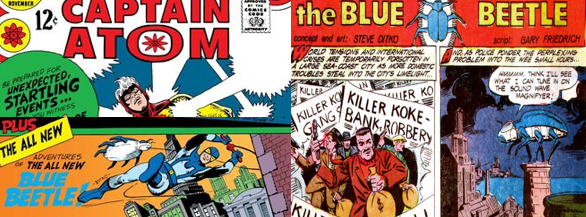
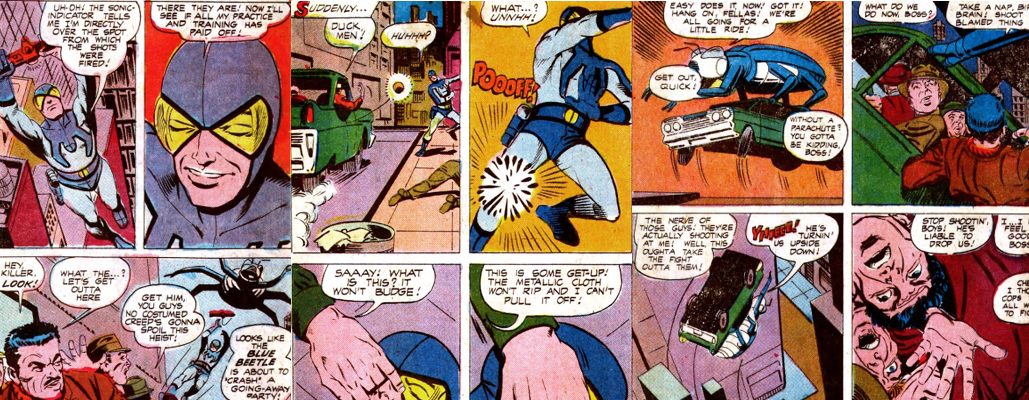
Similar to this predecessor, Ted Kord’s debut outing as the Blue Beetle begins not only with him already in the bug-themed guise of a masked crimefighter but also in the midst of a crime wave sweeping his city as the “Killer Koke Gang” make headlines for their many violent robberies. Unlike Dan Garret, however, Ted Kord’s Blue Beetle is tripped out on technology; he already has a massive, beetle-shaped hovercraft from which he can tune into sound waves throughout the city in search of trouble. When he picks up the sounds of gunshots from a nearby bank, the Blue Beetle flies into action, literally, guiding his craft through the night sky, though he strangely chooses to drop out of the craft and pilot it while hanging beneath it from a handle and wire. Although his monologue shares that he’s put in many hours of training, this is also still the Blue Beetle’s first field test and taste of real-world action; he’s so nervous about it that he almost clips a nearby building, but his presence certainly serves to put the wind up Killer Koke and his thugs.

Despite a minor setback, Ted Kord has a successful first night as the new Blue Beetle.

The Blue Beetle comes swinging in, fists flying, easily dispatching Killer Koke’s men with a deftness and skill despite their superior numbers and weaponry. Just as he’s feeling the thrill of the action, though, one of the goons tosses…some kind of spherical explosive…at the Blue Beetle’s knee, which manages to knock him unconsciously. Luckily for Ted, the thugs can’t get his mask off to learn his true identity and they’re scared off by a single cop before they can finish him off. When he comes to, the Blue Beetle assumes they fled because he was too much for them…even though he clearly saw one of them tossing that thing, whatever it was, at him. He summons his flying craft and makes a swift exit, praising his technology and prowess the entire time. Thanks to his amazing craft, the Blue Beetle is easily able to catch up to Killer Koke and his goons, literally snatching their car off the ground and depositing them, rattled and humiliated, at police headquarters. Although Killer Koke claims that the Blue Beetle was really behind it all, the cops are unconvinced and take them away, and the story comes to an end with the Blue Beetle name-dropping Dan Garret, suggesting a relationship between the two, and again praising the genius of his technology, such as the lock underneath his chin that kept him from being unmasked, and expressing excitement for his next crimefighting adventure.

The Summary:
I really didn’t think much of Dan Garret’s first outing as the Blue Beetle and, sadly, the trend continues here. Thanks to the immortal Steve Ditko, the art is at least much more palatable this time around; I’ve always liked Ted Kord’s Blue Beetle costume and, despite how corny it is with its overt bug theme, it’s at least more on brand with his masked persona that the suit-and-fedora combo of his predecessor. Ted Kord goes one step further than Dan Garret by having a massive beetle-shaped craft that doubles as a base of operations and his transport around town; it also leans into his branding and gives him an edge not shared by many other superheroes, who are more likely to utilise cars or motorcycles before jumping in a flying contraption. Having said that, though, it is all incredibly goofy; there’s nothing wrong with that, of course, and it makes for some fun visuals and concepts, but it’s just a bit weird seeing this massive metallic beetle rocketing through the city and scooping up cars. Similar to his predecessor, we learn almost nothing about this new Blue Beetle; we don’t even learn his true name in this story, much less delve into the relationship he may or may not have with Dan Garret or his motivations behind taking up the Blue Beetle mantle.

Despite his fancy new gimmick, Ted’s debut is barely any better than his predecessor’s.

Again, I’m okay with that, not every first appearance needs to be an origin story after all, but it does mean that Ted’s first appearance is more about expositing his technology than anything else. There’s still a sense of relatability to him; he appears to have no superhuman powers, starts the story itching to put his training to the test and nearly costing himself dearly because of it, and, for all his obvious fighting skill, he’s still flawed enough to be rendered unconscious by…whatever that thing was that was thrown at him. Killer Koke and his gang are just regular street-level mooks; they’re violent bank robbers and that’s about it, warm bodies for the Blue Beetle to beat up and prove himself against, and he’s very happy with how his first night went, despite nearly being unmasked, because he was smart enough to put a clasp on his cowl. I think it actually might’ve been better to showcase him using more gadgets in his fight rather than his fists to truly separate him from Dan Garret and lean into him being a more technologically-inclined crimefighter. As is, we’re presented with a guy who clearly has the time, means, and money to go out busting bank robbers with a fancy suit and craft but little that makes him stand out from other, similar costumed heroes. I’ve always been a fan of Ted Kord’s and he’s always been quite a goofy character, so I don’t want to begrudge his first appearance too much, but it’s surprising he was able to excel as far as he did after such a mediocre first outing.

My Rating:

Rating: 2 out of 5.

Could Be Better

What did you think to Ted Kord’s debut as the Blue Beetle? Were you stunned by how different he was, visually and in concept, to Dan Garret? What did you think to his costume and mechanical bug craft? Were you disappointed by ineffectual Killer Koke and his gang were and do you know what that thing was they threw at Ted? Which incarnation of the Blue Beetle is your favourite and what are some of your favourite Ted Kord moments? Whatever you think to the Blue Beetle, share your thoughts below or on my social media and be sure to check out my other Blue Beetle content across the site.

Back Issues: Mystery Men Comics #1

Story Title: “The Coming of the Blue Beetle”
Published:
August 1939
Writer: Will Eisner
Artist: Charles Nicholas

The Background:
Something I’ve always found fascinating about the history of DC Comics is just how many of their characters and concepts originated elsewhere; Billy Batson/Shazam might be a DC mainstay now but he started life in Fawcett Comics, for example, and even heavy hitters like the Justice Society of America were published under the All-American Publications banner before being bought by, or rebranded, to DC Comics. This is also true of the very first Blue Beetle, Dan Garret; created by Charles Nicholas Wojtkoski, the Blue Beetle was one of many costumed adventurers who would come to be featured in the pages of various comic books published by Charlton Comics and, in his earliest incarnation, was a domino-masked pulp crimefighter rather than a superhero. In fact, the character’s look and origin was almost a composite of the likes of Kit Walker/The Phantom and Denny Colt/The Spirit, which isn’t too surprising given that comic icon Will Eisner allegedly assisted with Garret’s first adventures. Initially appearing under Fox Comics publications, the otherwise powerless Blue Beetle would be taken on by Charlton Comics and play a significant, if often forgotten, role in the legacy of his successors. Indeed, Dan Garret is sometimes all but forgotten about whenever the subject of the Blue Beetle comes up since, like other Golden Age heroes, his influence was surpassed by his Silver and Modern Age equivalents. As a result, he’s rarely featured, referenced, or even acknowledged within DC Comics, let alone in ancillary media but, since his modern day successor has since made his live-action debut, I figured I would revisit Garret’s first appearance and examine the origins of this often overlooked character.

The Review:
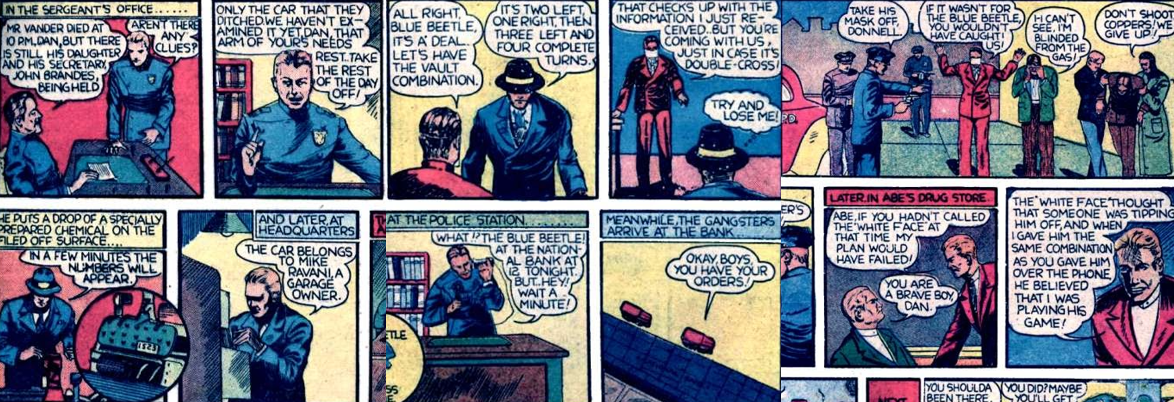
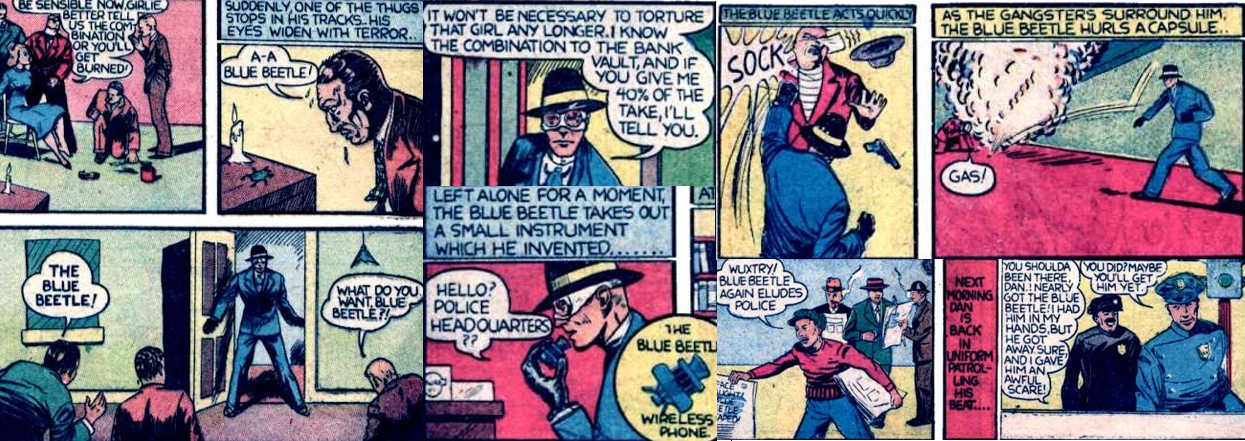
Dan Garret is just your normal, everyday beat cop in a normal, everyday city where bankers like Mr. Vander are kidnapped in broad daylight. Indeed, poor old Dan was just minding his own business, patrolling his beat, when he was suddenly fired upon from a car. Although he takes a slug to the shoulder, Dan still has the presence of mind to fire back, but he’s unable to stop the speeding car, out of which is thrown an elderly man. Despite the pain from his injury, Dan tends to the man, who turns out to be the aforementioned Mr. Vander, a banker who was kidnapped by the “White Face Gang” alongside his daughter and his secretary, John Brandes. While Dan miraculously recovers from his wound between panels, Mr. Vanders isn’t so lucky; the sergeant informs Dan that the banker died later that evening, though the cops were able to recover the gang’s car. Rather than rest up as his sergeant suggests, Dan inspects the vehicle. Although the car’s serial number has been filed off, a “drop of specially prepared chemical” reveals the number and that the car belongs to a certain garage owner named Mike Ravani.

When a banker’s daughter is kidnapped, flatfoot Dan Garret investigates as the Blue Beetle!

Later that same evening, the Vanders girl is being tortured across town in Ravani’s garage by a group of thugs, who threaten to set her ablaze if she doesn’t tell them the combination to her father’s bank’s vault. One of the thugs spies an ominous sight, however: a blue beetle, the calling card of the titular suit-and-fedora-clad vigilante. Rather than rushing in and beating the gang to a pulp, the Blue Beetle is able to spare the girl from further torture by offering to tell them the combination to the vault in exchange for a 40% cut. Despite the fact that he’s a mysterious masked manhunter, the gang agrees to the offer; though they’re smart enough to take the Blue Beetle with them, they inexplicably leave him alone long enough to place a call to police headquarters using his special wireless phone. Consequently, when the White Face Gang break into the bank, the cops are there to get the jump on them; the Blue Beetle then punches one out, blinds another with a gas capsule, and then flees in his car as the gang is arrested. Their leader is unmasked to reveal it was John Brandes all along in a twist that really doesn’t make all the much sense as it can’t have been difficult for Mr. Vanders’ secretary to learn the safe combination. Things get even more confusing as Dan owes his plan’s success to his friend, drug store owner Abe, who apparently houses his Blue Beetle gear and called the White Face Gang to confirm the Blue Beetle’s combination…? I don’t really understand it, personally. Anyway, the gang is arrested, and Dan returns to work, where one of his colleagues tells him all about how he came so close to nailing the elusive Blue Beetle…even though they never actually had a hope in hell as he was long gone by the time they arrived.

The Summary:
Well…this was pretty awful. It’s strikingly similar to the first appearance of Bruce Wayne/Batman, something that shouldn’t be too surprising considering Batman’s pulp roots and Bob Kane’s talent for plagiarism. While the quality of these scans isn’t great, the artwork is fitting for the era; by which I mean it’s grainy, messy, low on detail, and a bit confusing with all the high contrasting colours and such. To be fair, the story does a decent job of introducing us to Dan Garret; he’s just a normal, everyday bloke but he tends to others even while wounded and takes it upon himself to tackle criminals…even though there’s no suggestion that the police are baffled by the kidnapping and no reason given as to why he’s adopted a masked persona. Like many pulp heroes, the Blue Beetle has a fancy car and a base of operations (though we never see it in detail) and a confidante who shelters and supplies him (though we learn nothing about him except that he’s an old friend and runs a drug store).

A confusing story featuring a Green Hornet rip-off that fails to impress on almost every level.

The Blue Beetle’s attire here is a simple blue suit, black fedora, and white domino mask that looks like he’s wrapped a handkerchief around his eyes! In fact, there’s little to separate the Blue Beetle from Britt Reid/The Green Hornet when it comes to his overall appearance and the down-to-earth nature of his crimefighting methods. His iconography, the Blue Beetle, is visible on his chest and apparently is left as a calling card to announce his arrival, though it’s not clear how he got this into the gang’s garage nor is it explained why Dan has chosen this motif for his masked persona, which only lends more weight to the argument that he’s a Green Hornet rip-off. The Blue Beetle also employs smoke pellets to blind his foes, packs a mean right hook, and carries a miniature wireless phone that’s quite ahead of its time, indicating that he’s surprisingly well funded and intelligent for a simple beat cop. However, the story falls apart very easily for me; I don’t get why Brandes would have to resort to kidnapping and murder for his crime, or how Abe’s call to the gang aided the plan. It’s also weird that the Blue Beetle is seen to be a known vigilante, yet the White Face Gang take him at his word when he offers to help, almost as if he’s some underworld figure. I don’t have any answers to that; all I know was that this was a very confusing and an extremely disappointing first outing for the Blue Beetle that paints him as a forgettable knock-off rather than a memorable pulp hero.

My Rating:

Rating: 1 out of 5.

Terrible

Have you ever read the first appearance of Dan Garret’s Blue Beetle? If so, what did you think to it? Was there anything about this strip that impressed you or do you agree that the Blue Beetle was a rather underwhelming presence? Are you able to explain the plot and what the hell happened with Abe and Brandes’ plan, because it didn’t make much sense to me…? Who is your favourite pulp hero? Would you like to see more from Dan Garret or do you prefer a different Blue Beetle and, if so, who is it? I’d love to know your thoughts on the Blue Beetle down in the comments or on my social media, so feel free to share them and be sure to check out my other Blue Beetle content.