This month is all about the Resident Evil 3 remake (Capcom, 2020) and, as such, I’m taking a look back at the official Resident Evil comic released by WildStorm back in 1998 to 1999. The five-issue Resident Evil: The Official Comic Magazine mostly filled in events between, during, and after Resident Evil (ibid, 1996) and Resident Evil 2(ibid, 1998) to flesh out the Resident Evil lore outside of the videogames.
Issue two, released in June 1998, features only three stories compared to the four of issue one but has more pages devoted to each one). From this issue, the comics also start to use the God-awful American variant of the classic Resident Evil title font, most likely as this issue is more focused on events surrounding the second videogame.
Issue two includes an adaptation of Resident Evil 2.
Another major change is that this issue actually includes a straight-up adaptation of Resident Evil 2, including dialogue lifted straight from the videogame. Whereas the closest issue one got was a recap on the first game, “A New Chapter of Evil” (Adams, et al) details pretty much the entirety of Leon S. Kennedy and Claire Redfield’s stories, picking up with them being separated on the streets of Raccoon City and following both on their journey through the Raccoon City police station and the Umbrella facility beneath the city streets.
Leon’s story gets some fair representation here.
As in the game, the story jumps back and forth between the two but, ostensibly, the plot remains the same just without any Lickers: Leon makes it to the police station, where he meets and is eventually attacked by Marvin. After catching up with Claire, he bumps into Ada Wong and is shot by Annette Birkin after having a run-in with a G monster. Patched up by Ada, Leon dispatches of a giant mutated alligator and they descend into the Umbrella facility. Ada betrays Leon and falls to her death while trying to steal the G-Virus, leaving him with little time to escape the facility.
And that’s seriously all for Mr.X…
As all this is going on, Claire (who begins the story packing a lot more heat than her videogame counterpart) has an extremely brief and uneventful run-in with Mr. X. seriously, she takes him out with just “five rounds”, off panel, and he never appears again. It’s like the writers only played snippets of Claire’s story.
“G” goes down like a bitch every time.
Anyway, Claire meets Annette’s daughter, Sherry, and they witness the corrupt Police Chief Irons be killed by Sherry’s father, William, who has mutated into “G”. Claire dispatches “G” (once again with laughable ease) and comforts Sherry after her mother is killed. They hook back up with Leon and, after finally doing away with “G”’s final form, they escape the facility just as it self-destructs.
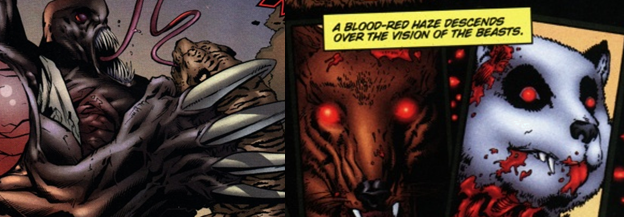
“G” infects the animals in the city zoo.
As an adaptation of Resident Evil 2, “A New Chapter of Evil” is both extensive and rushed; loads of Claire’s story is skipped entirely, with Mr. X practically being a non-player, and the threat posed by “G” is almost completely non-existent as the characters defeat it while barely breaking a sweat. Hell, it takes Leon more effort to kill the alligator than “G”! Yet, as a quick run through of the game’s major story events, this is serviceable enough, though it feels as though the issue would have benefitted greatly from devoting its entire page count to their adaptation rather than twenty-odd pages. “Mutant Menagerie” (Oprisko, et al) briefly shows how Birkin was driven to infect himself with the G-Virus after being gunned down for his research samples. Mutating into “G”, all he can think of is to infect as many hosts as possible, which leads him to the Raccoon City Zoo.
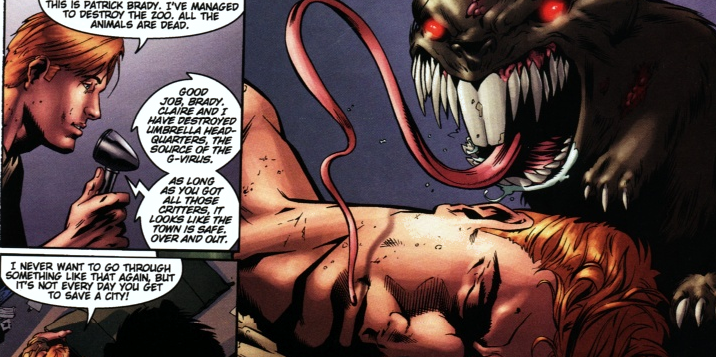
Patrick is successful…or so it seems!
This is bad news for the on-shift security guard Patrick Brady, who soon finds himself fighting to survive with limited ammunition and resources against infected tigers, pandas, snakes, apes, and prairie dogs. After he realises that he’s all alone, he fights through the zoo and its infected creatures to overload the zoo’s power generator and keep the animals from escaping. Though seemingly successful, he passes out from fatigue while one last prairie dog looms in for a snack.
A zoo was similarly infected in Outbreak: File #2.
This story does a pretty good job of relating the desperation that accompanies Resident Evil videogames; Patrick doesn’t have a lot at his disposal and is up against the odds, much like the player often is. He also is forced to battle through hordes of enemies to reach an elaborate objective, which is pretty much par for the course of all Resident Evil titles. Interestingly enough, one of the scenarios in Resident Evil Outbreak: File #2 (Capcom, 2004) saw characters dealing with a wide variety of infected creatures at the Racoon City zoo, though I would be surprised if that game took any inspiration from this particular story.
This issue really downplays the threat of the Tyant to an absurd degree.
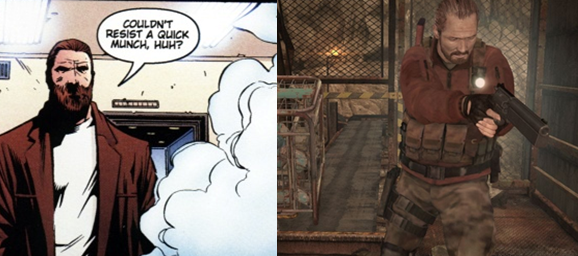
The final story, “Lock Down” (Oprisko, et al) follows Barry Burton about a week after the events of Resident Evil; traumatised by what he experienced, Barry opts to visit a psychiatrist but, wouldn’t you know it, the building is suddenly infested with zombies! Swiping an access key, Barry is handed a map and instructions by a dying guard and is forced to battle his way through not only zombies but a Tyrant in order to piece together a bomb that will destroy the building. Funnily enough, Barry struggles more with giant mutant cockroaches than the Tyrant and he is able to leap to safety as the building explodes.
All he’s missing is an Item Box…
If the first story was an adaptation of Resident Evil 2’s plot, the second adapted the survival/horror gameplay, this last story goes all-in with representing the arduous side missions and tasks players must complete while battling mutated creatures and monsters. Barry must search the building using a map to find the three bomb parts, even blasting a zombie apart to get a key to open a locker for one piece, and then assemble the bomb before escaping to safety.
This comic fleshed out Barry’s character before the games did.
It’s interesting how the first issue was basically an anthology comic of side stories and companion pieces to the first two Resident Evil videogames and it isn’t until the second that WildStorm produced a more traditional adaptation of the source material. That being said, while “Lock Down” does wonders for fleshing out Barry’s personality (he has a snarky, gritty action-hero attitude that wouldn’t really be seen for some time), the clear standout of this issue is “A New Chapter of Evil”. A lot of this is due to my personal bias for Resident Evil 2 but I feel it’s a stronger statement to feature an adaptation of the videogame alongside smaller side stories rather than just filling the pages with recaps or interludes.
My Rating:
⭐⭐⭐⭐
Rating: 4 out of 5.
Great Stuff
Did you ever read the Resident Evil comics published by WildStorm? Would you be interested in the series receiving a reprint as the collection is currently out of print? Do you have a favourite piece of ancillary Resident Evil media? Drop a comment below and come back next Tuesday for my rundown of issue three.
To continue to milk the release of the Resident Evil 3remake (Capcom, 2020), I figured I’d spend the next few weeks taking a look back at the official comic book magazine released by WildStorm between 1998 and 1999.
Resident Evil: The Official Comic Magazine ran for five issues and mostly featured stories that filled in events between, during, and after Resident Evil (ibid, 1996) and Resident Evil 2 (ibid, 1998). Many of these stories and events, and the characterisations of familiar Resident Evil characters, may have since been rendered non-canon by subsequent sequels and reboots but, nevertheless, these comics do a great job of fleshing out the Resident Evil lore outside of the videogames.
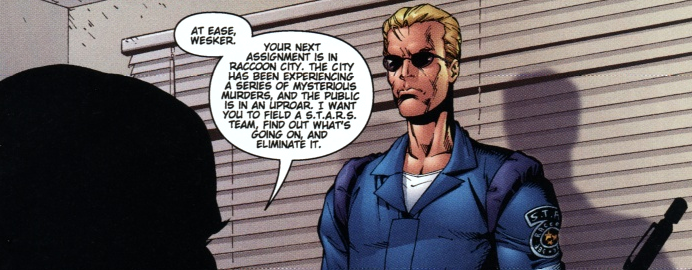
Wesker is assigned to investigate some strange murders.
Issue one released in March 1998 and featured cover art by the always-fantastic Jim Lee and four full-length stories. The first, “S.T.A.R.S. Files” (Adams, et al), is a minor prelude to Resident Evil in which Albert Wesker is charged by his mysterious superior officer to form two teams to investigate a series of murders in Raccoon City.
Wesker gives a rundown on his recruits…
Wesker compiles a report (how very Resident Evil) in which he runs down each member of the Bravo team and his Alpha team, their abilities, a bit of their backstory, and how much of a threat they pose. He talks about his willingness to blackmail Barry Burton into being his second-in-command, criticises both Rebecca Chambers and Brad Vickers, and gives a little bit of background to Chris Redfield and Jill Valentine. The story ends with the Bravo team heading out to Raccoon Forest and Wesker promising that the team won’t find out anything. Obviously, this story was written long before Resident Evil Zero (Capcom, 2002), so the Bravo team exists simply to be written off but this story, while brief, does provide some insight into Wesker’s motivations and mindset at a time when he was still a one-note, clichéd villain rather than a superpowered mastermind.
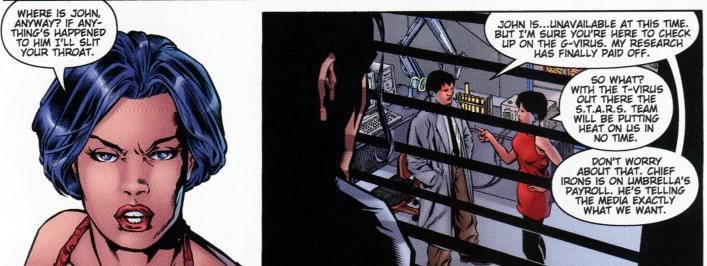
John created many of Resident Evil‘s iconic BOWs.
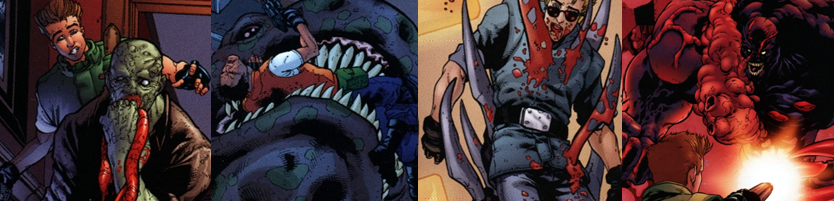
The second story, “Who Are These Guys?” (Adams, et al), sheds a bit of light into how all of those files and notes you pick up in Resident Evil titles are created by showing the story, and degeneration, of Ada Wong’s boyfriend, here called John Fay. It turns out that John was the scientist responsible for experimenting with the Tyrant-Virus (T-Virus) on animals, such as dogs and sharks, thus creating some of Resident Evil’s most memorable bio-organic weapons (BOWs).
John succumbs to the T-Virus and becomes just another zombie.
In the course of his research, and the story, John contracts the T-Virus and begins degenerating into a zombie; he just about manages to scrawl out passwords and codes for Ada before being blown to pieces by Jill. This was an interesting story, fleshing out a character I don’t think we’ve ever seen in the videogames and visually detailing the degenerative process the T-Virus has on a human. It’s quite fun to see how John’s note was written out, and how all he amounts to is being just another zombie to be dispatched during the game.
This story recaps the events of the first game.
“Dangerous Secrets” (Oprisko, et al) mixes things up a bit by telling a story about the survivors of Resident Evil as it literally takes place two days after the end of the game. The story is, basically, a recap of the events of the first game, recreating the team’s first encounter with a zombie, the infected crows, the fight against Yawn and Enrico’s assassination, their battles with the Hunters, Wesker’s betrayal and death, and the destruction of both the Tyrant and the mansion itself.
It’s all a matter of perspective…
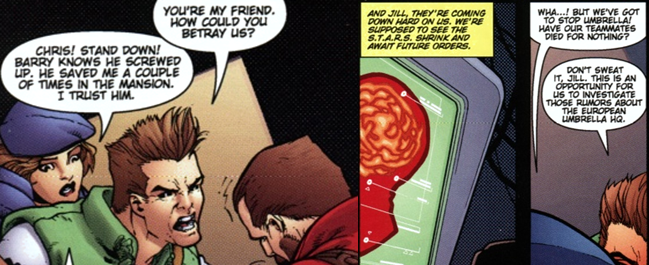
Tying in with the previous story a little bit, “Dangerous Secrets” also shows the characters actually using the files and notes they found in the mansion and Umbrella’s laboratory to their advantage to piece together what happened, how the T-Virus was created, and what it does to those infected. There’s also a really amusing part where Chris and Rebecca both reference how Jill was captured and imprisoned in a cell but Jill remembers the events slightly differently, believing that it was Chris that was imprisoned. This is a great reference to the contradictory story parts the player encounters when playing Resident Evil and good way of pasting over those continuity errors before the production of the Resident Evil remake (Capcom Production Studio 4, 2002) and other sequels; the idea being that each scenario is as valid as the other as it’s simply from that character’s perspective (it’s also slightly implied, through Jill’s thought bubble, that Chris is intentionally lying because he’s ashamed of being captured).
The story acts a bridge between the first two games.
This story is also where Barry’s betrayal is revealed to Chris, explaining in detail how Wesker threatened Barry’s family to get him to go along with his plot to release the Tyrant. The story comes to an end with Chris planning on investigating Umbrella further and Leon S. Kennedy arriving in Raccoon City, effectively bridging the gap between Resident Evil and Resident Evil 2 and (although unintentionally) Resident Evil – Code: Veronica (ibid, 2000).
Ada confronts Birkin, anaware they’re being spied on…
Speaking of Resident Evil 2, the comic’s final story, “Raccoon City – R.I.P.” (Adams, Oprisko, et al), details Ada’s arrival in Racoon City to confront William Birkin (who looks a little…different to how he appears in Resident Evil 2) just as the first zombies begin to crop up around the city (which is a bit of a continuity error as zombies weren’t supposed to appear until after Birkin is killed).
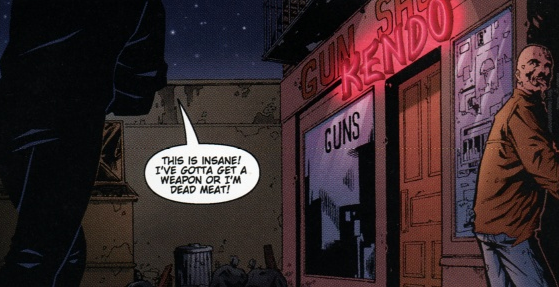
Gun Shop Kendo gets a brief cameo…
Their conversation is overheard by an unidentified third party, who then visits a bar that is promptly trashed by zombies. He heads to Gun Shop Kendo to grab a shotgun before being attacked by a zombie at a petrol station, which explodes in the fracas, killing him and his attackers.
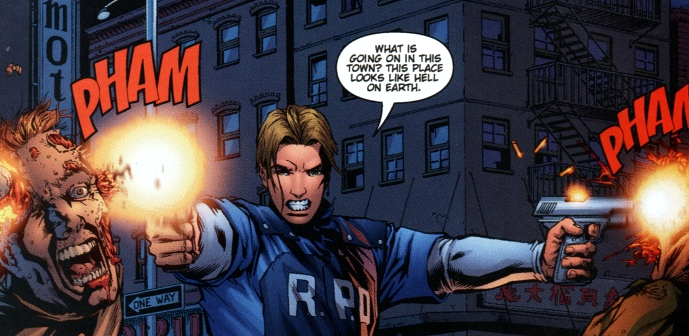
Sadly, Leon wouldn’t duel-wield for some time…
A trucker witnesses the explosion and is immediately set upon by zombies, who are taken out by a duel-wielding Leon, thus filling in a few blanks between Resident Evil and Resident Evil 2. Despite casting a bit more focus on Ada and her characterisation and detailing how quickly the T-Virus spread to Raccoon City, “Raccoon City – R.I.P.” is easily the weakest of this issue’s four stories; it’s got a lot more continuity errors, puts far less emphasis on recognisable characters, and the art isn’t as good.
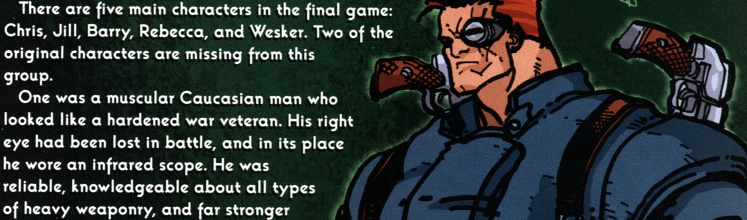
Mikami talks about some original character concepts.
Issue one also features a really insightful interview with Resident Evil producer Shinji Mikami, who details some of the production and design influences on the game and series, directly referencing the impact Night of the Living Dead (Romero, 1968) had on the game’s production. He also talks about how the version of Resident Evil released in the United States is actually harder than the Japanese version so that they could make more money of repeated game rentals (remember when those were a thing?) and some cut characters, including an original version of Barry who more resembles Arnold Schwarzenegger. In the end, this is a decent first issue; it’s more of an anthology and companion piece to the videogames rather than a by the numbers adaptation, with only “Dangerous Secrets” directly reinterpreting the videogame into comic book form. However, it has to be said that this story is easily the best this issue has to offer as it features all the characters and events you remember from the first game recreated with some stunning (and gory) art by Carlos D’Anda.
My Rating:
⭐⭐⭐⭐
Rating: 4 out of 5.
Great Stuff
Did you ever read the Resident Evil comics published by WildStorm? Would you be interested in the series receiving a reprint as the collection is currently out of print? Do you have a favourite piece of ancillary Resident Evil media? Drop a comment below and come back next Tuesday for my rundown of issue two.
Ah, the nineties! What a time to be alive for comic book fans! We saw Clark Kent/Superman die and be replaced by four imposters before returning…with a mullet! We saw Bruce Wayne/Batman get his back broken and be replaced with a Frank Castle/Punisher-like nutjob. We saw Arthur Curry/Aquaman get his hand bitten off by piranhas and replaced…with a harpoon! And we saw Hal Jordan, the premier Green Lantern, go mental, kill a bunch of his fellows, and take on an antagonistic role as Parallax. Yet, the legacy of Green Lantern lived on in a new, young, sexy replacement who was to take the title in a bold new direction; a character who, though he exists today, is a shadow of his former self, prompting me to ask…
DC Comics like to paint Hal Jordan as the greatest Green Lantern that ever lived. Literally almost every time the character appears, text boxes, character dialogue, or story events are geared towards this agenda. This was especially obvious in 1992 when, after being replaced buy Guy Gardner, Jordan decided that he had had enough of bitching, moaning, and moping about and forced Guy to relinquish the Green Lantern power ring and reclaim his mantle. This was sold to us as a miraculous return; characters, including Guy’s Justice League teammates, openly gushed at Hal reclaiming the mantle and trashed Guy. I mean, sure, Guy was no saint and was a massive pain in the ass, but for everyone to talk so much shit about him was jarring. Things went from bad to worse, however, when Mongul and Hank Henshaw/Cyborg-Superman obliterated Hal’s home town, Coast City, during the ‘Reign of the Supermen’ (Jurgens, et al,1993) arc that saw Superman return to life. Hal, unable to cope with the loss of his friends and family, tried to recreate the city and was admonished by the Guardians of the Universe. Incensed at what he saw was a betrayal after years of loyal service, ‘Emerald Twilight’ saw Hal fly to Oa, relieving multiple Green Lanterns of their rings, killed Kilowog and Thaal Sinestro (later revealed to be an illusion), and absorbed the entire power of the Central Power Battery. This immediately depowered every Green Lantern in the universe (it is implied that the majority of them died, though this was also later retconned) and transformed Hal into Parallax.
Kyle was severely tested at the start of his career.
While Parallax went out into the cosmos to acquire yet more power and would eventually attempt to rewrite all of time itself in Zero Hour: Crisis in Time (Jurgens, et al, 1994), the last remaining Guardian, Ganthet, travelled to Earth and, seemingly at random, presented the last power ring to the first person he saw: Kyle Rayner. Kyle, a young freelance artist, was initially characterised as being cocky and irresponsible; a rookie who received no training or instruction, he struggled to get to grips with his newfound power and responsibility. Attacked by enemies of Jordan’s who mistook him for the former Green Lantern, Kyle endured a trial by fire made all the more testing when Clifford Zmeck/Major Force infamously killed his girlfriend, Alexandra DeWitt, and stuffed her into a refrigerator! For a long time, this was a constant source of guilt and angst for Kyle; it seemed that he would openly mention it to anybody at the drop of a hat, even amidst battling Parallax, saving the universe, and joining perhaps the strongest incarnation of the Justice League ever. In time, though, Kyle was able to master his emotions and his power; unlike other Green Lanterns, Kyle’s ring did not carry a weakness to yellow (later revealed to be because the weakness was a result of Parallax being imprisoned within the Central Power Battery), did not need to be recharged, and could only be used by him, which effectively made him the most powerful Green Lantern ever seen at that point.
Despite making a name for himself, Kyle was constantly overshadowed by Hal.
As part of the Justice League, Kyle struck up friendships with Wally West/The Flash and Connor Hawke/Green Arrow, just as Jordan had been friends with Barry Allen and Oliver Queen in the past, and voted to keep Batman (one of his strongest supporters) in the Justice League following the ‘Tower of Babel’ storyline in 2000. As his career progressed entered into a romantic relationship with Alan Scott’s daughter, Jade, and evolved into a leader when he fought off the Circle of Fire. After Parallax sacrificed himself to reignite the Sun in the ‘Final Night’ storyline, Kyle received a massive power boost and was rechristened Ion. Wielding God-like powers, he eventually restored Oa, the Central Power Battery, the Guardians of the Universe, and the Green Lantern Corps in order to relieve himself of the burden of his newfound powers. Restored to a regular Green Lantern, but still unrestricted by the yellow impurity or the need to recharge, went from being the last of the Green Lanterns, and a God, to be one of many Green Lanterns. His status was further damaged when writer Geoff Johns took over the Green Lantern title and orchestrated Hal Jordan’s return in the ‘Rebirth’ storyline. Jordan, who had since become the Spectre, was absolved of all his previous crimes by the revelation that Parallax is actually a parasitic fear entity that latched onto his soul and drove him to evil. Thanks to the efforts of Kyle, Guy (who also had his recent years of messy writing undone), and John Stewart, Jordan returned to life as a Green Lantern once more and promptly took over the Green Lantern title.
Kyle has assumed a number of different forms and identities over the years.
Despite transforming back into Ion during Infinite Crisis (Johns, et al, 2006) following Jade’s death, Kyle was possessed by Parallax during the ‘Sinestro Corps War’ storyline (Johns, et al, 2007) and continued to operate as just one of four (five, if you count Alan Scott) Earth-based Green Lanterns, even after being promoted to ‘Honour Guard’ status. He even found his very existence branded as an anomaly during ‘Countdown’ and ‘Countdown to Final Crisis’ (Dini, et al, 2007 to 2008) and spent most of 2007 bouncing around the Multiverse with little rhyme or reason. He found himself on the frontlines during Blackest Night (Johns, et al, 2010), which saw Jade restored to life, and sacrificed himself to destroy a bunch of Black Lanterns. He, too, was restored to life and, during War of the Green Lanterns (ibid, 2011) assumed the role of a Blue Lantern after Parallax infected the Green Lantern rings. Unfortunately for him, Blue Lanterns are pretty useless; they only real do anything when Green Lanterns are around, making him the weakest of the rag-tag group (obviously led by Jordan) that stood against the renegade Guardian, Krona. As much as I hate to praise it, The New 52 actually returned some semblance of importance to Kyle; while Sinestro and Jordan dominated the main Green Lantern titles like it was the late-eighties, Kyle was the focus of the New Guardians title. When power rings from all the different corps are drawn to him, Kyle goes on a universe-spanning pilgrimage to master the entire emotional spectrum and once again reaches the levels of God-hood he enjoyed as Ion by becoming a White Lantern. Oddly, The New 52 also put Kyle in a romantic relationship with Jordan’s long-term love interest, the Star Sapphire Carol Ferris, which only further bogged his character down with unnecessary ties to Jordan’s legacy. It wasn’t to last, though, it soon became apparent that the powers of the White Lantern were too much for any one person to wield and, as of Rebirth, Kyle has returned to being a lowly Green Lantern.
What the hell is this nonsense!?
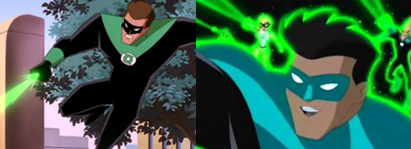
It gets worse for Kyle outside of the comics. Although his name and profession were used, he looked exactly like Hal Jordan when he appeared in Superman: The Animated Series, and even had Hal’s origin! With John Stewart acting as Green Lantern in Justice League, Kyle was relegated to brief cameos and bit-parts in Justice League: Unlimited. While Stewart is generally included as an alternative costume for Hal in various DC videogames, this luxury is rarely afforded to Kyle; he appears as a skin in Justice League Heroes (Snowblind Studios/Warner Bros. Games, 2006) and is featured in DC Universe Online (Daybreak Game Company/WB Games, 2011) and Lego Batman 3: Beyond Gotham (Traveller’s Tales, 2014) but barely gets a mention in the Injustice videogames (NetherRealm Studios/Warner Bros. Interactive Entertainment, 2013; 2017) due to being unceremoniously killed off in the prequel/tie-in comic books. I remember, many moons ago, reading an article in Wizard around the same time that the ‘Emerald Twilight’ storyline happened; whomever was being interviewed at DC said something along the lines of “DC reserve the right to not give their characters happy endings” and basically said “Hal is evil; Kyle is Green Lantern – deal with it!” as I mentioned, DC was all about major character changes in the nineties; Wally West had become the Flash following Crisis on Infinite Earths(Wolfman, et al, 1985), Dick Grayson became Nightwing in the ‘Judas Contract’ storyline, and Tim Drake succeeded him as Robin, in addition to the aforementioned Connor Hawke and even Roy Harper progressing to Arsenal.
A generation of heroes doomed to obscurity and irrelevance.
Kyle was supposed to be the next in line of these young new legacy heroes; his costume was bold and striking, a far cry from the regimental style favoured by most Green Lanterns, and his constructs were often infused with manga and anime imagery. As a young, untested hero, Kyle made reading Green Lantern was perfect for newcomers at the time who got to learn about the Green Lantern mythos through fresh eyes. However, once DC’s editors and writing staff switched hands and decided that they wanted to bring back Silver Age characters like Barry Allen and Wally West, the writing was on the wall for characters like Kyle. Once the sole Green Lantern and the figurehead for the Corps, Kyle was relegated to being just another face in a sea of green once Hal came back; even his costume and haircut changed and became far less interesting.
You’ll always be my Green Lantern, Kyle!
For my money, DC massively dropped the ball by not keeping Kyle bonded with Ion and carrying that codename; at least then Kyle would have been set apart from Hal Jordan and the other Green Lanterns. In these modern times, where we have a Corps for every colour of the emotional spectrum, there really is no excuse for Kyle, Hal, Guy, John, and newcomers like Simon Baz to all be Green Lanterns. I would have kept Kyle as the White Lantern, Guy as a Red Lantern, and John as an Indigo Lantern if only to mix things up and keep everyone different and relevant. Instead, with Hal still at the forefront of the Green Lantern titles and constantly being branded by DC writers, editors, and characters as the greatest Green Lantern of all time, there doesn’t seem to be any room for Kyle these days. Once upon a time, DC vowed that characters like Kyle and Wally were the new standard but, now, they’re pale imitations living in the shadow of the apparently far superior Silver Age counterparts and that’s just sad for people like me, who grew up in the nineties reading about Kyle’s adventures and growing attached to his character, rather than that of Hal Jordan.
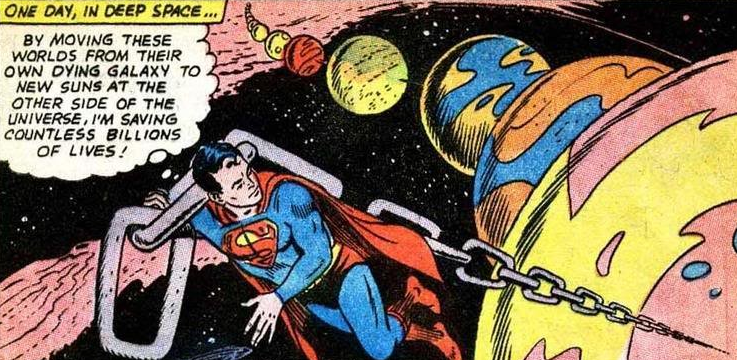
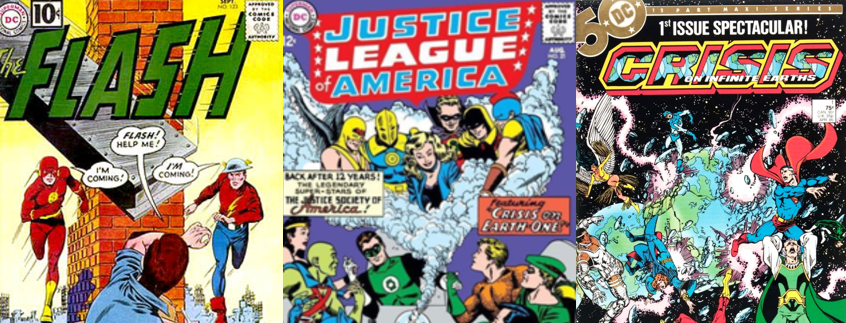
Ever since the 1938 introduction of Clark Kent/Superman, DC Comics has been known for its vast array of costumed crimefighters and interconnected, densely populated fictional narratives. For decades, continuity was played fast and loose; Superman evolved from being a moderately powerful superhuman who could leap over tall buildings into a God-like figure who could turn back time, possessed a super-human intellect, and could tow entire worlds through space with ease. Similarly, Bruce Wayne/Batman was depicted as being as youthful as ever despite having been active since 1939 and having taken part in World War Two. Some of these issues were resolved when, in the 123rd issue of The Flash, DC Comics introduced the concept of the multiverse. The issue postulated that there were an infinite number of parallel worlds co-existing in the same space and time but slightly out of synch with our own world due to being on a different vibrational frequency. The fallout from “Flash of Two Worlds” (Fox, et al) was the revelation that DC’s Golden Age superheroes, such as the Justice Society of America and older versions of Superman and Batman, existed on the parallel world known as Earth-Two while their Silver Age contemporaries (Hal Jordan, Barry Allen, and the like) in the Justice League of America existed on Earth-One.
Superman was originally more like a God than a man.
This concept allowed DC Comics to portray multiple iterations of their most popular characters as existing side-by-side, as well as numerous alternative worlds; Earth-Three, for example, was home to the Crime Syndicate, made up of villainous versions of the Justice League, while Earth-S was home to Freddy Freeman/Captain Marvel and other characters DC acquired from their purchase of Fawcett Comics. Unfortunately, decades of over-reliance of the multiverse concept meant that, by the 1980s, DC continuity was extremely difficult to keep track of and DC Comics were virtually inaccessible to new readers who had no idea what the multiverse was, much less how it worked. As a result, DC embarked on their most ambitious inter-company crossover yet. Crisis on Infinite Earths(Wolfman, et al, 1985) saw the entirety of the DC multiverse under threat from the malevolent Anti-Monitor. Seeking to rule in the desolation of nothingness, the Anti-Monitor begins destroying entire parallel worlds with an anti-matter wave, reducing their number from infinite to a mere five and causing the deaths of Barry Allen/The Flash and Kara Zor-El/Supergirl. In the end, Kal-L/Superman of Earth-Two, Alexander Luthor of Earth-Three, and Superboy of Earth-Prime end the Anti-Monitor’s threat and retreat to a “pocket dimension”, alongside the Lois Lane of Earth-Two, where they are protected from the merging of the remaining worlds.
Crises were commonplace in the Silver Age before DC tried to streamline their complex continuity.
It seemed like DC had come up with the perfect way to consolidate their continuity; the concept of parallel worlds was done away with and one singular reality was established. Stories like Superman: The Man of Steel (Byrne, et al, 1986) and Batman: Year One (Miller, et al, 1987) re-established the origins of DC’s flagship characters and, over the next few years, DC established that, while the events prior to the Crisis had occurred, very few of the characters who survived remembered much beyond vagaries (Wally West, for example, was now the Flash and knew, like everyone else, that Barry had died saving the world but not the exact specifics of how and why). Additionally, DC Comics began emphasising the idea of legacy superheroes; the Justice Society of America was established as having been active during World War Two and, while some of their members were active in present day continuity, they were noticeable aged and took on more of a mentorship role. Unfortunately, DC dropped the ball with Crisis. Rather than simply end every existing comic they published and reboot with brand new issue one’s and origin stories, some characters (such as Diana Prince/Wonder Woman) were not reintroduced into the new canon until much later. Others, like the Legion of Superheroes, had their entire origins altered forever by the removal of Superboy from the new canon (something that could have easily been remedied had DC simply rebooted the Legion and had them be inspired by Superman; instead, writers hastily incorporated an alternative Superboy from a pocket dimension or substituted him with Mon-El).
Zero Hour tried to fix DC’s post-Crisis lorebut actuallydid more harm than good.
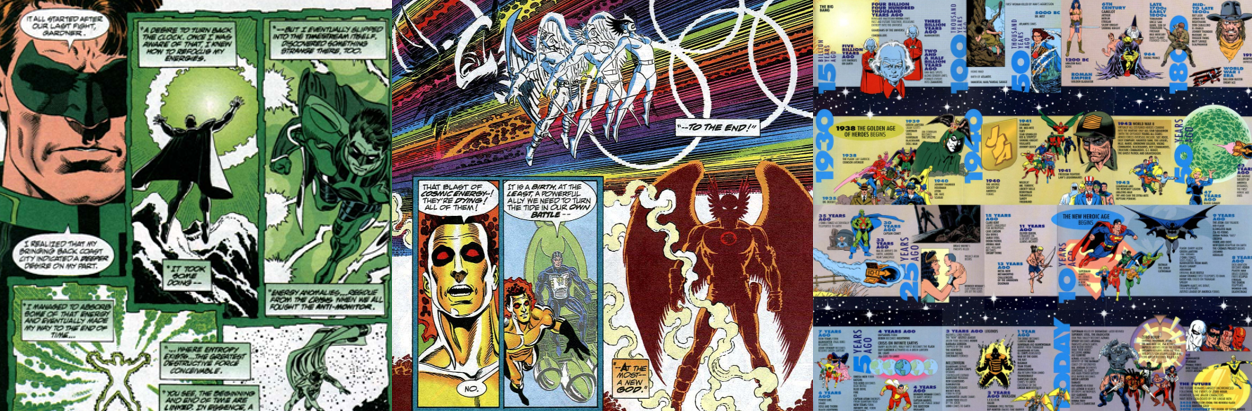
In an effort to address some of these lingering issues, and further incorporate some of the popular Pre-Crisis characters and ideas into modern continuity, DC capitalised on Green Lantern Hal Jordan’s recent descent into madness, genocide, and villainy with another massive inter-company event. Zero Hour: Crisis in Time (Jurgens, et al, 1994) saw Jordan, as Parallax, absorbing vast amounts of cosmic and chronal energy with which he planned to remake reality and undo all the wrongs that had happened since the death of Superman. Due to Parallax messing about with time, many continuity changes were forced into DC canon; Superman was explicitly described as having debuted “ten years ago”, the Legion of Superheroes were (finally) completely rebooted, Batman’s killer became anonymous and at large, and all conflicting versions of Carter Hall/Hawkman were consolidated into one singular character since DC never really bothered to reboot his origin story following the original Crisis. With the bulk of Zero Hour’s five-issue run being made up primarily of exposition from Richard Rider/Waverider or Parallax, many of the consequences of Parallax’s actions were told in DC’s individual comics. In the end, despite the insanity of time literally being ripped apart around them, the heroes were able to thwart Parallax’s efforts and allow time and reality to unfold naturally, albeit with many changes. Zero Hour resulted in many changes to popular DC characters; Guy Gardner suddenly became a shape-changing Vuldarian, many of the Justice Society were rapidly aged or killed off, Connor Hawke was introduced as the new Green Arrow, and Arthur Curry/Aquaman now sported an unkempt look and a harpoon for a hand.
Infinite Crisis returned the multiverse to the DC universe.
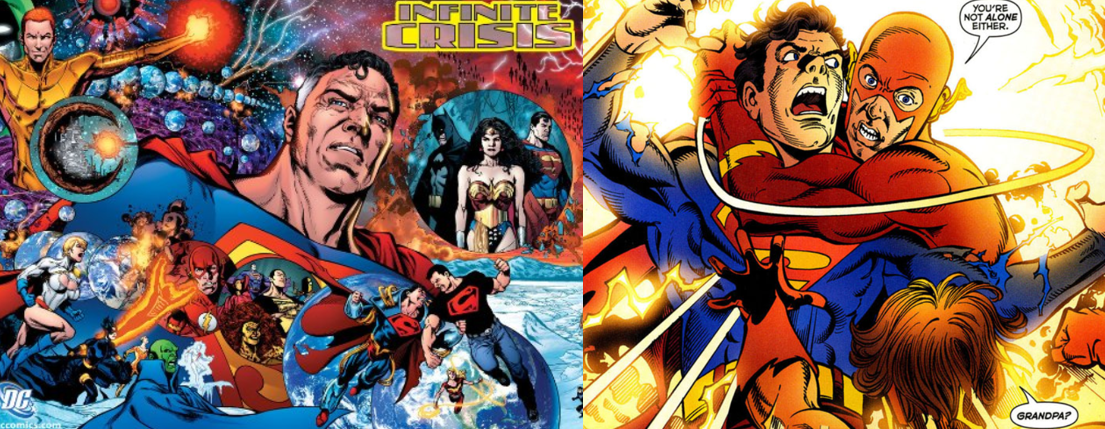
However, Zero Hour actually created more problems than it solved; Hawkman’s origins were no more clearer now than they had been before. Eventually, The Return of Hawkman (Goyer, et al, 2002) returned the character to mainstream continuity, explaining that the character was locked in a constant cycle of death and rebirth. Additionally, DC sought to address their ongoing continuity issues (and tell out of continuity stories) through the concept of Hypertime, which, much like the previous infinite Earths concept, allowed for alternative versions of events to be played out. Eventually, and with the twentieth anniversary of the original Crisis looming, DC decided to commission their biggest inter-company crossover yet. Consisting of multiple ongoing stories all building up to its central narrative, Infinite Crisis (John, et al, 2006) aimed to not only re-establish the multiverse concept and finally tie-up all of the lingering continuity issues left in the wake of Crisis on Infinite Earths and Zero Hour, but also move the company away from the dark stories that had dominated during the mid-nineties. After numerous event-scale storylines, the DC trinity (Batman, Superman, and Wonder Woman) were divided and the DC universe was in turmoil. Frustrated with how bad Earth heroes have let things get and perceiving that they have squandered their new world, Kal-L, Alexander Luthor, and Superboy-Prime break free from their pocket dimension and set about cannibalising the Anti-Monitor’s corpse to re-establish the multiverse and return peace and order to the universe. However, it turns out that seeing his world destroyed and having his youth ripped away from him, coupled with living in isolation and the machinations of Alexander Luthor, have driven Superboy-Prime mad. While Alexander straps various heroes and villains to an inter-dimensional tuning fork, Superboy-Prime goes on an accidental murder spree before Bart Allen/Kid Flash forces him into the Speed Force itself, at the cost of Wally West and his family.
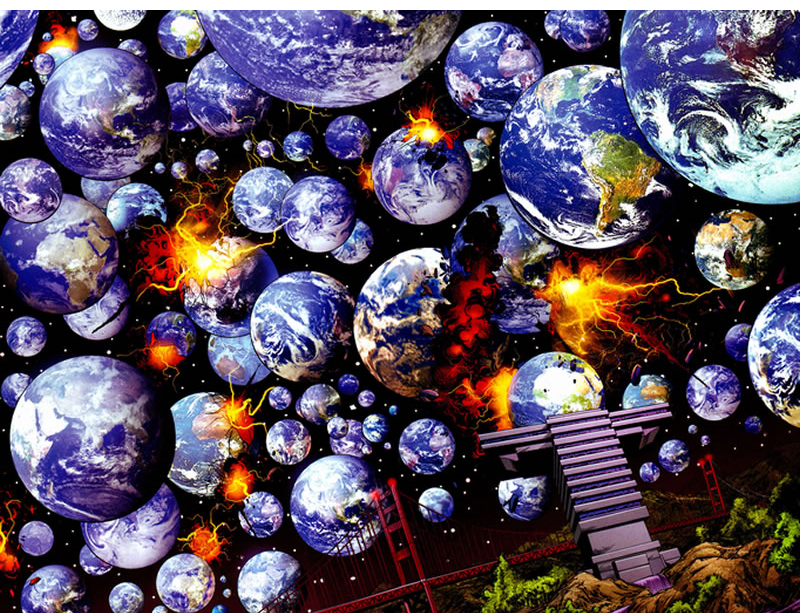
Infinite Crisis smashed together parallel worlds created 52 alternate Earths.
However, Superboy-Prime escapes, sporting a modified version of the Anti-Monitor’s armour and driven completely insane. With no regard for himself or others, he goes on a rampage; although Conner Kent/Kon-El/Superboy destroys Alexander’s inter-dimensional tower, it costs him his life and, finally convinced that Alexander’s plan would mean the genocide of countless lives, Kal-L joins forces with Superman to end Superboy-Prime’s threat. Infinite Crisis ends with the multiverse restored; though instead of there being an infinite number of parallel worlds, there were now a much more easy to wield fifty-two alternate Earths. In the aftermath, DC’s titles all jumped forward one year later, while the weekly 52 series explored the fallout of the events from the main crossover. This New Earth restored Superboy to Superman’s origin, depicted multiple non-canon stories as existing on the alternative Earths, introduced a new all-powerful villain in the form of Superboy-Prime, and resulted in Batman becoming far more trusting and open with his allies and family. For me, this was a great time to be reading DC comics. Unlike previous Crisis-level events, Infinite Crisis felt like a soft reboot that would be accessible to new readers; the multiverse existed but rarely impacted mainstream DC continuity and it felt like DC had finally closed the door of the events of the original Crisis and had finally moved on.
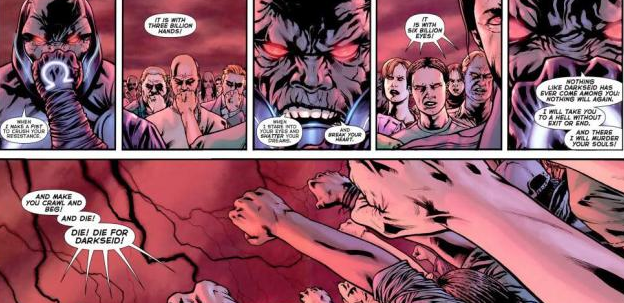
Morrison spearheaded an inter-company crossover that would change the DC universe forever. Unfortunately, DC decided to spend an entire year building up to this event with the weekly Countdown (later Countdown to Final Crisis) series, in addition to numerous tie-in and spin-off titles. As Countdown was of far less writing and artistic quality compared to 52, and due to the fact that many of its events contradicted what was happening in the associated titles, the build up towards Final Crisis (Morrison, et al, 2009) was lacklustre and confusing, to say the least. The basic premise, as far as I can understand it (Morrison’s writing is confusing and disjointed at the best of times) is that the New Gods have all died and been reincarnated on New Earth, causing a tear in space, time, and reality. Reborn, Darkseid finally solves the Anti-Life Equation and enslaves the planet; however, using a radion bullet, Batman mortally wounds Darkseid, before being erased from existence. As his essence dies, Darkseid attempts to obliterate all of reality until he is finally thwarted by Superman; Superman, and an army of his counterparts from across the multiverse then restore Earth and reality before it can be destroyed by Darkseid and Mandrakk, the Dark Monitor. Once you got past the mess of Morrison’s writing and the mess of a build-up to the main event, the fallout from Final Crisis made for very accessible stories. DC also focused on using the Green Lantern titles to expand their universe through sprawling, inter-connected stories.
Dick Grayson took over as Batman before Flashpoint gave us an angst-ridden jerk version of Superman.
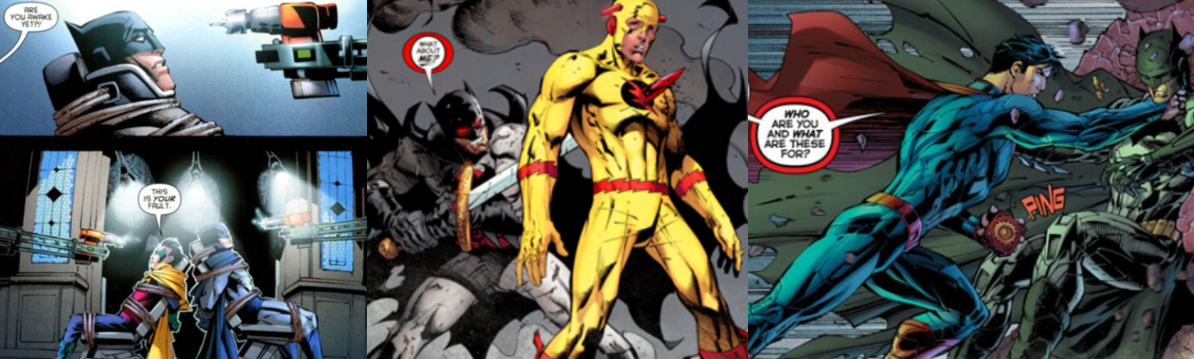
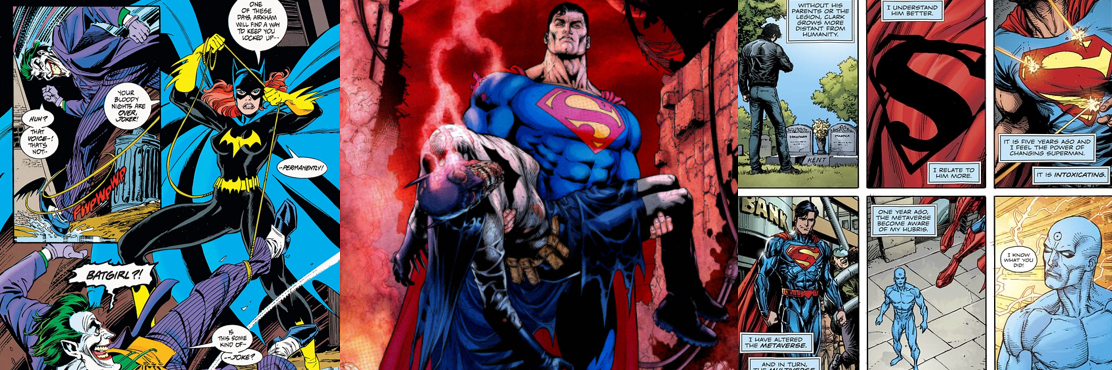
However, rather than fully capitalise on this (by, say, returning Bruce Wayne to life as an aged man, killing off Alfred, and having an elderly Wayne take his place as mentor to the new Batman and Robin), DC instead decided to undo all of their recent efforts a mere two years after the end of Final Crisis. The best thing about Final Crisis was the fallout; Batman, thought dead, actually embarked on a trip through time and space that threatened all reality until he was safely returned home by the Justice League. However, in the meantime, his duties were performed by Dick Grayson and Damian Wayne as an all-new, fresh take on the Batman and Robin duo. Additionally, both Kon-El and Bart Allen were resurrected and, for fans of the Silver Age, Barry Allen finally returned to the land of the living to become the Flash once more (though, personally, I am more of a fan of Wally West). In Flashpoint(Johns, et al, 2011), Barry Allen’s grief apparently got the better of him, causing him to go back in time and save his mother’s life. This results in a vastly altered timeline, which threatens to solidify itself as the true reality unless Barry can set things right. Teaming up with Thomas Wayne, here a violent version of Batman, and amidst an ongoing war between Atlantis and the Amazons, the Reverse-Flash reveals the key to restoring reality to Barry, allowing him to undo his actions. However, instead, we got what DC marketed as the “New 52” reality for the better part of five years. In this radically altered version of events, the DC universe has only existed for five years (meaning that Batman burned through one Robin every year-and-a-half or so), Barbara Gordon controversially recovered from the Joker’s attack and continued to fight crime as Batgirl, and many characters got entirely new origin stories (Superboy, Supergirl, and, in particular, Superman was changed so drastically that I swear he was a completely different character).
Convergence slightly alteredthe original Crisis.
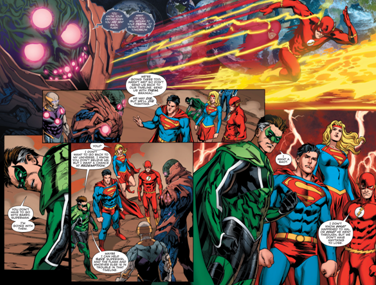
Additionally, Wildstorm and Vertigo publications were officially absorbed into the DC universe, while many recent events, particularly in Batman and Green Lantern titles, continued with very little alteration, truly begging the question as to why DC even bothered to reboot their continuity so severely just as their titles had become engaging and accessible for new and long-term readers. The biggest problem with the New 52, however, was that while DC still incorporated a version of the multiverse (complete with slightly different versions of Earth-Two and Earth-Three), it took DC almost a year to properly establish their new continuity; many characters went without detailed revised origins until this time, causing a great deal of confusion as to what events and characters were still canon, and largely alienating me in the process. Eventually, though, DC decided to bring the New 52 to a close and restart everything…again…using the Convergence (King, et al, 2015) storyline to kick-start their Rebirth titles. In Convergence, Brainiac has collected numerous cities and their inhabitants from across the multiverse (even some from prior to the original Crisis) and deposited them on Telos, a sentient planet that forces them to fight each other to see which is superior. Amidst the chaos and the fighting, the sorcerer Deimos usurps Telos and declares himself ruler and protector of this imprisoned on there. Eventually, Deimos is defeated by Parallax (drawn straight out of Zero Hour), which causes a chain reaction that threatens to annihilate the entire multiverse (…again). Brainiac, seeking to atone for his misdeeds, intervenes and sends pre-Flashpoint Superman and Zero Hour-Parallax back to the original Crisis to change its outcome and save the multiverse from collapsing.
Rebirth returned pre-Flashpoint charactersand brought the Watchmen to the DC Universe.
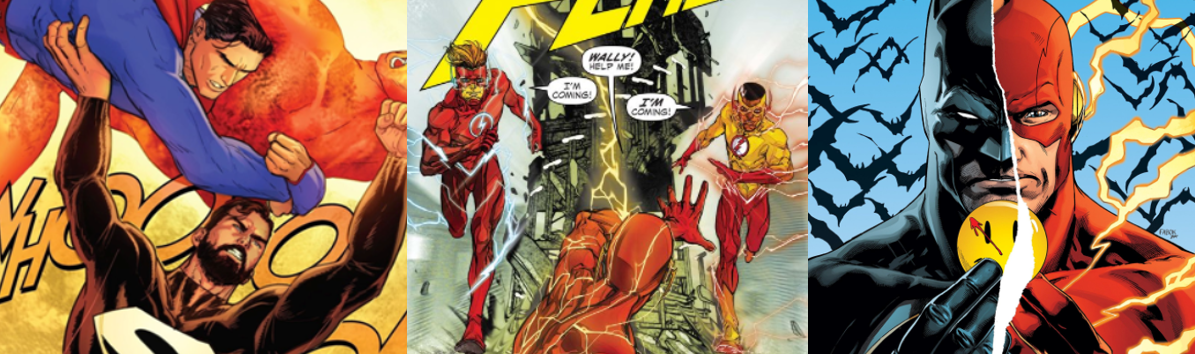
Convergence concluded with the return of the multiverse proper, with a potentially infinite number of worlds once again present in DC comics, while absorbing yet more commonly displaced titles into DC continuity; an ongoing theme throughout the resultant Rebirth-branded comics has been the introduction of characters from Watchmen(Moore, et al, 1987) into the larger DC universe for the first time. Perhaps the best thing to come out of Convergence and the resultant Rebirth titles was not only the death of the New 52-Superman but the return of the pre-Flashpoint Superman and the true Wally West. The pre-Flashpoint Superman is revealed to have been living a quiet family life with his version of Lois Lane and their young son and, despite starting as a separate character, has recently been amalgamated with and replaced the new 52-Superman entirely. Additionally, Wally now exists alongside his biracial counterpart, retconned as being his cousin, and even explains that Flashpoint was actually caused by Doctor Jon Osterman/Doctor Manhattan rather than Barry Allen. So, once again, DC Comics have been softly rebooted to attract new readers while reintroducing numerous popular concepts and characters into mainstream continuity. The return of the pre-Flashpoint Superman, a confidant married man with a superpowered child, is enough to bring me back to DC after the debacle of the New 52 yet their ongoing titles (particularly, again, Batman and Green Lantern, and even The Flash) continue the stories from the New 52 and with little consequence from the events of Convergence save for Batman and the Flash’s investigation of the Comedian’s button.
While Crises can be fun, they often cause more problems than they solve.
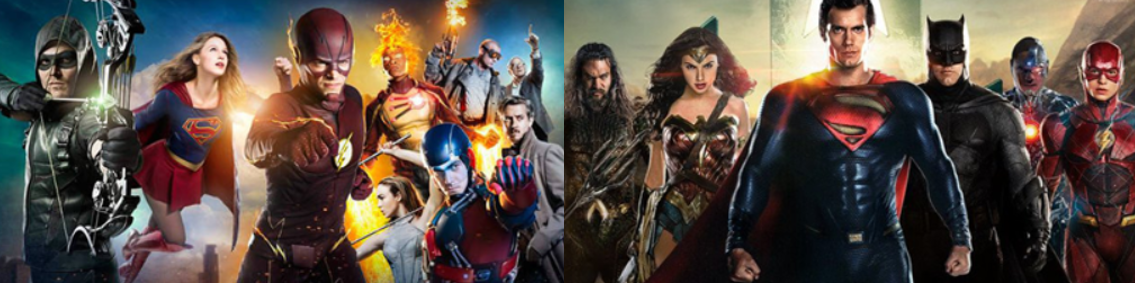
One of the things I love about DC Comics is that they’ll cook up a massive story whenever they want to make major continuity changes (as opposed to Marvel, who usually just quietly retcon stuff away, ignore it completely, or constantly update their sliding timescale to keep everything within an approximate five year timeline). While this means that everything can be canon at any one time, DC have notoriously dropped the ball with every Crisis-level event they produce. After Crisis, every title should have reset to zero and all continuity should have been rewritten and reset to accommodate the major changes they had made; to only have a few titles do this is ludicrous and created a knock-on effect that led to the disastrous Zero Hour event. It wasn’t until Infinite Crisis and Final Crisis that DC finally resolved the fallout from the original Crisis, and then they went and threw it all away with Flashpoint in an obvious attempt to bring in new readers unfamiliar with the events that had already transpired. Ironically, as a long-time comics fan, even I sometimes struggle with these massive Crisis events because they require a lot of background reading. As I mentioned, the New 52 publications alienated me completely and it’s only recently, now that DC has moved on to the Rebirth branding, that I have bothered to collect some key New 52 graphic novels. The worst part is that DC and Warner Bros. apparently would rather reference and incorporate elements from the multiverse concept in their movies and television shows. For example, the Flash seen in The Flash television show is not the Flash we see in Batman v Superman: Dawn of Justice(Snyder, 2016). This goes even further though as the Superman seen in Supergirl is not the Henry Cavill version of the character and Supergirl is not only separate the DC movies but also from The Flash, Arrow, and DC’s Legends of Tomorrow television shows (The Flash even goes to great lengths to introduce and explore the concept of the multiverse, again represented as 52 parallel worlds).
The DCEU is quite divided, to say the least.
This basically means that we will never see Stephen Amell appear as Green Arrow alongside Ben Affleck’s Batman and has resulted in two versions of the Flash, two wildly different versions of Batman’s origin between Batman v Superman and Gotham, two iterations of the Suicide Squad, and many more all existing simultaneously on television and in movies. DC and Warner Bros. then compound things even further by constantly talking about the multiverse and hinting that their movies are not all connected all with the intention of presenting themselves as doing things differently from Marvel Studios. However, the multiverse concept is incredibly complex and something only die-hard fanboys really understand. The general audience might not quite be ready for it and, besides that, it seems really stupid to want to have three different versions of Superman on screen at any one time, especially as DC have previously placed an embargo on Batman crossing over into other television properties. The multiverse has worked in comics because it has existed for so long and been explored to death; The Flash has done a great job of introducing the concept but that had three entire seasons to explore and discuss it at length. For a movie to do it would surely be far more trouble than it’s worth beyond simplifying it to a great degree, perhaps by introducing the Crime Syndicate or stating that a villain such as Darkseid has devoured parallel worlds or something.
Hopefully, however, DC has learned to better manage their Crisis-level events from now on, and also to limit them to one every ten or fifteen years or so; having massive inter-connected plots where the fate of the multiverse is at stake (and sticking guys like Batman at the centre of them!) occur every two to five years is just overkill, in my opinion, especially if DC screw the pooch as badly as the did with the New 52.













 Dr. K's Waiting Room
You must be logged in to post a comment.