Back Issues [Superman Day]: Action Comics #1


In 2013, DC Comics declared the 12th of June as “Superman Day”, a day for fans of the Man of Steel the world over to celebrate Clark Kent/Kal-El/Superman, the superpowered virtue of “Truth, Justice, and the American Way” who is widely regarded as the first ever costumed superhero.
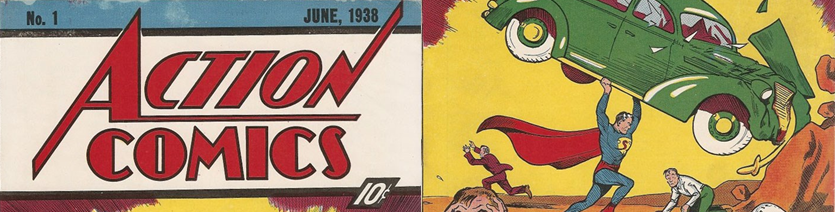
Story Title: “Superman”
Published: 18 April 1938 (cover-dated June 1938)
Writer: Jerry Siegel (credited as “Jerome Siegel”)
Artist: Joe Shuster

The Background:
Jerry Siegel and Joe Shuster, both sons of Jewish immigrants, first met in 1932 while attending Glenville High School; by the time they were both sixteen, the two were already accomplished comics creators and, in 1933, they thought up their first concept for a superman with the story “The Reign of the Super-Man”. This story depicted a bald mad scientist (very much a prototype for Superman’s arch nemesis, Lex Luthor) attempt to dominate others with his telepathic powers; later, the two would revisit and dramatically retool this concept into the world’s first super-powered crimefighter. Considering the massive success Superman has become as a character and a brand, it took some time for Siegel and Shuster to sell their revised concept, which took inspiration from mythological figures such as Hercules, fictional adventurers like Robin Hood and Zorro, and even circus strongmen for the character’s now-iconic costume. Yet, when DC Comics eventually purchased the character for publication, the two were paid a pittance for the now globally renowned superhero. Legal issues and disputes would follow the character for many decades before DC were able to iron out a mutually beneficial agreement with Siegel and Shuster’s heirs and allow them to be more fairly compensated for depictions of perhaps the most influential fictional character in American history.

The Review:
Action Comics #1 presents a much different version of Superman, one who might seem far removed from the virtual demigod we know and love today; back in 1938, for the Man of Steel’s iconic debut, Superman was still very much superhuman but he had yet to develop many of the powers and abilities he is now known for, much less the crazy, over-the-top powers he would later possess throughout later decades. The story begins by detailing Superman’s memorable origin…by summing it up in one simple panel. Yep, Superman’s home world (not yet identified as “Krypton”) is “destroyed by old age” in the comic’s opening panel and the future Superman’s rocket is discovered by a passing motorist in the next. Unlike traditional depictions of Superman’s origin, the alien infant within is immediately handed over to an orphanage where the attendants were “astounded at his feats of strength”. The next few panels quickly showcase the range of Clark Kent’s (his name comes out of nowhere a few panels later with no explanation) superhuman abilities: he can easily leap over a twenty-story building, lift incredible weight, run faster than an express train, and possesses impenetrable skin. Rather than explain his abilities as the result of Earth’s yellow sun or the differences in atmosphere between Earth and Krypton, the comic explains that the inhabitants of Kent’s home world had evolved a “physical structure millions of years advanced of our own” and compares them to the abilities of insects to lift incredible weights and leap vast distances.  
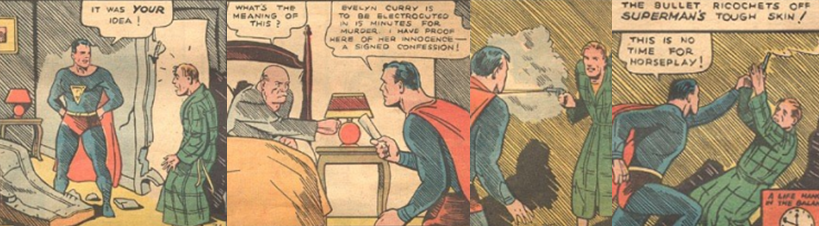
There are many convenient excuses to show off Superman’s awesome powers in the story.

Rather than being taught values and morals by loving, doting parents, Clark simply decides, off panel, to put his fantastic abilities to good use and crafts the persona of Superman, “champion of the oppressed [and] physical marvel]”. Superman is then introduced racing through the night with a bound and gagged woman, with no context or explanation; he can’t fly yet so he just runs at super speed to “the governor’s estate”, barging his way in and forcing his way past the governor’s butler with an uncharacteristic discourtesy. The butler is aghast when Superman easily dismantles the door to the governor’s “sleeping room” which, for some reason, is made out of solid steel! Superman explains to the governor that he has a signed confession that proves one Evelyn Curry is innocent of murder but, before the governor can properly digest this information, his butler confronts the costumed intruder with a pistol. Superman, however, easily shrugs off the bullet and disarms the man. With time fast running out, Superman convinces the governor to make the life-saving call and leaves the real culprit (the woman he was carrying in his first panel) in the custody of the governor. The next day, Kent is pleased to see that his actions, as Superman, have made the front page of the Daily Planet Star and the governor is left feeling eternally grateful that Superman is on their side…and well he should be given Superman’s blunt and direct approach to the fight against injustice.
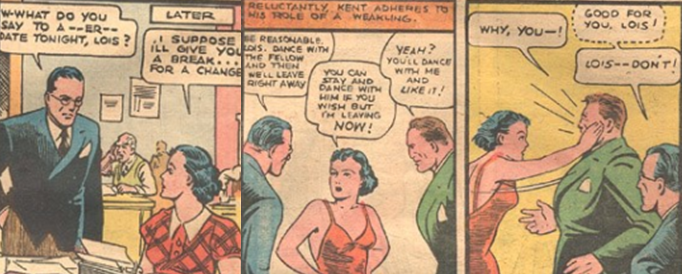
Clark keeps up his façade as a weakling, much to Lois’s continued disgust.

Kent then meets with the unnamed chief editor of the Daily Star, who orders him the assignment of covering the mysterious Superman who has been making so many headlines. While it might seem like Kent has walked in off the street, the next panel seemed to prove that he does, in fact, work for the paper as he is informed by a co-worker of a wife-beating taking place (seems like an odd thing for a paper to be tipped off about but I didn’t live in the 1930s so maybe this was a thing…?) Superman immediately rushes over to the scene of the crime and makes the abuser pay by shoving him violently into a wall, breaking his knife on his impenetrable skin, and threatening the man so fully that he faints in his arms. Superman then quickly changes back into his civilian guise to explain the situation to a policeman, making sure to attribute the woman’s rescue to his super-powered alter ego. Later, Clark works up the courage to ask his co-worker, Lois (no last name yet), out on a date and she decides to “give him a break…for a change”. This, and the next panel, quickly summarises that Lois tends to avoid Clark and give him the run around in the office as, when he asks why she treats him so unfairly, she simply scoffs: “I’ve been scribbling “sob stories” all day long. Don’t ask me to dish out another”. When Butch Matson, a local tough or possibly a mobster, decides to impress his gang of apes by cutting in on Lois and Clark, Lois reveals the truth about why she avoids Clark: she sees him as nothing more than a “spineless, unbearable coward!

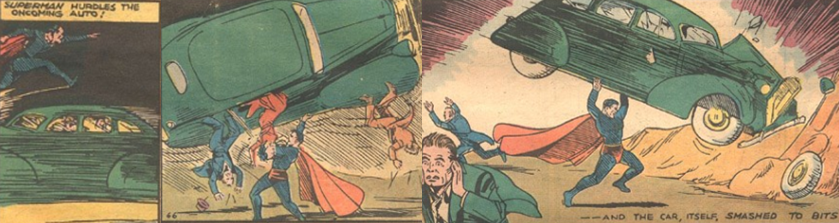
Superman easily catches up to and destroys Butch’s car in an iconic visual.

Of course, during Clark’s confrontation with Butch, the narration boxes and Clark’s thought balloons briefly gloss over the fact that Clark merely pretends to be a “weakling” to keep his secret identity…well…a secret, which is another pivotal aspect of the character that would be explored further in later Superman stories. Lois leaves in a huff and her taxi is soon forced off the road by Butch’s car; in what would quickly become a recurring tradition, Lois is kidnapped by Butch and his gang for little other reason than he took a liking to her, felt slighted by her rejection, and apparently has plans on raping her. Clark, as Superman, had been observing the whole thing from a distance and puts the wind up Butch and his cronies by first leaping over their speeding vehicle, then catching up to it, shaking them all out, and finally smashing it to pieces on a nearby rocky hill.
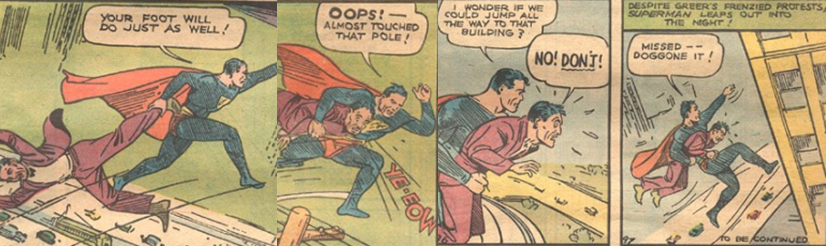
You’ll have to read the next issue to find out what the hell Superman is doing!

Superman teaches Butch a further lesson by leaving him stranded high up on a telephone pole before racing Lois, who is struck with fear and awe at his presence, to safety. Against Superman’s wishes for anonymity, Lois tries to tell her editor about her ordeal but he dismisses her story as ravings (which is really strange as the other day he was desperate for the scoop on Superman!) Anyway, Kent’s editor sends him to San Monte to cover an escalating conflict but, similar to when he was given the Superman assignment, Clark immediately disobeys this directive and, instead, takes a train to Washington, D.C. to investigate Senator Barrows. Clark snaps a picture of Barrows talking with a man whom the local newspaper identifies as Alex Greer, “the slickest lobbyist in Washington”. His unfounded and unexplained suspicions about the senator aroused, Superman climbs up to Barrows’ residence (the visual of him clambering up a building like Peter Parker/Spider-Man is both amusing and bizarre) and discovers the senator and Greer are in cahoots to get a seemingly innocent bill passed that will see America “embroiled with Europe” before anyone even knows what’s happened. Superman immediately confronts Greer and demands answers, taking him out onto the telephone wires high above the city and taunting the crook him with the threat of electrocution. He then leaps over to the White House to put the wind up Greer and the issue ends with a cliffhanger as Superman continues his intimidation of his victim by, apparently, unsuccessfully making the leap to a nearby skyscraper.

The Summary:
“Superman” is, honestly,  a dreadful story in terms of its pacing and narrative; very little time is spent explaining much of anything, with Superman’s alien origins completely glossed over and readers being forced to infer everything through context. We’re never told that Clark works as a reporter for the Daily Star, we just have to get that he is through inference; Superman races around with a bound woman and barges into homes without provocation and we only find out why after the fact; and God only knows why he pursues Senator Barrows rather than attempting to intervene in the San Monte conflict. But…it’s Action Comics #1, the first ever appearance of the greatest and most recognisable superhero the world has ever known, so I have to recommend that you read it if only for the purposes of witnessing history but, if I’m being brutally honest, the story isn’t really that great beyond the introduction of such an iconic character.
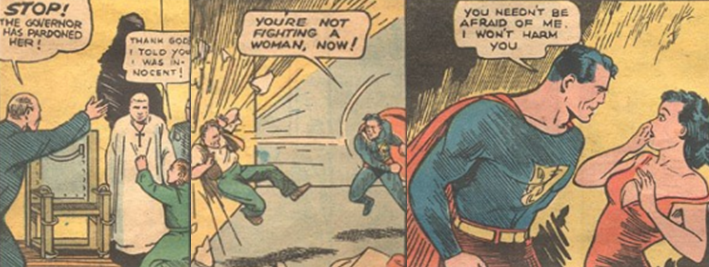
Whether by coincidence or design, Superman primarily saves women from abuse and persecution.

The entire story hinges on the colourful and extraordinary character of Superman himself; an enigma capable of incredible superhuman feats, Superman is visually and imaginatively appealing, I’ll admit. He has no time for decorum or adhering to the rules of the system; he simply strikes back at injustice no matter how trivial it may seem. To Superman, the life of an innocent woman is just as important as the torment of a victim of abuse and he tackles both with the same brute efficiency, utilising his fantastic strength and unmatched physical abilities to dominate the corrupt and the wicked. It’s interesting that pretty much everyone Superman saves in the story is a woman, with each of them being powerless victims of male oppressors, making Superman the paragon of virtue and honour as much as justice.
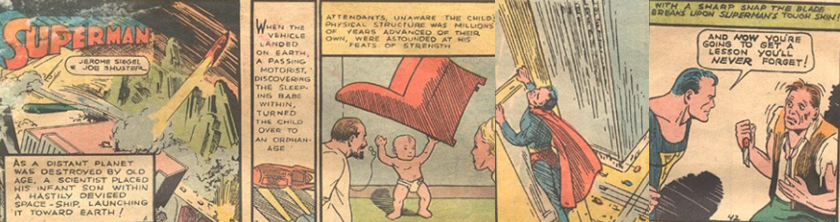
Superman’s more recognisable elements wouldn’t appear for some time…

As Superman’s first ever story, and a product of its time, a lot of forgiveness and leeway needs to be given to Action Comics #1. Many of Superman’s more recognisable and traditional elements wouldn’t be introduced for some time so, in that regard, the story is a little alienating to those who’ve only ever known him as the flying, all-powerful demigod with a colourful rogues gallery and fully developed supporting cast. Indeed, the seeds for Superman’s more critically regarded aspects are there, they’re just glossed over or barely touched upon: Superman’s status as the most powerful immigrant, for example, and his adoption of a meek alter ego in a reflection of his views on humankind are seen very briefly but the story is more focused on the wish fulfilment of a colourfully-garbed super man shrugging off bullets, smashing up vehicles, and teaching good-for-nothings a much needed lesson.
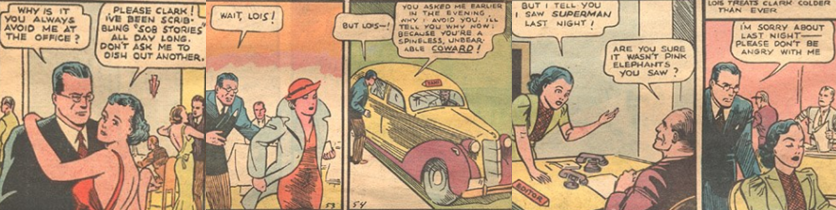
Make no mistake, Lois was a despiable character here and for many, many years.

Similarly, the story introduces the idea of tension and friction between Clark and Lois. I’ve always hated the early characterisation of Lois Lane and never understood what Clark ever saw in her or why she was deemed worthy enough to carry her own comic title; she was a snobby, condescending, annoying woman who constantly berated Clark and was obsessed (obsessed!) with marrying Superman for no other reason than she wanted him and she was a far cry from the strong-willed, independent, snarky, and yet actually likeable and supportive character she is often depicted as these days. Interestingly, Lois reacts to Superman more with fright than the fanatical wonder she was known for for many decades and isn’t shown to prefer Superman over Clark in this story but her bitchy attitude towards Clark is well and truly intact, though it’s just a hint towards the despicable character she would eventually become.

My Rating:

Rating: 2 out of 5.

Could Be Better

Have you ever read Action Comics #1; if so, what did you think of it and Superman’s debut? Were you surprised at how underdeveloped Superman’s origin and powers are in his debut issue or do you feel the focus on the action and spectacle of Superman justifies the brevity of its narrative? Do you prefer Superman as a more grounded, less elaborate superhero or do you prefer him as an all-powerful character? Which of Superman’s later, wackier powers and stories was your favourite? What is your favourite Superman story, character, or piece of media? How are you celebrating Superman Day today? Whatever you think, feel free to share your opinion and thoughts on Superman in the comments below.

Back Issues [Sonic Month]: Sonic the Hedgehog Story Comic


Sonic the Hedgehog was first introduced to gamers worldwide on 23 June 1991 and, since then, has become not only SEGA’s most enduring and popular character but also a beloved videogame icon. Since the Blue Blur turned thirty this year, I have been dedicating every Friday to SEGA’s supersonic mascot.


Story Title: Dr. Eggman’s Challenge!!, Clash!! South Island, and Sonic Rampage
Published: June to July 1991
Writer/s: Unknown
Artist/s: Unknown

The Background:
Sonic the Hedgehog (Sonic Team, 1991) underwent quite a complex development cycle; intended to be SEGA’s mascot and their answer to Nintendo’s Super Mario, numerous designs and concepts were submitted internally before SEGA settled on Naoto Ohshima’s spiky protagonist, later coloured blue and christened Sonic, and SEGA put a lot of effort and money into marketing and adapting Sonic to be appealing to a worldwide audience. This included not only redesigning the character somewhat but also stripping away some of the crazier aspects of Sonic’s Japanese lore. As a result, Sonic’s human girlfriend and rock band was dropped and Doctor Eggman was renamed Doctor Ivo Robotnik. Though this only really impacted the game’s manual, these changes were famously seen in a 1991 American promotional comic that established Sonic’s canon and informed his characterisation and world in comics and cartoons outside of Japan for years. Earlier that same year, though, Japanese readers of Mega Drive Fan were treated to a three-part manga that not only stuck far closer to the original, wackier ideas concerning Sonic’s lore but also the gameplay of the source material. Though never released outside of Japan, a fan translation does exist to provide a bit of a window into Sonic’s differing interpretations between the East and the West.

The Review:
The first part of the story, “Dr. Eggman’s Challenge!!”, begins with the mysterious South Island suddenly being invaded by Dr. Eggman and a horde of never-before-seen robots. Rather than his traditional Badniks, Dr. Eggman is accompanied by an army of construction and worker robots who quickly set to work building his fortress on South Island, displacing the cute and cuddly natives and destroying the natural ecosystem.

Dr. Eggman is a fun, goofy villain with some pretty daft motivations.

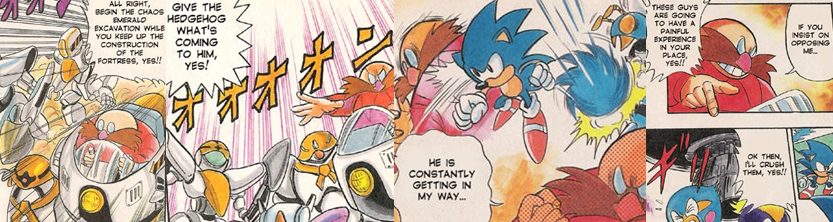
Dr. Eggman (often referred to as “Dr. Eggman-sama” in a reflection of his high status) is an extremely excitable, volatile, and goofy character; he has an odd tendency to end every sentence with a enlivened “Yes!!”, mischievously chuckles with a dastardly “Dohohoho”, and is primarily motivated to invade South Island to aid his desire for world conquest and to buy lots of his favourite food: eggs. When one of his minions informs him of the presence of a Chaos Emerald on South Island, Dr. Eggman becomes even more excitable and doubles his endeavours to build his fortress and excavate to legendary gem. However, Dr. Eggman mainly wants the Chaos Emerald to power the world’s largest pot and boil the world’s largest egg, which he claims has been his “life dream ever since [he] was young”. Remember, back in Sonic’s early days, Dr. Eggman was often associated with eggs and egg puns so this is a fun way to reference that recurring in-joke.

Sonic, here a rowdy rock star, wastes no time in dispatching Eggman’s robots.

The story then jumps to Green Hill Zone where Sonic and his oft-forgotten rock band are putting on a show for a huge gaggle of screaming fans and his own personal “bodyguard platoon”. Unfortunately, and quite conveniently, Sonic’s concert is taking place right where the Chaos Emerald is hidden and, thus, Dr. Eggman and his robots quickly attack, disrupting the crowd, attacking his fans, and wrecking the stage. In response to the interruption, Sonic attacks Dr. Eggman’s robots and trashes them with his patented speed and Super Sonic Spin Attack. Sonic is a slightly different character than you might be used to at this point; he’s not some snarky freedom fighter or a cool anime hero. Instead, he’s a rock star who’s all about putting on a performance for the adulation of others; when Dr. Eggman interrupts his concert, he takes it as a personal insult and doesn’t hesitate to strike back with his skills and a snarky attitude that has, sadly, been largely dropped from his characterisation.

Sonic is enraged at Dr. Eggman’s plot to turn his friends into robotic Badniks.

With his robots destroyed, Dr. Eggman tries to squash Sonic with his Egg-O-Matic’s wrecking ball but Sonic is much too fast to be hit and makes short work of Dr. Eggman’s contraption. With the dastardly doctor defeated, Sonic goes back to his concert and Eggman retreats to lick his wounds and plot his revenge by playing Sonic the Hedgehog on the “Megadora”, which motivates him to capture South Island’s woodland critters and transform them into the iconic Badniks. Dr. Eggman’s plot continues in the second part, “Clash!! South Island”; Sonic is incensed to see Dr. Eggman’s robots have spread to Marble Zone and learns from Pocky and Picky that Dr. Eggman has captured all of their friends and used them as living batteries for his Badniks. Disgusted and enraged, Sonic vows to head straight to Dr. Eggman’s base to put an end to his plot and rescue his friends…but is momentarily embarrassed to discover that he has no idea where to go.

Sonic takes a beating from Dr. Eggman’s various nefarious traps and hazards.

Picky points Sonic in the general direction and he speeds off, only to run afoul of the many and varied traps that Dr. Eggman has built into Marble Zone. Despite almost being crushed and fried to a crisp, Sonic is able to avoid Dr. Eggman’s traps with his super speed but ends up getting bashed about by bumpers in “Sparkling Zone”. Regardless, though having taken a beating, Sonic survives and is able to free Ricky and Cucky from their Badnik casings. Ricky and Cucky lead Sonic to “Star Land Zone” and to a capsule where their friends are being held captive. Sonic uses one of the Zone’s seesaws to spring himself up there and easily gets past an Orbinaut before Dr. Eggman comes in to battle him again.

Curse words and a bevvy of traps dog Sonic’s progress.

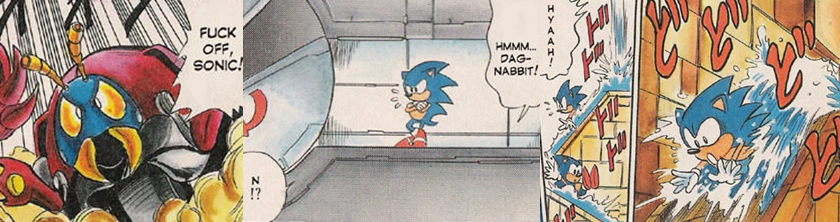
As in the game, Dr. Eggman is now packing a large spike on the underside of his craft but Sonic is easily able to outmanoeuvre him and take him out with a single Spin Attack. With Dr. Eggman sent packing once again, Sonic breaks open the capsules and revels in the adulation of his friends. Despite the setback, though, Dr. Eggman is only enraged even further and even more motivated to make Sonic pay for his interference by holding Flicky, Pecky, and Pocky hostage in his heavily fortified mountain lair. The final part of the story, “Sonic Rampage”, mainly details Sonic’s livid assault on the remainder of Dr. Eggman’s forces (this includes a hilarious piece of questionable translation when a Burrobot and Motobug spit out “Fuck off, Sonic!” to which Sonic replies (whilst smashing them to junk): “Fuck off yourselves!!”) Also of note is the mixed up order of the Zones Sonic visits here as the story opens with him in “Clockwork Zone” before going to Labyrinth Zone, where the final confrontation with Dr. Eggman takes place. This actually helps, in a way, to explain an oddity in Sonic the Hedgehog that I never really understood, which is why the third Act of Scrap Brain Zone is basically a fourth Act for Labyrinth Zone.

Sonic frees the last of his friends and defeats Dr. Eggman once and for all.

Rather than battling Eggman in the Final Zone and contending with his giant weighted machine, Eggman holds Flicky, Pecky, and Pocky prisoner in an unseen claw-like attachment to his Egg-O-Matic and threatens to squeeze them to death. However, faster than the naked eye, Sonic frees his friends and destroys the claw attachment before Eggman can even register what has happened and, with a fury of spikes, he unleashes his “Rolling Attack Rapid Strikes!!” attack to defeat Eggman once and for all and end his threat against South Island.

The Summary:
Sonic the Hedgehog Story Comic is a pretty simple but incredibly fun little adventure; obviously, the manga was designed purely to help advertise, promote, and sell copies of Sonic the Hedgehog and, as a result, each chapter ends with the characters or narrative breaking the fourth wall to advertise the game and the Mega Drive console. Still, what separates it from a lot of other Sonic media at the time is its fidelity to the source material; despite the fact that there are only a handful of Badniks, one for each of Sonic’s friends, and only three encounters between Sonic and Dr. Eggman (with only two involving his contraptions from the game), the manga captures the manic feel of the videogames much closer and reflects the simplistic narrative of the games much better than bogging it all down with the Ovi Kintobor story.

I really enjoy Sonic’s characterisation, which actually shows off his attitude and personality.

Of course, that’s not to say that it’s a 100% adaptation of the comics; for one thing, the Chaos Emeralds barely factor into the story at all. Only one is ever spoken about and it never actually appears in the story; the other five are completely missing, as are the Special Stages and Golden Rings, but then that does somewhat reflect how little importance the Chaos Emeralds had on the first game’s plot as it wouldn’t be until they were joined by a seventh that they would become a much more integral part of the plot. Two areas where the manga does excel, though, are the art and the characterisations; the art is very faithful to Akira Watanabe and Naoto Ohshima’s original Japanese artwork and aesthetic direction for Sonic, featuring such little details as Sonic have fangs and a great sense of his speed, with many of the illustrations of Sonic in action directly referencing his in-game sprites. As for characterisations, this is one of my favourite interpretations of Sonic; when he was first conceived, Sonic was the “Hedgehog with Attitude!” but, for the most part, he never really showcased that attitude. Sonic the Comic (1993 to 2002) reinterpreted Sonic as a sarcastic asshole but, for the most part, he was this good natured teenager who liked being the center of attention and getting praise and was extremely egotistical but was nowhere near as snarky and unruly as he is portrayed here and in the original video animation (OVA).

Eggman’s plans turn from conquering to a vendetta against Sonic.

Similarly, Dr. Eggman isn’t some bungling idiot or a semi-cybernetic dictator bent on subjected all of those beneath him; instead, he’s a goofy, maniacal bad guy motivated mainly out of greed, power, and the desire to have all the eggs he can handle. His temper flares as Sonic interferes in his plans and his plot alters from a vague desire for world domination to vindictively pursuing Sonic in a mounting obsession for revenge. It would be all too long before the goofier, more clown-like aspects of Dr. Eggman’s personality would find their way back into his character and they’re delightful to see here; he’s a goof, sure, but he’s also quite threatening at times, destroying the environment and kidnapping Sonic’s friends without hesitation, though he remains a largely ineffectual buffoon since, while he has a lot of robots and resources at his disposal, Sonic is easily able to take them all out and is never in any real danger.

My Rating:

Rating: 5 out of 5.

Fantastic

Have you ever read Sonic the Hedgehog Story Comic? Did you, perhaps, read the story when it was published in Mega Drive Fan or, like me, did you discover it through an online fan translation? What do you think to the early interpretation of Sonic as a snarky rock star? Were you a fan of the original ideas and design for Sonic or do prefer the changes made for his worldwide debut? What’s the most obscure piece of Sonic media you’ve ever seen or owned? Whatever your thoughts, feel free to leave a comment below and pop back next Friday for more Sonic content!

Back Issues [HulkaMAYnia]: The Incredible Hulk #1


Since his explosive debut in 1962, Stan Lee and Jack Kirby’s gamma-irradiated Jade Giant has been one of their most recognisable and successful characters thanks, in large part, to the Incredible Hulk television show (1977 to 1982) catapulting the Hulk into a mainstream, pop culture icon. Hulk has been no slouch in the comics either, being a founding member of the Avengers, joining teams like the Defenders, and has gone through numerous changes over the years that have added extra depth to the green-skinned behemoth and made him one of their most versatile and enduring characters.


Story Title: The Hulk (includes “Part 1: The Coming of the Hulk”, “Part 2 : The Hulk Strikes!”, “Part 3: The Search for the Hulk”, “Part 4: Enter…The Gargoyle!”, and “Part 5: The Hulk Triumphant!”
Published: May 1962
Writer: Stan Lee
Artist: Jack Kirby

The Background:
The Incredible Hulk (and his human alter ego, Doctor Robert Bruce Banner), was, of course, the creation of Marvel Comics legends Stan Lee and Jack Kirby. Inspired by a story of a hysterical mother exhibiting superhuman strength to rescue her trapped child, in addition to classic movie monsters such as Frankenstein’s Monster and the duel personalities of Doctor Jekyll and Mister Hyde, Lee and Kirby sought to create a tortured, monstrous figure that was a reaction to the mysterious of science and radiation and the foils of war. Famously, of course, the Hulk made his debut as a stone-grey figure who emerged at the onset of night; when printing errors saw the character rendered in different hues, Lee (who also often mistakenly referred to Bruce Banner as “Bob Banner”) decided to switch the character to his now-signature green (though red would have been far more appropriate considering it, like the Hulk, is associated with rage). Despite The Incredible Hulk being cancelled after only a year and a half, the character returned to a self-titled comic and a position of prominence with Marvel readers thanks to subsequent expansions of his lore and character and, of course, his inclusion in numerous team ups, issues of Tales to Astonish, and the popularity of the TV show and his other animated appearances.

The Review:
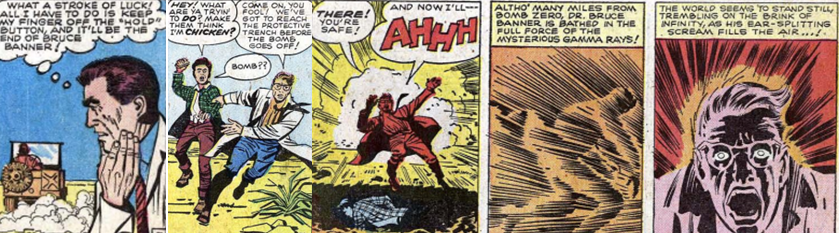
The issue begins in the middle of the desert where stands the Gamma Bomb (or “G-Bomb”), the “most awesome weapon ever created by man”; the genius behind the G-Bomb, Dr. Bruce Banner, waits anxiously in the concrete bunker some miles away. Banner’s nerves aren’t helped by the criticism of his fellow scientist, Igor, or the blustering presence of General “Thunderbolt” Ross. Ross isn’t happy at the delays Banner has caused the operation, or his men, and openly scoffs at Banner’s concerns and apprehension concerning the vague (yet nonetheless awesome) power the weapon holds. Igor, meanwhile, is incensed that Banner hasn’t shared the secrets of the G-Bomb with him or their peers, even more so when Banner reveals that no one has double-checked his formulas and calculations.

Thanks to Igor and Rick, Banner is bathed in the full force of the mysterious gamma rays!

Banner’s preference towards secrecy and privacy backfires on him, however, as Igor, eager to take all the credit for Banner’s work, allows the G-Bomb countdown to continue after Bruce heroically races out into the testing area to save the life of a teenage kid, Rick Jones, who has slipped past the guards. Banner shields Rick in a nearby trench but, thanks to Igor, the genius scientist is caught in the full blast of the exploding G-Bomb! Hours later, he awakens, still screaming, having miraculously survived the explosion and apparently suffering no ill effects from the awesome gamma rays. Rick, humbled and eternally grateful to Banner for saving his life, sticks around and watches in awe as, when night falls, Banner undergoes a startling transformation into a grey-skinned behemoth!

The Hulk’s rampage is stopped right before he can do serious harm to Rick.

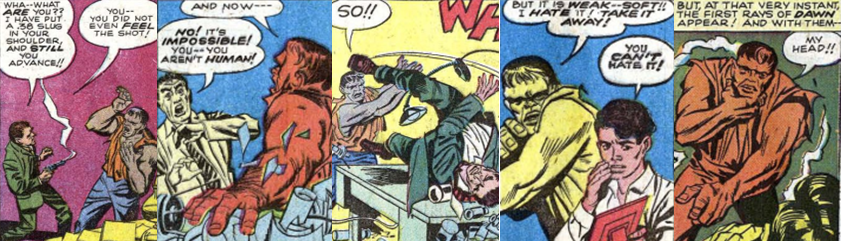
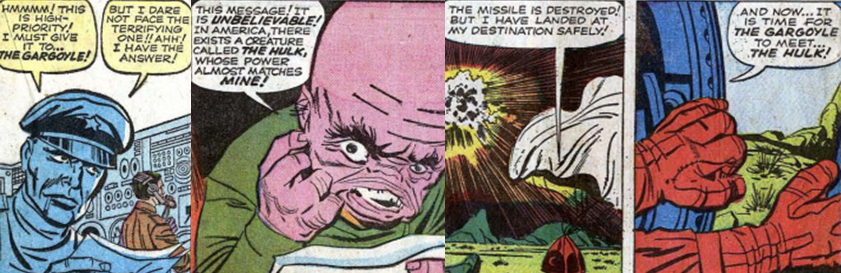
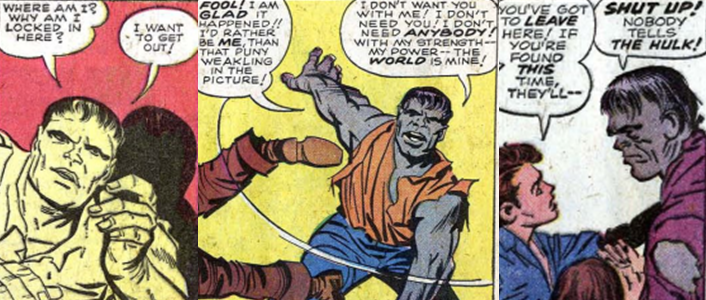
Rather than the mindless, rampaging beast known for his trademark cry of “Hulk smash!” this first incarnation of the Hulk (as the panic-stricken soldiers coin the beast) is a disconcertingly articulate and lumbering creature. His first thought is escape, smashing first through the concrete wall of the base and then trashing an oncoming jeep with ease before disappearing into the night as Rick frantically gives chase. While the soldiers back at base are gob-smacked at what they witnessed, they nevertheless mount an armed search party to track down the beast, whom they believe has kidnapped or killed Dr. Banner. The Hulk, meanwhile, is driven by pure instinct to retrieve Banner’s gamma formula but stumbles upon Igor attempting to steal it for himself! To Igor’s horror, the Hulk is completely unfazed by a “.38 slug in [his] shoulder]”, crushes Igor’s pistol in one meaty hand, and tosses Igor across the room effortlessly. Upon hearing Banner’s name, the Hulk is disgusted and annoyed, believing Banner to be “weak — soft!!”, and then violently rejects Rick’s desire to help him. Indeed, the Hulk advances on Rick, seemingly looking to kill him, and is only stopped by the sudden and unexpected rising of the sun, which sees the Hulk revert to Banner before Rick’s horrified and fascinated eyes.

The stress of his newfound curse begins to take its toll on Banner…

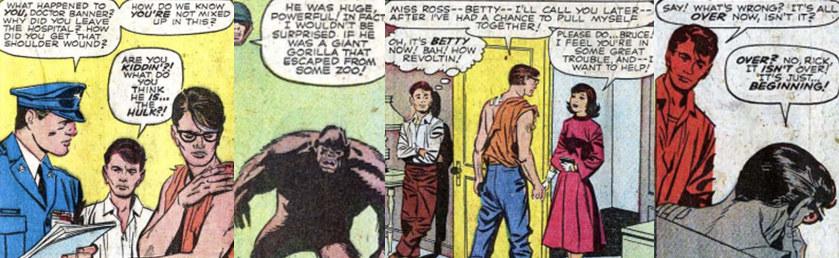
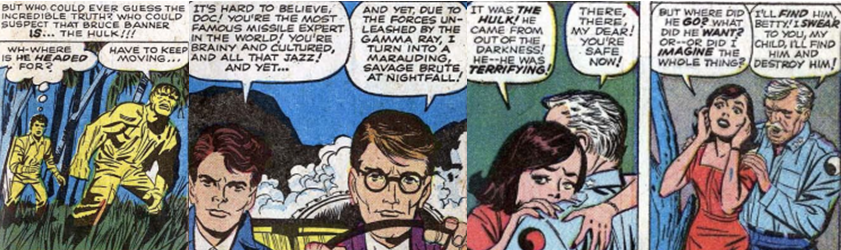
When General Ross and the Military Police show up searching for the Hulk, they immediately begin pointing fingers at everyone! Igor is detained as they believe he is in league with the Hulk and Banner (who sports a minor shoulder injury from Igor’s bullet) is questioned as a suspect. Luckily, plenty of eyewitnesses are on hand to attest to the Hulk’s monstrous appearance, though their accounts of the creature vary wildly. Amidst the confusion, Banner is comforted by Ross’s daughter, Betty, who previously defended him in front of her father. Perhaps out of pity, perhaps out of kindness, perhaps even out of an attractive, Betty offers her help and support to Banner, whom she believes is still suffering from the effects of the G-Bomb, to say nothing of the subsequent stress of recent events. After she leaves, Banner laments his cruel fate, despairing that, when the sun sets, he will once again become the Hulk and lose his rational mind to a monstrous creature.

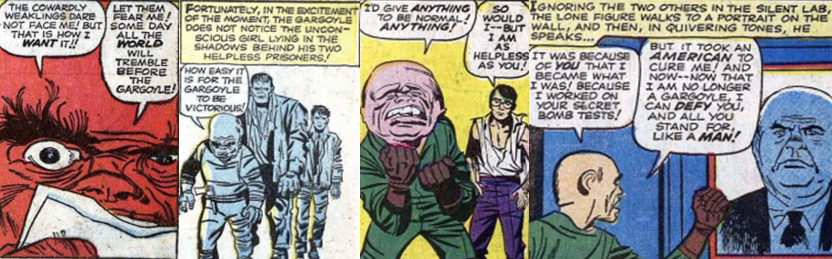
News of the Hulk’s strength reaches the Gargoyle, the Soviet’s ghastly grotesque.

Locked up in a prison cell, Igor (actually a spy for the Russians) is able to use a handy-dandy hidden “sub-miniature transistor short wave sending set” (translation: a small radio) hidden in his thumbnail to send a message to his Soviet comrades. The Russians take Igor’s message of the Hulk to the Gargoyle, “the most feared man in all of Asia”, a hideous little…gargoyle…of a man who is so feared that no one dares give him the message in person. Angered at the thought of a creature able to match his power, the Gargoyle immediately has himself literally launched over to America to confront the Hulk.

The Hulk is disgusted at Betty’s fragility…

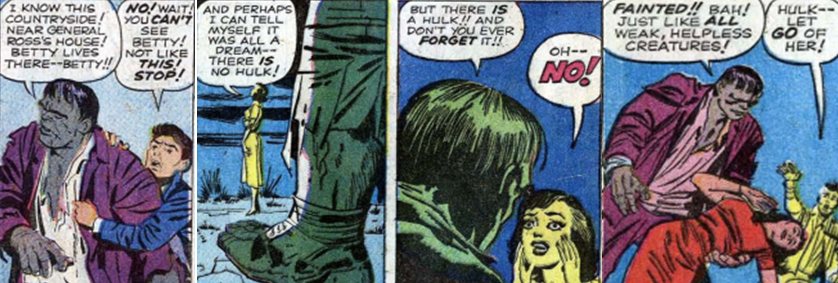
In a desperate attempt to keep the Hulk from hurting others, Banner and Rick drive out of the base and into the desert but, on the way, the transformation occurs and their jeep is wrecked. Rick is shaken by the crash but the Hulk is unfazed and immediately, instinctively, heads towards Betty at General Ross’s house. Betty, who is irrationally overcome with feelings of concern and affection for Banner, attempts to clear her head and encounters the Hulk just outside her house, fainting in his arms to the grey goliath’s disgust. However, unbeknown to the Hulk and Rick, they have been followed by the Gargoyle, who promptly shoots the charging man-monster and his young companion with a special pistol that instantly makes them obedient to his every command.

Banner uses his intellect to cure the Gargoyle, who sacrifices himself to ensure their escape.

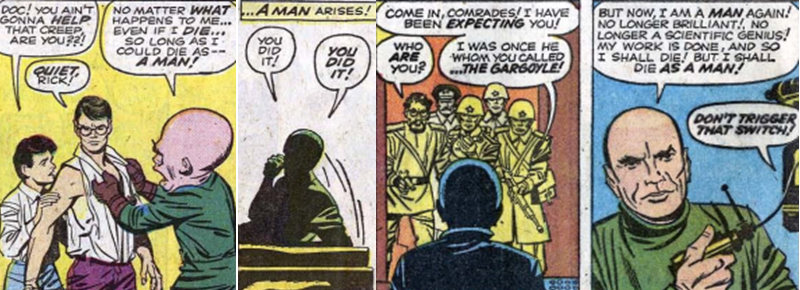
Utilising the help of similar slaves, the Gargoyle manages to escape with his prey back behind the Iron Curtain and is positively giddy at the thought of dissecting the Hulk and claiming his power for his own…and equally distraught to find that the Hulk has reverted back to Banner during the trip. Now no longer showing the effects of the Gargoyle’s weapon, Banner and Rick are astonished to witness the Gargoyle break into tears when he realises that the Hulk and Banner are one and the same. Distraught at his ghastly appearance, the Gargoyle wishes only to be a normal man again, just like Banner, whatever the cost. Banner, who has “seen cases” like the Gargoyle’s before, believes he can use “radiation” to grant the creature’s wishes and is, surprisingly, successful. Now a man once more, the Gargoyle allows his captives to return to America safely while he stays behind and sacrifices himself to destroy the Russian outpost

The Summary:
Well, honestly, I have to say that I am surprised; I was expecting the Hulk’s debut appearance to be primarily about him coming into conflict with the military but, instead, the story takes a dramatic and odd sharp left turn with the introduction of the Gargoyle.

The Hulk is surprisingly articulate and subdued compared to his later, more mindless portrayals.

“Unexpected” is perhaps the best world to describe The Incredible Hulk #1 since neither the Hulk or the Gargoyle are portrayed as mere mindless monsters. Instead, the Hulk is childlike, lumbering, and quick to anger but a far cry from the volatile creature he is now known to be. His feats of strength are extremely subdued compared to the literal world breaking exploits he would later indulge in and he’s also surprisingly articulate and cunning, acting on instinct but not simply yelling and screaming near-incoherently at his pursuers.

The Gargoyle, like the Hulk, is not what he seems on the surface.

The Gargoyle, meanwhile, appears to be this deformed, monstrous Red Menace and, indeed, it is implied that he is one of the Soviet’s most formidable weapons. Yet the knowledge that Banner and the Hulk are one and the same reveals his true nature as a tortured, pitiable creature who is lashing out because of his monstrous appearance. The Hulk, meanwhile, lashes out to escape and out of pure instinct thanks to the remnants of Banner’s memories and consciousness rather than out of pure malice and, while Banner is seemingly unable to help himself (though, to be fair, he hasn’t even tried yet) he is able to cure the Gargoyle through questionable means and allow him to die as a man.

Many of the Hulk’s troupes are established in this debut issue despite the story’s odd turn.

The issue, obviously, establishes many of the troupes that would come to be associated with the Hulk for decades: Banner is tormented by his condition, lamenting his fate and completely giving into despair and acceptance of his newfound curse. The Hulk wishes only to be left alone and to revel in his strength and power over the likes of “Puny Banner!” Betty is at once fascinated by Banner and terrified of the Hulk, with no one besides Rick having knowledge of his dual nature, and Ross, having discovered Betty still woozy from her fainting spell and babbling about the Hulk, vows to hunt down and destroy the creature without mercy. Little of this is really developed all that much in this first issue thanks to the sudden shift in tone and focus to the Gargoyle but the seeds are definitely planted and it certainly stands out as more of a monster/horror story than a traditional superhero tale, which may have been why the Hulk struggled to connect with Marvel readers for some time as they were, perhaps, expecting bright, costumed adventurers rather than a persecuted man-monster.

My Rating:

Rating: 3 out of 5.

Pretty Good

How did you find the Hulk’s debut story? Did you read it when it was first published and, if so, did the Hulk leave much of an impression on you or were you expecting something different from Marvel? What did you think to the Hulk as a character, especially compared to how he would be portrayed in subsequent years? Do you like the original grey-skinned Hulk or do you prefer the traditional green colouring? What is your favourite Hulk story, character, or piece of media? How are you celebrating the Hulk’s debut today? Whatever your thoughts on the Hulk, go ahead and leave a comment below.

Back Issues [X-Men Day]: The X-Men #1


To commemorate the culmination of their long-running and successful X-Men movies, 20th Century Fox declared May 13th as “X-Men Day”, a day to celebrate all things Mutant and the X-Men, Marvel’s iconic collection of superpowered beings who fight to protect a world that hates and fears them. To mark the occasion this year, I’ll be reviewing the original X-Men trilogy every Thursday from tomorrow to see how they hold up on a repeat viewing.


Story Title: “X-Men”
Published: 1 September 1963
Writer: Stan Lee
Artist: Jack Kirby

The Background:
By 1963, Marvel Comics were riding a wave of success thanks to characters like the Fantastic Four, Tony Stark/Iron Man, and, of course, Peter Parker/Spider-Man. Faced with the prospect of having to come up with more costumed heroes and needing a way to quickly and easily explain their powers, Stan Lee came up with the idea of “Mutants”, ordinary people who developed extraordinary powers once they hit puberty. Alongside long-time collaborator Jack Kirby, Lee created the concept of “The Mutants”, teenagers who were born with extraordinary abilities, but was asked to retool the concept with a new title: The X-Men, with the titular superheroes being students at a special school to hone their abilities into a force for good. Unlike superhero teams like the Avengers and the Fantastic Four, the X-Men were hated and feared by the general public for their powers and what they represented: the next step in human evolution. In this way, Mutants were used by Lee and Kirby to tackle variety of social issues, most notably racism. Although initial sales of The X-Men lagged compared to other Marvel titles and the comic was cancelled by issue sixty-six, a 1975 revival, in which an international team of Mutants joined the title, breathed new life into the concept and the X-Men have been an enduring and popular team in comics ever since, influencing an entire generation with a much-lauded animated series in the nineties and, of course, a series of massively successful live-action movies.

The Review:
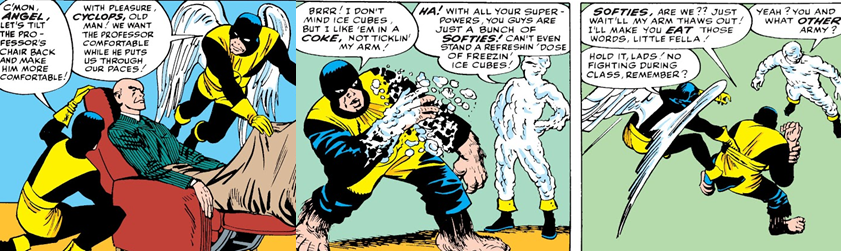
“X-Men” had quite a difficult prospect ahead of it that most other comic book origins didn’t at the time and that is that the story had to introduce an entirely new concept (Mutants) as well as seven new characters and the concept of the X-Men all in one issue. As a result, it’s quite a rushed and underwhelming issue in a lot of ways and none more so than in its first few pages. The issue opens with Professor Charles Xavier/Professor X sitting and brooding in the study of his “exclusive private school”; he’s just sitting there, all casual, and then suddenly sends a mental command out to his students, the X-Men, to report for class immediately. His pupils obediently obey, with each one entering the frame almost right away and in a way that immediately shows off their powers and abilities: Warren Worthington III/The Angel flies in on Angel’s wings, Hank McCoy/The Beast (not quite his furry blue self yet and resembling more of a muscular hunchback or ape-like man) bounds in through the window, Bobby Drake/Iceman (here resembling a living snowman more than a man of ice) slides down an ice pole that is connected to nothing but appears to be attached to one of Angel’s wings, and “Slim” Summers/Cyclops…runs in from the background, indicating how useless he is.

While Cyclops and Angel dote on Xavier, Iceman and Beast wind each other up.

In the very next panel, Cyclops and Angel, like the suck-ups they are, dutifully attend to Xavier’s comfort by adjusting his chair while Iceman and Beast get into a bit of banter that sees Beast more than a little perturbed by his team mate freezing up his arm. Iceman taunts Beast, and his fellow X-Men, showcasing an arrogant, free-spirited approach to his powers and abilities that immediately brings to mind Johnny Storm/Human Torch (Beast, with his large frame and quick temper, is equally reminiscent of Ben Grimm/The Thing). Angel keeps the two from coming to blows and Xavier orders the teens to begin their training exercise under Cyclops’ tutelage. Each of the Mutants is ordered to perform a specific task within a short time frame to demonstrate their powers and the control they have over their abilities: Beast expertly grabs a taut wire with his toes, spins himself around at an unbelievable speed, and then ricochets off the walls of the training room (not quite the Danger Room yet) before showcasing his superhuman balance and coordination (though he does overshoot on the final test). Angel (who exhibits a casual racism towards Homo sapiens) is up next, dodging jets of flame, crushing weights, and spinning blades with his expert agility and coordination but is momentarily stunned when a “sudden sound concussion” threatens to knock him out of the air. He recovers, learning a lesson in humility and also taking another step towards mastering hovering, all while Xavier mentally commands and praises his abilities.

Cyclops is easily able to subdue and best his team mates even when they outnumber him.

Iceman, impatient and frustrated, decides to throw a tantrum, believing that Xavier is going easy on him since he’s a little younger than the others. Xavier stresses patience but Iceman, ever the hot-headed and immature youth, decides to goof off and dress himself up as a snowman. At the last second, Iceman realises that this was all part of Xavier’s test of his reflexes as Iceman is forced to whip up a shield of ice to deflect a massive weighted ball that Xavier commands the Beast to throw right at his frozen comrade’s head! At this point, we’ve yet to see what Cyclops is capable of; up until now, he’s simply operated the controls of the training machine and supervised the drills of his team mates. Unimpressed with Iceman and Beast’s lackadaisical attitude to their training, he goads them into combat and showcases his own unique talent, almost blasting Beast through the wall with his optic blasts. Although Iceman encases himself in a thick ice cube, Cyclops easily breaks through it and, when all three of his fellow Mutants attempt to subdue him, Cyclops easily keeps them at bay with his red eye beams and physical ability, proving that he is, perhaps, the most powerful and capable of the X-Men.

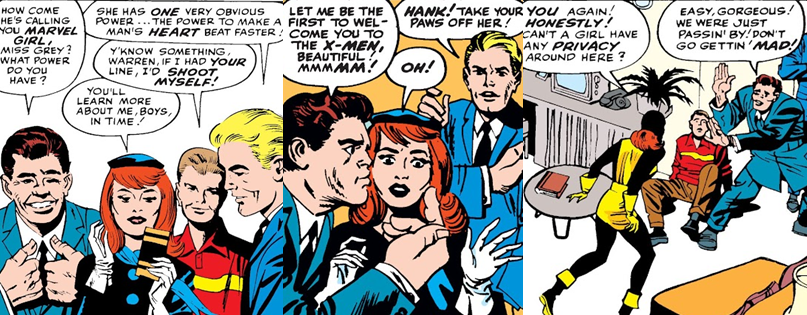
Jean exhibits her impressive telekinetic abilities to quiet her condescending peers.

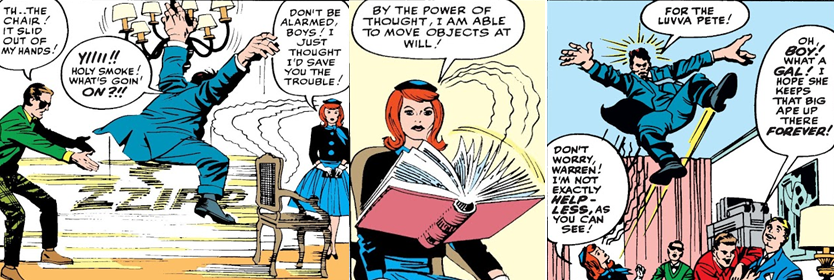
Satisfied with the abilities of his pupils, Xavier immediately calls and end to their training and rough-housing to introduce them to a new pupil, “a most attractive young lady”, which immediately sends the teens (with the curious exception of Iceman…at least, the dialogue makes it seem like it’s Iceman but he’s leering over her later in the story so who really knows?) into an excited frenzy as they leer at her from the window of Xavier’s study. The girl is, of course, Jean Grey, who has arrived more out of sheer curiosity than anything else since Xavier, apparently, didn’t give her any details prior to her arrival. He reveals that his school is actually a sanctuary for Mutants, those who posses “an extra power”, and home to his accordingly-named “X-Men”. Xavier introduces Jean to her new team mates, immediately inducting her into the school and onto the X-Men under the oft-forgotten and frankly lazy codename “Marvel Girl”. The boys, however, are unimpressed; seeing nothing unique about Jean, they regard her with scepticism and patronise her simply for being a gorgeous redhead. When “Slim” brings her a chair in which to sit, she shuts their condescending attitude right down by demonstrating her telekinetic powers, which are more than enough to move objects and fend off Hank’s creepy and inappropriate advances.

Magneto issues his threat against humanity and plots to take control of Cape Citadel.

With Jean part of the team, Xavier begins to divulge his backstory and the purpose of the X-Men: Xavier (who speculates that he was “possibly the first [Mutant]” since his parents worked on the “A-Bomb project”), recognising that “normal people” feared and distrusted him for his mental abilities, decided to set up a school to train Mutants in using their powers for the betterment of humanity, to help improve human/Mutant relations, and to protect the world from “evil Mutants”. The story then introduces us to one of these “evil Mutants”, Erik Lehnsherr/Magneto, who loudly monologues his own beliefs that humanity needs to be wiped out in favour of Mutants. Magneto demonstrates his incredible power of magnetism to destroy “the mightiest rocket of all”, turn a machine gun against a group of soldiers, and terrorise an army base by sending a tank amok before issuing an ultimatum to the Cape Citadel army base and calling for their immediate surrender. When the humans defy Magneto’s order, he destroys another of their missiles and then walks right into Cape Citadel! Garbed in a magnificently regal red costume and elaborate helmet, Magneto emits magnetic waves that render the soldier’s weapons useless and repels them with pure magnetic energy. Despite the General’s bluster, Magneto is easily able to overpower him and the entirety of his guards and lay claim to the base to fulfil his first objective towards his lofty goals of Mutant domination. Back at Xavier’s school, Bobby, Hank, and Warren’s disturbing leering of Jean is interrupted by another of the Professor’s mental summons; having heard of Magneto’s takeover of Cape Citadel, he orders his X-Men to confront the Master of Magnetism and defeat him in the first true test of their abilities. Seems a little unfair to Jean since the X-Men have been training together for some time and she literally just joined the team so she has no idea of their tactics and no experience of working alongside them as a team so she’s at a severe disadvantage even compared to the untested X-Men.

Magneto is defeated and the X-Men earn the respect and admiration of the army and their mentor.

Rather than dramatically flying to the base using the X-Jet on campus, the X-Men are driven to the airport in Xavier’s Rolls Royce and then spirited to their destination by a private jet controlled by Xavier’s “thought impulses”. Upon arrival, the X-Men find the army unable to penetrate Magneto’s magnetic force field and, driven to desperation, the General is willing to allow the X-Men fifteen minutes to attempt to breach Magneto’s defences. The soldiers are stunned by the X-Men’s abilities, which they thoughtlessly use to cut a path through their ranks and approach the shield, just in case you forgot what these new heroes are capable of. Thanks to Cyclops’ incredible optic blasts, the X-Men are able to easily breach Magneto’s barrier; the assault causes physical pain and a debilitating effect on Magneto so, in anger, he launches the base’s missile defences against the X-Men. Thanks to the team’s unique abilities and intense training, though, they’re easily able to avoid and dispatch the missiles, with even Marvel Girl pulling her weight with her telekinetic powers. Though impressed with their abilities, Magneto nevertheless takes immense pleasure in proving is power and superiority over them even when the X-Men are able to counter each of his attacks: when Magneto crushes Angel beneath a pile of junk, Cyclops blasts it away; when he sends a burning trolley of rocket fuel their way, Iceman shields them with an “igloo shield”. Magneto is then caught off-guard by the X-Men’s persistence and, after taking a blast from Cyclops, decides that an immediate and tactical retreat is in order; he levitates away using “magnetic repulsion” and uses another force field to keep the Mutants from following him. With Magneto scared away, the X-Men earn the respect and gratitude of the General as well as the praise and congratulations of their mentor,

The Summary:
Even taking into account the way Marvel operated back in the 1960s, “X-Men” is a very disappointing debut story for Marvel’s premier Mutant team. The art is stark, simple, and not very eye-catching or inspiring, with only Magneto really impressing in his design and abilities, and the dialogue is full of some of the worst clichés of comics at the time. The X-Men are constantly talking, generally always boldly exclaiming their names and abilities in a constant reminder of who they are and what they can do; this is indicative of comics of the time, as superheroes constantly felt the need to remind readers of these things (and their origins), but it’s especially annoying and off-putting here as it not only happens constantly but is the main thrust of the issue’s narrative. For a comic about the debut of a bombastic and exciting group of superpowered teenagers, barely anything happens throughout the issue as copious panels must be used to showcase these new characters and their abilities and to explain to the reader what Mutants are. I can understand it but it does interfere with the action and pace of the story and, ironically, would be a consistent issue in subsequent stories and arcs in future X-Men comics and spin-offs; even to this day I find X-Men comics quite off-putting due to the sheer amount of characters, dialogue, and dense lore that is packed into every issue and I pity anyone that tries to break into X-Men on a whim!

Jean must endure a lot of uncomfortable scepticism, leering, and comments from her team mates.

I can forgive the out-dated slang and even Marvel cutting corners on characterisation by supplanting the personalities of the Fantastic Four into their new team but it’s very hard to forgive the treatment of Jean Grey; like Susan Storm/Invisible Girl and even Janet van Dyne/The Wasp before her, Jean is constantly patronised, met with condescending comments, and leered over by the X-Men a frankly disgusting amount. Again, times were different back then, but Jean’s narrative is so simple it’s almost insulting: the boys are sceptical of her because she’s a girl but even when she demonstrates her powers they still treat her as little more than eye-candy, meaning she must not only prove herself as a capable X-Man but also constantly strive to be seen as a capable individual regardless of her gender. Still, at least she shows a bit of gumption and puts the horny teenagers in their place. Each of the X-Men gets a chance to showcase their personalities, which are as distinct as their powers, but some are more interesting and unique than others. Why should I care about Iceman being an arrogant, hot-tempered show-off when Johnny Storm already did it better? We learn next to nothing about Angel except that he’s a bit of a bigot towards humans and Beast is far from the eloquent, educated voice of reason we know him as today; instead, he’s just a Thing knock-off who is just as immature and foolhardy as Iceman. Cyclops, meanwhile, is the straight-laced teacher’s pet of the team; he gets a chance to show off how formidable his powers and abilities are, proving that he can best all of the X-Men even when they gang up on him, but he’s not an especially fun or interesting character since he’s all about adhering to Xavier’s rules and taking their training seriously.

Despite Magneto’s incredible power, he is defeated with ridiculous ease!

Xavier is also something of an enigma; we learn a bit about his background and his motivations and his cause is certainly a just one but he comes across as a stern and strict teacher, issuing orders and expecting them to be followed immediately, without question, and to the letter. His school is also noticeably light on students, meaning that he’s literally been training his X-Men to be superheroes rather than educating an assortment of Mutants for a variety of reasons, and he seems like a very secretive, devious individual since he freely reads people’s thoughts, projects his thoughts into the minds of others, and recruits Jean without her even understanding what she’s signing up for. Even Magneto, clearly the most visually interesting character, is little more than a rip-off of Victor Von Doom/Doctor Doom; he loves to monologue, is egotistical and brazen, and relishes in demonstrating his superior powers at every opportunity. Yet, despite appearing to be an unbeatable foe who is able to render men helpless simply through the weight of his magnetic force fields, Magneto is defeated with ridiculous ease! Seriously, the X-Men don’t even fight him as a team like the front cover suggests; they simply shrug off his pathetic attempts to destroy them, Cyclops blasts him once, and that’s it! Job done, Magneto flees, and the day is saved! It’s a lacklustre end to a lacklustre comic, to be honest, and it feels like everyone involved was just phoning it in and more concerned with getting over their new concept rather than debuting the X-Men in a fun and interesting way. The X-Men have certainly had better stories and debuts in the years since but it’s hard to really recommend their debut issue beyond nostalgia or curiosity to see how far the concept has come since its dull beginnings.

My Rating:

Rating: 1 out of 5.

Terrible

What are your thoughts of The X-Men #1? What did you think to the X-Men and their introduction? Do you agree that the story suffers somewhat from poor art and characterisation or were you instantly hooked on Marvel’s new team? Which character was your favourite? What did you think to Magneto’s debut, the portrayal of his powers, and his ultimate defeat? Which era of the X-Men is your favourite and who is your favourite ever team/character? How are you celebrating X-Men Day today? Whatever your thoughts, leave a comment below and be sure to come back tomorrow, and every Thursday for the rest of May, for more X-Men content.

Back Issues: The Amazing Spider-Man #300

Story Title: “Venom”
Published: May 1984
Writer: David Michelinie
Artist: Todd McFarlane

The Background:
In 1982, Marvel Comics’ editor-in-chief Jim Shooter took a liking to an illustration from reader Randy Schueller that depicted Spider-Man in a smooth, black outfit with a large red spider motif across the chest; after purchasing the concept for a mere $200, writer Tom DeFalco and artist Ron Frenz conceived of the costume being a living organism and Spidey’s new black suit debuted without explanation in The Amazing Spider-Man #252 before Marvel Super Heroes Secret Wars #8 revealed that Spidey acquired the suit during the “Secret Wars” event. Over the next year or so, Spidey revelled in the costume’s unique and helpful ability to form both clothing and organic webbing until Doctor Reed Richards/Mister Fantastic revealed its true nature as a symbiotic lifeform. Out of fear, Spidey rejected the symbiote, using the cacophony of church bells to drive it from his body and began wearing a cloth version of his black suit. At the conclusion of Web of Spider-Man #24, though, a mysterious assailant attempted to push Peter in front of an oncoming train and a shadowy figure was clearly stalking him throughout 1988 before the symbiote, now known as Venom, made its full and dramatic reappearance. Since then, Venom has evolved from a gruesome, twisted killer into a violent anti-hero and a more morally righteous hero, with the symbiote jumping from numerous hosts and spawning a number of similarly-powered offspring. Acting as Spider-Man’s dark doppelgänger, Venom was an immediate favourite for me and many readers thanks to their knowledge of Spidey’s true identity, resistance to his spider-sense, and having all of Spidey’s powers (and more) but being far for vindictive, sadistic, and lacking Peter’s strong moral compass.

The Review:
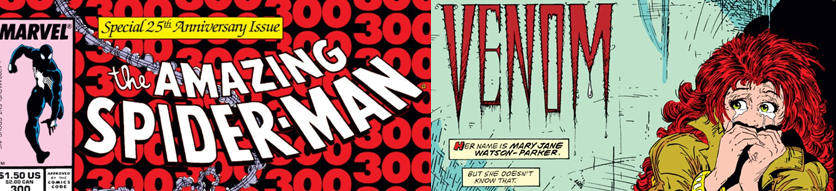
“Venom” opens with the startling image of Mary Jane Watson-Parker, Peter’s former fling turned wife, huddled in the corner of their apartment nearly out of her mind with fear. When Peter returns home, still garbed in his cloth black costume, initially Mary Jane recoils in horror before gratefully embracing Peter. Peter, though disturbed by Mary Jane’s condition and the fact that she was attacked in their apartment, is even more troubled by her description of her attacker and worries that the alien costume might have survived their dramatic break-up. Mary Jane, ever the feisty and capable woman, is largely back to her old self after a good night’s rest in a hotel and immediately makes arrangements for them to move so she can put the whole thing behind her.

The usually strong-willed and brazen Mary Jane is left a trembling wreck by Venom.

However, overcome with his characteristic worrisome nature, Peter retrieves a Sonic Blaster from the Fantastic Four (a formidable weapon against the symbiote, which is highly vulnerable to sonic waves and intense heat), but is too highly strung to notice a mysterious stranger stalking him or to properly socialise with his friends and family, despite Mary Jane’s best efforts to perk him up. It’s an extremely effective way to introduce Venom without even seeing them on-panel; although Venom doesn’t physically hurt or molest Mary Jane, their mere presence and alien nature are enough to reduce her to a shivering wreck. Her condition greatly disturbs Peter, who points out through his internal monologue what a strong, impendent, and capable woman Mary Jane usually is; she’s always been very brazen and outspoken so to see her reduced to little more than a frightened child is a chilling moment for him (and us, the reader). At their house-warming party, Peter suddenly leaves after spotting his alien costume swinging around town and is immediately blind-sided by a muscular doppelgänger of himself baring a horrific grin. Although the reader was introduced to Eddie Brock, a large, stone-faced, muscle-bound man who is in possession of the alien costume, earlier, we don’t actually learn who he is or any of his backstory until this moment. Previously, we saw that he lives in a rundown apartment full of weightlifting equipment and newspaper clippings of Spider-Man, openly converses to the symbiote (though it doesn’t answer him back), and that he religiously pumps iron to increase both his physical strength and the strength of the symbiote.

Brock was driven to the edge before bonding with the symbiote and becoming Venom.

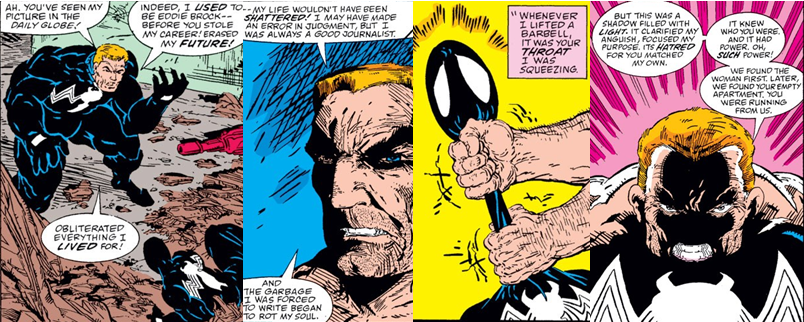
Peter, however, recognises not only the symbiote but also Brock, who is revealed to have been a respected reporter whose reputation was tarnished when he was duped by a compulsive confessor. Because Spider-Man captured Stan Carter/The Sin-Eater, Brock’s big story was discredited and he blamed Spider-Man for the sudden downturn in his fortunes. Brock’s mania was so complete and had blinded him so completely that he was driven first to strenuous exercise and, finally, to suicide; however, right as Eddie was contemplating the worst sin imaginable to his Catholic upbringing, the symbiote found him and, joined in their hatred of Spider-Man, they formed a bond so complete that Venom was born.

Spidey’s mercy proves to be his downfall as Venom are easily able to overpower and defeat him.

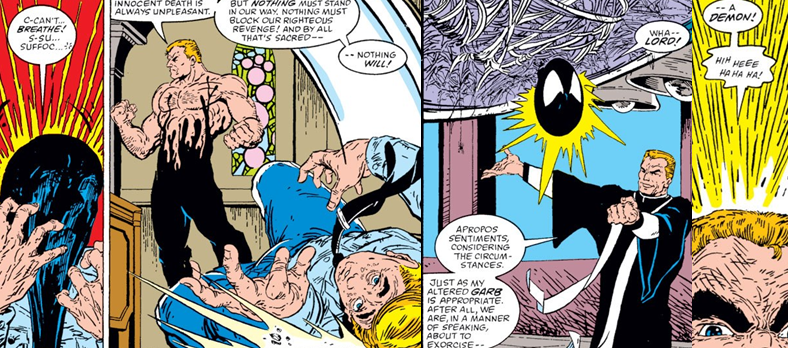
Though Spidey tries to use Brock’s monologue to edge his way towards his Sonic Blaster, Venom easily overpowers him with their superior strength. Spidey is, however, able to knock Venom down with a massive girder and blast him with the Sonic Blaster; Spidey hesitates, though, when he realises that the two have formed an unbreakable symbiotic bond and that further exposure to the high-intensity sound waves could kill Brock and decides to regroup and think of a new plan. This is all the hesitation Venom needs to recover, though, and with one massive blow, they knock Spidey out. When he awakens some hours later, Spidey finds that he has been webbed up to a church bell by Venom’s far stronger and much thicker webbing. Brock, now garbed in a priest’s robe, revels in the delicious irony and fitting nature of Spidey’s impending death since Peter tried to use the same massive bells to destroy his “Other”. Like any good, overconfident villain, Venom leaves Spider-Man to his fate and, as such, misses their chance to keep Peter from using his sheer force of will and brute strength to keep himself from being pounded into mush and breaking free of Venom’s webbing.

Spidey outsmarts Venom by forcing them to expend their webbing and tire out.

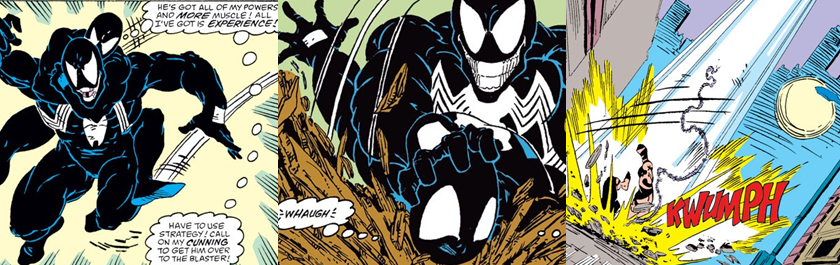
Unable to match Venom’s strength and at a serious disadvantage since Venom doesn’t set off his spider-sense and appears to have all of his strengths and abilities, Spidey decides to outsmart Venom by forcing them to expend their webbing and tire themselves out, draining the symbiote’s energy and sending Brock crashing to the street below. The story ends with Brock, and the symbiote, being held captive at Four Freedoms Plaza, the high-tech home of the Fantastic Four; there, encased within a cylinder and rendered inert by a constant barrage of sonic waves, Venom’s threat is effectively neutralised. Upon safely returning to Mary Jane, Peter and his wife agree that it is no longer appropriate for him to wear the black costume given Venom’s sadistic nature and he finally returns to the classic red and blue for the first time in about four years.

The Summary:
“Venom” is a really great introduction for one of Spider-Man’s most complex and vicious foes; this story took place during the much lauded Micheline/McFarlane pairing, which results in some absolutely fantastic and detailed artwork. McFarlane always drew a brilliant Spider-Man, emphasising the complexity of his webs, the inhuman positions and poses he would strike while web-slinging, and giving every character an edgy, nineties make-over to help them stand out a little more. Venom, in comparison, is far more subdued, visually, than he would later be, appearing as simply a jet-black, muscular version of Spider-Man with a demonic grin; it wouldn’t be until Mark Bagley came onto the title that Venom would take on some of their more recognisable characteristics, such as the writing tentacles, mass of teeth, and long, drooling tongue.

Brock is a hypocrticial, deluded, sadistic individual in his debut.

Still, Eddie Brock makes for a unique and interesting new addition to Spidey’s rogues gallery; Brock is one of a handful of Spidey’s villains who actually knows his secret identity and the only one (at the time) able to use that information to his full advantage thanks to his ability to circumvent Peter’s spider-sense and the many attributes of his alien costume. Brock is, of course, a complete madman here and in his early appearances; slighted by Spider-Man’s involvement, he blames all of his failings on Spidey rather than admit to being duped by a compulsive confessor. Eddie believes that Spider-Man is an evil and malevolent individual and that it is his sacred duty to put an end to his (Spidey’s) menace; his obsessive mania is so complete that he kills an innocent police officer and then justifies it as being necessary to his “righteous revenge”. He openly admits to being disgusted by innocent death but is all-too-happy to torment Mary Jane, stalk Peter, and attack Spider-Man with a maniacal glee.

Despite all their power, Venom are defeated quite easily through Spidey’s guile and cunning.

If there’s a downside to the story, it’s simply that Venom is defeated rather anti-climatically; the Sonic Blaster proves effective but Peter is too concerned with Brock’s well-being to press his advantage and, unable to match Venom’s brute strength (which is on par with Spidey’s and further augmented thanks to Brock’s intense physical training), Spidey simply has the symbiote exhaust itself and that’s it. However, Venom’s threat wouldn’t end here by a long shot and this is a simple way to leave the door open for their subsequent, far more impressive return and defeats. Furthermore, this tactic shows how blinded by his rage and spite Venom are and how adaptable and intelligent Peter can be; he doesn’t win through sheer mindless brute strength, as Venom are attempting to do, and must instead rely on his wiles and intelligence to overcome Venom’s very real and lethal threat.

My Rating:

Rating: 4 out of 5.

Great Stuff

Have you read “Venom”? Did you purchase a copy of The Amazing Spider-Man’s landmark 300th issue back in the day? What did you think to Venom’s introductory story; were you a fan of the concept and character or do you feel they are a product of a darker time in comics? What did you think to Spider-Man’s black costume and the revelation that it was an alien symbiote? What is your favourite Venom story? How are you celebrating Venom’s dramatic debut today? Whatever your thoughts on Venom, do please leave a comment below.
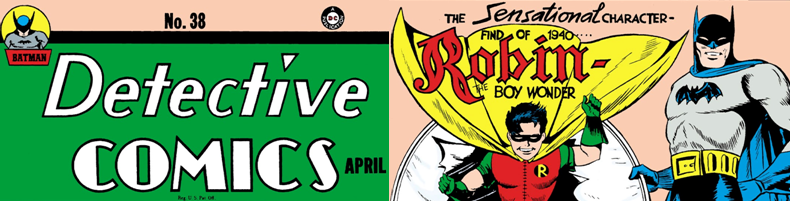
Back Issues [Robin Month]: Detective Comics #38


In April of 1940, about a year after the debut of arguably their most popular character, Bruce Wayne/Batman, DC Comics debuted “the sensational find of [that year]”, Dick Grayson/Robin. Since then, Batman’s pixie-boots-wearing partner has changed outfits and a number of different characters have assumed the mantle as the Dynamic Duo of Batman and Robin have become an iconic staple of DC Comics. Considering my fondness for the character and those who assumed the mantle over the years, what better way to celebrate this dynamic debut than to dedicate an entire month to celebrating the character?


Story Title: Technically untitled but presented as: “The Batman Presents The Sensational Character Find of 1940…. Robin – The Boy Wonder”
Published: April 1940
Writer: Bill Finger
Artists: Bob Kane and Jerry Robinson

The Background:
Since his debut in Detective Comics #27 in 1939, Batman had become a popular staple of DC Comics; the masked crimefighter began as a mysterious individual and, over time, acquired many of the supporting characters and gadgets that would become synonymous with the character thanks, largely, to the understated influence of writer Bill Finger, who greatly expanded upon many of the ideas of artist Bob Kane. However, to make Batman more accessible to younger readers and to give him someone to talk to rather than simply relying on monologues or thought balloons, Kane, Finger, and fellow creator Jerry Robinson came up with the concept of introducing a kid sidekick for Batman. With the character’s look inspired by illustrations of Robin Hood, the appropriately-named Robin not only significantly altered Batman’s dynamic and portrayal, casting him as a less darker and violent vigilante and more as a Sherlock Holmes-type father figure, but also dramatically increased sales and interest in the character upon his debut.

The Review:
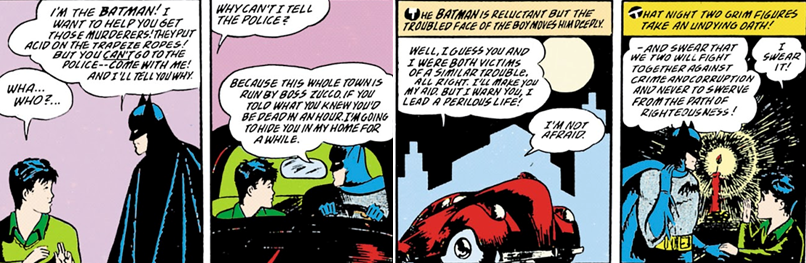
The issue kicks off right away by introducing us to the Flying Graysons, John, Mary, and their young son Richard (or “Dick” as he prefers…feel free to make jokes in the comments), a family of trapeze artists for Haly’s Circus who regularly wow the crowd with their high-flying antics, particularly their “death-defying […] triple spin”. One night, whilst backstage, Dick overhears a couple of criminals threatening the owner of the circus, Mr. Haly, who balks at their attempts to force him to pay them protection money, though they promise him that “accidents will happen”. The next night, right as John and Mary are performing their headline act, their trapeze ropes snap in mid-air and they plummet to their deaths off panel but right before Dick’s very eyes!

The Batman finds a kindred spirit in Dick, who is only too eager to join his crimefighting cause.

After being briefly comforted by Bruce Wayne, who was in attendance that same night, Dick overhears the gangsters confess to causing the accident, which is enough to both scare Haly into paying them protection money and to convince Dick to go to the police. However, he is stopped by the timely arrival of the Batman, Gotham’s legendary vigilante, who takes Robin with him in order to spare him from reprisals since the entire town is run by mob boss Tony Zucco and ratting out Zucco’s men would surely mean death for Dick. Batman shares with Dick a truncated version of his own childhood trauma and Dick immediately volunteers to join his cause. Though Batman warns him of the dangers of his vigilante life, Dick is unafraid and, with what now appears to be very little convincing, Batman swears Dick to an undying oath to dedicate himself to the fight against crime and corruption.

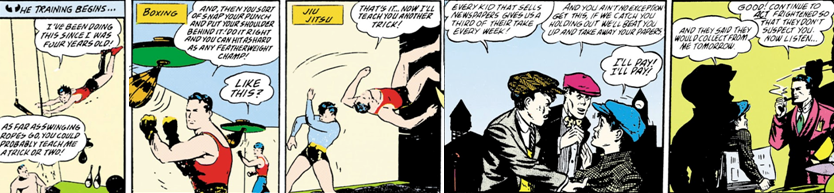
Dick excels at his training and is soon out on the streets gathering information on Zucco.

Having revealed his true identity to Dick (off panel, of course), Bruce begins training the boy for his new life; thanks to his circus background, Dick excels at rope swinging and takes to his training in the likes of boxing and “jiu jitsu” with an eagerness and talent over a period of many months. Finally, Dick is ready to play a part in Bruce’s crusade and, for his first assignment, Bruce has Dick impersonate a grubby-faced newsboy in order to attract the attention of Zucco’s thugs and track them back to their lair. With the information provided to him by Dick, Batman is able to intercept and disrupt Zucco’s operation, taking out his thugs across town and smashing up the mob boss’s gambling house. Each time, he tells his prey to give Zucco one simple message (“The Batman”) and dispatches Zucco’s cohorts with both ease and a snappy wit. Batman then delivers a threatening note to Zucco, who is so wound up by Batman’s antics that he falls completely for Batman’s bait and heads to the Canin Building (along with a number of his goons) to personally put an end to the Batman’s interference. However, instead of the Batman, Zucco and his minions are targeted by Dick in his new costumed guise of Robin.

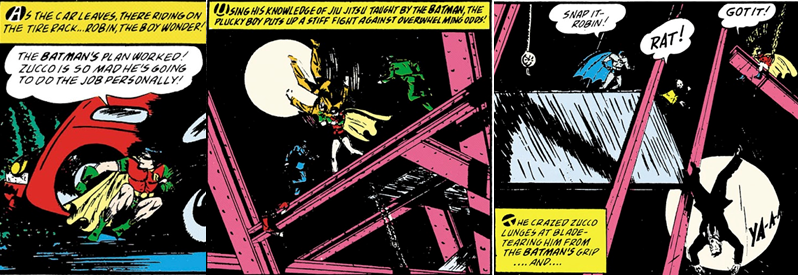
Overexuberance puts Robin in danger but it’s nothing a little murder can’t solve…

Striking fast and hard, Robin tackles one of Zucco’s men, causes another to (apparently) fall to his death by throwing a stone at his head, and handily takes out the rest using his speed, acrobatics, and the element of both surprise and misdirection. However, perhaps because of his youthful exuberance (Dick is clearly relishing the chance to beat up some thugs), Robin slips on a girder and is left dangling hundreds of feet in the air at the mercy of one of Zucco’s men. Fortunately, Dick’s circus training pays off and he is able to twist himself around to send the gunman falling to his death and Batman arrives to take out Zucco before he can get a shot at the Boy Wonder. Batman than threatens Zucco’s remaining henchman, Blade, into signing a confession (…he just happened to have this on him, presumably in his utility belt) about their involvement the deaths of the Graysons and willingly allows Zucco to send Blade falling to his death in order to capture evidence of Zucco killing a man. Batman then assures Zucco that both the confession and the picture will be enough to see him tried and sentenced to summary execution and, having orchestrated events so that Dick could avenge the deaths of his parents, returns to Wayne Manor with Dick to await their next “corker” of an adventure.

The Summary:
Okay, so, maybe Batman didn’t immediately turn into a child-friendly character all at once. Indeed, if you judge this story by most modern metrics of the character and his much-lauded “no kill rule”, you might be surprised to see Batman being so complicit and stoic about things such as mobsters being tossed off a building by a young boy. Of course, you can make the argument that Batman technically doesn’t murder anyone in this story; instead, he orchestrates events so that others do the dirty work for him but it’s quite astounding to see Dick go from a fun-loving, carefree young circus acrobat to a masked killer in just a few months.

Robin revels in the opportunity to fight at Batman’s side.

Of course, the entire point of this story is to introduce and sell us on the idea of Batman adopting (in the literal sense rather than the legal one) a young sidekick; Robin’s origin is a thematic parallel to Batman’s, having witnessed his parents’ deaths at the hands of criminals, but he’s a much different character to Bruce. He’s younger, obviously, faster and far more agile and, thanks to his circus background, takes to his new vocation with vigour and enthusiasm. Though he takes a vow to commit himself to justice, for Dick, being a crimefighter is a thrill and a privilege and, clearly, the entire point of the character is to exist as a form of wish fulfilment for all youngsters out there who wish they could swing through the city and fight thugs alongside the Caped Crusader.

My Rating:

Rating: 4 out of 5.

Great Stuff

What did you think about Robin’s sensational debut? What do you think about the idea of Batman having a kid sidekick? Do you prefer Batman to work alone or do you like the dynamic he has with his colourful partners? What are your thoughts on comics characters brazenly killing or willingly allowing children to be involved in such a violent life? Which of the Robins is your favourite, or least favourite, and why? How are you celebrating the debut of Robin this year? Whatever you think, feel free to leave a comment about Robin below and pop back next week for the next instalment of Robin Month.

Back Issues: Detective Comics #27

Story Title: The Case of the Chemical Syndicate
Published: March 1939 (cover-dated May 1939)
Writer: Bill Finger
Artist: Bob Kane (with sole credit going to “Rob’t Kane”)

The Background:
Seeking to capitalise on the success of Clark Kent/Superman in their Action Comics publication, the editors of National Comics Publications wanted more superheroes under their banner. In response to this, artist Bob Kane, inspired by pulp heroes like Kit Walker/The Phantom and Lamont Cranston/The Shadow and Leonardo Da Vinci’s sketch of an ornithopter flying device, drew up a design for a new masked crimefighter, the “Bat-Man”. This design, however, was wildly different from the image of the Caped Crusader we know and love today and it was only thanks to the long-suppressed influence of artist Bill Finger that the Bat-Man gained his iconic cape, cowl, and darker, more gothic uniform. In the years since his debut, Batman has become not only one of DC Comics’ most popular characters but also a mainstream cultural icon, appearing in numerous other comics, movies, cartoons, and videogames and it all began way back in 1939 when one man chanced upon the nucleus of a blockbuster idea and decided to exploit his partner, and his character, for all they were worth.

The Review:
Batman’s first ever story is a brisk, six page adventure that begins shortly after the masked man’s debut. Unlike other superhero debuts, the Bat-Man is not afforded an origin story and his true identity isn’t revealed to the reader until the very last panel, creating a sense of mystery around the character. You’ll also notice that many of Batman’s popular and familiar elements are missing: there’s no Alfred Pennyworth, no Dick Grayson/Robin, no Batarang or Bat-Cave, Batman drives a big, red, clunky automobile rather than the Batmobile, and the story doesn’t even take place in Gotham City!

Gordon’s young friend seems to lead a boring, uneventual life.

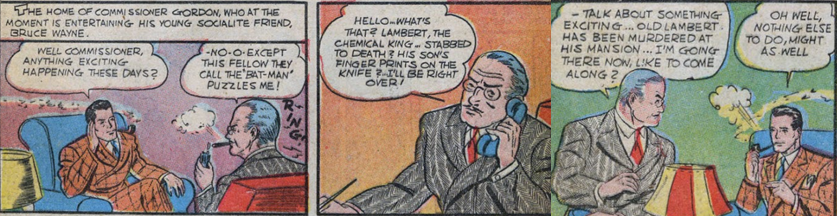
The story begins with Police Commissioner Gordon entertaining “his young socialite friend”, Bruce Wayne; the two are enjoying a good, old fashioned bit of smoking (with Bruce puffing away on a pipe as characters were known to do in those days) and Gordon blatantly disregarding police protocol by expressing his bemusement at the mysterious “Bat-Man”. Gordon is interrupted by a report of the murder of Lambert, the “chemical king”, apparently at the hands of his own son and Gordon invites Bruce to accompany him to the scene of the murder. Yes, that’s right, the commissioner of the police invites his bored, young playboy pal to visit a murder investigation. At the scene of the crime, Gordon bluntly confronts the young Lambert about his father’s death and, after working himself into hysterics, the young man relates that he returned home early to find his father on the floor with a knife in his back and moaning about a “contract” with his dying breath. Although the young Lambert isn’t able to name any potential enemies of his father, he does name his three business partners and, quite coincidentally, Gordon gets a call that one of these, Steven Crane, received a threat against his life that very day!

The Bat-Man makes short work of Crane’s murderers and retrieves a vital clue.

Unfortunately, Crane is shot and killed in the very next panel before Gordon can even begin to mobilise a response unit but, as the killers make their escape via the rooftop, they are confronted by the Bat-Man! Garbed head to toe in black and grey, the Bat-Man sports some oddly unfitting purple gloves and showcases incredible physical strength, easily knocking out one man and sending the other “flying through space” following a “deadly headlock”. Though Gordon and his cops arrive soon after and attempt to pursue him, the Bat-Man manages to escape with the paper the murderer’s stole from Crane. Meanwhile, Lambert’s other partner, Paul Rogers, having just learned of Lambert’s death, pays a visit to their third and final partner, Alfred Stryker, only to be knocked unconscious by Stryker’s assistant, Jennings. Jennings ties Rogers up and prepares to seal him within a gas chamber in order to gas the man to death, his speech punctuated by loathsome little giggles. Luckily for Roger, the Bat-Man makes a dramatic entrance and first plugs the gas-jet with his handkerchief (…how very…low-tech of you, Batman…) and then smashes them to freedom with a wrench. Although Jennings is packing heat, the sight of the Bat-Man is enough to cause him to hesitate and be felled by a brutal tackle and a swift left hook.

*shrug* I guess that’ll save the expense of a trial…

Stryker walks in and looks to finish the job on Rogers with a knife but the Bat-Man stops him, revealing that Stryker was behind all the murders in an attempt to become the sole owner of their company, the Apex Chemical Corporation, and to get out of having to pay his former partners off. In a moment of desperation, Stryker breaks free of the Bat-Man’s grip in an attempt to escape so the Bat-Man smacks him in the jaw and sends him tumbling into an acid tank, offering only a dry comment on Stryker’s fate. The next day, Bruce Wayne appears to be unimpressed with Gordon’s telling of the story, appearing to be little more than a bored, easily distracted rich man but the final panel of the story reveals to the reader that Bruce Wayne is actually the mysterious Bat-Man which, I don’t know about you, I never saw coming!  

The Summary:
“The Case of the Chemical Syndicate” is quite a dull story, in a lot of ways; it’s definitely an inauspicious debut for one of DC’s most iconic and popular characters and could even be a bit off-putting for modern readers, who would be more used to all the familiar trappings and elements of Batman and may be perturbed by their absence. Without the Bat-Signal, the many Bat-gadgets, or the other myriad of Bat-related elements, “The Case of the Chemical Syndicate” is definitely much more of a pulp mystery than a traditional superhero story. Obviously, this is mainly because superheroes were still in their genesis during this time and to be expected given the Bat-Man’s pulp influences and it does work for the context of the story.

The Bat-Man debuted as a very simple character and lacked many of his recognisable elements.

The plot revolves first around the mystery of the business partners being offed and secondly around the enigma of the “Bat-Man”, a vigilante who puzzles the police commissioner and whose motivations and backstory are a complete mystery at this point. Even learning that Bruce Wayne is the man behind the mask doesn’t really tell us anything about the character except that Bruce is clearly hiding behind the façade of a wealthy socialite. Of course, the main takeaway from this story is the Bat-Man’s callous murder of Stryker and his nonchalant reaction to it. Nowadays, Batman is notorious for his staunch “no kill” rule and would never be written to kill a man in such a malicious way but, back in 1939, that’s just what pulp heroes did and it was widely accepted. Nobody bats an eyelid and even Gordon seems in awe of the Bat-Man’s mystery and motivations and it would take a number of subsequent stories and significant developments and additions to the Bat-Man mythos to transform the character into the Batman we know and love today.

My Rating:

Rating: 3 out of 5.

Pretty Good

Have you ever read “The Case of the Chemical Syndicate”? What did you think of the Bat-Man’s memorable debut? What are your thoughts on the Batman, or other costumed heroes, killing? Did you guess that Bruce Wayne was the man under the mask? Do you think Bob Kane’s original Bat-Man concept would have been as successful as the character eventually became? What was your first experience of Batman and how are you celebrating his debut this month? Whatever your thoughts, drop a comment below and be sure to stick around for more Batman content throughout the year.

Back Issues: Tales of Suspense #39

Story Title: Iron Man is Born!
Published: March 1963
Writers: Stan Lee and Larry Lieber
Artist: Don Heck

The Background:
Long before Robert Downey Jr. uttered that unforgettable line, “I am Iron Man”, Stan Lee’s original idea behind creating Iron Man was to take a concept his readers would hate (a rich, military industrialist), throw in a little inspiration from Howard Hughes, toss in a little vulnerability and personal tragedy, and make him a character they would root for. Although Lee intended to write Iron Man’s debut, mounting deadlines saw him turn to his younger brother, Larry Lieber, to flesh out this concept. Though artist Don Heck drew the interior artwork, the cover art (which posits the question “Who? Who? Who?” and depicts Iron Man’s awesome, super chunky grey armour) was done by the legendary Jack Kirby. Stark and his armoured alter-ego was initially a whimsical, Errol Flynn-type anti-communist who existed, largely, for Lee to comment on both industrialism and the Cold War, and debuted in the pages of Tales of Suspense, a title known for including science-fiction mystery and (fittingly) suspense stories.

The Review:
“Iron Man is Born!” begins in “a secluded area somewhere in the U.S. perimeter” where Anthony Stark is demonstrating the power and awesome potential of his “tiny transistors”. Though the General is initially unimpressed with Stark’s grandstanding, with just a flick of a switch, Stark’s transistor technology increases the power of even the smallest magnet a thousandfold to tear open even a heavily-sealed vault door in an impressive demonstration of the technology he believes to be “capable of solving [the] problem in Vietnam”.

Stark impresses both military officials and ladies alike with his many talents.

Having introduced us to Stark’s impressive technological genius, the story then spends the next couple of panels giving us a glimpse into the type of character Stark is. A rich, handsome, glamorous playboy, Stark is seemingly lusted after by every woman who lays eyes on him and is both a sophisticate, millionaire bachelor and a scientist who wants for nothing, is capable of getting, making, or having anything he wants, and who is one of the premier hot-shotters in the U.S.

Wong-Chu has been terrorising South Vietnam, trouncing all who dare oppose him.

We’re then introduced to the tyrannical Wong-Chu , a stereotypical “Yellow Peril” menace who has mercilessly dominated the majority of South Vietnam, bringing village after village to its knees and besting all who dare challenge him in single combat and plundering without compassion. Wong-Chu and his “Red Guerrillas” vastly outnumber the stationed U.S. forces and have the advantage of being able to navigate through the dense jungle, which keeps the U.S. military’s heavy weapons and armaments at bay. Considering it’s Vietnam and we all know how messed up that particular conflict was, it’s a bit odd that the army would rather employ Stark’s transistor technology (as groundbreaking as it apparently is) to solve this problem rather than, I dunno, simply burning the jungle.

A booby trap causes sharpnel to become lodged near Stark’s heart, giving him just days to live!

However, while wandering around in the jungle for apparently little other reason than to deliver exposition, Stark triggers an unseen booby trap and is captured by the Red Guerrillas while he lies wounded. At the Guerrilla chief’s headquarters, their physician reveals that Stark is in critical condition; shrapnel near his heart makes it impossible for them to operate and Stark will be dead within about a week. Undeterred, Wong-Chu decides to coerce Stark into using what little time he has left to make weapons for them instead. Immediately sensing Wong-Chu’s deception, Stark agrees to their terms if only to use their resources in one last, desperate attempt to keep himself from dying. Considering he has untold pieces of shrapnel lodged in his chest and is, apparently, in critical condition and mere days away from death, Stark is rather spirited, able to stand, walk around, and work himself around the clock with only the looming threat of his impending demise working against him rather than, you know, agonising pain.

Yinsen helped Stark, and sacrifices himself, to create a powerful suit of armour to save his life.

On the second day, Wong-Chu bring Stark an assistant, the aged Professor Yinsen, a man whom Stark recognises and seems to idolise after studying Yinsen’s texts while in college. Stark shares his plans with Yinsen and they work together to complete Stark’s imaginative solution to his problem: a mighty electronic body powered by Stark’s transistor technology. This massive iron frame is specifically crafted to replicate all the natural movements of a man and to work in conjunct with Stark’s transistors to both keep him alive and grant him freedom of movement. With Stark’s conditioning worsening as time goes on, Yinsen presents him with the iron chest-plate to applies it, and the remainder of the suit, to Stark’s body. However, after powering up the generator, Yinsen selflessly rushes out to keep Wong-Chu’s forces at bay while Stark lies motionless and helpless.

The suit saves Tony’s life but it takes him some to adjust and adapt to it.

As the transistors charge up Stark’s suit, he is devastated to hear the sound of his friend being shot and killed and swears vengeance for him. Once the suit is fully charged, Stark’s life is saved; the transistors imbedded in the chest plate are vaguely depicted as being something akin to a life support machine that keeps Stark’s heart beating but we know, from the demonstration of the transistor’s magnetic powers that we saw earlier and from subsequent stories, that the suit is actually keeping the shrapnel at bay to keep Stark from dying. Surprisingly, and somewhat hilariously, Stark struggles to adjust to his new armoured suit, falling and having to take a panel or two to master the awesome power of the suit. Even more surprisingly, as Wong-Chu’s men head towards his cell, Stark has a moment of despair; he sees the oncoming battle as his “greatest test” and wonders if his suit will be up to the task while simultaneously doubting his own humanity and the unknown future that lays ahead of him as he must remain reliant upon, and encased within, his iron suit. It’s a startlingly affecting couple of panels and really shows just how much the experience has affected the formally carefree Stark.

Iron Man’s armour affords Stark many abilities and allows him to easily best Wong-Chu in combat.

Pragmatic as ever, Stark utilises his “transistor-powered air-pressure jets” to perform a great vertical leap and hides from Wong-Chu’s forces using “suction cups” to cling to the ceiling. After hearing clarification of Yinsen’s death, Stark again swears to make the Red Guerrilla’s pay for killing an innocent, harmless old man as Iron Man. Out in the courtyard, Wong-Chu is celebrating another victory over a hapless villager when Here Comes a New Challenger!! Iron Man approaches Wong-Chu and challenges him to single combat, easily besting him with his transistor-powered strength.

Iron Man uses his many gadgets and gizmos to deter and and demoralise Wong-Chu’s forces.

Iron Man’s reinforced metallic shell is even capable of deflecting bullets and, when Wong-Chu orders the use of grenades, Iron Man simply “[reverses] the charge in [a] magnetic turbo-insulator” and “[uses] a top-hat transistor to increase its repelling power a thousandfold” to deflect the incoming projectiles. Wong-Chu is incensed when his men flee from Iron Man’s power and uses a loudspeaker to offer a thousand yen reward to the man who can destroy the metallic menace who threatens his rule; however, Iron Man uses “electrical interference” to drown out Wong-Chu’s words and replace them with an order for the Red Guerrillas to flee in panic.

Though stunned by a rock-filled filing cabinet, Iron Man brings an end to Wong-Chu’s threat.

Though he easily uses his miniature buzz saw to cut through the locked door that hides Wong-Chu, Iron Man is briefly incapacitated when Wong-Chi is able to topple a rock-filled filing cabinet on top of him. Okay…first of all: where did Wong-Chu get the rocks to fill the filing cabinet and, secondly, how was is it he had the strength to push it down the stairs but Iron Man, with all his transistor-powered strength, struggled to lift it off of him? Regardless, Iron Man soon lifts the weight off of him but finds that he has exerted his power levels far too much and cannot pursue Wong-Chu. However, determined to keep the tyrant from slaughtering all of the prisoners in the camp, Iron Man squirts a thin stream of oil towards the ammunition storage building Wong-Chu is running past and ignites it, blowing Wong-Chu to smithereens without hesitation and leaving Stark to ponder his unknown future that lies before him as Iron Man.

Tony does not initially appear to be made out of traditional hero material…

The Summary:
“Iron Man is Born!” is quite the snappy little story; Tony Stark is indeed a very different character compared to some of Marvel’s other heroes in that he is a womanising philanthropist. While he’s not shown to be aloof or carefree, the panels depicting him as a billionaire playboy certainly indicate that this is the case; sure, he’s clearly a patriot but he seems to assist the military effort more out of personal pride and to show off his technology rather than out of any real inherent duty to his homeland.

A prisoner with only days to live, Stark falls back on his intellect to save his life.

Yet, when captured by the Red Guerrilla’s, Stark comes face-to-face not only with the true extent of the brutality of the Vietnam conflict but also his own mortality; where other Marvel heroes may have faced this threat with a witty remark or a patriotic resolve, Stark instead invests himself in the only thing he really knows: his science and genius. He works tirelessly to construct the Iron Man armour, crafting a sophisticated, life-saving machine out of a smattering of resources and technology, not just to save his own life but also to take Wong-Chu down with him.

Stark faces an uncertain future as he is initially bound to the armour in order to survive.

Indeed, initially, Stark seems to accept that this will be a suicide mission and that he may very well fail before he can even complete the armour; his motivations turn to revenge after the death of Yinsen, however, and he becomes quite the unlikely hero thanks to the experience of being held prisoner, coming to terms with his mortality, and the unlimited potential of his transistor-powered Iron Man persona. In the end, I actually felt like Stark had a lot in common with Doctor Bruce Banner/The Hulk in that he is somewhat horrified by the monster he has made himself into; he is not only overwhelmed by the implications of being trapped within the armour but ends the story satisfied with his vengeance but uncertain how the man once known as Tony Stark can continue to live in the world as an Iron Man.

My Rating:

Rating: 3 out of 5.

Pretty Good

Have you ever read “Iron Man is Born!”? How did you find it as a story and as an origin for ol’ shellhead? What did you think of Tony Stark compared to other Marvel superheroes at the time? What are some of your favourite Iron Man characters or stories? Where does Iron Man rank in your hierarchy of comic book characters? Are you doing anything to commemorate Iron Man’s debut appearance and, if so, what is it? Either way, I’d love to hear your thoughts on Iron Man so leave a comment below.

Back Issues: Captain America Comics #1

Story Titles: “Case No.1. Meet Captain America”, “Captain America and The Riddle of the Red Skull”, and other untitled stories
Published: March 1941
Writer: Joe Simon
Artist: Jack Kirby

The Background:
By 1941, World War Two was in full swing; Nazi Germany had overtaken Denmark and Norway in April 1940 and, after a period of resistance to joining the war effort, the United States entered the fray during 1941, providing much needed support against the combined “Axis powers” of Germany, Japan, and Italy. As a result of the ever-escalating conflict, patriotism and national pride was high, especially in America, and it was at this turbulent time that Joe Simon and the legendary Jack Kirby first debuted Steve Rogers/Captain America and his kid sidekick, James Buchanan Barnes/Bucky, two characters who would not only take the fight directly to the enemies of America and the free world but also encourage readers to support the war effort by any means necessary.

The Review:
Captain America Comics #1 is a bumper forty-five page debut issue for the First Avenger that features four short stories (and even a two-page text story with only a couple of accompanying drawings and panels) but only two of these stories have actual titles. The first, “Case No.1. Meet Captain America”, details the origin of the titular star-spangled Avenger; the War is in full swing and, while America faces real threat from the vast Axis armies overseas, they also face the threat of sabotage, treason, and terrorist bombings on their home turf thanks to the actions of the “Fifth Column”, spies and traitors from the Axis forces who perpetrated such heinous attacks. To combat this threat, the President of the United States has J. Arthur Grover of the Federal Bureau of Investigation (F.B.I.) take two high-ranking military officers to “a sinister-looking Curio Shop” in a “shabby tenement district” in Washington, D.C. that is actually the front for a highly sophisticated laboratory. There, they join other attendees in witnessing a frail, young man who was deemed unfit for active service be miraculously transformed into a man in peak mental and physical condition by Professor Reinstein’s mysterious serum.

Frail Steve Rogers is transformed into the peak of human physical ability!

Reinstein thus dubs the young man “Captain America” and explains to his awestruck audience that he is to be the first in a “corps of super-agents” who will actively oppose spies and saboteurs on America’s home turf. Unfortunately, one of the men in attendance is one of these spies (so much for the military’s stringent background checks…); with only a few frantic shots, the spy kills both Reinstein and Grover and destroys the only remaining vial of the super-soldier serum! Luckily, Captain America is able to subdue the spy, driving him to stumble into a bank of laboratory equipment and causing him to be summarily electrocuted to death. Sadly, though, the damage is done; with Reinstein dead, the serum destroyed, and the laboratory trashed, America’s hopes of building an army of super solders are dashed. Undeterred, Cap enlists in the army as Private Steve Rogers whilst also battling enemies of American soil as Captain America. Cap’s heroic antics catch the awe and imagination of his regiment’s mascot, young Bucky Barnes. Bucky is both stunned and exhilarated to stumble onto the fact that Steve is his patriotic hero, literally walking in as Steve is halfway through changing into his Captain America costume in perhaps the most anticlimactic and convenient of accidents. If you thought that was contrived and ridiculous though, Steve decides that the only logical course of action is for Bucky to join him as his partner. And so, donning a brightly-coloured outfit, a domino mask, and the laziest codename ever (Bucky goes by “Bucky”…), Captain America and his woefully-inexperienced sidekick pledge themselves to opposing the Axis powers in all their forms.

Cap and Bucky subdue the Nazi goons and put a stop to their nefarious plot.

They continue this fight in the issue’s next story, which goes untitled; in this story, a stage performer known as Sando has his diminutive, hunchbacked accomplice Omar stun audiences with predictions of the future, all of which detail terrorist attacks or destructive events. Although Bucky believes the two to be fakes, Cap is convinced when Omar’s prediction of the destruction of a nearby bridge comes true and the two suit up to confront the two stage performers. Cap doesn’t pull any punches, aggressively questioning Sando and then laying him out with a punch while Omar makes a quick getaway. I wouldn’t mind but the two haven’t even done anything yet or been proven to be responsible! Luckily Conveniently, Cap’s war-time paranoia turns out to be true as, when he races after Omar, he finds both Bucky and a beautiful reporter named Betty Ross (no relation, I’m sure) being held hostage at gunpoint by Sando and Omar, who are revealed to be working in league with Hitler’s spies to cause disasters across the country. Unimpressed, Cap and Bucky make short work of the Fuehrer’s goons, with Bucky swiftly tackling one and tossing the bomb he planned to use to kill them all out of the window before disappearing into the night. The issue’s third story also goes untitled and introduces a crazed Nazi who is known only as Rathcone but who comes to brand himself “The Dictator”. A malformed, goblin-like man, Rathcone has his own plans for world conquest and favours crafting little chess pieces that resemble his opposition, announcing his intentions to kill a target over the radio, and then employing a number of Nazi agents to carry out the deed. Captain America and Bucky seek Rathcone out after the self-styled Dictator makes good on his promise to kill Admiral Perkins; the witnesses to the gruesome visage of Perkins’ execution are whipped into a frenzy and baying for blood but Cap and Bucky waste no time in tracking down the assassin responsible for the murder.

Honestly, Steve, your constant snark to your superior officers isn’t helping the situation!

Despite Cap questioning (presumably in jest) Bucky’s ability to handle “a man’s job”, Bucky successfully tackles the killer and Cap is all set to force information out of him when an unseen assailant kills the man. This is also the first instance of Cap using his shield to…well, shield himself from gunfire, however neither he nor his kid partner are able to find the shooter. Next, Rathcone targets General Ellsworth; coincidentally (and conveniently) enough, Rogers and Bucky are ordered to report for “special duties” at Ellsworth’s hut, which means that they are the first to discover the General dead at his table! The media, of course, has a field day and Rathcone is so enthused by the two murders he has orchestrated that he begins to set his sights on the lofty goal of invasion; but first, he plots to remove Cap and Bucky from his chess board by…having his goons lure them into a trap that Bucky walks right into. Returning to his tent and finding that Bucky has gone off alone, Steve pulls on the stars and stripes and sets out to rescue him, making short work of Rathcone’s muscleman, Herr Strangler, in the process.

Rathcone captures Bucky but wastes time monologuing so Cap lays him out.

Rathcone, however, holds Cap at gunpoint and, typically, wastes his best chance to off the two masked men by explaining his master plan, which gives Cap the chance to lay him out with a good, old-fashioned punch to the jaw. After freeing Bucky, the two are set upon by Rathcone’s goons, with Bucky again requiring Cap’s assistance when two Nazis pin him down and try to stab him (I mean, it’s almost as if Cap has partnered up with a child with no training or physical acumen of any kind…). Although Rathcone recovers, tries to make a break for it, and even attempts to fight Cap off by smashing a chair over the Avenger’s head, Cap easily puts him down for the count and they uncover detailed documents of the self-styled Dictator’s plans to put an end to his scheming. The issue concludes with the first ever appearance of the Red Skull, Cap’s Nazi counterpart who would go on to be his most iconic, and enduring, archenemy. Though the Red Skull is typically the codename of Johann Schmidt, in his debut story it’s actually the persona adopted by George Maxon, a seemingly innocuous American businessman who has turned traitor and is working for the Nazis. Like Rathcone, the Red Skull’s modus operandi is to target influential military personnel in order to weaken America’s will and capabilities; he does this by stalking them, attacking them, and getting them in a choke hold all while chanting “Look at me! Look at death!” to, apparently, will his victims to death with a death gaze. So notorious is the Red Skull that he’s become something of an urban legend amongst the military personnel but, when Major Croy is found dead, the latest victim of the Red Skull, Cap takes it upon himself to investigate.
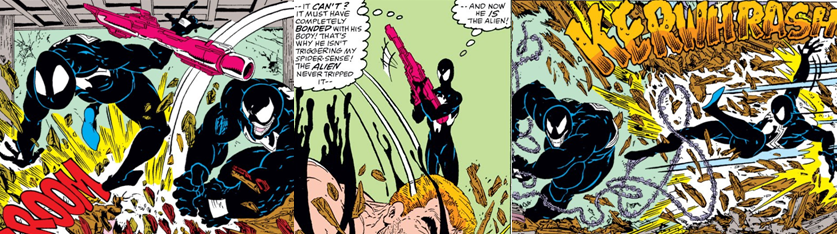
The Red Skull’s ability to apparently will his victims to death gives Cap reason enough to go solo…

Annoyed at being left behind (to be fair, I don’t blame Cap for this but, at the same time, it is extremely random (and, again, convenient) that he decided not to bring Bucky along this time…), Bucky decides to conduct his own investigation and (…somehow) stumbles upon the Red Skull’s secret lair where he is outlying his plan to overthrow the American government by “[looting] the First National Bank” because nothing says “Superhuman Nazi Terrorist” like a bit of old-fashioned bank robbery! Thanks to some shoddy masonry, Bucky falls into the villain’s lair as he moves to warn Cap of the Red Skull’s plan and, once again, finds himself being held as a hostage; this time around, though, Bucky’s slightly more feisty and doesn’t let himself get captured without a fight but, wouldn’t you know it, Cap also found the Red Skull’s lair and arrives just in time to bash up his goons, though the Red Skull manages to slip away. The next day, Steve, Bucky, and their squad are introduced to Mister Maxon who has come to join them in watching his new plane take a test flight. However, the plane catches fire in mid-flight and plummets to the ground in a fireball. Steve is disgusted that Maxon only cares about the loss of the plan rather than the men who were in it and is reprimanded by his superior officer as a result but vows to investigate further as Captain America.

Despite a brief setback, Cap is finally able to take out the Red Skull.

Later that evening, the Red Skull strikes again, literally crossing General Manor off his hit list, but is distracted from escaping into the night by the General’s wife. Though this allows Cap to get the drop on the Red Skull, he is knocked out cold when the nefarious Nazi smashes a chair over his head (which is odd as Cap shrugged off a similar shot easily enough earlier in the comic…). Luckily, Bucky flies in and rescues Cap from the Red Skull’s death gaze and, upon regaining consciousness, Cap fells his foe with a punch so hard that it shatters the Red Skull’s head! It turns out, of course, that the Red Skull was wearing a “false-face” and that Maxon had used the guise of the Red Skull, and a hypodermic needle filled with poison, to terrorise and murder his victims. Quite why he felt the need to make such a dramatic affair of it all with his “look at death” spiel is beyond me; it’s not like any of his killings took place in public or had any witnesses, after all.Anyway, Maxon makes one last, desperate lunge for Bucky and, in the fracas, rolls over onto his own needle and dies! Interestingly, Bucky questions why Cap didn’t try to intervene and he simply replies: “I’m not talking, Bucky”. Regardless, with the Red Skull dead, Cap and Bucky flee into the night, returning to their tent for some much-needed rest (Steve loves to puff away on his pipe after a good bit of manslaughter…), and ready for more adventures as Captain America and Bucky!

The Summary:
Captain America Comics #1 is little more than what you might expect it to be; a bright, colourful piece of patriotic propaganda featuring a superhero literally wrapped in Ol’ Glory herself and tackling foreign enemies on American soil. It’s a brief, action-packed affair full of contrivances, conveniences, and long out-dated dialogue and virtues, but it’s a product of its time so you kind of have to expect that. You’ll notice, of course, that Captain America uses a completely different shield in his debut appearance; Cap wields a diamond-shaped shield in these stories, one far less versati le and iconic as the discus-shaped shield he would acquire in the very next issue and generally favour over the next eighty-odd years. As a result, there’s very little shield-based action or combat in this issue; Cap only uses it as a shield once, never throws it, and the rest of the time it’s more of a prop than anything else as Cap prefers to use his fists to settle his foes.

Cap’s exact strengths and limitations are quite vaguely defined in his debut appearance.

Speaking of which, Cap’s a bit of a blunt instrument here; in contrast to the majority of superhero origin stories, literally no time at all is spent showcasing Rogers’ training or physical abilities (and even less is spent on Bucky’s) and Cap’s exact strengths and limitations are extremely vague. He’s described as hitting hard and fast and can clearly take a good deal of punishment, and yet he can be stopped in his tracks by a gun, knocked out cold, and never displays any of the near-superhuman levels of strength we’ve come to associate with the character. Stylistically, the comic is obviously designed to make monsters out of the Axis powers, specifically Nazis and their ilk. Both Rathcone and the Red Skull take on grotesque visages and appearances, appearing more like demons than humans, and their underlings are depicted as slimy, cowardly traitors or muscle-bound henchmen who all blindly follow the Fuehrer’s commands even to their deaths. The idea is pretty simple: America is the bastion of all that is good and just, with their army made up of red-blooded men and patriots who are giving it all for their country, and the Axis powers are misshapen, demonic, nefarious devils who revel in spreading death and terror. In that regard, Captain America Comics #1 does its job extremely well but, overall, I can only really recommend it for containing Cap’s iconic origin story and the first appearance of the Red Skull.

My Rating:

Rating: 3 out of 5.

Pretty Good

Have you ever read Captain America Comics #1? If so, what did you think of it and the early adventures of Captain America and Bucky? What was your first exposure to Captain America and where do you rank him against other superheroes, Marvel or otherwise? What story or character of his is your favourite and why? How are you celebrating Captain America’s star-spangled debut today? Whatever your thoughts, drop a comment below and check out my other Captain America content!

Back Issues [Dare-DAY-vil]: Daredevil #1


Blind lawyer Matt Murdock first made his debut in Daredevil #1 in April of 1964 and was co-created by writer/editor Stan Lee and artist Bill Everett, with input from the legendary Jack Kirby. While perhaps not as mainstream as characters like Peter Parker/Spider-Man, Daredevil has become one of Marvel Comics’ greatest creations and has featured in a number of ancillary media and merchandise, included a questionably-received big-screen adaptation in 2003 and a critically-successful Netflix series. Still, he’s one of my favourite Marvel characters so what better excuse to pay homage to the “Devil of Hell’s Kitchen” than by dedicating a few days to celebrating his auspicious debut.


Story Title: The Origin of Daredevil
Published: April 1964
Writer: Stan Lee
Artist: Bill Everett

The Background:
The 1960s were a golden age for Marvel Comics; in collaboration with such legendary names as Steve Ditko and Jack Kirby, Stan Lee created some of the most iconic superheroes, including such names as the Fantastic Four, Doctor Bruce Banner/The Incredible Hulk, and Spider-Man. At this point, Marvel were largely beyond introducing their new superheroes in the pages of other, unrelated or obscure comics and tended to debut them in a first issue devoted solely to Lee’s newest brainwave. Created by Stan Lee and artist Bill Everett (with some influence from Jack Kirby), Matt Murdock/Daredevil debuted on 1 April 1964 in his own, self-titled comic (which, judging by the cover, actually seems to be titled Here Comes… Daredevil – The Man Without Fear!) that blatantly leeches off the success and popularity of Lee’s other creations Spider-Man and the Fantastic Four on its front cover. Though Daredevil produced numerous challenges for Lee as a writer and editor since he was the first superhero Lee had a hand in creating with a physical handicap (in this case blindness), Daredevil would go on to be one of Lee’s most popular and enduring characters, featuring in numerous other media and adaptations over the years.

The Review:
Daredevil #1 leaves nothing to the imagination by immediately proclaiming that Daredevil is destined to be the next big comics character in the same vein as Spider-Man and that his debut issue is sure to be as much a sought-after collector’s item as The Amazing Spider-Man #1 (of course, these boisterous and flamboyant claims turned out to be true as this issue is now worth up to several thousand dollars).

Daredevil exhibits his superhuman agility (and biting wit) in his search for the Fixer.

If you’ve watched the Netflix series, or only have a cursory knowledge of Daredevil, you might be surprised to find that the colourful masked crimefighter is on the hunt for a mob boss known only as “the Fixer” rather than Wilson Fisk/Kingpin. To that end, Daredevil interrupts a poker game being played by a bunch of the Fixer’s goons, easily taking them out with his incredible agility and physical strength, all while spouting exposition (comics characters loved to narrate what they were doing as they were doing it back in the sixties) and quips very much in the same manner as Spider-Man (only without the webs and constant referral to his superhuman strength and abilities).

Matt promises his Dad to focus on his studies rather than sports to make something of himself.

After depicting Daredevil thoroughly trouncing his opponents and impressing the reader with his fighting ability, the story then flashes back to 1950 where a young Matt Murdock is basically ordered by his father, Jack Murdock, to put aside sports or other physical pursuits in order to dedicate his every waking moment to studying and books. Jack, an over-the-hill boxer who performs under the name “Battling Jack Murdock”, promised Matt’s mother before she died that he wouldn’t let Matt throw away his education as Jack did and, desperate to please his father, Matt heeds Jack’s advice, despite believing that he would be just as good as the school’s best players.

It turns out Matt has a natural aptitude for fighting and weight training.

Watching with envious eyes from his bedroom window as the neighbourhood kids play and wrestle in the streets, Matt soon becomes frustrated when the local kids taunt and jeer at him, giving him the derogatory nickname “Daredevil”. In his anger, Matt strikes one of his Dad’s punching bags so hard that he knocks it clean off the chain and begins a vigorous training session involving both weight training and cardio in order to stay in shape when he isn’t studying. Because physical strength and aptitude can, apparently, be passed down genetically, Matt excels at his workout as well as he excels in his studies, developing both body and mind in order to both please his father and indulge in his desire to engage in physical activities. While Jack is proud of his son’s dedication to his studies, he’s facing hard times as he’s been unable to get a fight for some time due to his age; in his desperation, he signs a contract to become one of the Fixer’s hired fighters and is promised that he won’t have to throw a fight. Overjoyed at what he perceives to be his big comeback, Jack hurries home to share the news with his son only to find that Matt isn’t home.

Matt heroically saves an old man’s life and ends up blinded by radioactive waste as a result.

Matt, it turns out, had been studying at the library like a good little nerd but, on his way home, spots an old blind (and, presumably, deaf) man wandering into the path of an oncoming truck! Reacting with “the speed of thought” (another common colourful statement of comics from this time), Matt rushes to the man’s aid, pushing him clear of the truck but is subsequently blinded when a canister of radioactive waste falls from the truck and splashes across Matt’s face. Though Jack is despondent at his son’s condition, Matt remains optimistic and cheerful; he’s even told (in a minor, throwaway line that I feel is often forgotten and overlooked) that an operation may be able to restore his sight in a few years’ time. Matt continues both his studies (by switching to Braille, which he apparently learnt to read with little issue) and his training unabated; in fact, while exercising, he notes that his remaining senses now seem to function at a near superhuman level.

Blindness is little more than an inconvenience for Matt and actually improves many of his abilities.

After successfully graduating from high school, Matt ends up sharing his college dormitory with Franklin “Foggy” Nelson, who is in awe of Matt’s intelligence and ability. While Matt credits this to his father and his years of study, he also goes into a long internal monologue detailing how the radioactive substance may also have played a part since his hearing is now so acute that he can hone in on heartbeats, his sense of smell is so finely tuned that he can recognise and remember people on scent alone, his sense of touch is so keen that he can judge the weight of objects, read ink through skin contact, and perform all manner of superhuman acrobatics without fear, and his sense of taste is so augmented that he can tell “exactly how many grains of salt are on a piece of pretzel”. Perhaps most astounding, however, is that Matt has developed a kind of built-in radar, a sixth sense of sorts that allows him to be acutely aware of his surroundings at all times. Similar to Spider-Man’s spider-sense, Matt can tell where objects and hazards are and instinctively move to avoid them, meaning he’s far more aware and perceptive of his surroundings than fully-able people. This isn’t portrayed that well in this debut issue and would be refined over the years into something more akin to echolocation that effectively allows Matt to “see” through a sonar effect that registers movements and sounds to his mind’s eye.

Matt constructs a masked persona to honour his father and put his skills to good use.

Meanwhile, Jack’s many victories over the years have resulted in him earning a fight against the number two contender; although the Fixer orders Jack to take a dive in the first round, he is determined to make his son (who is in the audience with Foggy) proud and, spurred on by this motivation, he manages to overwhelm his foe and score the surprise victory. However, for defying the Fixer, Jack is killed by gunshot later that night, leaving Matt devastated but nonetheless determined to graduate as class valedictorian. Thanks to Foggy’s father, Matt and Foggy quickly set themselves up as attorneys at law in New York City, even hiring an attractive secretary, Karen Page. However, Matt is tormented by his need to see his father’s killer brought to justice but torn between the promise he made long ago to use his head, rather than his fists, to solve his problems. It’s then, in a flash of madness inspiration, that Matt decides to put his superhuman senses to work in creating a costume and a masked persona through which he can put his skills to use while still honouring his promise to his father. Rather than constructing the iconic red suit that has long been associated with the character, Matt uses primarily yellow and black fabrics for his first suit and takes the name Daredevil to turn the jeers of his neighbourhood kids into a moniker to strike fear into evil-doers everywhere. If you thought Matt’s sewing skills were implausible, you won’t believe his ability to take something as normal and unassuming as a walking stick and turn it, with relative ease, into a versatile combat device. Thanks to just a few hinges and a flexible handle, Matt’s stick becomes an all-purpose weapon, doubling as a billy club, a hook to swing from, and to give him a bit more leverage when he’s jumping and flipping about.

Daredevil is nigh-unstoppable in a fight and can even tell when someone is lying.

The only lead Matt has is a name, the Fixer, so he debuts his new costumed persona at the gym his father frequented, which brings the story back to where we left it in the opening, with the Fixer’s goons all beaten up. The Fixer immediately and unceremoniously walks in and Daredevil demands answers from him about Jack Murdock’s death, which causes another fight to break out. This fight goes about as well for the Fixer and his mooks as the first fight did, with Daredevil using his uncanny senses and heightened physical abilities to easily wipe the floor with them all. It’s also in this part of the story that we learn that Daredevil’s radar sense is so acute that he can tell when a person is lying simply by listening to the changes in their heartbeat. As great as Daredevil’s senses are, though, his emotions get the better of him and he is abruptly (and hilariously) shoved out of an open window (…funny, I honestly didn’t realise/couldn’t tell that they weren’t on the ground floor). Luckily, though, he’s able to use his fast reflexes and trusty cane to swing back up into the room from a convenient flag pole. Having identified that the Fixer’s goon Slade was the gun man working on the Fixer’s orders, Daredevil shoos out the other goons and attempts to get one (or both) of the men to confess to the murder of Jack Murdock but, in his overconfidence, is completely felled when the Fixer suddenly (and literally) pulls the rug out from underneath him!

*shrug* A fitting end for his kind, I guess…

Although the Fixer and Slade escape out on to the streets, and Daredevil has “wrenched” his arm in the fall, Matt is easily able to track them from the smell of the Fixer’s cigar smoke. Quickly switching back into his Daredevil costume, Matt confronts the two one last time down in the subway, tripping Slade with his billy club and using a trash can to race after the Fixer. However, the stress and excitement of it all is too much for the Fixer, who collapses from a fatal heart attack…which Daredevil is surprisingly nonchalant about. Daredevil then leads the transit police to Slade and tricks him into spilling his guts, finally ensuring that his father’s death won’t go unavenged and making his debut as a costumed crimefighter before (a division of) New York’s finest. I, personally, love how the cops are immediately accepting and trusting of Daredevil upon sight; the Marvel universe is really weird like that in that cops and the public are fine with guys like the Avengers and the Fantastic Four but cannot stand Spider-Man and the X-Men half the time, as though there’s anything about them that’s really different enough to warrant such a response.

Matt has no time for the guilty, apparently…

Satisfied, Matt returns to his office and his friends where Foggy reveals that he’s already turned down an offer to act as Slade’s defence attorney since he (as in Foggy) was convinced that Slade is guilty. Matt is, obviously, perfectly fine with this but it seems a bit unethical to me; surely lawyers are duty-bound to represent anyone and everyone to ensure that they get a fair and just trial? Plus, the implication seems to be that without Matt or Foggy acting as his council, Slade will definitely be prosecuted to the fullest extent of the law, which is a bit of a stretch when we haven’t even seen these two in a court room yet!

The Summary:
“The Origin of Daredevil” is a pretty sub-par and by-the-numbers story, if I’m brutally honest. It’s bright and colourful, as comics tended to be back the, and full of near-endless exposition, dialogue, thought- and speech-balloons, and long-outdated slang and clichés but it’s appealing enough. I guess, at the time, readers hadn’t really seen anything quite like it as, while Daredevil acts and even looks, to a degree, like Spider-Man (even borrowing one of Spidey’s most recognisable abilities), he’s still a distinctive and unique character in his own right. Daredevil is, clearly, the stand out character of this story (and rightfully so given it’s his debut and origin issue) but I can’t say that I actually find Matt to be that appealing or interesting a character. Thanks to his Dad, he’s a massive swot, a well-read bookworm who thus excels at almost everything since he’s so smart. Not only that but he’s immediately fantastic at boxing, weight-lifting, and other exercise, attractive and charming enough to appeal to and win Karen over after barely sharing a panel with her, and is seemingly infallible in every respect.

Daredevil is pretty much infallible even with his handicap, which only augments his abilities.

Obviously, you probably don’t want to debut your new character as a flawed or unlikeable individual but Daredevil only makes mistakes when the plot requires it and that’s purely just to show off his quick reflexes and physical aptitude. It does help separate him from his closest counterpart, Spider-Man, who is also a massive nerd who loves to flip all over the place dropping quips and one-liners, though. In that regard, Murdock seems like a more adult character since he is a little older than Peter Parker and has an actual, stable job and Daredevil seems to be his way of releasing all of his tension and pent-up adrenaline. There’s a lot of unique aspects to the character thanks to his blindness affording him near-superhuman abilities but, to be honest, that’s not really focused on all that much in his debut issue; blindness seems to be little more than an inconvenience for Matt as we never seem him struggle to adapt to it and, instead, he revels in the heightened abilities it affords him. Again, this does little to endear me to his character as it just makes him seem like a braggart and an annoyingly foolproof, flawless character but, thankfully, later writers would bring a dark, gritty edge to Daredevil that helped to make him far more appealing while still retaining his more impressive attributes.

My Rating:

Rating: 3 out of 5.

Pretty Good

Have you ever read “The Origin of Daredevil”? Do you, perhaps, still own a copy of Daredevil #1 and, if so, could you sell it and send me the money? What did you think of Daredevil’s dynamic debut and how do you think the story has aged after all these years? What do you think of Daredevil as a character and which storyline of his do you think is the best, or the worst? How are you celebrating Daredevil’s debut this year? Whatever you think about Daredevil, drop a comment below.