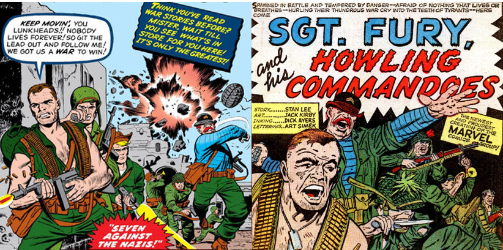
Back Issues: Sgt. Fury and his Howling Commandos #1

Story Title: “Seven Against the Nazis!”
Published: 5 March 1963 (cover-dated May 1963)
Writer: Stan Lee
Artists: Jack Kirby

The Background:
Over its many decades of existence, Marvel Comics has produced some of the most colourful and memorable characters in the entire industry. There was a time, generations ago, when comic books hadn’t quite found the niche they have today, leading to pulp tales, surreal horror-themed publications, and war comics. War tales were bolstered by spandex-clad heroes like Captain Steve Rogers/Captain America, who encouraged readers to buy war bonds and support their fighting troops overseas, leading to quite the booming period in Post-War America. For Marvel Comics, it was the legendary duo of Stan Lee and Jack Kirby who were responsible for creating some of their most popular characters through their unique “Marvel Method” of writer/artist collaboration, but it might surprise you to know that Nicholas “Nick” Joseph Fury, the eyepatch-wearing, cigar-chomping agent of super-spy agency Supreme Headquarters, International Espionage and Law-Enforcement Division (S.H.I.E.L.D.), actually came about as the result of a bet between h and his publisher, Martin Goodman, that Lee and Kirby could sell a comic with a ridiculous title like Sgt. Fury and his Howling Commandos. The racially and ethnically diverse titular squad would be led by a tough, no-nonsense sergeant as a more adult counterpart to DC Comics’ Boy Commandos, though Fury would be rebranded as more of a James Bond-type figure just two years after this debut appearance and is perhaps more famous for his association with S.H.I.E.L.D. and his duplicitous (and often contentious) dealings with Marvel’s superhero community. Although Nick Fury has featured in cartoons, videogames, and even got his own much-maligned live-action feature, he has been largely supplanted by his more recognisable African-American variant; General Nick Fury featured in Marvel’s comparatively short-lived Ultimate line of comics, where his design was based on Samuel L. Jackson, who would go on to portray a version of the character in the Marvel Cinematic Universe.

The Review:
The first couple of pages of Sgt. Fury and his Howling Commandos #1 are spent introducing us to the titular team of battle-tempered soldiers: we have “six foot two […] steel-muscled, iron-nerved” Sgt. Nick Fury who’s built a reputation for being one of the most feared men in the Army; Jonathan Juniper/Junior, the “cheerful eager-beaver” who’s “fast as a panther and just as dangerous”; Robert Ralston/Rebel, an ex-jockey who’s “tougher than his small size makes him appear”; Corporal “Dum-Dum” Dugan (whose real name isn’t revealed here), a former circus strongman garbed in a bowler hat; Gabriel Jones/Gabe, a proficient trumpet player; actor Dino Manelli; and scrappy, moustachioed mechanic Izzy Cohen. Rather than then jump into showing us these seven colourful characters interacting or showcasing their personalities and skills, the story switches to a French underground communications centre where two members of the French resistance, Pierre and Henri, scramble to warn the Howling Commandos of the Nazi’s latest plans. Although Henri is wounded and the two are captured, Henri successfully sends the message via Morse code, and it reaches the attention of executive officer “Happy Sam” Sawyer. Sawyer isn’t optimistic about the message, which requests that his Howling Commando division be sent in to rescue the leader of the French resistance, but the fate of Operation Neptune (or “D-Day”, as it’s most commonly known) is at hand so, while it might be a suicide mission, he orders Sgt. Fury to get his team ready. An abrasive, aggressive, stone-faced commander, Sgt. Fury goes to round up his troops, who are practising their manoeuvres in a most extreme way: Dum Dum is firing live ammo over their heads from a mounted machine gun as they crawl across a mine field! Sgt. Fury puts a stop to their “fun”, but his commandos relish the opportunity to get out into the field and go up against the Nazis, even if the odds are stacked against them; they’re so gung-ho that they even believe that they outnumber the Nazis!
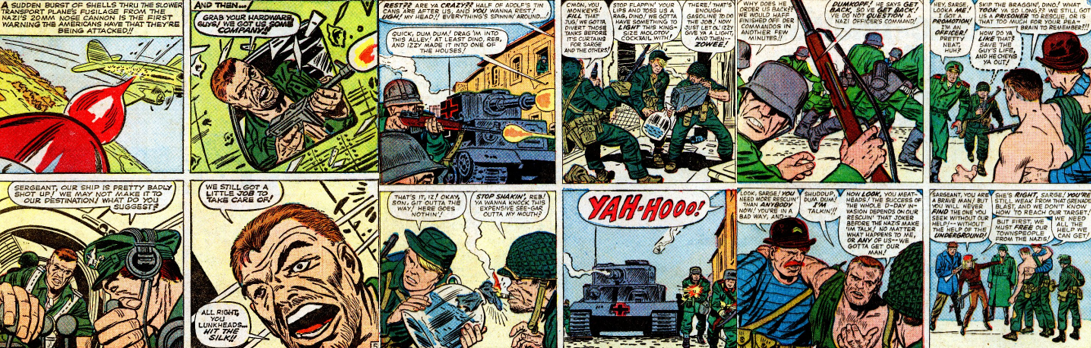
The grizzled Howling Commandos embark on a suicide mission to rescue an important ally.

However, for all their macho bravado, the Howling Commandos’ plane is set upon by a squadron of Luftwaffe, forcing the troop to parachute to the ground (though Dum Dum is inexplicably able to take out one of the German planes with a well-aimed grenade toss). The soldiers reach a French town occupied by Nazis and, true to their name, the group fire upon the enemy, with Sgt. Fury taking out a tank-full of Nazis single-handily with his own grenade, all while howling with glee! The blast injures Sgt. Fury; though he’s too stubborn to rest, he, Dum Dum, and Junior are forced to take cover from the Nazi retaliation. Luckily, Dino, Rebel, and Izzy rig up a “king-sized Molotov cocktail”, which they hurl at the advancing troops and set their other tank ablaze. The Nazis quickly shower the Howling Commandos with bullets, pinning them down but not injuring or killing a single one of them; still, they’re helpless to fight back, so it’s up to the French resistance to bail them out by killing their attackers off-panel. Rebel and Izzy then steal the Nazi uniforms and Dino dresses up in the coat and cap of a Nazi officer, which is a disguise and performance good enough to convince the other Nazis to withdraw, thus saving Sgt. Fury and the others. Though wounded, Sgt. Fury is as pig-headed and determined as ever to complete his mission, but their saviours rightly point out that they haven’t a hope in hell without the underground’s help, and they’ll only assist them if they save the rest of the townsfolk from being executed by the Nazis. Still in disguise as “an imperious Nazi Ubergruppen-Feuhrer” Dino easily fools the firing squad, and the Commandos and the underground’s superior numbers, and firepower, quickly see the Nazis surrendering; Izzy then steals their truck and the allies climb aboard towards Louivers, where the ludicrously-named underground leader Monsieur LaBrave is being held captive in a Nazi-controlled fortress.
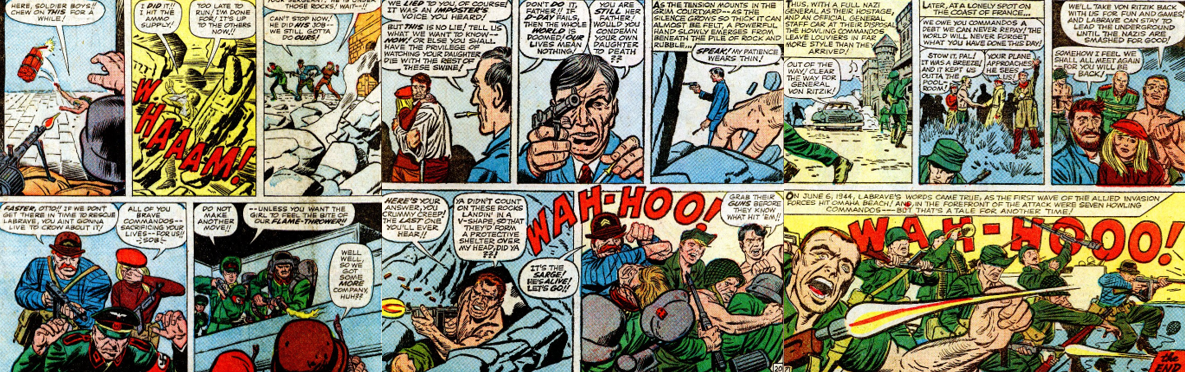
Sgt. Fury shrugs off death to turn the tide and give the Allied Forces the edge on D-Day.

Though beaten and weary, LaBrave refuses to give in to his torture and reveal the plans for the D-Day assault; pressured by Adolf Hitler himself to get the information by any means necessary under pain of death, the Nazi General Von Ritzik hands over the interrogation to the feared Gestapo, who immediately kidnap LaBrave’s daughter and threaten to harm her if he doesn’t co-operate. Luckily, the Howling Commandos and their French ally (later named Marie) are closing in on the heavily-fortified Louivers; despite his injuries and the insanity of launching a daylight campaign, Sgt. Fury refuses to wait until dark or let himself or any of his soldiers rest for the coming battle and his stubborn, bull-headedness briefly raises the ire of Dum Dum. Posing as an old farmer pulling a cart of produce, the soldiers easily slip past the enemy guards and destroy their arsenal with a “holocaust” of an explosion! This diversion is enough to allow them to storm the fortress, where Gabe and Junior bravely hold back the advancing troops so the others can continue on the mission. When Junior is jumped by Nazis in his attempt to take out the machine gun placement laying down supressing fire in the courtyard, Sgt. Fury simply crawls along the cobblestone ground on his belly and chucks a bundle of dynamite at the Nazis, seemingly perishing in the blast as he’s buried under a pile of rocks. Although Marie turns her tears into an angry wrath and Dum Dun pushes on with the same dogged determination as his fallen commander, the two of them are soon captured and lined up alongside their comrades, and LaBrave, before another firing squad. It turns out that Marie is actually LaBrave’s daughter and that he was almost tricked into giving up their cause for her safety; however, now that she is actually there, the Gestapo threatens to shoot her before his eyes if he doesn’t spill the beans. Fortunately, Sgt. Fury is alive and well and comes bursting out from his tomb guns blazing! Galvanised by seeing their grim commander alive, the Howling Commandos easily fend off the Nazis and capture General Von Ritzik, who secures them save passage down to the coast so he can be shipped back to the Allies, and the story ends with the teaser that this victory gave the Howling Commandos and their allies the edge they needed in the subsequent D-Day assault.

The Summary:
So, here’s a fun fact: this is both the first issue of Sgt. Fury and his Howling Commandos and the first solo Nick Fury story I’ve ever read! I don’t think that’s much of a stretch of the imagination to believe, though, as Nick Fury is generally more of a background player or a supporting character in other Marvel stories and, quite frankly, that’s how I prefer him. This is a Nick Fury at the peak of his curmudgeonly ways; war has made him little more than a gruff bull who charges head-first into battle with no time for sentiment, rest, or even to tend to his own injuries. He’s hard on his soldiers, who are equally hungry to mix it up with the Nazis, and even harder on his enemies, who he attacks with little to no quarter. He expects nothing but total commitment from his men because that’s what he’s willing to give; he doesn’t care how stacked the odds are or how suicidal his missions are, he just wants to go in (and out) in a blaze of glory, chomping his cigar, firing off bullets, and ranting at his Nazi enemies as he goes down. He’s every bit the opposite of Captain America’s more righteous attitudes, but that makes sense as Sgt. Fury represents the hardened soldier on the front lines, one constantly forced to endure the dirt worst of conflict for the greater good, and thus Sgt. Fury embodies the indomitable American fighting spirit, one that will spit in your face and walk through Hell just to put down one more no-good Nazi.
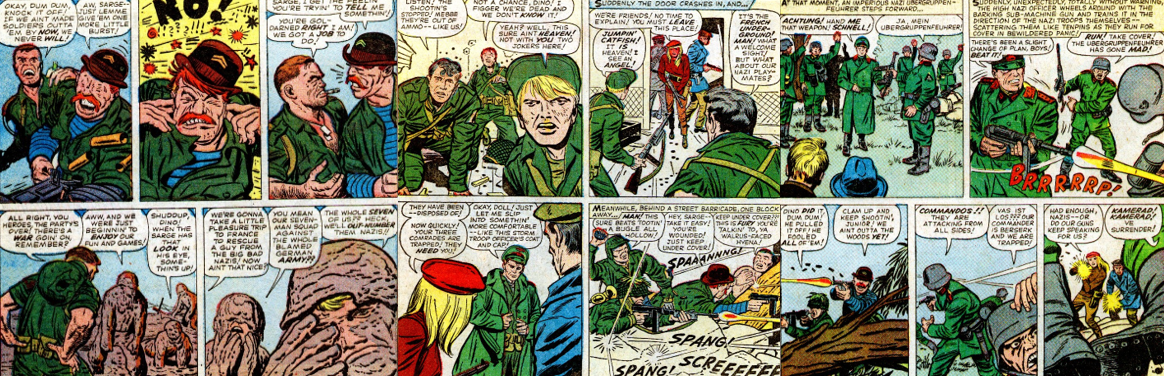
The gruff Sgt. Fury stands out from his mostly bland and underutilised fellow soldiers.

While I see a lot of parallels between Sgt. Fury and Ben Grimm/The Thing (both in their demeanour and their stony appearance), it’s a good thing that he stands out so much as his other Howling Commandos aren’t afforded such a luxury. It’s interesting that so much time is spent introducing each soldier and their basic characteristics as there aren’t many opportunities for them to shine in this story; Dum Dum is said to be a former circus strongman but exhibits no feats of strength and instead is portrayed as being a slightly less harsh version of Sgt. Fury, which leads them to butt heads a couple of times despite their deep respect for each other. Gabe is said to be quite the musician but never gets the chance to showcase this, the closest Izzy gets to using his mechanical skills is in commandeering a Nazi vehicle, and Junior is all excited about getting to blow shit up at the start of the story but ends up never getting the chance to actually use any explosives. Of them all, it’s Dino and Dum Dum who get the most chances to shine; Dum Dum makes an immediate impression with his stocky stature, thick moustache, and trademark hat but also appears to be half-crazed since his training methods are literally life or death for the Howling Commandos! Yet, when in the field, it’s Dum Dum who suggests they wait for the cover of darkness and tend to their wounds, only to be chewed out by his aggressive superior! Dino’s acting background comes into play when he disguises himself as a Nazi commander, but the story presents this in such a way that I would argue anyone could’ve done just as good a job as all he does is prance around in the uniform and bark orders in German; it’s not like he infiltrated the enemy and led them astray, or anything. Still, as disappointing as it is that most of the Howling Commandos don’t get the chance to do more than show off their fighting spirt and tenacity, it’s not entirely unexpected (there are seven main characters, after all) and they come off a lot better than Marie, who isn’t even named until right at the end of the comic and, for all her gumption, is still depicted as being more emotional compared to her war-hungry male counterparts.
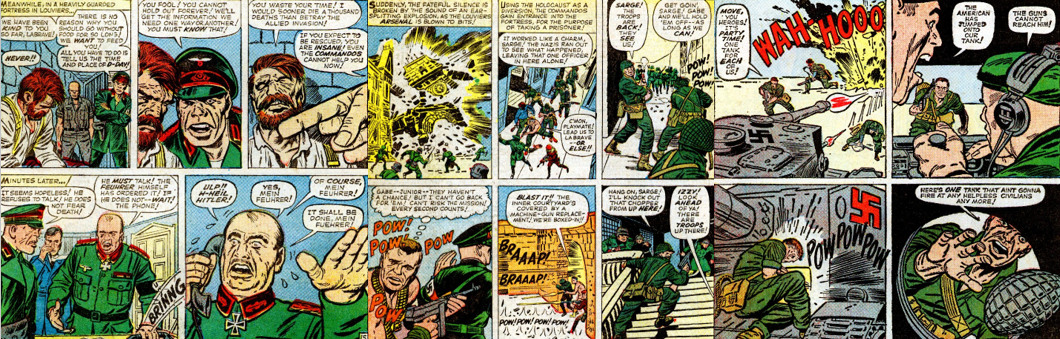
All of the Nazi’s forces and power are little consequence to the fighting American spirit.

Surprisingly, Sgt. Fury and his Howling Commandos makes an effort to portray the Nazis as a genuine threat; their sheer numbers and evil intentions loom over the story like an oppressive cloud, driving Sgt. Fury and his allies on since they know how important this mission is to the larger war effort. While Adolf Hitler is portrayed as a braying, childish brat, he’s only included as a cameo and his soldiers are more than capable of dominating entire towns, threatening woman and children alike, and delight in lining up innocents and enemies before a firing squad. However, while they are a clearly superior force, their numbers and weapons are nothing compared to the Howling Commandos; the troop’s reputation as crazed maniacs proceed them and still the Nazis are easily foiled by the crowing soldiers, who blow up their planes, tanks, and munitions stores with barely a sweat. Even when the Nazis have them pinned down, the Howling Commandos take no damage; at one point, it seems like Gabe and Junior are being left for dead (Sgt. Fury even acknowledges that they have no chance against the Nazis) but no, they’re fine. The worst offender of this, however, is the titular, grouchy Sgt. Fury himself; not only does he shrug off the injuries he suffers from a grenade blast, but he’s also eventually revealed to be little more than dishevelled after being caught in another blast and buried under a pile of rocks! Again, this speaks to his tenacity, but I do wonder if killing off one of the Howling Commandos or at least treating their wounds more seriously would have helped reinforce the team as tough, but human and relatable, soldiers on the front lines. While I’m generally not a big fan of Jack Kirby’s more outlandish artwork, it actually worked really well in this war-time setting; everything has a gritty realism to it, though there are still some fun comic book moments peppered throughout, and the comic does a decent job of representing the violence and bloodshed of war even though a lot of the killing is either implied or takes place off-panel. In the end, this was a decent enough story, full of bravado and patriotic vigour, but I think it’ll strike more of a chord with fans of war comics than casual readers.

My Rating:

Rating: 3 out of 5.

Pretty Good

Have you ever read Sgt. Fury and his Howling Commandos #1 or any of its subsequent issues? Are you a fan of Nick Fury and, if so, what are some of your favourite stories of his? Which of the Howling Commandos is your favourite and would you have liked to see their individual talents showcased more here? Are you a fan of war comics? Which version of Nick Fury do you prefer and why? Whatever your thoughts on Nick Fury, leave them down below or comment on my social media, and go check out my other Marvel content across the site.

Back Issues: Fantastic Four #2

Story Title: “The Fantastic Four Meet the Skrulls from Outer Space!” (includes “Part 2: Prisoner of the Skrulls”, “The Fantastic Four Fight Back!”, and “The Fantastic Four…Captured!”)
Published:
28 September 1961 (cover-dated January 1962)
Writer: Stan Lee
Artists: Jack Kirby

The Background:
In 1961, Marvel Comics readers were introduced to the Fantastic Four (Doctor Reed Richards/Mister Fantastic, Susan Storm/The Invisible Girl, Ben Grimm/The Thing, and a new version of the Human Torch, Johnny Storm), a dysfunctional family of superhumans just as likely to trade blows with each other as they were with their enemies! While the story of their creation has been disputed, the collaboration between writer Stan Lee and artist Jack Kirby popularised the “Marvel Method” of comic creation and this all-too-human “First Family” of superheroes went on to introduce characters and concepts that would forever influence Marvel Comics in the decades that followed. The first of these premiered in the team’s second issue and took the form of shape-shifting aliens known as Skrulls; also created by Lee and Kirby, these malicious, reptilian war-mongers have been a prominent antagonistic force in Marvel Comics ever since. Not only have they menaced the Fantastic Four and other superheroes through their sheer numbers, devastating technology, and copied their powers with their various “Super-Skrull” variants, they also engaged in a horrific war against the Kree, tried to surreptitiously invade Earth, and have popped up in cartoons and videogames as enemies of the Foursome and other Marvel heroes over the years.

The Review:
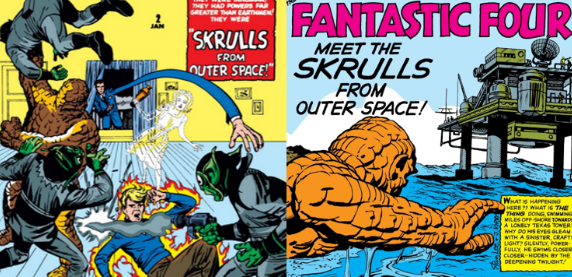
Our story begins with the Thing swimming far out to sea towards a “lonely Texas Tower”, which I’m just going to call an oil rig going forward. The Thing dives under the waves and shreds one of the oil rig’s support legs, causing the entire structure to topple into the water and forcing the workers to race to safety in lifeboats, where they spot the Thing swimming away and rightly assume that he caused the wreckage. The story then cuts to a jewellery store, where Sue has gone all dressed up to have a look at a particularly large and ridiculously expensive gemstone; plucking the sparkling jewel up, she promptly turns invisible and makes off with the gem, leaving the store owner and the inept guards baffled. Next, the unveiling of a priceless statue of solid marble is reduced to molten slag by the Human Torch and Mr. Fantastic uses his disturbingly stretchy arms to shut off all the power n New York City. The gleeful Foursome meet up to congratulate each other on their evil deeds but, as if something wasn’t already a miss, their overly expository dialogue reveals that they committed these acts not using their superpowers, but by means of technology: the Thing had a concealed detonator in his wrist (why it needed to be concealed beyond fooling the reader is beyond me as no one saw him beneath the sea), the Invisible Girl actually reduced her size rather than turn invisible, the Human Torch made use of anti-gravity gear and a low velocity thermal bomb, and Mr. Fantastic simply used his inherent physical abilities since he, like the other three, is actually a form-changing Skrull! The four imposters shift to their natural forms as goblin-like, reptilian aliens and revel in their actions, which have caused the media and public to turn against the Fantastic Four and therefore allowed the impending Skrull invasion to take place unopposed!

When the Fantastic Four are framed by the Skrulls, they take drastic measures to lure out their foes.

The actual Fantastic Four are off in a secluded lodge having a bit of vacation time hunting in the woods when they learn of what’s happened; while Johnny is confident that Reed will figure out who’s been impersonating them, the news report triggers the Thing, who briefly blows his lid and is ready to fight the entire human race in his mindless rage. When Reed tries to calm him down, the Thing just launches into a tirade lamenting his existence and becomes so consumed by the need to lash out that he starts to sound like Doctor Bruce Banner/The Hulk, it’s very uncharacteristic and odd to see but presumably the Thing’s personality hadn’t quite been worked out at this point. Reed assumes full responsibility for the Thing’s aggressive demeanour; after all, as his obligatory recap of their origin reminds us, he is responsible for Ben being reduced to a rock-covered monster, though none of this brings them any closer to figuring out a plan of action, meaning they’re easily surrounded and captured by the United States military. The Fantastic Four surrender peacefully and are locked up in special cells said to be capable of containing their awesome powers, though this is, of course, just an excuse to pad the story out with visual reminders of what they’re capable of: Sue easily slips out of her cell when the guards foolishly open the door to provide her with food (!), Johnny rips up the flooring to find an air vent, Reed disturbingly squeezes himself out through a single loose rivet, and Ben simply smashes his way out with brute strength in no time at all. They flee in a stolen helicopter and reconvene at one of their “many secret apartment hideouts”, where Johnny and Ben almost come to blows over which one of them will willingly sabotage a space shuttle launch to draw out their doppelgängers. Ultimately, the Thing’s rage is quelled, and the Human Torch attacks the launch site and finds himself picked up by the Skrull impersonators; Johnny learns of their alien nature and plans for world conquest and signals for his teammates, who arrive just as Johnny is facing certain destruction at the Skrulls’ hands.

The Skrulls are easily warded off, the Four are cleared, and their impersonators duly punished.

Thanks to Sue tripping one of them, Reed disarming another, and Ben’s brute strength, the Skrull are subdued and willingly spill the beans when they see the extent of the Thing’s rage towards them; the Skrulls explain that there’s a Skrull invasion fleet waiting to attack and Reed decides that their only course of action is to turn the tables on their doppelgängers by commandeering their shuttle (which is disguised as a water tower) and heading up to the city-sized mothership to try and destroy the fleet. There, they masquerade as their impersonators and tell tales to the Skrull Commander about the might of not just the Fantastic Four, but Earth’s monstrous forces, giant ants, and weaponry hidden in the atmosphere. Incredibly, not only does this dupe work, convincing the Skrull Commander to pull back the entire fleet, but the Fantastic Four are also able to avoid having to shift back to their Skrull forms with a flimsy excuse and are even awarded for their bravery when they volunteer to stay behind and remove all traces of the race from the planet. However, as the Fantastic Four are left to drift back to Earth, the shuttle happens to pass through the same radiation belt that gifted them their powers, which inexplicably returns the Thing to his normal, human form! Upon exiting the shuttle, though, they are immediately placed under arrest and Ben’s joy at finding himself human once more is immediately undone when he just turns back into the Thing within a space of a few panels. Although the police chief refuses to listen to Reed’s explanations, he and the other cops are suitably convinced when they’re attack by a giant snake, a bulbous, spiky-rock-monster-thing, and a large vulture. The Fantastic Four easily subdue these three Skrulls and are exonerated by the flustered police chief; as for the Skrulls, Reed opts not to kill them or take the chance of locking them up or to trust that they can exist amongst humans peacefully as they claim and instead decides to hypnotise them into spending the rest of their lives believing that they’re cows!

The Summary:
Generally speaking, I really don’t enjoy stories where characters or heroes are framed for crimes by an impersonator; I find they can be very repetitive and frustrating, but I actually think “The Fantastic Four Meet the Skrulls from Outer Space!” was quite a fun twist on the concept. It’s interesting that the Skrulls regard the Fantastic Four as the sole threat to their invasion plan; everything they do is geared towards removing the Fantastic Four from the battlefield by ruining their reputation, something that’s ridiculously easy to do in Marvel Comics thanks to their fickle civilians. I actually quite enjoyed that Johnny and the others barely even bat an eyelid when they find out that they were being impersonated by goblin-like aliens; they just took it in stride and it’s only their second issue and Marvel hasn’t even had a chance to think up some of the bizarre cosmic shit that they’re known for! Another positive was that Sue didn’t get written like a complete airhead in this issue; sure, she barely did anything except trip a few people, but at least she wasn’t being shallow or idiotic or getting yelled at by Reed. This issue also spent a good deal of time showing how combustible the relationship between the Fantastic Four can be, particularly Johnny and Ben, who argue and almost come to blows a few times throughout the story. It also placed a great emphasis on the agony and despair Ben feels about being trapped in a grotesque, rocky hide. While his characterisation is a bit suspect at times and he’s written to almost evoke the Hulk on more than one occasion with his mindless rage, this aspect of the character, that he feels ostracised and tormented by his appearance, has become a defining trait of the Thing’s personality over the years so it was interesting to see it being spotlighted here, even if it’s set off with little provocation.

While the Skrull’s aren’t much of a threat, the story does a good job of fleshing out the title characters.

This led directly into him clashing with the more laidback Johnny, which in turn allowed Reed and Sue to be further fleshed out as the cooler heads and parental figures of the group while also exploring the guilt Reed feels for causing Ben’s condition. While I was okay with the recap of their origin as it tied into this and didn’t take up much space, the brief detour where they’re captured by the military was a bit of a waste, especially as we could’ve seen them battling the shape-shifting Skrulls instead. The Skrulls are depicted as patient and methodical; their plan isn’t to directly engage the Fantastic Four, but see to it that the world turns against them and does the work for them, though this plan is riddled with holes if you actually stop and think about it. If the Fantastic Four are their only threat, why don’t the Skrulls just use their massive fleet to attack New York City, obliterating their enemies in the process? Also, we don’t really get to see much of the Skrulls abilities or threat here; sure, they can mimic the Fantastic Four’s appearances and abilities and turn into monstrous creatures, but they’re easily defeated and their commander is duped with just a few photos and wild stories, severely diminishing whatever threat they might pose. It’s a bit of a shame, as they have a fun design and it would’ve been cool to see them showcase their power and technology in a proper fight, but it does sell the Fantastic Four as being both intelligent and physically capable. Overall, this was a pretty fun and surreal tale; it helped to flesh out the characterisation of the Fantastic Four both individually and as a group, gave them a chance to showcase a bit more of their powers and personalities, and introduced an intriguing alien race that would eventually be depicted as a far more capable menace than what is seen here. The art was colourful and popped nicely, even if the Thing and the Human Torch still look a bit basic here, and the writing was actually pretty good for a change so I’d definitely say that I enjoyed “The Fantastic Four Meet the Skrulls from Outer Space!” more than I expected.

My Rating:

Rating: 3 out of 5.

Pretty Good

Have you ever read “The Fantastic Four Meet the Skrulls from Outer Space!”? What did you think to it? Were you impressed by the first appearance of the Skrulls or do you agree that they weren’t presented as much of a threat? What did you think to the characterisation of the Fantastic Four here? Which of the four team members is your favourite and why? Are you a fan of imposter stories? What are some of your favourite stories that include the Skrulls? Whatever you think about the Fantastic Four and the Skrulls, go ahead and leave a comment down below or on my social media, and be sure to check out my other Fantastic Four reviews on the site.
Back Issues: Spider-Man 2099 #1-3

This review has been supported by Chiara Cooper.
If you’d like to support the site, you can do so at my Ko-Fi page.

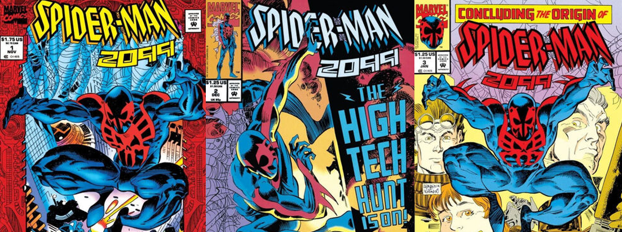
Writer: Peter David – Artist: Rick Leonardi

Story Title: “Stan Lee Presents Spider-Man 2099”
Published: 1 September 1992 (cover-dated: November 1992)

Story Title: “Nothing Ventured”
Published: 6 October 1992 (cover-dated: December 1992)

Story Title: “Nothing Gained”
Published: 3 November 1992 (cover-dated: January 1993)

The Background:
Back in 1962, Marvel Comics editor and head writer Stan Lee, hot off the smash hit that was the Fantastic Four, soon achieved even greater success with teenage superhero icon Peter Parker/Spider-Man. After his debut in Amazing Fantasy #15 became one of Marvel’s best selling titles, Spider-Man’s popularity saw him graduate to his own solo title barely a year later and become perhaps the most recognisable character in Marvel’s colourful repertoire. Over the years, Spider-Man has endured many changes, and not all of them for the best: there was the time he grew four extra arms, the whole clone debacle that is still widely regarded as one of the character’s lowest points, the introduction and subsequent popularity of Miles Morales, a noir-themed Spider-Man, Peter Porker the Amazing Spider-Ham, and, of course, the Spider-Man of the future, Miguel O’Hara. In 1992, Marvel Comics presented an alternative future for their costumed characters, the cyberpunk era of 2099, where many of their most recognisable heroes and villains were reinterpreted with a gloss of futuristic sheen. Spider-Man 2099 debuted in this self-titled series and was designed by artist Rick Leonardi, though it was writer Peter David who created his alter ego, whose debut issue became David’s highest-selling comic. In fact, Spider-Man 2099 would prove to be the most successful of all the Marvel 2099 comics; it ran for forty-six issues before financial issues caused the run to be cancelled, but Miguel remained a mainstay of Marvel’s far-flung future and crossed over to the mainstream Marvel universe on more than one occasion both in and out of the comics, before finally returning in an ongoing series in 2014. Spider-Man 2099 is often regarded as one of the better alternate versions of the web-slinger, and with good reason; personally, I’ve always been a fan of his costume, the unique nature of his powers, and his cyberpunk future and was very excited to see him take centre stage in Spider-Man: Across the Spider-Verse (Dantos, Powers, and Thompson, 2023).

The Review:
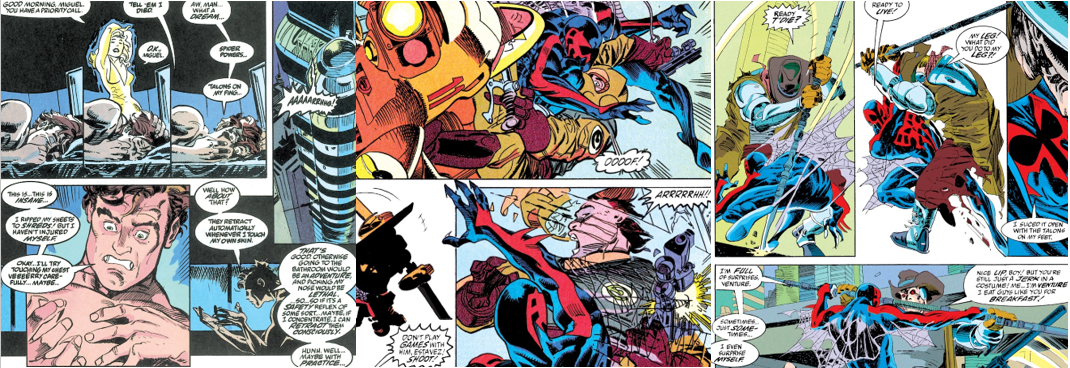
Considering how successful and popular Spider-Man 2099 was and still is in the grand scheme of things, it’s a shame that this original run from the early-nineties is so hard to come by. While many of his later stories are widely available, and the second collection of this run is currently quite affordable, physical copies of the first volume have skyrocketed, despite a re-release coming not too long ago. Luckily, I was able to grab a copy of the first volume to finally get a taste of Spider-Man 2099, but it does irk me that Marvel’s physical publications are often either hard to come by or extortionately expensive, especially their stories from the nineties. Nevertheless, our story begins in medias res with Spider-Man being pursued through the New York City of the future by officers of the Public Eye, the law enforcement arm of this future world. They, like practically everything in the city, are funded by Alchemax, a hugely influential conglomerate that practically owns the city; basically think if Omni-Consumer Products (OCP) actually succeeded in building and dominating Delta City. The officers chase Spider-Man relentlessly but are stunned by how fast and agile he is; no matter how hard they try, they can’t land a shot on him and they can barely keep up with him, much less compete with his web-slinging, webbed airfoils that allow him to glide and influence his airspeed, and his razor-sharp talons. These abilities allow Spider-Man to easily give the cops the slip and leave them humiliated before a gaggle of awed onlookers, and our story shifts to Babylon Towers, where an exhausted half-Mexican, half-Irish Miguel O’Hara returns to his flat (or “apartment” for you Americans) only to be greeted by a series of holographic messages that further compound his already dire mood. Messages from the likes of Tyler Stone, Miguel’s brother Gabriel “Gabe” O’Hara, and Miguel’s fiancée, Dana D’Angelo, indicate that Miguel is not only mixed up in some ethically questionable activities with Alchemax but also hooked on drugs that are seriously messing him up. But what does Miguel have to do with the mysterious new web-slinger in town? Well, for that, the story has Miguel record a journal entry that sheds some light on the connection.

When smart mouthed Miguel is addicted to drugs by his boss, he turns to genetic research to cure himself…

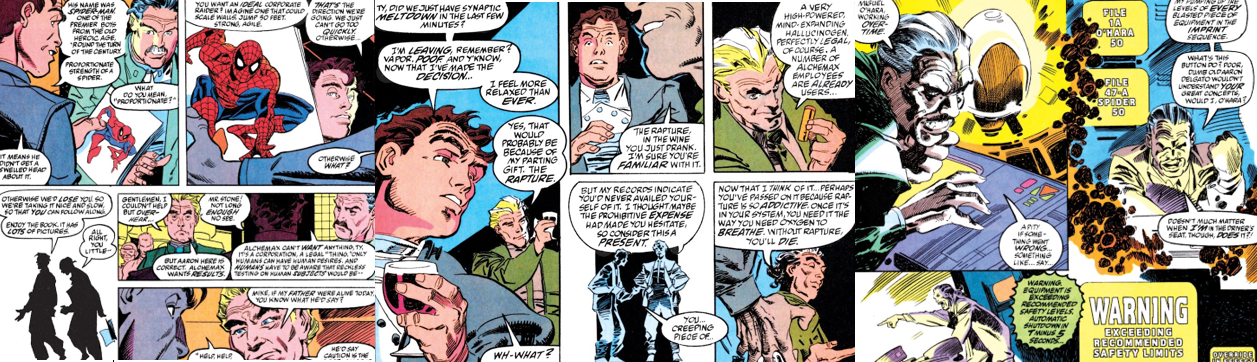
Miguel was the head of a project researching gene alteration at Alchemax; though a genius who envisioned recreating the amazing superhuman abilities of Spider-Man for the company’s Corporate Raiders, Miguel had little respect for the chain of command, resulting in a strained relationship between him and his superior, Aaron Delgato, a J. Jonah Jameson type who didn’t appreciate Miguel’s smart mouth or disrespectful attitude. Miguel’s quick wit even extended to Tyler Stone, the head of the Alchemax Corporation; however, Tyler countered Miguel’s brashness not with blustering frustration like Delgato but with an insistence of advancing to human testing. Although Miguel disagreed with this decision, to defy Tyler would be to leave the volunteer, Mr. Sims, in Delgato’s hands and, as Miguel didn’t trust Delgato with the technology, Miguel begrudgingly agrees to start small, planning only to slightly alter Mr. Sim’s genes to grant him superhuman strength, and was horrified when the procedure transformed the man into a feral, monstrous beast that attempted to kill its creator before dying. In many ways, this was a self-fulfilling prophecy; Miguel states he designed his “transformation chamber” after an old “holo”, The Fly (Cronenberg, 1986), so it’s only fitting that Mr. Sims would become a mindless grotesque upon first use. Still, Tyler was impressed by the display of superhuman strength, and Miguel was so disgusted by the entire ordeal that he quit from Alchemax. While Tyler wasn’t happy with this decision, he appeared to support it and even promised to give Miguel a glowing recommendation, though this was all a ruse; Tyler slipped a dollop of the drug Rapture into his wine to force Miguel to be reliant upon Alchemax to survive since they’re the only licensed distributor the highly addictive hallucinogen. The Rapture quickly took hold, driving Miguel into a rage and causing him to strike Dana; though she was forgiving and supportive of him, Miguel was incensed by the betrayal and the prospect of spending his life as a drug addict, so he returned to his lab in a bid to use his research to cure himself. However, Delgato alters the program of out spite, determined to pay Miguel back for speaking down to him and attempting to kill Miguel by infusing him with the spider DNA he was toying with earlier.

The mysterious new Spider-Man attracts Alchemax’s attention and sees him hunted by a cyborg.

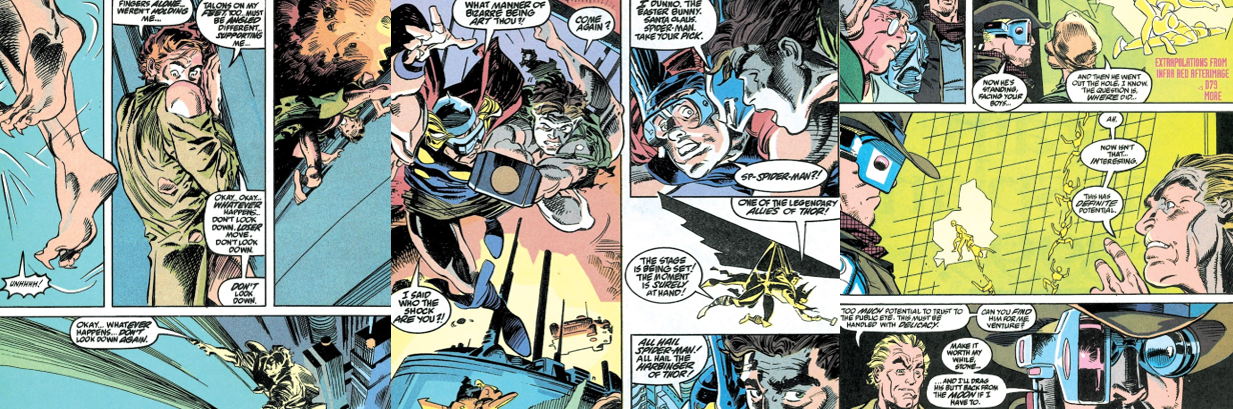
Despite the system overloading and an almighty explosion, Delgato was stunned to find Miguel not only alive, but sporting fanged teeth, white eyes, and with spiked talons on his fingers. Terrified by Miguel’s monstrous appearance, Delgato opened fire, determined to both defend himself from what he saw as an attack and finish the job he started, but Miguel’s newfound agility allowed him to easily dodge the blasts. Delgato’s wild firing caused another explosion, though, that left him dangling precariously over the city below and, when Miguel tried to pull him up, his talons sliced into Delgato’s arm and caused him such agony that he plummeted to his death. Horrified by this, and with the Public Eye bursting in to investigate the lab, Miguel attempted to leap to his death, only to find himself capable of scaling walls with his talons and possessing the proportionate strength and speed of a spider. Cursing Delgato’s interference and cowardice, and finding himself unable to go through with his suicide, Miguel then caught a lift off a passing Thorite (a doomsayer dressed up like Thor Odinson who was flying around the city on a hang glider calling for people to repent). Caught up in the excitement of the escape, Miguel offhandedly referred to himself as Spider-Man, much to the delight of the Thorite, who saw it as a sure sign of his saviour’s second coming; while the Thorite was clearly nuts, he did help spirit Miguel to safety and encouraged him to mask his face like the wall-crawler of old. Thanks to the investigation of one of his elite operatives, the cybernetic bounty hunter-esque Venture, Tyler learns of the spider-powered individual; however, for all the technology of the future, all they have to go on are wireframe holographic recreations, so they have no idea of Spider-Man’s true identity and Venture was tasked with tracking him down.

When Venture comes calling, Miguel dons an awesome costume and engages him as Spider-Man.

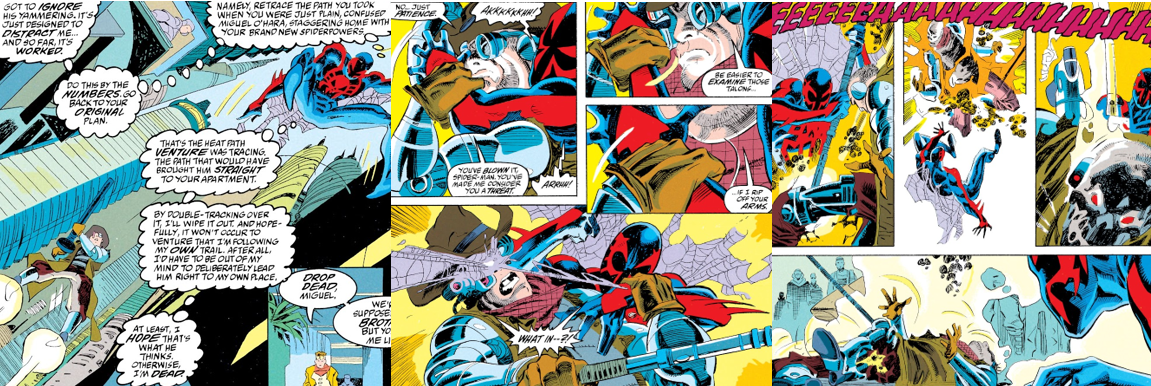
Miguel returned home in a fever and woke to find that he has an aversion to bright lights and had shredded his bedding with his talons and that they instinctively retract whenever they come close to his skin, leaving him unharmed and with the hope that he can learn to consciously retract them in time or else he faces the prospect of shelling out for clothes made of “unstable molecules”. The only outfit he has made of this super-durable and malleable substance is a “Death’s Head” costume he wore to the Day of the Dead festival the previous year, and Miguel considers wearing it full time since his newfound condition spells the end of his normal life. After his home A.I., Lyla, tried and failed to cheer him up by changing its appearance to that of a snooty butler and frail old aunt, Gabe dropped by to check in on him; surprisingly, Miguel was very open about his condition, but Gabe naturally laughed it off in favour of lecturing him about Alchemax’s shady nature. Miguel was forced to toss Gabe out when he got an inkling of danger (a “spider-sense”, if you will) and spotted Venture outside his apartment building. Recognising the cyborg as one of Alchemax’s elite trackers, Miguel donned the Death’s Head outfit to turn Venture’s attention away from him and firmly towards Spider-Man. Although Miguel’s first attempt at intimidating the elite cyborg is less than he hoped and he struggles to work the costume’s webfoils, he managed to get the drop on Venture and catch him off-guard, only to be goaded into a fight when Venture attacked the Thorites who bravely, but foolishly, rush to the web-slinger’s aid. Since he’s a scientist and a smart mouth rather than a fighter, Miguel struggled against Venture, who easily countered Spider-Man’s style with his fighting prowess, numbing his arm with his electronic rod and giving Miguel enough pause to consider whether he’d gotten in over his head and should surrender rather than go toe-to-toe with Alchemax’s number one cyborg.

Though not a natural superhero, Miguel overcomes Venture through luck and guts rather than skill.

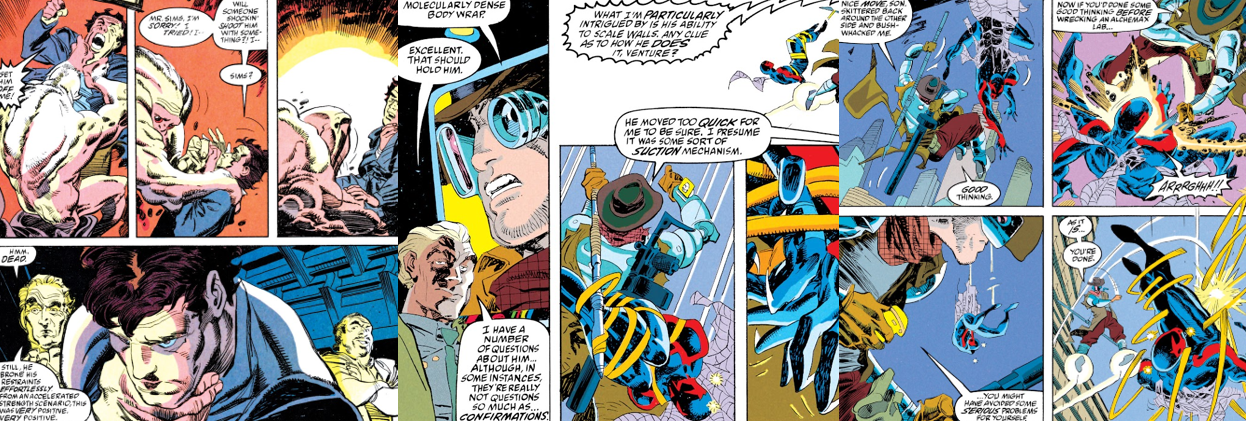
However, when Venture murdered one of the Thorites in cold blood and relished in the deed, Spider-Man was compelled to act; though Venture noted Spider-Man’s guts and was staggered by a fierce blow from the web-slinger, Miguel’s plan wasn’t to get into a brawl with the cyborg, but to lead him away from the crowd and back over the trail that’d led him to his apartment to again shake suspicion off his civilian identity. The trick appeared to work as Venture was focused only on nailing his target, regardless of whose apartment he trashed along the way, and the two traded barbs during their chase through the city skyline, with Venture expressing boredom and frustration at Spider-Man’s escape attempts. Although Miguel was able to surprise Venture with a sneak attack, the cyborg’s arsenal proved to be the deciding factor in their conflict; once Spider-Man was close enough, Venture stunned him with his rod and ensnared him in “molecularly dense body wrap”. However, Venture called in his success to Tyler Stone a little too early and didn’t account for Miguel’s talons, which allowed him to break free and sabotage the cyborg’s jet boots, and they were both left stunned when Venture’s attempt to rip Miguel’s arm off activated his organic webbing, blinding the cyborg and sending them crashing to the street below. Angered, Venture prepared to blindly open fire, so Spider-Man (still stunned by his incredibly strength) used a passing maglev car to relieve Venture of his weapon, hit him with it, and overload the cyborg’s systems using his own electrical rod. Although he survived the battle by the skin of his teeth, Miguel is left pondering his strange new abilities, which have cured his addiction to the Rapture but massively impacted not only his life but also that of Dana and Gabe, and the three-issue origin arc ends with Tyler knocking on Miguel’s door and asking to talk about Spider-Man…

The Summary:
Marvel’s vision for the New York City of 2099 is one of a bustling cyberpunk metropolis that owes more than a little inspiration to the likes of Blade Runner (Scott, 1982); it’s a sprawling, technologically advanced society where the skies are filled with flying cars and hoverbikes, and the people of the future enjoy the benefits of advanced technology such as voice-activated conveniences, attentive artificial intelligence and holograms, and plasma-based weapons. Unsurprisingly, even language has evolved, with the expletive “Shock!” a common curse word, and there are many hints towards how the world has changed over the last one-hundred years; the age of heroes has seemingly past, with no active superheroes being mentioned, though the Thorites are certain that the God of Thunder will return to bring judgement to the masses and people are well aware of the likes of Spider-Man. Latveria is still a governing nation and Stark Enterprises is still operational, albeit in the form of Stark-Fujikawa following a corporate merger. One key difference, at least in these issues, is the public’s reaction to Spider-Man; they are largely impressed by him, especially when he fells the Public Eye or defends them against Venture, and he’s met with awe rather than hatred and fear. The Public Eye are obviously an exception, largely due to the influence of Alchemax and Tyler’s obsession with getting his hands on Spider-Man so he can dissect how he gained such incredible powers where others were met with a gruesome end.

Alchemax is not above killing, creating monsters, or employing sadistic cyborgs to achieve their goals.

Visually, the world of Spider-Man 2099 certainly pops; there’s nothing here we haven’t really seen in countless other futuristic stories and settings but everything’s very bright, detailed, and technologically slanted. It’s not a major plot point in this story, but Alchemax is presented as this highly influential and shady mega-corporation; both Dana and Gabe openly speak out about the heinous things the company is involved in and their desire to see Miguel wash his hands of his involvement with Alchemax. It’s a general rule that any corporation that’s involved in questionable genetic research is going to be malevolent but Alchemax definitely go all-in with it; Miguel’s research is apparently geared towards a military arm of the company, or to augment their troops with superhuman abilities, and Tyler is so keen to unlock the secret of genetic tampering that he’s happy to sacrifice lives to get his way. Alchemax goes one step further by producing Rapture, a deadly and addictive hallucinogen that many of its employees are already hooked on. Although it can be acquired on the black market, it’s heavily implied that Rapture is perfectly legal as Alchemax is fully licensed to distribute the drug and many in the city are under its sway, and Tyler maliciously gets Miguel hooked on the drug in order to keep him dependent on the company for a regular fix. This is, ultimately, an important but minor plot point; it’s what drives him to use his research to cure himself, sure, but once he gains his spider powers, Miguel is seemingly cured and the matter is dropped. Alchemax is also in the business of employing (and, presumably, creating) cyborg operatives to carry out more hands-on tasks. Venture is their top cyborg and boasts infrared vision, augmented strength, a wealth of futuristic weapons that constantly give him the edge against Spider-Man, and rocket boots that allow him to fly. Venture is also a sadist who’s perfectly happy to kill innocent civilians in pursuit of his target, and so confident in his abilities (especially when faced with Spider-Man’s sloppy fighting style) that he openly mocks Spider-Man at every turn and delights in putting a beating on him.

Miguel’s wit, unique powers, and striking costume make him a relatable and appealing, if reluctant, hero.

While there’s not much to the villains of the story (Alchemax is every evil corporation, Tyler and Delgato and Venture are all quite one-dimensional, being slimy corporate types, disgruntled authority figures, or cruel bounty hunters, respectively), Miguel absolutely steals the show, and rightfully so. While he has a likeness of Peter Parker, particularly in his hairstyle, he’s a very different character; for one thing, he’s actually a successful and presumably well-valued and well-paid scientist who works for the biggest corporation in the city. For another, he has a fancy apartment, a stable love life, and a brother who, while overprotective, is always on hand to look out for him. In many ways, Miguel takes some of Peter’s most recognisable aspects and dials them up to eleven: Peter had an aptitude for science so Miguel is a geneticist; Peter had a quick wit so Miguel is smarming off to anyone and everyone, leading to some genuinely amusing exchanges between him and other characters; Peter had the proportionate strength and speed of a spider so Miguel gets fangs, talons, and an overall more monstrous appearance. Indeed, while Spider-Man 2099 is very similar to his mainstream counterpart in terms of his abilities, he’s also very different thanks to Delgato cranking up the exposure to spider DNA. His talons allow him to climb walls but also afford him a brutal offensive weapon not exhibited by Peter (and lead to him amusingly slashing people’s clothes by accident), but Miguel is less attuned to his spider-sense; it constantly goes off through this arc, but he doesn’t understand what it is or equate to it warning him of danger. Miguel also boasts one of the best Spider-Man costumes; a stark black and red number that is both fearsome and striking, with shredded web appendages that allow him to briefly glide and control himself in mid-air. Ultimately, while Spider-Man 2099 lacks the finesse and polish of Peter Parker, he makes up for it in his down-to-earth personality, biting wit, and his guts; he’s clearly not a natural hero or fighter and is mostly reacting rather than acting, with his motivations being purely selfish in this origin story, and yet he still leaps into action when Venture attacks innocents, which I think speaks volumes to his appeal and the ongoing appeal of his comics.

My Rating:

Rating: 4 out of 5.

Great Stuff

Are you a fan of Spider-Man 2099? What did you think to Miguel, his smart mouth and his characterisation as a reluctant hero? Were you a fan of his costume and altered powers? What did you think to Venture and evil mega-corporation Alchemax? Did you enjoy Marvel’s futuristic vision of 2099? What other Marvel 2099 characters and stories did you enjoy from this period? Whatever your thoughts on Spider-Man 2099, feel free to share them below and be sure to check out my other Spider-Man content!

Back Issues: Flashpoint

This review has been supported by Chiara Cooper.
If you’d like to support the site, you can do so at my Ko-Fi page.

Story Title: “Flashpoint” (comprised of “Chapter One” to “Chapter Five”)
Published: July 2011 to October 2011
Writer: Geoff Johns
Artist: Andy Kubert

The Background:
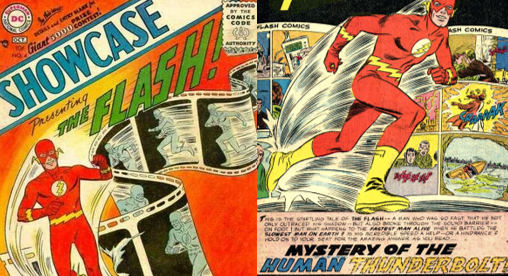
Robert Kanigher and artist Carmine Infantino introduced readers to Barry Allen/The Flash in Showcase #4 (1956) and heralded the “Silver Age” of comics; this new incarnation of the Scarlet Speedster may have taken the place of his predecessor, Jay Garrick, but it wasn’t too long before the two were coming face-to-face thanks to the concept of the multiverse. Barry fast became one of the most popular and iconic characters to carry the Flash mantle, and his death in Crisis on Infinite Earths (Wolfman, et al, 1985 to 1986) was long-regarded as one of the few permanent fixtures in comics. However, in the ridiculously confusing Final Crisis event (Morrison, et al, 2008 to 2009), DC finally brought Barry back and reinstated him as the Flash, a decision that irked (and continues to irk) many fans of his replacement, Wally West. Though Barry was returned to a world that had largely passed him by, a series of retcons enabled him to slip back into his old role; however, despite having already torn apart and rebuilt the multiverse just five years prior in Infinite Crisis (Johns, et al, 2005 to 2006), writer Geoff Johns decided to shake up the DC Universe with this five-issue event, which was bolstered by a number of tie-in stories. Flashpoint saw massive changes to DC’s timeline, characters, and continuity; it directly led to one of my least-favourite eras of the comics, The New 52, and both compressed, altered, and confused many of DC’s storylines. The story proved quite influential, however; not only was it partially referenced in The Flash (2014 to present), it was also adapted into a well-received direct-to-DVD animated feature, and served as significant inspiration for the Flash’s big-screen solo film.

The Review:
Flashpoint begins and is punctuated by narration from Professor Zoom, Eobard Thawne/The Reverse-Flash, Barry Allen’s long-time nemesis who has a warped hero worship of the Flash that compels him to cause the Fastest Man Alive nothing but pain and misery in a twisted attempt to make him a better hero. A series of little flashbacks establish Barry’s close relationship with his mother early on; he adored Nora as a child and the mystery of her strange and brutal death haunted him even into his adult life, where he became a forensic scientist. Once he was struck by that errant lightning bolt and gained his superspeed, the Flash found a happiness that was missing from his life: friends and colleagues in the Justice League, love with his own wife, Iris West, and a family of fellow speedsters. However, all of that randomly changes for Barry when he’s roused from sleep at the Central City Police Department to find that Central City is under the protection of a questionable hero, Leonard Snart/Citizen Cold, the Flash’s rogues gallery doesn’t exist and, to Barry’s horror, he no longer has his superspeed or identity as the Flash.

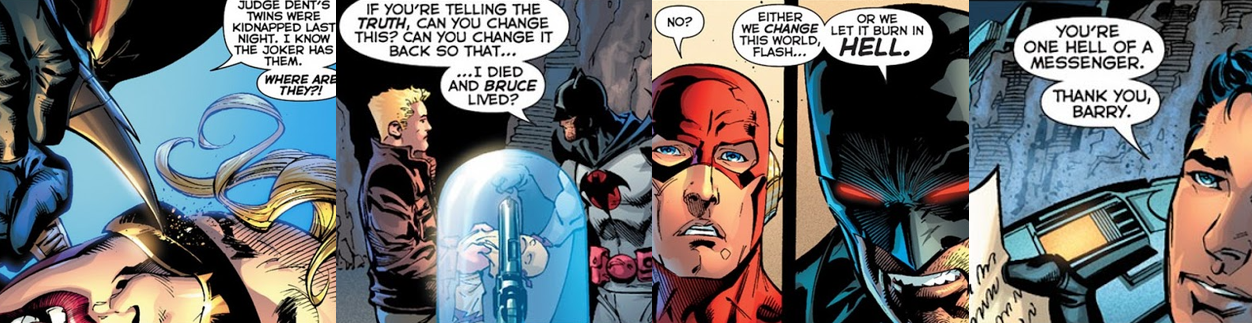
Barry finds the world has changed for the worst and that Bruce has been replaced by his violent father!

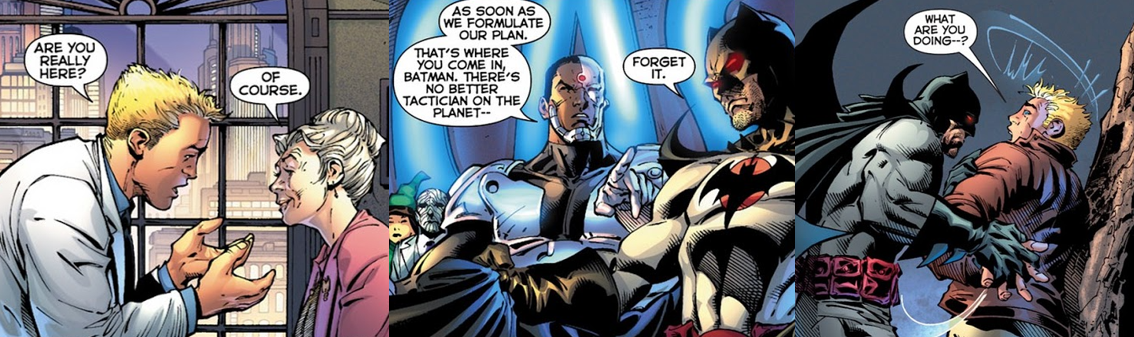
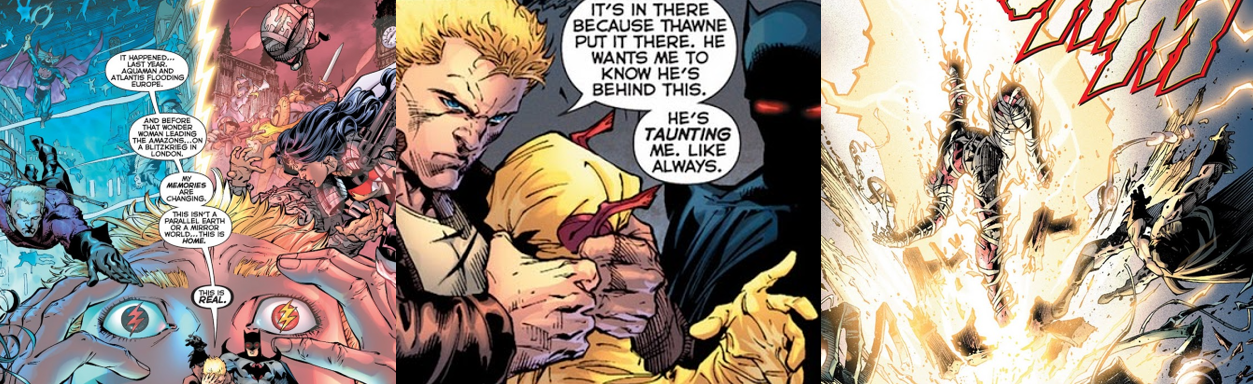
If that wasn’t bad enough, Iris is in a loving relationship with another man; however, on the plus side, Nora Allen is still alive but, while Barry is overjoyed at being reunited with his beloved mother, his analytical mind immediately sets to work trying to figure out what’s happened to the world; he still remembers heroes like Clark Kent/Superman and the Justice League, but neither of these aspects appear to exist anymore…with one exception: Batman. The story jumps over to Gotham City, now a bustling metropolis with neon billboards promoting “Wayne Resorts and Casinos” and haunted by a far darker and more violent version of the Caped Crusader. While this Batman is far more callous than his mainline counterpart, and perfectly happy with tossing costumed baddies to their deaths, he’s just as driven to hunting down the Joker, and especially motivated as the Harlequin of Hate has kidnapped Mayor Harvey Dent’s twins. His investigation is interrupted by Victor Stone/Cyborg who, rather than judging Batman’s violent methods, invites him to align with a motley crew of alternative heroes and villains in order to oppose Arthur Curry/Aquaman and Diana Prince/Wonder Woman, whose warring nations threaten to destroy the world in their conflict. Batman, however, is uninterested in joining their cause since none of them stand a chance at fighting the Atlanteans and the Amazons, and his disinterest causes many of Cyborg’s followers to cut out as well, leaving the man-machine despondent. Confused and desperate for answers, Barry is forced to endure the frustration of traffic jams in order to travel to Gotham City to ask Bruce Wayne for help. However, when he arrives at Wayne Manor, he finds Alfred Pennyworth missing, the stately home in disarray, and is shocked to discover that this Batman isn’t Bruce…but his father, Doctor Thomas Wayne!

Barry goes to extreme lengths to regain his powers before he loses his memories of the original timeline.

In this world, it was young Bruce who died that night in Crime Alley, turning Thomas into a brutal and sadistic bat-themed vigilante. Believing Barry to be delusional, and angered at his knowledge of Bruce, Thomas breaks Barry’s finger and puts a beating on him, unimpressed with his claims to be the Fastest Man Alive. The conflict with Thomas not only assaults Barry’s body, but also his mind as his memories start to change to align with this new world, one caught in the middle of a war between Atlantis and Themyscira that has devastated large parts of the world. One year previously, the hostile Aquaman and his half-brother Orm Marius/Ocean Master flooded much of Western Europe and, before that, Wonder Woman and her Amazons attacked and conquered London, re-christening it New Themyscira. Barry finds his Flash ring in the Batcave but is shocked to find Thawne’s Reverse-Flash uniform in there instead of his Flash costume and theorises that the maniacal time-traveller must be behind the changes to the timeline. Although initially sceptical of Barry’s story, Thomas is intrigued by Barry’s tragic and twisted history with Thawne, who purposely travelled back in time to cause him anguish by killing his mother and hounding his superhero career, and spurred to help him since restoring the timeline will mean that Bruce never gets murdered. However, the only way they can hope to achieve this is to restore Barry’s superspeed before he forgets everything about the previous timeline, but his initial attempt to recreate the accident that doused him with chemicals and saw him struck by lightning leaves him a charred and scarred mess. Although left in agonising pain from third degree burns over seventy-five percent of his body, Barry is adamant about trying again, with an even bigger bolt of lightning, before his new memories completely override everything he used to be and know. Thomas, of course, thinks he’s a madman for risking his life in such a desperate attempt, but the second bolt of lightning does the trick and Barry’s superspeed and connection to the Speed Force is restored, which has the added effect of speeding up his recovery time. Barry whips himself up a fresh new Flash costume and sets to work trying to figure out what else has changed in this new timeline and who else is available to help; he explains the dangers and mechanics of time travel to a cynical Thomas, that Thawne is afforded additional abilities thanks to his “Negative” Speed Force and has no compunction about screwing up the timeline, which can have serious consequences even if only small changes are made.

Since Superman’s no help, Batman joins the Resistance, but they’re hopelessly outmatched against their foes.

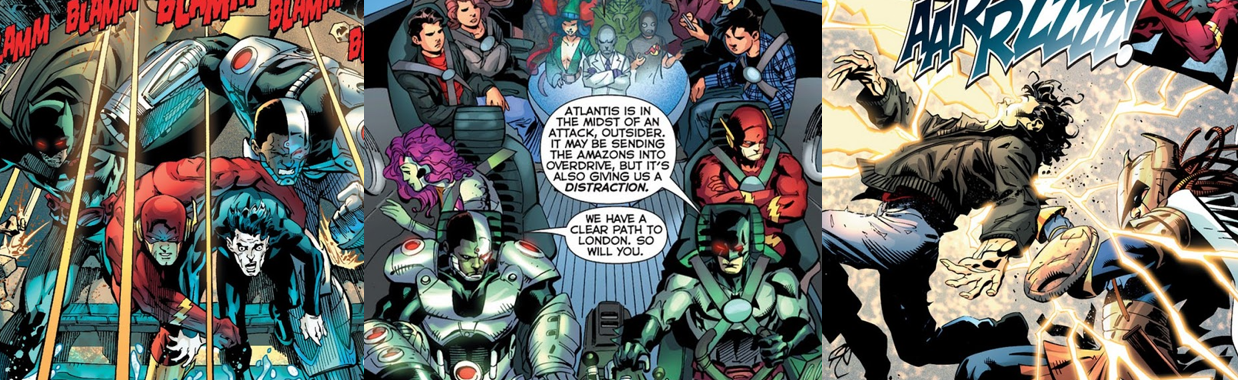
Believing that Thawne purposely orchestrated this new timeline to take the world’s greatest superheroes out of action, Barry discovers that the Kryptonian rocket carrying the infant Superman crashed into Metropolis and killed thirty-five thousand people, and Thomas agrees to be Cyborg’s strategist in exchange for access to classified government information on the rocket that only Victor can supply. Thomas has absolutely no problem with deceiving Cyborg since, if they’re successful, time will be forever changed and none of their strife will have happened or mattered, which is perfectly fine with this jaded, semi-suicidal version of Batman. Cyborg leads the two to a secret underground facility beneath Metropolis, the home of “Project: Superman”, which they sneak into and discover the skeletal remains of a Kryptonian canine and an emaciated, terrified Kal-El who has been routinely tortured, experimented on, and kept out of the sun’s rays his entire life. Batman is less than impressed with Barry’s so-called “saviour”, who has little to no control over his powers and deserts them the moment that General Sam Lane’s soldiers close in. Thankfully, they’re saved by Emily Sung/Element Woman, who chemically incapacitates the soldiers, but Barry continues to be plagued by the physical pain and seizures his new memories cause him; these show a life where his mother was constantly by his side encouraging him, even after his father’s tragic heart attack, and a version of Barry who continuously struggled to find a woman to settle down with. After Colonel Steve Trevor fails to liberate reporter Lois Lane from New Themyscira, the United States President is left with no choice but to employ the full might of the U. S. military, which results in Hal Jordan (who never received the Green Lantern ring in this world and resents the world’s superheroes for not getting involved in the greater conflict) being shot down and killed by the Amazon’s invisible jets. With the entire world on the brink of all-out war, and the United Kingdom threatened by a devastating tidal wave, Barry berates Thomas for writing his world off; arguing that, at any moment, Barry could completely forget Bruce and the former timeline, Barry encourages Cyborg to make contact with the superhero community to defend the world and, although their ace in the hole, “Superman”, has literally flown the coop, they’re joined by Billy Batson and his adopted family, who are collectively known as Captain Thunder in this world. Such is the allure of Batman’s urban legend that all it takes is his involvement and leadership to unite the world’s superheroes in interceding in the battle between Aquaman and Wonder Woman, however they’re betrayed by June Moon/The Enchantress, who forcibly transforms Captain Thunder back into his mortal form so that Diana can run him through with her sword.

Reverse-Flash’s boasting is cut short and Barry is seemingly able to set the timeline right…

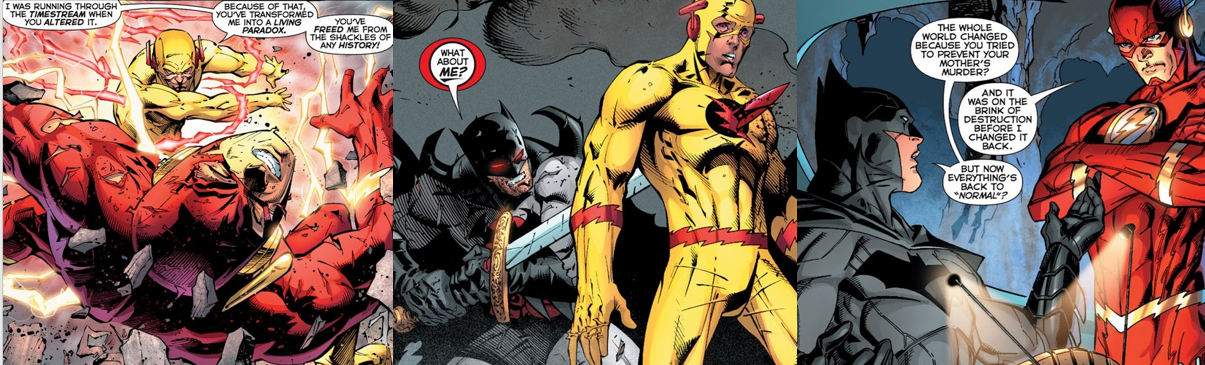
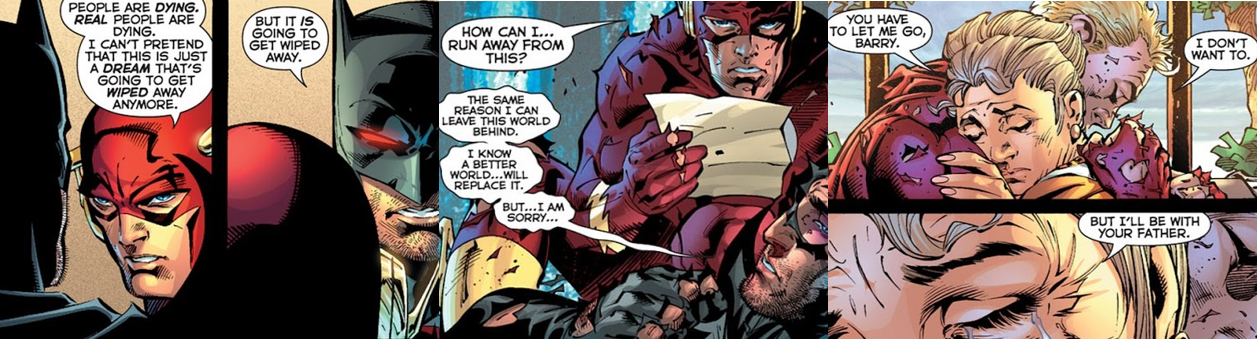
It’s here, in the midst of a brutal war with the fate of this alternative world in the balance, that the Reverse-Flash finally makes his physically appearance. Naturally, a vicious fist fight breaks out between the two, but Barry is devastated to learn that it was he who caused this dark new timeline and not Thawne. Thawne “[resets Barry’s] internal vibrations” to reveal that Barry was so distraught after learning that Thawne killed his mother that he pushed himself further than he’d ever gone before, travelled back in time, and called upon the entire power of the Speed Force to prevent that event from ever happening. The result was a fracturing of the timeline in wild and unpredictable ways, and also that Thawne has been “removed from the timeline” so that, no matter what happens in the past, present, or future, he will continue to exist to plague his foe. This means that Thawne no longer has to rely on Barry being alive to ensure his creation in the far future, and nothing Barry does will prevent Thawne from existing. However, just as it seems like Thawne has achieved his ultimate victory, Batman stabs Thawne through the back and kills him, admonishing him for turning his back on the battlefield. Even though Superman makes a dramatic reappearance to join the fight, the war escalates uncontrollably; Atlantis plans to sink the United Kingdom and Enchantress mortally wounds Batman, who begs Barry to set things right. Reluctant to leave the world to its fate, Barry first stops by to talk to his mother, who encourages him to do the right thing since he’s literally sacrificed billions of lives and made the world a complete hellhole just to save her life. Heartbroken, but galvanised by her blessing, Barry intercepts his past self and knocks him from the Cosmic Treadmill but, when he returns to the time stream, Barry finds that there are three separate, competing timelines and a mysterious, hooded woman warns that time has been splintered and that only Barry can help merge them back into one unified timeline. When Barry awakens at his desk, the world appears to be back to normal; the first thing he does is race to the Batcave to talk with Bruce, who is once again Batman and who, surprisingly, reassurances Barry that he’s only human and couldn’t have known that saving his mother would have screwed the world up so badly. In an interesting twist, Barry retains his memories of the “Flashpoint” universe, and leaves Bruce in tears when he delivers him a letter rom his father. However, Barry fails to notice a few changes that have occurred as a result of his time meddling; not only is his Flash suit different, but so is the Batsuit, and all of the world’s heroes have been altered into their God-awful “New 52” forms, but the extent of Barry’s actions wouldn’t be revealed for some time and, for all intents and purposes, this is now the “real world”.

The Summary:
If there’s one reason to read Flashpoint, it’s the gorgeous artwork by Andy Kubert; stylistically similar to Jim Lee and John Romita Jr., Kubert really emphasises the kinetic energy of his characters, which is perfect for the Flash, while still balancing the many secondary characters in a way that’s bold and striking and crafting a far darker and more fearsome rendition of Batman. Each issue is accompanied by supplementary materials about this changed world, such as a world map that shows who controls which territory and where these new groups of alternative characters operate, and line art showing Kubert’s process. Sadly, though, just reading the main five issues doesn’t give you the entire story of Flashpoint; like pretty much every big Crisis and crossover event these days, Flashpoint was accompanied by four one-shots, two preludes, and no less than seven additional tie-in titles that further explored this alternative world and these far darker, less hopeful characters. I haven’t actually read any of these as I never felt compelled to explore it further as I subscribed to Thomas Wayne’s philosophy that it really doesn’t matter what happened to him, Aquaman, Hal Jordan, or any of the other characters changed by Barry’s actions as the timeline is reset at the end of the story. That and I really can’t afford to by the omnibus edition that collects all these issues, I don’t want any of the tie-ins taking up space on my shelves, and I really don’t care for the story enough to want to read any more about it.

Barry really comes across as a hypocritical, selfish asshole in this story.

This really isn’t a great story, or look, for Barry Allen. For someone like me, who grew up reading Wally West’s adventures as the Flash, it was already quite the insult to have him so readily supplanted by his predecessor, but to write a story where Barry’s so selfish that he screws up the entire timeline and, not only that, hesitates to set things right because he can’t stand to lose his mother? Yeah, that’s not a great look. And I get it; he’s grieving and in pain and not thinking rationally, but it’s especially odd that Bruce reassures him that he (as in Bruce) probably would’ve done the same thing…despite the fact that he turned down the chance to see the world and timeline reorganised in his favour in Infinite Crisis. The message seems to be that we have to sympathise with Barry but, while he’s obviously suffered a terrible loss at the hands of one of his worst enemies, it kind of seems like Geoff Johns wrote this twist simply because it’d be too predictable to have Thawne be behind the changes to the timeline. On the plus side, Barry certainly suffers for his selfishness; he’s nearly killed by the lightning bolts he attracts to himself and endures an unimaginable amount of agony from their impact, which is the least he deserves to go through. It’s interesting, though, as Barry feels morally obligated (or, perhaps, guilty enough) to help save this world and even has the gall to lecture Thomas Wayne about condemning the world to die. He even hesitates to undo his actions and is desperate to find a way to save his mother and the world at the same time, but finally being convinced to do, y’know, the right thing and prioritise the greater good and he doesn’t even do that right as it births the New 52 world.

Thomas Wayne’s violent, jaded Batman steals the show and delivers a heart-warming end to the story.

Flashpoint’s nightmare timeline is very different from the mainline DC Universe; it’s full of conflict, loss, and despair. A world constantly on the brink of war, under threat by two warring superpowered nations, and suffering without the world’s greatest superhero. This is a world where the public has lost faith in costumed heroes since they’re reluctant to stand against the forces of Atlantis and Themyscira and many of them have either been killed, maimed, or forced to make unlikely alliances and rely on subterfuge to survive and try to take a stand. However, the allure of Batman’s reputation remains as strong as ever; while Cyborg doesn’t approve of Batman’s violent methods, he knows that the Resistance will only really commit to fighting if Batman is onboard and goes out of his way to try and recruit the Dark Knight in order to spark some small sliver of hope. Thomas Wayne, naturally, steals the show here; his darker costume and demeanour show an alternative version of Batman who’s much older and far more cynical than Bruce Wayne. It’s consistently hinted that Thomas Wayne is in such a dark place that he’s not only completely given up on the world, but he also doesn’t really care whether he lives or dies. For him, nothing really matters anymore as not only was his entire world ripped away from him when he watched his son die before his eyes, but everything could be wiped out at a moment’s notice. He is compelled to help Barry, despite his cynicism, not to save his world, but to undo it entirely, fulfilling both of these goals, and really makes an impression with his surly demeanour, willingness to kill, and glowing red eyes. Sadly, despite appearing to die here and this timeline being erased, Thomas Wayne’s Batman would return later down the line and actually oppose his son as yet another dark analogue to the Caped Crusader, but I have to admit that he was one of the few highlights of this Crisis.

As if besmirching Barry’s character wasn’t enough, Flashpoint resulted in the dreadful New 52 era!

Overall, I really don’t care for this story specifically because it spelt the end for the DC Universe as I knew it and the beginning of my least favourite time in DC Comics, the New 52 run. I just didn’t understand the need to even do this and reset things in such an extreme way when Infinite Crisis had already done that not too long before this was published. As a self-contained, throwaway Flash tale that taught Barry a serious lesson about dealing with his grief, it could’ve worked; hell, even as a longer story the stretched over a few of the Flash titles and shook up the status quo for the Flash might have been more enjoyable, but it falls pretty flat as a reality-warping Crisis event because it’s a mere five issues and is lacking the expansive scope of these events. For me, it just doesn’t work since it paints Barry in such a poor light, and it feels completely pointless to dip into any of the tie-in stories since this was obviously never going to last as a timeline. I absolutely feel this could have worked much better if the Reverse-Flash had been the mastermind behind it and had cropped up a bit more in these five issues; this could’ve been a great showcase to show how depraved and twisted he is and could have presented a nightmare timeline where he’s the hero and the Flash is a villain, but he shows up far too late in the story to really make much of an impression and, despite boasting that he’s effectively immortal, is dispatched pretty easily by Batman and his trusty sword. In hindsight, now that the New 52 has finally been undone, Flashpoint isn’t as bad as it was when I first read it and was struggling to cope with all the rubbish decisions made in that era, but it’s still easily skipped over, I think. Just the idea that Barry, who lectures Thomas on how dangerous haphazard time travel can be, would make such a poor, selfish decision without thought to the consequences really doesn’t warm me to his character and, in many ways, makes him as reprehensible as Hal Jordan was back when he was Parallax. These are the actions of a misguided villain, not a sympathetic hero, and all the heart-warming letters from dead fathers and grief over lost mothers in the world can’t save this utter dreck of a story.

My Rating:

Rating: 2 out of 5.

Could Be Better

Are you a fan of Flashpoint? If so, what did you like about it? If you read the tie-in stories, which ones were your favourite and what did you think to this alternative timeline? Were you a fan of DC’s decision to reset their continuity again? What did you think to Barry’s decision to save his mother? Did you sympathise with him or did it paint him in a bad light? Were you a fan of Thomas Wayne’s Batman? Which Flash or speedster is your favourite? What’s your favourite Flash story? Which of DC’s infinite parallel worlds is your favourite? Feel free to sign up and share your thoughts on Flashpoint below or drop a comment on my social media.

Back Issues: Showcase #4

This review has been supported by Chiara Cooper.
If you’d like to support the site, you can do so at my Ko-Fi page.

Story Title: “Mystery of the Human Thunderbolt!”
Published: October 1956
Writer: Robert Kanigher
Artist: Carmine Infantino

The Background:
In 1940, writer Gardner Fox and artist Harry Lampert introduced readers to Jay Garrick, a college student granted superhuman speed after inhaling “hard water vapours”, and thus the very first superhero to use the name “The Flash” was born. The Flash not only became a charter member of the Justice Society of America but also graduated to his own solo book a year after his debut; however, All-Flash was cancelled after thirty-two issues when the onset of the Second World War saw superheroes decline in popularity. In the seven years that passed after Jay’s last publication hit comic book stands, a lot had changed; the rights to the Flash were now held by DC Comics, who set about reinventing “Golden Age” superheroes like the Flash and Alan Scott/Green Lantern. Thus, in 1956, readers of Showcase #4 were introduced to an all-new version of the Scarlet Speedster; created by writer Robert Kanigher and artist Carmine Infantino, forensic chemist Barry Allen heralded not only the “Silver Age” of comics but also the concept of the multiverse as it was later revealed that Jay existed on a parallel version of Earth. Barry quickly became one of the most popular and iconic incarnations of the Flash mantle, being a founding member of the Justice League of America and cementing his legacy after sacrificing his life in the Crisis on Infinite Earths epic (Wolfman, et al, 1985 to 1986). Although Barry’s demise lasted longer than most superhero deaths, he was eventually brought back in the ridiculously confusing Final Crisis event (Morrison, et al, 2008 to 2009) and his popularity and influence has seen him in a starring role in two live-action television shows, feature prominently in DC cartoons and videogames, and also seen him brought to life on the big screen as part of the largely disastrous DC Extended Universe.

The Review:
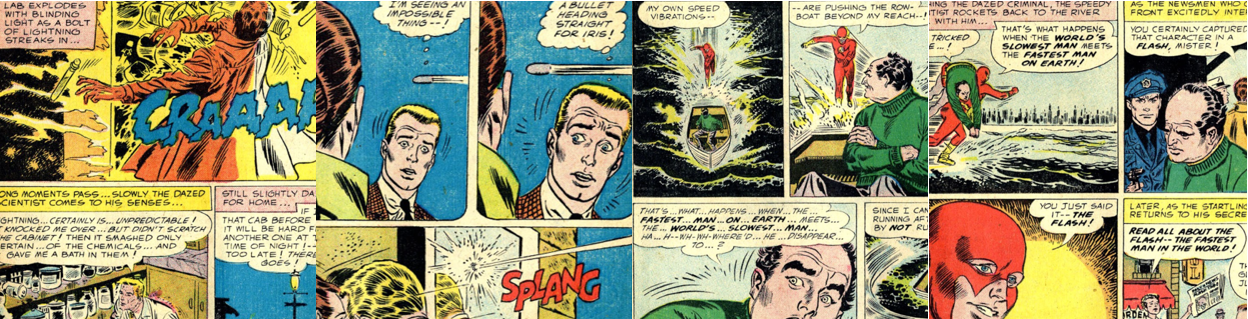
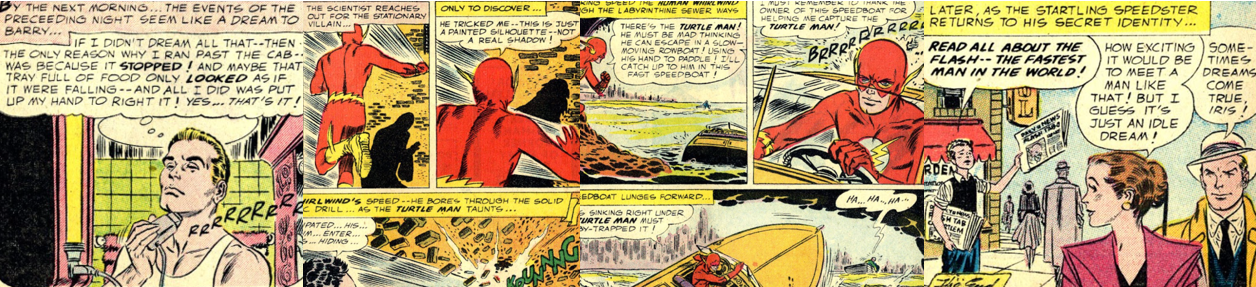
Our story begins with a crisis at a radar station on the East Coast; two military personnel are startled after picking up a strange object travelling faster than anything ever recorded before it sends their equipment haywire. To explain this phenomenon, the story flashes back a short time to Central City on a night when the city was ravaged by a tumultuous lightning storm. Here, in the police laboratory, we meet scientist Barry Allen, who marvels over stories of the Jay Garrick version of the Flash, who at this point exists only in comic books in a slice of metatext. As he returns to his mysterious experiment (which, apparently, requires the use of “every chemical known to science”), a bolt of lightning causes him to be doused in chemicals, leaving him wet and dazed but otherwise unharmed. Shaken, Barry leaves but is too late to hail a cab so tries to chase one down, only to find himself flying along at super speed! Believing his near-death experience has caused him to imagine things, Barry stops at a diner to catch his breath and is startled to find that he can now perceive time in slow motion, moving so fast that a clumsy waitress cannot comprehend what happened, but he still believes he’s suffering from shock so he goes home to rest. By the morning, he’s used some wonky logic to explain everything away but, when he meets Iris West for a date (receiving a talking down for his poor timekeeping), his super speed kicks in again just as a stray bullet threatens her life! Acting quickly, he tackles Iris out of harm’s way, earning him her gratitude, and finally realises that his molecular structure has been altered by the accident to turn him into the fastest man on Earth. Inspired by the adventures of Jay Garrick, Barry…somehow…crafts himself a sleek, form-fitting costume that can condense into a ring on his finger and makes his debut as the Flash to answer a burglar alarm at the city’s central bank.

After gaining superhuman speed, Barry Allen tracks down the sloth-like villain the Turtle Man.

Thanks to his superhuman speed, the Flash can effortlessly race down the sides of buildings and across town so fast that he breaks the sound barrier, thus explaining the disruption monitored at the start of the story. At the bank, The Flash finds nothing has been stolen; questioning the holdup victims, he learns that the perpetrator was “The Turtle Man”, a villain known as the slowest man on Earth, and somehow intuits that the thief left the job half finished to complete it later on. This odd logic is compounded when the Flash is easily fooled by a silhouette painted on a brick wall, like he’s Wile E. Coyote, and goes crashing through a wall while trying to apprehend the Turtle Man. Somehow, despite the fact that the Flash just appeared and no one even knows about him, Barry believes the villain is “using [his] speed […] as a weapon […] against [him]” and stays on his guard as he follows the Turtle Man’s trail through a sewer and to the river. The Turtle Man certainly lives up to his name; not only does he talk in laborious sentences, but he also chooses a rowboat for his getaway, yet he is also smart enough to boobytrap a speedboat to keep the Flash from pursing him. Thankfully, the laws of physics mean nothing to the Scarlet Speedster and he races across he water’s surface, but he’s unable to apprehend the villain because his movements only push the rowboat further away. Instead, the Flash circles the rowboat at superspeed, trapping it in a vortex and easily capturing the sloth-like crook. The cops and press are awestruck by the feat and the Flash becomes the talk of the town; even Iris swoons over the super-speedy hero completely unaware that she’s already dating the Scarlet Speedster.

The Summary:
Well, I’m not gonna lie…this was a bit of a disappointment. These older comic book tales always tend to be very brief and simplistic but I found Barry’s debut story to be particularly bland considering how colourful and versatile the Flash and his powers can be. I liked that Barry didn’t immediately realise what’d happened after the lightning strike but it takes him so long to figure out what happened that he comes across as a bit of a dunce. His misadventures do give a taste of what he’s now capable of, showing that he can accelerate to inhuman speeds, defy gravity and physics, and even perceive time differently, but it’s handled very clunkily and not in an especially engaging or entertaining way. Barry’s clothes don’t catch fire from the friction, which would’ve been a fun visual, and he’s far too quick to explain away what’s happening with weak logic. Once he does figure things out, he’s somehow able to create this amazing suit that shrinks down into a ring, something I always thought came along later in his career but isn’t even explained with a wishy-washy trope like “unstable molecules”.

An unfortunately dull story with a foolish hero and a ridiculous villain that fails to impress.

The Turtle Man isn’t exactly a visually interesting or threatening first villain, either. I get the idea of pitting the world’s slowest man against the world’s fastest man as a kind of thematic parallel but it doesn’t really work because…why the hell would the world’s slowest man pose a threat to the Flash, of all people?! And…he doesn’t. He briefly bamboozles the Flash by fleeing the crime scene, causes him to run into a wall and sink, both of which are minor inconveniences at best, and is easily apprehended without really taxing the Flash’s powers or intelligence anywhere near their limit. It feels as though this story needed a few more pages; there are other standalone Flash stories in this issue but I would’ve used the extra pages to establish the Flash in the city before he encounters the Turtle Man as the villain is…somehow…aware of the Scarlet Speedster and relishing in their conflict despite him just making his debut! In the end, it’s a kind of fun, wacky tale but a bit of an inauspicious debut for one of DC Comics’ most popular heroes; a lot of the groundwork is here and there’s some fun art showcasing the Flash’s super speed and such but it’s ultimately a bit lacklustre and too simplistic for me to be the definitive origin story for the character.

My Rating:

Rating: 2 out of 5.

Could Be Better

What did you think about Barry Allen’s debut as the Flash? Were you impressed by it at the time or were you left a little fulfilled, like me? What did you think to the new Flash and how do you think he compared to Jay Garrick? Did you also find it odd that Barry took so long to figure out what was going on? What did you think to the Turtle Man and his threat to the Flash? Which Flash or speedster is your favourite and what are some of your favourite Barry Allen moments? Feel free to share your thoughts on the Flash below and be sure to check out my other Flash-related content!

Back Issues: Predator #1-4

This review has been supported by Chiara Cooper.
If you’d like to support the site, you can do so at my Ko-Fi page.

Story Title: “Concrete Jungle”
Published: June 1989 to March 1990
Writer: Mark Verheiden
Artist: Chris Warner and Ron Randall

The Background:
In 1980, Mike Richardson founded Dark Horse Comics, a comic publisher that separated itself from the heavy-hitters like DC Comics and Marvel Comics by focusing its efforts on creator-owned titles. Dark Horse Comics achieved greater mainstream success in 1988 by publishing licensed stories and adaptations of horror and science-fiction films and franchises, the most prominent of these was the merging of the Alien franchise (Various, 1977 to present) and the Predator films (Various, 1987 to present). However, concurrent to writer Chris Warner’s three-issue clash between those two, Dark Horse Comics also published this four-issue spin-off of the Predator franchise, specifically revolved around the hitherto-unknown brother of Major Alan “Dutch” Schaefer (Arnold Schwarzenegger), later retitled to “Concrete Jungle”. Perhaps bolstered by the crossover between Aliens and Predator, “Concrete Jungle” proved popular enough to spawn not only a slew of additional Predator spin-off comics and movie adaptations, but also crossovers with other comic book icons such as DC Comics’ superheroes and even lawman of the future Judge Joseph Dredd. While the Predator movies have often been met with mixed reviews, comic book adaptations continued to be published, with the alien hunters even crossing over into Marvel Comics after Disney purchased 20th Century Fox.

The Review:
Much like Predator 2 (Hopkins, 1990) “Concrete Jungle” is set in an overpopulated and crime-ridden city during a stifling heatwave that drives its citizens to violence and even murder. In this case, we’re in New York City and following police detectives and long-term friends and partners Errol G. Rasche and John Schaefer, Dutch’s older brother who got them transferred from narcotics to homicide after tossing a cartel chief off a rooftop. While Rasche is convinced this is a conspiracy headed by their corrupt police captain, McComb, to have them offed by local gangs, Schaefer’s more concerned about the stars looking “different” than either their current situation or the escalating drug problem sweeping the city streets. This nicely segues to a tense meeting between two rival gangs, headed by Lamb and Carr; while Carr advocates for them joining forces to maximise their profits and fend off Columbian cartels, Lamb would much rather fight to the death and see who’s left to reap the rewards. Just as an all-out gunfight is about to break out, one of Lamb’s men is blasted from behind by the Predator’s plasma cannon; another is diced up when he sticks his head out the window and, assuming it’s an attack by the Columbians, both gangs open fire and blow a hole in the building wall. The fracas draws the attention of the cops but, when Rasche and Schaefer arrive, they’re barred from entering the building until Captain McComb arrives.

Stubborn Schaefer ignores all the warnings and ends up going toe-to-toe with a Predator.

Just like the hot-headed Lieutenant Mike Harrigan (Danny Glover), Schaefer doesn’t really give a damn about McComb’s authority and he and Rasche head on in after one of the gang members is hurled from a window and crashes into a police car. Inside, they’re horrified to find the remains of the two gangs littering the floor and strung up, skinned, from the ceiling. Carr, who somehow survived the massacre, opens fire, blaming the cops for what happened, and manages to slip away right before Special Weapons and Tactics (S.W.A.T.) come crashing in, led by an incensed McComb. Pissed that Schaefer disobeyed a direct order, McComb continues the homage retread of Predator 2 by chewing the blonde-haired muscleman out for overstepping his boundaries. Later, Rasche and Schaefer investigate a wholesale slaughter in the subway, again covering the same ground as Predator 2 and seeing McComb reprimand them despite the fact that they’re literally just responding to calls rather than actively involving themselves in the investigation. This time, however, McComb’s orders are overruled by the appearance of General Homer Philips, Dutch’s former commanding officer from the first movie, who takes Rasche and Schaefer aside to warn them off out of loyalty to Dutch. While we’re never told what happened to Dutch or where he is, he clearly told General Philips enough about his big brother and the Predator for him to step in, for their own safety, assuring them that it’ll all be over in about two weeks if they don’t interfere. Realising that the gruesome murders are somehow connected to Dutch, Schaefer naturally ignores these warnings and breaks into Lamb’s apartment, now a crime scene, where he’s blindsided by the Predator. A fist fight breaks out, one naturally one-sided, that sees the Predator place a curious implant into Schaefer’s neck and him managing to steal the creature’s helmet after smashing it off with a piece of timber.

Schaefer’s search for answers takes him to South America, where he easily scores his first Predator kill.

For his efforts, he’s left with a broken nose and sent plummeting to the street below; he’s saved from death only by grabbing on to and tangling himself up in washing lines conveniently hanging between buildings. Despite being left a bloody mess, his snark remains intact, but his doctor is unconvinced by the paper thin explanations the two give for the brute’s injuries. Stubbornly refusing to take the time to rest, Schaefer limps his way over to Rasche’s home where he suggests that the Predator tagged him to keep track of him for later and insists that they try to find General Philips so they can get some real answers. Their efforts are interrupted by a furious McComb, but when he threatens to have Schaefer brought up on charges, the hulk lashes out, smashing his telephone, ramming McComb against the wall, and threatening him with further violence if he doesn’t give up General Philips. However, McComb is too low on the totem pole to help; as far as he’s concerned, General Philips doesn’t exist, there is no investigation, and all of it is far above his paygrade. With no other leads to go on, Schaefer decides to fly out to South America, Dutch’s last known location, and look for answers himself despite the danger posed to him by the Columbians he’s pissed off. He finds himself a guide in a seedy bar in Riosucio and is led to first the overgrown remains of the guerrilla camp Dutch and his team ransacked in Predator and then the massive crater left over from the Predator’s (Kevin Peter Hall) self-destruct device. At night, Schaefer reminisces about his childhood with Dutch (the two of them used to hunt in the woods, not for sport or fun but to test their mettle against nature) and arms himself with a fully automatic shotgun when his neck implant alerts him to the Predator’s presence. Although he’s able to dodge the Predator’s plasma cannon and even land a shot on the creature’s shoulder, Schaefer’s caught off-guard by the Predator’s cloak; still, he’s able to stab it in the ribs before being manhandled. Schaefer’s as quick with his wit as he is with his thinking, though, and tosses salt in the Predator’s eyes before beating it with a log, successfully knocking it over a cliff edge and causing it to be impaled on a spike-like tree branch.

In the face of a Predator invasion and military cover-ups, Schaefer seeks allies in low places.

Schaefer’s less than surprised when it turns out that his guide was one of General Philips’ men, who’s distraught that Schaefer killed the creature and even suggests that Philips knew about the Predator when he sent Dutch into the jungle. As he forces Schaefer to face General Philips, chastising him for not understanding the implications of killing one of the alien hunters, they’re attacked by Columbian drug lords, who kill the guide and manage to knock Schaefer out. Although Schaefer’s able to fight his way out before he can be tortured, a whole gang of Predators strikes the drug camp, wiping out the Columbians with their plasma cannons and setting the base on fire. Thankfully, General Philips arrives to help get Schaefer out of there and back to New York, where Philips confirms that he’s known about the Predators all along and that they seem to be fixated on Schaefer and his brother. Meanwhile, Rasche messes about with the Predator’s helmet and, when he puts it on, figures out what’s been screwing with television receptions and the stars when he sees a whole fleet of cloaked Predator ships hovering throughout the city skyline! When he attempts to warn McComb, the police captain shoots him down and threatens him with jail for withholding evidence and he’s taken into custody by agents of the Inland Revenue Service acting on behalf of the Federal Bureau of Investigation (FBI). When he realises that the Feds mean to hand Schaefer over to the Predators, Rasche is able to take advantage of the accountants’ penchant for numbers to overpower them and load up at the station armoury. Showing little concern for the safety of New York, Schaefer knocks Philips out and forces his chopper to land so he can reconvene with Rasche but, realising that they’re outgunned and outmatched against the alien menace, Schaefer goes to Carr to recruit him and his gang.

Just when all hope seems lost, the Predators just…decide to leave and the conflict is over.

Although he’s naturally suspicious of the cop, Carr is immediately attacked by a Predator; when Schaefer struggles to fend off the Predator, Rasche arrives and blows it away with a bazooka, convincing Carr to set aside their differences to combat the alien invasion. The Predator ships open fire, bombarding the city with devastating laser blasts but Schaefer and the others manage to escape to safety and get their forces together to make a final stand against the invaders. Schaefer draws first blood, using the Predator helmet to direct Carr in bringing down a Predator ship with a single rocket, somewhat undermining the threat of their advanced technology and looming ships. Their efforts catch the attention and anger of Captain McComb, who surrounds the immediate area and calls for their surrender but, just as McComb is about to gun Schaefer down in the street, a Predator ship decloaks and opens fire, resulting in McComb getting his face blasted off by a Predator’s plasma blast. Schaefer’s helmet is damaged after he goes off all gung-ho and Rasche is injured by a plasma shot before General Philips and the army turn up, only to reveal that the military is preparing to launch a massive air strike that will level the city and lay waste to both the populace and the “foreigners”. Schaefer targets fire hydrants to short out the Predator’s technology, revealing their ground forces and allowing him and his allies to take the fight to them, but the Predators quickly overpower even Schaefer. However, they burst into laughter when they see the incoming choppers amidst a dark, rainy sky. Schaefer finally pulls his neck implant out as the Predators leave, theorising that the weather has turned too cold, and the situation has escalated so far that there’s no sport to be found in New York anymore. Schaefer vows to see them again the next time it grows unseasonably hot and ignores General Philips’ scolding to get Rasche to safety, showing little consideration for the state of the city.

The Summary:
While the artwork of “Concrete Jungle” is pretty good, with Schaefer appearing as a good facsimile of Arnold Schwarzenegger and New York City mimicking the aesthetic of Predator 2, the writing and narrative leaves a lot to be desired. Although Dutch dropped a couple of situational one-liners, he wasn’t some cliché, snark-spouting machine; his older brother, however, has almost John McClane (Bruce Willis) levels of sarcasm and is never short of a wry remark no matter how desperate the situation is. This is fine for a one-dimensional action hero and helps to differentiate the elder Schaefer from his brother, but it doesn’t always land for me; it doesn’t help that he’s motivated not out of a desire to serve and protect but more to test his own limits. A proud man with little regard for authority, he sees New York as an unsalvageable cesspool and he simply rises to the challenge when the Predators arrive, sensing their presence even before he’s forcibly implanted with their relatively unexplained and ultimately pointless neck device. In many ways, Schaefer is a mixture of Dutch’s musclebound bravado and Harrigan’s weathered, roguish character; he bursts into crime scenes, shows up where he’s not wanted, and openly defies both his superior and the American military, just like Harrigan, while throwing his muscles around and being a driven man’s-man just like his younger brother. Unfortunately, these elements come together in a way that doesn’t really gel for me; “Concrete Jungle” has a really interesting premise that it just squanders in favour of recreating or referencing events from the first two Predator films.

The story contains a few too many callbacks to the films and completely upends General Philips’ character.

I really like the idea of the hunters arriving on Earth en masse; the visual of characters wearing their helmets, being horrified at the sight of the fleet, and the Predator ships opening fire upon New York City and swarming the streets is a striking one and a natural escalation from the existing movies that only comics can provide since they’re unconstrained by budgets. But all the potential of these plot points isn’t realised until the final few pages of the last issue and, instead, the bulk of the story is spent on a rehash of the main plot elements of Predator 2. Like Los Angeles, New York is a grimy city in the middle of a gang war about drugs that involves a lot of violence, and, like Harrigan, Schaefer has no time for the red tape surrounding this and wants to bring both gangs down. The Predator not only slaughters both gangs much like in the opening moments of Predator 2 but even randomly attacks subway passengers, just like in that film; McComb’s anger at Schaefer is a combination of Special Agent Peter Keyes (Gary Busey) and Deputy Chief Phil Heinemann (Robert Davi), and the general visual and narrative thrust of the first two issues is geared very much towards recreating sequences of Predator 2, robbing “Concrete Jungle” of much of its identity. The story then finds a contrived reason to ship Schaefer over to South America for literally no other reason than to reference events from the first film; it turns out that he’s right and General Philips is there, but this could’ve just as easily taken place somewhere else, and Dutch’s actions could’ve been represented by pictures and dialogue rather than literally having Schaefer stand in that crater. I enjoyed the return of General Philips, a character I would’ve loved to see make a return in a hypothetical Predator 3 back in the nineties, and it was interesting learning that he was aware of the Predator before sending Dutch in, effectively turning him into a Keyes substitute.

Some good art and action doesn’t make up for a squandered plot and diminished Predator threat.

I can’t say I actually enjoy this twist, though; the brief interaction between Dutch and Philips spoke to me as two old friends who have an immense amount of respect for each other, and nothing in Predator suggested that he (or anyone apart from Anna Gonsalves (Elpidia Carrillo)) was aware of the Predators. In fact, the prevailing understanding is that the world (or, at least, the government and military) only became aware of the Predators after that first film and I found it a bit disappointing and frustrating to find out that Philips was happy to sacrifice his best soldier and close friend to the alien hunters. Of the two protagonists, Rasche gets quite a bit of development; we see his home, learn and see a little from his family, and he’s much more concerned with the implications of their actions compared to Schaefer; it’s also through him that we learn anything about Schaefer for some time, as surface-level as it is, so I was glad that he didn’t die, especially as it seemed like he was going to. Then there’s the Predators; modelled after the ones seen in the first two movies with little deviations, they sport very little new weaponry or technology, and their threat has been significantly downplayed. Naturally, in a one-on-one fight, not even Schaefer can stand against one of them, but he is able to wound them, knock one of their helmets off, sense their presence even before he gets his neck implant, and is able to kill one much easier than either of the films’ two protagonists. Schaefer can dodge their plasma cannons pretty easily, regularly fights them off with melee weapons, and never has to worry about their wrist blades, combisticks, or other weapons as these either don’t get much play or are only used against disposable background characters. The ending was also extremely anti-climactic; with all of New York under siege and the human characters vastly overpowered, the battle/invasion/whatever just…ends because of a bit of rain and the suggestion that the Predators just wanted to goad humans into destroying each other. It’s a bit vague and very unfulfilling for an ending, with the only consolation being that it didn’t end the same way as the films (with a one-on-one fight against a Predator) but, in this case, maybe it should’ve as it seems like the Predators were just messing about and never intended to wipe out the city (and/or humanity) despite clearly being able to with their superior force (…as long as you ignore how easily Carr took down one of their ships…)

My Rating:

Rating: 2 out of 5.

Pretty Good

Have you ever read the original, four-issue Predator story? If so, what did you think to it? Do you own a copy of the original comics or did you pick up the collected edition? Were you also disappointed by repetition of events from the first two movies? What did you think to John Schaefer, especially compared to his little brother, and the revelation that General Philips knew about the Predators? Were you disappointed that the story didn’t do more with the Predator invasion plot or did you enjoy the callbacks to the first two films? Which of Dark Horse’s Predator stories or adaptations was your favourite? Whatever your thoughts on Predator, and comic book adaptations of this kind, drop a comment down below or share your thoughts on my social media.

Back Issues: Guardians of the Galaxy (2008) #1-3

Writers: Dan Abnett and Andy Lanning – Artist: Paul Pelletier

Story Title: “Somebody’s Got To Do It”
Published: 14 May 2008 (cover-dated July 2008)

Story Title: “Legacy”
Published: 18 June 2008 (cover-dated August 2008)

Story Title: “Beyond Belief”
Published: 10 July 2008 (cover-dated September 2008)

The Background:
Today, Marvel Comics’ Guardians of the Galaxy are well-known as a group of reprobates-turned-heroes thanks to their inclusion in the Marvel Cinematic Universe (MCU), however I think it’s fair to say that the team (and the concept) was relatively obscure compared to other Marvel heavy-hitters like the Avengers and Peter Parker/Spider-Man before the release of Guardians of the Galaxy (Gunn, 2014). As I have already explored, the cosmic team was initially very different when they debuted in the pages of Marvel Super Heroes! #18 (Drake, et al, 1969) and, despite strong sales of the team’s debut issue, the Guardians of the Galaxy remained dormant for about five years and also underwent many alterations as they graduated to their own self-titled series. Between 2006 and 2007, Marvel Comics published a cosmic crossover series titled Annihilation (Giffen, et al), a sprawling storyline in which Annihilus spread destruction throughout the galaxy with his “Annihilation Wave”, an event heralded for proving such epics could occur without Marvel’s flagship characters at the helm. From August 2007 and June 2008, Dan Abnett and Andy Lanning spearheaded a follow-up miniseries, Annihilation: Conquest, out of which was formed a new line-up of Guardians that served as direct inspiration for the MCU’s movies and subsequent multimedia iterations of the team.

The Review:
In place of the usual text boxes, the story is intercut with log debriefings from the Guardians as they reflect on their mission, and therefore jumps about between a few different time periods, which makes a step-by-step recap a little difficult so, instead, I’ll try and go mostly in chronological order. Two weeks ago, Star-Lord, Phyla-Vell/Quasar, and the last surviving member of the Nova Corps, Richard Rider/Nova, were discussing the power vacuum in the galaxy after back-to-back destructive conflicts with Annihilus and the Phalanx. Both battles caught them completely off-guard so, rather than establish a peacekeeping force like the Nova Corps, Star-Lord suggests assembling an “ass-kicking force” that can pre-emptively tackle threats before they can escalate. The first person Star-Lord recruits is Rocket Raccoon, primarily for his “military smarts” and also because he’s “the best tactical mind [he] ever met”. Although Star-Lord tries to grease the wheels by tanking Rocket up with alcohol, he didn’t need to do this, or pile on the compliments; recognising the guilt Star-Lord carries after unwittingly causing the Phalanx’s invasion, Rocket agrees to help but only if Peter quits giving himself a hard time over it, especially as they won the day in the end. Quasar then paid a visit to the grieving Drax the Destroyer whose daughter, Heather Douglas/Moondragon, perished in a previous battle against Ultron. Filled with regret over never having a “regular” relationship with her and having lost his purpose now that he has slain Thanos, Drax considers himself a liability to others because of his thirst for death, but Quasar offers him purpose and direction as part of Star-Lord’s team. Nova then went to recruit Gamora, who was incensed at the suggestion, and that Nova never tried to get her into bed following their victory over the Phalanx. However, despite her stubbornness, Gamora is won over not just by the prospect of a booty call with Rider but also by his compelling argument that she’s tired of being an emotionless killer and desires something more out of life. Together, the group turn to Adam Warlock/Him for further support; troubled by the recent incursions, which have weakened space and time so badly that fissures into extradimensional universes are threatening to spill God knows what into the galaxy and tear it apart, Warlock agrees to join them in order to ensure the stability and continuation of life across our universe.

The fledgling Guardians come together to defend the galaxy from interdimensional incursions.

The fledgling Guardians soon came into a violent conflict with the Universal Church of Truth, a group of zealots who, in an alternate timeline, worshiped Warlock like a God. There were some teething problems throughout this battle; Star-Lord struggled to pull these volatile egos together, leading to Warlock, Gamora, and Drax heading to the control deck to tackle the root of the problem. The Church’s templeship is powered by “faith”, specifically faith in life (which Warlock notes is ironic as the Church’s plan will destroy life rather than grant it) and, once they realise their sacred ship is in danger, the Church’s founders, the Crusaders, promptly teleport away, leaving their devout followers behind, much to the disgust of Warlock, Gamora, and Drax. By the time the others reach the control deck, their options are limited as the templeship is already breaching a fissure; to make matters worse, a gigantic, disgusting eldritch abomination comes through the breach. However, Quasar and the others are able to hold it back to buy Rocket time to destroy the control deck with a grenade; the remaining energy is absorbed by Warlock and Quasar and the threat is summarily ended. They promptly teleport victorious (though Rocket claims the bulk of the victory for himself) to Knowhere, an interdimensional crossroads on the outer edge of time-space that allows them to rapidly transport anywhere using their “passport” bracelets and which happens to be housed inside the severed head of a Celestial! Knowhere is maintained by a group of strange alien lifeforms and overseen by Cosmo the Spacedog, a telekinetic Russian-born hound who has a rivalry with Rocket, acts as their chief of security, and has been busy getting Knowhere up and running for their services. Knowhere is also home to a thriving alien society, including a marketplace and economic system, and to the steadily growing sapling that was once Groot and Brandt/Mantis, an empath who has the unenviable job of maintaining the psychological well-being of the team and facilitating their disparate personalities. However, her precognitive abilities also alert her to an impending betrayal from within, though she’s unable to inform them of this as it could threaten the delicate balance of the timeline. No sooner are the Guardians back at Knowhere that Warlock detects another fissure on the ice asteroid of 5G Hydronis, a place where time and space are being torn apart and where, upon melting away some of the ice, the Guardians are stunned to find the Avengers Mansion contained within!

As the team struggles against the Cardinals, the time-displaced Vance fights off a mysterious attacker.

Before they can properly process the implications of this, they’re attacked by more Lovecraftian beasts, this time giant, slobbering worms that burst up from the ice and ensnare them. Luckily, Major Vance Astro/Major Victory of the original Guardians of the Galaxy happened to be frozen on the planetoid and briefly helps the struggling team before promptly collapsing in a fit of confusion and exhaustion. Star-Lord and Rocket hold off the creatures to cover Drax and Gamora as they tend to Vance, then the group promptly teleports out of there as Warlock and Quasar destroy the asteroid and its monstrous inhabitants. Star-Lord sees providence in Vance’s appearance, especially the symbolism of the shield he carries and the importance both it and Captain Steve Rogers/Captain America had on the legacy of the Avengers. Still encased in his protective suit and apparently dislodged from the time stream, Vance suffers from crippling amnesia and can only remember some vague importance about being at exactly this time period. Mantis tends to Vance to try and acclimatise him to the time period and help him recover his lost memories; though Rocket, inspired by Vance’s story, is more concerned with pestering the team into adopting the Guardians of the Galaxy name. After picking up another fissure, the team head to a seemingly abandoned Dyson Sphere – a literal sun encased within an artificial shell – where they are attacked by Raker and his knightly Cardinals. Sent by the Matriarch of the Church to seek retribution and garbed in gleaming golden armour, the Cardinals are powered by the prayers of their faithful, proving a formidable threat since they are capable of doing anything as long as they believe it, including conjuring weapons and shields of golden energy. Offended by Warlock’s magic and with no time for the team’s heathenistic explanations, the Cardinals make short work of the group simply by believing they have the means to overpower them, meaning they not only break Star-Lord’s hand but also run the mighty Adam Warlock through with a sword. As the Guardians struggle against the self-righteous Cardinals, Vance is suddenly attacked by the time-displaced Stakar of the House of Ogord/Starhawk, who takes even Mantis off-guard thanks to being completely invisible to her mental powers. Starhawk attacks the confused Vance with very familiar claw-like appendages and their battle rages through Knowhere, destroying six of their teleportation batteries, before he teleports out without a single word and leaving the perplexed Vance to incur the wrath of Cosmo for all the damage he caused in the fight.

Gamora’s selfless actions galvanise the team, but the threat of betrayal hangs in the air…

Having accomplished their mission, the Cardinals return to their homeworld; however, many are also dissolved when the Dyson Sphere’s population rises against them; reduced to a corrosive bio-mass after their genetic experiments opened a fissure in their very DNA, the inhabitants have become a tortured, grotesque hive mind. Already beyond salvation, absorbing the Cardinals only accelerates their instability and threatens to open a more destructive fissure. As Gamora tends to Star-Lord’s wounds, he shares with the group his plan to lift the shield that protects the surface from the sun’s rays, a strategy that will fry the entire Dyson Sphere and its out of control inhabitants in one swift move. The idea works and the bio-mass is summarily set ablaze, but Peter’s plan to teleport to safety is scuppered thanks to the damage caused by Vance and Starhawk. With the protective dome fading quickly, Drax and Star-Lord both volunteer to restore it; unfortunately, Quasar’s power is taxed to the limited just trying to keep them safe, so Gamora opts to handle it herself. Thanks to her healing factor, and the limited protection offered by Quasar, Gamora is able to reach the controls and restore the dome and, though she survives the ordeal, she’s left chargrilled and mutilated by the heat of the supernova. Still, her teammates are impressed by her bravery and her actions galvanise the team yet, despite their victory, Warlock remains disturbed not just by the fact that He was unable to save that advanced civilisation but also by the motives behind the Universal Church of Truth’s attack. An epilogue reveals that the Matriarch sent Raker to engage the Guardians not to “purify” them for their interference in their plans, but to verify that Warlock is actually the real deal as it’s revealed she has His protective cocoon resting in her palace, indicating the presence of an imposter.

The Summary:
The story’s action is peppered with log entries from the individual Guardians that offers insight into their character and commentary on their actions; Star-Lord is cautiously optimistic about his new team despite their inelegant solutions to problems, Quasar had her doubts that the mismatched team of egos could pull it together despite Star-Lord’s determination, Rocket expressed regret at being talked into joining such an outfit and venturing into the dangerous depths of space, Warlock has His doubts but recognises the value of the Guardians given the short lifespan of the cosmos, and Drax bluntly refuses to elaborate on his many experiences with death. Gamora is easily the most vocal about her scepticism; almost every line she has questions their purpose and direction, to the point where even Drax, who was equally sceptical about his value to such a group, calls her out on her lack of team spirit when she boasts of her healing factor to the less-fortunate Quasar. This makes her selfless act to endure the searing heat of the sun’s flames all the more impressive and goes to great lengths to earn her the respect and admiration from her teammates. One of the things I loved about the MCU interpretation of the Guardians of the Galaxy is their dysfunctional dynamic; they banter with and aggravate each other, to the point where they generally spend more time arguing than co-operating, which lends to their charm. Those aspects are alive and well here; in the heat of battle, the team are more focused on coming up with a name for themselves than fending off their enemies; Warlock, who’s had some experience in leading teams, is the first one to point this out and even Star-Lord, for all his enthusiasm, begins to question his decisions when their distractions send him hurtling out of a window.

The banter snark, and dysfunctional family dynamic are all appealing elements to this team.

There’s some concern, mostly from Gamora, regarding Warlock’s nature; His talk of altering the timeline and general demeanour have Gamora questioning how much He’s changed since she last saw Him. It’s clear that Warlock has changed recently and knows far more than what He’s letting on to His teammates; His philosophy seems to be to simply tackle an issue before it can escalate and explain the why of the matter later since it’s inconsequential against the need for action. As much as I love Dave Bautista’s portrayal of Drax as this loveable meathead, this version of Drax is far more coherent and sensible, though he is a bit of a blunt instrument; he’s aggravated by Warlock’s complex explanations, Quasar’s constant questions, and sees little point in cooking when they have perfectly good bars at Knowhere. While the others are intrigued by the puzzle of Vance Astro, Drax couldn’t care less about the former Avenger, not least because fighting alongside Earth’s Mightiest Heroes directly led to his daughter’s death. Indeed, as much as the Destroyer would rather just get to the point (and the fighting), Drax is just as apt to make quips about Warlock’s out of date hairstyle as Rocket, resulting in a more well-rounded character than his MCU counterpart, for sure, but one far less entertaining, in my opinion. Rocket’s characterisation should be pretty familiar with fans of the MCU, however; he’s a trigger-happy, snarky little rodent who cares for Groot and begrudgingly follows Star-Lord’s lead presumably because he has nothing better to do. Star-Lord may lack the multiple pop culture references of his MCU counterpart but much of his character is familiar as well; this is actually a very different version of the character to how he was first introduced, where he was a little more bland and less prone to self-deprecation and quipping. Here, he’s desperately trying to atone for his actions in unleashing the Phalanx and is determined to make this team work, despite how inelegant their approach is. Though unsettled by the symmetry of Vance’s appearance to Captain America’s own dethawing years ago, Peter is excited at the idea of the group rallying around the iconography of the shield, though he remains completely unaware of a possible traitor in their midst since Mantis refuses to divulge this information just yet.

These new Guardians impress thanks to some fun dialogue, visually exciting action, and lingering mysteries.

It’s nice to read something a little more modern from Marvel Comics; there’s something to be said for the simplicity of older tales, which are generally far less complex in their narratives and easier to digest in a single readthrough, but the dialogue and, especially, the art are far more appealing in modern tales, at least to me. While they share a colour scheme in their vaguely-matching uniforms, the Guardians are all very distinct personalities and characters despite their similarities: for example, Star-Lord and Rocket have no powers, relying on their helmet, weapons, and gadgets to win the day but are clearly unique since one is a talking raccoon! Gamora and Drax are also somewhat similar, being battle-hungry killers looking for a greater purpose, but Gamora has her healing factor, cynicism, and promiscuousness and Drax carries his guilt and an almost self-destructive thirst for combat. Quasar and Warlock also have some similarities in that they’re both, essentially, cosmic wizards but Quasar’s powers are limited in a way Warlock’s aren’t; Warlock is also seen as the expert in the time/space fissures and clearly the heavy-hitter of the group, yet He’s still vulnerable and requires the aid of His teammates to combat these threats. I liked the appearance of Vance Astro, too, as a link to the original Guardians of the Galaxy and a mystery for the team to solve over subsequent issues; Knowhere also functions as a very visually interesting and fun homebase for the team, not least because of Cosmo and it being the head of a Celestial, and the story arc was brimming with personality and mystery. The Universal Church of Truth are very intriguing villains; essentially a gaggle of cosmic zealots who wield incredible power simply through faith, they betray their own cause through their destructive ways and have spread death and discord rather than life and hope. The Cardinals, especially, prove a fearsome threat; there’s a suggestion that they could’ve easily killed the Guardians were it not for the bio-mass suddenly attacking them and the nature of their mission, which again adds to the appeal of the team: they’re already flawed and volatile personalities but they’re not infallible and even the almighty Adam Warlock can be killed, which makes them very relatable as a dysfunctional family that’s more human that their appearances may suggest. All in all, I really enjoyed this three-issue arc for the fledgling Guardians of the Galaxy and would absolutely want to read more from this run based on the strength of these issues alone and how impactful this period was to their live-action interpretation.

My Rating:

Rating: 4 out of 5.

Great Stuff

What did you think to this new incarnation of the Guardians of the Galaxy? Which member of the team was your favourite? What did you think to Universal Church of Truth and the threat posed by the Cardinals? Did you enjoy the banter and team dynamic between the group? What did you think to the mystery surrounding Vance Astro’s appearance? Which version of the team is your favourite and why? Are you a fan of the Guardians of the Galaxy comics and, if so, did you like the MCU’s interpretations of the characters and concepts? Be sure to share your thoughts on the Guardians of the Galaxy in the comments below and on my social media, and check out my other Guardians of the Galaxy-related content on the site.
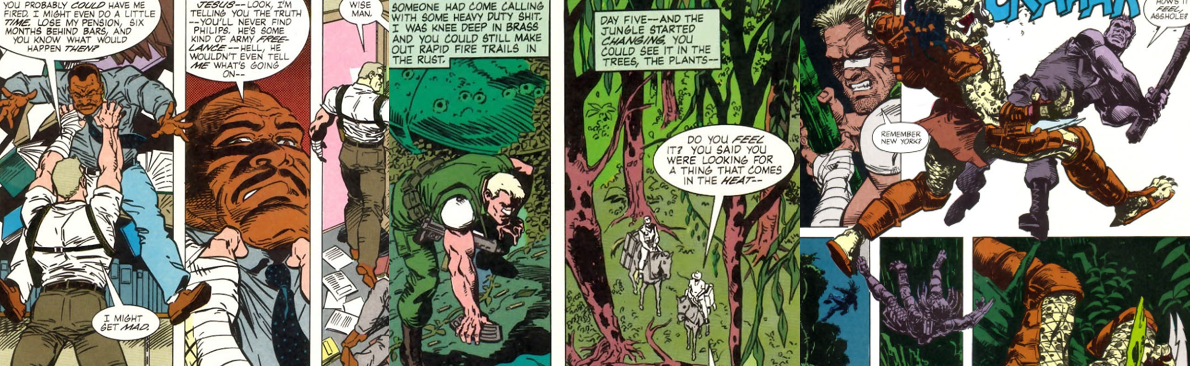
Back Issues [HulkaMAYnia]: The Savage She-Hulk #1


Since his explosive debut in May 1962, Stan Lee and Jack Kirby’s gamma-irradiated Jade Giant has been one of their most recognisable and successful characters thanks, in large part, to the Incredible Hulk television show (1977 to 1982) catapulting the Hulk into a mainstream, pop culture icon. The Hulk has been no slouch in the comics either, being a founding member of the Avengers and undergoing numerous changes that have made him one of their most versatile and enduring characters, so what better way to celebrate all things Big Green than by dedicating every Sunday in May to the Green Goliath?


Story Title: “The She-Hulk Lives”
Published: 13 November 1979 (cover-dated February 1980)
Writer: Stan Lee
Artists: John Buscema and Chic Stone

The Background:
The Incredible Hulk (and his human alter ego, Doctor Robert Bruce Banner), was another creation of Marvel legends Stan Lee and Jack Kirby. Inspired by a story of a hysterical mother exhibiting superhuman strength to rescue her trapped child, as well as classic movie monsters Frankenstein’s Monster and Doctor Jekyll and Mister Hyde, Lee and Kirby’s allegory to the foils of war initially debuted as a stone-grey figure who emerged at the onset of night. Although The Incredible Hulk was cancelled only a year and a half in, the character returned to a position of prominence thanks to subsequent expansions of his lore and character and the popularity of the Incredible Hulk television show. The eighty episode series not only established the Green Goliath as a mainstream icon but also directly led to the creation of his female counterpart; fearing that Incredible Hulk producer Kenneth Johnson would create a female spin-off as he had with The Bionic Woman (1976 to 1978), Marvel had Lee dream up a She-Hulk first so that they would own the rights, and the character would be the last one Lee created for Marvel until the early nineties. Written as the alter ego of Banner’s cousin, Jennifer Walters, She-Hulk was intentionally cast as a lawyer to promote equality and her original self-titled run lasted 1982, after which she made guest appearances, joined the Avengers and the Fantastic Four, and became known for both breaking the fourth wall and being a strong feminist icon for Marvel. Although a live-action film never came to pass in the early nineties, She-Hulk shared the spotlight with her cousin in the Incredible Hulk cartoon from the mid-nineties and made her live-action debut in the Marvel Cinematic Universe at the tail-end of 2022.

The Review:
Our story begins with a dialogue box amusingly lamp shading Stan Lee’s tendency to get Banner’s first name wrong and finding the fugitive arriving in Los Angeles, California. After being on the run, hounded by the police and the military, ever since his first transformation into the Hulk, Banner has finally reached his limit and is in need of help, so he seeks out his kid cousin, Jennifer Walters, for some solace. I’m not entirely sure where his long-time friend, confidante, and on-and-off sidekick Rick Jones is or if the comics have ever mentioned Jennifer prior to this, but apparently they were extremely close as children, almost like brother and sister. Jennifer works as a successful criminal lawyer and affectionately refers to Banner as “Doc”, but also has absolutely no knowledge of his dual identity so you know what that means! Over the course of six panels and one page, Banner recounts the specifics of his origin and his curse to transform into a rampaging, near-mindless beast whenever angry or panicked thanks to a massive dose of Gamma radiation, and, despite her shock at this knowledge, Jennifer immediately insists that he come back to her home so that she can shelter and help him. Although he’s reluctant because of the inherent danger, she waves his concerns off since her profession means she’s used to living with danger; for example, she’s currently defending a low-level hoodlum named Monkton who’s been accused of murdering mobster Nick Trask’s bodyguard, which she believes is a frame-up.
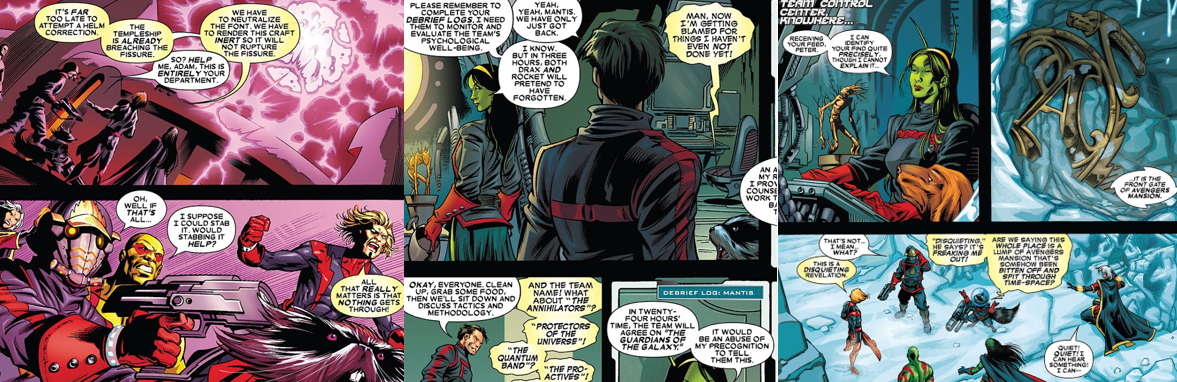
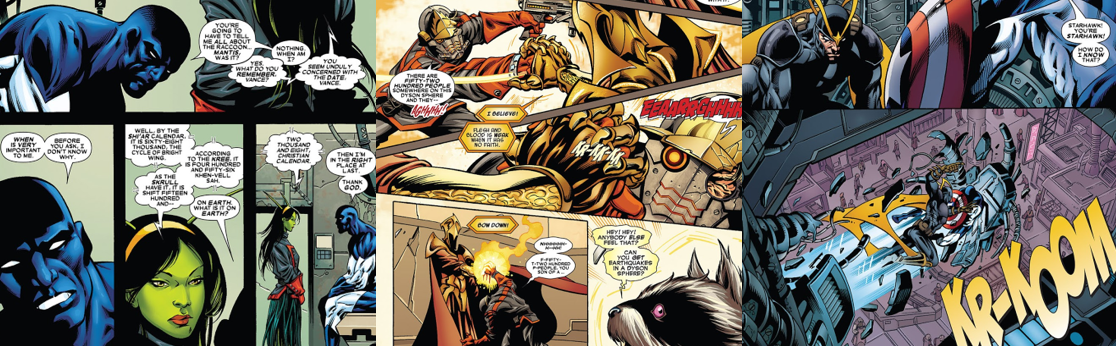
Banner’s forced to give Jennifer a blood transfusion, transforming her into the Savage She-Hulk!

While she’s confident of her ability and safety, Banner isn’t so sure, and his concerns immediately turn out to be correct as Trask’s hitmen follow them back to her house and put a bullet in her back. Banner’s able to keep calm long enough to fend the gunmen off with a simple garden house and they hit the road to avoid attracting any unwanted attention, leaving Banner to struggle with his rising emotions and to find some way of helping the injured Jennifer. With no time to wait for an ambulance, he carries her over to (and breaks into) a convenient nearby doctor’s surgery and does the only thing he can think of: a blood transfusion with his blood (which, also conveniently, is the exact same as Jennifer’s) which stabilises her long enough for him to call for an ambulance and the police. For some reason, the cops immediately peg Banner as a suspect, especially when he doesn’t have an identification or credit cards, and the stress finally reaches boiling point, causing him to Hulk-out and escape custody (though we only get the briefest glimpse of the Hulk). The next day, Banner is relieved to learn from the local tabloid that Jennifer is doing well and reluctantly makes plans to leave town to avoid his true identity being discovered. However, while recovering in the hospital, Jennifer feels a strange tingling sensation throughout her body but this, and her concerns over Banner’s welfare, are quickly set aside when Trask’s hitmen come in posing as doctors and looking to finish the job they started. As they pin her down and attempt to chloroform her, Jennifer suddenly undergoes her own startling transformation, tossing her attackers aside and looming over them as a huge, muscular, savage green-skinned beauty they dub “She-Hulk”.

She-Hulk’s abilities are more than enough to force a confession and empower her to right wrongs.

Unlike her brutish cousin, Jennifer retains her intelligence and personality when transformed, but the surge of power afforded to her (especially after feeling so helpless mere moments before), causes her to lash out and revel in her newfound abilities. She easily tosses a hospital bed at one of her would-be murderers (probably killing him…) and chases down the others, ripping open elevator doors and hauling the elevator cart up when they try to escape! Though terrified by their pursuer, the hitmen are able to elude her, and she inspires only further fear in the hospital staff and orderlies due to her savage appearance and ceaseless pursuit of her targets. “Throbbing with power” and revelling in her superhuman strength, She-Hulk’s rational mind is somewhat clouded by her absolute rage and, as they try to race away in their car, she easily cripples their vehicle with a well-timed throw of a nearby road sign. She then manhandles one of them until he confesses that Trask hired them to kill her and admitting that it was Trask himself who killed Monkton. This is apparently enough for the nearby cops to arrest the gunmen, and they ultimately let She-Hulk go since “there’s no law against green skin” (and, apparently, destruction of city property, causing an affray, grievous bodily harm, and harassment are all hunky-dory). As She-Hulk flees, her anger fades alongside her incredible strength with it. She successfully makes it back to her hospital room without being seen, returning to her normal, human state just in time, and consoles herself with the knowledge that her newfound monstrous alter ego will be able to handle any threat that comes her way in the future.

The Summary: 
I was expecting a little more from “The She-Hulk Lives”, if I’m being honest. Her bombastic debut issue really could’ve done with being a double-length feature so we would could learn a little bit more about Jennifer and Banner’s past and relationship beyond a couple of panels, and the story almost reads like it could’ve been condensed down a little and been included as a back-up feature in the regular Hulk book. Thankfully, the artwork, writing, and dialogue are much better than what we normally saw in the sixties; unlike many female characters, Jennifer isn’t written as some air-headed bimbo and is actually a pretty capable woman in her own right. She clearly went to law school, or a similar educational institute, and is successful enough to have her own office and to be working on a big case. She’s also incredibly compassionate and loyal to her cousin; she doesn’t judge him for his affliction and offers to help him without hesitation, viewing him as a brother and sure that the two of them can work something out. Finally, she’s pretty self-confident; although he’s usually overly paranoid, Banner immediately recognises that her case against Trask is considerably dangerous but she’s so sure of herself that she doesn’t even consider there being any reprisals against her. Naturally, this ends up biting her in the ass and she nearly dies from a gunshot wound and this (and her subsequent spell in hospital) is the only time Jennifer is portrayed as being weak and in need of help from others.

Although I’d to see more of Jennifer and Banner/Hulk, She-Hulk made a decent impression.

Banner is so panicked at the thought of losing her that he gives her his blood without thinking and, for all his science-smarts, without even considering the effect his Gamma-irradiated blood might have on her. Due to the risk of being exposed and causing unnecessary destruction, he doesn’t even check in on her afterwards and quietly leaves the story without us even properly seeing the Hulk, which is actually to allow the She-Hulk to take centre stage. It’s not explored in this story but it can be assumed that the transfusion was far less potent than Banner’s own Gamma exposure, accounting for She-Hulk’s retained personality and intelligence and less impressive strength, but she’s still a force to be reckoned with in her green state and overcome with anger due to her previous helplessness and the evil of Trask’s men (and, it can be inferred, all such men who seek to undermine and hurt women). I do feel, though, that the story might’ve benefitted from a confrontation between She-Hulk and the Hulk; maybe she could’ve battled him to a standstill and helped calm him down through their shared condition and showing him some compassion. I have no doubt that this probably did happen in a subsequent issue or encounter between the two, but it does mean that She-Hulk’s debut falls a little flat even compared to her cousin’s first appearance since she only exerts herself against a few regular hoodlums. While this opens itself up into a feminist reading about a woman exerting power and dominance over an oppressive patriarchy, I feel that’s more inferred than explicitly showcased in her debut issue and wouldn’t come to the forefront until she was a bit more established.

My Rating:

Rating: 2 out of 5.

Could Be Better

How did you find She-Hulk’s debut story? Did you read it when it was first published and, if so, did She-Hulk leave much of an impression on you or were you expecting something more? What did you think to the concept of a female Hulk and the idea that she is far more stable when transformed? Would you have liked to see her throw down with the Hulk here or were you happy with her rallying against common mobsters? What is your favourite She-Hulk story or moment and how are you celebrating the Hulk’s debut this month? Whatever your thoughts on She-Hulk, go ahead and share them below or leave a comment on my social media and be sure to check out my other Hulk content!

Back Issues: Marvel Premiere Featuring the Power of… Warlock #1

Story Title: “And Men Shall Call Him… Warlock!”
Published:
April 1972
Writer: Roy Thomas
Artist: Gil Kane

The Background:
It’s generally accepted that Marvel Comics head honcho Martin Goodman tasked then-editor Stan Lee with creating a superhero team in response to DC Comics’ Justice League of America. Lee used this opportunity to create stories and characters that appealed to him and drafted a synopsis of the dysfunctional Fantastic Four for the legendary Jack Kirby to work on, creating the “Marvel Method” of writer/artist collaboration in the process. Although Kirby disputed this story, the duo are credited as co-creators of Marvel’s First Family, whose comic books went on to introduce characters and concepts that would become integral to Marvel Comics. One such character was the mysterious cosmic entity initially known only as “Him”; also created by Lee and Kirby, He first appeared in Fantastic Four #66 and 67 as an artificial being created by a malevolent group known as the Enclave, who were bent on world domination. After rebelling against his creators and being rechristening “Adam Warlock” by Herbert Wyndham/The High Evolutionary, an arrogant supervillain scientist known for creating bizarre animal/human hybrids, Warlock was imbued with the power of the Soul Gem and headed out into the universe to find his true self. Though a relatively unknown Marvel creation, Adam Warlock was at the forefront of one of the publisher’s biggest stories, The Infinity Gauntlet (Starlin, et al, 1991), fought against his own dark half given physical form, and was often positioned as an allegorical Messiah against the backdrop of cosmic discord. Adam Warlock has featured in minor roles outside of the comics, appearing as a supporting character in Marvel videogames and cartoons, and was name-dropped at the end of Guardians of the Galaxy Vol. 2 (Gunn, 2017) as a future threat for the titular Guardians before making his live-action debut in Guardians of the Galaxy Vol. 3 (Gunn, 2023), portrayed by Will Poulter.

The Review:
Since Marvel Premiere #1, in true Marvel fashion, features a lengthy recap of Adam Warlock’s origin, I didn’t think it was necessary to do an in-depth review of His first true appearance in Marvel Comics but, for those who are curious, He came about after Ben Grimm/The Thing’s blind girlfriend, Alicia Masters, was abducted by the Enclave and taken to their unreasonably complicated, beehive-like lair. There, she learned that the Enclave’s highly advanced scientists desired to create a perfect race of human beings, with “Him” being the first; however, He proved so unstable and powerful that they were forced to contain Him and unable to look upon Him due to his blinding light. They wanted Alicia to sculpt a likeness of Him and she braved His destructive power to reach and appeal to Him, completely unaware that the Enclave wished to use His power to conquer the Earth. Initially encased within a rock-like cocoon, He burst free and enacted a brutal revenge upon his creators, sparing Alicia but exhibiting a cold disinterest in the destruction of the beehive laboratory that birthed Him as He fled to the stars until the world was ready for His power.

Prior to creating his own world, the High Evolutionary finds and forms a bond with Him out in space.

“And Men Shall Call Him… Warlock!” opens in the vastness of space to find the High Evolutionary’s massive asteroid space station drifting through our galaxy; aboard, the High Evolutionary himself muses on the long and difficult journey he has taken in the quest to produce his half-human, half-animal “New-Men”. His highly advanced technology saw him transform an ordinary wolf into a man-sized beast that was savage enough to battle Thor Odinson in combat; the failure of this project exposed the High Evolutionary to the threat his creations pose to his former homeworld, so he transported the Man-Beast and a contingent of “evil” New-Men to a faraway world, where they only further regressed, forcing him to turn to Doctor Bruce Banner/The Hulk to quell their aggression. In the fracas, the High Evolutionary was mortally wounded, forcing him to abandon his armour and subject himself to an experimental process that saw him ascend to the pinnacle of human evolution. Immortal and God-like, he merged with the greater cosmos but was driven to the brink of madness from isolation, thus returning to his armour to fulfil some mysterious purpose. His ruminations are interrupted by Sir Raam, the most loyal of his Knights of Wundagore, who alerts him of His mysterious cocoon floating in space; curious, the High Evolutionary has it brought onboard his planetoid so he can investigate further. Unfettered by His visage, the High Evolutionary is instead captivated by His unblemished perfection and urges the divine man to share his story. After fleeing Earth, He also came into conflict with Thor before retreating to the stars to await the day when He could exist in a universe free from hatred and oppression. Impressed, the High Evolutionary agrees to expediate His journey through the stars but He is intrigued by the immortal’s “Project Alpha”, an ambitious plan to create a mirror version of Earth whose evolution he can directly influence.

With his world tainted, the High Evolutionary reluctantly agrees to send Him to tack down the Man-Beast.

The two agree that humanity is too volatile and too quick to descend into misery and bloodshed, so the High Evolutionary creates a Counter-Earth as a haven for his own creations. Although the process places an intense strain on the High Evolutionary, he pushes through his discomfort to bombard a rock sample with “rays” and accelerate the formation of this new world, one safely hidden from ours by being placed on the opposite side of the Sun and, within the space of a few panels, has created a prehistoric world whose development he’s able to speed up beyond the limits of creation, evolution, and even the divine. This Counter-Earth is thus ripe for the coming of the High Evolutionary’s superior race of men, one purged of their killer instinct, but the effort of creating it is so intense that it causes the High Evolutionary to pass out from exhaustion. This is the moment that the Man-Beast and his followers, who had been observing their creator, choose to strike, gunning down Sir Raam and perverting this new world, introducing violence and aggression and causing the Counter-Earth to descend into generations of war at the simple twist of a dial. The High Evolutionary recovers and surprises the Man-Beast with his newfound superior physical strength; however, a ”bestial mind-blast” and the sheer numbers and savagery of his rebellious creations threaten to overwhelm the would-be deity and, seeing this, He decides to break free from his cocoon to intervene. Emerging garbed in a “resplendent […] armour and ornaments” created by his cocoon, He causes the beasts to flee in terror to the Counter-Earth. Dismayed by the Man-Beast’s actions, the High Evolutionary sees no other choice but to destroy his new world but He beseeches him to spare the world. Retracting his condemnation of humanity and wishing to nurture their better nature, He requests to be sent to the Counter-Earth to track down the Man-Beast. Touched by His words, the High Evolutionary reluctantly agrees; he gifts Him with a mysterious jewel to protect Him from the Man-Beast’s snares and transports Him to the surface of the fledgling world with a heavy heart and bestowing upon Him that which He has never had: a name, “Warlock”.

The Summary:
Previously, I only really knew Adam Warlock from The Infinity Gauntlet; I’ve literally never read another story with Him in in all my years of reading comics, so He’s always been a very elusive and mysterious figure for me. It’s actually refreshing that He’s not been wheeled out every time there’s a big cosmic event as it makes Him more alluring and significant, at least to me, so I was intrigued to see some of His background in this story. There was clearly a conscious effort to build a sense of mystery and divine beauty to this character, who is touted over and over as the pinnacle of human scientific acumen and seen as the next step in our evolution, a golden creation so astounding that to look upon Him is to suffer greatly. Yet, He is a deeply sensitive man-god; capable of sensing the intentions of men and fully capable of judging them accordingly, He has no interest in mindless combat and wishes only to isolate Himself until the time is right for Him to walk amongst men. Despite having battled the likes of Thor, He hasn’t ever encountered anyone worthy of his presence until He’s discovered by the High Evolutionary, a mind with whom He can relate to so strongly that He openly shares His assessment of our tumultuous species and His chaotic origins.

Him and the High Evolutionary share many of the same views about our volatile society.

I’m equally unfamiliar with the High Evolutionary, a highly advanced individual who I’ve always seen as a combination of Doctor Victor Von Doom/Doctor Doom and Dr. Moreau from H. G. Wells’ titular 1896 science-fiction story. The parallels are pretty explicit, given both characters like to create monstrous human/animal hybrids but the High Evolutionary isn’t just some sadistic mad scientist. Disillusioned with humanity and our warring wars, he seeks to “improve” upon our aggressive nature and faults not by destroying humankind but by creating his own world and actively directing the course of the counter-humanity’s evolution. However, comic books generally cast anyone who seeks to create life through scientific or magical means, effectively defying the natural order, as a villainous character and, to be sure, the High Evolutionary’s methods are highly questionable, yet he expresses genuine regret over the savagery of the Man-Beast. His plot isn’t to create a race of superpowered or animalistic abominations to dominate the world, or to wage war against the Earth from his asteroid laboratory; he simply wishes to create a utopia on the other side of the Sun to manipulate humanity to be the very best of themselves. In Him, the High Evolutionary sees his dreams take physical form; just seeing His visage is enough to captivate the High Evolutionary, who refers to Him as the son he never had on more than once occasion.

Having championed humanity’s potential for good, He gains a name and a purpose for the first time.

The two share a unique bond, agreeing that humankind is far too quick to resort to warfare than strive towards peace and prosperity, and both are impressed by each other’s abilities. However, He recognises humanity’s inherent potential for “goodness” and, thanks to his divine nature, is perhaps the only one capable of staying the High Evolutionary’s hand when he prepares to destroy the Counter-Earth he created with such ease. The High Evolutionary expresses regret in His decision to be a champion on Counter-Earth but respects Him enough to allow Him the chance to try; he doesn’t rate His chances for success but prepares Him as best as he is able, even bestowing Him with His first true name. Thus, the stage is set for the newly-christened Warlock to be not a destroyer or an impassive observer but an active participant in the formation of this Counter-Earth’s development. Those who read comics looking for some cosmic action and to see what Warlock is truly capable of may be left disappointed; as is often the case, much of the story is taken up with recaps of each character’s backgrounds but, at its core, it’s a rumination on the nature of humanity and the conflict these powerful, God-like beings feel in regards to our volatile ways. Warlock and the High Evolutionary share some engaging and introspective exchanges, there’s an interesting dialogue on offer here concerning their morally grey and ambiguous natures, and I think the story does a decent job of leaving you wanting to know where Warlock’s story goes from here on out and how he goes from desiring to inspire Counter-Earth’s residents to almost literally playing cosmic chess with Marvel’s greatest heroes and characters in The Infinity Gauntlet.

My Rating:

Rating: 3 out of 5.

Pretty Good

What did you think to the return and naming on the God-like “Him”? Were you intrigued by Adam Warlock’s presence and eager to know more about Him or did you find Him a rather bland character? What do you think to the High Evolutionary, his opinions on humanity, and his plan to create his own Earth? Did you read Adam Warlock’s subsequent stories and, if so, what are some of your favourite moments of His? What did you think to this MCU debut? Whatever you think about Adam Warlock and Marvel’s cosmic shenanigans, please share your thoughts below or leave a comment on my social media.

Back Issues [HulkaMAYnia]: Tales to Astonish #90/91


Since his explosive debut in May 1962, Stan Lee and Jack Kirby’s gamma-irradiated Jade Giant has been one of their most recognisable and successful characters thanks, in large part, to the Incredible Hulk television show (1977 to 1982) catapulting the Hulk into a mainstream, pop culture icon. The Hulk has been no slouch in the comics either, being a founding member of the Avengers and undergoing numerous changes that have made him one of their most versatile and enduring characters, so what better way to celebrate all things Big Green than by dedicating every Sunday in May to the Green Goliath?


Writer: Stan Lee – Artist: Bill Everett

Story Title: “The Abomination!”
Published: 10 January 1967 (cover-dated April 1967)

Story Title: “Whosoever Harms the Hulk…!”
Published: 14 February 1967 (cover-dated May 1967)

The Background:
Created by Marvel legends Stan Lee and Jack Kirby, Doctor Robert Bruce Banner’s monstrous alter ego, the Incredible Hulk, was inspired by the story of a hysterical mother using superhuman strength to rescue her child and classic screen monsters Frankenstein’s Monster and Doctor Jekyll and Mister Hyde. Initially debuting as a stone-grey figure, the character soon gained his trademark green hue and became a fixture of Marvel Comics thanks to expansions of his lore and character and the popularity of the live-action television series. Stan Lee also had a hand in creating some of the Hulk’s most memorable enemies; having birthed the Hulk’s intellectual superior, Samuel Sterns/The Leader, alongside Steve Ditko about three years prior, Lee and artist Gil Kane introduced Marvel readers to one of the Hulk’s most persistent physical rivals, Emil Blonsky/The Abomination, in this two-part tale. Lee came up with monster’s unique name and reportedly instructed Kane to make the Abomination bigger and stronger than the Hulk to make for some fun conflicts. Over the years, the Abomination has been through almost as many changes as his lifelong rival, being a savage brute, a schemer, and a figure of redemption. His impact on the Hulk’s life has been so influential that he’s featured in numerous Marvel cartoons; although he made his live-action debut in the unfairly overlooked The Incredible Hulk (Leterrier, 2008), it would be some thirteen years before he would return to the Marvel Cinematic Universe.

The Review:
Our story begins with the Green Goliath embarking on an unstoppable rampage thanks to the manipulations of a cosmic being I’m personally unfamiliar with but who calls himself “The Stranger”; believing that humanity is a blight that needs to be eradicated, the Stranger has set the Hulk to work wiping the planet clean of humankind’s influence, and the Hulk is only too happy to give in to his anger. Already harbouring a resentment and animosity towards the “puny humans” who hate and fear him, the Hulk wrecks a suspension bridge and prepares to lay waste to a missile base when he’s suddenly hit with an intense pain in his head that not only causes him to fall, but also triggers his transformation back into cursed Gamma scientist Bruce Banner. This has the knock-on effect of severing the Stranger’s mind control, but Banner is terrified at the prospect of the Hulk resurfacing and continuing the Stranger’s work and resolve to destroy the Hulk (and himself, if necessary) once and for all using the “Gamma Ray Machine” he created and which just so happens to be at the very base he’s found himself at.

While Banner broods and Ross blusters, a foreign agent undergoes an incredible transformation!

Nearby, the cantankerous General Thaddeus “Thunderbolt” Ross is determined to root out the man behind a recent assassination attempt on his daughter (and Banner’s flame), Betty Ross; also Major Glen Talbot assures Ross that it’s just a matter of time before the foreign agent is discovered, Ross explodes in anger and demands that they find the perpetrator before they can endanger the missile, giving his men orders to shoot to kill if necessary. Betty is distraught that there’s been no word from Banner for some days and fears for his life as long as he shares a body with the Hulk; she’s so devastated at the idea of losing him that she pays no mind to Talbot’s attempts to insert himself in Banner’s place. Meanwhile, in Banner’s lab, Ross’s spy (whom we know as Emil Blonsky but who isn’t named in this story), is snooping around in the guise of a soldier and trying to snap pictures of Banner’s vaulted Gamma Ray Machine. Although Banner returns at that very same moment, intending to use the machine on himself, he’s spotted and arrested by military police and the smug Talbot, who refuses to listen to his pleas. Amused by the turn of events, Blonsky comes out of hiding and investigates the machine, activating it out of sheer curiosity and bathing himself in an intense dose of Gamma radiation. The result is his instantaneous transformation into a hulking, green-skinned, lizard-like monstrosity; thanks to stepping out of the Gamma rays early, this Abomination is able to retain his intellect and revels in his newfound super strength, which he believes will make him “master of the world–of the whole universe!!” and promptly destroys the machine so that none will challenge his invincibility.

The Hulk is overwhelmed by the superior strength and intellect of his newest foe.

The Abomination’s subsequent rampage through the base catches the eye of the imprisoned Banner, who willingly transforms into the Hulk as only his alter ego has a chance of opposing this new Gamma monster. Ripping open his cell, the Hulk leaps into the fray but quickly finds that the Abomination is not only smarter thanks to not being a mindless brute, but also more powerful as he was conveniently subjected to a more powerful dose of Gamma radiation. Consequently, Ross, Talbot, and Betty can only watch on in horror as the Abomination asserts his dominance and brutally beats the Hulk into unconsciousness, clearly establishing himself as a formidable threat, and that Blonsky is oddly concerned that he wouldn’t survive the military’s counterattack so he kidnaps Betty and flees from the base. Driven to desperation by the events he’s witnessed, Ross has no choice but to order his physicians to try and save the Hulk’s life; while the surgeon is initially baffled by the half-dead creature’s physiology, perennial sidekick Rick Jones bursts into the facility to suggest using Gamma electrodes to revive the beast and, in panels that owe more than a debt to Frankenstein (Whale, 1931), the Hulk lives again! Believing the soldiers are trying to contain him, the Hulk refuses to listen to reason and even swats Rick aside, vehemently denying his tearful pleas for help, until the mention of Betty’s name causes him to calm down and revert back to Bruce Banner.

Although Banner devises a workable plan, the monster’s rematch is abruptly interrupted.

Cutting through Ross’s bluster and inconsolable babble and prejudice, Banner comes up with a plan to lure the Abomination back to them, rather than confront his great power directly, and reconfigure his “Infinite Weapon” to nullify Blonsky’s strength with “Infra-Gamma Beams”. Begrudgingly, Ross orders his technicians and soldiers to follow Banner’s every command as they race to perform the necessary adjustments, and the Abomination willingly returns to the site, drawn by the allure of the Gamma radiation, though everyone, even Rick, is unsure as to how Banner plans to oppose such a fearsome monstrosity. The Abomination bursts into the laboratory, setting down Betty and preparing to finish off Banner, but is surprised when the machine causes him incredible pain and saps his mighty strength. It’s at this key moment that Banner uncontrollable turns into the Hulk and the two Gamma Giants set about having a rematch. Although they bash each other through walls and promise to really go at each other, the Stranger chooses this moment to return to the story; watching from “a thousand galaxies away”, he begins to consider that humanity might not be beyond all hope if a brute such as the Hulk can be so valorous and chooses to take the Abomination for his own needs. He also completely removes the influence he had over the Hulk’s mind but, while he’s met with congratulations and a semblance of gratitude from even General Ross, the Hulk chooses to head back out into the world alone once more.

The Summary:
The Abomination’s debut is much more the type of Hulk story I’m used to; by this point, Bruce Banner’s dual identity is well known and his adventures follow a very simple formula of him wandering around the country, desperately trying to avoid conflict, all while the Hulk threatens anyone and everyone around him and lashes out at those he deems to be a threat. Unfortunately, I didn’t think much to Gil Kane’s artwork, especially on the Abomination and the Hulk’s face, both of which look to little too simplistic and goofy for my tastes. I did enjoy the twist of the normally unreasonably antagonistic General Ross absolutely snapping when the Abomination kidnaps Betty; he’s so traumatised by this that he’s forced to not only rely on the Hulk and Banner for help, but even revive the Green Goliath and order his men to follow Banner’s every instruction. It’s an interesting twist on his usually staunchly anti-Hulk/Banner mindset, kind of like whenever J. Jonah Jameson is forced to eat crow, though I was interested to see that Major Talbot was actually arguing in favour of Ross’s hated enemy on more than one occasion. Similarly, I liked that Banner got to do a little more than just wallow in despair and self-pity; he puts his genius mind to work creating a trap to lure in the Abomination and sap his strength, though it was a little too contrived that all of Banner’s machinery and work just happened to be at this military base. The Hulk is pretty much exactly as he’s always presented, with the added wrinkle that he’s suffering from the influence of the Stranger; this doesn’t really seem to change his character all that much, however, as it’s hardly an uncommon occurrence to see the Hulk going on an all-out rampage for the smallest of reasons.

The Abomination’s strength is so great that it takes brains, not brawn, to challenge him.

This is potentially the first time that the Hulk has ever faced a foe as physically imposing as him, however; he fought Groot (no, not that one) a few years earlier but as far as I can tell most of his more monstrous foes made their first appearances after this story. Consequently, the Abomination makes quite the impact; not only does he retain his intelligence, allowing him to out-think the Hulk, but he’s portrayed as being significantly more powerful, knocking the Hulk out and beating him almost to the point of death in their first encounter. However, the praise kind of stops there; the explanations behind Blonsky’s retained intelligence and greater strength and paper thin and it’s really weird that he would choose to flee after besting the Hulk as he would surely have even less reason to fear the military’s weapons than the Green Goliath. The Abomination’s greater intelligence also doesn’t really translate into any kind of impressive strategy either; immediately drunk on his newfound power, Blonsky sets his goals as lofty as conquering the entire universe, than smashes the place up a bit, and then resorts to kidnapping Betty. He doesn’t even use her as a means to give the Hulk pause to attack and abandons her the moment he arrives back at the base, but worst of all is the fact that this Stranger’s intervention cuts short his rematch with the Hulk simply to keep the Abomination’s threat unchallenged. Overall, this wasn’t a bad two-part story but it definitely wasted its potential; there was so much that could’ve been done with the duality of these monsters, the twist of Ross having to rely on his enemy, and seeing the Hulk and the Abomination tera up the base of the countryside but the story instead plays it very safe and simply hands the Hulk a decisive loss and has his newest (and presumable most powerful) villain left out in the world (well, cosmos) to no doubt hound him again at some point.

My Rating:

Rating: 3 out of 5.

Pretty Good

Did you enjoy the Abomination’s debut? Did you read it when it was first published and, if so, how did you think the Abomination compared to other Hulk villains? What did you think to the idea that the Abomination was not only smarter but stronger than the Hulk? Would you have liked to see a proper rematch between the two in the second part? What are some of your favourite fights or moments between the Hulk and the Abomination? Who is your favourite Hulk villain? Whatever you thoughts on the Abomination (and the Hulk), feel free to share them below or leave a comment on my social media and be sure to check in again next Sunday for more Hulk action!