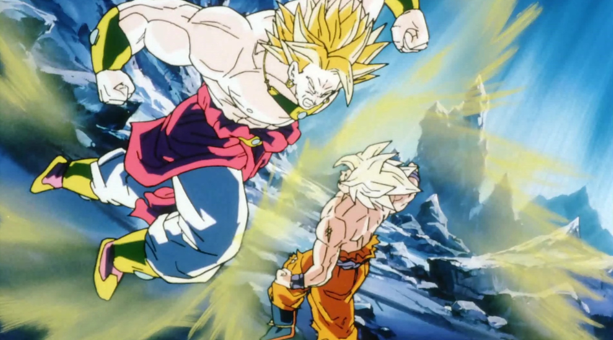
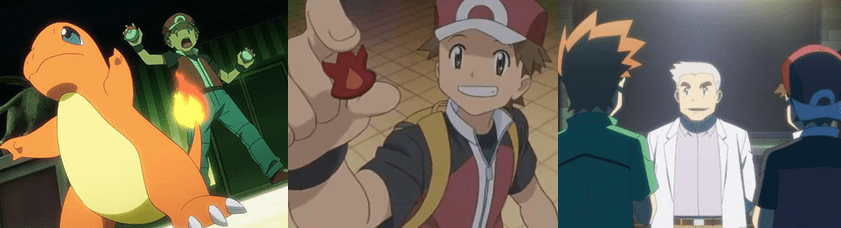
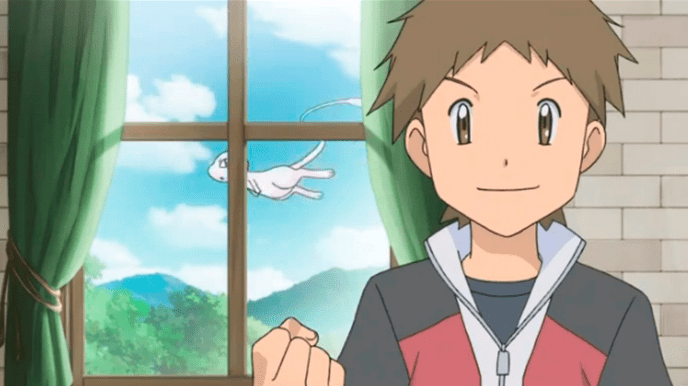
Movie Night [Dragon Ball Month]: Dragonball Z: Bio-Broly


DragonBallDay

When the Great Demon King Piccolo was released upon the world, he broadcasted a message on television declaring May 9th as “Piccolo Day”…and promptly celebrated by announcing his ownership over the planet. Since then, May 9th has been officially recognised as “Goku Day” but, to make things simpler, I’ve been using this as a good excuse to celebrate all things Dragon Ball and to take a look back at one of the franchise’s most popular villains: Broly.


DBZBroly3Logo

Released: July 1994
Director: Yoshihiro Ueda
Distributor: Toei Company
Budget: Unable to verify
Stars: Kara Edwards, Laura Bailey, Vic Mignogna, Meredith McCoy, C.T. Anger, Bill Townsley, Chris Rager, Sonny Strait, and Robert McCollum

The Plot:
When the World’s Martial Arts Champion, Mr. Satan (Rager), is challenged by his old rival, Mr. Jaguar (Townsley), Goten (Edwards), Trunks (Baily), and Android #18 (McCoy) accompany him to an island laboratory to take part in a special tournament only to find that Jaguar’s bizarre cloning technology has resurrected the Legendary Super Saiyan, Broly (Mignogna), now mutated into a grotesque abomination.

The Background:
Dragonball Z, the anime that defined a generation of kids, was the sequel series to Akira Toriyama’s Dragon Ball, a manga and anime that followed the adventures of Son Goku, a young boy with incredible martial arts prowess who grew up to become the kind-hearted (if goofy) saviour of the world. With the anime proving to be even more successful than its original series, a number of feature-length animated movies were produced without the direct involvement of Toriyama. Though they are largely non-canon to the wider Dragon Ball story arc, they did introduce us to Broly, a near-unstoppable and mindless antagonist who appeared to be the “Legendary Super Saiyan” incarnate. So popular was Broly upon his debut that he became only the second movie villain to star in more than one film and quickly became a popular character in Dragon Ball fighting games and merchandise. This, and the ¥2.33 billion brought in by his debut feature, Broly – The Legendary Super Saiyan (Yamauchi, 1993), no doubt contributed to Broly featuring in not one but two movies in 1994 to complete a loose trilogy of sorts.

The Review:
Bio-Broly gets off to a bad start for me, personally, right from the get-go. Because of where it takes place within the Dragon Ball timeline, Goku (Sean Schemmel) is back in the afterlife after returning to Earth for one day for the World’s Martial Arts Tournament and, given the absence of many of the series’ most popular and powerful characters, this movie is awkwardly placed in the early going of the “Majin Buu Saga”. This, unfortunately for me, means that the film’s primary focus is on Goku’s youngest son, Goten, and Trunks, the son of Goku’s arch-rival and fellow Saiyan, Vegeta (Christopher R. Sabat). This wouldn’t be a problem were it not for the fact that I find both of these characters incredibly annoying; they’re all the worst parts of Saiyans (overconfidence to the point of arrogance, insatiable hunger, and being bored to the point of distraction when they’re not fighting) dialled up to the nth degree thanks to their childishness and immaturity. They’ve never made for compelling characters for me, personally; Trunks was only interesting when he was a time-travelling prodigy and Goten never even managed to grow up to match the disappointment his brother, Gohan (Kyle Hebert) turned out to be. The only time I really enjoy the characters is when they’re fused or being beaten to a pulp as it’s the only time I find them credible or tolerable, respectively.
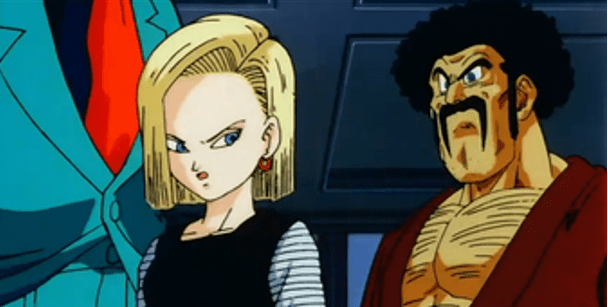
Mr. Satan plays a central role in the movie’s plot.

The same can also be said for my thoughts about Mr. Satan (or “Hercule”), though I do find him to, at least, be a far more enjoyable and hilariously ridiculous character when he’s used sparingly and smartly. Luckily, that is largely the case here and we get to see a little bit more of Mr. Satan’s past and backstory but I find the movie’s focus on Dragonball Z’s more ridiculous characters to be its downfall and it only serves to further devalue Broly’s mystique and aura. This means that it’s largely up to Android #18 to carry the film’s fight scenes; a cold, focused character, #18 is only interested in receiving the money she is owed by Mr. Satan. In the absence of Vegeta or Piccolo (Sabat), she’s easily the film’s most credible fighter, fulfilling the same stoic, grouchy characterisation those two typically have and she’s perfectly cast as the reluctant muscle of the film.
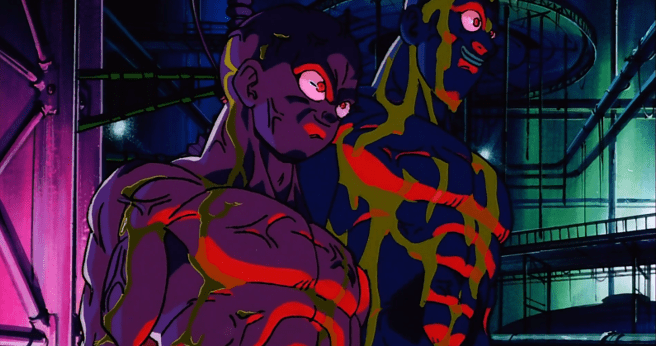
Jaguar’s Bio Warriors are little more than generic goons for the heroes to pummel.

Sadly, though, the film’s fight scenes leave a lot to be desired; for the most part, our heroes are battling Jaguar’s generic-looking “Bio Warriors”. Jaguar himself is a largely ineffective and bumbling fool; the entirety of his threat is based around his cloning technology and his ability to create monstrous fighters, the majority of which are largely unimpressive to look at. Unfortunately, far too much of the movie’s runtime is devoted to fight scenes involving these Bio Warriors; the opening already hints at Jaguar having a Saiyan ready to go and we know Broly is in the film but he doesn’t actually show up until a good way into the movie, meaning the bulk of the film’s focus is on a bunch of unimposing freaks that are easily dispatched by #18, Trunks, and Goten.
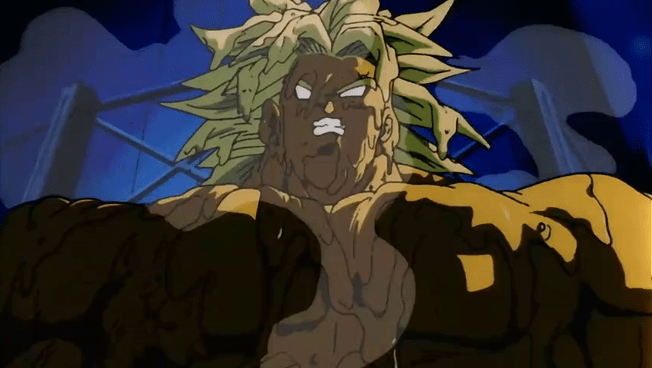
Broly is quickly, disappointingly, transformed into a mindless goo creature.

As it is part of a loose trilogy of films revolving around Broly, Bio-Broly sees the return of a small character from the last movie, Maloja (McCollum); rather than developing into a fully-fledged character or playing a pivotal role, however, Maloja simply exists to explain how Jaguar was able to recreate Broly. In some ways, the film’s plot would have made more sense to me if Maloja had replaced Jaguar entirely as the film’s primary human antagonist; after all, he has an axe to grind against Goten and Trunks after the last movie and it would have been a far better pay off than randomly bringing in a guy who even more pathetic and foolish than Mr. Satan. Once Broly is discovered by Goten and Trunks, the film steps up a notch for the briefest of moments; still just as obsessed with killing Goku and overcome by his limitless power, Broly is just as sadistic and terrifying as ever…for about five minutes. Rather than going on a destructive rampage as the Legendary Super Saiyan, Broly is almost immediately engulfed by a mutagenic liquid and becomes little more than a mindless slop monster, severely diminishing his threat.

The Nitty-Gritty:
Bio-Broly suffers quite a bit by focusing on slapstick and nonsense for the majority of its runtime; the film’s central plot revolves almost entirely around Mr. Satan, which is somewhat amusing when he’s either being pummeled or held up for money by #18, but quite a step back considering the different facets of established characters we saw in Broly – The Legendary Super Saiyan or the potential of a cross-generation conflict in the previous movie.
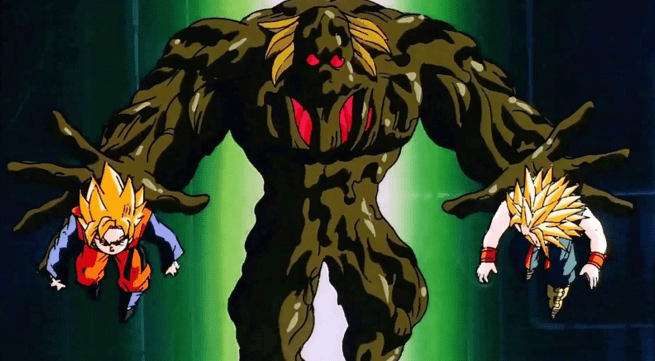
Broly is just as unstoppable as ever but looks far less unique and appealing.

Truthfully, Broly was always kind of one-dimensional in the previous movies, motivated purely by his destructive rage and hatred of Goku but, here, he’s even more of a blank slate; he literally could have been replaced with any other dull monster so ineffectual is his presence. The potential threat Broly has is given some lip service but the film does little to follow through on it other than showing Bio-Broly to be just as unstoppable as the original Broly, but nowhere near as eloquent or visually appealing, until he is unceremoniously dissolved with relative ease. I’m not really sure why these films go to such lengths to portray Broly as this creature of limitless power and largely immune to pain and physical damage only to have him destroyed with the most anti-climactic of methods; the last film set such a high standard with its triple Father-Son Kamehameha but this film’s climax is even more disappointing than Broly’s end from his debut film.
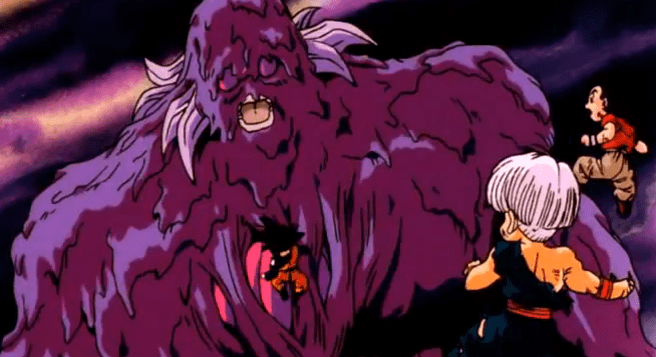
Broly’s threat is minimal, at best, and he meets his most disappointing end yet.

This time around, there’s no magic assistance from dead fathers or other Saiyans; Goten and Trunks are just as physically outmatched as ever and, thankfully, never depicted as being physically capable of matching or besting Broly’s power. Instead, they have to rely on dousing Broly in a caustic liquid that dissolves him on a cellular level; while this does initially cause Broly to transform even further into a gigantic goo creature, he simply collapses from the strain of the damage. I can’t help but feel like the film would have been a little better if Broly had retained his usual appearance for the majority of his screen time, exhibiting new or enhanced abilities (elasticity and near-instant cellular regeneration), and not assumed his monstrous, gunk-covered form until the end of the film. At least then he’d be far more imposing and interesting to look at rather than being reduced to a mindless sludge monster.
The Summary:
Dragonball Z: Bio-Broly is a pretty poor end to what was, initially, one of the more impressive movie (and Dragon Ball) villains. While always little more than an engine of destruction, Broly at least looked impressive and intimidating, dominating the most powerful characters of the series with ease and only being defeated by pure luck more than anything. Rather than focus his second appearance around a generational conflict that saw Broly go head-to-head with a more powerful and experience Gohan, his subsequent appearances have been little more than shameless attempts to cash in on his popularity. There was so much potential in repeat appearances from Broly to expand on his characterisation and threat but, in each reappearance, he was neutered further and further until he literally became nothing more than a mindless monster that was more an inconvenience than a true, life-threatening menace. It’s not just my bias against Goten, Trunks, or Mr. Satan that drags Bio-Broly down; it’s flawed on almost every level of its execution and can’t even be salvaged by the brief return of Broly let alone its few unimpressive fight scenes and, even when compared to other Dragon Ball features, it is one of the weaker entries for me.

My Rating:

Rating: 1 out of 5.

Terrible

What did you think of Dragonball Z: Bio-Broly? Were you as disappointed as I was at the way Broly was treated in this film or do you actually rate this movie quite high? Are you a fan of Goten and Trunks or do you also find them to be annoying and grating characters? Which Dragon Ball characters do you like, or dislike, the most? How do you feel about this loose trilogy of films involving Broly? No matter what you think, feel free to leave a comment below.

Movie Night [Dragon Ball Month]: Dragonball Z: Broly – Second Coming


DragonBallDay

When the Great Demon King Piccolo was released upon the world, he broadcasted a message on television declaring May 9th as “Piccolo Day”…and promptly celebrated by announcing his ownership over the planet. Since then, May 9th has been officially recognised as “Goku Day” but, to make things simpler, I’m using this as a good excuse to celebrate all things Dragon Ball and spend this month taking a look back at one of the franchise’s most popular villains: Broly.


DBZBroly2Logo

Released: March 1994
Director: Shigeyasu Yamauchi
Distributor: Toei Company
Budget: ¥14.5 million
Stars: Kyle Herbert, Vic Mignogna, Kara Edwards, Laura Bailey, Robert McCollum, Sonny Strait, and Sean Schemmel

The Plot:
Whilst searching for the seven magical Dragon Balls with Videl (Edwards), Goten (ibid) and Trunks (Bailey) accidentally awaken the Legendary Super Saiyan, Broly (Mignogna), who crash-landed to Earth after escaping the destruction of New Vegeta. With Goku (Schemmel) dead, it’s up to the Saiyan children, and Goku’s oldest son, Gohan (Herbert), to confront Broly and end his threat once and for all.

The Background:
After debuting in the pages of Weekly Shōnen Jump back in 1984, Akira Toriyama’s Dragon Ball spawned not only an anime of its own but also a sequel series, Dragonball Z, in which series protagonist Goku had grown up to become a superhuman defender of the world. After being licensed by Funimation back in 1996, Dragonball Z largely dominated the lives of a generation of kids who were exposed to its depictions of good and evil and wacky, otherworldly concepts. A series of feature-length animated films accompanied Dragonball Z; though produced without the direct involvement of Toriyama, and thus largely considered non-canon, the films did introduce us to Broly, the hulking, terrifyingly powerful Super Saiyan of legend. The character became a near-instant hit, which no doubt contributed not only to him being only the second Dragonball Z movie villain to star in more than one film but also his multiple appearances in videogames and being the only movie villain to eventually be integrated in Toriyama’s recognised canon.

The Review:
Broly – Second Coming opens to show a Saiyan pod ominously crash-landing on Earth. Its passenger is, of course, a seriously wounded Broly, who is quickly frozen and entombed in ice. Apparently, mere moments before the destruction of New Vegeta in the last movie, Broly was able to make his way to a Saiyan craft and escape; quite how his pod knew to come to Earth isn’t really explained (I assume Paragus (Dartanian Nickelback) pre-programmed all of his crafts to head there since it was his goal to invade the planet, after all) and, while it is a bit lame to have Broly’s injuries not be as fatal as they appeared in the last movie, it’s no more lame than him being defeated by a simple punch. We quickly join Goten and Trunks, who are searching for the seven Dragon Balls in order to summon the Eternal Dragon, Shenron, for Gohan’s girlfriend, Videl. Their motivation for this literally extends to simply being that Videl wishes to meet the dragon, Trunks wants his own amusement park, and Goten wants to live in a land of cakes and ice cream; the quest for the Dragon Balls has often been arbitrary and played for laughs but you’d think the group could think of something a little more useful to wish for.

Videl, Goten, and Trunks are searching for the Dragon Balls to make arbitrary wishes.

The group stumbles upon a village of locals, which is largely destitute despite the abundance of crystals scattered across the landscape. According to the village shaman, Maloja (McCollum) they are under constant threat from a monster that demands human sacrifice; Videl is characteristically sceptical but the village elder, Zalador (Grant James), attests that Maloja’s demands are the only way to appease their mysterious monster. Noticing that Maloja has a Dragon Ball around his neck, Trunks offers to take care of their problem and the three of them lay out an elaborate feast to lure the monster out. When Goten is unable to resist his Saiyan hunger, he gets a slap from Videl that sends him bawling; his cries echo through the mountain and awaken Broly, who was traumatised by the cries of Goten’s father as a child. The villager’s monster turns out to be little more than a dinosaur, a common creature in the Dragon Ball universe, which the Saiyan kids quickly taunt and make short work of, much to Videl’s chagrin. They then roast the dinosaur’s remains and return to the village as heroes, receiving the Dragon Ball for their troubles and disgracing Maloja. Their good time is soon interrupted, however, when Broly emerges from his frozen tomb and begins destroying the countryside; still baring the scars and wounds from his battle with Goku, and driven to insanity in his desire to kill the Saiyan who has haunted his nightmares, Broly violently attacks Goten (who naturally closely resembles his father) and the others.

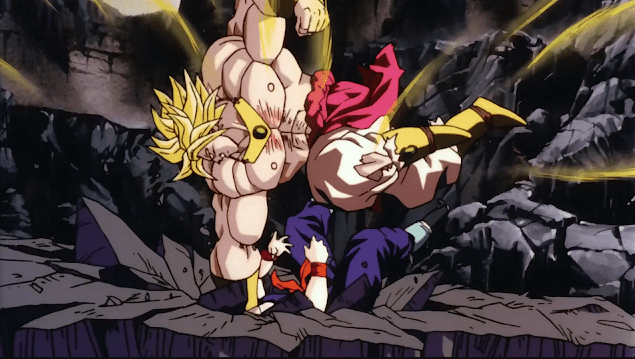
Broly goes right for Goten, mistaking him for Goku and decimating anyone in his way.

Immediately outclassed, the Saiyan children are little more than play toys for Broly’s raw strength. However, while Broly is attacking them and searching for them in their many periods of hiding, they manage to locate the Four-Star Dragon Ball, the last one they need to summon Shenron, and make a plan to hold out against Broly long enough to call upon the dragon for help .Sensing the battle, Gohan rushes to join the fight and is horrified to find Broly still alive. Well, maybe “mildly aggravated” would be a better way of putting it as even Gohan, despite having witnessed Broly’s bloodthirsty and brutal nature, seems more annoyed by Broly’s presence than fearful. Equally outclassed, Gohan is unable to best the Legendary Super Saiyan, even when transforming into a Super Saiyan 2 and throwing everything he has at Broly and with Goten by his side. With certain death looming their way, they desperately wish for more power (specifically, in Goten’s case, for his Dad’s presence) and, finally, the Dragon Balls decide to activate, bringing Goku’s spirit to the battlefield and joining his sons in obliterating Broly with his own ki sphere.

The Nitty-Gritty:
Videl is just as pig-headed as always but, thankfully, her role in the film is relatively short. It’s amusing to see her charge at Broly head-on but at least the film never depicts her as having a chance at going toe-to-toe with the Legendary Super Saiyan. One scene that is a source of constant amusement, however, is when Krillin (Strait) impersonates and imitates Piccolo (Christopher R. Sabat) to rescue Gohan, proving that Krillin alone is all the comic relief a Dragonball Z movie ever needs. Goten and Trunks are as annoying as ever in their arrogance and stupidity; they constantly avoid serious harm simply by virtue of being little kids and having been basically born Super Saiyans. Realistically, they would never stand a chance against Broly based on his power level from the last movie, especially at this point when they haven’t even mastered fusion yet.

Even Gohan is no match for Broly’s raw power, which really isn’t all the surprising…

As expected, the children care more about food, peeing, sleeping, and looking cool rather than actually being capable fighters, lucking into a lot of their advantageous positions due to dumb luck and the raw power of their Super Saiyan forms rather than skill or strategy. The same largely applies to Gohan, who was continuously noted to be far weaker as a young adult compared to when he destroyed Cell (Dameon Clarke) as a teenager. Indeed, Gohan’s power at this point was presumably far lower than his father’s when he fought Broly, and Goku could only defeat the Super Saiyan through the power of his allies. Because of this, the battles against Broly lack the impact and danger of those in the last film; rather than seeing Dragonball Z’s most powerful characters helpless and beaten to within an inch of their lives by this monstrous new foe, Broly – Second Coming is more about the remaining protagonists trying to survive until Shenron decides to hear their wish and summon Goku to the battlefield.

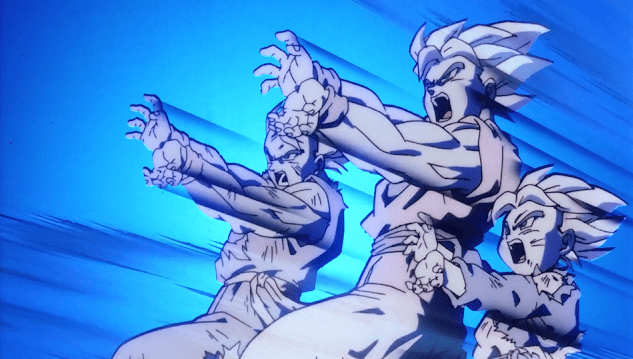
A triple Father-Son Kamehameha is a fitting end for Broly.

As a result, Broly’s power and menace seems far less impressive this time around; injured and driven to a near-mindless rage, he even seems leaner and less imposing that in his debut appearance. Though he makes short work of the children, and Goten, it’s nowhere near as impressive as the way he no-sold the combined attacks of Goku, Vegeta (Sabat), and Future Trunks (Eric Vale), characters all far more powerful than those that appear in this movie. Sadly, despite his raw power and constant rage, Broly is a bit of a joke in this movie; he is easily outwitted and eluded by the kids (despite the fact that he should be able to sense their ki) and even gets pissed on by Trunks at one point and still fails to live up to even half of the threat he posed in the last film. Once Broly finally powers up to his “Legendary Super Saiyan” form, much of his former glory begins to return as he pummels Goten mercilessly, to the point where he is forced to beg for his father’s help. This, of course, leads to a pretty decent call-back to the iconic “Father-Son Kamehameha” that finally destroyed Cell as Goku joins his sons, in spirit, and, after Trunks follows his own father’s example and lands a minor blow that is enough to distract Broly, the three Saiyans vaporise Broly once and for all. It’s a great moment and trumps Broly’s disappointing end from the last movie, finally giving him a fitting death, but the entire film is a poor imitation of Broly – The Legendary Super Saiyan.

The Summary:
Broly – Second Coming could have been so much more than it ended up being; thanks to the time period at which the film takes place (essentially some time after the end of the “Cell Games Saga”), we’re left following Goten and Trunks for the majority of the film’s runtime and, biased though I may be, I never found these characters that interesting; they’re an annoyance at the best of times and aggravating at the worst, constantly messing about and acting like…well, spoiled, arrogant little kids. I would have much preferred that the film focus on Gohan and his personal battle against Broly in a recreation of his battle against Cell; since much of the film borrows from these recognisable elements anyway, I feel it would have been far stronger if it had gone down this path and included Vegeta, Goten, and Trunks as supporting characters rather than not at all and primary protagonists, respectively. Either way, Broly is a neutered threat; he lacks most of the imposing menace and destructive power so brilliantly showcased in his debut film and seems to struggle against a handful of opponents who are far weaker than those he faced last time, making for a bittersweet reunion with one of Dragon Ball’s more ferocious villains.

My Rating:

Rating: 2 out of 5.

Could Be Better

Did you enjoy Broly – Second Coming? How do you feel it holds up compared to Broly – The Legendary Super Saiyan? How do you feel about Goten and Trunks and the missed opportunity to have Gohan become the series’ main protagonist after Goku’s death? Do you agree that Broly was severely neutered in this film or do you, perhaps, rank Broly – Second Coming quite high compared to other Dragon Ball movies? Whatever you think about this film, feel free to share your memories of Dragon Ball in the comments below.

Movie Night [Dragon Ball Month]: Dragonball Z: Broly – The Legendary Super Saiyan


DragonBallDay

When the Great Demon King Piccolo was released upon the world, he broadcasted a message on television declaring May 9th as “Piccolo Day”…and promptly celebrated by announcing his ownership over the planet. Since then, May 9th has been officially recognised as “Goku Day” but, to make things simpler, I’m using this as a good excuse to celebrate all things Dragon Ball and spend this month taking a look back at one of the franchise’s most popular villains: Broly.


DBZBroly1Logo

Released: March 1993
Director: Shigeyasu Yamauchi
Distributor: Toei Company
Budget: ¥713.7 million
Stars: Sean Schemmel, Vic Mignogna, Christopher R. Sabat, Stephanie Nadolny, Eric Vale, Sonny Strait, Mike McFarland, and Dartanian Nickelback

The Plot:
A rare moment of peace for Son Goku (Schemmel) and his friends is interrupted when Paragus (Nickelback) lures them to New Vegeta by appealing to the vanity and ego of Vegeta (Sabat), prince of the Saiyan race. Their curiosity is piqued by stories of the “Legendary Super Saiyan” running amok but things soon take a turn for the worst when they encounter Paragus’s unhinged son, Broly (Mignogna), who desires nothing more than death and destruction.

The Background:
Debuting in the pages of Weekly Shōnen Jump back in 1984 as Dragon Ball, Dragonball Z is the much-loved and popular creation of writer and artist Akira Toriyama. Originally borrowing many of its plot and characters from Journey to the West (Cheng’en, 1592), Dragon Ball followed Goku, a young boy with a monkey’s tail and exceptional martial arts skills, as he travelled the world growing stronger and often searching for the seven magical Dragon Balls. In Dragonball Z, Goku was depicted as an adult and a member of the exceptionally powerful Saiyan race. Dragonball Z took a far more science-fiction-orientated approach to the narrative, introducing several new characters and concepts that would come to define the entire franchise in popular, mainstream media. Dragonball Z was a massively popular anime in the West and was first licensed by Funimation back in 1996, who set about cutting or otherwise altering the often graphic and violent content of the original anime for its less desensitised audience. Nevertheless, the anime was popular enough in both the East and the West to inspire the creation of several feature-length films, seven of which had been produced prior to this one for Dragonball Z alone. Generally produced without the direct involvement of Toriyama, these films told a truncated version of the “Sagas” depicted in the anime and often failed to align with established canon as a result. As is often the case, though, Toriyama was invited to conceive of the design for an all-new antagonist, creating one of the most recognisable characters in Dragon Ball canon as a result, one who was so popular that he featured in three more movies (two of which were direct sequels to this one) and numerous videogames and ancillary media.

The Review:
Broly – The Legendary Super Saiyan sets the stage for the threat the titular Super Saiyan poses right from the off as it opens with the South Galaxy being “shattered by a Super Saiyan”; the level of destruction is so fearsome that it puts the wind up King Kai (Schemmel). While that may seem impressive, though, you have to remember that every threat that comes along in the Dragon Ball franchise tends to give King Kai the shivers; it’s such a common theme that it doesn’t really carry the same weight, especially when viewed retroactively. We then jump to series protagonist Goku, who has been forced into a fancy suit and is being badgered, as always, by his highly strung wife, Chi-Chi (Cynthia Cranz). Desperate to make a good impression so that their son, Son Gohan (Nadolny), can get into a fancy private school, Chi-Chi is even more overbearing and demanding than usual (if that’s even possible) and Goku is just as awkward and dumb-headed as ever, thinking only about fighting and food, and only serving to aggravate his wife even more.

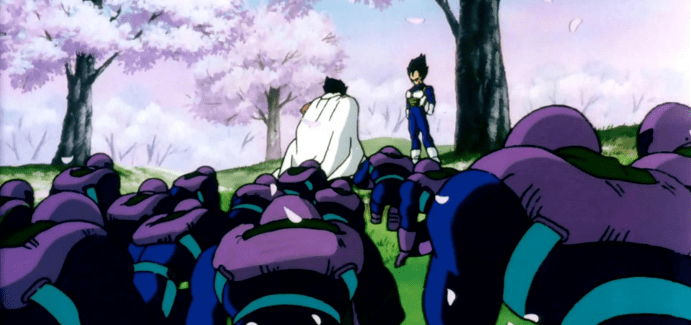
Paragus and his troops pay reverence to their prince, Vegeta.

Goku is restless not only because he’s bored and hungry but also because he’s missing out on a nice little picnic for his closest friends and family; in many ways, though, I envy Goku as he doesn’t have to put up with Krillin’s (Strait) God-awful singing, which is so bad that Vegeta looks ready to kill him. Thankfully, this ear-splitting screeching is interrupted by the arrival of Paragus, who drops down in a massive spaceship full of alien soldiers, all of whom immediately bow and pay reverence to Vegeta. While Vegeta isn’t massively impressed with Paragus’s desires to rebuild the Saiyan army, his curiosity is piqued when Paragus mentions that the “Legendary Super Saiyan” is wreaking havoc across the galaxy. Sure that it’s some kind of trick, Future Trunks (Vale) moves to stop his father from leaving and stows away on the spaceship with Krillin, Master Roshi (McFarland), and Oolong (Bradford Jackson), of all people. These latter two character exist simply to act as our comedy relief for the remainder of the film, which is generally their role in most of the Dragon Ball movies and anime but it’s somewhat out of place here; Roshi’s intoxicated state is good for a few laughs but I can’t help but feel like Krillin could have handled the awkward comedy relief parts perfectly well all by himself.

Both Goku and Vegeta are excited at the prospect of battling the Legendary Super Saiyan.

Goku, having learned of the “Legendary Super Saiyan” from King Kai, is just as excited at the prospect of facing such a powerful opponent. While Vegeta views the presence of the mythical warrior as a worthy challenge, arrogant in his belief that he will be able to overcome such a foe, Goku is as giddy as a schoolkid at facing someone that is potentially more powerful than him and immediately heads to the South Galaxy to track the Super Saiyan down. Neither character, or any of the others for that matter, seems to think about the fact that Super Saiyans already exist (Goku, Trunks, and Vegeta are already Super Saiyans by this point) but there is clearly a distinction between their power-ups and the “Legendary Super Saiyan” that inspired their golden forms. Equally odd is how easily impressed Goku is with the destruction left by the Legendary Super Saiyan; considering Frieza (Linda Young) did far worse to both Planet Vegeta and Planet Namek compared to what Goku sees, it’s a bit strange to see him so concerned about this new being’s power when all he’s seen is a wrecked city. Still, once the others reach New Vegeta, Vegeta is hailed as a king and takes an instant liking to Paragus’s Saiyan son, Broly. Vegeta even chooses Broly to accompany him in confronting the Legendary Super Saiyan over his son, which is a bit odd considering everyone goes out of their way to say how weak, timid, and unassuming Broly is. Clearly affected by his father’s choice, and concerned about Paragus’s true motives, Trunks investigates the planet with Krillan and Gohan and discovers that New Vegeta is little more than a barren wasteland filled with the skeleton of a civilisation to give the illusion of a vastly populated world. They also discover an alien race being enslaved by Paragus’s troops to power his citadel but, after Goku arrives via Instant Transmission, their concerns about Paragus are almost immediately and stupidly put to ease. However, we the audience are then subsequently shown that Paragus is, in fact, plotting to have a comet destroy the planet.

Broly was an immensely powerful and violent child.

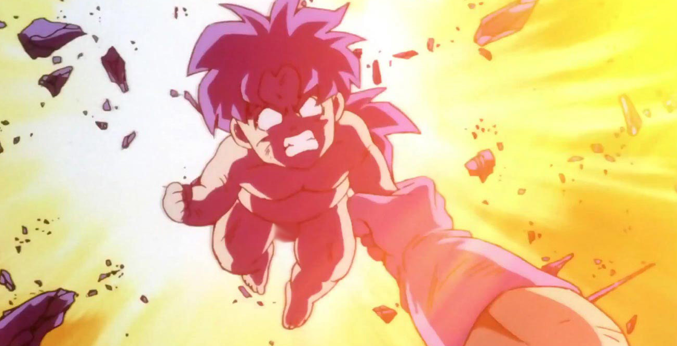
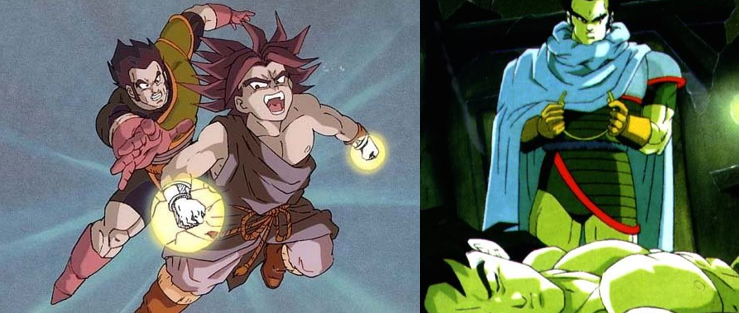
Vegeta and Broly return empty-handed soon after; Vegeta is characteristically frustrated not just because they failed to track down the Legendary Super Saiyan but also because of Goku’s presence. And he’s not the only one annoyed by Goku as, upon meeting him, Broly gets extremely agitated, is barely able to contain himself, and must be subdued by his father and his handy-dandy remote control. The very next scene reveals that the remote is starting to have less and less effect on Broly’s power due to Goku’s presence and we get the first of a number of flashbacks to help flesh out the backstory of Paragus and Broly. Broly was a super destructive feral child and Paragus, unable to control him, was forced to fit him with a suppressing device out of fear for Broly’s violent and ever-growing powers, which almost caused Broly to kill his father, and in a bid to use that same power to dominate the universe. Critically, Broly was also born with a power level of ten thousand and on the same day as Goku; baby Goku’s constant wailing and crying disturbed Broly, traumatising him and causing him to grow up with a dead-seated hatred for Goku. Unable to contain this hatred, Broly attacks Goku in a mindless rage, proving a formidable opponent whose power appears to be almost limitless, until Paragus is able to calm him once more. The fight is enough to convince Goku that Broly is the Legendary Super Saiyan they have been searching for, a fact he shares with Vegeta just as he is about to leave and which is corroborated when the alien slaves identify Broly as the one who ransacked their world. With the truth revealed, Paragus immediately reveals his true intentions: he orchestrated the entire charade in order to use the oncoming comet to remove the only ones capable of keeping him from invading and colonising Earth with a new Saiyan army (quite how he intends to do that without any Saiyan women is beyond me…).

Thanks to Piccolo’s timely intervention, and the energy of his allies, Goku emerges victorious.

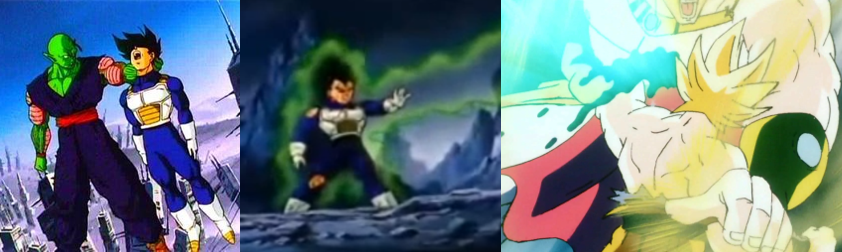
Paragus also reveals that he desires revenge against Vegeta since it was his father, King Vegeta (Sabat) who, fearing Broly’s power, banished the two of them and tried to have them killed. Unable to contain himself any longer, Broly disobeys his father, begins to power up, and engages with the Saiyans. Even as a Super Saiyan, Vegeta’s attacks don’t even faze Broly, who relentlessly targets Goku, shattering his restraining headband and finally transforming into the hulking Legendary Super Saiyan in an explosion of power so immense that it threatens to split the planet in half. Now little more than a mindless, ravenous beast, Broly’s awesome power is enough to bring Vegeta to his knees in fear; seeing that Broly truly is the Legendary Super Saiyan, Vegeta refuses to fight, believing that they (and even he) are powerless in the face of such awesome might. Broly makes short work of all those who oppose him, his power actually increasing the longer the fight progresses, and lays waste to the entire planet in a burst of rage. So total is his mindless, insane fury that he callously murders his father, freeing him of all restrictions and allowing him to truly let loose his full power. True to form, Piccolo (ibid) eventually arrives to lend a hand, healing the protagonists with some Senzu Beans and setting the stage for the film’s ultimate climactic battle and eventually convincing Vegeta to join the fight. Of course, Vegeta’s fears are true and they are no match for Broly’s power, even fighting as a group, forcing the protagonists to pool their energy into Goku for one last blow, defeating Broly and leaving him to die as the comet strikes New Vegeta.

The Nitty-Gritty:
Broly is a nigh-unstoppable force of nature not unlike DC Comics’ Doomsday, who debuted a few months earlier, and attacks do little to faze him even before he powers up to his “Legendary Super Saiyan” form. He has the same distinct footsteps as Cell (Dameon Clarke) but, despite having an interesting backstory that directly ties him to Goku and being far chattier here than in other appearances, he is a far cry from more loquacious and charismatic villains like Frieza or Cell. Instead, Broly is all about sheer, mindless power and unbridled destruction; he is the Saiyan lust for battle incarnate and dialled up to eleven, revelling in death, devastation, and driven only to kill Goku and all those who stand before him So awesome is Broly’s power that he destroys an entire world with one energy blast; this puts him at a level above Frieza, who took forever and a day to charge enough energy to destroy Planet Namek. His sheer indestructibility and ability to absorb and no-sell hits also puts him on a similar level to Cell, though he favours raw, unbridled strength over absorbing or adapting to the abilities of his opponents. In just a few blows, Broly is able to blast Gohan and Trunks out of their Super Saiyan forms and, even after Piccolo’s Senzu Beans restore their vitality, Goku is, of course, soon left to tackle the Legendary Super Saiyan alone with only his strength and matchless tenacity.

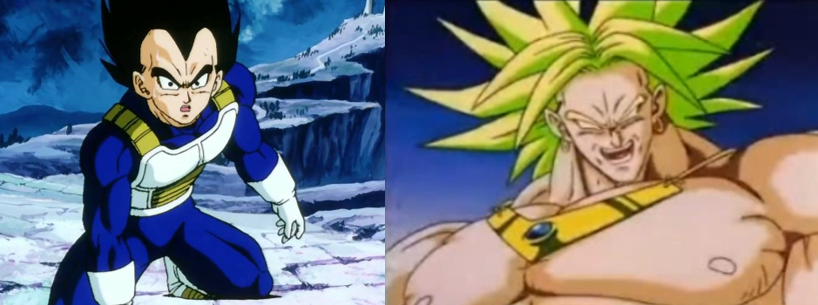
Vegeta is uncharacteristically paralysed with fear in the face of Broly’s awesome power.

Vegeta is so horrified by Broly’s power that he refuses to fight; never before has Vegeta been so crippled by fear and awe. Even in the face of Frieza and Cell’s final forms, he would rise to fight, refusing to admit that he was outmatched but, here, he can’t even bring himself to defend himself much less try to oppose Broly. He cannot understand why Goku and the others even attempt to match fists with Broly, so total is his despair at the futility of their situation; even when completely out-matched by Kid Buu (Josh Martin), Vegeta at least attempted to fight but, against Broly, it’s all he can do to begrudgingly lend Goku the power to defeat the Legendary Super Saiyan. It’s an interesting new twist on Vegeta’s stubborn, prideful nature; seeing him shaken to the core and paralysed by dread is a sobering moment and really helps sell the level of Broly’s threat just as much as seeing him make mincemeat of Goku and the other Super Saiyans.

A physically impressive, if somewhat one-note antagonist, Broly decimates our heroes with ease.

Yet, as impressive as Broly is, he is little more than a mindless beast and this film essentially boils down to an extended fight scene. The plot moves along briskly, never stopping to dwell or elaborate on things and characters more than it has to, which is something I always liked about the Dragon Ball feature films: they distil the generally prolonged fight scenes and endless power up sequences of the anime down to the basics and get right to the action as quickly as possible. Broly has an interesting backstory and certainly makes an impression…right up until his anticlimactic defeat. In the end, after all the ki blasts, power-ups, and blows he has absorbed, Broly goes down relatively easily from a super-powered blow to the abdomen. At least it makes a change from Goku defeating his opponent with a Spirit Bomb but it’s a disappointing way to defeat what is an otherwise very impressive villain; luckily, though, the next movie retroactively shows that Broly actually survived this attack (and rightfully so) but Broly’s unbeatable aura would be diminished in his subsequent appearances.

The Summary:
The Dragon Ball feature films have always been quick snapshots of the generally long-winded anime and Broly – The Legendary Super Saiyan is no different; flying through the simple plot and getting right to the action, Broly – The Legendary Super Saiyan stands out from its predecessors through the sheer impressive presence of Broly. A sadistic, merciless, hulking monster of a Saiyan, Broly is fascinating for the questions he raises about the Super Saiyan form alone: is he truly the Legendary Super Saiyan whom Vegeta had heard stories of as a child or is he simply an enormously powerful Saiyan who has tapped into a raw form of the same energy the other Saiyans use? While little more than one massive fight scene, Broly – The Legendary Super Saiyan is worth a watch for the titular Super Saiyan, if nothing else, and definitely to see Vegeta so wracked by horror that he flat out refuses to fight.

My Rating:

Rating: 4 out of 5.

Great Stuff

What did you think of Dragonball Z: Broly – The Legendary Super Saiyan? Where does it rank for you against the other Dragonball Z feature films? What did you think of Broly’s introduction and how would you rate him as a character and antagonist? Would you have liked to see Broly integrated into the main series canon sooner or do you feel he’s over-rated and, perhaps, a relatively underwhelming character? What Dragon Ball character (hero, villain, or otherwise), saga, or movie is your favourite and why? How are you celebrating Piccolo/Goku Day this year? Whatever your thoughts on Dragon Ball, please leave a comment below.

Screen Time [National Anime Day]: Attack on Titan (Season One)


15 April has been designated National Anime Day to celebrate the stylistic genre, which achieved mainstream success thanks to animators like Osamu Tezuka.


Season One

Air Date: 7 April 2013 to present
UK Distributor: Netflix, et al
Original Network: MBS/NHK General TV
Stars: Bryce Papenbrook, Josh Grelle, Trina Nishimura, Jessica Calvello, Lauren Landa, Matthew Mercer, and R Bruce Elliott

The Background:
Attack on Titan began life as a Japanese manga written and illustrated by Hajime Isayama and has been published in Bessatsu Shōnen Magazine since September 2009. Drawing from personal experiences regarding the fear of strangers you cannot communicate with, the isolated and enclosed nature of Japanese culture, and the Muv-Luv visual novel series (âge/5pb, 2003 to 2016), Attack on Titan was very well received, selling over 100 million copies by the end of 2019 and quickly etching itself into worldwide popular culture. As a result of the manga’s popularity, Attack on Titan has been adapted into videogames, live-action movies, and an ongoing anime. The anime was produced by Wit Studio and Production I.G, directed by Tetsurō Araki, and dubbed into English by FUNimation Entertainment. Like the manga, the anime was received generally positively, with critics praising the storyline, animation, and music but criticising the crudeness or the titular Titans and the bleakness of the story’s tone.

The Plot:
For a hundred years, the last vestiges of humanity has lived in cities surrounded by enormous walls that protect them from gigantic man-eating humanoids referred to as Titans. After his mother is devoured by a Titan before his eyes, Eren Yeager (Papenbrook) vows to join the Titan-hunting Scout Regiment alongside his friends Mikasa Ackerman (Nishimura) and Armin Arlert (Grelle) and rid the world of the Titans once and for all.

The Review:
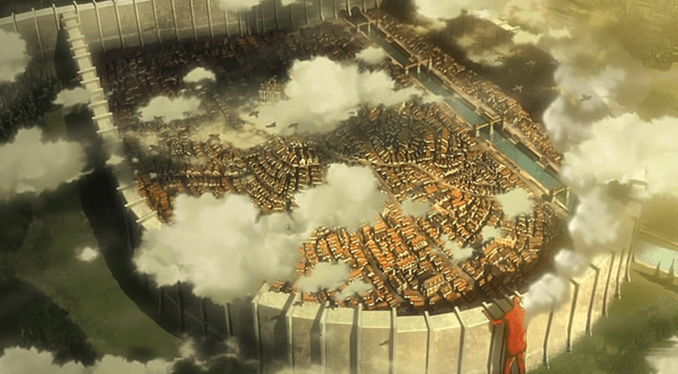
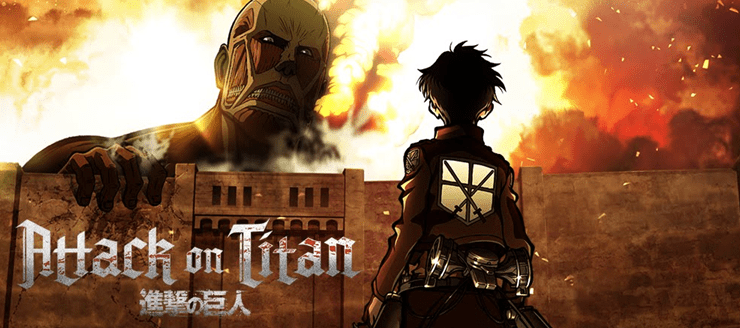
In a world where we are literally swamped with all kinds of bat-shit crazy ideas for manga, anime, and videogames, Attack on Titan offers what can only be described as a “unique” premise: one day, about a hundred years ago, the gigantic cannibalistic Titans simply showed up and started eating humans left, right, and centre. They appeared seemingly out of nowhere and decimated humanity, driving them behind fifty-foot high walls and to the point of near extinction. Since then, humanity has lived in relative peace, training generations of soldiers to battle the nigh-indestructible Titans and scout out new areas for expansion and the acquisition of resources. The titular Titans are gruesome, disturbing creatures; ranging in height from around three to fifteen meters tall, they vary in appearance from constantly-grinning or alarmingly stoic-faced naked humanoids, to twisted, frenetic freaks and skinless, steam-emitting monstrosities. Deceptively fast and light despite their enormous size, the Titans are superhumanly strong and constantly regenerate from any injury unless attacked at their one weak point at the base of the neck. The Titans generally attack without reason or mercy, devouring humans not for sustenance but, apparently, simply out of some kind of base instinct (though more intelligent Titans do exist).

Horrific, intelligent Titan variants pose a real threat to humanity’s survival.

The Colossal Titan (which is so huge that it can peer over the walls that keep humanity safe from the Titans) systematically destroys the weakest part of Wall Maria to allow its brethren to enter the outer area of the city. This act alone earns the Colossal Titan (and the Titans in general) Eren’s hatred as it directly leads to the death of his mother and kick-starts his entire crusade to hunt down and destroy all of the Titans. Later in the season, Eren and Squad Levi encounter a skinless Female Titan that specifically targets Eren and is capable of hardening its skin at will and is smart enough to cover its neck when under attack. Similarly, the Armoured Titan is not only highly resistant to the army’s anti-Titan cannons but methodically picks and choose its targets, unlike the horrific Abnormals, which run and skitter around in an unhinged frenzy.

The Titans are practically unstoppable and have driven humanity to near extinction.

Honestly, one of the best parts of Attack on Titan is the Titans themselves; they are horrific creatures that are cold, unmoved, and seemingly unstoppable. Just one Titan is capable of swatting attackers right out of the air, stomping on them, or chomping down on them in the apparent blink of an eye. Often, two or three Titans are seen as a significant threat to the populace and those trained to protect them but, other times, soldiers (specifically the army’s more highly-skilled individuals) will be able to cut Titans down almost effortlessly and, yet, the Titans continue on regardless and it is stated at one point that humanity has never, in a hundred years, scored anything close to a significant victory until the episode “Primal Desire: The Struggle for Trost, Part 9” (Koizuka, 2013).

The O.D.M. allows the characters to perform superhuman feats.

Opposing the Titans are the city’s military; trained in the use of Omni-Directional Mobility Gear (O.D.M.), these guys are able to fly all over the place thanks to the O.D.M.’s gas-powered grapple hooks. Once mastered, the O.D.M. pretty much turns every character into Peter Parker/Spider-Man as they swing, fly, and rappel all over the place with superhuman skill and ease, attacking Titans with their swords and yet, despite all their skill and extraordinary physical prowess, they are still splattered into mush or devoured by the hundreds in seemingly every campaign, willingly throwing their lives away even when escape would be a far better proposition. Attack on Titan centres around three human characters: Eren (the hot-headed, idealistic protagonist), Mikasa (Eren’s stoic, but highly skilled adopted sister and self-appointed bodyguard), and Armin (their childhood friend who is more of an academic than a fighter). Of the three, Eren is easily the most relatable and interesting; wracked with guilt after never appreciating his mother and haunted by fragmented memories of his father, he is driven by an unrelenting desire to succeed in the military, join the Scout Regiment, and experience life beyond the walls of the city to hunt down and destroy every Titan he finds. Eren is quite the flawed character; despite his bravado and commitment to his mission, he struggles to master the O.D.M. gear, is far less capable at battling the Titans than Mikasa or Captain Levi (Mercer), the military’s most decorated and powerful soldier, and isn’t as well-read as Armin.

Somehow, Eren is able to transform into the Attack Titan to take the fight to the Titans.

However, his heart cannot be denied; in the face of a Titan assault in “First Battle: The Struggle for Trost, Part 1” (Ezaki, 2013), Eren immediately takes command and leads the charge against the Titans. Briefly paralyzed with fear in the face of the Titans’ awesome power, he barely hesitates to sacrifice himself to save Armin from being swallowed by the Bearded Titan, apparently dying in the process. Luckily, however, Eren later resurfaces in his own Titan form, the Attack Titan, apparently mysteriously having the innate ability to transform into a Titan when injured and with a clear, defined goal. At first, and sporadically throughout the season, Eren cannot fully control this transformation and struggles to understand it; understandably, it causes a lot of fear and mistrust amongst his fellow soldiers, who constantly treat him either with respect and awe or terror and hatred, and his superiors constantly flip-flop on whether to use his powers to aid them or simply execute him.

Levi is the army’s most formidable soldier and a decorated Titan killer.

Eventually, Eren is assigned to Squad Levi and the direct scrutiny of Captain Levi, a stoic but superhumanly capable soldier who is equal to the strength of a hundred fully-trained soldiers. Levi is the anime’s standard detached, bad-ass character, slicing up even the near-unstoppable Female Titan in a whirlwind of blades and fully prepared to sacrifice his entire regiment (comprised of the army’s best and longest-living Titan hunters, it must be said) to protect Eren.

Though stoic, Mikasa has a natural aptitude for combat.

Levi’s demeanour is largely mirrored by Mikasa, a damaged young girl whose entire family was slaughtered before her eyes until she was saved by Eren, the two of them killing her attackers in a mindless fury. Since then, Mikasa has attached herself to Eren, following him everywhere, even to military school and out into the 104th Regiment. Though not quite as stoic as Levi, Mikasa is nevertheless capable of killing entire swarms of Titans all by herself through some innate physical prowess that is never really explained. It’s hinted numerous times throughout the season that Mikasa’s feelings towards Eren border on something more than friends and family but both are quick to either brush off this suggestion or are far too focused on the far more prominent threat of destroying the Titans.

Armin is the weakest and most annoying of the three protagonists.

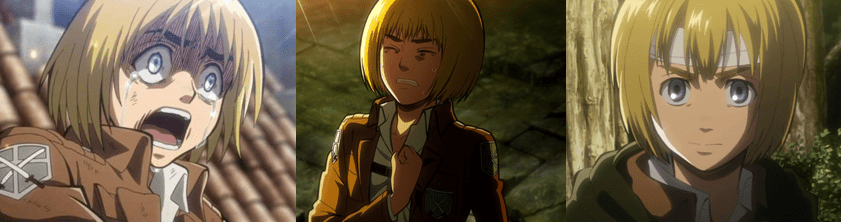
Finally, there’s Armin, easily the weakest and most annoying character of the three. Many episodes either grind to a halt or entirely focus on one of the three debating the merits of teamwork, humanity, or reliving their memories and feelings through long-winded internal (or external) monologues or flashbacks but never is this more annoying when the focus is placed on Armin. The weakest link of his regiment, Armin’s prowess lies more in academics, strategy, philosophy, and introspective analysis; he’s quick to give in to despair (though, to be fair, so are a large number of the anime’s soldiers and characters in the face of the Titans’ inexorable threat) and to stand useless and in fearful awe in the midst of a heated battle where untold numbers of his friends and peers are decimated by the Titans to incessantly monologue about his shortcomings or the bravery of others.

Hange Zoë is easily the worst and most annoying character of the season.

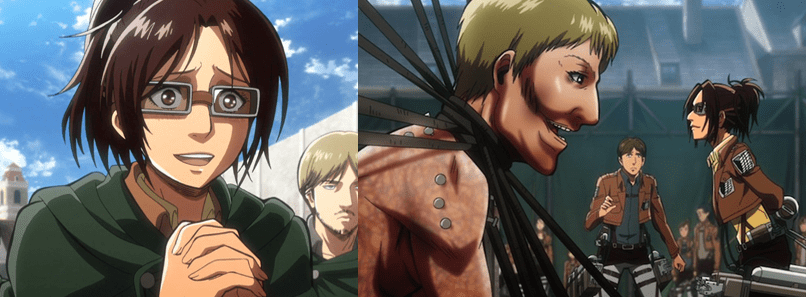
Still, as annoying as Armin is, he’s got nothing on Hange Zoë (Calvello), a military scientist who is so incredibly obsessed with the Titans that she has been driven to what appears to be near insanity. Loud, obnoxious, and exploding into a crazed frenzy at the drop of a hat, Zoë wants nothing more than to study and investigate the Titans, growing uncomfortably close to captive Titans and disconcertingly obsessed with Eren and his unique physiology. Though her experiments and studies have uncovered numerous helpful insights into the Titan’s composition and nature (and has led to the creation of numerous weapons to bring them down or kill them), her character is largely both uncomfortable and annoying at the same time as she often cares more for the well-being of the Titans than her fellow humans.

Many of the supporting characters are easily forgotten until they suddenly die.

Rounding out the cast are a number of expendable soldiers and civilians; sure, most of them have names and character traits but it’s largely pointless to remember them or grow too attached as they are liable to either get splattered into a bloody mess, eaten alive, horribly dismembered, or found as little more than a bloodied and mutilated corpse. Often, another character would lament their comrade’s fate and I would find myself struggling to remember who they were, what they did, or when they last appeared. Interestingly, the city is made up of varying classes, each of which experience life within the walls differently and views the military, and the Titans, in different ways: many criticise the need for expensive military ventures and pursuits, others are living comfortably deep within Wall Sina, while those in the outer areas live relatively underprivileged lives. Like a lot of post-apocalyptic narratives, I have many questions regarding the world of Attack on Titan; I’ve looked into the series and researched it a little bit to get some answers regarding the history of this world and how the walls and city were erected but, in the context of season one, we get very little information regarding how the city was built and how they survive.

I have many questions about the city, its society, and the lore of this world.

For some reason, currency and wealth is still a thing within the city; many of the wealthier citizens are frustrated at their “taxes” paying for what amount to little more than suicide missions against the Titans and the Royal Family live in opulence within Wall Sina. Equally, there is a lot of mention of rations and finite resources; every time Titans breach the walls and cause a mass evacuation, food and supplies are strained so badly that it is often seen as a good thing when hundreds of soldiers are killed by Titans so that the city’s resources can last a bit longer. I have many questions regarding this: shouldn’t the city just be entirely focused on training soldiers, fortifying their defences, and building a military society rather than giving people the option of living passive lives? Why is money and wealth a thing? How can money really mean anything in this type of world? Where do the resources come from? How were all these houses built, to say nothing of the walls that protect the city? How do the citizens even have the means to build anything with such finite resources? Why aren’t the soldiers, especially the veterans, better at killing Titans when the creatures are largely predictable, have a well-known weak spot, and seem so cumbersome and slow despite their surprising speed and daunting strength?

Eren isn’t the only one who can transform into a Titan, raising many questions for season two.

These questions are generally disregarded in season one and, for the most part, it works; despite characters knowing a lot about the Titans’ physiology, the creatures and their origins are a complete mystery to the characters and they are constantly forced to learn as they go and endure horrific losses to gain slivers of new information about them. How Eren, and others, are able to spontaneously produce Titan bodies is left obscure and the motivations of the Titans’ cannibalistic ways are up for debate at this point. The season ends, however, not only with the knowledge that Eren is not unique as Annie Leonhart (Landa) is revealed to not only be a traitor to the humans but also capable of transforming into a Titan herself, but also that gigantic Titans are encased within the walls of the city, ending the season on a massive cliff-hanger as we’re faced with the knowledge that human-to-Titan individuals are more commonplace than first thought and that there is more to the history of this world than we, and the characters, are aware.

The Summary:
I had heard a lot about Attack on Titan for quite some time; I am not, by my own admission, the most well-read anime fan as I find a lot of the most popular anime films and series to be dense almost to the point of being impenetrable and with so many episodes (most of them being filler or padding) that I just don’t have the time or patience to fully invest my energy and effort.

There are so many monologues! It really grinds the pace and action to a halt.

However, when I saw Attack on Titan was on Netflix, I figured I’d watch a few episodes and see if it hooked me. Within three episodes, I was interested enough to carry on but, by around episode fifteen, the series had started to lose me. I quite liked Eren’s flawed character and the constant life and war lessons he was forced to learn through numerous encounters with the Titans and characters like Mikasa and Levi helped make the anime exciting and engaging when it was actually focused on action rather than constantly slowing the plot down with endless monologues and prattling on and on (often, inexplicably, when characters are moving at high speeds) about teamwork, friendship, and the futility (or glory) of war.

Attack on Titan excels whenever Titans are onscreen or the action picks up.

Attack on Titan excels when it focuses on the Titans and the action-packed assaults against them; seeing Eren and his fellow soldiers swing and fly all over the place, either being crushed, devoured, or successfully cutting down the creatures is exciting and gorgeous to behold and really showcases the detail and intricacies of the anime’s smooth and slick animation. Sadly, though, entire episodes can go by without the merest hint of action or appearances by the titular Titans; while this can lead to some interesting character development, more often than not episodes drag their runtime out focusing on characters who quickly die, strategies that immediately fail, or retreading the same ground about Eren, Mikasa, and Armin’s characters and backstory.

Some flashbacks and slower moments help flesh out the main characters.

Occasionally, our protagonists will learn and grow as characters, which is nice to see, but often they’ll learn a lesson or some self-confidence in one episode only to immediately have to relearn this again in the next (or subsequent) episode. It makes for a disjointed pace and gives me far too much time to think about the rules of this world and questioning how their society even works much less proves so unreliably effective against the Titans even with years of experience in fighting them. As a result, despite the massive cliff-hanger at the end of the season and what I’ve read of how the plot develops later on, I can’t see myself coming back to Attack on Titan again. At least, not the anime, anyway.

My Rating:

Rating: 2 out of 5.

Could Be Better

What are your thoughts on Attack on Titan? Did you enjoy the series or, like me, did you have issues with its plot, pacing, and content despite its interesting premise, creatures, and characters? Did you ever read the manga; if so, do you prefer it to the anime? Perhaps you prefer the live-action films, or the Attack on Titan videogames; if so, which is your favourite and why? Which character, or Titan, is your favourite? Do you also find Zoë and Armin annoying characters? How are you celebrating National Anime Day today? Whatever you think about Attack on Titan, or anime in general, please do leave a comment below.

Screen Time: Pokémon Origins

Air Date: 2 October 2013
Worldwide Network: Pokémon TV 
Original Network: TV Tokyo
Stars: Bryce Papenbrook, Lucien Dodge, Jamieson Price, Kirk Thornton, and Kyle Hebert

The Background:
The brainchild of executive director Satoshi Tajiri, Pokémon began life as Capsule Monsters (later changed to Pocket Monsters and rebranded as Pokémon for the games’ worldwide release), a role-playing game inspired by Tajiri’s childhood days wandering through forests and collecting bugs. Thanks largely to the decision to produce two versions of the game, each with different Pokémon to collect and encouraging gamers to battle and trade with their friends to catch every Pokémon, the games sold very well in Japan and were soon localised for a worldwide audience. Fearing that American audiences would struggle to connect with the game’s cute concepts and creatures, Nintendo apparently spent well over $50 million localising, rebranding, and marketing the games for their international release. It turns out, however, that Nintendo were wrong to doubt Pokémon’s appeal; still, when Pokémon: Blue Version and Pokémon: Red Version released in 1998, they were accompanied by an anime, a trading card game, and more advertisements and media coverage than you could shake a stick it. Of course, history shows us that this aggressive strategy paid off; Blue and Red sold over 30 million copies worldwide, birthing one of Nintendo’s most popular and enduring videogame franchises ever, and the anime continues to air to this day, with feature-length movies and television specials being regularly produced.

Thanks to a co-ordinated marketing campaign, Pokémon dominated an entire generation.

In short, Pokémon was not just some short-lived fad of one generation but a multimedia blockbuster franchise that has spanned multiple generations and shows no signs of stopping. By 2013, there were over 720 Pokémon to be found, battled, and traded in comparison to the 150 regularly-obtainable Pokémon of the original videogames. The anime was well into its sixteenth season, having aired over 780 episodes, the sixteenth feature-length movie had just been released, the excellent ongoing Pokémon Adventures manga (Various, 1997 to present) was entering its eleventh chapter, and Pokémon was celebrating its fifteenth anniversary that year. This was also the year that Production I.G, Xebec, and OLM, Inc. produced a ninety-minute animated special, split into four parts, which retold the events of the original games in a way that was more faithful to the source material than the regular, ongoing anime. First broadcast on TV Tokyo ten days before the release of Pokémon X and Pokémon Y (Game Freak, 2013), the episodes were dubbed into English with a new voice cast and made available both on home media (in some countries) and to watch on various online platforms, including Pokémon TV.

The Plot:
Red (Papenbrook) and his childhood friend and rival, Blue (Dodge), have been chosen to select their first Pokémon from Professor Oak (Hebert). Tasked with completing Oak’s lifelong dream of capturing and recording data on all Pokémon, they set out into the region of Kanto, battling both Gym Leaders and the nefarious Team Rocket in a quest to not only capture every Pokémon but also become Pokémon League Champion.

The Review:
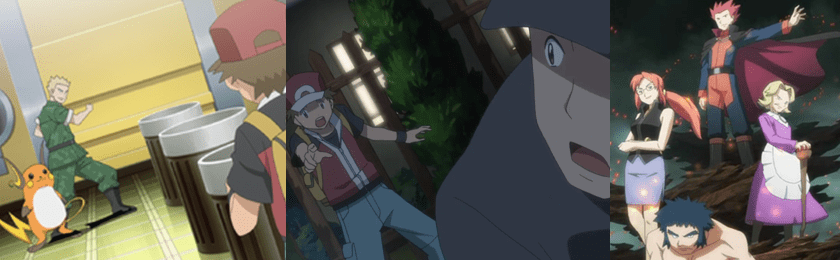
Pokémon: Origins is split into four parts, “File 1: Red” (Kawasaki, 2013), “File 2: Cubone” (Kuroda, ibid), “File 3: Giovanni (Takahashi, ibid), and “File 4: Charizard” (Tomiyasu, ibid). The animation style is quite different to that of the existing Pokémon series; for one thing, Origins looks much more professionally rendered and of a higher quality than even some of the Pokémon feature films. For another, many episodes feature music inspired directly from the videogames, with the classic Pokémon battle theme playing during Pokémon battles and the iconic, creepy Lavender Town theme playing when the story reaches the haunted Pokémon Tower. Of course, the anime did feature remixed versions of some recognisable Pokémon themes but nowhere to the degree of Origins; Origins also opens and closes each episode with a game save/load screen and includes dialogue boxes ripped right from the videogame.

Origins includes many aspects and mechanics from the videogames.

This closer fidelity to the source material brings Origins more in-line with Pokémon Adventures, which recreated many of the gameplay mechanics of the videogames with a surprising amount of detail and loyalty compared to the anime but also took the source material a bit more seriously as well, featuring blood, much higher stakes, and even Pokémon dying. While Origins doesn’t go fully down this path, it does go out of its way to stay closer to the source material than the anime: Red receives Technical Machines (TMs) and Hidden Machines (HMs) in the form of floppy discs, just like in the game; Pokémon battles (while generally much faster and glossed over thanks to Origins’ short runtime) are much more intense and closer to how they go down in the games (there’s no bullshit strategies like sprinkling water on an Onix to make it weak to electric attacks); and many of the items (such as the PokéFlute, the fishing rods, and the Silph Scope) from the videogame make an appearance, albeit a brief one.

Sadly, Origins glosses over many of the game’s important battles and plot points.

Something that lets Origins down, though, is the brevity of its narrative and the way it devotes the focus of each of its four episodes. “File 1: Red” begins in standard fashion, with Red and Blue beginning their Pokémon journey, establishing their rivalry (which is much friendlier than portrayed in the games or the early days of the anime), and Red learning the basics of Pokémon battling and capturing from Brock (Johnny Yong Bosch). However, from “File 2: Cubone”, each subsequent episode begins, and includes, a recap and a montage of sorts that glosses over what I consider to be some very important story beats: Red tells us about, and we briefly see, how he defeats the majority of the Gym Leaders (we only see him battle two in full throughout the course of the series), acquires the aforementioned fishing rods, captures the majority of his Pokémon (again, we only really see him capture a handful in any kind of detail), the evolution of his Charmander (Shin’ichirō Miki), and even his battles against the Elite Four and, most egregious of all, some of his most important encounters with the villainous Team Rocket.

Red and Blue begrudingly team up but Team Rocket are easily defeated despite their reputation.

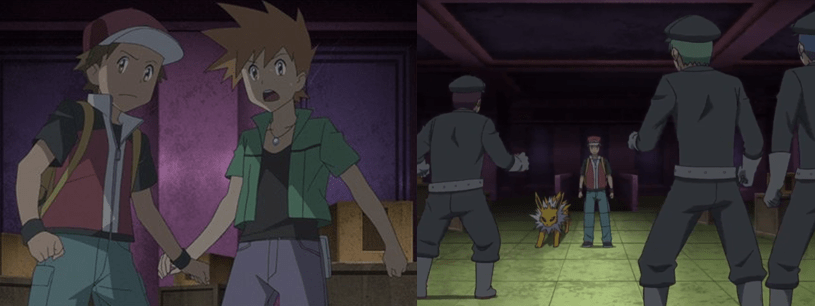
Obviously, there are only four episodes of this mini series so the story cannot cover everything from the videogames but, for me, glossing over Red’s first meeting with Team Rocket and his eventual vendetta against them is a bit of a mistake. Take “File 2: Cubone”, for example; sure, it features Team Rocket having overtaken the Pokémon Tower, but it’s far more concerned with the trauma the group caused Cubone (Cristina Vee) and the ghost that haunts the tower. Red and Blue begrudgingly team up to solve both problems but Team Rocket is easily defeated first off-screen by Blue and then with a ridiculous amount of ease by Red, who successfully scares them off after defeating one of their Pokémon. Considering how the townsfolk were so afraid of Team Rocket’s power and threat earlier in this episode, this is more than a little disappointing and I would have preferred to see Red’s journey through Mt. Moon and his battle against Lieutenant Surge to help properly establish Team Rocket’s threat in this world. On the plus side, at least the group isn’t portrayed as largely ineffectual bunch of goofballs and Red takes his opposition to their plot a lot more seriously than Ash Ketchum (Veronica Taylor/Sarah Natochenny).

Although he stumbles in the first episode, Red quickly becomes a competent and capable trainer.

When comparing Red to Ash, it’s like comparing night to day or apples to oranges. There are some similarities but these are generally due to the fact that both characters are based on the avatar from the games and therefore follow the same path the player forges in the source material. While both are big Pokémon fans and excited to become Pokémon trainers and both start out knowing very little about the actual mechanics of Pokémon battling, capturing, and the scope of their journey, it takes Red a bit more time to learn that a close bond with his Pokémon is required to grow stronger and succeed in battle. While Brock does help to teach him these lessons, Red’s bond with Charmander is nowhere near as intense as Ash’s with Pikachu (Ikue Ōtani) yet he quickly becomes a far more competent trainer than Ash; in a surprising amount of restraint, Pikachu only appears in a brief cameo and, to separate Red from Ash even more, Red not only uses a far more competent Electric-Type Pokémon in Jolteon (Unknown) but only captures a Pikachu after he has become the Pokémon League Champion! Granted, most of this is implied, seen in montages, or takes place between episodes but Red captures way more Pokémon (mainly because he’s much more committed to completing the PokéDex than Ash), easily defeats pretty much every trainer and Gym Leader he comes up against, and has a far more well-balanced and well-trained team than Ash has ever had. Hell, Red even ends up with Articuno (ibid) in his squad and, generally speaking, has much more in common with his counterpart from Pokémon Adventures, who was also a far more competent and capable trainer compared to Ash.

Blue is humbled in defeat, realising Red’s bond with his Pokémon has made him superior.

One thing that helps separate Origins from the anime is the relationship between Red and Blue; in the games, and the anime, these two had a largely antagonistic relationship throughout the story until facing off in the Pokémon League. Here, though, while Blue is arrogant and a blowhard and determined to complete the PokéDex before Red and become a more powerful and capable trainer than him (he picks Squirtle (ibid) not because it matches his name but specifically because it will give him the type advantage over Red’s Charmander), he and Red have a much more friendly rivalry than one based on actual animosity. Blue sees himself as Red’s superior and seems to both be motivated to beat Red to the punch wherever possible and happy to walk away from confronting the likes of Team Rocket when it doesn’t suit him but the two are generally more about ribbing on each other and winding each other up about their progress and abilities than actually hating each other. Sadly, though, because of the brevity of the mini series, Red and Blue only battle head to head twice in this story; the first time, Red is soundly defeated as his strategy of mindlessly attacking without having properly developed trust and partnership with his Charmander prove his downfall. Brock specifically uses Blue as an example of a trainer who has established this bond and it is from both of them that Red learns to put his love and trust into his Pokémon, which are treated as his beloved partners and allies rather than mere tools. However, when they face-off again in “File 4: Charizard”, the tables have turned; though Blue has already become the Pokémon League Champion, he falls to Red despite having amassed a team powerful and diverse enough to conquer any and all opponents not because of his lack of strength but because he had failed to maintain the bonds of trust and friendship between himself and his partners. Humbled by his defeat, Blue nevertheless congratulates Red on his victory and accomplishments and the two retain a friendly rivalry for the final episode of the anime, one based on Blue’s desire to one-up Red at any opportunity while still acknowledging his skill and capability.

Battling with Red awakens a passion that Giovanni had long forgotten.

Despite much of Origins being reduced to quick montages, there is still a strong sense of Red’s capability throughout the anime; after learning valuable lessons from Blue and Brock, Red goes from strength to strength, easily defeating other trainers and Gym Leaders even when he has a massive type disadvantage. Not counting that initial battle against Blue, Red only runs into two roadblocks throughout his journey, the first being his showdown against Giovanni (Price). Though Red’s first meeting with the Team Rocket boss is glossed over in a recap, his battle against him for the Earth Badge is a significant part of the aptly-named “File 3: Giovanni”. The strength of Giovanni’s Rhyhorn (Unknown) alone is enough to wipe out all of Red’s team even when Red has the type advantage but Red’s determination and passion for both battling and towards his Pokémon awakens something in Giovanni he had long forgotten. Exhilarated by the thrill of the battle (even though it’s ridiculously one-sided in his favour for the majority of the time), Giovanni is impressed, humbled, and even grateful to have been defeated by such a zealous trainer. So touched is Giovanni that he disbands Team Rocket and wishes Red well on the remainder of his journey, urging Red to follow the path that he (Giovanni) strayed from long ago and pledging to carve a new path for himself going forward.

Mewtwo represents Red’s final, and greatest, challenge.

The second obstacle Red encounters is hinted at in “File 2: Cubone” and forms the central focus of “File 4: Charizard” and it is, of course, Mewtwo (ibid). Mewtwo’s threat is immediately established by how badly, and easily, it overwhelms Blue, leaving him badly injured and putting the wind up the usually arrogant trainer. Nevertheless, motivated by the desire to finally complete Oak’s PokéDex, Red heads to Cerulean Cave to confront the creature, which is still a genetic copy of the mythical Pokémon Mew (Christine Marie Cabanos) but, unlike in the anime and manga, it never speaks or communicates in any way other than brutal, aggressive battle. Far from the nuanced, tortured character in other media, Mewtwo is portrayed more as simply an extremely powerful Pokémon to be captured like any other, which is much more in-line with its position in the games as a “super boss” of sorts rather than a pivotal plot point. However, even Red is unable to match Mewtwo’s monstrous power; luckily, though, he was gifted two Mega Stones by the mysterious Mr. Fuji (Kirk Thornton) in “File 2: Cubone” and, even more helpfully, they just so happen to react to the close bond between Red and Charizard (Shin’ichirō Miki) and allow Charizard to mega evolve into Mega Charizard X (did I mention that Origins came out around the same time as Pokémon X and Y?) This is enough of a power boost to allow Red to overwhelm Mewtwo faster than it can react and capture it with a ridiculous amount of ease; seriously, Red throws two Ultra Balls and captures Mewtwo with the second, which is some serious bullshit when you think about how many damn balls it can take to snag Mewtwo in the games. I would have liked to see Red use a Master Ball but, sadly, he never acquires one in Origins as it’s merely an unfinished prototype in this story.

Origins ends with Red eager to find more Pokémon, starting with the mythical Mew.

Regardless, Red is successful and captures all 150 Pokémon but his mission is far from over as, while celebrating with Oak and Blue, he remembers that Mewtwo was created from Mew and rushes out a bundle of excitement and anticipation at the prospect of encountering and capturing still more Pokémon. It’s here, and in Red’s steadfast determination in battle, that we see the closest links between Red and Ash: both are stubborn in battle and endlessly excited about capturing and finding new Pokémon. However, Red ends Origins a far more accomplished and experienced trainer; he’s the Pokémon League Champion, for one thing, and now has numerous Legendary and incredibly powerful Pokémon in his possession. In this regard, Origins ends exactly as a standard game of Blue or Red would end, with the character having numerous Pokémon at their disposal and ridiculously overpowered. While Ash does also grow and become more accomplished as a trainer, this takes…what? A hundred episodes? Two hundred? And even then he still makes rookie mistakes; no such foibles befall Red but, to be fair, much of his growth as a trainer and a character is implied, rushed through in montages, or takes place between episodes and relies heavily on the viewer’s familiarity with the videogames to fill in the blanks whereas the anime is able to use many (many) episodes to show Ash’s numerous lessons and growth.

The Summary:
Pokémon: Origins is an extremely enjoyable, gorgeously-animated anime; everything from the character designs, Pokémon battles, and sounds is fantastic to look at and closely reminiscent of the source material. Unlike the anime (and a lot of Pokémon media), Pokémon do not constantly speak their names and instead have more realistic, animal sounds like in the games; Japanese text is also left unaltered, which is refreshing, and while many elements, mechanics, and important plot points from the games are glossed over, at least they’re actually included here rather than either being ignored or significantly altered. As much as I enjoy the anime (specifically the films because of their focus on Legendary Pokémon), it can be grating at times to follow a character as annoying and unreliable as Ash and, because of that, Red is a breath of fresh air. Like his manga counterpart, Red is competent, brave, and determined; he starts out as a rookie, knowing very little about the basics and nuances of Pokémon battling, and quickly matures to the point where he can defeat Gym Leaders with ease, single-handedly brings down Team Rocket (something Ash is still struggling to do), and not only captures Legendary Pokémon but casually uses them as part of his team just like the player would. His fidelity to the player’s character and journey is commendable; he learns the same lessons that the player does throughout the game while still being his own distinct character separate from the player’s avatar, Ash, and even his manga counterpart.

Origins‘s fidelity is impressive, though it rushes through many usually-important plot points.

It’s this fidelity to the source material that elevates Pokémon: Origins and makes up the majority of its appeal; the anime strayed too far from the gameplay mechanics and spirit of the games for my taste, as much as I enjoy it, so it’s refreshing to see such a well-crafted and well-animated series tell a very similar story to the anime but in a way that is so much closer to the source material. The only thing that lets Pokémon: Origins down is the brevity of its narrative; limiting its story to just four episodes means so much of the game’s story gets glossed over and the focus can be a bit skewed at times. While, at its core, it focuses on Red’s journey and his mission to complete the PokéDex and his ongoing rivalry with Blue and Team Rocket, I can’t help but feel like this would have benefitted from being more like ten episodes to spend a bit more time on Team Rocket, Red’s battles against the Kanto Gym Leaders, and, specifically, his battles against the Elite Four.

My Rating:

Rating: 4 out of 5.

Great Stuff

What did you think about Pokémon: Origins? How do you think it holds up when compared to the anime and numerous feature films? Did you enjoy how faithful it was to the source material or do you feel that it was weighed down by focusing on fidelity over telling a more unique story? Do you agree that certain parts were rushed or were you happy with the story it told? Which character, or Pokémon, is your favourite and why? How did you capture Mewtwo when you first played Pokémon? Whatever you think, do please leave a comment below and join me next Saturday for National Pokémon Day!