Movie Night [National Anime Day]: Final Fantasy: Legend of the Crystals


15 April has been designated National Anime Day to celebrate the stylistic genre, which achieved mainstream success thanks to animators like Osamu Tezuka.


Released: 21 March 1994 to 21 July 1994
Directors: Rintaro, Naoto Kanda, and Tomohiko Ohkuda
Distributor: Madhouse
Budget: Unknown
Stars: Matt K. Miller, Sherry Lynn, John DeMita, Kate T. Vogt, Michael Sorich, Julia Fletcher, and Barbara Goodson

The Plot:
200 years after Final Fantasy V (Square, 1992), the malevolent Ra Devil (Sorich) arrives from the Black Moon and seeks the four elemental Crystals and only a quartet of unlikely heroes – headstrong Prettz (Miller), timid Linaly (Lynn), bumbling Valkus (DeMita), and mischievous Rouge (Vogt) – can stop him.

The Background:
In the mid-1980s, developer Square entered the Japanese videogame industry with simple role-playing games (RPGs), racers, and platformers for the Nintendo Famicom but, fearing low sales, forbade Hironobu Sakaguchi from developing a more complex RPG. That all changed with the success of Dragon Warrior (Chunsoft, 1986), prompting Square to reconsider their stance. Thus, Sakaguchi formed a small team to develop what he saw as his last chance at success in the industry. Of course, Final Fantasy (Square, 1987) was a huge hit that not only popularised the genre, but led to a slew of sequels and spin-offs over the following years. By 1994. the series spanned five games (with a sixth, arguably one of the greatest entries, due that same year). Final Fantasy V was a big hit upon release, despite not receiving an English translation, and Square sought to capitalise (and expand beyond videogames) by partnering with NTT Publishing on an original video animation (OVA) based on the title. The first direct sequel to a Final Fantasy game, Final Fantasy: Legend of the Crystals was originally released in Japan across four episodes on VHS before being dubbed into English and released in two volumes some three years later. At the time, the OVA was warmly received and praised for its visually engaging mixture of action and adventure. While some have criticised it as a poor adaptation and for its more comedic aspects, Final Fantasy: Legend of the Crystals became notorious for its scarcity. The OVA has never been re-released on any other media and is essentially lost to time, known only to a handful of die hard Final Fantasy and anime fans.

The Review:
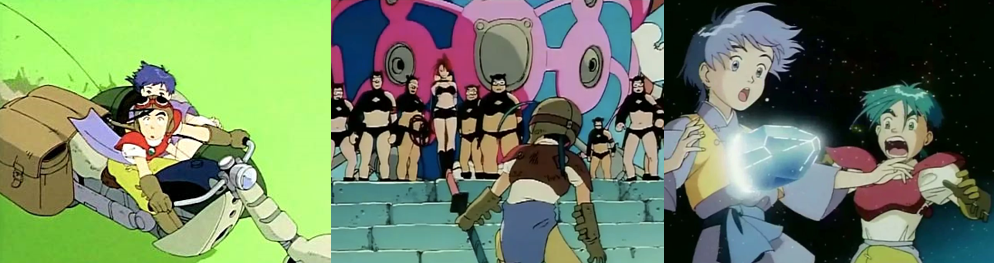
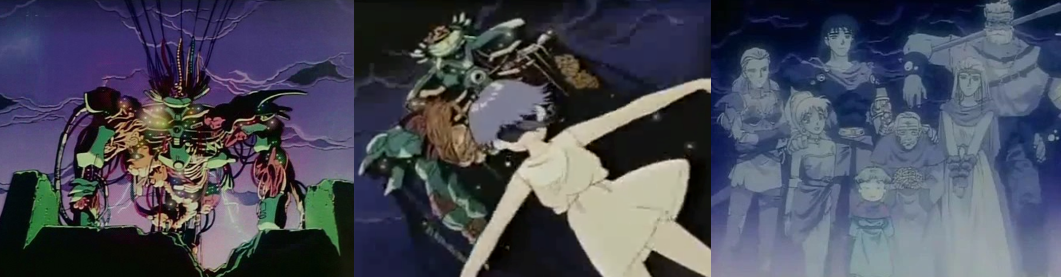
200 years ago, the Warriors of Light (or “Valiant Ones”, as they’re referred to here) defeated the mad ambitions of Exdeath (dubbed “Exodus” here) to use the four elemental Crystals of Planet R to plunge all life into an everlasting void of darkness. Since then, Bartz Klauser (here called “Batz”), Lenna Tycoon, Galuf and Krile Baldesion, and Faris Scherwiz have passed into legend, with only Batz leaving behind a legacy in his descendants, the elderly Hassam (John Hostetter) and his brave but timid daughter, Linaly. Hassam operates alongside an unnamed Blue Mage (Unknown) as a spiritual advisor to Queen Lenna (Goodson), monarch of Tycoon, who learn from the wind itself of an oncoming danger. Despite his age, Hassam is adamant about journeying to the Wind Temple to investigate, determined to live up to the standard set by his ancestor. When Linaly offers to go in his place, the two reach a compromise to travel together, but Hassam refuses to allow boisterous Prettz to tag along as Linaly’s “bodyguard”. Believing the hot-headed youth would desecrate the sacred Wind Temple (and suspecting that Prettz just wants to impress Linaly), Hassam refuses to divulge their destination or let him on their boat, despite Linaly having a soft spot for the boy. Undeterred, Prettz follows on his bitchin’, steampunk-esque motorcycle, ultimately saving them from a gigantic, insectile desert monster when his nodachi proves more effective than the gaunt, featherless Chocobo Linaly summons. Despite severing the creature’s head with one dramatic slash, Prettz fails to impress Hassam who, too injured and exhausted to continue, insists that Linaly continue by herself. With Hassam returning to their village to rest and offering spiritual guidance to his granddaughter through a mystical talisman, Prettz continues to follow Linaly, whom he has an obvious crush on. Though she steadfastly refuses his offer for a ride since she wants to honour her grandfather’s wishes to go alone, Linaly soon changes her mind when threatened by a massive airship. Piloted by treasure-hungry pirate Rouge and her all-female crew, the pirates accost them, looking to steal their bike and possessions. Although Prettz manages to elude the pirates using his riding skills and one of his trademark spiked bombs, he makes an enemy of Rouge, who vows to hunt him down and make him pay for the humiliation.

Prettz insists on accompanying Linaly and gets mixed up with a magical Crystal.

While taking refuge in a forest, Linaly reveals the true nature of her quest to Prettz and uses her talisman (and telepathic advice from Hassam) to guide them to the Wind Temple, leading them to a raging sandstorm which Prettz rushes head-first into while Linaly allows her faith to guide her. Upon reaching the Wind Temple, however, they find the shrine out of reach. Hitting upon an idea, Prettz doubles back and forces Rouge and her crew to pilot her airship into the temple valley, threatening to blow them all sky-high unless they agree. Begrudgingly, Rouge agrees and, despite her annoyance and doubts that her ship will even fit through the canyon, successfully brings Prettz to the temple’s entrance…where he finds Linaly waiting! While he was off being a show-off, Linaly investigated the area and solved the puzzle to open the way to the Wind Temple and she ventures inside with Prettz while Rouge is distracted by an incoming airship. Braving the temple’s interior, the duo locate the Crystal, which, upon contact, bombards Linaly with visions of the past and a malevolent figure and the spirits of the long-dead Valiant Ones crying for aid. Overwhelmed by the barrage, both Prettz and Linaly are powerless to keep the Wind Crystal from entering her body, where it glows ominously from her perky little butt (leading to much raunchy leering throughout the OVA). Desperate to help his friend, Prettz races from the Wind Temple, reasoning that the Blue Mage would be able to help her, only to be confronted by Valkus, the heavyset commander of the Iron Wings, the same airship that caught Rouge’s attention. Having learned that the other three elemental Crystals have been stolen and their nations have descended into chaos, Valkus and his crew flew to the Wind Temple to secure and protect the remaining Crystal. Naturally, Valkus believes Prettz and Linaly to be thieves and fires on the two when they not only refuse to return the Crystal but when Prettz also pushes his disrespectful attitude too far. Despite the Iron Wings’ bombardment and Valkus shooting at the two with his pistol, the duo topple Valkus and attempt to escape. After being grazed by one of Valkus’ shots, however, Prettz flies into a rage, only to have his sword blocked by the commander’s bare hands and the hostilities between the group ended when Rouge (who had been eavesdropping the entire time) knocks them all unconscious with gas and kidnaps them, lusting after the mysterious Crystal she heard them talking about.

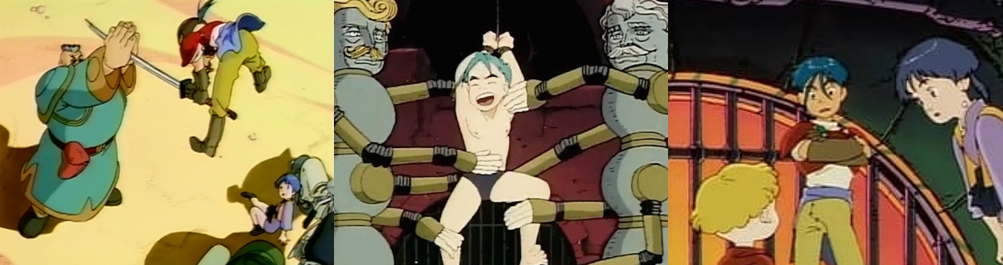
The lovelorn Valkus is locked up with the duo and learns of the impended threat from Mid.

Elated to have captured not only the kids who humiliated her so badly but also the captain of the Iron Wings, Rouge spirits her quarry to her personal island and threatens them with torture. Defiant to the end, Prettz scoffs at her threats, maintaining his insolent attitude even when Rouge subjects him to a tickle machine. When Rouge threatens to snap Linaly’s neck with her whip, Prettz attacks in a fury, only to receive a beating that renders him unconscious. The three are thrown into a cell while Rouge ponders her next strategy. Though Prettz desperately tries to break out, he receives little help from Valkus, who finds himself confused by his attraction to Rouge. While Valkus’s crew frantically search for their lost commander, following sporadic energy spikes emitted by the Wind Crystal, the prisoners are stunned when the Crystal suddenly emerges from Linaly’s chest, and the spirit of Mid Previa (Fletcher) appears before them. The grandson of Cid, an ally of the Valiant Ones, Mid’s restless spirit ignores Prettz’s insolence and drops a bunch of exposition on the captives. Sometime after defeating Exodus, Mid was heartbroken when his beloved grandfather died, taking all his secrets of the Crystals with him since he’d come to realise it was foolish to meddle with their divine power. While mourning at Cid’s grave, Mid was suddenly attacked by the same dark figure that’s been haunting Linaly’s dreams and barking orders at his robotic subordinate throughout the OVA. This demonic being, later identified as Ra Devil, desecrated Cid’s grave, stealing his brain to absorb the old man’s knowledge, and murdered Mid simply for witnessing the act. Unable to rest, Mid pleads with Linaly to keep the Crystal safe within her and reveals that the three of them (and Rouge) have been chosen by the Wind Crystal to be the new Valiant Ones destined to save Planet R from destruction. Despite Prettz’s scepticism and continued hostility towards Mid because of their shared feelings for Linaly, the group soon set aside their differences when Rouge takes Linaly to forcibly remove the Crystal from her. Thanks to spurring Valkus on with promises that he can see Rouge again if they escape, Prettz finally breaks free from the cell and is forced to follow Mid’s lead.

The rag-tag Valiant Ones must awaken a dragon to confront Ra Devil on the Black Moon.

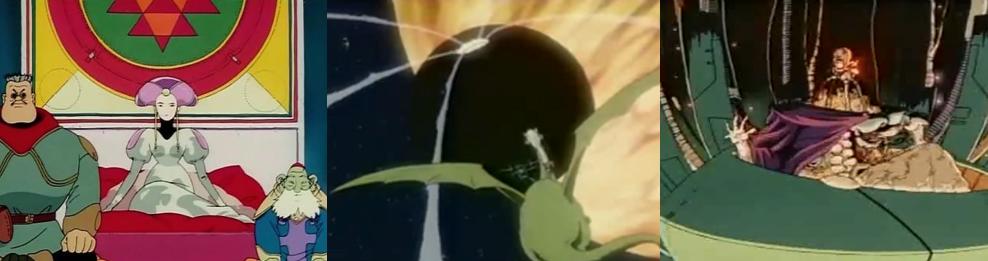
Although Rouge implied that she would surgically remove the Crystal, Prettz is stunned to find the pirate queen serving his friend laxatives! After fighting past Rouge’s guards, Prettz rescues Linaly and reunites with his bike, thanks to Mid, discovering a massive cavern filled with explosives. When their escape threatens to turn violent, Valkus intervenes to try and make peace, only for Ra Devil’s Deathgyunos forces to attack. Prettz lures the alien creatures away, claiming that he possesses the Wind Crystal and allowing the others to flee to the Iron Wings. Prettz leads the creatures to the cavern of explosives and sets off a massive explosion that leaves Rouge’s island in flames, distraught at the sight, Rouge is offered some comfort by the blushing Valkus and Linaly is overjoyed to see Prettz inexplicably survived the explosion despite being at the heart of it. Reunited on the Iron Wings, Rouge is initially outraged when Valkus is forced to put her in chains to appease his loyal crew. However, she’s soon freed per a decree from Queen Lenna, whom the group meets in person upon reaching Castle Tycoon. Queen Lenna echoes much of Mid’s earlier exposition, explaining that the rag-tag group are the last hope for the world, which will be torn apart if Ra Devil acquires the last Crystal and absorbs their powers. Although Mid confirms the villain’s threat, the group remains sceptical: Linaly doesn’t believe she’s special, Prettz refuses to believe he’s been chosen by an inanimate object, and Rouge scoffs at the idea of a pirate like her being crucial to saving the world. Only Valkus accepts his destiny and the challenge of confronting Ra Devil on his base, the Black Moon, though the others are soon coerced into helping when Queen Lenna promises Rouge a treasure trove of riches and Prettz volunteers to protect Linaly, who quietly accepts her calling to save the world. However, to reach the Black Moon, the group must first venture into the depths of Castle Tycoon to awaken their guardian deity, the flying dragon (or “Hyriuu”). While Valkus and Rouge fend off the attacking Deathgyunos forces, Prettz, Linaly, and Mid head into the catacombs beneath the palace, fending off Ra Devil’s soldiers and taking a plunge through the clouds to a hidden stone shrine to the dragon. Prettz is dismayed to find the creature is represented only by murals and a tiny, flightless lizard (though Linaly is instantly enamoured by the cute little dragon). However, when Ra Devil appears in the chamber and kidnaps Linaly, shrugging off Prettz’s attack and terrifying Mid, Prettz finds himself astride the legendary dragon when it undergoes a dramatic transformation into a titanic winged deity ready to spirit the group to the Black Moon.

The Nitty-Gritty:
Although I haven’t played Final Fantasy V yet, Final Fantasy: Legend of the Crystals is no less enjoyable both as an adaptation/continuation of the game and as an anime. Setting it 200 years after the videogame is a good way to tell a brand-new story with some original characters, though I do wonder if this may alienate or disappoint fans of the game, who only get to see familiar characters returning as spirits. The visual, action, and humour are all far more reminiscent of Dragon Ball (1986 to 1989), focusing more on touches of lewd humour (mainly with everyone staring at Linaly’s glowing butt) and a fantasy land that’s less medieval and more disparate. I’d wager some of the locations will be familiar to fans of the videogame, especially Castle Tycoon and the Black Moon, and the OVA does a decent job of recreating a few of Final Fantasy’s gameplay mechanics. The group engage in random battles, for example; Linaly is a summoner (albeit not a very accomplished one); Queen Lenna is advised by a Blue Mage; and elements of the iconic Final Fantasy theme are sprinkled throughout the soundtrack. Airships are also few prominent and Linaly’s shown to be able to summon Chocobos. They don’t resemble the cute, furry beasts from the games, but this is attributed to Linaly not having fully realised her power. Each of the new Valiant Ones also has a “class” just like in the classic games, with Prettz being a swordsman, Linaly a mage, Valkus a marksman, and Rogue basically being a thief. Finally, there’s the obvious plot point of them safeguarding magical Crystals (specifically the Wind Crystal), which are so powerful and integral to Planet R that their absence causes nations to fall into ruin. Indeed, Queen Leena warns that simply protecting the Wind Crystal isn’t enough and that the world will end if the other three aren’t recovered, much less if their powers and corrupted by Ra Devil.

The OVA is bolstered by some fun action and amusing moments between the heroes.

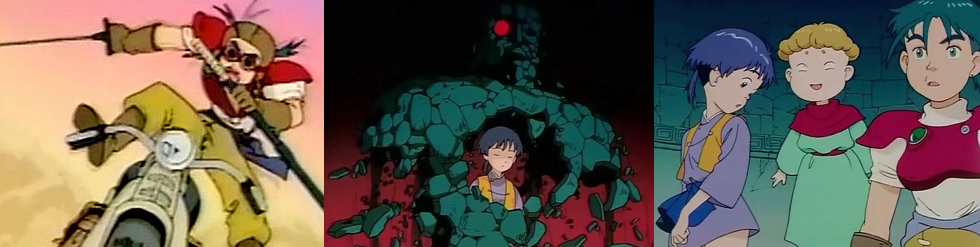
Ra Devil is an indistinct and vague threat who spends the first three parts of the OVA barking orders from his Black Moon base and resembling little more than a shadowy, vaguely cybernetic/demonic figure. When he appears before Mid and Linaly, he cuts an intimidating if generic and stoic figure, conveying his menace through desecrating Cid’s grave, murdering Mid, and kidnapping Linaly. Rather than being Exdeath Exodus reborn, Ra Devil is a seemingly alien threat who leaves the heavy lifting to his Deathgyunos soldiers, a nigh-endless swarm of demonic creatures who have the numbers advantage but are routinely cut down by Prettz and Valkus. There’s some enjoyable anime action in this OVA, especially when Prettz blasts about on his motorcycle or busts out his sword (something that, sadly, doesn’t happen all that often). The airships are suitably impressive, being immaculately detailed, and I enjoyed the mixture of action and comedy in most action scenes. Rouge’s “torture” turning out to be tickling and prune juice was amusing, as was Mid constantly winding Prettz up by comparing him to a dog and being immune to his physical reprimands. Although the attraction between Prettz and Linaly isn’t dwelled on all that much and is mainly conveyed through his willingness to endure any hardship to protect her, I enjoyed Valkus’ adoration of Rouge, which left the big man a blushing mess whenever the sultry pirate was around. The mismatched Valiant Ones make for quite the odd partnership; they’re often plagued by doubts or bickering between each other rather than battling Ra Devil’s forces. While only Valkus and Mid (and, to a degree, Linaly) understand the true scope of Ra Devil’s threat, even Rouge is convinced to help save the planet when she’s presented with riches. Prettz may be a sceptic and have an unruly demeanour, but he’s loyal to Linaly almost to a fault, volunteering for dangerous missions without truly understanding what he’s up against and taking on foes and even natural disasters with only his moxie and bombs to back him up. Though he knows when to flee a confrontation, Prettz is quick to join a fight if insulted or if Linaly is in danger and impresses with his defiant spirit. This contrasts with Linaly’s more subdued characterisation and leads to some fun interactions between him and his rag-tag cohorts.

Ultimately Linaly bests the God-like Deathgyunos, saves the world, and honours her ancestors.

Despite none of their airships being protected against the vacuum of space, the flying dragon hauls Valkus and Rouge’s crafts into the void, leaving Rouge and her crew stunned to discover Planet R is round rather than flat. Upon spotting the Black Moon, Mid is dismayed to find that Ra Devil’s plot is already underway. After wandering the universe in search of the ultimate power, the half-crippled demonic entity built an ominous base on the Black Moon and hooked the three Crystals up to an elaborate machine. With Linaly in place alongside Cid’s severed brain, Ra Devil begins siphoning the Crystals’ energy to channel the cosmic power of the universe into his very being! While his minions cry out in joy as Ra Devil slowly absorbs the power and knowledge of the universe, a lightning bolt causes our heroes to crash to the Black Moon’s surface, which is both hospitable and strewn with debris. After ordering her crew to repair the damage and nurse the dragon back to health, Rouge joins Prettz, Valkus, and Mid in tracking Linaly using her talisman (which Prettz retrieved in the dragon’s chamber) and Cid’s desperate pleas. When Ra Devil completes his transformation into Deathgyunos, the “God of Oblivion” (a titanic Eldritch abomination of organs and metal), Valkus and Rouge return to their airships to counterattack his forces, leading to Valkus flying into a rage when Rogue is wounded and his ship to be destroyed in an ultimately futile attempt to bring the behemoth down. Although Prettz rescues Linaly, he’s attacked by her thanks to Deathgyunos’ influence and it’s only through Mid’s intervention that the girl is brought to her senses. After Valkus’s men retrieve the other three Crystals and Mid reunites with his grandfather’s brain, Mid stalls Deathgyunos’ advance to allow his newfound friends to escape. Undeterred and seemingly unkillable, Deathgyunos continues, relentless in its desire for complete obliteration and torturing Prettz after the Wind Crystal joins with him. Though Valkus destroys the abomination’s hand, Linaly’s left to confront the creature alone when it subdues her friends with its energy blasts. Summoning a flock of Chocobos, Linaly rips Deathgyunos to shreds, leaving it vulnerable to Prettz’s final sword slash. Victorious, the newly formed Valiant Ones bid a fond farewell to Mid, who crosses over to be with his grandfather and friends, before returning home. Linaly relates their adventure to Hassam, who reacts with awe and pride, and the OVA ends to show Vulkus joining Rouge’s pirates to be with his sultry queen.

The Summary:
It’s a shame that Final Fantasy: Legend of the Crystals isn’t more readily available. The best you can hope for are poor transfers on video streaming sites or maybe a battered VHS copy. It really should be more widely available and I’ve never understood why it isn’t, especially as Final Fantasy and anime fans would probably lap it up. This is a really fun OVA with a lot of amusing moments and memorable characters. I really liked how hot-headed and brazen Prettz was, how he treated everyone except Linaly with such a smart-mouthed disdain and how he impressed with his defiant, never-say-die attitude. He charges into situations without thinking, full of piss and vinegar, and never betrays his friends, no matter the situation. Linaly was probably my least favourite character since she’s so sombre and laid back. Though I enjoyed the relationship between her and Prettz, I would’ve liked to see more of her struggling with her ancestry. Valkus and Rouge were also great; I loved how the big, bossy oaf was left a blushing schoolboy whenever Rouge sauntered about and how mischievous and roguish the pirate queen was. Mid also proved an enjoyable foil for Prettz, even if he’s mostly there for exposition and as a link to Final Fantasy V. Again, I suspect the large gap between the game and the OVA may be disappointing to fans of Final Fantasy V as it may as well have just been a standalone Final Fantasy story since it’s so far removed from Final Fantasy V. I suspect the biggest issue from this is with Ra Devil, a painfully generic threat compared to Exdeath, though he at least visually makes up for it by transforming into a nigh-unstoppable Lovecraftian monstrosity at the end. I would’ve liked to see more from Ra Devil, perhaps have him physically interact with the heroes a bit more, and maybe create a link between him and Exdeath based on their shared desire for destruction. Similarly, while I enjoyed that much of the conflict came from the mismatched Valiant Ones learning to co-operate, it would’ve been nice to see a few more action scenes to show off the gorgeous animation. Otherwise, Final Fantasy: Legend of the Crystals is a lot of fun and has a lot to offer. It’s definitely worth seeking out and petitioning for an official release for, if only to drag it out of obscurity so I can stop thinking of it as a “hidden gem”.

My Rating:

Rating: 4 out of 5.

Great Stuff

Have you ever seen Final Fantasy: Legend of the Crystals? Were you disappointed that it was set 200 years after Final Fantasy V or did you enjoy the new characters? Which of the new Valiant Ones was your favourite and what did you think to their interactions? Did you like Ra Devil and how do you think he compares to Exdeath? Would you like to see the OVA be more widely available or do you think it deserves to be forgotten? What was your introduction to anime and how are you celebrating National Anime Day today? Whatever your thoughts on Final Fantasy: Legend of the Crystals, or anime in general, feel free to share them in the comments, support me on Ko-Fi, and go check out my other anime and Final Fantasy content.

Movie Night [National Anime Day]: Death Note Relight 1: Visions of a God


15 April has been designated National Anime Day to celebrate the stylistic genre, which achieved mainstream success thanks to animators like Osamu Tezuka.


Released: 31 August 2007
Director: Tetsurō Araki
Distributor: Madhouse
Budget: Unknown
Stars: Brad Swaile, Alessandro Juliani, Brian Drummond, Shannon Chan Kent, and Chris Britton

The Plot:
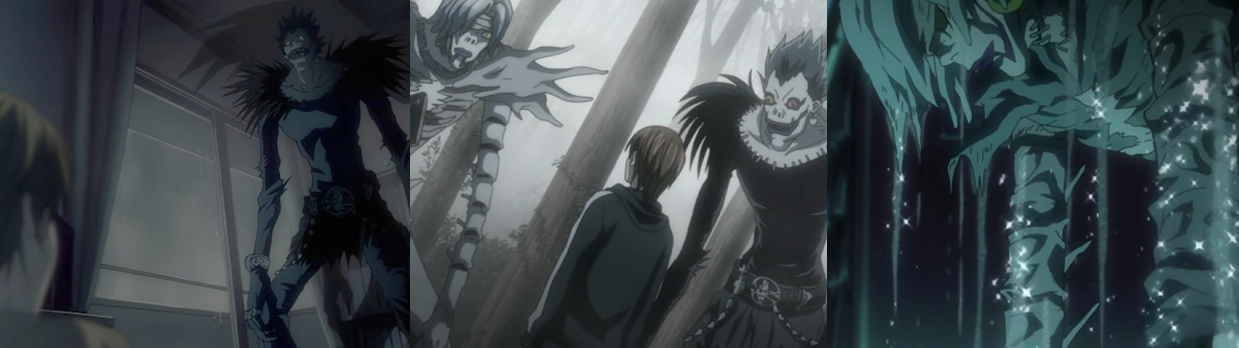
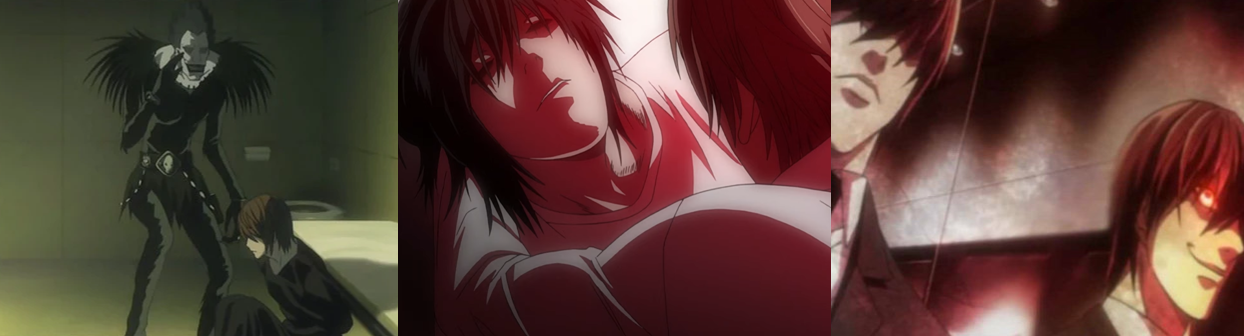
In the Shinigami realm, the mischievous Ryuk (Drummond) regales his fellow Death Gods with tales of his time in the human world, specifically the complex game of cat-and-mouse between Light Yagami (Swaile), who used Ryuk’s killer notebook to punish criminals, and the eccentric “L” (Juliani), a detective determined to bring Light’s alter ego, “Kira”, to justice.

The Background:
Death Note (stylised as “DEATH NOTE”) was a manga created by author Tsugumi Ohba and illustrated by Takeshi Obata that began as a very broad and basic concept regarding Shinigami and a series of strict rules. Ohba and Obata developed a system where they would draft storyboards alongside their editor; Ohba visualised the panels during his downtime and Obata was apparently afforded a great deal of creative freedom for his artwork. Published in Weekly Shōnen Jump between 1 December 2003 and 15 May 2006, Death Note was incredibly successful and widely praised for its art, compelling characters, and complex plots and was so popular that it received an equally well-regarded thirty-seven episode anime between 3 October 2006 and 26 June 2007 and two highly praised live-action, Japanese adaptations. To coincide with the end of the anime, two feature-length specials were produced that retold the story, with new footage linking the condensed format. Many have criticised the films for simply existing as a recap of the anime and a shameless cash-grab, ones that might do a good job of telling a more concise story but ultimately have little appeal for those that have already watched the entire anime series.

The Review:
If you’re familiar with the anime version of Death Note, then Death Note Relight may hold few surprises for you; the bulk of the special’s runtime is made up of re-edited scenes and sequences from the anime, recontextualised into a condensed version of the story that acts as both a celebration of the anime and a fantastic way to digest its first twenty-six episodes or so. Death Note Relight is framed as a flashback, of sorts, a tale told by Ryuk to another, unnamed Shinigami (Unknown) who is bored of their realm and wishes to hear stories of Ryuk’s time on Earth before heading there himself. Although unimpressed by the Shinigami’s gift of a rotten apple, Ryuk agrees to share his tale and the story quickly introduces us to budding criminologist Light Yagami who, angered by the various injustices sweeping the world, vowed to stamp out crime and change society for the better using the titular Death Note, a notebook from the Shinigami world that allows the writer to kill and alter the lives of any names written in its pages, in order to become a God of a new world order.

Using Ryuk’s Death Note, Light executes criminals in order to establish a new world order as “Kira”.

A genius prodigy, Light found himself easily bored in classes and by his academic success; although his curiosity was aroused when the Death Note randomly fell from the sky to the campus grounds, he believed the notebook to be a sick prank but couldn’t help himself from trying it out based on the helpful instructions written inside. Realising that the notebook was legitimate, Light soon found himself consumed by a murderous need to punish evildoers everywhere, and quickly overcame his horror at Ryuk’s appearance, apparently ready to face the consequences of his actions with a blasé arrogance. However, even Light was stunned to find that Ryuk approached him not to punish him, but to enjoy the show, with the only consequences of using the notebook being that Ryuk himself would take Light’s life when the time came and the would-be God would be trapped in purgatory afterwards. Despite these warnings, Light continues to use the Death Note to punish those he deems guilty and quickly becomes renowned as a bringer of justice, with his followers dubbing him “Kira” and praising his actions and swift brutality. Although he isn’t happy with the pseudonym, Light can’t help but be pleased by the following he builds and the influence he’s already having, but his joy is short-lived when he’s publicly challenged by the secretive and equally intelligent private detective “L”. Slighted by accusations of his methods, Light doesn’t hesitate to try and kill L, switching from a twisted sense of moral justice to a manic desire to prove his superiority over his newfound rival, even if it means murdering lawmen or those who dare to speak out against his divine actions.

The eccentric L’s suspicions about Light are accurate but he’s frustrated by a lack of evidence.

Naturally, Kira’s actions quickly attract the attention of the International Criminal Police Organisation (ICPO), who were so confused and frustrated by the random series of heart attacks and murders of criminals that they quickly embrace L’s input despite his controversial methods and odd behaviour. An enigmatic figure whose deductive skills are as legendary as his arrogance, L both shocks his colleagues, including Light’s father, detective superintendent Soichiro Yagami (Britton), and impresses Ryuk with his ability to outsmart Light using body doubles, aliases, and distorted voices. Soichiro and his staff are stunned to find that L (who allows them to address him as “Ryuzaki”) is an emaciated, pale, soft-spoken young man with a penchant for sweet treats provided by his handler, Watari (French Tickner). Regardless, L exhibits near-superhuman insight into the Kira murders; simply by observing Kira’s methods, L accurately deduces Kira’s personality and basically everything about him except for how he executes his victims and his true identity. Naturally, volunteers are few and far between since many quit the case to avoid being targeted by Kira, leaving L with Soichiro and a handful of his most loyal officers at his disposal and L somewhat alienates even these men when he proposes closely monitoring them and their families since he suspects that Kira is closely linked to the police department. This leads to surveillance cameras being placed around the Yagami house and public messages being broadcast to try and flush Kira out but, thanks to Ryuk, Light is fully aware of this and goes to great lengths to continue his studies and his vigilante actions while appearing to be just a fastidious student. Though impressed by this, L remains convinced that there’s more to Light but is frustrated by a lack of evidence, and ultimately agrees to officially bring Light into the investigation when the even more dangerous “Kira II” appears.

Guided by Rem, Kira fanatic Misa will do anything, even kill and shorten her life, to earn Light’s love.

At first, Light is fairly routine in his approach to the Death Note and is content to allow his victims to die of simple heart attacks; however, once he learns of the police investigation into Kira, he starts to become more elaborate and complex in his methods. He threatens Federal Bureau of Investigation (FBI) agent Raye Penbar (Michael Adamthwaite) and his family with death to learn the names of every FBI agent assigned to the case (and then kills him anyway), which sets his fiancée, Naomi Misora (Tabitha St Germain), on a path of vengeance against Kira. A coincidence of fate sees Light cross paths with Naomi, whose attempts to protect herself with a fake name fail spectacularly when Light emotionally manipulates her into trusting him with her true name, thereby allowing him to compel her to kill herself through the Death Note’s power. Thanks to the Death Note’s ability to alter the lives and destinies of those written in it, Light covers his tracks and picks off both criminals and police officers alike to continue operating as Kira, but even he lacks the “Shinigami Eyes” that Kira II, beloved celebrity Misa Amane/Misa-Misa (Kent), possesses. A Kira fanatic who believes so strongly in his work that she’s willing to indiscriminately murder police officers and anyone who dares to speak against Kira, Misa owes her life to the diminutive Shingami Gelus (Michael Dobson), who broke a cardinal rule of his kind and saved her life at the cost of his own; out of loyalty to Gelus, Rem (Colleen Wheeler) guides and protects Misa on her quest to join forces with Kira. Thanks to the Shinigami Eyes, she’s able to seek out Light and pledges to follow his every word if he agrees to be her boyfriend, even entrusting him with her Death Note and happy for him to use her however he sees fit out of appreciation for him, as Kira, unwittingly punishing the man who killed her parents.

The Nitty-Gritty:
The Death Note Relight films are, so far, my only exposure to the anime version of the manga and, from what I’ve seen, there’s certainly enough visual impetus to check out the anime; in fact, the only reason I haven’t yet is simply due to lack of time. The animation and level of detail in Death Note Relight is truly astounding, however; the Shinigami realm, in particular, is a notable highlight. A realm of desolate darkness, gothic architecture, and a veritable bone graveyard as far as the broiling grey clouds allow you to see, the realm is a bleak, nightmarish landscape where the Shinigami sit around, toiling with boredom and unable to find a decent meal. The human world is equally impressive; there’s a fantastic use of lighting and shadows, especially whenever Ryuk appears or Light’s obsessive demeanour is explored, which effectively showcases that Light is seeping further and further into the darkness of the Shinigami world he more he experiments with the Death Note’s capabilities and the more his morality deteriorates. This is also emphasised in the constant framing of eyes; L’s are always half-open and shrouded in shadow, either due to poor natural light or his mop of hair, while Light’s dramatically change colour to an ominous purple-red whenever he’s conspiring to kill to revelling in his sadistic form of justice.

Even the impressive and aloof Shinigami end up subjected to Light’s malicious machinations…

As ever, the most visually impressive and thematically intriguing aspect of Death Note, for me anyway, are the Shinigami; Ryuk appears as a towering, gaunt, gothic figure, never blinking and with a permanent shark’s grin on his face. He observes and comments upon Light’s actions with an unbiased glee, delighting in Light’s murderous actions, and becomes deeply invested in the game of cat-and-mouse between him and L simply because it provides him with a source of amusement for the first time in ages. However, while Ryuk follows Light about, hovering over his shoulder unseen by anyone who hasn’t touched the Death Note, he certainly doesn’t play favourites; he can see the names and life span of others with his Shinigami Eyes but only offers to share this gift in exchange for half Light’s natural life, and rarely offers Light any assistance simply because he finds it amusing to see how Light deals with each obstacle in his path towards Godhood. However, Light coerces the omniscient Shinigami’s assistance in locating the surveillance devices placed throughout his house by threatening to deny Ryuk his beloved apples, which have the same addictive properties to Shinigami as alcohol and cigarettes, showcasing that even a God of Death isn’t beyond Light’s scheming. Ryuk is contrasted by Rem, the skeletal, androgynous (but clearly more recognisably female) Shinigami who has vowed to protect Misa in Gelus’s place. Unlike Ryuk, Rem is far more protective of her Death Note handler; she reluctantly wipes Misa’s memory when she’s held in captivity, threatens to kill Light if he doesn’t find a way to rescue her, actively intervenes to protect her when she infiltrates the Yotsuba Group, and reveals to L and the other officers that Light has been fooling them with fake rules. Rem is horrified both when Misa further shortens her lifespan by dealing with Ryuk and when she realises that Light has manipulated events to take her out of the equation, forcing Rem to kill to keep Misa alive, destroying herself as a result and galvanising Light’s sense of superiority over even the Shinigami.

The intriguing dynamic between Light and L remains despite the special rushing through certain events.

Due to Death Note Relight being comprised of snippets and key moments from the first twenty-six episodes of the anime, there are some issues with the special’s pacing; while I’m familiar with the general story thanks to the live-action films and anyone who’s watched the anime would be able to follow along without much issue, the uninitiated may be put off by how the special breezes through certain aspects of the story, jumping from beat to beat to recap the most narratively important aspects of the anime. Consequently, there’s a disconnect regarding Light’s character, for example; we don’t really get to see him before he acquires the Death Note, which means he appears far more malevolent and self-centered rather than tragic and morally corrupt. A lot of L’s initial mystery is quickly swept aside when Ryuzaki reveals himself so he can work more effectively with Soichiro’s task force, and even Misa’s introduction feels a little rushed considering how important she is to the second half of the story. Regardless, the essential intrigue of Light’s descent into egomaniacal obsession and his tense back and forth with L remain in Death Note Relight; both know so much about each other and yet so little, specifically their true identities, either of which would result in ultimate victory for the other. Light gains a significant advantage when he agrees to team with Misa, but his attempts to manipulate events so he can discover L’s real name are compounded by L’s suspicions about him, which means Light can’t just arrange L’s death without incriminating himself, and L’s incarceration of Misa since she’s far less adept at covering her tracks than Light.

Light’s manipulations put him on track to becoming the God of the new world.

This would spell victory for L if Misa didn’t willingly forfeit her ownership and memories of the Death Note in order to protect Light; however, L is baffled when Light willingly allows himself to be incarcerated and briefly succumbs to despair after his deductions seem incorrect. When Light suddenly changes his demeanour after giving up his own memories as part of a complex plot to manipulate events in his favour, a brief scuffle breaks out between the two that ends with Light being chained to L and uncovering a link between Kira and the Yotsuba Group, which has profited from the killings perpetrated by Light’s patsy, Kyosuke Higuchi (Andrew Kavadas). Higuchi plots to use the Death Note to take over Yotsuba and coerce Misa into marrying him and, when he’s apprehended following an action-packed car chase, L and the others finally learn about the Death Note and the presence of the Shinigami. L is so stunned by this that he completely misses that Light has undergone another dramatic change after reacquiring the Death Note; regaining all of his memories, Light revels in his victory and intellectual superiority, though his plot to murder L stumbles when Misa’s unable to recall L’s true name, forcing her to reduce her lifespan even further to earn Light’s love and respect. Just as L attempts to test the rules of the Death Note, he’s aghast when Watari suddenly dies of a heart attack and all their data is deleted thanks to Rem, who sacrificed her existence to ensure Misa’s safety. Rem also writes L’s name in the Death Note, killing the eccentric and tragic detective and awarding Light ultimate victory. Light plays the part of an enraged, grieving victim well but, once the mourners disperse from L’s grave, Light descends into maniacal laughter; he boasts of his triumph and superiority over his rival and promises to entertain Ryuk further with the creation of his new world. The special comes to an end with Ryuk ruminating over Light’s perceived Godhood and wishing the unnamed Shinigami well in his search for excitement on Earth after all his experiences with Light.

The Summary:
As I mentioned at the beginning of this review, I just don’t have the time or motivation to sit down and watch every episode of the Death Note anime, especially if I was to put together an in-depth review. So, for me, Death Note Relight 1: Visions of a God is a fantastic way to experience the general sense of the anime’s story in a relatively painless two hour stint. I make this distinction only because it can’t be denied that the story suffers a bit from the re-edit; if I were to go into this completely blind, I might find some of the characters a bit one-dimensional, the lore of the world a little undercooked, and the pacing a bit suspect as the story jumps between a series of barely-connected events without much cohesion. However, I am initiated so this isn’t a massive issue for me and all the things I love about Death Note are here, from Light’s unbearable smugness, L’s quirky demeanour, and the always impressive Shinigami. The moral implications of the Death Note and Kira’s actions aren’t delved into too deeply (he’s simply seen as a murderer who needs to be stopped, regardless of who he’s targeting), robbing Visions of a God of some of Death Note’s normal nuance, but the character study and dynamic between Light and L is still fascinating to watch. The sequences are all gorgeously animated as well, with fantastic use of atmosphere and a hard rock soundtrack to give even tense dialogue a bit of a punch, and it ends on a cliff-hanger that’s just enticing enough to encourage a watch of the second part. Overall, I think there’s a lot to like here for die-hard and casual Death Note fans alike but Visions of a God is a must-have for anyone who’s a fan of the series but doesn’t want to waste an entire weekend binge-watching the anime.

My Rating:

Rating: 4 out of 5.

Great Stuff

What did you think to Death Note Relight 1: Visions of a God? Did you think it was a bit pointless considering the entire story was told in the anime series or did you enjoy the condensed story? What did you think to Light, his campaign against crime, and his tense rivalry with L? Which of the Shinigami is your favourite and how would you use a Death Note? What was your introduction to anime and how are you celebrating National Anime Day today? Whatever your thoughts on Death Note, or anime in general, feel free to share them in the comments or on my social media.

Movie Night [National Anime Day]: Street Fighter II: The Animated Movie


15 April has been designated National Anime Day to celebrate the stylistic genre, which achieved mainstream success thanks to animators like Osamu Tezuka.


Released: 6 August 1994
Director: Gisaburō Sugii
Distributor:
Toei Company
Budget: $6 million
Stars:
Hank Smith, Ted Richards, Mary Briscoe, Donald Lee, Steve Davis, and Phil Matthews

The Plot:
M. Bison (Matthews), the vicious and powerful head of the notorious Shadowlaw syndicate, is brainwashing street fighters across the world to carry out assassinations and has his sights set on Ryu (Smith), a formidable martial artist who bested one of Bison’s lieutenants. When he’s unable to track Ryu down, Bison targets Ryu’s friend and sparring partner, Ken Masters (Richards), and Ryu finds himself joining forces with Captain Guile (Lee) and Interpol agent Chun-Li (Briscoe) in an effort to track down Bison and stop his mad schemes.

The Background:
In 1987, Capcom brought the very first Street Fighter to arcades across the world; conceived of by Takashi Nishiyama, who sought to expand upon the boss fights of Kung-Fu Master (Irem, 1984) and inspired by The Game of Death (Lee, 1972), Street Fighter stood out from other videogames by utilising unique pressure-sensitive pads for its controls but was generally met with widespread criticism for its graphics and gameplay. Undeterred, Capcom chose to develop a sequel that expanded on the alternative, six-button control setup; Street Fighter II: The World Warrior (Capcom, 1991) expanded on everything from its predecessor, from the graphics to the roster of playable characters, and took the world by storm, ushering in an entire sub-genre dedicated to competitive fighting games that only expanded further when the game was bolstered by ports and upgrades. Such was the popularity of Street Fighter II that Capcom began expanding their franchise outside of the videogame industry; Street Fighter II: The Animated Movie was not just the first anime film I ever saw, but also the franchise’s first foray into animation. The slickly animated anime  couldn’t have been more different from the much-maligned live-action adaptation that released in the same year; it became one of the top-grossing films of that year in Japan and is widely regarded as one of the best videogame adaptations ever produced.

The Review:
I have a bit of a confession to make…I’m not actually a massive fan of the Street Fighter franchise. Sure, I researched it and wrote extensively about it for my PhD, but my actual experience with playing the games is quite limited. I grew up playing Street Fighter II on the Amiga, and my version was “cracked” so it had all kinds of helpful cheats to make playing through it a doddle. When I moved on to Super Street Fighter II: The New Challengers (ibid, 1993) and Street Fighter II’: Special Champion Edition (ibid, 1993), I didn’t have the benefit of any cheats so my tactic to just blindly flailing away as Blanka or Ken didn’t really amount to a whole hell of a lot. To this day, I struggle with the franchise, which is so dependent on frame cancels and complex button combos, but I do have an affinity for it and that’s mainly down to the glorious slice of cheese that was the live-action adaptation and this slick, beautiful anime that not only introduced me to the concept of anime but remains, for me, the quintessential Street Fighter II adaptation.

After defeating Sagat, Ryu looks for inner peace while Ken struggles to find a real fight.

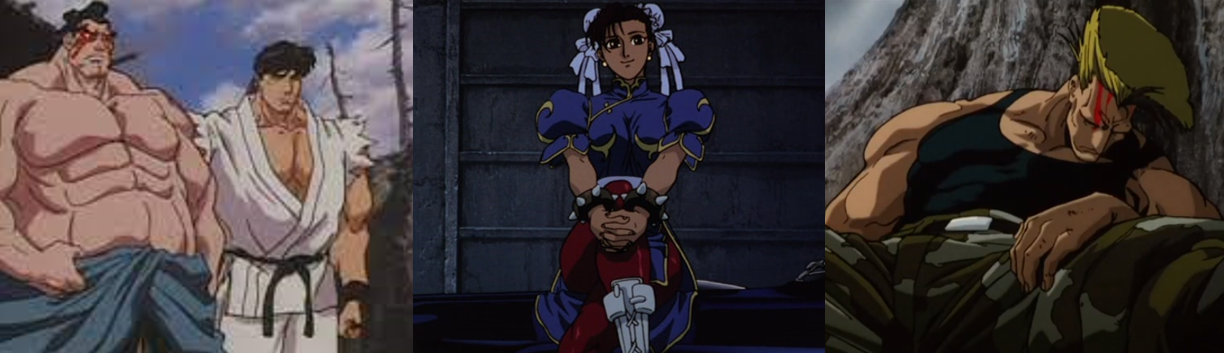
Street Fighter II: The Animated Movie begins with a brief prologue, which takes place between the opening credits. Framed very much like the iconic opening of Super Street Fighter II: The New Challengers and bolstered by some rocking electric guitar chords, we are introduced to main character Ryu at conclusion of his violent battle against Muay Thai champion Sagat. Despite Sagat’s mountainous size and incredible speed, Ryu is able to match him blow for blow and even counter his ki-based attacks with one of his own, a devastating  Shōryūken that splits open Sagat’s chest and leaves him with a humiliating scar throughout the remainder of the movie. Driven to a mindless rage by the disgrace and his inability to put Ryu down, Sagat charges head-first into the blast of Ryu’s Hadōken, which puts Sagat down and earns Ryu worldwide respect as one of the world’s most powerful fighters. However, in the time following this fight, Ryu has become a nomad; travelling the world learning to focus his ki and carrying with him the lessons of his master (George Celik) and memories of sparring with his friend, Ken, Ryu makes a point to help others in need but, despite his fantastic abilities and fighting potential, is haunted by his master’s unanswered riddle: “What do you see beyond your fist?” In their youth, Ryu and Ken were like brothers; they constantly trained together, and Ken’s more playful, carefree nature often clashed with Ryu’s more pragmatic and focused mindset. While Ryu dropped off the face of the earth, Ken is a much more public figure who regularly participates in street fights for cash. Not that he really needs the money, judging by his fancy sports car; instead, Ken fights to try and find an opponent worth his time and effort, and is continuously disappointed to find that nobody can give him a fight quite like his old sparring partner. Despite the affections of the beautiful Eliza (Toni Burke), Ken is just as haunted by this lack of competition as Ryu is by his master’s riddle, and vehemently declines to fight glory hounds like T. Hawk (Richard Cardona) since he sees it as a waste of his time and skills. Since Bison’s unable to locate Ryu, he targets Ken, whose fighting potential is theorised to be equal, and personally arrives to “recruit” him into his organisation. Ken’s desire for a real fight is more than met when Bison comes calling and he’s easily overwhelmed and subjected to Bison’s intense and horrific mind control powers, transforming him into a violent and mindless assassin.

E. Honda adds a bit of levity, but sadly Chun-Li gets sidelined and Guile gets wrecked by M. Bison.

While wandering the world, Ryu is pushed into an underground fight by a raucous crowd, instantly besting his opponent with a headbutt to the nose. This attracts the curiosity of Fei Long (Phil Williams), a champion of the underground fight scene who has since become an arrogant and successful action movie star. Fei Long would much rather get into the ring with Ryu than heed the call of his director (Kevin Seymour) but, while he’s a talented and agile fighter with his own mastery of ki, Fei Long’s ego means he doesn’t know when to quit and results in him being badly beaten and defeated by Ryu. Still, the two find a mutual respect for each other from the fight and Fei Long gives Ryu the rundown on where Sagat headed after his defeated, bringing Shadowlaw to his attention for the first time. Ryu’s travels then take him to Calcutta, where his ki arouses the attention of Dhalsim (Don Carey) and intrigues him so much that he forfeits his fight against E. Honda (Patrick Gilbert). A bombastic and aloof sumo wrestler, E. Honda is the film’s comic relief and he offers both shelter for Ryu out of a sense of brotherhood and amusing commentary on the film’s events. The main plot kicks in right after the opening credits, when government minister Sellers (Peter Brooks) is brutally executed in front of a gaggle of reports and eyewitnesses. The assassin was Cammy White (S. J. Charvin), an MI6 special agent who was brainwashed into becoming a terrorist for Shadowlow, an underground criminal organisation that seeks out street fighters and subjects them to torturous mind control. Heading the investigation into Shadowlaw is Chun-Li, a pragmatic and committed Interpol agent who almost immediately clashes with Guile, who holds a personal vendetta against Shadowlaw’s head honcho, M. Bison, after he killed his best friend. Guile’s abrasive attitude and refusal to cooperate winds Chun-Li up, but they soon reach an understanding after she shares with him that she also has a personal stake in the investigation as Bison killed her father. Unlike the live-action movie, though, neither Chun-Li nor Guile really have that much impact on the plot; despite having the most personal investment in Bison’s schemes, they’re merely supporting characters there to deliver exposition on Shadowlaw, and Chun-Li ends up being hospitalised after a brutal attack. Guile does show up for the finale and gets to engage with Bison, but is pitifully cast aside with very little effort on Bison’s part and left a broken, helpless mess at the bottom of a ravine, leaving the heaving lifting to the real main characters of the franchise Ryu and Ken.

M. Bison is a cruel would-be dictator who bends others to his will with his extraordinary powers.

Bision’s cyborgs constantly monitor the street fighters, giving us a rundown of their fighting potential, strength, reflexes, and other statistics and keeping him a persistent and ominous presence throughout the film despite the fact that he only really appears sporadically. When he’s introduced, Bison is flanked by his three lieutenants (Sagat, Balrog (Joe Michaels), and Vega (Davis)) and cuts quite the intimidating figure; a massive muscle-bound freak garbed in a glorious cape, Bison strides through his hidden facility with purpose and wears both a constant grimace and stoic expression. Tellingly, both Bison and Sagat are completely devoid of pupils, giving them a demonic air; but where Sagat is a mostly silent underling whose only spark of individuality is his lust to settle the score with Ryu, Bison is a malicious individual who demands results and doesn’t tolerate any questions or insubordination. Cold-hearted and cruel, Bison thinks nothing of breaking minds with his “Psycho Power” or discarding his “puppets” once they’ve outlived their usefulness. Bison’s abilities are portrayed as near limitless and incredibly powerful; he exhibits a degree of psychic power, being able to lift and toss people around with his mind and can easily bounce back projectiles and move faster than the eye can track. Essentially superhuman and untouchable, Bison relishes the thought of toying with and punishing his prey, so drops his power down for the finale and yet remains a fearsome opponent even when the odds are stacked against him.

The sadistic Vega lays an unsettlingly and brutal beating on Chun-Li to take her out of action.

Bison’s mercenaries are a strange bunch; despite his big introduction in the anime’s prologue, Sagat is basically a non-factor throughout the film and his vendetta against Ryu has absolutely no impact on the film (he doesn’t even fight Ryu again, or appear in the finale). Similarly, Balrog really doesn’t get much of anything to do except stand around, look good in a tuxedo, and trade blows with E. Honda at the end. Thus, the standout from the group is easily Vega; hiding behind his blank mask and carrying a nasty claw, Vega’s physical threat is matched only by his perverse nature; he and Bison drool over security footage of Chun-Li and Vega takes a sadistic pleasure in targeting her right after she’s finished showering (making for one of the anime’s most memorable moments of full frontal nudity and, of course, a fight sequence where Chun-Li is brutalised while wearing very little). Fast and vicious, with a bloodlust that matches his sick fantasises, Vega mercilessly slices and beats on Chun-Li, licking her blood from her claws and overwhelming her but, of course, his greatest weakness is his narcissism; when Chun-Li attacks his exposed face, he flies into a rage that ultimately proves his undoing, as she’s able to summon the last of her strength to kick him out of a window. Although it’s stated that Sagat chose to work for Bison, presumably to get the power and opportunity to fight Ryu again, Bison subjects his underlings to the full extent of his Psycho Power, in conjunction with a sophisticated machine, to twist and individual’s mind into that of a cold, vicious servant. This easily allows him to prey on Ken’s passion for fighting and relationship with Ryu and fashion him into a replacement for Vega, but he underestimates the depth of the bond between the two friends and unwittingly brings about his own end as a result.

The Nitty-Gritty:
To clarify (and no doubt upset all the anime purists” out there), I am watching (and pretty much always watch) the American dub of Street Fighter II: The Animated Movie. There are, however, some fantastic benefits to this; first and foremost is the inclusion of songs from bands like Korn, Alice in Chains, and Silverchair and, perhaps even more memorably, some fantastically memorable lines from the dubbed script. Sure, Ken’s delivery is a little weird at times and Ryu’s very American for a Japanese guy, and there’s nothing to match or better Raul Julia’s iconic lines from the live-action adaption, there are some brilliant lines here: Ken scoffing at Bison and killing him “buffalo” is hilarious, as is Guile pointlessly and awkwardly flexing his muscles while vowing to avenge Chun-Li. Guile delivers again in the finale, when he promises to “rip [Bison’s] fucking heart out” and Bison wonderfully taunts him with this line soon after; Bison also delivers a brilliant callous “I don’t give a shit; if her jobs finished, she’s finished!” that’s equalled only by E. Honda’s random outburst of “I gotta kill this nut before I kill myself” and he and Balrog hilarious screaming “Oh shiiiiit!” while tumbling off a cliff edge!

The film is very violent and full of some tantalisingly adult content.

Although the lighting in anime is very dark at times, this actually gives it a real mood; the film is surprisingly adult and serious, especially compared to its live-action counterpart, and the fights are slick, fast, brutal, and beautifully animated. Guile is introduced at an airbase that greatly resembles his stage and the characters are all ripped right from the videogame artwork and all wear their game-accurate costumes and even adopt recognisable stances; even better, they all perform their signature moves, and even announce them more often than not, with no other explanation other than the idea of them being skilled fighters with a lot of potential. For a fan of the Street Fighter videogames, this is a dream come true and just goes to show that you don’t need to skirt around the concept of ki or superhuman abilities; you can just showcase them and have that be enough of an explanation because we’ve all played the games and we all expect them to have these abilities. However, it does have to be said that the anime is a little bloated and a little short on character development for a lot of its characters: Guile is little more than a gruff, buff guy with a personal vendetta and a rod up his ass. He develops a camaraderie with Chun-Li, who is revealed to have a far more playful personality than is first evident, simply because the plot demands that they get on the same page and the sidelining of Sagat for the finale is very odd considering how important he is seen to be at the start, but this prologue is mainly about establishing how strong Ryu is rather than placing any significance on the rivalry between him at Sagat.

Although some characters being mere cameos, the finale pitting is a slick and brutal affair.

However, there’s no tournament structure and street fights aren’t really a part of the plot; every character from Super Street Fighter II is included in some way, though many amount to little more than cameos, such as when Guile and Chun-Li ask Dee Jay (John Hammond) to help gather information about Shadowlaw but this is never revisited and serve sonly to alert Bison of Guile and Chun-Li’s presence. Sadly, this also means that characters such as Zangief (William Johnson) and my favourite fighter, Blanka (Tom Carlton), are reduced to bit parts, with these latter two simply showing up for an action-packed brawl in Balrog’s casino that is cut short to get to Chun-LI’s titties. Still, the main focus of the film is the bond between Ryu and Ken; rather than focusing on the politics or a military movement against Shadowlaw, the friendship between these two are their unfinished business is a central part of the anime. We get to see them training together, the brotherly bond between them, and origin of Ryu’s headband (Ken gave it to him after accidentally injuring him), and both have struggled to find an opponent or a purpose as meaningful as what they found in those years training together. This reaches a fantastic culmination in the finale, where Ryu refuses to fight his brainwashed friend despite Ken attacking him with a relentless brutality; Ryu is able to get through to Ken and help him remember their friendship, which breaks Bison’s control over him just in time for them to join forces and destroy Bison. Thanks to Bison lowering his power level, the two are able to double-team him very effectively with their most powerful and iconic signature moves, finally finishing him off with a double Hadōken and the United States/Interpol assault on Shadowlaw effectively ends Bison’s threat once and for all. In the aftermath, Ryu and Ken awkwardly part was and, as Korn’s “Blind” blares up, it’s randomly revealed that Bison actually survived and the anime ends on a massive cliff-hanger as Ryu leaps in to confront the would-be dictator once more.

The Summary:
I still have vague memories of spotting Street Fighter II: The Animated Movie scheduled to run late at night on the Sci-Fi Channel and setting up my VCR to record it. I’m pretty sure that this was my first ever exposure to anime and I was absolutely blown away by his crisp and beautiful the animated was, the memorable soundtrack and lines, and the level of violence, swearing, and nudity on offer. My interest in anime spring-boarded from there, though I’ll admit that I haven’t been exposed a huge variety of movies or shows since I used Street Fighter II: The Animated Movie as the bar of quality for the longest time. While the narrative is pretty bare bones and many of the characters are one-dimensional or inconsequential, Street Fighter II: The Animated Movie remains, for me, the best and most accurate adaptation of the source material ever produced; I’ve seen all of the subsequent cartoons and anime and still consider this to be the most entertaining and faithful of them all. Bison is a fantastically alluring, malevolent villain who exudes menace even when he’s just striding through a hallway or sitting in a chair, to say nothing of him being a fearsome opponent thanks to his Psycho Power. I love that the anime focuses on the relationship between Ryu and Ken and is framed around bringing them together for the first time in years to fight both against, and alongside, each other. While this does unfortunately mean that other characters do get pushed to the side, there’s plenty for series fans to enjoy here thanks to the accurate depiction of the characters’ looks, abilities, and special moves, and that’s not even mentioning Vega’s brutal attack against Chun-Li or the lewd showcase prior to that fight, which I’m sure has a great deal of appeal for horny teenagers. Still, the action and animation quality make Street Fighter II: The Animated Movie an endlessly appealing experience and I always enjoy revisiting it to see the action-packed fight scenes, rock along to the soundtrack, and marvel at the ridiculousness of some of the dubbed lines.

My Rating:

Rating: 5 out of 5.

Fantastic

Are you a fan of Street Fighter II: The Animated Movie? Did you like that it focused on Ryu and Ken or were you disappointed to see the other characters pushed aside? How do you think the anime compares to its live-action counterpart and which of the other Street Fighter cartoons and anime is your favourite? Did you enjoy the soundtrack and the fight scenes in the anime and what did you think to the adult content in the film? Which Street Fighter character or videogame is your favourite? How are you celebrating National Anime Day today? Whatever you think about Street Fighter II: The Animated Movie, or anime in general, please do sign up to comment below.

Movie Night [National Anime Day]: Akira


15 April has been designated National Anime Day to celebrate the stylistic genre, which achieved mainstream success thanks to animators like Osamu Tezuka.


Released: 16 July 1988
Director: Katsuhiro Otomo
Distributor:
Toho
Budget: ¥700 million
Stars:
Cam Clarke, Jan Rabson, Lara Cody, Tony Pope, Lewis Arquette, and Bob Bergen

The Plot:
The year is 2019 and Neo-Tokyo is plagued by corruption, anti-government sentiment, and terrorism following Tokyo’s sudden destruction on 16 July 1988. Amidst the chaos, biker Shōtarō Kaneda (Clarke) uncovers a diabolical government conspiracy when his friend, Tetsuo Shima (Jabson), acquires incredible telekinetic abilities after a motorcycle accident that eventually threaten an entire military complex.

The Background:
It’s hard, if not practically impossible, to talk about anime without mentioning Akira; pretty much single-handedly responsible for the popularity of the genre outside of Japan, Akira remains an incredibly influential and popular animated feature and, arguably, the principal reason why anime remains so prevalent in the western world. Akira began life as a cyberpunk manga series written and illustrated by Katsuhiro Otomo. What was initially thought to be a short work of only ten chapters ended up ballooning into a 120 chapter piece that was serialised bi-weekly in Young Magazine from 20 December 1982 to 25 June 1990. Akira proved such a success in its native Japan that Otomo was approached to publish an English language version in 1983; indeed, Akira is often credited for introducing manga to Western audiences, and Otomo was eventually intrigued at the prospect of adapting his story for the screen…as long as he retained creative control, which meant not only collaborating on the screenplay, but also helming the adaptation, which was the most expensive anime film at the time. In a first for the genre, Akira used pre-scored dialogue where the dialogue was recorded first and the animation was keyed to match it and over 16,000 animation cels were used to bring the story to life, although Otomo later expressed disappointment at making the anime before the manga was finished due to how many omissions had to be made. Although a moderate success at the Japanese box office, Akira eventually grossed $49 million worldwide, and its success on home video basically kick-started the widespread release of anime outside of Japan. Anyone with even a passing knowledge of anime will be unsurprised to learn that Akira is held in extremely high regard; critics praised the dubbing and presentation, especially the slick animation and kinetic action, and film went on to be extremely popular and influential on a generation of writers, filmmakers, and creators and is widely regarded as one of the greatest anime films ever made.

The Review:
I feel like it’s important to preface this review by saying that I’m watching the original 1989 version of the film, dubbed into English; I know a lot of anime purists” might take exception to this, but I always prefer a dubbed version over subtitles or the original Japanese language as it’s easier for me to digest it and understand the content. Secondly, I never really cared for Akira; I’ve seen this version, and the 2001 re-dub, a few times both dubbed and with subtitles and, while the animation and attention to detail and the premise has always intrigued me, it tends to lose me about halfway through so I went into this viewing a little hesitant, to say the least. The film opens on 16th July 1988 to dramatically set the stage for its narrative by showing the utter obliteration of Tokyo from a massive energy blast; thirty-one years later, Neo-Tokyo was built on artificial islands nearby and all that’s left of the once bustling metropolis is an ominous crater. 2019 Neo-Tokyo is both a technologically advanced civilisation and a crime-ridden cesspit full of seedy bars and dilapidated back alleys. It’s in both of these locations that we meet our two main characters; abrasive Kaneda, the leader of a biker gang known as the Capsules (who are embroiled in a bitter feud with the rival Clown gang), and Tetsuo, a young, embittered member of the Capsules who both idolises Kaneda and is envious of his iconic high-tech bike. A brutal high-speed chase between the Capsules and the Clowns is cut short when the cops arrive to chase them off and, amidst all of this, the city is under lockdown following a student riot; armed police are called in to help manage the chaos, and end up shooting an armed man as he tries to desperately protect Takashi (Barbara Goodson), a young boy with a wizened appearance who exhibits incredible psychic powers when under stress.

A chance encounter with a strange child sees angst-ridden Tetsuo develop incredible powers.

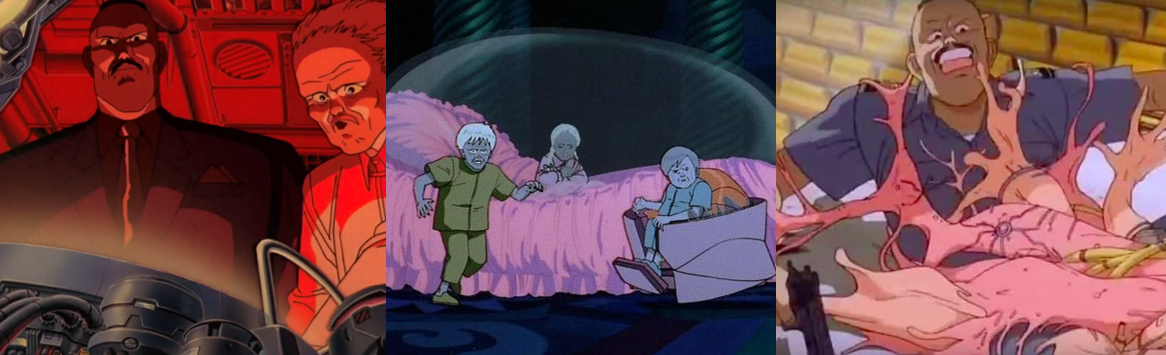
The streets are thrown into chaos as the cops use gas to disperse the crowd, and Tetsuo takes a bad fall from his bike after running across Takashi; Takashi’s abilities attract the attention of Masaru (Bob Bergen), a fellow ESPer, who leads Colonel Shikishima (Pope) of the Japan Self-Defence Forces right to him, resulting in Takashi, Tetsuo, Kaneda, and the rest of the Capsule gang being apprehended. While the injured Tetsuo is transported away, Kaneda and his gang prove too clueless to be involved in the greater concerns of anti-government protesters and resistance fighters, and are released from custody. However, Kaneda spots Kei (Cody) amidst the suspects and, taking a shine to her, manages to trick the cops into releasing her alongside them by claiming she’s part of his gang, though she rebukes his advances afterwards. At school, Kaneda and his gang are severely disciplined for their actions, which only riles the anti-authority biker up even more; he and the Capsules attract a lot of female attention for their bad boy antics, but he’s in no mood for socialising after the night he’s had, and openly criticises Tetsuo for “showing off”. Only Tetsuo’s girlfriend, Kaori (Barbara Goodson), shows concern for the boy, and he goes to her after escaping from the military facility; traumatised by his experiences, and fearing for his life, he steals Kaneda’s bike and prepares to leave the city with Kaori, but their escape is cut short by a group of vengeful Clowns. They attack Kaori, humiliating and hurting her as Tetsuo is held helpless and, though they’re saved by Kaneda and the Capsules, Tetsuo is angered at Kaneda’s constant interference in his life. Suffering from crippling headaches, nightmarish visions, and a voice tormenting him with an unknown name, “Akira”, over and over, Tetsuo is easily detained and returned to the facility for further observation by Shikishima’s staff.

Shikishima is a complex soldier who takes the ESPer’s word, and threat, very seriously.

Shikishima acts as the stubborn, pig-headed, yet surprisingly complex antagonist of the feature; convinced that there’s a mole within the executive council and determined to shut down any anti-government sentiment and apprehend anyone who learns of the ESPers no matter the cost. With no time for political games, Shikishima is more concerned with identifying and controlling telekinetic abilities so that the military can gain a formidable weapon without the risk of mass destruction exhibited by Akira; when Doctor Ōnishi (Lewis Arquette) identifies that Tetsuo has the potential to become as powerful as Akira, Shikishima orders that he be subjected to a series of painful and invasive procedures to unlock that potential but warns that the angst-ridden biker is to be terminated the minute any danger arises. Despite his implacable, hardened exterior, Shikishima seems to have a greater deal of respect and admiration for the ESPers in his employee and care and thus takes Kiyoko’s (Melora Harte) warnings of Neo-Tokyo’s impending destruction very seriously. Although he is disgusted at how quickly the city has degenerated into a den for hedonistic excess and believes that the people have lost their way, he’s not a scientist or an optimist and instead sees the world in very black and white terms and from a strict military perspective of action versus inaction, with little room for debate or hesitation between these extremes. Unfortunately, the supreme council fail to heed his warnings or to grant him the funding necessary to prepare against Kiyoko’s prediction; instead, they cast doubt over Akira’s existence and involvement in the last World War, call the colonel’s integrity into question, and would rather bicker and squabble about preparations for the upcoming Olympics, which only enrages Shikishima. Determined to track Tetsuo down and contain him before his powers reach their full, destructive potential, Shikishima takes control of the government and the entire military in a coup d’état and engages Tetsuo with the military’s full force, which results only in countless soldiers perishing and tanks being destroyed by Tetsuo’s raging powers, which allow him to form protective shields, toss back tank shells, and tear apart an entire bridge in his fury.

Tetsuo is a slave to his emotions, consumed by rage, envy, and his own monstrous body!

Kaneda continuously runs across Kei and is so besotted by her that he even tries to downplay her first kill and ends up following her to a resistance safehouse; there, he learns not only that they are trying to free the ESPers from their confinement but also that Tetsuo has become the military’s newest test subject, and he agrees to join their efforts both to help his friend and get close to Kei (and he’s allowed to if only to serve as a patsy for the resistance’s actions). While at the hospital, Tetsuo is plagued by vivid and disturbing nightmares of both his childhood, his destructive powers, and the mysterious Akira, the most powerful of all the ESPers who once potentially represented the next stage in human evolution. Akira’s power was virtually limitless, but when the government tried to take control of him, he lashed out in self defence and caused the catastrophe that decimated Tokyo. His remains are kept in cryogenic suspense beneath the Olympic Stadium’s construction site, and Shikishima has no desire to see that destructive power unleashed once more, and takes a vested interested into making sure that the remains stay dormant, though Akira still has a strong influence as many zealots in the city foretell of his destructive return. Sensing that Tetsuo’s powers are raging out of control, the ESPers try to kill him before he can awaken Akira and trigger another catastrophe; however, despite them being more adept at creating illusions and wielding their psychic powers, Tetsuo’s abilities are exacerbated by his anger, confusion, and trauma, which makes him more than a match for them, to say nothing of Shikishima’s forces. Revelling in his newfound powers, Tetsuo is driven to near insanity, lashing out at friend and foe alike with a maniacal glee; he kills a couple of his former comrades in search of Kaneda’s bike, garbs himself in a dramatic cloak, and is heralded as the returning “Lord Akira” for his immense powers. Despite Kiyoko’s best efforts, Tetsuo exhumes Akira’s tomb and is astounded to find that the feared psychic is nothing more than just organs and remains in jars; Kaneda attacks Tetsuo with a high-powered laser rifle and berates his friend with taunts, only to be outmatched by Tetsuo’s powers and at the mercy of his power-drunk friend. Despite losing at arm to Shikishima’s orbital cannon, Sol, Tetsuo proves his superiority by flying into space and obliterating the orbital weapon before constructing a replacement mechanical arm for himself. Although Kaori tries to comfort him, and even Shikishima tries to talk him into returning to the hospital for treatment, Tetsuo’s powers grow dangerous and out of control; wracked with constant pain and mutating at an alarming rate, Tetsuo metamorphosises into a horrific, foetus-like monstrosity that is only stopped by the ESPers reviving Akira and drawing him into a singularity.

The Nitty-Gritty:
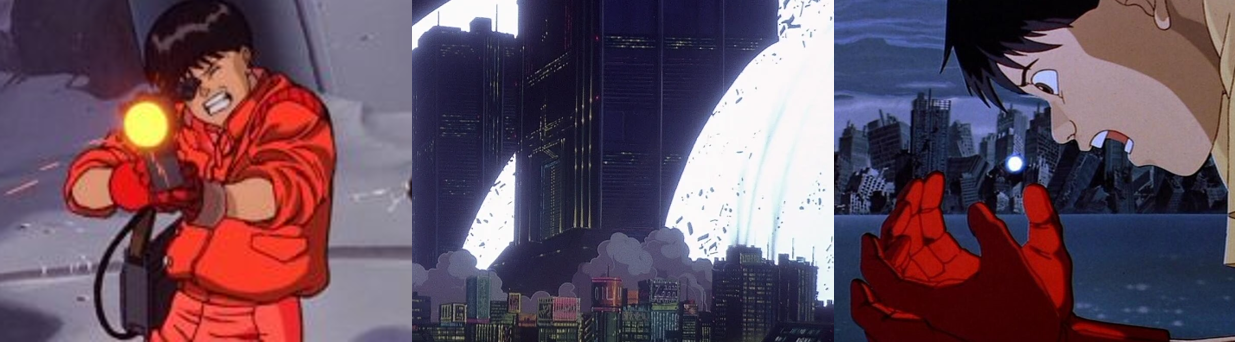
The animation quality in Akira remains almost unparalleled; the feature-length anime definitely set a standard for all to follow with its gorgeous chase sequences, intense attention to detail, and slick, striking character designs. Neo-Tokyo is a neon-drenched metropolis that owes more than a debt to Blade Runner (Scott, 1982) and, alongside that classic science-fiction thriller, helped popularise the “cyberpunk” art style and genre. The city is ruled by the classic class system, with the lower-class and impoverished literally fighting for survival in the filthy back alleys and the upper-class living in opulence and luxury in the high-rise skyscrapers, far above the violence on the city streets. Neo-Tokyo is under constant threat from terrorist attacks by resistance fighters, who set of explosions across the city and cause anarchy in the streets in a desperate effort to fight back against an oppressive government. The city is alive with advanced technology, from futuristic motorcycles, flying craft, and complex machinery to monitor and contain the ESPers, the city, and the people and this is juxtaposed with rancid sewers and the comparative squalor of the alleys and lower street levels. The facility where Tetsuo and the other ESPers is kept is both a sophisticated military hospital and a bizarre nursery for the decrepit, child-like psychics, but the triumph of the modern age is Sol, a weaponised space station that Shikishima turns on Tetsuo in a desperate attempt to destroy him before his powers can rage out of control.
Akira is full of horrific imagery and body horror as Tetsuo’s powers rage out of control.

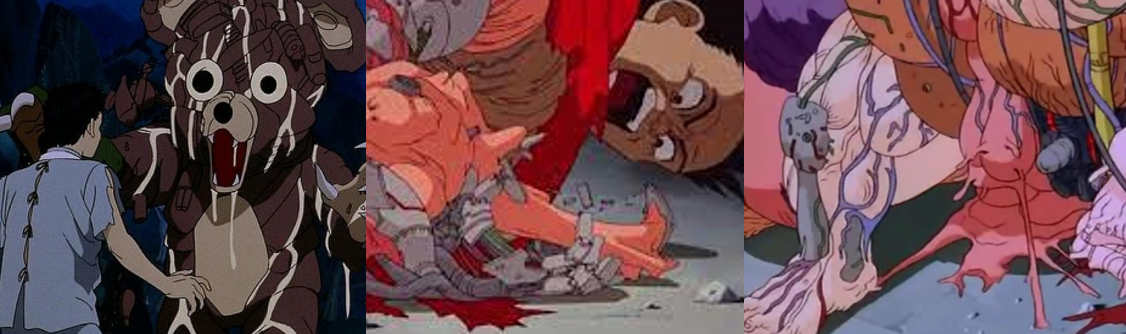
One thing that separates Akira from other traditional cartoons and animation is the gritty, unabashed adult themes and content in the feature; biker gangs race through the streets at high speeds, with little protection and even less regard for who they hurt or the damage they cause in their wake, curse words are dropped with reckless abandon by the hot-headed youngsters who make up our main characters, and bodies break and blood splatters as characters beat and pummel each other. This latter aspect is only escalated by the trigger-happy Neo-Tokyo police, who brutally gun down Takashi’s handler without a second thought, and both the visions Tetsuo is plagued by and the horrific mutations he undergoes as his powers rage out of control. Tetsuo is tormented by hallucinations of demonic toys and, angry and afraid, lashes out at everyone around him to leave orderlies and guards a mere bloody mess on the hospital walls. As Tetsuo’s powers grow, his ability to control them wanes; overcome by pain and hatred, he lashes out in a mindless fury and ends up becoming a rampaging monstrosity that kills Kaori and threatens to absorb Kaneda, the ESPers, and Shikishima. This replaces Tetsuo’s fanatical lunacy with outright panic as his body refuses to listen to his demands; as if the sight of him raging into the upper atmosphere with a bloody mess where his arm once was wasn’t bad enough, the sight of this grotesque mass of screaming flesh and muscle engulfing everything in its path certainly escalates the stakes of Akira from one boy’s madness to a disaster that potentially threatens all life in Neo-Tokyo and beyond.

Kaneda’s confrontation with Tetsuo results in widespread destruction…and the birth of a new God!

Tetsuo is a tragic figure, one filled with conflicting emotions of abandonment, resentment, and anger; the more his abilities grow, the more overwhelmed and out of control he becomes. Finally given the power to strike back at those who seek to use or hurt him, Tetsuo’s confusion and fury are only exacerbated by the ESPers, Shikishima’s vendetta, and even Kaneda, who mocks his friend even as his body horrifyingly transforms. Realising that they’re not powerful to oppose Tetsuo, the ESPers revive Akira, who sucks the monstrous beast into a sphere of pure light. Kaneda is drawn inside this singularity and relives Tetsuo’s memories of his traumatic childhood, a time of abuse and fear where he idolised Kaneda; the ESPers willingly enter the singularity as well in an attempt to rescue Kaneda, and their memories of being subjugated to experimentation are also revealed to him. Shikishima, Kei, and Tetsuo’s remaining friends watch from a safe distance as Neo-Tokyo is engulfed by the singularity, destroying it in much the same way as its predecessor was obliterated some thirty years ago, and the ESPers are able to return Tetsuo to the remains of his home so that he can help Kei during the development of her own psychic powers. As for Tetsuo, the feature concludes with the ESPers and Akira using all the power at their disposal to help him fully transcend beyond the mortal realm; having tapping into the limitless energy and primordial power that exists within all humans, Tetsuo ascends to the level of an omniscient God and, to herald his birth, gives life to an entirely new universe! This, honestly, is not massively clear by the finale which is an ambiguous and surreal series of images, memories, and half-finished sentences, but brings the film to a conclusion that I have to say was very much out of left field considering it started off as a simple tale of an angsty gang of bikers.

The Summary:
Even now, after a few viewings of Akira, I struggle a bit with this film; while it’s undeniably beautiful to look at and full of some absolutely stunning animation, its surreal metaphysical undertones always knock me for a loop. Like a lot of anime and manga, there’s a lot happening here, from street-level violence and social discord, to childhood trauma, to government experiments and children developing psychic powers. It’s definitely a very complex and multifaceted world, with a lot of layers and sub-plots happening all at once that some characters, like Kaneda, aren’t entirely aware of; people revere Akira as some kind of prophet and saviour, resistance fighters bomb buildings and kill to try and expose the government’s experiments, and shrivelled up children with telekinetic powers bring toys to life in the most disturbing way possible. I think the concept has a lot of legs, however; this idea of a screwed up little biker kid being empowered by these destructive abilities and lashing out at the chaotic world around him leads to some of Akira’s most dramatic and memorable moments, and the relationship between Kaneda and Tetsuo as these kind of traumatised kids with a chip on their shoulder bonded by a lifetime of hardship results in them being the clear standout characters. Shikishima is also surprisingly well-rounded, and every character, even the ESPers, is seeped in shades of grey rather than being morally black or white. Of course, Akira will forever be remembered and praised for its slick and detailed animation, which results in some stunning chase sequences, dramatic moments, and grotesque imagery to really inspire the viewer to think about what they’re seeing, what it means, and rethink their surface evaluation of these characters. It can be a lot to take in, no doubt, but the visuals and narrative intrigue are well worth taking the time to give Akira a watch and, if it hooks you, check out other similar anime or even read through the manga if you want your mind blown even further.

My Rating:

Rating: 3 out of 5.

Pretty Good

Are you a fan of Akira? Which of the characters was your favourite and what did you think to the morally ambiguous nature of its cast? What did you think to Tetsuo, his emotional outbursts, and his eventual monstrous transformation? Were you a fan of the film’s cyberpunk setting and the escalation from street gangs to psychically-endowed children? How did you interpret the ending, and were you a fan of how the story wrapped up? Have you ever read the original manga and, if so, how does the film compare as an adaptation? Was Akira your introduction to anime or did a different feature make you a fan of the genre? How are you celebrating National Anime Day today? Whatever you think about Akira, or anime in general, sign up to drop your thoughts below.

Screen Time [National Anime Day]: Attack on Titan (Season One)


15 April has been designated National Anime Day to celebrate the stylistic genre, which achieved mainstream success thanks to animators like Osamu Tezuka.


Season One

Air Date: 7 April 2013 to present
UK Distributor: Netflix, et al
Original Network: MBS/NHK General TV
Stars: Bryce Papenbrook, Josh Grelle, Trina Nishimura, Jessica Calvello, Lauren Landa, Matthew Mercer, and R Bruce Elliott

The Background:
Attack on Titan began life as a Japanese manga written and illustrated by Hajime Isayama and has been published in Bessatsu Shōnen Magazine since September 2009. Drawing from personal experiences regarding the fear of strangers you cannot communicate with, the isolated and enclosed nature of Japanese culture, and the Muv-Luv visual novel series (âge/5pb, 2003 to 2016), Attack on Titan was very well received, selling over 100 million copies by the end of 2019 and quickly etching itself into worldwide popular culture. As a result of the manga’s popularity, Attack on Titan has been adapted into videogames, live-action movies, and an ongoing anime. The anime was produced by Wit Studio and Production I.G, directed by Tetsurō Araki, and dubbed into English by FUNimation Entertainment. Like the manga, the anime was received generally positively, with critics praising the storyline, animation, and music but criticising the crudeness or the titular Titans and the bleakness of the story’s tone.
The Plot:
For a hundred years, the last vestiges of humanity has lived in cities surrounded by enormous walls that protect them from gigantic man-eating humanoids referred to as Titans. After his mother is devoured by a Titan before his eyes, Eren Yeager (Papenbrook) vows to join the Titan-hunting Scout Regiment alongside his friends Mikasa Ackerman (Nishimura) and Armin Arlert (Grelle) and rid the world of the Titans once and for all.

The Review:
In a world where we are literally swamped with all kinds of bat-shit crazy ideas for manga, anime, and videogames, Attack on Titan offers what can only be described as a “unique” premise: one day, about a hundred years ago, the gigantic cannibalistic Titans simply showed up and started eating humans left, right, and centre. They appeared seemingly out of nowhere and decimated humanity, driving them behind fifty-foot high walls and to the point of near extinction. Since then, humanity has lived in relative peace, training generations of soldiers to battle the nigh-indestructible Titans and scout out new areas for expansion and the acquisition of resources. The titular Titans are gruesome, disturbing creatures; ranging in height from around three to fifteen meters tall, they vary in appearance from constantly-grinning or alarmingly stoic-faced naked humanoids, to twisted, frenetic freaks and skinless, steam-emitting monstrosities. Deceptively fast and light despite their enormous size, the Titans are superhumanly strong and constantly regenerate from any injury unless attacked at their one weak point at the base of the neck. The Titans generally attack without reason or mercy, devouring humans not for sustenance but, apparently, simply out of some kind of base instinct (though more intelligent Titans do exist).

Horrific, intelligent Titan variants pose a real threat to humanity’s survival.

The Colossal Titan (which is so huge that it can peer over the walls that keep humanity safe from the Titans) systematically destroys the weakest part of Wall Maria to allow its brethren to enter the outer area of the city. This act alone earns the Colossal Titan (and the Titans in general) Eren’s hatred as it directly leads to the death of his mother and kick-starts his entire crusade to hunt down and destroy all of the Titans. Later in the season, Eren and Squad Levi encounter a skinless Female Titan that specifically targets Eren and is capable of hardening its skin at will and is smart enough to cover its neck when under attack. Similarly, the Armoured Titan is not only highly resistant to the army’s anti-Titan cannons but methodically picks and choose its targets, unlike the horrific Abnormals, which run and skitter around in an unhinged frenzy.

The Titans are practically unstoppable and have driven humanity to near extinction.

Honestly, one of the best parts of Attack on Titan is the Titans themselves; they are horrific creatures that are cold, unmoved, and seemingly unstoppable. Just one Titan is capable of swatting attackers right out of the air, stomping on them, or chomping down on them in the apparent blink of an eye. Often, two or three Titans are seen as a significant threat to the populace and those trained to protect them but, other times, soldiers (specifically the army’s more highly-skilled individuals) will be able to cut Titans down almost effortlessly and, yet, the Titans continue on regardless and it is stated at one point that humanity has never, in a hundred years, scored anything close to a significant victory until the episode “Primal Desire: The Struggle for Trost, Part 9” (Koizuka, 2013).

The O.D.M. allows the characters to perform superhuman feats.

Opposing the Titans are the city’s military; trained in the use of Omni-Directional Mobility Gear (O.D.M.), these guys are able to fly all over the place thanks to the O.D.M.’s gas-powered grapple hooks. Once mastered, the O.D.M. pretty much turns every character into Peter Parker/Spider-Man as they swing, fly, and rappel all over the place with superhuman skill and ease, attacking Titans with their swords and yet, despite all their skill and extraordinary physical prowess, they are still splattered into mush or devoured by the hundreds in seemingly every campaign, willingly throwing their lives away even when escape would be a far better proposition. Attack on Titan centres around three human characters: Eren (the hot-headed, idealistic protagonist), Mikasa (Eren’s stoic, but highly skilled adopted sister and self-appointed bodyguard), and Armin (their childhood friend who is more of an academic than a fighter). Of the three, Eren is easily the most relatable and interesting; wracked with guilt after never appreciating his mother and haunted by fragmented memories of his father, he is driven by an unrelenting desire to succeed in the military, join the Scout Regiment, and experience life beyond the walls of the city to hunt down and destroy every Titan he finds. Eren is quite the flawed character; despite his bravado and commitment to his mission, he struggles to master the O.D.M. gear, is far less capable at battling the Titans than Mikasa or Captain Levi (Mercer), the military’s most decorated and powerful soldier, and isn’t as well-read as Armin.

Somehow, Eren is able to transform into the Attack Titan to take the fight to the Titans.

However, his heart cannot be denied; in the face of a Titan assault in “First Battle: The Struggle for Trost, Part 1” (Ezaki, 2013), Eren immediately takes command and leads the charge against the Titans. Briefly paralyzed with fear in the face of the Titans’ awesome power, he barely hesitates to sacrifice himself to save Armin from being swallowed by the Bearded Titan, apparently dying in the process. Luckily, however, Eren later resurfaces in his own Titan form, the Attack Titan, apparently mysteriously having the innate ability to transform into a Titan when injured and with a clear, defined goal. At first, and sporadically throughout the season, Eren cannot fully control this transformation and struggles to understand it; understandably, it causes a lot of fear and mistrust amongst his fellow soldiers, who constantly treat him either with respect and awe or terror and hatred, and his superiors constantly flip-flop on whether to use his powers to aid them or simply execute him.

Levi is the army’s most formidable soldier and a decorated Titan killer.

Eventually, Eren is assigned to Squad Levi and the direct scrutiny of Captain Levi, a stoic but superhumanly capable soldier who is equal to the strength of a hundred fully-trained soldiers. Levi is the anime’s standard detached, bad-ass character, slicing up even the near-unstoppable Female Titan in a whirlwind of blades and fully prepared to sacrifice his entire regiment (comprised of the army’s best and longest-living Titan hunters, it must be said) to protect Eren.

Though stoic, Mikasa has a natural aptitude for combat.
Levi’s demeanour is largely mirrored by Mikasa, a damaged young girl whose entire family was slaughtered before her eyes until she was saved by Eren, the two of them killing her attackers in a mindless fury. Since then, Mikasa has attached herself to Eren, following him everywhere, even to military school and out into the 104th Regiment. Though not quite as stoic as Levi, Mikasa is nevertheless capable of killing entire swarms of Titans all by herself through some innate physical prowess that is never really explained. It’s hinted numerous times throughout the season that Mikasa’s feelings towards Eren border on something more than friends and family but both are quick to either brush off this suggestion or are far too focused on the far more prominent threat of destroying the Titans.
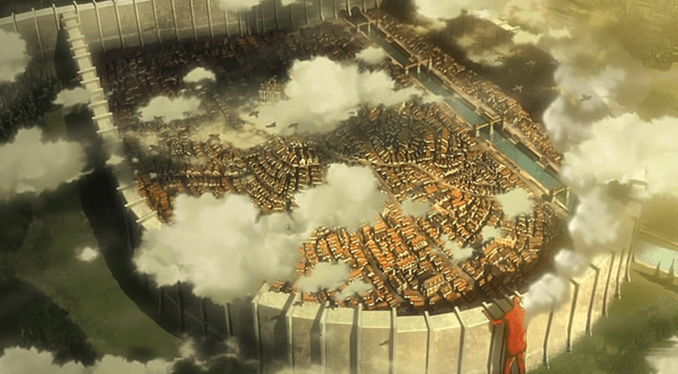
Armin is the weakest and most annoying of the three protagonists.

Finally, there’s Armin, easily the weakest and most annoying character of the three. Many episodes either grind to a halt or entirely focus on one of the three debating the merits of teamwork, humanity, or reliving their memories and feelings through long-winded internal (or external) monologues or flashbacks but never is this more annoying when the focus is placed on Armin. The weakest link of his regiment, Armin’s prowess lies more in academics, strategy, philosophy, and introspective analysis; he’s quick to give in to despair (though, to be fair, so are a large number of the anime’s soldiers and characters in the face of the Titans’ inexorable threat) and to stand useless and in fearful awe in the midst of a heated battle where untold numbers of his friends and peers are decimated by the Titans to incessantly monologue about his shortcomings or the bravery of others.

Hange Zoë is easily the worst and most annoying character of the season.

Still, as annoying as Armin is, he’s got nothing on Hange Zoë (Calvello), a military scientist who is so incredibly obsessed with the Titans that she has been driven to what appears to be near insanity. Loud, obnoxious, and exploding into a crazed frenzy at the drop of a hat, Zoë wants nothing more than to study and investigate the Titans, growing uncomfortably close to captive Titans and disconcertingly obsessed with Eren and his unique physiology. Though her experiments and studies have uncovered numerous helpful insights into the Titan’s composition and nature (and has led to the creation of numerous weapons to bring them down or kill them), her character is largely both uncomfortable and annoying at the same time as she often cares more for the well-being of the Titans than her fellow humans.

Many of the supporting characters are easily forgotten until they suddenly die.

Rounding out the cast are a number of expendable soldiers and civilians; sure, most of them have names and character traits but it’s largely pointless to remember them or grow too attached as they are liable to either get splattered into a bloody mess, eaten alive, horribly dismembered, or found as little more than a bloodied and mutilated corpse. Often, another character would lament their comrade’s fate and I would find myself struggling to remember who they were, what they did, or when they last appeared. Interestingly, the city is made up of varying classes, each of which experience life within the walls differently and views the military, and the Titans, in different ways: many criticise the need for expensive military ventures and pursuits, others are living comfortably deep within Wall Sina, while those in the outer areas live relatively underprivileged lives. Like a lot of post-apocalyptic narratives, I have many questions regarding the world of Attack on Titan; I’ve looked into the series and researched it a little bit to get some answers regarding the history of this world and how the walls and city were erected but, in the context of season one, we get very little information regarding how the city was built and how they survive.

I have many questions about the city, its society, and the lore of this world.

For some reason, currency and wealth is still a thing within the city; many of the wealthier citizens are frustrated at their “taxes” paying for what amount to little more than suicide missions against the Titans and the Royal Family live in opulence within Wall Sina. Equally, there is a lot of mention of rations and finite resources; every time Titans breach the walls and cause a mass evacuation, food and supplies are strained so badly that it is often seen as a good thing when hundreds of soldiers are killed by Titans so that the city’s resources can last a bit longer. I have many questions regarding this: shouldn’t the city just be entirely focused on training soldiers, fortifying their defences, and building a military society rather than giving people the option of living passive lives? Why is money and wealth a thing? How can money really mean anything in this type of world? Where do the resources come from? How were all these houses built, to say nothing of the walls that protect the city? How do the citizens even have the means to build anything with such finite resources? Why aren’t the soldiers, especially the veterans, better at killing Titans when the creatures are largely predictable, have a well-known weak spot, and seem so cumbersome and slow despite their surprising speed and daunting strength?

Eren isn’t the only one who can transform into a Titan, raising many questions for season two.

These questions are generally disregarded in season one and, for the most part, it works; despite characters knowing a lot about the Titans’ physiology, the creatures and their origins are a complete mystery to the characters and they are constantly forced to learn as they go and endure horrific losses to gain slivers of new information about them. How Eren, and others, are able to spontaneously produce Titan bodies is left obscure and the motivations of the Titans’ cannibalistic ways are up for debate at this point. The season ends, however, not only with the knowledge that Eren is not unique as Annie Leonhart (Landa) is revealed to not only be a traitor to the humans but also capable of transforming into a Titan herself, but also that gigantic Titans are encased within the walls of the city, ending the season on a massive cliff-hanger as we’re faced with the knowledge that human-to-Titan individuals are more commonplace than first thought and that there is more to the history of this world than we, and the characters, are aware.

The Summary:
I had heard a lot about Attack on Titan for quite some time; I am not, by my own admission, the most well-read anime fan as I find a lot of the most popular anime films and series to be dense almost to the point of being impenetrable and with so many episodes (most of them being filler or padding) that I just don’t have the time or patience to fully invest my energy and effort.

There are so many monologues! It really grinds the pace and action to a halt.

However, when I saw Attack on Titan was on Netflix, I figured I’d watch a few episodes and see if it hooked me. Within three episodes, I was interested enough to carry on but, by around episode fifteen, the series had started to lose me. I quite liked Eren’s flawed character and the constant life and war lessons he was forced to learn through numerous encounters with the Titans and characters like Mikasa and Levi helped make the anime exciting and engaging when it was actually focused on action rather than constantly slowing the plot down with endless monologues and prattling on and on (often, inexplicably, when characters are moving at high speeds) about teamwork, friendship, and the futility (or glory) of war.

Attack on Titan excels whenever Titans are onscreen or the action picks up.

Attack on Titan excels when it focuses on the Titans and the action-packed assaults against them; seeing Eren and his fellow soldiers swing and fly all over the place, either being crushed, devoured, or successfully cutting down the creatures is exciting and gorgeous to behold and really showcases the detail and intricacies of the anime’s smooth and slick animation. Sadly, though, entire episodes can go by without the merest hint of action or appearances by the titular Titans; while this can lead to some interesting character development, more often than not episodes drag their runtime out focusing on characters who quickly die, strategies that immediately fail, or retreading the same ground about Eren, Mikasa, and Armin’s characters and backstory.

Some flashbacks and slower moments help flesh out the main characters.

Occasionally, our protagonists will learn and grow as characters, which is nice to see, but often they’ll learn a lesson or some self-confidence in one episode only to immediately have to relearn this again in the next (or subsequent) episode. It makes for a disjointed pace and gives me far too much time to think about the rules of this world and questioning how their society even works much less proves so unreliably effective against the Titans even with years of experience in fighting them. As a result, despite the massive cliff-hanger at the end of the season and what I’ve read of how the plot develops later on, I can’t see myself coming back to Attack on Titan again. At least, not the anime, anyway.

My Rating:

Rating: 2 out of 5.

Could Be Better

What are your thoughts on Attack on Titan? Did you enjoy the series or, like me, did you have issues with its plot, pacing, and content despite its interesting premise, creatures, and characters? Did you ever read the manga; if so, do you prefer it to the anime? Perhaps you prefer the live-action films, or the Attack on Titan videogames; if so, which is your favourite and why? Which character, or Titan, is your favourite? Do you also find Zoë and Armin annoying characters? How are you celebrating National Anime Day today? Whatever you think about Attack on Titan, or anime in general, please do leave a comment below.