Back Issues: Hulk #1-6

Writer: Jeph Loeb Artist: Ed McGuinness

Story Title: “Who is the Hulk?”
Published: 4 January 2008 (cover-dated: March 2008)

Story Title: “The Smoking Gun”
Published: 20 February 2008 (cover-dated: April 2008)

Story Title: “Creatures on the Loose”
Published: 23 April 2008 (cover-dated: June 2008)

Story Title: “Red Light, Green Light”
Published: 25 June 2008 (cover-dated: August 2008)

Story Title: “Rolling Thunder”
Published: 6 August 2008 (cover-dated: October 2008)

Story Title: “Blood Red”
Published: 24 September 2008 (cover-dated: November 2008)

The Background:
Created by legendary Marvel duo Stan Lee and Jack Kirby, the depiction of Doctor Robert Bruce Banner transforming into the monstrous Incredible Hulk was inspired by a story of a hysterical mother summoning superhuman strength to rescue her child and classic screen monsters Frankenstein’s Monster and Doctor Jekyll and Mister Hyde. Initially appearing as a stone-grey creature, the Hulk has appeared in many forms and at different levels of strength and intelligence over the years. We’ve seen an old, dictator-like Hulk, an intelligent gangster Hulk, a “Smart Hulk”, and even a “Devil Hulk” so why not a Red Hulk? The idea of a Red Hulk can be traced back to Kenny Johnson, producer of the popular and iconic Incredible Hulk television series (1977 to 1982), who lobbied for the colour change since red is commonly associated with rage, the Hulk’s defining characteristic, only to have his logic dismissed. However, a mere thirty-odd years later, then-Marvel editor-in-chief Joe Quesada officially introduced a red variant of the Green Goliath, one whose identity was kept a closely-guarded secret for about three years. A dangerous, intelligent, and tactically-savvy villain who grew hotter the angrier he got, the Red Hulk was eventually revealed to be Banner and the Hulk’s long-time enemy, General Thaddeus “Thunderbolt” Ross, a cantankerous military man who hounded both characters for decades. Naturally, General Ross appeared prominently in the Hulk’s ancillary media, appearing in cartoons and live-action many times, but the Red Hulk (or “Rulk” as he’s colloquially known) has not only been a card-carrying member of the Avengers but has also appeared in Hulk-centric cartoons and even unexpectedly appeared in the Marvel Cinematic Universe, courtesy of Harrison Ford.

The Review:
Our story begins in Russia, where Doctor Leonard Samson/Doc Samson and Jennifer Walters/She-Hulk investigate the sight of a fierce battle between the Hulk and his monstrous rival, Emil Blonsky/The Abomination. Begrudgingly, She-Hulk allows Samson to recreate the fight, deftly surmising and reenacting both character’s movements based on footprints and the surrounding devastation. It’s Doc Samson’s learned belief that the Hulk was unusually vicious, that he sought to beat the Abomination to death no matter what damage he caused in the process, and that, with his foe at his mercy, the Hulk drew a pistol and shot the creature at point-blank range. General Ross, Strategic Homeland Intervention, Enforcement, and Logistics Division (S.H.I.E.L.D.) commander Maria Hill, and S.H.I.E.L.D. director Anthony “Tony” Stark/Iron Man, who are also present, question the legitimacy of such an outrageous claim. However, when Hill reveals that S.H.I.E.L.D. does make a weapon big enough for the Hulk to fire and Doc Samson points out the residual Gamma radiation, the evidence, however unlikely, becomes difficult to ignore. She-Hulk and Samson also note that the Hulk is apparently emitting so much radiation that he’s scorching the earth with each footprint. The team’s squabbling and theorising is interrupted by Russia’s equivalent to the Avengers, the Winter Guard, led by Anton/The Red Guardian, who demand to take charge of the investigation. Despite being invited by the Russian government, the Red Guard have issue with their unauthorised personnel, like Samson, who reacts by starting a fight with the Red Guardian. Not to be outdone, Mikhail Ursus/Ursa Major, Boris Vadim/Crimson Dynamo, and Sasha Roerich/Darkstar join the fracas, with the bear-like Ursa clawing She-Hulk’s arm and Iron Man blasting the mech-armoured Crimson Dynamo right in the face. The battle is violent but short-lived as General Ross discovers a survivor, a traumatised boy who can only repeat the word “Красногоin” (or “red”) over and over.
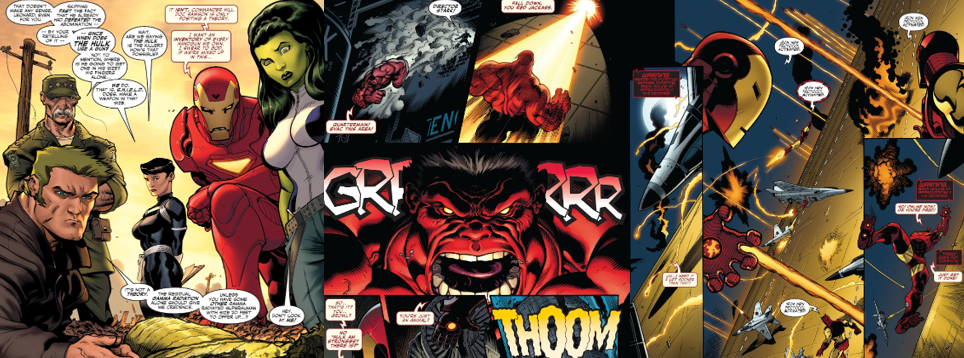
A mysterious Red Hulk murders the Abomination and trashes the S.H.I.E.L.D. Helicarrier,

On the S.H.I.E.L.D. Helicarrier, Maria shows Stark a version of the gun used to kill Blonsky, a weapon he had no knowledge of. However, their discussion is interrupted when She-Hulk is suddenly attacked by a monstrous, Hulk-like figure. Though Stark barely glimpses the creature, he sees that it’s red, not green, and is stunned when the unconscious and badly beaten She-Hulk is dumped at his feet. Stark armours up and meets agent Clay Quartermain, who’s been injured by the monster but no less determined to bring him, and any and all Hulks, down. Iron Man’s orders are cut short when the Red Hulk suddenly tackles him through a wall. Noting the strange contradiction of a Hulk that growls like an animal but apparently wields a pistol and systematically targets a Helicarrier, Iron Man scrambles to fend off the brute’s vicious attack and deploy his spare armours to help stabilise the Helicarrier and catch the jets that tumble from it following the Red Hulk’s attack. Though his armour’s severely damaged, Iron Man is saved from a plummet by She-Hulk, who reveals that the Red Hulk wiped S.H.I.E.L.D.’s secure files with a sophisticated virus, and that the Red Hulk threatened her with an eloquence not shown to Stark. Despite Iron Man’s best efforts, the gold-plated Helicarrier crashes in a New Jersey field (with, surprisingly, no causalities). Iron Man’s attempts to formulate an effective counterattack are put on hold when Maria shows him video footage of General Ross and Doc Samson meeting with Bruce Banner, who’s held captive in the Gamma Base located in Death Valley, Nevada. The footage confirms that there is another Hulk out there, one very different from Banner’s mindless alter ego, and Banner suggests it’s someone who’s previously been exposed to high levels of Gamma radiation. However, Iron Man’s enraged when a crucial exchange between Banner and Ross is rendered unintelligible and orders Maria to clean up the recording. Later, Iron Man is brought to a meat packing plant where Agent Quartermain has been found dead alongside a severely torn, Gamma-irradiated coat belonging to Doc Samson, framing the superhuman psychiatrist as the Red Hulk.
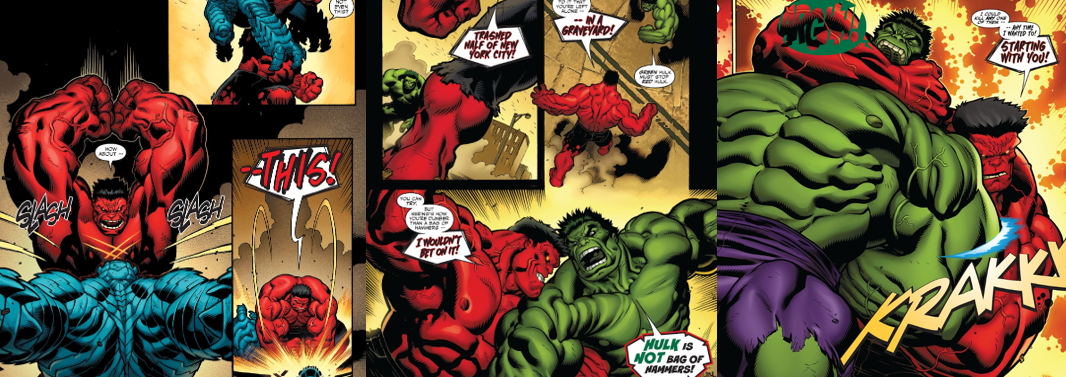
The Red Hulk easily overpowers A-Bomb and even the rampaging Green Goliath!

Elsewhere, the Red Hulk blindsides perennial sidekick Rick Jones outside Gamma Base, transforming him into his own Gamma monstrosity, the A-Bomb. It’s in this fight that we learn just how intelligent the Red Hulk is. While A-Bomb can only bark childish threats, the Red Hulk is goading, intelligent, and aware of his surroundings. Although Gamma Base recognises the Red Hulk as an authorised entrant, its defences fire on A-Bomb and Red Hulk takes advantage, swiping a massive cannon and taking great pleasure in riddling the armoured monster with bullets. When A-Bomb spits claims of his invulnerability, the Red Hulk gleefully tests his theory by pummelling him into the ground. The sheer force of the assault sends seismic shocks through the entire base and triggers Banner’s transformation into the Hulk when his cage attempts to gas him. As the battle rages, the base unleashes its Adamantium-taloned harpy robots (modelled after Banner’s long-time love, Doctor Betty Ross) to carry the two away. Unfortunately, the machines are no match for either monster’s strength, though the distraction separates them long enough for the Hulk to confront his red-skinned doppelgänger. Before the two can lock horns, however, the Red Hulk casually punches out Uatu the Watcher, who randomly popped up due to the significance of these two immensely powerful beings coming to blows (and, I guess, to show how tough this new Hulk is). After humbling the cosmic overseer, the Red Hulk finds the Hulk enraged by his appearance. The Hulk sees his red double an imitation and challenger to his title of “The Strongest One There Is”, a title he vehemently seeks to defend as aggressively as ever. Red Hulk, however, dives into the fight with relish, determined to make the Hulk pay for years of death and destruction, and for waging war against the entire planet after his return from Sakaar. Though the Hulk’s no longer as intelligent as his “World Breaker” persona, his strength only increases with his anger. However, the Red Hulk weathers the beating and easily grabs the Hulk’s wrist, breaking his arm and causing him to pass out.
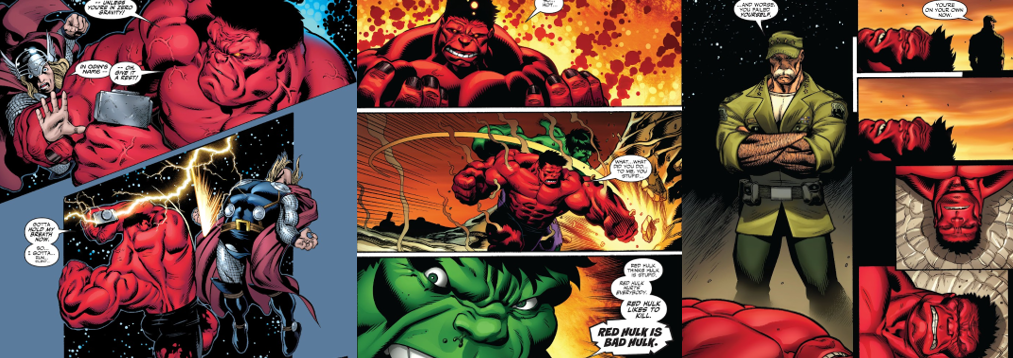
Though he humbles Thor, the Red Hulk is outsmarted by the Hulk, his true identity left a mystery…

The Hulk awakens atop the Golden Gate Bridge and avoids a public execution by biting the Red Hulk’s gun. For his insolence, the Red Hulk decides to let his foe live with the knowledge that he’s not the strongest and knocks him into the bay, trigging the San Andreas fault. Thor Odinson then confronts the monster, only for the God of Thunder to be stunned when the Red Hulk shrugs off a blow from the mighty Mjöllnir. Savouring the chance to beat a God to death, the Red Hulk backs his words with blows powerful enough to draw blood and knock Thor flying. Thor fights back, not realising his foe is a different Hulk to the one he knows and is therefore left speechless when the intelligent Red Hulk gets around Mjöllnir’s enchantment by launching them out of Earth’s atmosphere. In zero gravity, the Red Hulk humbles Thor by beating him with his own hammer and dumping him on the Moon. After the Fantastic Four seemingly confirm that the Red Hulk is Doc Samson and A-Bomb pulls the Hulk from San Francisco Bay, Iron Man, She-Hulk, Ben Grimm/The Thing, Johnny Storm/The Human Torch, Prince Namor McKenzie/The Sub-Mariner, and Ares, the God of War, arrive to help save the city. While the Hulk initially rejects their assistance, he begrudgingly agrees to let them get San Francisco under control so he can confront the Red Hulk in Monument Valley. The Hulk’s efforts are aided by the returning Thor and A-Bomb, with the latter revealing the Red Hulk’s weakness (that he gets hotter the madder he gets) and restraining Thor so the Hulk can settle the score alone. Smartly, the Hulk absorbs the Red Hulk’s horrendous assault, causing the monster to overheat and grow weaker. The Hulk then asserts his dominance and knocks the Red Hulk out with a single punch. He then parts ways with Thor as friends before wandering into the desert, exhausted and reverting to Banner. However, when A-Bomb turns back into Rick and tries to reveal the Red Hulk’s identity, he’s shot in the back by Doc Samson. Both Samson and General Ross express disappointment with the Red Hulk, who they leave lying in the dirt as his eyes snap open…

The Summary:
First of all, I have to say that I love Ed McGuinness’s artwork. His work is always hyper-stylised and very bold and cartoonish, and he draws a wonderful Hulk and Hulk-like creatures, with them all being brutish monsters full of life and personality. You can tell so much about each of the Hulks in the way Ed McGuinness draws them: A-Bomb is constantly hunched over, as though weighed down by his armoured scales; the Hulk is always bulging and ready for a scrap; and the Red Hulk stands tall and confident, with a condescending smirk plastered to his face most of the time. The glue that holds this story together is the mystery of who the new Red Hulk is. At first, Doc Samson believes the Hulk is behind the Abomination’s murder. This is an odd hypothesis given he knows as well as General Ross that Bruce Banner is locked up in Gamma Base, but not one without merit; after all, Doc Samson himself once split Banner and the Hulk into separate beings. Naturally, given he was a bit of a dick around this time, Iron Man’s primary thought is to his culpability; he snaps and rages at Maria Hill about the Hulk-sized weapons S.H.I.E.L.D. developed and is desperate to ensure he can’t be held accountable for the murder. The evidence seems to ring true, but for the use of a gun and the scorched footprints, though She-Hulk remains unconvinced that her cousin was capable for such a cold-blooded act. Little moments throughout the story give some hints towards the Red Hulk’s identity, but there are numerous red herrings as well: Rick Jones, for example, seems tormented at the events, initially framing him as a suspect. We see that both Samson and Ross are authorised Gamma Base personnel, and that the base’s security recognises the Red Hulk’s iris. The garbled security footage seems to implicate Samson, as does his tattered coat, and the story even ends with the suggest that Doc Samson is the Red Hulk…until it’s revealed he’s not. But then again, General Ross is also seen standing over the Red Hulk’s unconscious body and he was right there when the Red Hulk attacked the Helicarrier, and he later turns out to be the Red Hulk! Indeed, the ending suggests more that Samson and Ross were in league with the Red Hulk, rather than being him, and I’d be interested to know or try and remember exactly how they explained how Ross and the Red Hulk could be in the same place at the same time (though it was probably a Life-Model Decoy).
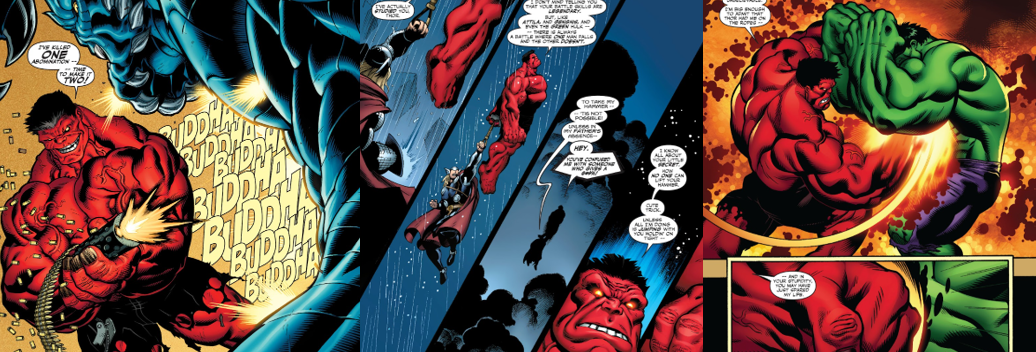
The Red Hulk is an overpowered, egotistical, and incredibly dangerous Hulk.

As for the Red Hulk…well, this is a glorious showcase. Doc Samson’s intuitive nature reveals that the Red Hulk is a formidable foe, capable of beating even the super-tough Abomination into submission and fighting with a ferocity and power comparable to the Hulk. The Red Hulk is also seen to be tactically minded, launching an all-out assault against Iron Man’s fancy-pants gold Helicarrier and even wiping S.H.I.E.L.D.’s files. The Red Hulk’s intelligence is showcased in his eloquence; he delights in goading and taunting his foes as he fights them, displaying a familiarity with each and the defences of Gamma base. He repeatedly demonstrates a personal vendetta against the Hulk, first happy to frame him for murder and then delightedly besting him in a straight-up fight, even going so far as to break the Green Goliath’s arm and wish to publicly execute him. This, as he says, is payback for the Hulk’s years of death and destruction and more recent assault against the entire planet. The Red Hulk sees the Hulk as the true threat and is determined to stamp him out, but he’s also out to prove himself the superior being in mind and body. And what better way to do this than by not just beating the piss out of the Hulk and kicking him to the bottom of the San Francisco Bay, not just by punching out the Watcher, but by besting Thor in combat! Seriously, the Red Hulk is so massively overpowered it’s not even funny. Not only does he outmatch and humiliate Thor, even using insane logic to rob him of Mjöllnir, the Red Hulk completely disrespects and disregards the God of Thunder like he was nothing. A vindictive, calculating, ferocious opponent, the Red Hulk is so much than just another “Smart Hulk”. His blows have a purpose, striking at weak points and mixing pure power with tactical precision; he knows what he’s doing and enjoys doing it. His only weakness, one he doesn’t seem to realise, is that his body temperature rises exponentially when he gets mad, weakening him significantly. Well, it’s not his only weakness: he still needs to breathe, but that isn’t much of an issue considering he effortlessly trounced Thor while holding his breath.
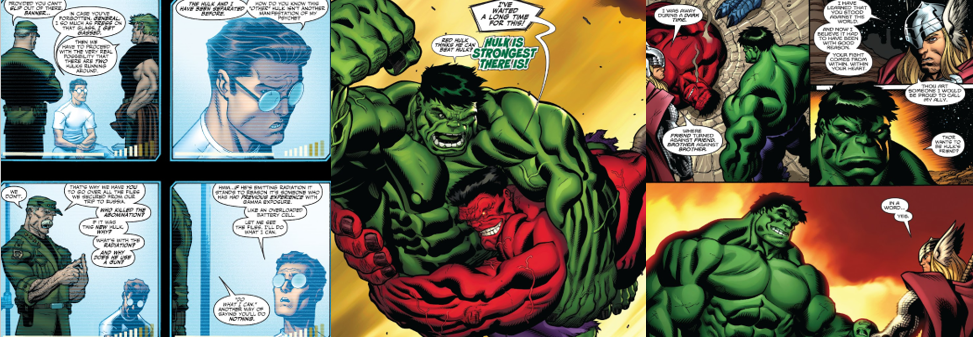
The Hulk doesn’t care who his new foe is. He just wants to prove he’s the strongest!

The Red Hulk’s debut starts off as a showcase for the new Hulk on the block and a superpowered murder mystery. The investigation into the Abomination’s murder, the murder weapon, and the mystery of what’s happened to drive the Hulk to such an uncharacteristic action frames the first issue and a half. Once the Red Hulk makes his presence know, there’s some brief confusion as even Banner states that he’s been split in two and assumed different forms before, but then the crux of the story becomes trying to work out who this new Hulk is. Thus, everyone’s favourite Jade Giant doesn’t factor into the story for a few issues. Indeed, it’s up to the decidedly Hulk-like A-Bomb to carry the load when the Red Hulk targets him, but the action really ramps up when the two Hulks come to blows. I’m not sure what happened between Green Scar’s return to Earth and this story, but the Hulk has regressed to his mindless, child-like persona and is therefore at an initial disadvantage against his more tactile-minded doppelgänger. The Hulk’s driven to fight the Red Hulk out of a sense of pride (“Hulk is Hulk!”, after all) rather than to protect others, but his need to prove himself superior aligns with defending his few friends (such as A-Bomb) and allowing Iron Man and the others to save San Francisco. Thanks to Ed McGuiness, the Hulk-on-Hulk action is dynamic and interesting; it’s not just a senseless brawl as both Hulks weather their opponent’s onslaught to tire them out or strike when the opportunity presents itself. The Red Hulk, especially, stands out by using an enemy’s momentum against them and mixing brain with brawn, while the Hulk is naturally more savage and only tries a different tactic after seeing how dangerous his foe is. The art definitely makes his story a visually enjoyable experience and I did like the intrigue surrounding the Red Hulk. The red herrings and revelations are kind of odd knowing what I know now about the character, but it’s always nice seeing 2008-era Iron Man get his smug face smashed in and I loved that an intelligent Hulk proved to be such a threat. There’s definitely enough here to make me want to read up on what happened next with the Red Hulk and the lingering plot threat regarding Doc Samson, and the mixture of action and mystery were highly entertaining all-in-all.

My Rating:

Rating: 4 out of 5.

Great Stuff

Did you enjoy the Red Hulk’s explosive first appearance? Do you think the writers went a bit over the top in showcasing his threat, power, and intelligence? What did you think to the murder mystery sub-plot and who did you think the Red Hulk was? Were you impressed by the way the Hulk defeated his doppelgänger at the end? Which alternative version of the Hulk is your favourite? What are some of your favourite Red Hulk moments? Tell me your opinions on the Red Hulk in the comments and be sure to check out my other Marvel and Hulk content.

Back Issues [HulkaMAYnia]: Future Imperfect


Since his explosive debut in May 1962, Stan Lee and Jack Kirby’s gamma-irradiated Jade Giant has been one of their most recognisable and successful characters thanks, in large part, to the Incredible Hulk television show (1977 to 1982) catapulting the Hulk into a mainstream, pop culture icon. The Hulk has been no slouch in the comics either, being a founding member of the Avengers and undergoing numerous changes that have made him one of their most versatile and enduring characters.


Published: 22 December 1992 / 26 January 1993
Writer: Peter David
Artists: George Pérez

The Background:
The Incredible Hulk (and his human alter ego, Doctor Robert Bruce Banner) was another creation of Marvel legends Stan Lee and Jack Kirby. Inspired by the story of a hysterical mother showcasing superhuman strength to rescue her endangered child and classic movie monsters like Frankenstein’s Monster and Doctor Jekyll and Mister Hyde, the Hulk functioned as an allegory for the foils of war and was initially depicted as a stone-grey figure who emerged at night. Although his first series was cancelled after a year and a half in, the character returned to prominence following expansions of his lore and character and the popularity of the Incredible Hulk TV series. Nowadays, the Hulk is a staple of Marvel Comics, with an extensive gallery of villains who have tested him both physically and mentally, but one of his greatest tests came when writer Peter David and artist George Pérez had the Green Goliath encounter a possible future version of himself, the malevolent Maestro. Possessing the same insurmountable strength as the Hulk and bolstered by his calculating intellect, the Maestro is often regarded as one of the Hulk’s most dangerous and formidable villains. His debut story is so well regarded that the character has cropped up in additional tales to flesh out his backstory and regularly appears in the Hulk’s cartoon and videogame adaptations, so great is the threat of this devious alternative Hulk.

The Review:
Our story begins in a dystopian wasteland about one hundred years into the future; the overgrown, dishevelled ruins of New York City house the remnants of society in overcrowded, war-torn streets. Tensions are high and a “Big Brother” monitoring system is in place, courtesy of the mysterious Maestro, who dwells within an emerald palace high above the ruins. Amidst the bustling, anxious crowd, we’re introduced to Janis Jones and her cohorts in the rebellion against the Maestro, one that’s vastly outnumbered and against the odds. This is immediately demonstrated not just in their paranoia about their plans being overheard by the Maestro’s “Gravity Police” but the violent introduction of his cybernetic law enforcers, who immediately execute one of their number and demand their immediate surrender. Although Janis begs them to fall back and get to safety, her fellow insurgents choose to fight, leaving the elderly Pizfiz with a bloody stump for a leg and Janis and Skooter desperately trying to escape their pursuers. Luckily for them, a building collapses and covers their escape and, from the rubble, emerges none other than the Incredible Hulk. Now, this is the so-called “Professor Hulk”, a stable merging of Banner and the Hulk’s psyches who operated during the nineties. This Hulk wears clothes and is capable of intelligent speech, while also still exhibiting his trademark superhuman strength and dexterity, though not quite to the same degree as his usual savage self. This means he waxes lyrical while thrashing the Gravity Police but briefly struggles against their massive, mechanical “Dog O’ War”. However, he’s still the Hulk so naturally he rips the robot dog’s head off and sends the cops packing as a message to the Maestro.

100 years hence, the world is a dystopian hellhole ruled by a malicious Hulk.

Naturally, the Hulk attracts a fair amount of attention as he walks the streets; the people view him with a mixture of fear and respect, which he finds strangely alluring. He’s soon accosted by Janis and taken to the literal underground, where the rebellion hides deep beneath the wreckage of the city streets. Janis gives her people a quick history lesson on the Hulk, going over his classic origin courtesy of “sliding”, a visual representation of actual eyewitnesses to the Hulk’s history. It seems Janis recruited him to help them out and the Hulk went along because his old friend, Rick Jones, vouched for her and out of curiosity regarding the Maestro’s true identity. Janis takes the Hulk to an aged and decrepit Rick, who sits in Professor Charles Xavier’s hoverchair amidst a trophy room of those who have fallen in the years since, hero and villain alike. Word of the Hulk’s appearance quickly reaches Thomas Raymond, minister to the Maestro, who interrupts his leader’s orgy to bring him news of this temporal impossibility, giving us our first look at the Maestro as an older, more grizzled version of the Hulk who sports a lion’s mane of grey hair and beard. Favouring a regal cape and an intimidating helmet, the Maestro callously interrogates Pizfiz. When Pizfiz tries to goad the Maestro into losing his temper and killing him, the dictator allows the influence of the Minister and his cooler temperament to keep him in check and forcibly extracts the information he requires. Pizfix got Doctor Victor Von Doom/Dr. Doom’s time machine up and running and sent himself and Janis to the past to recruit the young Rick and the Hulk in helping them out. When Pizfiz is left a broken, lifeless husk from the stress of the procedure, the Maestro splatters him for his insolence and prepares to lead a strike team to hunt down his younger counterpart.

The Hulk is overpowered by the far stronger, far more cunning Maestro and left his helpless captive.

The frail Rick reveals that, in the end, humanity was their own undoing; two massive nuclear wars ravaged the world, killing the world’s heroes and villains, not to mention countless innocents, with only their costumes and ashes left as a memorial in Rick’s collection. Not so for the Maestro, who only increased in power from the radioactive fallout, built a dystopian society for his own amusement, and was driven completely insane. Much like Darkseid, the destitute peons of the city cheer the Maestro’s name and try to win his favour, only to be brushed aside and kicked out of the way like flies. The Maestro also has no time or worry for any defences the resistance may have set up and simply burrows his way down to their hideout using sheer brute strength, caring little when his men are dissolved by acid and gas or sliced to ribbons by lasers. The Maestro simply walks through these traps to come face to face, and blow for blow, with his counterpart. Their fight quickly explodes to the streets above, where the Maestro tests the Hulk’s resolve by calling him ”Puny Banner” and threatens to tear an innocent girl to pieces if he doesn’t surrender. The Hulk calls his bluff, reasoning that the Maestro must truly fear him to resort to such a tactic, but is unable to keep himself from leaping to the woman’s aid, much to the Maestro’s delight and disgust. Though the two are somewhat evenly matched, the Maestro takes the upper hand throughout the fight; he also constantly goads the Hulk, reasoning that he (as in the Maestro) can out-think and out-match him at every turn through the gift of hindsight as well as his awesome power and devious intellect. The plan works; when the Hulk charges in, the Maestro easily dodges and counters him to prove his intellectual superiority. Although the Hulk briefly turns the tide by fighting dirty with a nut shot, a haymaker sends the Maestro into a nearby building crushing and threatening innocent lives. The Hulk’s desperate need to save those lives allows the Maestro to get the jump on him and subdue him by breaking his neck. While Janis and the other lament the damage done to the Hulk, the Green Goliath wakes in the Maestro’s throne room, strapped into a massive neck brace and attended to by one of the Maestro’s “favourites”, who identifies herself as “Betty” and, apparently, rapes or at least physically interferes with him against his will, much to the Maestro’s pleasure.

The Hulk feigns injuries and temptation to lure the Maestro into a false sense of security.

Powerless and paralysed, the Hulk is forced to endure the Maestro’s scathing rhetoric; the Maestro even offers the Hulk the opportunity to put himself out of his misery, confident that his existence is assured since he has no memory of these events. The two get into a metaphysical debate about time travel theory but, in the end, the Hulk can’t bring himself to end his life since the risk that the Maestro is telling the truth about branching timelines being true is too great and would simply result in the Maestro’s continued existence. Resigned to being held prisoner while his wounds heal, the Hulk is forced out to the wastelands, where the elderly Boz and other would-be farmers desperately try to cultivate the irradiated and war-torn soil. Due to the scarce resources in the city, and the physical imperfections of these outsiders, they’re dependent on the Maestro’s limited generosity. He allows them to live, even furnishes them with supplies and has been trying to introduce nutrients into the soil, and all he asks in return is to take their most beautiful and worthwhile women for his own sordid amusement. The Maestro tries to win the Hulk over to his way of thinking, dressing him in fine robes and expositing the benefits of the less spirited slave girls in his palace, but the Hulk remains unimpressed. The Maestro sees his indignation and rejects it; to him, humans are the true monsters, for they destroyed themselves before any supervillain could. He sees himself as benefitting from the strange fate placed upon him since he was fortunate to have avoided being at ground zero and therefore reaped the rewards of the nuclear fallout while the world died around him. He offers the Hulk the chance to stay and rule at his side, promising that the future that lies ahead of him is full of the same hatred ad betrayal he’s always known, and the Hulk feigns temptation, and the extent of his injuries, in order to lead Janis and her allies into the palace.

Overpowered by the Maestro, the Hulk’s only hope is to out-think his foe using the time machine.

Pointed in the right direction by the Minister, the Hulk attempts to confront the Maestro directly and is blasted full force by a cannon specially created by Forge to kill the Green Goliath. Congratulating himself for being one step ahead of his counterpart, and his enemies, once more, the Maestro sets his forces against the resistance and a big ol’ shootout ensues. Angered at his soldiers’ inability to wipe the resistance out, and the disappearance of the wounded Hulk, the Maestro callously snaps the Minister’s neck and storms off in search of his younger self as his palace becomes a chaotic warzone. The Maestro follows the Hulk’s blood trail, and the familiar sound of Rick’s harmonica, to the trophy room; there, he chastises himself for allowing sentiment to stay his hand and delivers a mighty blow to his old friend. Though the frail Rick attempts to shield himself with the iconic shield of Captain Steve Rogers/Captain America, the force of the punch sends him flying across the room, where he’s impaled on the Adamantium claws of James “Logan” Howlett/Wolverine’s skeleton, much to the Maestro’s sneering amusement. In anger, the Hulk launches a surprise attack and attempts to cut the Maestro in half with Cap’s shield. When the Maestro attempts to counterattack with Thor Odinson’s magic hammer, he’s incensed to find he still cannot enough to lift it and briefly takes a beating after being blinded by the ashes of his former lover, Doctor Betty Ross. Once again, though, the injured Hulk finds himself overpowered and pummelled by the insane dictator’s onslaught; however, in the end, the Hulk is able to outsmart his devious doppelganger by luring him into Dr. Doom’s time machine. The Hulk activates the device, sending the Maestro to the one place he can be destroyed, ground zero of the very Gamma explosion that birthed the Hulk in the first place! In the aftermath, Boz’s daughter is returned to him and the people begin to pick their lives up in the Maestro’s absence. In a poignant farewell to his old friend, the Hulk launches Rick’s ashes, attached to Cap’s shield, into the horizon for one last adventure.

The Summary:
If you’ve ever read any story dealing with a dystopian future, particularly in Marvel Comics, then much of Future Imperfect will be visually familiar to you. The depiction of a war-ravaged, overgrown city full of strangely dressed survivors, cobbled together technology, and an oppressive, survival-of-the-fittest mentality is nothing new but this story does put a bit of a unique spin on things by focusing on the Hulk. As is often the case with stories that take place far in the future, the people of Future Imperfect use a lot of weird terminology in place of modern slang, curses, and even simple words like “see” to give it that bizarre edge, but this isn’t a future where advanced technology is readily commonplace. Thanks to humanity waging two devastating wars, these people are lucky to even be alive, much less spared the ravages of radiation poisoning and mutation, and it’s only through the paper thin grace of the tyrannical Maestro that they’re even able to eek out the harsh living they’re forced to endure. What’s left of the world’s heroes and Marvel’s iconic characters is stored in Rick’s trophy room; tattered costumes, forgotten weapons, and the ashes and memories of heroes and villains alike adorn the walls and are a stark reminder that, for all their battles, the superhuman community was unable to save humanity from itself in the end. This, as much as anything else, is a crucial aspect of the Maestro’s rise to power; as he so eloquently exposits to the Hulk, the people who hated, feared, and fought him were undone by their own monstrous nature and the “monster” they rallied against became a saviour and survivor in the aftermath.

The tyrannical Maestro is the Hulk’s physical and mental superior throughout the story.

At least, that’s how he sees himself. A combination of radiation, power, and presumably survivor’s guilt have driven the future Hulk completely mad. Selfish and tyrannical, he cares only for his own self gratification and sees himself as a tough but fair ruler to his people, who he demands sing his praises but cares little if they’re trampled underfoot. This is perfectly juxtaposed by the Hulk; younger, leaner, far less jaded (no pun intended), the Hulk retains his moral compass and respect for life, setting him at ideological odds with the Maestro in a way that wouldn’t be as possible or versatile with his more savage counterpart. It also helps that Professor Hulk is clearly much weaker than usual, especially against the Maestro; the added radiation and one hundred years of living give the Maestro the edge in terms of sheer power, ferocity, and cunning that even Professor Hulk struggles against. Rather than thinking with his fists or relying on his usual strategies, the Hulk is forced to endure being the Maestro’s captive to wait for an opening to strike more effectively, which allows us a deeper glimpse into the workings of the Maestro’s world and the depths of his insanity. I think it’s telling that the Maestro is so loquacious in his demeanour; he truly sees himself as the hero of his world, as the apex predator, and as deserving of everything his built and amassed after being hounded all his life and left the sole survivor following the devastating nuclear attacks.

The Hulk’s clash against the Maestro shows how dangerous an intelligent, evil Hulk can be.

Thus, the Maestro and the Hulk clash with morals as much as their fists, and both are intriguing. It’s not often that you see the Hulk, even Professor Hulk, manhandled and brutalised as badly as he is here; he’s constantly being swatted away, overpowered, and injured, bleeding in the finale and left half-paralysed after having his neck broken! In the rare instances when the Hulk is able to fight back, he’s always on the back foot within a few panels and, in the end, is forced to outwit the Maestro rather than out-fight him since he’s clearly outmatched. The supporting characters were okay; they fulfilled their purpose as resistance fighters who recruited the Hulk out of desperation, but it does make you wonder why Janis wouldn’t just stay in the past when she travelled back rather than risk her life saving a world that’s already gone to hell. The story even lampshades the suggestion that they go back and get more reinforcements; like, yeah, they could have tried to recruit more heroes while back in the past, and honestly the whole story of how the Hulk even got there is barely touched upon. Ultimately, they’re a means to an end; Janis needs to exist so the story can happen, but she’s not as interesting to me as the elderly Rick and his roomful of Easter Eggs, which served as a great backdrop for the finale. Ultimately, I can see why the story and the Maestro are so fondly regarded; it definitely could’ve benefited from being longer, perhaps five twenty page issues, to help things breathe a bit. Yet, the visual of the Maestro, his wild hair and his gruff, conniving demeanour, is certainly striking. The idea of the Hulk becoming intelligent and cruel enough to rule over the last vestiges of humanity is a powerful one since his rage at being ostracised is fully justified and he represents a nigh-unstoppable foe, and those elements were conveyed very well even in these two, all-too-brief issues.

My Rating:

Rating: 4 out of 5.

Great Stuff

Are you a fan of Future Imperfect? What did you think to the Maestro and his depiction as a tyrannical, malicious future version of the Hulk? Were you a fan of Professor Hulk, and would you have liked to see the more savage Hulk take his place in this story? Which of the Easter Eggs in Rick’s trophy room was your favourite? Which dystopian future of Marvel Comics is your favourite and do you have a favourite alternative version of the Hulk? How are you celebrating the Hulk’s debut this month? Whatever your thoughts on Future Imperfect, go ahead and share them below or leave a comment on my social media and be sure to check out my other Hulk content.
Screen Time [HulkaMAYnia]: She-Hulk: Attorney at Law


Since his explosive debut in May 1962, Stan Lee and Jack Kirby’s gamma-irradiated Jade Giant has been one of their most recognisable and successful characters thanks, in large part, to the Incredible Hulk television show (1977 to 1982) catapulting the Hulk into a mainstream, pop culture icon. The Hulk has been no slouch in the comics either, being a founding member of the Avengers and undergoing numerous changes that have made him one of their most versatile and enduring characters, so what better way to celebrate all things Big Green than by dedicating every Sunday in May to the Green Goliath?


Air Date: 17 August 2022 to 12 October 2022
Network: Disney+
Stars: Tatiana Maslany, Todd Phelps, Jameela Jamil, Josh Segarra, Ginger Gonzaga, Tim Roth, and Mark Ruffalo

The Background:
Following the incredible success of the Incredible Hulk television show, Marvel had Stan Lee create a female counterpart to the Green Goliath to beat Incredible Hulk producer Kenneth Johnson to the punch. A powerful feminist icon for Marvel who has been a member of the Avengers and the Fantastic Four, She-Hulk shared the spotlight with her cousin in the Incredible Hulk cartoon from the nineties and very nearly got her own live-action movie back then, too; Brigitte Nielsen was even cast to bring the character to life at the time. Decades later, Marvel Studios announced that She-Hulk would be joining the Marvel Cinematic Universe (MCU) with a nine-episode series streaming exclusively on Disney+, with Kat Coiro placed as the guiding hand behind the series and Tatiana Maslany cast in the dual role. She-Hulk’s visual effects were the work of multiple effects studios and initially caused some premature backlash, and the show promised not only to feature Mark Ruffalo as Doctor Bruce Banner/The Hulk in a mentor role but also the long-awaited return of Tim Roth as Emil Blonsky/The Abomination. After being delayed due to COVID-19, She-Hulk: Attorney at Law released to largely positive reviews; critics praised the performances and interpersonal slant towards a legal drama, and the comedic aspects were particularly lauded. Others, however, were not so impressed; some criticised the pacing, the CGI effects were a massive point of contention, and the show was slandered by online trolls throughout its run. Regardless, She-Hulk was also praised as an empowering series for female viewers that tackled the subject toxic masculinity and was highly regarded if only for returning a beloved, seemingly forgotten MCU character to the franchise. Finally, unlike other Disney+ MCU shows, Kevin Feige stated that She-Hulk had the potential to not only gain additional seasons but to also cross over into the MCU’s big-budget feature films.

The Plot:
After a car crash sees her blood contaminated with the Gamma-irradiated blood of her cousin, Bruce Banner, lawyer Jennifer Walters (Maslany) finds herself able to transform into a superpowered hulk. As she tries to adapt to her new situation, she tackles a series of unique superhero court cases and finds herself targeted by a slanderous online smear campaign.

The Review:
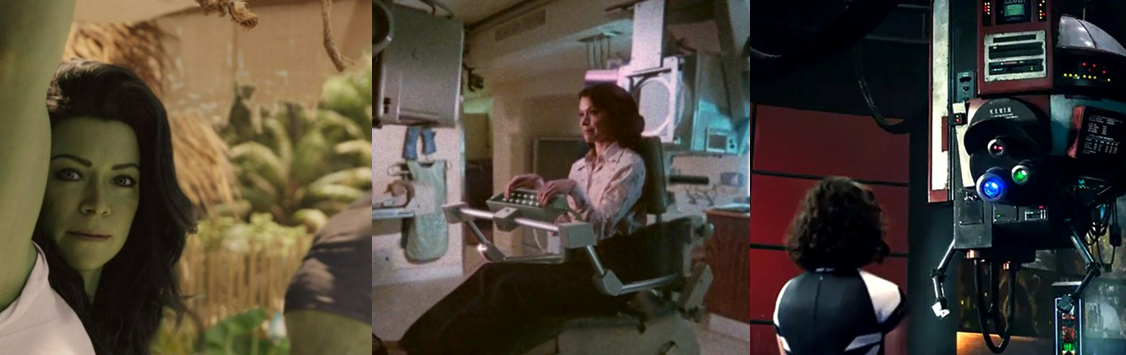
She-Hulk: Attorney at Law begins in medias res; Jen is already capable of becoming She-Hulk, her best friend and paralegal Nikki Ramos (Gonzaga) is aware of her abilities, and she immediately showcases her additional ability to address the audience to catch us up with her origin story. Jen was on a road trip with Bruce and the two of them were involved in a car crash caused by the sudden appearance of a Sakaaran spacecraft. While rescuing Bruce from the wreckage, some of his blood drips into her wound, instantly transforming her into a savage hulk in the first of many call-backs to the pilot episode of The Incredible Hulk. Disoriented and dishevelled, she’s unquestionably supported and fixed up by a gaggle of helpful women at a bar but is triggered by a group of pushy guys before being tackled by the Hulk and brought to his secluded island laboratory for testing and training. Jen is distraught at the idea of being handicapped by such a life-destroying condition and immediately annoyed and critical of the Hulk’s attempts to mentor her; this ends up going both ways, however, as the Hulk’s lifelong syllabus on controlling his rage is rendered mute by Jen’s natural ability to retain her personality and intelligence in her Hulk form since she’s so used to managing her emotions, both in public and at work, to avoid lashing out at every creep or being branded as inferior because of her gender, which allows her to willingly transform at will because, essentially, she’s always angry.

Jen’s transformation into a Hulk causes some major changes to her personal and professional life.

This presents the unique dichotomy of She-Hulk; while the Hulk strived for years to master his abilities and to reconcile his two warring halves, Jen immediately has full control of not only her strength but also her transformations; though she’s physically smaller and less savage than the Hulk, she showcases all of his abilities with the added benefit of greater physical control. However, despite the Hulk’s best efforts, Jen has no desire to abandon her life and her career to be a superhero; after a brawl, he reluctantly agrees to let her live her own life, but things quickly become complicated for the superpowered lawyer when, during a session in court, she’s forced to reveal her dual identity in front of the world when “superpowered influencer” Mary Macpherran/Titania (Jamil) literally crashes in and threatens lives. It takes Jen some time to embrace her superhero identity; she regularly distances herself from the She-Hulk name and constantly downplays the appeal and benefits of being a superhero, and her condition comes to negatively affect her when she’s fired and unable to find work at a conventional law firm. Holden Holliway (Steve Coulter) throws her a lifeline by offering her the chance to join a superhero law division at Goodman, Lieber, Kurtzberg & Holliway (GLK&H); though initially annoyed that she’s been hired to represent clients as She-Hulk and as more of a publicity stunt than for her legal skills, she’s won over by her new office and just being back at work. Unfortunately for Jen, her troubles only escalate; the press constantly hound her, reporting rumours as facts and often belittling her because of her gender, and she’s even forced to set aside her personal bias in order to represent Emil Blonsky/The Abomination (Roth) at his parole hearing. This all comes to a head when Titania releases a rage of beauty products using the She-Hulk name and sues her for misuse of the copyright, which ties into a central theme of the series, which revolves around Jen learning to embrace both sides of her personality, the meek and somewhat awkward Jen and the sexually confident and alluring She-Hulk; throughout the show, she takes great strides in reconciling both in the court room by embracing her moniker and even later donning a form-fitting superhero outfit to directly assist others.

Jen’s struggles at romance are compounded by an online group that targets and slanders She-Hulk.

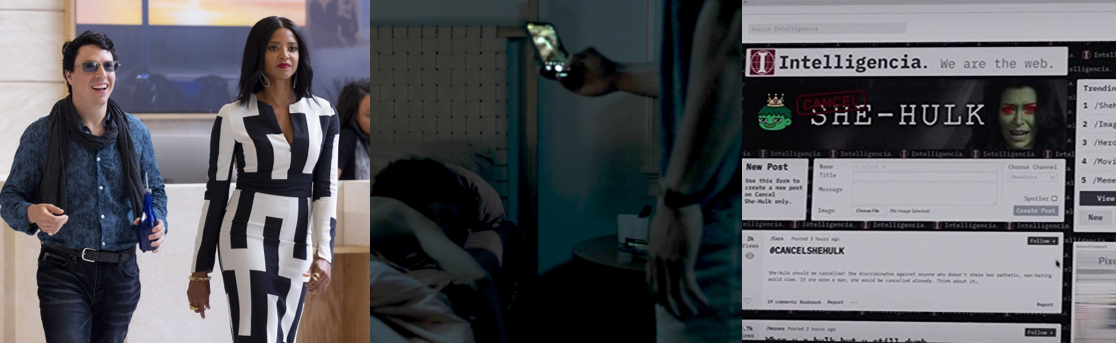
This character growth is full of little stumbles, however. Not only is she faced with an overbearing family who clearly care for her but can’t help but interfere and put her down, her love life is a bit of a shambles. Even after she reluctantly changes her online dating profile to a She-Hulk one, Jen is forced to endure a series of disastrous dates with self-obsessed, disrespectful, and down-right creepy men who either disregard her entirely or care only about comparing her to her more famous cousin, such as the uncomfortably obsessed Todd Phelps (Jon Bass), who later forms an entire online movement, Intelligencia, designed to hate on She-Hulk. Because of this, and Jen’s low self-esteem and desire for attention, it doesn’t take much for Arthur (Michel Curiel) to make an impression; he seems genuinely interested in her and actually engages her in conversation, however he has no interest in Jen and thus isn’t interested in pursuing a serious relationship with her. While attending the wedding of her high school friend, Lulu (Patti Harrison), Jen is surprised to make a connection with the charming Josh Miller (Trevor Salter), especially as she’s forced to stay in her human form so as not to steal Lulu’s spotlight. Josh appears to be the opposite of Arthur; he’s only interested in Jen and never really asks about She-Hulk and they actually take the time to date rather than jumping into bed right away. Unfortunately, after they do sleep together, he ghosts her, driving her to distraction; while she finds a measure of closure and self-respect thanks to some unlikely advice from Blonsky and the gaggle of misfit, rehabilitated supervillains at his retreat, she’s driven into an uncontrollable fury when Josh leaks her personal information, including photos and videos of her, to Intelligencia, resulting in her briefly losing the support of the public and being imprisoned.

Of all the guest stars to feature, Daredevil undeniably steals the show with his long-awaited return.

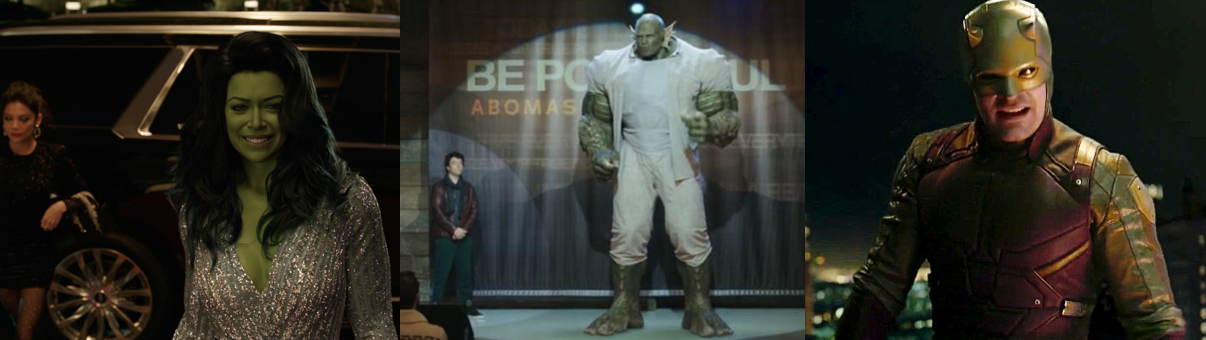
Thankfully, it’s not all bad news for Jen in the romance department. While he initially rubs her the wrong way by proving to be a competent lawyer, blind, flirtatiously charming Matt Murdock (Charlie Cox) proves to be a suitable confidante and partner after not only encouraging Jen to help others with her powers when the law fails them but also being unmasked as the superpowered vigilante Daredevil. Together, they’re able to rescue a mutual acquaintance, eccentric superhero fashion guru Luke Jacobson (Griffin Matthews), from wannabe superhero-turned-supervillain Eugene Patilio/Leap-Frog (Brandon Stanley) and, in the process, She-Hulk learns a little bit about what it means to be a superhero. The chemistry between them boils over following their fight and the series ends with the suggestion that they’re going to be a regular thing going forward since he joins her and her family for a meal. Although he steals the show in every scene, Daredevil isn’t the only guest star to feature in She-Hulk: Attorney at Law; Wong (Benedict Wong) shows up a few times, first to help with Blonsky’s appeal and then to ask for She-Hulk’s aid in barring disgraced sorcerer Donny Blaze (Rhys Coiro) from threatening the fabric of reality with his reckless magic. Similarly, the Hulk also plays an important role in the first episode; initially appearing as Bruce Banner thanks to a convenient inhibitor, he assumes his “Smart Hulk” form and puts Jen’s abilities to the test. He’s frustrated by her not taking his lessons seriously and tries to emphasise the burden and responsibility of being a Hulk, but ultimately trusts her to live her life her own way and disappears into space for his own side story, one that we’re not privy to but see the results of in the finale when he returns from Sakarr with his son, Skaar (Wil Deusner). We even get a couple of celebrity cameos as David Otunga and rapper Megan Thee Stallion feature in the series but the show’s breakout original character is clearly the brazen Madisynn King (Patty Guggenheim), a career party animal who makes a shady deal with a demonic goat and ends up forming an unlikely bond with Wong over their shared love of television.

While spending a lot of time in court, She-Hulk also explores her duality and self-esteem.

At its core, She-Hulk: Attorney at Law is a superhero comedy with a fair amount of courtroom drama serving as the focal point or backdrop of each episode. Whether it’s Jen trying to find a job in her field, Nikki and their co-workers Augustus “Pug” Pugliese (Segarra) and Mallory Book (Renée Elise Goldsberry) working cases involving shapeshifting elves or immortal cuckolds, rogue sorcerers or bumbling heroes, superhero law is naturally a large focus of the show. Conjecture, hearsay, trademarks, and faulty manufacturing are all elements that need to be addressed in a court of law, just like in normal life, but the superhero slant definitely makes these aspects more entertaining to watch. She-Hulk is often representing or even defending individuals who have wronged her in the past; she puts her neck on the line to vouch for the rehabilitated Blonsky, is called to speak to misogynistic Dennis Bukowski’s (Drew Matthews) stupidity, and is even forced to parade her former dates in order to prove that she identifies as She-Hulk. That’s not to say that the show is without any action scenes; Jen may prefer to use her legal skills more than her fists to resolve conflicts but she gets into a number of scraps throughout the show, often for comedic effect. Her first fight with Titania, for example, is over in a single punch and Jen forgets herself for a moment when she’s jumped by Wrecking Crew – Dirk Garthwaite/The Wrecker (Nick Gomez), Eliot Franklin/Thunderball (Justin Eaton), Henry Camp/Bulldozer (Tennison Barry), and Brian Calusky/Piledriver (Kyle Murillo) – when they try to steal her blood using Asgardian-powered construction tools, before easily dispatching them as She-Hulk. She-Hulk is specifically recruited by Wong to fend off the goblin demons Donny unwittingly summons, and she throws down with Titania again at Lulu’s wedding, much to the delight of the guests, but she chooses to leave the violence to Daredevil when confronting Leap-Frog and instead offers him legal counsel. Indeed, She-Hulk largely subverts a lot of the usual expectations when it comes to action sequences; she openly criticises Daredevil’s reliance on stealth and denies him another fight in a hallway and even finds herself really opening up to Blonsky and the oddball guests at his retreat since they can relate to her identity crisis.

Jen’s so annoyed at the derivative nature of her narrative that she forces the show to change tack for the finale.

She-Hulk’s true enemy here isn’t the monstrous Abomination, who’s now repentant and committed to offering emotional support and spiritual guidance, or even Titania, who’s strength makes her almost as formidable a foe as her spiteful nature. Instead, She-Hulk’s greatest foe throughout the series is toxic masculinity. We get our first taste of this moments into the first episode when Dennis undermines Jen’s abilities and suggests he’s a more capable lawyer than her; he continues to talk down to her even when addressing She-Hulk and, later, refuses to have her or Mallory represent him as he’d rather have a man. A shallow, arrogant little man, he refers to women as “hot chick” and “it” but it’s this delusional nature which ends up winning him the case against catfisher Runa (Peg O’Keef). Although a small-time annoyance, Dennis is just one example of the persecution Jen faces, both as herself and as She-Hulk; when the Wrecking Crew confront her, they accuse her of flaunting herself when she’s simply living her life and the press are constantly using derogatory terms to label her. Very few males treat her as an equal or with the respect she deserves, allowing the likes of Pug, Murdock, and even Blonsky to stand out as they actually engage with her and don’t condescend her or try to undermine her intelligence and abilities. Male chauvinism isn’t limited to just She-Hulk either; Craig Hollis/Mr. Immortal (David Pasquesi) lands himself in hot water after abandoning his many marriages by faking his death, leading to him not only earning Mallory and Nikki’s ire but also being forced to agree to a fair settlement tailored for each of his slighted partners. No male is more troublesome to She-Hulk’s stature than Todd, however; using the online alias “HulkKing”, Todd forms Intelligencia specifically to slander her and create a following of likeminded assholes to steal a sample of her blood so they can take the power they feel she doesn’t deserve. Still, luckily for Todd and his vile followers, Jen herself takes issue with the redundant nature of their plot and literally demands that the show try something a little more original, tailoring the ending into something a little less derivative and seeing that the HulkKing and his cohorts are exposed for the toxic, petty-minded jerks they are.

The Summary:  
There’s a real nasty environment that’s brewed online in the last few years where any product that even dares to try something new or feature a strong female lead, or include any kind of diversity, is immediately labelled as “woke”. Personally, I have no idea what this is supposed to mean and find it extremely degrading as it’s just some catch-all term mindless, anonymous idiots use to slander anything they don’t like. She-Hulk: Attorney at Law deals very heavily in this topic; although she largely ignores her online haters (primarily because she knows they wouldn’t dare say anything to her face), Jen is constantly besmirched and belittled both subtly and explicitly throughout the show. It’s small wonder, then, that she goes on a rampage, one eerily reminiscent of Carrie (De Palma, 1976), when Intelligencia publicly slut shame her at an award ceremony. This ceremony is perhaps the best example of the struggles Jen faces in her career; multiple women are named Female Lawyer of the Year and they’re paraded on stage like it’s a Miss Universe pageant, and Jen even foreshadows this when she quite rightly rants to her cousin about how difficult it is for a women to succeed as she’s slandered the moment she shows any weakness.

She-Hulk’s CGI is admittedly dodgy but other characters fare much better in this regard.

But I know what you want to hear me really talk about: the special effects. First of all, the Hulk looks fantastic; his CGI model is on point, which is to be expected as they pretty much perfected the look in Avengers: Endgame (Russo and Russo, 2019), but still surprising for a television show, especially as a Hulk-centric show seems to me to be one of the more costly MCU projects. Similarly, the Abomination looks really good; I’m really digging his more comic-accurate redesign and even enjoyed seeing him as this rational pacifist rather than some mindless monster, though I will admit that his face was a little off and his transformation was a little too “clean”. She-Hulk suffers from this a bit as well; she simply grows larger or smaller, her custom-made clothes expanding to accommodate her, so we’re largely beyond the days of dramatic transformation sequences for these characters. As for She-Hulk…she mostly looks perfectly fine, but it does vary wildly. Given that she’s not as monstrous as the Hulk, I do wonder if it might’ve been better to use her on-set stand-ins, Maliah Arrayah and Devon Lewis, to actually portray the character and enhance her with CGI, imposing Maslany’s face onto the larger doubles as a modern take on the 1970’s show (something the show does actually do when it lovingly recreates The Incredible Hulk’s iconic opening sequence). I think the things that bother me the most is her hair, which looks like a bad wig most of the time, and her eyes and face, which are a little lifeless and blank at times. It definitely works but it does stick out quite a bit and I can see why people would be distracted by it; low lighting definitely aids the presentation, but I admire how often Jen is seen in broad daylight as She-Hulk. Thankfully, Daredevil is here to again make up for some of these effects; now garbed in a yellow and red number, this is a fantastic return to form for the character, who seems much more jovial and far less bleak than in his Netflix show, allowing him to kick ass and be intimidating but also be a fun and attractive prospect for Jen. Hell, I even enjoyed the Leap-Frog suit and the inclusion of small-time, ridiculous villains like William Taurens/Man-Bull (Nathan Hurd), Alejandro Montoya/El Águila (Joseph Castillo-Midyett), Saracen (Terrence Clowe), and Alexander Gentry/Porcupine (Jordan Aaron Ford). I always enjoy it when live-action adaptations turn to the more obscure and ludicrous characters, and they really worked in the context of this show and played a surprisingly poignant part in shaping Jen’s acceptance of herself and her duality.

She-Hulk’s ability to break the fourth wall results in a unique metatextual humour.

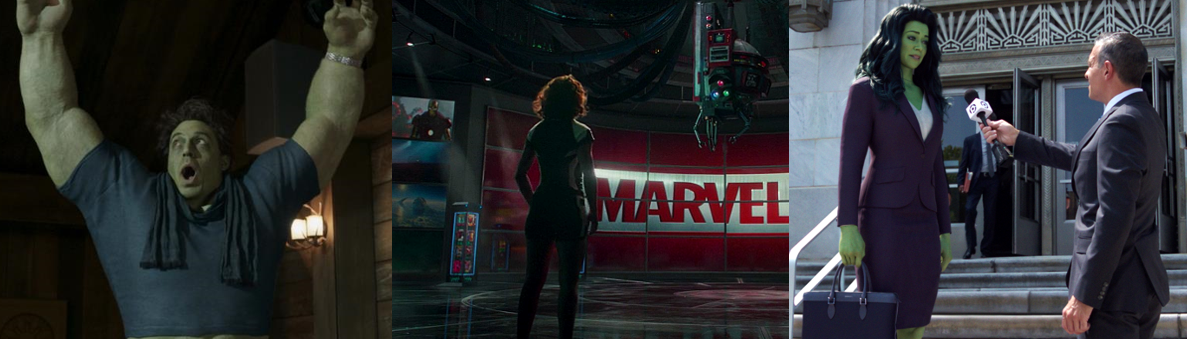
Of course, one major aspect that separates She-Hulk from most comic book characters is her ability to break the fourth wall, which is present right from the start and, while characters occasionally react to this, it’s mostly just played for laughs and ignored. Jen habitually addresses the camera, generally asking us not to judge her, addressing the abundance of cameos throughout the show, and questioning the plot at certain points. This metatextual approach extends to the title sequence, which changes a number of times to reflect what’s happening (such as Jen being out of work, Titania’s lawsuit, and Jen being barred from transforming into She-Hulk). The aforementioned recreation of the 1970’s intro was my favourite instance of this but all this metatextual commentary comes to a head in the finale; after being forced to wear an inhibitor after her rampage, Jen is at her lowest point when Todd transforms into a Hulk-like creature and even Titania and the Hulk show up at the last minute in a chaotic attempt to have all her separate storylines converge. She’s so unsatisfied with the conclusion that she literally escapes to the Marvel Studios: Assembled (Baruh, 2021) documentary to confront She-Hulk’s staff, who are amusingly non-plussed at a fictional character gate-crashing their meeting and direct her to “Kevin”, who turns out not to be MCU executive producer Kevin Feige but an artificial intelligence which makes all of the decisions about the MCU. Somewhat reminiscent of the divisive finale to The Matrix Reloaded (Wachowskis, 2003), Knowledge Enhanced Visual Interconnectivity Nexus/K.E.V.I.N. (Brian T. Delaney) continues the metatextual narrative by asking that she transform back into Jen as she’s “very expensive” and the visual effects team has “moved on to another project” and explaining that it uses advanced algorithms to create “near perfect” products, the quality of which is left up to the internet. Using her legal skills, Jen’s able to argue for more originality in her show, criticising Todd’s plot and the entire finale and demanding that she get the ending she deserves rather than what’s expected. She then goes on to address many of the issues people have with the MCU and even asks about the X-Men before being denied such a boon in the future and left to enjoy her happy ending.

A fun show with some great humour, action, and an empowering message that nicely expands the MCU.

I honestly didn’t expect to enjoy She-Hulk: Attorney at Law as much as I did; like a lot of people, I was mainly watching it to witness the glorious official integration of Daredevil into the MCU but the whole show was really good from start to finish. At nine episodes, it’s longer than usual for a Marvel Disney+ show and there’s an argument that a couple of the episodes could’ve been trimmed down or had their plot points combined into other episodes, but I have no complaints about the length or the content. It was a great introduction to this fresh new Hulk character, one who’s fully capable of defending herself and having a successful career and yet as conflicted and full of doubts as anyone else. Jen’s ability to break the fourth wall helps her to stand out even more and enabled the show to have a fun, carefree vibe while still holding up a mirror to the online trolls and toxic masculinity that is so prevalent in this day and age. While they were only minor roles, I also enjoyed Jen’s supporting cast; her doting, if annoying, family, Nikki’s endless enthusiasm, and Pug’s awkwardness at being forced to integrate with Intelligencia all made for some compelling and entertaining side characters. The courtroom drama was also very enjoyable; I liked seeing She-Hulk coming up with legal loopholes, even if it meant embarrassing herself, to win cases and I’d like to see the second season spend a little more time in the courtroom with some of Marvel’s more colourful and obscure characters. Alterations to the Abomination and the continuation of the Hulk’s mini arc also landed well with me; it was great to see Blonsky back, and cast in a sympathetic light and elevated into something more than just a brutish solider/supervillain and I was left really intrigued to see what’s next for the Hulk family. Yes, She-Hulk’s special effects can be wonky but I fully expect to see this addressed in another season; they work and can be impressive but you will have to get over it to fully enjoy the show. Also, if you’re one of these “woke” crusaders it’s probably better you watch something else as She-Hulk: Attorney at Law is very much geared towards sending a positive message about rising above hate and valuing people based on their ability and merits rather than belittling them because a small-minded minority think of themselves as somehow “superior”.

My Rating:

Rating: 4 out of 5.

Great Stuff

What did you think about She-Hulk: Attorney at Law? Did the CGI used to bring She-Hulk to life put you off? What did you think to her ability to break the fourth wall? Were you a fan of the legal drama and comedy aspects? What did you think to the Abomination’s character growth and the reintroduction of Daredevil? Did you enjoy the attack on toxic masculinity or was it too “woke” for you? Where would you like to see the character go in the future and are there any She-Hulk storylines or characters you’d like to see included in future seasons? Whatever you think about the show, or She-Hulk in general, leave a comment below or on my social media and be sure to check out my other Hulk content!

Back Issues [HulkaMAYnia]: Tales to Astonish #90/91


Since his explosive debut in May 1962, Stan Lee and Jack Kirby’s gamma-irradiated Jade Giant has been one of their most recognisable and successful characters thanks, in large part, to the Incredible Hulk television show (1977 to 1982) catapulting the Hulk into a mainstream, pop culture icon. The Hulk has been no slouch in the comics either, being a founding member of the Avengers and undergoing numerous changes that have made him one of their most versatile and enduring characters, so what better way to celebrate all things Big Green than by dedicating every Sunday in May to the Green Goliath?


Writer: Stan Lee – Artist: Bill Everett

Story Title: “The Abomination!”
Published: 10 January 1967 (cover-dated April 1967)

Story Title: “Whosoever Harms the Hulk…!”
Published: 14 February 1967 (cover-dated May 1967)

The Background:
Created by Marvel legends Stan Lee and Jack Kirby, Doctor Robert Bruce Banner’s monstrous alter ego, the Incredible Hulk, was inspired by the story of a hysterical mother using superhuman strength to rescue her child and classic screen monsters Frankenstein’s Monster and Doctor Jekyll and Mister Hyde. Initially debuting as a stone-grey figure, the character soon gained his trademark green hue and became a fixture of Marvel Comics thanks to expansions of his lore and character and the popularity of the live-action television series. Stan Lee also had a hand in creating some of the Hulk’s most memorable enemies; having birthed the Hulk’s intellectual superior, Samuel Sterns/The Leader, alongside Steve Ditko about three years prior, Lee and artist Gil Kane introduced Marvel readers to one of the Hulk’s most persistent physical rivals, Emil Blonsky/The Abomination, in this two-part tale. Lee came up with monster’s unique name and reportedly instructed Kane to make the Abomination bigger and stronger than the Hulk to make for some fun conflicts. Over the years, the Abomination has been through almost as many changes as his lifelong rival, being a savage brute, a schemer, and a figure of redemption. His impact on the Hulk’s life has been so influential that he’s featured in numerous Marvel cartoons; although he made his live-action debut in the unfairly overlooked The Incredible Hulk (Leterrier, 2008), it would be some thirteen years before he would return to the Marvel Cinematic Universe.

The Review:
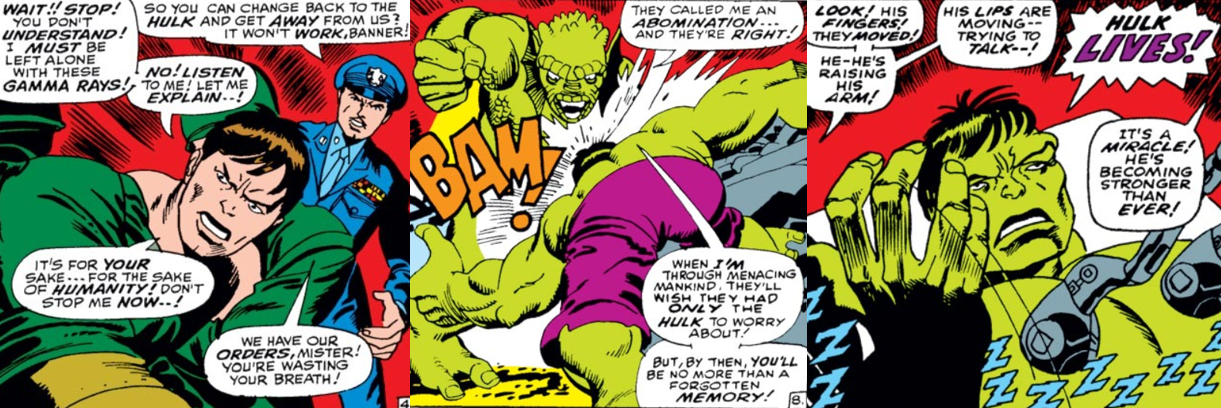
Our story begins with the Green Goliath embarking on an unstoppable rampage thanks to the manipulations of a cosmic being I’m personally unfamiliar with but who calls himself “The Stranger”; believing that humanity is a blight that needs to be eradicated, the Stranger has set the Hulk to work wiping the planet clean of humankind’s influence, and the Hulk is only too happy to give in to his anger. Already harbouring a resentment and animosity towards the “puny humans” who hate and fear him, the Hulk wrecks a suspension bridge and prepares to lay waste to a missile base when he’s suddenly hit with an intense pain in his head that not only causes him to fall, but also triggers his transformation back into cursed Gamma scientist Bruce Banner. This has the knock-on effect of severing the Stranger’s mind control, but Banner is terrified at the prospect of the Hulk resurfacing and continuing the Stranger’s work and resolve to destroy the Hulk (and himself, if necessary) once and for all using the “Gamma Ray Machine” he created and which just so happens to be at the very base he’s found himself at.

While Banner broods and Ross blusters, a foreign agent undergoes an incredible transformation!

Nearby, the cantankerous General Thaddeus “Thunderbolt” Ross is determined to root out the man behind a recent assassination attempt on his daughter (and Banner’s flame), Betty Ross; also Major Glen Talbot assures Ross that it’s just a matter of time before the foreign agent is discovered, Ross explodes in anger and demands that they find the perpetrator before they can endanger the missile, giving his men orders to shoot to kill if necessary. Betty is distraught that there’s been no word from Banner for some days and fears for his life as long as he shares a body with the Hulk; she’s so devastated at the idea of losing him that she pays no mind to Talbot’s attempts to insert himself in Banner’s place. Meanwhile, in Banner’s lab, Ross’s spy (whom we know as Emil Blonsky but who isn’t named in this story), is snooping around in the guise of a soldier and trying to snap pictures of Banner’s vaulted Gamma Ray Machine. Although Banner returns at that very same moment, intending to use the machine on himself, he’s spotted and arrested by military police and the smug Talbot, who refuses to listen to his pleas. Amused by the turn of events, Blonsky comes out of hiding and investigates the machine, activating it out of sheer curiosity and bathing himself in an intense dose of Gamma radiation. The result is his instantaneous transformation into a hulking, green-skinned, lizard-like monstrosity; thanks to stepping out of the Gamma rays early, this Abomination is able to retain his intellect and revels in his newfound super strength, which he believes will make him “master of the world–of the whole universe!!” and promptly destroys the machine so that none will challenge his invincibility.

The Hulk is overwhelmed by the superior strength and intellect of his newest foe.

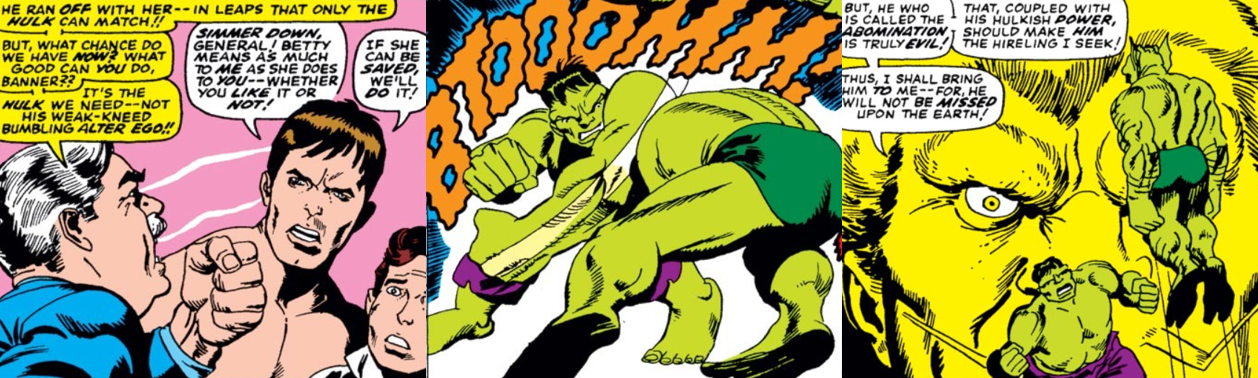
The Abomination’s subsequent rampage through the base catches the eye of the imprisoned Banner, who willingly transforms into the Hulk as only his alter ego has a chance of opposing this new Gamma monster. Ripping open his cell, the Hulk leaps into the fray but quickly finds that the Abomination is not only smarter thanks to not being a mindless brute, but also more powerful as he was conveniently subjected to a more powerful dose of Gamma radiation. Consequently, Ross, Talbot, and Betty can only watch on in horror as the Abomination asserts his dominance and brutally beats the Hulk into unconsciousness, clearly establishing himself as a formidable threat, and that Blonsky is oddly concerned that he wouldn’t survive the military’s counterattack so he kidnaps Betty and flees from the base. Driven to desperation by the events he’s witnessed, Ross has no choice but to order his physicians to try and save the Hulk’s life; while the surgeon is initially baffled by the half-dead creature’s physiology, perennial sidekick Rick Jones bursts into the facility to suggest using Gamma electrodes to revive the beast and, in panels that owe more than a debt to Frankenstein (Whale, 1931), the Hulk lives again! Believing the soldiers are trying to contain him, the Hulk refuses to listen to reason and even swats Rick aside, vehemently denying his tearful pleas for help, until the mention of Betty’s name causes him to calm down and revert back to Bruce Banner.

Although Banner devises a workable plan, the monster’s rematch is abruptly interrupted.

Cutting through Ross’s bluster and inconsolable babble and prejudice, Banner comes up with a plan to lure the Abomination back to them, rather than confront his great power directly, and reconfigure his “Infinite Weapon” to nullify Blonsky’s strength with “Infra-Gamma Beams”. Begrudgingly, Ross orders his technicians and soldiers to follow Banner’s every command as they race to perform the necessary adjustments, and the Abomination willingly returns to the site, drawn by the allure of the Gamma radiation, though everyone, even Rick, is unsure as to how Banner plans to oppose such a fearsome monstrosity. The Abomination bursts into the laboratory, setting down Betty and preparing to finish off Banner, but is surprised when the machine causes him incredible pain and saps his mighty strength. It’s at this key moment that Banner uncontrollable turns into the Hulk and the two Gamma Giants set about having a rematch. Although they bash each other through walls and promise to really go at each other, the Stranger chooses this moment to return to the story; watching from “a thousand galaxies away”, he begins to consider that humanity might not be beyond all hope if a brute such as the Hulk can be so valorous and chooses to take the Abomination for his own needs. He also completely removes the influence he had over the Hulk’s mind but, while he’s met with congratulations and a semblance of gratitude from even General Ross, the Hulk chooses to head back out into the world alone once more.

The Summary:
The Abomination’s debut is much more the type of Hulk story I’m used to; by this point, Bruce Banner’s dual identity is well known and his adventures follow a very simple formula of him wandering around the country, desperately trying to avoid conflict, all while the Hulk threatens anyone and everyone around him and lashes out at those he deems to be a threat. Unfortunately, I didn’t think much to Gil Kane’s artwork, especially on the Abomination and the Hulk’s face, both of which look to little too simplistic and goofy for my tastes. I did enjoy the twist of the normally unreasonably antagonistic General Ross absolutely snapping when the Abomination kidnaps Betty; he’s so traumatised by this that he’s forced to not only rely on the Hulk and Banner for help, but even revive the Green Goliath and order his men to follow Banner’s every instruction. It’s an interesting twist on his usually staunchly anti-Hulk/Banner mindset, kind of like whenever J. Jonah Jameson is forced to eat crow, though I was interested to see that Major Talbot was actually arguing in favour of Ross’s hated enemy on more than one occasion. Similarly, I liked that Banner got to do a little more than just wallow in despair and self-pity; he puts his genius mind to work creating a trap to lure in the Abomination and sap his strength, though it was a little too contrived that all of Banner’s machinery and work just happened to be at this military base. The Hulk is pretty much exactly as he’s always presented, with the added wrinkle that he’s suffering from the influence of the Stranger; this doesn’t really seem to change his character all that much, however, as it’s hardly an uncommon occurrence to see the Hulk going on an all-out rampage for the smallest of reasons.

The Abomination’s strength is so great that it takes brains, not brawn, to challenge him.

This is potentially the first time that the Hulk has ever faced a foe as physically imposing as him, however; he fought Groot (no, not that one) a few years earlier but as far as I can tell most of his more monstrous foes made their first appearances after this story. Consequently, the Abomination makes quite the impact; not only does he retain his intelligence, allowing him to out-think the Hulk, but he’s portrayed as being significantly more powerful, knocking the Hulk out and beating him almost to the point of death in their first encounter. However, the praise kind of stops there; the explanations behind Blonsky’s retained intelligence and greater strength and paper thin and it’s really weird that he would choose to flee after besting the Hulk as he would surely have even less reason to fear the military’s weapons than the Green Goliath. The Abomination’s greater intelligence also doesn’t really translate into any kind of impressive strategy either; immediately drunk on his newfound power, Blonsky sets his goals as lofty as conquering the entire universe, than smashes the place up a bit, and then resorts to kidnapping Betty. He doesn’t even use her as a means to give the Hulk pause to attack and abandons her the moment he arrives back at the base, but worst of all is the fact that this Stranger’s intervention cuts short his rematch with the Hulk simply to keep the Abomination’s threat unchallenged. Overall, this wasn’t a bad two-part story but it definitely wasted its potential; there was so much that could’ve been done with the duality of these monsters, the twist of Ross having to rely on his enemy, and seeing the Hulk and the Abomination tera up the base of the countryside but the story instead plays it very safe and simply hands the Hulk a decisive loss and has his newest (and presumable most powerful) villain left out in the world (well, cosmos) to no doubt hound him again at some point.
My Rating:

Rating: 3 out of 5.

Pretty Good

Did you enjoy the Abomination’s debut? Did you read it when it was first published and, if so, how did you think the Abomination compared to other Hulk villains? What did you think to the idea that the Abomination was not only smarter but stronger than the Hulk? Would you have liked to see a proper rematch between the two in the second part? What are some of your favourite fights or moments between the Hulk and the Abomination? Who is your favourite Hulk villain? Whatever you thoughts on the Abomination (and the Hulk), feel free to share them below or leave a comment on my social media and be sure to check in again next Sunday for more Hulk action!

Movie Night [HulkaMAYnia]: The Incredible Hulk


Since his explosive debut in May 1962, Stan Lee and Jack Kirby’s gamma-irradiated Jade Giant has been one of their most recognisable and successful characters thanks, in large part, to the Incredible Hulk television show (1977 to 1982) catapulting the Hulk into a mainstream, pop culture icon. Hulk has been no slouch in the comics either, being a founding member of the Avengers, joining teams like the Defenders, and has gone through numerous changes over the years that have added extra depth to the green-skinned behemoth and made him one of their most versatile and enduring characters.


Released: 13 June 2008
Director: Louis Leterrier
Distributor:
Universal Pictures
Budget:
$137.5 to 150 million
Stars:
Edward Norton, Liv Tyler, Tim Roth, and William Hurt

The Plot:
While trying to recreate the super-soldier serum, Doctor Bruce Banner (Norton) exposed himself to gamma radiation and, whenever provoked or enraged, transforms into a green-skinned behemoth known as the “Hulk” (Lou Ferrigno). Desperate for a cure, and to avoid General Thaddeus “Thunderbolt” Ross (Hurt), Banner reluctantly reconnects with former flame Doctor Betty Ross (Tyler) and is hounded by Emil Blonsky (Roth), a relentless soldier who exposes himself to the same process to match the Hulk’s physical abilities.

The Background:
Stan Lee and Jack Kirby’s green-skinned rage monster had a troublesome road to the big screen; although Hulk (Lee, 2003) featured its fair share of impressive visual effects shots and was relatively profitable, its poor critical performance quashed plans for a sequel. However, when Universal Pictures failed to produce a follow-up in time, the rights reverted to Marvel, who were currently riding high after the critical and commercial success of the first film in the Marvel Cinematic Universe (MCU), Iron Man (Favreau, 2008). Opting to reboot the property, Marvel hired director Louis Leterrier and writer Zak Penn, who both drew significant inspiration from their love of The Incredible Hulk television show (1977 to 1982). Edward Norton was cast as Banner and also provided some work on the script, which caused some tension between him and Marvel when many of his additional scenes were cut and ultimately led to him leaving the role. Like Hulk, The Incredible Hulk brought the Hulk to life through visual effects specifically tweaked to portray him beyond the peak of human physical ability and the film even brought back Joe Harnell’s iconic and tragic “Lonely Man” theme from the TV show. The Incredible Hulk was not quite as profitable as Iron Man; it made a little more than its predecessor with a worldwide gross of nearly $265 million but was again met with mixed reviews. Although development of a solo sequel film stalled after disagreements with Universal Pictures, the character would be recast for subsequent appearances in the MCU, where he received something of a “mini arc” and many of the film’s loose ends were eventually addressed in later MCU productions.

The Review:
I came away from Hulk relatively satisfied; it was longer and far more cerebral than I was expecting but I always thought that it was a pretty impressive and enjoyable big-screen debut for the Jade Giant and I was disheartened to learn that we wouldn’t be getting a direct sequel. Still, hearing that the next film in the MCU would feature another crack at the Hulk was an encouraging sign that Marvel Studios were eager to both do the character justice and make him a prominent feature in their fledgling interconnected universe. Even better was the fact that The Incredible Hulk benefitted from a surge of fantastic casting in superhero films at the time; actors like Robert Downey Jr., Jeff Bridges, Michael Caine, and Morgan Freeman were really adding a lot of legitimacy and gravitas to the genre and I thought it was quite the coup to see Edward Norton cast in the lead role in The Incredible Hulk. Sadly, Marvel Studios seemed to lose faith in the project before the release day and spoiled Tony Stark’s (Downey Jr.) appearance the pre-credits scene in the last few trailers and, even now, The Incredible Hulk remains one of the lowest-grossing films in the MCU.

Banner is a desperate man on the run trying to cure his unique condition and avoid capture.

Like Hulk, The Incredible Hulk plays its opening titles over a montage that is both a clear homage to the 1970s TV show and a revised origin for the character as Banner exposes himself to gamma radiation in an attempt to recreate the super-soldier serum rather than as an experiment on the limits of the human body. As much as I enjoy Mark Ruffalo in the role, there’s no denying that Edward Norton is a different quality of actor; he makes for a great Banner, showcasing the same empathy, humanity, intelligence, and desperation that made Bill Bixby so great in the role, and is still probably the most accurate onscreen portrayal of the character in my mind. Actively hiding his identity and staying off the radar of both Ross and the Strategic Homeland Intervention, Enforcement, and Logistics Division (S.H.I.E.L.D.), Banner busies himself with a menial job while communicating with the mysterious “Mr. Blue” in an effort to synthesise a cure for his condition. Banner also wears a heart rate monitor to warn him when he’s getting too stressed and works with an Akido instructor (Rickson Gracie) to control his emotions and anger through breathing and meditation techniques. Having reached the limit of what he can accomplish with his mediocre resources, and after accidentally alerted Ross to his presence with a single drop of blood, Banner has no choice but to abandon his hard but largely peaceful life and return to the United States in an effort to find a cure.

Betty can’t help but be drawn to Bruce and helps him out of pure adoration and love.

This reunites him with Ross’s daughter and Banner’s former love, Betty, a renowned and capable scientist in her own right who, despite being in a relationship with psychiatrist Leonard Samson (Ty Burrell), has never forgotten her feelings for Bruce. Reunited after five years apart, she immediately insists on helping him in any way she can, which involves bringing him clothes after his Hulk-out, helping him gain access to Culver University, going with him on the run, and shielding him from her tyrannical father at every opportunity. Betty is, once again, an empathetic and supportive character who is both clearly besotted with Banner and exhibits a sympathetic protectiveness of his green-skinned counterpart; Tyler and Norton have a very real, tangible chemistry and it’s great seeing their characters interact as equals and attempting to act on their obvious attraction to each other. Crucially, Betty also holds key data that Mr. Blue (who turns out to be Doctor Samuel Sterns (Tim Blake Nelson)), needs to properly help synthesise a cure for his condition.

The Hulk is far more aggressive and wild than usual and more like a force of nature.

Though still largely a silent character, the Hulk continues to exhibit a great deal of personality to separate him from Banner. Far more aggressive and angrier than his 2003 counterpart, this is a Hulk who has had to deal with being constantly suppressed within Banner’s subconscious and finds himself relentlessly hounded by Ross, Blonsky, and the military. As he simply wants to be left alone but is quick to fly into a rage and even mumble a few words of protest when provoked, the Hulk appears to be much more feral than usual, though he does retains his child-like demeanour at times while also seeming much more akin to a wild animal. Crucially, the Hulk is fiercely protective of Betty, who’s the only person to show him any kindness, and notably shields her when Ross allows his selfish vendetta against him to threaten her safety, lending further credibility to Betty’s later belief that the Hulk has great potential as a force for good. Since the film doesn’t delve into Bruce’s childhood or emotional trauma, the Hulk is much more of a result of science gone wrong but there’s also the suggestion that he has the potential to be so much more; Banner, however, is more concerned with ridding himself of his ailment than learning to properly accept it as part of himself and his fear of the Hulk is almost as great as Ross’s hated of him.

Just as Ross is desperate to apprehend Banner, Blonsky is obsessed with fighting the Hulk.

Speaking of ol’ Thunderbolt, General Ross continues to be a stubborn and vindictive character; personally directing the missions to detain Banner, his motivations stem just as much from Banner’s first transformation landing Betty in the hospital as it does from his desire to contain the beast lest anyone discover the role Ross and the U.S. military played in his creation. Again a stern and uncompromising authority figure who prioritises his duty and career over his daughter, Ross begins the film estranged from Betty and their relationship is only further strained by the revelation that Ross is seeking to dissect the Hulk from Banner’s body in order to weaponise the creature. Ross’s ceaseless campaign against Banner sees him employ the services of Emil Blonsky, a former Royal Marines Commando who quickly develops an intense rivalry with the Hulk. Eschewing promotions that would take him away from the combat he craves so dearly, Blonsky obediently follows orders to the letter but, having witnessed the Hulk’s destructive power (and feeling the physical strain of a lifetime of combat), candidly requests more information on Banner and the Hulk and is only too eager to receive a version of the super-soldier serum in order to improve his own strength, speed, reflexes, and recuperative powers. However, when even this fails to make him a match for the Hulk, Blonsky seeks more extreme methods to battle the Green Goliath. Sterns is only too willing to further augment Blonsky’s body with mutated samples of Banner’s blood, which causes him to transform into a bestial form of his own to finally battle the Hulk on equal ground for the finale.

The Nitty-Gritty:
I touched on this earlier but, for a time, it wasn’t entirely impossible to view The Incredible Hulk as a follow-up to Hulk; the film opens in Brazil, very similar to where the 2003 film ended, and it’s easy enough to believe that Banner was granted permission to return to the U.S. to help with the super-soldier serum only to be further ostracised by Ross, and you could even explain away to recasting of Talbot from Josh Lucas to Adrian Pasdar and his revival can be explained away by the questionable canonicity of Marvel’s television shows. I always felt like there was just enough connective tissue to link the two without explicitly stating it but, ultimately, The Incredible Hulk also works extremely well as a reintroduction to the character. By evoking the familiar imagery of the TV show and leaning into the accepted tropes associated with the character, the film is much faster and more action-packed since it doesn’t waste time delving into the Hulk’s origin and instead kicks things off with Banner a desperate man on the run, something immediately familiar to fans of the early comics and the aforementioned TV show.

Banner comes to consider that the Hulk could be used as a force for good.

That’s not to say that The Incredible Hulk isn’t without its poignant moments; it may not be a methodical in-depth character study like the last film but there’s a great amount of time devoted to Bruce’s increasing desperation to rid himself of the Hulk. This has left him alone and exiled from his home and love, and constantly on edge and reluctant to trust anyone with too much of his blood or research lest he be discovered or his condition weaponised. Banner is outraged to discover that Sterns has synthetised large quantities of his blood for medicinal purposes and is disheartened to find that Sterns’ efforts have been unable to produce an actual cure. When he returns to the U.S., Banner is initially reluctant to reconnect with Betty but she insists upon offering her assistance out of a genuine affection for him; Betty is also the one who suggests that the Hulk is actually a force for good, something that kept him from dying from a gamma exposure, and plants the first seed in Banner’s head of trying to “aim” the beast and influence the Hulk’s actions rather than simply eradicate the Jade Giant. There’s also an interesting addition whereby Banner’s condition means he cannot allow himself to get sexually aroused since this risks provoking the Hulk’s emergence, replacing the allegory of the Hulk as an expression of his repressed childhood trauma with a metaphor for impotence.
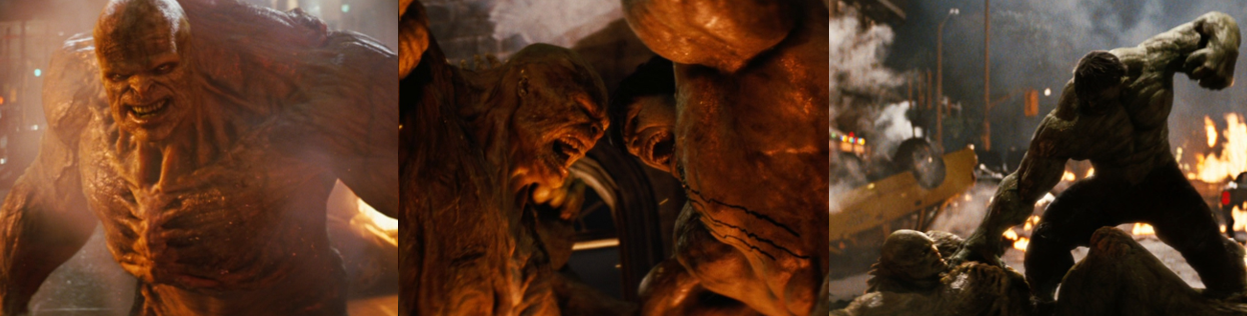

The Hulk is a highly adaptable and aggressive fighter.

Like his 2003 counterpart, the Hulk is a purely digital creation; similar to the last film, the Hulk is initially obscured by darkness and very much painted as a mysterious and fearsome monster. This time, he’s got more of a grey/green hue, is noticeably much more ripped than his predecessor, and there’s loads of really intricate details in his model like bulging veins and muscles that make him a far more impressive digital creation. However, despite this, it can’t be denied that the special effects have aged somewhat. Although the Hulk’s digital model is visually far more impressive than his predecessor, the effects remain somewhat inconsistent in his quality; the Hulk appears very cartoonish when he emerges on the university campus but looks far more believable and fearsome when filmed at night and in the finale. Though he doesn’t continuously increase in mass as he gets madder and stronger, this Hulk is far more aggressive and much more diverse in his attack patterns. He performs his patented thunderclap manoeuvre and his ability to use his surroundings to his advantage, coupled with his ferocious rage, make him a terrifying force of nature. Indeed, the Hulk is smart enough to rip apart military vehicles and turn them into makeshift shields and weapons, very similar to The Incredible Hulk: Ultimate Destruction (Radical Entertainment, 2005), which he uses to trash Ross’s heavy ordinance and sonic weapons. Although he wishes to be left alone, the Hulk’s threat only increases the more he is provoked and Blonsky certainly drives him to his limits with his persistence and taunts, earning him a near-fatal blow from the Green Goliath, who appears to rack up quite the body count through his many rampages.

Despite being a dark mirror of the Hulk, the Abomination makes for a thrilling final foe.

Thankfully, there are no gamma dogs this time around and the Hulk surprisingly appears in a number of populated areas, adding to the film’s level of destruction over its predecessor. While Blonsky’s enhanced abilities provide a taste of what we would later see from Steve Rogers/Captain America (Chris Evans), his obsession with besting the Hulk leads to him forcing Sterns into transforming him into a version of the Abomination. This bony, hulking monster is quite the upgrade compared to the finale of the last film but is a noticeable departure from his traditional comic book appearance and does admittedly add to the MCU’s tendency to rely on dark mirrors of their heroes. Still, the brawl between the Hulk and the Abomination makes for a far more visually impressive finale, not least because you can actually see what’s going on this time around. Potentially because of his conviction or having been exposed to a more potent version of the super-soldier serum, Blonsky retains his personality and intellect when transformed but, drunk with the power afforded to him, the Abomination goes on a rampage through Harlem, attacking civilians and Ross’s troops alike to draw the Hulk out and forcing Ross to risk sending Banner into the hot zone to take Blonsky down. I can totally understand the argument that ending the film with two similar-looking CGI characters bashing each other senseless takes away from the human element of the narrative but it’s a Hulk film so what do you expect? The scene is also framed in a way to make the Hulk appear both heroic and monstrous; though he attacks the Abomination, he causes a great deal of damage in the process but his rage is effectively directed in a more productive way. Despite boasting bony protrusions, the Abomination is ultimately bested by the Hulk’s unquenchable rage but is saved from being choked to death by Betty’s intervention; afterwards, he’s carted off to be thrown in prison in the Raft for the better part of a decade. Humbled by having to turn to the Hulk for help, Ross is far from impressed when Stark comes seeking to recruit the Hulk and the film ends with the ambiguous suggestion that Banner has learned to control his transformations.

The Summary:
Honestly, it annoys me that people overlook The Incredible Hulk; it doesn’t help that legal issues between Marvel Studios and Universal Pictures kept the film somewhat suppressed for a great deal of time and meant that all of the dangling plot threads and sequel bait would sadly never be developed or take a long time to be addressed in the wider MCU. The film’s homages to 1970s show and films like An American Werewolf in London (Landis, 1981) are a nice touch and the cast is absolutely fantastic; Norton, Tyler, Hurt, and Roth all bring a real humanity and intensity to their roles in their own ways and the Hulk is realised perfectly onscreen. Despite being much brisker and more action-orientated compared to the 2003 film, The Incredible Hulk still perfectly captures the desperation of the character as seen in the source material and the popular TV show, and even an admittedly lacklustre finale doesn’t spoil what I find to be an extremely enjoyable and under-rated entry in the MCU.

My Rating:

Rating: 3 out of 5.

Pretty Good

Are you a fan of The Incredible Hulk? Would you agree that it’s an under-rated entry in the MCU? What did you think to the cast and would you have liked to see Edward Norton reprise the role in the MCU? Were you a fan of the Hulk’s appearance and characterisation this time around and how did you interpret the film’s final shot? Would you have liked to see all of its loose ends addressed in a dedicated Hulk sequel or were you happy with how the MCU incorporated these elements later on? What Hulk story from the comics would you liked to see adapted one day? Whatever your thoughts, feel free to leave a comment below.

Talking Movies: What If…? Thanos and the Masters of Evil

Talking Movies

In Avengers: Infinity War (Russo and Russo, 2018) the Mad Titan, Thanos (Josh Brolin), finally made a significant appearance in the Marvel Cinematic Universe (MCU). When the idea of a two-film saga based on the Infinity Gauntlet comic book (Starlin, et al, 1991) was first announced, I, like many others, had many theories about what was going to happen, who was going to live and die, and how everything was )going to go down. For example, before Thor: Ragnarok (Waititi, 2017), I was certain that Thanos’ big entrance was going to immediately establish his threat by hanging him storm into Asgard kill Odin Allfather (Anthony Hopkins), and claim the Tesseract (and, obviously, the Space Stone it help). After all, how better to establish this big bad villain than by having him kill a God?

Thanos’ Black Order made their MCU debut in Avengers: Infinity War.

Instead, of course, Thanos wrecked Thor Odinson’s (Chris Hemsworth) ship and slaughtered half of the Asgardians onboard. Still an impressive feat, to be sure, but one that focused more on Thanos’ grandeur and pretentious philosophy rather than his actual physical strength thanks to the bulk of the work being undertaken by his underlings, the “Children of Thanos”. Headed by Ebony Maw (Tom Vaughan-Lawlor), Cull Obsidian (Terry Notary), Proxima Midnight (Carrie Coon/Monique Ganderton), and Corvus Glaive (Michael James Shaw), the Children of Thanos didn’t actually appear in The Infinity Gauntlet and are, instead, relatively recent additions to Thanos’ ranks who first appeared (as the “Black Order”) in Infinity (Hickman, et al, 2013). In the film, we don’t really learn much about these guys at all except that they enforce Thanos’ will with unquestioning loyalty and that he trusts them to help him gather the remaining Infinity Stones and, while they certainly look visually interesting, they’re mostly disposable bad guys for the Avengers to fight in place of Thanos.

While Abomination is a good choice, I definitely think Ronan could’ve taken Cull’s place.

Now, I’ve never read Infinity; I have no emotional attachment to the Black Order or any of the characters and, as a result, they were merely nothing more than henchman to me and I only really recall one of them being referred to be name (“I take it the Maw is dead?”) While I enjoyed their inclusion in the film, I can’t help but feel like they could have been dropped and supplanted with some other, more recognisable MCU villains had some other films and events happened just a little differently. For example, take Cull Obsidian; he’s Thanos’ muscle who basically does nothing and is largely inconsequential. What if, instead of killing Ronan the Accuser (Lee Pace) in Guardians of the Galaxy (Gunn, 2014), Ronan had been soundly defeated and humbled and, having seen the extent of Thanos’ power (he did destroy Xandar (offscreen), which was what Ronan wanted, after all, and would be enough to bring Ronan to heel, I would wager), he pledged himself fully to Thanos’ cause to get revenge against the Guardians of the Galaxy? I’m not massively familiar with Ronan but it seems to me like it was a bit of a miss-step to kill him off when he could have fulfilled a role in Thanos’ little gang at the very least, if not remain as a recurring antagonist for the Guardians. Another potential replacement for Corvus would be Emil Blonsky/Abomination (Tim Roth) who, at the time, had been conspicuous by his absence from the MCU. However, arguably, it wouldn’t make as much sense for Thanos to recruit the Abomination as he’s not exactly floating around in the depths of space for him to encounter.

What if Loki or the Red Skull had aligned themselves with Thanos in place of Ebony Maw…?

Intrigue was equally high in the build-up to The Avengers/Avengers Assemble (Whedon, 2012); I was hoping to see a version of the Masters of Evil, with Loki Laufeyson (Tom Hiddleston) joining forces with Johann Schmidt/The Red Skull (Hugo Weaving) – who was clearly transported away from Earth by the Bifrost at the end of Captain America: The First Avenger (Johnston, 2011 – and either the Abomination or Doctor Samuel Sterns/The Leader (Tim Blake Nelson) once they got to Earth. While I was happy with the first Avengers team-up we got, I do feel this was another missed opportunity that we never saw this anti-Avengers team-up. Consequently, I feel like we could have swapped out Ebony Maw for either of these characters; in The Infinity Gauntly, Thanos was advised by Mephisto, a role many expected Loki to play in Infinity War given his mischievous and devious nature. Naturally, of course, you could argue that this wouldn’t really fit with Loki’s character arc by that point but remember how he feigned loyalty to Thanos and then tried to stab him in the neck? Well, imagine that but throughout a large portion of the movie. Loki pledges fealty, willingly hand shim the Tesseract, and spends the remainder of the film waiting for the perfect moment to strike and then he’s killed for his efforts. Obviously, the Red Skull finally showed up in Avengers: Endgame (Russo and Russo, 2019) in a slightly different role as the Stonekeeper (Ross Marquand), but again…what if the Red Skull had replaced Ebony Maw? How much more interesting and impactful would it have been to see the Red Skull empowered by Thanos and making a triumphant return as Thanos’ chief torturer? Sure, if his death was the same then you could argue that he would’ve been “wasted” or been killed off too easily but I still feel like this would have been a better use of the character than as the keeper of the Soul Stone (a role that could’ve been filled by character’s envisioning the Stonekeeper as someone close to them, perhaps?)

With some tweaks, nebula could have taken Corvus’ role as Thanos’ chief assassin.

Corvus Glaive is a trickier one to “replace” in this hypothetical alternate world, however I have one  suggestion: Nebula (Karen Gillan). Now, similar to Loki joining Thanos, this would require quite a few changes to Nebula’s character arc; in Guardians of the Galaxy Vol. 2 (Gunn, 2017), she finally buried the hatchet with her “sister”, Gamora (Zoey Saldana) and it was great seeing her grow as a character, put aside her hatred, and learn how to work alongside the Guardians and the Avengers. In The Infinity Gauntlet, Nebula spends most of her time as a mindless zombie thanks to Thanos’ wrath but plays a vital role in his downfall by stealing the Gauntlet for herself (and promptly being driven mad by its power). By tweaking her character arc, or having it so that Thanos either intimidates or reprograms her into subservice, you could replace Corvus with a more prominent and recognisable character and still find ways to weave her existing arc into the story. Like, what if, after Guardians of the Galaxy Vol 2, Nebula is forced into Thanos to serve him (maybe he threatens to kill Gamora/the Guardians or promises to “repair” her once he’s assemble the Gauntlet) in Corvus’ place; she could still have been ripped apart and tortured to force Gamora into revealing the Soul Stone’s location and would have even more motivation to turn against her “father” since he would have lied to and manipulated her once again.

If Hela wasn’t going to take Death’s place, she could’ve replaced Proxima Midnight.

Another character who I, like many, expected to play a prominent role in Infinity War was Hela Odindottir (Cate Blanchett), a character who a lot of people expected would take the role of Lady Death as the object of Thanos’ affections. Of course, this didn’t turn out to be true as Hela was killed in Thor: Ragnarok and Thanos’ motivations were changed from worshipping Death to wanting to bring a sense of balance to the galaxy. Still, how awesome would it have been if Hela had taken Proxima Midnight’s place in the Dark Order? If killing the Allfather didn’t show you that Thanos was a bad-ass, bringing the Goddess of Death to heel totally would have and could have made for a much more memorable female villain for the finale in Wakanda. Again, there’s the question of her being killed off but what better way to help showcase Wanda Maximoff’s (Elizabeth Olsen) sheer power than by having her shred a Goddess to pieces? Or you could rewrite her death to maybe come at the hands of her brother, Thor, and his new weapon, Stormbreaker, to sell the awesomeness of the weapon.

As cool as the Black Order were, would a version of the Masters of Evil have been better…?

Ultimately, I was more than happy with Avengers: Infinity War, Endgame, and the MCU’s portrayal of Thanos overall. His underlings were find cannon fodder for the film and helped to serve as extensions of the Mad Titan’s will but I do feel it would have been even more awesome to see these more recognisable villains swayed to Thanos’ cause so that we could see them interact with their rivals, and other heroes, in new and interesting ways. Sure, many have cropped up again since then and the potential of a Masters of Evil in the MCU is still there, I just think that maybe these huge movies could have been made even bigger if things had been slightly changed to accommodate these more familiar characters. Do you agree or disagree? Maybe you’re a big fan of the Black Order from the comics? Perhaps you’d have like to see a different route taken? Do you even want to see the Masters of Evil in the MCU? Either way, feel free to sound off in the comments below.