On 23 November 1963, the longest-running and most successful science-fiction television series ever, Doctor Who, first aired on BBC One in the United Kingdom.

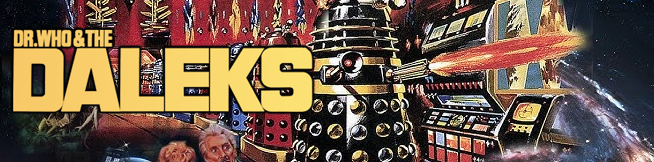
Released: 23 August 1965
Director: Gordon Flemyng
Distributor: Regal Films International
Quick Facts:
In 1963, Doctor Who viewers were terrified by Terry Nation and Raymond Cusick’s Daleks and “Dalekmania” swept the nation. To capitalise, Joe Vegoda and Milton Subotsky secured the rights to produce feature-film retellings of Dalek adventures, with the distinguished Peter Cushing portraying a variant of the Doctor. The redesigned Daleks were initially planned to use flamethrowers before this was deemed too dangerous and scary and much of the Doctor’s lore was altered for the film, which produced a sequel despite a largely negative reception.
The Review:
Dr. Who and the Daleks is (obviously) a feature film adaptation of the show’s second serial, “The Daleks” (Barry and Martin, 1963), and therefore shares many of the same plot elements and characters. However, since, it’s a standalone adaptation, the film also incorporates a reinterpretation of parts of “An Unearthly Child” (Hussein, 1963), specifically in its beginning. Therefore, rather than dropping us onto the Time and Relative Dimension in Space/Tardis, the film shows how these familiar but slightly different versions of the show’s characters got swept up in a time and space adventure. While the movie doesn’t tell us Barbara Wright (Jennie Linden) and Ian Chesterton’s (Roy Castle) professions, or explain how they met and started dating, it’s demonstrated that Barbara has an aptitude for science just like her little sister, Susan Foreman (Roberta Tovey). Ian shows no such aptitude so I can’t imagine he’s a schoolteacher, but he might be a bungling one. Although it’s implied Susan has met Ian before, she doesn’t think much of him to begin with and I’m not surprised: the man is a kindly but clumsy buffoon who’s always tripping over stuff and making an ass of himself. Indeed, Ian’s clumsiness is what gets them sent to Skaro as he trips inside Tardis and activates the machine before its creator, Doctor Who (Peter Cushing), can set the controls. While Dr. Who and Susan are excited to explore a strange alien world, even one was barren and desolate as Skaro, Ian is eager to return home, his mind blown by the “magic” of Tardis (which is somehow bigger on the inside than the outside), only to begrudgingly be swept up in Dr. Who’s hairbrained insistence on exploring a nearby futuristic city.
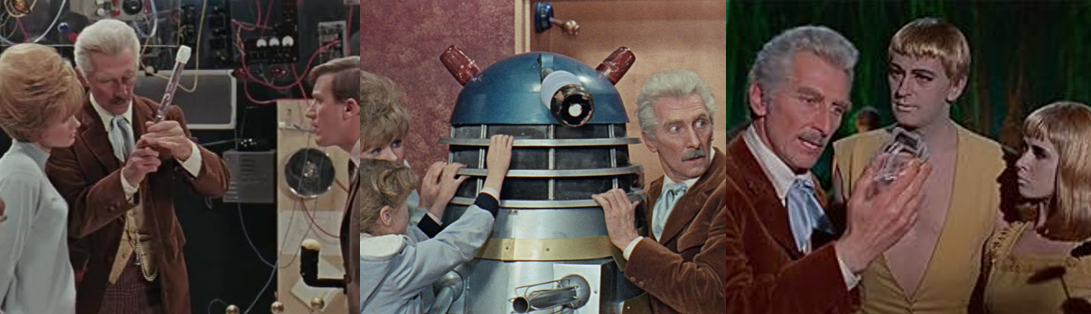
Unquestionably, this is not the Doctor we know now, or even the Doctor we knew back then! “Dr. Who” is an excitable, forgetful, kind-hearted old man with a passion for science and exploration. Clearly a genius, he somehow cobbled Tardis together in his back garden, mastering the physics of fourth dimensional space to make it bigger on the inside and travel through time and space, and yet left the interior cluttered. Dr. Who is positively giddy with excitement to be on a mysterious new world, even one that shows signs of devastating atomic war, and to explore the mysterious metallic city, even going so far as to deceive the others about Tardis’s condition to force them to stay. While his excitement and enthusiasm and scientific curiosity are boundless, Dr. Who is still an old man and quickly becomes fatigued upon reaching the city, being the first to show signs of radiation sickness and the one to succumb to its effects the worst. Though fascinated by the Daleks (David Graham and Peter Hawkins; Brian Hands, Bruno Castagnoli, Eric McKay, Gerald Taylor, Kevin Manser, Michael Dillon, Len Saunders, and Robert Jewell), Dr. Who suspects their evil intentions and works to escape their captivity once well. It’s Dr. Who who discovers the Dalek’s surveillance device and (with some input from Barbara) the source of their power (magnetism). Dr. Who is a wily old coot, dreaming up dangerous plans to overpower a Dalek and have Ian assume its identity and even tricking Alydon (Barrie Ingham) into breaking his pacifist code by threatening to trade Dyoni (Yvonne Antrobus) for the Tardis fluid link. Indeed, Dr. Who happily braves any danger, or sends others to risk their lives, for the greater good, desperate to save lives when he can but insisting that the Thals must fight to preserve their dwindling society.
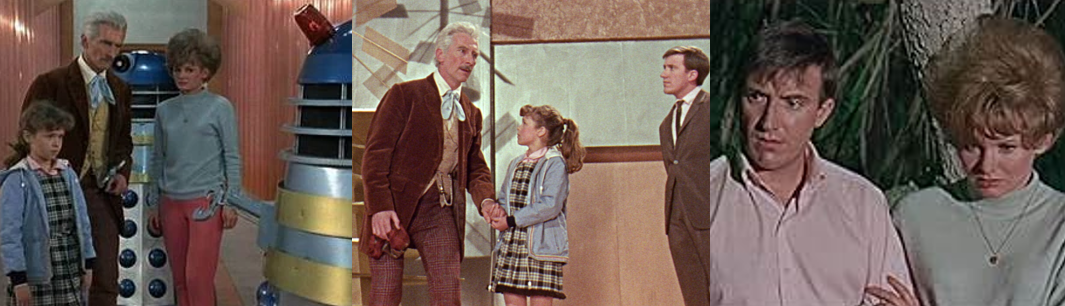
While Barbara isn’t a complete buffoon like Ian, she’s not as sharp as Susan and is largely here to look pretty, scream at stuff, and help encourage the Thals to fight. She does hit upon the idea of blinding a Dalek with their food slop and clearly cares for Ian as she always shows concern when he blunders into his latest pratfall. However, when they accompany Ganatus (Michael Coles) and Antodus (John Bown) to infiltrate the Dalek city via the hazardous swamp, Barbara’s the first to need rest and she’s more likely to rush to someone’s aid than get involved in the fighting. By contrast, Ian starts as an unlikely hero. He’s clumsy and dim-witted compared to Dr. Who and his family, has no desire to explore Skaro, and is reluctant to risk his life. However, he’s compassionate enough to sympathise with the Thals and realises he must take risks to get to safety. This sees him reluctantly climb into a Dalek machine and almost get killed during their desperate escape, begrudgingly taking a blow from Alydon to assist Dr. Who’s ruse and willingly leads the others through the swamp despite being spooked by a water pipe and struggling to clear a jump. His progression is the most obvious of the main characters as he’s in the thick of the Thal uprising by the end, even risking his life once more by making himself a target for the Daleks to halt their neutron bomb. Meanwhile, Susan has a very close relationship with her grandfather, mirroring his scientific curiosity and boundless energy, while also chastising Ian’s cowardice and risking further radiation sickness to recover the anti-radiation drugs from Tardis. She befriends Alydon and desires to help the Thals and is happy to put herself in danger for others, never once crying or screaming and even ad-libbing during their escape to showcase her initiative.
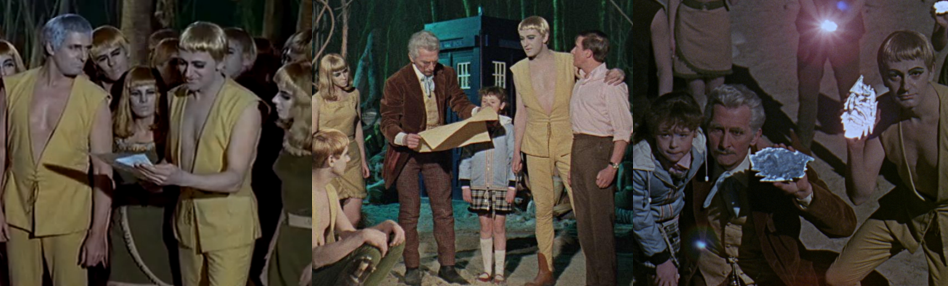
The Thals are on the verge of extinction following a disastrous war waged by their forefathers. While many that live in the irradiated wasteland are horrific mutations or dangerous creatures (which we never really see), the Thals evolved (or mutated, it’s not clear) into a humanoid form to best survive. They live far from the Dalek city but were driven there in search of food and water, and many are so naïve and desperate that they’ve not only become pacifists but also readily accept the Daleks’ offer for help and friendship. Only Temmosus (Geoffrey Toone) warns them not to trust the Daleks, reminding the other Thals (Bruce Wells, Gary Wyler, Jack Waters, Jane Lumb, Ken Garady, Martin Grace, Michael Lennox, Nicholas Head, Sharon Young, and Virginia Tyler) of their previous aggressive ways, but Alydon overrules him and nearly leads his people into a slaughter. Indebted to Dr. Who and the others, Alydon offers to help them but refuses to lead the Thals into war, having no desire to fight, kill, or further destroy their world. His intentions are noble but short-sighted and flawed, as demonstrated by Dr. Who and Barbara, who argue that Alydon’s compassion is not shared by the warmongering Daleks. Ultimately convinced, Alydon devises a two-pronged assault on the Dalek city, only to be captured and face execution thanks to the Daleks’ superior weapons and technology. The Thals are a strangely beautiful race, draped in cloaks and who somehow have the intelligence and resources to produce an anti-radiation drug to survive the wasteland, an ability coveted greatly by the Daleks, who are unable to leave their machines or city and who react fatally to the drug. The Thals are a simple people who long for peace but are encouraged by Dr. Who to take arms to ensure that peace and have a sliver of hope of rebuilding Skaro to something resembling the “great civilisation” that once thrived there.
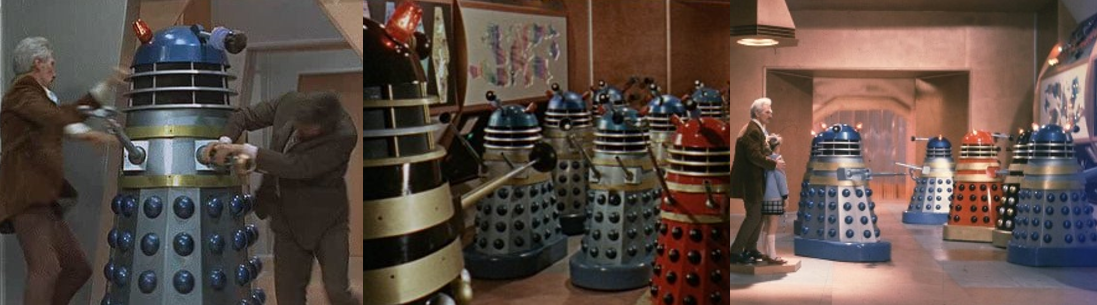
The Daleks are initially kept very mysterious: their city appears abandoned and gives few details regarding the state of Skaro. They soon advance on Dr. Who and the others, though, ordering them into a cell and temporarily crippling Ian with their usually deadly gas weapon. Compared to the television show (especially at the time), the Daleks look fantastic here. They’re much bigger and come in different colours, with the Black and Red Daleks appearing to be commanders. The Daleks also sport different appendages in place of their iconic plungers, such as claws to activate switches and choke and a blowtorch to cut through sealed doors. However, many feature constantly blinking lights, making it difficult to tell which one is talking. Some are also oddly looking down a lot and they’re a bit clunky (or, perhaps their operators weren’t sure how to control them). The Daleks briefly pose as tragic mutations doomed to exile in the city but cut fearsome figures and immediately reveal they have no intention of keeping their prisoners alive once they’ve served their purpose. The Daleks long to shed their metallic casings and spread beyond the city, but the Thal drug proves fatal to them, so they resolve to detonate another neutron bomb and render Skaro uninhabitable to all but the Daleks. Their sheer numbers, their hatred of anything that’s not a Dalek, their willingness to destroy, and their deadly weapons make them a force to be reckoned with, especially for the underequipped Thals. Despite this, they’re strangely weak here. They can be blinded (sending them into an uncharacteristic panic), overpowered (and easily hijacked), and shut down by cutting them off from the city’s magnetic floor. We only get a tantalising tease of what the Daleks’ true form is, too, and they have a tendency to monologue to each other and their prisoners, giving Dr. Who and his family all the assistance they need to warn and aid the Thals.
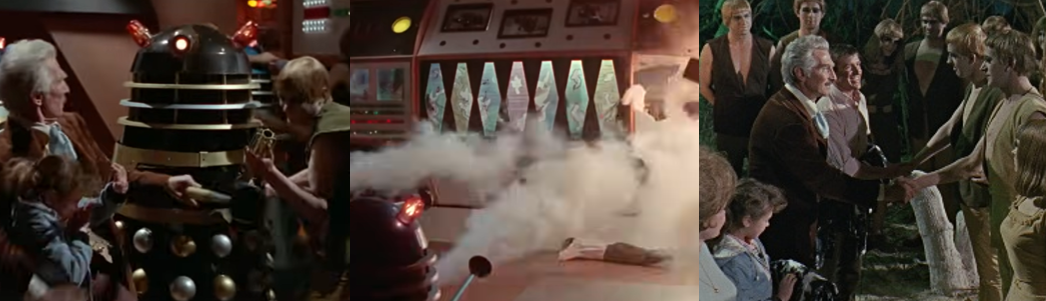
Although Dr. Who’s hopes of using reflective mirrors to mess with the Dalek sensors sees him and Susan recaptured, and Antodus’s terror of the Daleks sees him almost scupper the rear-end infiltration of the Dalek city, Alydon is inspired by Dr. Who to rally the remaining Thals on a desperate rescue mission. With the countdown to Skaro’s pending doom literally before his eyes, Dr. Who begs the Daleks to live in peace and is met with a scathing rhetoric regarding their desires to dominate the planet. In desperation, Dr. Who tries to barter with the Daleks, offering them the secrets of Tardis if they halt their attack, only for them to further mock him and promise to expand their conquest using Tardis once they’ve exterminated the Thals, confident that they will “find a way” to operate the machine without Dr. Who. In the end, the Daleks’ overconfidence leads to their downfall: they leave their borders unguarded, allowing the Thals, Ian, and Barbara to surprise them in their control room. With only seconds to spare, Ian captures the Daleks’ attention and tricks them into destroying their main console, stopping the countdown, saving the planet from further destruction, and ending the Dalek threat as their power source is cut off. In gratitude for their help, Alydon and the other Thals gift them cloaks and wish them well, and a satisfied Dr. Who and his companions say their goodbyes as they return to Tardis to finally go home (having recovered the fluid link in the aftermath). However, while Dr. Who changes into his house slippers and relaxes in his rocking chair, Ian activates Tardis and they land not in London, but in the middle of a painfully bad composite shot of stock footage. Alarmed at the approaching Roman army, Ian flies into a panic, shuts the door, and desperately fiddles with the Tardis controls as the others watch with quiet bemusement.
Final Thoughts:
Doctor Who was having a hiatus when I was a kid. All I had growing up until 1996 were the odd BBC special, some Dalek comic books, a stack of novelisations, and the Peter Cushing movies. I didn’t know much about the show, lore, or character at the time, but I was switched on enough to know that this film was a reinterpretation of the original serial and therefore not a representation of the show. Still, this really isn’t all that good. I love me some Peter Cushing, though, and I find his interpretation of the Doctor to be very charming and endearing. I love that he keeps forgetting Ian’s name, his child-like wonder, and his insatiable curiosity, and that he’s got a bit of an edge to him, rallying the Thals to fight and happily offing Daleks as he goes. I loved his relationship with Susan, who’s just tolerable enough to not be too annoying, though Barbara was somewhat wasted here. Ian’s buffoonery got old quickly but luckily faded as he grew in confidence and faced more perilous situations. The Thals were kind of annoying, being hopelessly naïve and stubborn and even foolish enough to think the Daleks want to be friends! The presentation is pretty good for the time, with some nice sets and matte paintings, though the score is dreadful and everything’s a bit cringe these days. The Daleks obviously steal the show. I love how big and fearsome and colourful they are, how many there are, and how demanding they sound. I don’t even mind their smoke blasts or how easily they were defeated since they look so good, but their constant need to monologue was annoying. Dr. Who and the Daleks is a decent little sci-fi adventure but it’s weird that it removes so much of the magic from the Doctor and the pacing is all over the place, meaning this drags more than it should. It’s clear to me that most of the budget went on the Daleks and the sets as there’s a lack of energy to this one that’s happily addressed in the sequel. Ultimately, while I’m nostalgic for this one, Dr. Who and the Daleks is little more than an odd curiosity in the franchise’s long and storied history. Sadly forgotten, maybe, but also not too surprising.
My Rating:
Could Be Better
Are you a fan of Dr. Who and the Daleks? What did you think to Peter Cushing’s version of the Doctor? Were you impressed by the bulkier Daleks or did their smoke blasts disappoint you? Do you think the Thals were right to avoid conflict? Which other Doctor Who serials would you have liked to see get the big screen treatment? How are you celebrating Doctor Who Day today? Let me know your thoughts on Doctor Who and this obscure movie in the comments and donate to my Ko-Fi if you want me to review the sequel.


