
In Back to the Future Part II (Zemeckis, 1989), Marty McFly (Michael J. Fox) travels to October 21, 2015, which is known as “Back to the Future Day” to celebrate the franchise and science.


Quick Facts:
Celebrated as one of the most beloved, successful, and influential trilogies, the Back to the Future films expanded into decades of mediocre to aggravating tie-in videogames. Annoyingly, this sadly obscure, Japanese-exclusive release (originally intended to be a top-down adventure game), could’ve turned the tide with its colourful visuals and simple, but fun gameplay.
The Review:
Super Back to the Future Part II is a 2D, sidescrolling adventure in which you guide Marty McFly through six levels (known as “Rounds”), each with two to five stages and based on locations from the film. Although the game has no difficulty options, you can make things harder by limiting your lives, though I’d recommend selecting five as the game gets a bit brutal with its enemy and hazard placement. Each Round has a super simple (if sometimes nonsensical) password to continue your progress or skip tricky sections. Marty is essentially a slower, clunkier imitation of Sonic the Hedgehog, spinning about on his hoverboard to defeat and bounce off enemies, hitting springs to get higher, and avoiding spike pits, hazards, and ceilings. Players jump and perform Marty’s somersault with A and hold B to speed up, essential for climbing the game’s many slopes and making the longer, trickier jumps. Unfortunately, you must often hold B to jump to moving, temporary, and stationary platforms, which can be very finnicky. Marty doesn’t carry his momentum when jumping, can be very weighty and unwieldy, and is also very floaty, so you often zip past platforms, plummet to lower areas, or struggle to jump to a simple platform because Marty won’t move his ass. Players grab gold coins to exchange to helpful items at vending machines, restoring their health and gaining a temporary shield or invisibility, or earning an extra life. Oddly, there is no high score system so there’s not much replay value beyond the obscurity and visual appeal. It does offer a “Lesson” mode and the usual sound test options, though these are the bare minimum I’d expect. Unfortunately, there’s not much gameplay variety here. There are no bonus rounds or autoscrolling chase sections, for example, or opportunities to play as other characters, which is a shame.
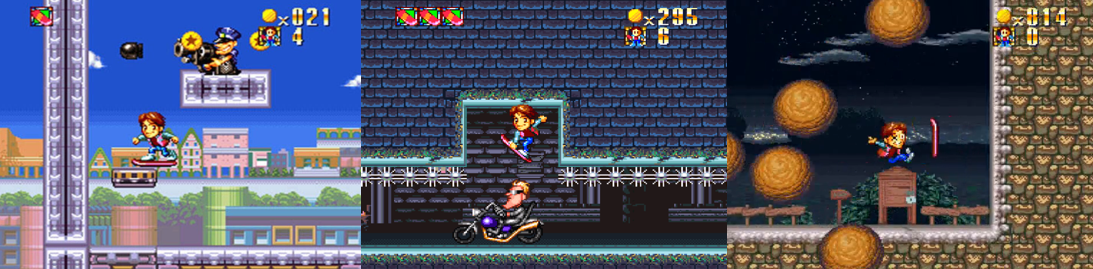
Super Back to the Future Part II follows the movie plot very closely, starting in the far future of 2015, visiting the dystopian 1985, and ending in 1955 in a race to recover the Grays Sports Almanac from Biff Tannen. This mainly involves dashing up and down slopes, making blind leaps, awkwardly hopping to moving, falling, and temporary platforms, and hitting switches to lower barriers. While there are no bottomless pits, the knockback is unreal and can set you back quite far, or see you trapped down spike pits or hit by enemies until you rage quit and use a password. Marty’s sprite may be colourful and expressive, with a fun, super-deformed aesthetic, but his hit box is huge and you’re often required to spin into falling hazards or hop against walls to clumsily escape pits. Still, Marty is much more fun to control in the open, where a good run-up can see you hurtle or plummet past most stage hazards. When confined to the sewers or Biff’s luxurious casino hotel, Marty struggles, especially when there are ceiling spikes and moving platforms as it’s all-too easy to simply pass through these or slip off because of the dodgy jump mechanics. You’re occasionally asked to bounce off enemies to clear gaps, which is kind of fun, bombs and balloons sometimes fill the screen, and some Rounds see you riding wind currents (though you drop like a stone if you hit an enemy or obstacle). “Round 4 -2” sees you heading left, some Rounds are almost maze-like in their sprawling, samey layouts, and all these gimmicks are recycled in aggravating ways in “Round 6-1” (alongside massive falling boulders and more spikes than ever) to present the toughest challenge. While the gameplay is fun, the difficulty ramps up due to the awkward controls and how unreliable Marty is to control. Without a duck and with a massive hit box, it’s easy for him to take damage when riding platforms and such, and it doesn’t help that he sometimes gets a bit stuck on (or clips through!) the environment, or that he’s sent flying from the smallest of hits!
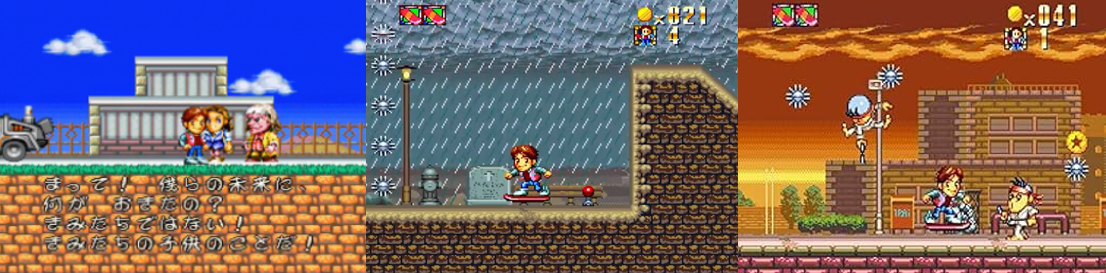
However, the game has an undeniable visual appeal and is visually the best looking of all the Back to the Future games released back in the day. Super Back to the Future Part II is ridiculously colourful, featuring chibi-style sprites that give everyone oversized heads and bring the game to life with an anime aesthetic. Marty is super expressive and has fun idle and victory poses where he taps his foot impatiently and flips and holds his hoverboard. Doctor Emmett Brown, Lorraine and George McFly, and different versions of Biff appear in the sprite-based cutscenes to advance the plot, and most Rounds start and/or end with either a sprite-based cutscene or some fun detailed (if unfortunately static) sprite art that tells a truncated version of the film’s story. Accordingly, the environments mirror the film and are just as vibrant and chunky as the sprites, reminding me of Amiga games, though some elements were a bit bland and some levels were a bit confusing to navigate. The game’s at its best in recognisable locations like variations of Hill Valley (the far future, with the courthouse and fountain, the desolate present, with its broken windows and ominous atmosphere, and the jaunty 1950s with its blood orange sky). There are a handful of these beyond the town square, such as the Café 80’s where you fight Griff, Biff’s garish casino hotel and neon-drenched rooftop, the haunting cemetery, and knobbing about backstage at the Enchantment Under the Sea dance. Sadly, these are juxtaposed with generic locations like sewers and warehouses and the level layouts rarely take advantage of their settings. There is very little to the casino stage, for example, which could’ve featured unique gimmicks like slot machines or elevators. Hitoshi Sakamoto offers a lovingly faithful, chip tune rendition of the film’s classic overture. Though this is reused in multiple levels, others sport jaunty little tunes or fun remixes of it and even a “Johnny B. Goode” soundalike in “Round 5-3”. While the interludes and cutscenes are fun, there’s no real ending and sadly we must rely on fan-made hacks to play translated versions, though the game remained gorgeous to look at, at least.
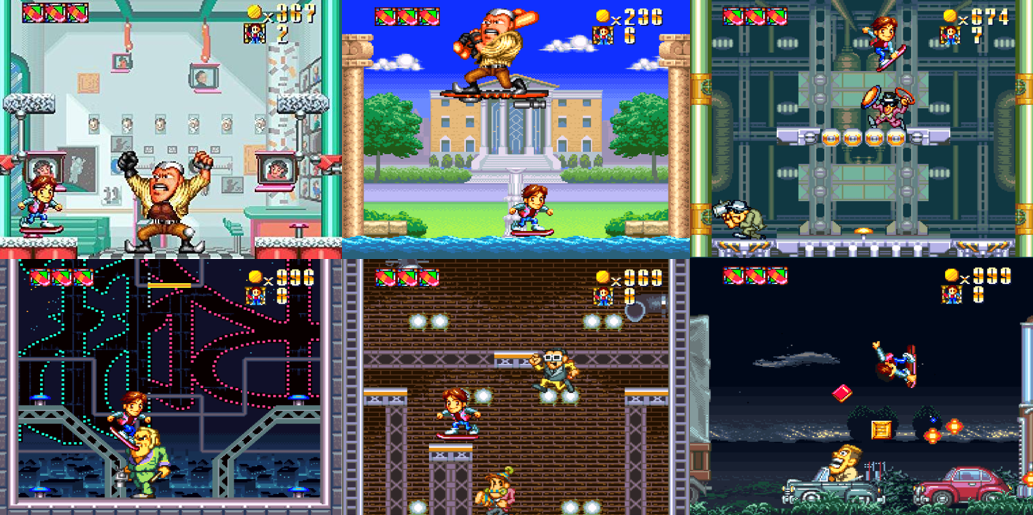
Marty dispatches a bunch of random shite in his adventure. He bops off various robots, trigger happy cops, and hoverboard (and hoverbike) riding goons in 2015, beats up Biff’s taser-wielding security detail in 1985, battles ninjas, dodges cans tossed by delinquents, and even comes across baddies wielding assault rifles, shotguns, or tossing dynamite! Each Round boasts at least one boss battle, with you facing Griff in “Round 1-2” and “Round 2-2”. In the first fight, he spins two baseball bats, slamming them to the ground to rain Pepsi bottles, and you must simply attack him or hit the television monitors to damage him. In the second, he floats above firing projectiles and occasionally ramming into you, protected from below by his hoverboard and forcing you to rely on switches to activate the central fountain and send him hurtling into the courthouse. You fight a musician in “Round 3-3, dodging little black balls and musical notes and utilising falling platforms and pipes to lands hits, and some dude with a hammer and some circus performer in “Round 3-5”. You can hit a switch to separate them, but it’s easier to focus on one at a time than chase them around. You fight the alternate 1985 Biff on the casino rooftop, hitting switches to send electrical sparks across the neon sign in the background to hurt him (though these can also hurt you!) and avoiding his pistol and rapid baton attack. Biff’s buddies Matches, Skinhead, and 3D await in “Round 5-4”, with each patrolling a different level of a three-tier environment. One holds a champagne bottle and fires a cork at you, another attacks with party poppers and such, and 3D runs back and forth laying a projectile trap. The hardest thing about this fight is getting Marty to each level without slipping or falling, though! “Round 6-2” sees you fighting Biff in a quasi-autoscroller where you’re actually confined to one area by trucks either side. Biff occasionally tackles you and tosses projectiles, and there are crates and other junk to avoid, but this wasn’t much of a challenge. Sadly, the hope of a second phase where you desperately race away from him was dashed as this is simply a cutscene, making for a bit of an anticlimactic ending.
Final Thoughts:
I’ve known about and wanted to play Super Back to the Future Part II for a long time but never got around to it back when I was emulating games as a hobby. It was really exciting to get into it for this review as it is a gorgeous and wacky title. It’s bizarre to me that this game was never released outside of Japan as I can’t see any reason why it wouldn’t be easy to translate and ship overseas. It’s doubly annoying as the franchise really needed this game back in the day as the other 8- and 16-bit titles were borderline unplayable. Sure, this game has flaws, but it’s clearly the best Back to the Future game of its time, even if Marty is a clunky-ass bag of sand with a massive hit box. It’s a shame the game didn’t do more with its mechanics. It’s clearly borrowing from Sonic so it would’ve been fun to sprinkle in some autoscrolling chase sections, perhaps a bonus stage where you control the DeLorean, or a level where you guide Jennifer Parker through the 2015 McFly house. Considering when the game released, it also might’ve been fun to have it feature levels from all three films, with Marty using a traditional skateboard, hoverboard, and perhaps gaining a pistol in 1885. Instead, the game relies heavily on the gold coins, which isn’t all that great and strangely limits your options for pick-ups. Add to that some finnicky jumping and platforming mechanics, some odd clipping issues, and the general lack of polish to the gameplay and Super Back to the Future Part II is undeniably a disappointment in terms of its gameplay. However, it’s so colourful and visually appealing that you almost don’t mind that aggravating aspects, especially as the level codes are so simple to enter. Overall, yes, it’s a flawed game that need a bit more polish, but Super Back to the Future Part II is still very appealing and enjoyable and I’ll always be mad that it never got released outside of Japan or ported to other consoles.
My Rating:
Pretty Good
Did you ever play Super Back to the Future Part II? Do you agree that it’s the best of the Back to the Future games released back then? Would you have liked to see it released outside of Japan or do you think it’s too janky for a wider release? Did you also find the jumping and momentum awkward to deal with? Which Back to the Future videogame is your? How are you celebrating Back to the Future Day today? Whatever you think about Super Back to the Future Part II, share your thoughts below and donate to my Ko-Fi if you liked this review.


