8 September 1966 saw the debut of Star Trek (1966 to 1969), “The Man Trap” (Daniels, 1966), beginning a massive cultural phenomenon and perhaps the most influential science-fiction franchise of all time. Accordingly designated “Star Trek Day”, the September 8 is the perfect excuse to celebrate this enduring sci-fi franchise.


Released: 6 December 1991
Director: Nicholas Meyer
Distributor: Paramount Pictures
Budget: $30 million
Box Office: $96.8 million
Rotten Tomatoes Scores: 83% / 84%
Quick Facts:
Following Star Trek V: The Final Frontier’s (Shatner, 1989) critical and commercial failure, Paramount Pictures initially planned to recover with a prequel set at Starfleet Academy before star Leonard Nimoy assisted with writing a swan song for the original cast that doubled as an allegory for the “Cold War”. Sets and models were again re-used to save money, the Klingons were redesigned by Dodie Shepard, and Industrial Light & Magic produced the many visual and practical effects that co-existed with political and Shakespearean intrigue.
The Review:
Star Trek VI: The Undiscovered Country is essentially about finality. It’s the last film for the Original Series crew, the last time all the Original Series actors appeared in a film together, the Enterprise-A is a few months from being decommissioned, the main characters are set to be retired, and the plot concerns the end of decades of hostility with the war-like Klingon Empire. This doesn’t come about naturally, however, but is forced upon the aggressive race when one of their moons explodes and devastates Qo’noS, threatening to render the planet inhospitable (and potentially make the Klingons extinct) within fifty Earth years. Out of desperation, Klingon Chancellor Gorkon (David Warner) offers an olive branch to the United Federation of Planets, promising to end hostilities and broker peace if the Federation assists with evacuating Qo’noS and sheltering the Klingons, who can no longer afford to go to war since their resources are so tight. Captain Spock (Leonard Nimoy) spearheads the negotiations with Chancellor Gorkon, seeing a historic chance to foster true galactic peace, but faces opposition from bigoted Federation Admiral Cartwright (Brock Peters) and Spock’s long-time friend and crewmate, Captain James T. Kirk (William Shatner). Indeed, Kirk is outraged to learn that Spock personally vouched for him to take the Enterprise-A to escort Chancellor Gorkon to Earth for peace talks. Considering Kirk has been at war with the Klingons for most of his life and harbours a personal grudge against them for the death of his son, the legendary captain is adamant that the barbaric race cannot be trusted and should be left to perish for their crimes. However, despite his personal feelings, Kirk is duty-bound to adhere to his orders and reluctantly meets with Chancellor Gorkon, even inviting him and his detachment – including daughter Azetbur (Rosanna DeSoto) and veteran General Chang (Christopher Plummer) – to dinner.
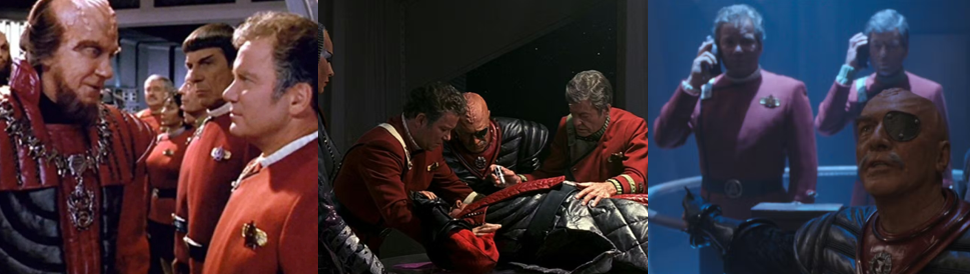
Although Chancellor Gorkon is immediately seen to be unlike his more brutish comrades, Kirk remains apprehensive, at best, and disgusted at worst, and sceptical of the entire situation in general. Kirk immediately gets a bad vibe from General Chang, who spends the entire evening quoting the “original Klingon” of William Shakespeare and banging on about how the two are kindred warrior spirits, and Kirk’s crew struggle to stomach the Klingons’ bad table manners. While Kirk is mature enough to recognise that he conducted himself poorly, he refuses to trust Chancellor Gorkon and grapples with the idea that such a huge part of his life, hostilities with Klingons, could be ending. Kirk is aghast, however, when the Enterprise-A suddenly fires upon the chancellor’s unsuspecting Bird-of-Prey, sending the bridge crew into a mad panic to discover how they’ve fired when their torpedo stock is accounted for. While Captain Montgomery “Scotty” Scott (James Doohan), Commander Pavel Chekov (Walter Koenig), and newcomer Lieutenant Valeris (Kim Cattrall) scramble for answers, two unknown assailants in Federation spacesuits board the Bird-of-Prey and gun down Chancellor Gorkon and some of his crew. When the rightly incensed General Chang assumes Kirk has launched an unprovoked attack and moves to respond, Kirk orders the Enterprise-A to surrender and he and Doctor Leonard “Bones” McCoy (DeForest Kelley) desperately try to save Chancellor Gorkon, only for Bones to be strangely baffled by Klingon anatomy and meet with failure. Blamed for the attack and the assassination, Kirk and Bones are arrested and forced to stand trial in what’s little more than a kangaroo court, where Kirk’s prior prejudices and even his private log are used against him as evidence, alongside McCoy’s age and perceived incompetence. Kirk and Bones are thus convicted as the perpetrators of a devious attempt to upend peace talks and sentenced to life imprisonment on the harsh world of Rura Penthe, a frozen planetoid where prisoners work themselves to death digging for dilthium. Meanwhile, Azetbur succeeds her father and agrees to continue his efforts for a truce with the understandably flustered Federation President (Kurtwood Smith).
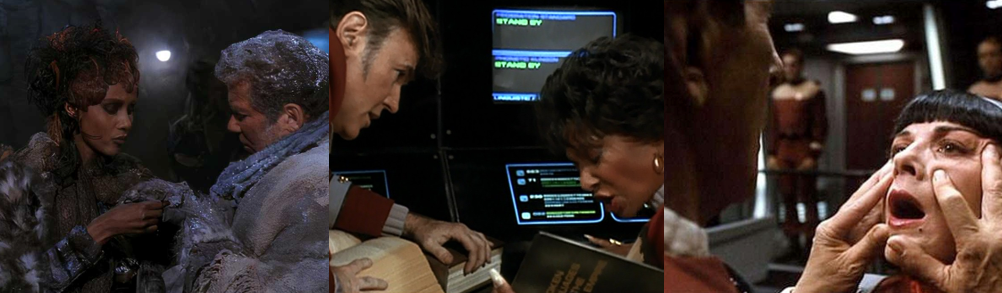
While imprisoned on Rura Penthe, Kirk and Bones discuss their aging relevancy to the universe while fending off the aggressive inmates, finding an ally in sultry shapeshifter Martia (Iman) and eventually learning that they’ve been set up by persons unknown to impede the peace talks. Meanwhile, Spock, Valeris, Chekov, and Scotty turn the Enterprise-A upside down in search of clues to the perpetrator’s identities, correctly assuming that a revolutionary new Bird-of-Prey (which can fire while cloaked) was responsible and that the assassins are onboard the Enterprise-A. While Commander Nyota Uhura (Nichelle Nichols) stalls the Federation and the Klingons static and Captain Hikaru Sulu (George Takei) of the Excelsior rushes to assist while also denying knowledge of the Enterprise-A’s location, the search initially turns fruitless when their assumed suspect is physically incapable of wearing the anti-gravity boots used in the assassination. Thanks to Spock’s foresight, Kirk’s wiles, and Martia’s assistance, Kirk and Bones are rescued but not before Martia turns on them, having been in on the scheme all along. Once aboard the Enterprise-A, with the offending spacesuits randomly recovered by Scotty, Kirk’s hunch about their assassin is proven when he and Spock lay a trap for the culprit. Spock is uncharacteristically enraged to learn that Valeris was one of the perpetrators, admonishing her betrayal and forcibly drawing the names of her co-conspirators from her with a mind meld. Kirk and Spock ruminate of their prejudices and bias together, in quiet solitude, realising that they were both blinded by these emotions. Kirk fully admits to being scared to face the “undiscovered country” of peace with the Klingons, while Spock admits to placing all his faith in his young protégé out of a need to continue their legacy.
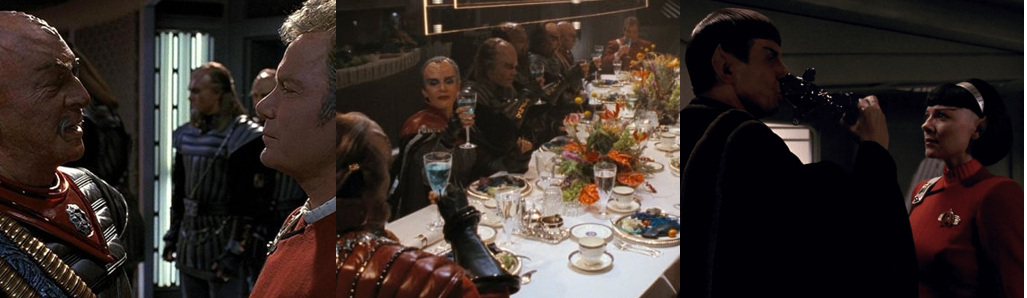
This discussion of bigotry is rife throughout The Undiscovered Country. The Klingons are seen as an aggressive, barbaric race who cannot be trusted, are uncivilised and war-like, and who must be always treated with contempt and hostility. To be fair, Kirk is right to suspect them after everything he’s been through, but the circumstances clearly depict the Klingons as desperate to ensure their survival. For Spock and Chancellor Gorgon, the historic chance for peace is worth setting aside the decades of bloodshed and hatred, especially as it would mean the Klingons’ survival, but the prospect of “tearing down the wall” is terrifying for the likes of Kirk and General Chang, who instigates the assassination to ensure that things stay “as they should”. The Klingons are equally distrustful of humans and amusingly shown to be poor guests, despite their appreciation for Shakespeare, but racial undertones are prevalent in their depiction, with Chekov even muttering “Guess who’s coming to dinner?” and Azetbur criticising the Federation for being an “all-humans” club. Kirk’s prejudices are naturally the most obvious and emotional, given a Klingon killed his son, and it leaves him standoffish with Chancellor Gorgon, who truly wanted peace, and easily setup by General Chang and Valeris. Ironically, Valeris conspires with the Klingons, whom she distrusts so much, to assassinate Chancellor Gorgon to show how untrustworthy the Klingons are. She has a similar mindset to Admiral Cartwright that inviting the Klingons into Federation space is foolish and believes the Federation is betraying their core principles by negotiating with the hostile species, something Spock chastises her for while grilling her as Valeris has also betrayed the Federation’s principles by sowing discord. Naturally, General Chang is all for this as he relishes combat, testing his mettle against a worthy opponent like Kirk and indulging his war lust.
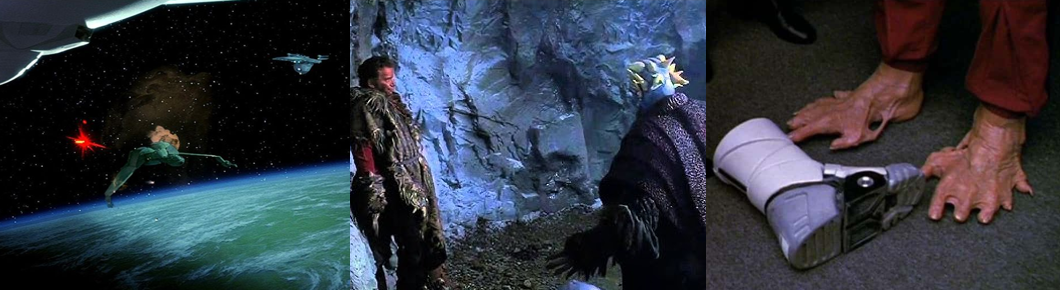
Unfortunately, we don’t get many space battles here as The Undiscovered Country is more focused on the tensions between the Enterprise-A crew and the Klingons, figured out who was behind the attack, and Kirk and Spock’s detour to Rura Penthe. There is a cool sequence where the crippled Bird-of-Prey’s gravity field is damaged, leaving Chancellor Gorgon and his crew floating helplessly as the assassins strike, and a decent battle pitting the Enterprise-A and the Excelsior against General Chang’s special Bird-of-Prey in the finale. However, as we’ve seen a few times before, the Federation ships strangely struggle to locate the cloaked ship. Luckily, Spock and Bones modify a torpedo to home in on the plasma emissions from the invisible craft, allowing Kirk and Sulu to attack and the filmmakers to once again recycle to same Bird-of-Prey explosion from previous films. Rura Penthe was an interesting location and scenario. I was surprised to see Bones imprisoned alongside Kirk as the movies generally team Kirk with Spock, so it was a nice change of pace to let the disgruntled doctor take some of the spotlight. Naturally, he laments their situation, especially at their age, meaning it’s up to the aged Kirk to fend off any physical challenges and have a brief fling with the alluring Martia to facilitate their escape. There are a couple of moments for the other main characters to shine as well, such as Chekov amusingly offering excuses to Starfleet and confronting their assumed culprit, Uhura struggling to pronounce Klingon, and Scotty aiding in finding the suits. Although largely separate from the plot, Sulu finally gets his own command and aids in his own way, but it was a bit of a shame to not have him aboard the Enterprise-A and to be denied his full kudos from the egotistical Shatner.
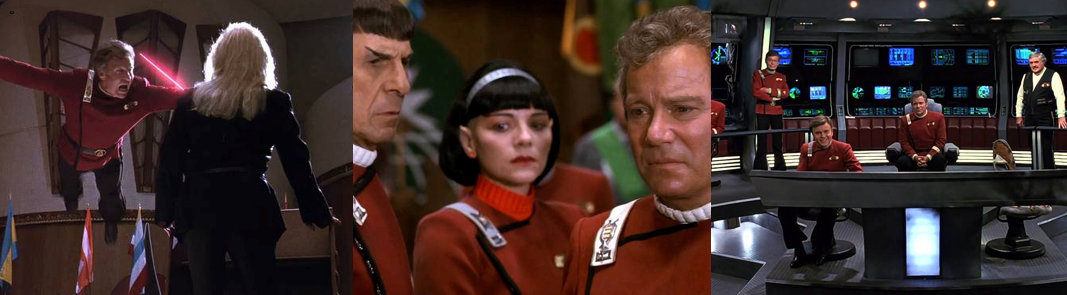
Thanks to Spock tracing a tracker onto him before his trial, Kirk and Bones and rescued by the Enterprise-A and Spock angrily confronts Valeris, learning that she, General Chang, Admiral Cartwright, and Romulan ambassador Nanclus (Darryl Henriques) conspired to sabotage peace talks between the Federation and the Klingon Empire. Realising that the saboteurs plan to assassinate the Federation President and Chancellor Azetbur at the peace conference, the Enterprise-A races to intervene, with Kirk and his crew beaming down to save the president and Scotty offing would-be assassin Colonel West (René Auberjonois). Thanks to a full confession from Valeris, who remains somewhat conflicted due to her admiration and respect for Spock, all the remaining conspirators are arrested, clearing Kirk, Bones, and the Enterprise-A of all charges. Despite this, the legendary ship is still ordered to return to Starbase for decommissioning so, in one last act of defiance, Kirk orders the ship to take a final jaunt to the stars before a new generation continue their journey. Honestly, I’ve never been a big fan of The Undiscovered Country, preferring the much maligned fifth entry over this one, mainly because it’s got so much posturing and is stuffed with ham-fisted allegories. I like that it tells a more personal and grounded story for the aged Enterprise-A crew, one that’s clearly an allegory for the Cold War and allows Kirk to revisit his hatred of the Klingons from the third movie. The performances are all really strong throughout, though I could’ve done without General Chang constantly quoting Shakespeare, but I’ve never felt it was a great swansong for the Original Series crew to literally sign out on. People aways say the even-numbered Star Trek movies are the best ones, but I always point to this movie as evidence that’s not true as it meanders a bit in the middle and I find the decision to give Spock a new protégé rather than revisit or recast Lieutenant Saavik hurts the movie. Her connection to David Marcus (Merritt Butrick), Kirk, Spock, and familiarity with the audience would’ve made for a much more impactful reveal, I think.
Final Thoughts:
So yeah, full disclosure: I’m not a big fan of this one. It was a bit better this time around than I remember, mainly because I haven’t watched it in a while and I guess I’ve got a whimsical nostalgia for these Original Series movies. I really enjoyed the exploration of Kirk’s hatred and prejudice against the Klingons; his outburst of “Let them die!” is one of his strongest moments and I liked seeing Kirk grapple with his emotions and sense of worth in a universe on the cusp of change. The narrative idea of the future being difficult for veterans like Kirk and General Chang is intriguing as all they’ve known is war with each other, so it’s natural there would be some tension and resentment. I liked seeing Bones take some of the spotlight for a change, how distraught he is at failing to save Chancellor Gorgon, and how out of his depth he is on Rura Penthe. Some of the moments with Chekov and Uhura were pretty amusing, and I guess the investigation into the assassination was interesting (even if Chang and Valeris are obvious candidates), though the racial undertones are a touch questionable. I think they’re definitely apt and perfectly valid, but I always saw the differences between Starfleet and the Klingons to be more ideological, with one valuing strength and power and the other harmony and knowledge. I would’ve liked to see this clash brought to life in a more thrilling way than just the Enterprise-A and the Excelsior dominating Chang’s Bird-of-Prey, but it’s nicely conveyed through the tense dialogue and the body language of all involved in the unprecedented peace talks. Ironically, though, for a movie so focused on finality, I’ve always found The Undiscovered Country lacking as a swansong for the Original Series crew. It would arguably be tough for any movie to do this justice, but I still think The Undiscovered Country is largely lacking in its execution and could’ve been a far better send-off for these characters.
My Rating:
Could Be Better
Are you also a fan of Star Trek VI: The Undiscovered Country? Do you consider it a suitable send-off for the Original Series crew or do you also find it lacking? Did you guess who was behind the assassination? Were you intrigued by the racial and societal undertones of the film? Which Star Trek captain, crew, show, or movie is your favourite and why? How are you celebrating Star Trek Day today? No matter what you think, leave your thoughts down below, support me on Ko-Fi, and go check out my other Star Trek content.


One thought on “Movie Night [Star Trek Day]: Star Trek VI: The Undiscovered Country”