
Cover-dated April 1985, the first issue of Crisis of Infinite Earths (Wolfman, et al) precipitated the destruction of the “Multiverse” and what better way to celebrate than with a “Crossover Crisis” of my own?

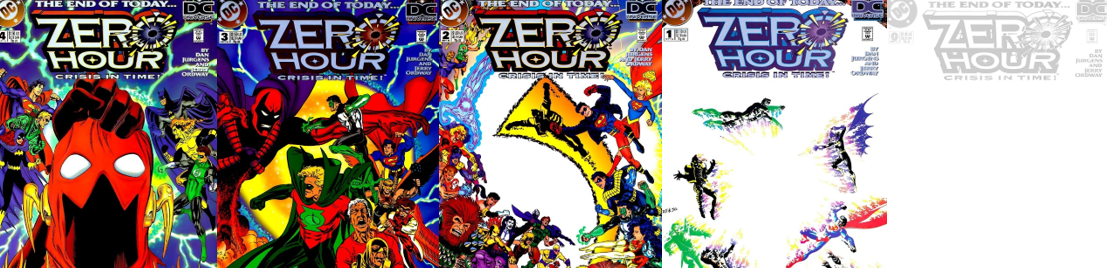
Published: September 1994
Writer/Artist: Dan Jurgens
Quick Facts:
After DC established an infinite number of parallel worlds in Showcase #4 (1956), writers like Mark Wolfman became frustrated with this concept and spent two years planning Crisis on Infinite Earths, one of the greatest comic book crossovers. However, while the likes of Clark Kent/Kal-El/Superman and Wally West/The Flash benefitted from this reboot, others like Carter Hall/Hawkman did not so writer/artist Dan Jurgens sought to correct this about ten years later with Zero Hour: Crisis in Time! Accompanied by numerous tie-in issues and occurring during the “Dark Age” of the industry, the story is largely regarded as a confusing, poorly executed mess that created more problems than it solved.
The Review:
As if numbering this miniseries in reverse order (so the story starts in issue #4 and concludes in issue #0) wasn’t unique enough, each page and/or panel takes place at different times, both literally and relatively, making this a confusing time-based tale. The story begins at the literal end of time, when destructive, unstoppable entropy has engulfed the cosmos. Here, an unseen force executes the mysterious Time Trapper while berating the cloaked figure and others like him for flaunting their omnipotence and yet allowing injustice to prosper. This powerful, unseen figure then harnesses entropy’s destructive power and vows to end the universe’s suffering. His actions (unseen at this point but probably related in one of the event’s many tie-in comics) are detected by Metron, the scientific advisor to almighty Darkseid, who’s so concerned by the unravelling universe that he defies his master and seeks out allies to halt annihilation. Our first indication that something is very wrong with time occurs in Gotham City, where the Joker’s latest killing spree is unexpectedly ended by Barbara Gordon/Batgirl, apparently back in her prime and perplexing even Bruce Wayne/Batman since she was dramatically paralysed by a gunshot some time ago. The enigmatic Linear Men, who monitor and safeguard time from a pocket dimension, then observe entire timelines being erased, dispatching Matthew Ryder/Waverider and Rip Hunter to investigate. In the 64th century, Wally West/The Flash notices the surreal light engulfing the world and learns from Waverider that entropy is ceaselessly making its way back through time, wiping out everything in its path. Though Waverider’s powerless to stop it, Citizen Abra/Abra Kadabra and the Linear Men suggest that the Flash create a super-speed vortex. However, Waverider realises all-too late that the effort is futile and is unable to keep the Flash from running to his untimely doom just like his mentor in the previous Crisis, resulting in the death of the 64th century and Waverider vowing to honour Wally’s sacrifice.
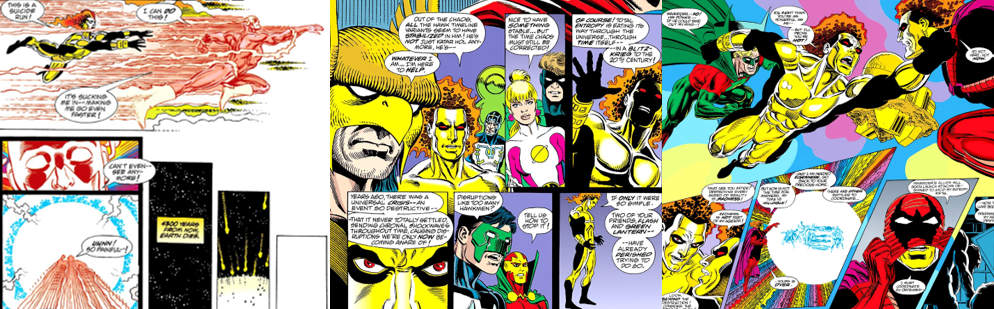
Their next stop is 57000 A.D, where a youthful Harold “Hal” Jordan/Green Lantern (plucked from before he became the malicious Parallax) is currently battling entropy. Green Lantern’s efforts only feed the destructive force, however, causing it to obliterate Hal and Rip. Before he dies, Rip tells Waverider to research the previous Crisis. Disregarding an anomaly in the timestream, Waverider returns to Vanishing Point and is horrified to learn of the last Crisis and frantically heads to Earth for help, arriving to find Hawkman fluctuating between his various incarnations, Alan Scott/Green Lantern randomly de-aged, and reminding Jay Garrick/The Flash of Barry Allen’s fate while simultaneously informing him of Wally’s leaving Jay heartbroken at having lost the men he considered sons. When Waverider transports the Justice Society of America (JSA) to Vanishing Point, they’re mysteriously separated and attacked by the malevolent Extant. Metron recruits Batman and Superman, who call an emergency meeting of all costumed heroes (though Metron fails to enlist Jim Corrigan/The Spectre’s help as he’s unconcerned by natural disasters). Already rattled from experiencing his own time anomalies, Superman stops to assist the debuting Bartholomew “Bart” Allen II/Impulse (displaced from the 30th century) and recruits him. Earth’s heroes discuss the time anomalies, which see heroes pop in and out of existence, the various Hawk-beings merged into a single, God-like entity, and timelines to merge as the Crisis worsens. Waverider brings the group up to date (inspiring Guy Gardner/Warrior to attempt to change Hal’s fate) but quickly teleports to Vanishing Point when he senses the JSA are in trouble. When he arrives, Extant has killed Al Pratt/The Atom and Kent Nelson/Doctor Fate and rapidly aged Doctor Charles McNider/Doctor Mid-Nite and Rex Tyler/Hourman (to the point that he dies). Although the grief-stricken Alan’s ring is depleted, Waverider gets his comrades to safety and confronts Extant, horrified to find his future self behind the mask and not Hank Hall/Monarch as he suspected!
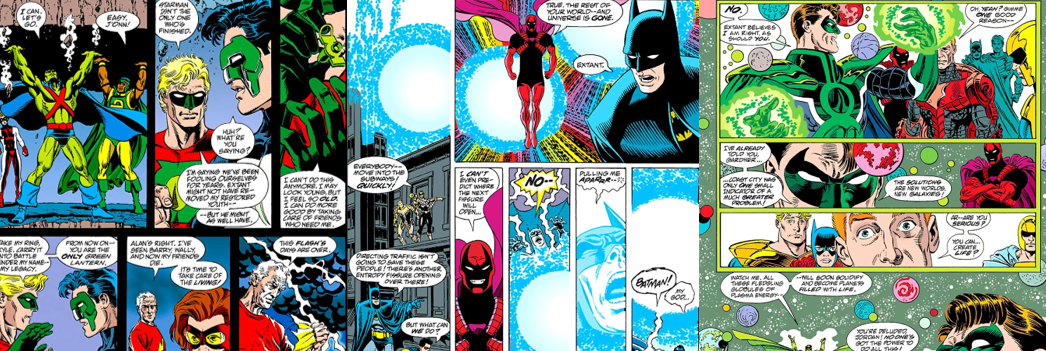
Extant reveals that he’s the amalgamation of Waverider, Monarch, and others, having assimilated incredible powers, amassed an army, and spread entropy to birth a new world. Extant teleports Waverider and the others away since it’s too soon for them to fight, though the shattered, aged JSA quit from superheroics due to their losses, officially making Kyle Rayner the only Green Lantern. Inspired by their sacrifices, Superman and the others transport to the 30th century with Metron. As they struggle to halt the entropy, Kara Zor-L/Power Girl suddenly goes into a mystical labour, and Warrior suddenly sprouts weapons by mere thought, they’re attacked by Extant’s brainwashed Team Titans before the man himself attacks…as his future self watches on! Waverider desperately teleports the others away right before Extant plunges his hand into his body and absorbs his incredible time-based energy, assuming Waverider’s guise and completing his time loop as an unseen other retrieves Alan’s discarded power ring. Returned to the 30th century, Metron has Superman and Princess Diana Prince/Wonder Woman hurl his “Mobius Chair” into the entropy rift and Captain Nathanial Adam/Captain Atom pour his full power into it, creating a Boom Tube that successfully dispels the rift. Unfortunately, entropy continues to ravage the timelines, shredding John Henry Irons/Steel and leaving Warrior distraught. Still, angered at his plans being disrupted and his armies defeated, Extant’s past and present-selves merge to ponder the rampant entropy rifts, only to be blind-sided by a greater power for attempting to usurp his plans for reality with the rifts, which erase Impulse and Michael Carter/Booster Gold. Luckily, Jay convinces guilt-trips he Spectre into joining the fray right before he also dies and the few survivors flee to Vanishing Point to restore Waverider. Although he arrives too late to save the Batman from being torn apart by a random rift, Waverider leads the assault against Extant (which leaves Doctor Ray Palmer/The Atom de-aged to a teenager!), only for Parallax to finally assert himself as the man behind the destruction of time!
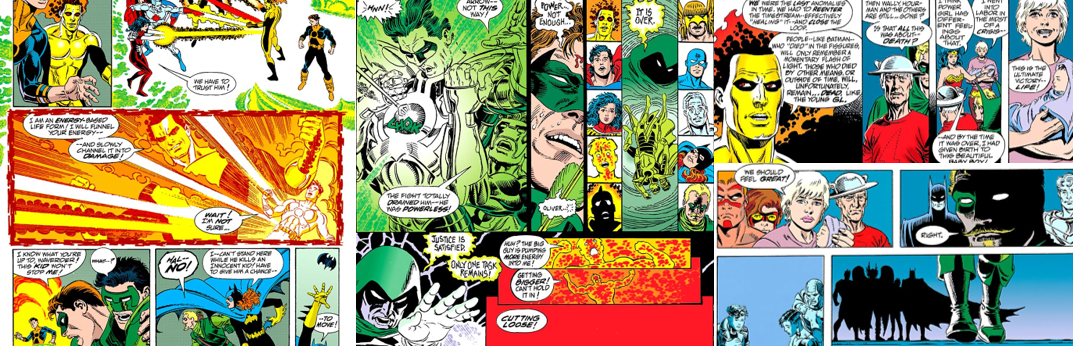
Determined to re-write reality to undo all the injustices they’ve suffered, Parallax wills entropy to engulf all that ever has or will be in the hopes of starting fresh, reshaping reality from a pocket dimension of pure, white space as the handful of shocked survivors watch. Although Guy and the others think he’s mad, Parallax vows to ensure all of them, even the time displaced Batgirl and Extant, get the world they desire, utilising leftover chronal energy and cosmic power from the first Crisis to effectively make himself a God. Having saved a handful of others and spirited them away to Vanishing Point, Waverider proposes piggybacking off Parallax’s efforts and restarting the universe in a more natural way, rather than allowing Parallax to decide who exists and who doesn’t, bringing them into conflict with Batgirl and those who want their worlds back. Lamenting having to fight his old allies and amazed that they would oppose his promise of paradise, Parallax easily fends off Superman and even the wrathful Spectre. While Oliver Queen/Green Arrow tries in vain to reach his friend and laments how far he’s fallen, Waverider has Superman and a few others channel their awesome powers through him, which he then redirects to confused outcast Grant Emerson/Damage, with the remorseful Batgirl sacrificing herself to protect the boy from Parallax’s fury. Heartbroken by how far his friend’s fallen, Green Arrow does the only thing he can and fire an arrow at the weakened Parallax, seemingly killing Hal and leaving the stage clear for the super-charged Damage to spark a new big bang. Thanks to Waverider’s intervention, Superman and the others watch as a new timeline forms, restoring many lost during the Crisis but leaving others, like Batgirl, lost to memory. Although Power Girl rejoices at having birthed new life in this new world, Green Arrow is left devastated and the survivors are both rattled and haunted by the experience, which caused numerous changes to their history (such as Warrior losing his armour and Batman no longer knowing who killed his parents, and the “Modern Age” of superheroes having only started “10 Years Ago” with the debut of Superman).
Final Thoughts:
As I really started getting into comics during the 1990s, Zero Hour: Crisis in Time! was possibly the first Crisis event I ever read (or, at least, the one I read the most). I’ve only ever read the main five issues and a few of the tie-in and aftermath issues, which mainly dealt with our heroes encountering other versions of themselves or bizarre time anomalies. However, I would probably advise that you seek out the complete event as the main story can be confusing without context. For example, Superman says he encountered his Kryptonian parents and different versions of Batman, Warrior’s left devastated by some unexplained loss, and it’s clear that key events are missing from the main story. This may be the first DC event where the tie-in issues were semi-required to fully grasp what’s going on, which does impact the story as it’s so crammed with characters and events that it’s difficult to keep track of what’s happening and a chore to read at times. Every panel is stuffed with heroes and word bubbles, with many just standing around aimlessly, justifiably confused, or summarily executed by the entropy rifts. This means Raymond “Ray” Terrill/The Ray is left spouting “Cool!” and hovering in the background before randomly helping to kick-start the new big bang, and powerhouses like Matrix/Supergirl are as powerless to stop the destruction as the likes of Richard “Dick” Grayson/Nightwing, who joins Batman in a futile attempt to save lives. However, I did like that the heroes were determined to save as many as they could, and to intervene when the timelines merged, even though it was blindingly obvious they couldn’t stop the entropy, and how devastated they were when they inevitably failed. The stakes are definitely high and the heroes are constantly fleeing, reeling from their losses, or trying new ways to halt the destruction, keeping tensions high as they constantly fail.
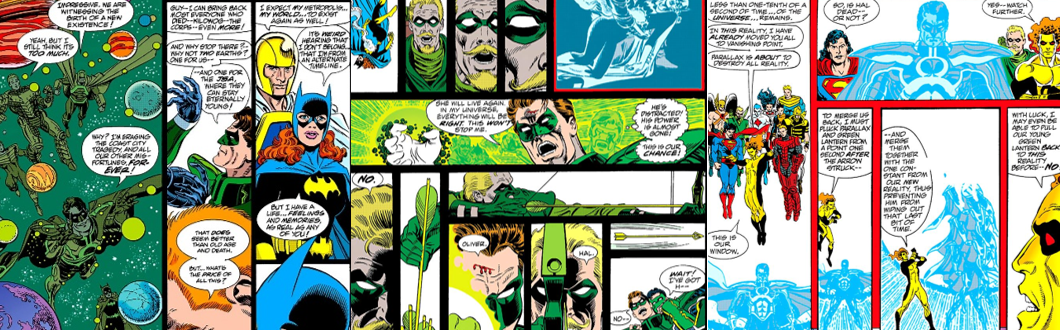
However, the pacing is all over the place. One minute, things are going a mile a minute; the next, things grind to a halt, and the cluttered panels are filled with endless dialogue as Waverider describes what’s going on. This really comes to a head in issue #0, where Waverider plucks the survivors from a microsecond of time and they witness the rebirth of the universe, all while Waverider waffles on about how they have one shot to re-join the timestream and it must be at the exact moment. He then explains, in great and confusing detail, why the likes of Batgirl (and, it’s assumed, Kyle) are dead but Batman and the billions of others are alive. Conveniently, this is because those latter examples died before the timeline reset; but anyone killed afterwards is really, truly dead. This does tie into Green Arrow’s grief and anger as he’s devastated at being forced to kill his best friend, despite having no choice as Hal was clearly mad with power and had appointed himself judge and jury over all lives and timelines. Green Arrow gets into a physical and ethical debate with Batgirl regarding this as Batgirl simply wants to live, just as the other anomalies want their worlds and lives back, and they briefly defend Parallax since he promises to give them everything they want. Though impressed by Batgirl’s spirit, Green Arrow echoes Warrior’s sentiments and believes Parallax isn’t qualified to make these decisions since it defies the natural order, but Oliver is distraught at being forced to take such extreme actions and this informed his characterisation for a while in the aftermath. Sadly, this comes far too late in the main story to be as impactful as it could be. I’m sure it’s fleshed out more in a tie-in comic but it’s noticeably lacking here, just like Warrior’s desire to undo Hal’s corruption and restore the Green Lantern Corps, which ends up being just one of many sidebars that aren’t resolved in the main story.
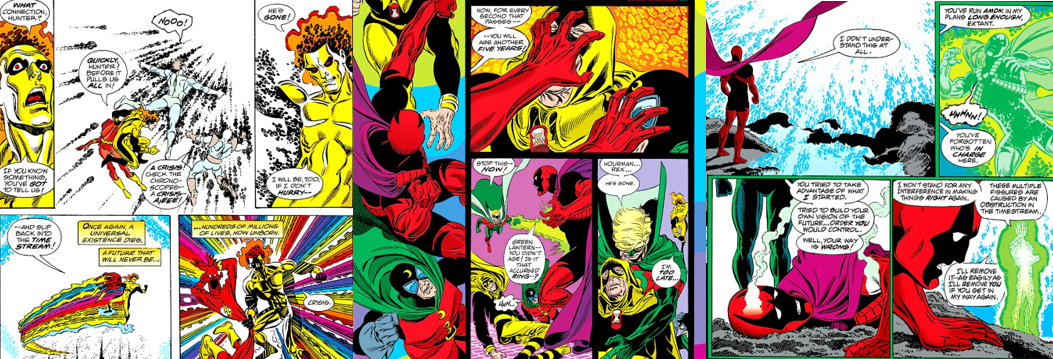
As Zero Hour features time travel shenanigans, it makes sense for it to be confusing story and that the likes of Metron and Waverider must rattle off a lot of exposition. It gets frustrating as every issue reiterates a lot of this information, and if you’re not a big fan of Waverider, like me. I liked the twist that Extant was a gestalt entity comprised of different time-based powers and people, reducing him to an energy-based being with no real identity who sowed destruction for this own ends. I quite like Extant and feel he got short-changed here as he was rendered completely impotent once Parallax emerged from the shadows. Consequently, I think Zero Hour would’ve been far better and more coherent if Parallax had been the antagonist from the start, going around time destroying and absorbing power from the likes of Extant, the Time Trapper, and Waverider, just to give the story more focus and really emphasise how shocking it is when the JSA are de-aged and killed and characters are erased. This would’ve been a natural evolution of his original turn when he destroyed the Guardians of the Universe and would’ve made for more drama as his former allies lamented his madness and struggled with fighting him, rather than Extant constantly unmasking to be different people, and could’ve even seen Hal’s past self confronted by his future, corrupted counterpart. While the art is okay, Zero Hour suffers from having far too many characters crammed into every panel, making it difficult to keep track of who’s still around or not. I liked the depiction of entropy erasing characters and timelines, especially as a metaphor for DC literally streamlining their time, but the execution was lacking as it left Hawkman a combined entity rather than simply resetting him and I always come out of this story wondering what the purpose was beyond being a cluttered celebrating of DC’s colourful characters. Sadly, it falls very short and everything that happened in it was rewritten eventually, with even Parallax being redeemed, making the entire story forgettable and pointless.
My Rating:
Could Be Better
Were you also disappointed by Zero Hour: Crisis in Time!? Were you able to follow all the time-based nonsense and exposition? Are you a fan of Waverider and Extant or did you also find them dull characters? Which of the deaths was most impactful or senseless to you? Were you a fan of Hal’s turn as Parallax and do you agree he should’ve been the sole villain here? Did you like the changes made to DC following Zero Hour? Which Crisis event was your favourite and what are some of your favourite cosmic events? Tell me what you thought about Zero Hour: Crisis in Time! in the comments and donate to my Ko-Fi to suggest other Crisis events for me to cover.

 Dr. K's Waiting Room
2 thoughts on “Back Issues [Crossover Crisis]: Zero Hour: Crisis in Time!”