
January celebrates two notable dates in science-fiction history: “National Science Fiction Day” on January 2 to coincide with the birth of world renowned sci-fi writer Isaac Asimov, and 12 January being when Arthur C. Clarke’s HAL 9000 was created. Accordingly, I dedicate January to celebrating sci-fi in all its forms.


Released: 29 September 1990
Developer: Capcom
MobyGames Score: 7.6
Also Available For: Arcade, Amiga, Amstrad CPC, Atari ST, Commodore 64, Master System, MS-DOS, Nintendo Entertainment System (NES), Nintendo Switch, Nintendo Wii (Virtual Console), PC, PC Engine.TurboGrafx-16, PlayStation, SEGA Mega Drive Mini, ZX Spectrum
Quick Facts:
Back when arcade machines were at their peak, Capcom were one of the premier names thanks, in no small part, to Street Fighter II: The World Warrior (1991). With Capcom’s popular and varied efforts cementing their legacy, they teamed with manga studio Moto Kikaku on the arcade Strider, its solid (if forgotten) NES port, and a manga adaptation. Director Kouichi “Isuke” Yotsui capitalised on the ninja fad of the era with Strider Hiryu, best known for his acrobatics and climbing abilities. This Mega Drive port was praised for sticking closely to its arcade roots, though Strider was largely relegated to cameo appearances even after a warmly received 2014 reboot.
The Review:
Essentially a remake and reimagining of the original arcade game, its ports, and its sequels, Strider is a 2D arcade-style hack-and-slash title. Players guide top assassin Strider Hiryu through five stages (set in the far-flung future of 2048) to assassinate Grandmaster Meio, who has established a dictatorial rule with his robots and cyborgs. Though he lacks any idle poses or victory animations, Strider is a visually impressive character, sporting a purple/blue/silver attire, a shock of red hair, and somersaulting about with his floaty jumps. Gameplay options are a simple as you could want, with Strider performing his aforementioned jump with either A or C and slashing enemies with his sword with B. You can crouch and attack, attack in mid-air, and press A and C or C and B together to performing a leaping attack. Strider clings to walls and ceilings with a pair of hooks to clamber up surfaces and shimmy over enemies. Pressing down and either A or C sees Strider slide under hazards, projectiles, and some enemies (though I always took damage if I hit an enemy) and you can extend the reach and power of your sword attacks with certain pick-ups. Others grant you an extra life or make you temporarily invincible (both of which you’ll desperately need!), restore some or all of your health or extend your health bar, or award points. You earn extra lives with a high score and you’ll get some temporary help from robot allies if you’re lucky. The Dipodal Saucer may weaken your energy bar, but it attacks with electrical blasts when you slash your sword to attack other enemies, the Terapodal Robo-panther fights alongside you on the ground, and the Hawk Robot circles above striking nearby enemies. You often grab these items by destroying robot drones and they nearly always land in precarious positions, meaning you’re likely to injure yourself grabbing them!
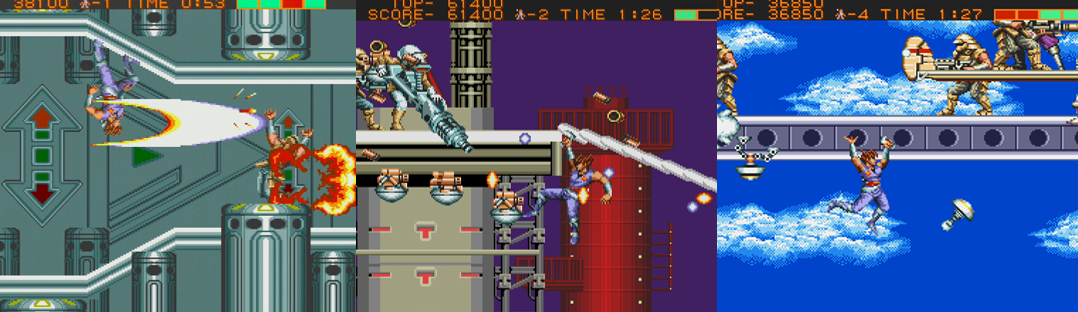
Strider offers three difficulty settings and allows players to set the number of lives they start with. Each stage contains a few different areas to battle through, with the game being surprisingly generous with its checkpoints, and betrays its arcade roots by pitting you against a timer. This refills when you defeat mini bosses, but it can be quite tight to reach each checkpoint with the many hazards and projectiles in each screen. Strider may be nimble but he’s a very big, often slow target and it’s extremely easy to be hit in mid-jump or when sliding under projectiles. It doesn’t help that the enemies flood the screen, constantly respawning and swarming you, or that this slows the action with sprite flickering, screen tearing, and stuttering as the game loads each area. While fun to control on the ground and often tasked with outrunning explosions and other hazards, leaping across chasms or hopping to moving platforms, Strider is very finnicky when affixed to walls and ceilings. His controls go a bit wonky, he hangs there as an obvious target, and it’s very easy to simply slip or be knocked down one of the game’s many bottomless pits. Some stages feature a gravity gimmick, forcing you to battle on the ceiling and turning the sky into a hazard. Others have you hopping to flying platforms and hanging beneath them to avoid bombs dropped by the Ballrog battleship. Drill-like spikes, piranha-infested waters, unreliable springy platforms, explosive munitions, spiked walls, and hidden boosters that send you flying into the abyss are commonplace, so you must constantly be vigilant. While each stage is quite large and varied, they’re also paradoxically short and there are no bonus games to mix up the action, such as a sidescrolling shooter where you get to control Strider’s awesome, high-tech glider. Instead, you must settle for some bonus points at the end of the stage.
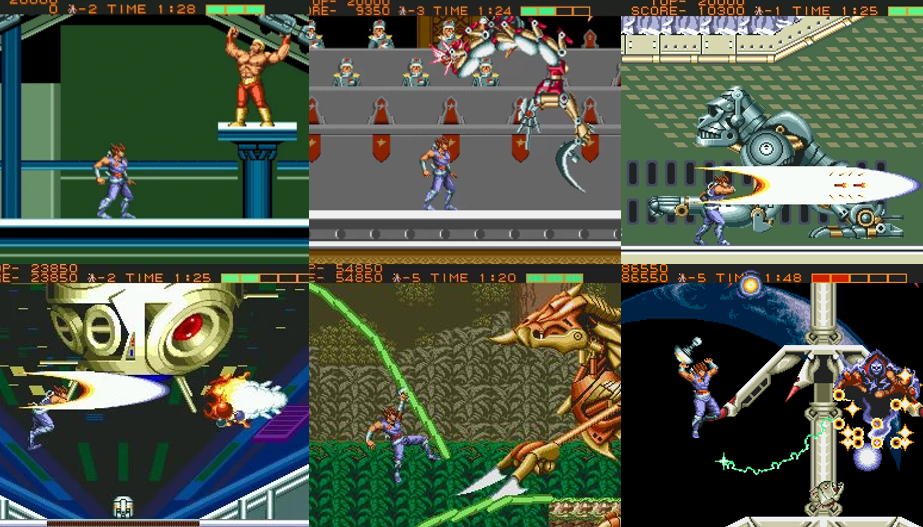
Although Strider often struggles with all the action and many enemies sport basic attack animations, the game throws loads of enemies in your path and they’re all annoying! From swarms of seemingly never-ending drones to cybernetic soldiers carrying pulse rifles, to spider-like robots and chicken-like mech walkers, the game’s enemies are relentless, constantly respawning and filling the screen with projectiles. You’ll also encounter many mini bosses and peculiar large mechanical guardians, with many littering the screen with flames or projectiles upon defeat. Stage 1 pits you against a theatrical wrestler who blocks your sword and judo tosses you overhead, a security robot traps you in an enclosed space and fires lasers that ricochet off every surface. A gaggle of onlookers turns out to be a large, sickle-wielding robot centipede whose back you must jump and cling to to pummel its head! Stage 2 has you battle a giant (but limited) mechanical ape (who bursts into hazardous flames upon defeat), desperately landing hits as he fires homing missiles, darts offscreen, and take out three kung-fu ladies to gain control of the Ballrog. While on the battleship, you’re sent flying around an antigravity chamber attacking the floating central control sphere, which is protected by smaller spheres and often sees you take damage without even realising it. A titanic mechanical dinosaur awaits in the jungle, which taxes the Mega Drive hardware and sees you using the high ground to attack its head and avoid its spiral flame shot and extendable claws. Most bosses return for a gauntlet in the final stage, with you battle the floating sphere, security robot, the mechanical ape (alongside constantly respawning but largely harmless Tyrannosaurs rexes), and the robot dinosaur (this time forced to time your jumps since there’s no platform). After besting the flying gunner again and being carried across a void by the robot centipede (and then destroying it again), you finally confront the grandmaster. This cloaked nuisance floats around an antenna, with a bottomless pit below and various projectiles to dodge. Luckily, you can grab some health here and there’s a chance you can stun-lock the grandmaster to make short work of him, but it’s pretty challenging since Strider’s such a huge target.
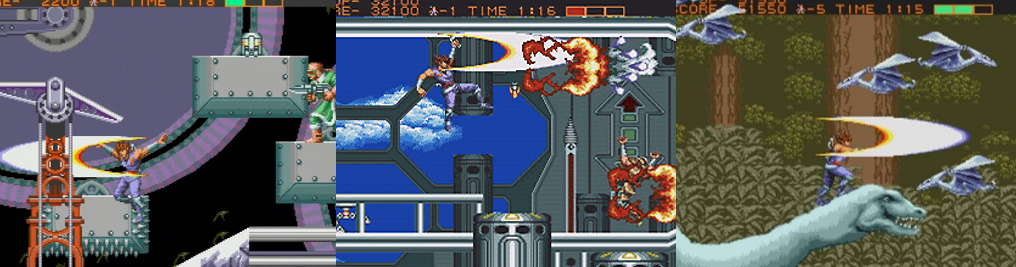
While Strider initially impresses, with Strider slicing apart the title screen background, there is no pre-game story cutscene or context to be found. Interludes pop up between stages, featuring the bad guys mocking you and praising Grandmaster Meio, but the game’s surprisingly light on story considering how rich its visuals are. Indeed, while the music didn’t exactly wow me and many backgrounds were disappointingly sparse, resembling the plain voids often seen in Master System titles, there’s a fair bit happening in every stage. You start off in the vaguely-Russian city of Kazufa, battling past the twinkling city lights, searchlights, and towering, Byzantine-esque buildings which hide futuristic weapons factories. There are always platforms to hop to, cling to, or pull yourself up m, with many being slanted and sporting hordes of mechanical enemies. Turrets line the walls and ceilings, drones hover from above, and giant gears turn platforms as you progress. Stage 2 places you in the frigid Siberian mountains, where wolves and an avalanche force you into a robot factory, where large dynamos flash intermittently to turn everything black and fill the screen with lightning bolts. Upon scaling the mountain, Strider finds himself on the heavily armed, steampunk-esque Ballrog battleship, whose outer hull is defending but turrets and a massive, tank-like cannon that sends you flying it you don’t quickly destroy it. Strider must smash his way inside, running and then frantically wall jumping to avoid being crushed, before making his way to the control cockpit. Stage 4 takes a bizarre detour into the Amazon jungle, where Tarzan-like natives toss boomerang-like projectiles, swarm from bendy branches, and friggin’ dinosaurs stomp past! You can hop on the backs of Brachiosaurus to fend off flocks of Pterodactyls and avoid being torn apart in the dangerous waters below. As if that fever dream wasn’t surreal enough, the game ends with you storming the grandmaster’s main base on “The Third Moon”, a space station teeming with deadly hazards, defences, and sending you reeling with its gravity gimmick. You’ll hop to giant satellite dishes, desperately cling to slanted platforms, be jostled about in another antigravity chamber, and end up clambering up an antenna to face the big bad himself. The game’s ending is barely worth it, with Strider looking upon the destruction he’s caused and flying off victorious past an enemy roll call as the credits play, with the game offering no high score table for your efforts.
Final Thoughts:
I was really excited to get my hands on Strider, a very affordable and often visually impressive early title for the Mega Drive, primarily because of how cool the title character looks somersaulting about and slashing foes with his giant sword. Unfortunately, the game sticks a little too close to its arcade roots, throwing a timer, hordes of nigh-endless enemies, and a slew of unfair pitfalls and hazards at you. With limited lives and no continues, you’re probably better off taking advantage of some of the push button codes or even modern ports of the game, which include rewinds and save states. Still, I was impressed by Strider in a lot of ways. Strider looks great, the foregrounds, especially, are incredibly detailed and varied, and I enjoyed the cyberpunk aesthetic that permeates every area (except for that random jaunt into a prehistoric jungle…I don’t know what that was about!) Unfortunately, the game might be a little too ambitious as the Mega Drive struggles to render everything at an acceptable speed and consistency, slowing the action and assaulting you with flickering and stuttering. I loved the giant and creative mini bosses, but they were painfully limited and artificially made more challenging by restricting you to tight corridors where Strider’s hit box works against him. power-ups were few and far between and it’s way too easy to take damage when slicing through enemies, severely limiting the action. This means you can neither blast through the game at high speed or afford to take your time, as the clock and the enemies are always against you. I enjoyed the stage variety, though, and gimmicks like the exploding floors and walls, but many of the backgrounds were far too basic for a 16-bit behemoth like the Mega Drive. Honestly, you’re probably better off emulating the arcade version as at least then I assume you can keep pumping in coins to push through tougher sections, but this home console port is a little too unforgiving to be as enjoyable as it could be.
My Rating:
Pretty Good
Did you ever play the Mega Drive version of Strider? Were you impressed by how close it was to the arcade version? What did you think to Strider’s appearance and sword attack? Which of the game’s bosses did you find the most ludicrous? Did you manage to clear the game legitimately? What are some of your favourite sci-fi-orientated videogames? Whatever your experiences with Strider, feel free to share them below, check out my other sci-fi and retrogaming content, and donate to my Ko-Fi to suggest other games for me to review.

 Dr. K's Waiting Room
One thought on “Mini Game Corner [Sci-Fanuary]: Strider (Mega Drive)”