
January celebrates two notable dates in science-fiction history: “National Science Fiction Day” on January 2 to coincide with the birth of world renowned sci-fi writer Isaac Asimov, and 12 January being when Arthur C. Clarke’s HAL 9000 was created. Accordingly, I dedicate January to celebrating sci-fi in all its forms.


Released: 13 August 1953
Director: Byron Haskin
Distributor: Paramount Pictures
Quick Facts:
As one of the forefathers of science-fiction genre, it’s perhaps no surprise that Herbert George Wells’s seminal 1898 alien invasion story The War of the Worlds is so widely lauded in mainstream and academic circles alike. After the book gained widespread notoriety from a radio adaptation, George Pal spearheaded the film version, which noticeably differed from the source material and reimagined H. G. Wells’s Tripods as flying machines courtesy of Albert Nozaki and his award-winning visual effects. Heralded as a sci-fi classic, inspired a follow-up television show, similarly-themed alien invasion movies, a slew of remakes and knock-offs, and a widely celebrated musical adaptation from Jeff Wayne.
The Review:
After humanity decimated each other in two World Wars, the Earth was on the precipice of dangerous and terrifying times. Advancements in nuclear and atomic science saw devastating weapons created and stockpiled, which threatened to destroy all life on Earth. Yet, as the omniscient narrator (Sir Cedric Hardwicke) relates, there are beings in the universe far above humanity’s petty squabbles. Far away on the long-dead red planet, unseen and malicious Martians observed our world with curious and envious eyes. Determining that the Earth was their best shot at migration considering how cold, dead, and hazardous the other planets are, the Martians begin a methodical invasion of our world with the simple crash-landing of a red-hot meteor outside Linda Rosa, California. Naturally, this draws immediate attention from the locals, film crews, and the United States military, who struggle to contain the resultant flash fires and rope in visiting scientists like atomic expert Doctor Clayton Forrester (Gene Barry) to offer their insight. Dr. Forrester quickly discovers the meteorite is radioactive and guesses that it’s hollow, explaining why the impact didn’t destroy the town (or the whole planet). He is so intrigued by the arrival – and clearly captivated by local Sylvia Van Buren (Ann Robinson) – that he decides to stick around and investigate the object further once it cools down, graciously accepting the hospitality of Sylvia’s uncle, Pastor Matthew Collins (Lewis Martin. While Dr. Forrester enjoys the square dance, part of the meteorite suddenly unscrews and a strange, mechanical, snake-like periscope emerges, flash-frying the nearby guards when they try to make contact and knocking out all the electricity and phone lines in the town with a burst of magnetic radiation (what we would now call an electro-magnetic pulse/EMP).
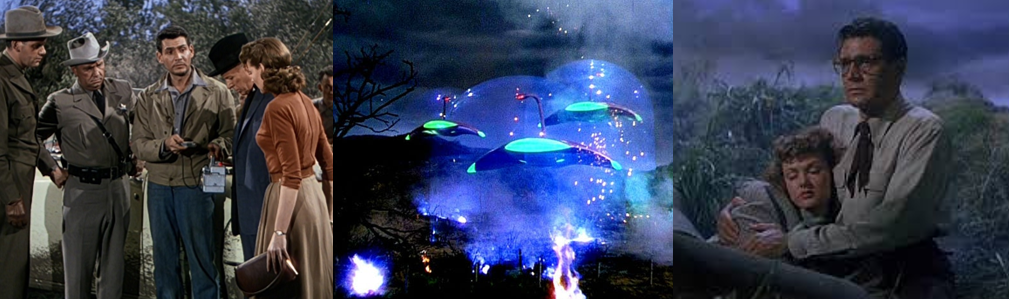
As more of the objects arrive, the military rolls in to secure the crash site. Major General Mann (Les Tremayne) takes charge, ordering a cordon and authorising lethal retaliation against the invader. Pastor Collins, reasoning that the Martians must be a higher lifeform and thus closer to God, attempts to make contact and is immolated by their “heat-ray”, alongside most of General Mann’s troops, when the Martians emerge from their meteorite (actually a cylindrical travel pod) in sleek, manta-ray-like craft that appear to levitate on magnetic beams. The flying machines obliterate everything in their path, easily resisting gunfire, mortars, and even aerial bombardment thanks to their impenetrable force fields. Dr. Forrester and Sylvia flee in a small plane but crash-land in a field, taking shelter in a nearby farmhouse and using the brief reprieve to bond. While Dr. Forrester has no family, Sylvia comes from a large, close-knit family unit and is thus terrified of the destruction caused by the Martians, who slowly sweep across the world as more of their cylinders crash to Earth. When one lands right by the farmhouse, partially destroying it and briefly injuring Dr. Forrester, the strange, squat aliens investigate and Dr. Forrester learns that they are as fragile as humans and, after reconvening with the remains of the military and scientific community, that they’re entirely dependant on their awesome technology. Research on the Martian’s blood also shows they’re highly anaemic while the severed electronic “eye” Dr. Forrester recovers gives some insight into how they perceive the world and humanity, but little advantage is revealed from this. As the world’s nations crumble under the Martian attack, the survivors are driven far from their homes, with the world’s military and surviving governments forced to co-ordinate from makeshift camps with the strangely untouched Washington, D.C., where efforts to mount an effective counterattack are explored.
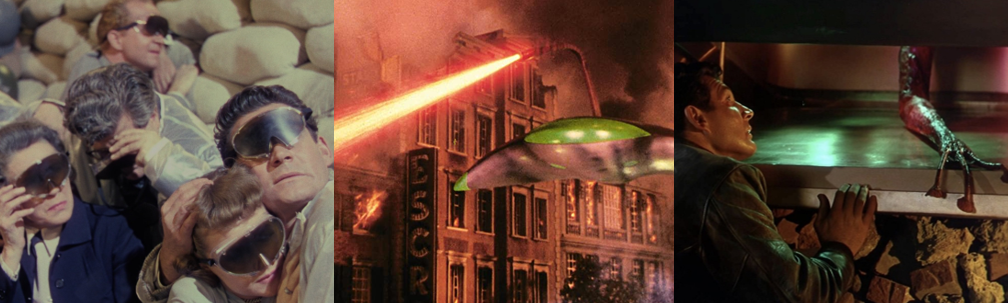
With the Earth on the brink of complete destruction, it’s decided to unleash a far deadlier and more powerful version of the atom bomb. Interestingly, no one (not even Dr. Forrester) objects despite the incredible risk and soldiers, civilians, and reporters observe the blast from dangerously close proximity, seemingly unafraid of any lethal fallout. The devastating force is barely an inconvenience to the Martians, however, thanks to their forcefields, and civilians are ordered to evacuate to the perceived safety of the mountains. Dr. Forrester and his colleagues are thus given the unenviable task of coming up a solution to the problem, an arduous request considering it’s predicted the Martians will conquer the world in just six days, and one almost immediately scuppered when those left behind descend into madness. Rioting, looting, and violence flood the streets, with Dr. Forrester forcibly removed from his car and separated from his vital equipment, seemingly dooming humanity thanks to greed and fear. Concerned only with reuniting with Sylvia, who was similarly forced from a bus heading to the Rocky Mountains, Dr. Forrester recalls a story she shared with him from her childhood where she took shelter in a church and finds her amidst a gaggle of terrified survivors praying for a miracle. Their prayers are seemingly answered when the flying machines suddenly lose control and crash midway through blasting the remains of Los Angeles. The survivors cautiously flood the streets and watch, amazed, as the Martians succumb to the bacteria and diseases humanity has long developed immunity against. Thus, at the very last second, the world is saved not by force or weapons, but by the simplest organisms of all as the planet itself repels its vicious invaders.
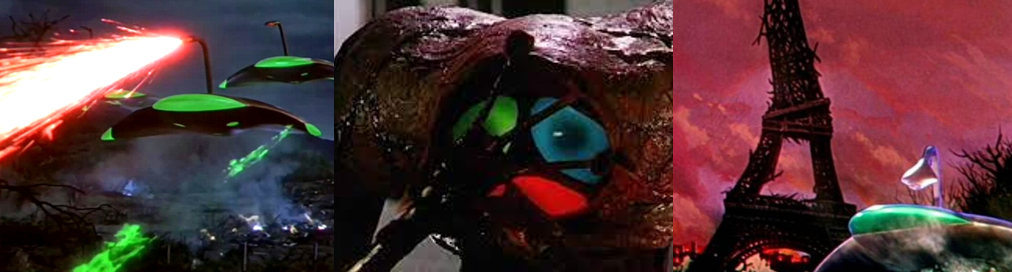
I’ve read The War of the Worlds a couple of times, but I haven’t committed it to memory. This film, while largely similar to the book, its noticeably different in that it’s set in America, follows a named (and somewhat educated) central protagonist, and depicts the Martians hovering around rather than stomping through cities in their Tripods. While the Martians utilised flying machines in the book, they were rarely seen, yet the visual of these sleek, deadly craft spewing red death has become iconic in the sci-fi genre. The film also places also more emphasis on the atomic bomb, as I recall, with the weapon depicted as humanity’s last, best hope against the invaders, and many supporting characters are omitted. Dr. Forrester and Sylvia take shelter in a farmhouse, but the curate is missing. The Martians don’t spread their red weed to terraform the planet, don’t capture or consume people, and are never seen engaging with the Navy. The Martians are also depicted very differently than in the book. Rather than being bizarre, octopus-like creatures with a mass of tentacles and bulbous main bodies (essentially being all brain and little else), the Martians are stumpy, gangly creatures with long, spindly arms and weird, biomechanic eyes. This was a strange choice that makes the creatures look more ridiculous than intimidating, though the scene where one fondles Sylvia is still somewhat striking and the cold, efficient ruthlessness of the flying machines more than makes up for how ridiculous the operators look. Indeed, the film emphasises that the Martians are biologically unremarkable, doubling down when they succumb to simple bacteria, and are only fearsome because of their machines, making for a startling allegory for the arrogance and warmongering nature of humanity.
Final Thoughts:
The War of the Worlds certainly earned its place as one of the quintessential sci-fi movies of the 1950s and beyond. It’s the classic story of aliens invading the Earth and set the blueprint for so many alien invasion movies, rip-offs, and parodies, and it all came from this loose adaptation of a centuries-old text whose message has only become more prevalent over time. The main showcase of the film might be the amazing special effects, but the character work is pretty good here, too. I liked Dr. Forrester as an unlikely hero. He knew enough to flee when faced with an overwhelming force and his first thought was also to learning more about their enemy than confronting it head-on, and to protecting others rather than giving in to fear and despair. Sylvia is largely here to look pretty, scream when the Martians attack, and lose herself to hysterics, but she gives Dr. Forrester strength and something specific to fight for and focus on. I enjoyed how stern but fair General Mann was and how utterly useless all our fancy weapons and military might were against this aggressive and advanced enemy. The visual of the Martians shrugging off an atomic bomb remains striking and seeing them slowly and methodically wipe out humanity across the world set the standard for later depictions of world-wide destruction. Sure, there are liberties taken with the text and the Martians themselves look kinda goofy, but their flying machines are now intrinsically linked with the story and have become a symbol of the genre. The War of the World’s message about the dangers of humanity taking their planet and lives for granted remains as true as ever, with us being hopelessly insignificant compared to Mother Nature, and the film remains a bleak, humbling narrative about how insignificant we are against such homegrown and outside forces.
My Rating:
Pretty Good
Is The War of the Worlds one of your favourite sci-fi films? Did you like the changes made to the source material or were you annoyed to see the focus changed so much? Were you impressed by the special effects and the sleek flying machines or did you miss the lumbering Tripods? Do you believe alien life is seeking to conquer our world? Which version of The War of the Worlds is your favourite and how are you celebrating sci-fi this year? use the comments below to let me know, check out my other sci-fi reviews, and donate to my Ko-Fi to suggest other War of the Worlds media for me to cover.

 Dr. K's Waiting Room
One thought on “Movie Night [Sci-Fanuary]: The War of the Worlds”