
January celebrates two notable dates in science-fiction history: “National Science Fiction Day” on January 2 to coincide with the birth of world renowned sci-fi writer Isaac Asimov, and 12 January being when Arthur C. Clarke’s HAL 9000 was created. Accordingly, I dedicate January to celebrating sci-fi in all its forms.

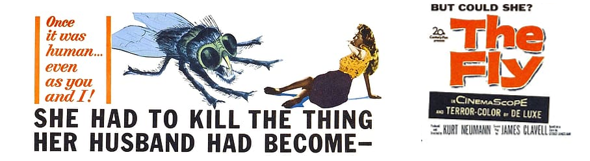
Released: 16 July 1958
Director: Kurt Neumann
Distributor: 20th Century Fox
Budget: $350,000
Box Office: $1.7 million (or $3 million)
Rotten Tomatoes Scores: 95% / 71%
Quick Facts:
A relatively faithful adaptation of George Langelaan’s 1957 short story, The Fly saw star David Hedison struggle with the ambitious and surprisingly terrifying practical effects as much as co-star Vincent Price struggled with the film’s iconic final moments. Regarded as a sci-fi classic, The Fly spawned a couple of sequels and a widely praised remake in 1986.
The Review:
Set in Montreal, Quebec, The Fly opens with all the major action having already taken place and aspiring scientist André Delambre (Al Hedison) crushed by a hydraulic press at his family factory. His equally wealthy brother, François Delambre (Vincent Price), is shocked by this but knocked for a loop when André’s beautiful wife, Hélène Delambre (Patricia Owens), confesses to killing her husband. Stoic and apparently remorseless, Hélène openly admits to the act, refusing to paint herself as a “murderess” as André willingly placed himself under the hydraulic press but confessing to activating the machine twice to crush his head and arm. Having adored his brother, his curious young nephew, Philippe Delambre (Charles Herbert), and having secretly been in love with Hélène for years, François is desperate to know why she’s saying such awful things and to get to the truth of the matter. François aids Inspector Charas (Herbert Marshall) in this endeavour, eager to understand why Hélène is so desperate to find and kill a white-headed fly. As Hélène faces either hanging for murder or being committed to an asylum on the grounds of insanity, François pretends to have captured the fly and threatens to give it to Inspector Charas unless Hélène tells the truth. This breaks Hélène’s crazed demeanour and she reveals she’s been pretending to be mad to protect Philippe. Assuming that François has seen the truth of the fly he’s supposedly caught, Hélène agrees to tell him and Inspector Charas the whole story, meaning most of The Fly is framed as flashback to a couple of months ago, when the Delambres’ were a healthy and happy family very much in love and enjoying the opulence of their home.
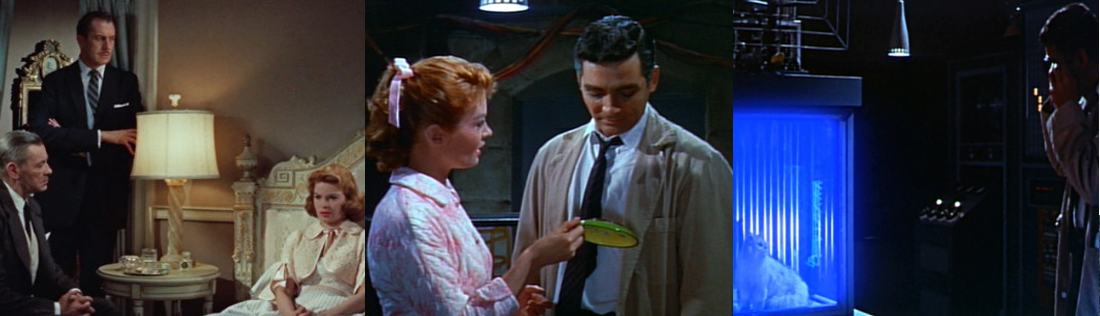
Back then, the charming André was a loving, if reclusive, scientist who spent days in his basement laboratory working away but always greeted his wife and son with a smile. One day, André bounded from his lab and eagerly brought Hélène to witness his latest, greatest creation: the “Disintegrator-Integrator”. Hélène watches in amazement as André’s machine teleports a plate from one glass chamber to another and shares his elation in the potential applications of the machine, which promises to solve world hunger and change concepts of transport. Unfortunately, André’s delight quickly turns sour when Hélène discovers the reintegrated objects are not perfect duplicates, so André immediately returns to work, shunning his family for several days before he solves the problem. Once satisfied that the flaw’s been corrected, André moves to live animal testing by transporting the family cat, Dandelo (Unknown). However, Dandelo mysteriously fails to reintegrate (possibly because she was transported alongside a saucer of milk) and is apparently reduced to atoms, with only her disembodied cries echoing throughout the lab. Grieved by this mishap, the cause of which he never discovers, André returns to work on his machine and finally re-emerges to demonstrate the revised Disintegrator-Integrator to Hélène, now able to teleport living objects and allowing her to care for a reintegrated guinea pig to atone for Dandelo. Though eager to celebrate his breakthrough, André hesitates to inform the wider scientific community as even he doesn’t fully understand his machine, though he excitedly requests that Hélène bring François to witness the fruits of his labour and bask in what promises to be a world-changing creation. However, when François arrives, he and Hélène are disappointed to find a badly written note taped to the door of André’s lab asking them to stay away. Assuming André has lost himself in his project once more, the two leave him to it, only for André to remain in the lab for several days.

Concerned, Hélène goes to check on him and finds him hiding his face behind a black cloth and keeping his left hand obscured. Though unable to speak, André converses through written and typed notes and by banging once for “yes” and twice for “no”, forcing Hélène to turn her back as he slurps his food and revealing that he experienced a horrible accident when he transported himself through the Disintegrator-Integrator. A common housefly got into the chamber with him and mixed up their DNA, leaving André with a deformed, fly-like hand and head and the fly with a human head and arm. Strangely, André retains his logic and reason but, knowing it’s only a matter of time before he loses his humanity, he orders Hélène to find the white-headed fly. Hélène spends a couple of days frantically searching all over for the fly, aided by her eager son and confusing their housemaid, Emma (Kathleen Freeman), who somehow misinterprets Hélène’s clear instructions to capture the fly and goes around swatting them. Determined to help her husband, Hélène repeatedly tries to corral the fly and is constantly met with failure: it slips out of Philippe’s net and eventually escapes into the garden, presumably acting as a fly would and slowly having its instincts overridden by André’s consciousness just as André becomes increasingly animalistic. Indeed, the frustration at his wife’s failure only exacerbates André’s condition. He struggles to type and write and keep his thoughts straight and warns that he will have to “destroy himself” if the fly isn’t found. Refusing to accept this, Hélène desperately begs André to try transporting himself again, confident that this will undo the damage, only to be left a shrieking, horrified wreck when she whips off André’s cloth and witnesses his gruesome fly head!

While quaint by today’s standards, this practical effect is surprisingly shocking. It twitches and moves like a fly’s proboscis and effectively transforms the beautifully handsome Hedison into a tragically monstrous figure. This is further emphasised by how hard André fights the animalistic urges of his fly genes; he struggles to keep his fly arm from harming Hélène, and this same limb actively fights against him when he destroys his lab in despair. Realising that he’s meddled in forces beyond human understanding and wishing to destroy all evidence of his experiment, André uses what little humanity he has left to ransack his lab and scrawls a final declaration of love and plea for help on his chalkboard. Thus, Hélène helps her husband to the hydraulic press and, following his instructions, activates the machine to crush his fly parts into indistinguishable mush (though not before his fly arm tries to bring her under with him!) Though amazed by Hélène’s story, Inspector Charas begrudgingly returns with a warrant and the men in white coats to take her to the nut house. While he’s also sceptical, François is desperate to save Hélène and frantically alerts Inspector Charas to a white-headed fly Philippe found caught in a spider-web in the garden. Dubious, Inspector Charas entertains François’s plea one last time, taking no pleasure in causing him pain, and is appalled when he sees the fly has André’s head! Inspector Charas and François watch in horror as a spider advances on the half-human fly as André screams for help. Unable to stand the screaming, Inspector Charas crushes both and François immediately condemns him as being as guilty of murder as Hélène. Shocked by the whole ordeal, Inspector Charas reluctantly agrees to François’s suggestion that André committed suicide, sparing Hélène from death and the asylum. Some time later, Hélène and Philippe return to normal, with François now much closer to them, and François sadly tells Philippe that his father died in a reckless search for the “truth”.
Final Thoughts:
Although I grew up with the 1986 remake, I’ve always had a fondness for the 1958 adaptation of the The Fly, which I read and wrote about at university. Aside from a few changes, this is surprisingly faithful to the original short story and certainly one of the more ambitious sci-fi efforts of the late-1950s. Although some of the dialogue is a bit clunky and André and Hélène’s relationship is sickeningly sweet, André has an enthusiastic and affable charm about him thanks to the charismatic David Hedison, who adeptly captures André’s despair and torment after his horrific accident. Vincent Price brings his peerless authenticity to the film, perfectly portraying François as a lovestruck, tormented man trying to do his best by Hélène while struggling to comprehend her fantastical tale. Philippe was kind of annoying but did his best to be helpful, while Patricia Owens did a fine job carrying the bulk of the drama, portraying Hélène as a devoted wife desperate to help her husband. The Fly does a great job of building tension to the big reveal, giving glimpses of André’s malformed hand and depicting his obvious desperation and struggle to maintain his humanity. Sure, the fly head might be quite laughable by today’s standards but that reveal scene is an iconic moment in sci-fi cinema and has immortalised the film as much as the infamous ending. Again, the fly-André’s anguished cries of “Help me! He-ll-p me-e!” might be absurd, but it’s played so straight and so horrific that I can’t help but get shivers as that painfully fake spider devours him. While The Fly was completely outshined by its remake, it’s still a classic sci-fi morality tale of the dangers of science and a surprisingly effective exploration of madness and devotion, to say nothing of having some memorable moments that make it a truly timeless experience.
My Rating:
Pretty Good
Did you enjoy this sci-fi classic? Did you like how accurate it was to the book? Were you won over by the seemingly perfect life shared by André and Hélène? Did you like the build up towards the big reveal or did the endless chasing for the fly get on your nerves? Were you impressed with the practical effects or do you think they’ve aged badly? Would you like to see another adaptation that was as closely tied to Langelaan’s book? How are you celebrating sci-fi this January? Like this review and leave a comment below, check out my other sci-fi reviews, and donate to my Ko-Fi to suggest other sci-fi movies for me to cover.

 Dr. K's Waiting Room
3 thoughts on “Movie Night [Sci-Fanuary]: The Fly (1958)”