
January celebrates two notable dates in science-fiction history: “National Science Fiction Day” on January 2 to coincide with the birth of world renowned sci-fi writer Isaac Asimov, and 12 January being when Arthur C. Clarke’s HAL 9000 was created. Accordingly, I dedicate January to celebrating sci-fi in all its forms.


Released: 27 April 1951
Director: Christian Nyby
Distributor: RKO Radio Pictures
Budget: $9 to 15 million
Box Office: $1.1 million
Rotten Tomatoes Scores: 87% / 73%
Quick Facts:
Based on celebrated, influential novella, Who Goes There? (Campbell, 1938), The Thing from Another World was loosely adapted by Charles Lederer, Howard Hawks, and Ben Hecht. The titular “Thing” (James Arness) became a plant-like humanoid thanks to extensive make-up later replaced with an asbestos suit for an ambitious fire stunt. Though very different from the novella, The Thing from Another World is considered one of the best movies of the 1950s and inspired one of the greatest remakes ever made in 1982.
The Review:
While searching for his next big story in Anchorage, Alaska, “newspaper man” Ned “Scotty” Scott (Douglas Spencer) bumps into old friend, pilot Lieutenant Eddie Dykes (James Young) of a United States Air Force re-supply crew, at an officers’ club and meets his cohorts: gruff Captain Patrick Hendry (Kenneth Tobey) and flight navigator Ken “Mac” MacPherson (Robert Nichols). When noted scientist and Nobel laureate Doctor Arthur Carrington (Robert Cornthwaite) radios in a vague call for aid at a North Pole research camp, Captain Hendry and his jovial crew are ordered to assist, flying some hands, sled dogs, and the eager Scott out to investigate Dr. Carrington’s ambiguous concerns about a mysterious aircraft. Upon arriving at the Polar Expedition Six outpost, the stern but amicable Captain Hendry bristles to reunite with the gorgeous and playful Nikki Nicholson (Margaret Sheridan), who’d previously humiliated him in a drinking game and turned down his handsy advances. Though flustered by her mischievous nature, Captain Hendry is obviously as attracted to her as she is to him and they enjoy a fun back-and-forth throughout the film that’s as entertaining as the banter between Captain Hendry, Lieutenant Dykes, Mac, and Scotty. The crew are clearly friends as much as co-workers and express their affection through light-hearted banter, teasing Captain Hendry for his drinking habits and past blunders, only for him to jokingly threaten them with guard duty and other empty threats. There’s a unique approach to dialogue and interactions here as characters talk over each other and converse very bluntly, making every scene feel ad-libbed (except for Dr. Carrington, who expresses himself with a theatrical guile) and the relationships between the characters feel far more personable and natural as a result.
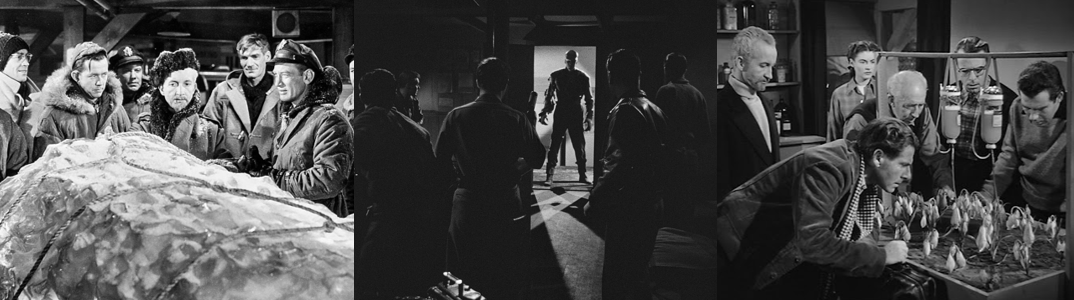
After meeting with the other scientists and civilians stationed at the outpost, Captain Hendry flies his crew, Dr. Carrington, and others to the crash site, only to discover a genuine flying saucer buried under the ice! Rather than wait for approval from his commanding officer, Captain Hendry orders thermite charges to be placed around the site to melt the ice, accidentally destroying the craft when the explosives react violently to the hull. Though Dr. Carrington is aghast by this, his excitement soon reignites when they discover a large humanoid “Thing” buried nearby. This time, the team dig it out and take it to the outpost, though Dr. Carrington’s frustrated by Captain Hendry’s insistence that they await further orders before defrosting or investigating their strange guest. Scotty is similarly irritated to be barred from reporting what they’ve found, seeing the discovery as the story of the century and eager to share it, as Captain Hendry is anxious to avoid another blunder. As the team hunker down against a blistering storm and take shifts watching the creature, Corporal Barnes (William Self) becomes unnerved by the Thing’s gaze and accidentally thaws it out after covering it with an electric blanket he didn’t realise was plugged in. The Thing awakens, briefly runs amok through the outpost, and flees into the storm, attacking the sled dogs and losing some of its arm before disappearing. Upon investigating the severed limb, the resident scientists conclude that the creature is a bizarre humanoid plant that feeds on blood; the hand even reanimates after absorbing some of the dog’s blood staining it. Dr. Carrington slowly becomes obsessed with the creature, believing it to be intellectually and physically superior to man and wishing to learn its secrets, only for Captain Hendry to repeatedly shoot down his insane requests and prioritise saving lives over reasoning with a mindless creature.
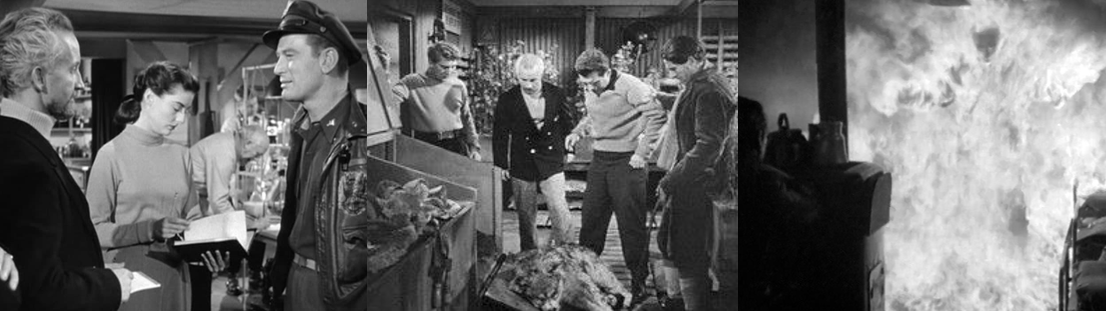
The titular “Thing” is seen sparingly, which I was surprised by. After its initial awakening, the creature vanishes and the film focuses on the research into its nature, barricading the outpost against further attacks, and searching for the creature before it can strike again. It’s still active in the background, but we only hear about it from shellshocked survivors and through dialogue. Unlike the shapeshifting, nebulous alien Thing from the book and subsequent outings, the Thing is a towering, humanoid “Martian” more like a vampire than a voracious extraterrestrial. The survivors discover a sled dog drained of its blood and hear from the traumatised Doctor Stern (Eduard Franz) that the creature attacked the outpost greenhouse, killing everyone and hanging them from the rafters to drain their blood, which would’ve been gnarly to see. Captain Hendry is surprisingly calm about the entire situation and there are no instances of paranoia or cabin fever among the survivors. The only conflict comes from the scientists who wish to defend and study the creature and the military who wish to kill it. Captain Hendry is horrified to learn from Nikki that Dr. Carrington, who’s been going without rest since the Thing was discovered, has been feeding blood samples to seeds from the creature’s arm, producing alien plants that has the airmen speculating that the Thing came to conquer the world. Thanks to the storm, communicating with Brigadier General Fogerty (David McMahon) and the outside world is spotty, at best, resulting in Captain Hendry receiving a bunch of one-way messages and orders to fortify the outpost and survive but leave the creature unharmed. Seeing the threat the Thing poses, Captain Hendry naturally disregards these orders, and Dr. Carrington’s mad objections, and has the Thing doused with kerosene and set alight when it next attacks. Despite the Thing going up in flames, it wildly lashes out and almost burns the outpost down before escaping into the snowstorm.
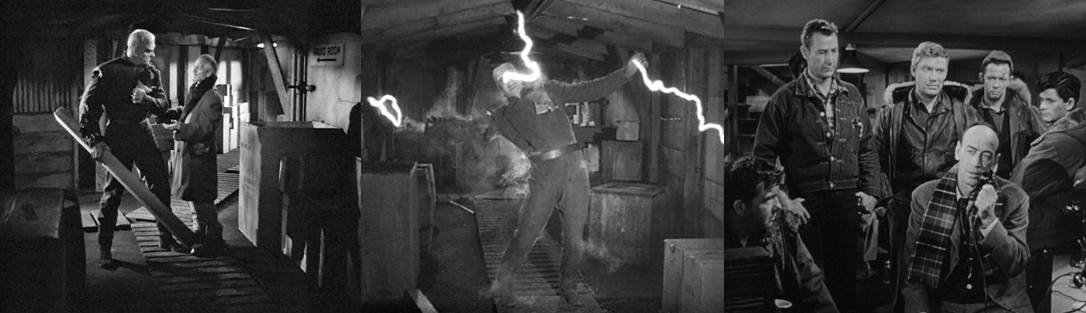
While recovering, the survivors are horrified to learn that Dr. Carrington’s musings about the creature’s intelligence are at least partially true as the Thing sabotages the outpost’s heating system, threatening to freeze them to death within hours. Surmising that the Thing will target the electricity next, Captain Hendry corrals all the survivors into the generator room and the airmen take an offhand suggestion from Nikki (“Boil it, bake it, stew it, fry it”) to heart, rigging a high voltage “fly trap” to electrocute the creature in a narrow corridor. Seemingly sensing their blood, the Thing crashes through their makeshift barricade and stalks its way towards them, noticeably avoiding the wires hidden beneath the pallets on the floor. Although Dr. Carrington attempts to sabotage the plan by shutting the generator off at a crucial moment, he’s easily disarmed and briefly subdued, but Captain Hendry’s forced to wait for the hulking Thing to position itself correctly on their trap. Dr. Carrington rushes to it, pleading for reason and to begin a dialogue, only to be roughly shoved aside and left with a broken collarbone. Despite its immense size, strength, and durability, the Thing blunders into position and is zapped by a few thousand volts in a surprisingly ambitious light show. Captain Hendry keeps the juice poured on until the Thing is reduced to a smouldering pile of ash, though Scotty faints before he can get a clear shot of the creature. The survivors round up all remains of the Thing and burn those, too, before treating their wounds and decompressing as the storm dies down. While Captain Hendry and Nikki tease taking their relationship to the next level, Scotty finally gets to call in his story, eagerly painting a dramatic picture of the pitched battle fought at the outpost and warning his listeners to “Watch the skies everywhere. Keep looking. Keep watching the skies…”
Final Thoughts:
Although I’m a big fan of John Carpenter’s 1982 remake of Who Goes There?, I’ve never read the book or watched this original adaptation, though I gather it’s a very loose one with only the basic elements of the story being represented. Most notably, the titular Thing is very different from the source material and subsequent adaptations, being more akin to Frankenstein’s Monster than a shape-changing organism. I’m not surprised by this as I doubt the technology existed to bring the creature to life in a more faithful way and it makes sense to reimagine it as a hulking, humanoid alien given where sci-fi was at the time. I liked the twist that it was essentially a walking vegetable and like a vampire, feeding on blood and growing alien plants from its seeds, potentially to overrun the world. I would’ve liked to see this emphasised more, perhaps to see the Thing’s spores spread throughout the outpost and maybe infect those within to bring in some of the paranoia from the book and definitely would’ve liked to see more death and destruction from the disappointingly absent creature. Luckily, the relationships and banter between the characters is more than enough to sustain the film in the Thing’s absence, with Captain Hendry and his men having very enjoyable and realistic interactions. I really liked that the actors kept talking over each other and the banter between the characters, which was nicely contrasted with Dr. Carrington’s objections. He was a very theatrical character but, again, felt somewhat underutilised and I would’ve liked to see him sabotaging their efforts more. Despite all this, and the film being oddly paced and lacking in urgency, The Thing from Another World was still quite enjoyable and somewhat ambitious at times. It’s a great example of a classic, 1950s sci-fi flick that is perhaps a little dated these days, far surpassed by its remake, and arguably lacking compared to some of its peers, but it still has a charm and appeal that make it an entertaining watch.
My Rating:
Could Be Better
Did you enjoy this first adaptation of Who Goes There? If you’ve read the book, what did you think to the changes made to the story? Did you enjoy the banter and interactions between the characters? Do you agree that the Thing should’ve featured a lot more? Do you think Dr. Carrington was right to want to communicate with the Thing? How are you celebrating sci-fi this month? Whatever you thought to The Thing from Another World, comment down below and donate to my Ko-Fi to suggest other sci-fi films for me to review.

 Dr. K's Waiting Room
4 thoughts on “Movie Night [Sci-Fanuary]: The Thing from Another World”