
The Day of the Dead (or Dia de los Muertos) is a traditional Latin American holiday celebrated every November 1st. This is the perfect excuse to spotlight the long-running and ever-changing zombie genre, which is often used to parallel society and culture.


Released: 1 November 2002
Director: Danny Boyle
Distributor: Fox Searchlight Pictures / 20th Century Fox
Budget: $8 million
Stars: Cillian Murphy, Naomie Harris, Megan Burns, Christopher Eccleston, and Brendan Gleeson
The Plot:
Twenty-eight days after rabid chimpanzees infected with a “Rage” virus spread an aggressive plague, bicycle courier Jim (Murphy) awakens to find London in shambles. After encountering other survivors, Jim follows a military broadcast promising sanctuary from the infected…
The Background:
Zombies have featured in movies in some form since the 1930s, initially portrayed as mindless slaves and popularly portrayed as the shambling undead thanks to the legendary George A. Romero. Like many, writer Alex Garland was directly inspired by Romero when dreaming up 28 Days Later, which came when zombies were having one of their many resurgences in horror cinema. Director Danny Boyle joined the project, impressed by Garland’s screenplay, which he saw as more of a post-apocalyptic story than a traditional zombie tale. 28 Days Later reimagined the living dead as voracious, aggressive infected individuals and achieved its iconic shots of deserted London streets by filming in short bursts early in the morning. Funding was a constant headache during production, leading to multiple alternate endings. Things took an eerie turn when filming coincided with the September 11 terrorist attacks, and rights issues have limited the film’s availability on streaming services, though 28 Days Later proved a massive box office success. Although zombie genre purists debated the film, 28 Days Later was universally praised for revitalising the concept, its stirring performances, unsettling atmosphere, and savage, fast-paced editing. The film inspired a wave of violent new takes on the genre and was followed by a similarly regarded sequel in 2007 and (eventually) the first of a proposed follow-up trilogy in 2025.
The Review:
28 Days Later has one of the most startling and dramatic openings in all of cinema. After a brief prelude where animal rights activists break into a secret laboratory to free some chimpanzees, the action picks up literally twenty-eight days later to find Jim alone in a dishevelled hospital. Confused and disorientated, he wanders the deserted hallways and stumbles onto the equally lifeless streets of London, seemingly left behind during the Rapture. For Jim, this is very puzzling as, from his perspective, he was ferrying a package across the city when he was hit by a car, only to wake up apparently the last man alive in the nation’s capital. Loading up on sugary drinks and venturing into the city on a whim, desperately calling out for anyone else, Jim gets his first glimpse of what’s happened when he sees headlines warning of a mass evacuation and military deployment. Bewildered, Jim finds a church full of bodies being feasted on by a handful of the infected, who immediately chase him, roaring and ravenous, into the streets. Malnourished and unprepared, Jim’s completely ill-equipped to escape or fight the infected horde. Indeed, much of Jim’s character arc is transitioning from a near useless, clueless bystander and into a more capable and proactive survivor, one who doesn’t hesitate to kill to defend himself and others and who actively makes plans to outwit the infected and any disreputable survivors. While Jim’s initially in disbelief that the Rage virus effectively wiped out the government and civilised society, the undeniable truth quickly sinks in after repeated attacks from the voracious infected and after he pays a sombre visit to his parents’ (Christopher Dunne and Emma Hitching) home and finds they’ve committed suicide rather than fall victim to the virus.
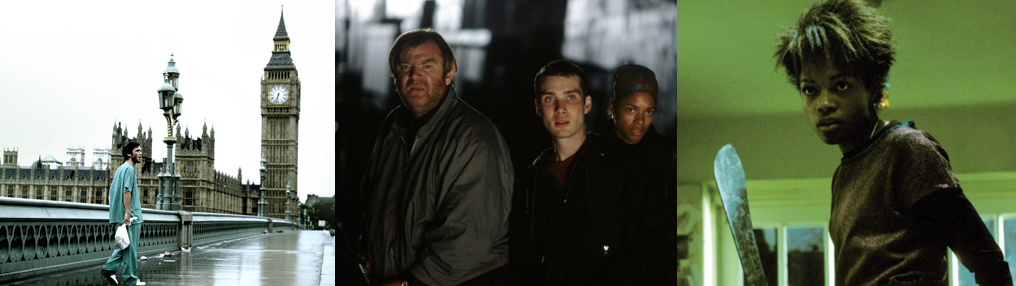
Yet, despite the United Kingdom being a post-apocalyptic wasteland where bodies, abandoned cars, ransacked shops, and highly aggressive, zombie-like creatures lurk, Jim carries a glimmer of hope that not everything has gone to shit. This largely contrasts with Selena’s (Harris) perspective as she’s so hardened by the sudden destruction of everyday norms that she’s initially cold, pragmatic, and willing to hack apart her allies if there’s even a small chance of infection. Indeed, Mark (Noah Huntley) shares his harrowing escape from the infected, we never learn what Selena went through to go from chemist to cold-blooded survivor and are simply presented with a grim woman who refuses to let anyone slow her down or give in to hope. Despite her best efforts, Selena’s demeanour cools throughout not just Jim’s influence (regardless of her no-nonsense attitude, she fights to save him in the early going) but also spending time with Frank (Gleeson) and Hannah (Burns), a father/daughter duo who shelter them in their tower block flat and beg Jim and Selena to help them reach safe harbour at a military outpost. Moments of levity and normality are fleeting in 28 Days Later, but they flicker to life as the two stay, travel, and bond with Frank and Hannah, with Frank being a father figure to both and caring for Hannah’s welfare melting Selena’s ice-cold heart. The four make a good, fun surrogate family unit, bouncing ideas and opinions off each other and sticking together to gather resources and push through obstacles. While Jim advises against travelling through a tunnel, the four work together to replace a flat tyre and share some carefree moments. Jim’s so relieved to experience a brief flash of normality that he’s understandably horrified when he dreams of waking up alone once more, and noticeably hesitates when Frank is accidentally infected when they reach the military blockade.
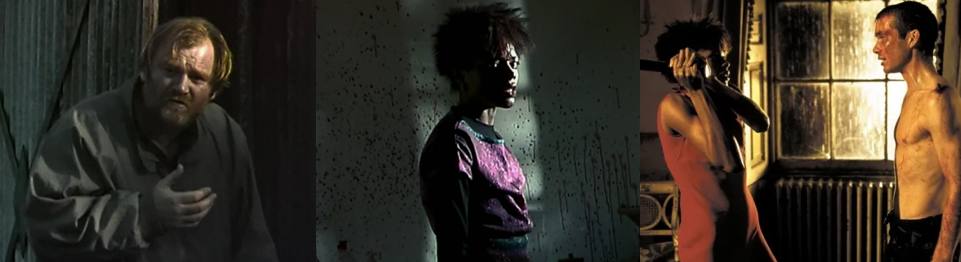
While Selena initially believes that Frank and Hannah, despite being good people, will inevitably be a burden, she warms to them and, despite her hardened attitude, can’t help but care for and protect others. She easily could’ve left any of them at any time but chooses to stick around and even becomes attracted to Jim, even if she still has walls around her heart. Selena is thus heartbroken for Hannah’s loss, equally distraught at first seeing her grouchy but affable father turn into a mindless monster and then witnessing him being gunned down. Although Selena was sceptical of salvation or a cure, she’s as grateful as Jim is when Major Henry West (Eccleston) rescues them and takes them into his heavily fortified mansion and offers the protection of his renegade soldiers. Like Major West, there’s a sense that all Selena has seen is death and violence, meaning she’s largely numb to it. By contrast, Jim’s noticeably rattled by it all, especially when he’s forced to kill an infected boy (Justin Hackney). Even then, Jim simply reacts to what happens, whereas Selena is always prepared, carrying a backpack of supplies and wielding a machete. By comparison, Hannah isn’t a fighter and even her dad, despite his cool riot gear setup, is more about first hunkering down and then travelling to a safer place where others can do the fighting. While Major West and his soldiers are more than capable of defending their turf, setting up trip wires, landmines, floodlights, and being well armed, their intentions are far from noble. Faced with a squad close to breaking point, Major West ordered them to make preparations and set up a false radio broadcast to bring in women and thus hope for the future, though Sergeant Farrell (Stuart McQuarrie) refuses to participate in sexual slavery and believes his commanding officer has gone mad.
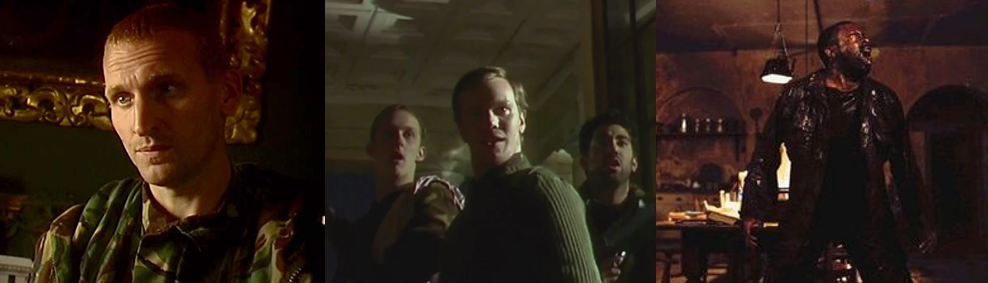
I’ve always felt like 28 Days Later loses its way once Major West and his soldiers appear. The bleak, desolate atmosphere so meticulously established is replaced with a bunch of assholes who just want to muck about and bully struggling chef Private Jones (Leo Bill). To be fair, even douchebags like Corporal Mitchell (Ricci Harnett) and Private Bedford (Ray Panthaki) are quick to defend against the incoming infected. However, even their resources (which, strangely, include piles of electronics) cannot last forever and the restless men soon turn their eyes towards Selena and Hannah. While Major West initially chastises them, preferring a softly-softly approach, he’s quick to reveal his true intentions to Jim, hoping to coerce him to their side, but shows no hesitation in ordering Jim and the rebellious Sergeant Farrell to be killed. Though Private Jones objects to Corporal Mitchell choosing to stab Farrell rather than just shoot him, the others can’t wait to get their hands on Selena and Hannah. Amusingly though, despite all their training and weapons and preparation, the soldiers are easily overwhelmed by Jim and a few infected, showing that they were all bluster and no balls. In a film full of questionable, if relatable, performances (with Megan Burns being the weakest), 28 Days Later is elevated by Christopher Eccleston’s enigmatic presence. Major West exudes authority and initially welcomes the three, offering a sympathetic ear to their plight. However, his charming demeanour falters as the men grow increasingly restless and is soon shown to be a stone-cold pragmatist who sees their current situation as nothing out of the ordinary and has no compunction about chaining up the infected Private Mailer (Marvin Campbell) or letting his men rape women. For Major West, this is what’s necessary to learn more about the infected and rebuild society, but even he and his soldiers barely represent the worst of humanity as some are reluctant to follow his orders. While this shows that human nature is just as implicitly ugly as the infected are explicitly hideous, I do feel the film loses a lot of momentum once it clutters the screen with largely interchangeable soldiers.
The Nitty-Gritty:
For me, 28 Days Later is at its best when it’s showcasing the bleak, empty streets of London and the deserted motorways of the United Kingdom. It’s startling to see the normally busy and bustling city a literal ghost town as Jim wanders through the remnants of a once thriving society. Today, in a post-COVID world, these scenes hit even harder, with Jim discovering numerous posters of lost loved ones and left confused and horrified at the idea of some virus wiping out or driving away the populace. Jim’s initial goal is simply to find people and find out what’s happened, but he must work through the stages of grief before accepting the new status quo, insisting on visiting his parents and struggling to fight the infected. Conversely, Selena attacks with a viciousness that rivals that of the infected and keeps others at arm’s length, whereas Jim is still hopeful that there’s a chance for humanity, especially after seeing Frank and Hannah’s love and a plane flying overhead. Thus, 28 Days Later isn’t just about “survival” but what it means to live, with even Selena finding something more beyond violence thanks to their surrogate family. Still, things are pretty damn hopeless for the UK here as the government’s been wiped out (no big loss, really) and cities are abandoned or in flames. It’s left intentionally vague how many escaped before the UK was locked down, and Mark’s harrowing story of the masses literally trampling over each other again strikes a nerve post-COVID, but there’s also the suggestion that the rest of world is perfectly fine, meaning there’s a vague hope for the future even if the UK has been quarantined. For those left behind, it’s an endless fight for survival and some meaning beyond just living another day, with Major West having high hopes for rebuilding society with his morally skewed soldiers.
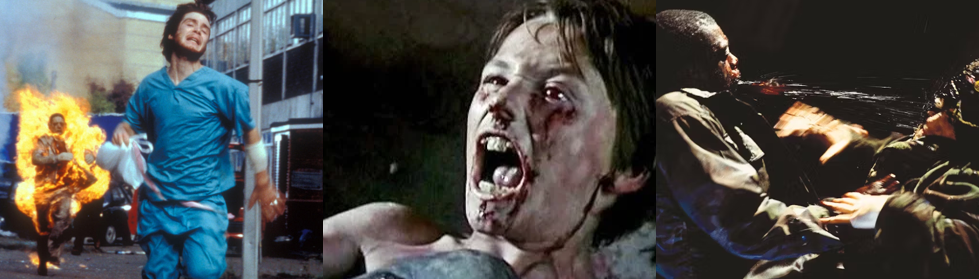
Of course, 28 Days Later isn’t a “zombie” film in the strictest sense but it’s clearly inspired by the genre and absolutely reinvigorated it, popularising fast and aggressive undead (or zombie-like creatures) that endure to this day. You know it’s not a typical zombie film right from the start, however, as 28 Days Later provides an explanation for its events with the vaguely defined Rage virus. This appears to be a man-made pathogen (though it can also be implied to have been inherent to the chimps) that drives the infected into a mindless, ravenous aggression where they attack and devour anyone on site. A bite or even a single drop of blood into a wound or orifice is enough for the Rage to near-instantly take hold, with Selena stating that you have between ten and twenty seconds to kill an infected before they fly into a wild rage, and there’s said to be no cure (largely because the chimps were released before the infection could be properly understood). The infected don’t seem to eat their victims, though they are driven by insatiable hunger and violently vomit blood and guts when starved. Major West is particularly curious about how long it takes the infected to starve and the film’s epilogue, which takes twenty-eight days after the initial twenty-eight days, indicates they need flesh to survive. The infected are extremely aggressive, exhibiting superhuman speed and strength and apparently having enhanced senses, particularly smell and hearing. If you see one, others soon swarm in a ravenous horde, crashing through windows and tearing through barricades in a desperate search for sustenance. Still, they’re easily killed (bullets, landmines, blades, baseball bats, and Molotov cocktails all work extremely well) and won’t return once killed, nor do they need their brains destroyed to be put down, but their sheer numbers and aggression make even one a formidable obstacle.
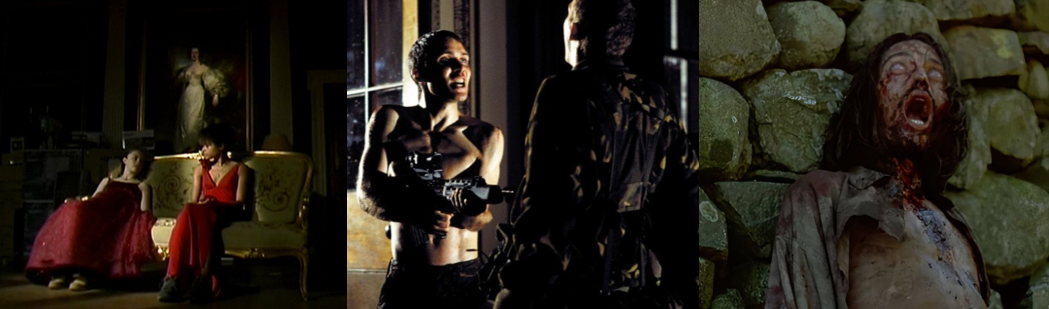
As pressing as the infected are as a threat, they are largely contained to cities and appear only sporadically. Like any good zombie (or zombie-adjacent) film, 28 Days Later is thus more concerned with the threat of human nature than its infected, with Major West and his soldiers posing more of a threat to Jim, Selena, and Hannah than the infected, whom they largely avoid on their road trip. The soldiers easily fend off the external threat but cannot deny their base instincts, relishing the thought of passing around Selena and Hannah and caring more about their sexual lusts than their dwindling numbers. Their overconfidence in their weapons is their greatest weakness as the untrained, scrawny Jim easily picks them off both by himself and by releasing the starving Private Mailer, who easily infects the soldiers and bring down their fort. Though Selena tries to spare Hannah the trauma of being raped by doping her on Valium, her feisty nature is quelled by the lustful Corporal Mitchell, leading Jim to leap to her defence and gouge the soldier’s eyes out in a rage. Selena’s so stunned by Jim’s animalistic behaviour that she almost mistakes him for an infected, yet she hesitates to kill him due to her feelings and is relieved to find he’s simply embraced his killer instinct to save them. As the three escape, however, Major West takes his revenge and shoots Jim, leading Hannah to feed him to his infected soldiers and Selena to desperately save Jim’s life at a nearby hospital. This is also where 28 Days Later falls apart a bit as the ending is so haphazard and nonsensical, with Jim miraculously surviving the gunshot and the three signalling a passing jet for aid. It’s clear that Jim was supposed to die, as in the alternative endings, and this slapdash “happy ending” just doesn’t gel well as a result. It would’ve been far easier to reshoot the scene with Major West to show him missing his shot than pretend like Selena could’ve ever saved Jim from a bullet to the gut.

The Summary:
It’s probably sacrilege to admit this but I’ve never been a fan of 28 Days Later. I find the film quite inconsistent and dull at times, the script is kind of all over the place with inconsistencies and obvious rewrites and changes, and the film loses so much momentum once Major West and his cronies show up. It’s a real shame as it starts so strongly, with Cillian Murphy wandering the eerily deserted streets of London and a palpable sense of dread and confusion presented through the visuals. Murphy does a good job as Jim, starting as a confused and somewhat useless leftover and eventually gaining a killer instinct that almost makes him indistinguishable from the infected. I enjoyed Selena’s no-nonsense portrayal as well, and that we never learn what made her so hardened to the post-apocalypse, and her character arc in learning there’s more to life than just surviving. I liked the surrogate family unit they built with Frank and Hannah, which was obviously doomed to end in tragedy but was far more appealing than having a bunch of dickhead soldiers eat up the screen time. Granted, Christopher Eccleston gave a captivating and chilling performance, standing out as the diamond in the rough, and Major West’s soldiers represented the worst of humanity, but I feel this angle stopped the film dead. There’s something here about the nature of humanity and the juxtaposition of an explicitly monstrous external threat being as dangerous as humanity’s base instincts, but I don’t think it was executed very well. I did like the depiction of the infected as ravenous, hyper aggressive, mindless animals and how quickly they spread the Rage virus. They’re not zombies at all and that’s made very clear, but they’re a significant threat and it’s still chilling seeing the United Kingdom left deserted and in shambles after just a few weeks of exposure. I absolutely consider 28 Days Later an influential film for many reasons and can see why so many like it and so many zombie purists abhorred it, especially back then, but I can’t say that it’s a favourite of mine or a film I’m inspired to watch much. It just feels too haphazard by the end, like there were too many ideas on the table and the simple, startling premise got muddled by rewrites and changes, making it an overall mediocre experience for me to this day.
My Rating:
Pretty Good
Do you think I was too harsh on 28 Days Later? Were you a fan of the more aggressive and faster infected compared to slower zombies? What did you think to the bleak, empty city streets? Do you agree that the pacing and ending were a bit off? Which character was your favourite and did you like how the genre was changed by this film? What is your favourite zombie film and how are you celebrating the Day of the Dead today? Whatever your thoughts on 28 Days Later, and zombie films in general, feel free to leave a comment below, check out my other zombie content, and donate to my Ko-Fi for more.

 Dr. K's Waiting Room
I’ve never seen this movie but I hear a lot of people really like it!
LikeLiked by 1 person
It gets a lot of hype but I’ve always been meh about it
LikeLike