
October 5th is officially recognised as “Global James Bond Day” so I’m dedicating some time to revisiting some firsts in the long-running franchise.


Released: 12 July 1973
Director: Guy Hamilton
Distributor: United Artists
Budget: $7 million
Stars: Roger Moore, Yaphet Kotto, Jane Seymour, Julius W. Harris, and David Hedison
The Plot:
Renowned super spy James Bond/007 (Moore) travels to New Orleans to investigate mob boss Mister Big/Doctor Kananga (Kotto), a drug baron planning to mass distribute his particularly addictive strain of the heroin.
The Background:
MI6 agent James Bond is the creation of writer Ian Fleming and was heavily inspired by his time and experiences as a Navy intelligence officer. The unparalleled James Bond cinematic franchise famously got started with Sean Connery in the lead role before he tired of the part. Although Connery was lured back by a whopping $1.25 million deal, this was a temporary reprieve and suave Roger Moore finally took the role after finishing up with The Saint (1962 to 1969). Loosely based on the 1954 novel of the same name, screenwriter Tom Mankiewicz purposely emphasised the racial undertones of the story, inspired by the Black Panther movement and “Blaxploitation” movies of the era and to include a crocodile farm after spotting one during location scouting. Mankiewicz also worked with Moore to tweak Bond’s characterisation, making him a more light-hearted character, though it took some time for this to solidify. While Mankiewicz wanted signer Diana Ross for Solitaire, the producers cast up-and-comer Jane Seymour, while the late Yaphet Kotto reportedly had issues with the racial clichés of the script and his villain. The production was littered with issues, from Moore’s kidney stones, stuntmen being injured, and many struggling with the live snakes. Live and Let Die’s $161.8 million box office got the franchise back on track after the previous films underperformed, though some criticised Moore’s performance and the more over-the-top elements. Others praised the film’s more innovative moments and its fun chase sequences, though Dr. Kananga has been cited as one of the worst Bond villains and the comedic moments divided some. Still, Moore returned as Bond the following year and finished up with an unprecedented seven-film run as the character, and is often regarded as the best actor to ever portray the legendary super spy.
The Review:
Live and Let Die uses its opening moments to establish that something fishy is going on with Dr. Kananga, the proud and outspoken dictator of the small Caribbean nation of San Monique. Those monitoring him are killed in subtle, yet amusingly theatrical ways, prompting MI6 director “M” (Bernard Lee) to visit Bond at home and send him to New York City to investigate. Our new Bond is introduced in bed with an Italian special agent (Madeline Smith) and, most crucially, in his home, which I don’t believe we’d seen before. Moore’s Bond is a charmer and a little more comedic than his predecessors, dancing around distracting the exasperated M to keep him from spotting the girl. While M had little time for Connery’s antics, he seems visibly aggravated by Bond’s cavalier attitude. This is possibly because “Q” (Desmond Llewelyn) is uncharacteristically absent and elements of his irritated opinion of Bond have been splicing into M, especially apparent by their discussion of Bond’s fancy new magnetic watch. Thanks to a quick intervention from Miss Moneypenny (Lois Maxwell), Bond avoids any repressions and heads to New York to liaise with his Central Intelligence Agency (CIA) counterpart, Felix Leiter (Hedison), who’s been monitoring Dr. Kananga. Despite his cheerful and confident disposition, Bond is caught somewhat unawares when his driver (Joie Chitwood) is murdered at the wheel, but quickly gains control with minimal damage and even providing the registration number of a suspicious pimpmobile. So, right away we can see that Moore is capable and charismatic, greeting every situation with a wry grin and a disarming pun, but also observant and adaptable, using any means necessary to overcome danger.
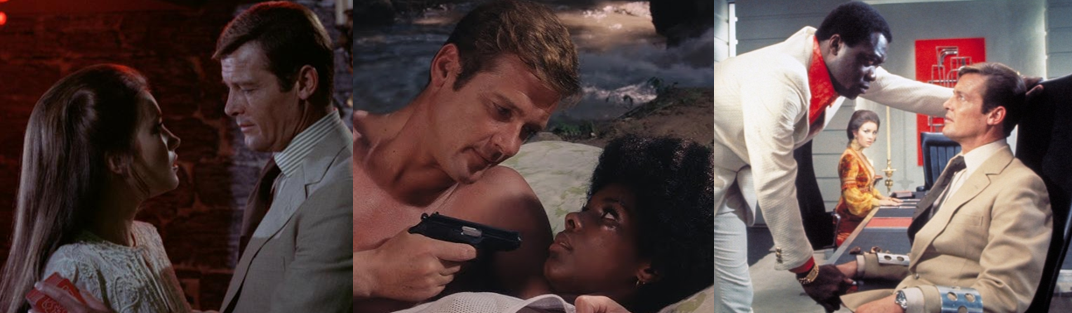
While investigating the pimpmobile, Bond tails Dr. Kananga and his colourful entourage to a “Fillet of Soul” restaurant in downtown Harlem, receiving a suspicious welcome from the predominantly Black clientele and meeting the aggressive and demanding Mr. Big, a strangely deformed mobster who orders his execution. Luckily for Bond, Mr. Big’s henchmen take their sweet time marching him to his death and Bond turns the tables before pondering the situation with Felix and fellow CIA agent Harry Strutter (Lon Satton). Since Dr. Kananga has flown back to San Monique, Bond follows and is again threatened in his bugged bungalow suite, first by a snake and then by a gun-toting assassin who turns out to be fledgling CIA operative Rosie Carver (Gloria Hendry). Though she’s unsure of herself and terrified by local voodoo superstitions popularised by the mysterious, seemingly immortal Baron Samedi (Geoffrey Holder), Bond sweet talks Rosie into bed and onto his side as she’s his only link to investigating one of the MI6 murders. Thanks to a chance encounter with Mr. Big’s medium, the beautiful Solitaire (Seymour), and quickly brushing up on tarot cards, Bond is tipped off about Rosie’s duplicitous nature and his kindly (if somewhat condescending) demeanour turns sour as he threatens her for information. However, when Rosie’s killed to keep her silent, Bond’s forced to use even less gentlemanly means to seduce the naïve Solitaire, easily tricking her by stacking her beloved cards in his favour, only to be frustrated to learn that she knows nothing of Dr. Kananga’s operation and simply gives him readings to help guide his actions. Despite this, Bond clearly sees that Solitaire’s life is in danger now that she’s lost her virginity and her uncanny abilities and promises to protect her. She’s thus with him when he discovers Dr. Kananga’s priceless poppy plantation, one protected by voodoo superstitions and ritualistic killings.
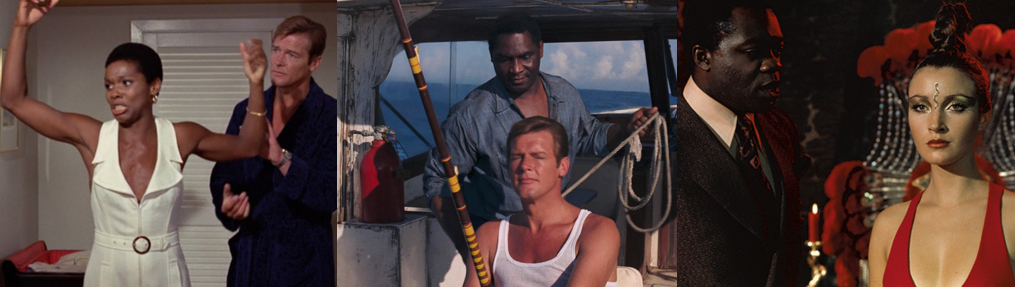
Although almost every Black person in the movie secretly works for Dr. Kananga/Mr. Big as an undercover operative, Bond has a fair bit of backup. Felix freely shares his findings into Dr. Kananga, and conducts damage control when Bond commandeers an aeroplane and traumatises trainee pilot Mrs. Bell (Ruth Kempf). Oddly, Felix doesn’t accompany Bond for his late-night raid of the poppy plantation, instead handing over the weapons and explosives to 007 and stoic sailor Quarrel Jr. (Roy Stewart). Quarrel Jr. provides some backstory to the island but is basically just there to drive the boat so it’s a little odd seeing him sulking around with explosives instead of Felix. Initially, Rosie seems like she’ll be a comedic foil for Bond, a clumsy, untested field agent who succumbs to his charms and grows into her own by the film’s end. However, Rosie’s soon revealed to be working for Dr. Kananga and is quickly offed (which is odd as the bullet could’ve just as easily hit Bond). After escaping from Dr. Kananga’s crocodile farm, Bond annoys Sheriff J.W. Pepper (Clifton James) and the Louisiana State Police, who scramble to chase him and his pursuers as they race around in speedboats, only to be comedically foiled time. Finally, there’s Solitaire, whom Bond is immediately entranced by and wastes no time turning her cards against her by uncovering the “Lovers” card. While Bond seems disturbed by Solitaire’s ramblings regarding the “Gods” and her “powers”, he resolves to protect her, and she willingly goes along with him since she knows Dr. Kananga will kill her once he discovers her gift is gone.
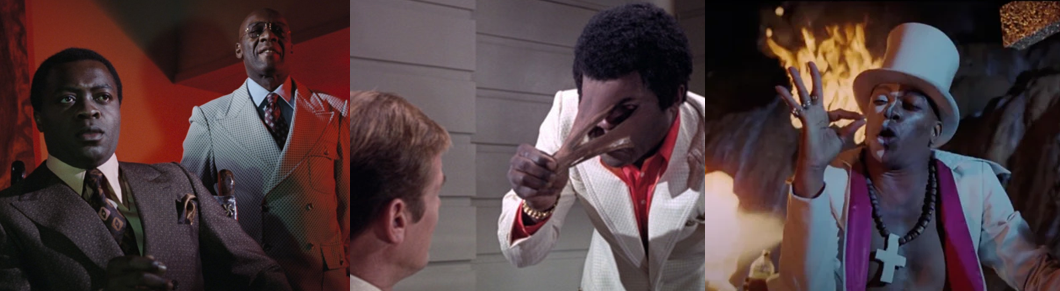
Dr. Kananga is actually two villains in one, since the bombastic president doubles as a mob boss thanks to peculiar disguise, quickly revealing his dual identity to Bond. While Mr. Big is a gruff, severe mob boss, Dr. Kananga is a loquacious and mostly charming psychopath who delights in his plot to distribute his heroin free of charge to ensure his dominance over the drug trade. Dr. Kananga’s actions are guided by Solitaire’s insight, though he’s angered when Bond defies her predictions and laments having to punish her, clearly harbouring an affection for her that leans towards something more sinister as he is both enraged and betrayed to learn she gave herself to Bond and not him. Surrounded by his colourful entourage, Dr. Kananga fosters local superstition to protect his operation and spread fear, relying on the voodoo legend of Samedi to bolster his reputation and the unnerving muscle of the sadistic Tee-Hee Johnson (Harris), a brutish man with an infectious smile and a particularly nasty prosthetic arm. Tee-Hee relishes taunting Bond, bringing him to the crocodile farm to be eaten alive and gladly returning for one last shot at killing 007 in the finale. The soft-spoken Whisper (Earl Jolly Brown) crops up to lure Bond into traps and Dr. Kananga delights in executing his foes in the most theatrical way possible, even leaving Bond’s fate to a shiver of sharks rather than simply shooting him dead.
The Nitty-Gritty:
It’s undeniable that Live and Let Die is “Bond Meets Blaxploitation”. I’m no expert and probably not the best person to comment on how “appropriate” any of this is these days, but it was certainly a style at the time, and it does bring a certain uniqueness to the film. Many characters criticise Bond for wandering around Harlem and into exclusively Black territory, though the only Black characters to give him grief are those working for Mr. Big. Even then, Dr. Kananga’s henchman all have a jive and swagger to them that’s far more visually interesting than most disposable minions, spitting racially charged insults at Bond, sassing the locals, and have an air of confident cool about them that nicely contrasts with Sheriff Pepper’s bluster. I think it’s also important to note that neither Bond or Dr. Kananga exhibits a discriminatory attitude: Bond never comments on anyone’s race, seducing Rosie as eagerly as Solitaire, and Dr. Kananga gleefully makes his product available to everyone. Ironically, he also delivers a stirring tirade calling for his people to rise up and happily encourages superstition if it means deterring outsiders. These voodoo rituals probably veer on the offensive as people writhe about in loincloths carrying snakes and chanting like stereotypical depictions of island “savages”. The supernatural is treated very ambiguously, with Bond believing it a smokescreen but Dr. Kananga trusting Solitaire’s predictions, which are all seen to be true. I’m also at a loss to explain the cackling Baron Samedi, who turns to porcelain when shot and returns from death time and again, with little logical explanation beyond the presence of lifts beneath his gravesites.
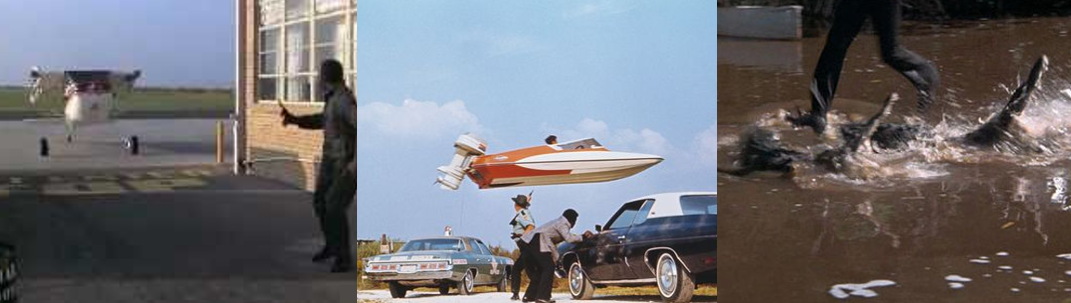
Despite Q’s absence, Bond gets a few memorable and bizarre gadgets. His new wristwatch emits a powerful magnetic force said to be capable of stopping a bullet, but which is simply used to attract a compressed gas pellet (though Bond also uses its buzzsaw function to escape his vines). When scoping out his bungalow, Bond whips out a gadget to detect surveillance bugs then taps at another gadget at the window (though I’ve no idea why) and even uses a hang glider to reach Solitaire’s abode. While he loses his signature Walther PPK thanks to Tee-Hee’s bionic claw, Bond later blasts Dr. Kananga’s henchman with a miniaturised shotgun and proves adept with a speedboat. Sadly, this chase becomes a slapstick farce as the cartoonish Sherriff Pepper repeatedly fails to apprehend his man. This sequence quickly outlives its welcome, depicting Bond and Dr. Kananga’s henchmen blasting across grass, through a wedding, and crashing into a local’s swimming pool. Bond’s escape through Mister Bleeker’s (Stephen Hendrickson) flying school is equally outrageous, with Bond somehow outpacing his pursuers and causing them to crash just by casually driving around a Cessna 140, which the henchmen run despite having a clear shot. On the plus side, there’s very little of that awful rear projection early Bond films were so notorious for and the car chase and crashes are pretty good. I liked how subtly the pimpmobile rolled up and executed Bond’s driver, Bond’s use of an abandoned double decker bus, and the jive cab driver (Arnold Williams) who constantly obstructs Bond’s investigation. Moore’s Bond isn’t much of a fighter, however, and is more apt to walk into elaborate traps and be clobbered from behind Instead, his Bond tries to talk his way out of every situation, or at least distract his captors with dry wit, mocking Tee-Hee’s disability even as he’s at risk of having his finger…and more…severed. Moore’s Bond is extremely adaptable, however, seen to be quick thinking and using his surroundings to his advantage, including an overhead ladder, a makeshift blow torch, and hopping across crocodiles!
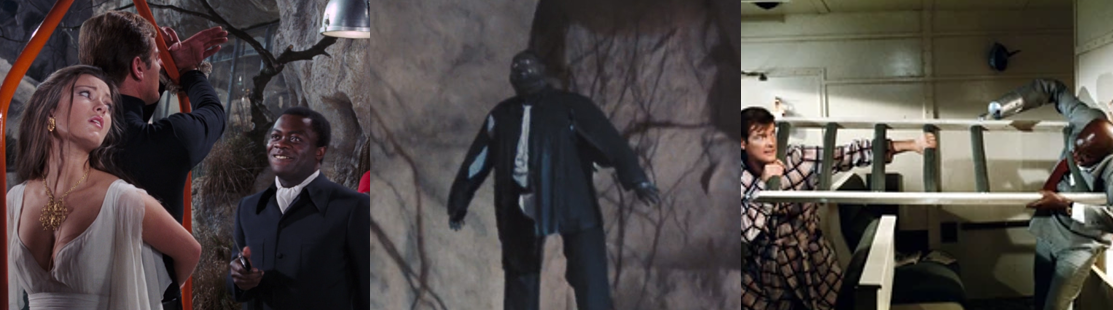
After giving Bond the chance to escape, Solitaire returns to Dr. Kananga but endures his wrath for her betrayal, ending up tied to an altar to be executed in a voodoo ritual. Luckily, Bond and Quarrel Jr. show up to blow up the poppy plantation and Bond rescues Solitaire, seemingly killing Baron Samedi and descending into Dr. Kananga’s surprisingly high-tech underground hideout, which where he monitors his operation and plans to move heroin from the island. Naturally, Dr. Kananga greets Bond and Solitaire as guests and treats them to a drink before disarming them and strapping them to a winch, amused by Bond’s gadgets but even more excited to slice his arms and get his sharks in a frenzy for a fittingly theatrical and bloody execution. Cool as a cucumber, Bond surreptitiously uses his watch to snag one of his compressed gas cannisters and cut his binds, subduing the oafish Whisper and facing Dr. Kananga, who’s practically giddy at the prospect, baiting him and waving a hunting knife in 007’s face. There isn’t much to this fight, however, as Bond easily sidesteps Dr. Kananga and they tumble into the water, where the drug baron panics at the sight of his sharks, allowing Bond to stuff the cannister into his mouth and inflate him like a balloon for perhaps the most comical and ludicrous death of the entire franchise. Bond and Solitaire’s hopes for a long, relaxing train ride back to New York are dashed when Tee-Hee attacks. Despite the brute’s augmented strength, Bond’s wiles again prove the difference maker as he cuts some wires in Tee-Hee’s arm, locking him in place to be easily tossed out the window to his death. Having been bested at cards by Solitaire, Bond prepares to “test an old adage” about being luckier at love, unaware that Baron Samedi inexplicably survived and is laughing like a maniac on the front of the train…

The Summary:
Fun fact: Live and Let Die was the first of what I call the “Classic Bond” movies I watched all the way through and is the reason Roger Moore is my favourite Bond of this era. While Sean Connery was charismatic but cold-blooded and George Lazenby was just a guy pretending to be Bond, Roger Moore is a suave, charming, jovial character who’s all business when he needs to be but would rather disarm his enemies with his quick wit and make up his escape plans on the fly than shoot or fight his way out of situations. Generally, this works pretty well for him and Bond utilises some absolutely comical methods to elude and dispatch Dr. Kananga’s henchmen, but he’s just as apt to be knocked out and placed in an elaborate death trap that requires an equally over the top method to escape. Still, Moore oozes charm and fits nicely into the role, and I liked that he still had a bit of an edge to him but seemingly disliked resorting to violence. Bond’s nicely out of his depth in Harlem and San Monique, seen as a “honky”, sticking out like a sore thumb, and refusing to entertain the local superstitions. While the “Blaxploitation” aspects are probably problematic, I really liked the swagger and theatricality given to Dr. Kananga and his underlings as it made them more lively and enjoyable to watch than the usual stone-faced Russians. Jane Seymour is easily one of the most gorgeous of the Bond Girls and delivers a suitably alluring, almost childlike performance and I really enjoyed Julius W. Harris as Tee-Hee, how he relished each encounter with Bond, and continue to be fascinated by the theatrical Baron Samedi. As much as I love Yaphet Kotto, however, Dr. Kananga is a strange villain who constantly flip-flops between being sinister, aggrieved, and insane, being just as likely to delight in conversing with Bond as he is to lash out in anger. His death was ludicrous even for this film, which largely ruins every action sequence with slapstick buffoonery and cartoonish supporting characters. While I think Moore acquitted himself well in Live or Let Die, the overall plot and most of the execution is somewhat questionable, despite the jive cool that permeates the film, making this one of his more forgettable outings as the suave super spy.
My Rating:
Pretty Good
Did you enjoy Roger Moore’s debut as 007 in Live and Let Die? How do you think he compared to his predecessors? Do you find the “Blaxploitation” angle problematic? Would you agree that Dr. Kananga has one of the worst deaths in the franchise? Do you think there is a supernatural element present in this film? Which Bond actor, film, story, villain, or moment is your favourite? How are you celebrating James Bond this October? Whatever you think about Live and Let Die, leave a comment below, check out my other 007 content, and donate to my Ko-Fi to suggest other Bond movies for me to review.

 Dr. K's Waiting Room
One thought on “Movie Night [00-Heaven]: Live and Let Die”