
To celebrate the release of this movie, the first of many filmic outings for James Bond, October 5th is officially recognised as “Global James Bond Day”. Today, 007 is one of the most recognised and popular movie icons of all time so I’m dedicating some time to revisiting some firsts in the long-running franchise.


Released: 5 October 1962
Director: Terence Young
Distributor: United Artists
Budget: $1.1 million
Stars: Sean Connery, Joseph Wiseman, Jack Lord, John Kitzmiller, and Ursula Andress
The Plot:
After an MI6 liaison is murdered in Jamaica, suave spy James Bond/007 (Connery) discovers a plot by malformed mad scientist Doctor Julius No (Wiseman) to disrupt an American rocket on behalf of the Special Executive for Counter-intelligence, Terrorism, Revenge and Extortion (SPECTRE).
The Background:
Super spy James Bond was the brainchild of writer Ian Fleming in 1953, heavily inspired by Fleming’s years as a Navy intelligence officer. 007 first came to life not through Sean Connery’s immortal and iconic performance or even the bizarre comedy loosely based on Fleming’s first Bond book, but a one-hour CBS television adaptation of that same book that was heavily altered for American audiences. Bond was next adapted into a South African radio drama in 1958 and Fleming’s books became a long-running series of comic strips starting in 1957, before Casino Royale (1953) finally came to the big screen in 1967 after years of Development Hell and rights disputes. Though initially reluctant, Fleming eventually sold the rights to all his Bond novels (except Casino Royale and, most infamously, 1961’s Thunderball) to producer Harry Saltzman. Saltzman partnered with Albert R. “Cubby” Broccoli to spearhead an adaptation of the 1958 novel of the same name, bringing in director Terence Young to define the onscreen portrayal of the super spy for decades to come. Though hampered by a paltry budget, Young chose to innovate and spend what little money had had wisely, while the script included many alterations from the source material, including painting Dr. No as an agent of SPECTRE. While the producers initially envisioned Cary Grant as Bond, Richard Johnson claimed to have been tapped for the role, and Rod Taylor rejected the pitch, former bodybuilder Sean Connery impressed with his devil-may-care attitude and cemented his career (for better or worse) with his now-iconic performance. Although Dr. No received a mixed reaction at the time, it proved a box office success that kick-started a cinematic franchise, with each subsequent film out-performing the last at the box office. In the years since its release, Dr. No has been critically re-evaluated in a more positive light, with the film named as one of the top 100 British films of all time and praised for delivering some of the most memorable moments in the series.
The Review:
I think it’s only fair to start off by admitting that I’ve never been a fan of Dr. No. While it’s easy to explain away a lot of its flaws by pointing to the era it was made and it being the first of a series, so many of the recognisable Bond elements hadn’t been refined yet (even if they make their debut here), I’ve just never been a fan of the pacing and plot. Indeed, one thing I often joke about is that, even now, I don’t really know what Dr. No is about or what the titular mad scientist is after. Therefore, I went into this viewing really trying to pay attention and grasp what the plot was and what was happening. Surprisingly, Dr. No’s stakes are surprisingly low; the world isn’t at stake here. In fact, no nations, cities, or lives seem to be at risk at all, save those who venture to Dr. No’s private island, Crab Key, uninvited or those who stand in his way. The film’s events kick off when John Strangways (Timothy Moxon/Robert Rietti), a keen fisherman, poker player, and head of MI6’s Kingston station, and his secretary, Mary Trueblood (Dolores Keator), are murdered by, of all things, three assassins posing as blind beggars. After a few hours trying to re-establish contact with Strangways, the cantankerous and officious head of MI6, “M” (Bernard Lee), pulls Bond from a game of Baccarat and orders him to find out what happened, advising him to liaise with his Central Intelligence Agency (C.I.A.) counterpart, Felix Leiter (Lord), and to not waste any time. Though Bond happily takes the assignment, he drags his feet a little by flirting with M’s secretary, Miss Moneypenny (Lois Maxwell), and hooking up with the alluring Sylvia Trench (Eunice Gayson), firmly establishing that, while Bond is loyal to King and Country, he’s got a soft (well, more accurately a hard) spot for the ladies and the finer things in life, such as a good smoke and a stiff drink.
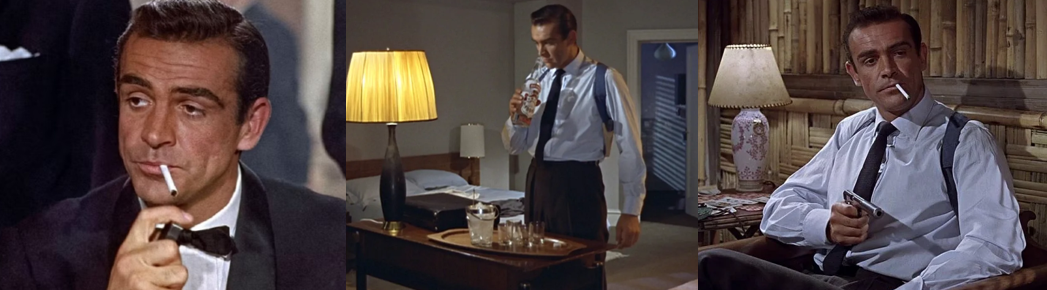
Sean Connery immediately embodies the now-world famous super spy with a relaxed, confident poise and charm. He greets every situation, even admonishments from M, with a wry smile and a biting wit, seemingly fearless and maintaining his composure even when he’s being followed or clearly duped by enemy agents. While this is Bond’s first screen outing, it’s clearly not his first assignment as he’s been licensed to kill for some time (though M’s dialogue suggests Bond may only be a year or so into this career as a 00 agent) and is generally hyper aware of his surroundings. Even when he’s welcomed by Chief Secretary Pleydell-Smith (Louis Blaazer) and given lodgings at Government House, Bond checks for bugs and preps his room to alert him to intruders. Unlike later Bond movies, 007 is rather ill-equipped; Major Boothroyd (Peter Burton) simply furnishes him with the standard issue Walther PPK in place of his unreliable Beretta M1934 and that’s it. Not that Bond really needs any gadgets here, just a rental car and a working telephone suffice for most of the film. Bond’s first official big screen adventure is much more of an investigative thriller than anything else. Bond wanders about Kingston meeting with those who knew or saw Strangways last, piecing together what happened, knocking back vodka martinis (“Shaken, not stirred”) and other vices as he goes. After a brief misunderstanding, Bond meets with Leiter, visits a few more locations, and eventually suspects Professor R. J. Dent (Anthony Dawson), a geologist and one of the last people to see Strangways alive. Bond’s investigation alerts him to Crab Key, a forbidden island owned by the mysterious Dr. No, which Strangways regularly visited. It’s all very mundane and dull, sadly, with only Connery’s magnetic screen presence holding my interest as Bond simply stumbles upon breadcrumbs to discover that Dr. No obviously had something to do with Strangways disappearing.
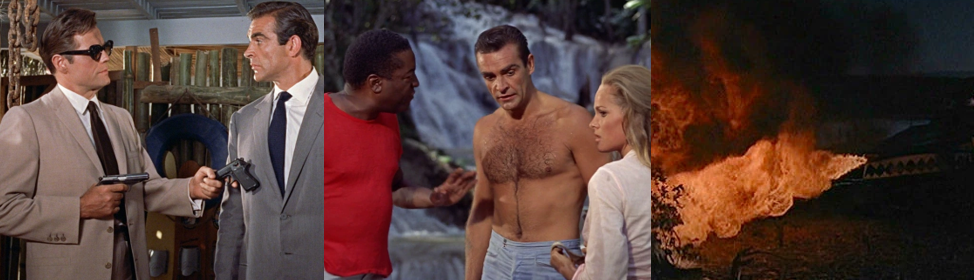
Bond’s eventually aided by Leiter, though Felix at first suspects 007 of being corrupt since Bond willingly allows obvious enemy plants to drive him around and lure him into bed. Bond does this in hopes of questioning and/or boning said agents, though his investigation is often frustrated since many of his would-be assassins choose death by cyanide over talking. Leiter reveals that he worked closely with Strangways to discover the source of a radio jamming signal that has been disrupting America’s space exploration rockets. Leiter’s also instrumental in cooling tensions between Bond and Quarrel (Kitzmiller), a Cayman Islander whose boat Strangways took to Crab Key and collect samples. Initially giving Bond the brushoff, Quarrel confronts him and knifepoint and the two scuffle until Leiter intervenes and they all get on the same page. While Leiter isn’t that interesting, simply being a friendly face to give Bond some intel and call out his womanising ways, Quarrel is quite an enjoyable addition, being an upbeat and friendly seaman who affectionately calls Bond “Cap’n”. Rather than rely on sea chats or coordinates, Quarrel follows his instincts but is extremely hesitant to go to Crab Key due to rumours of a fire-breathing “dragon” dwelling there. While Bond initially gives Quarrel the option of staying behind, his patience with these stories grows thin, especially when they bump into the beautiful Honey Ryder (Andress) and she echoes Quarrel’s fears. Still, Quarrel proves useful to Bond’s investigation and subdues Annabel Chung (Marguerite LeWars) when she spies on the trio. Bond seems genuinely distraught when Quarrel meets his horrifying (and ridiculously abrupt) end at the hands of Dr. No’s “dragon” (an armoured tank with a flamethrower) and adds the seaman’s name to the list of people he wishes to avenge.
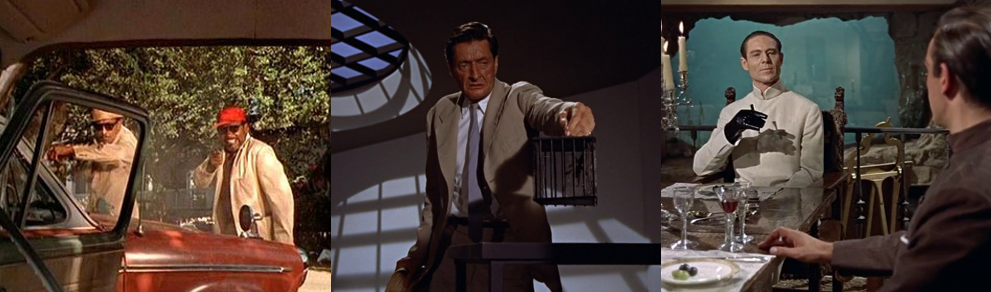
As if Dr. No wasn’t disappointing enough, the titular scientist is quite a letdown as well. Like Honey, Dr. No doesn’t fully appear until the final act, which is pretty incredible considering his unique affliction and his admittedly captivating screen presence. While I appreciate the fear and awe given to Dr. No throughout the film, with the locals scared of Crab Key and Dent terrified of his master’s reprisals, I think the film suffers from not including him at least once before Bond reaches Crab Key. A mysterious and isolated figure, Dr. No initially appears as a disembodied voice reprimanding Dent and ordering him to kill Bond using a tarantula (an effective means, to be sure!) Dr. No has agents all over Kingston, it seems, with him sending a driver (Reginald Carter) to try and kill Bond soon after he lands, placing Miss Taro (Zena Marshall) as a double agent, and employing some goons to try and run Bond off the road. Despite Dr. No voicing an explicit desire to have Bond killed, he does a complete 180 once Bond arrives on Crab Key. His loyal soldiers give Bond, Quarrel, and Honey multiple chances to surrender peaceful and end up roasting Quarrel alive when they disobey, but Dr. No treats Bond and Honey as distinguished guests and has them decontaminated and confined to a room that’s more deluxe suite than a dungeon. Dr. No is impressed by Bond’s repeated interference (even though I’m not sure what Bond did to cost him time and money…) and believes him an intellectual equal, only to be angered by Bond’s dismissive and condescending attitude. Although Dr. No claims his genius is as formidable as his physical strength thanks to his painfully limited artificial hands, he’s clearly a madman. So much so that neither the East or the West wished to employ his services and even SPECTRE seems somewhat embarrassed by him. This could be because Dr. No uses his vast and overly complicated nuclear-powered facility to disrupt Cape Canaveral simply for his own self-gratification as he issues no threats and demands no ransom, seemingly embodying only the “Revenge” aspect of SPECTRE as he wishes to prove himself superior to those who mocked and dismissed him.
The Nitty-Gritty:
Dr. No is obviously the blueprint which all future Bond movies were based, establishing many of the tropes, elements, and recurring themes for the series. Accordingly, we get out first gun barrel sequence (with stuntman Bob Simmons as Bond), first utterance of “Bond… James Bond”, and our first title sequence (though there’s no cold open here). Unfortunately, Dr. No fails to impress with its opening titles, which are simply a mess of colours, dancing girls, and “007” plastered over the screen while Monty Norman’s “James Bond Theme” blares. Bond’s iconic overture oddly crops up when he’s doing such exciting tasks as… walking, searching his room, or using the telephone. Rather than have an artist or group write a unique song for the film as would later become a key component of the franchise, Dr. No repeatedly falls back on renditions of “Under the Mango Tree”, a tune I’d happily never have to listen to again after sitting through this snore fest. The basic frameworks of future Bond films are established here, however, meaning it’s perfectly natural for M to simply show up to give Bond his mission and Miss Moneypenny to give Bond someone to flirt with in MI6 headquarters. Long-time Bond fans may be surprised that Desmond Llewelyn isn’t playing “Q” here (though Major Boothroyd is the same character). Consequently, there’s no visit to Q-Branch, no Aston Martin, and Bond’s even light on the quips, only dropping a couple of deadpan comments after outwitting his would-be assassins. Bond is a largely apathetic character, seemingly bored with the routine aspects of his job and preferring to be in the field, where he does his own thing regardless of his orders. This sees him getting a dressing down for carrying a Berretta and taking many detours in his investigation to get his end away or have a drink or smoke. Indeed, both M and Leiter comment on Bond’s lackadaisical attitude, though his methods always return to his primary mission one way or another.
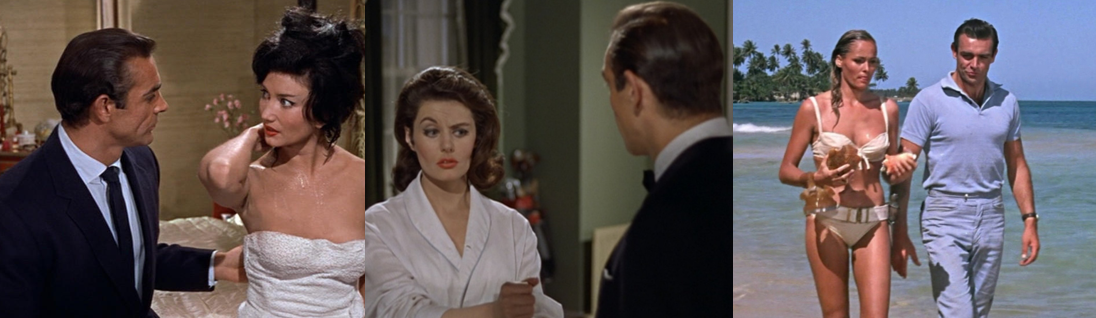
Despite getting second billing alongside Sean Connery, Ursula Andress only appears in the third act and has such a small role that it’s barely worth discussing. Of course, she makes a lasting impression on both audiences and Bond with her dramatic emergence from the sea, clad in a sultry bikini and inspecting her coveted seashells, but it might’ve been nice to include her a bit sooner to break up the monotony of watching Bond mingle around rooms. Though initially appearing naïve and almost childlike in her demeanour, Honey’s actually a well-travelled young lady, an accomplished diver, and has experienced by heartache (she believes Dr. No murdered her father) and strife. As a child, she was sexually assaulted (or possibly raped) and took her revenge by killing her attacker with a black widow spider (though oddly reacts in horror when Bond offs one of Dr. No’s henchmen). Still, she plays basically no role in the finale, with Bond successfully convincing Dr. No to send her away for their parlay and is simply there to have a pretty face onscreen at the tail end of the film. She’s nice on the eyes, for sure, and somewhat aids Bond with her familiarity with Crab Key, but her demeanour is a bit odd and it’s difficult to really care that much about her since she appears so late in the film. Similarly, while Sylvia gets a lot of play at the start of the film, she’s simply an attractive Baccarat player Bond seduces with his card game rather than an undercover SPECTRE agent like Miss Taro, Pleydell-Smith’s secretary. Indeed, it’s possible Sylvia and Taro would’ve been combined into one character in a later Bond film (and, truthfully, that would’ve made more sense here) to give Bond a tertiary threat while playing detective. Though she acts coy about listening into Bond’s meeting and the conveniently missing files on Dr. No, Miss Taro tries to lure Bond into a trap and then uses her body to distract him, only for him to effortlessly see through her ruse and simply use her for his own gratification (and to lure Dent into outing himself as another of Dr. No’s agents).
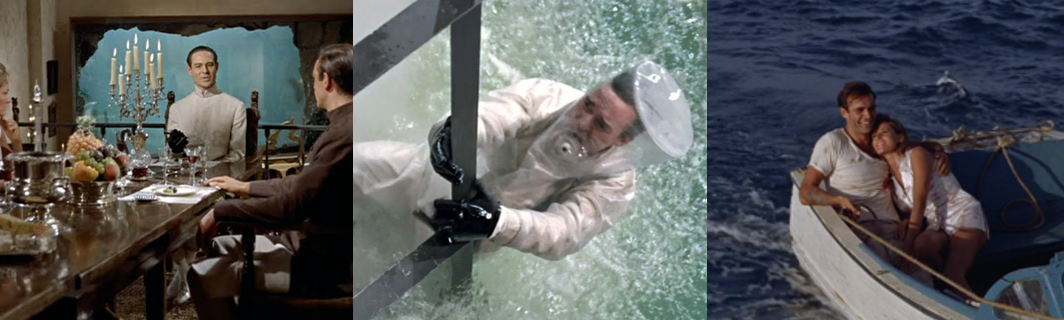
After knobbing around Kingston for a few days, dodging death every other night and following leads on Strangways, Bond becomes very suspicious of Crab Key and its mysterious Dr. No. After using Miss Taro and easily fooling Dent, Bond decides he has enough evidence to visit Crab Key, convincing Quarrel to give him a lift and having Leiter on standby with the Marines. After Quarrel’s killed, Bond and Honey are welcomed as Dr. No’s distinguished guests, furnished with a luxurious room, drugged coffee, and a fine dinner. Dr. No’s patience and reverence for Bond quickly grows thin when 007 insults him and refuses to join SPECTRE, however, leading to Bond being beaten and tossed into a cell. Despite the electrified grate, and his injuries, Bond easily escapes through the facility’s massive ventilation shafts, kills one of Dr. No’s technicians (Anthony Chinn), and assumes his role in the control room. There, himself and his underlings protected from the radiation that cost him his hands, Dr. No directs a test on his nuclear reactor, apparently to disrupt America’s latest rocket launch. Despite his genius, Dr. No’s so distracted by his monitors that he fails to notice Bond overloading the reactor until its too late. With the facility in meltdown and his minions fleeing for their lives, Dr. No awkwardly confronts Bond on the gantry. Rather than treating us to a slugfest where the underdog 007 must use his wit and wiles to compensate for the crushing power of Dr. No’s prosthetic hands as the environment goes up in flames around them, this final battle is merely a clumsy scuffle on a small platform descending into a cool pool and Dr. No’s superior strength fails him as his crappy plastic hands can’t grip for shit. With everyone more concerned with escaping, Bond easily convinces Dr. No’s panicked employees to point him in Honey’s direction, and he rescues her from…being slowly drowned, I guess? The two then commandeer a convenient boat and drift away from Crab Key just as Dr. No’s facility explodes, ending whatever vague threat he posed. Though Leiter comes by to tug the two to safety, Bond opts to release his line so he and Honey can canoodle in their boat during the credits.

The Summary:
I was honestly dreading watching Dr. No again as, like I say, I’ve never been a fan of it. I want to respect it for laying the foundation for one of my favourite cinematic franchises, and that (alongside Sean Connery’s magnetic performance) is what gives it its second star, but this is always a tough watch for me. There’s so much working against it, from the dull opening titles, the Bond theme blaring in the most mundane scenes, and the dull focus on Bond’s investigation rather than action, women, or suspense. I understand that this was a different time and there was only so much the filmmakers could do (painfully obvious during Bond’s big car chase…), and that Dr. No is more of an investigative thriller than a bombastic action movie, but my lord is this painfully slow to watch. Bond meanders from scene to scene, easily piecing together clues when you’d think Dr. No would want to cover his tracks, and happy to waste his time bedding and toying with Dr. No’s obvious agents rather than getting to business. Dr. No is painfully absent throughout, meaning his motivations and character are poorly developed, to say the least. SPECTRE is little more than a name drop, Dr. No is simply a maniacal cripple childishly lashing out at a world that rejected him, and his plan is painfully ill defined. I still have no idea what the stakes are or why I should care about Dr. No’s plot when he makes no demands and seems to just be messing with America for shits and giggles, and we’re even robbed of him matching wits (and brawn) with Bond since Dr. No prefers to let his underlings or spiders do the work rather than just bloody shoot him! Ursula Andress may be gorgeous and have captivated a generation, but Honey Ryder shows up far too late to be that interesting. Had she been featured throughout, or perhaps been Dr. No’s unwilling concubine, then maybe I would care but, as is, she’s just kind of there. Sean Connery, Joseph Wiseman, and John Kitzmiller are the stars of this show but even they can’t keep me from tuning out every time I watch Dr. No and I’m honestly surprised we got a Bond franchise after this tedious slog of a movie.
My Rating:
Could Be Better
Am I being too harsh on Dr. No? Where would you rank it against the other James Bond films? Were you impressed by Sean Connery’s first outing as 007? What did you think to the focus on his investigation and the film’s slower pace? Do you agree that Dr. No and Honey Ryder should’ve shown up sooner? Were you disappointed when Quarrel got roasted? Can you tell me what Dr. No’s plan was, because I still don’t know… Which Bond actor, film, story, villain, or moment is your favourite? How are you celebrating Global James Bond Day today? Whatever your thoughts on Dr. No, or James Bond in general, leave a comment below, check out my other James Bond reviews, and suggest some 007 content you’d like me to cover by donating to my Ko-Fi.

 Dr. K's Waiting Room
One thought on “Movie Night [00-Heaven]: Dr. No”