Back Issues [Thor’s Day]: The Mighty Thor #337-339


In August 1962, Stan Lee, Larry Lieber, and Jack Kirby debuted Thor Odinson, God of Thunder and cosmic adventurer, who became another of Marvel’s most successful and versatile characters. As today the first Thursday (or “Thor’s Day”) of the month, this is the perfect time to celebrate the God of Thunder!

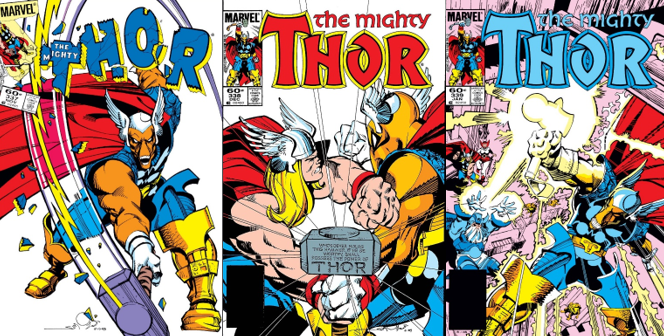
Writer and Artist: Walter “Walt” Simonson

Story Title: “Doom”
Published: 2 August 1983 (cover-dated: November 1983)

Story Title: “A Fool and His Hammer…”
Published: 30 August 1983 (cover-dated December 1983)

Story Title: “Something Old, Something New…”
Published: 4 October 1983 (cover-dated: January 1984)

The Background:
After debuting Doctor Robert Bruce Banner/The Incredible Hulk, legendary Marvel Comics writer, editor, and creator Stan Lee took inspiration from Norse legends to create an even more powerful superhero. Working alongside his brother, Larry Lieber, and the immortal Jack Kirby, Marvel Comics introduced a new version of the Norse God Thor Odinson, who claimed ownership of Journey into Mystery before replacing it with his own self-titled comic in 1970. Thor was a founding member of Marvel’s premier super team, the Avengers, regularly clashed with his adopted brother, Loki Laufeyson, and was even transformed into a frog! In 1983, writer and artist Walt Simonson sought to shake up The Mighty Thor by introducing a new, alien character, Beta Ray Bill the Korbinite, who, despite his monstrous appearance, would not only be eloquent and heroic, but also worthy of lifting Thor’s enchanted hammer, Mjölnir. After clashing with Thor in his three-issue debut, Beta Ray Bill gained an enchanted weapon of his own, Stormbreaker, and operated as a cosmic superhero, battling the likes of Surtur and the mythical “Great Beasts” and even driving the mighty Galactus to the brink of starvation. Though a largely obscure character amidst Marvel’s heavy hitters, Beta Ray Bill has a strong cult  following, headlined a few self-titled comics, and has often appeared in videogames as a skin for Thor. Beta Ray Bill has also appeared in a few Marvel cartoons, with The Avengers: Earth’s Mightiest Heroes (2010 to 2012) loosely adapting his debut, though he was cut from an early draft of Thor: Ragnarok (Waititi, 2017).

The Review:
The ballad of Beta Ray Bill begins with the destruction of a faraway galaxy, which leaves behind a chunk of “molten ingot of star-stuff” that’s grasped by a leering, titanic cosmic being wielding an equally massive pair of tongs. The impact of the star-stuff being smashed against a gigantic anvil reverberates across “a billion billion worlds”, though they’re buried beneath the sounds of Grant Park, Chicago, where Doctor Donald Blake, alter ego of the Mighty Thor, is taking a stroll. Somewhat envious of humanity’s carefree nature, Dr. Blake ruminates on how blessed he is to be amongst mortals when he’s suddenly abducted by Colonel Nick Fury of the Supreme Headquarters, International Espionage and Law-Enforcement Division (S.H.I.E.L.D.) Demonstrating knowledge of Dr. Blake’s dual identity, Fury flies the two to the strangely phallic looking S.H.I.E.L.D. Helicarrier so Agent Jasper Sitwell can fill him in one their current crisis. Agent Sitwell explains to Thor that S.H.I.E.L.D. developed a hyper-advanced probe to transmit pictures of the cosmos back to Earth and discovered an alien vessel destroying an entire star to refuel its engines. Concerned about a potential threat, Fury requests Thor check out the ship and, curious himself, the God of Thunder agrees. While Lady Sif seeks a great battle to ease Thor choosing “Midgard” over her, Balder Odinson drowns his sorrows, and Volstagg hopes to dine with better company, Loki’s abject boredom is suddenly broken by the arrival of the alluring Lorelei, whose very words send Asgard’s warriors fleeing and whose presence intrigues the God of Mischief. When the story jumps back to Thor, he arrives at the alien vessel’s location courtesy of Mjölnir, Thor presses his pursuit, only to be repeatedly blasted by the ship’s energy cannons.
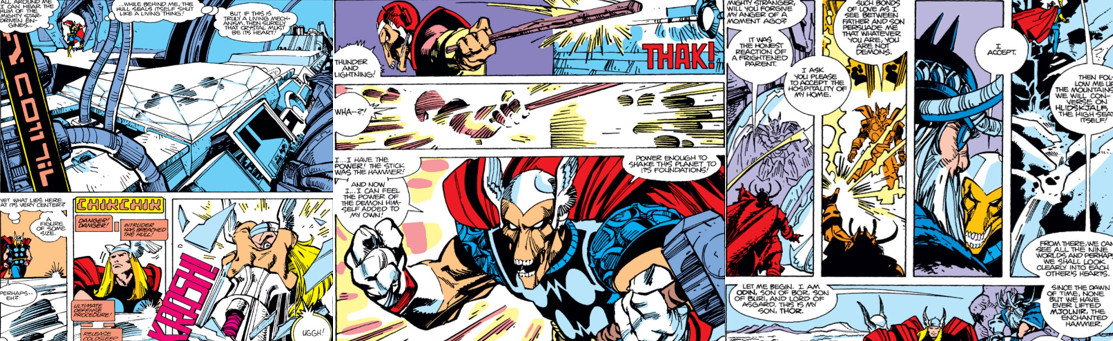
Thor’s power is usurped by the cybernetic alien Beta Ray Bill, who’s determined to protect his people.

Angered, Thor rips into the ship and is attacking by a monstrous, horse-faced brute who’s the subject of this review. Impressed by Thor’s strength, the imposing cyborg nonetheless attacks, determined to stamp out “all of demonkind” and confusing Thor, since the warrior has clearly mistaken him for some other “breed”. Regardless, Thor matches Beta Ray Bill blow for blow but, in his warrior rage, he forgets his hammer and, having been separated from Mjölnir for too long, magically and forcibly reverts back to his human form! This allows Beta Ray Bill to easily knock the stunned Avenger out, however the damage causes his ship to crash land on Earth. When Nick Fury and S.H.I.E.L.D. surround the ship and try to negotiate, the prideful Beta Ray Bill desperately searches for his foe’s powerful weapon. When he finds only a wooden stick, the cyborg lashes out in anger but is amazed to be imbued with the power of Thor! Suitably empowered, Beta Ray Bill attacks Fury’s forces and revels in his newfound might, only for Odin Allfather to suddenly appear and, mistaking Beta Ray Bill for his son, spirit him to Asgard, leaving Dr. Blake stranded and “forsaken” on Earth! Despondent and heartbroken, Dr. Blake is comforted by Fury, while Beta Ray Bill angrily and blindly lashes out at the Asgardians as they celebrate “Thor’s” return, believing them to be demons. Naturally, Odin immediately realises something’s amiss and demands answers so Beta Ray Bill, ever the hothead, immediately and arrogantly attacks. Odin easily reclaims Mjölnir and finds truth in Beta Ray Bill’s claims that he won the hammer “in combat”. Odin immediately sets to put things right and summons Dr. Blake to Asgard, where he becomes Thor once more, and then apologises to Beta Ray Bill and offers him sanctuary. Wary, Beta Ray Bill demands that the Asgardians prove they’re not demons before he relaxes his guard, so Odin takes the two to the frigid summit of Hliðskjálf to parlay.
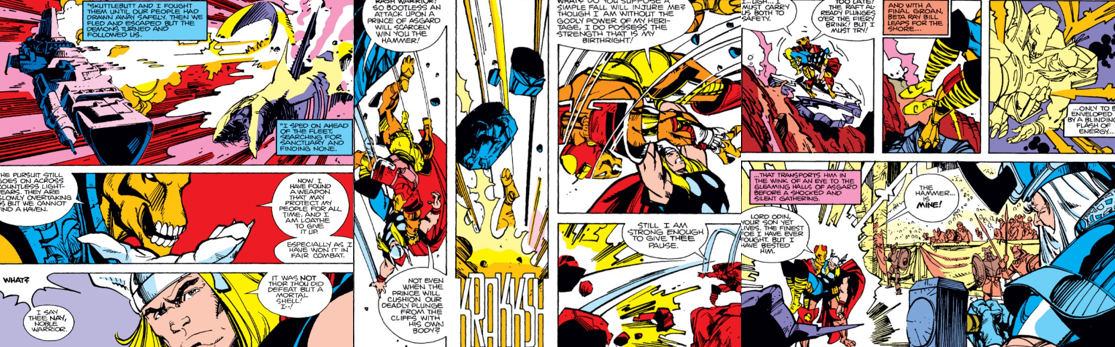
Beta Ray Bill bests Thor in a fight to the death and lays claim to Mjölnir.

While Loki and Lorelei use their illusions to anger Lady Sif and make her think Thor is cheating on her, Beta Ray Bill tells his story to Odin and his son. Claiming to come from an “ancient and noble race”, Beta Ray Bill tells how his once prosperous people were all-but destroyed when the core of their galaxy suddenly exploded. The survivors fled in spacecrafts and Beta Ray Bill was chosen to be genetically and cybernetically altered into their protector. While leading his people in his warship, the Skuttlebutt, as they slept in cryogenic chambers, Beta Ray Bill was suddenly attacked by destructive demons, whom he’s been pursuing ever since. Determined to use Mjölnir to destroy the demons and safeguard his people, Beta Ray Bill refuses to give up the hammer. Since both his son and the cyborg have valid claims to it, Odin orders them to face each other in equal combat, with the victor claiming the prize and aiding Asgard in battling the demonic horde. Thus, Odin transports the two to Skartheim, a barren and dangerous landscape, for their fight. Beta Ray Bill attacks while Thor searches for more stable ground and the two grapple and exchange blows with equal might and bluster. Impressed by his foe’s strength and conviction, Thor doubles his efforts, unaware that Beta Ray Bill feels the same awe and respect for his opponent. Striking while Thor’s readying his next attack, Beta Ray Bill hurls boulders at the Avenger, one of which Thor tosses back to bring Beta Ray Bill close to a horrific fall into lava. However, when Thor flies in to press his attack, the two warriors collapse from exhaustion. Beta Ray Bill recovers first and, seeing his foe is still unconscious and heading to a nasty end, flies Thor to safety and returns to Asgard victorious!
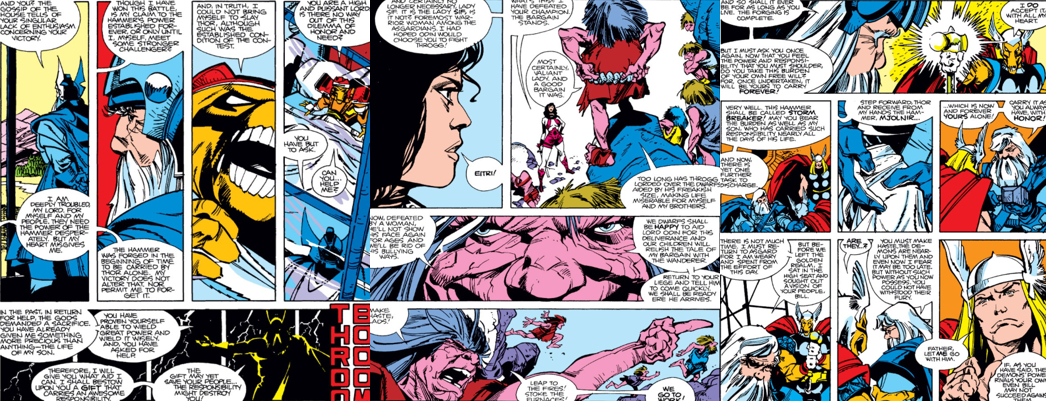
Odin arranges events to gift Beta Ray Bill with his own weapon so he can fight alongside Thor.

When Beta Ray Bill collapses immediately after, Odin has the two brought to the Royal physicians, where the disgusted Lorelei keeps a close eye on them during their recovery, clashing with Lady Sif in the process. Feeling he’s disgraced his father, Thor denounces his Godhood and believes he’s no longer worthy of Mjölnir, while a grateful and concerned Beta Ray Bill worries that he may lose the hammer’s power, as Thor did, and begs Odin to help with his dilemma. Impressed by the bionic warrior’s conviction, Odin travels to the tranquil realm of the dwarfs, Niðavellir, to ask the surly Dwarf King Eitri for a favour. Despite his race being shunned by the Gods, Eitri agrees on the condition that Odin provide their champion with a woman to either best him in combat or “serve as his chattel”. While Thor commends Beta Ray Bill’s victory and wishes him well as Mjölnir’s wielder, determined to forsake his former life, the cyborg humbly points out that his victories have largely been luck. Their conversation is interrupted when Thor spots Lady Sif battling the dwarves champion, the hulking Throgg, as requested by the Allfather. Lady Sif deals first blood to her foe and knocks him unconscious, choosing to spare her grotesque foe the sharp edge of her blade. Eitri reveals that Throgg was a menace who’s now been suitably humiliated, but honours his bargain and commands his people to light the incredible furnaces of Niðavellir, moulding Uru, the material of the Gods, into a mighty battleaxe – dubbed Stormbreaker – that Odin enchants so that its mighty powers will belong to Beta Ray Bill alone. Thus, the cyborg claims his prize, and his power, and vows to wield it proudly. Odin then returns Mjölnir to his son and, learning of the demons’ pending approach upon Beta Ray Bill’s slumbering people, Thor leaps aboard his enchanted chariot, alongside Lady Sif, to meet the threat with his newfound ally.

The Summary:
I’ve always been fascinated by Beta Ray Bill, a monstrous and unlikely wielder of Thor’s magical hammer, and the implications his character has on Thor’s mythos. Until Beta Ray Bill, Thor was a person, not a mantle or a title, despite what the hammer’s enchantment said, with even Thor’s human form being the same personality, just as a mortal to keep him humble. Suddenly, the enchantment wasn’t just a threat to Thor’s ability to command thunder and lightning, it was a promise that any “worthy” champion would essentially become Thor, which opened the floodgates for future stories. While the art is a bit janky at times, this story was very bold and cosmic in its scope, with the narrative punctuated by some unknown, titanic figure forging a massive sword that apparently speaks to a looming threat. There’s also a side plot concerning Lady Sif’s desire to prove herself worthy of Thor’s attention in battle, which actually feeds into the finale when she readily faces Throgg and then insists on accompanying Thor and Beta Ray Bill to battle the demons. The secondary sub-plot concerning Loki and Lorelei’s efforts to discredit Thor was interesting, and clearly sowing the seeds for a future story, but somewhat took away from the battles between Thor and Beta Ray Bill, limiting them to tests of physical strength and dramatic claims by our unseen narrator. I enjoyed the portrayal of Thor here, who starts out so proud and happy to be this all-powerful warrior and then feels so humbled by his losses that he’s ready to give up Mjölnir, only to still be deemed worthy by his father. It’s interesting as it speaks to Thor’s brief wish to be relieved of his responsibilities, and even Beta Ray Bill tries to talk him out of so readily giving up his awesome power, as much as the bionic warrior needs it to protect his people.
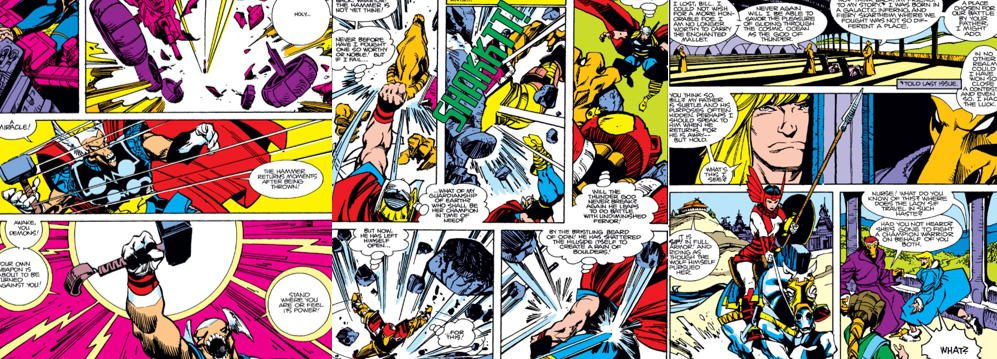
An action-packed and thought-provoking debut for an interesting, if grotesque, new hero.

Naturally, Beta Ray Bill is the standout character in these issues. I would’ve loved to see a bit more time and effort spent fleshing out what, exactly, the “demons” are that threaten his people, but it’s enough to know that he’s desperate to protect what’s left of his civilisation from a very real theat. So much so that he willingly allowed himself to be altered, even gene spliced with his people’s most deadly predator and augmented with cybernetics, to serve as their protector. This single-minded need somewhat blinds Beta Ray Bill, leading to him to attack Thor on sight and even lashing out at Odin before he’s convinced that the Asgardians aren’t demons. Despite his horrific appearance, Beta Ray Bill is deemed worthy enough to lift and be empowered by Mjölnir and immediately relishes having the power necessary to wipe out his enemies. Thus, while Beta Ray Bill respects Thor, sparing his life and recognising that his victories may not have been entirely honourable, the cyborg champion is reluctant to give up his newfound Godhood. Depicted as Thor’s equal in terms of strength and conviction, Beta Ray Bill is a stubborn, hot-headed, but ultimately honourable character, so much so that it’s implied Odin is subtly manipulating events to grant him Godly power and that the Allfather goes to Eitri for help, despite the dwarves being wary of their Gods. While Beta Ray Bill proves himself in battle against Thor, Odin compromises and ensures that he’ll never lose his power as long as he wields Stormbreaker, gifting the cosmos a new champion and providing Thor with a powerful and equally worthy ally. This was a fun story with a lot of action, a lot of discussions regarding duty and worthiness, and some fun asides that fed into the main plot. I really dig the juxtaposition of this grotesque alien cyborg being such an honourable warrior that he’s worthy of Thor’s power, and his own Asgardian weapon, and that the two came to respect each other through combat. The art was a bit wonky at times and I would’ve loved to see more of their powers on display in their fights, but this was a great introduction to Beta Ray Bill and I’d happily read more stories featuring him.

My Rating:

Rating: 4 out of 5.

Great Stuff

Are you a fan of Beta Ray Bill? What did you think to his debut story, and the dichotomy of his grotesque appearance and honourable nature? Were you shocked when Beta Ray Bill went toe-to-toe with Thor and lifted his hammer? Did you enjoy seeing the two clash ad that Odin commissioned a weapon for the cyborg? What are some of your favourite Beta Ray Bill moments? Do you have a favourite character, arc, or era in Thor’s long publication history? How are you celebrating Thor’s debut this month, if at all? I’d love to see your thoughts on Thor and Beta Ray Bill in the comments below, and it’d be great if you supported me on Ko-Fi and checked out my other Thor content.


Movie Night [Spidey Month]: The Amazing Spider-Man


Easily Marvel Comics’ most recognisable superhero, unsuspecting teenage nerd Peter Parker was bitten by a radioactive spider and learned the meaning of power and responsibility in August 1962. Since then, the Amazing Spider-Man has featured in cartoons, movies, videogames, and countless comic books. To coincide with his day of celebration, I’m dedicating every Monday of August to everyone’s favourite web-head!


Released: 3 July 2012
Director: Marc Webb
Distributor: Sony Pictures Releasing
Budget: $200 to 230 million
Stars: Andrew Garfield, Emma Stone, Rhys Ifans, Denis Leary, Sally Field, and Martin Sheen

The Plot:
Bitten by a genetically enhanced spider, Peter Parker (Garfield) tries to atone for the death of his beloved Uncle Ben (Sheen) as Spider-Man while romancing science-whiz Gwen Stacy (Stone) and opposing Doctor Curtis “Curt” Connors’ (Ifans) mad plot to turn New York City into lizard people like him!

The Background:
After his debut issue became one of Marvel’s best selling titles, Spider-Man’s popularity cemented him as their flagship character, though his cinematic debut was infamously delayed by rewrites and legal issues. Eventually, Sam Raimi and Sony Pictures Entertainment produced a critical and commercial success with Spider-Man (Raimi, 2002), and one of the greatest superhero movies ever made with Spider-Man 2 (ibid, 2004), before closing the trilogy with the profitable but divisive Spider-Man 3 (ibid, 2007). Initially, Sam Raimi and star Tobey Maguire were set to return for a fourth movie and Raimi even got as far as casting and storyboarding the film before creative and deadline issues saw the sequel scrapped and Mark Webb hired to helm a reboot. Determined to reinvent Spider-Man, Webb insisted upon including Spidey’s web shooters and worked with costume designer Kym Barrett to create a darker, sleeker costume. Andrew Garfield, a fan of Tobey’s portrayal, took over the title role and went to a lot of effort to research how to move in the suit, as well as legitimately falling for co-star Emma Stone during filming. Though striving for a grounded approach to the action, 3ality Technica presented the new Spidey’s swinging and like never before with their 3D conversion process, and Sony Pictures Imageworks brought classic, tragic Spidey villain the Lizard to life using a mixture of stand-ins, motion capture, and star Rhys Ifans’ performance. The result was a film that earned a little under Spider-Man 2’s final gross and somewhat divided critics. While most of the cast, particularly Garfield, were as praised for their performances as the impressive Spidey effects, the Lizard’s CGI was slated and many labelled the film as an unnecessary rehash of Raimi’s previous efforts. Still, The Amazing Spider-Man did well enough to get a notoriously lambasted sequel two years later, and both Garfield and Ifans reprised their roles about ten years later for the multiversal epic Spider-Man: No Way Home (Watts, 2021).

The Review:
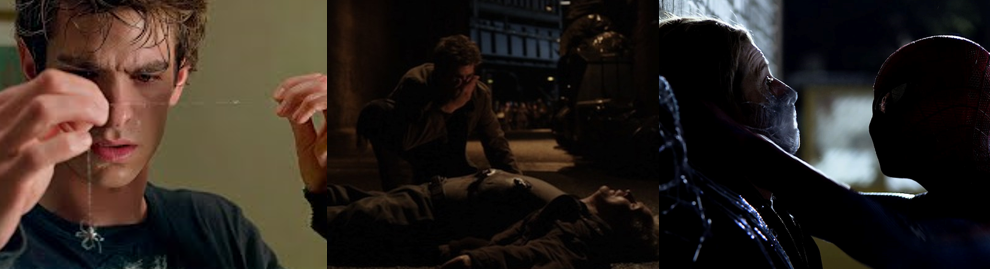
Personally, I’ve always felt it was a bit odd to do a full-on Spider-Man reboot just five years after the end of Sam Raimi’s trilogy. Considering how much The Amazing Spider-Man borrows and rehashes form Raimi’s films, I’ve often wondered if it might’ve been better to simply recast and continue in the world he established, like with the James Bond films or Joel Schumacher’s Batman movies. Even The Amazing Spider-Man’s title sequence is a truncated version of Raimi’s, and James Horner’s score is stylistically similar to Danny Elfman’s. Still, The Amazing Spider-Man tries to separate itself in the early going by showing a glimpse into Peter’s past, where young Peter (Max Charles), is spirited away in the middle of the night by his parents, his heartbroken mother, Mary (Embeth Davidtz) and his secretive scientist father, Richard (Campbell Scott), after his father’s office and work was ransacked during the night. Of course, the confused and scared Peter is left with his doting Aunt May (Field) and Uncle Ben Parker, who raise him after his parents die, offscreen, in a plane crash. The loss of Peter’s parents weighs heavily on him, despite his close relationship with Ben and May, and he’s left with many questions regarding their disappearance and feeling an outcast at home and at school, since he inherited his father’s aptitude for science. However, while Tobey Maguire was a moronic geek who clammed up at the first sign of confrontation, Andrew Garfield is a snarky, skateboarding kid who stands up to the bullish antics of Eugene “Flash” Thompson (Chris Zylka) despite being physically outmatched and who’s more quirky and reclusive than a stereotypical bookworm. When he’s not skateboarding or studying, Peter’s taking photographs for the school bulletin board and helping his uncle with odd jobs, which is how he discovers his father’s battered old briefcase and discovers a bunch of scientific documents and a photograph of his father with a mysterious, one-armed scientist. This piques Peter’s curiosity and leads Ben, remorseful at rarely speaking about Richard, to identify the scientist as Dr. Curt Connors.

Greif-stricken outcast Peter embarks on a vigilante quest for revenge after his beloved uncle is killed.

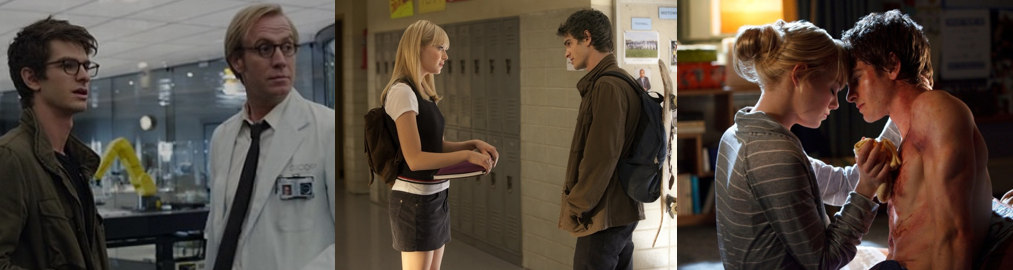
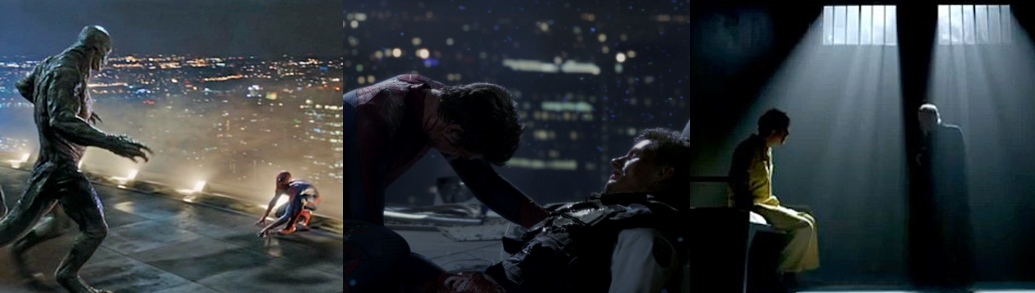
This leads Peter to amusingly tag along with an intern group at the towering, high-tech Oscorp skyscraper, where the beautiful Gwen Stacy works alongside Dr. Connors as his head intern. There, Peter impresses Dr. Connors (while shocking Gwen with hiss appearance) with his knowledge of cross-species genetics, the very subject Dr. Connors and Richard Parker worked on in the hopes of curing diseases and ailments by infusing the DNA of other species into sick or maimed people. Despite Gwen warning Peter to behave, his curiosity gets the better of him and he wanders into a restricted laboratory, where he discovers a batch of genetically modified spiders created by his father and, while being chastised by Gwen, receives a painful bite. As in Raimi’s first film, Peter experiences bouts of nausea and passes out, only this time he blacks out on the subway and discovers his powers purely on instinct when he’s accosted by other passengers, suddenly springing and clinging to the ceiling and demonstrating superhuman strength and reflexes. This Peter is far more unnerved by his powers, which initially make him anxious and eccentric as he reacts to his enhanced senses, leading to an insatiable hunger, him snatching a fly in mind-air, and some pratfalls as he adapts to his incredible strength. This also gives him the edge to humiliate Flash, much to his uncle’s chagrin, and the additional confidence to up his adorable flirting with Gwen. However, while the film wastes a good hour with all this setup and exploring Peter’s abilities with a skateboarding montage, the euphoria again leads him to forget his responsibilities, leading to a chewing out by his uncle that sees Peter storm out. This time, Peter runs afoul of a convenience store clerk (Michael Barra) and is therefore dismissive when a thuggish gunman (Leif Gantvoort) robs the place. Unfortunately, Uncle Ben gets shot when confronting the robber, leaving Peter grief-stricken and embarking on late-night searches for the killer, accosting any street thugs he encounters and continuously coming up short, eventually crafting a disguise after punks see his face and being inspired by luchador masks.

While Dr. Connors get some spotlight, it’s the chemistry between Peter and Gwen that really impresses.

However, this Spider-Man far less virtuous. Although Peter later gets into a heated debate with Police Captain George Stacy (Leary) he’s about “protecting people” and “stopping bad guys”, Spider-Man is obsessed with finding his uncle’s killer, neglecting his aunt, constantly bruised and morose, and only saves innocents by proxy. It isn’t until Dr. Connors’ first rampage as the monstrous Lizard that Peter realises Spider-Man is capable of more, saving saves young Jack (Jake Ryan Keiffer) from a fall and earning his father’s (C. Thomas Howell) eternal gratitude. This Spider-Man is also far more scientifically gifted, cobbling together his trademark webshooters, piecing together the solution to the “decay-rate algorithm” that’s been dogging Dr. Connors’ work, and helping to synthesise a cure for the Lizard alongside Gwen. Gwen is far more capable than her predecessor as well. Not only does she have fantastic sexual chemistry with Peter, but she’s just as much of a science nerd as he is and aids him in created the cure in the finale. Though attracted to Peter, Gwen’s interest skyrockets when he impulsively reveals his identity, and she remains infatuated despite her apprehension due to her father’s dangerous profession. Similarly, I adored Sally Field as Aunt May. She’s a lot younger than Rosemary Harris and much more of a working-class Aunt May than a doting old woman, but her grief at losing her husband and her anguish at Peter’s constant injuries is palpable. Yet, her love for him remains strong and she desperately tries to reach him even when he’s consumed by anger and guilt, something reflected in the change in Peter’s relationship with Flash. While he starts out as a jock asshole, Flash awkwardly tries to connect with Peter after Ben’s death, leading to them forming a more stable friendship by the film’s end.

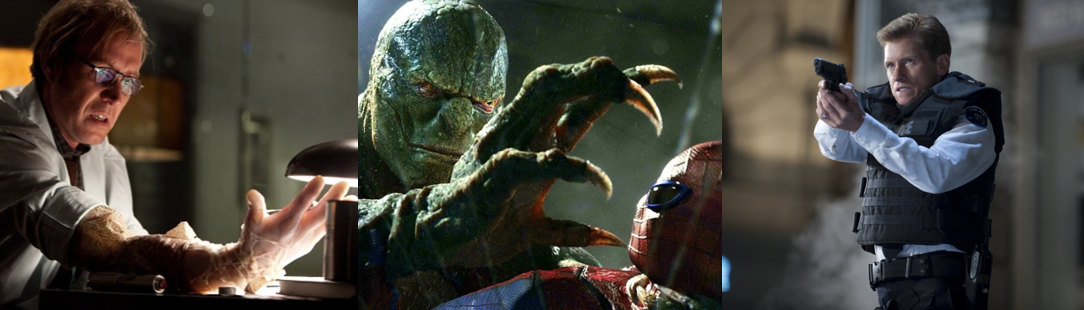
While the Lizard suffers from questionable CGI, Stacy embodies the spirit of J. Jonah Jameson.

Although Peter investigates Oscorp and Dr. Connors works there, and the criminally underutilised Doctor Rajit Ratha (Irrfan Khan) exudes the same shady menace as the laughably faceless Norman Osborn, the company merely facilitates the film’s drama and action. Dr. Connors has dreamed of improving himself (and curing others) with his research, only to be labelled a mad scientist and be frustrated by roadblocks, both scientifically and politically. When Peter offers a solution, Dr. Connors’ hope and excitement is reignited, especially after they successfully implant lizard DNA into a rat and regrow its limb. However, when Ratha steals his research and fires him for his hesitance to start human testing, a desperate Dr. Connors injects himself with the serum and is elated when his arm grows back. This quickly turns to horror, however, as he undergoes a startling and monstrous transformation, losing his rational mind to animalistic rage. Stunned by the Lizard, Peter investigates and stupidly leads the crazed scientist to him by leaving his name on one of his cameras! Thirsty for revenge, the Lizard attacks Midtown Science High School and, when Spider-Man pursues him to his makeshift sewer lab, Peter discovers his identity and his plot. Dr. Connors, driven mad, plots to use a mutagenic solution to twist his dream of making everyone “equal” and healthy by transforming them into lizards! As much as I enjoyed finally seeing the Lizard get his time to shine, I have to admit I’ve always been disappointed by his appearance. He looks very off and far too dinosaur-like, sadly shedding his signature tattered lab coat. The film also wastes so much time retreading Spidey’s origin that Dr. Connors’ family is omitted, meaning he lacks a lot of the sympathy often associated with the character. Though Peter tries to warn Captain Stacy of the threat, he’s dismissed, largely because Stacy was unimpressed by Peter’s defence of what he sees as a dangerous and unpredictable vigilante. Indeed, while J. Jonah Jameson is absent, his spirit lives on in Captain Stacy, who publicly denounces Spider-Man, orders his arrest, and hounds him on sight. Still, Stacy’s sharp enough to investigate Dr. Connors and later sees the true threat first-hand, leading to an unlikely team up between the webslinger and the police captain in the finale.

The Nitty-Gritty:
The Amazing Spider-Man initially advertised itself as the “untold story” of Spider-Man and, if you squint, some of that remains amidst all the rehashing of Raimi’s films. The sub-sub-plot about Richard and Mary Parker is intriguing, but sadly little more than a tease as we learn nothing about what happened to them beyond a brief flash of a headline and it’s left somewhat vague about what they were working on and why that was a threat. While threatening Dr. Connors, Ratha suggests the Parkers’ deaths were due to Oscorp but it all feels very tenuous and isn’t as big a deal as I would’ve liked. Instead, The Amazing Spider-Man wastes a lot of time retreading familiar ground, dwelling on Peter’s pre-Spidey life, showing him exploring his powers and making his suit, and detailing how he abandons his selfish crusade for a higher purpose. As much as I loved all the actors and performances, I really think this is a detriment to the film and things could’ve been sped up. It means Dr. Connors doesn’t get much screen time and it makes it harder for Andrew to stand out from Tobey, despite being a far better fit for the role with his uncanny physical performance and much more natural smart mouth. I absolutely think rewriting the film to be a continuation of Raimi’s movies would’ve been far better. We could’ve reduced the origin to a montage and jumped into the action, with Gwen still being the love interest and exploring Peter’s relationship with Dr. Connors in more detail. To its credit, The Amazing Spider-Man does a lot better than Raimi: the webslinging is much more exciting, Peter’s characterisation is a vast improvement, and even the webshooters are a fun addition (as much as I like and prefer organic webbing). It just really hurts the pacing to waste a whole hour redoing the origin rather than getting to the action, especially when the chemistry between Peter and Gwen is so captivating…and hot! Seriously, these two are horny for each other and I am all for it!

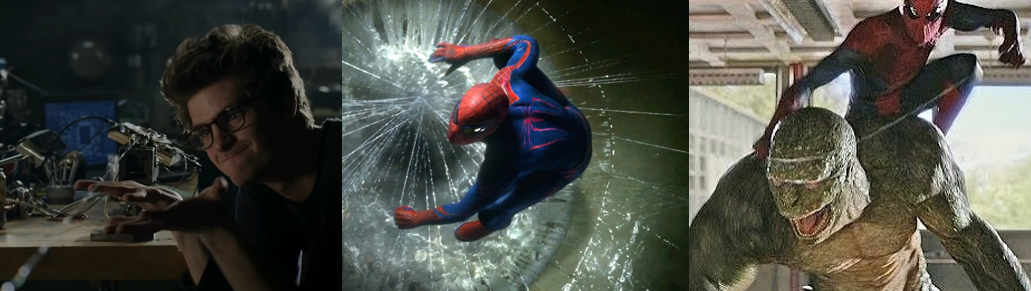
While Spidey has never looked or been embodied better, the Lizard’s CGI is questionable, at best.

Still, The Amazing Spider-Man separates itself from Raimi’s films in a few ways, most obviously the redesigned Spidey suit. While I recall many hating the redesign, I’ve always been a fan of it and I was actually a bit disappointed that they switched to a more traditional costume for the sequel. Just as Andrew’s performance and poses are more animalistic and bug-like, so too is his suit more menacing and insectile, sporting a slick, almost wet-looking texture that makes it seem otherworldly. Another way the film stands out is by his dark it is! So much of The Amazing Spider-Man takes place at night, obscuring a lot of the action and CGI (a conscious decision, I’m sure) and also giving an additional menace to Spider-Man, especially when he’s unloading on thugs and evading the cops. Ironically, this Spider-Man is the wittiest and most amusing yet; I especially loved when he feigned horror when a carjacker (Keith Campbell) pulled a small knife on him! This Spidey is faster and leans into his bug-like nature more than ever, cocooning the Lizard in webbing, making a spread of webs to detect the Lizard in the sewers, and being hyperaware of his surroundings in a way not seen before. I was strangely okay with the first-person shots and odd camera choices, and even the obvious moments shot for 3D viewings, especially as I first saw this in 3D and it absolutely worked like a charm. It’s unfortunate, then, that the Lizard looks so awful. I’ve always been forgiving and understanding of this since it’s a difficult, CGI-heavy character and the film had a reduced budget compared to the last film, but the rest of the movie looks so slick and gorgeous (when you can make out the actions) that the Lizard can’t help but be a letdown. Perhaps if the filmmakers had gone for a gradual transformation, using prosthetics with CGI enhancements and saving the final, complete transformation until the end (or using the heavy shadows), it might’ve been executed better. It’s a shame as the Lizard is pretty impressive, slashing and smashing everything in sight and giving Spider-Man not only a far greater physical challenge but also a mental one, as he (and Gwen) must science-up a way to reverse the mad scientist’s formula.

While Spidey foils the Lizard’s plot, the cost is high and a mysterious threat lingers in the background…

This culminates in an action-packed and emotionally charged finale. After clashing with Captain Stacy over branzino and their different opinions on Spider-Man, Stacy goes all-out to try and apprehend Spider-Man even after confirmation of the Lizard’s threat. After realising Dr. Connor’s plot, Spidey races to stop him and is accosted by the cops, eventually shot mid-swing with a taser bolt and left unmasked before the police captain. Stunned, realising he’s been mistaken and yet conflicted between his duty and his morals, Stacy reluctantly allows Peter to leave but Spidey takes a bullet in the process. Luckily, Jack’s father organises some crane operators to clear a path to Oscorp Tower, though the injured Spidey is physically outmatched by the monstrous scientist. Luckily, Stacy (…somehow…) arrives in time to help with a shotgun and the anti-lizard cure, courtesy of the resourceful Gwen. Unfortunately, though Stacy slows the Lizard with repeated shots and some well-placed liquid nitrogen, he gets skewered through the gut, though Spidey just manages to insert the cure before the device activates. The results are near-instantaneous, painfully reverting the Lizard and restoring his sanity in time to not only save Peter and lament the loss of his arm but to realise the gravity of his murderous actions. Though Peter tries to save him, the mortally wounded Stacy begs him off and reconciles with the young hero, begging Peter, with his dying breath, to leave Gwen out of his double life for her safety. Though grief stricken, Peter honours Stacy’s wishes, ending the relationship, only for Gwen to realise it’s because of her father and for Peter to almost immediately walk back his promise, which I think was supposed to be a subversion of Spider-Man’s ending but came across as a bit awkward and spiteful on Peter’s part. Though Peter heads out into the night for a celebratory swing, now fully embracing his newfound purpose as Spider-Man, he’s unaware that a mysterious individual (Michael Massee) visits the remorseful, incarcerated Dr. Connors regarding the Parkers, hinting at some deeper plot concerning Peter’s parents…

The Summary:
Despite the circumstances surrounding its creation, I think time has been quite kind to The Amazing Spider-Man and, on the whole, removed from the confusion and disappointment of the time period, it holds up pretty well. Andrew Garfield remains my favourite Peter Parker/Spider-Man, embodying the character like never before at the time with his physicality, his wit a d his quirky performance. His absolutely raw emotional range and chemistry with Emma Stone oozes off the screen and I loved how capable and smart and sassy Gwen was, a far cry from the source material and her wooden predecessor. The cast, all around, is superb here, with Rhys Ifans giving a sombre and magnetic performance that turns into the right level of over-the-top camp once he transforms and Denis Leary grumbling his way through every line. I just wish we’d gotten more time with some of the actors. Spidey’s suit, movements, and action sequences were top-notch as well, far beyond anything Raimi’s films did, and I loved the subtle edge given to him, where he’s initially driven more by anger and revenge. Unfortunately, The Amazing Spider-Man stumbles due to a hesitancy to go all-in with the reboot idea. Visually and thematically, it’s very similar to Raimi’s films and it retreads far too much of Spidey’s origin to truly stand alone, again making me wish it had simply been a soft reboot set in the same world. Any intrigue surrounding Peter’s parents is swept under the rug and it’s simply there as sequel bait and to make you think this is something new and the reliance on Oscorp was disappointing after three movies of Osborn shenanigans. As much as I enjoyed Ifans as Dr. Connors, the Lizard is painful to watch at times, barely resembling the source material and losing many of the qualities that made him such a strong and sympathetic villain, meaning the film falls back on the tired “crazy scientist” trope that Raimi drove into the ground. It’s a thrilling and exciting adventure at times with some incredible visuals and moments, but a lot of it is lost in all the darkness and poor lighting, meaning Spider-Man doesn’t pop with colour like he should. It’s a shame as there’s a lot to like here, but The Amazing Spider-Man stumbles more than it strides and it’s difficult to look past some of its failings, despite the appeal of its charismatic cast.

My Rating:

Rating: 3 out of 5.

Pretty Good

Were you a fan of the Amazing Spider-Man or were you surprised to see a reboot so soon after Raimi’s films? What did you think to Andrew Garfield’s performance and his suit? Were you also disappointed by how much of the origin was rehashed and how dark the film was? What did you think to the chemistry between Peter and Gwen? Which Spider-Man film is your favourite and how are you celebrating the wall-crawler this month? Let me know what you think about The Amazing Spider-Man in the comments, support me on Ko-Fi, and check out my other Spider-Man content.

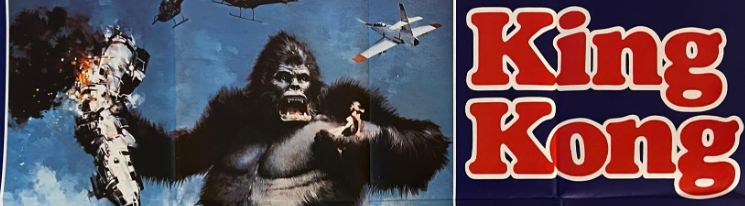
Movie Night [K-Month]: King Kong (1976)


In the absolutely bonkers science-fiction film Pacific Rim (del Toro, 2013), the monstrous Kaiju first attacked humanity on 10th August 2013, which was subsequently branded “K-DAY”. To celebrate this event, and giant monster movies, I’m dedicating every Sunday in August to one of cinema’s most prolific monsters: King Kong!


Released: 17 December 1976
Director: John Guillermin
Distributor: Paramount Pictures
Budget: $23 to 24 million
Stars: Jeff Bridges, Jessica Lange, Charles Grodin, Rick Baker/William Shepard/Peter Cullen, and René Auberjonois

The Plot:
Ruthless oil executive Fred S. Wilson (Grodin) discovers a primitive world ruled by the giant ape “Kong” (Baker/Cullen/Shepard). When the beast kidnaps beautiful castaway Dwan (Lange), stowaway primate palaeontologist Jack Prescott, (Bridges) tries to save her amidst Wilson’s plot to commercialise the creature.

The Background:
As hard as it may be to believe, it was nearly a hundred years ago that filmmaker, adventurer, and former World War I aviator Merian C. Cooper dreamed up the iconic visual of a giant gorilla ascending the Empire State Building and wowed audiences with King Kong (Cooper and Schoedsack, 1933), largely regarded as one of the most influential movies of all time. Amazingly, King Kong was followed by a sequel that very same year, though Son of Kong (Schoedsack, 1933) leaned more into comedy and largely divided critics. After a planned revival fell through in the 1960s, the concept and character were repurposed into a battle against Godzilla, much to Cooper’s displeasure, resulting in a profitable but divisive clash. After a stint in animation, King Kong returned to cinema screens for a loose tie-in, King Kong Escapes (Honda, 1967), a much-maligned entry that ended Toho’s brief stint with the legendary ape monster. About ten years later, the idea of a then-modern remake was pitched, though there are conflicting reports about who we have to thank for this: some say it was Michael Eisner and veteran producer Dino De Laurentiis, while De Laurentiis claims it was all his idea. Regardless, Paramount Pictures financed the project and De Laurentiis worked with screenwriter Lorenzo Semple Jr. to update the story to focus on the energy crisis and culminate at the World Trade Center. To save on costs, all dinosaurs were omitted and an elaborate suit, animatronic, and puppets were used in place of laborious stop-motion techniques. Special effect artist Carlo Rambaldi constructed an impressive £500,000 mechanical Kong that infamously failed to work when the cameras rolled, forcing the production to rely on what Rick Baker saw as an inferior suit. Thousands of onlookers flocked to the World Trade Center for the dramatic finale, many being paid to be extras, and an extended cut of the film was assembled for home media. King Kong was largely praised for revamping the original unorthodox love story and for its impressive practical effects, though it’s also been criticised for its janky editing and composition and its strange balance of humour and drama. Though De Laurentiis was disappointed by the film’s $90.6 million box office, a critically and commercially panned sequel followed ten years later and the franchise remained dormant until Peter Jackson’s big-budget remake in 2005.

The Review:
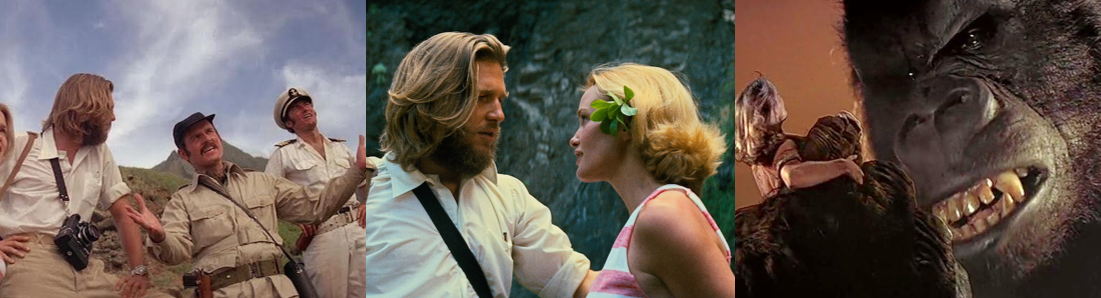
Though it’s narratively very similar to the classic 1933 original, this King Kong separates itself in a few ways to put a different spin on the formula. I don’t mind this so much as I’ve always argued that remakes should try to do something new with their properties rather than being shot-for-shot or beat-for-beat recreations. In this case, we’re not following an adventurous film crew and their misadventures on Skull Island, but instead Fred Wilson, executive of the childishly named Petrox Oil Company, who assembles a crew to sail to an uncharted island. Since Petrox has been in a slump and the world is facing an energy crisis – and competition from other oil and petrol sellers is high – Wilson is banking everything on claiming a hitherto-undiscovered oil reserve on the mysterious Skull Island. Thanks to paying off an unnamed official in Washington, D.C., Wilson obtains top secret satellite imagery of the island which, as his resident science expert Roy Bagley (Auberjonois) explains, reveals the landmass hidden by a thick and mysterious fog. Their data indicates that the island is rich in oil and other minerals and Wilson is determined to get his hands on it to turn Petrox’s fortunes around, though stowaway associate professor Jack Prescott offers another, far more sinister perspective on the island. Prescott talks of journals and other evidence indicating that the island is not only inhabited, but ruled over by some gigantic, unknowable beast and attempts to persuade Wilson of Skull Island’s dangers and to let him join the expedition out of sheer scientific curiosity. Believing he has the inside track on Skull Island, Wilson is naturally sceptical and accuses Prescott of being a spy from a rival oil company, ordering Captain Ross (John Randolph) to lock the troublemaker up and doing a deep dive into Prescott’s background to figure out who he is. When this only corroborates Jack’s story, Wilson reluctantly allows him to join the crew as their official photographer but, for a good while, the two seemingly reach a mutual respect, especially when leading their later rescue mission.

Wilson’s search for oil and Jack’s awkward romance are scuppered by a giant, horny ape!

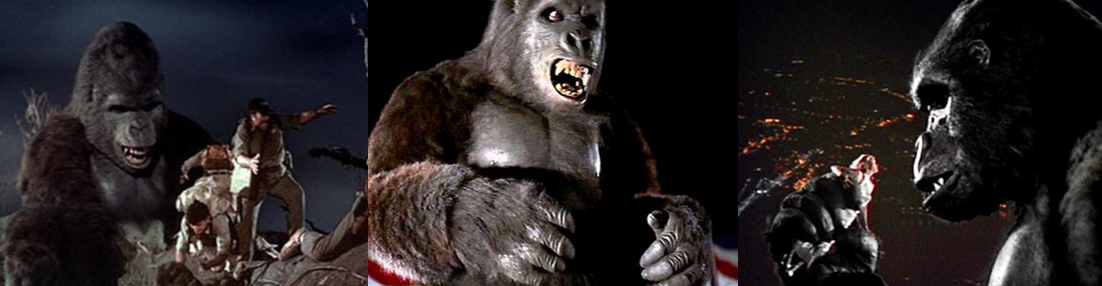
This comes about when Wilson’s ship happens upon a stray life raft carrying beautiful aspiring actress Dwan, who was left adrift when her yacht  suddenly exploded. Dwan joins the crew as something of a mascot and a fancy, immediately catching Prescott’s eye and flirting with him, sharing her dreams of being a big star. While the romance angle was extremely rushed in the original film, I understood it as the film was much shorter and that was in keeping with the style at the time. Here, I’m not sure why Jack is so smitten with Dwan beyond her looks as she’s a bit of an airhead who wanders around with big doe eyes, chattering about her dreams, blabbering about how beautiful things are, completely oblivious to obvious dangers and being painfully naïve. Though she’s more likely to babble about her star sign than anything meaningful, it seems Prescott is captivated by her whimsical, carefree nature and he becomes very protective of her, as does the rest of the crew since she’s initially ordered to stay behind when they reach Skull Island. Instead, she accompanies the group and, predictably, observes the native’s rituals with a naïve wonder compared to Prescott’s more measured caution. When the tribe’s shaman (Keny Long) spots her, he immediately orders (in his native tongue) for her to be handed over as a sacrifice to their God, even offering six of the native women in return for Dwan, though both Prescott and Wilson naturally decline. This sees the natives kidnap Dwan in the dead of night and force her to be strung up as Kong’s latest bride and, like Prescott, Kong is immediately taken by the blonde-haired maiden. Dwan is helpless in Kong’s grasp, resorting to screaming and begging and then lashing out in fear and anger since she’s afraid of heights. Not wishing to anger the beast, whom she and Wilson believe intends to eat her, Dwan tries to soothe him with kind words, though her attempts to flee fail and she’s reduced to a mere damsel in distress. This gives Jack the chance to step up as he leads the rescue mission, exasperated by Wilson being more concerned with his oil (which turns out to still be gestating and thus unsuitable for mining), though he’s ultimately left to rescue Dwan alone when Kong kills most of the rescue party.

Though a king in his native land, Kong’s reduced to a wild animal by Wilson’s theatrics.

Since his plan has gone awry, Wilson comes up with a new plot to capture Kong and parade him around the United States as Petrox’s mascot. After calling in some supplies, he orders Captain Ross and his men to prepare an elaborate trap rather than send out a search party, digging a huge pit to chloroform the giant ape. While Kong’s busy battling a giant snake, Prescott grabs Dwan and bring her back to the native’s village. However, when the angered Kong pursues, he falls into Wilson’s trap and is soon being transported to America. The gas and lack of food and water take their toll on Kong, who sits heartbroken and throws a tantrum as they near the mainland, with his rage only soothed by Dwan. Once they reach America, Wilson turns from a greedy but otherwise reasonable man into a full-blown megalomaniac as he wins over Dwan by casting her in the lead role in Petrox’s new advertising campaign to recreate her time on Skull Island before the braying masses as Kong is held in chains. While Prescott initially signs on for this, his moral compass sees him reject the offer and urge Dwan to leave with him, but she’s so obsessed with being a star that she can’t turn Wilson down. While Dwan is terrified of Kong, she feels a great deal of sympathy for him and puts her life on the line to calm him when he threatens to sink the boat. Similarly, she begs Kong not to let her go in the finale so he’ll be spared death and even Jack is cheering Kong by the end after he’s double-crossed. Thanks to his extremely expressive face, Kong is more human and emotive than ever, showing great affection, pain, and anger as required. Though revered as a God by the natives, Prescott sees Kong as a unique species that needs to be preserved. He’s aware of the beast’s danger and desperate to get Dwan away from him, but constantly advocates for Kong to be left unharmed and is deeply disturbed when Wilson takes Kong from his homeland.

The Nitty-Gritty:
One of the things I love about the original King Kong is how it moves at a brisk pace and yet still showcases a lot of amazing effects and action. The romance subplot is hammy, for sure, but it’s all in good fun. Sadly, this King Kong suffers from a bloated runtime. It’s not as bad as the next remake, but the film chugs along at a snail’s pace, spending way too much time on the boat and trying to make us care about the blossoming attraction between Jack and Dwan. While Bridges and Lange have chemistry, Dwan’s portrayed as such a fickle and flighty bimbo that I find it hard to believe Jack could stand being with her beyond a quick bunk up. Hell, he even says to her (after she interrupts their desperate escape from Kong’s rampage for a drink) that she’d quickly grow bored of him since he can’t afford to keep her in the lifestyle she’s accustomed to. While she seems to genuinely deny this, I’m on Jack’s side here; Dwan would be seeking the next thrill after a month or two, for sure. I enjoyed Grodin’s bombastic performance as Wilson, who becomes quite affable during the second act but quickly descends into a spiteful villain who cares only about making a theatrical showcase of Kong. Having sacrificed many lives and shown a complete disregard for others, and Kong’s welfare (seriously, how did the big ape survive the trip back to America?), it’s only fitting that Wilson goes out in the stupidest way possible: running right into Kong and being crushed under his foot, despite him literally being able to flee in any direction! The natives don’t get much play here and disappear after sacrificing Dwan, but they’re portrayed as a stereotypical, primitive tribe who seek only to appease their God. They regularly repair the great wall to keep Kong out and send him women to satisfy his needs and Jack states that the tribe will most likely be disillusioned and downcast after they kidnap their deity.

While Kong is impressive, the effects don’t land or age as well as the ambitious original.

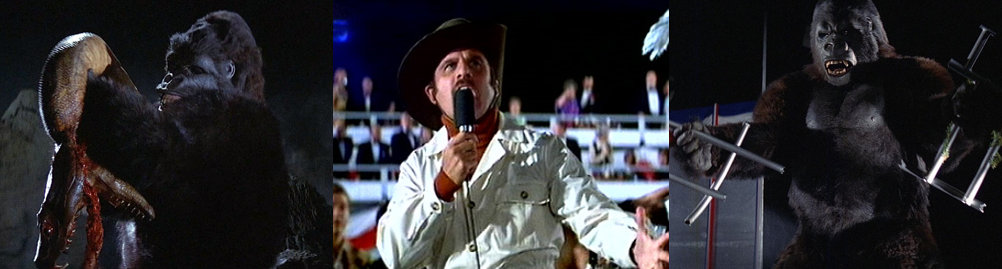
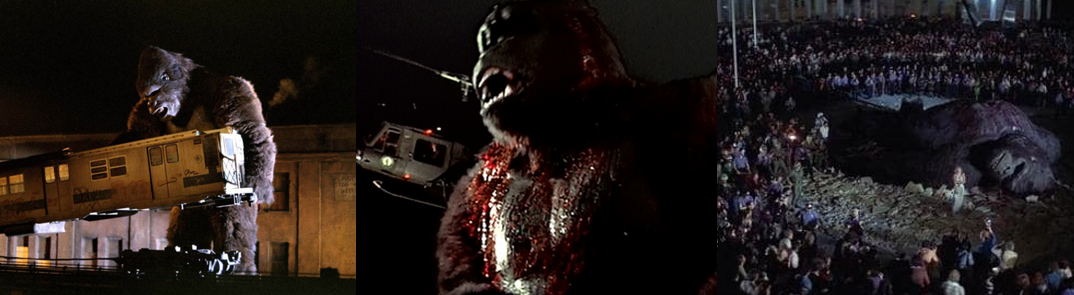
Though comprised of various real-world locations and elaborate sets, Skull Island isn’t as impressive as in the original film as this King Kong chooses not to have dinosaurs and other prehistoric creatures on the island. Indeed, the only other giant creature is a massive snake that Kong awkwardly wrestles with, which is a shame as I would’ve much rather seen more time spent exploring the island’s dangers than trapped on the boat with these assholes. Skull Island’s threat is thus in its landscape, which is comprised of a thick jungle and deep chasms and Kong who, despite his obnoxiously loud roar and thundering footsteps, can apparently sneak up out of nowhere and send Jack’s rescue party plummeting from their log bridge. As you’d expect, Kong is the film’s most impressive aspect and the suit really does look amazing. Kong towers over the miniatures and has a far greater range of movement than stop motion can provide, though he looks janky and awkward when briefly substituted for a robotic duplicate or filmed against rear projection. There’s obviously a lot of that (and forced perspective) here and it hasn’t aged as well as the black and white original, which gets more slack due to being limited by the technology of the time. Here, it’s painfully obvious when a giant Kong hand is holding Dwan before a projection of Kong and when Kong is smashing through miniatures. To be fair, these look far more impressive during Kong’s rampage through New York City, where he overturns a train and terrorises the public, though he looks extremely ungainly when climbing the World Trade Center. Kong’s most impressive feature is his highly expressive face, which sees him gaze upon Dwan with lovesick eyes, glare at people when they shoot him, and illicit a great deal of sympathy when trapped on the ship or suffering mortal wounds. Kong’s definitely more human than in the original, standing upright and lumbering about like a man, though the little head tilts and constant roaring tie into his animal side, as does his confusion and rage when surrounded by the unfamiliar sights and sounds of New York City.

Kong’s rampage is tragically ended in spectacularly gory fashion!

Remarkably, despite being unprepared for Skull Island’s true danger and having lost the chance to rape its oil deposits, Wilson snatches victory from the jaws of defeat by hastily trapping Kong. Being drugged, malnourished, and separated from his land and new love seems to physically drain Kong, allowing him to be chained up in a seemingly inescapable cage and paraded before the masses amidst Petrox’s massive billboards. However, Kong’s rage is stoked when reporters rush Dwan and push her about, giving him the strength to break free and rum amok, crushing people under his feet and terrorising the streets in his pursuit of her. While Jack gets Dwan to safety, she randomly demands a drink, sure that the river will deter the ape, and is naturally snatched by Kong when he simply wades through the water without issue. Luckily for Dwan, Prescott intuits that Kong will be drawn to the World Trade Center since the Twin Towers resemble a rock formation on Skull Island. Though Jack barters with the city officials to take Kong alive, he’s immediately double-crossed when soldiers shoot flamethrowers at Kong. Though unable to reach the roof of the South Tower, Jack’s even more helpless when Kong leaps to the North Tower, kills his assailants, and is approached by three attack choppers. Though the pilot (George Whiteman) orders his men not to fire with Dwan in the ape’s hand, Kong seemingly recognises the threat and accepts his fate, placing the aghast Dwan on the roof and prepares to face his attackers. While Kong does take a couple of the choppers down when they fly a little too close, he’s basically dead meat the moment they fire their massive chain guns. It’s honestly disturbing seeing bloody chunks and spray fly from Kong’s chest, neck, and belly and seeing his fur matted by gore, his breathing becoming more laboured and his screams more anguished as he’s riddled by seemingly explosive bullets. In the end, the assault is too much and Kong collapses first to the roof and then to the ground below. As reporters clamber on his prone body and Dwan desperately tries to comfort him, Kong’s heart slowly beats to a stop. The masses celebrate, jostling Dwan about and trying to snap her picture, all while a despondent Jack looks on, unable (and seemingly unwilling) to reach her.

The Summary:
This is the King Kong I grew up with. As a kid, I remember being awestruck by the Kong suit, which still holds up really well and is a fantastic way to give Kong more movement and expression than stop-motion or animatronics. While he lacks a lot of the charm of the original and doing a man-in-a-suit might seem a bit cheap, Kong is still incredibly impressive, especially his emotions and face, and he’s only let down by some dodgy rear projection and questionable performances. I didn’t mind Jeff Bridges here, he took the lead pretty well and seemed very charismatic, but he had more chemistry with Charles Grodin than Jessica Lange. Dwan is one of the weakest aspects of the film, being a shallow and wholly uninteresting character who seems too fickle and flighty for Jack to waste his time on. Wilson was great as a bombastic, greedy antagonist who takes any opportunity to turn his fortunes around. Sadly, King Kong is a slog to watch, with the film dragging on and offering little but a dull romance sub-plot and actors fumbling about on a jungle set. Things pick up in the finale but, by then, I wouldn’t blame you if you’d tapped out from boredom as the film lacks the magic of the original and doesn’t pace out its set pieces well. It’s a shame as I have fond memories of this one from my childhood but this King Kong is tough to rewatch, despite how unsettling the ending is and its ambitious suit effects.

My Rating:

Rating: 2 out of 5.

Could Be Better

Have you ever seen the this 1976 remake of King Kong? If so, did you like it and how do you think it compares against the original and other King Kongs? What did you think to the suit effects and animatronics? Were you disappointed we didn’t get more giant monsters on Skull Island? Did you also find the film boring at times? What did you think to the changes it made to the original? Which version of Kong is your favourite and how are you celebrating K-Day this month? Whatever your thoughts on King Kong, Kaiju, or monster movies in general, leave a comment below, support me on Ko-Fi, and go check out my other King Kong and Kaiju content!

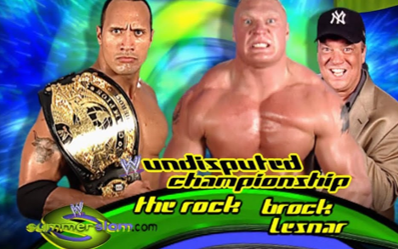
Wrestling Recap: Rock vs. Lesnar (SummerSlam ’02)

The Date: 25 August 2002
The Venue: Nassau Veterans Memorial Coliseum; Uniondale, New York
The Commentary: Michael Cole and Tazz
The Referee: Mike Chioda
The Stakes: Singles match for the Undisputed Championship

The Build-Up:
By 2002, World Wrestling Entertainment (WWE) was in a state of flux. After their main rival, World Championship Wrestling (WCW), went out of business and the company was purchased by Vince McMahon, an ill-fated “Invasion” angle saw WCW superstars appear on World Wrestling Federation (WWF) programming. Once this storyline was abruptly ended, the WWF was legally forced to rebrand as WWE and, to keep the spirit of competition alive, the first-ever “brand split” occurred. This meant WWE Superstars and championship belts would be exclusive to either Raw or SmackDown!, with each brand favouring a different presentation (Raw focused more on storylines while SmackDown! focused on in-ring wrestling). Despite this, there was still one top prize in the company, the WWE Undisputed Championship, which “The People’s Champion”, the Rock, had captured the previous month. In a first for the WWE, the Rock’s SummerSlam challenger was decided at the annual King of the Ring tournament, which was won by newcomer Brock Lesnar. Debuting the night after WrestleMania X-8 and embarking on a tear, the monstrous Lesnar was an accomplished amateur wrestler and champion who quickly made a name for himself by decimating his opponents. Coined “The Next Big Thing” by his agent, Paul Heyman, Lesnar went unpinned following his debut and even made short work of the legendary Hulk Hogan on his path to the championship. After winning the King of the Ring, Lesnar immediately targeted the Rock, interfering in his matches and engaging in brawls, and much of the build-up for the match emphasised the training and conditioning the two were undergoing in preparation for it.

The Match:
I remember when Brock Lesnar first debuted, decimating opponents with powerbombs and his sick-ass F-5. At the time, I was somewhat unimpressed; he just looked like a generic big guy, after all. He rarely spoke (and, when he did, he sounded awful), and he didn’t have the same aura or charisma as, say, Batista, who debuted around the same time. Yet, I remember being very surprised when Lesnar won the King of the Ring and was catapulted to this main event match and I have to at least give the WWE credit for actually trying to push new stars in the main event scene. While the audience was in relative awe of Lesnar during his entrance, the Rock’s initial pop was soon joined by a chorus of boos since everyone knew he was leaving to film The Scorpion King (Russell, 2002). Yet, undeterred, the Rock sprinted out to kick off a slugfest with his monstrous young challenger. With the crowd chanting “Rocky sucks!”, Lesnar shut down the Rock’s flurry with an overhead belly-to-belly suplex and repeated backbreakers, scoring a couple of two counts. Targeting the Rock’s already injured ribs, Lesnar repeatedly drove his shoulder into the Rock’s gut in the corner and then punted him out of the ring, where Heyman landed a cheap shot to the champion. Lesnar followed, knocking the Rock over the barricade and muscling him into it before the braying crowd. Back in the ring, Lesnar landed an overhead throw for another two count and Heyman tripped the Rock as he mounted a comeback, leading to the champion being stomped and choked on the canvas. A powerslam shut down another Rock comeback, who continued to be berated by the extremely vocal crowd as Lesnar worked the ribs. This eventually cost him when the Rock caused Lesnar to hit the ring post and, after both leapt to their feet and Lesnar challenged the Rock to knock him down, the Rock scored his first two count off a DDT. The Rock decked Heyman and then tied Lesnar into a Sharpshooter (to a sea of boos), but Heyman tossed a chair into the ring. With the referee distracted, Lesnar drove the chair into the Rock’s injured ribs and slapped on the bearhug that “retired” Hulk Hogan. Much to the chagrin of the crowd, the Rock fought out of the hold, hitting a low blow when the referee was distracted (to yet more boos!)

Lesnar’s dominating performance saw the monstrous youngster capture his first WWE Championship.

Lesnar quickly recovered, though, muscling the Rock into the corner, only to get dropped by a massive clothesline and smacked out of the ring. Visibly pissed by the crowd’s apathy and boos, the Rock tore apart the Spanish announce table, slamming Heyman face-first into it and absolutely launching Lesnar into the ring post! This gave the Rock the chance to hit a Rock Bottom on Paul Heyman through the announce table before tossing Lesnar back into the ring to hit another Rock Bottom. However, Lesnar kicked out at two, much to the delight of the crowd and the astonishment of the champion. Lesnar then surprised the Rock by suddenly hitting his own Rock Bottom (or “Brock Bottom”, as Tazz coined it) for another near fall! The Rock then countered an Irish whip, hit with a spinebuster, and prepared to hit the People’s Elbow…only for Lesnar to spring up and whip him out with a clothesline. However, the Rock slipped free when Lesnar went for his patented F-5 and tried for the Rock Bottom twice more. Each time, Lesnar fought back, but the second time saw him scoop the Rock up and annihilate him with the F-5! And, just like that, Brock Lesnar became the youngest WWE Champion in history, much to the adulation of the crowd, who showered the Rock with boos and insults. This was a decent enough match that told a very simple story of the fired-up veteran being absolutely dominated by his young, upstart challenger. The Rock showed no fear, constantly fighting out of the challenger’s holds, but was no match for Lesnar’s pure power. There was a story here about how the Rock’s veteran instincts weren’t to be counted out, but it wasn’t played into much since he spent most of the match on the receiving end of a beatdown. The most interesting thing, for me, is the crowd completely turning on the Rock, to the point where he was clearly annoyed by their jeers. When he tried to do a speech after the match, the crowd absolutely tore him apart, leading to him washing his hands of them.

The Aftermath:
As mentioned, the Rock left the WWE for about six months to film The Scorpion King, so he never got a rematch with Brock Lesnar for the title. In fact, the two never fought again in a televised match and, when the Rock did return, it was as an arrogant Hollywood superstar heel. Lesnar’s win meant the WWE Undisputed Championship became exclusive to the SmackDown! brand, leading to the belt being rechristened the WWE Championship. Raw General Manager Eric Bischoff repurposed the WCW Championship as the WWE World Heavyweight Championship for Triple H, kicking off his “reign of terror” with the belt. As for Lesnar, he spent the next few months defending the belt against the Undertaker, leading to a brutal and dominant Hell in the Cell victory at No Mercy, and Edge, before being screwed out of the championship when Paul Heyman turned on him in favour of the Big Show at Survivor Series. Lesnar would turn face in the aftermath, regain the belt (and suffer a nasty concussion) at WrestleMania XIX, and spent most of 2003 feuding with Kurt Angle. He eventually turned heel again and realigned with Paul Heyman before finally dropping the belt to Eddie Guerrero and eventually leaving the WWE in controversial fashion.

My Rating:

Rating: 3 out of 5.

Pretty Good

What did you think to the generational clash between the Rock and Brock Lesnar? Were you impressed by Lesnar back then? What did you think to Lesnar’s dominating performance? Were you surprised that the crowd turned on the Rock? What did you think to Lesnar’s first run in the WWE? Which SummerSlam match or event is your favourite? Whatever your thoughts on Rock vs. Lesnar, and SummerSlam, leave a comment below, support me on Ko-Fi, and be sure to check out my other wrestling content across the site.

Back Issues [Spidey Month]: The Amazing Spider-Man #6


Easily Marvel Comics’ most recognisable superhero, unsuspecting teenage nerd Peter Parker was bitten by a radioactive spider and learned the meaning of power and responsibility in August 1962. Since then, the Amazing Spider-Man has featured in cartoons, movies, videogames, and countless comic books. To coincide with his day of celebration, I’m dedicating every Monday of August to everyone’s favourite web-head!


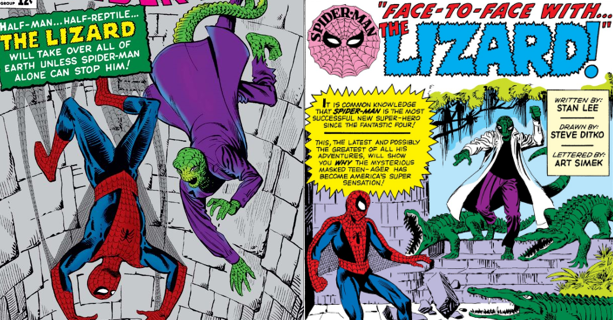
Story Title: “Face-to-Face with… the Lizard!”
Published: 8 August 1963 (cover-dated: November 1963)
Writer: Stan Lee
Artist: Steve Ditko

The Background:
After finding success with the Fantastic Four, Marvel editor and head writer Stan Lee dreamed up teenage superhero Peter Parker/Spider-Man, whose Amazing Fantasy debut became a best seller for Marvel Comics. Spider-Man’s subsequent popularity saw him headline numerous comics, including partnering with other, less mainstream superheroes in Marvel Team-Up, and amass perhaps the most colourful and memorable rogues gallery in all of comics. Doctor Curtis “Curt” Connors/The Lizard first appeared in the sixth issue of Spidey’s long-running Amazing Spider-Man book, courtesy of Stan Lee and Steve Ditko. Like many of Spider-Man’s villains, the Lizard was a tragic victim of science gone wrong and very much in the same vein as Doctor Henry Jekyll and Mister Edward Hyde: a seemingly normal man who underwent a horrific mental and physical transformation due to science. Spidey’s relationship with Dr. Connors became a complicated one, with the two often working together to try and cure the scientist or figure out solutions to Spidey’s latest drama, and them desperately trying to keep the doctor’s condition a secret from his family. Though he’s threatened to turn all of New York City’s inhabitants into lizards and even regressed into a monstrous form, the Lizard has turned towards the light before, though he’s primarily used as a low-tier supervillain in Spidey videogames. The Lizard has also featured in Spider-Man’s animated ventures. Most notably, he featured in the first episode of the 1990’s Spider-Man cartoon (Richardson, 1994) and later helped Spider-Man in the cartoon’s Secret Wars (Shooter et al, 1984 to 1985) adaptation. While we never got to see Dr. Connors (Dylan Baker) become the Lizard in Sam Raimi’s films, the Lizard was the main villain in The Amazing Spider-Man (Webb, 2012). While his design was heavily criticised, Rhys Ifans returned to voice the character nearly ten years later, and the Lizard is generally seen as one of Spidey’s more under-rated villains.

The Review:
Our story opens in “the murky swamps of Florida’s everglades”, where a group of…well, I assume they’re tourists but one of them has a gun so maybe they’re poachers? Or perhaps they just have a well-prepared tour guide? It’s hard to tell and ultimately inconsequential. Anyway, a group of men are suddenly attacked by a giant, man-sized lizard in purple trousers and a lab coat. As if the sight of a six-foot lizard wasn’t shocking enough, the creature speaks (and quite eloquently, too), voicing rage and displeasure at the men for venturing into his swamp. After proving bulletproof, the Lizard causes the trespassers to flee by uprooting a massive tree and waving it about in a threatening manner. Further reports of additional encounters and attacks soon spread, leading the locals to avoid the swamplands and live in fear of the man-lizard in the region. The news is so astonishing that it even reaches the streets of New York, courtesy of the Daily Bugle, whose editor, the miserly J. Jonah Jameson, wastes no time using his publication to challenge Spider-Man to defeat the Lizard. Though he scoffs at the headline, Spider-Man reasons that he might be able to convince Jonah to send him to Florida to snap some pictures of the Lizard. However, Jonah shoots him down, primarily because he believes the whole thing’s a hoax anyway (making me question why he’d risk the Daily Bugle’s reputation printing the headline). Though dejected, Peter heads to the Natural History Museum to brush up on his lizard knowledge. During a lecture on dinosaur anatomy, Peter’s spider-sense alerts him to two thieves, who he quickly subdues, and he’s so bolstered by his actions that he decides to approach Jonah in his masked identity. Spider-Man humiliates Jonah in his office and accepts his challenge, but on the caveat that Jonah sends a photographer to capture the fight, however Peter’s plan backfires somewhat when Jonah insists on tagging along! After saying his farewells to his doting Aunt May, Peter takes his mind off the uncomfortable plane ride by researching Dr. Connors, a lizard expert in the Everglades who he tags as a possible source.

After hearing of Dr. Connors’ tragic fate, Spidey works to find a cure and stop his monstrous rampage.

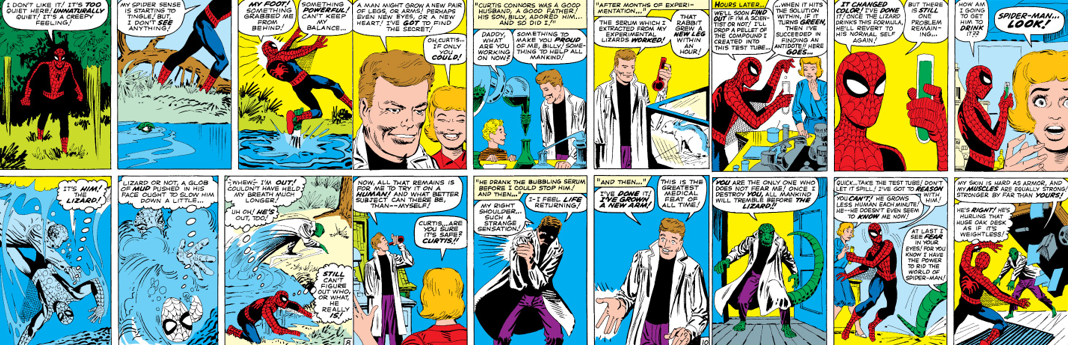
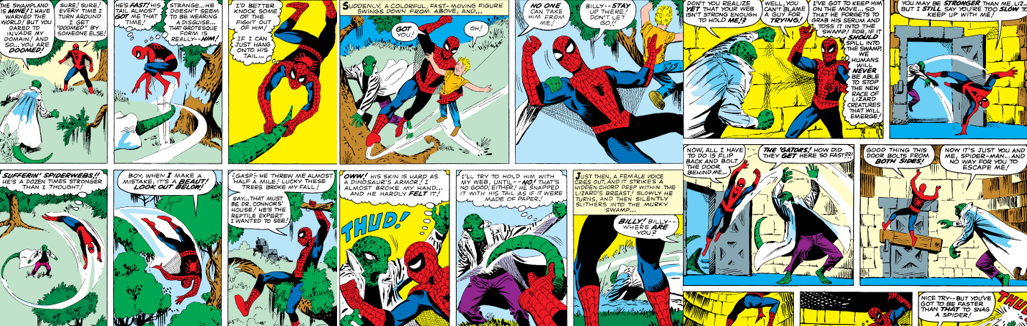
After ditching Jonah, Peter checks out the swamp-like Everglades and is ambushed by the Lizard! Dragged underwater and nearly drowned, the web-slinger’s reflexes are all that save him from a swipe from the monster’s tail, though the Lizard proves to be as strong as he is fast as he sends the youngster flying with a flick of the appendage! Convinced that he needs more intel, Spidey drops by Dr. Connors’ house and finds his wife, Martha, in tears. She not only reveals that her husband is the Lizard but also fills Spidey in on the whole backstory. A former surgeon, Dr. Connors was forced to retire after losing an arm “during the War” and became obsessed with the unique regenerative properties of lizards. Hoping to not only regrow his arm but also help countless others, Dr. Connors worked tireless in his experiments, fully supported by his loving wife and awestruck son, Billy. After many months, Dr. Connors synthesised a serum from lizard DNA and successfully tested it on a rabbit. Emboldened by this, Dr. Connors wasted no time and downed the solution and, after a brief spot of agony, was delighted when his arm grew back! Unfortunately, his elation quickly turned to horror as he transformed into a hideous, half-human lizard. Although the monstrous Dr. Connors returned to try and reverse the process, his mind quickly degenerated and, with the last vestiges of his humanity, he begged Martha to get herself and Billy to safety. However, some trace of Dr. Connors obviously still remains in the Lizard as Martha’s story is interrupted by Billy being accosted by the creature outside. After getting Billy to safety, Spider-Man fights the Lizard again, this time noting the creature’s tough, dinosaur-like armour plating and ability to snap his webs! When Martha rushes to Billy, the Lizard flees in horror and Spidey spends the next few hours going through the doctor’s notes to try and create a cure.

Spidey endures the Lizard’s assault and cures Dr. Connors, but gets screwed by Jonah.

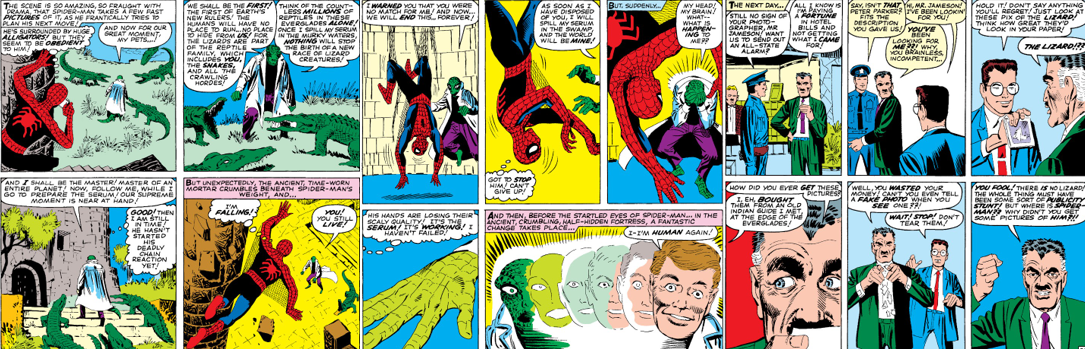
Thanks to his scientific acumen, Spider-Man is successful and, right on cue, the Lizard attacks the lab. Overwhelmed by the creature’s speed, ferocity, and incredible strength, Spider-Man is beaten unconscious, allowing the Lizard to retrieve his serum to empower the local lizards in a mad plot to conquer the Earth. With no time to call for help and no choice but to pursue, Spidey whips up a pair of “web swamp-shoes” and goes paddling through the stream into the Lizard’s territory, pondering how he’s going to subdue the Lizard without harming Dr. Connors. Reaching an abandoned fort, Spider-Man spots the Lizard monologing to a congregation of alligators, who listen intently and obey his every command, attacking Spider-Man when instructed and forcing the hero to scale the fort’s tower to escape. Determined to keep the Lizard distracted, Spider-Man throws webs and his quick wit at the creature and stays on the move, eventually trapping them both within the fort. When the Lizard pursues him up the walls, Spidey makes a desperate gamble and plunges to the ground, tackling the Lizard in mid-air and forcing the antidote down his throat. Spidey is stunned by the Lizard’s powerful tail and left powerless but, just as the Lizard moves to strike, the antidote takes effect. In a few panels, the Lizard’s transformation regresses and Dr. Connors returns, human and sane again (though still missing an arm) to reunite with his family. After Dr. Connors vows to destroy his research, Spidey takes pity on him and promises to keep his secret, much to their relief. In the aftermath, Jameson destroys the photos Peter brings him, convinced the Lizard was all made up and the trip was a waste. He therefore refuses to pay Peter, adds the cost of the trip to his bill and, to make matters worse, Peter’s shot down by Elizabeth “Liz” Allen since she’s got the hots for Spider-Man!

The Summary:
It’s always funny to me to look back at these old stories and see these now-iconic and nuanced villains treated as simple, run-of-the-mill, monthly issues for our favourite web-spinner. “Face-to-Face with… the Lizard!” has a bit more meat on its bones than some stories from back then thanks to Dr. Connors’ tragic origin story, but it’s still full of a few blunders. I’m not the biggest fan of these single issues wasting time on Peter’s supporting cast and this issue definitely does that with Peter’s visit to the museum. It makes sense for him to brush up on his lizard knowledge, but he visits the dinosaur exhibit, which isn’t really the same thing, and later gets exposition from Martha so this feels like a waste. Sure, we get to see Spidey in action but I feel those panels could’ve been used to add to his later fights with the Lizard. And, yes, we see Eugene “Flash” Thompson and Liz Allen there and that ties into Peter’s ongoing social angst, but he also flirts with Jonah’s secretary, Betty Brant, so I do feel some reshuffling could’ve been done. The worst example, though, is the whole side plot with Jonah tagging along. He doesn’t factor into the story at all except as a bookend so it seems like a waste of time to have him go to Florida. It’s not like we cut away from the main story to see him searching for Peter, arguing with hotel staff, or trying to prove the Lizard is a hoax. He just belittles Peter, laughs at the idea of a man-lizard despite printing headlines about it, then disregards the photographic evidence and vows to make Peter reimburse him. I definitely think Jonah should’ve been taken out or reduced or had some significance to the plot if he was gonna be there. Perhaps he could’ve gotten involved in the Spidey/Lizard fight and the story would end with another outrageous headline claiming Spider-Man is in cahoots with the Lizard. As it is, it feels like unnecessary padding to add to the page count.

Despite some colourful battles, the story and its plot felt very rushed and didn’t live up to its potential.

This is a shame at the best of times but particularly disappointing considering the unique tragic backstory of the Lizard. While we get a decent insight into this thanks to Martha, freeing up panels and page space could’ve gone into more detail about his accident, his drive to help similarly disabled people, and his loving relationship with his family. It also could’ve added to the Lizard’s fights with Spider-Man, which felt very rushed. I was hoping we’d see Spidey out of his element in the swamp and therefore at a disadvantage because of the trees, murky water, and aggressive wildlife and, while these elements are briefly touched upon, it’s nowhere near as in-depth as I’d expect. The fights aren’t given much time to breathe; the Lizard boasts of his superior strength and speed and demonstrates it, but it doesn’t have the impact I’d expect. It’s as though everything’s rushing along rather than having a more natural pace. I liked that Peter scientific acumen was put to the test but find it awfully convenient that he whipped up an antidote in a few hours. The reveal that the Lizard can command alligators was fun but underutilised; again, we could’ve had a few more panels of Spidey tangling with the ‘gators to add to the tension. The serum the Lizard steals disappears, never to be seen again; the Lizard’s said to be a ruthless and animalistic creature but he’s incredible articulate and calculating; and, while the idea that Spidey had to be careful not to harm Dr. Connors had legs, I never felt like there was a danger of that since Spidey couldn’t penetrate the Lizard’s hide and had a magic antidote to cure him. Everything’s very colourful, at least, and I liked seeing Spider-Man in a new environment. I also dug the tragedy of the Lizard and that Spidey took pity on him rather than bringing him to the authorities, especially as Dr. Connors didn’t really hurt anyone. However, I don’t think this is all it could’ve been and it felt very rushed and nonsensical at times. That might not be surprising given the rate Marvel were pumping out stories back then, but it is disappointing and hurt my enjoyment of this issue.

My Rating:

Rating: 2 out of 5.

Could Be Better

What are your thoughts on the Lizard’s debut? Are you a fan of the character and, if so, what are some of your favourite Lizard stories? Did you also think the whole Jonah side plot was a waste of time? What did you think to the Lizard’s tragic backstory and his plot to conquer the world with lizards? Were you also disappointed with the pacing of the story? Which of the Lizard’s appearances outside of the comics is your favourite? Feel free to leave your thoughts on the Lizard below, support me on Ko-Fi, and be sure to check out my other Spider-Man content.