Game Corner: Banjo-Kazooie (Nintendo 64)

Released: 29 June 1998
Developer: Rare
Also Available For: Nintendo Switch, Xbox 360, Xbox One, Xbox Series S/X

The Background:
Beginning life as Ultimate Play the Game and having established themselves as one of the biggest UK-based video game development companies, Rare built a strong working relationship with Nintendo after revitalising their Donkey Kong franchise on the Super Nintendo Entertainment System (SNES). Eager to capitalise on this success, Rare began work on “Project Dream”, an ambitious adventure game starring first a sword-wielding boy and eventually a bear with a backpack. As the project grew, Rare switched development to the upcoming Nintendo 64, eventually retooling the concept into a 2.5D sidescroller and, ultimately, a 3D action/platformer collectathon heavily inspired by Super Mario 64 (Nintendo EAD, 1996). Rare’s staff ballooned and their work hours increased as they sought to refine the 3D camera system and encourage player exploration across multiple, colourful worlds, infusing the game with a quirky, British sense of humour. Unfortunately, a multiplayer mode was scrapped due to time constraints alongside an ambitious plan to swap data between cartridges to unlock extra content. Banjo-Kazooie was universally praised, with critics praising the gameplay and visuals and technical superiority over Super Mario 64, though the camera was criticised as being unwieldy at times. Although we’ve been denied a long-running series of sequels, we got a Game Boy Advance spin-off and an equally lauded sequel followed in 2000, the characters appeared in various spin-offs and limited merchandise, and Banjo-Kazooie is widely regarded as one of the best and most pivotal 3D platformers of all time.

The Plot:
When his sister is kidnapped by the vain Gruntilda “Grunty” Winkybunion, dim-witted Banjo and loud-mouthed Kazooie quest to retrieve the magical Notes and Jiggies in Grunty’s lair to rescue the terrified bear cub.

Gameplay and Power-Ups:
Banjo-Kazooie is a 3D action/platformer collectathon in which players guide the titular bear and bird duo across nine main worlds, accessed via a main hub world, searching for magical jigsaw pieces (“Jiggies”) and Musical Notes to unlock additional worlds and progress further up Grunty’s lair to rescue Banjo’s sister, Tooty. You begin outside on Spiral Mountain, a diverse area where players can choose to learn or practice the duo’s moves, which are taught by the short-sighted mole Bottles, whom you’ll encounter at various molehills. Banjo and Kazooie have various moves to take out enemies and traverse the game’s worlds, some of which are similar to Mario’s 3D abilities and others which are unique to them. Banjo takes the lead and swipes with his claws in a short combo with B or rolls into enemies when running and pressing B. A sees him jump and pressing it again in mid-air sees him get a boost from Kazooie to cross small gaps. Pressing B in mid-air performs the super useful Rat-a-Tat Rap, where Kazooie pecks at enemies, while holding Z and pressing B when standing still sees Kazooie charge with her peak. Pressing A when standing still sees the duo backflip to higher areas and you can hold either A or B when underwater to swim, though you must collect air bubbles or resurface to avoid drowning. Similarly, you restore your health by collecting Honeycombs, extend your life bar by hunting down Extra Honeycombs, and snag an extra life from the golden Banjo trophies dotted around, You have decent control over the camera, but it can be clunky and get stuck on the environment at times. Indeed, the unreliability of the camera and Banjo’s inability to grab ledges are the only gripes I have with the game, but they’re easily dealt with once you get into the swing of things.
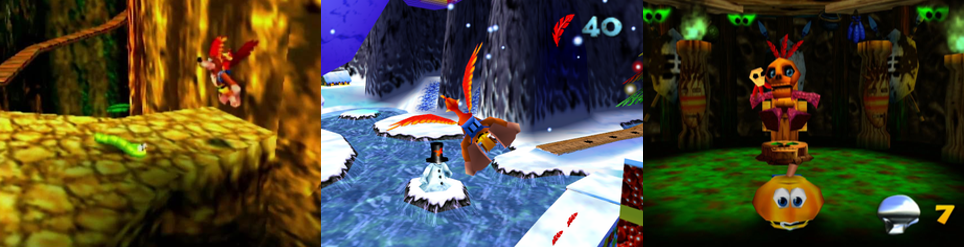
The duo’s abilities are expanded with some fun moves and bizarre transformations.

Banjo and Kazooie’s move set expands as you explore the game’s worlds, constantly adding new abilities to your arsenal that are tested by the environments. Kazooie fires eggs from her mouth or butt by holding Z and pressing C-up or C-down, respectively. This can be unwieldy as it’s difficult to precisely aim at targets but it’s great for picking enemies off from a distance and solving certain puzzles, such as extending bridges. The duo perform a ground pound by pressing Z in mid-air to crush enemies or activate switches to open new areas, reveal Jiggies, or start timed challenges. Holding Z and pressing C-left sees Kazooie dash across the landscape, greatly improving your movement speed and allow you to traverse inclines, while pressing C-right sees Kazooie shield Banjo with her wings, effectively making them invincible. Like your egg attacks, this “Wonderwing” ability lasts as long as you have ammo on hand (specifically Gold Feathers). Similarly, you’ll need Red Feathers and a Flight Pad to take to the air, where you can rise higher with A or blast at enemies and targets with B as long as you have Red Feathers to expend. Kazooie can also spring the duo to higher levels using Shock Jump pads, they can climb pipes and trees just by jumping to them, and Kazooie uses special shoes to vastly (if temporarily) increase her running speed or carry the duo across brambles and red-hot quicksand. You’ll also find numerous Mumbo Tokens everywhere; collect enough and the mystical shaman, Mumbo Jumbo, transforms the duo into various forms. These include a termite, a bee, a tiny crocodile, and a stout little walrus, with the transformation automatically ending once you venture far enough from the world. These forms are both amusing and incredibly useful: Banjo’s pumpkin form, for example, squeezes him into small spaces while his walrus form allows him to compete in a sledge race against the lazy polar bear, Boggy. The bee form lets you fly indefinitely by tapping B (though it’s even more unwieldy than the regular flying) and the termite allows you to clamber up steep surfaces that even best the Talon Trot. The crocodile form is the only one that can attack, snapping its jaws with B and easily crossing piranha-infested water, but it’s very small and no match for the bigger, tougher Mister Vile.
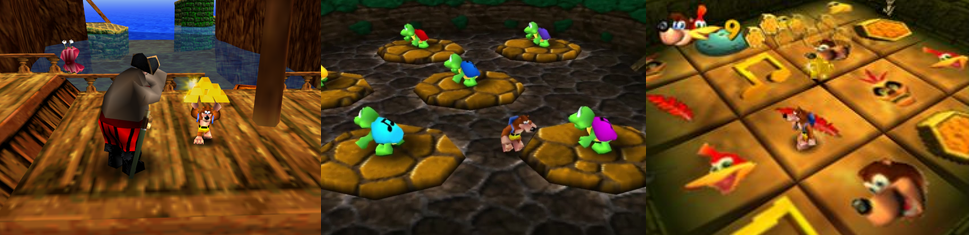
You use all the duo’s abilities to complete various missions to acquire Jiggies.

Like Super Mario 64, each world contains numerous collectibles you need to open new areas. There are 100 Musical Notes in each world and, when you leave the world, the Notes reset, so you’re better off collecting them all on your first go-through (which is possible, even when some areas require additional abilities to access). There are also ten Jiggies in each world, with one awarded when you find the five colourful Jinjos hiding in each world. Some Jiggies are out in the open, sitting on ruins or reached with a bit of platforming or careful traversal over narrow platforms, and others are guarded by bosses, revealed by hitting switches, or earned by solving puzzles. You’ll be smashing huts, hitting targets, completing races and timed events (such as jumping through hoops), and fending off waves of enemies to earn Jiggies. You’ll also aid various non-playable characters (NPCs), such as finding Captain Blubber’s gold, finding Boggy’s kids’ lost Christmas presents, rescuing Snorkel from a weighty anchor, and collecting acorns so Nabnuts can hibernate. Unlike in Super Mario 64, you’re not booted from the world upon collecting a Jiggy and your progress is saved even if you lose a life, though your Notes won’t be. Like that game, Jiggies are also found in the hub world, spawning when you activate switches in the main worlds, and you’ll also play some fun mini games to collect them. You’ll perform with Tiptup’s choir, spell out the game’s title on a sandcastle floor and on a Ouija board, match tiles and race through mazes in ancient pyramids, fly through hexagonal rings, defend sentient Christmas lights, and brave a dangerous fan room all to claim a prize. Jiggies become especially obtuse in Click Clock Wood, a world split into four seasonal sub-sections. You must complete tasks in the spring and summer to earn Jiggies in autumn and winter and vice versa, sprouting and watering a plant and helping Gnwaty throughout the seasons. The difficulty can spike in Clanker’s Cavern and Rusty Bucket Bay, where drowning is a constant threat alongside bottomless pits and polluted water that, like its ice-cold variants, quickly saps your air and health.

Presentation:
Banjo-Kazooie is an absolutely gorgeous game that still holds up today. Obviously, the game looks and runs a lot smoother on the modern re-releases but even the Nintendo 64 original stands the test of time thanks to its colourful visuals and quirky, fairytale-like world. Everything is so full of life and it’s truly remarkable and amusing. Banjo and Kazooie play pranks on each other when left idle, making daft sounds when jumping and attacking, and even the enemies are lively and peculiar, reacting when they spot you (my favourite’s being the Seaman Grublins, who shout an enthusiastic “Hi!” before charging!) Banjo, Kazooie, and all their supporting cast (and even collectibles) chatter with a whimsical babbling, communicating through gibberish, text bubbles, and pantomime movements. Enemies and hazards taunt you, collectibles encourage you to grab them, Bottles and Kazooie bicker constantly, and Grunty taunts you relentlessly as you explore or fail challenges. There’s a little bit of fog and pop-up but I can forgive it considering how large and varied each world is, especially compared to Super Mario 64. Like in that game, players visit worlds via a hub world, but these are unlocked in a fun and interesting way. You may need to explore or activate a switch to reach the puzzle pad and unlock the world, or activate a switch within the worlds to affect the hub world, and utilise various coloured cauldrons to fast travel throughout Grunty’s lair. Grant Kirkhope brings every environment to life with his infectious and whimsical soundtrack, which changes as you explore, becoming muted when underwater or ominous when exploring more dangerous areas. Grunty’s lair is a prime example, with Kirkhope’s rendition of “The Teddy Bear’s Picnic” warping and changing in each area. The soundtrack is, honestly, one of the best parts of the game and immediately makes an impact with Mumbo’s Mountain and only improves from there. Freezeezy Peak has a Christmassy overture that perfectly matches its festive aesthetic, Mad Monster Mansion is suitably spooky, and Click Clock Wood’s music alters depending on the season.
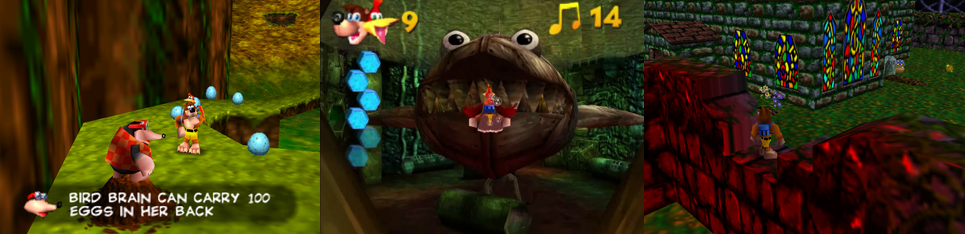
The game’s quirky humour is matched by colourful visuals and an infectious soundtrack.

The worlds on offer are as unique as the game’s quirky humour, which is both snappy and witty and very British at times. While things start very tame in Mumbo’s Mountain, which has no bottomless spits or hazards to worry about (except maybe drowning or taking fall damage), drowning or being bitten by Snacker are constant threats in Treasure Trove Cove, which highlights how large and varied the game’s worlds are with its beach, open sea, lighthouse, and pirate ship. Clanker’s Cavern (essentially Grunty’s sewer) introduces air bubbles to keep you from drowning and centres around the enormous semi-cybernetic shark Clanker and the duo’s efforts to both scale and explore within him. Bubblegloop Swamp is a suitably murky and hazardous environment thanks to the narrow platforms over piranha-infested water, which test your platforming skills. The world branches off to a maze and a giant crocodile, and meeting Tiptup inside a giant turtle. Freezeezy Peak is comparatively smaller but has always been a favourite, despite the ice-cold water and the tricky flying challenges. The annoying Sir Slushes and NPCs like Boggy and his kids and the anxious Wozza the Walrus add a lot of depth to the area. I was never a fan of Gobi’s Valley, which is treacherous like Freezeezy Peak but trickier to traverse as you need to fly, run, ride magic carpets, and complete timed challenges to get inside its pyramids. You’ll brutalise poor Gobi to earn Jiggies, feed Rubee’s snake, and tackle ancient challenges to claim prizes. I’ve always enjoyed Mad Monster Mansion, another wide and varied world sporting a haunted hedge maze, mansion, and church. Tombstones spring to life, brambles prick your feet, pipes must be scaled and dropped down, and you must race into the church to play a giant organ and sneak past a cantankerous ghost. Rusty Bucket Bay can be very challenging with its polluted water and bottomless pits in the engine room; like Mad Monster Mansion, it can also be easy to get lost as there are so many areas to explore. Finally, Click Clock Wood is actually four worlds in one and changes with each season, introducing different enemies and hazards. You’ll run up piles of leaves and snow mounds, for example, or platform using blossoming leaf platforms, but also find the water dried up, frozen over, or some areas are inaccessible depending on the season.

Enemies and Bosses:
Banjo and Kazooie encounter some bizarre enemies on their quest. You can practice your moves against the anthropomorphic vegetables patrolling Spiral Mountain and battle territorial termites and the first of many Grublin variants in Mumbo’s Mountain. Most enemies aren’t much of a threat as, while Buzzbombs swoop at you, Bigbutts try to gore you and can only be stunned, and Chinkers duplicate when hit, but most are easily taken out with a few hits. As you progress further through Grunty’s lair, her Gruntling minions become more durable and the beehives that yield Honeycombs are protected by swarms of bees, adding some challenge to each encounter. Mum-mums and Tee-hees pose a problem as they can only be destroyed with the Wonderwing, while Boom Boxes and Sharpnel mines explode when defeated or they make contact with you. Various Chompas burst from pipes and portraits to deliver a jump scare or take a bite out of you, often knocking you from high places if you’re slow to Rat-a-Tat Rap. Life rings and pipes come to life, monsters burst from wooden panels, mutated and regular crabs must be tipped over to attack their vulnerable bellies, and thrashing tentacles clog up tunnels alongside many environmental hazards. These include fan blades, scorching hot lava, brambles, freezing cold water, unseen piranha, and stinging sandworms but one of your biggest obstacles will be fall damage and bottomless spits, especially by the end game. While you can mitigate fall damage by landing in water or using the Feathery Flap, you’re more likely to plummet to the ground and take considerable damage, so be sure to watch your step, especially in Click Clock Wood. You’ll also have to be mindful of the likes of Snacker and Chump (who are difficult to defeat as the duo have no swimming attacks), Slappas (mummified hands that try to squash you) and the snowballs tossed by the jeering Sir Slushes.
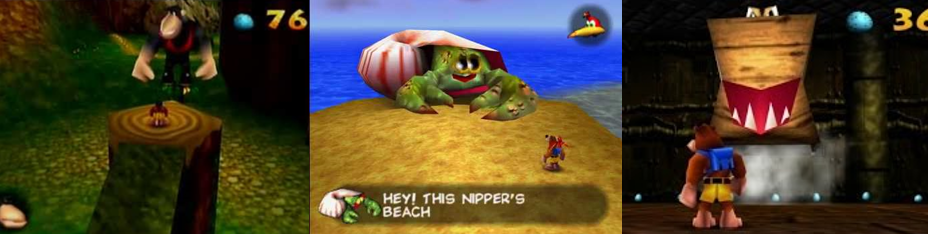
The few boss battles are fun challenges that perfectly match the game’s light-hearted tone.

Banjo-Kazooie is a little light on traditional boss battles. While there are larger or challenging enemies battled in each world to acquire Jiggies, I would only classify a few as being traditional bosses. In Mumbo’s Mountain, for example, you battle Conga atop a tree. You must trick him into tossing his oranges to hit three switches for a Jiggy, feed one of his fruits to a hungry monkey for another, and then head up top to fire eggs at him for a third, but he’s more of an obstacle than a boss. While a tougher crab enemy awaits inside Treasure Trove Cove’s sandcastle, the gigantic Nipper is the game’s first real boss. He tries to clip you with his massive claws but it’s easy to dodge them and Rat-a-Tat Rap his eyes; three hits and he’s done, allowing you to enter his shell for a Jiggy. The closest Clanker’s Cavern has to a boss are the mutated Snippets you fight in a radioactive chamber. Similarly, you battle a gauntlet of frog-like Flibbets in Bubblegloop Swamp and a swarm Zubbas in Clock Clock Wood when you venture into their hive. Bubblegloop Swamp kind of has a boss in Mr. Vile, a mean crocodile who challenges Banjo’s croc form to gobble coloured worms but who isn’t fought in the traditional sense. Similarly, Sir Slushes supplant a boss battle in Freezeezy Peak; you must charge into them when flying to take them out and smash a larger Chinker to earn a Jiggy. Boggy also challenges you to two sledge races, one against your walrus form and one where you’ll need Kazooie’s speed shoes to win, with both being tricky due to you having to pass through slalom gates and avoid the freezing cold water. The closest Gobi’s Valley comes to a boss is when you race to swipe a Jiggy from Grabba, while Mad Monster Mansion simply has you sneak up on Napper. Rusty Bucket Bay does feature a showdown with Boss Boom Box, but it’s essentially just a bigger version of fighting a regular Bomb Box. He’ll split into smaller forms, exploding on contact, so either use your eggs or the Wonderwing, if you have enough Gold Feathers.
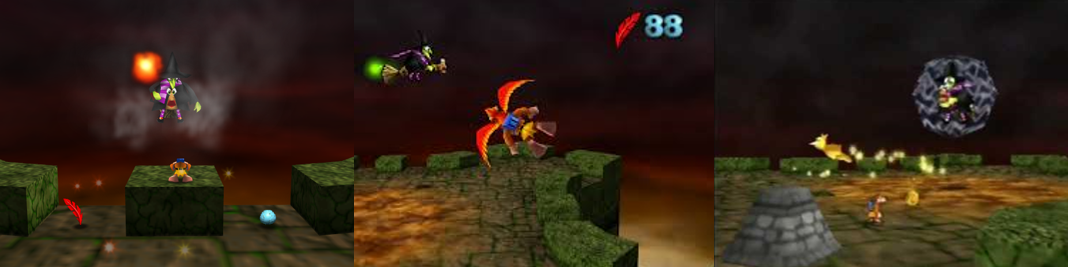
The final showdown with Grunty rightfully tests all the skills you’ve learned throughout.

Even when you finally reach the top of Grunty’s lair and confront her, you must first endure Grunty’s Furnace Fun, a quiz show you must complete without dropping to the insta-death lava below. The quiz tests your knowledge of the game, asking you to name worlds and characters, identify music, and even battle previous bosses. As you explore Grunty’s lair, you’ll inevitably meet her kindly sister, Brentilda, who tells secrets about Grunty that’ll be answers in this quiz. Honeycombs and extra lives are strewn about the board and you can earn Joker cards to skip challenges, each of which is timed and deals damage if you fail. You can also take different paths to the end, where you’ll be treated to a roll call and what appears to be the ending before the duo realise that Grunty escaped! You then venture to the rooftop for the final showdown, stocking up on ammo if you have enough Magical Notes to open the doors. The battle against Grunty has multiple phases, each one ending with her tossing a homing shot that you must defend against with the Wonderwing. In the first phase, Grunty swoops down on her broomstick; you must Talon Trot out the way and hit her with a Rat-a-Tat Rap three times, dodging her explosive fireballs after each hit. Things get tricky in the second phase; not only do you have to avoid slipping to your doom but Grunty’s now out of reach. She tosses multiple fireballs from afar and you have a very small window to hop on the ledge and pelt her with eggs, which is incredibly tricky without precision aiming. If you hit her enough times, she’ll fly high up, forcing you to use a Flight Pad to follow. While her fireballs are easily avoided, it’s not so easy to direct your Beak Bomb but, eventually, you’ll hit her enough to cause her to erect an impenetrable shield. In this phase, you activate the Jinjo statues with your eggs, avoiding Grunty’s shots, to bring her to the ground, then frantically avoid her barrage of fireballs and homing shots to power up the Jinjonator and send her plummeting to her doom.

Additional Features:
There are 100 Jiggies to collect in Banjo-Kazooie, ten in each world and ten in Grunty’s lair. While you don’t need all of them to unlock every world, you will need plenty to solve jigsaw puzzles and earn an upgrade to your life bar prior to the final showdown. There are also 900 Musical Notes to find, 100 in each world, which again you’ll need if you want to access every area of Grunty’s lair and the ammo stocks prior to the final boss. You can return to any world at any time to hunt down any Jiggies and Notes you’re missing and check your progress from the pause menu. Each world also has two hidden Extra Honeycombs which are worth collecting as you’ll extend your health bar with them, alongside multiple Mumbo Tokens, which you’ll need to change form. If you explore Grunty’s lair, you’ll activate cauldrons to create short cuts and discover Cheato, Grunty’s rebellious cheat book who gives codes to enter in Treasure Trove Cove’s sandcastle to increase your eggs and feather stocks. You can also utilise online guides to enter longer cheat codes in the same way to access mysterious eggs and a giant Ice Key, items that are completely useless here but unlock extras in the Xbox 360 version. There are other cheats you can enter as well to give you infinite lives, eggs, feathers, and air, though some of these cheats disable leaderboards and saving on the Xbox 360 version. Speaking of which, there are twelve Achievements in this version that are all simple to get, whereas the Nintendo Switch version lets you create save states. Finally, you can return to Banjo’s house and complete Bottles’ timed jigsaw puzzle challenges for additional fun cheats, my favourite being one that transforms Banjo and Kazooie into a washing machine!
The Summary:
I played Banjo-Kazooie to death as a kid. I was absolutely enamoured by everything, from its quirky characters to its colourful visuals, and its infectious soundtrack brought me such delight. I searched high and low for every secret I could find, eagerly testing out the sandcastle cheat codes and trying to open doors or find new areas. The game invites this at every turn, encouraging exploration and experimentation and crafting an intricate and enjoyable interconnected world. There are some nitpicks, of course. The camera is finnicky and awkward, flying can be clunky, the life system is antiquated, and it’s annoying that you must recollect Notes each time you enter a world if you don’t get all 100 on the first go. However, these are minor complaints, and the positives far outweigh these issues. I loved that you stay in each world after collecting a Jiggy and that there was a lot of variety in how you acquired them. From simply grabbing them, to completing puzzles, timed challenges, or the odd boss battle, I always felt a sense of accomplishment with every Jiggy I got. Similarly, the worlds are endlessly enjoyable, even the more annoying ones like Gobi’s Valley. I loved how characters carried over between worlds, how you altered the hub world with switches, and how each world had such a strong visual identity. Banjo and Kazooie steal the show with their quirky antics, versatile move set, and mismatched partnership. I just adore how whimsical and random everything is; it’s a lot of fun encountering new, oddball enemies and seeing them taunt the duo. While some elements were refined and expanded in the sequel, Banjo-Kazooie remains the superior game for me. nostalgia has a lot to do with that but I’ll never say no to playing this game. It’s always a joy to come back to it and I was doubly impressed to learn that I remembered how to get everything even though it’s been years since I last played it.

My Rating:

Rating: 5 out of 5.

Fantastic

Was Banjo-Kazooie part of your Nintendo 64 library back in the day? If you discovered it on modern platforms, how do you think they hold up to the original? What did you think to the game’s colourful visuals and quirky sense of humour? Which of the Jiggies was the most challenging for you to collect? Were you disappointed by the lack of traditional boss battles? Did you ever find all the game’s secrets and collectibles? Which world was your favourite and would you like to see the bear and bird duo make a proper comeback? I’d love to hear your thoughts and memories of Banjo-Kazooie so please share them in the comments, consider supporting me on Ko-Fi, and check out my other retrogaming content on the site.

Mini Game Corner [DK Day]: Donkey Kong ’94 (Nintendo Switch)


In 1981, Shigeru Miyamoto and his team at Nintendo R&D1 created Donkey Kong, an arcade title that introduced gamers to two of Nintendo’s most recognisable characters: Mario and Donkey Kong. To celebrate everyone’s favourite King Kong knock-off, I’m dedicating a few days this week to gaming’s most famous ape!


Released: 7 March 2025
Originally Released: 14 Jun 1994
Developer: Nintendo EAD / Pax Softnica
Also Available For: Game Boy and Nintendo 3DS (Virtual Console)

A Brief Background:
Back in 1981, Nintendo were in a tight spot after their plans to expand into North America with Radar Scope (Nintendo R&D2/Ikegami Tsushinki, 1980) failed. President Hiroshi Yamauchi thus tasked young designer Shigeru Miyamoto to create a new arcade cabinet to turn things around and, when plans to adapt the popular comic strip character Popeye fell through, Miyamoto took inspiration from Beauty and the Beast (Barbot de Villeneuve, 1740) and King Kong (Cooper and Schoedsack, 1933) to create Donkey Kong (Nintendo R&D1/Ikegami Tsushinki, 1981). A critical and financial success, Donkey Kong not only introduced to world to a prototype of Nintendo’s plumber mascot and ensured a foothold for Nintendo in the United States, it also kick-started a slew of ports and sequels. Perhaps the most notable conversion of the title was this version for Nintendo’s popular handheld, the Game Boy. Unlike the version released for the Game Boy’s home console counterpart, this Donkey Kong was more of a puzzle platformer and greatly expanded upon the core gameplay and mechanics of the original, solidifying Mario’s character following his successful solo ventures and bringing more eyes to Nintendo’s Super Game Boy peripheral. Widely praised and highly ranked amongst Donkey Kong’s solo ventures, Donkey Kong inspired a spiritual successor in 2004 and finally saw life outside of the retrogaming scene when it was released digital via Nintendo’s online services in 2011 and 2025.

The Review:
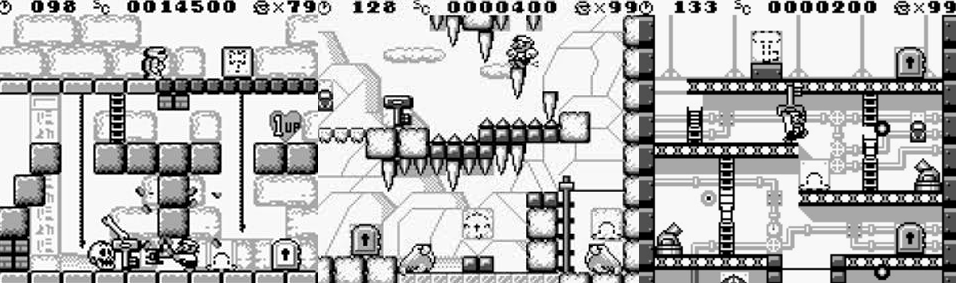
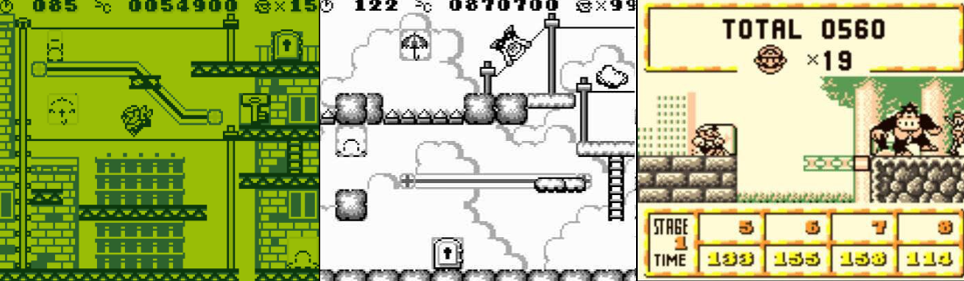
Although this version of Donkey Kong (referred to on the title screen as Game Boy Donkey Kong and widely known as Donkey Kong ’94) is a fundamentally different and expanded version of the original arcade game, it’s still technically quite simple and not varied enough in some aspects to warrant my usual full review. Upon first starting the game, players pick from three save files and immediately get underway playing an adaptation of the arcade hit, guiding a distinctly Mario-looking Mario across girders, through a pie factory, and removing rivets to reach the cantankerous ape, who escapes with Pauline each time. After clearing the first four stages, however, Donkey Kong scarpers across nine additional stages, each with anywhere from eight to fifteen levels, and the game completely changes from a simple platformer to a puzzle platformer. Luckily, Mario’s abilities have been expanded to accommodate this. His jump is far better now, allowing you to hop between platforms and across gaps and even survive falls from short to medium heights, largely eliminating the aggravating fall deaths from the original game. By crouching and pressing A, Mario performs a handstand to protect himself from Donkey Kong’s barrels and other hazards and then performs a somersault jump by pressing A again to hop to higher ground. Mario can also pull off a back flip if you quickly press the directional pad (D-pad) in the opposite direction alongside A, which is great for hopping over enemies or out of tight corners, as well as crouch to fit through narrow gaps. By pressing B on barrels and certain enemies, Mario picks these up and throws them, though you’ll primarily use this to retrieve the many keys hidden across the game’s stages. Finally, Mario can still grab his trusty hammer to take out enemies, though he can’t jump while using it. The game also includes the Super Hammer, which destroys certain blocks, and Mario can toss both weapons and quickly retrieve them to solve puzzles.

Smash blocks with your hammer and utilise various platforming skills to get the key to the door.

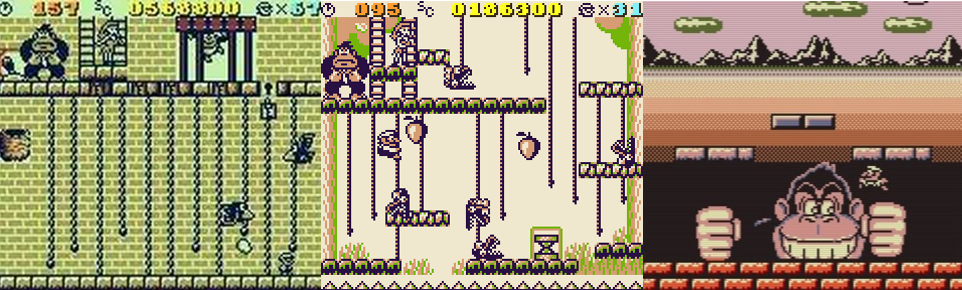
Many stages feature ladders and ropes you must climb. Sometimes these ladders rise and fall to make you time you climb, sometimes there are ropes, vines, or chains or you must carefully grab nearby vines, avoiding any enemies or a potentially fatal plummet like in Donkey Kong Jr. (Nintendo R&D1, 1982). There are also wires to spin on by holding up on the D-pad, which will fling you into the air or across the stage, though you must watch for insta-kill hazards like electrical sparks and spikes. Mario can also swim by tapping A, collect extra lives from 1-Up Hearts hidden in stages, and hop over enemies or retrieve Pauline’s lost items for bonus points. Finding all three of these and clearing a level takes you to a bonus game, where you must stop a slot machine or number icons to earn additional lives. Finally, players pull levers to open doors, activate or change the direction of moving platforms, and switch the direction of conveyer platforms, as well as utilise timed item blocks to aid their traversal. You can grab a ladder to quickly reach higher platforms, create a temporary bridge to toss the key to, and spawn a spring to bounce upwards, with some stages requiring multiple item blocks to clear them, avoid a deadly fall, or get the key to higher ground. You must retrieve the key and carry it to the door before the timer expires, taking care not to toss it into pits or water or leave it idle as it’ll vanish. Sometimes, the door is invisible, requiring you to pay attention during the intro cutscene; other times, it’s deep underwater or protected by hazards. While you can toss the key to defeat some enemies, you can’t carry it up ladders so you must use the item blocks, conveyors, platforms, and levers to get the key where you need it to go. While the challenge of getting the key to the door starts quite simple, with you simply avoiding some enemies or hazards, it quickly becomes complicated as the game throws deep chasms, hazardous mazes, and brain teasing puzzles that’ll have you checking a guide or using trial and error. The Nintendo Switch’s save state and rewind feature is a godsend here as it can be tricky figuring out what to do, though often the solution is very simple and you can even ride some enemies to cross gaps and such.

The game’s challenge is bolstered by some impressive visuals for the handheld.

It’s pretty amazing how visually engaging this version of Donkey Kong is compared to the original, and the other home console ports, especially considering the Game Boy’s limitations. Mario, Donkey Kong, and Pauline are all rendered very accurately, with the latter two having some fun animations. I enjoyed seeing Donkey Kong squeeze his butt through doors and the cute little chase animations that play between stages, and Mario has some amusing death animations here. He’ll be squashed flat as a pancake, incinerated, face plant and be left twitching or simply crash to the ground and die, which all adds to the visual charm. Add to that some fun and impressive animated sprite art and in-game cutscenes and you have a game that blows its counterparts away, as long as you don’t focus too hard on the backgrounds and sound. While the backgrounds are varied and you end up exploring a deep jungle, slipping around on a frozen iceberg, swimming through water, exploring a hazardous city, and climbing Donkey Kong’s fortified tower, they’re obviously very limited due. The game performs really well, though, with no real slowdown or sprite flickering, and makes good use of its assets by scrolling the screen in larger areas. It’s also surprisingly long and challenging, with some stages featuring so many levels that it can get quite taxing, though the music is naturally limited and quite repetitious. Each stage introduces new gimmicks, or turns old ones on their head, though, to have you riding Thwomp blocks, clinging to Monchee tails, avoiding Poison Mushrooms, riding platforms, creating bridges over gaps, battling against strong winds, and contending with the cheeky Donkey Kong Jr. as he pulls levers to mess up your progress.

Donkey Kong and his cheeky sprog regularly challenge your platforming skills.

Each stage is filled with puzzles, hazards, and enemies, some of which aid you since you can walk on or get a boost from them, but most of which will immediately kill you. Some resemble recognisable Mario enemies like Piranha Plants, Cheep-Cheeps, and Bloopers, others return from the original Donkey Kong games, like the flammable oil and egg-dropping birds, while others are quirky newcomers ranging from waddling penguins and aggressive crabs to spiky porcupines, deep sea divers, and various oddball anthropomorphs who patrol each platform. Every fourth level pits you against the titular Donkey Kong and forces you to hop up platforms, avoiding his projectiles, and either get to Pauline or toss a barrel at him three times. Sometimes, the action takes place over a bottomless pit, a body of water, or a bed or spikes. Other times, you hop to conveyor belts, ride platforms, or race across disappearing block platforms. Sometimes, you pull levers to reverse the direction of these gimmicks; others, these same levers open doors for you to reach Pauline. Often, Donkey Kong Jr. blocks your path or undoes your progress until you eventually trap him in a cage and take him out of the equation in Stage 9. Donkey Kong is largely stationary but sometimes jumps and causes debris to rain down, or also pull levers to annoy you. He throws barrels that must be picked up and thrown at him, oil barrels that you must jump over, boulders and springs that you can hop on to climb higher, and Poison Mushrooms to shrink you. Reaching and battling him is generally easier than tackling the obstacle courses that precede him, but things can get tricky when enemies spit projectiles or Donkey Kong smashes barrels to spawn Poison Mushrooms. When you reach the finale of Stage 9, you must again climb chains to push keys into holes and send Donkey Kong plummeting, only to be surprised by a three-stage final boss against a gigantic Donkey Kong! In this final bout, you must avoid his crushing fists and hop to higher ground, using your handstand to tip over barrels to toss at his big, stupid face. His fists also slam together and erratically smash the ground to mix things up, but as long as you stay high and in a handstand, you can mostly avoid his attacks and any damage.

The Summary:
I spent a long time regretting not getting this version of Donkey Kong when the Nintendo 3DS Virtual Console was active. I’d heard a lot of good things about it and was attracted to how it expanded upon the core gameplay of the admittedly limited original, though even I was surprised by just how much is packed into this little game! I find it amazing that Nintendo chose to create this expanded version for their less powerful handheld and not their industry changing home console, though it’s quite the technical marvel for the Game Boy. I loved how animated Mario and Donkey Kong were, how much variety was packed into every stage, and the clever way the developers reused and retooled each gimmick in challenging ways. Make no mistake, this Donkey Kong is a thinking man’s platformer and some of the stages really had me baffled about how to get the key to the door. The gameplay loop did become tiresome after a while, though, even with the fun cutscenes and throwaway bonus stages, especially in stages with an obscene number of levels. It was also disappointing that the battles against Donkey Kong and his sprog didn’t deviate too wildly from the original arcade game, especially as the developers could’ve snuck in some autoscrolling chasers to mix up the formula. I enjoyed Mario’s new moves and the item blocks, which had to be placed strategically to solve some puzzles, and the tension of racing to the key before it or your items disappeared. Some levels were more unfair than others, require multiple reloads, but this was a fun way to pass the time and a great expansion on the original title. While the Game Boy Donkey Kong did get a little too tiresome at times for me to rate it any higher, it’s still the best version of the original game, though it’s a shame the Nintendo Switch doesn’t allow for the Super Game Boy colour palette to be utilised.

My Rating:

Rating: 3 out of 5.

Pretty Good

Did you ever own Donkey Kong for the Game Boy back in the day? How do you think it compares to the original arcade version? Did you enjoy the challenge on offer or do you agree that it gets a bit tedious after a while? What did you think to the puzzle/platformer gameplay and Mario’s expanded moveset? Did you ever clear every stage in the game? Which Donkey Kong videogame is your favourite and why? How are you celebrating Donkey Kong’s anniversary this year? Whatever your thoughts on Donkey Kong, feel free to leave a comment below, support me on Ko-Fi, and check out my other Mario and Donkey Kong content.

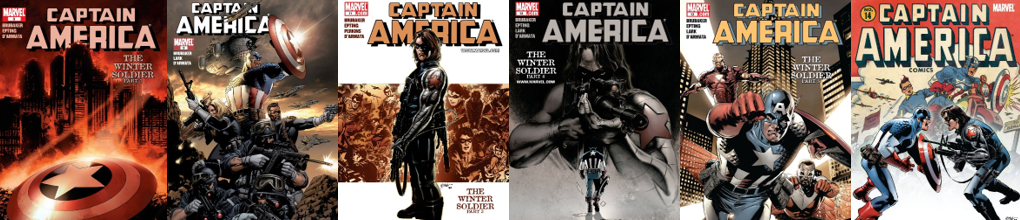
Back Issues [Independence Day]: Captain America Vol. 5 #8-14


First appearing in 1941, Captain Steve Rogers/Captain America, became one of Marvel Comics’ most recognisable and celebrated characters not just for his super patriotism but also for being a prominent member and leader of Marvel’s premier super team, the Avengers. As today is Independence Day, this is the perfect excuse to pay tribute to the star-spangled Avenger.


Story Title: “The Winter Soldier” (Part 1 to Conclusion)
Published: 20 July 2005 (cover-dated: September 2005) to 1 February 2006 (cover-dated: April 2006)
Writer: Ed Brubaker
Artist: Steve Epting and Michael Lark

The Background:
By 1941, World War Two was in full swing and, after Nazi Germany invaded Denmark and Norway, the United States finally joined the fight to oppose the triumvirate “Axis powers” of Germany, Japan, and Italy. The ever-escalating conflict meant patriotism and national pride were high in America and Joe Simon and the legendary Jack Kirby capitalised by having Captain America and his kid sidekick, James Buchanan Barnes/Bucky, take the fight to the Axis and encourage readers to support the War. After the War ended, superheroes declined in popularity and Captain America’s solo title was cancelled in 1954. However, he got a new lease of life when he was recast as a “man out of time” and joined the Avengers. For decades, Bucky was one of the few comic book characters whose death seemed permanent but that all changed with this story arc. It was writer Ed Brubaker, fresh off reinventing Cap’s comics as espionage thrillers, who dreamed up the idea of reviving Bucky as part of a life-long desire to reinvent him as a brainwashed, special ops soldier. Although Captain America editor Tom Brevoort initially opposed the idea, he eventually relented when Brubaker pitched the idea as recontextualising Cap’s greatest failure and crafting a new anti-hero for readers to connect with. “The Winter Soldier” was widely praised and is seen as one of the greatest Captain America stories ever told. It also reinvented Bucky for a modern age and set him up to assume the Captain America mantle later down the line. The story was so influential that it was adapted into videogames, cartoons, and brought to life in the Marvel Cinematic Universe, with Sebastian Stan receiving critical acclaim for his portrayal of the character.

The Review:
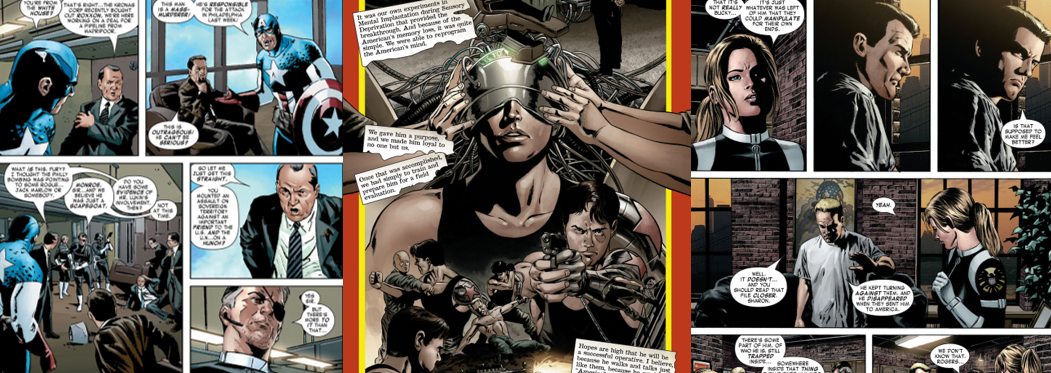
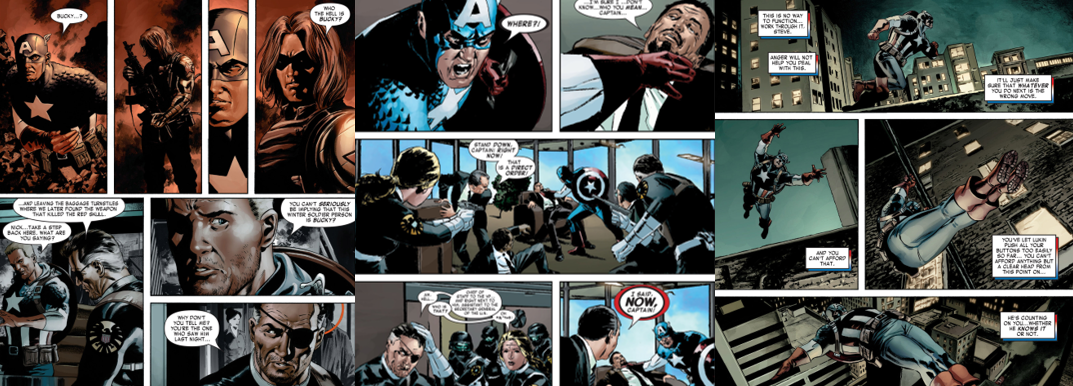
Our story begins way back in 1945 in an experimental Soviet submarine floundering in the English Channel. There, we find the crew intercepting coded messages from Nazi Germany confirming that Captain America was blown up over the Channel Islands and, accordingly, they move to intercept and discover a heavily injured, one-armed survivor floating in the sea. We then jump to the Helicarrier, the flying battleship headquarters of the Strategic Hazard Intervention Espionage Logistics Directorate (S.H.I.E.L.D.), where Nick Fury and Sharon Carter/Agent 13 show Cap photographic evidence of his old partner, Bucky, appearing older and alive and well despite seemingly perishing in that aforementioned explosion. Naturally, Cap isn’t just sceptical, he’s in full-blown denial, believing it must be some kind of trick and refusing to entertain the idea that his friend is not only alive but responsible for a horrific act of terrorism in Philadelphia. Specifically, a devastating bomb attack that saw Cap clash with Advanced Idea of Destruction (A.I.D.) whose beekeeper agents appeared to recover the tech, mercilessly gunning down any survivors, and set their Military Operatives Designed Only for Combat (MODOC) Squad on Cap. His skills tested by the seemingly semi-cybernetic ninjas as they quickly adapted to his superhuman abilities, Cap nevertheless bested his foes, though was wounded by a knife to the gut. Distracted by the wound, Cap was almost picked off by a MODOC soldier but was unexpectedly saved by a mysterious man in a domino mask and sporting a cybernetic arm, whom Cap recognised as his old partner, seemingly back from the dead and with no memory of his real name. Though his mysterious saviour fled, Cap’s told by Fury that he’s cropped up across the world over the decades as the “Winter Soldier”, a near mythical assassin for the Committee for State Security (KGB) who’s said to be kept in suspended animation between jobs. Unable to deny the evidence, Cap first lashes out and then commits to Fury’s plan to find Aleksander Lukin, the man behind the Philadelphia attack, and relieve him of his Cosmic Cube, dealing with the Winter Soldier if and when he crops up along the way.

Already frustrated by bureaucracy, Cap’s distraught to learn of Bucky’s horrendous fate.

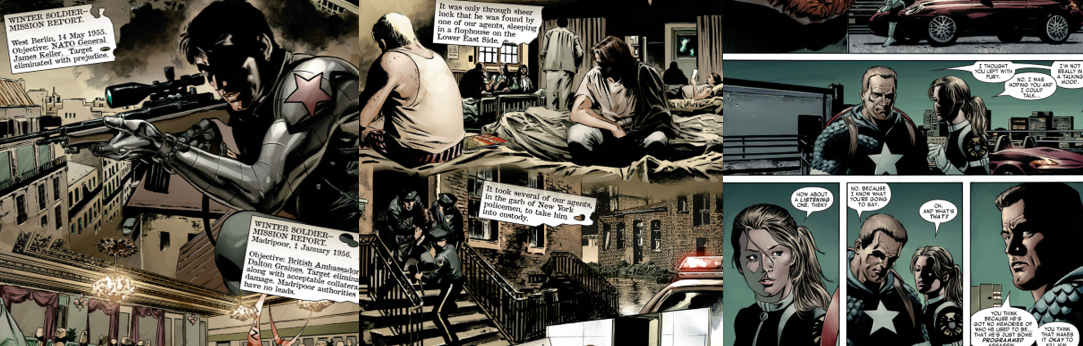
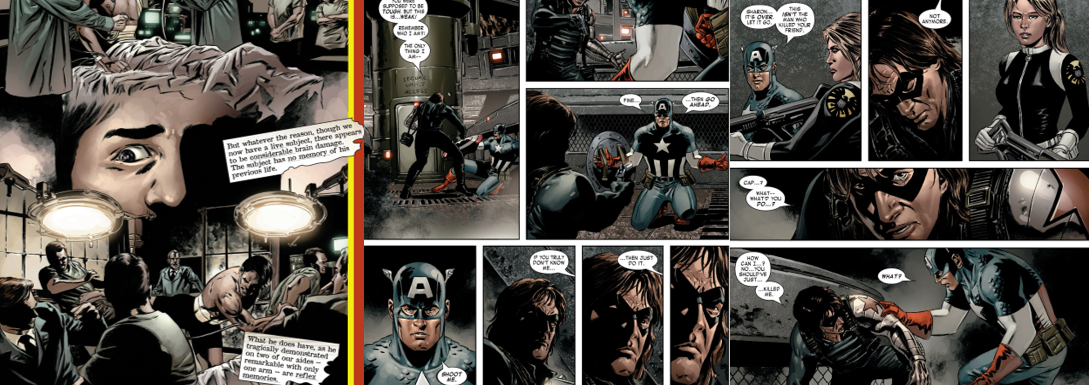
While Brock Rumlow/Crossbones picks off soldiers stationed at a “re-education facility” and kidnaps the amnesiac Synthia Schmidt, daughter of the Red Skull, to set up a future conflict, Cap and Sharon prepare to drop into Mongolia but find their relationship strained since, just the day before, Sharon raged at Cap for recommending she be kept off the mission. Although Steve argued that he was trying to avoid her going off on a vendetta since her boyfriend was killed in the Philadelphia attack, she believes he was trying to keep her from killing Bucky and remained steadfast in his belief that the overwhelming evidence against his former friend was either faked or a misunderstanding. It doesn’t help that, two days previously, Fury confided to Steve that the mission isn’t authorised by the United States government, primarily due to all the “red tape” and diplomatic drama Lukin caused with his own little empire, Kronas International, on the Mongolian border. Cap, Sharon, Fury, and a S.H.E.I.L.D. squad storm Kronas, setting aside their grievances to fight their way inside, only to find Lukin hosting a meeting with high-ranking American politicians! Though ordered to stand down, Cap is aghast to find they’re brokering an oil pipeline deal with Lukin and refuse to believe he’s anything other than a lucrative businessman since all the evidence points to a convenient patsy, Jack Marlow. Forced to leave and unable to act since Lukin has diplomatic immunity, Cap stews on the ride home though he, Sharon, and Fury vow to topple the maniac one way or another. Luckily for them, a dossier mysteriously vanishes from Lukin’s office and ends up in Cap’s apartment. The document details how the injured Bucky was saved from death by the freezing water, revived by Soviet doctors, and suffered from brain damage that left him only with the instinct to fight. Though dismayed to find he wasn’t subjected to the super soldier serum, Bucky was kept in stasis and later fitted with his prosthetic arm. Bucky was then subjected to invasive brainwashing, reconditioned to become a loyal soldier and assassin for the Soviets, and easily  assassinated high profile targets as the Winter Soldier. The dossier explains, in great detail, the Winter Soldier’s early missions, which were all completed successfully, and that he was kept in stasis since his mental state became increasingly unstable while conscious and threatened to undo their brainwashing.

Bucky’s violent past as the Winter Soldier causes tension between Cap and Sharon.

This came to a head in 1973 when, after assassinating his latest target, the Winter Soldier  fled across America. Desperate to retrieve him, the Soviets aggressively interrogated anyone they could before finally following his erratic movements to New York City. Although he was apprehended, the incident rattled the Soviets and they decided not to deploy the Winter Soldier on American soil. The Winter Soldier was next charged with safeguarding Major General Vasily Karpov, who was highly suspicious of his “bodyguard” because of his background, though he took a perverse pleasure in the irony of an American protecting him. After successfully mitigating America’s efforts to invade the Middle East for about five years, the Winter Soldier was decommissioned and left to rot in an undisclosed location alongside other abandoned experiments. Disturbed by the dossier, Steve calls Fury and Sharon to discuss it further, believing Lukin used the Cosmic Cube to deliver the dossier to taunt him. Fury takes the document to be verified, though both he and Steve are confident that it’s accurate. Although Sharon believes that Bucky is lost to decades of Soviet brainwashing, Steve is adamant, based on the evidence, that a part of Bucky’s true self is still alive. Steve’s emotions are heightened by memories of when he and Bucky were celebrated War heroes. Back then, Bucky was an enthusiastic and thrill-seeking teenager in contrast to Steve’s more sombre respect for the harsh reality of war. Steve also remembers when he first met Bucky, then a plucky kid with some impressive fighting skills. Though initially hesitant because of his age, Steve agreed to take Bucky as his partner to inspire teenagers to sign up to the Army. Back in the present day, Steve and Sharon continue to butt heads and morals regarding the Winter Soldier: while Sharon believes he should be killed for his crimes, Steve refuses to entertain the idea that Bucky was anything other than an unwilling puppet.

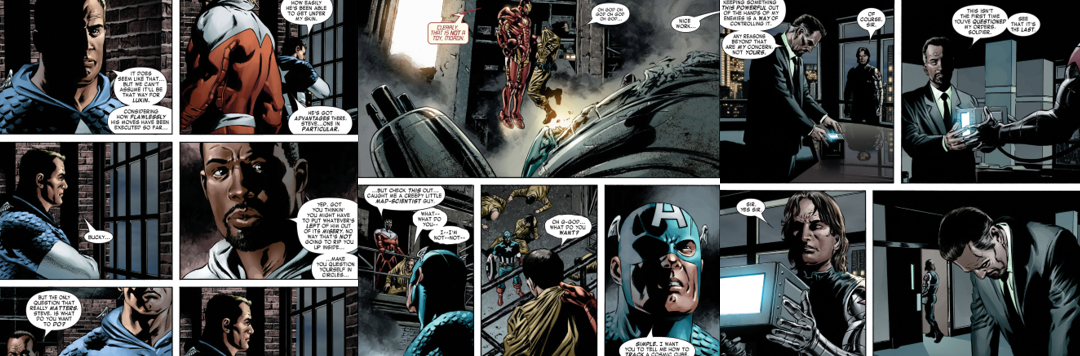
Falcon and Iron Man help Cap track down the Cosmic Cube, which is guarded by the Winter Soldier.

Meanwhile, Lukin hosts a bidding war for his Cosmic Cube, proving its reality-bending power not just by manipulating the bidders to attend but also compelling them to sign documents to make their corporations subsidiaries of Kronas. However, during a recess, Lukin stumbles and appears physically drained by the Cosmic Cube and is driven into a violent rage when his aide dares to caution against its use. While racing across the city rooftops, Cap also finds his emotions in turmoil, desperately willing himself to get it together to save his former partner. He remembers another time when the two were fighting through the Netherlands in pursuit of the Red Skull and they were horrified when their enemy sent boobytrapped prisoners of war to curtail their counterattack. Cap’s thoughts are interrupted by his friend and former partner, Sam Wilson/The Falcon, who offers Steve a friendly ear and speculates that there’s more going on with Lukin and the Winter Soldier. Unlike the sceptical Sharon and Fury, the Falcon agrees to help Steve save Bucky and the two bring in Anthony “Tony” Stark/Iron Man to raid an A.I.D. facility. Though they encounter some resistance from a gigantic, weaponised mech suit, the three subdue their targets and force them to hand over the means to track the Cosmic Cube. Thanks to Tony’s tech, the three discover that the Cosmic Cube is heading to a Kronas research facility, unaware that Lukin has tasked the Winter Soldier with spiriting the Cosmic Cube far away and burying it, believing it to be cursed. Unfortunately, Tony’s unable to accompany them as recent corporate shenanigans would make it look bad for him if he was seen tangling with Kronas. Thus, Steve and Sam head out by themselves (though, once she finds out about it all, Sharon organises a strike team) unaware that the Winter Soldier has taken up a sniping position.

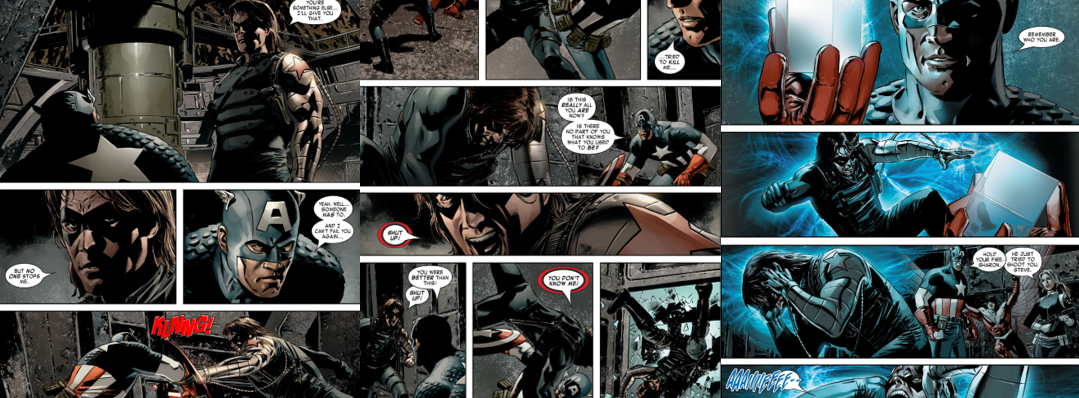
After a brutal slugfest, Cap restores Bucky’s memories with the Cosmic Cube.

Despite having the two dead to rights, the Winter Soldier misses a kill shot when the Falcon’s given a head’s up by the local birds and, his position compromised, calls in some backup to hold the gate. Undeterred, Cap charges through the troops, leaving the Falcon to cover his rear, and finally comes face-to-face with the Winter Soldier. Naturally, a brutal fist fight ensues during which Cap repeatedly tries to reason with his former friend and bring him to his senses and the Winter Soldier stubbornly refuses to listen to Cap’s words. Evenly matched, with the Winter Soldier’s bionic arm countering Cap’s vibranium shield, Bucky’s enraged by Cap’s repeated pleas, the fight spilling the two further into the facility. Realising that the Winter Soldier is determined to kill him, Cap surrenders and dares Bucy to pull the trigger. Sharon and the Falcon arrive in time to see not only the shot but also Cap’s superhuman reflexes; Steve dodges the bullet and tosses his shield, causing it to ricochet off the walls and knock he Cosmic Cube from the Winter Soldier’s grasp. Despite the Falcon earlier warning that no one has ever made the Cosmic Cube to work properly, Cap retrieves the artifact and utters a simple request: “Remember who you are”. Thanks to the Cosmic Cube’s reality warping powers, the Winter Soldier is bombarded by memories of both his past before he became an assassin and his time carrying working for the Soviets. Though Sharon’s ready to kill the Winter Soldier while he’s vulnerable, Cap talks her down and moves to comfort his traumatised friend. Overwhelmed by his actions and coming to his senses, Bucky lashes out in anger and remorse and grabs the Cosmic Cube, seemingly atomising himself as penance for his actions. However, Cap’s suspicions that Bucky’s still alive are quickly shown to be true, though Bucky’s left distressed by the ordeal. The story then ends with the reveal that Lukin shares his consciousness with the disembodied Red Skull, who chastises him for disposing of the Cosmic Cube and vows to assert full control in time.

The Summary:
This is my first time reading the “Winter Soldier” arc and I have to say that it lived up to the hype. Although I’m not the biggest fan of this art style, which was quite prominent in Marvel Comics at the time, it really adds to the mood and tension of the story. The arc is much more of a thriller than an all-out action piece, and a meditation on Captain America’s past and moral compass. As such, there isn’t really a primary villain for him to sink his fists into (an explosive scruffle with A.I.D’s mech is the best we get in this regard) and Cap instead battles more powerful enemies, such bureaucracy and international law. Despite possessing the Cosmic Cube, a device whose power is limited only by the wielder’s imagination (and their ability to keep a strong grip on it), Aleksander Lukin is more of an untouchable manipulator than a physical threat. As related by the Red Skull, Lukin never used the Cosmic Cube to its fullest extent, wary of its power and limited himself to small, controllable actions to mitigate its side effects. Indeed, the moment he experiences negative effects from wielding the Cosmic Cube, Lukin orders the Winter Soldier to dispose of it and is relieved to be rid of it. Still, Lukin remains a despicable villain, perpetrating horrendous acts of terrorism and hiding behind diplomatic immunity, making him the perfect foil for Captain America, who’s unable to bring Lukin to justice lest he spark a global conflict. Seen as a master manipulator who uses mind games and tricks to rile up his foes, Lukin otherwise hides behind his public façade and colludes with other, more disreputable forces (such as the Winter Soldier) to carry out his darker aspirations in secret.

Cap’s emotions are all over the place thanks to Lukin’s machinations and Bucky’s reappearance.

Consequently, “The Winter Soldier” would’ve been an extremely trying and aggravating time for Captain America even without Bucky’s involvement. Steve claims to be level-headed and focused on the mission but repeatedly loses his cool throughout the story thanks to Lukin’s machinations and his inner dialogue shows a man wrestling with his emotions. He has many outbursts over these issues, putting an aggressive beating on A.I.D’s forces and lashing out at both Fury and Sharon when they try to get him to see sense. The only person he doesn’t flip out on is the Falcon, who loyally stands by his side and takes his side even if he has his own doubts about the situation and the Winter Soldier. Cap’s shown to be in deep denial over the whole situation, first refusing to believe that Bucky is still alive, then refusing to believe that he’s a Soviet assassin, and stubbornly refusing to entertain Sharon’s arguments about killing the Winter Soldier or that there isn’t some part of Bucky still alive inside the killer. He’s partially right about this but I wonder if Bucky would’ve regained his senses without Cap using the Cosmic Cube and the story is very ambiguous about this, allowing the reader to see all sides of the argument. It helps that Sharon has a fully justified argument for killing the Winter Soldier. However, while is he responsible for many deaths over the years, Sharon’s judgement is clouded by her personal feelings since Bucky killed her boyfriend. Simultaneously, there’s no doubt that Cap is also biased towards Bucky and, believing he failed the boy by both involving him in his life and causing his condition, Cap’s determined to “save” Bucky, even if it means going against his present-day allies. Numerous flashbacks further reinforce this, showcasing Bucky’s incredible aptitude for fighting, his infectious enthusiasm, and how the atrocities of war affected him over time. Cap’s always carried a great deal of guilt and regret about Bucky’s death so it’s a shock to see his partner alive and turned into a mindless weapon and Cap sees it as a chance for redemption, both for himself and for his young friend. Cap believes so blindly in Bucky that he eventually refuses to fight and leaves his life in the assassin’s hands, then braves severe consequences by wielding the unstable Cosmic Cube to restore Bucky’s memories to the fractured Winter Soldier.

Bucky was totally reinvented as a bad-ass, tortured assassin.

Of course, the star of the show here is the titular Winter Soldier. At the time, I was sceptical about bringing Bucky back since he was one of the rare comic book characters who seemed destined to be dead forever. However, just like when DC Comics brought Jason Todd/Robin back as the Red Hood, retconning Bucky to have survived that explosion was a genius move that not only added new layers to Cap’s characterisation but also brought a bad-ass new anti-hero into Marvel Comics. Sporting long hair, a stoic visage, a form-fitting leather outfit, and an awesome robotic arm, the Winter Soldier cuts an intimidating and mysterious figure that’s only enhanced by his decades of assassinations. Restored to life and brainwashed by the Soviets, Bucky was transformed into a living weapon, a “blank slate” they could program to kill anyone they wished, one who easily infiltrated their enemy’s ranks since he looked and sounded just like them. Depicted as a natural fighter whose first instinct is to fight, the Winter Soldier is a keen marksman and an adept assassin, eliminating numerous targets when activated and easily holding his own against Cap despite lacking superhuman abilities. However, the Winter Soldier’s psyche is fractured, his mental state unstable, and he was frequently noted to be unreliable when activated for too long. When deployed on American soil, the Winter Soldier became confused and almost escaped his Soviet masters, ultimately leading to him being mothballed. It’s not made clear how and why he was released from captivity, but Bucky’s appearance causes a great deal of turmoil for Cap and their encounters cause confusion and anger in the unstable assassin. Obviously, much of Bucky’s past and future was cleared up in subsequent stories but this was a fantastic revival of the character, one that turned Cap’s life upside down and forever transformed Bucky from a plucky, annoying kid sidekick into a sexy, bad-ass killer.

My Rating:

Rating: 4 out of 5.

Great Stuff

Have you ever read the “Winter Soldier” arc? If so, what were your thoughts and what did you think to Bucky being revived? Do you think Sharon was right and that Bucky should’ve been put down? Did you enjoy seeing Cap wrestle with his guilt and conflicting morals? What did you think to the Winter Soldier’s look and backstory? Can you name some of your favourite Winter Soldier moments? How are you celebrating Independence Day today? Whatever your thoughts, drop a comment below and be sure to check out my other Captain America content across the site!

Wrestling Recap: Hogan & Rodman vs. Luger & Giant (Bash at the Beach ’97)

The Date: 13 July 1997
The Venue: Ocean Center; Daytona Beach, Florida
The Commentary: “The American Dream” Dusty Rhodes, Mike Tenay, Bobby “The Brain” Heenan, and Tony Schiavone
The Referee: Randy Anderson
The Stakes: Tag team match between heated rivals

The Build-Up:
On 4 September 1995, World Championship Wrestling (WCW) changed the wrestling industry with the debut of WCW Monday Nitro, which featured the unexpected WCW debut of Lex Luger and kicked off the “Monday Night Wars” by airing at the same time as the World Wrestling Federation’s (WWF) Raw is War. For eighty-four weeks, WCW dominated this ratings war thanks to signing wrestling’s biggest names to lucrative contracts, including Scott Hall and Kevin Nash, who regularly gatecrashed WCW programming to declare war on the organisation. At Bash at the Beach 1996, these “Outsiders” were joined by the legendary Hulk Hogan in a turn that legitimately shocked the wrestling world and reinvigorated Hogan’s career. Rechristened “Hollywood” Hogan, the former hero led the New World Order (nWo) as the WCW World Heavyweight Champion, leading to an alliance of WCW faithful to stand against the group. With Sting on a hiatus in preparation for dethroning Hogan, former nWo member the Giant and the aforementioned Lex Luger led the charge against the nWo, only for Hogan to bring in controversial basketball star “The Worm” Dennis Rodman for this tag team match. Rodman, who had long been a fan of professional wrestling, jumped at the chance to rub shoulders with Hogan and exacerbated the issues between him and Luger the previous month at Uncensored by costing Luger a triangle tag team match and joining Hogan in attacking and humiliating his opponent.

The Match:
This unlikely tag team contest occurred about one year after the nWo first dramatically formed and pretty much solidified that the group were the coolest baddies around since they were rubbing shoulders with the likes of Dennis Rodman. Amazingly, WCW Champion “Hollywood” Hulk Hogan and Rodman were accompanied to the ring by the “Macho Man” Randy Savage, a far more suitable pick for Hogan’s partner, though (as related by the commentary team) the purpose seemed to be to use Rodman to humble Hogan’s opponents and put WCW on the map using his celebrity status. Hogan and Luger started the match, with Luger getting the better of his opponent with some wrist and hammerlocks, so Hogan retaliated by baiting in and taunting his foe. After a bit of stalling, the two locked up and Luger muscled Hogan into the corner, though Hogan eventually answered back with a shoulder block, so Luger fired up and hit one of his own. Aghast, Hogan stalled on the ring apron, argued with the referee, posed, and pranced around the ring to drag out the action before luring Luger in with a test of strength and beating and choking him in the corners. Though downed by a slam, Luger dodged the Atomic Leg Drop and hit a big slam of his own, forcing Hogan to tag in Rodman. Rodman took a page out of Hogan’s book and pranced around, backing away from Luger’s challenge and sticking close to his corner, much to the annoyance of the crowd. When the two finally locked up, Rodman took Luger down with an arm drag, which caused everyone to lose their minds, so Luger retaliated by hitting Rodman and Hogan with multiple arm drags. Stunned, Rodman and Hogan retreated outside to reconvene with Savage before Rodman staggered back into the ring, leapfrogged over Luger, and hit a shoulder block.

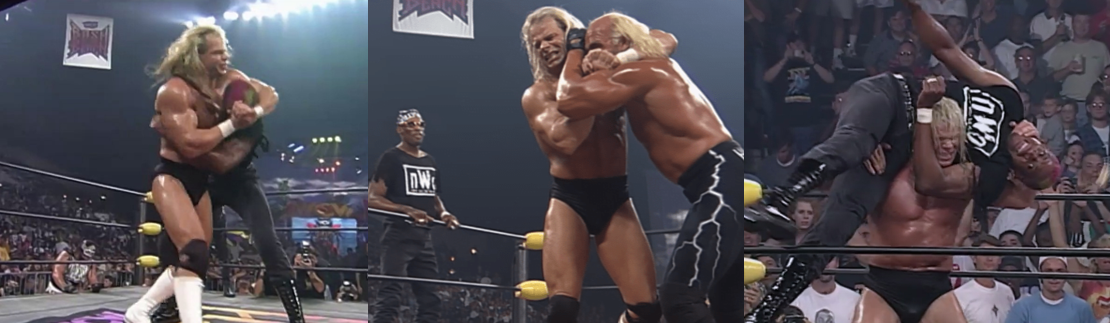
After much stalling and messing about, Luger scored the victory in this dull match.

Although Rodman impressed with two more leapfrogs, he got blasted by a Luger clothesline. When Hogan tagged in, Luger answered the crowd’s calls and brought in the Giant. Hogan gained the early advantage with some clubbing blows, choking and chopping the Giant in the corner, but retreating when the Giant shrugged off Hogan’s clothesline and threatened to Chokeslam him. When Hogan returned to the ring, he eventually got planted with an atomic drop and Rodman returned to the fray. Despite his fearless arrogance, Rodman got caught in a bearhug and hit with an atomic drop, but Hogan attacked when the Giant lifted Rodman with a chokehold. The nWo continued to make a joke of the Giant with double team moves and cheap shots and, when the Giant refused to drop after a big boot or be hip tossed, Hogan brought in Rodman but the Giant easily powered out of the cover even with both dogpiling him. Luger tagged in and went on a tear before being shut down by Rodman and dropped by Hogan. More shots and choking from Hogan left Luger powerless to avoid the Atomic Leg Drop, though he kicked out at two to no reaction! Rodman took over with some elbows and a foot choke in the corner, easily dodging Luger’s charge before being repeatedly knocked down by the Giant. After smashing Rodman and Hogan’s heads together, the Giant went to Chokeslam Rodman, only for Sting to whack him over the back with a baseball bat! However, Luger got Hogan up in the Torture Rack and secured the win, before slapping the hold on both Rodman and Savage. Although Rodman showed some impressive agility and held his own in the ring, there was way too much stalling in this match and I hated how the nWo dominated the Giant, who was continuously overwhelmed by the simplest of strikes. They seemed hesitant to kick into a higher gear since Hogan’s repertoire is so limited and Rodman obviously isn’t a competitor, resulting in a plodding and frustrating affair with an anti-climactic finish.

The Aftermath:
If you’re wondering why Sting, who was touted as WCW’s saviour from the nWo at the time, attacked the Giant and tried to cost the WCW team the match, it turned out that it was actually Kevin Nash in disguise. Luger’s victory made him the number one contender for the WCW Championship but, while the match was scheduled to take place at Road Wild the next month, Luger famously challenged Hogan one week early on WCW Monday Nitro. Although Luger scored the victory and became the champion, he lost the belt back to Hogan at Road Wild and Hogan remained champion until the controversial 1997 Starrcade. Luger moved on to feud with Scott Hall, Buff Bagwell, and “Big Poppa Pump” Scott Steiner before joining the nWo Wolfpac in 1998. He never became WCW Champion again, similar to the Giant, who rejoined the original nWo to feud with “Big Sexy” Kevin Nash before ultimately leaving WCW for the WWF in 1999. This wouldn’t be the last time we saw Dennis Rodman in a wrestling ring, either, as the Worm dressed as Sting to cost Luger the belt at Road Wild and teamed with Hogan again at the following year’s Bash at the Beach to take on Diamond Dallas Page and Rodman’s basketball rival Karl Malone before losing to Randy Savage at the 1999 Road Wild event.

My Rating:

Rating: 2 out of 5.

Could Be Better

Did you enjoy Dennis Rodman’s in-ring debut? What did you think to his performance in this match? Were you a fan of Lex Luger? What did you think to the way the nWo dominated the Giant? Who were your favourite members of the nWo? What are some of your favourite matches and moments from WCW’s Bash at the Beach pay-per-views? Whatever your thoughts on Dennis Rodman, Bash at the Beach, and WCW, feel free to voice them below, show me some love on Ko-Fi, and check out my other wrestling content.