

Released: 29 May 2018
Originally Released: 1 December 1990
Developer: SEGA
Also Available For: Mega Drive, Nintendo Wii, PC, PlayStation 2, PlayStation 4, PlayStation 5, PlayStation Portable (PSP), Xbox One, Xbox Series S
A Brief Background:
Back in the day, for a while there, ninjas were the latest craze, appearing as mutated turtles, rainbow-coloured fighters, or mysterious assassins, especially in videogames, where the challenge of ninja-based titles defined a generation of gamers. SEGA’s bid to get involved in the fad resulted in notable success with Shinobi (SEGA, 1987), a taxing but praised arcade title that was improved for home consoles. While its Mega Drive sequel, The Revenge of Shinobi (SEGA, 1989), was met with widespread praise, Shinobi’s first sequel was actually an arcade release just like the original game. Boasting improved graphics and teaming Joe Musashi with a canine companion, Shadow Dancer (ibid) released the same year as The Revenge of Shinobi and was largely praised, despite some aggravating mechanics. While a port was released for the Master System in some territories, the Mega Drive version was noticeably different, adding additional gameplay gimmicks while also being far more faithful to the arcade title than Shinobi’s previous home conversions. Well received at the time and standing the test of time as another classic title for the 16-bit powerhouse, Shadow Dancer was often included in subsequent collections, including the SEGA Mega Drive Classics collection that added a few quality of life mechanics to the game.
The Review:
I was all ready to do one of my regular lengthy reviews about Joe Musashi/Shinobi’s quest for revenge against the Union Lizard ninjas, only to find that Shadow Dancer adheres a little too closely to its arcade roots and therefore is too short to warrant a longer review. Like in the original arcade title, players run, jump, and toss shuriken though five levels (referred to as “Rounds”, with three stages each (the third being a boss battle). Players won’t need to worry about their health here as Musashi once again keels over and dies if he takes a single hit, though he can bounce and bump off enemies and some hazards so it’s only attacks that kill him. Like in The Revenge of Shinobi, players can set the game’s difficulty level, changing the title screen and increasing the number of enemies while decreasing the player’s continues, and will rescue hostages in each stage. Male hostages add to the player’s score, with a final tally adding additional points once a Round is cleared, while female hostages upgrade Musashi’s attacks and see him fling flaming projectiles and throw flaming kicks rather than using his sword for close-quarters combat. Players can add an additional challenge by disabling the shuriken (a death sentence if I ever saw one) and can pick from four different control types. I chose Type B, which mapped the jump to the A button, shuriken to the X button (with no rapid-fire option available), and Shinobi’s patented ninjutsu magic to the B button. Like in the original Shinobi, players are assigned different ninjutsu for each stage and only get one use per stage, earning a point bonus if they finish without using their magic. Musashi can conjure flaming pillars, whirling tornados, and a meteor storm to destroy all enemies, which is handy when you’re swarmed by ninjas. You’re also playing against a three-minute timer (though I always had plenty of time) and can occasionally collect extra lives by finding Union Lizard tokens.
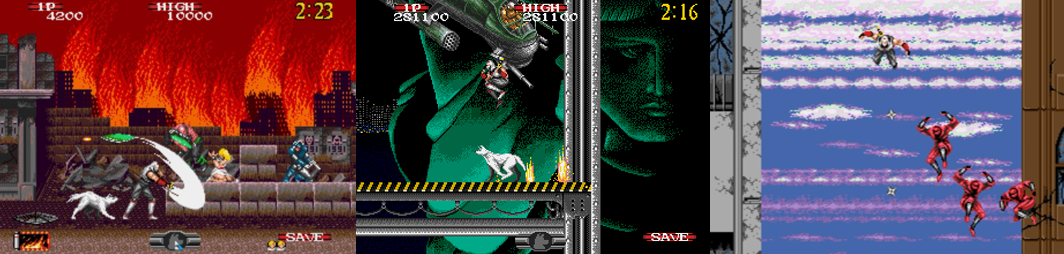
Though he lacks his somersault and shuriken spread and more versatile ninjutsu magic from The Revenge of Shinobi, Musashi can still duck, avoid projectiles using crates and boxes, and hop to higher ground or over fences by holding up and pressing the jump button. This is useful for evading enemies, finding hostages, and getting around some hazards and obstacles, though some enemies can follow you. The game’s big gimmick is the large white canine who fights alongside you. By holding the attack button, players charge a meter and, when released, Yamato pounces upon nearby enemies, distracting them so Shinobi can attack. If players don’t time the button press correctly, Yamato takes a hit and temporarily reverts to a useless puppy, though this mechanic was nowhere near as useful as it could’ve been. I found Yamato often wouldn’t attack and just yapped away uselessly. It would’ve been nice to see him have a more versatile move set, like giving you a jump boost, activating levers, collecting power-ups, or acting as a health bar of sorts so Shinobi can survive one measly hit! As ever, you must avoid bottomless pits and raging waters, though there are some interesting gimmicks that make Shadow Dancer stand out. Round 1-2 features a fun earthquake that splits the screen, for example, Round 3-2 takes place entirely on a rising elevator, Round 4-2 sees the environment and enemies obscured by sporadic shadows in a neat effect, and Round 5-1 is a multi-room gauntlet against swarms of the game’s toughest enemies. Shadow Dancer is incredibly unforgiving at times thanks to its one-hit-kill mechanic, with enemies circling and bouncing you around or knocking you down pits. However, you can hold the Left Trigger to rewind the game, hold “Home” to create or load a save state, and use the Right Trigger to fast forward the action. As in the original arcade Shinobi, a Bonus Round breaks up the action between Rounds. In this section, you frantically toss shuriken at ninjas as Shinobi dives from a skyscraper, earning additional points to claim a few more extra lives depending on how many you kill off.
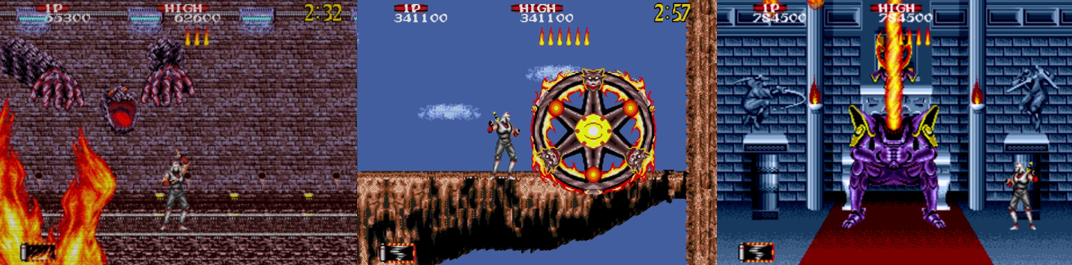
Musashi battles a handful of enemies in his quest for revenge. Mercenaries fire laser pistols, taking cover to avoid your shuriken, while their larger commanders shield themselves and toss their shields at your head or shins. Four different coloured ninja grunts regularly throw punches, stab with knives, or carry spears. The claw-handed Iron Claws leap in and roll about, frog-like Geckos crawl around the environment, and an attack helicopter takes shots as you scale the Statue of Liberty. Colourful, nimble ninja also teleport in, wielding dual katana and somersaulting about, slashing at you and attacking in large groups, deflecting your shots and being tougher to kill depending on their colour (with black being the worst!) Each Round ends in a battle against the big bad Sauros’s “Aides” (though, ironically, the titular Shadow Master isn’t amongst them) not unlike those of the original Shinobi. Each appears in a flash of lightning, has a health bar, is fought in an enclosed arena, and players must fight without Yamato or Musashi’s powered-up attacks. Stomper is a giant, distinctly beetle-like samurai who, like Shinobi’s Ken-Oh, spits fireballs that are tricky to dodge. This is compounded by his massive hit box, the debris he rains down, and how tricky it can be to hit his helmet. Mirage is a nimble dominatrix who leaps off screen and tosses large buzzsaws, which she also uses to shield her vulnerable head. At the end of Round 3, Sauros brings a brick wall to life. This screaming monster randomly spawns across the background and attacks by extending and dropping its hands towards you, which are pretty difficult to avoid. Round 5 sees you battle Blade, a spinning, pentagram-like Catherine Wheel that circles your falling platform and tries to roast you, though you can easily spam your shuriken when it stays still. After battling past Sauros’s gauntlet, you face the main man reptile himself in a pretty anti-climactic confrontation. Sauros simply sits on his throne and spawns black ninjas to distract you, eventually detaching his helmet to rain fireballs into the throne room. This is your chance to attack the glowing orb that is his weak spot but be sure to position yourself between the flames!
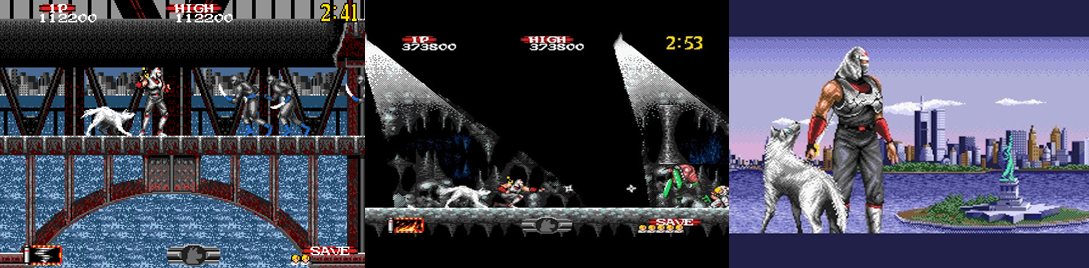
Shadow Dancer looks pretty good, being about on par with The Revenge of Shinobi and featuring large, well detailed sprites. While Musashi doesn’t show much personality, Yamato helps add some visual variety, which the sprites need as there is only a handful of enemies and they’re constantly recycled. Things get off to a decent start with an impressive bit of sprite animation and story text. Each Round is introduced with a big, but partially obscured map and sees Shinobi leap into action, and players are initially dropped into a desolate, seemingly post-apocalyptic city. The background is in flames, the buildings are wrecked, ninja burst from the windows, fire spews from the sewers, and debris falls from the sky! Round 2 sees you first traversing a partially destroyed bridge and then battling across disused railroad tracks, hopping to a rail cart and over fences, while Round 4 takes place in a desolate cavern that tests your platforming skills. Although Round 5 is a largely unimpressive warehouse, Round 3 sees you scaling the Statue of Liberty, hopping up girders and supports, and taking a lift to the torch, with Lady Liberty and New York City in the background. The music is pretty upbeat and fitting for the action, though there’s nothing as memorable as in The Revenge of Shinobi, and players are treated to a bit of partially animated sprite art and ending text upon completion. This version of the game offers filters to recreate the good old 16-bit days, screen borders, a mirror mode for an additional challenge, and two special challenges. If you complete the first two stages without using your magic, you’ll get an Achievement and if you can beat a stage with Yamato in his puppy form, you’ll either earn another Achievement if that’s the first Challenge you completed or be one step towards another Achievement.
The Summary:
Wow, I was so disappointed by Shadow Dancer: The Secret of Shinobi. I think I must’ve gotten the game confused with the far superior third game in the series as, while the game looks about on par with The Revenge of Shinobi, this is more like a visually improved version of the original, notoriously challenging arcade Shinobi. Joe Musashi lacks all of his improved moves and versatility from Revenge in favour of a cute canine who’s criminally underutilised. I barely used Yamato he was so useless, and it says a lot when your 16-bit, arcade-perfect videogame lacks mechanics that were included in the 8-bit port of Shinobi! Shadow Dancer would offer a decent challenge if not for the archaic and unfair one-hit-kills, which strangely carry over from the arcade version despite them being eliminated in other home console Shinobi games. While the game looks great and it can be fun searching for hostages, it’s pretty barebones, with only five Rounds and extremely limited ninjutsu magic, meaning you’re more likely to rely on your shuriken. Enemies were also painfully recycled, lacking any of the character and personality of those from The Revenge of Shinobi, and the plot is strangely bonkers, focusing on a lizard man with a ninja army? I’m not sure what the titular “secret” of Shinobi was supposed to be or why the game is called Shadow Dancer when that enemy doesn’t even appear, or why SEGA didn’t feel fit to enhance the arcade title to be more in line with the improvements made in The Revenge of Shinobi. If you’re going to play Shadow Dancer, this version is probably the best way since you can exploit the rewind and save state features, but this was a disappointingly hollow experience that didn’t do justice to what the Mega Drive – or the franchise – was capable of.
My Rating:
Pretty Good
Did you enjoy Shadow Dancer: The Secret of Shinobi? How do you think it compares to the arcade version and other 16-bit Shinobi titles? Were you also disappointed that it included one-hit kills and greatly limited your options? What did you think to Yamato and how useful did you find him? Which of the bosses was your favourite and what do you think the “secret” of Shinobi was? Which Shinobi game is your favourite? Let me know what you think about Shadow Dancer: The Secret of Shinobi in the comments, send me some coppers on Ko-Fi, and go read my other Shinobi reviews.

 Dr. K's Waiting Room
One thought on “Mini Game Corner: Shadow Dancer: The Secret of Shinobi (Xbox Series X)”