
Released: 2 December 1989
Developer: SEGA
Also Available For: Android, Mega/SEGA-CD, Mega-Tech, Nintendo Switch, Nintendo Wii, PC, PlayStation 2, PlayStation 3, PlayStation 4, PlayStation 5, PlayStation Portable (PSP), Xbox 360, Xbox One, Xbox Series S/X
The Background:
Back in the 1980s, ninjas were a big deal. Mysterious, agile, swift-footed martial artists tossed shuriken and took movies, comic books, cartoons, and videogames by storm. We had everything from silent assassins working for the US government, mutated turtles, a slew of rainbow-coloured warriors, and games so iconic and so challenging that they defined a generation of players. SEGA saw considerable critical and commercial success with Shinobi (SEGA, 1987), a tough but rewarding arcade title later refined for its home console conversion. For the sequel, director Noriyoshi Ohba wished to showcase the then-new Mega Drive hardware through a more story-driven title, one better suited to the home console market. Thus, Shinobi gained a life bar and was purposely given a steep difficulty curve to encourage player experimentation. To balance things out, Shinobi was given a finite magic system to help in trickier situations, as well as a handy double jump for improved platforming. Of course, the game became notorious for including unlicensed appearances by major pop culture icons, leading to numerous revisions and graphical tweaks to avoid a lawsuit! One of the defining Mega Drive experiences of my childhood, The Revenge of Shinobi has stood the test of time as a classic of its generation, impressing with its visuals and gameplay variety as much as it frustrated with its mechanics and difficulty curve, and even directly inspired a semi-recurring comic strip here in the United Kingdom. The Revenge of Shinobi has had a tumultuous life post-Mega Drive, occasionally omitted from retrogame collections in favour of its sequel, though a remaster did briefly appear on digital stores (alongside some Trophies and quality-of-life features) in 2012.
The Plot:
When the criminal organisation Neo Zeed murders Joe Musashi’s master and kidnaps his bride-to-be, Musashi once again dons his Shinobi garb and sets out to rescue her.
Gameplay and Power-Ups:
The Revenge of Shinobi is a sequel to the arcade, ninja-themed run-and-gun (more of a “walk-and-gun”, I suppose) Shinobi and, like its predecessor, is an action platformer that sees players guide Joe Musashi, the titular “Shinobi”, across eight stages (billed as “Rounds”), each with three parts (referred to as “Scenes” in the manual and comprised of two action stages and a battle against the game’s “Power Villains”). The Revenge of Shinobi incorporates a “continue” feature, limiting players to three continues per game, and allows players to choose from four difficulty settings (with the hardest settings limiting how many lives they have) and four control schemes. Personally, I prefer “Type 2”, which maps Musashi’s attack to the A button, jump to the B button, and “ninjitsu” magic to the C button. You can also customise how many shuriken Shinobi starts with, and I’d recommend setting it to the maximum amount as you’ll be chucking a lot of throwing stars in this challenging title. Musashi’s primary attack is to throw ninja stars, which he can do while walking, crouching, or jumping. When enemies get close, Musashi strikes with his Oborozuki blade or a kick, with most enemies literally exploding after just one hit. Musashi has a decent, if clunky jump that players can use to hop over simple obstacles (walls, crates, and junk cars) or onto moving platforms, but he can also perform a somersault to reach higher ground or flip over chain-link fences. Unfortunately, this somersault is extremely finnicky to perform as, rather than simply tapping B twice, players must awkwardly press B at the height of their jump, meaning the somersault is effectively useless in restrictive locations like hallways and interiors. This also means you can’t hop halfway across a gap and then activate the somersault; if you try this, you’ll plummet to your death. It’s worth pulling this move off, though, as you can press A when somersaulting to fire a spread of shuriken, though this quickly depletes your stock. Luckily, players can break wooden crates for more shuriken, health, and even extra lives. However, you must watch out for sneaky (often unfair) timed bombs that can whittle down your health or send you down a bottomless spit thanks to the game’s aggravating knockback.
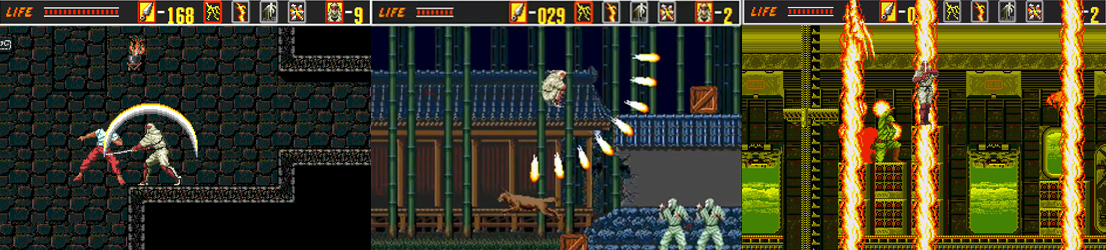
Musashi can also collect “Power Packs” to increase the speed and power of his attacks, gaining his sword and changing his shuriken to flaming projectiles. When walking or crouch-walking while powered up, Shinobi holds his kunai before him to reflect projectiles, which is a handy feature. Defeating enemies and clearing stages also adds to your high score, with Musashi’s life bar increasing by two when players reach 100,000 points and earning extra lives whenever they clear a Round or reach first 50,000 and then 100,000 subsequent points. Pausing the game lets you select one of four ninjitsu techniques to use with the C button, with each having different pros and cons. Ikazuchi, the “Art of Thunder”, surrounds Shinobi with an electrical shield to protect him from damage and even seems to hurt enemies, though it fades after too many hits. Kariu, the “Art of the Fire Dragon”, summons great plumes of dragon-like fire to damage all enemies. Fushin, the “Art of Floating”, increases the speed, height, and length of your jumps and somersaults, allowing you to easily cross gaps. Though it lasts until the Scene ends and can be used alongside other ninjitsu, it can be unwieldy. Finally, Mijin, the “Art of Pulverising”, sees Shinobi self-destruct, costing a life but dealing big damage to enemies and bosses. You can use each ninjitsu twice per life and can earn additional uses by finding rare ninjitsu items in crates; if you perform the somersault attack, you may also find hidden items scattered through the environments. Unlike in the original game, there are no quasi-first-person sections in The Revenge of Shinobi and no hostages to rescue. You simply move from right to left, taking out any enemies and crossing deadly gaps, until you reach the exit or defeat a boss. However, you must occasionally step on switches to open doors or clear a path, crouch-walk through hidden passageways, Fushin-leap across gaps, and ride moving platforms or chains to bypass instant-death hazards.
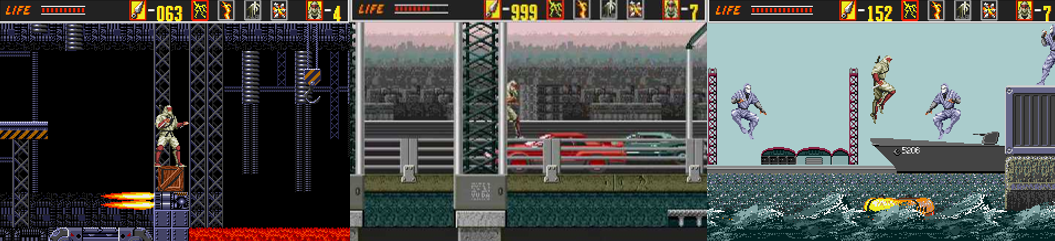
The Revenge of Shinobi starts out quite fair, demanding little from players than to avoid projectiles and hazards, but quickly becomes a challenging title. Players must avoid being skewered by bamboo spikes, crushed by sliding crates, and scorched by bursts of fire. Molten steel, raging waters, and bottomless pits will cost you a life and you must also take care to not be sucked out of Round 3’s air locks. Fushin comes in handy when tackling Round 2’s waterfall, where you hop to dropping logs and high platforms, and your jumping prowess is tested when you hop to and from Round 5’s bridge avoiding speeding red cars. When in Round 3’s military airfield, players must somersault over the chain-link fence to avoid or take out the armed guards stationed there, while Round 5 sees you hopping to moving laser turrets to scale Neo Zeed’s skyscraper headquarters. When navigating the pier Scene in Round 7, you must hop to rubber dinghies, then avoid the massive turrets stationed in a similar Scene in Round 8. Some stages, like Round 2: Scene 2 and Round 6: Scene 1, see you using the rooftops to avoid enemies and pits, while Round 6: Scene 2 sees you ducking and jumping over hazards while plodding across a speeding train. While you’ll encounter enemies popping from hidden doors as early as Round 2: Scene 2, Round 8: Scene 2 presents a frustrating door maze, where you must choose the correct path, battling every enemy faced in previous stages, and thanking the gaming gods that The Revenge of Shinobi doesn’t have a timer and that online guides are a thing! Still, the game’s difficulty can be daunting at times. Musashi and his enemies have quite large hit boxes and Shinobi is a bit clunky to control, especially when jumping. You can’t scroll the screen up or down, making it easy to be blindsided by enemies; though, on the plus side, enemies don’t respawn. Those damn bombs also become a massive headache as you progress, to say nothing of enemies that deflect your shuriken or disguise themselves as nuns!
Presentation:
Although The Revenge of Shinobi was an early title for the SEGA Mega Drive, it’s still very impressive from a visual standpoint. Joe Musashi may not have any idle poses, but he strikes a dramatic pose with each ninjutsu, collapses in defeat when killed, and assumes a more aggressive stance when powered up. While the basic ninja enemies aren’t much to shout about, the samurai are far more detailed and I liked the agility of the Pink Dragon enemies, who fall to their knees after taking a few hits rather than exploding like Shinobi’s other enemies. These explosions are ridiculously fun and I liked how some enemies wield swords or other weapons that deflect your projectiles, forcing you to alternate between high and low attacks. While some stages can be a bit bland or cluttered at times and the game lacks the colourful, visual “pop” of the Mega Drive’s most popular titles, there’s a lot of detail in every area. Round 1: Scene 1 transitions from dusk to night, for example, waters rage in Round 7 and 8 (with the latter also including rain effects and a lighthouse in the background), and there’s some minor examples of parallax scrolling at work. The game’s introductory scene features a large, partially animated sprite of Sonny Chiba Musashi deflecting some shuriken and a still image of him holding his murdered sensei as the game’s plot appears in text. Between each Round, you’re treated to a world map that shows your progression and the game’s sound effects should be readily familiar to anyone who’s played the Streets of Rage trilogy (SEGA/Ancient, 1991 to 1994) since those games copied them, and some graphical elements, wholesale from The Revenge of Shinobi. The game is also a licensee’s nightmare, depending on which version you play, as Musashi encounters enemies clearly inspired by John Rambo (Sylvester Stallone) and bosses either inspired by or blatantly ripping off Doctor Robert Bruce Banner/The Hulk, the T-800 Terminator (Arnold Schwarzenegger), Peter Parker/Spider-Man, Bruce Wayne/Batman, and Godzilla! It’s surreal encountering these enemies, even if you’re playing a version that recolours or alters their sprites, as they’re decidedly at odds with he game’s more grounded aesthetic.
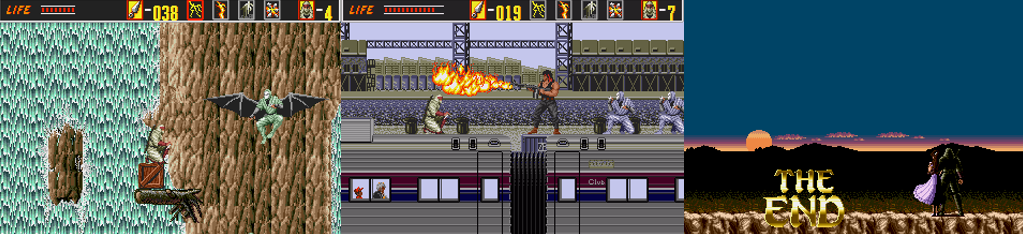
To be fair, though, The Revenge of Shinobi may start out rather mundane and traditional, with Musashi exploring a bamboo forest and guarded pagoda before hopping to the nighttime rooftops, he’s soon storming a well-armed military airfield, awkwardly navigating the claustrophobic interior of a steampunk-like airship, and somersaulting through the neon-drenched skyline of Chinatown. Equally, while his enemies start out as simple ninjas appearing in puffs of smoke or from hidden doorways, he’s soon taking on assassins disguised as nuns and dodging laser blasts from automated turrets. While the game’s soundtrack is practically burned into my memory, particularly the intro music and opening Scene, it is disappointing that The Revenge of Shinobi repeats a few of its tracks, especially considering the variety packed into each Round. This can also be a double-edged sword, to be fair: the train Scene, for example, starts off in a really bland tunnel and then jumps to the extreme with a cluttered and confusing background (though I liked seeing passengers mingling in the carriages). I enjoyed the chaos of the steel mill, however, and the busy bridge (despite how difficult it can be to avoid enemies and cars and not plummet to your death), and especially liked the detail in splashing waters in the pier Scenes. These effects were far more effective than in the waterfall Scene, where it can be difficult spotting enemies and even Musashi’s sprite due to the clashing colours. While the game strangely lacks an end credits sequence, there are two endings depending on how quickly you defeat the final boss and whether or not you rescue Naoko. I also liked that the Power Villains changed colours to visually indicate that you were dealing damage (though sound effects also helped with this), and how they dramatically exploded upon defeat, with some even breaking apart for added effect. While the game performs pretty well, never taxing the Mega Drive’s hardware too much, there can be some instances of slowdown and sprite flicker when a lot of big, moving sprites are present.
Enemies and Bosses:
There are only a handful of enemies in The Revenge of Shinobi, but the game eventually mixes and matches their combinations and offers palette swapped variants who are a bit tougher and more aggressive in their attacks. One of the most common enemies you’ll face are Neo Zeed’s ninjas (or Omote), who appear in a puff of smoke or from behind hidden doors or even flying about on bat-like wings! These guys can jump, somersault over you, and toss shuriken of their own, but explode in one hit. They’re bolstered by samurai (or Kabuto), who deflect your shuriken with their katana and have a long reach, and attack dogs that pounce at you. Neo Zeed’s reach extends to the American military, meaning you’ll often face off with soldiers armed with rifles, tossing grenades, or stationed behind machine guns. These guys can also lie on the ground and come in pairs to fill the screen with machine gun fire and are often accompanied by “Gunners”, the Rambo-esque brutes that carry flamethrowers. Kasumi (who win top price in the Elektra Natchios lookalike competition) fool you by disguising themselves as nuns and then leaping with a flying kick and sai in hand. The game’s Bruce Lee-like martial artists also utilise flying kicks, while the White Phoenix enemies have incredible reach with their spinning, bladed nunchaku. I really liked the Pink Dragon enemies, robed dancers who elegantly spin around, deflecting your shuriken, and take multiple hits to defeat before crumbling to their knees rather than exploding (a detail not mirrored by the Kasumi). These enemies eventually start mingling and you’ll encounter them all in Round 8: Scene 2, which can be especially aggravating as their projectiles and sprites take up screen space and box you in. It’s also worth remembering that the Gunner’s flames and the many bombs you encounter linger onscreen for a few seconds, so you must either take your time or execute a somersault to avoid damage. Hazards like jet flames, pits, molten steel, turrets, and lasers are also present, though you can use some of these to help upwards in some Scenes.
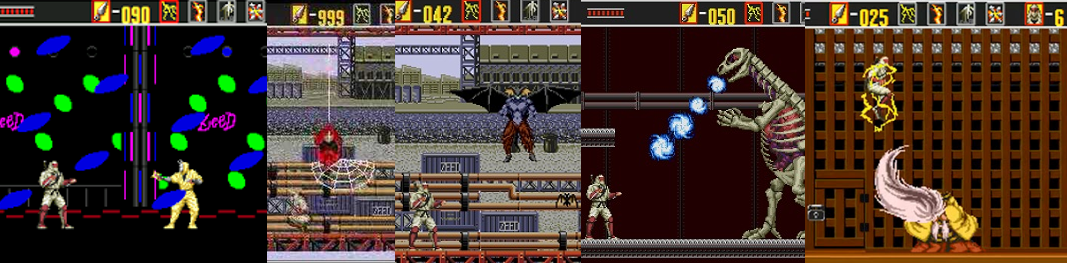
Each Round ends with a battle against a “Power Villains”. The first, the Blue Lobster, is a large samurai who shields himself and has fantastic reach with his Masamune-like blade. However, by utilising the arena walls, you can avoid his attack and execute the somersault spread to whittle him down. Next, Shinobi encounters the super agile Shadow Dancer in a kaleidoscopic nightclub. This guy is essentially a supped-up Omote but he’s quite challenging as he can only be damaged when on the ground, fires a shuriken spread, and turns pitch-black near death to make him even harder to spot! Round 3 pits you against a heavily-armoured super computer, protected by ceiling lasers, that can only by damaged by targeting its exposed brain. At the end of Round 4, you battle the “Master Attacker” in the junkyard. This hulking brute tosses cars and debris, has a shoulder charge, and turns out to be a kamikaze robot, but you can again use the high ground and somersault attack (or Kariu) to damage him. Next, you’ll clamber over a massive, missile-carrying vehicle, attacking the red orbs when they pop up and avoiding shots, the blue spark that travels across the ground, and falling to your death. Round 6 sees you ambushed by Spider-Man and Batman (or a spider-like ninja and a menacing vampire) in a two-stage battle. Spidey crawls along the ceiling firing webs and descending on a web line (that also makes him invulnerable), while Batman swoops at you and is surrounded by bats (though these, like Spidey’s webs, can be destroyed). As if that wasn’t bonkers enough, either Godzilla or a fire-breathing Brontosaurus await in Round 7’s final Scene. Either way, you must again use the high ground to attack the beast’s head, watching for its atomic breath and large tail, and hopping from one side to the other to avoid damage. Finally, Shinobi battles “The Boss” for Naoko’s life. This squat, kabuki-like crime lord is mostly stationary but protected by a mane of impenetrable hair that he whips and flings at you. You must stay close, firing at his exposed belly, and utilise Ikazuchi (since all other magic seems ineffective) to outlast his attacks and finish the fight quickly, otherwise Naoko will be crushed!
Additional Features:
As mentioned, there are multiple difficulty settings in The Revenge of Shinobi. So, if you somehow find the game too easy on “Easy”, you can give yourself a harder challenge by limiting how many lives you have. There’s no real benefit to this other than bragging rights, though, as the ending you receive relies solely only how first you defeat The Boss and if you can keep Naoko from being killed. If the game proves too challenging, you can set the shuriken count to 0 in the game’s “Settings” menu and wait a few seconds for the number to change into an infinity symbol, granting you unlimited projectiles. Hidden extra lives can also be farmed in some Scenes, though there’s oddly no high score table to aim for (you must record your score in the manual like some kind of caveman!) If you’re lucky enough to still own the seventh-generation remaster, there are twelve Achievements/Trophies to obtain, with one being awarded for using all ninjutsu attacks, one for beating the game without a continue, and others for oddball tasks like deflecting ten attacks or falling down a waterfall. Other modern re-releases are oddly missing Achievement support but do come with save states and, often, rewind features, which make this challenging title far easier and much more enjoyable to playthrough.
The Summary:
Like many kids back in the day, I’m sure, The Revenge of Shinobi was an essential title in my Mega Drive library. This was probably the most challenging game I owned back then, yet I kept it and often revisited it time and again despite often running into a brick wall around Round 7. Years later, I picked up the remaster for the PlayStation 3 and finally finished the game for the first time, and I’m still a bit regretful that I ended up selling that console and losing that version of the game. Thanks to re-releases, The Revenge of Shinobi is more accessible than ever but there’s something magically nostalgic about revisiting it on original hardware. The game holds up pretty well, especially the soundtrack and some of the sprite work. It can be clunky at times (Joe Musashi is very slow and his jump, particularly his aggravating somersault, are difficult to master) and the environments lack a lot of the detail and variety you’d expect from later Mega Drive titles, but I appreciate that the developers tried to make each Scene stand out in their own way. I still get a thrill hearing that Round 1: Scene 1 beat kick in and laugh every time those blatantly ripped off enemies crop up, and I love how Musashi can hop behind chain-link fences and bolster his attacks with ninjutsu magic. The Power Villains are all large and suitably impressive, testing your jumping skill and forcing you to think about when and how best to use your ninjutsu, while the stage variety always keeps you on your toes. I may not enjoy the bridge, train, or many of the platforming mechanics and that damn door maze might’ve driven me mad, but I’m glad that the game tried to be a bit ambitious and mix things up. It’s a shame that the developers didn’t rejig the first-person-esque sequences for the first game or the hostage rescue mechanics into mini games or gimmicks for some Rounds, and that the screen area is unnecessarily restricted at times, but this is still a classic mega Drive title. It was undoubtably surpassed by its sequels, but there’s a special kind of magic to the Revenge of Shinobi that still gives me the feels to this day and I’m always glad to boot it up again, though I admit this blatant nostalgia is the reason it gets an extra fourth star as the awkward controls, slow pace, and difficulty curve do bog it down.
My Rating:
Great Stuff
Was The Revenge of Shinobi a staple of your Mega Drive library back in the day? How do you think it compares to the first game, and its sequels? Which of Musashi’s ninjutsu attacks was your favourite and did you also struggle with his somersault attack? What did you think to the stage variety and the soundtrack? Which version of the game did you own and what did you think to the crazy bosses? Did you ever defeat The Boss and rescue Naoko? Which of the re-releases is your favourite and would you like to see a Shinobi collection released for modern consoles? Share your memories and opinions on The Revenge of Shinobi down in the comments, go support me on Ko-Fi, and check out my other Shinobi reviews.

 Dr. K's Waiting Room
5 thoughts on “Game Corner: The Revenge of Shinobi (Mega Drive)”