

Released: 11 June 2024
Originally Released: 15 September 1994
Developer: Konami
Also Available For: PC, PlayStation 4, PlayStation 5, Super Nintendo Entertainment System (SNES)
The Background:
Sonic the Hedgehog’s (Sonic Team, 1991) incredible success paved the way for a slew anthropomorphic mascot platformers back in the 1990s. We had everything from a heroic frog, a gun-toting jackrabbit, an intergalactic adventurer, a fragile bobcat, and a superpowered earthworm, so why not a possum with a rocket pack? Created by Nobuya Nakazato, who spearheaded many Contra titles (Konami, 1987 to present), Rocket Knight Adventures (Konami, 1993) became one of the most popular and lauded titles for the Mega Drive. Although a SNES port was allegedly cancelled, Rocket Knight Adventures was followed by two sequels the very next year: one a notoriously expensive Mega Drive-exclusive title and this similarly-titled but unrelated SNES-exclusive game. Although largely praised for its visuals and gameplay, Sparkster was criticised for not further expanding upon the first game’s formula and 1994 was, essentially, the end of Sparkster’s brief time in the spotlight. Although Sparkster did get a six-part story in Sonic the Comic (1993 to 2002), he didn’t get a cartoon like his more popular peers and was forgotten until Climax Studios attempted a revival in 2010, to mixed reviews. Sparkster, and its other 16-bit titles, finally got a modern re-release with this Re-Sparked! collection, a well-received release that included bonus materials and quality of life features.
The Plot:
When the kingdom of Eginasem is attacked by Generalissimo Lioness’s Wolf Army and Princess Flora is kidnapped by rogue Rocket Knight Axel Gear, Sparkster fights to save the land.
Gameplay and Power-Ups:
Like its predecessor, Sparkster is a 2D, sidescrolling action platformer with run-and-gun action in which players take control of Sparkster and his rocket pack and battle through a fantasy land infused with a dollop of steampunk madness. As before, players choose between three different difficulties, though you’ll only experience the full game and the true ending by playing on at least “Hard”. To aid with this, Sparkster incorporates a password system, one still relevant as the rewind and save state features won’t help you when you get to a nigh-impossible boss battle in the late game. Sparkster’s entire repertoire of moves and abilities returns alongside a couple of additional abilities. You jump with B and attack with Sparkster’s sword and sword beam with Y. As before, holding this button charges Sparkster’s rocket pack, allowing him to blast off in the direction he’s facing, straight up, or diagonally. If you don’t press a direction, he simply spins on the spot and, when aimed at walls, he’ll ricochet to higher areas. While there’s no need to swim this time around, Sparkster still clings to vines, branches, and poles with his tail and you’ll be hopping, sliding, and jumping to these purchases a lot more this time around. Pressing L or R sees Sparkster perform a flaming kick, of sorts, for an additional attack and mid-air boost, something you’ll be using a lot to reach higher platforms as Sparkster’s otherwise uncontrollable after blasting off. Although there are still no power-ups to collect, you can grab gems to increase your score (and your life count once you get 100 gems), the odd 1-up, and fruit (apples and bananas) to refill your health. There are far more gems this time around as well, possibly to offset the steep difficulty curve, but there are no horizontal sections where you blast along using Sparkster’s rocket pack.
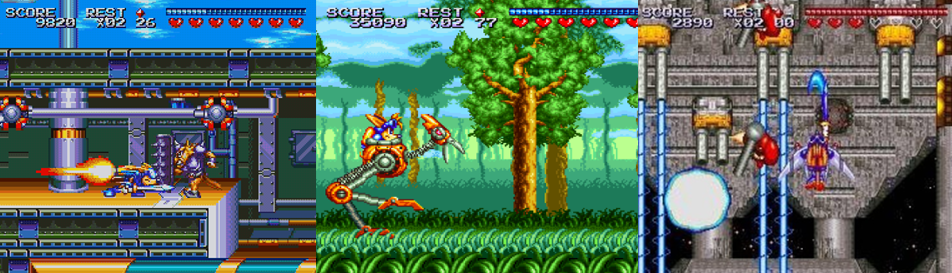
However, the spirit of these sections is evoked when Sparkster hops on a chicken-like mech and races through the jungles in Stage 3. In this long section, you press Y to fire a ring shot from the mech’s mouth while also attacking with Sparkster’s sword beam to dispatch enemies coming from behind. You must also duck under spikes and other hazards, get launched to other mechs, and take out waves of enemies as you race along. Later, in Stage 7, the game adopts a top-down view and you control Sparkster as be flies through space in pursuit of Generalissimo Lioness’s massive ship. In this section, you can still fire Sparkster’s sword beam but can also hold B to fire a spread of pellets to take out turrets and enemies. This is actually a bit awkward thanks to the button placements and it’s easy to miss incoming projectiles as a result, though the section is a burst of exhilarating fun until you get to the near-impassable wall that is a top-down Rock ’Em Sock ’Em Robot mech-battle against Axel Gear. In Stage 4, you use tubes to blast around the interior of an attack submarine and must avoid water jets that blast you into ceiling spikes. Stage 5 sees you venture into a pyramid, one that constantly shifts as you pass door-like tiles. You must shift and rotate the environment to find goodies and progress, which can be very aggravating and confusing as it’s not immediately clear which configuration you need to move on. Later in this same stage, you ride a translucent, rotating triangle platform up a shaft, avoiding spikes as you go, while high-speed tubes masquerading as musical instruments blast you along or send you back a fair bit in Stage 6. This stage also sees you bouncing to drums, riding air currents, and using teleports not unlike those in Rocket Knight Adventures.
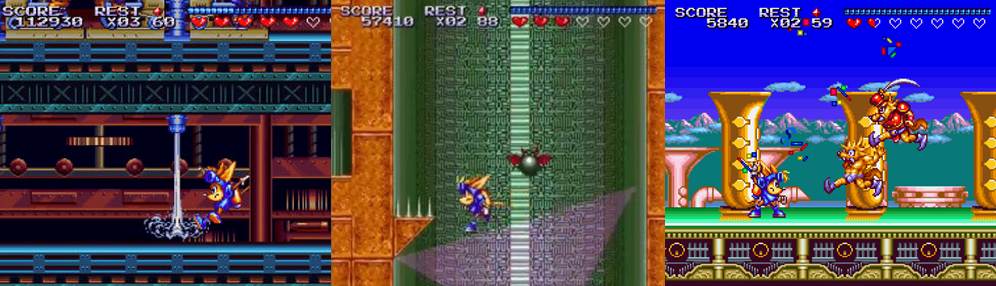
Sparkster is extremely similar to Rocket Knight Adventures, so much so that, at times, it feels like a SNES reimagining of the first game. You begin in a very familiar medieval forest setting, blast to a steampunk-like ship, and encounter many of the same hazards at times. Similarly, the game’s difficulty curve is slow but steep and things start off easy enough, even with the seemingly endless waves of enemies spawning in, but you’ll soon see boulders transform into enemies, clamber between bars and poles to avoid molten metal, and battle against conveyer belt platforms that push you towards instant-death gears. Giant crushing hazards are also present alongside an odd paint mechanic in Stage 2 that briefly turns you red, sheer drops in Stage 3 where it’s almost impossible to avoid being damaged by robotic owls, and bursts of steam courtesy of wolves running on treadmills in Stage 4, which also includes an all-too-brief pogo mechanic. Stage 4 also sees you frantically outracing a wall of rushing water not unlike the flame wall from Rocket Knight Adventures, except this one pushes you into wall spikes or drowns you in seconds if it overtakes you. Stage 6 also has you quickly hopping between cymbals trying to avoid being crushed when they clap together and falling into the tubas, which warp you back to the start of the obstacle course. Stage 7 is, essentially, a pretty standard top-down space shooter that has you weaving between laser blasts and destroying turrets, while Stage 8 has you traversing a long corridor on a space station and ducking under gigantic missiles that instantly kill you on contact. You’ll also ride a flame burst up a long shaft battling an oddly shaped wolf mech and encounter ceiling turrets that bounce lasers off bug-shaped robots. While instant death hazards and bottomless pits aren’t as prominent in Sparkster and there are far less tricky sections where you’re outracing crushing or dangerous hazards, the gigantic bosses and some cheap moments are sure to wipe out your stock of lives.
Presentation:
Although Sparkster overhauls the graphics and presentation of Rocket Knight Adventures, redesigning Sparkster into a more serious, anime-inspired protagonist, it continues the same cartoonish charm of the first game. Leaner and sporting a grim frown, Sparkster constantly has one paw on the hilt of his sword, glares at you when left idle, and squeals when hit or killed. Sparkster outdoes its predecessor with a more elaborate title screen and opening cutscene, which employs in-game sprites to show Axel Gear kidnapping another princess. This scene, Sparkster’s cannon blast to space, and Axel’s later escape from Sparkster’s wrath all closely resemble cutscenes seen in Rocket Knight Adventures, lending more credibility to my claim that this game is part-sequel, part-remake. Unfortunately, there are far less cutscenes like this in Sparkster, no stage intros, and the music is a far cry from the first game. While it’s jaunty enough, there are no tunes to rival the main theme of Rocket Knight Adventures and, while the game performs far better, with none of the slowdown from the first game, this is greatly aided by Rocket Knight Adventures: Re-Sparked’s “Boost” toggle from the ZL menu. Still, there are a lot of impressive visual effects included here; day turns to dusk turns to night, the Stage 7 missiles have a quasi-3D look, Sparkster’s rocket pack seems to charge faster, and there’s a unique (if odd) feature in Stage 2 where all sprites are rendered as silhouettes behind giant white screens. I also really enjoyed the sense of speed as you race along on your chicken-walker in Stage 3. The environment blurs past and there’s a lot of action here and, thankfully, no bottomless pits or unfair, split-second tests of your reflexes.
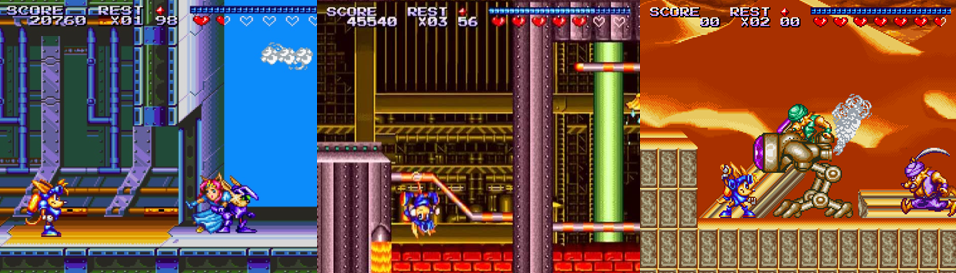
Sparkster seems to lean into the steampunk/fantasy aesthetic far more than Rocket Knight Adventures. You start in an open field, hopping to branches and trees, before blasting to Axel’s ship in what’s basically a combination of two stages from the first game. Clouds fly past the ship, which features flashing lights, destructible elements, and wolves popping from holes in the floor. Stage 2 is a cluttered factory that’s a mess of chains, lights, steam, and tubes and can be tricky to navigate as a result. Similarly, Stage 5’s desert exterior can be confusing as many columns and stone blocks obscure you. There’s a neat heat shimmer effect to this stage and I did like venturing into the pyramid; as perplexing as it was, it was far more memorable than the attack sub. You do end up outside this submarine, going to the left side of the screen and taking down biplanes, but it’s a bit dull compared to Stage 6’s bizarre musical-themed world. While this sticks out like a sore thumb against the other steampunk and medieval settings, it’s certainly whimsical and unique, even if it’d be more suitably in Zool: Ninja of the Nth Dimension (Gremlin Graphics, 1992). Stage 7 may just be a space shooter but there’s a lot of detail on the Generalissimo’s gigantic mothership (too much, at times, as turrets, enemies, and projectiles are hard to spot). Generalissimo Lioness’s space station has an impressive curve effect to its long-ass missile corridor, multiple missiles sitting stationary, and claustrophobic missile shafts to ricochet around in. It’s all very visually similar to Rocket Knight Adventures but just different enough to be unique. Still, I would’ve liked a greater visual distinction between the Wolf Army and the Devotindos Empire as the wolves’ armour even flies off like the pig infantry’s and the game ends with a big sprite art of Sparkster flying at the screen, just like before. While this art and the background accompanying the credits is more detailed, it’s still all a little too similar to be truly original.
Enemies and Bosses:
Just as you decimated an army of wacky pigs in Rocket Knight Adventures, so too will you cut through various wolves in your quest to liberate Eginasem. These wolves are functionally identical to the Devotindos Empire’s infantry, charging you with swords and powering defences to keep you at bay. While they don’t wield bazookas, they pop from the foreground, transform from boulders, bounce you back with shields, and wear different outfits depending on which stage you’re on. Various wolf mechs also appear, such as the one fought when you ride a flame pillar in Stage 7, and wolves riding chicken walkers in Stage 5. Stage 5 also sees a wolf pilot the Elephant Robot in a fight that’s functionally identical to the Raccoon Robot mini boss from Rocket Knight Adventures. You must avoid its extending arms and buzzsaw hands (which play the keys at your feet), dodge the explosive maracas, and rocket into the orb on its forehead. Robotic enemies also appear, such as the aforementioned owls (returning from the first game) and various robotic drones shot down in Stage 3 and 7. Robotic shrimp-type-things bounce about on Stage 6, robotic worms pop from walls in Stage 4, and the massive, wacky robot monkey, Ukkey-Ukikky that acts as the mini boss of Stage 1. Ukkey-Ukikky leaps and dives at you, chasing you and trying to stomp you, and becoming more aggressive when you steal its bananas, though it’s not too difficult to rocket-charge into its big, stupid head. You battle a tripod robot not unlike an octopus in the pyramid, one which flies about after a few hits by spinning hits legs like helicopter blades. Stage 2’s mini boss is fought on a rising elevator whose core looms overhead as a glaringly obvious target, one protected by two turrets. You must also defeat a gigantic flying mech in Stage 7, one that punches, fires a spread shot, and explodes in a shower of apples upon defeat.
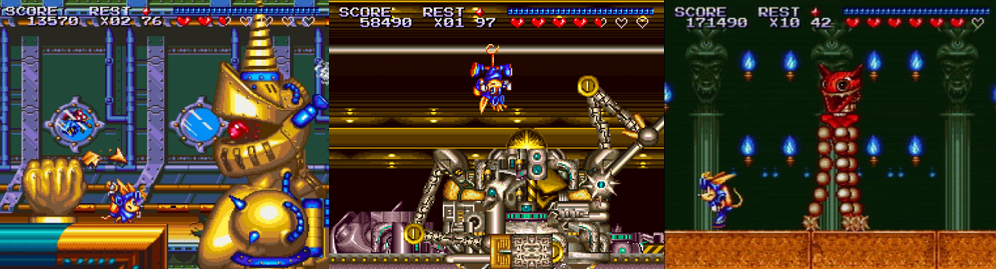
Colonel Wolfheim confronts you midway through Stage 3, piloting a praying mantis-like mech and relentlessly tossing bombs and flailing its long arms. Unlike the fight against Captain Fleagle, you simply attack Colonel Wolfheim’s mech directly rather than reflecting his bombs. Colonel Wolfheim returns atop the attack sub, now commanding a giant cannon protected by smaller turrets. After you deal enough damage, the cannon detaches and is revealed to be a mech, which fires a massive flame burst and swings its spiked arms around wildly. Your best bet is to get behind Colonel Wolfheim’s mech and rocket-burst into it. The first boss is Temper-Drilln, a gigantic suit of golden armour that bursts through the airship’s hull, spawns wolves to distract you, and fires an eye laser. You must hop to its fists as they punch through the floor and time your rocket charge into its eyes to bring it down, a difficult task given the limited room to manoeuvre. Stage 2 culminates in a battle against a massive trash compactor. You can cling to the pole overheard to attack the exposed core and dodge some of its attacks, which consist of debris and buzzsaw-like arms. If you drop down, be wary as the ground is a conveyor belt that causes you to take damage from the boss. Stage 3 ends in an autoscroller battle against the Crazy Caterpillar, a robotic insect that wriggles along an overhead vine and drops parts of its body to bounce and explode into you after taking damage. It also tosses regular bombs and bounces in front of you firing flame bursts that can be hard to avoid given your larger hit box thanks to your chicken-mech. At the end of the desert, you battle a robotic worm around a bunch of ruins, forcing you to platform about to chase it down. It also burrows underground, breathes fire, and splits apart when you hit the glowing red sections of its body. Midway through Stage 8, you attack the core of the Generalissmo’s space station, rocketing into four rotating crystals and destroying the rings that protect it, which speed up as you deal damage.
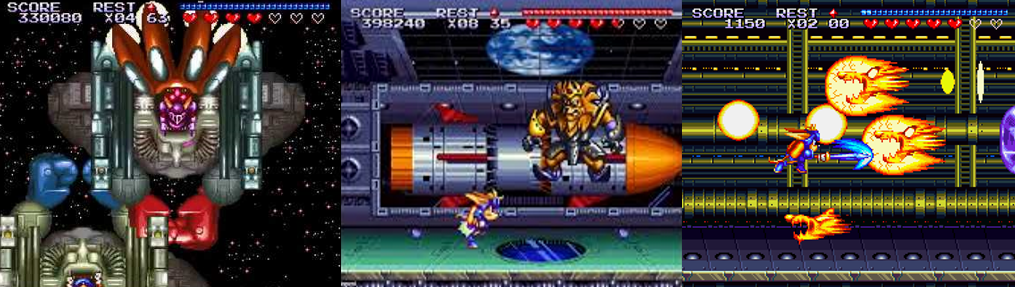
Like in Rocket Knight Adventures, Sparkster constantly pursues Axel Gear, a rival and corrupt Rocket Knight who kidnaps the local princess and evades Sparkster at every turn. You finally battle him at the end of Stage 6 before a giant organ. Like in the first game, Axel Gear has the same abilities as you, ricocheting about, flinging sword beams, spinning into you, and diving with a flaming kick. Thanks to the verticality of the arena, it can be difficult hitting Axel Gear, but it’s nothing compared to the top-down mech battle at the end of Stage 7! Here, you press Y to fire a weak-ass projectile, tap L and R to punch with each robotic fist, and hold the triggers to block. You can hold Y to charge a dash but, in my experience, it did nothing, and I wouldn’t guard for long as Axel destroys your arms. While you can land a few solid shots, Axel constantly has his guard up, rushes you, and obliterates you with an unblockable barrage. I genuinely have no idea how you’re supposed to beat this fight as I was forced to use a password to skip to Stage 8. This is, obviously, Generalissimo Lioness, who breathes fire across the ground, conjures a boomerang-like energy wave, and fires two electrical beams using his sceptre. It’s best to stay in the middle of these, duck under the energy waves, and perfectly time a jumping vertical rocket boost to avoid the Generalissimo’s attacks, attacking whenever you can until his biological visage reveals his cybernetic interior. The final boss, accessed only on “Hard” mode or higher, is the Missile Core, a large, stationary target that fills the screen with flaming projectiles resembling wolf heads, drops spiked mines, and fires a gigantic laser across the screen. You should dash to the far left to avoid the mines and safely destroy the projectiles then rocket-charge into the core, landing a quick sword beam strike before dashing to safety, though the projectiles increase as the fight progresses.
Additional Features:
Rocket Knight Adventures: Re-Sparked includes both the American and Japanese versions of Sparkster alongside the impressive anime opening, different filters and borders, the aforementioned “Boost” toggle, and the incredibly helpful rewind and save state features. The collection also includes a boss rush for the game, various advertisements and concept art, the box art and manual, and the entire soundtrack alongside various Trophies for the PlayStation 4/5 version. These require you to clear every stage (meaning you must play on at least “Hard” mode), finish the game on “Normal” mode, and clear the boss rush. There is also a hidden “Crazy Hard” mode in Sparkster that’s accessed with a push button cheat code and passwords to jump you to any stage on any difficulty, which is basically required as I have no idea how the hell you beat that Axel Gear mech fight!
The Summary:
As a huge, lifelong fan of Rocket Knight Adventures, I’ve always wanted to give Sparkster a go but, being a SEGA kid, I never got the opportunity, which is another reason I’m grateful for Rocket Knight Adventures: Re-Sparked. Although the visuals have been overhauled and are more anime inspired, losing the chubby, chibi-style look of the first game, everything is as colourful and sharp as ever. Sparkster is now grim and serious, constantly ready to fight and ploughing through enemies with a burst of gusto, and has more gems to collect that ever. Interestingly, Sparkster places more emphasis on traditional platforming than its rocket pack gimmick, even omitting the horizontal shooter sections from the first game, which was a bit of a mistake, in my opinion. The chicken-walker chase and top-down space shooter sections had the same energy, but it was disappointing to not do more with the rocket pack. I liked that there were less chase sections and insta-death hazards and there were some interesting new gimmicks, like the shifting pyramid, though it also felt a little too safe. Many sections, cutscenes, and even bosses felt very similar to Rocket Knight Adventures, almost as though the developers wanted to atone for not porting the first game to the SNES. I didn’t mind this, but it felt more like a rehash at times and was especially disappointing as none of the game’s tunes match those of Rocket Knight Adventures. I did enjoy the massive bosses and how they continued to be creative and visually appealing, but that mech battle against Axel Gear can go and burn in hell! Honestly, I was tempted to knock another star off simply for that, and the requirement that you must play on at least “Hard” mode to finish the game. Thankfully, the rewind and save state features eased the pain of these sections but I was annoyed that I needed a password to skip that boss, especially as the subsequent bosses were much easier. In the end, Sparkster is a worthy follow-up that has a lot of visual appeal. It performs really well and challenges even the most seasoned platformer player, but its difficulty curve and more repetitive sections bring it down a notch compared to the first, especially as the develops didn’t take full use of the SNES to expand on the story and in-game cutscenes.
My Rating:
Great Stuff
Did you own Sparkster back in the day? How do you think it compares to Rocket Knight Adventures? What did you think to the anime paint job given to the sprites? Did you ever legitimately beat Axel Gear’s mech and, if so, how? Which of the new gimmicks was your favourite? Would you like to see a new entry in the Rocket Knight series? Whatever you think about Sparkster, share your thoughts below, consider supporting me on Ko-Fi, and check out my other Rocket Knight reviews.

 Dr. K's Waiting Room
3 thoughts on “Game Corner: Sparkster (Nintendo Switch)”