

Released: 11 June 2024
Originally Released: 6 August 1993
Developer: Konami
Also Available For: Mega Drive, PC, PlayStation 4, PlayStation 5
The Background:
Thanks, largely, to the phenomenal success of Sonic the Hedgehog (Sonic Team, 1991), anthropomorphic mascot platformers were all the rage back in the 1990s to the point where, in a landscape featuring a gun-toting jackrabbit, an acrobatic bat, a superpowered earthworm, and an intergalactic adventurer, a sword singing possum with a rocket pack doesn’t seem all that strange! Designed by Nobuya Nakazato, the man behind many of the notoriously challenging Contra videogames (Konami, 1987 to present), Rocket Knight Adventures was lauded as one of the best titles available for SEGA’s all-powerful Mega Drive. Though a popular and well-regarded title, Rocket Knight Adventures was essentially Sparkster’s peak; a Super Nintendo port was allegedly cancelled and its sequels were both region-locked and ridiculously expensive for decades. While Sparkster received a six-part story in Sonic the Comic (1993 to 2002), he didn’t get an animated spin-off like some of his peers and remained in obscurity until Climax Studios attempted a revival in 2010. Mixed reviews notwithstanding, the game captured a lot of Rocket Knight Adventures’ spirit and long-time fans of the franchise finally got a modern re-release of the original three games with this Re-Sparked! collection, a warmly received release that included a handful of bonus materials to celebrate the unfairly forgotten series.
The Plot:
When the Kingdom of Zephyrus is invaded by Emperor Devilgus Devotindos’s pig army, heroic Rocket Knight Sparkster fights to rescue Princess Sherry from the clutches of his rival, Axel Gear, and stop their forces.
Gameplay and Power-Ups:
Rocket Knight Adventures is a 2D, sidescrolling action platformer with elements of run-and-gun action and some sidescrolling shoot-‘em-up sections. Players take control of Sparkster, the titular Rocket Knight, a possum clad head to toe in armour, armed with a sword, and carrying a surprisingly versatile rocket pack on his back. You swing Sparkster’s sword with A or Y, sending out an energy spiral to attack enemies from a set distance, and press B to jump, with Sparkster snagging poles and branches with his tail. By holding A or Y, you charge Sparkster’s rocket pack; once the meter is full and flashing, you can release and Sparkster will fly off in the direction you press. You must often use this manoeuvre to richochet off walls to progress higher in stages, sometimes over lava, and to blast between vines over large, spiked balls. If you don’t press a direction, Sparkster performs a grounded spin attack to deal damage and reflect certain projectiles and Sparkster is often invulnerable when performing his rocket attacks. The rocket pack can take some time to charge so it’s worth planning ahead if you’re looking to quickly blast away and you must often blast off while jumping for additional height, either to reach doors, platforms, or high up goodies. Sparkster has a large health bar (represented by hearts) but it’s whittled down quite quickly. Apples and bananas will partially or fully fill it and you can snag a handful of generous 1-ups along the way. You also earn extra lives if you collect enough points, receiving a bonus at the end of each stage. Before you start, you can also adjust the game’s difficulty, which changes how many lives and continues you have, though trust me when I say the game’s hard enough even on “Easy” mode.
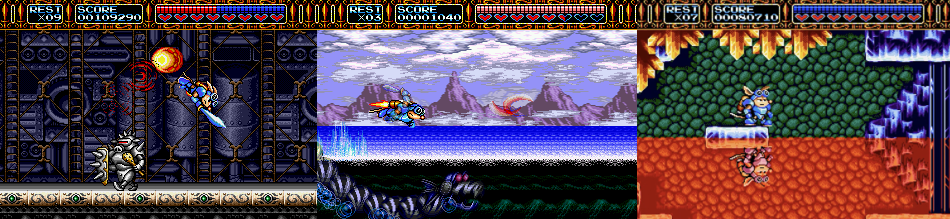
Occasionally, Sparkster collects a power pack or is dropped into an area where he flies indefinitely. These sections turn the game into a high-speed, action-packed autoscrolling shoot-‘em-up and have you weaving Sparkster between missile and other projectiles while picking off airborne enemies. Sparkster can also swim, automatically treading water and moving through the drink depending on your button presses, attacking with his sword and blasting from the water with his jet pack. However, his movement becomes noticeably sluggish and his hit box alters, making it tricky to navigate the tight, hazard-ladened depths. Each stage tests Sparkster’s platforming and rocket pack skills in different ways, from simple ricochet tricks to jumping to vines and branches, to racing from hazards (such as walls of fire, spiked knights, and crushing floors) that spell instant doom to the Rocket Knight. Platforming is largely satisfactory here and the usual tropes of swinging platforms and precarious handholds appear, but you’ll also be riding mine carts, leaping across bottomless pits and ducking under spiked ceilings. Stage 2 has you pass behind waterfalls using special platforms to progress, Stage 3 sees you using the reflective surface of rising and falling lava to hop to platforms, while Stage 4 has you clambering on the underbelly of Axel’s ship trying not to plummet to your doom. When on the roof, and during the final confrontation with Axel, you battle a strong wind that’ll suck you to an instant death, while Stage 5 has you race through claustrophobic tunnels avoiding knights that kill you on contact. The challenge is palpable but increases as you progress, easing you into the game’s surprising difficulty and introducing new gimmicks that test how you control Sparkster. Unfortunately, there are no power-ups to aid you (no shields or invincibility or anything like that) and you’re limited by your lives and continues, though thankfully this version includes rewind and save state features that finally allowed me to beat the game after more than thirty years!
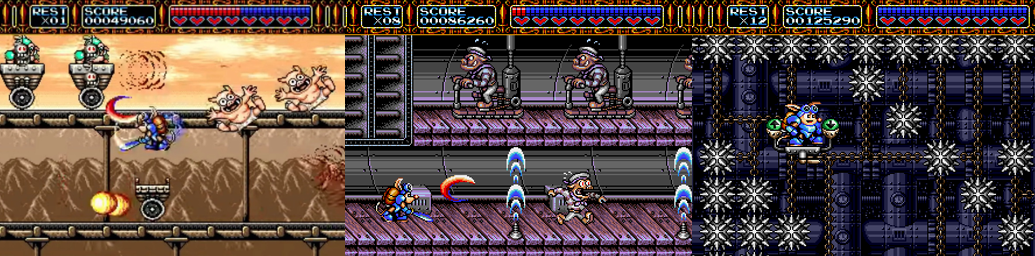
It’s not long before hazards become troublesome for Sparkster. Each stage is split into multiple, interconnected areas, with the first stage culminating in you traversing Castle Zephyrus, which is full of burning pits and sees you being chased by a wall of fire. This will instantly kill you if you don’t keep moving, made harder by the stone walls you must hop over and the flame bursts you must duck to avoid, though this is all practice for a similar section in Stage 5, where you must run, ricochet, and jump away from Axel as he pursues in an insta-death mech suit! While it’s simple enough to hop to tree branches in Stage 1, Stage 2 introduces spiked balls to avoid while jumping, while spiked ceilings and surfaces dog both your high-speed jaunts on mine carts and your efforts to control a propeller platform in Stage 5. Stage 4 sees you taking out bazooka-wielding pig soldiers in tight corridors, your progress barred by temporary energy barriers, while Stage 5 introduces the rising floor gimmick that ended my runs as a kid. With enough speed and timing, you can outrun this hazard but it’s very tight, even when abusing the rewind feature. This stage also includes teleporter doors that represent your goal in each section, though they’re functionally no different from the regular doors you enter prior to this stage. Stage 7 introduces a springing ground, almost a quasi-anti-gravity feature, to boost your jumps, though it’s limited to snagging some out of the way goodies and battling a boss. The autoscrolling sections start off simple, with you mowing down aerial enemies and attacking a giant, robotic snake, but your manoeuvrability is tested in Stage 5, where you weave between gigantic missiles and cross-crossing gunfire and engage in glorified dog fights with mech walkers. Things are much simpler when you’re blasting through an asteroid field in Stage 6, though you must still be mindful of the small projectiles that can get lost against the stars. Stage 5 also culminates in you taking control of your own giant mech, though your options are simply limited to stomping back and forth and swinging its buzzsaw arms with A or Y; there’s no block or charge attack or anything.
Presentation:
Rocket Knight Adventures is and always has been a joy to play, purely from a visual standpoint. Released at the peak of the Mega Drive’s popularity, when mascot platformers were extremely popular, the game oozes colourful, cartoonish appeal. Presented with a steampunk-style fantasy land, players explore environments teeming with personality. You see the castle being attacked in the background of the first stage, panicked civilians and chickens run and flutter, and enemies are sent into a panic when hit, running around with their briefs on show! Though he can be a little clunky and his hit box is quite large, Sparkster is a wonderfully realised character. Blasting past the Konami logo at the start and standing proud against the title screen and in the brief prelude, he radiates heroism. Not only does Sparkster bop up and down by default, but he also judges the player when idle and calls to them to get a move on. He also squeals in pain when killed, reacts with panic when falling, and regularly advances towards his objective and enemies in the handful of cutscenes between stages. As if these stunningly lively and detailed visuals weren’t enough, Rocket Knight Adventures is bolstered by an infectious soundtrack, one of my favourites of the era. However, it’s true that the game peaks with Stage 1’s iconic and instantly memorable overture, which is rightly evoked for the end stage score tally. Still, the boss themes are really good and add to the tension when facing these troublesome foes. One negative about Rocket Knight Adventures, however, is the slowdown which occurs when there’s too many sprites on the screen. Thanks to the large scale of some enemies and the many explosions and effects peppering certain moments, the game can struggle along for a few seconds. It’s never impacted my progress, but it is noticeable. Furthermore, the title screen, despite showcasing large sprite art for Sparkster and the game logo, is surprisingly bland, especially compared to the detailed environments.
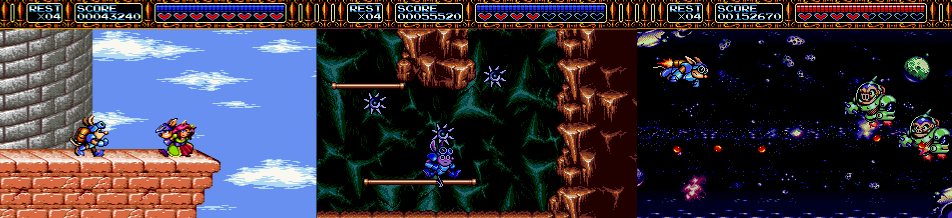
Things start out safe enough with Stage 1’s flat fields, which act as a testing ground for players to test Sparkster’s moves, but even this area is full of detail, from the aforementioned castle in the background to the besieged homes and ransacked environment. As you blast through the skies, mountains and water rush past, with a lovely splash effect appearing as you skim the water’s surface. Sparkster loves to charge head-first into enemy strongholds, the first of which includes busts, skewed portraits, and windows where the first stage’s boss looms. While Stage 2 starts comparatively bland, you’re soon climbing vines and avoiding spikes amidst a large waterfall and racing around on high-speed mine carts. Stage 3 begins in a quartz cavern with a reflective effect applied to the lava, extends to an underwater cavern, and ends with you battling a gigantic robotic fish in a volcano. Stage 4 takes place on Axel’s ship and really leans into the steampunk aesthetic, having you navigate inside and outside the ship, clambering to poles, jumping to platforms, and passing energy barriers powered by pigs on treadmills! Stage 5 takes the steampunk aesthetic to the next level as you blast through the skies of a heavily polluted, heavily guarded pig city. There’s a real depth to the polluted backgrounds that’s married with the mechanical facility to crash into, a robot factory full of narrow corridors and insta-kill hazards. Stage 6 and 7 add a science-fiction twist to the steampunk fantasy and see Sparkster blasting through an asteroid field and infiltrating Emperor Devotindos’s “Pig Star” space station. Though you’re limited to a few rooms and boss battles here, you can see the stars and asteroids in the background and end up falling back to Earth in an escape pod, burning up on re-entry and showered by debris from the exploding space station! The large sprite art returns for the end credits, which feature Sparkster heroically flying towards the camera, and the pantomime-like cutscenes add to the game’s visual charm, with Princess Sherry, King Zephyrus, and Axel gear all exuding the same personality seen in Sparkster’s cartoonish animations.
Enemies and Bosses:
The Devotindos Empire is primary made up of armour-clad pigs, disposable ground forces who stand no chance against Sparkster’s sword and rocket pack. Though they leap from the background, drop down on balloons, and wield swords of their own, the pig infantry is easily dispatched in a single hit. Occasionally, you battle large groups of them, but you can simply rocket through them, making them more of a nuisance than anything. The sailor variants are a bit more formidable thanks to their bazookas and you being confined to tight corridors, as are the jet ski riders, who fire a spread shot while you’re floundering in the water. Pigs also race around in steampunk-style cars and chicken walkers, which can be trickier to put down as they’re much bigger and take more hits to defeat. At least they can be defeated, though, which is more than can be said of the later spiked armour variants. You’ll simply bounce off these guys and be killed if you touch them, so you must run from them and lure them into a molten metal trap to end their threat. Emperor Devotindos bolsters his forces with other robot minions, such as robo-owls who can spoil your jumps and robotic duplicates of himself, which spring to life at the worst possible moments, take a few hits to put down, and offer a significant obstacle thanks to their large hit boxes and pursuing you across the environment.
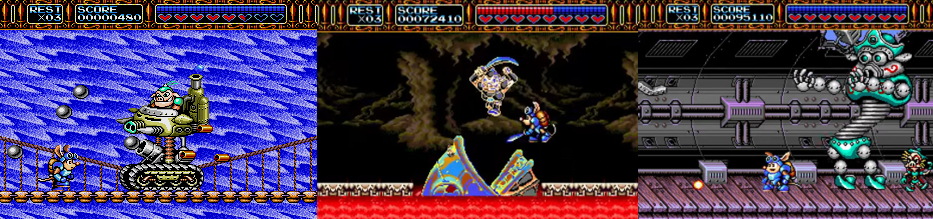
The pig infantry also controls numerous large, steampunk-style craft to act as mini- and end bosses. The first is a lumbering tank that fires slow moving cannonballs and tries to roast you with its flamethrower. Your best bet is to rocket behind it to quickly pummel it, but you’re then forced to avoid and frantically slash it as it pinballs around in the rapids in an exploding frenzy. A large mech greets you at the start of Stage 2, taking up the background and sporting extendable arms with buzzsaw-like hands. You must battle the finnicky swimming controls to avoid being hit, attacking the glowing red sphere on the front of the mech to put it down. Stage 3 sees you battle a gigantic crab mech, attacking its extendable pincers and avoiding its ring shots once they’re destroyed, floating precariously close to the craft to hit its cockpit. This stage ends with you fighting a giant robot fish in a battle not unlike the Lava Reef Zone boss. You must jump to floating platforms, which get faster and faster, avoiding the lava and the shower of pellets the fish spits. When the pilot appears, be sure to smack him a few times and grab the bananas if you’re low on health. A more powerful pig walker attacks in Stage 5, one that fires dual lasers and is protected by an energy barrier you must whittle down before the craft can be destroyed. Finally, Captain Fleagle constantly hounds you in Stage 4. First, he hides behind an energy barrier and tosses bombs which you must reflect back at him (the timing can be tricky and the bombs have a large blast radius, so watch out!) You must avoid Captain Fleagle’s shots on the roof and send him running once more. After knocking sentient bombs onto a flying mechanical pig head on the underside of the ship, Captain Fleagle calls in his large mechanical doppelgänger. Mirroring Captain Fleagle’s movements, this mech causes debris to by shaking its hips and fires large blasts from its torso, giving you a small window to attack it. Once it’s destroyed, the battered Captain Fleagle runs and jumps around in a panic as the battleship explodes, finally finished for good after a few whacks with your sword.
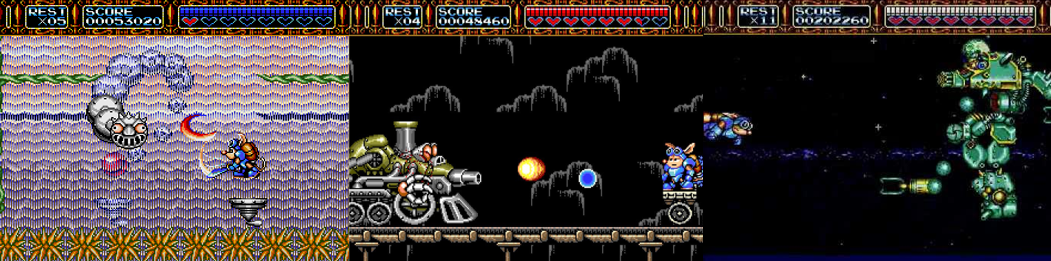
Gigantic mechanical enemies also appear as mini- and end bosses, such as the Snake Mecha that lunges at you in the first flying section and the Big Spider at the end of Stage 1. This thing crashes its head through the castle walls and ceilings, giving you a chance to land some attacks, but you must avoid standing in the wrong place and being smacked by its spiked tail. Stage 2 features a weird collection of spheres, not unlike a mechanical caterpillar, that dives in and out of a waterfall. You must do the same and blast between vines to avoid its wide arc and pummel the weak spot on the end of its tail, which is pretty tricky given the hazardous environment. Stage 2 ends with you battling a menacing steampunk train that charges towards you firing slow shots and then transitions to an upper path, swinging and extending its claw arms, before finally firing bouncing shots from its wrecked behind, its weak spot changing each time. A satellite-like robot challenges you in Stage 6’s asteroid field, blocking your shots with a shield and firing a dual spread shot, and you must take on the strangely sized pig mothership, too. Since this hurts you if you touch it and fires relentlessly, you must target the many turrets to deal damage, switching position as it teleports in and out, taking out its minions, and dispatching its giant mouth cannon before you get fried! As the fight progresses, the cockpit detaches, leaving you to destroy the main body of the ship. However, the cockpit transforms into a mech that fires pellets, a ricocheting laser, and flailing its arms. You must strike the ball it bounces between its hands to deal damage, then fly around as it bounces around the screen in a frenzy, which makes for a troublesome boss due to its large hit box and the lack of health pickups.
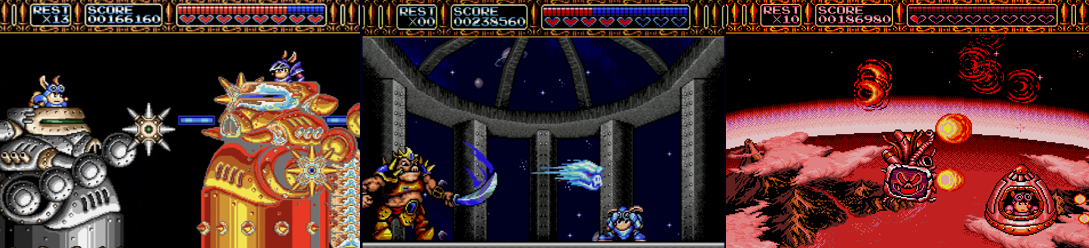
Your most persistent enemy is rival, corrupt Rocket Knight Axel Gear, who kidnaps Princess Sherry and constantly ducks you. When you finally go toe-to-toe with Axel in Stage 5, it’s in a Rock ’Em Sock ’Em Robots mech battle. After racing to your mech, you must avoid his hits and tap A or Y to swing your buzzsaw-like, extendable arms and damage his craft. It’s a bit clunky and difficult to avoid damage but, eventually, Axel’s mech is destroyed. Axel then appears at the end of the asteroid section of Stage 6, now sporting a gigantic laser cannon and firing smaller homing missiles. You must loop behind him to attack and take out his smaller shots, watching for his circular movements as he prepares each shot. Axel than challenges you to a more traditional sword fight mid-way through Stage 7’s gruelling boss gauntlet. Here, Axel sports the same abilities as you, swinging his sword, unleashing a rocket spin, and ricocheting about. Note that your sword beams cancel each other out and he’ll eventually cause explosive decompression! You must cling to the poles, attacking Axel with your sword beam and avoiding his missiles and circle motions, finally flying with your rocket charge when he’s charging his own. Emperor Devotindos is the game’s final boss and certainly doesn’t go down easily! Your first battle isn’t too bad, with you simply dashing from across the screen and charging into the pig monarch, dodging his progressively faster projectiles. After enough hits, he reconstitutes himself into a maniacal cyborg and you must avoid his extendable legs and rocket into him diagonally. Emperor Devotindos downloads his consciousness into the Pig Star’s main core, causing it to float, teleport, and bounce around firing various laser spreads that you must avoid while charging at the small red weak spot. As you escape the exploding Pig Star, Emperor Devotindos (now little more than a television screen) pursues you, thrashing tentacle-like limbs, firing ring projectiles, and barging into you. You cannot attack here and must simply survive until atmospheric re-entry finishes the bovine bastard off, a daunting prospect as Emperor Devotindos is hard to avoid and deals a lot of damage.
Additional Features:
There are four difficulty settings to challenge in Rocket Knight Adventures, with each one altering how many lives and continues you play with and slightly altering the end text. If you beat the game on anything other than the hardest difficulty, you’ll be challenged to try a harder difficulty once the credits have rolled. Interestingly, you can input a code from the pause screen to record your progress as the game’s demo mode, though the level select code apparently only works in the Japanese version of the game. Luckily, Rocket Knight Adventures: Re-Sparked lets you pick between the American and Japanese versions of the game and offers a host of additional features, too. There’s the slick, sexy, anime style opening that makes me wish we’d gotten a cartoon back in the day, various filter and border effects, and the always helpful rewind and save state features. You can also play a boss rush mode and view various advertisements and concept art for the game, peruse the box art and manuals, and freely listen to the game’s kick-ass soundtrack. The PlayStation 4/5 version also comes with numerous Trophies for you to earn, with nine specifically earned from playing this game (best done on the hardest mode to stack them) and clearing its boss rush.
The Summary:
I’ve been in love with Rocket Knight Adventures since I was a kid. I was captivated by its bright, cartoonish visuals and fun, action-packed gameplay from the start and regularly find myself humming that memorable Stage 1 theme in my day-to-day life. One of the biggest gripes of my life-long gaming career is that I was never able to beat this game back in the day; that damn crushing floor always ended my playthroughs. However, this version of the game changed all that. It’s telling that I needed the rewind and save state features to finally beat this game and shows just how challenging Rocket Knight Adventures is. It lulls you into a false sense of security by easing you into the challenge, slowly adding more and more obstacles and insta-death hazards and leaning more on split second reaction times as you progress through its detailed and varied stages. Yet, while the difficulty curve is off-putting at times and the game occasionally seems needlessly unfair and cheap (infinite continues would’ve helped mitigate this), I still find it a hugely enjoyable experience. Sparkster is a fantastic character and often unfairly forgotten in the pantheon of mascot platformers and I loved his sword- and rocket-based gameplay. The ricochet mechanics were a neat feature; however, if anything, they were underutilised and the game relies on traditional platforming tropes and mechanics than its unique selling point, which is a bit odd. I loved all the big enemies and bosses, the switch to sidescrolling shooter sections, and the sheer variety on offer. No two stages are the same and the game’s constantly throwing new gimmicks at you, from mine carts to flying platforms to mech battles and races through mazes. There are few games as visually appealing on the Mega Drive than Rocket Knight Adventures, which has such franchise and merchandise appeal that I’m honestly surprised we didn’t get more games and tie-ins, such as toys and comics and cartoons. Still, that doesn’t diminish how enjoyable Rocket Knight Adventures is. To this day, it’s one of the best platformers on the system and this Re-Sparked version just makes it more accessible and entertaining than ever before.
My Rating:
Fantastic
Was Rocket Knight Adventures in your Mega Drive library back in the day? What did you think of the rocket-based mechanics and the colourful visuals? Which of the game’s bosses was your favourite? Did you manage to clear the game without modern quality of life features? Which of Sparkster’s sequels was your favourite and would you like to see him brought back from obscurity? Either way, whatever your thoughts on Rocket Knight Adventures, leave a comment below, consider supporting me on Ko-Fi, and check out my other Rocket Knight reviews.

 Dr. K's Waiting Room
6 thoughts on “Game Corner: Rocket Knight Adventures (Nintendo Switch)”