

Released: March 2009
Originally Released: 14 September 2005
Director: Tetsuya Nomura
Distributor: Square Enix Holdings
Budget: Unknown (potentially up to $100 million)
Stars: Steve Burton, Rachael Leigh Cook, Steve Staley, Fred Tatasciore, Dave Wittenberg, Wally Wingert, and George Newbern
The Plot:
Two years after Final Fantasy VII (Square, 1997), Cloud Strife (Burton) exiles himself to avoid spreading the Geostigma disease he and many children are suffering after Sephiroth (Newburn) contaminated the Planet’s core. However, when three Remnants of Sephiroth – Kadaj (Staley), Loz (Tatasciore), and Yazoo (Wittenberg) – kidnap the diseased children to resurrect Sephiroth, Cloud reunites with his friends to defend the world once more.
The Background:
After decades of being largely exclusive to Nintendo’s 8-bit and 16-bit titles, the genre-defining Final Fantasy franchise was given new life when developer square shifted focus to the PlayStation with the award winning, incredible success that was Final Fantasy VII. This success eventually led to a whole host of spin-off media that didn’t just include new games, but Square’s second crack at a feature-length CGI movie following Final Fantasy: The Spirits Within (Sakaguchi, 2001), a critical and commercial disaster that nearly bankrupted Square. Final Fantasy VII: Advent Children began as a short film by Visual Works, the company behind Square’s CGI cutscenes, designed to pitch a new game. Instead, Final Fantasy VII character designer Tetsuya Nomura joined the team and helped them develop the concept into a feature-length film, one that would focus primarily on Cloud Strife and Tifa Lockhart. While motion capture technology helped map out the character’s movements, the team struggled to bring the more complex action sequences to life and many characters were redesigned to make the animator’s lives easier. Accompanied by an anime tie-in and selling over 700,000 copies in Japan in its first three weeks, Advent Children garnered mixed reviews. While some praised the animation and action scenes, the confusing plot and reliance of audience familiarity with Final Fantasy VII turned many mainstream reviewers off. Regardless, the film was enhanced and extended for its Blu-ray release with this “Complete” edition, which was specially screened in Japan, increased the violence, and was largely received more positively upon release.
The Review:
If you’re a newcomer to Final Fantasy VII or it’s been a while since you played the game, Final Fantasy VII: Advent Children Complete has you covered in more ways than one. If you want a more comprehensive catchup on the events leading up to the film, there’s a “reminiscence” included in the special features that includes key cutscenes from the videogame. This edition also includes an expanded reminiscence for the entire Compilation of Final Fantasy VII which, while lengthy in its own right, is a fun way to relive the videogame without pouring fifty-odd hours of your life into it. Beyond that, the movie includes an opening narration from Marlene Wallace (Grace Rolek) that summarises the videogame from a child’s perspective, greatly truncating events but quickly setting the tone for what’s to come. For the better part of forty years, the Shinra Electric Power Company sucked Mako energy from the lifestream of the Planet, using it to power the vast cities and equip their lite fighting force, SOLDIER, with the best weapons and technology. SOLDIERs were genetically enhanced super soldiers infused with cells from Jenova, an alien lifeform that fell to the Planet on a meteor many years ago. When he found out about his true origin, Sephiroth (Shinra’s elite SOLDIER) went mad and tried to destroy the world, though he was ultimately thwarted by Cloud, a confused Mako-infused mercenary, and AVALANCHE, an anti-Shinra group who regularly destroyed their Mako Reactors. Many lives were lost in the battle, which reduce the Midgar slums to ruins and saw Cloud’s love, Aerith Gainsborough (Grace Rolek) murdered by Sephiroth, but the group eventually stopped him at the Northern Crater, with the very Planet itself helping to repel the massive meteor summoned by Sephiroth. Unfortunately, though his body was destroyed, remnants of Sephiroth’s consciousness and poisonous influence seemed into the lifestream, afflicting many inhabitants of Edge, a city built on the outskirts of Midgar’s ruins and which contains a gigantic monument to the lives lost during “Meteorfall”. Cloud’s ally and love interest, Tifa Lockhart (Cook), owns a bar and delivery service in the city and cares for various orphans, including young Denzel (Benjamin Bryan), as well as looking after Marlene while her father, passionate ecowarrior Barret (Beau Billingslea), travels to find alternatives to Mako energy.
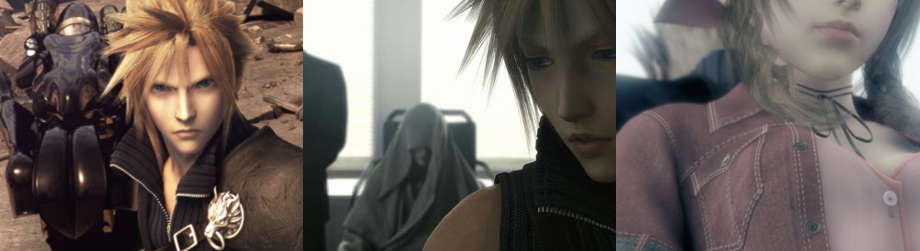
The Geostigma disease afflicts many of Edge’s children, appearing as an unsightly blemish on the skin and causing nausea, vomiting, and a violent death. Since there’s no known cure, those afflicted are shunned and the citizens live in fear of contracting the disease, which has also manifested in Cloud. Accordingly, the troubled mercenary has isolated himself in the wastelands outside Edge and taken shelter in the dilapidated church where Aerith once tended to her flowers. Fearing he’s ad anger to those around him and unfit to help others, Cloud continues to be wracked with guilt for failing to save both Aerith and his best friend, Zack Fair (Rick Gomez), an elite SOLDIER who died saving Cloud and who’s memories and abilities Cloud inherited. Though conflicted and dejected, Cloud continues to carry his cell phone, listening to but ignoring the many calls he receives from the worried Tifa and his former allies, who continue to try and reach him despite his best efforts. It’s while brooding in the wastelands that Cloud is attacked by the three Remnants of Sephiroth and driven to begrudgingly take up Reno’s (Quinton Flynn) offer for work. Since Reno and his hulking partner Rude (Crispin Freeman) are Turks, Shinra’s special forces, Cloud’s naturally wary of him and, when he discovers Shina president Rufus Shinra (Wingert) inexplicably survived being caught in a massive explosion, Cloud’s ready to walk away from Shinra’s representatives. However, intrigued by Kadaj demanding to know the location of his “mother” and bothered by the notion that the Remnants are seeking to resurrect Sephiroth, Cloud reluctantly becomes embroiled in the investigation, though he strictly acts alone. Thanks to Rufus, Cloud heads to the Forgotten City to rescue the infected children, only to find the Remnants have brainwashed the kids into mindless puppets. Saved by his even dark and more stoic gothic ally, Vincent Valentine (Steve Blum), Cloud discusses and ruminates on his disposition. Constantly distracted by memories and messages from Zack and Aerith, who’s face is always hidden from his eyes, Cloud struggles to let go of his guilt and move on from his past. Seeing Vincent as a dark mirror of himself, Cloud resolves to try and atone for his sins, gaining new strength from his friends and his those he cares for. With this, Cloud’s already formidable superhuman abilities only increase, allowing him to defy physics and pull of his more powerful Limit Breaks, all with the aid of his fancy (if impractical) Fusion Sword, which separates into pieces and easily allows him to fend of multiple enemies at once.
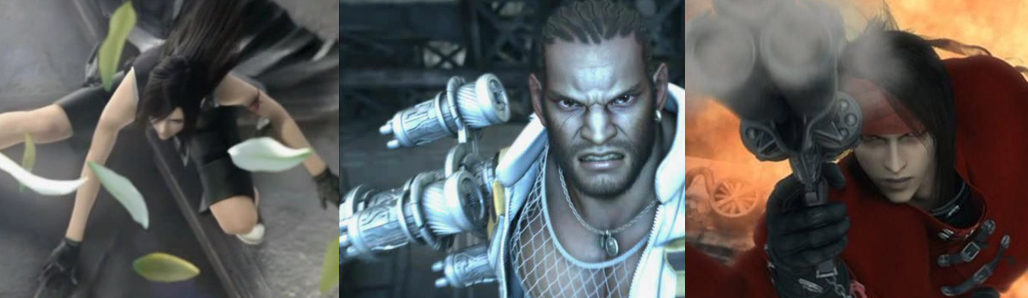
Stubborn, melancholy loner that he is, Cloud leaves the beautiful Tifa behind at Seventh Heaven and shuns his responsibilities as her point man and his relationship with her. Despite this, Tifa continues to care for and pine for him, keeping the businesses ticking over in his absence and promising Marlene that they’ll give him a “lecture” when he inevitably shows up. Realising that Cloud’s sick, Tifa’ hurt that he chose isolation rather than asking for help but gives him a stern talking to once they reunite, chastising him for “dilly-dallying” and outright demanding that he choose between a “memory [and] us”. While she’s no super soldier, Tifa is an incredible formidable fighter; she goes toe-to-toe with Loz, matching his brutish power and augmented speed, and instinctively leaps to Marlene’s defence whenever she’s in danger. Advent Children is largely an exploration of Cloud and Tifa’s relationship, meaning the other members of AVALANCHE are largely sidelined. Barret, Cait Sith (Greg Ellis), Cid Highwind (Chris Edgerly), Yuffie Kisaragi (Christy Carlson Romano), and Red XIII/Nanaki (Liam O’Brien) are all absent the battle with Bahamut SIN, meaning only Vincent gets significant screen time. Sporting supernatural abilities and whisking Cloud to safety with his ragged cloak, Vincent gives Cloud a lot of intel on the Remnants and their plot but initially refuses to get involved since he’s also burdened by his past sins. Unlike Cloud, Vincent doesn’t even have a phone and is a true loner, though he’s inspired by Cloud’s conviction to aid in battling Bahamut SIN. This fight sees Cloud reunite with all his allies and all of them get in on the action, giving him the physical and motivational boost to take down the rampaging Summon and allowing him to draw additional strength from their support. While they’re all ready to help Cloud in his subsequent battle with Kadaj and the reborn Sephiroth, Tifa orders them to stand down so Cloud can literally and figuratively exorcise his demons.
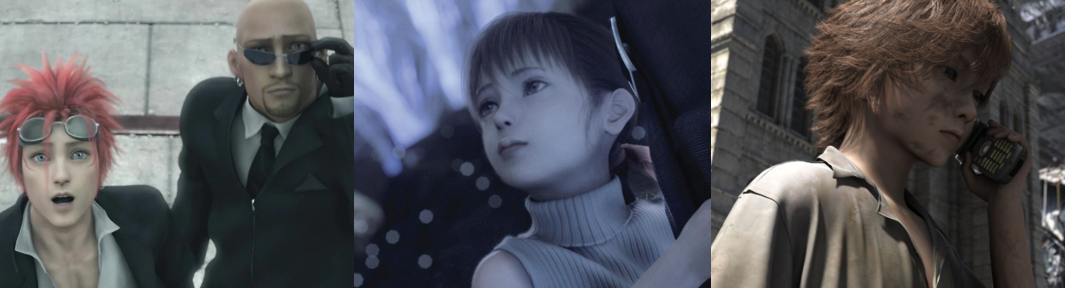
Having nearly caused worldwide destruction, the critically injured Rufus Shinra resolves to make amends for his past misdeeds and the selfish actions of his company. Thus, Rufus dispatches his Turks – Elena (Bettina Bush), Tseng (Ryun Yu), Reno, and Rude – to investigate the Northern Crater, only for them to be attacked by the remnants. Thanks to Vincent’s timely intervention, Elena and Tseng were spared death and, at Rufus’s insistence, Reno and Rude actively aid Cloud and his allies. Naturally suspicious of the three, Cloud initially gives them the brush off but Reno and Rude continue to aid him whether he likes it or not. Though largely portrayed as comic relief, Reno and Rude are determined to atone for their past and even take on the Remnants (despite being severely outmatched) and seemingly ready to sacrifice themselves to both aid Cloud and try to defeat the three Remnants. When faced with Kadaj, who demands to be handed Jenova’s remains, Rufus remains impassive and defiant, using the opportunity to learn more about the Remnants and hiding both the extent of his injuries and the fact that possesses the calamity’s head. Cloud and the others come to respect Reno and Rude and bury the hatchet with their former adversaries, especially after the two both try to help take down Bahamut SIN and actively save lives during the beast’s attack. In the two years since the end of Final Fantasy VII, Cloud has become a reluctant father figure to both Marlene and Denzel and a figure of inspiration to Edge’s orphans. While this makes him uncomfortable since he doesn’t feel he’s strong or capable enough to protect the children, they constantly pine for his return and have an unwavering belief in him. Though a new character whose background is further explored in the On the Way to a Smile – Episode: Denzel short (Ishihara, 2009), we learn that Denzel was orphaned when the Sector 7 plate crushed the Slums and stumped upon Aerith’s church in a bad way. Afflicted with Geostigma and increasing worn down by his condition, Denzel willing goes along with the other children when the Remnants promise to cure them, only to become another mindless puppet thanks to Kadaj’s corrupted water. It’s only when his maternal figure, Tifa, is injured during Bahamut SIN’s attack and Cloud arrives to save the day that Denzel snaps out of his malaise. Reinvigorated by his hero’s return, Denzel takes a page out of Cloud’s book to save others from the Remnant’s Shadow Creepers.
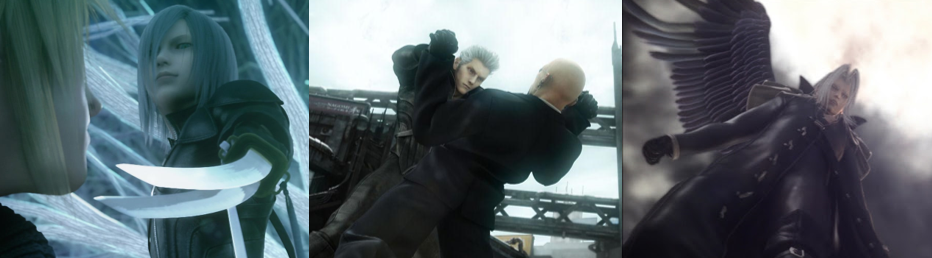
Birthed at the Northern Crater and appearing as manifestations of Sephiroth’s personality and spirit, the Remnants are like angry, defiant teenagers lashing out at a world they feel has mistreated them. Though similar and largely interchangeable, they are separated by some unique characteristics: Kadaj is the composed eloquent leader and wields a doubled-blade sword, Loz is the child-like brute whose punches and speed are augmented by a wrist gauntlet, and Yazoo…well, Yazoo largely disappears for me since he gets the least screentime and only stands out because he carries a gunblade and regularly mocks Loz for “crying”. While all three are passionate and emotionally unstable individuals, Loz is the most erratic of the three, desperate to be reunited with his mother and descending into anger or tears whenever he feels he’s let her down or been denied her. Seeing Cloud as their older “brother”, the Remnants mindlessly target him, Rufus, and anything remotely related to Shinra in a bid to retrieve Jenova’s head and complete their metamorphosis into Sephiroth. The Remnants summon Shadow Creepers to act as their minions and have no hesitation in using children as human shields to gain leverage. When they steal Cloud’s cache of Materia, Kadaj gleefully Summons Bahamut SIN to ravage the Meteorfall monument and attack the citizens to cause chaos and uncover Jenova’s remains. At times, Kadaj relates his despair at being a mere puppet, one with no true purpose other than to facilitate Sephiroth’s resurrection, yet he remains nonetheless determined to do this, mirroring Sephiroth’s anger at the world and his desire to destroy everything. Though he doesn’t fully appear until the climatic finale, Sephiroth looms over Advent Children Complete like a dark shadow. People are only sick because of him, much of Cloud’s guilt is because of Sephiroth, and the Remnants only exist to bring Sephiroth back. Once he does return, Sephiroth wastes no time in renewing his rivalry with Cloud, relishing the battle and taunting his foe, and using his vast powers to shroud the world in darkness, presumably in preparation for another meteor. Sprouting a single black wing and wielding the lengthy Masamune Blade, Sephiroth is effectively untouchable and attacks with a superhuman vigour, savouring his resurrection and the chance to torture Cloud both physically and mentally.
The Nitty-Gritty:
Guilt is a major theme in Final Fantasy VII: Advent Children Complete. Despite being powerless to help Zack, Cloud carries tremendous guilt about his death and struggles to live up to his promise of being the SOLDIER’s “living legacy”. Despite Zack spirit encouraging him and guiding him (both as a human and as a wolf), Cloud cannot let do of his insecurities, which are only exacerbated by him having indirectly caused Aerith’s death. Similarly, Aerith doesn’t blame or judge Cloud for this and only encourages him to move on and fight harder, but uncertainty weighs heavily on Cloud’s troubled mind and causes him to distance himself from his allies. This is best evidenced in Cloud abandoning Zack’s Buster Sword and leaving it to rust at the spot where his friend died, almost as if the weight of carrying Zack’s legacy was too much for him to carry, and isolating himself from his friends. Eventually, Cloud resolves to at least try and atone for his sins and returns to the fight, emboldening his allies and drawing strength from them in turn. The need to atone is another strong theme here, with Rufus trying to pay penance for Shinra’s part in ravaging the world and Vincent so troubled by his past that he’s even more isolated than Cloud. This need to atone sees Cloud and his friends set aside their differences with Shinra against a common foe and to try and rebuild their world for the better, all of them having been humbled at how close to complete annihilation they came. Unlike Final Fantasy: The Spirits Within, Advent Children is so intrinsically linked to its source material that it may alienate newcomers. Anyone who’s played the game should be delighted to see almost everyone return and many of them pulling off their signature Limit Breaks during the film’s exhilarating fight scenes. It certainly adds to the emotional weight of the film to see Midgar in utter ruins after the events of the game and to see the survivors struggling with the fallout of Sephiroth’s defeat, and I loved seeing AVALANCHE given more personality through voice acting, even if some of my favourites (Barret and Cid) were sidelined. The film’s bolstered by remixes of Nobuo Uematsu’s iconic tunes, with new versions of “Fight On!” and “Jenova” punctuating the action and easily my favourite version of “One-Wing Angel”, a hard rock remix that really adds to the emotional gravitas of the final battle.
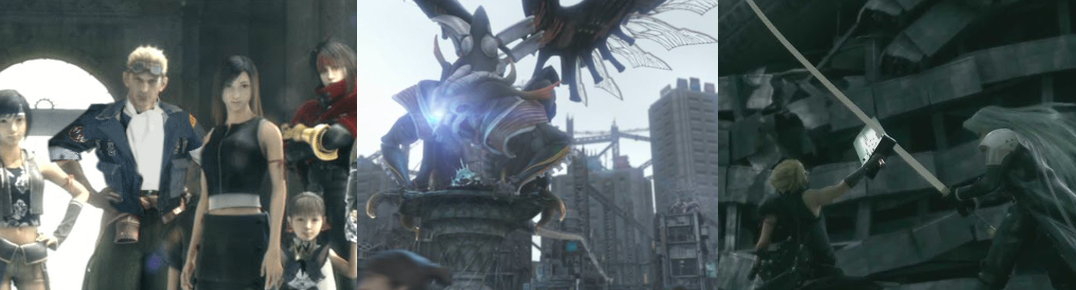
As impressive as the photorealistic CGI was in Final Fantasy: The Spirits Within, it’s not only much better here but strengthened since it brings these beloved characters to life. Cloud greatly benefits from this effort, sporting a brooding, dark redesign that mirrors his conflicting demeanour. Riding a bad-ass new motorcycle and wielding an unnecessarily complex sword, Cloud’s insecurities and guilt are as perfectly portrayed as his superhuman abilities. Similarly, Tifa has never looked better than here; not only is she gorgeous, she moves with a fluid, powerful grace that recreates her martial arts skill in stunning detail. Vincent also makes a hell of an impression with his flowing cape, numerous buckles, and gothic demeanour. I loved Barret’s redesigned gun arm and the detail in Red XII, despite him having the least screen time. The level of detail in the locations is equally stunning, with the game’s pre-rendered backgrounds being brought to life with an impressive attention to detail. We see recognisable locations, such as Aerith’s church and the plate that hung over the Slums, and the finale takes place entirely around and on the remains of a Mako Reactor and the Mako Cannon. The film goes to great lengths to recreate the more bizarre gameplay elements of the Final Fantasy VII in a way that makes some sense. Limit Breaks are largely shown to be physical attributes, though Barret does charge energy through his gun arm and Cloud gains an ethereal aura when he powers up. Everyone defies gravity and endures tremendous punishment, surviving brutal wounds and cutting through the air with ease. This results in some spectacular fights, such as Tifa and Loz beating the hell out of each other in Aerith’s church, a high-speed motorcycle chase down the ruined highways and, of course, the devastating battle against Bahamut SIN. Though more closely resembling the Final Fantasy X’s (Square Product Development Division 1, 2001) version of Bahamut, this creature is an immense, aggressive, biomechanical monstrosity that devours civilians and obliterates everything in sight with Petaflare (100055). Though the team throws everything they have at it, their attacks barely scratch Bahamut SIN’s hide and it takes Cloud’s Climhazzard attack (strengthened by his friend’s support) to finally destroy the creature. While we’re sadly denied seeing the rest of Yuffie’s armful of Materia in action, Kadaj regularly summons Shadow Creepers and the remnants exhibit magical abilities as they fight, with Loz moving at superhuman speed and the characters deflecting bullets with ease.
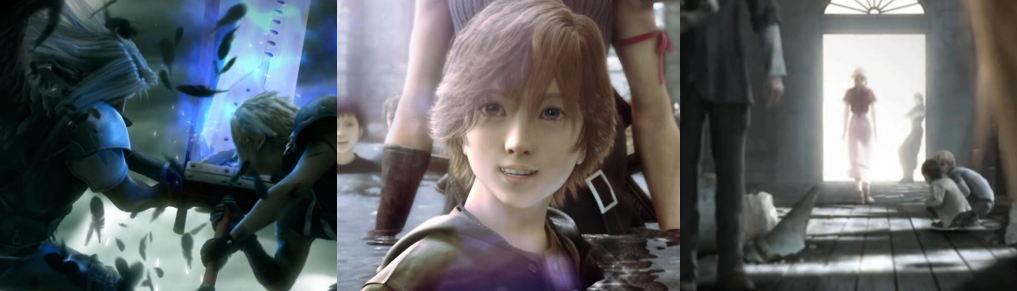
After Bahamut SIN is destroyed, Kadaj retrieves Jenova’s head from Rufus and makes a run for it. Yazoo and Loz are seemingly killed thanks to Reno and Rude and Cloud desperately battles Kadaj on the remains of the Mako Cannon, only for the Remnant to merge with Jenova’s head and Sephiroth to be reborn. Sprouting his black wing and flying through the air, Sephiroth attacks Cloud with a cold, clinical aggression, taunting him at every turn and mocking both his attachments to his friends and his fractured memories. Though he holds his own, Cloud’s noticeably overwhelmed by his rival, who slashes him to ribbons with a version of Octoslash and once again impales Cloud on his impossibly long sword to torture him. Weakened from blood loss and stunned by Sephiroth’s plot to eradicate all life on the Planet and use it as a vessel to travel to a new world, Cloud’s encouraged by Zack’s spirit and flies at his foe, determined to protect the ones he loves at any cost. In this version of the film, that translates into an all-new version of Omnislash, which sees Cloud fly at Sephiroth with each of his blades before delivering the final blow. Though defeated, Sephiroth vows to “never be a memory” and dissipates, leaving only the exhausted Kadaj, who reconciles with Cloud before rejoining the lifestream. Though victorious, Cloud is mortally wounded by the persistent Yazoo and Loz before that also disappear, though thankfully his life is saved when his friends bring him to Aerith’s church. With Sephiroth and the Remnants gone, Aerith’s spirit conjures a healing rain that cures everyone of their Geostigma and restores Cloud to full health. Surrounded by grateful children and his friends, Cloud spots Aerith and Zack’s spirits as they bid him a final farewell and he realises that he’s not alone, seemingly ready to let go of his guilt and embrace the present rather than dwelling on the past. This is further reinforce din a post-credits scene, which shows the restored Buster Sword how sitting in the flower patch in Aerith’s church.
The Summary:
I was really ass-backwards with Final Fantasy VII. I watched this movie first, a year or so before I got to play the game and have to confess that I had a lot of questions as a result. The film does a decent job of getting audiences up to date and is clearly aimed at fans of the videogame, but it can be a bit overwhelming for those who haven’t played Final Fantasy VII (either ever or for a while). Still, Final Fantasy VII: Advent Children is an exhilarating and impressive visual rollercoaster, one that holds up incredibly well today and set a new standard for Final Fantasy’s cutscenes and action-orientated battles. While it can get a bit deep with Cloud’s existential crisis and exploring his feelings of guilt and self-doubt, the film never fails to visually impress, and the battle sequences are a real highlight. I love how it translated the Limit Breaks and physical attributes of its characters to the screen, staying faithful to the source material but still keeping things largely grounded so the more elaborate and supernatural elements (such as the Shadow Creepers and Bahamut SIN) make a greater impact. While it’s disappointing that the supporting characters are relegated to glorified cameos, I liked the development of Cloud’s relationship with Rufus, Reno, and Rudo, the depiction of Cloud drawing strength from his friend’s encouragement was spot on, and the emphasis on Cloud’s relationship with Tifa explored his character in interesting ways. Cloud’s a guy whose entire life turned out to be a lie and he’s been wrestling with his identity for years, so it’s gratifying to see him realise he has so much to fight for and throw his all into opposing Sephiroth. This climactic fight, with its infection hard rock remix of “One-Wing Angel” and brutal, intense action, steals the show even from the battle with Bahamut SIN. It’s amazing seeing these two heated rivals clash with such detail, brutality, and grace and this battle alone clearly informed the more modern, action-orientate gameplay seen in the Final fantasy games (to say nothing of its all-action spin-offs). While every version of Advent Children is a blast, Advent Children Complete is the best way to watch the film with its extended scenes and improved visuals. Overall, Final Fantasy VII: Advent Children Complete is the Final Fantasy movie series fans deserved, being both a loving homage to the source material and a worthy follow-up to perhaps the greatest game in the franchise.
My Rating:
Fantastic
Did you enjoy Final Fantasy VII: Advent Children Complete? What did you think to the additions made to this version? Were you disappointed that some of the supporting cast got less screentime? What did you think to Cloud’s character arc and the guilt that weighed so heavily on him? Were you impressed by the CGI and the high-octane battles? What did you think to the remnants and the final battle with Sephiroth? Which Final Fantasy game would you like to see get a sequel or adaptation like this? Leave your comments down below, go support me on Ko-Fi, and check out my other Final Fantasy content.

 Dr. K's Waiting Room
6 thoughts on “Movie Night: Final Fantasy VII: Advent Children Complete”