

Released: 20 June 2023
Developer: Tindalos Interactive
Also Available For: PC, PlayStation 4, PlayStation 5, Xbox One, Xbox Series S
A Brief Background:
The Alien franchise (Various, 1979 to present) has had a long and complex history with videogame adaptations over the years. The films have been adapted into everything from primitive pixelated messes to crossover titles, survival/horror experiences, and first-person shooters. We even got a real-time strategy title back in 2003, one that garnered a lukewarm reaction from critics. While it may be surprising that Tindalos Interactive chose this genre for their adaptation of Aliens (Cameron, 1986), there was precedent for this given their success in the genre with Battlefleet Gothic: Armada (2016). While there isn’t much information about the game’s development available online, I can tell you that Aliens: Dark Descent was received rather favourably and that critics praised the foreboding atmosphere and immersive gameplay while criticising its performance and the unwieldy nature of certain control options.
My Progression:
Aliens: Dark Descent is a real-time tactics games that borrows many visual cues, dialogue, and audio from Aliens. Played from a top-down, isometric perspective, the game has players control a squad of four Colonial Marines and take on various missions on Lethe, a planet they’re stuck on following a Xenomorph outbreak on an orbiting Weyland-Yutani space station. Initially, you learn some of the basics by controlling a single character, Deputy Administrator Maeko Hayes, who’s responsible for them being stranded on Lethe. While nowhere near as capable as the Marines, controlling Hayes teaches you the basics of character and camera movement, the interactions you’ll need to progress, and the importance of stealth in later missions. She also tours the downed USS Otago between missions, promoting Marines, assigning Physicians to heal injured troops, and deploying missions across Lethe. When on a mission, you press X to have your Marines move to a point on the environment. You can also double tap X to have them run, though they’re inexplicably unable to shoot and run at the same time. Y allows them to interact with the environment, activating consoles, calling lifts, extracting samples from downed Xenomorphs, and repairing sentry guns or healing teammates. You can also hold Y or press in the right stick to activate a flashlight, which is super useful for exploring the game’s dark, ominous areas. A confirms your menu selections, B cancels them, and the Xbox’s ‘View’ button opens a full-sized map (though I found the smaller mini map, with built-in motion tracker, more useful). From the map screen, you can select any security cameras you’ve activated, see primary and secondary objectives, and call the M540 Armoured Reconnaissance Carrier (ARC) for some heavy ordnance support or to extract your team. The Left Trigger allows a grapnel function, though I never utilised this so I can’t comment on it, and you can focus on your team leader or reload your weapons by using the directional pad.
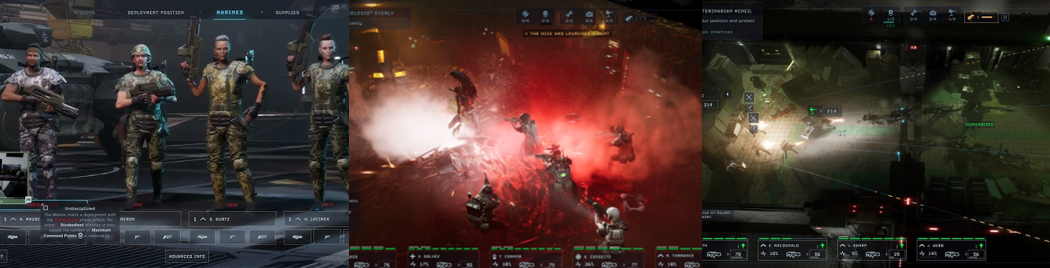
Your squad will automatically open fire on any nearby targets or if manually directed by your inputs. They don’t have infinite ammo, however, so you must loot corpses and crates to boost your stock, though your inventory is limited. You can select a Marine with Y to apply first aid or give them a booster to calm their nerves as your troops will grew more and more anxious as you engage in combat. The Right Trigger opens the “Skill Menu”, allowing you to utilise additional weapons (such as a shotgun spread, suppressive fire, a flamethrower, and a grenade launcher) at the cost of “Command Points”. Command Points regenerate over time, but you can fully restock them, calm down your squad, and manually save the game by welding shut doors in enclosed spaces to create a “Shelter”. This can only be done as long as you have “Tools” points and will not refill their health, unfortunately, but it gives you a chance to catch your breath. Each Marine has a personality trait that affects their gameplay; they may be cowardly, or quick to panic, or clumsy. These negatively impact their performance, reducing accuracy, increasing the chances of exhaustion, and lessening their attack power. Even if your Marines survive their mission, they are left traumatised by several afflictions. While some are cured by a Physician, others escalate, especially as you pass days to give them time to recuperate. You can level-up and Promote your Marines, however, adding additional buffs such as increasing their armour or their build/health speed. You also spend points in the workshop purchasing new weapons, such as the Smart Gun and mines, and accessories like the sentry guns and tactical analysis, which can be lifesavers out in the field. While you can heal, save, and often carry downed Marines to safety, any you lose are gone forever and memorialised on the USS Otago, forcing you to strategize and make smart use of your resources and surroundings to keep them healthy and alive.
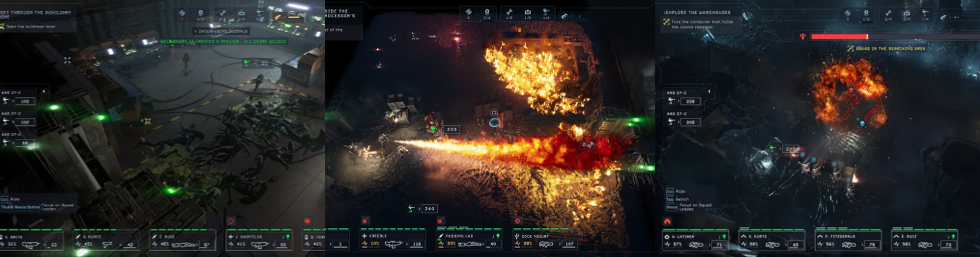
This adds a level of tension and dread to Aliens: Dark Descent that’s exacerbated not just by the foreboding visuals and obscured map but also the game out-right warning you of its difficulty. You can adjust the game’s difficulty settings and the enemy intelligence before starting a campaign, though the standard settings were challenging enough for me. Lethe is crawling with Xenomorphs who scurry about on walls and ceilings and burst from pipes and the shadows. Aliens swipe with their claws and tails, attack with their little mouths, spit and bleed acid, and abduct your Marines and non-playable characters (NPCs) to be cocooned elsewhere. You’ll occasionally free these victims, though most die from a Chestburster, and encounter numerous Alien eggs and Facehuggers, which must be dispatched before they impregnate your troops. Even bog standard Xenomorph drones can take a lot of firepower to put down, especially if your squad is weak, injured, or panicked. Your best bet is to either use cover or stay back, laying down suppressive fire or deploying sentry guns in a kill box to thin out the Aliens. While they usually attack in small groups, their aggressiveness will increase, they will actively hunt you, large swarms spawn in for a short time, and their numbers and aggression only increase the more days you waste recuperating. Eventually, you’ll encounter a larger Alien variant, a “Charger”, that…well, charges at you like a rhino. Though big and cumbersome, the first encounter in the slaughterhouse isn’t too bad as long as you stay back and rest your troops, but they spelled disaster for my repeated excursions into the mine. An Alien nest is found here, with cocooned scientists and eggs everywhere, and sheltering a gigantic Xenomorph Queen. Ironically, this battle was easier than exploring the mines! I laid down suppressive fire, unloaded with the grenade launcher and flamethrower, and placed a sentry gun or two and she went down on my second try, though I think the strength of my squad had a lot to do with that as I had to extract and heal up to even reach her lair. It seems like you’ll also battle malfunctioning synthetics as well; this happened once during my playthrough so I imagine they, and other Aliens, crop up later in the game.
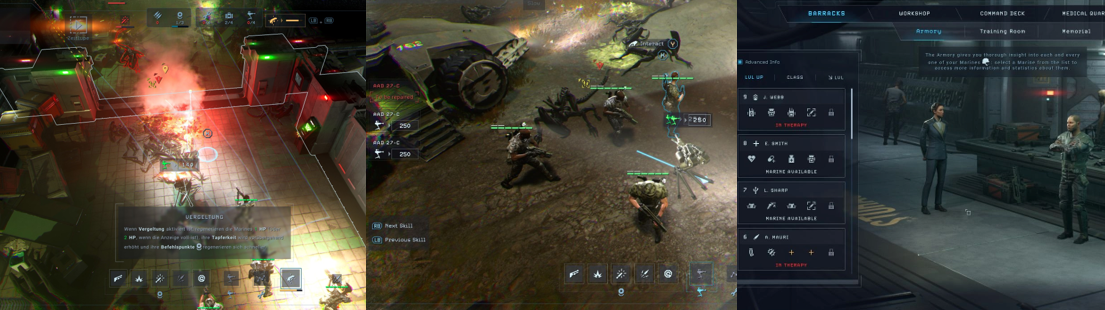
Aliens: Dark Descent certainly looks the part. The perspective obviously makes the game far less detailed than FPS or third-person Alien titles, but the environments are all ripped right out of Aliens and I loved how all the tech and readouts aligned with what we saw in the first two films. Character models are very basic, however, often disappearing into the dark environments and not featuring much variety unless your troops are limping from wounds. They express themselves more through dialogue, shamelessly stealing the best lines from Aliens and commenting on every situation, and through the many pre-rendered cutscenes. Hayes’ time on the USS Otago recalls similar third-person sections from Aliens: Fireteam Elite (Cold Iron Studios, 2021) and sees her meeting new recruits, prioritising her troops, and being assigned side missions by other NPCs. If you choose not to deploy your squad, the infestation increases and your troops suffer; oddly, demanding they rest causes them to become exhausted, which was very strange. Passing the time often gives you the option to undertake offscreen missions for additional resources, though at the cost of a deployment, meaning you have to weigh the pros and cons of obtaining additional bonuses versus increasing the Alien resistance. Eventually, I got into a routine of deploying, accomplishing a mission or two, and fleeing Lethe with more of my squad, meaning the bulk of my gameplay was focused on repetition, trial and error, and revisiting the same locations with a bit more experience. It took everything I had just to clear the first mission, which took a good few hours, which tells me that Aliens: Dark Descent has a lot of play time in it, likely focused on grinding and exploration to nab all those hidden Achievements, though it’s possible those better versed in this genre of game may have better luck than I did during my frustrating play time.

When I first started Aliens: Dark Descent, I was expecting a game akin to the Command & Conquer games (Various, 1995 to present) I dabbled in as a kid. This turned out to not be entirely true as it’s much more focused on stealth and action rather than building bases and such, though the Shelter mechanic masquerades as a base, I suppose. This genre of game isn’t really one I’ve had that much experience with; it seems more geared to mobile players or fans of “roguelike” titles, and therefore was quite a chore and a challenge to play. I was hoping for a mission-based title where you strategically place troops and build forces to hold off the Xenomorphs, and instead was beaten over the head with a moody, difficult, and often tedious gameplay experience. The visual fidelity to the first two movies is amazing; the atmosphere is perfectly foreboding and the dread of every encounter, however minor, definitely echoes the dire straits faced by the Marines in Cameron’s sci-fi classic. Aliens: Dark Descent can be very unforgiving, though; even if you take the time to heal and prepare, the odds are always against you. Just one Xenomorph can wipe out your squad, especially if they are injured or fresh-faced recruits, and it’s very easy for the tide to turn against you, even if you set up a well-armed kill box and farm nearby resources. I can see that Aliens: Dark Descent is going to demand a lot of my time as the first mission took me most of an afternoon to get through, meaning it’s a game I will likely revisit in the same manner I played: “short, sharp bursts” to whittle away at each objective, no doubt to be wiped out by some unforeseen new Alien variant. But maybe I just suck. Maybe you had a better strategy. Maybe you found all the data pads and creamed this game. If so, tell me about it in the comments, tell me your favourite Alien game, and check out my other Alien content.

 Dr. K's Waiting Room