
Upon the release of Pokémon: Blue Version and Pokémon: Red Version (Game Freak, 1996), a new craze swept through playgrounds. An entire generation grew up either playing Pokémon, watching the anime, playing the trading card game, and watching the feature-length movies as clever marketing saw it become a massively lucrative and popular multimedia powerhouse. Accordingly, February 27th is now internationally recognised as “National Pokémon Day”, which I expanded to an entire month of Pokémon this February.

Released: 12 April 2023
Originally Released: 14 December 2000
Developer: Nintendo EAD
Also Available For: Nintendo 64
A Brief Background:
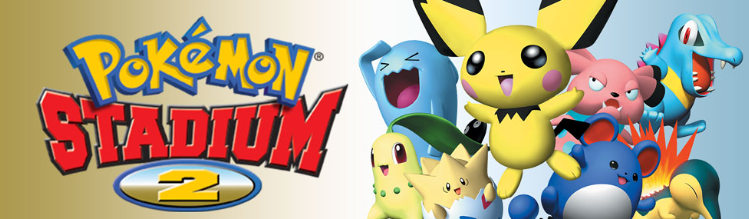
Pokémon’s status as a cultural phenomenon wasn’t just due to savvy marketing. It was thanks to a slew of merchandise and ancillary media, such as the popular trading card game, that the franchise dominated an entire generation on the Game Boy. Pokémon first made the jump to 3D two years after the original games released with the Japan-exclusive Pocket Monsters’ Stadium, a limited proof of concept initially created for the ill-fated Nintendo 64DD that was quickly followed by Pokémon Stadium (Nintendo EAD, 1999). Impressing with its lauded 3D rendition of the turn-based battles of the mainline games and ability to transfer Game Boy data via the underutilised “Transfer Pak”, Pokémon Stadium became a best-selling Nintendo 64 title. This success naturally led to a follow-up, first showcased at the 2000 Nintendo Space World festival and which expanded the concept to incorporate Pokémon from the second-generation games. Like its predecessor, Pokémon Stadium 2 reviewed well; the game was largely seen as superior to the original, despite including many of the same features and issues, though its sharp difficulty spike was criticised. Like the first game, Pokémon Stadium 2 was stuck on the Nintendo 64 for decades and extremely expensive to buy, until it was finally made available on the Nintendo Switch Online + Expansion Pak in 2023.
The Review:
Like its predecessor, Pokémon Stadium 2 is a collection of mini games, battles, and various options to gawk at your favourite Pokémon in 3D. In the original release of the game, players could again copy over Pokémon from the Game Boy games (all six versions) to take them into 3D battles against computer-controlled opponents or their friends in single or team-based contests. Of course, this option isn’t available in the Nintendo Switch Online version, but you can still use “rental” Pokémon (though, unlike the CPU’s Pokémon, these can’t be renamed and you can’t change their moves). Although all 251 Pokémon are represented in the game, you won’t get access to Legendary Pokémon Mewtwo, Mew, Lugia, or Ho-oh until you clear each of the game’s various battle modes. Rental Pokémon all come with four moves that have decent Type-coverage and try to accommodate different battle styles. For example, your Pokemon may sport a Physical and Special Attack move, a move to buff their stats (speed, defence, etc), and a move of a different Type (such as Ampharous, an Electric-Type, using Dynamicpunch, a Fighting-Type move). If you pick third-stage evolutions (Typhlosion, Lantern, Houndoom, etc) or Legendary Pokémon, your Pokémon will boast better stats (which you can now view when selecting a Pokémon) and more powerful moves, but these moves may have a greater chance of missing or will have less Power Points (PP). This time around, you can visit Earl’s Pokémon Academy and read through various tutorials (presented as “lectures”) to learn the controls and battle mechanics. You can also view stats and details about each Pokémon in the Library, learning about what each move does and viewing details on Type advantages, making it much easier to pick a diverse team and plan your attack strategies. Type advantages are key to scoring wins and, in Pokémon Stadium 2, you’ll need to factor in the new Dark- and Steel-Type moves and Pokémon. Dark-Types finally level the playing field against the all-powerful Psychic-Types, for example, and Steel-Type Pokémon can cut through Rock-Types.
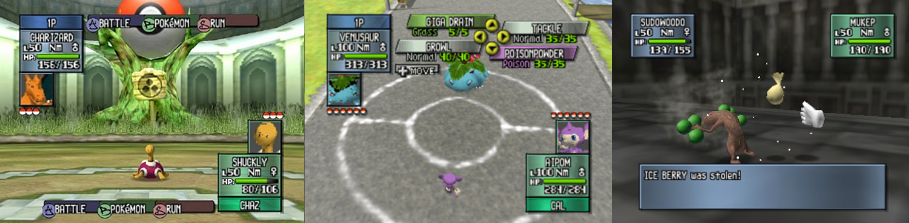
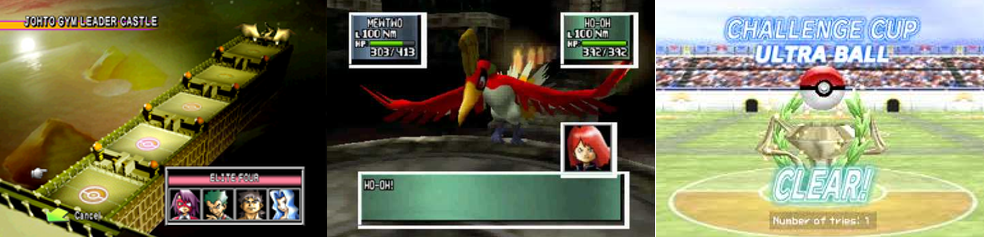
As ever, moves deal additional damage if you score a “critical hit”, but your Pokémon may also take recoil damage. You’ll need to be mindful of status effects such as being paralyzed or poisoned, though the game’s still rigged so no two Pokémon can be frozen or asleep per battle. As before, you’ll put together a team of six but only battle with three. You’ll see which Pokémon your opponent has but won’t know which ones they’ve picked, though I did find that Trainers and Gym Leaders tended to favour Pokémon of a certain Type this time (when challenging Falkner, for example, he and his underlings mostly used Flying-Type Pokémon). Still, you need to be mindful of enemy Pokémon surprising you with unforeseen moves and dragging battles out with moves like Protect, Disable, and Attract, which can cost you turns. The battle system has been tweaked here to incorporate items; when selecting you team, you can have them hold a single item that will passively take effect in battle. This will restore some health points (HP), or cure status effects like confusion, paralysis, or poisoning; however, you cannot manually use these items, and your opponent also holds the same items. Winning without receiving any damage earns you a continue should you be defeated (though abusing the save state feature greatly aids in this regard) and conquering the four “cups”, each with their own level restrictions and one of four PokéBall-themed trophies. The Gym Leader Castle returns, now pitting you against the Johto Gym Leaders and your Rival (who battles with Mewtwo, Ho-oh, and Lugia!) This time around, each Gym Leader has a different number of underlings you must battle beforehand, and Team Rocket even gatecrash the castle, forcing you to battle them. Besting all the Johto challengers unlocks the Kanto Gym Leader Castle, where you must face the Kanto Gym Leaders, Elite Four, and resident champion, Red, though you won’t have to battle past their understudies. Sadly, there is no big boss battle against a Legendary Pokémon this time around, though you’ll still unlock a much more challenging “Round 2” mode by winning all the cups and besting the Gym Leader Castle. There is a new cup on offer, Challenge Cup, where you’re forced to battle with a set team of Pokémon, and the “Event Battle!” mode is strictly for players with a game cartridge installed. Battles are as basic as before; since the items are limited, you can still get stuck if you’re hit with status ailments and it’s still way too easy to sweep your opponent’s team in a few hits.
There are more options to alter the game’s difficulty and you can even create your own rules for free battles and the expanded move and Type pool does mix things up. However, you’ll still be facing non-stop battles to get to Round 2, which can get tedious. The overly enthusiastic announcer returns, though can again be disabled, and Pokémon still don’t scream their names, which is much more true to the source material than the anime. While the returning 3D models aren’t much different, Pokémon Stadium 2 also brings the Johto Pokémon to life, allowing Lugia to dwarf the likes of Spinarak and even the battlefield. Though the new moves are also represented, the Pokémon still have limited attack animations, however the textures and details have been given a boost thanks to the Nintendo 64 Expansion Pak. Pokémon Trainers are still just profile pictures rather than 3D models but the battle display has been tweaked to include pre- and post-game comments from your foe and even mid-battle statements to better mirror the mainline games. Many of the Pokémon you face will again sport bizarre nicknames and even different palettes, but the arenas are just as empty as before. However, there are more of them and they have more detail and variety going on; even the PokéBall intros and outros have been made more grandiose and the menu screens are far more visually interesting. However, it’s still all very similar to what came before and just feels like a graphical glow-up rather than actually rendering arenas full of animated spectators. Remixes of all your favourite Pokémon themes try to keep battles fun and engaging and the introductory cutscene, title screen, and main map have been spruced up, but again it’s just presenting the same game in a slightly more appealing way instead of addressing the monotonous gameplay flaws. Once again, many game modes are locked off in this version. You can’t visit the Pokémon Lab to organise or bring in Pokémon from the Game Boy games, you can’t visit the “My Room” mode to see a 3D representation of your bedroom from the second-generation games, and you can’t utilise the “Mystery Gift” feature to earn items or decorations for your room.
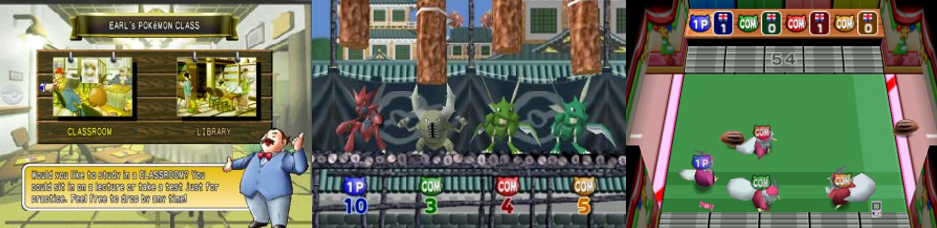
Again, most annoyingly, you cannot access the GB Tower, so you can’t play the first- and second-generation Pokémon games or utilise the speed-up features you unlock through battle. The Hall of Fame and picture mode also seems to be missing, though you can view all 251 Pokémon from the academy, essentially giving you a 3D PokéDex, and take part in quizzes to earn Medals (presumably for bragging rights). A whole new batch of mini games are also on offer here; each has three difficulty levels, with a fourth unlocked by playing on “Hard” mode. There’s another quiz here, too, and you can challenge the “Mini-Game Champion” mode where you play through each mini game, rolling dice beforehand to determine how many “Tokens” are needed to win and competing for the top score. Some mini games are similar to those from before; Pichu’s Power Plant, for example, has you tapping A or B in conjunction with a direction to charge electrodes like Thundering Dynamo and Tumbling Togepi sees you rolling across a treadmill avoiding obstacles, like Run, Rattata, Run. Otherwise, you’ll be tapping A to fly about as Golbats, bashing other players and collecting hearts, tackling rival Hitmontop out of a sumo ring, pressing A at just the right time to slice through falling logs, and dashing various PokéBalls into goals for points. There’s a four-way version of Pong (Atari, 1972) in which you ricochet balls using Mr. Mime’s Barrier, you’ll be running laps around a dirty track with Donphan, counting Pokémon as they march past, and gathering up presents to fill Delibird’s sack. You’ll also be catching falling eggs and avoiding Voltorb with Chansey and playing a version of musical chairs in Eager Eevee, tackling Aipom and avoiding an exploding Pineco when they appear in the middle of the arena. Since I didn’t play Pokémon Stadium 2 as a kid, I have less nostalgia for these mini games but they’re a decent enough distraction. Technically, though, they’re better and more challenging than the last game. As before, you’ll be awarded with special prize Pokémon for beating the game’s battle modes; you’ll even unlock a “Move Relearner” mode, though you obviously can’t take full advantage of any of this since you can’t plug in a Game Boy game.
The Summary:
As I said, I never got to play Pokémon Stadium 2 as a kid. I enjoyed the novelty of the first game, and was still playing the Game Boy games, but I think the game was just too difficult to come by or I was spending my money on more fulfilling Nintendo 64 experiences at the time. However, the second-generation games are my favourites so I was excited to see some of my favourite Pokémon, like Typhlosion and Lugia, come to life in 3D. In this regard, Pokémon Stadium 2 doesn’t disappoint; the new Pokémon all look great and the graphical bump provided by the Expansion Pak spruces up the visuals and makes battles a bit more engaging. Sadly, the arenas are still very bland and the game is basically a carbon copy of the last, flaws and all. Once again, it’s just a constant stream of non-stop battling with little to break the monotony. Incorporating items and allowing players to view details of the Pokémon, moves, and Types was great but it’s again all very limited. You’re limited by moves, by levels, and by your customisation options and these issues are only exacerbated in this version since you can’t access the Game Boy titles. To make matters worse, there isn’t even a big battle against, like, Lugia and/or Ho-oh. Sure, the Rival has these Pokémon but that’s not as epic as facing off against Mewtwo. The new mini games are a step up, for sure, and I liked how the overall presentation was much improved over its barebones predecessor. However, it’s still the same game at its core; you battle over and over for cups and trophies, then do it all over again in Round 2. The Rocket takeover was a fun inclusion; I would’ve liked to see that expanded on, maybe even looped in as a rudimentary story mode. Ultimately, I’d say this is the version of Pokémon Stadium you should focus your time and energy on because of the improvements it brings to the table, but it still falls way off the mark of giving a true 3D Pokémon experience and can’t help but disappoint as a result.
My Rating:
Pretty Good
Did you ever own Pokémon Stadium 2 back in the day? What did you think to the graphical boost and the inclusion of items? Did you enjoy the new mini games? Were you disappointed that the core gameplay remained unchanged? Did you ever best all the cups and Gym Leaders? Would you like to see another title in the series? How are you celebrating National Pokémon Day this year? Whatever your thoughts on Pokémon Stadium 2, drop them below and check out my other Pokémon content.

 Dr. K's Waiting Room
One thought on “Mini Game Corner [PokéMonth]: Pokémon Stadium 2 (Nintendo Switch)”