
Upon the release of Pokémon: Blue Version and Pokémon: Red Version (Game Freak, 1996), a new craze swept through playgrounds. An entire generation grew up either playing Pokémon, watching the anime, playing the trading card game, and watching the feature-length movies as clever marketing saw it become a massively lucrative and popular multimedia powerhouse. Accordingly, February 27th is now internationally recognised as “National Pokémon Day”, which I expanded to an entire month of Pokémon this February.


Released: 12 April 2023
Originally Released: 30 April 1999
Developer: Nintendo EAD
Also Available For: Nintendo 64
A Brief Background:
Pokémon was an instant cultural phenomenon when it first released. It wasn’t just because of the games, which cleverly encouraged players to “Catch ’Em All”; it was the slew of merchandise and ancillary media that made Pokémon a household name. Right from the beginning, Pokémon was followed by spin-off games; whether it was the incredibly popular trading card game or other videogame genres, like pinball, Pokémon dominated an entire generation, especially on the Game Boy. Two years after the original games released, Japanese Nintendo 64 players were treated to Pocket Monsters’ Stadium. Originally intended as a launch title for the ill-fated Nintendo 64DD, the game was limited to only forty playable Pokémon but set the template for 3D Pokémon battles. Pokémon Stadium was its successor, incorporating 3D models and animations for all 151 Pokémon and being chosen for international release over its predecessor, much like how the inferior Pocket Monsters: Green Version was superseded by its successors. It was HAL Laboratory president Satoru Iwata who studied the Game Boy source code and converted it to work on the Nintendo 64, though Pokémon Stadium’s other big selling point was its ability to communicate with the Game Boy using the unique (and sadly underutilised) “Transfer Pak” to import copies of Pokémon from the handheld titles. Pokémon Stadium was generally well received at the time; reviews largely focused on praising the 3D models and impressive adaptation of the turn-based battle system, though criticised the annoying announcer. Though a best-seller, and followed by a superior sequel in 2000, Pokémon Stadium was stuck on the Nintendo 64 until it was finally made available to modern gamers, via the Nintendo Switch Online + Expansion Pak, in 2023.
The Review:
Pokémon Stadium is a 3D Pokémon adventure in which players could upload copies of the Pokémon from the Game Boy games and battle it out in 3D against computer-controlled opponents or their friends. Since the Nintendo Switch Online version lacks connectivity with the Game Boy games (which aren’t even available on the Nintendo Switch Online as of this writing), you’re limited to using “rental” Pokémon, which can’t be renamed or customised in any way. When you first start the game, only 149 Pokémon are available to rent but you’ll gain access to Mewtwo and Mew by clearing all the game’s battle modes. Each rental Pokémon has four moves, with the third-stage evolutions (like Blastoise and Charizard) sporting better stats (higher attack and defence, for example) but wielding more unreliable moves (such as Fissure, a one-hit knockout move that can miss four times out of five) or moves with less Power Points (PP), such as Fire Blast and Mega Beam. Although I mentioned stats earlier, you can’t view the stats for any Pokémon in the game, rental or otherwise. You have no idea how strong your Pokémon is beyond the level they are and you have no options to improve their stats. The best you can do is use moves that buff them in battle, such as Swords Dance, to increase your chances of attacking before your opponent, or ones that de-buff your foe (such as Sand Attack to reduce their accuracy). As ever, Type advantages are a key factor in battle; Fire-Type moves are “super effective” against Grass-Type Pokémon, for example, which have the edge over Water-Type Pokémon. Many moves also have a chance of landing a “critical hit” for extra damage, missing, hitting you with recoil, or causing status effects. Pokémon can be burned, frozen, put to sleep, paralysed, and poisoned and you have no way to solve these ailments as there are no items here (though the game’s rigged to ensure no two Pokémon can be frozen or asleep in a battle).
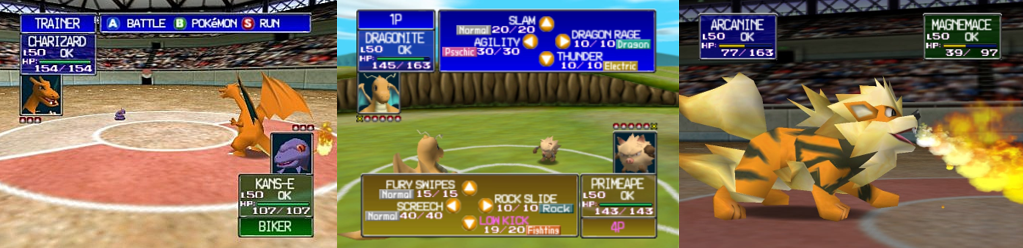
The limitations don’t end there, either. Although you assemble a team of six Pokémon, you only ever battle with three. Similarly, while you can see your opponent’s available Pokémon, you have no way of knowing which ones they’ve picked so it’s best to assemble a diverse team. Luckily, every Pokémon has a diverse move pool consisting of elemental attacks, status-inflicting attacks, buffs, or alternative elemental attacks (Marowak, for example, not only has Ground-Type moves but also uses Fire Blast, a Fire-Type move) to provide additional coverage in battle. If you win without taking a single hit, you’ll earn an extra continue to battle on should you be defeated (though the Nintendo Switch’s save state feature can mitigate this). When taking on the titular Pokémon Stadium, you compete in one of four “cups”, each imposing level restrictions, to win one of four PokéBall-themed trophies by gaining six consecutive victories. The Gym Leader Castle has a similar setup, except you only have to win four battles (besting three underlings before challenging the Kanto Gym Leaders, Elite Four, and your Rival) and there are no level restrictions. Besting all these battles unlocks a final super boss battle against Mewtwo, in which you take six Pokémon in battle to beat him, unlocking the much tougher “Round 2” mode and changing both the title screen and the main menu accordingly. Battles are pretty basic; once you get over the fun, colourful, cartoonish animations of the Pokémon, you start to see how limited your options are. You can’t do anything but power through if your Pokémon is poisoned, its moves are disabled, or it gets confused and attacks itself. Type advantages can see you sweep entire teams, but the diverse move pools mean you can’t underestimate opponents, especially if you chose poorly when assembling your team. Finally, battling non-stop can get really tiresome; it’s definitely a game best played in little spurts rather than trying to beat everything in one sitting as the novelty quickly wears off.
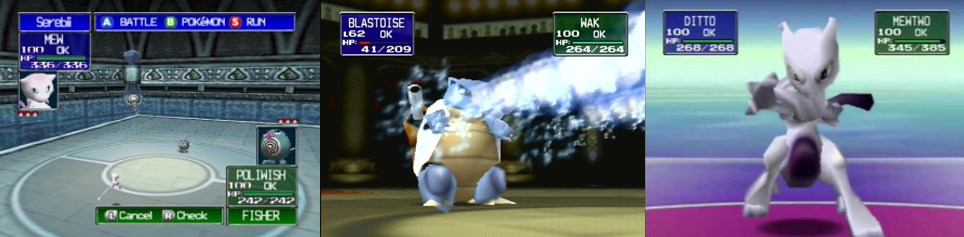
The grating announcer doesn’t help; this overly enthusiastic guy will spout the same exclamations over and over, chastising you if you take too long or pick the wrong Pokémon and screaming praise for every correct decision. Luckily, you can turn him off from the options. Unlike in the anime, Pokémon don’t scream their name when in battle (except for a Pikachu imported from Yellow Version), but this actually makes the game more appealing in my eyes. Pokémon are rendered in full 3D and exhibit a lot of personality; Mr. Mime actually mimes when idle, Onix’s body rotates and squirms, Muk is all sludgy and gooey, and Primeape dances about ready to fight. Rival Pokémon often sport rudimentary nicknames and alternative colour schemes and, while they only have a handful of animations, these work for the moves they perform, which are all brought to life in suitably dramatic fashion even if physical moves (like Mega Punch and Slash) don’t actually connect with the opponent as the Pokémon stay on each side of the arena. You never see the Pokémon Trainers except in profile pictures before and after battle and, while audiences react and make noise in arenas, you won’t see any spectators (at least, not clearly, anyway). Arenas are largely empty and underwhelming, to be honest; some are suspended over water or lava, some are inside, some outside, and you battle Mewtwo in a surreal sky landscape, but there’s nothing to really see as the focus is squarely on the 3D Pokémon models and their attack animations. This is fine and it all looks good and more accurate than the depictions in the anime, but again it’s all quite bland and tiresome after a while. The game is bolstered by renditions of the classic Pokémon theme, battle music, and other in-game tunes, which are always fun to listen to, but the introduction movie is incredibly basic and just showcases a few Pokémon models flying about.
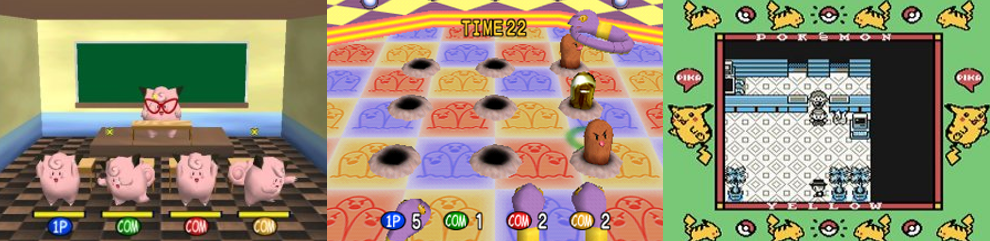
Of course, it’s not all battling in Pokémon Stadium, but that is half of the story in this version of the game. Normally, you could visit Professor Samuel Oak’s lab and organise or trade in Pokémon from the Game Boy games, but you can’t do that here. Most notably, you used to be able to access the GB Tower and play the original games on your TV screen, with options to speed up the gameplay at hand, but that’s also not available. Since you can’t import Pokémon, you can’t get the special Surfing Pikachu, though you’ll still be awarded with one of eight semi-rare Pokémon each time you clear the Gym Leader Castle. You can still visit the Hall of Fame and view the Pokémon character models up close, though you must best the Gym Leader Castle with all 151 Pokémon to do this (which also earns you a Psyduck that knows Amnesia). Luckily, you can still visit the Kids Club and play the many fun mini games on offer, either against the computer or alongside your friends. Here, you’ll copy Clefairy’s dance instructions, gobble up sushi with Lickitung, race against Rattata, cast Hypnosis against other Drowzee, see how any times you can get Magikarp to splash, charge up a dynamo with Pikachu or Voltorb, defend against incoming rocks with Kakuna and Metapod, toss Ekans like a ring, and dig into the ground with Sandshrew. These mini games are only short but they’re quite fun and addictive; the timing can be a little off at times and other times you must pay attention to not drain your health bar, but it’s enjoyable enough battling alone or against friends. I do wish the game did more with these, though, like maybe had a random mini game play during the cups to let you earn single-use items or some kind of buff. Other options include a gallery (another limited feature where you can photograph Pokémon to view its model, though you obviously can’t print these anymore), the ability to jump straight into a CPU battle, and unlockable stickers for the gallery when you beat “Round 2”. Beating the Kids Club’s “Who’s the Best?” mode on “Hard” unlocks the “Hyper” difficulty, but it can’t be denied that the game’s appeal and longevity suffer with this version since you can’t access the GB Tower.
The Summary:
I remember when Pokémon Stadium was announced and first released. It was the first time I can remember pre-ordering a game, and all my friends and I delighted in seeing our portable Pokémon brought to life in 3D. It was a big deal then, but it can’t be denied that Pokémon Stadium hasn’t aged well, hence this shorter review. It’s certainly still a lot of fun and a nostalgic high to see those early 3D Pokémon models, which were reused for many years after and are actually more lively than in some of the modern games, and I loved that they made noises like the in the Game Boy titles rather than screaming their names like in the anime. There are a few options available here, but Pokémon Stadium is essentially a glorified party game. When you’re not battling for cups and trophies, you’re battling the Gym Leaders, a friend, or the computer. When you’re not doing that, you’re playing mini games which, while fun, aren’t enough to sustain your interest for longer than half an hour or so. Without the GB Tower functionality, Pokémon Stadium loses a lot of its replay value, and you’re forced to focus on the repetitive and tiresome battling. With limited options, no items, and no room for customisation since you can’t import your portable team, the battling just appears very shallow and basic. As a 3D representation of Trainer and Gym Leader battles, it’s serviceable but Pokémon Stadium only does a rudimentary job of representing that one aspect of the mainline games. It’s fun enough in short bursts, but even then it can be tedious hearing the same announcements over and over and essentially just hitting A again and again to spam super effective moves since it lacks the depth and complexity of its far superior portable counterparts.
My Rating:
Could Be Better
Did you enjoy Pokémon Stadium? Were you excited to see your team brought to life in 3D back in the day? Which of the mini games was your favourite? What did you think to the limited battle options and repetitive gameplay? Did you ever fill up the Hall of Fame and defeat Mewtwo? Are you disappointed that so much of the game is inaccessible in this version? Would you like to see another battle-centric 3D Pokémon game? How are you celebrating National Pokémon Day this year? Whatever your thoughts on Pokémon Stadium, feel free to leave them below and check out my other Pokémon content across the site.

 Dr. K's Waiting Room
One thought on “Mini Game Corner [PokéMonth]: Pokémon Stadium (Nintendo Switch)”