
January celebrates two notable dates in science-fiction history, “National Science Fiction Day” on January 2 and Arthur C. Clarke’s HAL 9000’s birthday on January 12. Accordingly, I’m dedicating January to celebrating sci-fi with an event I call “Sci-Fanuary”.

Released: 22 July 2022
Originally Released: August 1996
Developer: Capcom
Also Available For: Arcade, GameCube, GameTap, Nintendo Switch, PC, PlayStation 2, PlayStation 4, PlayStation 5, Xbox, Xbox One, Xbox Series S
A Brief Background:
After ushering in Capcom’s debut in the home console market, the excessively difficult (but no less lauded) Mega Man (Capcom, 1987) eventually spawned enough of a franchise to become a Nintendo staple. Despite this, Capcom remained at the forefront of the popular arcade scene thanks to their blockbuster tournament fighter, Street Fighter II: The World Warrior (1991), which soon spawned numerous imitators to its throne. While Capcom later appeared reluctant to create new Mega Man games, a well-received (if simplistic) spin-off fighter was released to arcades in 1995. The following year, Capcom released a sequel, one that expanded upon the original’s cast and mechanics to produce a more fleshed-out version of the concept. Like its predecessor, Mega Man 2: The Power Fighters was included in various home console ports and featured as part of Capcom Arcade 2nd Stadium, which is the subject of this review.
The Review:
Like its predecessor, Mega Man 2: The Power Fighters is a 2D, largely one-on-one tournament fighter (though two players can team up to dominate their foes). The original playable cast (the titular Mega Man, his loner older “brother” Proto Man, and grim anti-hero Bass) are joined by the mysterious Duo and again pick from three story paths. Although I’ve heard that each of the four characters has different attributes, I noticed only minor differences between them, with the except of Duo. While the others all fire shots from their arm cannons, Duo attacks with an extendable arm and fires out a fist; he’s also a bigger target and potentially a bit slower. The controls remain unchanged, with players attacking with A and holding the button to charge a more powerful shot or using a rapid-fire variant with X. You jump with B (jumping higher the longer you press it), executing either jumping shots or wall jumping off the arena sides to dodge incoming attacks. Pressing down and B sees you dash ahead, while Y switches between your available Special Weapons. As ever, you acquire these by defeating Robot Masters and they’re tied to an energy meter, though this time you must pick up the Special Weapon orb after a victory and your friend can steal it from under you. Finally, you can press in the right-stick to enter a coin and continue fighting where you left off if you’re defeated, selecting a new character if you wish, with your health and weapon energy fully restored. Visually, sprites and attack animations are lifted wholesale from its predecessor. I didn’t find the all-new backgrounds as interesting as the first game’s and it was a little disappointing to not see more detailed environments or additional cameos included. The same can be said of the music, which is more of the same, though more sound bites are included here alongside additional cutscenes. These often feature Roll bestowing you an upgrade or Doctor Thomas Light giving exposition on your enemy and advancing the paper-thin plot, with the more impressive sprite art being saved for the endings, as you’d expect.
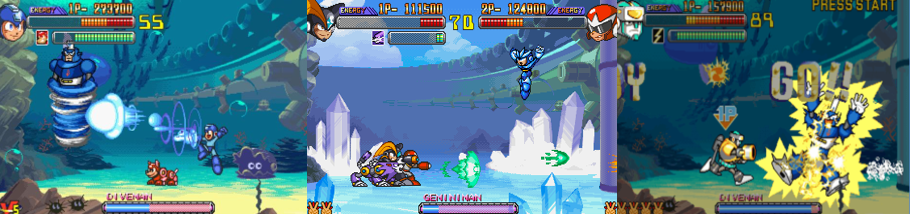
Some other tweaks include the pre- and post-fight text being more animated, characters having victory poses, and enemies dropping health and weapon energy pick-ups as you attack, giving you a bit more leeway in tougher bouts. Enemies can also block your attacks and reflect your shots, two abilities that you’re denied, and will enter a “pinch” mode when their health drops to half, increasing and varying their attacks and putting you on the defensive. To even things up, each character has a special attack they can perform by pressing up and X with a fully charged shot, with Mega Man unleashing a jumping uppercut, Proto Man firing a short-range burst of energy, Bass performing a crescent kick, and Duo hitting an uppercut/slam combination. Furthermore, Eddie appears during fights and bestow a robot helper who temporarily replaces your Special Weapon function until their life bar runs out. Mega Man is aided by Rush, allowing him to spring higher by jumping on the robo-dog’s back and send him flying at foes by charging his primary shot. Proto Man and Duo are aided by Beat, who grants them a temporary invincibility, and Bass is joined by Treble, who fires his own attack when you press X and can also be sent charging at enemies. Additionally, each story path sees you gifted an “upgrade” that either increases your attack power, adds a super jump (performing by pressing up and B), or increases the length of your weapon energy bar. These additions appear alongside the same features as the first game, including customisable borders and filters, a helpful rewind and save state feature, the ability to alter the game’s speed, difficulty, and the length of the one-round fights, and an optional invincibility mode that will disable both Capcom Arcade 2nd Stadium’s Achievements and the in-game “Triumphs” you can earn by playing. Again, you shouldn’t really need this option with the rewind and save state features. No Achievements are tied to beating the game without taking damage, earning a perfect no-damage victory bestows only points, and the game is just as easy as before, with the exception that I noticed enemies seem to take more hits to defeat this time around.
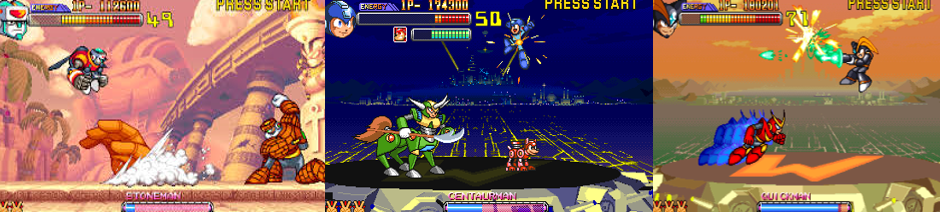
In true Mega Man fashion, you can circumvent this by acquiring specific Special Weapons to target specific Robot Masters. This time, you can freely select which enemy you face, though the damage you take in each fight still carries over to the next, so it pays to think about the order you tackle the Robot Masters. You’ll have an easier time against Plant Man, for example, if you defeat Heat Man and get the Atomic Fire weapon; similarly, Dive Man is weak to the Thunder Beam and Napalm Man is weak to the Gemini Laser. Gameplay is largely unchanged from the last game, with no stage hazards to be concerned about and the backgrounds noticeably changing to different times of day, locations, or other visuals depending on which path you take. There are no chases to worry about this time (though you can fight on stages that appear to spin or bob up and down in water or lava) and battling the Robot Masters still consists of an arcade-style rendition of the main games’ boss battles. Your foe will jump about firing their signature weapon, then add a few extra attacks when their health drops. Those that return from the last game (Heat Man, Plant Man, Gyro Man, Slash Man, Cut Man, Shade Man, Gemini Man, Napalm Man, and Guts Man) remain largely unchanged except for their “pinch” attacks, though I did notice that their health bars increase as you gain victories. New Robot Masters fit in very well with their counterparts, with Air Man blowing you back with his chest fan and firing mini tornados, Bubble Man capturing you in his slow but powerful bubbles, Centaur Man charging you and firing arrows, Dive Man bestowing homing torpedoes, Elec Man blasting three-way Thunder Beam, Pharaoh Man floating around with telekinesis and utilising a two-way wave attack, Quick Man moving with a shadow effect and speeding up your attacks with the Quick Boomerang, Shadow Man bombarding you with Shadow Blades, and Stone Man erecting stone walls and giving you a slow stone hand to fire as a ground shot. With enemies able to block, reflect, and power up, bouts do last a little longer, but the continued absence of combos and other mechanics means you can simply plough through to win as before.
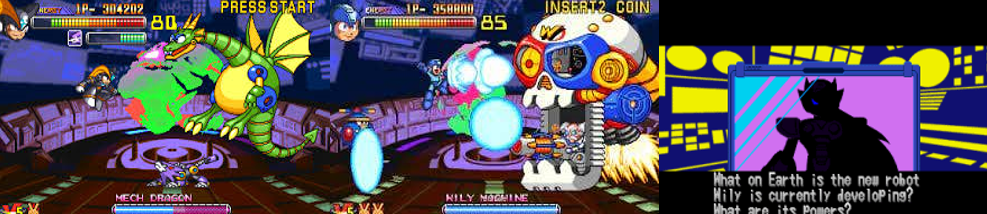
After defeating the six Robot Masters in your chosen path, you’ll enter Dr. Wily’s fortress and fight one of three additional bosses before meeting the mad doctor face-to-face. Returning from the last game is the Yellow Devil; slightly redesigned and far tamer than before, the Yellow Devil jumps more, fires a barrage of cubes and a focused laser blast from its eye, as well as slapping you, firing projectiles, and transforming into a sphere. The Mad Grinder from Mega Man 7 (Capcom, 1995) appears to fire buzzsaws and flatten you with his steamroller appendage, flinging his mohawk and spitting fireballs but being notably weak to the Centaur Arrow, while Mega Man 2’s (ibid, 1988) Mecha Dragon pops up to roast you with large fireballs, deal continuous damage with its flame breath, and spawn smaller minions. Defeat each other these and Dr. Wily will attack in his newest contraption for a three-stage final bout. In the first phase, Dr. Wily summons a robot minion to distract you, fires a robotic fist to punch or flick you, and defends himself with those same hands, firing small projectiles or a larger mouth cannon. In the second phase, he takes to the air as a smaller target, launching bombs, taking shots, and trying to target you with an explosive attack. Take this out and you’ll be given ten seconds to finish him off as he teleports between pods, though you’ll only be denied seeing Dr. Wily beg for mercy if you fail to finish him. You’ll get different endings depending on which character or character combination you play as, with Duo’s being a massive tease for Mega Man 8 (ibid, 1996) and the introduction of Zero, Mega Man briefly questioning his morals, Proto Man refusing Dr. Light’s help, and Bass continuing to disrespect his creator. After viewing these, and the end credits, you can enter your name in the high score table and try a different story path or play again to try and beat your best score.
The Summary:
Although Mega Man 2: The Power Fighters expands on the original game with a few new features, it remains as barebones as the original and thus there isn’t too much to say about it. I definitely think it’s a superior game thanks to the deeper variety in the playable characters, Robot Masters, and in-game action, but it’s not enough to bump the overall score any higher. I wasn’t exactly blown away by what Duo brought to the table and, while I liked the robot helpers, it bugged me that you have to pick between using them or using your Special Weapons. Having health and weapon energy drop in fights made things a touch more interesting, and I like the competitive nature of two players fighting to snag the Special Weapon after defeating a Robot Master, but it remains a colourful, enjoyable, but strangely shallow arcade interpretation of the boss battles from the mainline games. The new story paths weren’t bad, though I could’ve done with more story being included in each, and the addition of upgrades and special attacks helped mix things up, but the combat is still ridiculously simplistic compared to other fighters so there’s not much incentive to come back, especially as Capcom Arcade 2nd Stadium doesn’t include game-specific Achievements. I’ll give it this: the fights lasted longer and were more engaging this time, both because the Robot Masters seem tougher and have that “pinch” mode, and Dr. Wily’s sub-bosses were definitely more impressive this time around. But the uninteresting backgrounds, the lack of a tangible differences between the fighters, and the simplistic nature of the combat keep this from being the glow up it had the potential to be. It’s still a nice bit of cartoonish arcade fun, but you’ll quickly be returning to deeper, more challenging fighters after blasting through this one.
My Rating:
Pretty Good
Did you ever play Mega Man 2: The Power Fighters in an arcade? What did you think to Duo and the added combat mechanics? Which of the new Robot Masters was your favourite? Did you like the addition of robot helpers? Would you like to see Mega Man tackle the fighting genre again someday? How are you celebrating the science-fiction genre this month? Whatever your thoughts on Mega Man 2: The Power Fighters, share then below and check out my other Mega Man reviews!

 Dr. K's Waiting Room
One thought on “Mini Game Corner [Sci-Fanuary]: Mega Man 2: The Power Fighters (Xbox Series X)”