
January celebrates two notable dates in science-fiction history, “National Science Fiction Day” on January 2 and Arthur C. Clarke’s HAL 9000’s birthday on January 12. Accordingly, I’m dedicating January to celebrating sci-fi in an event I call “Sci-Fanuary”.


Released: 7 June 2024
Originally Released: 29 October 1993
Developer: Minakuchi Engineering
Also Available For: Game Boy and Nintendo 3DS
A Brief Background:
After Mega Man (Capcom, 1987) allowed Capcom to stake a claim in the revitalised home console market, the franchise became a Nintendo staple known for its challenging difficulty. Capcom expanded their reach to the Game Boy in 1991 by outsourcing the franchise, resulting in the highly regarded Mega Man: Dr. Wily’s Revenge (Minakuchi Engineering, 1991). When the quickly produced sequel divided critics, series artist Keiji Inafune allegedly blamed the inexperience of developers Thinking Rabbit, leading to Capcom collaborating with Minakuchi Engineering once again for the for a third, better regarded effort. For Mega Man IV, the developers again borrowed elements from the main console games, mixing and matching them into a bite-sized title that was largely praised for pushing the limits of the Game Boy and better emulating the main series titles. Unfortunately, like its predecessors, Mega Man IV was stuck as a Game Boy exclusive for many years as a collection of these games was cancelled, though this eventually changed when they were all ported to Nintendo’s online shops and services.
The Review:
Mega Man IV continues the time-honoured tradition of the Blue Bomber’s handheld adventures by recycling and remixing elements from the franchise’s release on the Nintendo Entertainment System (NES), namely Mega Man 4 (Capcom, 1991) and Mega Man 5 (ibid, 1992). In many ways, these portable titles are delivering what I came to hope from the mainline series in that they’re combining elements of two games into one, and a common complaint I had about Mega Man’s console games was how redundant some of them are since the changes were so minimal. Without a doubt, Mega Man IV is the closest to the console games so far in terms of presentation, length, and gameplay mechanics. The basic setup is all here: Mega Man runs-and-guns through four initial stages, defeating Robot Masters to gain their Special Weapons, then battles through four additional stages in his quest to defeat Doctor Albert Wily. B and X fire your Mega Buster or currently equipped Special Weapon. Holding down the button charges a shot with either the Mega Buster or Pharoah Shot, with the added wrinkle that Mega Man’s basic charged shot now has a little recoil you’ll need to account for. B jumps, with Mega Man being lighter when underwater, and down and B slides beneath jumping enemies, projectiles, and through narrow tunnels. While enemies will still drop health and weapon energy, and the occasional 1-up, and you can still collect these and energy filling E-Tanks in stages, Mega Man IV introduces a new collectible. During your adventure, you’ll collect P-Chips; collect enough of these and, between stages, you can visit Doctor Thomas Light and purchase various single-use power-ups. You can fully refill Mega Man’s health or weapon energy, gain a 1-up, store an E-Tank (or purchase a small one to trade in for a large one), and refill one or all your weapons. Personally, I found this a bit tedious; the P-Chips simply meant more grinding for health or energy and the power-ups weren’t really worth the extra effort of collecting them.

Mega Man’s robotic companions return in Mega Man IV, though Rush sadly doesn’t get much play. Rush Coil is primarily used to reach higher platforms containing goodies or the odd alternative path, while Rush Jet didn’t really factor into the game until I reached Dr. Wily’s space station and needed to fly over some insta-kill spikes. Beat also returns, with him summoned when you collect four letters to spell his name from the first four stages. I was actually able to accomplish this this time around, meaning I made use of Beat to chip away at the latest “Mega Man Killer”, Ballade. Eddie also pops up to offer you helpful power-ups and you can even take alternative paths to find Proto Man, who’s standing near some helpful pick-ups. Finally, you must collect the WILY letters from the second set of stages to access Dr. Wily’s newest stronghold, and you’ll gain a brand-new Special Weapon, Ballade Cracker, which tosses an explosive in all directions and is very handy when escaping Dr. Wily’s exploding base and battling the mad scientist. Otherwise, Mega Man’s Special Weapons are the same as in Mega Man 4 and Mega Man 5: you douse flames and hit all enemies with Rain Flush, freeze enemies (and Pharaoh Man) in their tracks with Bright Flasher, fire diagonally or charge an overhead energy ball with Pharaoh Shot, and toss a quick returning Ring Boomerang. Defeating the second set of Robot Masters adds the slow, explosive Crystal Eye, the bouncy explosive Napalm Bomb, the twirling Power Stone, and the sliding Charge Kick to your arsenal. As ever, these Special Weapons are best saved for use against specific Robot Masters and bosses, but they’re also useful for attacking aerial or tougher enemies and destroying certain walls. Though Rush Marine isn’t present, you can jump to propeller platforms to cross spike beds and ride slow moving, insta-kill drills to cross gaps.
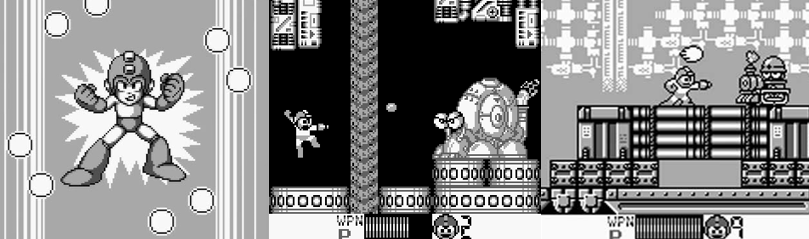
Mega Man IV does a commendable job of recreating the stages from its NES counterparts and features more story than of the previous handheld Mega Man games. Dr. Light appears, as do frequent text boxes, and big pixel art is the order of the day; you even get a quick demonstration of Mega Man’s new abilities and a new stage introduction. Unfortunately, slowdown and sprite flickering are still a problem, particularly when using the Power Stone. Enemies constantly respawn and bottomless pits and various spikes are everywhere, but Mega Man IV feels fairer than the last game. The perspective hasn’t changed and sprites, though detailed, are still too big (like some hit boxes), but the difficulty was way more accessible for me this time around. Many gimmicks from the console games are faithfully recreated here, such as the light gimmick from Bright Man’s stage (where you must destroy Dompans or activate switches to light up the area), the quicksand from Pharaoh Man’s stage, and the zipping platforms from Ring Man’s stage. Crystal Man’s stage is full of glittering crystalline trappings and spikes, Napalm Man’s stage features destructible blocks and collapsible walkways, and Charge Man’s stage again takes place in and on top of a train, with the screen juddering to simulate the train’s movement. Magnetic hazards await prior to Ballade and you’ll blast at missiles across the deck of Dr. Wily’s ship before venturing inside, where a very detailed mechanical hellscape awaits you. Mega Man IV really pushes the Game Boy to the limit, featuring blinking lights, numerous medium-to-large enemy sprites, and a far more detailed enemy roll call at the end that shows Mega Man battling each Robot Master. The sprite-based cutscenes are entertaining to see on the handheld and the larger pixel art is impressive, it’s just a shame the hardware is still struggling to render everything that’s happening. Luckily, the rewind and save state feature can help you out, and the game still includes a password feature (which has also received a new coat of paint).
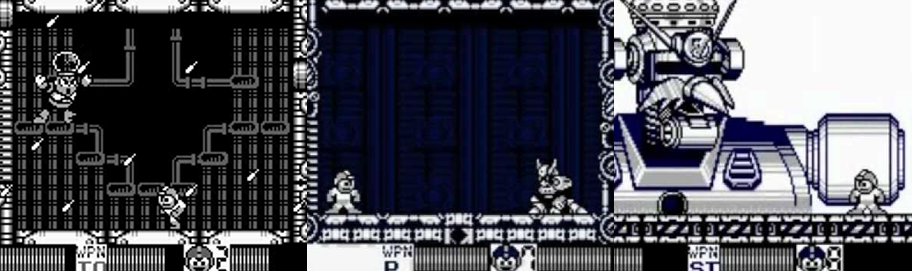
There’s far greater enemy variety in Mega Man IV, which faithfully recreates some of Mega Man 4 and Mega Man 5’s most recognisable foes. Crystal and Gunner Joes will dog you, Mummira’s appear from hidden doors and toss their heads, Metall’s drive little choo-choos or split into miniature versions of themselves, and tiger-like Sumatran pounce at you. Coccos sit in place and spawn little chicks, bombs and rocks are tossed at you, and four familiar, giant mini bosses also return. The large snail Escaroo again tosses bombs and its vulnerable eyes at you, the hippo-like Kabatoncue stays high up out of reach and spits homing missiles (it’s best to use Pharaoh Shot rather than waste time bringing him to the ground), a giant Metall shoots at you from a massive cannon (easily destroyed by hopping on the gun barrel and blasting his eyes), and you’ll want to use Bright Flasher to expose Whopper’s weak spot. The Robot Masters are much easier in this game thanks to the arenas being a little bigger, meaning you’re less likely to take damage from their massive hit boxes. Charge Man was an exception as he was tricky to jump over, but guys like Toad Man and Pharaoh Man are a joke thanks to the former just hopping around and the latter being powerless against Bright Flasher. You’ll fight Ballade twice, with his second form being a bit tougher, but he’s a big target for your charged shot. Dr. Wily’s base is protected by a large energy cannon and mechanised bridge, with the latter firing some of the Robot Masters’ attacks, as well as eyeball-like drones and the traditional rematch against the eight Robot Masters. Dr. Wily attacks in a machine so vast it is the background; he’ll punch you or slam the ground, causing debris to fall, and fire a shot from his central core. Simply avoid these hazards and time your Power Stone to knock out this first stage, then his bird-like cockpit lowers and fires electrical blasts from its antenna. In this phase, you must toss Ballade Cracker into the mech’s mouth and unload with the Mega Buster when it tries to crush you. Finally, Dr. Wily pulls the old disappearing trick in his UFO but with a twist; he drops bombs that’ll destroy sections of the ground, and you’ll need to chase after him, relentlessly tossing the Ballade Cracker until he’s begging for mercy!

The Summary:
Well, it’s taken four games, but the developers finally brought something that closely mirrors Mega Man’s console outings to the Game Boy. Mega Man IV is a clear step up, visually, from its predecessors; the added focus on story and sprite- and pixel-based cutscenes alone speak to that. It’s also a lot bigger than its predecessors; the main content is about the same length, but the stages definitely feel longer and more challenging. Yet, the challenge is notably fairer than normal and the game’s way more forgiving than Mega Man III. I liked the little touches, like the recoil from Mega Man’s charged shot and the optional paths, which included cameos from Proto Man. While the developers haven’t played around with the format too much, the action was a lot smoother and less aggravating than before, with less cheap deaths and enemy and hazard placements, to the point where I was actually enjoying myself rather than tearing my hair out with the rewind function. It’s still a tough game and I still question how anyone completed it back in the day, but the margin for error is much wider this time around. This is best seen in the Robot Masters; while still big targets and difficult to avoid, I didn’t feel as much pressure to go in with full health and it felt satisfying offing them rather than a chore. The P-Chip system was a bit weird and unnecessary; Dr. Light doesn’t sell anything you can’t get with a bit of exploration ot pre-boss grinding and the mechanic just reduces the drop rate of health and energy. Like, why not purchase Proto Man’s shield or a passive item that instantly respawned you when you fall down a pit, or a rapid-fire power-up? Similarly, it’s a shame Rush was sidelined and that the Ballade Cracker was little more than a secondary explosive. Still, I liked the sidescrolling chaser sections where you have to outrun the exploding environment and the faithful recreation of some of Mega Man 4 and Mega Man 5’s more recognisable enemies and mechanics. It was still a short, shallow, and tricky experience, but Mega Man IV is much closer to the level of quality I’d expect from the series and therefore where your handheld Mega Man journey should start, in my opinion.
My Rating:
Pretty Good
Was Mega Man IV a part of your Game Boy library growing up? Do you agree that it’s one of the better portable Mega Man adventures? Were you disappointed by the Ballade Cracker? Did you ever collect all the letters and utilize Beat? Which Robot Master was your favourite to fight? Do you have a favourite portable Mega Man game? How are you celebrating the science-fiction genre this month? Whatever opinions on Mega Man IV, leave them below and be sure to check out my other Mega Man reviews!

 Dr. K's Waiting Room
One thought on “Mini Game Corner: Mega Man IV (Nintendo Switch)”