
January celebrates two notable dates in science-fiction history, “National Science Fiction Day” on January 2 and Arthur C. Clarke’s HAL 9000’s birthday on January 12. Accordingly, I’m dedicating January to celebrating sci-fi with an event I call “Sci-Fanuary”.

Released: 30 June 2022
Originally Released: 21 October 1994
Developer: Minakuchi Engineering
Also Available For: Mega Drive, Mega Drive Mini, and the SEGA Channel
A Brief Background:
Before 1987, Capcom was mostly known for their arcade titles. The 1987 release of Mega Man (or “Rockman” in Japan) changed all of that. Widely regarded as an 8-bit classic, Mega Man was notorious for its difficulty and maintained this reputation across its many sequels and spin-offs. For decades, Mega Man was a Nintendo staple thanks to Capcom outsourcing the franchise to Minakuchi Engineering (and, briefly, Thinking Rabbit) for the Blue Bomber’s Game Boy ventures. Capcom also teamed with Minakuchi Engineering for Mega Man’s one and only Mega Drive appearance, which proved to be a nightmare because, as related by series artist Keiji Inafune, the developers struggled with the debugging procedure. Inafune stepped in to assist and also designed the new Wily Tower bosses for the game, whose North American release was first delayed and then cancelled due to technical issues. The Wily Wars eventually surfaced on the subscription-based SEGA Channel but it would take decades for it to be widely available to gamers. Those lucky enough to play it gave mostly positive reviews that praised the graphical overhaul and additional gameplay mechanics, though the sluggish control scheme and awkward hit detection was noted.
The Review:
I’ve already reviewed the first three Mega Man games (and a whole bunch of others) so it seems superfluous to go into great detail for this 16-bit remake collection. Essentially, The Wily Wars recreates Mega Man’s first three adventures from his Nintendo days in glorious, full-colour, 16-bit graphics. You get three save files to play with, that ability to switch around the game’s simple controls, and a sound and music test and that’s it. You play each game in turn, gaining an “All Clear” screen upon completing them, and each game stays true to their original mechanics. So, for example, you won’t be sliding, charging, or utilising E-Tanks in Mega Man, which is a bit of a shame as it would’ve been nice to see the later features incorporated to add a new challenge. By default, B fires your currently equipped weapon, A sees you jump, and you can pause the action and open the in-game menu with either Y or +. From here, you can select an E-Tank to refill your health when playing Mega Man 2 (Capcom, 1988) or Mega Man 3 (Capcom, 1990) and equip different Special Weapons. As in the original games, each Special Weapon is earned by defeating Robot Masters and each one has a finite amount of energy. Exploring stages and defeating enemies grants you small or large refills for your health and weapon energy; you’ll also find 1-ups, E-Tanks and, in Mega Man, can add to your high score by playing through the game.
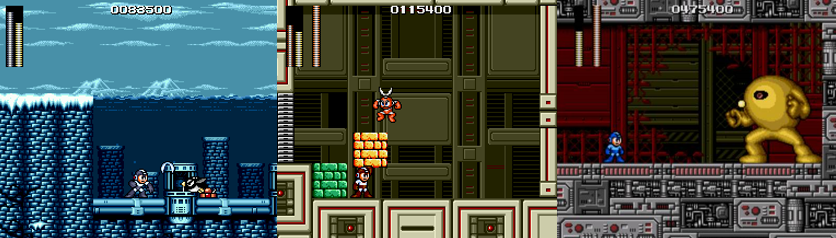
Naturally, I took on Mega Man first and the graphical overhaul is immediate right from the start. Mega Man looks great as a 16-bit sprite; he still only blinks when left idle but it’s nice to see him resembling his box art for a change. Stages are obviously far more impressive here, with elements like rocky grounds, mechanical platforms, and piping given far more detail. There are some instances where the background scrolls past in a version of parallax scrolling; mountains, clouds, and scenes of destruction can also be seen in the backgrounds. Ice Man and Fire Man get the biggest glow ups in terms of visuals, with their slippery, snowy ground and flash-frozen backgrounds and shimmering heat effect and rushing lava, respectively. You can still freeze fire plumes with the Ice Slasher and grab certain blocks with the Super Arm, and this is still the only way to get the Magnet Beam to navigate Doctor Albert Wily’s fortress. The action is a little zoomed out, giving you more room to manoeuvre; this is especially noticeable in boss arenas, where it’s easier than ever to avoid attacks thanks to the extra screen space. Sprites still have sizable hit boxes and enemies will still respawn over and over, but Mega Man has never looked or performed better, with no slowdown or screen tearing evident in my playthrough. Things are a little bland, though; Sonic the Hedgehog (Sonic Team, 1991) this is not and, frankly, the presentation doesn’t seem to match what the superior Mega Drive was capable of in 1994. The music has also been remixed and, similarly, has a decidedly tinny and grainy sound that isn’t up to Nintendo’s 8-bit standards let alone the Mega Drive’s higher sound quality. Still, we get some decent, partially animated sprite and pixel art and all the same Robot Masters and bosses return. As you’d expect, all the same strategies work just as well this time, with the exception of the Yellow Devil; you can no longer exploit the pause function to easily defeat him. Still, they all look very vibrant and dynamic even when you’re decimating them with their main weakness and it’s immensely satisfying seeing Dr. Wily beg for mercy in 16-bit glory.
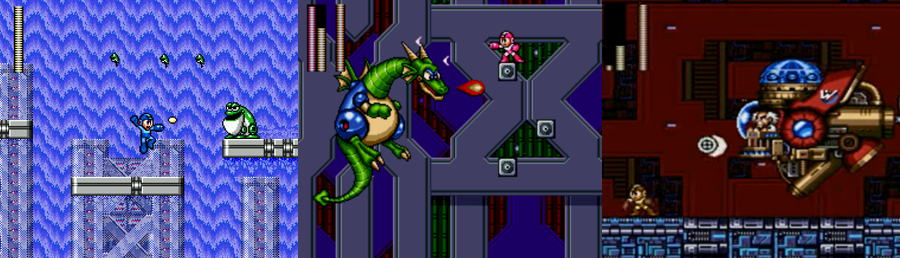
The visual upgrade continues in the game’s redesign of Mega Man 2 and is evident right from the start. However, while the game’s iconic title screen has been rendered in the same 16-bit art style, the city in the background does look a bit pixelated. This effect continues in Dr. Wily’s third stage and the Robot Master teleporter room is now a mess of animated panels, but most stages shine from the additional processing power. Bubble Man’s stage, for example, is awash with a very impressive waterfall effect that showcases some transparency effects; Wood Man’s forest has never been denser; you’ll hop behind big fluffy clouds like never before in Air Man’s stage; and Flash Man’s crystal mine is very beautiful with all its gleaming rocks and slippery crystal platforms. Mega Man 2 is further bolstered by big pixel art renditions of Mega Man receiving his upgrades; these are joined by incoming calls from Doctor Thomas Light that grant you the Items you’ll need to cross spike beds and navigate Dr. Wily’s stages. Large enemy sprites are better than ever here; there’s no slowdown when the Lantern Fish and Hot Dogs spawn in, no matter how many Shrinks and flame bursts they fire, and Quick Man’s stage still has its fading light gimmick and insta-death lasers. These are actually easier to avoid this time around; maybe it’s because of my past experience with the game but I relied on the Time Stopper far less this time around. A bit of parallax scrolling and an abundance of blinking lights and environment effects add to the visual appeal of this remake, though I will say that the stage designs could’ve been tweaked as there’s often a lot of empty space that feels wasted. The Robot Masters retain all their weaknesses, though their intros have bene reworked, but it’s the big bosses in Dr. Wily’s castle that benefit the most. Mecha Dragon, Guts Tank, and Dr. Wily’s machines are now fought against detailed backgrounds rather than a plain black void and you have more room to avoid their attacks. Mega Man did seem a touch slipperier in this game, I will admit, and the game seems to be deadlocked into its “Difficult” mode, meaning those damn Sniper Joes take a lot of hits or waiting around to destroy. Still, the visual glow up and the remixed soundtrack make this already great game even better and I loved the personalities of the quirky Robot Masters, which shined through much clearer thanks to the Mega Drive’s greater processing power.
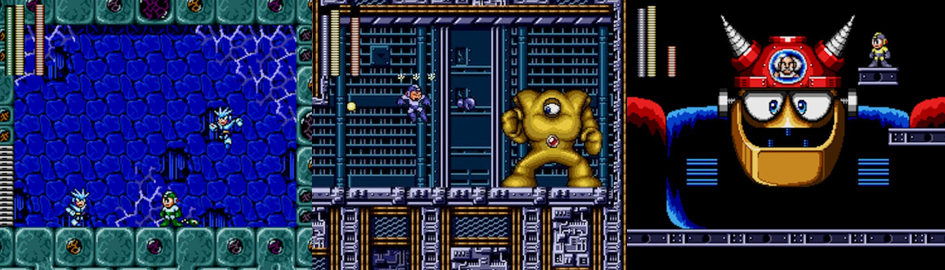
Things are very much the same for Mega Man 3, though Mega Man can now slide by pressing down and A and his weapon select screen has been changed. It now appears at the bottom of the screen, which I found to be a bit clunkier. Otherwise, the same kind of semi-parallax scrolling can be found here, with backgrounds moving with you through windows in Top Man’s stage and layers of pipes and machinery in Spark Man’s stage. Background details in general are much more detailed than in the original games: lava flows and bubbles in Shadow Man’s sewer-like dwelling, Snake Man’s jungle is much denser, and Needle Man’s clear sky reveals a city in the distance. Some stages are cluttered by the additional background details, though: Spark Man’s, for example, is so lively and has so many clashing elements that it was easy to miss pits and hazards. Gemini Man’s crystal cave is a step down from Flash Man’s, though the coral-infested, tadpole-dwelling depths have never looked better. Proto Man’s sprite doesn’t quite match up with the upgrade given to Mega Man, Dr. Light, and the enemy sprites, though, appearing strangely small and simple. The game still handles far better than its 8-bit forefathers, with backgrounds appearing for all boss battles and larger enemies like Bikkys, the Giant Metall, Penpen Makers, and Tama appearing (with limited frames of animation) without any slowdown. However, the game does struggle when you battle Gemini Man as he duplicates himself and sends his Gemini Laser ricocheting about. The action also slows whenever you fire this weapon, which is a shame as The Wily Wars had coped with these issues really well up to this point. As in the previous games, there’s much more room to manoeuvre here, giving you more margin for error in boss battles, though the battle against the tedious Yellow Devil MK-II is just as annoying since you have to wait for him to assemble. He also looks super derpy here, though you can at least get a few more shots in with the Hard Knuckle. You’ll still revisit four previous stages and battle the Robot Masters from Mega Man 2, with the Doc Robot assuming their abilities, and fly over spike beds on Rush Jet. Dr. Wily’s crawling machine is easier to avoid thanks to the extra space, negating its large hit box, and the gigantic Gamma now looks gloriously cartoonish as a huge, detailed background image that smashes up the lower platform with its fists. You’ll also still battle Proto Man and be left clueless regarding his true identity, despite redrawn, sprite-based cutscenes where Dr. Light muses about his true motivations and the shield-carrying anti-hero still watches his brother from afar.
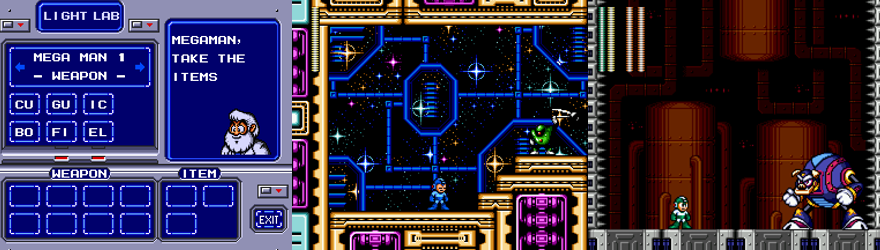
Finishing all three games on the same save file unlocks an additional mode exclusive to The Wily Wars: The “Wily Tower”. This mode remixes bits and pieces from all three games, including enemies, hazards, and stage elements to present Dr. Wily’s latest challenge to his rival. The begin with, you can challenge one of three new “Genesis Unit” Robot Masters before taking on the titular tower itself (which is essentially Dr. Wily’s newest fortress). Before each stage, you get to equip Special Weapons, Items, and Rush abilities from all three games. You can mix and match up to eight Special Weapons and set three Item slots, allowing you to use, say, Rush Jet alongside Item-3. This is a really fun feature and one I honestly wish the developers had applied to the other three games; you’ll need a guide or something to help you pick the right loadout for each stage, though. This is because, while you can get by perfectly fine for the most part, you’ll open up alternative paths using the likes of the Crash Bomb, freeze flame bursts with the Ice Shooter, and of course reach different areas with Rush. The Genesis Units are also weak to specific Special Weapons, so it’s fun to mix and match and see what works. While stages remix elements from all three games in a fun way, there are a lot of Hammer Joes in each stage. Still, it’s fun seeing Snake Man’s stage suddenly emerge from the grassy hills, the layered island and water visuals of Mega Water S’s stage and seeing Jamacys emerge from pipes in Hyper Storm H’s stage. The three Genesis Units are all based on characters from Journey to the West (Cheng’en, 1592): Buster Rod G is modelled after Sun Wukong and attacks with an extendable lance and duplicates; Mega Water S is based on Sha Wujing and boasts a water shield and jet stream; and Hyper Storm H is based Zhu Bajie and sports two health bars! However, Hyper Storm H may look intimidating, and his stage may sport damaging spikes, but he’s the easiest of the three, with Mega Water S being the trickiest since he can force you into insta-death spikes and Buster Rod G being the most frustrating since he can deflect your shots and shield himself at the same time.
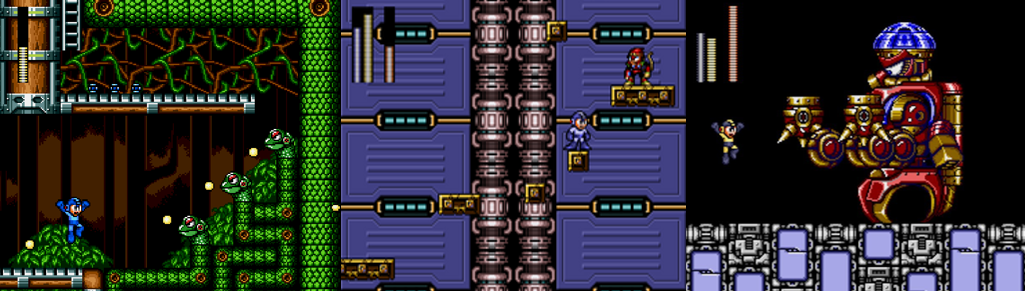
Clearing these three stages sees you challenge the Wily Tower itself, the only part of this mode you can replay after clearing it. These stages recycle elements from Dr. Wily’s previous fortresses and other stages, as before, with you riding tracks like in Mega Man, battling Hot Dogs and riding Lighting Lord’s clouds like in Mega Man 2, avoiding turbines, hopping to spinning tops, and more. Naturally, Dr. Wily has some defences you must past to reach him. The first, Snakey, is a fire serpent that pops out of lava and breathes fire or leaps over you spitting fireballs. The hardest thing about this fight is not falling in the lava courtesy of the small, springy platform you fight on; if you have the Ice Slasher or Bubble Lead, though, it’s a joke. The Iron Ball is even easier, despite firing the Gemini Laser. This easily avoided sphere bounces about a bit and is only vulnerable when its face is exposed, but it’ll crumble from a few shots of the Thunder Beam. You’ll then battle Buster Rod G again, this time while freefalling on pieces of a destroyed walkway, which is very unique. He’s technically much easier here as he just fires shots at you while hopping to platforms, but he can be tricky to hit unless you have the Air Shooter or Metal Blade on hand. Your final challenge is Dr. Wily’s giant mech, a machine so big that we’re denied a background and you must first destroy its legs to attack its torso. In this first phase, it just stomps about and fires homing missiles, but you can use the rising blocks to blast the sphere at its hip with Crash Bomber, Spark Shot, or Thunder Beam. Its torso assumes a boxer’s stance and tries to smack you with its spiked fists, which you can hop on to pummel its face with Hard Knuckles while also freely chipping away with Metal Blades. Once destroyed, Dr. Wily resorts to his UFO once more, dropping time bombs that are easily avoided. Though he stays out of reach at the top of the screen, you can finish him off with the Thunder Beam to complete this mode. It’s a shame there’s no boss rush and you still can’t play as Proto Man, but I enjoyed the “Wily Tower” as an additional mode so much that I honestly would’ve liked to see its mechanics applied to the other games, at least after defeating this bonus mode, just to mix up the classics.

The Summary:
Mega Man: The Wily Wars is an interesting conundrum. On the surface, it sounds great! The first three Mega Man titles on one cartridge, with save files, a bonus game mode, and all brought to life by 16-bit visuals? Sign me up, right? Well, it’s a bit of a mixed bag, really. Graphically, yes, the games obviously look and run better than they did on the Nintendo Entertainment System. There’s no slowdown until you encounter the Gemini Laser, sprites and stages are far more detailed, and the layering and visual glow-up given to these 8-bit titles is immediate and eye-catching. Yet, I can’t help but feel like they fall short of what the Mega Drive was truly capable of. They remind me more of the James Pond games (Millennium Interactive, 1990 to 1993) which, while colourful and fun in their own right, aren’t exactly comparable, graphically, the Sonic games or Rocket Knight Adventures (Konami, 1993), which released a year prior to The Wily Wars. The action is a bit too zoomed out (a strange complaint given how frustrating Mega Man’s portable adventures were), reducing the detail in the sprites and arguably making the games easier by giving you more room to jump about. They’re still challenging titles, don’t get me wrong, but I think the developers missed a trick by not trying to do more than just improve the visuals. They copied the games so faithfully that they even included Mega Man’s useless score system, which is just baffling. I think it would’ve been better to look at the improvements the series had made by this point and apply them to all three games, sprucing up the interface and mechanics. Capcom would later do something like this with Mega Man Powered Up (2006), but it’s baffling to mee that Mega Man was up to his sixth game by this point and none of his then-modern mechanics (a charged shot, Rush’s other capabilities, and such) were included here. The Wily Wars’ main appealing factors are its visuals and its rarity; it’s a curio few got to play and thus worth a look, if only to challenge your skills in the enjoyable Wily Tower mode. However, I think I preferred playing the 8-bit versions, flaws and all, just because they had a charm and heart to them that was somewhat lacking here simply because The Wily Wars could’ve been so much more and it played things far too safe.
My Rating:
Pretty Good
You didn’t own Mega Man: The Wily Wars back in the day so I won’t ask. But, when did you first play it? What did you think to the graphical overhaul given to the first three games? Were you disappointed that Mega Man didn’t sport more of his later abilities? Did you ever complete the Wily Tower? Would you have liked to see its mechanics applied to the other games? Which Mega Man game is your favourite? How are you celebrating sci-fi this month? Whatever you think about Mega Man, comment below and then check out my other Mega Man reviews!

 Dr. K's Waiting Room
4 thoughts on “Mini Game Corner [Sci-Fanuary]: Mega Man: The Wily Wars (Nintendo Switch)”