
January celebrates two notable dates in science-fiction history, “National Science Fiction Day” on January 2 and Arthur C. Clarke’s HAL 9000’s birthday on January 12. Accordingly, I’m dedicating January to celebrating sci-fi in all its forms in an event I call “Sci-Fanuary”.


Released: 12 December 2019
Originally Released: 9 September 2017
Developer: Nintendo EAD / Argonaut Software
Also Available For: Super Nintendo Entertainment System (SNES) Classic Edition
A Brief Background:
While working to enter the 16-bit market, Nintendo had a close relationship with Argonaut Software that saw the creation of the ground-breaking “Super FX” chip, which allowed the SNES to process 3D graphics. To best showcase the chip, the two companies took inspiration from the original Star Wars trilogy (Various, 1977 to 1983) and created Star Fox (1993), an arcade-style space shooter that became the fastest-selling videogame in North America. Despite this, and rave reviews, its sequel was unceremoniously cancelled so Nintendo could focus on the more powerful Nintendo 64. Prior to this, Star Fox 2 was reportedly 95% complete. Powered by the Super FX 2, the game boasted improved visuals and a degree of free-roaming gameplay, alongside additional playable characters and even a mech walker form for the Arwing craft. For decades, Star Fox 2 remained an elusive piece of lost media playable only through buggy, illegally leaked ROMS and emulators. However, thanks to Nintendo archiving the title, Star Fox 2 finally saw the light of day when it was included in the line-up of the SNES Classic, resulting in positive reviews that praised the ambitious gameplay and expanded mechanics while criticising its short length.
The Review:
Those reviews were right about one thing: Star Fox 2 certainly is a short game, perhaps even shorter than the first. Because of this, it didn’t seem worthwhile doing one of my usual long, in-depth reviews, though I did play enough of the game to share some thoughts. Fundamentally, Star Fox 2 is very much the same game as its predecessor, but with aspects changed or expanded and mechanics tweaked into something resembling a strange hybrid of an arcade shooter and a real-time strategy (RTS) game. This time around, you can pick which member of the Star Fox team to play as, with two new, never seen again characters tossed into the mix. Not only does each character have their own unique craft, but they have different stats, too, with some being faster, stronger, or taking less time to charge their weapons. You also pick two characters, a lead pilot and a wingman, and can switch between them by pressing – on the main map screen. I believe this allows you to send one character one way and the other in a different direction, and allows two player simultaneous co-op, but the craft simply followed each other in my playthrough. Star Fox 2 also offers four control schemes, with the default settings seeing A brake, B firing your primary blaster, X unleashing a limited supply of special weapons (a smart bomb, a shield, or replenishing your regular shields), and Y letting you boost towards targets. Holding B charges a more powerful shot, but this doesn’t home in on your target so I usually missed unless the target was stationary or flying right at me. Double tapping L or R lets you “barrel roll” out of harm’s way and, when on a planet’s surface, – will transform your Arwing into its mech walker mode.
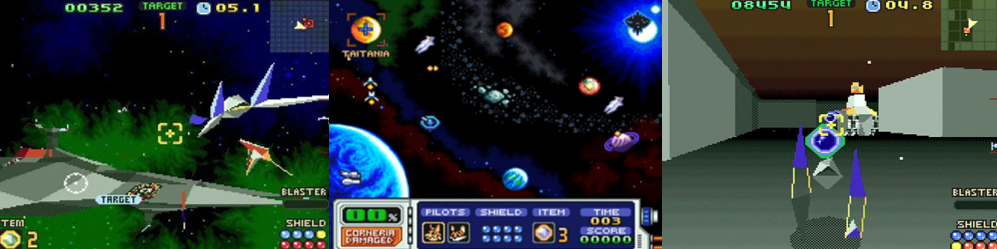
In this state, the controls change slightly. Now, A jumps and L and R are used to awkwardly spin around and your shots do seem to home in on targets. In this mode, you’ll mainly clomp about blasting enemies and stepping on switches to unlock doors, but it’s also the recommended state for destroy the heavily armed energy cores that lie in the centre of Andross’s bases. Another new aspect here is the aforementioned RTS mechanics. When on the map or engaging with Andross’s forces, cruisers, or bases, Corneria is under constant threat of attack. Missiles fire at the planet and Andross rocks up in his Star Destroyer-esque cruiser to fire a devastating shot, so you’ll need to intercept these and even quit out of stages to defend the planet. If Corneria’s damage percentage reaches 100%, it’s game over, which was honestly an aggravating mechanic as it interrupted the gameplay flow. By default, your forced into a first-person cockpit view; you can change this with + but the third-person view isn’t much better. There’s a lot of clutter on the screen, from arrows pointing you towards targets, the mini map, and the heads-up display, none of which can be turned off. You’re not on rails this time so it can be disorientating and difficult to fly about and focus on your target, especially if you don’t invert the controls. You no longer replenish your shield’s defences with rings; instead, you grab energy tanks and medals for a power-up. If you’re destroyed, you can choose to quit or switch to your wingman to carry on, effectively meaning you get two lives per game. There are also three difficulty settings available (though only “Normal” and “Hard” are selectable at the start), with enemy aggression and numbers increasing on harder difficulties.
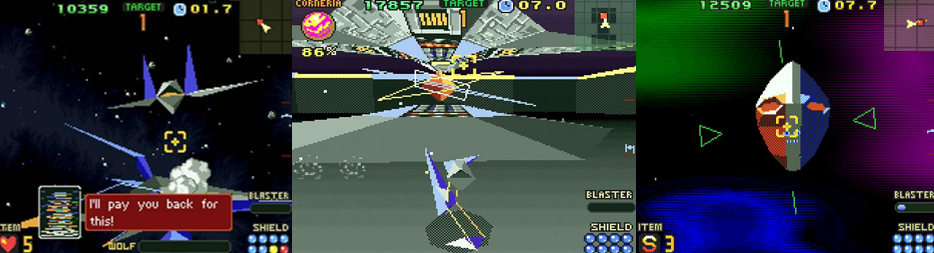
There’s a degree of chance at work in Star Fox 2. Andross randomly picks which worlds to establish his bases on and places his battle cruisers in different locations each game, eliminating the branching paths of the first game but ensuring no two playthroughs are ever the same. A simple gameplay loop quickly becomes apparent, however. You either intercept missiles to defend Corneria or engage with one of Andross’s cruisers, battling past the defences and flying inside its narrow corridors to destroy the core. This will give Corneria a reprieve, but you’ll only get to confront Andross directly after destroying his planetary bases. To do this, you’ll fly to a planet, open his base with the walker, and then fly or stomp through the same narrow corridors, blasting turrets and insectile craft to destroy the power core. Once you’ve cleared all Andross’s forces, you’ll warp to his main base for the final confrontation. In between this gameplay loop, additional challenges will arise: Andross’s mega powerful laser cannon, for one, or his projectile spitting Mirage Dragon for another. Yet, the bulk of the game’s challenge comes from rival space team Star Wolf. Its members lurk around the planets and asteroid belt and challenge you to a dog fight, a prospect that’s pretty daunting given how fast they are, their capabilities (which match yours), and how hard it is to track targets. Star Wolf himself challenges you right before you head to Andross’s base and these battles are even tougher on “Hard” mode. Andross’s base includes every hazard you’ve overcome so far (narrow hallways, tight corners, turrets, flame walls, and doors) and houses a disturbing Andross cube at its core. Destroying this is child’s play and no different to the other central cores, but you’re ejected into a psychedelic final battle battle against Andorss afterwards. Like before, he encases his cuboid core behind a projectile-spewing mask. You must fire at his eyes to drop his defences and then attack the cube as it spits out rectangular Andross projectiles, a prospect that’s far from challenging compared to the dogfights against Team Star Wolf. Once you’re victorious, you’ll get a rundown of the game’s enemies over the credits, a final score tally, and can challenge the next difficulty level if you like.
The Summary:
Star Fox 2 is a very strange game. Its very nature means you spend more time flying in the void of space or dodging asteroids as you desperately try to destroy missiles or enemy craft, which doesn’t make for the most inspired presentation. Similarly, the battle cruisers and Andross’s base are a mess of grey corridors and bland textures, and things are only slightly better when you’re clomping about on a planet’s surface. The planets themselves are far more restrictive this time, confining you to a small play area where your only objective is to activate switches. The music doesn’t fair much better, being nowhere near as memorable, though the game boast far more cutscenes are more detailed sprite art. The character variety is appreciated, as is the ability to avoid Slippy’s constant cries for help, but the screen is constantly bombarded by text from your wingman or arrows or other mess that clogs up the view. The RTS mechanics were an interesting inclusion; it kind of works to mix up the formula but adds unnecessary pressure to the admittedly shallow gameplay loop. If Corneria was spared danger when you were in a space battle, at least on “Easy” mode, that might’ve helped but, as presented, you’re encouraged to quit mid-mission to defend the planet, which interrupts the action. The polygonal models are as ugly as ever; they seem slightly improved, but they’re still a mess to look at and it makes it difficult to focus at times since the hardware seems to be struggling to bring the game to life. Ultimately, Star Fox 2 is just way too short. It lacks the epic boss battles of its predecessor and the final “choose your own adventure” mechanics and plays very much like an advanced tech demo for a Star Fox RTS spin-off rather than a capable sequel. It doesn’t expand upon what came before (and actually limits you more than you’d expect) and is more a curiosity than anything. It’s a shame as there was definite room for improvement over the original, but it seems the developers got ahead of themselves a bit by being too ambitious for their own good.
My Rating:
Could Be Better
Have you played Star Fox 2? What did you think to the RTS mechanics? Which character was your go-to? Were you disappointed by the lack of big boss battles? Did you ever go to great lengths to emulate this game back in the day? Which Star Fox game is your favourite? Whatever your thoughts on Star Fox 2, please share them below orand check out my other sci-fi content across the site!

 Dr. K's Waiting Room
2 thoughts on “Mini Game Corner [Sci-Fanuary]: Star Fox 2 (Nintendo Switch)”