After debuting as part of the “Million Dollar Man” Ted DiBiase’s Million Dollar Team at the 1990 Survivor Series, the Undertaker became a force of nature within World Wrestling Entertainment (WWE). To celebrate the Deadman’s illustrious career, I’m looking back at his WrestleMania matches against the future members of the super-stable Evolution.
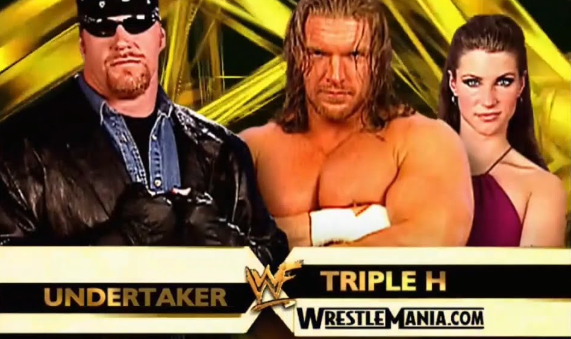
The Date: 1 April 2001 The Venue: Reliant Astrodome; Houston, Texas The Commentary: Jim “J.R.” Ross and Paul Heyman The Referee: Mike Chioda The Stakes: Singles grudge match
The Build-Up: After his 1990 Survivor Series debut, the Undertaker amassed an impressive list of rivalries with some of wrestling’s most talented, and notorious, names in his near-mythical wrestling career. If that wasn’t enough, the Undertaker amassed the greatest winning streak in wrestling history with 21 WrestleManiawins between 1991 and 2013. By WrestleMania X-Seven, one of the most celebratedWrestleMania events of all time, the Undertaker was in the middle of one of his biggest reinventions as the leather-clad motorcyclist “American Bad Ass”. He became embroiled in the battle against Triple H and the McMahon-Helmsley Regime, who had run roughshod over the WWF using their political power. After Triple H finished up is most recent feud with “Stone Cold” Steve Austin, “The Game” touted his superiority and dominance and raised the ire of the Undertaker, whom Triple H had never faced in a pay-per-view singles match before. Immediately, tensions escalated to the point where they were interfering in each other’s matches, using proxies (such as the Undertaker’s brother, Kane, and the Big Show) to attack each other, and Triple H even had the Undertaker arrested after he tried to force his way into his limousine. In retaliation, the Undertaker had Kane hold Triple H’s wife, Stephanie McMahon-Helmsley, hostage to force WWF Commissioner William Regal into sanctioning this one-on-one match on the grandest stage of them all!
The Match: Although many have criticised the Undertaker’s American Bad Ass (or “BikerTaker”) phase, I always enjoyed it. Of course, it helped that I started watching wrestling around the time of the 1999 Royal Rumble, so this was the only version of the Undertaker I knew outside of the videogames, and that I was into heavy metal music and the whole leather aesthetic that was popular at the time. Regardless, I always felt like it was a fantastic reinvention of the character. It allowed the Undertaker to stay relevant in the far more grounded landscape of 2000’s WWF, gave him the chance to showcase more personality and vulnerability, and saw him destroying foes with an absolutely devastating lifting powerbomb known as the Last Ride. At the time, there was no greater, more hated heel than Triple H (well… maybe WWF Chairman Vince McMahon…). He’d not only dominated the main event as the WWF Champion but also been revealed as the mastermind behind Steve Austin’s run-in with a car, though he had definitely been taken down a notch by both Austin and the Rock earlier in the year. The best thing about these two WWF stalwarts was that it made perfect sense to have them face off, even if it was pretty clear that they were playing second fiddle to the more dramatic story revolving around Austin, Rock, and the WWF Championship. The match was bolstered somewhat, however, as Triple H was played to the ring by the legendary Motörhead in a rousing mini rock concert that ensured the Game got his fair share of cheers despite his heinous actions throughout the year. Not to be outdone, the hometown hero, the Undertaker, blasted to the ring on his bike to Limp Bizkit’s “Rollin’”, which, while a good song, still pales in comparison to his original Kid Rock theme. They brawled around at ringside, with Triple H collapsing through a makeshift announcer’s table before being rolled into the ring and J.R. pointing out (maybe for the first time?) that the Undertaker had never lost a WrestleMania match and had amassed an 8-0 winning streak at the show of shows.
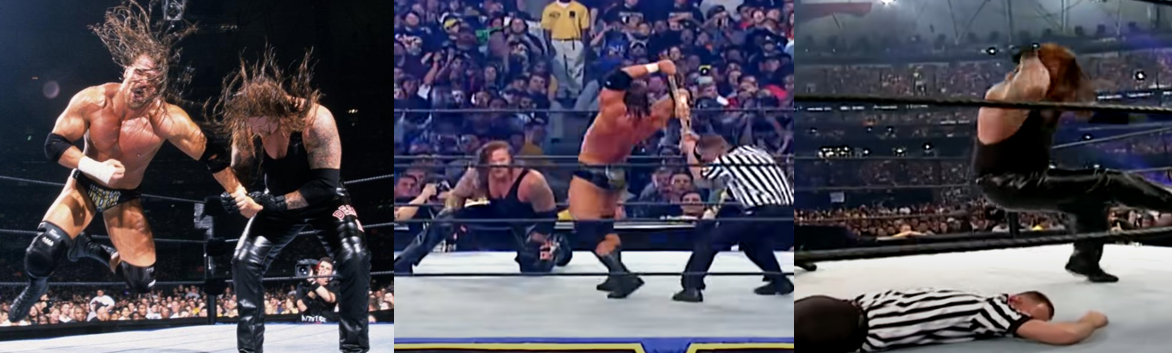
The Undertaker dominated the early and took things to the outside after attacking the referee.
Triple H’s attempt to trade punches with the Undertaker in the ring might have gone badly, but the Game scored a knockdown with his Harley Race-style jumping knee…only for the Undertaker to shrug it off, manhandle Triple H into the corner, and toss him overhead with a back body drop. The Undertaker continued to press his advantage, beating Triple H silly from corner to corner and planting him with a powerslam. Even when he missed an elbow drop, the American Bad Ass came right back with his signature flying clothesline but found himself launched from the top rope when Triple H countered the former Deadman’s “Old School” rope walk strike. Triple H capitalised with a neckbreaker for the first near fall of the match before working over the Undertaker’s forehead (which he had split open with a sledgehammer in the build up to this match) on the ring apron. Frustrated after another slick neckbreaker resulted in a two count, Triple H went for multiple covers and the Undertaker kept kicking out, so the Game started arguing with referee Mike Chioda and then hit his trademark knee smash to shut down the Undertaker’s attempt to fight his way back into the match. Exasperated and sadistic, Triple H harassed the timekeeper and retrieved his trusty sledgehammer, but Chioda snatched it away before he could do any damage with it, only to get sandwiched in the corner when the Undertaker catapulted Triple H out of a Pedigree attempt. This meant that the referee was a little too slow in making the count when ‘Taker covered Triple H off a Chokeslam, so the Undertaker also attacked Chioda and took him out of the match for a ridiculously long time, effectively turning this into a no holds barred brawl for a bit. The Undertaker thus launched Triple H to the outside and tossed him over the barricade and into the crowd for a slugfest through the audience without fear of a count out or a disqualification.
Despite some fun spots, this otherwise standard brawl that was overshadowed by later matches.
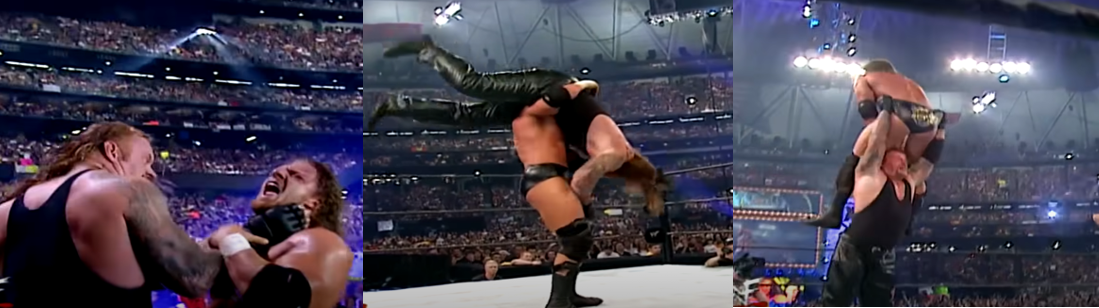
The two battled up to a production area full of monitors and machinery. Here, the Undertaker beat the hell out of Triple H and the Game repeatedly bashed Undertaker’s head and legs with a steel chair. However, the Undertaker dramatically Chokeslammed Triple H over the railing to the concrete below and followed up with a diving elbow drop, an effect sadly ruined by an unfortunate camera angle that clearly showed the crashmat the two guys landed on (still a hell of a bump, though). The Undertaker fended off the doctors and beat Triple H through the raucous Houston crowd before tossing him unceremoniously back into the ring. With Triple H battered and helpless at his feet, the Undertaker grabbed the sledgehammer and prepared to get himself a little payback but got kicked right in the dick instead! Still, the Undertaker avoided taking a shot from the hammer by booting Triple H in the face and the two just exchanged haymakers instead. To try and one-up his opponent, Triple H tried to hit the Tombstone Piledriver, but the Undertaker impressively pivoted out and reversed it into a Tombstone of his own, but Mike Chioda was still out like a light, so it was all for nought. Although Triple H countered the Last Ride with a sledgehammer shot to the Undertaker’s head, it still wasn’t enough to keep the American Bad Ass down for the three count. Incensed, Triple H furiously attacked the Undertaker’s bleeding forehead. He was so desperate to bust ‘Taker open further that he clambered up the ropes for the ol’ ten punches and left himself in prime position for an absolutely devastating Last Ride right out of the corner! The Undertaker dropped to the mat, the referee made the count, and the match ended with another victory for the legendary icon, bringing his winning streak to 9-0. This was an okay match, but nothing really special apart from the brief detour out of the ring and even that was sullied by one of the longest ref bumps I’ve ever seen. Most of the match was a slugfest, which is always a little disappointing as both men are capable of so much more, but it definitely had a big-match feel and spectacle to it. I think it might’ve helped to have the sledgehammer come into play a little more and to have Triple H properly target a body part rather than just getting dominated and begging off, but the biased crowd was super into the whole thing and it was fun enough, though it’s obviously overshadowed by their later WrestleMania bouts.
The Aftermath: So no, this wasn’t the last time that the Undertaker and Triple H battled at the Showcase of the Immortals. This match also didn’t put an end to the rivalry between the two men. The main event of WrestleMania X-Seven saw Steve Austin shock the world by joining forces with Vince McMahon and, the next night on Raw, Triple H shockingly formed the “Two-Man Power Trip” with his hated rival. Triple H captured the Intercontinental Championship and the heinous heel tandem delighted in tormented Matt and Jeff, the Hardy Boyz, and their companion, Lita. Since the Two-Man Power Trip boasted about being the most dominating duo in the WWF, the Undertaker and Kane quickly stepped up to oppose them. However, although the Brothers of Destruction captured the WWF Tag Team Championships, Kane got his arm broken by the Two-Man Power Trip, which was a deciding factor in the brothers losing the belts to Austin and Triple H at Backlash the month after WrestleMania X-Seven. Unfortunately, Austin and Triple H’s run with all the gold and all the power was cut short when Triple H tore his quadricep muscle in a tag team match, a horrific injury that side-lined him for most of 2001. When Triple H returned, it was to triumphant cheers; for the first time in years, Triple H was lauded as a hero while the Undertaker was in the midst of a heel run beating the respect out of people. It wouldn’t be long before the two clashed again as the Undertaker defeated Triple H for the Undisputed Championship at the 2002 King of the Ring, though their in-ring encounters did noticeably lessen for a few years after this thanks to the first brand extension.
My Rating:
⭐⭐⭐
Rating: 3 out of 5.
Pretty Good
What did you think to the Undertaker and Triple H’s first WrestleMania match? How would you rate it against their other WrestleMania matches? Were you a fan of the American Bad Ass gimmick or did you think it was unsuitable for the Undertaker? What did you think to the Chokeslam off the equipment area and did the referee bump also confuse you? How are you celebrating the Undertaker’s debut this year, what are some of your favourite matches and moments from his long and distinguished career, and what dream match would you have liked to see him involved in? Whatever your thoughts, drop a comment below and be sure to check out my reviews of other Undertaker matches across the site!
Toho’s famous atomic beast, and easily the most recognisable kaiju in the entire world Gojira first emerged from the waters of outside of Japan to wreck the city of Tokyo on this day all the way back in 1954. In 2016, the day was declared “Godzilla Day” and, as a result, I am also appropriating November 3rd to shine a spotlight on the undisputed King of the Monsters.
Released: 14 December 1991 Director: Kazuki Ōmori Distributor: Toho Budget: $12 million Stars: Kōsuke Toyohara, Anna Nakagawa, Megumi Odaka, Chuck Wilson, Yoshio Tsuchiyam, Kenpachiro Satsuma, and Hurricane Ryu
The Plot: Time travellers offer to get rid of Godzilla (Satsuma), Futurians create the terrifying King Ghidorah (Ryu), leaving science-fiction writer Kenichiro Terasawa (Toyohara) and remorseful Futurian Emmy Kano (Nakagawa) to desperately revive Godzilla ensure Japan’s survival.
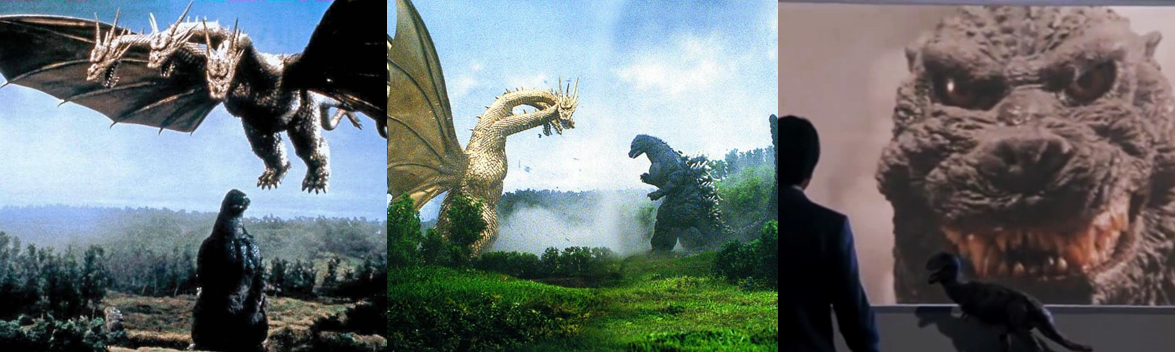
The Background: When he made his big-screen debut in Godzilla (Honda, 1954), Gojira (more popularly known worldwide as Godzilla) represented very real lingering fears regarding the threat and consequences of nuclear war. However, it didn’t take long for Godzilla to be recast from Japan’s destroyer to its a saviour. While he often caused a great deal of destruction, Godzilla would often team up with other kaiju, such as Mothra and Rodan, to fend off a greater threat and cement his place as an iconic figure in pop culture. Perhaps Godzilla’s greatest nemesis is the three-headed dragon King Ghidorah (also known as “Ghidrah” and “Monster Zero”), a titanic winged beast created by Godzilla creator Tomoyuki Tanaka and inspired by the Lernaean Hydra and the Orochi of Japanese folklore. Initially depicted as an ancient alien monstrosity from Venus, King Ghidorah’s debut feature was so successful that he reappeared the following year and was a natural choice to recoup some of the studio’s losses after the disappointing box office of Godzilla vs. Biollante (Ōmori, 1989). Believing audiences wanted time travel plots given the success of Back to the Future Part II (Zemeckis, 1989), director Kazuki Ōmori specifically tailored the script to include this and place greater emphasis on developing the personalities of the monsters rather than the human characters. The movie reused the Godzilla suits from Godzilla vs. Biollante, but with some modifications that slightly altered Godzilla’s face and allowed actor Kenpachiro Satsuma a better range of movement when in water, and the redesigned King Ghidorah featured far more advanced wirework puppetry than its predecessor. Ultimately, Toho’s hopes of surpassing Godzilla vs. Biollante were not to be as Godzilla vs. King Ghidorah made noticeably less than its predecessor and the film is generally regarded as a visually impressive, if convoluted, entry in the franchise. The film also attracted controversy for its depiction of events from World War Two but this wouldn’t be the last Godzilla film, or the last we’d see of King Ghidorah. Godzilla was back in action a year later and his nemesis returned to do battle time and time again in many forms.
The Review: I have been a massive Godzilla fan since I was a little kid, but my exposure to the scourge of Japan was actually quite minimal growing up. Godzilla films weren’t exactly commonplace on TV back in the day so I (and a lot of kids my age) really started getting into the franchise with the impending release of Godzilla (Emmerich, 1998). To celebrate the release of that film, I believe it was BBC2 that dedicated an entire night to Godzilla and other kaiju, and this evening of documentaries, quizzes, and comedy was capped off by the first Godzilla movie I ever watched, Godzilla vs. King Ghirodah. Godzilla had battled his most famous nemesis before, back in the “Shōwa Era”, but this was their first meeting in the “Heisei Era”, which began in 1984 and basically rebooted the franchise with bigger and better suits and new, ferocious monsters for the Big G to fight. This is also probably my favourite era of Godzilla movies since this is when I really started getting into the franchise, though I feel it’s only fair to also point out that I am watching the dubbed version of the film (because I can’t get enough of that “You bastards!” line delivery!)
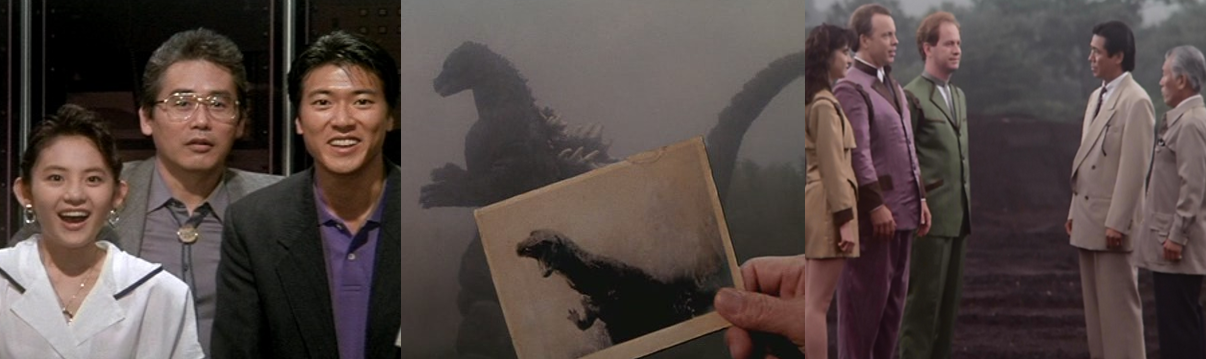
Terasawa’s research into Godzilla coincides with the Futurians’ arrival from 2204.
Oddly enough, as if all the kaiju action wasn’t enough, Godzilla vs. King Ghidorah heavily features a time travel plot. The film begins in 2204A.D., where King Ghidorah is little more than a mutilated skeleton at the bottom of the ocean, before jumping ahead to the then-present day of 1992 where all of Tokyo is shocked by the sudden arrival of a strange spacecraft on Mount Fuji. The unidentified flying object (UFO) instantly makes headlines but science fiction writer Kenichiro Terasawa has grown weary of the genre that has made him a “rich man” for his employers, Super Mystery Magazine, and is more interested in writing a detailed history of Godzilla. To that end, he interviews a number of World War Two veterans, including wealthy businessman Yasuaki Shindo (Tsuchiya), who were present on Lagos Island when Japanese troops were unexpectedly protected from the United States forces by the Tyrannosaurs rex-likeGodzillasaurus, which they revere as a benevolent, powerful, protective spirit. Consequently, they believe the same to be true of Godzilla, especially as the world’s most famous kaiju is the mutated form of this dinosaur following hydrogen bomb tests. As is often the case in Godzilla films, the human characters are divided into journalists like Terasawa and the Japan Self-Defense Forces’s (JSDF) desperate attempts to combat the kaiju threat. In their efforts to uncover more information about the UFO, the JSDF turn to Miki Saegusa (Odaka), a character who has the rare distinction of appearing in subsequent Godzilla movies and is something of Godzilla expert and a budding psychic (because that’s often a thing in these movies, too). Because of this, she’s part of a team of specialists selected to ensure Japan’s future after the Futurians – Grenchiko (Richard Berger), Wilson (Chuck Wilson), Emmy, and their android, M-11 (Robert Scott Field) – deliver a morbid warning to Japan’s government, headed by the Prime Minister (So Yamamura).
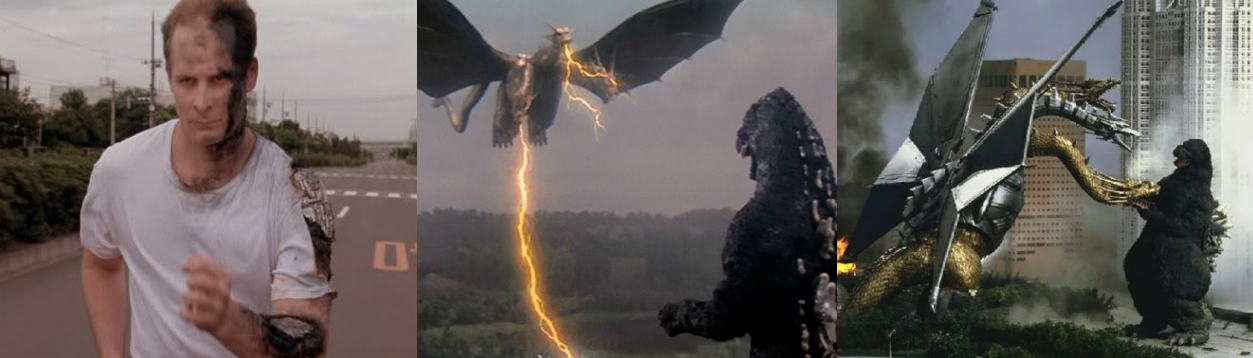
Thanks to time travel shenanigans, Godzilla is removed from history.
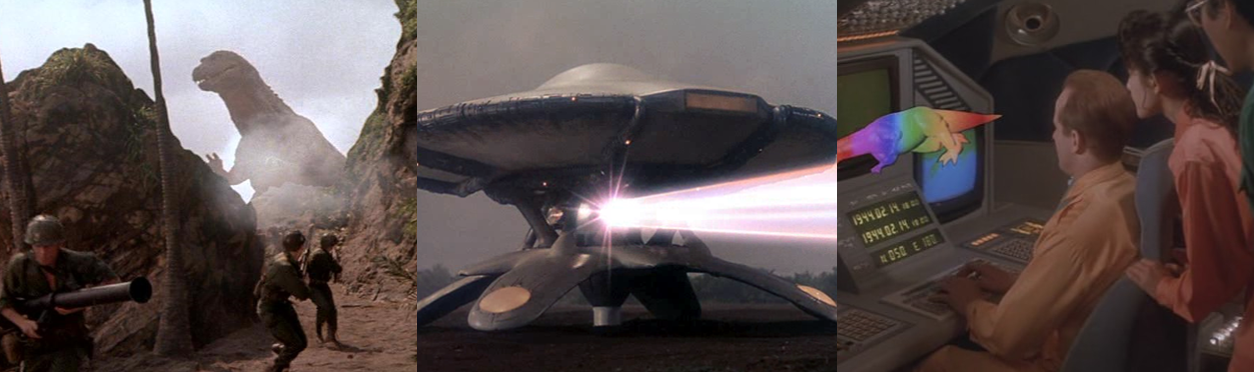
There, the seemingly benign Futurians completely disregard any sense of temporal paradoxes and time displacement to warn of a terrible future where Godzilla has decimated Japan following an unprovoked attack and devastating nuclear fallout. As proof, Emmy presents Terasawa’s book on Godzilla, thus bringing him into the JSDF’s investigation and confirming his theory that the Godzillasaurus became Godzilla. Thus, the Futurians propose travelling to Lago Island in 1944 and teleporting the Godzillasaurus to 1992, thereby sparing Japan’s social and economic future. Terasawa, Miki, and dinosaur expert Professor Hironori Mazaki (Katsuhiko Sasaki) join this expedition despite there being more qualified and experienced people, but Wilson hypocritically explains that this is because they can’t risk a temporal problem by sending, say, Shindo back to Lagos since he was already there as a young man (but changing the past by removing Godzilla is apparently fine…) Although Terasawa is disheartened to learn that his book didn’t make an impact in the future, he and the others are astounded by the Furtuians’ time ship. They travel through very Doctor Who-like swirls of colour to arrive in the past (spooking “Major Spielberg” (Daniel Kahl) in the process) and witness first-hand as the Godzillasaurus defends the brave and outnumbered Japanese troops. This is the first taste of kaiju action and it’s a little different from what we’re used to. Although it’s easily able to intimidate and crush the U.S. soldiers, the Godzillasaurus is far from the invincible titan we know and love and is easily felled by the Navy’s missiles. Badly wounded, the dinosaur is easily transported to 1992 by the Futurians, but they leave a substitute in its place: three small, winged Dorats that are hideously transformed by the nuclear radiation into a hydra-liked dragon!
A bigger, more violent Godzilla defeats King Ghidorah and then turns on Japan!
When Terasawa and the others return, expecting to face a more prosperous future without Godzilla (…though everyone still remembers Godzilla in another example of the film’s inconsistent time travel mechanics), they find Japan under attack by this three-headed mutate, the titular King Ghidorah. A screeching, golden-scaled, devil-like monstrosity, King Ghidorah mercilessly unleashes devastating lightning blasts upon Japan and the sight of it gliding through the skies and between skyscrapers is quite the nightmarish visage. Unrelenting and aggressive, King Ghidorah is controlled by the Futurians to wipe out Japan, which has actually become an economic superpower greater than the U.S., China, and even all of Europe. Feeling remorseful for her actions, and not wishing to see her home country annihilated, Emmy reveals the truth to Terasawa but their attempts to stop the government kick-starting the Godzillasaurus’s transformation into Godzilla with Shindo’s secret nuclear submarine fail when they’re intercepted by M-11. Thus, over forty minutes into the film, Godzilla and its iconic theme tune finally make an appearance as a newer, far bigger and far more hostile version of Godzilla is near-instantly created when it also absorbs the radiation from a crashed Russian submarine. It immediately clashes with King Ghidorah but not out of any sense of duty or to protect Japan as Shindo believes. This is purely a clash of territory and pride and Godzilla has no qualms about destroying parts of the city, and even obliterating Shindo himself, with its destructive atomic breath. Oddly, the two are said to be evenly matched, despite the fact that this new Godzilla is also said to be far more powerful than before thanks to being born from modern nuclear weapons. Godzilla thus topples its rival and lays waste to Tokyo, leaving Japan’s survival in the hands of Emmy and M-11, who jump to the future to augment King Ghidorah’s corpse and defend Japan against their violent attacker.
The Nitty-Gritty: I mentioned up top that I purposely chose to watch the dubbed version of Godzilla vs. King Ghidorah. This is always my go-to viewing option for foreign-language films but it can’t be denied that the dubbing is pretty atrocious throughout the film, especially whenever the Futurians are speaking. Godzilla movies have always been deeply entrenched in the fallout from World War Two; the kaiju owes its existence to the War and is pretty much always surrounded by allegory of the dangers of conflict and nuclear power. However, it’s rare that a Godzilla movie actually tackles the Second World War directly and I believe that Godzilla vs. King Ghidorah was the first film in the franchise to actually depict events from the War and so many veterans from the conflict as being central to its story. Here, the U.S. is depicted as an invading, hostile force that overwhelmed the Japanese with ceaseless aggression. Though some American troops wish to see the conflict end, they do so under the shroud of victory for the stars and stripes rather than a more generalised end to the death and fighting. The Japanese forces are mercilessly cut down by their better equipped enemy and their final assault against the U.S. troops is framed as a brave and noble suicide run for the glory of the “motherland”, which is definitely a different perspective on the conflict and helps to humanise the Japanese forces.
While M-11 and the sci-fi effects look terrible, the suitmation scenes are explosion fun!
One of the major appealing factors of these Godzilla movies has always been the “suitmation” and practical special effects. Godzilla vs. King Ghidorah continues to evoke the Gerry Anderson aesthetic in its models, water scenes, and especially when depicting the UFO, which flails about unconvincingly compared to the awesome rubber kaiju suits. The UFO delivers such dated and questionable effects as a beaming technique and hologram effects that would put Star Trek: The Original Series(1966 to 1969) to shame and evokes the same concern and environmental message (and special effects) seen in The Day the Earth Stood Still (Wise, 1951), and offers a knock off of Skynet’s finest infiltrator units in M-11. Exhibiting superhuman strength, speed, and durability in ways that would make Colonel Steve Austin (Lee Majors) cringe, M-11 is perhaps their greatest weapon outside of their impressive teleportation device, which instantly transmits objects across both time and space. Thankfully, the film doesn’t rely on these dodgy optical effects and the rubber suits are soon out in full force. King Ghidorah is one of the franchise’s most technically impressive monsters, a combination of a man in a suit, animatronics, and puppetry that cuts through the sky, stomps around on elephantine feet, and constantly spews crackling electricity. Though far bigger and subjectively more powerful than Godzilla, King Ghidorah is hampered by the humans that control it, meaning it goes wild once Terasawa, Emmy, and the reprogrammed M-11 storm the Futurian time ship in a laser pistol fight. This allows Godzilla to blast off one of King Ghidorah’s heads and send it crashing into the ocean, leaving this aggressive and unfriendly Big G to rampage through Tokyo unopposed.
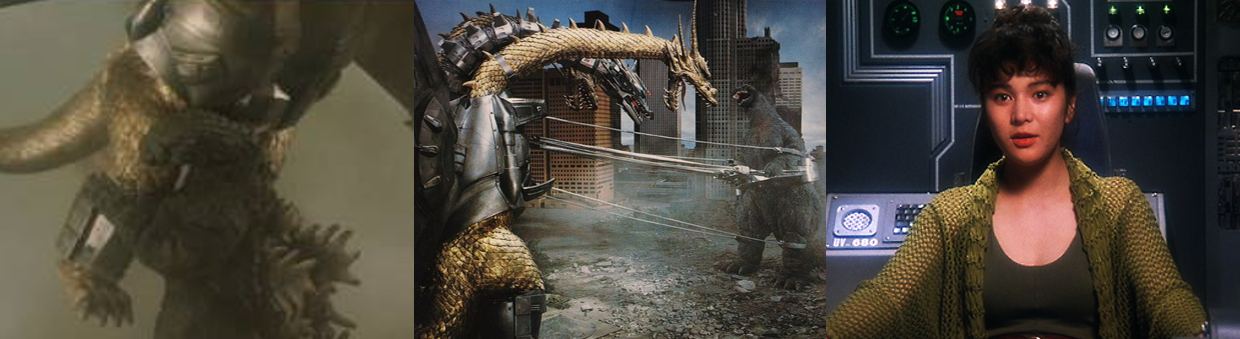
After a brutal scuffle, Mecha-King Ghidorah anti-climatically defeats Godzilla.
With Godzilla’s personality and aggression fundamentally altered and heightened, Japan has no hope of fending off her attacker with either conventional weaponry of the JSDF’s high-powered energy beams. Godzilla simply shrugs off attacks, topples skyscrapers and landmarks, and obliterates everything with its unmatched atomic breath. However, after a jaunt to the future, Emmy comes back piloting the cybernetically-enhanced corpse of King Ghidorah and battles with Godzilla to protect her beloved country. The humans we’ve been following become completely obsolete in this climatic and action-packed finale, which sees Grenchiko and Wilson atomised and the fate of Japan in the hands of Emmy and Mecha-King Ghidorah. Thus, the finale comes down to a rare case of a human piloting a mechanical kaiju-destroying creature rather than two wild monsters going at it. However, while Mecha-King Ghidorah is bolstered by future technology and armour, this new Godzilla is more powerful and aggressive than ever. It easily withstands Mecha-King Ghidorah’s boosted lightning and relentlessly attacks with its atomic breath, forcing Emmy to take a different approach, at great risk to herself. She grabs Godzilla in mechanical clamps and flies it to the ruins of Tokyo, dumping it in the sea. Though Mecha-King Ghidorah is destroyed, Emmy survives and reveals that she’s Terasawa’s ancestor (making the subtle attraction and flirtation between them a little awkward) before returning to the future. However, Godzilla soon reawakens at the bottom of the ocean but decides it would rather stomp away than resume its attack, making for an anti-climatic finish as it’s always disappointing when Godzilla is simply tossed aside rather than actually defeated.
The Summary: I’m massively biased towards Godzilla vs. King Ghidorah since it was the first Godzilla movie I ever saw and got me hooked on the franchise, and there’s a lot to like here. The suits and monster-on-monster action are big, detailed, and very action-packed. King Ghidorah, especially, had never looked better prior to this film. While its design is a little clunky and bizarre since it lacks arms, its three heads, incessant screeching, and explosive lightning make for a formidable threat and it was pretty cool seeing it come back augmented with futuristic technology as Mecha-King Ghidorah. Godzilla is also pretty great in this film; while it takes a long time for it to show up, we get a revised origin for the kaiju and a return to its more aggressive personality as time travel shenanigans see it reborn as a hostile creature more akin to its original depiction. It is absolutely relentless in its rampage, spewing atomic breath all over the place and appearing more terrifying and formidable than ever. Sadly, the kaiju action takes way too long to kick in, leaving us with this bizarre time travel plot that’s full of temporal anomalies and reduces King Ghidorah to a puppet of these pantomime-like villains whose cringe-worthy lines and personality rob them of any menace. It was interesting, if a little unorthodox, to depict scenes from World War Two and explore an alternative origin for Godzilla, but the poor attempts to copy from better, big-budget science-fiction films really handicaps the overall plot. I feel like Godzilla vs. King Ghidorah overcomplicates and overstuffs things, making its human characters more inconsequential than usual as they don’t really get much to do except be stunned and betrayed. Also a disappointment is the film’s finale, which simply sees Godzilla dumped into the ocean…which is where it generally lives anyway so I’ll never understand how this is supposed to defeat it. Still, when the kaiju are actually going at it and when the dubbing is at its exaggerated best, the film is very enjoyable, but it does a drag a bit as the plot trips over itself to limp towards the titular clash of these two long-standing rivals.
My Rating:
⭐⭐⭐⭐
Rating: 4 out of 5.
Great Stuff
What did you think to Godzilla vs. King Ghidorah? How did you feel about its time travel plot and the changes made to Godzilla’s creation? Did you like King Ghidorah’s revised origin and what did you think to Mecha-King Ghidorah? Were you also disappointed by the film’s inconsistent and nonsensical time travel shenanigans and poor attempts to rip-off other sci-fi films? What is your favourite Godzilla movie and why? How are you celebrating Godzilla Day this year? Whatever your thoughts on Godzilla vs. King Ghidorah, or Godzilla and kaiju films in general, feel free to leave them below.
The Day of the Dead (or Dia de los Muertos) is a traditional Latin American holiday on which, every November 1st, the lives of deceased loved ones are celebrated with food, drink, parties, and a great deal of masquerade involving the calacas and calaveras (skeletons and skulls). For me, this seems like the perfect excuse to look back on the long-running and ever-changing zombie genre that was largely popularised by director George A. Romero, which I devoted a great deal of my PhD thesis towards and which has often been used as a parallel to various aspects of society and culture.
Released: 25 October 2004 Director: Edgar Wright Distributor: Universal Pictures Budget: $6.1 million Stars: Simon Pegg, Nick Frost, Kate Ashfield, Lucy Davis, Dylan Moran, Penelope Wilton, and Bill Nighy
The Plot: Perennial loser Shaun (Pegg) is easily swayed from adult responsibilities by his oafish best friend, Ed (Frost). After Liz (Ashfield) ends their relationship, he resolves to win her back but awakens to find Crouch End under siege from a sudden zombie outbreak!
The Background: Zombies have had a long and varied history in cinema. Originally, films like White Zombie (Halperin, 1932) depicted them more as voodoo slaves but director George A. Romero (who famously avoided the term “zombie”) popularised them as shambling, flesh-hungry corpses in Night of the Living Dead (Romero, 1968). This inspired an entire sub-genre of horror, particular in the sequel, Dawn of the Dead (ibid, 1978), widely regarded as one of the best and most influential zombie films ever made. Specifically, Romero and Dawn of the Dead were a key influence on long-time friends and collaborators Edgar Wright and Simon Pegg putting together this “rom-zom-com” after filming a precursor to the film as a gag for their sit-com Spaced (1999 to 2001). Wright believed so strongly in the project that he turned down further television work as he shopped the concept around before Working Title Films agreed to finance it and production could begin. Both were also huge fans of the Resident Evil videogames (Capcom/Various, 1996 to present) and liked the idea of setting a zombie outbreak in London, where people lack the heavy ordinance typically seen in American films, and focusing on two layabouts who are the last to know about the outbreak. The cast included not just long-time friends Pegg and Frost but many popular British comedians, the filmmakers were inundated with volunteers to fill in as extra zombies, and the film was littered with pop culture references and nods to prominent zombie and horror films. Shaun of the Dead’s $30 million worldwide gross made it a big hit upon release and this was reflected in the unanimous praise that accompanied the film. The film was heralded as an instant classic and its success ensured that Wright, Pegg, and Frost would reunite for other collaborations in the loosely-connected “Three Flavours Cornetto” trilogy.
The Review: I was a bit late to the Spaced party; I didn’t watch the series until some time after seeing Shaun of the Dead, and I don’t think I saw that until a former friend of mine recommended it to me. One watch and I was instantly hooked and have been a fan of Pegg, Frost, and Wright ever since. The trio (and even two-group combinations of the group) have such a knack for crafting funny, believable, and incredibly relatable characters and stories even when things step into the fantastical and chaotic. As a Brit myself, I appreciate how they take the quaint, ordinary everyday mundanity of life in this little country of ours and satirise it, comment upon it and use it to show just how preposterous our nation can be at times. My love for zombie films may have dwindled over the years (watching and researching them non-stop for an entire year will do that to you) but I know which ones I like and count amongst the best, and Shaun of the Dead is definitely in the top-tier because of how wonderfully it utilises the shambling ghouls as figures of both horror and ridicule.
Shaun is at a crossroads in life where he’s not ready for adulthood, making for the unlikeliest of heroes.
As the title suggests, Shaun of the Dead is the story of Shaun, a twenty-nine-year-old manchild who lives in London and works in an electronics shop. Directionless and largely lethargic, he has fallen into an easy routine involving work, play, and simply hanging out at his local pub, the Winchester Tavern. As something of a manchild myself, I find Shaun’s attitude and predicament largely relatable. He has little to no job satisfaction, is still clinging to his more youthful days as a university student, and is generally just surviving his way through a humdrum existence. However, Shaun recognises that he is at an impasse even before Liz breaks up with him. He wants to do better and to do right by her, but is also fiercely loyal to Ed and can’t quite give up the carefree oaf’s influence on his life. Consequently, Shaun is a man who others see as having great potential but who lets himself get held back by excuses and by his friend. He only resolves to turn his life around after Liz is forced to break up with him, and he only comes to showcase his potential as an unlikely hero after he realises that London is in the middle of a zombie apocalypse. Even then, Shaun is largely making it all up as he goes along; his primary motivation is to get Liz and his mum, Barbara (Wilton), to safety. However, while he has lofty and noble intentions, he does make a bit of a balls-up of it along the way.
Though Liz breaks up with Shaun, she supports his plan to get everyone to safety and believes in him.
After Shaun fails to live up to his promise of trying to do better by her, and having finally had enough of his lackadaisical attitude, Liz is forced to break up with him to avoid being dragged into a sad, pointless existence where she wastes away at the Winchester rather than being out there and living life to the fullest. She doesn’t do this lightly; it’s clear that she’s very in love with Shaun and has a great deal of patience for, and belief in, him but she can only take so much of the same old routine day in and day out, night after night. Even after they’ve broken up, Liz still has a lot of faith in Shaun. She goes along with his plan to get everyone to safety, defends him from criticism regarding his plan (because, after all, at least he has a plan and is trying to do something helpful and proactive), and is generally very loving and supportive while also being level-headed, pragmatic, and calm even as flesh-eating zombies shuffle through the streets. Liz believes in Shaun’s potential to be and do better; all she wants is for him to grow up a little, sort his life out, and take charge of his own destiny rather than settling for a tedious existence that is beneath him. Shaun is thus fully aware that she’s the best and most positive influence of his life and continually puts himself in very real danger in order to win her back and keep her safe.
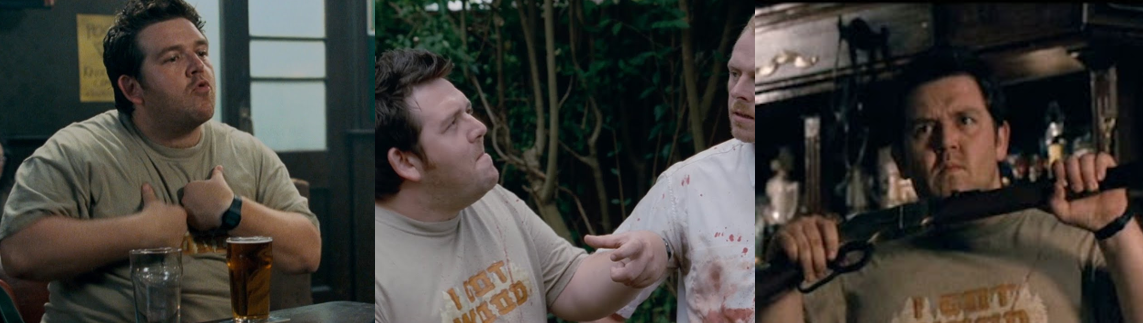
Perpetual manchild Ed is blamed for holding Shaun back but always has his back no matter what.
If Shaun is a manchild, then Ed is literally a child trapped in a man’s body. The quintessential slob, Ed is a jobless mooch who spends his days playing videogames, smoking fags and drinking beer, and selling a bit of weed on the side. He’s the definition of a moocher, living rent free at Shaun’s place and constantly encourages him to just “chill out” and waste their evenings at the Winchester. While others despair of Ed’s vulgar, unruly behaviour and demeanour, Shaun is fiercely loyal to his childhood friend and enjoys his company. He doesn’t see Ed as a drain or as holding him back, and simply enjoy having his best friend around because he’s fun to be around. In Ed’s defence, he does remind Shaun that he has to go to work and so can’t play videogames all morning, arranges for a lock-in so the two of them can have a few drinks and he can cheer Shaun up with his unique style of humour and crudeness after Liz dumps Shaun, and follows his friend’s lead without question when the zombie apocalypse hits. It’s Ed’s idea to head to the safety and familiarity of the Winchester, a plan that others (even Shaun) initially scoff at but actually has a lot of theoretical logic behind it (the pub has food and drink to sustain them and the windows, entrances, and exits could have been barricaded and boarded up to give them a decent chance at survival if the group was a little more competent). However, these flashes of unique brilliance are offset by Ed’s lack of urgency about everything. Ed sees the entire escapade as an adventure, one that gives him the chance to drive a Jaguar at high speeds and spend the day in the pub, which eventually aggravates even Shaun but the friendship and love between the two remains steadfast. The result is one of the most entertaining, and poignant, aspects of the entire film since they’re both incredibly devoted (and besotted) with each other.
Neither Pete or David much approve of Shaun and Ed’s antics, while Dianne’s mainly a mediator.
Contrasting Ed’s cheerful and apathetic attitude is Pete (Peter Serafinowicz), Shaun and Ed’s more responsible and strict roommate. Like Liz, Pete sees that Ed is a drain not just on Shaun but both of their lives (he doesn’t work, doesn’t tidy the house, and is generally slobbish and selfish) but, unlike Liz, Pete is far more direct in his dislike of Ed and his approach to get Shaun to grow up and take control of his life. Pete’s harsh, but he’s absolutely right, and his outburst is the final kick up the ass Shaun needs to resolve to turn things around, but Pete sadly falls victim to the zombie outbreak before this comes to fruition. Shaun faces similar criticism from Liz’s friend and roommate, David (Moran), who is dating Liz’s other friend and roommate, Dianne (Davis). Despite this, it’s pretty clear that David has feelings for Liz and he remains highly critical of both Shaun and Ed. While Shaun doesn’t agree with Pete’s assessment of Ed’s character, he acts a mediator between the two, but the same can’t be said of his relationship with David. The two have a mutual dislike of each other, which only exacerbates as David constantly berates and criticises Shaun’s plan for survival. This all comes to a head when Barbara reveals she’s been bitten and turns, leading to David almost killing Shaun with a rifle. Dianne is much calmer and more patient of the entire situation, but it’s clear that she’s on the verge of completely losing it at any moment. She proves herself adaptable and integral by putting her acting training to good use so they can comically stumble through the zombie hoards, and eventually snaps when David’s abrasive attitude reaches boiling point.
Everyday life is so dull, especially in Britain, that we’re already mindless zombies.
One of the fantastic things about Shaun of the Dead is how it depicts zombies. Zombies technically exist before the flesh-eaters even start walking the Earth as the opening credits show how Londoners are trapped in a lethargic cycle of sleepwalking their way through menial jobs and boring routines, and even Shaun resembles a shuffling ghoul when he drags himself out of bed in the morning. Nowhere is the depiction of the monotony of everyday life more prominent than in the parallel sequences that follow Shaun from his house and to the corner shop. Shaun is so blinded to what’s going on around him, and takes his life for granted so much, that he doesn’t even notice that things are wildly amiss the second time around. To him, it’s just another day in Crouch End, and he barely notices that the living dead are increasing around him until a blood-soaked ghoul wanders into his back garden. If you’ve seen a Romero film before, the zombies of Shaun of the Dead will be instantly recognisable to you. They’re the classic depiction of the living dead, being walking, bloodied corpses who attack the living on sight, ripping and tearing at their flesh until they’re satisfied and then turning their victims into shambling ghouls soon after. Though slow, they’re incredibly durable and dangerous in large groups, easily overwhelm their victims and can only being put down for good following heavy trauma or destruction of their heads. This proves difficult for the film’s protagonists as firearms aren’t easy to come by in the United Kingdom, meaning that Shaun largely relies on a cricket bat and other improvised weapons (such as vinyl records) before being stunned to find the rifle behind the bar is actually functional (though he’s naturally a “rubbish” shot).
The Nitty-Gritty: Considering Shaun’s background as a DJ and his former youth spent in clubs and raving, it’s very fitting that Shaun of the Dead makes great use of music. The Specials’ “Ghost Town”, the Blue Wrath’s “I, Monster”, and Kerkraft 400’s “Zombie Nation” are all used to great effect as background music over scenes of life before the zombie outbreak, which only further emphasises the theme of ordinary, everyday life and media consumption turning us into zombies even before the outbreak sweeps the nation. Of course, the most memorable use of music is the fantastic use of Queen’s “Don’t Stop Me Now” when Shaun, Ed, and Liz attack the zombified owner, John (Steve Emerson), which perfectly parallels one of the most upbeat songs every performed with a scene of extreme, if ludicrous, violence.
Sight gags, repetition, and clever use of camera and editing all add to the film’s humour.
One of the most impressive, entertaining, and memorable aspects of Shaun of the Dead (and Edgar Wright films in general) is the unique and unexpected use of camera movements and jump cuts for comedic effect. Wright makes even mundane tasks like peeing and getting dressed for work appear exciting and humorous by filming them like action sequences and utilises a fun snap-cut to instantly turn night to day as Shaun passes out in the kitchen. Wright and Pegg’s writing is absolutely top-notch; the characters fun and relatable, while being vulnerable and desperately trying to adapt to the horrific events happening around them as best they can. The comedy is often based on repetition, references, and foreshadowing; Shaun’s plan to kill Philip and get to the Winchester, Ed’s suggestion to get drunk basically describes the events of the zombie outbreak the next day, and his videogame antics come back into play when defending the Winchester. Pete screams at Ed to “Go and live in the shed!”, which ends up happening in the epilogue, the tracking shot of Shaun’s morning perfectly captures how ignorant he is to the events happening around him, and when he flicks through the TV channels, all the different sound bites perfectly describe what’s going on in a fun little moment.
Gore is used sparingly, but to great effect and heavily influenced by the likes of George Romero.
Fittingly, the film also contains a number of references and call-backs to popular zombie films. There’s a couple of nods towards Sam Raimi’s Evil Dead films (Raimi, 1981 to 1992) with Shaun referring to an “Ash” who is under the weather and his gasp of “Join us” when he first sees the zombified Pete. Fittingly, it’s Romero who has the most impact on the film; as in Romero’s movies, no definitive explanation is given for the zombie outbreak (the radio hints at a space probe crash, the newspaper headlines offer many different explanations, and the news reports that reports of “rage infected monkeys” are greatly exaggerated). As is often the case, finding the cause for the outbreak is largely inconsequential to actually surviving the chaos. The characters also discourage the use of a “ridiculous” term like zombies, a word never actually used in Romero’s films, and Ed directly quotes Night of the Living Dead with his declaration of “We’re coming to get you Barbara!” Perhaps the most striking and memorable homage to Romero is in David’s gruesome and gory death as he is literally torn to pieces by zombies in exactly the same way as Captain Henry Rhodes (Joseph Pilato) in Day of the Dead (Romero, 1985). Indeed, the film’s use of gore owes a lot to Romero and other “splatter horror” zombie films of the seventies and eighties. The film uses gore and blood sparingly but to great effect, delivering disturbingly mutilated zombies and such fun and disgusting moments as blood spurting from characters’ wounds, a zombie girl sickeningly pulling up after being impaled in Shaun’s garden, and Dianne leaping into the zombie hoard while brandishing her boyfriend’s severed limb!
Shaun is heartbroken when the outbreak forces him to kill his mother and even his stern stepdad.
As great as all of this gore is, a central aspect of the film, and Shaun’s character, is his strained relationship with his stepdad, Philip (Nighy), a stern and harsh patriarchal figure who Shaun resents for his condescending and disapproving attitude. Philip is the very embodiment of an overbearing authority figure and has long been a thorn in Shaun’s side as nothing he ever does, or has done, has ever been good enough for his would-be father figure. This is the exact opposite of his loving relationship with his mother, an eccentric and doting woman who just wants everyone to get along and doesn’t want to cause a fuss. This ranges from little things like being more concerned about making sandwiches for Shaun when he comes to rescue her, to hiding the bite she received from the others so as not to worry her beloved son. Having suffered two pretty horrific bites during their escape, Philip ultimately succumbs to his wounds and dies but, before turning, finally buries the hatchet with his step-son in a truly emotional scene. Philip admits that he also saw great potential in Shaun and did the best he could to push him to achieve that, but struggled as Shaun was already a pre-teen when they first met but, with his father-figure dying in his arms, Shaun finally puts his issues with his stepdad to rest. However, he’s absolutely heartbroken to find that his mum has also been bitten and leaps to her defence when David moves to execute her before she can turn. This causes the tensions between the two, and the entire group, to finally boil over and not only makes a traumatic moment even worse for Shaun but spells disaster for their makeshift fortification.
Shaun and Liz are the sole survivors but the country quickly recovers from the zombie outbreak.
Although Shaun bravely attempts to lead the zombie hoard away to cover his friends’ escape into the Winchester, they eventually find their way back to the pub, and the group fails to properly check and secure their stronghold for any resident evils. Thanks to David recklessly breaking a window so they can get inside rather than wait for Shaun to lead them to the back entrance, the zombies inevitably lay siege to the pub. After being bitten by Pete and other zombies, Ed is left bleeding out and doomed while Shaun and Liz find themselves trapped in the pub’s basement. After briefly considering killing themselves, they realise that they can make an escape using the keg lift, but Ed volunteers to stay behind rather than slow them down. In another of the film’s more poignant and moving moments, Shaun and Ed bid a heartfelt and tearful goodbye to each other and Shaun and Liz prepare to fight their way to safety on the infested streets…only to be suddenly saved at the last minute by the British military, led to them by Shaun’s friend and far more capable survivor, Yvonne (Jessica Stevenson). In this regard, the film veers away from the traditionally bleak endings of Romero’s films to give the couple a definitive and happy ending. In the aftermath, the film perfectly encapsulates how the UK recovered from “Z-Day” by turning the whole thing into a media circus: zombies appear on talk shows and gameshows, they are easily domesticated for menial work, and the entire event is largely glossed over as “just one of those things”. Crucially, Liz and Shaun find a happy medium where they go-exist as a slightly more adventurous (Shaun now takes two sugars in his tea!) couple while still having a regular routine. In many ways, Liz takes Ed’s place as Shaun’s best friend and most prominent influence, but she’s also fully supportive of him still spending time with his old friend, who is chained up in the shed so that the two can still enjoy videogames.
The Summary: I tend to avoid reviewing comedies. I find trying to explain why something is funny a bit difficult at times since comedy is subjective and maybe not everyone will appreciate or fully understand some of the gags a film or why others find them so amusing. However, it’s an absolute pleasure to revisit Shaun of the Dead and to talk about it in detail as it’s legitimately one of my favourite horror, comedy, and zombie films of all time. Being a Brit, I totally relate to the depiction of our society and just how boring and dull everyday life can be, and having worked in retail for eleven years I can attest that it is one of the most soul-destroying jobs out there where you’re often encouraged to be little ore than mindless automatons…or zombies. I also fully relate to Shaun’s plight; he’s at that difficult crossroads where he’s not ready to become a fully-fledged adult, and it’s easy to fall back on hold habits and creature comforts at that time of life. I can totally buy the idea that he wants to do better but just isn’t sure how and is quite awkward in his attempts to do so because it’s such a big step for him. Toss in some entertaining and innovative camera movements and shots, jump cuts, and a fantastic use of music, and you’re already in line for a pretty entertaining romantic comedy but the addition of gory, voracious zombies only adds to the film’s appeal. It’s a true love letter to zombie maestro George Romero, but made all the more ridiculous and enjoyable because it’s set in London, of all places, and the characters are all so incredulous to the chaos happening around them. Consequently, there’s loads here for horror and zombie fans to enjoy but the film is peppered with surprisingly emotional moments as well, not to mention the perfectly executed comedy and character beats and the hilarious use of foreshadowing and repetition throughout that ensures every gag gets a fun payoff and characters are seen as both competent and incompetent when it comes to adapting to the sudden zombie apocalypse. Overall, this is a thoroughly enjoyable movie from start to finish and may still be the best of Wright, Pegg, and Frost’s “trilogy” of movies for just how expertly it juggles all of its different tones, characters, and themes, and I honestly couldn’t recommend it more to both die-hard fans and newcomers to the genre.
My Rating:
⭐⭐⭐⭐⭐
Rating: 5 out of 5.
Fantastic
Are you a fan of Shaun of the Dead? Did you enjoy the references and call-backs to other zombie films in the movie, especially the works of George Romero? Were you able to relate to the characters and, if so, which was your favourite and why? Are you a fan of Wright, Pegg, and Frost and their unique style of filmmaking and comedy? What do you think caused the zombie outbreak and how do you think you would react in such a scenario? What is your favourite zombie film and what do you think of the genre in general? How are you celebrating the Day of the Dead today? Whatever your thoughts on Shaun of the Dead, and zombie films in general, feel free to leave a comment below.








 Dr. K's Waiting Room
You must be logged in to post a comment.