

Released: 17 February 2012
Director: Mark Neveldine and Brian Taylor
Distributor: Columbia Pictures / Sony Pictures Releasing
Budget: $57 to 75 million
Stars: Nicolas Cage, Johnny Whitworth, Violante Placido, Fergus Riordan, Idris Elba, and Ciarán Hinds
The Plot:
After selling his soul to the Devil, who’s taken mortal form as Roarke (Hinds), and being transformed into the demonic Ghost Rider, Johnny Blaze (Cage) has withdrawn from the world. However, when he’s charged with protecting Nadya and Danny Ketch (Placido and Riordan) from Roarke’s enforcer, Ray Carrigan/Blackout (Whitworth), Blaze discovers a chance to both redeem and rid himself from his nightmarish curse.
The Background:
Gary Friedrich, Roy Thomas, and Mike Ploog’s Ghost Rider first appeared in the pages of Marvel Spotlight #5 and has spearheaded many supernatural Marvel adventures since while invariably appearing in Marvel’s television ventures. After a long period in Development Hell (pun intended) Ghost Rider finally made his live-action debut with noted comic book fan Nicolas Cage portraying a quirky, damaged version of the character that left many critics disappointed. Though labelled as one of the worst films of the decade, Ghost Rider’s (Johnson, 2007) almost $230 million box office was a catalyst for a sequel, with Cage eager to explore a darker side to Blaze’s character. David S. Goyer signed on to pen the sequel, which was strangely framed as a quasi-reboot and lumbered with a far smaller budget than its predecessor. Visual effects studio Creative-Cartel took on the task of bringing the flame-headed spectre to life, producing around 850 visual effects shots and fitting Cage with an LED helmet to help perfect the lighting of Ghost Rider’s flaming skull, which was designed to express the character’s demeanour. Unfortunately, Ghost Rider: Spirit of Vengeance failed to match its predecessor’s box office or redeem Ghost Rider’s live-action career. Reviews were scathing, criticising Cage’s wacky performance, slapdash narrative, and dreadful 3D conversion. While it’s since developed a small cult following, Cage’s dissatisfaction with the film and the role scuppered any chance of a sequel and the character was eventually reacquired by Marvel in 2013.
The Review:
Ghost Rider: Spirit of Vengeance is a quasi-sequel, quasi-reboot of the franchise that picks up some years into former stunt rider Johnny Blaze’s cursed life as the titular Spirit of Vengeance. Thankfully, for those unfamiliar with the character and concept, Blaze is on hand to provide an opening narration (and a few narrative interludes) to catch us up on the story. Similar to the first film, Blaze was devastated when his father contracted terminal cancer and, in desperation, made a literal deal with the Devil to save his life. It’s not related what happened after that, just that the Devil (here given the unremarkable mortal name of “Roarke”) twisted the deal, bonding Blaze to an ancient demon that transforms him into a monstrous, flame-headed creature in the presence of evil. Haunted by this decision, and the guilt behind his selfish reasons for making it in the first place (Blaze later emotionally confesses to charismatic priest-cum-wine connoisseur Moreau (Elba) that he made the deal because he couldn’t bare to lose his father), Blaze flees halfway across the world, avoiding all human contact wherever possible. Unlike in the previous movie, where Blaze hid his tortured soul behind wacky eccentricities, Blaze is now withdrawn, socially awkward, and constantly battling against the demon that rages inside of him. Living a simple life in near squalor, he fights nightly to keep the Ghost Rider at bay. Sensitive to the light and with little interest in helping others, Blaze is initially hostile towards Moreau but is convinced to hear the bombastic priest out when he promises to take Blaze to his sacred order and have his curse finally lifted. Still, he’s naturally reluctant since he has little to no control over the Ghost Rider. The demon possesses him, seemingly taking full control of his body, and both cannot distinguish between those who are truly wicked and those who are merely misguided and has no desire to, simply relishing in violence and satiating its never-ending hunger.
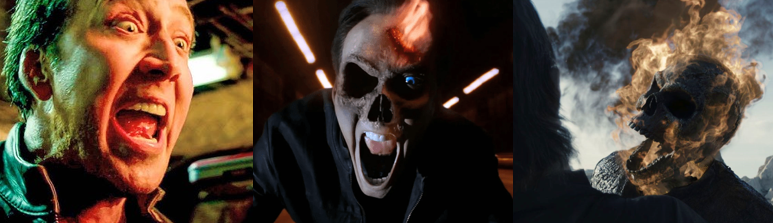
Later, when sheltered by Methodius (Christopher Lambert) and the other monks from Moreau’s order, Blaze learns the origins of the demon possessing him. It’s said to have once been Zarathos, the Spirit of Justice, an angel sent to defend humanity. However, Zarathos was somehow captured, tortured, and driven insane in Hell, transforming it into the unrelenting Spirit of Vengeance that now engulfs Blaze’s body. The Ghost Rider is a bizarre, disappointingly silent creature of vast, near-unlimited power. There’s little physical threat against his awesome Hell powers. He easily reduces every nameless, faceless goon to ash and cinders with his flaming chains and shrugs off bullets, relishing intimidating his prey by swaying about and striking odd poses. Exhibiting superhuman strength and durability, the Ghost Rider can transform any vehicle, no matter how big, into a flaming vessel but, of course, favours a bitchin’ motorcycle. His most powerful technique remains the Penance Stare, here changed to be the flaming demon simply screaming in his victim’s face for an awkward amount of time. Blaze says that the Ghost Rider consumes souls, but we don’t actually see that happen onscreen; his victims simply cower in fear and burst to ash, which is a bit of a disappointment. At one point, he does absorb and regurgitate a full clip of gunfire at one hapless goon, and he’s left unscathed by bazooka fire, though a desperate grenade shot by Carrigan is strangely enough to incapacitate him. Indeed, the only thing that can even stop the Ghost Rider is the word of Hell, a talent exhibited by Roarke’s unwitting son, Danny, who both commands the Ghost Rider to stop and returns his power in the finale. The Ghost Rider’s presence has clearly been infesting Blaze, driving him half mad; when the demon “[scratches] at the door”, Blaze descends into manic insanity trying to hold him at bay. He also seems to gleefully relish the demon’s incredible power as it literally bursts from him, melting his attire and transforming him into a wicked, bizarre creature said to have no conscience or morality.
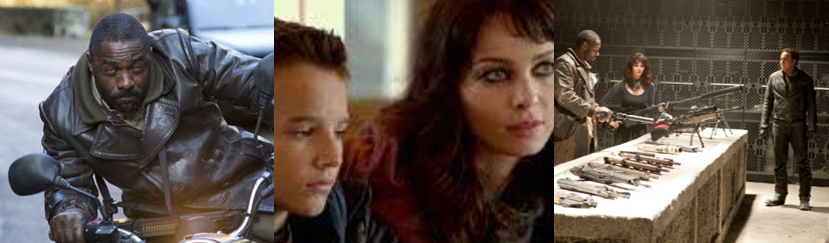
This belief is tested when Moreau begs Blaze to help keep Nadya and Danny safe from Carrigan (and, by extension, Roarke). A Gypsy beauty once caught up in Carrigan’s world of violence and drugs, Nadya was left near death after a botched job and, in desperation, made a deal with the Devil to save her life, unaware that his intention was for her to give birth to a “vessel” for his demonic essence, essentially making Danny the Anti-Christ. Living life on the run, forced to swindle horny businessmen out of their wallets and cars, Nadya is reluctant to trust anyone and seeks only to keep Danny safe and maybe one day build a real life for him. Though a snarky teen with a chip on his shoulder, Danny truly loves his mother and actually enjoys their life as outlaws, despite him longing for a normal family life. Still, he struggles with his half-human heritage; he wants to understand the dark power within him, but both fears and is allured by it. The Ghost Rider can sense his presence, drawn to his blood and power, and Blaze tries to impress upon the boy that he doesn’t have to let his dark side define his life (hollow words considering Blaze’s own struggles with that). Devoid of a father figure, Danny quickly bonds with Blaze, seemingly enamoured by his incredible power and his whole stunt biker aesthetic but resents him for giving up the Ghost Rider at the first opportunity. This comes courtesy of Moreau, easily the most enjoyable and appealing character in the film. Also an accomplished rider, Moreau is a man of deep spiritual belief who’s also very handy in a firefight. Verbose and incorrigible, Moreau gleefully leaps head-first into battle, ready to give his life to keep Danny safe (or rescue him) and Elba’s scenery-chewing enthusiasm makes even clunky exposition scenes entertaining to watch. It’s genuinely a shame when he’s killed by Carrigan, especially as he had a lot of potential as a secondary Ghost Rider.
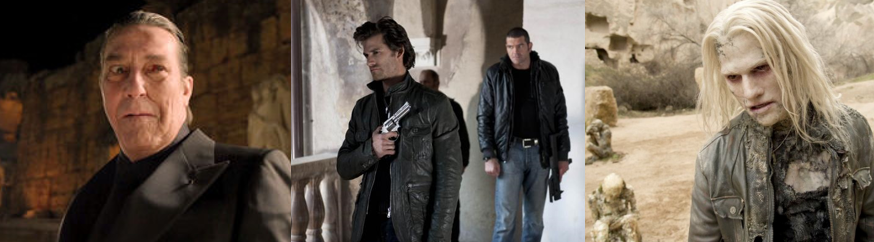
Speaking of Carrigan, he spends the first act of the movie as little more than an arrogant mercenary. Since Roarke’s human body is slowly dying from the incredible power within it, he contracts Carrigan and his goon squad to do his dirty work. Carrigan has a history with Nadya, resenting her for leaving him, and knows his worth; he demands a bigger payday after barely surviving his first encounter with the Ghost Rider and ups his arsenal for the rematch. However, this leaves all his men dead and him crushed under debris, barely mustering the strength to spit an insult in Roarke’s face before dying. However, death is merely an inconvenience for the Devil and Roarke revives and transforms Carrigan into an adaptation of Blackout, here realised as a zombie-like sadist able to decay anything (unless dramatically convenient) with a touch and rapidly attack foes from a surreal shadow dimension. Unhinged, drunk with demonic power, Carrigan delights in reducing anyone in his path to agonised, decaying husks, leaving them little more than screaming skeletons, slaughtering Methodius and his monks and even killing Moreau. It seems to be the Devil’s modus operandi to birth half-demon creations capable of ending him since, like the Ghost Rider, Carrigan’s demonic power is so strong that even Roarke snaps at him when he goes to touch him, indicating that Carrigan could’ve simply killed the Devil’s mortal form and usurped his position. Lacking the gravitas of Peter Fonda and simply appearing as a broken, half-crippled old man in a suit, the Devil has never been weaker than in this film. His human body is decaying quickly since mortal forms can’t contain his power, so he’s desperate to get his hands on Danny and perform a bizarre ritual that will transfer his essence into the boy’s half-demon body. Still, the Devil exhibits an alluring presence; though he’s still unruly around him, Danny is curious to learn more about the darkness Roarke implanted in him. Roarke also clearly has the power, money, and influence to keep Carrigan and a veritable army of gun-toting minions on hand to be summarily slaughtered by the unstoppable Ghost Rider.
The Nitty-Gritty:
It’s definitely far more accurate to label Ghost Rider: Spriit of Vengeance as a soft reboot, and that really irks me. Blaze’s opening narration uses weird, animated segments to tell a truncated version of his origin when footage from the last movie could’ve easily been supplanted. He also explains how the Devil has taken many forms before, showing Roarke once masqueraded as some of history’s worst dictators (and Jerry Springer…), meaning it would’ve been easy to name-drop Mephistopheles. Instead, the film essentially distances itself from the last movie but remains irrevocably and awkwardly tied to it through Nicolas Cage’s casting. It’s a bit like when Judy Dench stayed on as “M” when Daniel Craig took over as James Bond. Like, it’s obvious it’s a new film continuity but not recasting the lead muddies the water and just has me asking why it wasn’t a straight-up sequel. The movie is also a strangely surreal affair. Whereas Ghost Rider was painfully generic and toothless at times, Spirit of Vengeance is often like an acid trip, skipping frames, using odd camera angles, and utilising a rushed editing style to frame the Ghost Rider as a terrifying, unpredictable figure. In this regard, these techniques are surprisingly effective, but it also results in a confused tone. Sometimes, it wants to be this gritty, gothic horror; other times, it’s got a camp comedic edge (mainly through Moreau’s infectious personality); and at other times, it’s a reluctant meditation on the struggle between good and evil. Nowhere is this more evident, as expected, than in Cage’s crazed performance. I get it when he’s desperately trying to keep the Ghost Rider in check, but that’s no excuse for Cage’s weird mannerisms and line deliveries. It paints Blaze as painfully awkward; he constantly struggles to console Danny and Nadya, and is definitely a man whose actions speak louder than words.
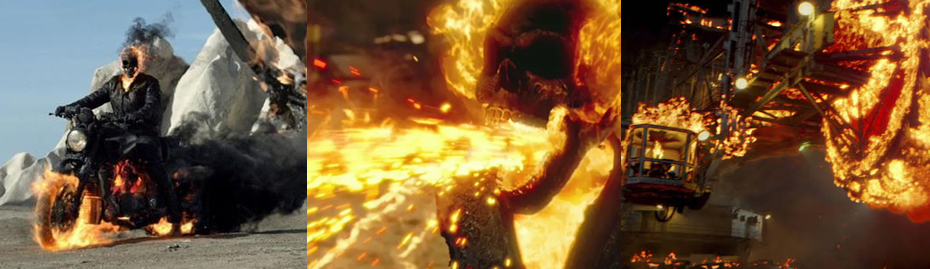
On the plus side, the Ghost Rider looks absolutely fantastic here! He looked pretty great in the last film, but the effects are way better this time around. His skull is charred and spews black smoke; his leather drips and bubbles from his intense Hellfire; and his flames are more realistic than ever. It’s like Clayton Crain’s gothic, realistic artwork has been brought to life and I loved that we got loads of sequences where the Ghost Rider is in action in broad daylight. It really is top-notch effects work that belongs in a better film and any scenes with the Ghost Rider, even when he’s acting like a complete moron, are a highlight. Of course, it helps that he’s an absolute menace; he’s so overpowered that nothing is a threat to him and he can afford to just knob about, toying with his victims before roaring in their face (…err, I mean, consuming their souls). Given the Ghost Rider’s nature, there are a fair few chase sequences here; the Ghost Rider turns cars and even a construction crane into a burning vehicle, decimating everyone in his way. Since Blaze successfully has Zarathos exorcised from his body at Moreau’s temple, he, Moreau, and Nadya are forced to use more traditional firearms and stealthier techniques to infiltrate the Uzak Gökten in the finale. Moreau acquits himself well here, throwing Roarke’s guards off with his brazen antics and openly firing upon his hooded followers. Like Methodius and the other monks, he tries to fight Carrigan and, like them, is rapidly decayed but not before delivering a defiant headbutt. Carrigan’s action sequences mostly take place in a peculiar dark dimension, where he slips up behind, outmatches, and dispatches his foes as easily as Ghost Rider incinerates them with his chains. Not to be outdone, Nadya has a lot of fight in her, even when overpowered or outmatched. She proves a crack shot with a sniper rifle, covering Blaze and Moreau’s backs, and is smart enough to flee with Danny whenever things start to get hairy for them.
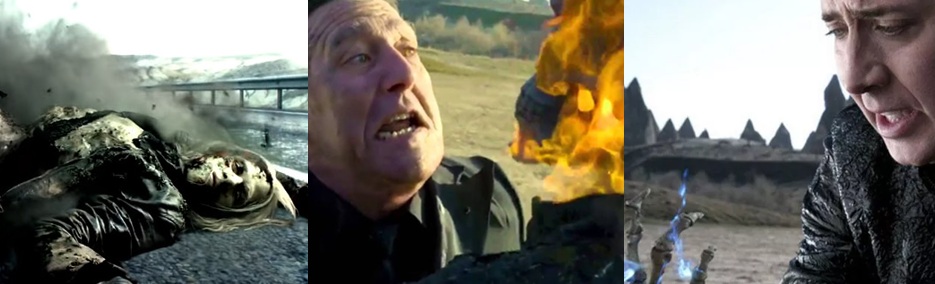
Having successfully dispatched Carrigan and his goons, Blaze brings Nadya and Danny to Moreau’s sanctuary and successfully has his curse lifted. This is a two-stage process that begins with Cage hamming up Blaze’s darkest confession regarding his deal and then being bombarded by strange lights and a cacophony of visuals that, apparently, banish Zarathos from his body. Although Methodius decides it’s better to simply kill Danny to prevent the Devil’s plot, Carrigan shows up and slaughters him and the other monks, kidnapping Danny, and bringing him to Roarke so he can be sedated and forced into a strange ritual. To the chanting of his influential, hooded followers, Roarke comes close to completing the demonic transfer before he’s interrupted by Blaze and Moreau, covered by Nadya and armed with the monks’ impressive arsenal of firearms. Though Moreau is killed by Carrigan and it seems like Danny is ready to embrace his demonic heritage, the boy tricks Roarke and restores the Ghost Rider’s powers to Blaze. Now empowered to exist in daylight, the Ghost Rider aggressively pursues Roarke when he flees with Danny, finally dispatching Carrigan in anticlimactic fashion and violently sending Roarke’s vehicle end over end. His body further damaged by the crash, Roarke is left a helpless wreck before the Ghost Rider’s power. Defiant to the last, Roarke curses the day he made the deal with Blaze but is powerless to avoid being forcefully sent back to Hell by the Ghost Rider’s chain. Nadya is horrified to find that Danny has been…injured? Killed? He’s unconscious, at least…in the crash. However, conveniently, Blaze feels Zarathos’ true nature resurface, changing his flames from red to blue and restoring the angel’s sanity and power as the Spirit of Justice. This allows him to revive Danny and abruptly end the movie with him reaffirming his identity as the Ghost Rider, essentially completing the same character arc we saw in the last movie.
The Summary:
Ghost Rider somehow took one of comicdom’s most visually interesting anti-heroes and delivered a generic action flick that lost momentum halfway through and was bogged down by Nicolas Cage’s bizarre mannerisms. A toothless, impotent affair, it barely scratched the surface of what the character and concept are capable of, disappointing in it squandering its potential. Much of the same criticisms can be lobbied at this awkward re-quel, which is again hampered by too low an age rating to really bring the Ghost Rider to life and Cage is wackier than ever, screaming with a maniac glee or mumbling clumsily through every scene. However, Ghost Rider: Spirit of Vengeance has far more positives than its predecessor: the Ghost Rider looks better than ever, tearing through goons with a vicious relish and impressing whenever he’s onscreen, and Idris Elba steals the show as Moreau, clearly enjoying chewing the scenery. It’s a shame, then, that the Ghost Rider is portrayed so unpredictably. On the one hand, he’s pretty terrifying and an unstoppable force of nature; on the other, he’s lollygagging around or awkwardly screaming in people’s faces. I enjoyed Nadya and Danny’s characters; the actors gave good performances and I liked seeing the kid bond with Blaze, though I think this could’ve been emphasised more in the middle portion. Carrigan was just the right level of camp and menace; like Blaze, he’s gifted with incredible demonic power. Unlike Blaze, Carrigan truly embraces it and relishes rotting his victims, whereas Blaze is constantly at odds with his dark half’s power. However, Roarke is a massive step down from Mephistopheles. Ciarán Hinds isn’t bad, but he’s no Peter Fonda and it’s difficult to reconcile the ham-fisted retconning of the previous film. For me, I would’ve much preferred that the film was a standalone sequel that either used footage from the last movie or didn’t outright contradict it. Therefore, it’s better to treat Ghost Rider: Spirit of Vengeance as a straight-up reboot, as nonsensical as that is. Ultimately, I do think it’s the better of the two, but the flaws still keep it from being a significant improvement over the previous film thanks, ultimately, to Nicolas Cage’s ridiculously over the top performance.
My Rating:
Pretty Good
Do you think Ghost Rider: Spirit of Vengeance surpassed its predecessor? Do you think it’s a stronger adaptation of the source material? What did you think to Nicolas Cage’s performance this time and the retconning of the last movie? Do you agree that the Ghost Rider looks far better here? What did you think to Roarke and Carrigan and the way the Ghost Rider decimated his enemies? What are some of your favourite Ghost Rider stories and moments? Whatever your thoughts on Ghost Rider: Spirit of Vengeance, share them below and be sure to check out my other Ghost Rider content on the site.

 Dr. K's Waiting Room
3 thoughts on “Movie Night: Ghost Rider: Spirit of Vengeance”