
Click here to listen to my guest spot on the Silver Screen Podcast discussing this film

Released: 15 August 1997
Director: Paul W. S. Anderson
Distributor: Paramount Pictures / United International Pictures
Budget: $60 million
Stars: Laurence Fishburne, Sam Neill, Joely Richardson, Richard T. Jones, Sean Pertwee, and Jason Isaacs
The Plot:
The experimental Event Horizon returns after a mysterious seven-year absence. However, when its designer, Doctor William Weir (Neill), and Captain S.J. Miller’s (Fishburne) crew investigate, they find the ship haunted by a presence from beyond our universe.
The Background:
It’s not hyperbole to say that Mortal Kombat (Anderson, 1995) made Paul W.S. Anderson’s career. The film’s critical and commercial success saw him bombarded by offers; he turned them all down, even a Mortal Kombat sequel, to make an R-rated horror. Attracted to Philip Esiner’s pitch of a “haunted house in space”, Anderson and producer Jeremy Bolt worked to tweak the script to emphasise these elements and veer away from comparisons to Alien (Scott, 1979), though fans later considered the film a spiritual prequel to Warhammer 40,000 due to similarities between the two. Many effects were done practically, such as constructing moving sets to bring the ominous Gravity Drive to life and harnesses to simulate zero gravity, all on sets said to be oppressive and claustrophobic for the cast. A rushed shooting schedule and pressure from studio executives led to Anderson struggling to deliver a final edit. Test screenings later complained of the extreme gore and subsequent cuts led to the excised footage disappearing, despite fan outcry for a director’s cut. With a box office of just $42 million, Event Horizon was a commercial failure; reviews were equally negative, saved for some praise for the special effects and visuals. However, it has since been re-evaluated and considered a cult classic, inspiring the Dead Space franchise (Various, 2008 to 2023) and getting its due from contemporary reviews, to the point where additional films and even a television series have circled the rumour mill.
The Review:
In the world of Event Horizon, humanity has finally spread its reach beyond our home planet and started to colonise space. First, there was an outpost established on the Moon; then commercial mining began on Mars (where promiscuous women are said to frequent). Then, finally, mankind strived to expand further into the galaxy. To facilitate this, the United States Aerospace Command (U.S.A.C.) first built hyper-fast ion drives and stasis booths to protect their crew from the intense g-forces, then turned to Dr. Weir to develop a prototype for faster-than-light travel. As pilot W. F. Smith/Smitty (Pertwee) and Dr. Weir correctly point out, all the laws of science make light speed unobtainable but, luckily, Dr. Weir found a way around this small hurdle. He developed an elaborate spherical engine, the Gravity Drive, that used focused particles and other complicated pseudo-science to generate an artificial black hole, essentially “folding” space and time and allowing the Event Horizon to instantaneously travel across the galaxy. However, the Event Horizon vanished during its maiden voyage; dubbed the worst disaster in space history, its failure has weighed heavily on Dr. Weir, who focused all his time and attention into the project to the detriment of his marriage. He was so consumed with his work that he failed to notice the failing mental health of his wife, Claire (Holley Chant), until it was too late, and by then she’d already slit her wrists in their bathtub. Haunted by guilt and grief and suffering from constant nightmares of his loss, Dr. Weir is exuberant when the Event Horizon suddenly reappears in Neptune’s orbit transmitting a distress signal and seeks to investigate in hopes of salvaging his life’s work. The true fate of the Event Horizon hasn’t been made public; U.S.A.C. instead concocted a story about it being destroyed due to a power overload. Thus, the rag-tag crew Dr. Weir partners up with to investigate the ship are initially sceptical both of the mission and the Gravity Drive’s ability to tear a hole in the fabric of the universe.
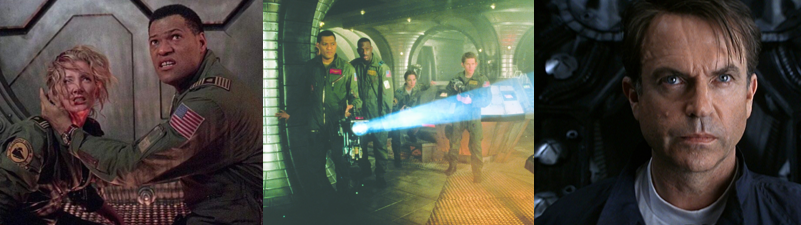
Consequently, Dr. Weir is met with a cold reception when he joins the crew of the deep space salvage vessel the Lewis and Clarke. The crew, led by their “skipper”, Captain Miller, are already disgruntled at being recalled from a well-deserved leave and sent to the outer reaches of the galaxy, especially as the last rescue attempt that went that far never returned. They therefore react with hostility when Dr. Weir explains his research to them. Despite also harbouring a resentment towards Dr. Weir, Miller, a by-the-book commander who inspires respect amongst his tight-knit crew, nevertheless chews out some of his more unruly crewmen when they dismiss Dr. Weir’s explanations and is determined to see the mission through as quickly and efficiently as possible. Miller is close to each of his crew, with all of them regarding young engineer Ensign F.M. Justin (Jack Noseworthy) as a surrogate son (they dub him “Baby Bear” and he frequently refers to the ship’s medical technician, Peters (Kathleen Quinlan) as “Mama Bear”). Miller’s served with each of them for a long time and they have a natural rapport based on mutual respect. Miller allows Smitty to light up a cigarette for a job well done and isn’t above joining in with the banter between the crew, ribbing smooth-talking rescue technician T.F. Cooper (Jones) by questioning his contribution to the ship. Like Dr. Weir, however, Miller is carrying a secret pain. He’s wracked by guilt at having left behind a young bosun, Edmund Corrick (Noah Huntley), a decision that has haunted him ever since and driven him to be the efficient commander he is today, expecting nothing less than the highest standard from his crew. As his second-in-command, he expects a lot from communications officer Lieutenant M.L. Starck (Richardson). As their situation worsens, his demands for answers become more forceful, though Miller’s reluctant to entertain her theory that the Event Horizon brought back some lifeforce from wherever it’s been. As Miller is tormented by visions of Corrick and witnesses that suffering of his crew, he directs his grief and anger towards Dr. Weir and the two quickly clash since Dr. Weir comes to be mesmerised and possessed by the ship and Miller’s efforts to escape are constantly thwarted by forces beyond his comprehension. Eventually, Miller’s forced to see that Starck was right and that something has tainted the ship, especially as its influence drives his crew to hysteria and costs him his beloved Lewis and Clarke.
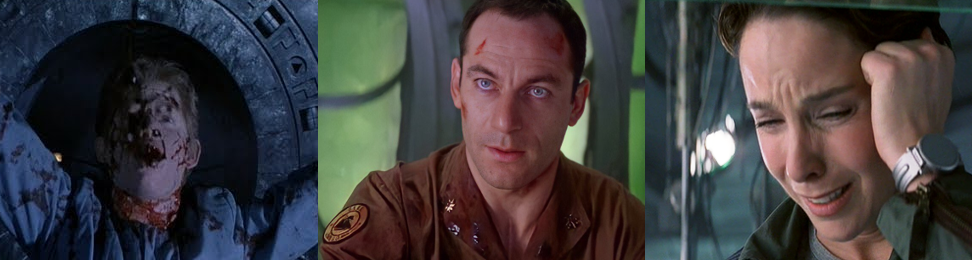
Upon first reaching the Event Horizon, the crew find it to be an ice-cold “tomb” devoid of all life signs (despite driving their scanners crazy) and filled with an ominous dread. When Justin investigates the Gravity Drive, the ship suddenly comes to life; the core (or “gateway”) opens and sucks him in and, though Cooper rescues him, Justin is left catatonic and the Lewis and Clarke is badly damaged. While Smitty works around the clock to repair the damage and the crew risk suffocation aboard the Event Horizon, Peters toils through the ship’s log and is dismayed to find Captain John Kilpack (Peter Marinker) and his crew were driven to a macabre insanity, slaughtering and mutilating ach other in a gore-drenched orgy, the remains of which are still plastered to the ship’s walls. Dr. Weir’s nightmares also come to him while he’s awake. He sees visions of Claire’s eyeless face and hears her voice whispering to him and is enthralled by the Gravity Drive, which slowly influences his decisions and turns him against the crew, dismissing their claims and concerns and causing Smitty to fly at him in a rage. Following a disturbing seizure in which he warns of the impending arrival of “The Dark”, the traumatised Justin is compelled to enter an airlock and kill himself to avoid going back there. To the horror of his crew, Justin is almost killed by decompression, though Miller gets him back in the ship and their resident doctor, the grim-faced D.J. (Isaacs), stabilises him. With Justin sedated in a stasis tank, D.J. is forced to reveal that Kilpack’s distress call, which consisted of Latin, was actually a warning to others to “save [themselves] from Hell”. Though neither Miller or D.J. are the religious type, it seems something evil has latched onto the ship and their situation only worsens when Dr. Weir sabotages their escape plan by blowing up the Lewis and Clarke with an emergency explosive, killing Smitty in the process and trapping the survivors on what is now clearly a very haunted ship.
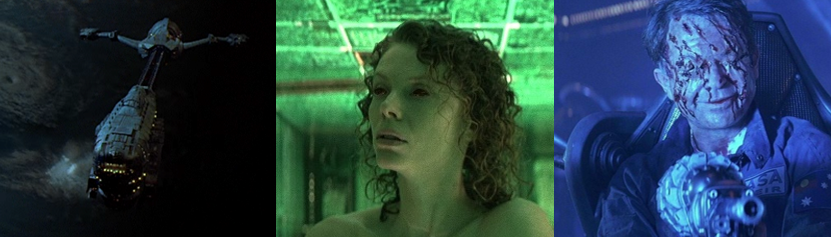
The Event Horizon is the primary antagonist of the film. A needlessly ominous, gothic ship, it looms in space like a haunted cathedral and creates a foreboding presence with its dark, claustrophobic hallways, abundance of spikes and chilling silence, to say nothing of the remnants of Kilpack’s gory orgy the crew eventually find. From the moment the crew step onboard, the ship influences them; not only do Miller and Dr. Weir hear and see their worst fears but Peters is routinely tormented by visions of her infirm son, Denny (Barclay Wright). These are so traumatic that she refuses to work in the medical room, much less alone, and later drive her to a tragic and brutal death when she chases what she thinks is Denny around the Gravity Drive and takes a fatal fall in the process. Of course, the Event Horizon has the greatest influence on Dr. Weir, arguably getting inside his head before he even reaches his beloved ship. Once onboard, his visions intensify; he’s already very protective of the ship and comes up with quasi-logical explanations for the strange events happening, but the crew don’t buy it. Eventually, the ship forces him to relive Claire’s suicide and he’s driven completely off the deep end; he comes to see the ship as “home” and gouges out his eyes, leaving him a half-crazed, demonic figure who coldly destroys the Lewis and Clarke. Miller is deeply affected by Smitty’s death but this explosion also flings Cooper out into space; however, thinking fast, the jovial rescuer blows his air tank and jets back to the Event Horizon. However, he finds Dr. Weir determined to reactivate the Gravity Drive and return to whatever lies beyond. It’s not clear where, exactly the Event Horizon has been; even Dr. Weir doesn’t know where the Gravity Drive leads to. Kilpack dubs the space between dimensions as “Hell”, a name that sticks even for the scarified, possessed Dr. Weir. Rather than jumping from one point in space to another, the Event Horizon punched a hole in reality itself and ventured to “a dimension of pure chaos… pure evil”. While there, the ship was infected by the dimension’s influence and drove its crew mad, apparently gaining a level of sentience and satiating itself on taking their lives (and, presumably, their souls). Accordingly, it delights in torturing Miller and his crew with their worst fears and toying with its prey. It constantly creates roadblocks, forcing them aboard and then trapping them there, intent on dragging the survivors back to Hell to expose them to even more macabre sights and suffering.
The Nitty-Gritty:
Although Anderson may have sought to move away from being compared to Alien, the sci-fi/horror classic’s influence is greatly felt in Event Horizon. For one thing, this is a very gritty, “lived-in” sci-fi world. The controls and technology and aesthetic of the Lewis and Clarke, in particular, are very low-tech, full of buttons and exposed gears, and her crew are very much analogous to the Nostromo’s complement of “truckers in space”. These are working-class space farers, paid a minimum wage and doing the best they can with obsolete technology, and their down-and-dirty attitude makes them very relatable characters who are easy to root for. Miller can be a bit uptight, but he has a great rapport with his crew, even if he gives Starck a hard time more often than not. D.J. is their more sullen crew mate, bluntly introducing himself and even threatening Smitty with a scalpel when he rages at Dr. Weir for perverting the laws of physics. Smitty and Cooper are the most grounded of the crew; however, whereas Cooper is cheerful and fancies himself a ladies’ man, Smitty is more gruff and would rather leave as soon as possible. Honestly, I’m so glad Cooper survived as he’s a fantastic character. He calls Dr. Weir out on his bullshit, earning himself a dressing down from Miller, and brings some infectious levity through his ridiculous return to the ship, which always makes me grin. Peters was perhaps the least interesting for me but she’s given emotional depth through her clear love for her son, while Starck was just trying to be pragmatic and keep her cool. Smitty and Starck immediately sense the bad vibes from the Event Horizon, a ship bathed in a perpetual thunderstorm courtesy of Neptune and constantly seeped in ominous darkness. All too late, Miller turns on the ship, ready to escape and blow it to pieces, only to be scuppered by the cruel-hearted Dr. Weir and his crew picked off one at a time by the ship’s visions or Dr. Weir’s mad designs.
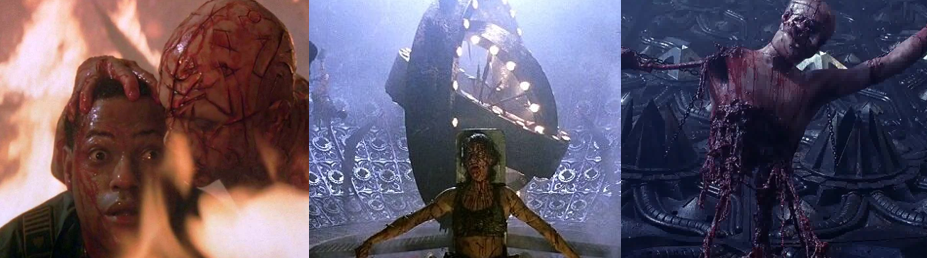
Describing Event Horizon as a haunted house in space is extremely apt, but it’d also be just as fitting to dub it “Hellraiser (Barker, 1987) in space”. In this latter regard, the film performs exceedingly well, offering a far more entertaining and disturbing experience than the actual Hellraiser in space we got. There’s a constant sense of dread as the crew wanders the ship’s dark and claustrophobic corridors. Flashes of lightning reveal disgusting gore on the walls and the frenetic ship logs offer but a taste of the horrors Kilpack and his crew endured while in Hell. The Event Horizon itself is a menacing construction; there’s no reason for it to be as long or intimidating as it is, and yet the Gravity Drive is protected by a “meatgrinder” corridor and full of spikes, creating an unsettling vibe even before the gateway opens. Obviously, there is some dated CGI and green screen effects, most notably in rendering the gateway and when the crew are wandering around the frigid, zero-g interior of the Event Horizon. However, the film makes up for this was some incredible set design (again, everything feels very Alien and suffocating in its aesthetic) and practical effects. Unfortunately, due to studio mangling, we’re denied seeing the full extent of Hell’s wrath and exactly what Dr. Weir does to D.J. but the horror of the unknown lands just as hard. When the scarified Dr. Weir assaults Miller in the finale, he forces Miller to see visions of his crew being raped, tortured, mutilated, and brutalised in Hell. Maggots, scenes of D.J. being strung up in a blood eagle, and flashes of Starck, Justin, and Cooper being flailed and impaled bombard Miller (and the audience) like a fever dream. It’s a disturbing cacophony of frenzied editing, but it works since it forces you to experience Miller’s visions as he’s being shown them. The makeup effects on Dr. Weir are particularly gruesome; first, he tears his eyes out and is left a mutilated, taunting villain obsessed with taking Miller and his crew to Hell. Then, after being blown out of the ship, he’s returned as a completely naked, demonic entity covered in weeping scars, completing his transformation into the personification of the ship’s evil.
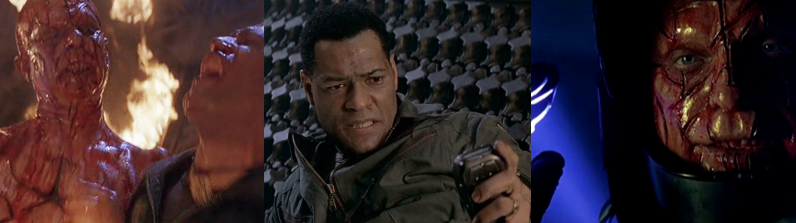
After working tirelessly to repair the Lewis and Clarke, Smitty is dismayed to learn that Dr. Weir has planted an explosive on the ship. Though he frantically searches for it, Smitty’s too late to deactivate it and is blown up with his beloved craft. Angered, Miller arms himself with a harpoon-like nail gun and prepares to make Dr. Weir pay for costing him his ship and his crew. Though he finds Starck alive, he’s left at the scarified Dr. Weir’s mercy, horrified to find the doctor has lost his mind and gouged his eyes out. Now completely consumed by the ship’s influence and determined to defend it at all costs, Dr. Weir activates the Gravity Drive, though he’s seemingly killed when he decompresses the bridge trying to kill Cooper. Miller gets Starck and Cooper to safety and concocts a plan to utilise the Event Horizon’s emergency lifeboat feature. As related by Dr. Weir earlier, the ship was designed to be split in half using explosives placed along its otherwise unreasonably long central corridor. After ordering Starck and Cooper to prepare the foredecks for their departer, leaving them to be assaulted by a very Shining (Kubrick, 1980) inspired torrent of blood, Miller is attacked by Corrick’s enflamed spirit and driven towards the Gravity Drive. There, he sees through the vision and is confronted by the now-demonic Dr. Weir. Subjected to horrifying visions and outmatched by the doctor’s augmented strength, Miller is left with no choice but to set off the explosives to deny Dr. Weir his full victory, sacrificing himself to the Hell dimension to save his crew. Many days later, the wreckage of the Event Horizon is discovered. However, the experience has left Starck traumatised and the film ends with the suggestion that the remains of the ship may be just as haunted as the half that was sucked back to Hell.

The Summary:
I discovered Event Horizon by accident. As a kid, I taped some other movie off the television and accidentally left the VHS running, recording the next movie, which just so happened to be this one. Despite not being into horror back then, I gave it a watch and was immediately enthralled and, to this day, Event Horizon is one of my all-time favourite, go-to horrors. I love the aesthetic of this movie, with its lived-in, gritty, clunky technology and the depiction of Miller and his crew as average Joes caught up in a nightmare they wanted no part of. Laurence Fishburne makes for a great, hard-assed leading man but he’s bolstered by some of Hollywood’s most underrated character actors. Sean Pertwee is always a delight and he’s great as the outspoken Smitty; Jason Isaacs brings a quiet intensity to D.J. who’s just barely keeping his shit together; but the standout was Richard T. Jones as Cooper. He’s just such an infectious and charismatic personality that steals every scene he’s in with his cocksure bravado and blunt honesty. Sam Neill also puts in a great performance as the haunted Dr. Weir; this is a man wracked with guilt who seems on the verge of suicide, and yet who sees the Event Horizon as a second chance. While he’s initially shocked and dismayed by the horrors and death that infest the ship, Dr. Weir is mesmerized by its influence and comes to protect and even love it, willing to butcher Miller’s crew to satisfy his creation’s macabre lust. The horror on offer here is palpable; the Event Horizon is a menacing presence throughout and looms over every scene, seemingly watching and infecting the characters’ every movement. It’s a shame we’ll never see the full extent of the gory visuals but the film works incredibly well despite that. The brief, frantic bombardment of torture and death are enough to hammer home how desolate and wicked Hell is and there’s still plenty of gore on offer. The fantastic use of disturbing practical effects, the unsettling depiction of Justin’s decompression, and Dr. Weir’s transformation into an eloquent and cruel demonic sadistic all make Event Horizon an unnerving and terrifying cult classic. With great performances, some incredible visuals and set design, and a truly frightening premise, Event Horizon will always be highly recommended by me and, if you haven’t seen it or want to see Hellraiser in space done right, now’s the time to change that!
My Rating:
Great Stuff
Have you ever seen Event Horizon? Do you agree that it’s an under-rated cult horror classic? What did you think to the visuals, the gothic construction of the titular ship, and the foreboding atmosphere? Which member of the crew was your favourite? What did you think to Dr. Weir’s descent into demonic insanity and Miller’s selfless sacrifice? Would you like to see the excised footage full restored to this movie? I’m always happy to talk about Event Horizon so please leave your thoughts below and go check out my other horror content across the site!

 Dr. K's Waiting Room
4 thoughts on “Movie Night: Event Horizon”